




Abstract
A brand name’s linguistic characteristics convey brand qualities independent of the name’s denotative meaning. For instance, name length, sounds, and stress can signal masculine or feminine associations. This research examines the effects of such gender associations on three important brand outcomes: attitudes, choice, and performance. Across six studies, using both observational analyses of real brands and experimental manipulations of invented brands, the authors show that linguistically feminine names increase perceived warmth, which improves brand outcomes. Feminine brand names enhance attitudes and choice share—both hypothetically and consequentially—and are associated with better brand performance. The authors establish boundary conditions, showing that the feminine brand name advantage is attenuated when the typical user is male and when products are utilitarian.
One of the most important and underestimated aspects of a brand is its name. In most instances, the brand name represents a consumer’s first point of contact and can therefore drive initial impressions, associations, and expectations (Aaker and Keller 1990). Just as with people, making a good first impression is important and can have cumulative, lasting benefits. Consequently, firms invest considerable resources in developing brand names to create positive impressions (Heath and Heath 2011). Moreover, as new brands are introduced daily, securing a desirable name is a growing challenge due to the limited number of existing words to trademark (Klink 2000). Perhaps for this reason, firms are increasingly turning to brand naming consulting firms to create names for them, and brand naming is a booming business (Gabler 2015).
One goal of brand naming is to create a name that signals desirable attributes, and brand name developers have several tools for doing so. They can create names that explicitly indicate a brand’s purpose (e.g., Lean Cuisine; Keller, Heckler, and Houston 1998), use unusual spelling to increase memorability (e.g., Citi; Lowrey, Shrum, and Dubitsky 2003), or use sound repetition to increase positive affect (e.g., Reese’s Pieces; Argo, Popa, and Smith 2010).
In recent years, brand name developers have even tried to leverage specific sounds to craft appealing names (Gabler 2015; Heath and Heath 2011). This approach is grounded in theory and research on phonetic symbolism—the notion that particular sounds convey meaning. Indeed, the sounds in a name can affect brand perceptions and judgments (Klink 2000). For example, people prefer an ice cream called Frosh to one called Frish because the /a/ sound conveys the desirable attribute of creaminess (Yorkston and Menon 2004). The sounds in a name can also convey brand gender. For instance, front vowels (e.g., the vowel sounds in “tea,” “tin,” and “tell”) convey femininity, whereas back vowel sounds (e.g., the sounds in “tool,” “tome,” and “tusk”) convey masculinity (Klink 2000). Thus, a product with a front vowel in the name is perceived to be more feminine than the same product with a back vowel.
In the present research, we propose a new mechanism by which the linguistic characteristics of a name influence gender associations and subsequent brand outcomes. To date, research on linguistic brand name gender has focused almost entirely on the effects of individual sounds. However, gender perceptions are driven by multiple linguistic properties—both phonological and morphological—not just sounds. We use this expanded view to examine the conditions under which feminine names are advantageous for brands. Beyond simply matching the gender of a brand name to a product category or user, we posit a process based on the Stereotype Content Model (Fiske et al. 2002) whereby brand warmth influences brand outcomes. We propose that feminine brand names convey warmth, and warmth positively influences brand attitudes and choice, with implications for brand performance. We refer to this effect as the “feminine brand name advantage.”
We provide evidence for the feminine brand name advantage in six studies, varying the types of brands (real, invented, and Interbrand top brands), methodology (observational and experimental), stakes (hypothetical, temporal, and economic), and participant population (online panel and college students). Results show that the effect of brand name femininity on positive brand outcomes is mediated by perceived warmth. We also identify theoretically and substantively relevant boundary conditions: the feminine brand name advantage is attenuated when the typical user is male and when the product is utilitarian.
Our research makes important theoretical and substantive contributions. First, we contribute to the literature on brand name linguistics. We introduce a more nuanced approach to studying how names influence gender perceptions that incorporates multiple linguistic dimensions (name length, sounds, and stress), distinct from prior research, which has focused primarily on sounds. Second, this work adds to the Stereotype Content Model literature by demonstrating that linguistic features of a brand name can result in the transfer of associated stereotypes to a brand. Thus, a brand with no inherent gender can be imbued with masculine or feminine stereotype traits via its name—which managers can leverage to influence brand outcomes.
This research provides important insights that are relevant to managers. Most importantly, the effects of linguistically feminine brand names on consumer evaluations provides guidance to managers when constructing new brand names. The linguistic gender of brand names drives brand perceptions, which in turn influence attitudes and choice. At a general level, brands with more linguistically feminine names are perceived as warmer, which has positive effects on brand outcomes. Thus, incorporating linguistic effects can influence consumers' reactions to new brands. We find evidence that the feminine brand name advantage may have downstream consequences for the performance of well-established brands as well, as linguistically feminine names are more likely to be ranked—and ranked higher—by Interbrand. However, we also show that linguistically feminine brand names are not an advantage for products typically used by men or for utilitarian products.
Conceptual Framework and Hypotheses
Linguistic Markers of Name Gender
Most people’s names are unambiguously male (e.g., David) or female (e.g., Linda). Gender associations develop over time through experience by observing co-occurrences between people’s names and their genders. Thus, people learn to recognize linguistic gender markers in people’s names because men’s and women’s names have recognizably different patterns (Barry and Harper 1995). Three characteristics in particular are relevant—name length, sounds, and stress. People reliably identify names as male or female based on these distinct linguistic characteristics (Cassidy, Kelly, and Sharoni 1999; Slepian and Galinsky 2016).
First, women’s names are longer—having, on average, more syllables than men’s names (Cutler, McQueen, and Robinson 1990). Second, men’s and women’s names differ on their ending sounds. Women’s names are more likely to end in a vowel sound, particularly schwa (e.g., Sar
A similar process may influence brand name perceptions. However, unlike person names, gender may not be explicitly associated with a brand name. For example, there is no obvious reason to consider the Nestlé or Gap companies as feminine or masculine. Yet these names differ on three key properties: Nestlé has more syllables than Gap, with stress divided between two syllables rather than one, and Nestlé ends with a vowel sound, whereas Gap ends with a consonant. Thus, Nestlé is linguistically feminine, whereas Gap is linguistically masculine. We propose that these automatically processed linguistic qualities will lead to implicit associations with feminine or masculine attributes, independent of explicit brand associations.
The purpose of this research, therefore, is to understand if the linguistic characteristics of a brand name lead to the implicit transfer of gender-associated qualities to the brand and when this might be relevant to marketers. Warmth is one quality a name may convey that is of critical importance to brand perceptions. The present research investigates how qualities such as warmth, which are associated with gender, may be implicitly transferred to the brand, as a result of the linguistic properties of the name. We focus on warmth because it is of fundamental importance to human judgments, generally, and to brand attitudes, specifically.
Stereotype Content Model
According to the Stereotype Content Model, people evaluate individuals and groups on two dimensions of social perception—warmth and competence—and these evaluations in turn drive emotional and behavioral reactions (Fiske 2002; Fiske, Cuddy, and Glick 2007; Glick et al., 2000). Warmth and competence are ubiquitous in interpersonal judgments because accurately evaluating these qualities is evolutionarily adaptive. Of the two dimensions, warmth is primary because it distinguishes friend from foe, whereas the competence of a potential threat is considered secondarily if it becomes necessary to make a fight-or-flight assessment (Cuddy, Fiske, and Glick 2007; Cuddy, Glick, and Beninger 2011; Fiske 2012). Moreover, people generally consider warmth-related traits to be far more important than competence-related traits (Wojciszke, Bazinska, and Jaworski 1998), and they make warmth judgments very quickly (Willis and Todorov 2006) and from a very early age (Mascaro and Sperber 2009). Warmth is associated with traits such as trustworthiness, sincerity, friendliness, tolerance, and good-naturedness (Cuddy, Fiske, and Glick 2008).
Research on the Stereotype Content Model, and gender research more generally, finds that women are associated with warmth to a greater degree than are men (Fiske 2010). People rate women as warmer than men (Eckes 2002), and on personality inventories, women rate themselves as warmer than men rate themselves (Costa, Terracciano, and McCrae 2001). Similarly, people evaluate brands in terms of warmth. Consumers often interact with brands as if they were people (Fournier 1998) and imbue brands with personality traits (Aaker 1997). Kervyn, Fiske, and Malone (2012) developed a framework that adapted the Stereotype Content Model to brands. They demonstrated that consumers assess brands in terms of warmth and are inclined to prefer brands that convey warm qualities. In particular, they found that “well-intentioned” (i.e., warmer) brands were rated higher on purchase and brand loyalty intentions. Drawing on this research, we hypothesize that the linguistic femininity of a brand name will increase perceived brand warmth, which will, in turn, positively affect attitudes and choice. Further, the brand relationship literature finds that more favorable consumer attitudes can enhance brand performance (Puzakova, Kwak, and Rocereto 2013). Therefore, we also predict positive downstream associations between feminine brand name gender and brand performance. Formally:
When Should Brand Managers Choose Linguistically Feminine Names (or Not)?
Typical user gender
Some products are typically used by men, whereas others are typically used by women. We explore whether the gender of the typical user is a boundary condition to the feminine brand name advantage. Research shows that names congruent with the typical user’s gender—based on name sounds—are better evaluated than incongruent names (Yorkston and De Mello 2005). Thus, the feminine brand name advantage observed here—based on name length, sounds, and stress—may also be attenuated when the typical user is male. This might occur if the relatively lesser warmth of masculine names is offset by the positive effects of congruence between name gender and typical user gender:
Product category
Thus far, we have posited that because femininity is associated with warmth (Fiske et al. 1999), and affective attributes such as warmth often drive brand outcomes (Chaudhury and Holbrook 2001; Kervyn, Fiske, and Malone 2012), linguistically feminine brand names should enhance perceived warmth and subsequent brand outcomes. However, warmth is an affective response, and some product categories are more affect-driven than others. For example, evaluations of hedonic products (e.g., candy, music) are primarily affect-driven, whereas evaluations of utilitarian products (e.g., batteries, tools) are more cognitively driven (Adaval 2001; Hirschman and Holbrook 1982; Pham 1998; Yeung and Wyer 2004). Because warmth is more valued for hedonic than for utilitarian products (Chattalas 2015), we expect the feminine brand name advantage to be stronger for hedonic than for utilitarian products:
We test these hypotheses in six studies. In Study 1, we investigate whether brand name femininity is positively associated with brand performance by examining the linguistic characteristics of Interbrand Global Top Brand names (H1). Study 2 tests the hypothesis that warmth mediates the relation between linguistic name gender and brand attitude using a sample of real-world brands (H2). Studies 3a and 3b replicate the main effect and process account, providing additional support for H1 and H2 using actual product choices with consequences for time (Study 3a) and money (Study 3b). Studies 4 and 5 test the boundary conditions of typical user gender (H3) and product category (H4).
We collected large experiment samples for precision (Cohen 1988) and because the effect sizes were unknown. Attention checks and/or IP address checking software were used to screen participants before they entered online experiments to ensure data quality (Dennis, Goodson, and Pearson 2020; Winter et al. 2019), except in Study 2, in which open-ended questions were embedded to discourage automated responses, and Study 3b, which was conducted in person in a lab. Data were analyzed only after collection was complete. Materials and data are publicly archived at https://osf.io/ekq2h/?view_only=8bc3e931655e4000b548d92129083404.
Study 1
In Study 1, we test whether feminine brand names are associated with brand performance (H1). Performance was indicated by inclusion on the Interbrand Global Top Brands list between 2000 and 2019. Interbrand constructs an annual list of top-performing brands based on criteria that include market share and brand strength (Interbrand 2018). We predicted that brand name femininity would be associated with higher rank on Interbrand’s list. We also compared the Interbrand Top Brands with an equal number of randomly sampled firms from the Thomson Reuters Eikon database. Inclusion in this data repository is not based on performance metrics as Interbrand is. We expected brand name femininity to predict inclusion on the Interbrand Top Brands list versus the comparison list.
Method
Interbrand data
First, we compiled each annual list of Top Brands. Many brands (e.g., Coca-Cola) appear on the list each year. To obtain a list with a single entry for each brand, we removed duplicates, resulting in 171 unique brand names. Next, we calculated the average rank for each brand. For example, if the brand was #1 each year, its average rank would be 1. If its rank changed from year to year, its average rank would be the sum of each year’s ranks divided by 20—the number of years for which we have data. For brands that “fell off” the list, the missing years’ ranks were replaced with 101, or one rank below the Top 100 (this provides a more conservative estimate of rank than simply averaging the years the brand was ranked).
Comparison data set and control variables
The comparison data set consisted of an equal number of companies randomly drawn from the Thompson Reuters Eikon database. We restricted the sample to companies with market capitalization over 2.5 billion USD, and excluded holding companies with no brand activity. Number of full-time employees and years in business for Interbrand and comparison companies were also drawn from Thompson Reuters. Finally, we created industry category dummy variables based on the U.S. Department of Labor categories.
Brand name gender score
We calculated the linguistic name gender of the Interbrand and Thomson Reuters Eikon brands using a method developed by Barry and Harper (1995; Appendix). The name gender score quantifies the degree to which a name is masculine or feminine based on its length, sounds, and stress as discussed in the introduction, with scores ranging from −2 (very masculine) to +2 (very feminine). This normative scale is based on men’s and women’s names from the United States and has been conceptually validated by subsequent research (e.g., Cassidy, Kelly, and Sharoni 1999; Slepian and Galinsky 2016; Smith 1998; Whissell 2001).
Results and Discussion
Interbrand top brand names were, on average, linguistically feminine (M = .13, SD = 1.06), with 55% having feminine name gender scores, 36% masculine, and 9% neutral, yielding a significant chi-square test for differences in distribution (χ2(2, 171) = 53.78, p < .001, d = 1.35).
Interbrand rank
We predicted a negative relation between name gender score (higher values = more feminine) and average Interbrand rank (1 = highest, 100 = lowest). To test this, we used stepwise linear regression, first regressing name gender score onto average Interbrand rank. This revealed a positive association between feminine name gender and higher rank (Figure 1).

Relationship between name gender score and average Interbrand rank (2000–2019).
We next added control variables for industry, number of employees, and years in business (Table 1, Panel A). As we expected, feminine brand name predicted higher average rank on the Interbrand list (b = −4.10, t(162) = −2.04, p = .042), controlling for other variables.
Regression Results in Study 1.

a Name gender score (based on Barry and Harper [1995]) ranges from −2 (most masculine) to +2 (most feminine).
b Six dummy coded variables represent industries categorized according to the U.S. Dept. of Labor (with Mining and Oil as reference in Panel A and Construction and Mining and Oil as reference in Panel B).
c Employee data from Thomson Reuters Eikon database. Where data were unavailable, we used the mean for all companies (top brands and others).
d Years in business data from Thomson Reuters Eikon database. Where data were unavailable, we used the mean for all companies (top brands and others).
Notes: Dependent variable: Inclusion on the Interbrand Global Top Brands list between 2000 and 2019. Panel A: Model 1: R2 = .03, F(1, 169) = 5.92, p = .016; Model 2: R2 = .15, F(8, 162) = 3.76, p < .001. Panel B: Log-likelihood (intercept only = 467.19; final model = 389.33); χ2(9) = 84.78, p < .001.
Comparison with non-Interbrand names
We conducted a stepwise logistic regression, first regressing name gender score onto a binary outcome variable indicating whether the brand appears on the Interbrand Top Brands list or not, and then adding control variables for industry, number of employees, and years in business (Table 1, Panel B). As we hypothesized, linguistically feminine brand names predicted inclusion on the performance-based Interbrand Global Top Brands list (vs. the non-performance-based Thompson Reuters list; p = .031).
These findings offer preliminary, real-world evidence of a feminine brand name advantage (H1). Moreover, the Interbrand data arguably provide a conservative test because they include product categories that, as we show subsequently, reduce the feminine brand name advantage (male user, utilitarian). Importantly, though, these results are correlational and thus cannot address causality.
Study 2
In Study 1, we found correlational evidence for the feminine brand name advantage among real brands. In Study 2, we test the hypothesis that the feminine brand name advantage is mediated by warmth perceptions (H2). To enhance realism, we collected participants’ warmth and attitude evaluations of real brands. We expect brand name femininity to positively predict warmth perceptions, which will in turn positively predict brand attitudes. We propose that using real brand names represents a conservative test of our hypothesis, because warmth perceptions of existing brands may also be driven by perceptions of the brand that have developed over time independent of the brand name (through brand positioning, advertising, etc.).
Method
Pretest: brand name stimuli selection
We pretested to identify brands relevant to our participant population with a high degree of variability in terms of attitudes. One hundred members of the Amazon Mechanical Turk (MTurk) online panel (60% men; Mag e = 34.66 years) were paid a nominal fee to list ten brands they thought were “really cool” and ten brands they “would never use,” following the procedures outlined by Escalas and Bettman (2003). We then selected the 25 most frequently listed, nonoverlapping brands in each category (Web Appendix B). Next, we computed name gender scores for each brand name, as in Study 1. Although not directly related to our hypothesis testing, well-liked brands had more linguistically feminine name gender scores than disliked brands (M = .20, SD = .90 vs. M = −.54, SD = 1.10; t(48) = 2.64, p = .010, d = .75).
Participants, design, and procedure
Five hundred twenty-four members of the MTurk online panel (51% men; Ma ge = 36.79 years; 99% native English speakers) participated for a nominal fee. Each participant was presented with a randomly selected subset of 10 of the 50 brands and, for each brand, answered warmth and brand attitude measures in random order. We measured warmth by asking participants to indicate the extent to which each brand sounded tolerant, warm, good-natured, and sincere (Fiske et al. 1999; α = .96). Brand attitude was assessed with five items adapted from Chaudhuri and Holbrook (2001) and Brakus, Schmitt, and Zarantonello (2009), asking the extent to which participants were or would be loyal to, committed to, buy, choose, and recommend the brand (α = .95). The brand attitude measure incorporated elements of loyalty because Kervyn, Fiske, and Malone (2012) find that warmth is positively related to brand loyalty. (We also measured competence but do not examine it here; for full details, see Web Appendix C). All items were measured on seven-point scales (1 = “not at all,” and 7 = “very much”). After participants evaluated the first five brands, we had them answer three open-ended questions to discourage automated responses. Finally, participants indicated how familiar the brands were.
Results and Discussion
Discriminant validity
To demonstrate discriminant validity, we calculated average variance extracted. The analysis showed that the average variance extracted between perceived warmth and brand attitude was greater than their squared correlation, indicating that the variables represent distinct constructs. These results were consistent for all variables in all subsequent studies.
Mediation
We expected that perceived brand warmth would mediate the relation between brand name gender and brand attitude. To test this hypothesis, we first transformed the data from “wide form” to “long form,” collapsing the 10 brand evaluations performed by each of the 524 participants to create 5,240 observations. This yielded a data set suitably structured for both within- and between-subjects analyses (Revelle and Wilt 2019). We tested for mediation using Hayes’s PROCESS Model 4 (Hayes 2013) with 5,000 bootstrapped resamples. The model included brand name gender as the independent variable (X), brand attitude as the dependent variable (Y), and warmth as the mediator (M). Brand name gender predicted perceived warmth, such that more linguistically feminine brand names were perceived as warmer. Greater perceived warmth, in turn, predicted brand attitude, and the indirect effect was significant (Figure 2), indicating mediation via warmth, in support of H2. Unexpectedly, the direct effect of name gender on attitude was nonsignificant.
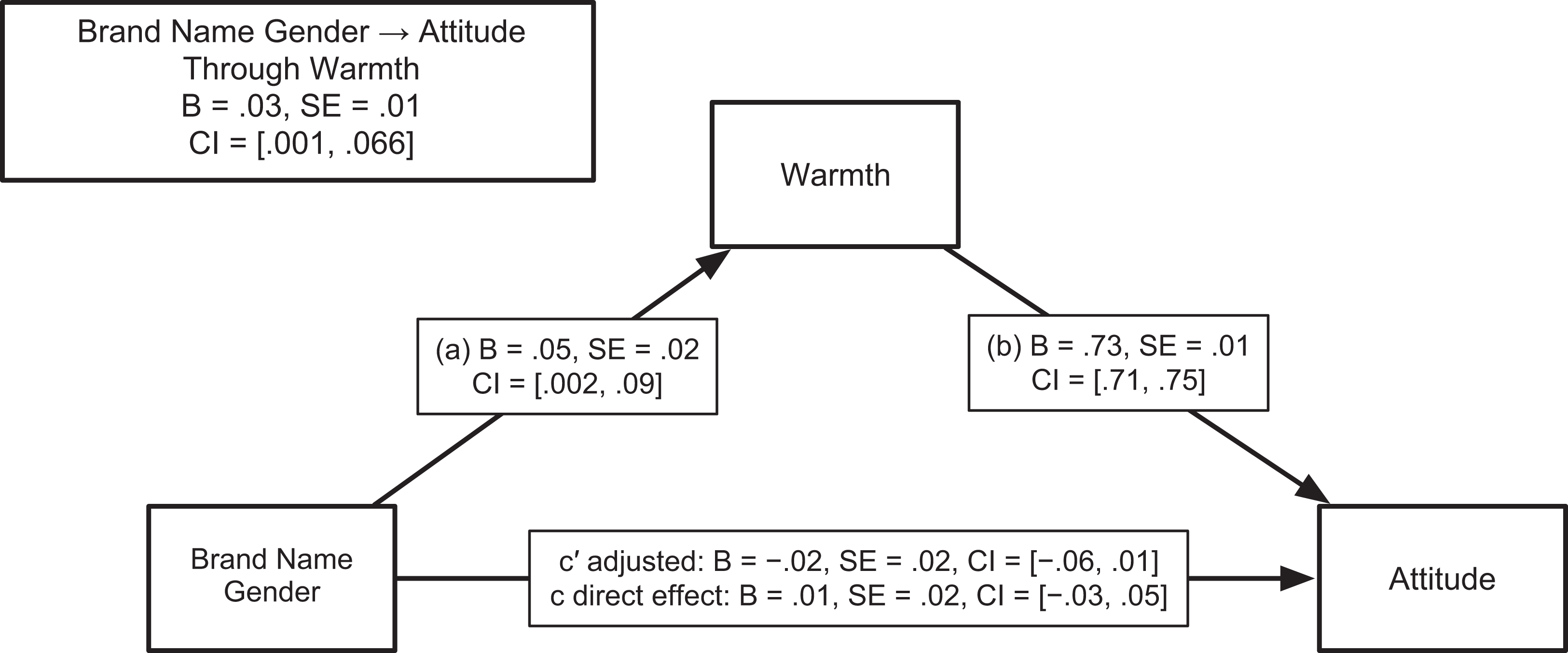
Indirect effect of brand name gender on attitude through warmth (Study 2).
Alternative explanations
We examined whether brand familiarity, idiosyncratic participant effects, or participant gender altered the results. For instance, it is possible that some brands in our sample are more familiar and therefore seem warmer due to fluency. Perhaps these brands also happen to have more feminine names, producing the observed results. Overall brand familiarity was above the scale midpoint, indicating that participants were generally familiar with the brands (M = 5.35, SD = 1.83; t(5,239) = 53.15, p < .001). Familiarity was a significant covariate when included in the model (t(5,234) = 26.39, p < .001) but did not alter the direction or significance of the results.
The observed effects could also be attributed to systematic idiosyncrasies in individual participants or participant gender. To address this possibility, we conducted mixed within- and between-subjects analyses using the linear mixed model function in the nlme package (Bates et al. 2015) in the statistical software R to examine possible rater effects, following the recommendation of Bates et al. (2015). A linear mixed-effect model with brand name gender and warmth as fixed effects and separate intercepts for each participant as random effects was consistent with the results in the PROCESS model. Thus, rater effects do not alter the findings. Inclusion of participant gender did not alter the significance or direction of the results in this study or any that follow (all effects reported in Web Appendix D).
Study 2 supports the hypothesized process in H2: feminine brand names are positively associated with warmth, which is positively associated with brand attitudes. However, the direct effect of brand name gender on attitude was not significant. A significant indirect but nonsignificant direct effect likely occurs because the model is underspecified (Hayes 2013; i.e., the indirect effect through warmth is positive, whereas the indirect effect through another, unspecified, mediator is negative, and the two indirect effects cancel each other out; Zhao, Lynch, and Chen 2010). This would likely be due to the use of real brands, which demonstrates external validity but also introduces considerable noise.
Although the mediation hypothesis was supported, we cannot draw causal conclusions from this correlational study, and the direct effect remains to be demonstrated. In addition, examination of the model (Figure 1) shows a small effect size for the link between brand name femininity and warmth perceptions. As noted previously, the relation between brand name gender and perceived warmth could be partly driven by preexisting perceptions of the brands that are independent of linguistic brand name gender. Thus, the relation between brand name gender and warmth may be multiply determined in this study of real brands, relative to the same relation for newly encountered brand names. We address these issues in Study 3.
Study 3
In Study 3, we manipulate linguistic brand name gender experimentally to test H1 under controlled conditions. We also expand our examination of brand outcomes to consequential choice, testing whether brand name gender influences product choices with real-world consequences. In Study 3a, we test the effect of name gender on participants’ choice of a video to watch, and we include a measure of pleasantness to address the possibility that the feminine brand name advantage is driven by name pleasantness rather than perceptions of warmth. In Study 3b, we test whether the feminine brand name advantage holds for financially consequential choices by offering participants one of three options for compensation: money, feminine-brand-named product, or masculine-brand-named product.
Pretest: Stimuli Development
We conducted a pretest to identify hypothetical brand names that varied on name gender while being equally and generally devoid of meaning and unfamiliar to participants. We generated test name stimuli drawing on prior work (Klink 2009; Lowrey and Shrum 2007). In addition to 55 potential name stimuli, a set of 10 words selected on a priori grounds to carry some semantic associations were included to provide a benchmark for comparison and encourage participants to use the full range of response scales (Schmitt, Pan, and Tavassoli 1994; see Web Appendix E).
Seventy-five MTurk participants were presented with a random subset of 25 words from the pool of 65 target stimuli and benchmarks, in random order, and asked to rate how familiar and meaningful each word was on seven-point scales (1 = “not at all,” and 7 = “very much”). We selected two brand name stimuli that were rated as significantly less familiar and less meaningful than the benchmark words and also significantly below the familiarity and meaningfulness scale midpoints (all ps < .001; for means and standard deviations, see Web Appendix F), indicating that the brand name stimuli were not familiar or endowed with meanings that might produce confounds. The brand name stimuli this pretest produced—“Nimilia” and “Nimeld”—are equally unfamiliar (t(51) = .10, p = .92) and unmeaningful (t(51) = −.11, p = .91) but score at the extreme ends of the name gender scale (Nimilia: +2, Nimeld: −2).
Study 3a: Method
Participants
Four hundred members of the Prolific Academic online panel (51% women; Ma ge = 32.91 years; 99% native English speakers) participated for a nominal fee. Posttest sensitivity analysis indicated adequate power (.80) to detect small effects (i.e., w = .15).
Design and procedure
The experiment was a one-factor (brand name gender: feminine, masculine) between-subjects design. Participants were told they would be evaluating a one-minute video from a channel of their choice. All participants were offered a choice between watching a channel with one of our pretested names or watching a video of equal length from a randomly selected YouTube channel. In the feminine name condition, participants chose between the “Nimilia YouTube Channel” and a randomly selected YouTube channel; in the masculine name condition, participants chose between the “Nimeld YouTube Channel” and a randomly selected YouTube channel. They next completed the same four-item warmth measure used in Study 2, along with a single-item measure of pleasantness (“To what extent does the Nimilia [Nimeld] Channel sound pleasant?”), in random order. The dependent variable was channel choice.
Study 3a: Results and Discussion
Choice
Participants chose to watch the feminine-named Nimilia Channel (43%) versus a random video at a greater proportion compared with the masculine-named Nimeld Channel versus a random video (32%; χ2(1, 400) = 4.71, p = .03, w = .22), in support of H1.
Mediation
Mediation analysis using PROCESS Model 4, with brand name gender as the independent variable (X), choice as the dependent variable (Y), and warmth as the mediator (M), showed that feminine brand name gender increased perceived warmth, which increased choice. Thus, the predicted indirect effect was significant, in support of H2 (Figure 3a). To rule out pleasantness as an alternative explanation, we conducted the same mediation analysis but included the pleasantness measure as a covariate. The index of mediation remained significant when we controlled for pleasantness (B = .26, 95% confidence interval [CI] = [.05, .51]).

Effects of brand name gender on choice (Studies 3a and 3b).
Study 3a replicates the process account shown in Study 2 with an experimental manipulation, allowing for causal inference and more robust support for H1 and H2. The study also rules out mere name pleasantness as an alternative explanation. We next test whether these results hold when financial consequences are at stake.
Study 3b: Method
Participants
One hundred fifty students (60% women; Mage = 20.45 years; 77% native English speakers) from a public North American university participated for course credit. We collected the largest sample possible given subject pool constraints. Posttest sensitivity analysis indicated adequate power (.80) to detect small effects (i.e., d = .15).
Design and procedure
The experiment employed a one-factor (participation incentive: cash, feminine-named product, masculine-named product) within-subject design. Students were welcomed to the study and told that, as a thank-you for participating, they could choose either $.50 or one bottle of small-batch hand sanitizer. The hand sanitizers were commercially available customizable products with either a linguistically masculine (Nimeld) or feminine (Nimilia) name on the bottle and the label. (Note: this study was conducted before onset of the COVID-19 pandemic, and the small colorful bottles presented as both fun and functional).
The bottles came in four colors that were rotated between lab sessions (yellow/purple, blue/red, red/yellow, purple/green). The left-right position of Nimeld and Nimilia was also rotated between sessions. A display showing the cash incentive and samples of each hand sanitizer was visible where participants checked in to the lab session (Web Appendix G provides images of the stimuli and display setup). After checking in, students were seated at computer stations with an empty seat between each station and one of each hand sanitizer and the cash incentive within reach to the right of the station. After indicating and receiving their choice, participants were asked not to share any information about the lab session or their choice, because this might bias others. Finally, we asked whether they had discussed the lab session or incentive choice with anyone else before participating.
Study 3b: Results and Discussion
A chi-square test showed that participants were more likely to choose the Nimilia hand sanitizer than any other option (49.3%), followed by the $.50 (36.0%), and Nimeld hand sanitizer (14.7%; χ2(2, 150) = 27.52, p < .001, d = .94; Figure 3b), in support of H1. To rule out alternative explanations, we regressed participant gender, product color, research assistant working the session, whether participant discussed sessions beforehand, and their interaction terms onto choice of Nimeld versus Nimilia hand sanitizer. None were significant predictors (all ps > .60).
Studies 3a and 3b provide further evidence for the feminine brand name advantage in the context of consumer choices with tangible consequences for both time and money. We next turn our attention to managerially relevant boundary conditions of the effect.
Study 4
In Study 4, we test a potential boundary condition: typical user gender. Our previous studies examined product categories commonly used by both men and women. In such cases, we predicted and found an overall advantage for linguistically feminine brand names over linguistically masculine brand names. However, if the product is primarily used by one gender and not the other, attitudes may be affected by the congruence between brand name gender and the typical user’s gender (Yorkston and De Mello 2005). Thus, when a product is typically used by men rather than women, the feminine brand name advantage may be attenuated (H3).
Moderation could occur in two ways. First, the misfit between feminine name gender and typical male user might reverse the feminine brand name advantage. In this case, we would expect to see linguistically feminine brand names preferred only for products typically used by women and linguistically masculine brand names preferred only for products typically used by men. Alternatively, typical user fit and feminine brand name warmth may exert parallel influences on attitudes. In other words, the warmth conveyed by feminine names may positively influence brand attitudes in general, whereas congruence between masculine names and user gender may also positively influence attitudes when the typical user is male. In this case, we would expect an interaction such that participants have more positive attitudes toward linguistically feminine brand names than masculine names when the typical user is female but equally positive attitudes toward linguistically feminine and masculine brand names when the typical user is male.
We predicted that typical user gender would moderate the indirect effect by reducing the influence of warmth on attitudes when the typical user is male (path b; Hayes [2013] Model 14). Alternatively, user gender might moderate the indirect effect by altering the influence of name gender on warmth when the typical user is male (path a; Hayes [2013] Model 7). We preregistered plans to test both models on AsPredicted (https://aspredicted.org/gc7r4.pdf).
Method
Participants
Eight hundred seventy-five Prolific Academic online panel members (49% women; Mag e = 32.39 years; 99% native English speakers) participated for a nominal fee. Posttest sensitivity analysis showed adequate power (.80) to detect small effects (i.e., d = .20).
Design and procedure
Participants were randomly assigned to conditions in a 2 (brand name gender: feminine or masculine) × 2 (typical user: male or female) between-subjects design. The stimuli names were the same as in Studies 3a and 3b, and participants evaluated either the masculine or feminine name (Nimeld or Nimilia). We chose sneakers as the product because they could be used by either gender, and both hedonic and utilitarian criteria are important (Yeung and Wyer 2004). To hold product category (hedonic/utilitarian) constant, we asked participants to imagine that they were “shopping for men’s [women’s] sneakers that are designed for both style and performance (maybe for yourself or maybe for someone else).” We manipulated typical user gender by telling participants that the sneakers were either for men or for women, which allowed us to hold the product constant. Participants then completed the same attitude (α = .93) and warmth (α = .92) measures used in Study 2, with the attitude items adapted for hypothetical, rather than real, brands (e.g., “I would want to buy…”).
We included a suspicion check to rule out possible demand effects and manipulation checks asking who the most typical user of the product was (men: −1, women: +1, both: 0) and how masculine or feminine the brand name seemed (1 = “very masculine,” and 5 = “very feminine”). The suspicion check indicated that less than 1.5% of participants suspected that the purpose of the study was to examine brand name and user gender. Per the preregistration plan, we conducted analyses both with and without suspicious participants. Excluding suspicious participants did not alter the direction or significance of results, so we retained them for the analyses reported next.
Results and Discussion
Manipulation checks
We conducted 2 (brand name gender: feminine or masculine) × 2 (typical user: male or female) analyses of variance (ANOVAs) on the brand name gender and typical user gender manipulation check measures. This analysis revealed a main effect of typical user condition on typical user manipulation check, as expected (F(1, 871) = 656.44, p < .001); a main effect of name gender condition on name gender manipulation check, as expected (F(1, 871) = 683.51, p < .001); and an unanticipated effect of typical user condition on name gender perceptions (F(1, 871) = 42.82, p < .001). The feminine name was perceived as more masculine by participants who evaluated the name in relation to a man’s sneaker (3.87 vs. 4.32); similarly, the masculine name was perceived as more feminine by participants who evaluated the name in relation to a women’s sneaker (2.46 vs. 2.20). While this finding is not ideal, it should not alter the validity of the findings, given that the masculine name was evaluated as significantly masculine and the feminine name was evaluated as significantly feminine regardless of condition (all ps < .001).
Effect of name gender and typical user gender on brand attitude
A 2 (brand name gender: feminine or masculine) × 2 (typical user: male or female) ANOVA with attitude as the dependent variable revealed a nonsignificant main effect of typical user gender and a main effect of brand name gender (F(1, 871) = 41.97, p = .001, η2 = .04), such that attitudes toward feminine brand names were more positive compared with those for masculine brand names (Mfeminine = 3.95, SD = 1.23 vs. Mmasculine = 3.39, SD = 1.32). This was qualified by the predicted name gender × typical product user interaction (F(1, 871) = 20.14, p < .001, η2 = .02). When the typical user was female, attitudes toward the feminine-named product were more positive than those toward the masculine-named product (Mfeminine = 4.07, SD = 1.21 vs. Mmasculine = 3.13, SD = 1.31; F(1, 871) = 60.20, p < .001, η2 = .06), consistent with previous results. However, when the typical user was male, the feminine brand name advantage was neutralized, and attitudes toward the masculine- and feminine-named products were equally positive (Mfeminine = 3.82, SD = 1.25 vs. Mmasculine = 3.65, SD = 1.28; F(1, 871) = 1.97, p = .16., η2 = .002). Thus, typical user gender attenuated the feminine brand name advantage by enhancing attitudes toward masculine-named products when the typical user was a man.
Effect of name gender and typical user gender on warmth
A 2 (brand name gender: feminine or masculine) × 2 (typical user: male or female) ANOVA with perceived warmth as the dependent variable yielded a nonsignificant main effect of typical user gender and a significant main effect of brand name gender (F(1, 871) = 108.90, p < .001, η2 = .11), such that feminine brand names were generally perceived as warmer than masculine names (M = 4.46, SD = 1.38 vs. M = 3.50, SD = 1.33). This effect was qualified by a name gender × typical product user interaction (F(1, 871) = 7.75, p = .005, η2 = .009). When the typical user was female, the feminine-named product was perceived as warmer than the masculine-named product (Mfeminine = 4.58, SD = 1.33 vs. Mmasculine = 3.37, SD = 1.38; F(1, 871) = 87.48, p < .001, η2 = .09). However, when the typical user was male, the difference in warmth perceptions between masculine and feminine names, although still significant, was not as large (Mfeminine = 4.33, SD = 1.42 vs. Mmasculine = 3.63, SD = 1.28; F(1, 871) = 29.24, p < .001, η2 = .03). Thus, the masculine name gender and user gender “fit” seems to enhance perceived warmth for male-user products.
Mediation
Analysis with PROCESS Model 4 shows that warmth mediates the effect of name gender on brand attitude (B = .55, 95% CI = [.43, .67] with 5,000 bootstrapped resamples). To determine whether typical user moderates this indirect effect, we tested the moderating role of typical user gender on the link from name gender to warmth (path a; Hayes [2013] Model 7) and on the link from warmth to brand attitude (path b; Hayes [2013] Model 14). Both models produced significant indexes of moderated mediation (Model 7: B = .29, 95% CI = [.08, .50]; Model 14: B = .14, 95% CI = [.04, .25]). Because user gender moderated the A and B paths separately, we tested Model 58 with moderation on both paths simultaneously (although this analysis was not preregistered). This model produced the most robust index of moderated mediation (Figure 4).

Indirect effect of brand name gender on attitude through warmth, moderated by typical user gender (Study 4).
Mediation analysis using Model 58 with typical user gender as a moderator showed that warmth is a statistically significant mediator for both typically female-used products (B = .79, 95% CI = [.59, .99]) and typically male-used products (B = .35, 95% CI = [.21, .51]). The index of moderated mediation shows that mediation is stronger for female-used products than for male-used products (B = .43, 95% CI = [.19, .67]). Examining the direct paths shows that name gender has a stronger influence on warmth for typically female-used products than male-used products (bfemale = 1.21 vs. bmale = .68, p = .006), and warmth has a stronger influence on attitudes for typically female-used products than male-used products (bfemale = .65 vs. bmale = .49, p = .001).
The results of Study 4 support H3, demonstrating the moderating role of typical user gender: the feminine brand name advantage is neutralized when the typical user is male, and attitudes toward linguistically masculine and feminine brand names are equally positive.
Study 5
The purpose of Study 5 was to test another boundary condition: product category. If perceived warmth mediates the relation between linguistic name gender and attitudes, then the effects should be larger for product categories in which warmth is an especially valued attribute, such as hedonic (vs. utilitarian) products. Thus, we expect to observe the feminine brand name advantage, and mediation through warmth, for the hedonic product. However, for the utilitarian product, which is more cognitively than affectively processed, we expect the effect to be attenuated.
We predicted that product category would moderate the indirect effect by altering the influence of warmth on attitudes (path b; Hayes [2013] Model 14). An alternative possibility is that product category might moderate the indirect effect by altering the influence of name gender on warmth (path a; Model 7). We preregistered plans to test both models, and Model 58 (moderation on both a and b paths), on AsPredicted (https://aspredicted.org/sp6mt.pdf).
To increase generalizability, in Study 5 we used different brand name stimuli. Our prior experiments relied on two carefully constructed brand name stimuli that varied on length (Nimilia vs. Nimeld), because feminine names tend to be longer than masculine names. However, it is possible that name length may have unintended effects, such as metaphorical associations with status (Mehrabian and Piercy 1993). It is also possible that our observed results were due to some idiosyncratic effects of the two particular names. In Study 5, we rule out these possibilities by using six different stimuli names of equal length.
Pretests
Name stimuli
We conducted a pretest to identify names that vary on gender score while being equal in length, equally and generally devoid of meaning, and unfamiliar to participants, following the same pretest procedure described in Study 3. Fifty-five name stimuli were generated for the pretest. We selected three name pairs that participants rated as significantly and equally unfamiliar and not meaningful (for pretest results, see Web Appendix F). Three of the names (Tilna, Seca, and Nemri) were moderately feminine (+.5 to +1), and the other three names (Telric, Siltac, and Nelmin) were moderately to very masculine (−1 to −2). Because the name gender scores are more moderately contrasting than those used in Studies 3 and 4, these stimuli provide a more conservative test. Moreover, the names all have equal numbers of syllables to control for possible metaphorical associations with name length.
Product category
We also conducted pretests to identify a hedonic product that is not also utilitarian, and a utilitarian product that is not also hedonic, using validated scales (Voss, Spangenberg, and Grohmann 2003). Further, we assessed how masculine or feminine each product seemed on seven-point scales (1 = “masculine,” and 7 = “feminine”). The order of all measures was randomized. The goal was to identify hedonic and utilitarian products that do not vary on product gender. Chocolate and bathroom scale met these criteria. Based on differences from the midpoint of the scale, chocolate was rated as hedonic (M = 6.07, SD = 1.02; t(43) = 13.44, p < .001) but not utilitarian (M = 3.39, SD = 1.88; t(43) = −2.16, p = .03), while bathroom scale was rated as utilitarian (M = 6.02, SD = 1.00; t(43) = 13.42, p < .001) but not hedonic (M = 2.68, SD = 1.84; t(43) = −4.75, p < .001). Both products were evaluated as feminine (Mchocolate = 4.57, SD = 1.09; t(43) = 3.47, p = .001; Mscale = 4.48, SD = 1.00; t(43) = 3.17, p = .003) and, importantly, were deemed equally feminine (t(43) = −.54, p = .59). This allowed us to control for perceived product gender. Importantly, the products are used by both men and women, so we would not expect a typical user effect as in Study 4.
Method
Eight hundred seventy-five members of the Prolific Academic online panel (50% women; Mage = 30.12 years; 93% native English speakers) participated for nominal payment. Posttest sensitivity analysis indicated adequate power (.80) to detect small effects (i.e., d = .20). Participants were randomly assigned to conditions in a 2 (brand name gender: feminine or masculine) × 2 (product category: utilitarian or hedonic) between-subjects design. The warmth (α = .90), and attitude (α = .93) measures were the same as those used in Studies 2 and 4. All measures were presented in random order. We included a suspicion check to rule out possible demand effects, and as manipulation checks we asked how masculine or feminine the brand name seemed (1 = “very masculine,” and 5 = “very feminine”). No participants guessed the purpose of the study.
Results and Discussion
Manipulation checks
A 2 (brand name gender: feminine or masculine) × 2 (product category: hedonic or utilitarian) ANOVA on the brand name gender manipulation check measure revealed only a main effect of name gender condition on name gender manipulation check (F(1, 871) = 745.38, p < .001). Participants in feminine-name conditions evaluated the name stimuli as feminine (M = 3.88, t(439) = 22.81, p < .001), and participants in masculine-name conditions evaluated the name stimuli as masculine (M = 2.26, t(434) = −16.40, p < .001). We created indices of warmth and performance collapsing across masculine and feminine name stimuli for analysis.
Effect of name gender and product category on brand attitude
A 2 (brand name gender: feminine or masculine) × 2 (product category: hedonic or utilitarian) ANOVA with attitude as the dependent variable yielded a main effect of product category (F(1, 871) = 8.20, p = .004, η2 = .009; Mhedonic = 3.82, SD = 1.36 vs. Mutilitarian = 4.06, SD = 1.33); a main effect of brand name gender (F(1, 871) = 19.34, p < .001, η2 = .02), such that feminine brand names were generally preferred over masculine names (Mfeminine = 4.13, SD = 1.30 vs. Mmasculine = 3.74, SD = 1.37); and the predicted name gender × product category interaction (F(1, 871) = 61.33, p < .001, η2 = .06). When the product category was hedonic, participants preferred the linguistically feminine brand over the masculine brand (Mfeminine = 4.34, SD = 1.20 vs. Mmasculine = 3.28, SD = 1.30; F(1, 437) = 79.57, p < .001, d = .85). However, when the product category was utilitarian, the linguistically masculine brand was preferred (Mfeminine = 3.91, SD = 1.36 vs. Mmasculine = 4.21, SD = 1.28; F(1, 434) = 5.55, p = .01., d = .22), though the effect was small. Thus, product category moderated the feminine brand name advantage; attitudes toward linguistically feminine brand names were more favorable when the product was hedonic, and attitudes toward linguistically masculine brand names were slightly more favorable when the product was utilitarian.
Effect of name gender and product category on warmth
A 2 (brand name gender: feminine or masculine) × 2 (product category: hedonic or utilitarian) ANOVA with perceived warmth as the dependent variable yielded only a main effect of brand name gender (F(1, 871) = 38.40, p < .001, η2 = .04), such that feminine brand names were generally perceived as warmer than masculine names (M = 4.30, SD = 1.24 vs. M = 3.77, SD = 1.30), and a brand name gender × product category interaction (F(1, 871) = 16.75, p < .001, η2 = .02). When the product category was hedonic, the linguistically feminine brand was perceived as warmer than the linguistically masculine brand (Mfeminine = 4.43, SD = 1.15 vs. Mmasculine = 3.55, SD = 1.33; F(1, 437) = 54.68, p < .001, d = .70). However, when the product category was utilitarian, there was no significant difference in warmth perceptions between the linguistically feminine and masculine brands (Mfeminine = 4.16, SD = 1.31 vs. Mmasculine = 3.98, SD = 1.25; F(1, 434) = 2.14, p = .14., d = .14).
Moderated mediation
Mediation analyses (PROCESS Model 4) show that warmth mediates the effect of name gender on attitudes (B = .37, 95% CI = [.24, .49] with 5,000 bootstrapped samples). We tested moderated mediation on the a and b paths, separately and together (Hayes [2013] PROCESS Models 7, 14, and 58, each with 5,000 bootstrap resamples). Only Models 7 and 58 were significant, but Model 58 produced a larger index of moderated mediation (Figure 5).

Indirect effect of brand name gender on attitude through warmth moderated by product category (Study 5).
Model 58 mediation analysis with product category as a moderator showed that warmth is a significant mediator for hedonic products (B = .65, 95% CI = [.45, .86]), but not utilitarian ones (B = .11, 95% CI = [−.04, .26]). The index of moderated mediation shows that the difference between conditional indirect effects is significant (B = .53, 95% CI = [.28, .78]). Examining the direct paths shows that name gender influences warmth for hedonic but not utilitarian products (bhedonic = .88 vs. butilitarian = .18, p < .001), and warmth has a marginally stronger influence on attitudes for hedonic than utilitarian products (bhedonic = .74 vs. butilitarian = .65, p = .09).
As we predicted, linguistically feminine names produced more favorable attitudes toward hedonic than utilitarian products, in support of H4. Although not expected, the data also suggest that product category alters perceptions of brand name warmth, such that linguistically feminine names are not perceived as warmer when the product is utilitarian. Moreover, linguistically masculine names enhance attitudes (slightly) for utilitarian products, whereas feminine names enhance attitudes (more robustly) for hedonic products. Study 5 demonstrates these effects using different name stimuli of equal length to control for associations with status as well as names that are not at the extreme ends of the name gender spectrum, providing a more conservative test.
General Discussion
The results of six studies offer convergent evidence for the feminine brand name advantage. Specifically, feminine brand names increase perceived warmth, which is associated with more favorable attitudes and increased choice for both real and fictitious brands. These findings suggest that the prevalence of feminine names among Interbrand top brands may be due in part to the ability of brand name linguistics to convey warmth. The feminine brand name advantage is neutralized when the typical product user is male and is stronger for hedonic than for utilitarian products. We demonstrate these effects empirically, using both real and hypothetical brands, as well as observationally, by examining secondary data.
Theoretical Contributions
Prior research has produced a rich literature on brand name linguistics (e.g., Klink 2000; Lowrey and Shrum 2007; Yorkston and Menon 2004). We extend this literature by introducing a measure of femininity that combines both morphology (name length and stress) and phonology (sounds). Previous research has typically focused only on the effects of single phonemes. One potential benefit of multiple linguistic indicators of femininity is that the effects may be stronger than for single indicators.
Prior work has examined brand names and gender, based on name sounds, in the context of matching hypotheses (e.g., feminine names are appealing to women or for feminine products; Grohmann 2009; Yorkston and DeMello 2005). We show that linguistically feminine names, as measured by length, sounds, and stress, are most often an advantage because they convey warmth, which is a generally desirable attribute. Feminine names are preferred by both men and women for products that are used by both genders (i.e., the vast majority of products) and are equally desirable as masculine names for products used by men.
Another key finding of the present research is that linguistic associations conveyed by a name may influence brand perceptions implicitly. For instance, most consumers probably do not consider Unilever to have a feminine name. Yet the automatically processed linguistic features of a name can endow a brand with gender-associated qualities that improve brand outcomes. The endowment of stereotype-based attributes (e.g., feminine warmth) to nonstereotype group members (e.g., brand of men’s sneakers) is an important finding. This finding has implications for the Stereotype Content Model by demonstrating that linguistic features of a name, independent of any group membership information, can influence perceptions of a target.
The present work also contributes to the research on hedonic and utilitarian product marketing. Previous work has established the affective nature of hedonic goods (Holbrook and Hirschman 1982; Yeung and Wyer 2004). We build on this research stream by showing the benefit of warm product descriptors (e.g., names) for hedonic products.
Managerial Implications
The present findings have important substantive implications and should inform marketing strategy. Feminine brand names appear to have a marketplace advantage, particularly for hedonic products. Moreover, such linguistic elements have an automatic influence (Pogacar, Shrum, and Lowrey 2018), providing a source of affinity that consumers respond to instinctively. Brand managers should take careful note of the linguistic characteristics of new brand names and brand extensions and leverage the feminine brand name advantage as appropriate.
Managers should be aware of two factors that might influence the brand outcomes observed here: differences in naming conventions between languages and differences in gender stereotypes between cultures. If women’s names are equally as likely as men’s names to end in vowels in a given language, for instance, then the Barry and Harper (1995) name gender scale should not guide naming strategy for target markets speaking this language. Rather, marketers should determine the linguistic cues that signal gender in the target market language and test brand names with those characteristics. In addition, the link between feminine gender and warmth may not exist in every culture. If the target market does not subscribe to this stereotype, then even a brand name that sounds linguistically feminine to the target market may not convey warmth. Managers should employ target market surveys of naming conventions and gender perceptions to address this. Moreover, in instances when brand names are not fixed across languages but are instead translated, brand managers should pay close attention to the effects of translation (Zhang and Schmitt 2001) and to local naming preferences (Wu et al. 2019).
Limitations and Directions for Future Research
One limitation of the present research is its focus on English-speaking participants. The Interbrand names we examined are global, and prior research suggests that many linguistic effects are robust across languages (Blasi et al. 2016; Shrum et al. 2012). However, differences between languages have also been observed (Coulter and Coulter 2010; Kuehnl and Mantau 2013), so it is an empirical question whether a given linguistic effect manifests in a given language. Indeed, the results of Study 3b, the only study with a sizable number of nonnative English speakers, suggest there may be language differences that merit further investigation (note B in Web Appendix D).
Future research should also investigate how established brands with masculine names can incorporate these findings. Brands with equity in their existing names may be ill-advised to discard a well-established masculine name, even if the brand markets hedonic products and typical users include women. However, it may be possible to imbue masculine brand names with warmth via feminine subbrands, brand extensions, or logos. For instance, Fiesta is a linguistically feminine subbrand of Ford that could add warmth to the masculine corporate brand.
Future work might also examine whether linguistically masculine names are advantageous when warmth is not a desirable product attribute. Although warmth is generally desirable, or at least not harmful, there may be rare exceptions. For instance, some products are designed to destroy pests, weeds, molds, warts, or even people. In such instances the feminine brand name advantage may be reversed. Indeed, our preliminary analyses suggest that people evaluate guns with masculine names more favorably than guns with feminine names (Web Appendix H) and that successful firearms have more masculine names than successful products from a more neutral category (i.e., backpacking packs; Web Appendix I).
The feminine brand name advantage is no substitute for the pillars of sound marketing: quality products, customer service, and strong corporate culture. However, marketers would be wise to leverage the feminine brand name advantage because, linguistically, Nestlé is indeed a lady—one that inspires warmth, positive attitudes, and choice.
Supplemental Material
Supplemental Material, sj-pdf-1-jmx-10.1177_0022242921993060 - Is Nestlé a Lady? The Feminine Brand Name Advantage
Supplemental Material, sj-pdf-1-jmx-10.1177_0022242921993060 for Is Nestlé a Lady? The Feminine Brand Name Advantage by Ruth Pogacar, Justin Angle, Tina M. Lowrey, L. J. Shrum and Frank R. Kardes in Journal of Marketing
Footnotes
Appendix: Name Gender Scoring System (Based on Barry and Harper 1995 )
Acknowledgments
The authors are grateful to Emily Plant, James Kellaris, Kate Loveland, Peter Chiu, Ryan Rahinel, Andrew Hayes, and the JM review team for their feedback and suggestions, and to Matthew Nakaska for assistance in data collating and visualization.
Associate Editor
Martin Schreier
Declaration of Conflicting Interests
The author(s) declared no potential conflicts of interest with respect to the research, authorship, and/or publication of this article.
Funding
The author(s) disclosed receipt of the following financial support for the research, authorship, and/or publication of this article: This work was supported by the University of Cincinnati Graduate School Dean’s Fellowship awarded to the first author, by the Poe Family Distinguished Faculty Fellowship awarded to the second author, and by research grants from the HEC Foundation of HEC Paris and Investissements d’Avenir (ANR-11-IDEX-0003/Labex Ecodec/ANR-11-LABX-0047) awarded to the third and fourth authors.

References
Supplementary Material
Please find the following supplemental material available below.
For Open Access articles published under a Creative Commons License, all supplemental material carries the same license as the article it is associated with.
For non-Open Access articles published, all supplemental material carries a non-exclusive license, and permission requests for re-use of supplemental material or any part of supplemental material shall be sent directly to the copyright owner as specified in the copyright notice associated with the article.
