




Abstract
Online virality has attracted the attention of academics and marketers who want to identify the characteristics of online content that promote sharing. This article adds to this body of research by examining the phenomenon of improvised marketing interventions (IMIs)—social media actions that are composed and executed in real time proximal to an external event. Using the concept of quick wit, and theorizing that the effect of IMIs is furthered by humor and timeliness or unanticipation, the authors find evidence of these effects on both virality and firm value across five multimethod studies, including quasiexperiments, experiments, and archival data analysis. These findings point to the potential of IMIs in social media and to the features that firms should proactively focus on managing in order to reap the observed online sharing and firm value benefits.
Digital communications have emerged as one of the most important means for firms to engage with customers (Colicev et al. 2018; Kanuri et al. 2018; Lamberton and Stephen 2016; Wedel and Kannan 2016). Anecdotal evidence suggests, however, that a growing number of consumers have become disenchanted and have grown suspicious—if not tired—of digital communications such as online advertisements (Wu 2016). To help overcome this consumer fatigue, we explore the potential of improvised marketing interventions (IMIs)—the composition and execution of a real-time marketing communication proximal to an external event—to improve the effectiveness of digital communication.
Consider Oreo’s famous tweet in response to the power outage during Super Bowl XLVII in 2013. Within moments of the power outage, Oreo tweeted, “Power out? No problem,” along with a starkly lit image of a solitary Oreo cookie. A caption within the photo read, “You can still dunk in the dark.” This exemplar of IMI received 15,000 retweets within the next eight hours, creating significant publicity for Oreo at minimal expense. By contrast, a Super Bowl ad costs an average of $4.5 million (Wu 2016). This example demonstrates that an IMI can provide a strong boost to a brand’s positive electronic word of mouth (WOM).
Prior research has highlighted the potential for improvisation (Miner, Bassof, and Moorman 2001; Moorman and Miner 1998a, b) and explored the benefits of firms’ active presence on various digital platforms, including consumers’ willingness to make positive comments about the firm online (see Colicev et al. 2018; Gong et al. 2017; Herhausen et al. 2019; Lambrecht, Tucker, and Wiertz 2018; Meire et al. 2019; Tellis et al. 2019). Yet critical questions remain. The Marketing Science Institute (2016), in fact, points to the limited research in this area and, in setting out its research priorities for 2016–2018, stresses the need for “getting marketing ‘right’ in real time.”
Inspired by the potential of IMIs, in this research we consider the following questions: First, is IMI’s underlying promise real? That is, to what extent does an IMI (vs. a non-IMI) result in greater virality? Second, what particular type of IMI message is most likely to achieve virality? And, third, how—if at all—do IMIs contribute to firm value? Drawing on research related to quick wit (Brant 1948; Freud 1928), we propose that IMIs are effective because they occur in real time, offer humor, and are either unanticipated or timely. We theorize this combination of traits to predict message virality and firm value. We test our theory using five studies. Study 1 uses a quasiexperiment during the Super Bowl on highly granular data to test whether an IMI increases virality more than a non-IMI. Study 2 uses an experiment to manipulate the key factors driving IMIs and test their effects on virality. Study 3 is based on a unique data set of 462 IMIs across 139 brands, spanning 58 industries over a six-year period to assess the relationship between IMI messages’ content with virality and firm value. And Study 4 uses IMI messages and non-IMI messages from the airline industry to examine the relationship between IMI messages’ content and virality as well as firm value. Finally, in Study 5 we generalize our findings using a random sample of S&P 500 firms to enhance the realism of the effects of IMI on virality and firm value. Table 1 provides an overview and lists the unique advantages of each study.
Overview of Studies.

By studying IMI, we aim to make the following novel contributions to the extant marketing literature and practice. First, we contribute to the work on improvisation and electronic WOM in social media by developing new knowledge using an array of studies that capture the phenomenon of IMI. Pauwels, Aksehirli, and Lackman (2016, p. 639) urge, “Managers need to know…which specific marketing communication actions…stimulate electronic WOM conversations.” We respond to their call and extend current knowledge by theorizing and systematically examining the type of IMI messages that have the greatest potential for achieving virality. Previous research that has examined firm-generated content and virality has investigated neither IMI nor the interplay between IMI and virality (see Table 2). While it is likely that there are important implications of this research beyond social media, we note that we are studying IMI in a social media context because of the ease of changing marketing actions in this context and the opportunity it presents for virality. In so doing, we shed light on the understudied phenomenon of IMI that can play a significant role in generating virality and firm value.
Review of Relevant Literature on Firm Generated Content and Virality.
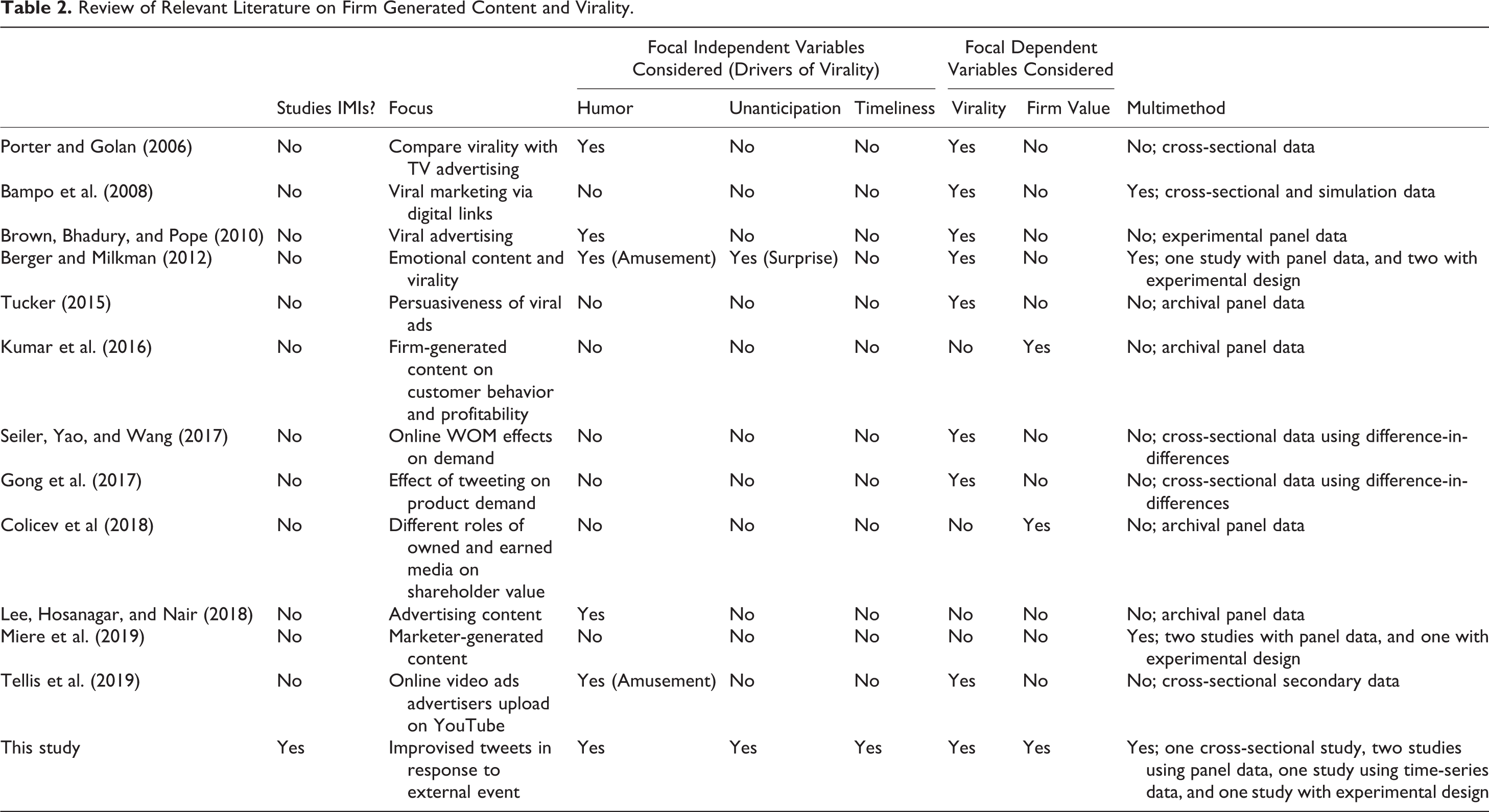
Second, we use the concept of quick wit for studying the virality of IMI messages and their role in influencing firm value. We define quick wit as situational humor that trades on timeliness and unanticipation (Brant 1948; Freud 1928). Firms today face significant challenges of breaking through the clutter of competing messages in the marketplace and reaching out to an increasingly wary audience (Pieters, Warlop, and Wedel 2002; Wu 2016). In this study, we advance the novel idea that IMI—through quick wit and, in particular, the interaction between humor paired with timeliness and humor paired with unanticipation—enables firms to drive both virality and firm value.
Third, we extend prior research and contribute to the literature on the marketing–finance interface about the role of marketing in driving firm value by studying how IMI captures financial value for a firm (Colicev et al. 2018; Srinivasan, Rutz, and Pauwels 2016; Tirunillai and Tellis 2014). In contrast to prior work, which links the valence of user-generated messages (positive or negative) to firm value (Tirunillai and Tellis 2012), we theorize and empirically examine the content of IMI messages, and we study their impact on firms’ abnormal stock market returns.
Conceptual Development and Predictions
The Nature of IMI
While improvisation has been studied in marketing and organizational research (Miner, Bassoff, and Moorman 2001; Moorman and Miner 1998a, b), we advance the novel idea that firms should put people and processes in place to facilitate the improvised composition and execution of real-time marketing communications in response to external events. By “improvised,” we follow the spirit of the definition proposed by Moorman and Miner (1998b), who define improvisation as the degree to which composition and execution converge in time. Therefore, in our setting, the closer the creation and execution of a tweet in time, the more improvisational the tweet. Because marketing professionals do not have advance knowledge of some of these events, they need to be empowered to react spontaneously to such unanticipated occurrences. Such events often are not easily predicted (e.g., a blackout during a Super Bowl), receive heightened attention from the potential audience, and require marketing professionals to leverage this heightened attention with effective IMIs that trade on quick wit. We study IMIs in a social media context because of the ease of changing marketing actions and the opportunities for virality in this context. We note implications beyond social media in the “Future Research” subsection.
Quick Wit and IMI
Attracting an audience’s attention using firm-generated content such as advertisements remains a key challenge for most—if not all—firms (Berr 2019). Doing so in a positive and engaging way that avoids the creation of consumer pushback and resentment is harder still. We use the theory of quick wit to argue for the special role played by IMI that contains humor tinged with timeliness or unanticipation in facilitating virality and enhancing firm value. Quick wit relies on situational humor that trades on a degree of timeliness and unanticipation (Brant 1948; Freud 1928). In accord with Warren and McGraw (2016), we define humor as a psychological response characterized by laughter, happiness, or joy arising from pun, play on words, events, or images. Timeliness is defined as the time taken to respond to an external event, and unanticipation is defined as the unexpected way in which a communication responds to an external event. Wit or appreciation of humor has a major influence on the quality of an interaction and can shape the impression a person forms of another (Warren, Barsky, and McGraw 2018). It can, for instance, decrease tension in a heated conversation or enliven a boring one (Treger, Sprecher, and Erber 2013), reduce dysfunctional stress and anxiety (Henman 2001; Yovetich, Dale, and Hudak 1990), and create positive feelings among conversation partners and facilitate bonding (Long and Graesser 1988; Treger, Sprecher, and Erber 2013). Furthermore, wit is specific to a particular event or social context (Apter 1985; Long and Graesser 1988) and is most effective when elicited in a timely or unexpected, spontaneous way (Wyer and Collins 1992). One proposed strategy to break through the clutter and noise in the marketplace, therefore, is to engage social media users in a conversation about “what is happening now” (Hearst, Hurst, and Dumais 2008, p. 96) in a witty way.
IMI and Virality
Research shows that people in general and internet users in particular have a desire to engage with events as they happen in a spontaneous manner (Kerns 2014; Treger, Sprecher, and Erber 2013). Social media users increase their own social capital by sharing a message that signals to others that they are “in the know” (Akpinar and Berger 2017; De Angelis et al. 2012; Toubia and Stephen 2013). People also share information with others to participate in online communities, show concern for others, and be helpful (Tellis et al. 2019). Improvised marketing interventions in response to current events help social media users contribute to their communities in more valuable and meaningful ways than they could with outdated and uninteresting news. With this information sharing, these users help firms grab the attention of other users within and potentially beyond the firms’ social networks. Heightened interest by social media users has been shown to kick-start new online discussion or invigorate existing talk about a firm among customers (Tirunillai and Tellis 2014, 2017). Responding to current events with an IMI thus helps firms grab social media users’ attention. Drawing on these arguments, we hypothesize,
When Do IMIs Contribute to Virality?
Humor has been argued to influence the nature of human relationships and communication in significant ways (Brant 1948; Eisend 2009; Warren, Barsky, and McGraw 2018). Here, we advance the novel argument that IMIs are only likely to become viral when they contain humor and timeliness (or unanticipation). We argue that humor, timeliness, and unanticipation individually would not have a significant main effect on virality for IMI because of the unique nature of the IMI phenomenon, which demands that a humorous message has to be paired with timeliness or with unanticipation to generate virality. We theorize why these pairwise interactions will drive virality next.
Theory on quick wit has highlighted that humor’s effectiveness is closely associated with timing and unanticipation (Long and Graesser 1988; Wyer and Collins 1992). Researchers have argued, for example, that “timing is everything” in the delivery of humor and in its opportunity to engage an audience in a positive manner (Attardo and Pickering 2011). We expect IMI’s humor to interact with timeliness in driving virality for at least two reasons. First, research on quick wit and conversational style suggests that, in addition to humor, speed of response attracts an audience’s attention, which consequently initiates further conversation (Henman 2001; Treger, Sprecher, and Erber 2013). Oreo’s message, for example, was tweeted within a few minutes of the lights going out during the Super Bowl. The message was, therefore, very timely. If the same message were sent out a few weeks or months after the game had ended, the message would have been relatively less timely, and its witty elements would have been less impactful. Second, theory of quick wit suggests that timeliness injects new fuel into a marketing communication’s humor, providing more impetus for people’s desire to bond with others through swift sharing (Barsade and Gibson 2007). It is important to note that humor is often situationally dependent. A witty message might attract an audience’s attention in one instance but may seem only mildly funny or completely irrelevant and irritating when outdated (Attardo and Pickering 2011; Long and Graesser 1988; Wyer and Collins 1992). Thus, we hypothesize,
Prior work has found that unanticipation also plays an important role in the delivery of humor by creating incongruous relationships, such as unexpected events, objects, or observable deviations from an implied standard (Attardo and Pickering 2011; Deckers and Devine 1981; Eisend 2009). From a quick-wit perspective and an image-related perspective (Freud 1928; Toubia and Stephen 2013), sharing humorous and unexpected or surprising content makes social media users look good to other users. As these perceptions, in general, are important to social media users, they inspire this higher level of interest (Akpinar and Berger 2017). While people may feel uncomfortable and thus are less willing to share an unanticipated message in certain circumstances, such as when the content of the message is sad, IMIs that contain humor and unanticipation help social media users surprise and delight others and to engage them in a light-hearted, positive way (Wyer and Collins 1992; Yovetich, Dale, and Hudak 1990). Thus, improvised marketing communication that is characterized by humor and unanticipation is likely to attract the attention of social media users and encourage people to share such content with others. Drawing on these arguments, we hypothesize,
Taken together, we propose that IMI that contains quick wit—humor with timeliness or unanticipation—is likely to attract users’ attention in social media and drive virality.
When Do IMIs Contribute to Firm Value?
We study firm value by using abnormal stock market returns, which represent changes in the market capitalization of firms. Stock prices capture firm value as per the efficient market hypothesis, which states that at a particular point in time stock prices fully reflect all currently available information about a firm (Sood and Tellis 2009). Thus, any change in the price of a stock due to the arrival of new information reflects the present value of all expected current and future profits from that new information (Sood and Tellis 2009).
We theorize that IMIs can increase stock price for at least two reasons: (1) the investors’ belief that the IMI’s virality itself will increase brand attitudes (e.g., awareness, purchase intent, advocacy) and (2) the IMI’s signal that the brand is confident enough about its own reputation and its employees’ judgment to empower them for IMI. Building on our previous arguments regarding humor, timeliness, and unanticipation, we expect IMIs with quick wit to have an important impact on firm value. Our rationale is that the interactions between humor and timeliness and between humor and unanticipation in IMI attract the attention of investors who see that the firm is proactively co-opting current events with heightened attention for the brand’s purpose. Heightened attention and potential for virality may affect revenues and earnings in the future. Succinctly put, as social media users are more likely to be attracted to IMI, investors are more likely to infer from such marketing communications that more consumers will be aware of the firm, talk about it positively to other consumers, and be interested in its product offerings in the future, thus influencing future firm financials.
Second, we argue that IMIs tinged with humor and timeliness and humor and unanticipation signal that the brand is confident enough about its own reputation and its employees’ judgment to empower them for IMI. Numerous signaling mechanisms can influence investor behavior. When a firm increases its advertising spending, this can draw investors’ attention to the firm. Some investors perceive advertising as a signal of a firm’s well-being (Joshi and Hanssens 2010). Joshi and Hanssens (2009) find that prelaunch advertising for a film generates positive stock returns even before the film makes any box-office returns. We argue that IMI may attract investors’ attention, as they infer that the brand is in a good place because it trusts and believes in its own marketing teams to carry out IMIs with the necessary pairings of humor and timeliness or unanticipation that can succeed in driving virality. Thus, IMI acts as an alternative source of information for investors to judge a firm’s marketing capability, which has been shown to have direct and significant effects on firm value (for a recent review, see Angulo-Riz et al. 2018). Drawing on these arguments, we hypothesize,
Roadmap of Studies
We conduct Study 1 to determine whether IMIs drive virality and, if so, to what extent they generate greater virality than non-IMIs (H1) using a quasiexperiment related to the Super Bowl. Study 2 is an experiment that provides evidence of key causal effects underlying the phenomenon. We further examine the extent to which the interactions between IMI humor and timeliness (H2) as well as humor and unanticipation (H3) generate stronger virality in Studies 3a, 4a, and 5a using observational data. Finally, we test the extent to which IMIs that contain humor and unanticipation (H4) and humor and timeliness (H5) are associated with greater firm value in Studies 3b, 4b, and 5b using observational data.
Study 1
Design and Sample
To test H1, we use a context that enables us to determine whether IMI messages lead to an increase in virality compared with non-IMI messages. Specifically, we use Oreo’s Super Bowl XLVII Tweet, “You Can Still Dunk in the Dark” (see Figure WA1 in Web Appendix A), as our context for testing the impact of IMI on virality. Oreo sent this tweet on February 3, 2013, at 9:58 Eastern Standard Time (EST) during Super Bowl XLVII. In the third quarter of the game, a partial power outage in New Orleans’s Mercedes-Benz Superdome suspended play for 34 minutes, earning the game the nickname, “the Blackout Bowl.” We compare Oreo’s “Dunk in the Dark” IMI tweet (hereinafter, OreoDunkIMI) with other Oreo tweets that are non-IMI. In this design, the firm is a control for itself. We use the number of shares (i.e., retweets) as our measure of virality. Though not focal to our hypothesis, we also test whether IMI leads to an increase in social media metrics that are important to managers: volume of tweets, likes (favorites), and sentiment of chatter (the difference between positive and negative tweets, using the Linguistic Inquiry and Word Count [LIWC] dictionary). We wrote a script that downloads from Twitter the volume of retweets, tweets, and favorites mentioning @oreo from 8:00
We analyze the data around the two-hour window of the OreoDunkIMI tweet and other Oreo non-IMI messages at the one-second level to determine whether Oreo’s IMI message led to a greater increase in virality than its non-IMI messages. Note that our chosen time window (60 minutes before and after a tweet) covers the 34 minutes of the power outage. Because our interest is in cleanly testing whether the Oreo IMI led to virality, we drop tweets by Oreo posted after OreoDunkIMI, as virality for other Oreo tweets might be confounded with virality for OreoDunkIMI. We find that Oreo posted ten tweets before the OreoDunkIMI during our sample time frame. The first tweet that Oreo sent within our sample time frame was on February 2, 2013 at 2:10 pm EST. Therefore, our analysis includes the OreoDunkIMI and 10 other Oreo tweets.
Model
For our model-free analysis, we first compare average virality per second before and after OreoDunkIMI. That is, we take the difference between the post-OreoDunkIMI average virality per second (in the 60 minutes after the tweet) and the pre-OreoDunkIMI average virality per second (in the 60 minutes before the tweet). We then compare average virality per second before and after each of the other ten Oreo tweets. In our model-free analysis (see Figure 1), we find that on average there were 12 and 18 Oreo retweets per second in the 60 minutes before and after Oreo’s other tweets, respectively. For OreoDunkIMI, we find that there were approximately 115 Oreo retweets per second in the 60 minutes after the “Dunk in the Dark” tweet. By contrast, Oreo had on average 7.5 retweets per second in the 60 minutes prior to the “Dunk in the Dark” tweet. Thus, the graphical analysis shows that the OreoDunkIMI had a substantial impact on Oreo’s virality compared with its other tweets.

Study 1: Virality between oreo IMI versus Non-IMI tweets using within-firm analysis.
We test whether the model-free result of the substantial impact of OreoDunkIMI on Oreo’s virality holds using a regression specification. Formally, we run a difference-in-differences regression with the following specification:

Here, t stands for one second. Viralityit is the number of Oreo retweets, OreoDunkIMIt is an indicator variable that takes the value of 1 if the Oreo tweet is the “Dunk in the Dark” tweet and 0 if it is one of the other ten tweets posted by Oreo, Postt is an indicator variable that takes the value of 1 for each Oreo tweet during the 61 minutes 1 (including the event minute and 60 minutes after the tweet) after any of the 11 Oreo tweets in the analysis (including the “Dunk in the Dark” tweet) and 0 for each Oreo tweet during the 60 minutes before any of the 11 Oreo tweets in the analysis.
We include a set of control variables (Controls) to ensure that the results are robust. First, we include an indicator variable that takes the value of 1 if the time period in our analysis overlaps with the Super Bowl game. It is indeed possible that users could have a higher propensity to tweet when the Super Bowl is on due to the excitement that the game and its advertisements generate (Fossen and Schweidel 2016). Second, we include an indicator variable (OutageEvent) that takes the value of 1 if the time period in our analysis overlaps with the time of the Super Bowl Blackout. It is conceivable that the outage event itself created an increase in social media usage. 2 Third, as the data are in panel format, we include individual tweet–level fixed effects to control for unobserved features and heterogeneity at the tweet level. eit is the unobservable random error term.
The parameter of interest is β that captures the impact of Oreo’s “Dunk in the Dark” tweet. The standard errors are robust standard errors clustered for each of our 11 Oreo tweets. Overall, our data set is at the second level and covers 121 minutes (60 minutes before the tweet is posted, the event minute of the tweet, and 60 minutes after the event minute of the tweet) and 11 Oreo tweets, resulting in 79,860 (121 × 60 × 11) rows of data.
Results and Robustness
We find β in Equation 1 to be positive and highly significant (β = 47.79, p < .001), which indicates the positive and significant effect of OreoDunkIMI for virality (see Table 3, column 1) in support of H1, and for the other social media metrics such as volume of tweets, likes (favorites), and sentiment of chatter (see Table 3, columns 2, 3, and 4, respectively). For robustness, we also utilize a 61-minute window around an Oreo tweet, analyzing 30 minutes of pre- and 30 minutes of posttweet virality plus the event minute. We find results similar to our main specification (see Table WA1 in Web Appendix A). In addition, we examine the unit-specific quantitative and time-varying estimate of the treatment effect of the OreoDunkIMI on Oreo’s virality using the synthetic control method (Abadie et al. 2010; Tirunillai and Tellis 2017). Figure 2 depicts the trajectory of Oreo’s virality (solid line) against the synthetic control’s virality (dotted line) during the sample time horizon, which includes the preintervention period (before OreoDunkIMI) and the postintervention period (after OreoDunkIMI). For our synthetic control method details, see Web Appendix B. We find that immediately after OreoDunkIMI, there is a rise in virality for Oreo compared with the counterfactual of Oreo not putting up the OreoDunkIMI. Specifically, the effect peaks at the fifth hour after the Oreo tweet, with a difference of 12,383 retweets between Oreo with the “Dunk in the Dark” IMI and the counterfactual Oreo that did not post the “Dunk in the Dark” tweet. We find that the effect lasts for about ten hours, and the effect then reaches its asymptote. Thus, in terms of the dynamics at the hourly level (Pauwels 2004), we find that the wear-in time (lag before the peak impact on virality is reached) is five hours, and the wear-out time (time after the peak impact before virality effects die out) is also five hours.
Effect of IMI on Social Media Metrics One Hour Before and After the Oreo Tweet.

***p < .001.
Notes: t-statistics in parentheses.
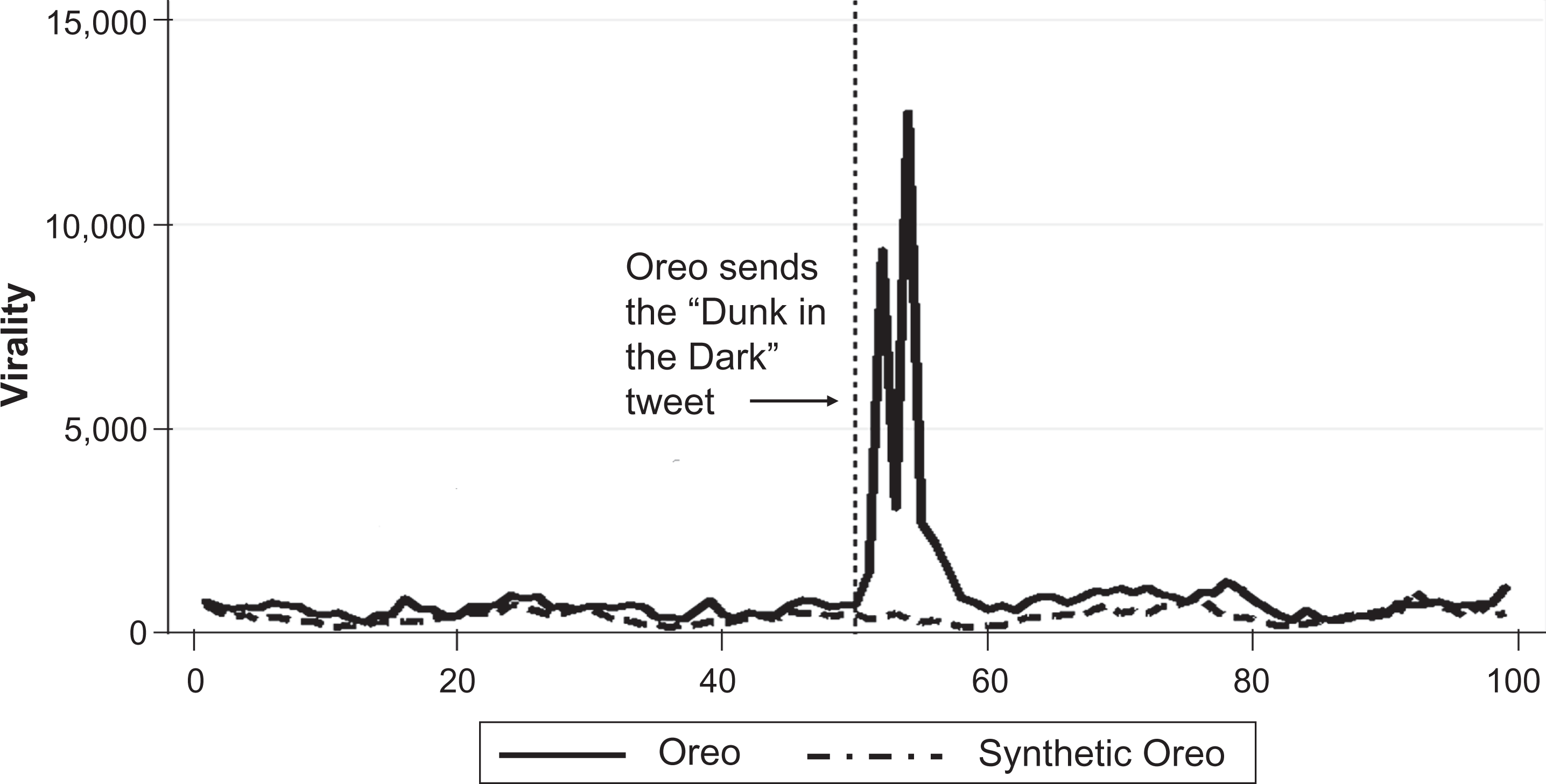
Virality of oreo with the “Dunk in the Dark” IMI versus synthetic oreo without the ‘Dunk in the Dark’ IMI using synthetic control method.
Discussion
Across the two methods employed in Study 1, we find strong evidence that IMI messages generate greater virality than non-IMI messages (H1). Though this study utilizes a within-firm analysis and a synthetic control method to test the relation between IMI and virality, it does not unpack and test the key characteristics of IMI that can drive virality (H2 and H3). To afford greater confidence in the causal connection between IMI and virality and examine the effects of humor paired with timeliness or unanticipation, we turn to an experimental design in Study 2.
Study 2
Study 2 manipulates the humor, timeliness, and unanticipation in IMI messages from a fictitious company in response to a fictitious event. This study enables us to demonstrate that humor is distinct from unanticipation and from timeliness while also controlling for consumers’ heterogeneity, including activeness on social media, general liking of the event, brand familiarity, and demographics. Study 2 also enables us to test the extent to which our findings are unique to IMI and whether unanticipated humor produces a similar virality.
Design and Sample
Eight hundred participants recruited from Amazon Mechanical Turk took part in this study for a prorated equivalent of $8 per hour. Participants who passed our initial screening question (whether they had a Twitter account) were randomly assigned to one of eight conditions in a 2 (humor: high vs. low) × 2 (timeliness: high vs. low) × 2 (unanticipation: high vs. low) between-subjects experiment. Twenty-nine participants failed the attention check (“I’m a living person”; 1 = “strongly disagree,” and 7 = “strongly agree”) by disagreeing with the attention check statement. Thus, our analyses are based on 771 observations (Nfemale = 380 [49.3%]; Mage = 37 years, SD = 11.22). Participants’ average activity on social media (Twitter) was 4.82 (SD = 1.49) on a seven-point scale (“I’m very active on Twitter”; 1 = “strongly disagree,” and 7 = “strongly agree”). As part of this study, participants completed two tasks followed by a survey. The first task asked all participants to watch a short video clip that was about two minutes long (https://www.youtube.com/watch?v=Z7PlUGbsXlQ), which served as the event that would inspire brands to tweet. After watching the clip, participants read a tweet that was pretested (N = 216) as high (or low) in humor and unanticipation (for detailed stimuli information, see Web Appendix C). For the high-timeliness condition, right after watching the clip, participants were told that the assigned tweet was posted by a brand called Wild Foods when the clip was aired on TV. In the low-timeliness condition, after a one-minute break, participants were told that the assigned tweet was posted by Wild Foods quite a while after this clip aired on TV and after many other brands had already tweeted about it. 3
Next, participants rated their willingness to retweet (“I would like to retweet this message”; 1 = “strongly disagree,” and 7 = “strongly agree”). Participants then completed manipulation check measures and rated the IMI’s humor (“The tweet content is humorous,” “The tweet content is funny,” and “The tweet content is hilarious”; α = .96), unanticipation (“The tweet content is very unexpected,” “The tweet content is very surprising,” and “The tweet content is very unanticipated”; α = .94), and timeliness (“The tweet was very timely in response to the video clip,” “The tweet was very speedy in response to the video clip,” and “The tweet was very quick in response to the video clip”; α = .96). We also controlled for participants’ familiarity with the fictitious brand (“I’m familiar with the Wild Foods brand”), familiarity with the video clip (“I’m familiar with the video clip just watched”), liking of the video clip (“I like the clip just watched very much”), and level of activity on social media (“I’m very active on Twitter”) (all anchored by 1 = “strongly disagree,” and 7 = “strongly agree”), as well as gender and age as potential confounds.
Results and Robustness
Manipulation check results
A 2 (humor) × 2 (timeliness) × 2 (unanticipation) analysis of variance (ANOVA) on humor supports the manipulation of humor. As we expected, participants in the high-humor condition rate the IMI’s content as more humorous (Mhigh = 4.59, SE = .08) than in the low-humor condition (Mlow = 3.40, SE = .08; F(1, 763) = 106.57, p < .001, partial η2 = .13). Furthermore, a 2 × 2 × 2 ANOVA on timeliness yields a main effect of timeliness; participants in the high-timeliness condition rate the IMI tweet to be more timely (Mhigh = 5.06, SE = .08) than participants in the low-timeliness condition (Mlow = 3.86, SE = .08; F(1, 763) = 112.17, p < .001, partial η2 = .13). Finally, participants in the high-unanticipation condition rate the IMI’s unanticipation as higher (Mhigh = 4.55, SE = .08) than those in the low-unanticipation condition (Mlow = 3.93, SE = .08; F(1, 763) = 27.50, p < .001, partial η2 = .04). No other significant main or interaction effect emerges (ps > .07).
Hypothesis testing
A 2 (humor) × 2 (timeliness) × 2 (unanticipation) ANOVA on intention to retweet as the dependent variable shows a main effect of humor (Mhigh = 3.97 vs. Mlow = 3.38; F(1, 763) = 17.39, p < .001, partial η2 = .02), timeliness (Mhigh = 3.90 vs. Mlow = 3.45; F(1, 763) = 9.55, p = .002, partial η2 = .01), and unanticipation (Mhigh = 3.84 vs. Mlow = 3.51; F(1, 763) = 5.12, p = .024, partial η2 = .01). Critically, and in line with our theorizing, we find the two pairwise interactions between humor × timeliness (F(1, 763) = 5.17, p < .05, partial η2 = .01) and humor × unanticipation (F(1, 763) = 5.98, p < .05, partial η2 = .01) to be significant, in strong support of H2 and H3. Neither two-way unanticipation × timeliness (p > .96) nor three-way interaction of humor × timeliness × unanticipation is significant (p > .68). To interpret our findings, we plot the line diagrams depicted in Figure 3, Panels A and B. Furthermore, to test whether our findings are unique to IMI or whether unanticipated humor produces similar virality, we compare the number of retweets in the high humor/high unanticipation/high timeliness condition with the number of retweets in the high humor/high unanticipation/low timeliness condition. The results demonstrate that timeliness boosted virality by a significant level. Specifically, participants note a greater willingness to retweet for unanticipated humor that is high in timeliness (M = 4.66, SD = 2.13) than low in timeliness (M = 3.96, SD = 1.92; t(193) = 2.41, p = .017).

Study 2 experiment results.
Discussion
In support of H2 and H3, the two pairwise interactions between IMI’s humor × timeliness and humor × unanticipation affected virality. Furthermore, Study 2 underscores that our findings are unique to IMI and that unanticipated humor does not lead to a similar opportunity for virality. To provide further evidence of H2 and H3 using actual retweet activity of IMI messages in the field, we conducted Study 3a.
Study 3a
Design and Sample
For the purpose of Study 3a we compile a data set of tweets that is comprehensive enough to include brands from several industries and cover a substantial time period. Following Kern (2014), we focus on IMI messages that are (1) related to tent-pole events, which occur at regular intervals (e.g., the Super Bowl, Oscars, Grammys, Winter Olympic Games), (2) related to specific events on established dates for which some details remain uncertain (e.g., messages speculating about which character might get killed in the final episode of the popular TV series Breaking Bad), (3) related to specific events on uncertain dates (e.g., messages related to the birth of a royal baby or the enactment of the marriage equality law in the United States), or (4) related to trending topics addressed by popular Twitter hashtags (e.g., #thedress, #bendgate, and #ruinaraptrack). Using these four criteria for the brands listed in the published Interbrand 100 ranking and most engaged in IMI activities as noted by Kerns (2014), we identified 462 IMI messages from 139 brands across 58 different industries 4 over the six-year period between 2010 and 2015. We compiled an archive of this set of IMI messages by taking a screenshot of each message in our data set and capturing the following information for each tweet: the full text of the tweet, the brand that controlled the Twitter handle, the number of followers of the Twitter handle, the total number of tweets posted from the Twitter handle, the date and time the tweet was posted, and the number of retweets received. We measure our dependent variable (Viralityirt) as the total volume of retweets for each specific IMI from day 1 of year t when the IMI was posted to the end of year t. 5 See Table 4 for a summary of variable definitions and operationalizations, which we detail next.
Constructs, Definitions, and Operationalization in Studies.
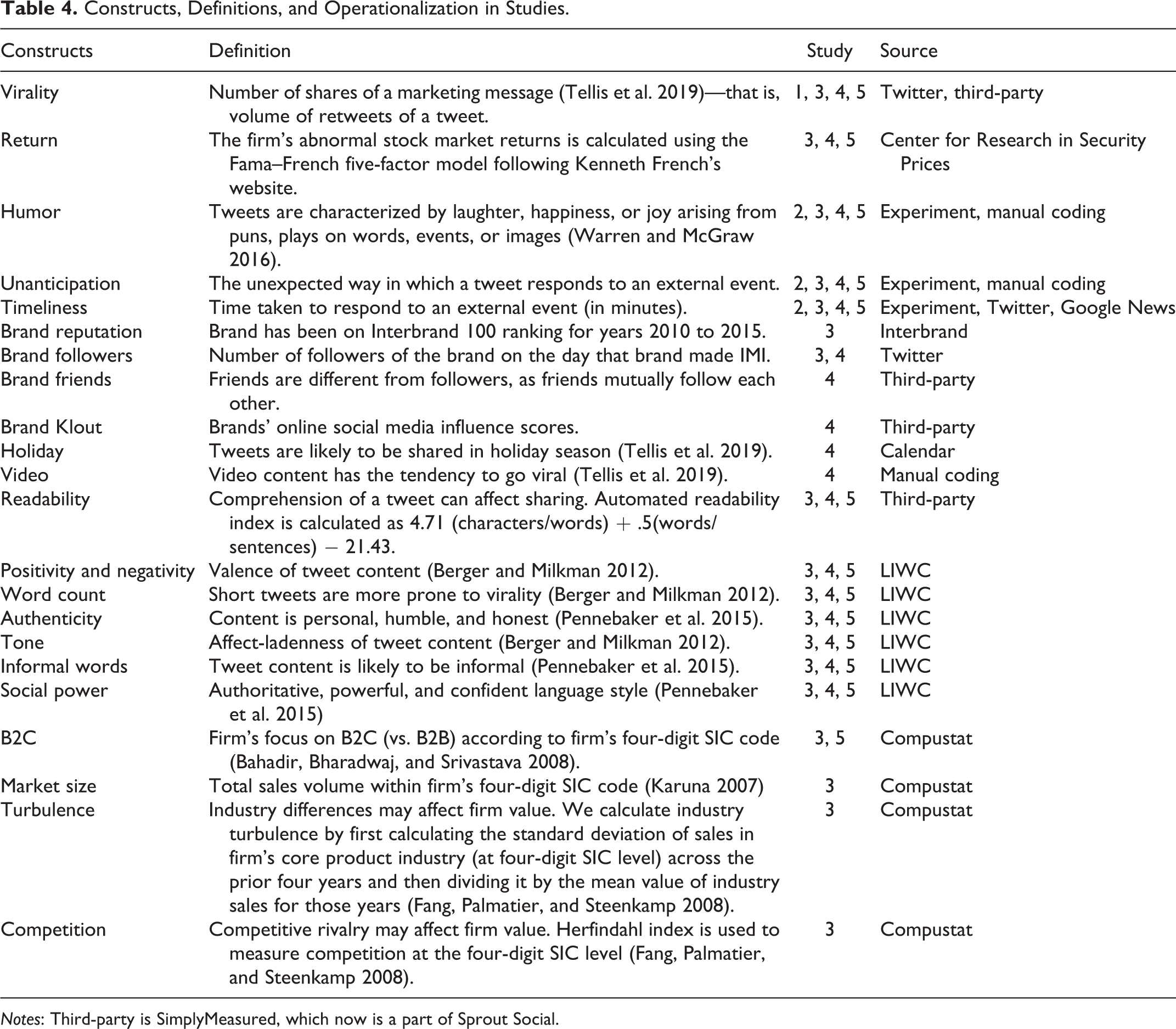
Notes: Third-party is SimplyMeasured, which now is a part of Sprout Social.
Independent measures
We assess IMI messages’ level of humor and unanticipation following well-established procedures for textual coding (Berger and Milkman 2012; Pang and Lee 2008). We rely on human coders to classify the extent to which the content exhibited specific characteristics (i.e., humor and unanticipation) because automated coding systems are not available for these variables. The coders were blind to the study’s hypotheses. We recruited one industry practitioner and one researcher who independently rated the 462 IMI messages’ humor and unanticipation. They received the text and creation time of each tweet, a web link to the tweet’s full text, and coding instructions (for details, see Web Appendix D). An IMI message’s level of humor is measured with a seven-point scale, ranging from 1= “serious” to 7= “humorous.” Tweets with content that is earnest or formal or has gravity are coded as serious, whereas tweets with content that is funny, jocular, or light-hearted are coded as humorous (Tucker 2015). The IMI messages’ level of unanticipation is measured with a three-point scale, ranging from 1 = “low” to 3 = “high.”
First, we selected a random set of tweets unrelated to the selected sample for the coders to practice (N = 80). We explained the coding scales and engaged in extensive coder training using the 80 tweets unrelated to the selected sample. Coders discussed the results of the test cases. We reviewed discrepancies and clarified the definitions to minimize future discrepancies in the coding of the actual IMIs used in the study. We then gave coders copies of each of the IMIs that composed our sample. Overall, intercoder agreement for both the coding of humor and unanticipation was high (rs ≥ .70). Disagreements between the two coders were resolved through discussion. The computed intercoder agreement was based on the correlation between the ratings of the two coders (Landis and Koch 1977). We capture timeliness as the time passed (in minutes) between the occurrence of the event and the IMI tweet. We determine the exact event time by first using the creation date of the IMI message as an anchor. We then search on Google News, customizing our search date range to two days before and two days after the creation date of the IMI message. Figure WA5 in Web Appendix D displays the histogram of timeliness for this study. We reverse-code the timeliness measure for our empirical tests so that a higher level means more timely for ease of interpretation.
Control variables
We incorporate several key control variables that can affect virality. First, consumers might be more prone to share messages from well-reputed brands (Tellis et al. 2019). Thus, we control for brand reputation by including an indicator variable for brands listed in the Interbrand 100 ranking for the year of the IMI tweet. Second, because a large base of brand followers will be more likely to share messages than a smaller base of followers (for “brand fan following,” see Colicev et al. 2018), we capture the number of the brand’s Twitter followers. We also control for the notion that business-to-consumer (B2C) firms might be more adept than business-to-business (B2B) firms in using social media, following Srinivasan, Lilien, and Sridhar’s (2011) classification of firms into B2C and B2B categories. In addition, we control for the various types of content within the tweet. First, comprehension of a tweet can affect users’ sharing. Thus, we use an index that measures readability. Specifically, we use the automated readability index; the formula for the measure is: 4.71(characters/words) + .5(words/sentences) – 21.43. Second, we use LIWC to count the percentage of positive, negative, and informal words (Herhausen et al. 2019; Pennebaker et al. 2015), as sentiment and informality of the tweet could influence sharing. Third, because the level of authenticity and tone of the language used in a tweet might influence virality, we account for these characteristics of content in the tweet using the LIWC dictionary. Fourth, we control for tweet length by the number of words used in the tweet, as short responses may be more prone to virality. Fifth, we also take the square of the tweet length to account for the idea that very short or long tweets may lead to less virality.
Model
We use the following specification for the model:

where Viralityirt is the number of retweets for IMI r posted by brand i at time t; Humorirt indicates the humorousness of IMI r posted by brand i at time t; Timelyirt is the timeliness of IMI r posted by brand i at time t, which is calculated as minutes between tweet post time and event time; Unanticipateirt represents the unanticipation of IMI r posted by brand i at time t; Controlirt is an array of variables for IMI r by brand i at time t; and the error term ∊irt captures unexplained variation in Viralityirt. We also control for brand-level heterogeneity to account for brand-level unobservables, and we control for month and year effects because the level of tweeting and virality may differ depending on the year and month the tweets were posted.
Results and Robustness
Descriptive statistics and correlations for the variables that appear in Equation 2 are in Web Appendix E. Multicollinearity is not a concern, and the variance inflation factor for the model is under 5. Multicollinearity is not a concern for every other regression specification that we estimate, as the variance inflation factor is under 10 for Studies 3b–5b. Table 5, Panel A, shows the results after estimating Equation 2. The dependent variable is the number of retweets for each IMI. We find a significant and positive interaction effect between humor and timeliness on virality (4.52, p < .05) as well as a positive and strong significant interaction between humor and unanticipation (12,991.59, p < .05) in support of H2 and H3, respectively.
The Effect of IMIs on Virality and Returns (Study 3).

*p < .05.
**p < .01.
***p < .001.
a N = 462; brand, year, and month fixed effects.
b N = 123 (3 observations had missing data for some of the independent variables in the model); brand and year fixed effects.
Notes: t-statistics in parentheses; N.A. = not applicable.
Discussion
Study 3a offers descriptive evidence of the significant effects of IMI’s humor × timeliness and humor × unanticipation on virality of IMI messages from 139 brands across 58 different industries over a six-year period. We next test whether these effects carry over to an objective measure of firm performance (i.e., firm value captured by a firm’s stock market abnormal returns). Study 3b thus tests H4 and H5.
Study 3b
Design and Sample
We use the event study method (Sorescu, Warren, and Ertekin 2017) to test H4 and H5. The event study approach builds on the efficient market hypothesis that states that any change in the stock price due to the arrival of new information reflects the present value of all expected current and future profits from that new information (Fama 1998; Sharpe 1964). We collect stock returns data for the firms owning the brands that tweeted the IMI messages in Study 3a between 2010 and 2015 from the Center for Research in Security Prices. The initial sample is 462 IMIs from 139 unique brands. As we can only run an event study on publicly listed firms, we drop 17 brands (and 38 IMIs) that are owned by private firms. Our sample thus consists of 424 IMIs across 122 unique brands.
Assuming efficient information processing of the IMI message, “an event window should be as short as possible” (McWilliams and Siegel 1997, p. 636). Because the market should incorporate IMI message information quickly, we use the window ranging from four days before and after the event to calculate the abnormal returns. In addition, we control for an array of confounding events around the nine-day window, including declarations of dividends, contract signings, earnings information, or mergers and acquisitions. We use a window of nine days because measurement windows of up to ten days have been used in prior research (Kalaignanam and Bahadir 2013; Sorescu, Shankar, and Kushwaha 2007; Tellis and Johnson 2007) and also to ensure that an announcement not related to IMI announced four days before the event does not spill over to the returns on the event day and beyond. We drop any observations with confounding events within the nine-day IMI window, which we identify from the Capital IQ, Factiva, and LexisNexis databases and various online sources. We thus exclude 298 IMI tweets due to potential confounds. In the end, we retain 126 IMI tweets from 67 unique brands that posted IMI messages. For a summary of the definitions and operationalization of the independent and control variables for this study, see Table 4. Almost all of the control variables in Study 3a are used in this study, too, but we drop the square of the length of the tweet as the variable does not add to the model’s explanatory power (i.e., adjusted R2 is lower than the model without the square of the tweet length because its t-statistic is below 1). Moreover, we control for competitive effects by including the turbulence and competition in the industry in which the brand operates using the measure used by Fang, Palmatier, and Steenkamp (2008). We also control for the size of the company by the market size (Karuna 2007). We use the SIC code for the three aforementioned variables. Finally, we control for the year of the tweet. The descriptive statistics and correlations appear in Web Appendix E.
Model
We calculate the abnormal stock returns using the Fama–French five-factor model (Fama and French 2016; for details, see Web Appendix F). We use the term “returns” to refer to cumulative average abnormal returns (CAAR). Next, we determine an appropriate event window (t1, t2) that is long enough to ensure the dissemination of information regarding the IMI message (Swaminathan and Moorman 2009). Therefore, we calculate returns for alternative event periods, each ranging from t1 to t2 to CAARi (−t1, t2). Our model is as follows:

where subscripts i, r, and t have the same interpretations as in the model formulation in Study 3a.
Results and Robustness
We begin by analyzing market responses for the focal IMIs (see Table 6, Panel A). We obtain positive returns for the (−1, 0), (0, 0), and (−2, +2) windows; however, these returns are not significant. The event window with the highest t-value and absolute value is the event day (0, 0) window. Thus, consistent with previous research, we use this window for all analyses (i.e., CAAR [0, 0]; Raassens, Wuyts, and Geyskens 2012).
Univariate Results of IMI Dimensions on Returns.

The effect of the IMI message for focal firms is positive but not significant for the (0, 0) window (.09%, p > .05). However, our main emphasis is to understand if the interactions of humor and timeliness or unanticipation can lead to a significant increase in returns.
Our first focal interaction is the coefficient of tweet humor × tweet timeliness, which we find to be positive and significant (.000014, p < .05) (Table 5, Panel B), in support of H4. Furthermore, we find the coefficient humor × unanticipation to be positive and significant (.01, p < .05). This result supports H5.
Discussion
Employing the event study approach, Study 3b offers descriptive evidence for the significant influence of IMI’s humor × timeliness and humor × unanticipation on firm value. However, both Studies 3a and 3b did not include non-IMI tweets, and our results may be biased by this selection and analysis of only IMI tweets. Thus, we conduct a new set of studies (Studies 4a–5b) in which we analyze both IMI and non-IMI tweets to test H2, H3, H4, and H5.
Study 4a
Design and Sample
We obtain a corpus of every tweet sent by ten airlines operating in the United States (Alaska Airlines, American Airlines, Delta, Frontier Airlines, Hawaiian Airlines, JetBlue Airways, Southwest Airlines, United Airlines, US Airways, and Virgin America) over a two-month period (December 1, 2013, to January 31, 2014) from a third-party data provider called SimplyMeasured, which is now a part of Sprout Social. 6 For the two-month period, we focus on tweets with text and photos or videos for two reasons. First, we want to capture multimedia IMI tweets, which are more conducive to virality (Akpinar and Berger 2017; Tellis et al. 2019; Tucker 2015). Second, we want to make the coding of the IMI characteristics manageable because the coding is done by human raters. It is a nontrivial task to code three constructs for more than 10,000 tweets from these ten airlines over our sample time period. This sampling strategy led to a sample of 692 tweets that had text with either a photo or a video. From this sample, we dropped 460 tweets as they were either retweets or replies. We thus had a final sample of 232 tweets, out of which 68 were IMI and 154 were non-IMI. 7 Following the same coding procedure that we used in Study 3, we captured each tweet’s humor, timeliness, and unanticipation, as well as a set of control variables that could affect virality for our empirical analysis. Intercoder reliability was again high on all dimensions (all rs ≥ .70). Web Appendix E lists correlations and descriptive statistics for the variables in this study.
Model
We use a panel regression and the vce (cluster brand id) option to account for clustering by brand. We estimate the model that includes the main effects of IMIs, humor, timeliness, and unanticipation and the interactions of humor and timeliness, humor and unanticipation, and timeliness and unanticipation for IMI tweets, following the specification used in prior studies (Rao, Chandy, and Prabhu 2008). However, we also include the humor construct for non-IMIs. We do not use the constructs of unanticipation and timeliness for non-IMIs because, by definition, these constructs are specific to IMIs. Thus, we multiply the main and two-way interactions of humor, timeliness, and unanticipation by IMIs. We specify the following model for testing our hypotheses using virality generated for brand i as the dependent variable on the focal independent variables along with brand-specific control variables:

where Viralitycit is the number of retweets (at end of 24 hours from time t) for tweet c posted by brand i at time t; IMIcit indicates that tweet c is an IMI posted by brand i at time t; Humorcit indicates the humorousness of tweet c posted by brand i at time t; Timelyci t indicates the timeliness of tweet c posted by brand i at time t; Unanticipatecit indicates the unanticipation of tweet c posted by brand i at time t; and θcit indicates the error term. δ5 and δ6 are the focal coefficients that test H2 and H3, respectively. ControlVarcit is an array of control variables to ensure that our point estimates are unaffected by any omitted variable bias. Along with the same set of control variables that are related to the content of the tweet in Study 3a, we control for tweet type (photo, video), the brand’s number of followers, friends, and Klout score (an often-used score for measuring the influence of a social media entity); tweet seasonality using an indicator variable with the value of 1 for the dates from December 22 to January 4 because the time period of the study overlaps with the holiday season, and 0 otherwise; a year dummy to account for macro trends; hour-of-the-day dummies to control for variation in virality by hour; and day-of-the-week dummies to control for differences during work days and weekends. Our results are the same if we omit these time-related variables.
Results and Robustness
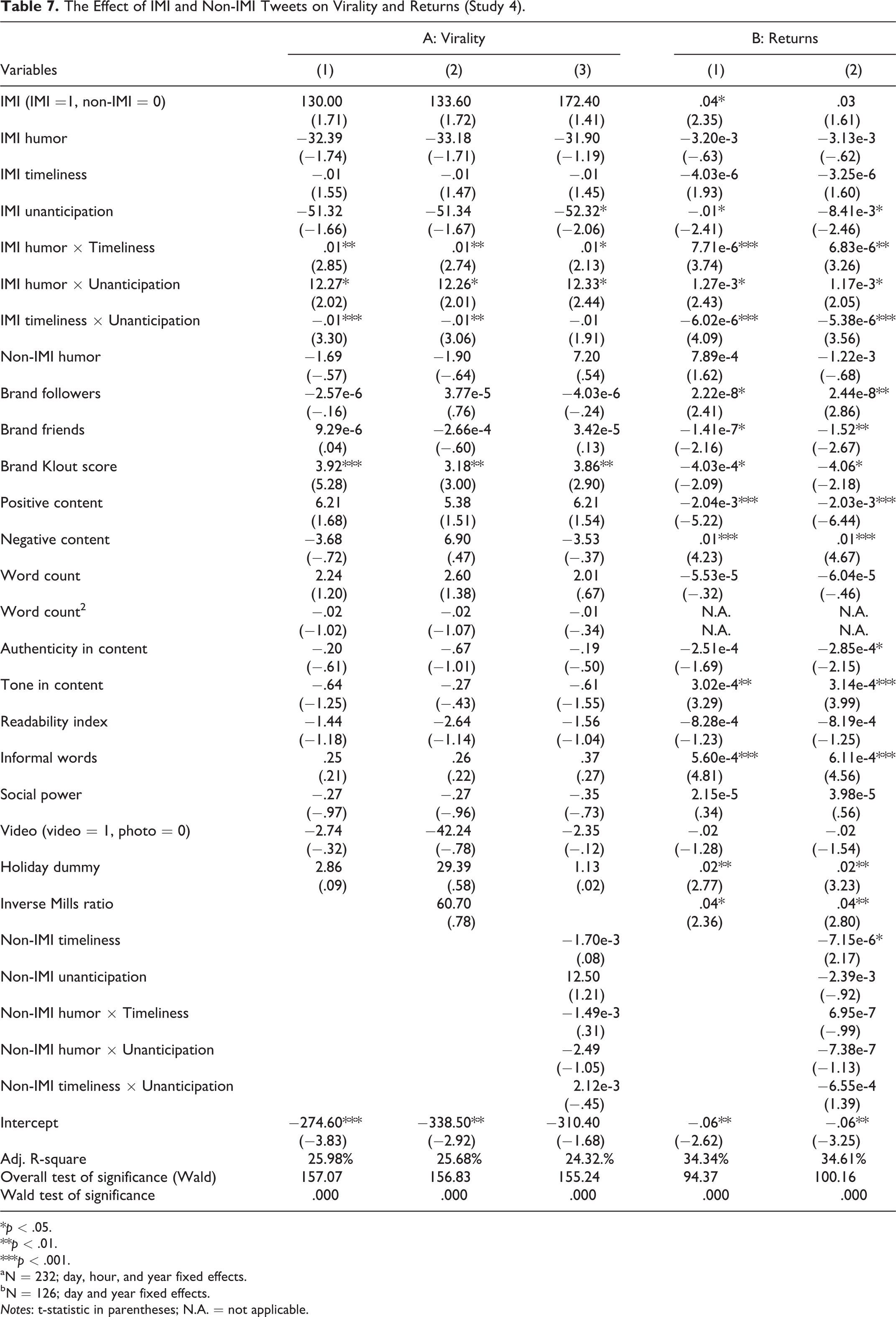
Table 7, Column A displays the results in three models. In Model 1, we find that the interaction of humor and timeliness is positive and significant for IMI tweets (.01, p < .01), in support of H2, and the interaction of humor and unanticipation is positive and significant for IMI tweets (12.27, p < .05), in accord with H3. We correct for self-selection in the choice to send out IMI tweets by choosing the predictors for the selection equation carefully and ensuring that we fulfil exclusion restrictions. We fulfil the exclusion restriction by having at least one variable (i.e., IMI intensity by nonfocal firm) in the selection equation (Table WA10 in Web Appendix G) that does not appear in the substantive Equation 4. Doing so facilitates model identification while correcting for sample selection. Thus, our results are robust to selection bias. Details of the selection model are in Web Appendix G, and coefficient estimates are in Table 7, Column A, Model 2, again supporting H2 and H3. The inverse Mills ratio is not significant (60.70, n.s.).
The Effect of IMI and Non-IMI Tweets on Virality and Returns (Study 4).
*p < .05.
**p < .01.
***p < .001.
a N = 232; day, hour, and year fixed effects.
b N = 126; day and year fixed effects.
Notes: t-statistic in parentheses; N.A. = not applicable.
To empirically address any potential shortcoming of the noncomparison between IMI and non-IMI, we run a regression including the interactions of humor and timeliness and humor and unanticipation for both IMI and non-IMI. Thus, we use the following specification:

We measure unanticipation for non-IMI following the same coding structure as for IMI in Study 3. For non-IMI’s timeliness, we use the average timeliness for each airline. Table 7, Column A, Model 3 displays the effects. We find that the interaction of humor and timeliness is positive and significant for IMI tweets (.01, p < .05), in support of H2, and the interaction of humor and unanticipation is positive and significant for IMI tweets (12.33, p < .05), in accord with H3. Thus, our results are robust even when we include non-IMI constructs.
Discussion
Study 4a shows that the significant interaction of humor and timeliness and the interaction of humor and unanticipation on virality persist even after we include non-IMI tweets. In Study 4b, we next explore whether our two interactions of interest significantly affect firm value even if non-IMI tweets are included in tests of H4 and H5.
Study 4b
Design and Sample
We use the event study method utilized in Study 3b to test H4 and H5 and use the same data employed in Study 4a. The initial sample is 232 tweets from ten unique airlines. As we can only run an event study on publicly listed firms, we drop two private firms. Our sample thus consists of 188 IMIs across eight unique firms. Using the same procedure as in Study 3b for confounding events, we exclude 62 tweets due to potential confounds. In the end, we retain 126 tweets from eight unique firms. We use the same control variables that are utilized in Study 4a but drop the square of the length of the tweet as reasoned previously. The descriptive statistics and correlations appear in Web Appendix E.
Model
We calculate the abnormal stock returns using the Fama–French (2016) five-factor model and use the term “returns” to refer to cumulative average abnormal returns.
Results and Robustness
Univariate analysis on returns
We begin by analyzing market responses for the eight focal firms, (see Table 6, Panel B). We obtain positive returns for the (0, 0), (0, +1), and (−1, +1) windows; however, these returns are not significant. The event window with the highest t-value (.88) and absolute value (.10%) is the event day (0, +1) window. Thus, we use this window for the subsequent analyses (i.e., CAAR [0, +1]).
On the one hand, the effect of the IMI message on returns for focal firms is positive and significant for the (0, +1) window (.36%, p < .05, one-tailed test). On the other hand, the effect of the non-IMI message on returns for the (0, +1) window is negative, albeit not significant (−.04%, p > .62, one-tailed test). We find a significant difference between IMI and non-IMI tweets such that IMI tweets generate .40% higher returns than non-IMI tweets (t(126) = 1.67, p < .05, one-tailed test).
Multivariate analysis of IMI dimensions on returns
The model formulation is similar to Equation 4, with the dependent variable now being “returns” rather than virality and including the inverse Mills ratio calculated for Study 4a. As we show in Table 7, Column B, Model 1, our first focal interaction is the coefficient of humor × timeliness for IMI tweets. We find this interaction to be positive and significant (.00000771, p < .001), which supports H4. Furthermore, we find the coefficient humor × unanticipation (.00127, p < .05) to support H5.
Robustness tests
We also estimate Equation 5 replacing virality with returns and including the interactions of humor and timeliness and humor and unanticipation for non-IMI tweets. Our results hold after inclusion of these interactions (see Table 7, Column B, Model 2).
Discussion
Study 4b offers additional evidence for the significant influence of IMI’s humor × timeliness and humor × unanticipation on firm value when including non-IMI tweets. However, one wonders whether the results generalize to other industries, using newer data, and examining a broader set of tweets that include text, links, videos, and images. We thus conduct Studies 5a and 5b.
Study 5a
Design and Sample
We randomly select a sample of 5% of the firms listed in the S&P 500 to test H2 and H3. The detailed list of firms is in Web Appendix H. These firms span industries ranging from energy to information technology. We collect every tweet sent out by these firms for the month of April 2019. Note that, again, we did not extend the time frame and sample because it is a nontrivial task to code the characteristics of IMI for more than 1,000 tweets. This sampling strategy led to a total of 470 tweets sent (out of which, 100 were IMI and 370 were non-IMI). Following the same coding procedure that we used in Study 3, we captured the tweet’s humor, timeliness, and unanticipation, as well as a set of control variables that could affect virality for our empirical analysis. Intercoder reliability was again high on all dimensions (all rs ≥ .70). Web Appendix E lists correlations and descriptive statistics for the variables in this study.
Model
We run the same model utilized in Study 4a to estimate the effects. We include the same content-based control variables in Study 4a but also include the industry type (i.e., B2C vs. B2B), as B2C firms may tweet differently than B2B firms. We also include the inverse Mills ratio in this specification (for the details of the calculation, see Web Appendix I).
Results and Robustness
Table 8, Column A, Model 1, displays the results. We find that the interaction of humor and timeliness (.02, p < .05) supports H2, and the interaction of humor and unanticipation (391.90, p < .05) supports H3.
The Effect of IMI and Non-IMI Tweets on Virality and Returns (Study 5).

*p < .05.
**p < .01.
***p < .001;
a N = 470; day and hour fixed effects.
b N = 226; day fixed effects.
Notes: t-statistic in parentheses; N.A. = not applicable.
Robustness tests
Following Study 4a, we also include the interactions of humor and timeliness and humor and unanticipation for IMI and non-IMI (see Equation 5). The focal results remain consistent after inclusion of these interactions (Table 8, Column A, Model 2).
Discussion
Study 5a includes non-IMI tweets and shows that the significant interaction of humor and timeliness and the interaction of humor and unanticipation on virality persist even after inclusion of non-IMI tweets for a random sample of S&P firms across different industries, for every type of tweet, and for relatively newer data. As in Study 4b, we next explore whether our two primary interactions of interest significantly affect firm value. Thus, Study 5b tests H4 and H5.
Study 5b
Design and Sample
The initial sample is 470 tweets. We exclude 244 tweets due to potential confounds across the nine-day window of a tweet. We hence use 226 tweets for the analysis.
Model
Similar to the former studies, we use the abnormal stock returns using the Fama–French (2016) five-factor model and use the term “returns” to refer to cumulative average abnormal returns. Note that we do not include firm- or competition-based measures such as size and turbulence, respectively, because these measures do not vary within a month and are captured by the firm fixed effect that we include in the model.
Results and Robustness
Univariate analysis on returns
We begin by analyzing returns (see Table 6, Panel C). We obtain positive returns for the (0, 0), (−1, 0), (0, +1), (−1, +1), and (−4, +4) windows; however, these returns are not significant. The event window with the highest t-value (1.42) and absolute value (.07%) is the event day (−1, 0) window. Thus, we use this window for the subsequent analyses (i.e., CAAR [−1, 0]). Next, the effect of the IMI message on returns for focal firms is positive and significant for the (−1, 0) window (.29%, p < .01, one-tailed test). On the other hand, the effect of the non-IMI message on returns for the (−1,0) window is positive albeit not significant (.04%, p > .24, one-tailed). We find that IMI tweets generate .40% higher returns than non-IMI tweets (t(126) = 2.24, p < .05, one-tailed test).
Multivariate analysis of IMI dimensions on returns
We use the same control variables that are utilized in Study 5a but drop the square of the length of the tweet as reasoned previously. The descriptive statistics and correlations are shown in Web Appendix E. Our first focal interaction is the coefficient of humor × timeliness for IMI tweets (.0000239, p < .001) (Table 8, Panel B, Model 1), in support of H4. Furthermore, we find the coefficient humor × unanticipation for IMI tweets to be positive and significant (.24, p < .01), in support of H5.
Robustness tests
Similar to Study 4b, we also estimate Equation 5, replacing virality with returns and including the interactions of humor and timeliness and humor and unanticipation for non-IMI tweets. Our results hold after inclusion of these interactions (see Table 8, Column B, Model 2).
Discussion
Study 5b offers evidence of the significant influence of IMI’s humor × timeliness and humor × unanticipation interactions on firm value after including non-IMI tweets across a random sample of S&P 500 firms from an array of industries using newer data and examining a broader set of tweets that include text, links, videos, and images.
Overall, across the five studies that span different methods utilizing archival and experimental data, we find evidence that an IMI generates virality and leads to a significant boost in virality compared with a non-IMI, and that IMIs characterized by humor and timeliness or unanticipation can enhance virality and firm value.
General Discussion
Digital advertising has grown considerably and is projected to account for more than 50% of total advertising spending in industrial economies by 2020 (eMarketer 2018). Yet consumers often say that social media ads are overwhelming, repetitive, and irrelevant (Gitlin 2016). Against the backdrop of consumer advertising fatigue, the current research about IMI highlights a set of novel and important findings that advance marketing theory and practice. We believe IMI’s potential for virality and greater firm value are relevant for any firm wishing to achieve greater exposure and increase visibility to consumers and positively influencing the stock market.
Implications for Research
This article makes several important contributions. Despite calls to study marketing events that happen in real time, no prior research has rigorously defined such marketing interventions. We introduce a formal definition of fast, mass-market (not customer-specific) responses to external events. To date, the role of improvised composition and execution of a real-time marketing intervention proximal to an external event in generating virality and adding to firm value has remained unexplored. Our study of IMI theorizes and articulates its essential characteristics and analyzes the opportunity for virality and enhanced firm value.
Indeed, there have been calls to study phenomena such as IMI from a wide array of sources—scholars and editors of scholarly journals (Akpinar and Berger 2017; Lamberton and Stephen 2016; Pauwels, Aksehirli, and Lackman 2016) as well as business publications such as The Economist and Financial Times. Thus far, however, such studies have been fairly rare in the marketing literature. In addition to defining IMI, we theorize and begin to examine its potential influence of IMI and its key characteristics on virality and firm value. We use an array of unique and varied data sets, designs, and methods to estimate this influence. This article’s provocative findings serve as the basis for further research on the dynamic and important yet poorly understood IMI marketing phenomenon, and on its influence on virality and firm value—thus addressing an important real-world marketing problem.
We use quick wit to advance the idea that IMI may help businesses reach out to and connect with an audience that is increasingly tired and wary of advertising messages. Thus far, the impact of humorous IMIs timed early in relation to an external event or tinged with unanticipation has not been well understood. The current research thus develops new theory about the critical role of a dose of humor, which only generates virality and firm value, if it is paired with timeliness or unanticipation. Specifically, while existing theory helps us understand the relevance of humor in day-to-day human interactions, we extend the theory on communication, consumer online engagement, and firm value by theorizing the relevance of quick wit in the context of ongoing events. Thus, our work adds to current theory by advancing that quick wit enables businesses to stay relevant, be part of, and—more critically—be a proactive driver of the ongoing discourse and of individuals’ thought processes.
Our finding about IMI’s impact on firms’ abnormal returns also encourages future researchers to examine other novel marketing activities in the digital and mobile realm and attempt to show the financial impact of these marketing activities.
Marketing Implications
In addition to advancing theory, our work on IMIs has critical implications for managers. Many managers believe that a firm’s marketing message is best preplanned well ahead, organized, and 100% under the control of the firm. The potential advantages of such an approach are well understood. However, this strategy can also lead to a brand being seen as out of touch, distant from its target audience, and failing to capture the zeitgeist, or trends, feelings, and ideas that are typical at the time.
Our results encourage marketing managers to carefully consider not what they say but, importantly, how and when they say it using social media. Often, in-house marketing teams lack the responsiveness and latitude to trade on the opportunity presented by a current event and tie their brand message to the event for maximum impact. We highlight this hidden opportunity for managers to spot trends and utilize those trends to seed advertising campaigns that can become viral. Numerous brands have yet to discover the potential of this marketing method. We encourage firms to empower marketing teams with the latitude to keep a close eye on trends and spontaneous chatter, and to quickly formulate witty messages in response to these events. Because people employed in marketing departments do not have advance knowledge of some of these events, they need to be empowered to react spontaneously. We acknowledge that this flexibility may necessitate relinquishing some level of control over the message at times, and it is possible that a marketing team may hit the “send” button too quickly. It is important that firms identify the right employees to execute IMI (e.g., their sense of humor and timing should be on point and not offensive). Nightmarish examples abound of consumer backlash against a brand’s own social media posts when the brand reputation is fragile (Cheng 2018). However, given the right employees who are empowered to act, not only do IMI messages around current events create potential for enhanced brand awareness and greater financial returns, but also they may cost a fraction of the advertising expenses for sponsoring events like the Summer Olympics or World Cup. Furthermore, we determine the extent to which the characteristics of IMI affect not only perceptual metrics such as virality but also the objective metrics of a firm’s stock returns—a metric that is of immense interest to a firm’s managers and shareholders. Today, social media platforms such as Twitter constitute an additional, significant source of novel information for investors.
Managers often believe that the only time they can influence stock market investors is when the firm releases its quarterly or monthly sales reports. Our findings show that IMIs can provide investors with instantaneous, critical information about the firm’s marketing performance in social media and its marketing capability. Drawing on Study 3b data, we find that an IMI with high humor and high unanticipation can generate $5.1 million, on average, in market capitalization while high humor and high timeliness can generate $3.1 million, on average, in market capitalization. These figures are comparable to prior analysis on the dollar impact of online reviews (Tirunillai and Tellis 2012). Firms are encouraged, then, to make use of IMI messages by using humor paired with timeliness and unanticipation, as these messages can influence investor behavior and subsequently the stock market. Ultimately, managers need to consider IMI proactively to be part of and shape the current zeitgeist—rather than be driven by it—and to achieve greater virality and generate stronger stock market returns.
Future Research
This work has several limitations, which reflect opportunities for further research. First, our theorizing on quick wit is general in scope and applies to a variety of marketing communications and social media. Our empirical context, however, is limited to Twitter, a single social media platform. Although it helps alleviate concerns regarding platform-level heterogeneity and thus enhances the internal validity of our study, a promising avenue for future research is to study IMI’s role in driving virality and firm value across other social media platforms and modes of communication and investigate whether one channel can have spillover effects on the other. Second, we use only one measure of virality: retweets. Future research might create a more complete empirical picture by testing other, more explicit and fine-grained measures of virality (e.g., number of shares by early propagators). Third, while our findings may inform “social media war rooms” (e.g., the 2019–2020 U.S. Democratic primary debates), one wonders about IMI’s effect when it relates to events that have a very negative valence (e.g., earthquakes, wildfires) or has very low fit with the parent brand’s image. Fourth, across all the models, we did not find a significant and positive main effect of humor on either virality or firm value (see Web Appendix J). Thus, our findings indicate that stand-alone humor cannot drive virality or firm value for IMI but must be paired with timeliness or unanticipation. This is a thought-provoking finding, and we invite future research to examine reasons for why humor alone does not have a significant influence on virality or firm value for IMIs. In addition, it would be interesting to examine whether aspects other than humor paired with timeliness and unanticipation could achieve virality for other types of firm-generated content. Fifth, we speculate that our effects on firm value might be driven by investors reacting to the possibility of IMI to generate virality, as we control for selection in Studies 4 and 5. However, it might be an interesting avenue for future scholars to examine the contingent effect of brand confidence and employee empowerment on the relationship between IMI and firm value. Finally, although the context of our study is social media, our findings may generalize to traditional media contexts (e.g., radio, digital billboards, electronic signs, personal selling) as well. Additional research on IMIs and the conditions in which they are most effective will shed greater light on this important phenomenon.
Supplemental Material
Supplemental Material, jm.18.0503-File003 - Improvised Marketing Interventions in Social Media
Supplemental Material, jm.18.0503-File003 for Improvised Marketing Interventions in Social Media by Abhishek Borah, Sourindra Banerjee, Yuting Lin, Apurv Jain and Andreas B. Eisingerich in Journal of Marketing
Footnotes
Acknowledgments
The authors thank the editor, associate editor, and anonymous reviewers for their excellent feedback and insightful guidance.
Associate Editor
Koen Pauwels
Declaration of Conflicting Interests
The author(s) declared no potential conflicts of interest with respect to the research, authorship, and/or publication of this article.
Funding
The author(s) received no financial support for the research, authorship, and/or publication of this article.

Notes
References
Supplementary Material
Please find the following supplemental material available below.
For Open Access articles published under a Creative Commons License, all supplemental material carries the same license as the article it is associated with.
For non-Open Access articles published, all supplemental material carries a non-exclusive license, and permission requests for re-use of supplemental material or any part of supplemental material shall be sent directly to the copyright owner as specified in the copyright notice associated with the article.
