




Abstract
Like Cinderella, many repurposed products involve a biographical transformation, from a tattered past identity (e.g., an old airbag) to a product with a valuable but different new identity (e.g., a backpack made from an airbag). In this article, the authors argue that marketers should help customers infer such product stories by highlighting the products’ tattered past identities. Three field experiments and four controlled experiments show that making a product’s past identity salient boosts demand across a variety of repurposed products. This is because past identity salience induces narrative thoughts about these products’ biographies, which in turn allows customers to feel special. Results also suggest that this strategy of past identity salience needs to be particularly well-crafted for products with easily discernible past identities. These findings highlight a promising new facet of storytelling (i.e., stories that customers self-infer in response to minimal marketer input); create new opportunities for promoting products with a prior life; and deliver detailed guidance for the largely unexplored, growing market for upcycled and recycled products.
Keywords
A worn-out airbag becomes a backpack. A leaky boat turns into a table. An old mosquito net transforms into a laptop sleeve. Product biographies that entail transformations from an old past identity to a new product identity are characteristic of production modes that involve the repurposing of old or dysfunctional products into new products. These include recycling, which is already common practice (Winterich, Nenkov, and Gonzales 2019), and upcycling, which is gaining in popularity (Petro 2019; Wilson 2016). For instance, a search on Instagram for upcycling yields over 1 million results, and the upcycled offers on the online marketplace Etsy have increased by 1,000% since 2011, with Etsy now featuring more than 300,000 different upcycled products in the United States alone. Many established companies, such as the outdoor brand Patagonia or the fashion retailers ASOS and Urban Outfitters, have also started to operate in this domain.
However, when companies offer new products manufactured from old or waste products, how can they ensure that customers will demand these products? In this article, we show how the unique properties of repurposed and transformed products illustrate a novel way of storytelling in marketing. Unlike conventionally produced goods, such products have both a clear past and present product identity. Although they may vastly diverge in their form and purpose, both identities are embodied in the product. We argue that the past identity of a repurposed product amounts to the starting point of its biographical story of transformation, and that this holds storytelling potential. We refer to this strategy of alerting customers to a product’s past identity as “past identity salience” and argue that it increases demand because it triggers narrative product thoughts and allows customers to feel special with the storied product. Notably, the past identity involves a waste product (e.g., a broken mosquito net) that may not serve the product’s current primary function (e.g., a wallet made from a broken mosquito net). Even though a product’s past identity is effectively useless (and potentially even disgusting), we suggest that marketers highlight it because it unlocks the product’s storytelling potential.
Results of three field experiments, four experiments conducted in controlled settings, and several replication studies support these claims. Our evidence pertains to different proxies of demand, stretches across multiple product categories and past identities, holds at both the store and product level, and emerges across different methods of making the past identity salient. We rule out several alternative accounts (perceived environmental friendliness, interestingness, surprise, originality, authenticity, a handmade effect, and informational value) and deduce two relevant boundary conditions. When a mere glance at the product allows customers to discern its past, simple appeals to the past identity do not further increase demand. Moreover, making the past identity salient only increases demand if the product had a prior life—and thus, a starting point of its biographical story. This applies to upcycling and the closely related practice of recycling (Mobley et al. 1995; Winterich, Nenkov, and Gonzales 2019) but not to conventionally produced products.
The present research offers important contributions to the storytelling literature in marketing. First, we show that marketers can utilize products’ own biographical stories rather than craft stories around product use or brand values, which dominate existing practices (Adaval and Wyer 1998; Escalas 1998; Sanders and Van Krieken 2018; Van Laer et al. 2014). Second, and in line with the story-prone nature of the human mind (Boyd 2009; Bruner 1990), we show that storytelling does not require explicit detail. Simple cues suffice for customers to note the presence of a story and essentially tell it to themselves (Herman 2004). Notably, we show that this boosts demand even if the starting point of these stories is prosaic, such as a past identity as a mundane pallet or an old mosquito net. Third, and drawing on the finding that storied objects are deemed special (Glenn and Walker 2012), we identify a rarely examined key mechanism that underlies our effects on demand: storied products provide customers with felt specialness.
We also contribute to the growing literature on products that entail the use of materials with a prior life and identity (Abbey et al. 2015). As one of the first empirical studies of upcycling from a marketer’s perspective, we highlight that success is more likely if marketers focus on the special biographies of upcycled products as their unique selling proposition (Kopytoff 1986). This is an important contribution, because it also extends to recycling and provides marketers of upcycled and recycled goods with actionable techniques to increase customer demand—an effort that is needed to realize the environmental and economic potential of these market practices (Kotler 2011).
Conceptual Background
Repurposed Products and the Salience of Past Identities
Upcycling is a sustainable production mode that prolongs the life of old objects by creatively reusing and reshaping them into new products (Bridgens et al. 2018; Wilson 2016). This repurposing practice allows brands to tap into new markets and generate value from what otherwise might be waste (Braungart, McDonough, and Bollinger 2007; Galbreth, Boyacı, and Verter 2013; World Bank 2018).
Upcycling shares this benefit with other sustainable practices of product reuse, such as secondhand products (Ackerman and Hu 2017; Kapitan and Bhargave 2013; Kopytoff 1986), vintage products (DeLong, Heinemann, and Reiley 2005; Veenstra and Kuipers 2013), or social recycling (Donnelly et al. 2016). However, these practices amount to the simple reuse of the same product by a different owner. In contrast, upcycling entails repurposing old products and results in a new product. It is thus similar to recycling, wherein the value is in old materials being transformed by breaking them down into raw materials before turning them into new products again (Braungart, McDonough, and Bollinger 2007; Trudel and Argo 2013; White, MacDonnell, and Dahl 2011). Both upcycling and recycling involve the repurposing of old products and entail a true and substantive transformation, in which the nature of the outcome product differs from the nature of its discarded source product.
As a result of this transformation, repurposed products have two differing identities: a past identity, which is derived from the form and functionality of the source product, and a present identity, which captures the product’s current and mostly different form and functionality. While marketers can focus on the upcycled product’s benefits and emphasize elements of its present identity, they can also highlight the product’s now dysfunctional past and draw customers’ attention to the old or waste materials that compose the product. We call this strategy of alerting customers to the repurposed product’s past identity “past identity salience.” For example, an ad for a wallet made out of old mosquito nets could either not mention this past or explicitly state that it is made from mosquito nets, which is what some upcycling brands do. For example, the luxury bag brand Elvis & Kresse (www.elvisandkresse.com) prominently references to the past identities of its products in its communications, and the Swiss brand Freitag leverages the fact that its bags and accessories are made from truck tarps (www.freitag.ch). The Berlin-based store Upcycling Deluxe even enables its customers to search for products on the basis of what they used to be (www.upcycling-deluxe.com). Recycling brands, in contrast, frequently draw attention to the recycled nature of their products but do not disclose their specific past identities. It is still unclear whether the demand for repurposed products benefits or suffers from a strategy of “past identity salience.”
Several findings actually discourage highlighting repurposed products’ past identities. Many customers are skeptical about purchasing used goods (Hood 2016), and they can be sensitive to the physical distortion of a product, which makes them dispose of it more quickly (Trudel and Argo 2013). Indeed, upcycled products often show traces of wear and tear from their original purpose, which makes customers aware that they are not the first person to interact with the product. Drawing attention to the product’s past identity may thus elicit processes of contagion that prevent customers from opting for a product contaminated by other people (Argo, Dahl, and Morales 2006; Morales and Fitzsimons 2007)—a danger that has been observed in the context of product reuse (Kapitan and Bhargave 2013) and could extend to repurposing.
However, we suggest that it does not, and that repurposed products escape the stigma of the past because they have effectively been transformed into a new product (see Winterich, Nenkov, and Gonzales 2019), who find that thoughts of transformation trigger recycling). Through this transformation, a salient past identity not only fails to harm demand but, on the contrary, fuels demand, and we propose that this is because past identity salience draws attention to the product’s special story. Repurposed products can serve as a prime example of how past identity salience can trigger the persuasive story of a product’s biographical transformation.
Past Identity Salience as a Story Cue
This argument is new to the storytelling literature in marketing. To support it, we first need to address the question “What is a story?” Essentially, a story is a linear temporal sequence of causally related events (Escalas 1998, 2004). It is a chronological description of which events occurred and how they are connected. Another term consumer researchers have used to describe this is “narrative” (Adaval and Wyer 1998; Escalas 1998, 2004). Note, however, that other literature has distinguished between these terms in that “story” refers to a chronological chain of events and “narrative” to their causal factors (Richardson 1997; Stern 1994).
Chronology and causality are the central structural characteristics that enable narrative thinking (Delgadillo and Escalas 2004; Escalas 1998, 2004; Stern 1994). Chronology refers to the temporal sequence or episodes of events (Polkinghorne 1988) and to the fact that stories have a beginning, a middle, and an end (Escalas 2004; Thompson 1997). Causality is defined as the causal connections or relationships between story elements (Escalas 1998) that enable customers to assign meaning to a narrative. Rather than causality, some authors use the term “plot,” which refers to the theme of a story and imbues story events with meaning (Polkinghorne 1988). Stories can feature any number of specific story elements, which are woven together in a plot. Several typologies have been offered to explain the plots of stories throughout history (e.g., Booker 2004; Campbell 1972; Tobias 1993). Although plots differ, a prototypical narrative features a protagonist who is the main character of the story (Polkinghorne 1988), such as Cinderella, who participates in story events (Delgadillo and Escalas 2004). Notably, the mere presence of a main character can serve as a means to provide causality (Delgadillo and Escalas 2004; Van Laer et al. 2014).
Humans have been attuned to stories and narrative thinking since the dawn of humankind and stories wield considerable power over people (Bruner 1990). They are able to demonstrate, communicate, and persuade (Escalas 1998, 2007). The marketing literature has been well aware of stories’ ability to fuel demand (Van Laer et al. 2014; Wang et al. 2019; Woodside, Sood, and Miller 2008), and storytelling is a common marketing practice (Sanders and Van Krieken 2018; Van Laer, Feiereisen, and Visconti 2019). Marketers tell brand stories (Sanders and Van Krieken 2018) and stories in which products affect consumers (Lien and Chen 2013; Wang et al. 2019), and artists tell stories that feature products or brands as contextual elements or accessories, as in the case of product placement (Kamleitner and Khair Jyote 2013; Russell 2002). In most of these stories, the product is not the main protagonist, and all of them are clearly recognizable as fully fledged stories that someone tells.
Advancing current theorizing, we suggest adding the product’s own biographical story to marketers’ storytelling toolbox. Moreover, we suggest that marketers can trigger these stories without spelling them out. Simply making the product’s past identity salient, as we propose, can induce customers to infer a repurposed product’s biographical story and in turn increase demand for the storied product.
But how can customers comprehend such stories when an ad features no more than the product and a reference to its past identity? The answer lies in the fact that humans are uniquely attuned to engage in narrative thinking and discern, self-tell, and appreciate a good story (Adaval and Wyer 1998; Escalas 1998). Moreover, even simple past identity appeals map onto the key structural story characteristics of chronology and causality. As to chronology, a product’s past identity is an episode in its life that chronologically precedes its present identity. Making the past identity salient thus ensures that multiple chronologically ordered episodes in the product’s life become salient. As to causality, salience of the product’s past and present identities implies their causal connection. The repurposed product is the protagonist that ensures causality through its implied identity transformation.
Transformational stories are historically one of the most popular forms of story (Campbell 1972; Propp 1968). They involve a change in identity as part of the protagonist’s biography. Also known as metamorphosis (Tobias 1993), this type of plot involves a temporally bounded event (i.e., the transformation) wherein the protagonist changes from one permanent state to a new permanent state without the disappearance of the protagonist from the story (Herman 2004). Metamorphosis plots are present throughout history (Gildenhard 2017), ranging from stories from antiquity (e.g., Ovid’s Metamorphoses), to more recent novels (e.g., Franz Kafka’s The Metamorphosis), fairy tales (e.g., Cinderella), and popular culture (e.g., The Incredible Hulk, The Matrix). Notably, it also extends to the biographical stories of repurposed goods, which transform from being a depreciated product on the verge of the waste-bin to a storied new object with multiple identities.
Transformational stories are particularly powerful in terms of inducing narrative thoughts. They only need what narratologists term a “minimal narrative” to unfold in people’s minds. A minimal narrative consists of identical entities that are present in two temporally and qualitatively distinct states (Prince 1973). The essence of minimal narratives is time change and, often, transformation (Meister 2005). In our research, the minimal narrative consists of the protagonist in time 1 (the salience of the product’s past identity) and the transformed protagonist in time 2 (the upcycled or recycled present product identity). Minimal narratives are more than a mere ordered sequence of events because of their overall meaning (Meister 2005), which unfolds in perceivers’ minds.
We propose that customers will infer a repurposed product’s story when its past is salient because this salience allows for an awareness of the plot (i.e., how the different identities are connected via the transformation). To attain that meaning, customers need to engage in inferential processing. Inferencing forms the narrative linkages that empower minimal narratives (past identity, present identity). To engage in inferential processing, individuals need to draw on their personal knowledge and imagination. In a dynamic process, individuals interact with the presented story elements, infer missing information, and include past information to disambiguate stories (Gerrig 1993; Iser 1978). Research in psychology and consumer research shows that humans are genuinely prone to take agency and engage in inferencing and using their imagination to generate story causality (Escalas 1998; Graesser, Singer, and Trabasso 1994; Van Laer et al. 2014) and to thus complete or comprehend a story that is not fully spelled out.
A plot of transformation provides a particularly rich resource for inferential narrative processing. The multiple identities and the metamorphosis itself allow for multifaceted interpretations (Gerrig 1993; Iser 1978) and provide perceivers with a wide projection; inferencing; and, thus, storytelling space. We therefore expect that a salient cue for a repurposed product’s past identity will suffice to induce perceivers to infer its biographical story of transformation.
Specialness as a Mechanism
Why would people demand a product that holds a story of having been waste more than a product that does not? We propose that storied products cause higher demand because they imbue customers with felt specialness—that is, the belief that they will feel more special as a result of acquiring and utilizing a product that holds a story.
To understand how stories can evoke a sense of specialness in people, it is important to understand the ways in which stories affect people (Bruner 1990; Escalas 1998; Lien and Chen 2013). On the one hand, stories focus them on the narrative rather than on rational arguments (Lien and Chen 2013), potentially even transporting (i.e., absorbing) recipients into a story (Green and Brock 2000; Van Laer et al. 2014). However, for this to happen, people must experience the pathos of a dramatic story (Phillips and McQuarrie 2010) and feel empathy for story characters (Van Laer et al. 2014). This tends to necessitate the act of telling a fully-fledged story to passive recipients. The minimal narrative provided by quick exposure to an ad including past identity cues is unlikely to allow for either of these experiences.
On the other hand, and largely fueled by inferential processes, stories help people in their sensemaking process (Woodside, Sood, and Miller 2008). This mechanism is well-suited to explain the appeal triggered by minimal narratives. People’s narrative thoughts help shape their perceptions of the story’s protagonist and its meanings (Escalas 1998). When stories are self-inferred, they are personal to the individual (Thompson 1997; Wang et al. 2019) and can evoke diverse special and individual meanings (Myers 1985; Rifkin and Berger 2016). For example, if a customer sees an ad for a wallet made from an old mosquito net, they might draw on their own associations and think of the lives the net has saved or connect it with their own personal travels. These self-inferred, special meanings help decommodify the object (Epp and Price 2009; Kopytoff 1986).
Simply “having” a story suffices for the protagonist to become more special. Cinderella, for example, is a special princess thanks to her story of transformation (see Gergen and Gergen 1997 for how biographical transformations affect the appreciation of the “transformer”). Like Cinderella, repurposed products are the protagonist in a transformational story that imbues them with a unique biographical history, and objects with such a story are likely to be perceived as special (Kopytoff 1986), even by young children (Pesowski and Friedman 2019).
Importantly, the meanings of objects tend to transfer to those who acquire and utilize them (McCracken 1986) and can help individuals in their identity work, a process that often motivates the decision of whether to acquire an object (Ahuvia 2005; Belk 1988; Brough et al. 2016). Storied—and thus, special—objects have the power to make individuals feel special about themselves. Given that objects that promise feelings of specialness are known for being high in demand (Bellezza, Gino, and Keinan 2014; Han, Nunes, and Drèze 2010), storied objects are likely to boost demand (Glenn and Walker 2012; Newman 2018).
In summary, we propose that making a repurposed product’s past identity salient alludes to the minimal narrative of its transformational story. This invites customers to engage in narrative thinking and allows them to infer an individualized and special version of the product’s story. Perceiving the product as storied, in turn, enables customers to feel special with the product, which eventually triggers demand. Figure 1 provides an overview of the propositions made.
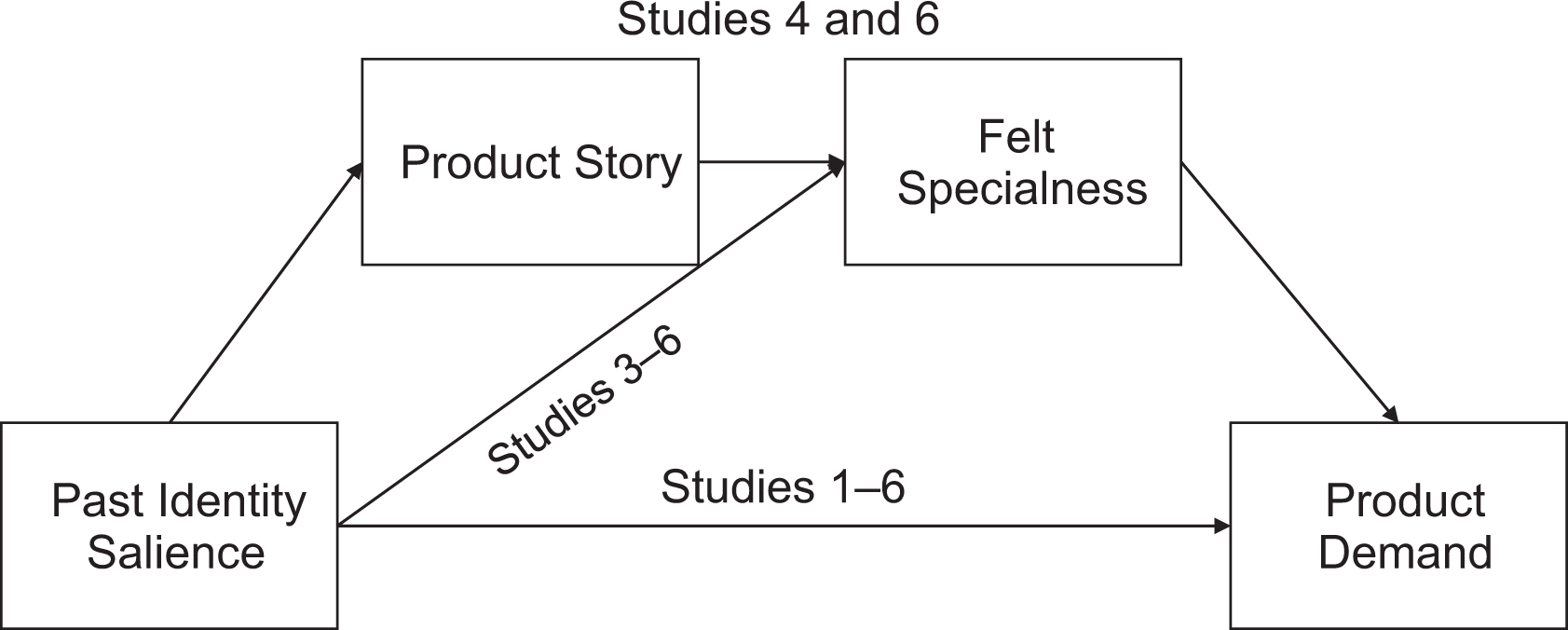
Conceptual model.
Summary of Studies
We test our propositions in seven studies. Studies 1a, 1b, and 2 provide evidence for the effect of past identity salience on real-world product demand. Studies 1a and 1b investigate this in actual Facebook campaigns. Study 2 examines sales data for an experimental upcycling pop-up store. Studies 3, 4, and 6 demonstrate that past identity salience increases demand because the product’s biographical story affords people with specialness and generalizes our findings to different types of products and past identities as well as the various claims that make these identities salient.
We also provide evidence of the limits of past identity salience. Marketer-crafted allusions to a product’s past identity are not the only means through which individuals may infer a product’s biographical story. Products with an easily discernible past identity, such as a bag sewn out of highly visible candy wrappers, already provide all the cues needed for the story to unfold in a customer’s mind. We thus do not expect additional appeals to a product’s past identity to increase demand when the past identity is already salient. Study 5 demonstrates that visual discernibility of a product’s past identity acts as a moderator.
Given that any biographical transformation requires a past identity, we also do not expect results to generalize to genuinely new products. Study 6 thus compares different production modes and shows that our effect is specific to repurposed products. In particular, it extends our findings to the more prevalent market practice of recycling and demonstrates that they do not generalize to conventional modes of production.
Finally, we address several alternative explanations across studies. Study 3 rules out the possibility that the effects are driven by increased perceptions of environmental friendliness. Study 4 shows that results are not a manifestation of a handmade effect, and Study 6 addresses the possibility of other plausible confounds (perceived originality, authenticity, surprise; see also the Study 2 posttest in the Web Appendix). All stimuli (Web Appendix W1), additional analyses (Web Appendix W2), supplementary studies (Web Appendix W3), and replication studies (Web Appendix W4) are included in the Web Appendix.
Studies 1a and 1b: Real Campaigns and Online Responses
In Study 1, we use two online field experiments to examine how people respond to Facebook ads that make the past identities of upcycled products salient. In Study 1a, we examine how these ads affect Facebook page likes. In Study 1b, we look at the effects on clicks.
Method
Participants and procedure
To ensure ecological validity, we teamed up with an upcycling store and jointly created two Facebook ad campaigns. The objective of the first campaign (Study 1a) was to increase the number of likes of the store’s Facebook page. The objective of the second campaign (Study 1b) was to drive traffic to an external website featuring an online voucher promotion. Each campaign targeted people between the ages of 18 and 65 years old (Facebook estimated a potential target audience of 1.34 million individuals) living in the store’s vicinity. To prevent people from being exposed to both campaigns on the same day, we activated only one at a time for seven days and six days, respectively.
Stimuli
We created small rectangular ads that featured different upcycled products from the store: a cake stand made from old pot lids, a vase made from a light bulb, and a pen holder made from used forks (Web Appendix W1). We manipulated past identity salience by stating what the products used to be (“I used to be a…pot lid, light bulb, fork”). The control group read: “Now I am…a cake stand, a vase, a pen holder.” By using the term “Now I am,” it also hinted at a transformation but made the products’ present identities salient.
Measures
In Study 1a, we measured unique and total like rate (the number of page likes the ad generated relative to its unique and total reach). In Study 1b, we measured unique and total click rate (the number of clicks the ad generated relative to its unique and total reach). To make measures comparable and to control for variance in unique reach (total number of unique people who saw the ad) and total reach (total number of times the ad was shown), we used relative measures (i.e., likes/clicks in percentages of reach) in both studies.
Results and Discussion
Table 1 presents a summary of campaign statistics and shows ad performance across conditions. Because we only had access to aggregate behavioral data, we conducted two-sample proportions z-tests to determine which ad was relatively more successful.
Descriptives of Appeal Measures by Condition (Studies 1a, 1b, and 2).

Study 1a
As expected, the ad yielded a higher unique (.16% vs. .06%; Z = 6.72, p < .001) as well as total like rate (.06% vs. .03%; Z = 4.65, p < .001) when the products’ past identities were made salient.
Study 1b
A similar pattern emerged for the promotion campaign. Past identity salience significantly increased unique (.29% vs. .26%; Z = 1.91, p = .06) and total (.11% vs. .08%; Z = 4.97, p < .001) clicks on the promotion.
Discussion
Drawing on ecologically valid experimental field evidence in an online context and featuring a portfolio of different upcycled products, Studies 1a and 1b show that past identity salience can increase demand for products of an upcycling store. Owing to the context in which low levels of engagement are common (for average clickthrough rates, see Chaffey [2019]), absolute effect sizes were quite small, even though like rates doubled and click rates increased by more than 37%. We designed Study 2 to provide ecologically valid field evidence in a context that allows for more pronounced absolute differences.
Study 2: Real Purchases in an Upcycling Pop-Up Shop
Studies 1a and 1b measured online interest as a demand proxy. Study 2 extends the inquiry to an experimentally controlled brick-and-mortar context and actual sales data.
Method
Participants and procedure
In collaboration with two upcycling stores, we set up our own upcycling pop-up store on the campus of a large European university. The assortment included 24 different upcycled products (e.g., bags, wallets, bowls). Items were made from a variety of source products (e.g., mosquito nets, parachutes, bicycle tubes) and priced between €5 and €85. Study participants were all potential customers who passed the shop. The shop was open over six days for five hours each day during the Christmas season in 2017. We hired two sales assistants to run the shop on alternate days. To allow for a constant setup, we provided them with a sales script. We instructed them to be friendly but passive (no sales pitches) and to discuss the product’s past identity only when prompted by customers. We also instructed assistants to take notes of all that happened during the day.
Stimuli and measures
We manipulated past identity salience by alternating the marketing materials at the point of sale. These included (1) a leaderboard that highlighted the products’ past (“We used to be…parachutes, truck tarps, pot lids, etc.”; experimental condition) or present (“We are…bags, wallets, cake stands, etc.”; control condition) identity, (2) a corresponding price list with individual price tags and product descriptions, (3) product flyers, and (4) a promotional poster (Web Appendix W1). We changed conditions on a daily basis.
For each day, we used the receipt data to assess the number of purchases, the number of products sold, and total revenue. To account for any effects associated with general customer frequency and engagement, the sales assistants tracked the number of visitors to the shop with a manual clicker, self-assessed the busyness level at the shop site every 30 minutes (1 = “not very busy,” and 7 = “very busy”), and measured conversation time per visitor.
Results and Discussion
Main results
Average busyness at shop site (Msalient = 2.55, SD = 1.17; Mcontrol = 2.77, SD = 1.34; t(58) = .46, p = .65) and conversation time per visitor (Msalient = .56 min, Mcontrol = .50 min; z = 1.09, p = .28) did not differ across conditions. When the past identities were made salient at the point of sale, however, the shop had approximately 60% more visitors (266 vs. 165; Mann–Whitney U-test: z = 1.96, p < .05); triple the amount of purchases (25 vs. 8; z = 1.99, p < .05); four times more products sold (36 vs. 8; z = 1.99, p < .05); and, as a result, more than quadruple the revenue (€572 vs. €127; z = 1.96, p < .05). Moreover, the conversion rate (proportion of visitors making a purchase) was nearly twice as high when the products’ past identities were made salient (9.4% vs. 4.8%; z = 1.63, p = .08, Table 1).
Discussion
Making the past identities of the products salient to customers in an actual upcycling store increased demand beyond our expectations and with regard to every single factor that can increase revenue: interest (i.e., visitors), conversion, and sales volume. To explore the underlying dynamics of these effects, we followed up on Study 2 with a posttest (Web Appendix W3), which revealed that our effects are unlikely to have been driven by how interesting, boring, or surprising people perceived the products to be. 1 Instead, and in line with our assumptions, people feel more special with the products, find them more appealing, and are more likely to purchase them when products’ past identities are made salient.
Study 3: Felt Specialness and a Product’s Biographical Story
Having established real-world support for our proposed main effect, Study 3 aims to show that past identity salience affects demand because it increases customers’ felt specialness with the product. We proposed that past identity salience would increase felt specialness because it triggers thoughts about the product’s biographical story. To test for this, we also qualitatively explore whether past identity salience triggers narrative thoughts—and, if so, what elements of the product’s story these thoughts refer to. Finally, we address the alternative explanation of felt environmental friendliness. Repurposing products is a proenvironmental practice. Stressing the product’s past identity may thus play into sustainable purchase motives (Olsen, Slotegraaf, and Chandukala 2014). We aim to rule out that past identity salience may drive demand because it increases felt environmental friendliness rather than specialness.
Method
Participants, design, and procedure
Two hundred twenty-four U.S. panelists from Amazon Mechanical Turk (MTurk; 44% female, Mage = 35 years) were instructed to evaluate a backpack upcycled from an old airbag in a one-factor (past identity: salient vs. control) between-subjects experiment. We manipulated past identity salience as in prior studies (see Web Appendix W1) and informed all participants that the backpack was upcycled. Participants in both conditions thus rationally knew that the product had a past identity, but this was made salient and concrete in only one condition.
Measures
As proxies of demand, we first assessed the backpack’s appeal (“How would you evaluate this product?” 1 = “unappealing/don’t like it at all,” and 7 = “appealing/like it a lot”; α = .95) and participants’ purchase intention (“Would you buy this product?” 1 = “No, definitely not,” and 7 = “Yes, definitely”). We measured felt specialness as the focal process variable (three items adapted from McFerran and Argo [2014]): “How special/unique/recognized would you feel with this product?” 1 = “not at all,” and 7 = “very”; α = .91) and felt environmentalism as an alternative process (three similar items: “How sustainable/environmentally conscious/environmentally friendly would you feel with this product?” 1 = “Not at all,” and 7 = “Very”; α = .93). To explore whether an appeal to the past identity would trigger narrative thoughts, we asked participants to describe what they thought was special about the product in an open-ended question. Finally, we asked whether they took the study seriously and answered conscientiously. Two participants who had indicated that they did not were excluded from further analyses.
Results and Discussion
Product demand
In line with previous results, past identity salience increased product demand. In particular, participants perceived the backpack as more appealing (Msalient = 4.80, SD = 1.84; Mcontrol = 4.04, SD = 1.94; t(220) = 3.01, p < .01) and were more likely to purchase it (Msalient = 4.17, SD = 2.00; Mcontrol = 3.43, SD = 2.07; t(220) = 2.70, p < .01) when its past identity as an old airbag was made salient.
Process variables
Participants also perceived the backpack as more specialness-affording (Msalient = 4.34, SD = 1.68; Mcontrol = 3.82, SD = 1.81; t(220) = 2.22, p < .05) and felt more environmentally friendly with the backpack (Msalient = 5.37, SD = 1.33; Mcontrol = 4.29, SD = 1.70; t(220) = 5.28, p < .001) when its past identity was made salient.
Mediation analyses
To test for the proposed effect of past identity salience on demand through specialness, we conducted two bootstrap mediation analyses (Model 4, Hayes 2013). We entered past identity salience as the independent variable (0 = control, 1 = salient), felt specialness as the mediator, and the respective demand variables as dependent measures. Because past identity salience also affected how environmentally friendly people felt, we included it as an alternative mediator. We found an indirect effect of past identity salience on product appeal (indirect effect = .40; 95% confidence interval [CI95] = [.05, .79]) and purchase intention (indirect effect = .44; CI95 = [.06, .86]) through felt specialness. Felt environmentalism did not mediate the effect on appeal (indirect effect = −.02; CI95 = [−.23, .20]) or purchase intention (indirect effect = .002; CI95 = [−.19, .20]). It can thus be ruled out as an alternative process.
Type of thoughts triggered
Finally, we analyzed the open-ended answers to explore differences in narrative thinking across conditions. All answers were coded in terms of whether or not they signaled narrative thinking and in terms of their content elements. Thoughts that hinted at chronology and causality, the central structural characteristic of narrative thinking, were coded as narrative, whereas other thoughts were coded as descriptive. As to the content elements, eight recurring themes emerged. Three narrative thought topics focused on different story elements. The respective codes are past identity, in which the prior life of the product was prominent; metamorphosis, in which the product’s transformation was prominent; and other biographical elements, in which chronology and causality of the product’s story were present but neither could be clearly identified as central. The five descriptive thought topics comprise type of material, production mode, environmental aspects, other product attributes, and product evaluations (for descriptions and examples, see Table 2). Two independent raters who were blind to the condition coded responses with regard to the presence of each of these codes. More than one code could be assigned to one response, and remaining disagreements were resolved through discussion (interrater reliability: all κs > .61).
Study 3: Thoughts and Themes Associated with Product Specialness by Condition.

a Numbers in brackets refer to participant numbers.
Table 2 shows the relative prevalence of codes across conditions. Despite the fact that all participants knew that the backpack had a history, narrative thoughts were more pronounced when the ad made the product’s past salient. Participants in the past identity salience condition more often reported narrative thoughts (69.6%) than those in the control condition (2.8%; χ2 = 105.53, p < .001). In particular, they more often referred to the product’s past identity (66.1% vs. 1.9%; χ2 = 100.30, p < .001), its metamorphosis (50.4% vs. .9%; χ2 = 69.60, p < .001), and other biographical story elements (17.4% vs. .9%; χ2 = 17.53, p < .001). In addition, descriptive thoughts about the production mode became more prevalent (34.8% vs. 15.9%; χ2 = 10.37, p < .01) when the past life of the product was made salient. In contrast, descriptive thoughts of general product attributes (37.4% vs. 61.7%; χ2 = 13.09, p < .001) and evaluations (21.7% vs. 35.5%; χ2 = 5.18, p < .05) were more prevalent in the control condition. Thoughts about the product’s material (19.1% vs. 18.7%; χ2 = .01, p = .93) or its environmental aspects (7.8% vs. 4.7%; χ2 = .93, p = .33) were equally prevalent across conditions.
Discussion
Study 3 replicates the effect of past identity salience on product demand in a controlled setting and supports our proposed account. Making the past identity of an upcycled product salient boosted its specialness-affording potential, which, in turn, increased product appeal and purchase intention. Although past identity salience also affected how environmentally friendly people felt with the product, environmental friendliness did not mediate the effect. 2 In addition, Study 3 provides qualitative insights into why customers feel more special once the past identity of a repurposed product is made salient. Past identity salience appears to trigger the product’s story and brings to mind additional narrative thoughts that relate in particular to the product’s past identity and metamorphosis while decreasing evaluative descriptions and focus on other attributes such as design or weight.
Study 4: Testing the Full Process
Study 4 provides additional evidence about the proposed process. It tests whether past identity salience enhances people’s perceptions of the product as storied, which in turn induces felt specialness and demand (see Figure 1). To corroborate the role of felt specialness as a driver of demand, we not only measured felt specialness but also tried to moderate it. If felt specialness drives the effect, then this route should be less pronounced for those who feel very special already. In addition, Study 4 ensures robustness of the results by extending the inquiry to minimal appeals (i.e., simple “made from” claims that neither spell out the story directly nor depict the past identity) and to a new product category and different source product (i.e., a wooden table made from a pallet). Finally, it also addresses another viable alternative explanation: it is possible that highlighting the past identity of a product induces people to think that the product is handmade, a product characteristic that is known to increase product attractiveness (Fuchs, Schreier, and Van Osselaer 2015).
Method
Participants, design, procedure, and measures
A total of 98 MTurk workers (41% female; Mage = 37 years) were randomly assigned to one of two ads that promoted a wooden table (Web Appendix W1). In the past identity salience condition, the ad read, “I was made from an old pallet”; in the control condition it read, “I was made for dining.” Prior to ad exposure, we assessed baseline feelings of personal specialness with the same three items used to capture product-specific felt specialness (“In general, how special/unique/recognized by others do you feel?” 1 = “not at all,” and 7 = “very”; α = .86). After ad exposure, we measured product appeal (α = .93) and purchase intention as in Study 3. To assess whether past identity salience triggers narrative thoughts about the product and its biography, we adapted four items from Lien and Chen (2013) (“The product tells a story,” “The product’s story has a beginning, a middle and an end,” “The product has evolved over time,” “The story of the product has a chronological order”; 1 = “Strongly disagree,” and 7 = “Strongly agree”; α = .95). Finally, we measured felt specialness, as in Study 3 (α = .93), and assessed the degree to which participants thought that the product was homemade (“This product looks…” 1 = “homemade,” and 7 = “made by a company”).
Results and Discussion
Main effects
When the past identity of the wooden table was made salient, participants perceived it as more appealing (Msalient = 5.15, SD = 1.56; Mcontrol = 4.29, SD = 1.69; t(96) = 1.80, p < .05) and were more likely to buy it (Msalient = 5.21, SD = 1.50; Mcontrol = 4.48, SD = 1.70; t(96) = 2.25, p < .05). Past identity salience also increased product story perceptions (Msalient = 5.13, SD = 1.30; Mcontrol = 3.89, SD = 1.95; t(96) = 3.71, p < .001) and made participants feel more special with the product (Msalient = 4.85, SD = 1.49; Mcontrol = 3.90, SD = 2.00; t(96) = 2.66, p < .01). Felt personal specialness prior to ad exposure (Msalient = 5.04, SD = 1.48; Mcontrol = 5.02, SD = 1.37; t(96) = .07, p = .95) and perceptions of the product as handmade (Msalient = 4.32, SD = 2.03; Mcontrol = 4.67, SD = 1.94; t(96) = −.87, p = .39) did not differ across conditions. Note that the latter also did not moderate the effect of past identity salience on demand (see additional analyses in Web Appendix W2).
The role of felt specialness
To corroborate the role of felt specialness, we ran moderated mediation analyses (Model 7, Hayes 2013) with past identity salience as the predictor (0 = control, 1 = salient), felt specialness as the mediator, product appeal and purchase intention as the outcome variables, and baseline personal specialness as a continuous moderator (M = 5.03, SD = 1.42). In support of our propositions, felt specialness mediated the effect for people low (−1 SD) and average (mean) in felt personal specialness, but not for people who already felt very special to begin with (+1 SD) (see Table 1 and Web Appendix W2).
Sequential mediation
We next tested whether product story perceptions led to an increase in felt specialness and, as a result, in demand. Two bootstrap sequential mediation analyses (Model 6, Hayes 2013) with past identity salience as the independent predictor (0 = control, 1 = salient), product story and felt specialness as sequential mediators, and product appeal and purchase intention as outcome variables found evidence for sequential mediation via product story and felt specialness on product appeal (indirect effect = .15, CI95 = [.06, .27]) and on purchase intention (indirect effect = .15; CI95 = [.05, .28]). Notably, both individual indirect effects through product story and felt specialness on demand became nonsignificant (CIs include 0). Moreover, switching the order of the mediators resulted in a nonsignificant mediation (CIs include 0). This supports the proposed sequential mediation chain.
Discussion
Results of Study 4 rule out the competing explanation that our effects are due to the handmade effect (Fuchs, Schreier, and Van Osselaer 2015) and fully support our proposed process. Even a simple “made from [past identity]” claim increased demand, and this was due to the claim imbuing the product with a story, which in turn made customers feel more special with the product. Study 4 thus supports our proposition that a product’s past identity holds storytelling potential. It also corroborates the central role of felt specialness as our underlying process. Baseline felt specialness moderated the effect of past identity salience on specialness and, as a result, the indirect effect of past identity salience on demand.
Study 5: The Moderating Role of Past Identity Discernibility
Our findings suggest that past identity salience is effective because it imbues products with a prior life with their specialness-affording biographical story. However, what if the product itself already tells the story (i.e., the past identity is visually discernible and salient in the product)? Our theorizing suggests this to be a relevant boundary condition for the power of ad-induced past-identity salience. In Study 5, we test for this boundary condition. Specifically, we used a vase made from an obviously discernible light bulb and a vase made from a less discernible electric insulator (for a replication across product categories, see Web Appendix W4). We expect our effect to generalize to the insulator vase but to be attenuated for the light bulb vase because its past life is already salient.
Method
Participants, design, and procedure
We recruited 562 volunteers from a university mailing list who were familiar with upcycling (61% female; Mage = 24 years) to participate in a 2 (past identity: salient vs. control) × 2 (past identity discernibility: subtle vs. discernible) between-subjects experiment. Depending on condition, participants saw an ad that either did or did not highlight the past identity of a vase made either from an easily discernible light bulb or from a less discernible electrical insulator (see Web Appendix W1).
Measures
We measured product appeal (“How much do you like this vase?” 1 = “don’t like it at all,” and 7 = “like it a lot”), purchase intention (“If you were looking for a vase, would you buy this particular one?” 1 = “No, definitely not,” and 7 = “Yes, definitely”), and willingness to pay (WTP; “What is the maximum amount you would pay for this vase?” open-ended). As a study incentive and a measure of behavioral product demand, participants could choose to win a product of their choice at the end of the study: the promoted upcycled or a conventional vase.
Results and Discussion
Product appeal
A two-way analysis of variance on product appeal produced a main effect of past identity salience (F(1, 558) = 8.19, p < .01) and a main effect of past identity discernibility (F(1, 558) = 34.60, p < .001) on product appeal. The prior effect is in line with previous results, and the latter is indicative of product differences. Importantly, these effects were qualified by a marginally significant interaction (F(1, 558) = 3.41, p = .06). Planned contrast comparisons revealed that past identity salience increased appeal when the past identity of the vase was not discernible (Msalient = 4.03, SD = 1.68; Mcontrol = 3.37, SD = 1.60; t(280) = 3.36, p < .01). It did not, however, affect the appeal of the visibly discernible vase (Msalient = 4.59, SD = 1.68; Mcontrol = 4.45, SD = 1.65; t(278) = .71, p = .48).
Purchase intention
A two-way analysis of variance again produced a main effect of past identity salience (F(1, 558) = 10.99, p < .01) and past identity discernibility (F(1, 558) = 20.56, p < .001), qualified by a marginally significant interaction effect (F(1, 558) = 3.63, p = .06). Making the past identity salient boosted demand when it was difficult to discern (Msalient = 3.18, SD = 1.74; Mcontrol = 2.46, SD = 1.46; t(280) = 3.78, p < .001) but not when it was visibly discernible (Msalient = 3.55, SD = 1.67; Mcontrol = 3.35, SD = 1.69; t(278) = .98, p = .33).
Willingness to pay
To assess effects on the highly skewed WTP measure, we built three equally sized groups of amounts that participants were willing to pay for the vase (<€5, €5–€10, ≥€10; Figure 2, Panel A). Chi-square tests per product show that past identity salience led to a significant increase in the number of people who were willing to pay more than €10 (57% vs. 43%; χ2 = 5.53, p = .06) when the past identity was difficult to discern, but this did not affect WTP when the past identity was visible to begin with.

Effects of past identity salience (Study 5).
Product choice
Finally, we ran a logistic regression with past identity salience, past identity discernibility, and their interaction term as the predictors, and product choice as the outcome. We found a significant interaction effect (Wald = 3.70, B = .68, p = .05) but found neither a main effect of past identity salience (Wald = 2.24, B = −.82, p = .13) nor a main effect of past identity discernibility (Wald = 1.29, B = −.62, p = .26). Past identity salience increased the choice of the upcycled product when its past identity was hard to discern (χ2 = 4.42, p < .05) but not when it was easily discernible (χ2 = .36, p = .55; Figure 2, Panel B).
Discussion
Study 5 demonstrates that making the past identity salient is effective, particularly when customers cannot easily discern this identity and infer the product’s biographical story by simply looking at it. 3 When the past identity was discernible, emphasizing it did not boost demand further. To see how this boundary condition can nonetheless be overcome, see Studies 4a and 4b in Web Appendix W3, which also rule out that a salient past identity could be effective simply because it offers more information.
Study 6: Reinforcing the Importance of a Prior Life
Study 5 showed that appeals to a product’s prior life primarily work if this prior life is not salient already. Study 6 addresses another managerially relevant boundary condition. So far, we have tested our propositions in the context of upcycled products, which doubtlessly hold prior identities. In Study 6, we thus ask whether the effect is indeed specific to repurposed products (i.e., products with a prior life). To do so, we generalize our inquiry to recycled products, which are also made from products with a prior life, and conventional products, which are made from brand-new raw materials that lack such a prior life. We expect results to generalize to recycled products but not to conventional products. In addition, we control for various alternative accounts. It is plausible that making the past identity of a product salient might simply trigger surprise and perceptions of product originality or authenticity. 4 All of these are connected to positive customer responses and have been studied in the context of vintage products, which are—like upcycled and recycled products—characterized by strong past identities (e.g., DeLong, Heinemann, and Reiley 2005; Valenzuela, Mellers, and Strebel 2009; Veenstra and Kuipers 2013). Moreover, surprise and novelty have been connected to storytelling (Escalas 1998).
Method
Participants, design, and procedure
We used the same backpack as in Study 3 and randomly assigned 163 individuals (57% female; Mage = 32 years) to one of four product ads, which manipulated production mode and thus the backpack’s past identity (Web Appendix W1). All conditions featured the same slogan “I am a trendy backpack.” In the upcycling condition, participants also read, “In my previous life, I used to be an airbag.” In the recycling condition, they read, “In my previous life, I used to be old plastic,” and in the conventional condition, they read, “In my previous life, I used to be polyester.” Past identity was not made salient in the control condition; it only read, “I am a trendy backpack.”
Measures
Following ad exposure, we first assessed demand variables. Product appeal (α = .94) and purchase intention were measured as in Study 4, and WTP was measured on a slider scale ranging from €0–€200. In addition, we assessed relative purchase intention by asking participants to rank different backpacks according to their purchase likelihood (1 = “highest” to 4 = “lowest” likelihood). These backpacks included our focal backpack from the ad and three additional backpacks participants had not been exposed to before. To corroborate the process, we also measured perceptions of product story (α = .90) and felt specialness (α = .93) as in Study 4. As a manipulation check, we added three items assessing the degree to which participants perceived that the product had a prior life (i.e., a true past identity; “The product contains…” 1 = “little history/past/identity,” and 7 = “a lot of history/ past/identity”; α = .94). Finally, we assessed perceived originality (“This product is novel/original/different”; α = .78), adapted from Koslow, Sasser, and Riordan (2003), as well as surprise (“The product surprises me/is unexpected”; α = .91) and authenticity (“The product is authentic/genuine and real”; α = .89) adapted from Kadirov (2015) and Newman and Dhar (2014), all on seven-point scales (1 = “Strongly disagree,” and 7 = “Strongly agree”).
Results and Discussion
Table 3 provides means, standard deviations, and pairwise comparisons of all assessed variables by condition. Conditions differ with regard to all assessed variables.
Study 6: Means Across Conditions (Past Identity Salience of Different Production Modes).
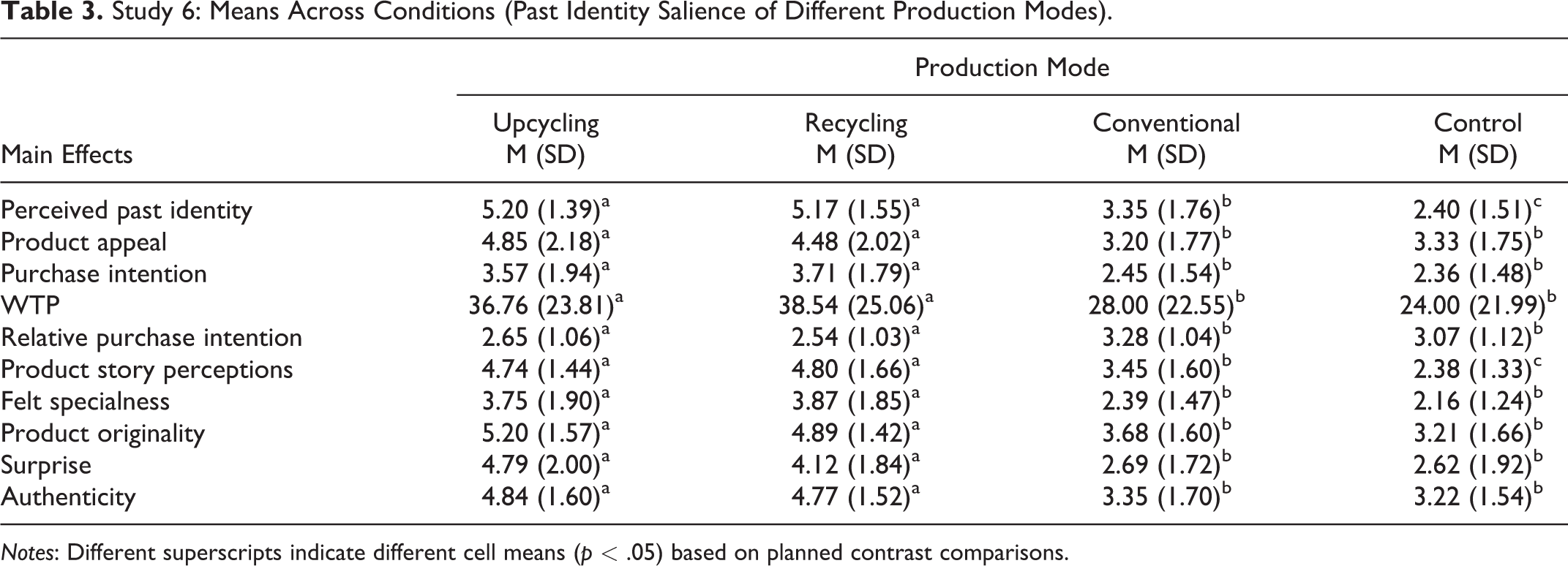
Notes: Different superscripts indicate different cell means (p < .05) based on planned contrast comparisons.
Manipulation check
In confirmation of the intended manipulation, we found stronger past identity perceptions in both the upcycling and recycling conditions than in the conventional backpack and control conditions (F(3, 159) = 33.12, p < .001).
Main effects
Conditions also significantly differ on product appeal (F(3, 159) = 7.25, p < .001), purchase intention (F(3, 159) = 7.41, p < .001), WTP (F(3, 159) = 3.72, p < .05), relative purchase intention (F(3, 159) = 4.32, p < .01), product story perceptions (F(3, 159) = 12.48, p < .001), felt specialness (F(3, 159) = 24.60, p < .001), product originality (F(3, 159) = 4.32, p < .01), surprise (F(3, 159) = 4.32, p < .01), and authenticity (F(3, 159) = 4.32, p < .01). Compared with the control group, all measures of demand were higher in both the upcycling and recycling conditions but not for the conventional backpack. Likewise, product story perceptions and felt specialness were significantly higher when the product was upcycled or recycled but not when it was conventionally produced. The same significant pattern of results emerged for our alternative processes, perceived originality, surprise, and authenticity. We thus controlled for them in all subsequent analyses.
Sequential mediation
To test whether past identity salience affects demand through product story and felt specialness, we ran sequential mediation analyses per demand variable. Production mode served as the multicategorical predictor (Model 6, Hayes 2013). We compared all groups in which we had made a past identity salient (upcycling, recycling, conventional) to the control group in which we had not done so. To control for potential confounds, we added our alternative process variables as covariates to the model (Web Appendix W2 provides further analyses ruling out these suggested accounts). We found evidence for a sequential mediation from past identity salience through product story and felt specialness on product appeal in both the upcycling (indirect effect = .09, SE = .05; CI95 = [02, .20]) and the recycling (indirect effect = .14, SE = .07; CI95 = [03, .30]) conditions. For these two production modes, we replicate the significant indirect effects on purchase intention (upcycling: indirect effect = .08, SE = .04, CI95 = [02, .18]; recycling: indirect effect = .13, SE = .06; CI95 = [03, .26]), WTP (upcycling: indirect effect = .74, SE = .43; CI95 = [.03, 1.72]; recycling: indirect effect = 1.21, SE = .58; CI95 = [.27, 2.55]), and relative purchase intention (upcycling: indirect effect = −.02, SE = .02; CI95 = [−.05, −001]; recycling: indirect effect = .−.03, SE = .02; CI95 = [−.08, −.003]). In the conventional product condition, however, neither indirect effect became significant (all CIs included 0).
Discussion
Study 6 extends our findings to a different context and a new product category. It also addresses an important boundary condition. Our effects are specific to products that are—like upcycling—associated with a prior life (i.e., recycled products) but are attenuated for products that carry little past identity in them (i.e., conventional products). Study 6 also rules out important alternative accounts around perceptions of product originality, surprise, and authenticity. While past identity salience boosts all of these factors, it is the story-induced felt specialness that primarily drives demand.
General Discussion
If products could speak, then each product made from repurposed materials would have a rich story to tell: a Cinderella-like story of a change in identity and purpose, from a discarded and useless past identity to a vastly changed and useful new identity as a new product. We show that appealing to the past identity (i.e., a discarded, broken object that is at odds with the product’s current functional purpose) fuels demand for upcycled and recycled products. This is because past identity salience draws attention to the product’s special story of metamorphosis, which allows customers to feel special themselves. These insights advance our current understanding of customer reactions to goods made from repurposed materials and open the window to a new facet of powerful storytelling in marketing.
Theoretical Implications
In this article, we provide novel contributions to the extant literature on storytelling and to the burgeoning literature on upcycling and recycling as two production modes that involve the use of repurposed materials. With regard to the storytelling literature, we show that one salient piece of information, the product’s past identity (i.e., the beginning of its biographical story) suffices to trigger the perception of the product as having a story. We observe this regardless of how we worded this information, from the somewhat story-like “in my previous life I used to be…” (Study 5) to the less story-like “I was made from…” (Study 4), to the purely informative “upcycled from…” (Supplementary Study 2, Web Appendix W3).
In contrast to prevalent storytelling practices, which focus on stories about product use or storied metaphors of a brand’s essence (Dessart and Lunardo 2017; Escalas 1998), we focused on the story entailed in a product’s own biography. We thus extend this literature by highlighting how products can be protagonists in their own life stories. This raises the question of what such product life stories need to look like to persuade. Our evidence suggests that a product’s metamorphosis, its transformation from a past identity, plays a crucial role. Metamorphosis or transformations are powerful narratives (Choi, Ko, and Megehee 2014; Herman 2004), and it seems that the source or consequence of the transformation is secondary to there being a transformation. Whatever past identity we used (from airbags to insulators) and whatever the transformation (from bags to tables), the results generalized. Just knowing that there has been a different past identity appears to suffice. We argue that it is this knowledge that invites the inference of all elements necessary for narrative thinking (Escalas 1998), a sequence of episodes (chronology) that logically build onto each other (causality).
Contrary to most current literature, we never actually spelled out the product’s story. Instead, we had customers infer the story by using a “minimal narrative” of making two different identities of the same product salient (Prince 1973). Our minimal intervention of past identity salience highlights that the mere presence of a story can be persuasive. This adds a novel facet to storytelling in marketing and advances prior literature that suggests that stories work particularly well, if people experience narrative transportation (Escalas 2007; Van Laer et al. 2014)—that is, become absorbed in narrated stories (see Dessart and Lunardo [2017] and Lien and Chen [2013], who also find that stories can persuade without transportation).
Why are these minimal stories persuasive? Because customers feel more special with a product that holds a biography (i.e., a story). We consistently found this, even when we controlled for novelty, surprise, authenticity, and originality. A good story increases appreciation for the story character (Adaval and Wyer 1998; Pasupathi 2001) and conveys specialness (McCracken 1986). Because people want to feel special, the promise of specialness fuels demand (Han, Nunes, and Drèze 2010 ; Veblen 1994 [1899]). This observation fits with prior insights on the specialness-affording value of object history (DeLong, Heinemann, and Reiley 2005; Kopytoff 1986; Veenstra and Kuipers 2013), but it constitutes a novel insight in the domain of storytelling. Having a story to tell should thus be added among the factors known to make customers feel special (e.g., Bellezza, Gino, and Keinan 2014; Han, Nunes, and Drèze 2010).
The power of the mere presence of a product’s biographical story also allows our insights to be positioned with regard to different production modes. On the one side, our results help distinguish upcycling (our key phenomenon) from consumption of secondhand goods and vintage items, in which a product’s prior life matters greatly and contagion is an issue (Ackerman and Hu 2017; Gullstrand, Matthias Lehner, and Mont 2016; Kapitan and Bhargave 2013). In contrast, upcycling encompasses the presence of a radical transformation away from a product’s past identity. This transformation eliminates any taint associated with an upcycled product’s past, although this past still makes it special. Notably, our findings generalize to recycling, in which products with past identities are broken down prior to being transformed into new products (Mobley et al. 1995). A process of transformation thus appears to be a managerially relevant conceptual distinction within market practices that draw on used materials. This insight also aligns well with Winterich, Nenkov, and Gonzales (2019), who find that highlighting a product’s transformative potential increases rates of recycling waste materials. Notably, our focus on metamorphosis or transformation also distinguishes upcycling and recycling from conventional production modes that create products from raw materials that are mostly devoid of a prior life and identity (Study 6). Our results suggest that insights from recycling may generalize to upcycling and vice versa. For both practices, marketers would do well to utilize transformational product biographies as their unique selling proposition. This sets a first benchmark for marketers in upcycling and provides a new lens for thinking about recycling. To date, most recycled products stress the environmental benefits rather than the specialness affordance inherent to past identities. More broadly, our results answer calls for marketing research on products created in environmentally friendly ways (Kotler 2011) and add to findings that suggest that environmentally friendly options are not necessarily preferred or avoided for their environmental impact (Brough et al. 2016; Luchs et al. 2010). We show that these products may be preferred if they afford specialness.
Future Research Directions
Highlighting a novel facet of storytelling within an upcoming mode of production provides substantial scope for future research. On the one hand, there are several open questions with regard to storytelling. One question is whether there are story elements that might be particularly powerful. In Study 3, we found that past identity salience triggered different narrative thoughts. Future research could explore how and whether such differences affect felt specialness and demand. Another open question is whether results would differ if marketers were to narrate the product’s biography in full. Would the effect be enhanced because everyone picks up on the story, or would it be reduced because there is less scope for self-inferencing? A related question asks how powerful a product’s biographical story would be compared with other stories told in marketing. This is a relevant but tricky question because stories are more than the sum of their elements. We nonetheless explored this in a supplementary study (Supplementary Study 2, Web Appendix W3). An ad for a laptop sleeve either implied its story through its stated past identity (upcycled from an old mosquito net) or narrated a story of its inception (the product creators were inspired by watching a spider web). The respective stories affected demand to the extent to which participants perceived the product to hold a story. Notably, the marketer-narrated story about the design inspiration imbued the product with less of a story and led to a smaller increase in appeal than the self-inferred story triggered by past identity salience. Future research is needed to identify whether the embodiment of a story in the product outperforms narrated stories that are meant to “rub off” onto the product.
Future research is also needed to ensure that the results are unaffected by the specific sampling frames we used. We tested our predictions across a range of samples from Austria, including Facebook users (Studies 1a–b), passers-by on campus (Study 2), convenience samples (Study 5), and pure student samples (Study 6). In addition, we conducted some studies with U.S.-based MTurk workers (Studies 3 and 4). Future research is needed to ensure that our conclusions extend beyond these populations. In particular, non-Western cultures may be more reluctant to adopt used goods (Xu et al. 2014).
Running our own pop-up store, we learned firsthand how different reactions to upcycling can be. Some people appear to be entirely averse to the notion of old source products. Past identity salience may intensify these individuals’ aversions, but these individuals might never fall into the target group. This does, however, raise the question of whether brands should highlight the fact that their branded products become repurposed, and whether they should use the same or a different brand for repurposed products.
The effects we observed appeared rather robust regarding who makes the product (see follow-up analyses on perceptions as handmade for Study 4, Web Appendix W2) and what the product was made of. We surmise that the metamorphosis removes the potential taint of nearly any past identity, and we find in a supplementary study (Supplementary Study 3, Web Appendix W3) that even the salience of a truly disgusting past identity (dirty mosquito net) did not hurt demand. The appeal of the past identity may nonetheless influence the size of the effect. This speaks to the power of transformations in overcoming issues of contagion and opens up several lines of future inquiry. For example, does the extent to which the past identity becomes transfigured and distorted in the process of upcycling matter (Trudel and Argo 2013)? Do functional source products (e.g., a glass window) result in different responses to hedonic source products (e.g., a decorative glass vase)? Moreover, who reacts most to past identity appeals, and are there people for whom such appeals backfire? Given that we find that demand is driven by felt specialness, it is plausible that customers who are low in power (Dubois, Rucker, and Galinsky 2012) or who feel a need for status (Eastman, Goldsmith, and Flynn 1999; Tian, Bearden, and Hunter 2001) would react more strongly.
The observed power of a prior life may also advance research on other effects attributed to a product’s origin or production mode. Storytelling principles might further increase the effectiveness of appeals related to prior users (e.g., Argo, Dahl, and Morales 2008), brands, and production sites (e.g., Newman and Dhar 2014) as well as production and design modes (e.g., Fuchs, Schreier, and Van Osselaer 2015). Whether results generalize to such diverse aspects of a product’s origin is, however, an open question. Prior research has only tended to find positive effects of appeals to a product’s origin when the highlighted origin aspect is desirable. This rests on the notion that the essence of what goes into a product persists in the final product. For example, Newman and Dhar (2014) found that products made in a firm’s original manufacturing location hold more appeal because they are believed to contain more of the brand’s authentic essence. In contrast, we found that past identity appeals work even when they highlight a discarded origin. In this respect, our findings are particularly novel.
Practical Implications
The salience of a product’s past identity robustly increased demand across a wide variety of contexts (store and product level, online and offline), categories (e.g., wallets, vases, chandeliers), ad appeals, and product origins (e.g., mosquito nets, parachutes, airbags). In a real store (Study 2), revenues more than quadrupled when we made the past identities of products the focal point of our marketing materials. Online (Study 1a), social media likes more than doubled, and in all instances where we expected to find an increase in WTP or choice share, such an increase was found. The upcycled (vs. conventional) alternative was chosen at least 12% more often when the past identity was made salient.
Importantly, our results generalized to recycling. When marketing products made from either of those production modes—recycling or upcycling—marketers should appeal to the product’s past, even though this past has no bearing on the product’s present identity or functionality. Regardless of what source product we used, past identity salience never reduced demand. However, when upcycled products told their story at a glance, simply restating the past identity did not further boost demand. This finding holds two important implications. First, in recycling, products are broken down to their granular structure. The past identities of recycled products are thus never visually discernible, suggesting that the more prevalent practice of recycling may benefit from past identity salience even more consistently than upcycling. This is an important contribution. In line with our market observations, most companies that use recycled materials simply stress their environmental friendliness but do little to highlight the specific source material going into their products.
Second, the boundary condition of past identity discernibility (Study 5) may be overcome even for upcycled products. In two additional studies (Supplementary Studies 4a and 4b in Web Appendix W3), we devised ways in which marketers can do so. We found that easily executed visual tweaks that logically reinforce the product’s biographical story boosted product demand even when the product’s past identity was discernible at first glance. The key appears to lie in storytelling principles. These suggest reinforcing the chronological and causal structure inherent to the product’s story (McCabe and Peterson 1984; i.e., feature the past identity first and more prominently than the resulting product).
Our implications also extend to the general adoption of the practice of upcycling. Every year, two billion tons of waste go to landfills around the world, posing a continuous threat to the environment, the economy, and society (Trudel and Argo 2013; White, MacDonnell, and Dahl 2011). Encouraging upcycling means that product waste will be reduced, resulting in less landfill and incineration, more energy savings, and decreases in industrial emissions (Braungart 2013). Upcycling has experienced impressive growth rates (Slotegraaf 2012) and allows for a value-adding possibility in companies’ own waste management, but it is still a niche phenomenon. Entering this market may be a worthwhile opportunity. Whenever we asked participants to choose between an upcycled product and conventional product, a substantial proportion of people preferred the upcycled option, and our pop-up store sparked interest. The addition of upcycled products to a retailer’s portfolio may be an actionable way to attract customers who want to feel special but lack the financial resources for status symbols.
Like Cinderella, the life of upcycled products holds the ingredients for the plot of a bestselling story. This article shows that we can learn from this story and that there may be more to storytelling than currently practiced in marketing. Stories truly unfold in customers’ minds (Escalas 1998; Van Laer et al. 2014), but to date marketers appear to think that they have to do all the telling. Our results suggest that customers infer stories, even when they only see a single piece of information. Our results also suggest that stories may imbue potential weaknesses in a product’s image (such as a useless past identity) with meaning that benefits rather than hurts demand. Customers appear to feel special when they obtain a product that allows them to infer its story. Perhaps it is time to think of marketing as the creation of a projection space for stories that customers tell and help marketers sell.
Supplemental Material
Supplemental Material, DS_10.1177_0022242919872156 - A Cinderella Story: How Past Identity Salience Boosts Demand for Repurposed Products
Supplemental Material, DS_10.1177_0022242919872156 for A Cinderella Story: How Past Identity Salience Boosts Demand for Repurposed Products by Bernadette Kamleitner, Carina Thürridl and Brett A.S. Martin in Journal of Marketing
Footnotes
Acknowledgments
The authors would like to thank the JM review team for their constructive feedback and guidance. They thank Dominika Pastorekova for assistance with Study 3b of Web Appendix W4 and participants of WU’s marketing department colloquium for helpful input on a previous draft of this paper. The authors also express their gratitude to the former upcycling label Auferstanden for its support in Studies 1 and 2 and the upcycling store Sorgsam for support in Study 2.
Author Contributions
The first two authors contributed equally to this work.
Associate Editor
Aric Rindfleisch
Declaration of Conflicting Interests
The author(s) declared no potential conflicts of interest with respect to the research, authorship, and/or publication of this article.
Funding
The author(s) disclosed receipt of the following financial support for the research, authorship, and/or publication of this article: The authors acknowledge funding by QUT Business School for Studies 1a and 1b.

Notes
References
Supplementary Material
Please find the following supplemental material available below.
For Open Access articles published under a Creative Commons License, all supplemental material carries the same license as the article it is associated with.
For non-Open Access articles published, all supplemental material carries a non-exclusive license, and permission requests for re-use of supplemental material or any part of supplemental material shall be sent directly to the copyright owner as specified in the copyright notice associated with the article.
