



Abstract
The identification of specific learning disabilities (SLD) remains fraught with controversy and uncertainty about professionals’ capacity to appropriately identify special education eligibility. For students from linguistically minoritized backgrounds, the exclusionary clause prohibits the identification of learning difficulties primarily attributable to contextual or linguistic factors. Yet the ambiguity of the federal language may hinder application, making critical states’ interpretation and corresponding guidance for professional practice in eligibility determination. In this archival study, we systematically reviewed state departments’ education policies and related guidance on the identification of multilingual learners with SLD, with a focus on how states have articulated policies and procedures related to the federal exclusionary clause. Our findings demonstrate variability and depth of information across states pertaining to guidance regarding the exclusionary clause. Implications for practice and policy are provided.
Keywords
The identification of specific learning disabilities (SLD), particularly among students from culturally and linguistically minoritized (CLM) backgrounds, remains fraught with controversy and fuels uncertainty about the professional capacity to identify special education eligibility (Burr, 2019). Rising enrollment of CLM students (e.g., Sullivan et al., 2016) has been accompanied by concerns about misidentification, particularly where educators conflate cultural or linguistic differences with disability (Artiles & Klingner, 2006). Although federal criteria for eligibility determination and SLD identification include exclusionary criteria specifying ineligible determinants of educational difficulties, it is unclear how these criteria are operationalized in state policy and procedures. Yet ambiguous policy invites varied interpretations and can be a conduit for inappropriate decisions, including discrimination (Sadeh & Sullivan, 2017; Sullivan & Osher, 2019). As such, an understanding of the topology of states’ guidance can shed light on drivers of the heterogeneous identification of SLD among CLM students and inform malleable targets for improving local policy and practice. In this study, we systematically reviewed state departments’ education policies and related guidance on the identification of CLM students with SLD, with a focus on how states’ policies and procedures related to the federal exclusionary clause.
The National Landscape of SLD Identification
Students with disabilities are legally entitled to free, appropriate public education if they meet eligibility requirements for select disability categories. The largest category of disability is SLD, in which approximately 2.3 million students (3.4% of all students) or 38% of learners with disabilities are identified (U.S. Department of Education [USDE], 2021). Nationally, among students with disabilities, multilingual (see Note 1) learners are more likely than monolingual learners to be identified in this category (50% compared with 39%; IDEA Data Center, 2015), ranging from 40% to 70% at the state level (Wisconsin Center for Education Research, 2017). Although underrepresentation is a common finding, multilingual learners are also disproportionately represented in some contexts (see, for example, Samson & Lesaux, 2009; Sullivan, 2011; Umansky et al., 2017). With both inappropriate under- and overidentification recognized as threats to CLM students’ rights and opportunities to learn (Sullivan & Osher, 2019), the policy context surrounding identification is important to explore a potential lever for improved identification and services. Indeed, variability in SLD identification of CLM students is posited to be at least partially attributable to varying state policies (e.g., Scott et al., 2014), definitions of multilingualism (e.g., Umansky et al., 2017), and the intersections thereof.
There are multiple levels of policy actors that shape the treatment of students with disabilities: federal agencies and officers who develop and interpret federal statutes; state officials who offer further interpretation and guidance; the judiciary, which intervenes in disputes under federal or state law; and educators and multidisciplinary team members who apply the law in specific cases (Crammond & Carey, 2017). At the federal level, SLD is defined under the most recent iteration of the Individuals with Disabilities Education Act as a disorder in one or more of the basic psychological processes involved in understanding or in using language, spoken or written, that may manifest itself in the imperfect ability to listen, think, speak, read, write, spell, or to do mathematical calculations, including conditions such as perceptual disabilities, brain injury, minimal brain dysfunction, dyslexia, and developmental aphasia. (§300.8(c)(10))
Operationalization and application of these criteria in practice are subject to ongoing debate and variability across states and school systems (e.g., Maki & Adams, 2019; Maki et al., 2015). In this milieu of uncertainty, CLM students could be particularly vulnerable to inappropriate SLD identification (Umansky et al., 2017).
Notably, the federal SLD definition also incorporates exclusionary criteria or clauses intended to preclude eligibility for difficulties resulting from specific physical and contextual factors, namely, “learning problems that are primarily the result of [. . .] environmental, cultural, or economic disadvantage” (§300.8(c)(10)(2)). In addition, according to determination of eligibility regulations under the Individuals with Disabilities Education Act (IDEA), the special rule for eligibility determination (§300.306(B)) states that a student cannot be found eligible for special education: (1) If the determinant factor for that determination is—(i) Lack of appropriate instruction in reading, including the essential components of reading instruction (as defined in section 1208(3) of the ESEA as such section was in effect on the day before the date of enactment of the Every Student Succeeds Act (December 9, 2015)); (ii) Lack of appropriate instruction in math; or (iii) Limited English proficiency.
This clause, first introduced in IDEA’s 1997 amendments, may be interpreted as prohibiting the identification of learning difficulties primarily attributable to insufficient opportunities to learn, including the inadequate opportunity to acquire and demonstrate English proficiency (McLaughlin et al., 2001). Thus, multidisciplinary evaluation teams are tasked with ruling out these factors as the primary cause of a students’ difficulties despite criticism that the causal inference this requires is tenuous at best if not outright ascientific (Sadeh & Sullivan, 2017). Perhaps unsurprisingly, scholars and teacher educators have long expressed concern about the application of SLD criteria and exclusionary clauses to CLM learners (e.g., Overton et al., 2004; Wilkinson et al., 2006).
Local Enactment of Federal SLD Policy
Where the federal statute is ambiguous, state departments become critical policy actors who interpret and guide the enactment of federal policy (Sullivan & Osher, 2019). A 2014 review of state policy and related guidance for the identification of SLD among CLM students found little commonality in states’ interpretations, with many states providing no guidance at all (Scott et al., 2014). This policy void creates challenges for local policy enactment and may contribute to the often idiosyncratic disability identification long noted across school systems at the practitioner level (Sullivan et al., 2019).
For multilingual students in particular, multiple archival studies of student records for multidisciplinary team evaluations, along with survey research and qualitative studies, have indicated that team members frequently fail to consider students’ language acquisition, culture, socioeconomic status, or receipt of language interventions, with little explicit attention to the exclusionary clauses (e.g., Chandler, 2014; J. D. Harris et al., 1997; Liu et al., 2008; Lybarger, 2017). In addition, contextual factors are often overlooked by multidisciplinary team members. This includes, for example, school psychologists per their own reports of practice, omission of consideration of families’ acculturation, cultural activities, migrant status, home literacy practices, education level, and fit between home and school environments; students’ educational experiences, curricular differences between the United States and native countries; and parents’ perceptions of their student’s academic difficulties (e.g., Cho & Kraemer, 2020; B. Harris et al., 2015). A mixed-methods study of school psychologists’ compliance with the clause and barriers to implementation noted unclear federal and state policies as key barriers to the application of exclusionary criteria (Lybarger, 2017). Elsewhere, qualitative findings highlight the uncertainty of school professionals in differentiating language acquisition from learning problems (Klingner & Harry, 2006).
Educators who lack familiarity with the language acquisition process may mistake bilingual student learning difficulties for learning disability (Artiles & Klingner, 2006; Elizalde-Utnick & Romero, 2017; Wellborn et al., 2012). Differentiating between typical language acquisition processes and a learning disability is complex; however, identifying bilingual students’ language proficiency in all languages can improve the understanding of their academic difficulties and thus contribute to appropriate special education referral (Abedi, 2011; Klingner et al., 2008). This type of differentiation requires training in the language acquisition process, acculturation, and appropriate instructional delivery as well as promoting the specialized training of bilingual service providers such as special educators and school psychologists. Adequate training of school professionals that serve multilingual learners is negatively influenced by the limited research in this area as well as the lack of professional standards for training and language proficiency of bilingual service providers in schools (Harris et al., 2021). In addition, these inconsistencies and inadequate assessment procedures have been highlighted as possible contributors to the disproportionate representation of CLM students in special education (Fletcher & Navarrete, 2003).
Taken together, the current context contrasts sharply with best practice recommendations from scholars and teacher educators who advocated for multilingual academic programming (Jegatheesan, 2011; Stele et al., 2017), academic intervention that is tailored and empirically supported for multilingual students (B. Harris & Sullivan, 2017; Ludwig et al., 2019), interprofessional collaboration and involvement of language specialists in the linguistically responsive practices and eligibility determination process (Ortiz et al., 2020), and collaborative and strengths-based family partnerships (Cheatham & Barnette, 2016).
The Current Study
Like many aspects of federal special education law (see, for example, Kramarczuk Voulgarides et al., 2014; Sadeh & Sullivan, 2017), the exclusionary clause contains undefined terms open to many interpretations and operationalizations. Vague federal criteria mean state policy and guidance may be especially important in guiding educators’ enactment of the special education law to support appropriate SLD identification and services for CLM students. Earlier research has indicated the variability in states SLD policies and guidance (Scott et al., 2014) as well as the limited application of exclusionary criteria to ensure cultural, linguistic, and experiential differences is not misconstrued as disability (e.g., Lybarger, 2017). To date, no studies have investigated states’ specific guidance pertaining to the exclusionary clause although these rule outs are crucial to valid SLD evaluations for CLM students. Given the increasing cultural and linguistic diversity in school settings as well as the challenge of examining the potential influences of the exclusionary clause on special education identification, research is needed to understand how states support professionals in engaging in these challenging considerations. Thus, for this study, we focused on the exclusionary clause factors pertaining to culture and language due to the inherent complexity in their interpretation and enactment during SLD eligibility determinations. Given the increasing cultural and linguistic diversity in school settings as well as the challenge of examining the potential influences of the exclusionary clause on special education identification, research is needed to understand how states support professionals in engaging in these challenging considerations. The purpose of this archival study, therefore, was to investigate the states’ policies and corresponding guidance on the identification of CLM students with SLD, particularly procedures related to the exclusionary clauses of language and culture. Analysis was guided by the following research questions:
Method
Design and Sample
The present study entailed archival research in which the websites for the departments of education for all 50 states and the District of Columbia (DC) were searched in 2019 to ascertain a sample of state SLD policies and related state-specific guidelines. (Although DC is not considered a U.S. state, the authors will combine it with the other states and use the terminology of “state” for the remainder of the article for ease of reporting.) In the context of this study, SLD webpage referred to a state department of education website specifically focused on content related to SLD identification. A guidebook was coded for resources that were standalone documents related to SLD identification exclusively. Although the content may be similar in both places, the ease of access related to the guidebook varied. In many situations, guidebooks were not easily located on SLD websites and were found in other online locations. Thus, they were coded as distinct resources.
Coding
Given the research questions, there were seven major categories of codes: (1) presence of an SLD-specific guidebook, (2) if the SLD identification criteria included “limited English proficiency” exclusionary clause, (3) if the SLD identification criteria included “culture” exclusionary clause, (4) if there was an explanation of “limited English proficiency,” (5) if there was an explanation of the definition of “culture,” (6) if there were instructions pertaining to modifications or considerations for “limited English proficiency,” and (7) if there were instructions pertaining to modifications or considerations for “culture.” Each of these items was coded using yes or no. If any item was coded with a “yes,” the website or text aligned with this item was also captured.
Procedures
The inception of this research project began with the creation of a protocol for coding states that was created and revised by the first and second authors. Initial coding was completed between January and February 2019 for all states to ensure updated data from respective state websites. This coding was completed by the second author following training by the first author. The second author coded all states using the coding sheet to discern the inclusion of seven coding categories on state websites. When coding was unclear, the second author requested double coding by the first author. Coding was finalized in September 2019 after all inconsistencies were discussed and double-checked. In November 2019, a separate coder was recruited to serve as part of the reliability check. In total, 18 states were randomly chosen by Microsoft Excel’s random sort function. This coder then coded all cells for the 18 states and this was checked against the originally completed coding. In total, the reliability was 93%, following which any disagreements and inconsistencies were resolved through a collaborative process until agreement reached 100%. The authors attempted to complete a qualitative analysis of the guidance provided by states. However, states rarely offered this qualitative guidance outside of federal requirements mentioned previously, and thus the authors were unable to complete the attempted qualitative analysis. Alternatively, selected quotes from select states that provided more comprehensive guidance were reviewed and included in the following analysis.
Results
RQ1. What SLD-Specific Policy Guidance and Resources Pertaining to CLM Students Do States Provide?
Out of the 51 state websites, only 25 had specific sections or webpages that were dedicated to SLD information (see Table 1). The type and quality of the information provided were heterogeneous. For example, some states had distinct resources for dyslexia but not SLD. Similarly, other state websites had more detailed information including curriculum resources and statutes (e.g., North Carolina), while other websites only had the legal definition and resources for parents (e.g., Georgia). Next, we investigated whether individual state websites had a specific SLD guidebook or specific standalone resource distinct from the website to help special education teams during an evaluation for SLD. Thirty-nine out of the 51 states provided these guidebooks. One state, Illinois, did not have a distinct SLD eligibility handbook but an response to intervention (RTI) guidebook that included chapters on SLD identification and eligibility (see Table 1).
Presence of Specific Learning Disability Webpage or Guidebook by State.
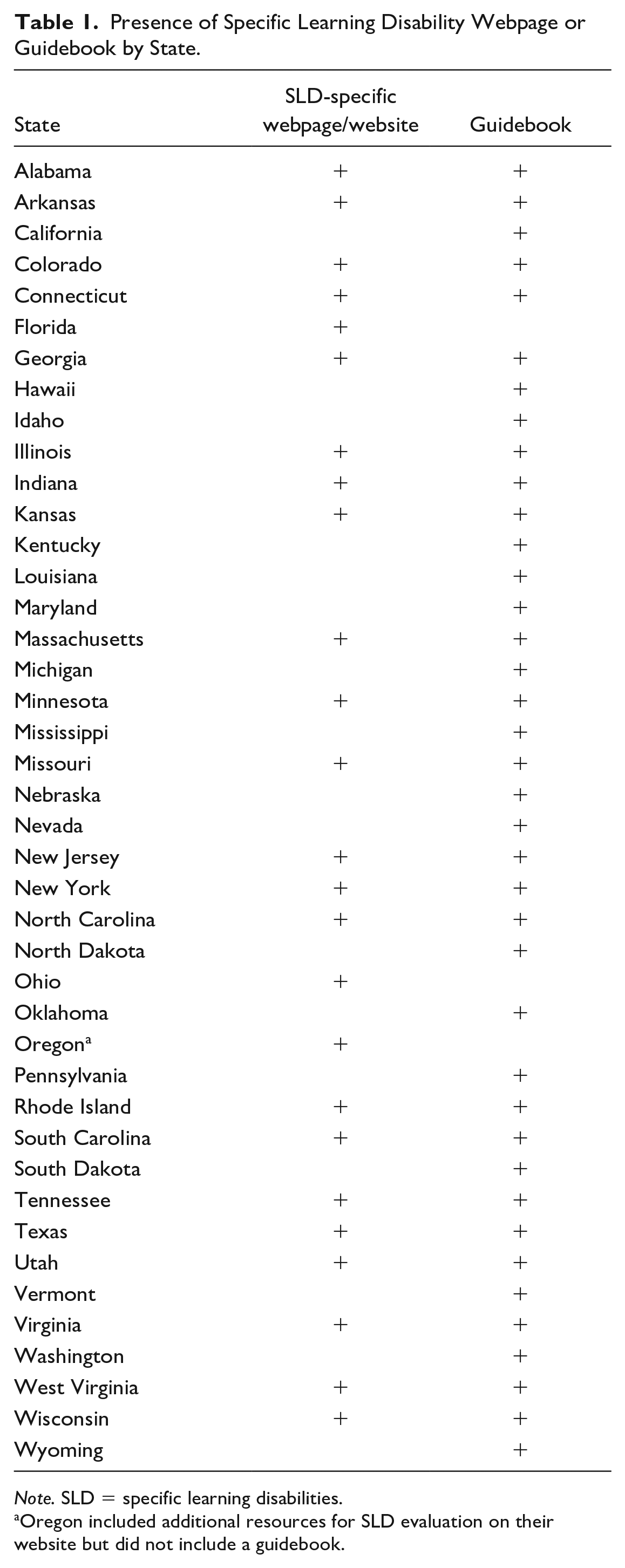
Note. SLD = specific learning disabilities.
Oregon included additional resources for SLD evaluation on their website but did not include a guidebook.
RQ2. To What Extent Do State Statutes and Corresponding Materials Operationalize Language Proficiency as an Exclusionary Clause and Its Potential Impact on SLD Identification?
Approximately half of the states (n = 24) provided varying guidance on how to modify, accommodate, and consider English language proficiency during a SLD special education evaluation. Some states required educators to consider several criteria including a student’s home language (n = 11), sufficient access to English language instruction (n = 14), comparison of progress in English to similar peers (n = 11), comparison of language proficiency in native language and English (n = 10), selection of valid assessments (n = 14), and the inappropriateness of the discrepancy method (n = 1; Arkansas). For state-specific information, see Table 2.
Specified Considerations for Multilingual Students in SLD Evaluation by State (n = 24).
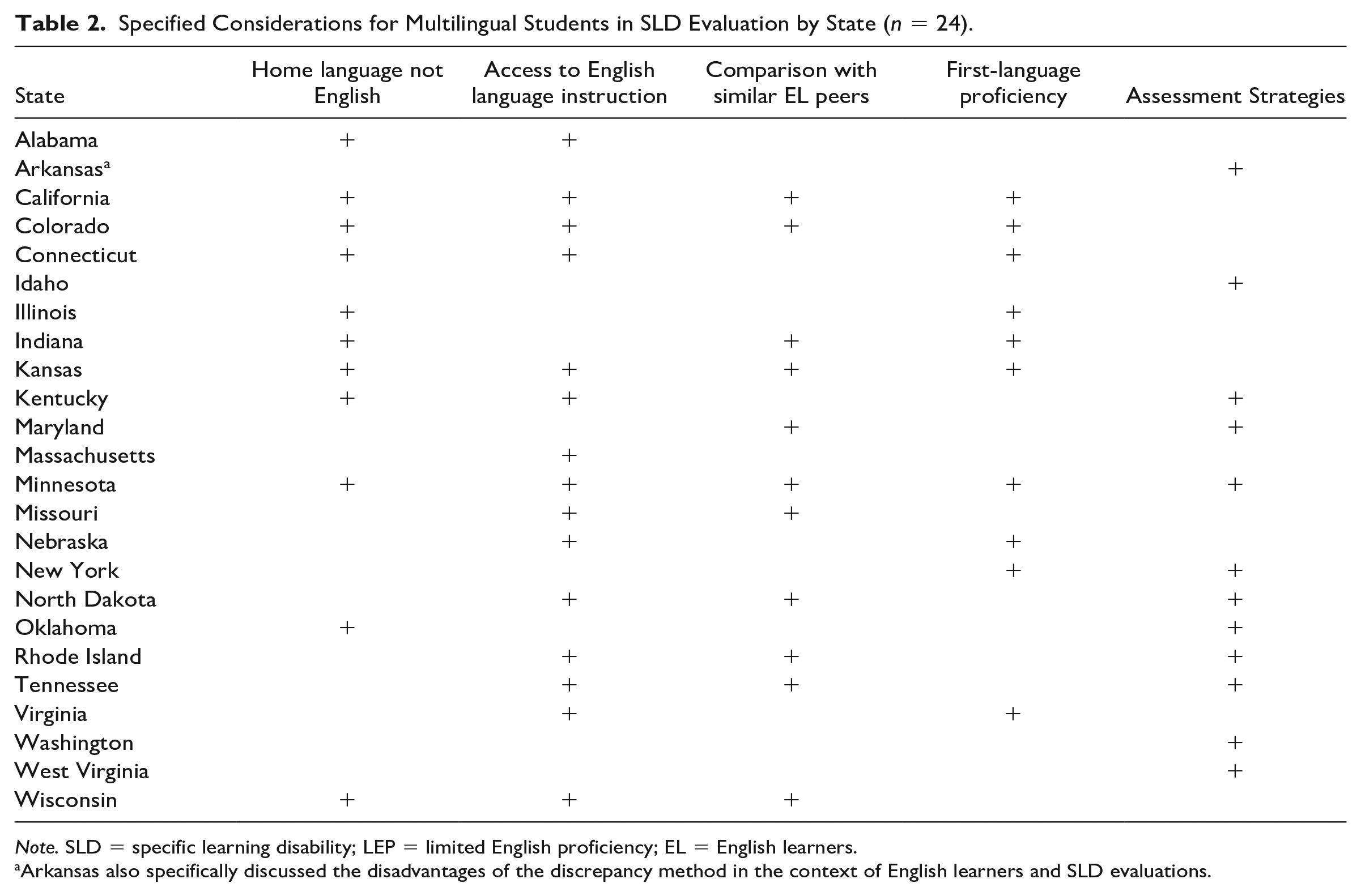
Note. SLD = specific learning disability; LEP = limited English proficiency; EL = English learners.
Arkansas also specifically discussed the disadvantages of the discrepancy method in the context of English learners and SLD evaluations.
RQ3. To What Extent Do State Statutes and Corresponding Materials Operationalize the Culture Exclusionary Clause and Its Potential Impact on SLD Identification?
All 51 states included the culture exclusionary clause in their identification criteria. However, only eight states defined or explained what the term culture meant, with half describing culture (a) as a set of shared attitudes and beliefs characteristic of a particular group of people and the rest as (b) terms of acculturation to U.S. schools and society. Sixteen states provided guidance regarding how to incorporate consideration of culture when conducting an SLD evaluation, albeit with wide variation (see Table 3). The most common guideline included in considerations of the culture exclusion criteria was the consideration of home language and whether the family and student spoke a language other than English at home (n = 9). Similarly, some states encouraged teams to consider families’ attitudes toward education or academic expectations (n = 7). Other criteria regarded evaluation components: detailed parent interviews (n = 7), information on the student’s academic performance to peers of a similar cultural normative group (n = 5), use of culture fair assessments (n = 4), the student’s refugee or migrant status (n = 3), acculturation of student to U.S. schools or society (n = 3), consulting with a cultural liaison (n =1), and assessing the appropriateness of the academic curricula to the student’s culture (n = 1).
Guidance for Cultural Considerations During SLD Evaluations by State (n = 16).
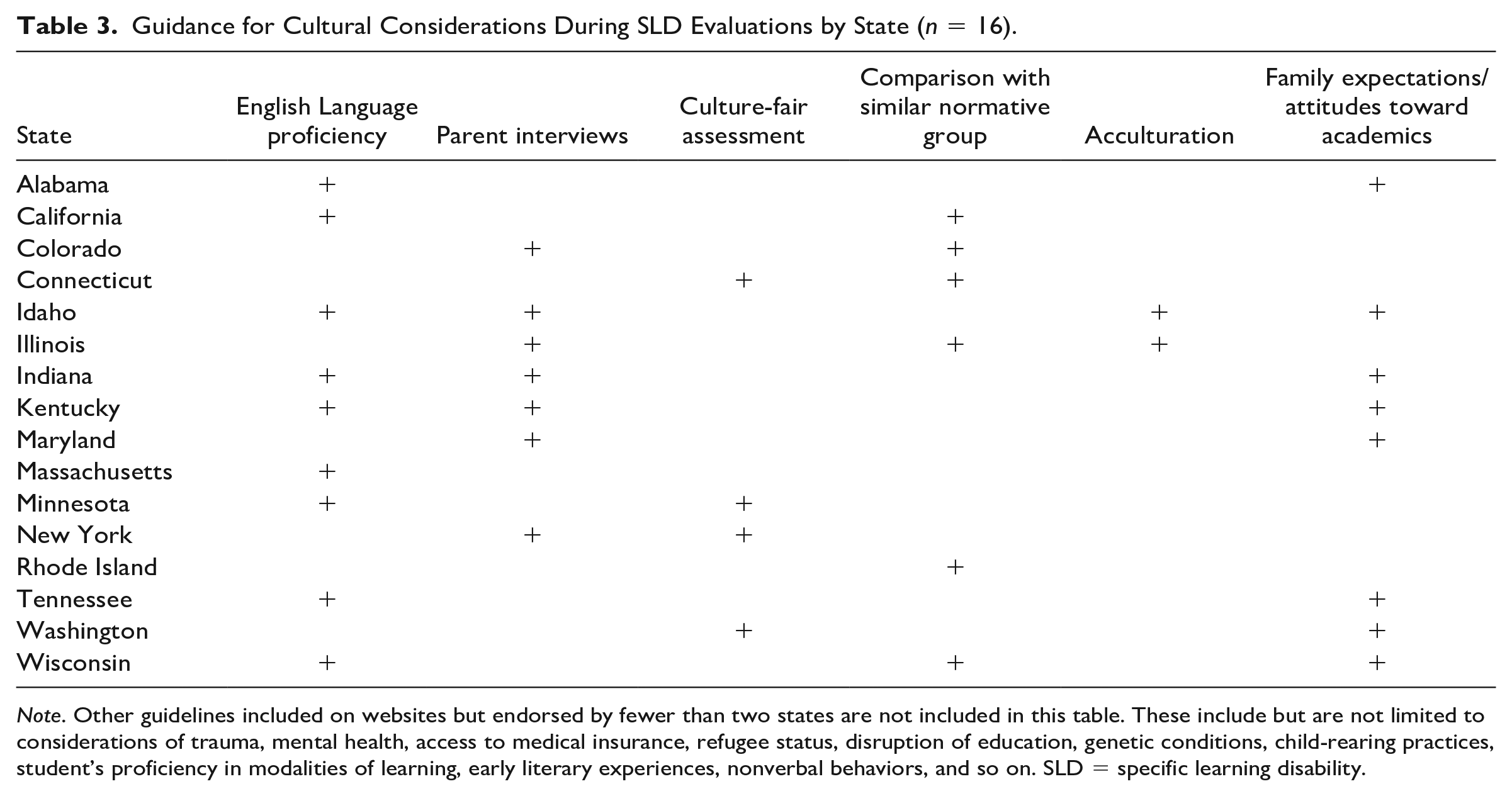
Note. Other guidelines included on websites but endorsed by fewer than two states are not included in this table. These include but are not limited to considerations of trauma, mental health, access to medical insurance, refugee status, disruption of education, genetic conditions, child-rearing practices, student’s proficiency in modalities of learning, early literary experiences, nonverbal behaviors, and so on. SLD = specific learning disability.
Qualitative Analysis of State Guidance Pertaining to the Exclusionary Clause
The final analysis for this study involved reviewing the qualitative guidance provided by states pertaining to the exclusionary clause. It should be noted that qualitative information was also extracted and reviewed if it specifically pertained to the exclusionary clause and not SLD more broadly. Comprehensive qualitative analysis was not possible due to limited extracted information due to brevity or the sole inclusion of quotations from legal policies.
Qualitative guidance provided by states pertaining to the interpretation and implementation of the exclusionary clause was limited in scope or nonexistent in almost half of the states (n = 23). When it was provided, it was often direct quotes from IDEA law or statements that did not provide explicit or actionable steps regarding the interpretation of the exclusionary clause for school teams. For example, some states (Maryland, Rhode Island, Wisconsin) recommended analysis of progress monitoring data with culture and language in mind, yet no further guidance was offered. Others (Colorado, Massachusetts, Minnesota, Virginia, and Wisconsin) recommended reviewing information related to cultural or linguistic factors, yet limited additional detail was provided. Only two states (Colorado, Indiana) specifically recommended interviewing families to learn more about cultural and linguistic factors that may influence the interpretation of the exclusionary clause specifically. A total of three states (California, Maryland, and Wisconsin) included questions that school teams can ask when determining the impact of the exclusionary clause. Only one state, Arizona, directed readers to a document created outside of the state departments of education (National Center for Learning Disabilities). One state (Washington) reviewed the problematic practice of providing a norm-referenced assessment and comparing to a population that is not representative of the standardization sample. Overall, most states provided minimal guidance regarding the interpretation of the exclusionary clause on SLD eligibility and its implementation.
Discussion
This study reviewed all 51 state department of education websites to investigate the extent to which states provide multidisciplinary teams guidance on the identification of SLDs when assessing CLM students, focusing on information regarding exclusionary clauses of language and culture as they pertain to eligibility determination. Overall, although many states did not have a website dedicated to SLD, most had a guidance document for educators and teams to help with the process of eligibility determination. Unfortunately, there was a paucity of guidance available on exclusionary clauses during an SLD evaluation. Approximately half of the states provided guidelines on the limited English proficiency clause for SLD eligibility. Even fewer delved into the cultural exclusionary clause, with most states not providing any information related to the application. These results could have far-reaching implications on the appropriateness of SLD identification of CLM students, and consequently, rates of misidentification and delivery of special education services for multilingual learners with SLD. Additionally, among the nine states that had the highest number of bilingual learners enrolled in their schools in the Fall of 2020 (i.e., >10%, National Center for Education Statistics [NCES], 2021), only four had guidance for special education teams on how to modify, accommodate, and consider English language proficiency during an SLD evaluation (California, Colorado, Kansas, Washington).
State Policy and Procedures and Misidentification
The wide variability in the quality of guidance by state departments of education for the exclusionary clause is concerning as it lends itself to variability in the implementation of exclusionary clauses in school systems and individual student cases. The few studies that have reported on this phenomenon support this hypothesis, and indeed, even within the same district, schools have been found to implement evaluation procedures in different ways (e.g., Chandler, 2014). If exclusionary clauses are not, in fact, being implemented consistently, it calls into question the validity of all eligibility decisions that are related to it. This has implications for both over- and underrepresentation, as CLM students without disabilities could be misidentified as having learning disabilities when instead they would benefit from strong English instruction or general education instruction (Artiles & Ortiz, 2002). Alternatively, students with disabilities may not be given the specialized instruction they need due to teams unknowingly attributing learning outcomes to a lack of cultural assimilation or English instruction instead of a genuine educational disability (Ortiz, 1997).
This lack of clarity at the state level can be, at least, partly be attributed to the lack of federal guidance on what it means to be environmentally, culturally, or economically disadvantaged or to how to assess it (Chalfant, 1989; Lybarger, 2017). Although published literature includes best practice guidelines in how to assess CLM students for SLD (e.g., Ortiz & Artiles, 2010), research to practice gaps remains as most states provided little information on how to measure, assess, or interpret data collected to determine whether a student’s disability is not due to cultural, environmental, or linguistic factors. In the case of SLD, the entire evaluation process is made murkier by the flexibility given to states in the process of eligibility determination itself, ranging from RTI, discrepancy, and patterns of strengths and weaknesses (Zirkel, 2017), suggesting a lack of research-based practice in general (e.g., Calderón-Tena et al., 2022; McGill et al., 2016). For example, although states in the study provided detailed guidelines on how to use RTI to assess a child with a suspected SLD (e.g., OR) few provided enough details for the team to consider exclusionary clauses in a systematic way. Taken together, it becomes difficult to say whether a team assessing a CLM student for SLD in one state would come to the same conclusion as a team following state guidelines in another, implying that both the SLD identification process and the implementation of the exclusionary clause itself can be heavily contextual (Fletcher & Navarette, 2003).
This variability is important because it can influence the quality of students’ educational experience and subsequent outcomes. Ultimately, policy actors at every level bear the responsibility of ensuring research-based practice consistent with the spirit of the law. Where federal and state policies are insufficient to substantively inform local practice, interpretation and enactment by local professional become especially important to fulfilling the spirit of the law. Although reliable identification is an important goal, so too is ensuring contextually appropriate decision-making predicated on a critical understanding of language, culture, and other experiential determinants of learning. Local interpretation and enactment of federal and state policy determine the quality and appropriateness of students’ experiences; indeed, the present study indicates that this is the context created by the current landscape of limited federal policy and state guidance. Barring guidance from federal and state actors, guidance can be created at the local level and then implemented and monitored for fidelity and appropriateness to ensure the exclusionary clause and other policies are implemented to promote legally, ethically, and empirically sound decisions for every student within a given school community. Although this puts the onus on local actors to identify, select, implement, and evaluate research-based practice appropriate to the characteristics, needs, and values of the students, families, and communities they serve, it also provides a powerful mechanism for enacting deeply contextual evidence-based practice in the service of students’ learning and wellbeing (Sullivan, Li, et al., 2022). That is, local educators can work with stakeholders to identify those practices, measures, and norms most appropriate based on the linguistic, cultural, and experiential background of their students as would be necessary even if extensive state guidance were provided. Indeed, the provision of state guidance would not negate the need for local knowledge and partnership to inform selection of evidence-based practice and rendering of ecologically valid decisions within local context. Because federal and state guidance are typically general or vague given the diverse contexts to which they apply, even where detailed guidance is provided, local enactment and variations thereof would remain because of variability in context, populations, etc.
Furthermore, it is important to note that state policy does not necessarily relate to local practice. Although local districts are regulated by state policies and encouraged to implement state guidance, the extent to which local contexts engage in this practice is outside the scope of this study. The impact of district local control should not be understated and may ultimately be more or less aligned with SLD identification practices that are evidence-based and culturally responsive. Past research highlights the importance of policy and guidance alignment at local and state levels as the most advantageous. For example, Oakes et al. (2005) discuss equity-minded school reform as originating in all levels of systems, including top-down mandates and resources from states and other constituents. The authors state that there is not one simple fix for equity-minded school reform, and change agents must engage in a wide range of ideas and strategies at various levels of systemic reform (Oakes et al., 2005).
In addition, where educational support for CLM learners is concerned, federal guidance is insufficient to drive equity, particularly where the nonspecific law allows for compliance without substantive change and practice grounded in critical consideration of the roles of language and culture in learning and practice. Kramarczuk Voulgarides et al. (2021) described IDEA federal compliance as practices that often sustain inequity as opposed to their intended outcome of disrupting racialized inequity. In their study, a district was easily able to be compliant with IDEA by engaging in “race-evasive bureaucratic and organizational processes” (p. 220). This allowed the district to avoid deeper reflections into how biased beliefs and resource inequities may shape policy compliance. Despite the intention for IDEA compliance to disrupt inequity, this study demonstrates how IDEA compliance can perpetuate inequity at a local level. Thus, robust state and federal policies that encourage more than procedural compliance, such as deep, intentional work on the part of local districts, are needed to truly disrupt inequity (Kramarczuk Voulgarides et al., 2021). State policy guidance reviewed in this study should be seen as part of a comprehensive approach to disrupting inequity, and its creation or implementation will not be sufficient on its own. Local enactment determines students’ subsequent experiences and outcomes.
Current Considerations for SLD Identification
The repercussions of unclear federal guidance on the contextual factors that could impact SLD eligibility for CLM students can result in unsystematic, and even haphazard, implementation of policy across states despite best intentions (Scott et al., 2014). It would be remiss not to discuss what the consequences of this could be in the current context of COVID-19. The upending of school and community contexts to enforce health and safety protocols has resulted in heightened disparities, particularly among children who are economically vulnerable, have disabilities, and identify as CLM youth (Sullivan et al., 2021). For example, with 93% of all households reporting some sort of distance learning in August 2020 (Mcelrath, 2020), the context of learning has changed. Economically vulnerable households have been hardest hit with poorer access to the internet and increasing concerns about equitable learning outcomes for populations that are traditionally underserved (Vogels, 2021). Regardless, guidelines from the USDE (2021) indicate that special education due process timelines and child find continue to apply and once again are left to state discretion. Responsibility for contextually appropriate decisions rests with multidisciplinary teams (Sullivan, Nguyen, et al., 2022).
These circumstances bring into the spotlight the tenuous nature of the eligibility determination process both in policy and in implementation. For example, the validity of assessing children in remote learning contexts, even in the general education framework, in these circumstances has already been called into question (Farmer et al., 2020). This has worrying implications for RTI frameworks for SLD identification which rely on robust instruction, curriculum, and universal screening (Fuchs et al., 2008; Reschly, 2014). CLM students, already vulnerable for misidentification, maybe now doubly disadvantaged as multidisciplinary teams are tasked with the challenging task of providing evidence that a student’s learning difficulties are not due to language or cultural factors in an environment where many best practice recommendations (e.g., compare progress to similar peers, in-person observation, family engagement, culturally responsive assessments) may not be applied or are made more challenging given current challenges. These are often due to inequitable access to general education (Castelo, 2020) and inadequate validity evidence for online administration of these assessments or other special education identification practices (Farmer et al., 2020). Now more than ever, professionals need to determine accessibility to culturally and linguistically appropriate instruction, which may be increasingly limited, given recent educational pivots to remote administration, subsequent potential absences, and limited information about engagement with the curriculum. Given these challenges, it is critical that greater guidance is provided on the operational definition of terms in federal policy language and what it would mean for a CLM student to be considered eligible for SLD services.
In the absence of federal and state guidelines, school systems must proceed with SLD eligibility decisions with caution, and doubly so for CLM students, as the legal definition itself makes it a disability category that may be much more context-dependent than others (Togut & Nix, 2012). Recent guidance from the National Center for Learning Disabilities and the National Association of School Psychologists (2020) encouraged states to develop policy guidelines for assessing the exclusionary clause during COVID-19 to (a) apply exclusionary factors as a first step in the eligibility process, (b) invest in building capacity in specialty areas such as the intersection of disability and bilingual status, and (c) develop robust targeted/Tier 2 intervention systems to ensure that students who need supports receive them. To apply exclusionary criteria as a first step, it is critical that schools develop strong evidence-based general education or Tier 1 instruction for emerging bilingual students. Given poor academic outcomes of emergent bilingual students regardless of disability status (National Assessment of Education Progress, 2019), if any SLD evaluation is to remain a valid representation of a student’s abilities, a robust Tier 1 must support academic success of all emergent bilingual students. There is mounting evidence that bilingual programs that focus on building proficiency of both home and English languages are associated with the best outcomes (e.g., Alvear, 2019).
Thus, for exclusionary criteria to be implemented appropriately, federal policy must support districts to move away from providing English-only immersion and English as a second language (ESL) support and fund more bilingual programs. Quality of instruction is a key ingredient to success, regardless of the type of programming or immersion settings (Slavin et al., 2011). Strategies like explicit instruction, primary language instructional support, and focusing on writing and speaking instead of only reading, are just a few examples of Tier 1 strategies to support the academic success of all students (August, 2018). Strong Tier 1 strategies must also include data collection methods that are psychometrically robust for CLM populations and can be included in all Tiers of support. This will require professional learning, both preservice and inservice, to support school professionals’ knowledge of language acquisition and associated assessment and instructional methods, including research-based practices for specific CLM populations served locally to bolster provision of culturally responsive practices. Similarly, it will require local investment in instructional, intervention, and assessment materials developed and validated for the local school populations.
The current absence of federal and state guidelines for utilizing the exclusionary clause in SLD identification makes the training as well as strong teaming approaches of school-based providers working with CLM students and families increasingly important. Interprofessional collaboration in Multi Tiered Systems of Support (MTSS) and special education teams is critically important to improve outcomes for children and families and is also required per the Individuals With Disabilities Education Act (IDEA, 2004). School teams should have routine opportunities for knowledge and resource sharing and collaboration. Team composition should be considered broadly, should center families, and include professionals such as school psychologists, speech-language pathologists, administrators, English language acquisition teachers, interventionists, and teachers (among others as appropriate for the individual). Members of these teams will come with unique, wide-ranging, and complementary skillsets to solve problem for the individual child and family, although school professionals will benefit from regular professional learning opportunities to advance collaborative practices and knowledge of SLD. States and districts may consider integrating and bolstering the training of diverse school professionals to differentiate between language acquisition and language differences or learning disabilities. In addition, given their unique training and skillsets, the recruitment, retention, and training of bilingual teachers and speech and language pathologists should be a priority of every state and school system.
Limitations and Future Implications
This study investigated state department of education websites and their guidance regarding considerations of culture and language when examining the exclusionary clause. There are some limitations to note. First, the authors solely investigated state department of education websites. It is possible that guidance pertaining to the exclusionary clause was provided by Local Education Agencies (LEA) directly, or guidance from the state was not housed on their website (e.g., direct dissemination to educators via [e]mail). While the coders comprehensively searched the state department of education websites, it is possible materials were missed, and new material could have been added since 2019. The information collected from the state department of education websites was reviewed for inclusion in a binary quantitative method, and the quality or comprehensiveness of the guidance was not qualitatively evaluated as it was outside the scope of this study.
Inappropriate SLD identification may be problematic for any student, and more so for CLM students, given their increased likelihood to experience other systemic challenges (e.g., racism, health disparities, segregation). Special education misidentification can lead to the provision of inappropriate intervention services as well as reduced time to participate in the general education environment and access strong Tier 1 services. Students with SLD who are not identified in a timely manner (or at all) may have difficulty accessing the curriculum, given their disability, which may further exacerbate learning challenges and contribute to problematic relationships within educational contexts (Klingner & Eppollito, 2014). Ultimately, states must provide more guidance to multidisciplinary teams’ comprehensive evaluation of the exclusionary clause for SLD identification. Most importantly, school teams must collect data relevant to the exclusionary clause and make the space to have critical conversations about culture and language to determine the salience of exclusionary factors.
Ideally, conversations about the potential influence of culture and language on academic performance should be occurring prior to eligibility determinations throughout general education and intervention processes (B. Harris & Sullivan, 2017). Most children who are referred for special education evaluation qualify (Ysseldyke et al., 1997); thus, school teams must strive to refer the children for evaluations in a data-based, equitable manner. Expanding culturally and linguistically responsive tiered systems of support, including strengthening Tier 1 instruction and schoolwide prevention and intervention services are ways to promote appropriate referral for special education.
Future research should consider the impact of such practices as data disaggregation for equity-based problem-solving, culturally responsive tiered practices, and other interventions to minimize bias in educational decision-making and their potential impact on enhancing considerations pertaining to the exclusionary clause (Sullivan et al., 2020). Comprehensive, theoretically, and empirically sound guidance on how to integrate consideration of language and culture within special education decisions is critical to ensuring CLM students are not further marginalized and subject to inappropriate treatment within schools. Future research must also consider the local context, how state guidance is interpreted and implemented by LEAs, as well as the depth, comprehensiveness, and systemic nature of such guidance and its influence on SLD identification practices and patterns. Furthermore, more investigation into the responsiveness of state guidelines to local populations and ever-evolving research-based practice and their impact on CLM students must be studied. Future studies can investigate whether particular states that offer more comprehensive and responsive SLD guidance have differences in other indicators of equity such as disciplinary practices, parent engagement, and special education identification. These studies could ultimately inform efforts to drive more standardized guidelines from the federal government that would encourage robust state-level policies that are responsive to local needs while also encouraging more systemic efforts that disrupt inequitable practices for CLM students.
Footnotes
Declaration of Conflicting Interests
The author(s) declared no potential conflicts of interest with respect to the research, authorship, and/or publication of this article.
Funding
The author(s) received no financial support for the research, authorship, and/or publication of this article.
