




Abstract
Over the past three decades, unions have played a critical role in advancing the rights and equality of lesbian, gay, bisexual, transgender, and queer (LGBTQ) people and other equity-seeking groups within and outside of unions. Accordingly, most unions in industrialized countries have institutionalized equity internally and through external campaigns, often delivered by union centrals. Scholarship about these initiatives has been largely celebratory, arguing that they have rendered unions more representative and socially just. This paper draws on interview and survey responses to explore LGBTQ union members’ experiences and perceptions of their unions in two deindustrializing cities. Workers who participated in union LGBTQ initiatives felt protected by their unions, less isolated in the workplace and more connected to coworkers and their unions. More commonly, however, workers faced barriers to accessing LGBTQ programming, felt disconnected from their unions and preferred employer to union support. These findings qualify the assumption that upscaling LGBTQ initiatives will advance union renewal. Instead, we suggest that strategies that foster inclusion in the workplace and union local are more likely to promote union engagement among, and social justice for, LGBTQ workers, particularly in places without preexisting support for LGBTQ people.
Over the past three decades, many unions in industrialized countries began to institute equity initiatives as part of a commitment to social justice and union renewal (Foley and Baker, 2009; Murray, 2017). Equity considerations, including for lesbian, gay, bisexual, transgender, and queer (LGBTQ) workers, now permeate union structures and activities, from collective bargaining to education programming and public campaigns. Despite their prevalence, however, few scholars have investigated the effectiveness of LGBTQ strategies, particularly from the perspectives of rank-and-file LGBTQ members. Existing scholarship about unions and LGBTQ equality tends to focus on success stories and celebrate the growth and formalization of union initiatives (Colgan, 1999; Hunt, 1997; Hunt and Eaton, 2007). Written at a time of expanding legal rights and social acceptance, it largely presumes that upscaling and mainstreaming initiatives will increase member engagement.
This optimism fails to contend with the current political environment, in which discrimination persists in the workplace (Maji et al., 2024, McFadden, 2015), and in which support for populist right-wing leaders who espouse anti-LGBTQ beliefs is rising even among union members. 1 This challenge is amplified in cities and regions with industrial legacies, where job loss might make workers susceptible to othering (Gest et al., 2018). At the same time, legal protections and equity, diversity, and inclusion (EDI) policies for LGBTQ workers can make union efforts appear redundant or spur opposition from local union leaders who view EDI as a threat to union power (Frager, 1983; Mills, 2011). These conflicting impulses create a complex environment for union LGBTQ initiatives.
Although organizational scholars have attended to LGBTQ inclusion, they have tended to focus on employer initiatives, overlooking the role of unions (Cech and Waidzunas, 2022; Maji et al., 2023). Addressing this gap is critical, since unions and employers are differently positioned to address equity and inclusion. Employer efforts, underpinned by the desire to comply with regulatory requirements and improve profitability, focus on the well-being and productivity of workers whose inclusion does not incur costs. Since union approaches are motivated by social justice, they have the potential to be broader in scope by reaching workers across class and identity divides (Colgan and McKearney, 2012, Kumar and Schenk, 2006).
We explore the role of unions in advancing LGBTQ inclusion from the perspectives of unionized LGBTQ workers in a range of workplaces and unions in two midsized Canadian cities with industrial legacies: Sudbury (population 164,687) and Windsor (population 329,144). Mining and manufacturing continue to be important industries in both cities, though their dominance has declined since the 1970s and 1980s, repsectively (King, 2017; Saarinen, 2013). In Sudbury, mining once provided full-time, unionized employment, but restructuring, technical displacement and mine closure drastically reduced the number and quality of mining jobs (Condratto and Gibbs, 2018). Windsor has suffered from the outsourcing of parts manufacturing and the great recession of 2008 (Lewchuk and Wells, 2007; Rutherford and Holmes, 2014). These shifts undercut union power in both cities (Condratto and Gibbs, 2018; Mazar, 2020; Rutherford and Holmes, 2014). Notably, both cities have few LGBTQ services and are geographically isolated from large Canadian centers with more visible LGBTQ communities.
In what follows, we first review the literature on unions and LGBTQ workers to show how, in its focus on structural gains and upscaling, it has tended to neglect the perceptions and experiences of rank-and-file LGBTQ members. We then describe how LGBTQ workers in Sudbury and Windsor perceived and experienced their unions’ support for queer and trans workers and draw on these findings to make two contributions to the union equity literature. First, we qualify the assumption that upscaled initiatives will advance social justice for LGBTQ workers and suggest that union LGBTQ strategies need to be locally implemented if they are to be effective. Relatedly, we suggest that union initiatives need to foster inclusion at the local level as a precondition to the engagement of LGBTQ members and as a precursor to union renewal. Local strategies are effective because of their ability to promote inclusion by challenging heteronormativity and cisnormativity and fostering positive interpersonal relationships among LGBTQ workers and allies. We contend that attending to inclusion is particularly important for unions in places with less support and visibility for LGBTQ people.
Union renewal, LGBTQ rights, and inclusion
Underpinning the union equity literature is the notion that advancing equity within and beyond unions is necessary to renew and revitalize unions (Foley and Baker, 2009; Kumar and Schenk, 2006; Lévesque et al., 2005; Needleman, 2012). With declining union membership and influence at the turn of the century, unions and labour scholars began to advocate for unions to become more inclusive, innovative, organizing-driven and democratic (Murray, 2017). This scholarship suggested that equity is necessary to rekindle the social justice purpose of unions (Kumar and Murray, 2006; Needleman, 2012). Several studies also found that attending to injustice faced by marginalized groups increased the success organizing drives and campaigns, rendering equity strategically important (Alberti et al., 2013; Cranford, 2007; Yates, 2005). Finally, Briskin (1999) and Colgan and Ledwith (2002) argued that providing space for minority voices in union governance would help union renewal by making them more democratic.
As we describe below, union strategies to advance LGBTQ equity have largely focused on internal and external structural changes meant to both remove discriminatory practices and accommodate the distinct needs of LGBTQ workers. The terms “equality” and “equity” are variously used in the union literature to denote both types of strategies. We use the term “equity,” as it is used in the Canadian union and policy context, as an umbrella term to denote “what is fair under the circumstances (also called substantive equality)” (Briskin, 2003: 31). This definition contrasts with the definition of equity as the proportional distribution of organizational rewards used by some scholar (Kabanoff, 1991; Morand and Merriman, 2012). Defining equity as equality of outcomes has allowed unions in Canada to frame approaches that, on the surface, appear to be catering to difference, as struggles for equality. This rendered them more compatible with traditional notions of solidarity.
Union transformation in an era of expanding LGBTQ rights
Much of the equity scholarship positions unions at the forefront of expanding LGBTQ worker rights. It outlines an evolution from early grassroots initiatives to more sophisticated structures, education programming, and campaigns, often orchestrated at the upper levels of unions. Underpinning this scholarship is the assumption that upscaling initiatives will broaden union constituencies by improving the experiences of LGBTQ workers and increasing their engagement with their unions.
Writing about union LGBTQ initiatives in the 1990s and early 2000s documents the successful efforts of activists to challenge structural discrimination against LGBTQ workers. It recounts how activists broadened the social justice imperatives of unionism and made unions relevant to new worker constituencies. For example, Hunt (1997) and Petersen (1999) chart how activists in Canada leveraged union power to achieve legal gains. The Canadian Union of Public Employees (CUPE) and the Canadian Union of Postal Workers negotiated antidiscrimination clauses into collective agreements that led to court challenges against the exclusion of gay workers from partner benefits. In the US, both Kelly and Lubitow (2014) and Frank (2014) describe how coalitions between LGBTQ groups and the American labor movement resulted in successful corporate boycotts. For example, the Teamsters, Hotel Employees and Restaurant Employees Union, and American Federation of Labor and Congress of Industrial Organizations partnered with gay activist organizations on a 20-year boycott of Coors, a company that was seen as both antiworker and anti-LGBTQ. Activist-led initiatives such as these, designed to better the lives of all LGBTQ workers, placed unions at the forefront of progressive change.
Just as LGBTQ activism expanded the repertoire of union activity, it also transformed unions internally. Following the strategies of women unionists, LGBTQ activists created separate organizing committees through the 1990s and early 2000s, first at the local level before scaling up their efforts into national- and regional-level causes. Researchers commended these initiatives, for their ability to make unions more representative and democratic, allowing for the expansion of equity initiatives (Briskin and McDermott, 1993; Colgan and Ledwith, 2002; Kelly and Lubitow, 2014). Crucially, separate organizing structures provide a platform for LGBTQ activists to lobby for political support from higher levels in their respective unions (Bairstow, 2007; Colgan and Ledwith, 2003; Humphrey, 2017). Central support provided LGBTQ activists with access to the financial resources, staff, and legitimacy needed to extend the reach of their strategies. For example, the Gay Teachers Alliance pushed the United Federations of Teachers of New York to campaign against the practice of dismissing “out” teachers (Frank, 1999), and CUPE's Pink Triangle committee pushed the union to prioritize antidiscrimination language in all contract negotiations (Hunt, 1997). Over time, the work of regional and national LGBTQ committees also fostered the mainstreaming of LGBTQ equality in a number of union activities, such as the inclusion of LGBTQ topics alongside those on other equity groups in professionally designed workshops, educational materials, and external campaigns (Briskin, 2008).
Despite an overriding consensus that upscaling LGBTQ initiatives is critical to advancing equity, some scholarship hints at cleavages. Both Humphrey (2017) and Kelly and Lubitow (2014) speculate that separate organizing might lead to polarization between rank-and-file members and leadership, a common problem in bureaucratic unionism. Only two studies investigate this issue empirically, however, and neither look at the experiences of rank-and-file members. In a comparison of separate organizing structures in 13 public sector unions in the UK, Bairstow (2007) found that “top down” LGBTQ initiatives were less successful than “bottom-up” initiatives. Colgan and McKearney (2012) compare the experiences of LGBTQ activists in union and company committees and find that although union committees provided workers with a greater voice, younger workers tended to prefer employer over union LGBTQ groups, citing “a complete absence of LGBT representation and/or a ‘macho’ or negative profile on LGBTQ issues locally” (371). Together, these studies signal that the upscaling and mainstreaming of initiatives, particularly in an EDI environment, may face implementation challenges.
Overall, however, the literature on unions and LGBTQ initiatives tends to assume that equity strategies will increase LGBTQ member engagement while advancing social justice for LGBTQ workers. The focus on union activists and structural change at levels beyond the local and the workplace, however, precludes an evaluation of whether these initiatives have influenced the experiences, perceptions, and engagement of LGBTQ workers. The mainstreaming of LGBTQ inclusion within corporate EDI programming, meanwhile, has spurred a burgeoning of scholarship on employer-led inclusion of LGBTQ workers.
LGBTQ inclusion in organizations
Unlike the union literature which focuses on structural change, the organizational scholarship is preoccupied with the well-being of workers as a corollary of worker productivity. As such, it is interested in how employer EDI initiatives can improve the experience and performance of workers from equity-seeking groups. While EDI initiatives are often discussed as a “bundle” of practices, each term has a distinct meaning. Equity refers to an attempt by organizations to have unbiased management practices while acknowledging that some workers face systemic barriers to equal treatment (To et al., 2024). Diversity refers to policies which encourage organizations to embrace difference both in recruitment and retention, and in organizational culture (Ferris et al., 1993). Inclusion underpins the success of both equity and diversity initiatives, extending beyond hiring goals or formal protections, and “focuses on the removal of obstacles to full participation and contribution of employees in organizations” (Roberson, 2006: 217). Inclusion has received greater attention over the past 10 years and is proposed to remedy or mitigate negative outcomes from diversity approaches, such as heightened workplace conflict (Bassett-Jones, 2005; Roberge and Van Dick, 2010). Inclusion focuses on the workplace environment, with the intent of ensuring that all workers have a sense of belonging, the ability to participate and are respected.
Research shows that inclusion is particularly critical for LGBTQ workers, who often have an invisible status. For these workers, the perception of an inclusive workplace improves well-being and reduces turnover (Bell et al., 2011; Sabharwal et al., 2019). Positive informal relationships are particularly important for the inclusion of LGBTQ workers. Scholars have linked organizational practices that foster positive interpersonal relationships and encourage LGBTQ workers to exercise greater voice to improvements in worker well-being (Mara et al., 2021; Roberson et al., 2023). Webster et al. (2018) found that the perception of a supportive climate due to organizational policies was more important than the policies themselves to countering negative attitudes, psychological strain, disclosure, and perceived discrimination. Relatedly, they found that supportive workplace relationships were “the strongest predictor of work attitudes and well-being” (Webster et al., 2018: 203). The importance of organizational climate and informal relationships is echoed by Fletcher and Marvell's (2023) study of transgender workers, who similarly found that the perception of having allies at work improved their sense of psychological safety and authenticity. The perception of a pro-diversity and pro-inclusion climate also influenced how cis workers reacted to fellow workers’ gender transitions.
Trade unions also influence workplace culture through their influence on peer-to-peer relationships. Few studies, however, explore the role of unions in the inclusion of LGBTQ workers. While Pulcher et al. (2020) found that in a European context unions can act as institutional entrepreneurs, encouraging corporations to adopt inclusive policies, like the LGBTQ literature, this study focused on higher-level structures rather than workplace experiences. In what follows, we bring the union equity scholarship into conversation with the research on inclusion by exploring how LGBTQ workers perceive and experience their unions and LGBTQ initiatives in the workplace.
Methods
To understand LGBTQ workers’ perceptions and experiences of their unions, we collected survey responses from, and conducted interviews with, LGBTQ workers and union members in Sudbury and Windsor, Ontario. Union perceptions and experiences were a key focus of a larger project seeking to understand LGBTQ employment experiences in deindustrializing cities (Mills and Oswin, 2024). Committees composed of LGBTQ representatives from the dominant private sector unions in each city (Unifor and United Steel Workers [USW]), local worker centers and LGBTQ organizations advised and participated in all phases of the research, including survey design, recruitment, analysis, and dissemination.
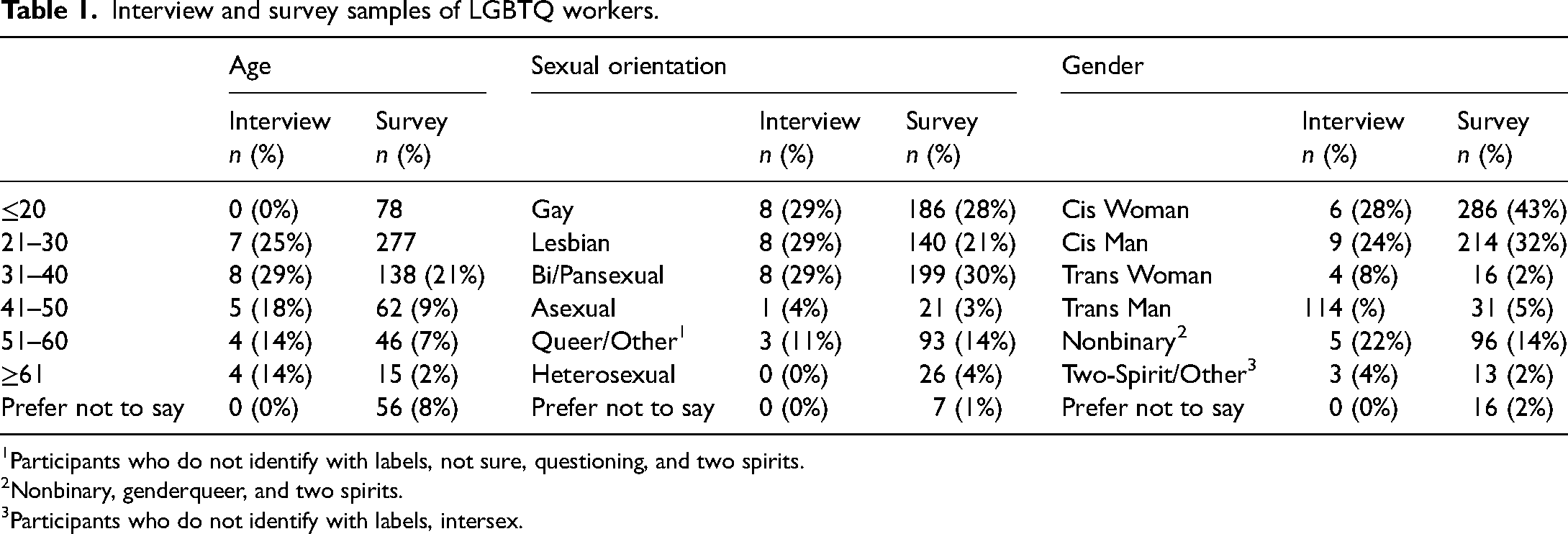
We conducted a community survey to provide context for, and increase the generalizability of, the qualitative findings. From July to December 2018, we surveyed 662 LGBTQ workers using electronic surveys online and in-person at local pride celebrations and other LGBTQ-focused events (Table 1). The surveys collected information on demographics, employment history, and experiences and perceptions of their employers and unions, as well as on health and well-being. Over one-third (243) of survey participants were unionized, with CUPE, Public Service Alliance of Canada (PSAC), and UNIFOR members being the most frequent (Figure 1).
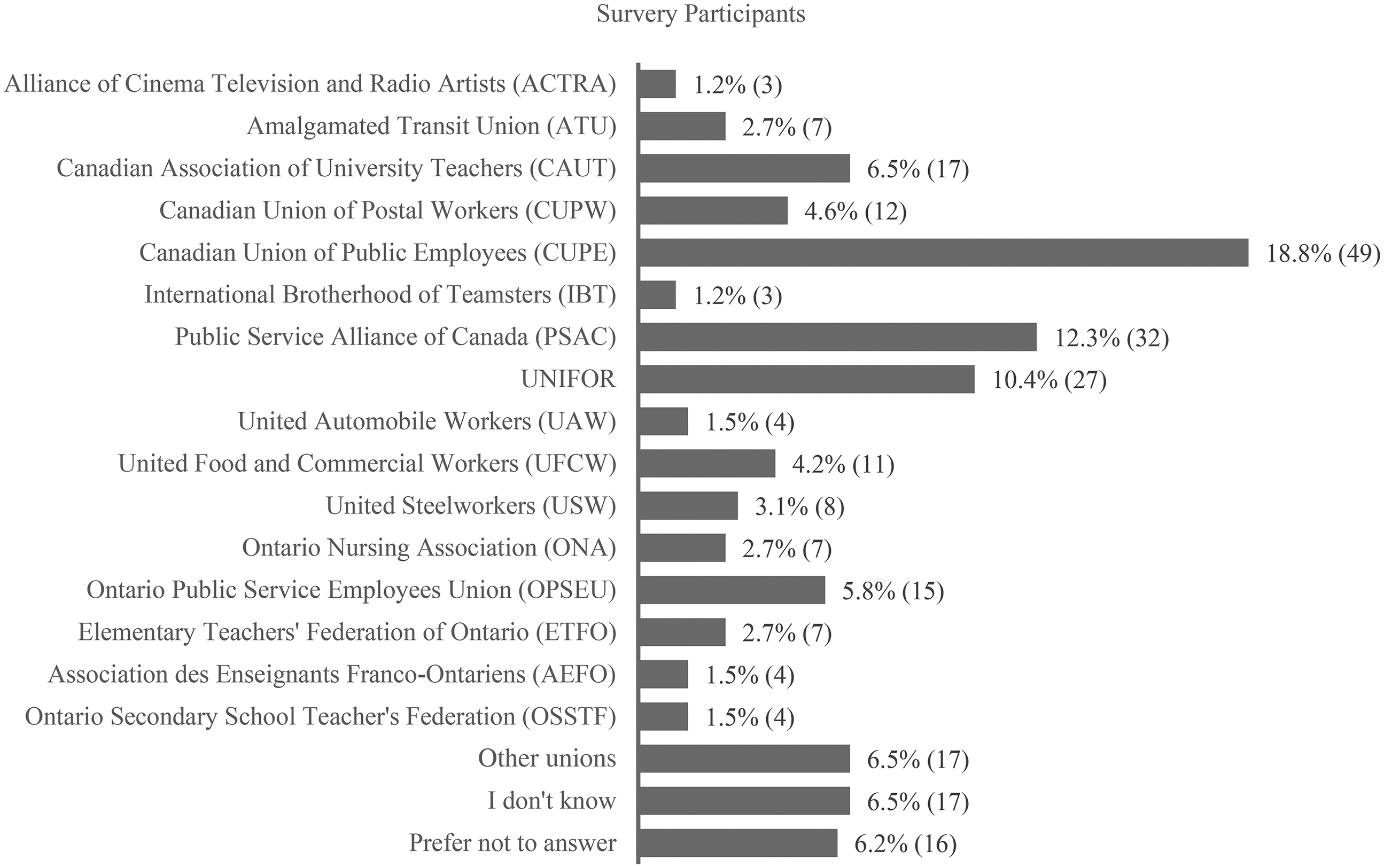
Union affiliation of survey respondents.
The following year, from June to November 2019, we conducted 28 interviews with unionized LGBTQ workers who met the survey criteria (19 from Windsor and 9 from Sudbury). Interview participants were recruited through social media, pride events, word of mouth, and referral networks, and by contacting those who indicated interest in the survey. We created a purposive sample that represented a broad range of industries and demographic characteristics (Table 1). Transcripts were independently coded by three people, first inductively, then deductively using NVivo 12. We first coded text into four broad themes: union support, employer support, union lack of support, and union discrimination. All union- and employer-related codes were analyzed and recoded into more narrow themes, which were then recombined in an iterative process. Emergent themes included: union protection, spatial disconnect, workplace inclusion, symbolic support, material support, networking/connection, union activism, union disconnect, and employer support. Themes and text segments were analyzed in relation to participant narratives, including their sector/workplace, whether they were out at work, whether they had transitioned at work and the extent of their union's equity initiatives. Last, interview and survey findings were triangulated to increase the validity and reliability of the findings and breadth of understanding (Thurmond, 2001). To protect respondent anonymity in cities with small LGBTQ populations, respondents are not identified by their union, (only by their city (S or W) and interview number), in the results below. The research team's knowledge of the respondent's union and their LGBTQ initiatives, however, informed our interpretation of text segments.
Interview and survey samples of LGBTQ workers.
Participants who do not identify with labels, not sure, questioning, and two spirits.
Nonbinary, genderqueer, and two spirits.
Participants who do not identify with labels, intersex.
LGBTQ programming in interview participants’ unions
Interviewees were members of 10 unions: CUPE (6), Unifor (5), Elementary Teachers’ Federation of Ontario (ETFO) (2), USW (2), Ontario Public Service Employees Union (OPSEU) (2); Windsor University Faculty Union (2), Association des enseignantes et enseignants franco-ontariens (AEFO) (2), United Food and Commercial Workers (UFCW) (1), Ontario Secondary School Teachers’ Federation (OSSTF) (1), PSAC (1), and Teamsters Canadian Rail Conference (TCRC) (1). Three participants did not disclose the name of their union for reasons of confidentiality. As we describe below, all of the unions above have sophisticated LGBTQ programming, with the exception of AEFO (representing Catholic teachers) and TCRC.
Most unions in Canada, with the exception of the building- and trades-based unions, have dedicated staff working on equity-based issues. Accordingly, all participant unions except AEFO have staff members for whom at least part of their responsibilities includes cultivating a pro-LGBTQ environment in the union. For example, ETFO, a provincial union, has five staff members dedicated solely to equity issues. UFCW's OUTreach committee acts as an international constituency group composed of staff and members, and works to raise awareness of LGBTQ issues through written materials, conferences, and education sessions. A recent UFCW report on LGBTQ issues showed that both union locals and union nationals had successfully lobbied against anti-LGBTQ legislation and for greater protections of human rights and access to healthcare (UFCW, 2020). Ontario Public Service Employees Union has an LGBTQ committee called the Rainbow Alliance, which raises awareness of LGBTQ issues in the union and promotes LGBTQ involvement in union leadership. Internationally the Teamsters, of which the TCRC is a part, has a Human Rights and Equity Commission that includes an LGBTQ caucus.
Many of the unions (CUPE, Unifor, UFCW, USW, OPSEU, ETFO, PSAC, OSSTF) also have LGBTQ committees as part of their governance structures, which allow LGBTQ members to build closer interpersonal relationships while advocating for LGBTQ issues in the union. For example, both Unifor and CUPE (Canada's two largest unions) have national-level LGBTQ committees (Pride Committee and Pink Triangle, respectively). These national committees have provincial and regional divisions, hosting social events and education and awareness campaigns, and work to ensure that LGBTQ issues are integrated into other levels of the union. The remaining unions in our sample (OPSEU, ETFO, OSSTF) are based only in Ontario. These unions have provincial committees that play a similar role within the union.
All the unions involved in our study have also incorporated LGBTQ issues into their collective agreements, most commonly in the form of antidiscrimination clauses. Some unions have ongoing campaigns to promote LGBTQ rights in local contracts. For example, in 2022, CUPE published a guide titled Bargaining Beyond the Binary, which provides sample contract language for union locals to promote inclusivity, benefits, and legal protections for transgender and nonbinary members (CUPE, 2022). Unifor's national president recently recommended that local unions conduct an equity audit of their collective agreements and membership to identify disparities in protections and benefits for LGBTQ members, while pushing for greater healthcare access for trans members. Unifor also has created additional staff positions to help union locals with this campaign.
Results
Lesbian, gay, bisexual, transgender, and queer (LGBTQ) workers had ambiguous feelings toward, and experiences with, their unions. Although most stated that their union would protect them from discrimination, few had participated in union equity initiatives, and many felt isolated and/or unsafe to be out at work. When union LGBTQ programming was present in the workplace, it reduced isolation, and in a minority of cases fostered workers’ participation in the union. In most cases, however, workers were unaware of, or faced barriers to accessing, union LGBTQ initiatives and many preferred employer-to-union support. Moreover, many respondents highlighted the need for union LGBTQ initiatives in the context of the limited LGBTQ visibility and dearth of services in their respective cities.
Union LGBTQ initiatives and inclusion
Lesbian, gay, bisexual, transgender, and queer (LGBTQ) interview participants reported that their unions fostered inclusion in several ways. Most commonly, LGBTQ workers reported that their union protected them from discrimination. In other cases, respondents felt supported by union officials, who affirmed their gender identity or sexual orientation. A smaller number of workers described how union strategies to support LGBTQ workers fostered interpersonal connections in their workplaces and union. Despite this emphasis on connection, workers largely viewed union strategies from a servicing lens; as services, their unions provided for LGBTQ workers, rather than acting as a pathway to further activism and leadership.
Survey respondents who were unionized were significantly less likely to report having no one to turn to for help when facing discrimination than non-unionized respondents (RR = 0.271, 95% CI 0.164 to 0.448). Approximately half of the survey participants reported that their union “always or mostly” protected them from discrimination on the basis of gender identity or sexual orientation (Figure 2). Protection from discrimination was also the most common way that interview participants described union support (S12, S14, S19, W4, W5, W6, W12, W14, W16, W17, W22). Although some workers had observed their union intervening in cases of discrimination by supervisors and coworkers, in other cases, the feeling of protection stemmed from union policies or the union's vigilance and frequent communication with members. When asked whether they felt protected from discrimination based on gender identity or sexual orientation, a nonbinary lesbian in a blue-collar workplace replied: It wasn’t really a concern for me … because again, our union is very on top of peer-on-peer harassment.… I wasn’t part of the union before so I was really surprised coming into [the workplace] and they come and check up on you every shift, so they’ll ask you if anything is wrong, and I’ve never had that before, right? The job I had previously … was again [a coffee chain], where basically all the co-workers bullied each other. (W12)
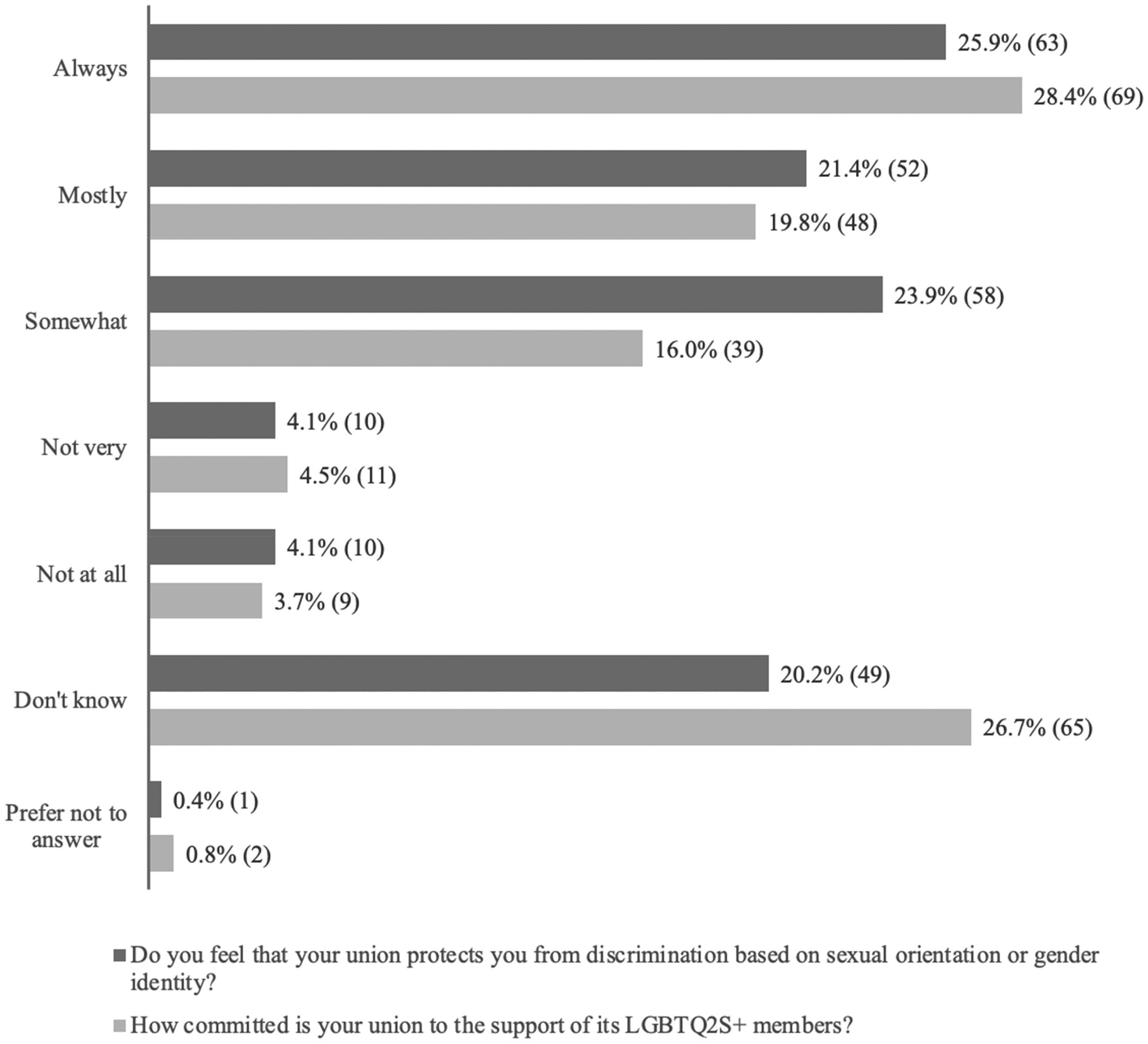
Survey respondents’ perceptions of union support and protection for lesbian, gay, bisexual, transgender, and queer (LGBTQ) members.
Union LGBTQ initiatives that extended beyond protection from discrimination had an even greater impact. Seven workers who observed or experienced union efforts to affirm LGBTQ identities in their workplace described feeling included and comfortable at work (S11, S12, S14, W6, W14, W16, W17). Affirmation came in various forms: participation in pride events, educational materials, LGBTQ committees and networks, and in two cases, advertisements for LGBTQ-focused conferences. Even symbolic displays of support were appreciated by workers. One nonbinary bisexual worker described: We have a little display upstairs where you can pick up rainbow flags and pamphlets and everything. We have the rainbow flag with the union symbol on it at everybody's desk across the building, so I do feel supported by my union at the end of the day. (S14)
In several cases, workers noted that these initiatives had the added benefit of connecting them with other LGBTQ workers and allies. For example, one bisexual cis woman described how the union's involvement with pride allowed her to connect with a queer coworker: Our union has a booth at the pride parade. There is one worker in my department in particular … he might as well be a ray of sunshine. He's great. And he's been around me a lot. And I think that's because he saw me at pride. (W16)
Relatedly, reports from the small number of respondents who had participated in LGBTQ committees or conferences were overwhelmingly positive (W6, W14, S11, S14). These participants often emphasized how connecting with other queer workers reduced their sense of isolation and was beneficial to their mental health and well-being. One worker became more involved in their union as an activist because of her participation in union equity initiatives: I got more involved with the union stuff. I got involved with the women's committee, the human rights committee, and now, the start of the LGBTQ committee, the first one in [the local]. … And that came out of the pride activist course. Because they say, you know, when you leave this course, you’re an activist now, you should plan something. (W14)
Geographies of exclusion
Positive stories about union LGBTQ programming, however, were outnumbered by the accounts of participants who were not aware of or unable to access programming (W1, W3, W4, W5, W8, W9, W10, W11, W12, W13, W15, S6, S15, S19, S23). Some respondents linked these barriers to a dearth of LGBTQ services in Sudbury and Windsor more broadly.
Several workers lamented that their union's strong equity stance at the provincial or national scale was not reflected in activities in their own local (W5, W13, W15, W16, S11, S25). One member of a union with strong equity programming noted: My local union here in Sudbury does not support me. I do not get support from my local union. [The provincial union] is a very supportive and, you know, open union on the provincial level, but at the local level here it's, not very supportive. (S25) We don’t have a culture or a gay community here in Sudbury. … we don’t have a voice for, you know, rights here in this city, we don’t have a voice in our union, we don’t have a voice at our workplaces. We’re invisible, and that's my reality. (S25) [M]ore socials. I think the power comes from—or lack of power—comes from isolation, right? If I was a new, young gay teacher and I was able to go to a dinner or a social and there was gay and lesbian teachers there and I wasn’t the only one… my perception was, I am the only gay teacher in all of Sudbury.… I think if they offered more, we wouldn’t feel so isolated, and I think you would see more of us come out or at least be more open and comfortable. (S11) Well, [the other local]… They’re in the pride parade. They do more stuff in the community, but my local does nothing, nothing, nothing, doesn’t do a thing. So it tells me that maybe our union president might be a little… [T]he [nearby union local] is all over the place … there's more openly gay and there's more of a presence.… I hear it's a way more comfortable setting over there. (W15) I put up the poster “history has set the record a little too straight.” … The union president came in … saw it and he said to me, “did you get permission to put that up?” I said, “no, why would I need permission to put this up?” [He said], “don’t you think it's going to cause a stir?” (W11)
In other cases, not feeling safe to be out at work hindered workers’ participation in union activities (S6, W3, W4, W12, W13). For a nonbinary pansexual worker, not being out at work was a barrier to finding out about committees and available resources. They describe how coworker attitudes led them to remain closeted: [T]here are colleagues at work that you know you don’t want them finding out these things.… [Y]ou go in the break room and he and a bunch of the other guys are sitting there talking about Donald Trump. And sometimes you do feel unsafe. I got to the point that I don’t go to the breakroom anymore. (W4)
For some interviewees, the lack of awareness of LGBTQ union programming may have reflected a broader disconnection from their union that may not be clearly related to their gender identity or sexual orientation. Over half of survey respondents (57.9%, or 140) did not attend meetings and just over one-third (35.5%, or 86) had not communicated with their union at all in the past six months. Moreover, 17 survey participants and three interview participants were unable to name their union (W8, W10, S23).
Reasons for feeling disconnected from unions and union initiatives were multifold. They included the absence of union LGBTQ strategies at the local or in the workplace, the desire to remain invisible in potentially homophobic and transphobic workplaces in regions and cities with little LGBTQ visibility, as well as reasons unrelated to LGBTQ support. Notwithstanding this disconnection, however, many LGBTQ workers expressed a strong desire to connect with others to relieve the isolation that they often felt as queer and trans workers. In some cases, this desire for connection was fulfilled by employer strategies.
Employer LGBTQ inclusion
When their union was not visibly supportive of LGBTQ people, workers looked elsewhere. For example, one bisexual cis woman was neither aware of her union's equity programming nor inclined to seek assistance from the union. When asked if she would approach her union if she experienced discrimination, she replied, “I can’t say that it would be the first thing that would come to my mind as somewhere to go” (W8). This reluctance to approach the union for support was not uncommon. In the context of legal protection for LGBTQ workers in Canada, workers were often more confident that they would be supported by human resource personnel than their union. As evidence of this greater trust, more than twice as many unionized survey respondents reported that they were “out” to their employer (36.3%, or 88) than to their union (13.7%, or 33). Furthermore, while 61.7% (150) of unionized survey respondents would seek help from their employer if they faced discrimination, only 43.3% (105) would reach out to their union.
Mirroring these results, many interview participants described seeking support from their employer instead of the union (S1, S6, S19, W1, W14, W17, W18). All of the workers who described transitioning at work approached human resources for assistance (S1, W14, S19). In some cases, this was related to a sense that the union was homophobic. One interviewee who approached human resources for help described her union president as “anti-trans” (S1), referencing his resistance to implementing a central union requirement to make their policies gender inclusive. Another trans woman in a male-dominated workplace described not involving her union in her transition, stating, “there wasn’t a lot of union involvement afterwards and that was by my hand” (S19). In these cases, and others, workers trusted human resource to manage the high stakes of transitioning at work and did not seek assistance from their unions.
In other cases, workers approach human resources personnel who were vocal about their support for LGBTQ people or were queer themselves (S11, W14, W15, W17). One worker recounted how a human resources manager facilitated their involvement in the employer's LGBTQ committee: She's an openly gay woman in human resources.… She does a lot of advocacy work.… she helped me through a lot. Because of her is how I got into the LGBTQ committee with the [employer] and the inclusive action group, too, and she runs both of those programs. (W15) [I]t's been nice having and seeing other people that work for [my employer] that identify with the LGBTQ community.… And just seeing that we’re not alone … because I find here in Windsor, I find there's no community that I’m aware of. I know there's got to be a community out there. Just doesn’t seem to be well known, seems like everyone's hidden. (W17)
Discussion: downscaling union strategies to promote inclusion
The perspectives of rank-and-file LGBTQ workers described above underscore the critical role that unions can play in fostering inclusion and union engagement among LGBTQ workers, particularly in regions with little LGBTQ visibility. Yet, they also show that in numerous workplaces and local unions, this potential has not been realized. Although nearly all interview participants belonged to unions with comprehensive equity initiatives, over half were not aware of initiatives beyond antidiscrimination measures in their local union or workplace, felt isolated at work and were disconnected from their local union. These results temper the optimism in the union equity literature by showing how LGBTQ workers are often left behind by professional equity strategies, particularly in places where there is less acceptance for LGBTQ people and when strategies are not championed by local leadership.
These findings make two key contributions to the union equity literature. First, they qualify the assumption that upscaling and formalizing initiatives will necessarily increase the engagement of equity-seeking members. Instead, results suggest that strategies need to be downscaled to local workplaces and unions to effectively engage LGBTQ workers. Second, our results corroborate literature on LGBTQ inclusion by highlighting the importance of interpersonal relationships in the experiences and sense of well-being of LGBTQ workers. Applied to the broader goal of union renewal, this suggests that inclusion in the workplace is a precondition for worker well-being, and union engagement and participation. As such, we argue that scholars concerned with union renewal and revitalization turn their attention to building inclusive solidarity through strategies that foster positive interpersonal connections among equity seeking members and all union members. Furthermore, we suggest that the need for locally implemented inclusion strategies is more acute in the context of support for populist leaders espousing anti-LGBTQ beliefs, particularly in deindustrializing cities and rural regions far from large urban centers.
The assumption that equity initiatives will necessarily lead to a more engaged membership undergirds much of the union equity and renewal literature. Separate organizing is championed as a way to upscale strategies, and in so doing, mainstream attention to equity throughout the union (Briskin, 1999, 2008; Colgan and Ledwith, 2002). Scholars writing about the emergence of LGBTQ initiatives also commend the creation of separate organizing committees at higher levels of unions for their ability to leverage political and financial resources (Hunt and Rayside, 2007; Kirton and Healy, 2013). A second premise for upscaling is that it allows unions to better address the injustices faced by LGBTQ workers while increasing their participation in the union. The experiences and perceptions of LGBTQ workers in our study, however, moderate this narrative. Equity strategies in national or regional levels often failed to reach rank-and-file LGBTQ workers. Most LGBTQ workers were disengaged from their unions and faced barriers to participating in LGBTQ initiatives despite the presence of formal and well-resourced LGBTQ equity strategies in union centrals. Crucially, our respondents benefited from union LGBTQ strategies only when they were downscaled. Downscaled strategies fostered inclusion by creating visibility for and fostering connections among LGBTQ people and allies.
Visible support in the workplace and local is particularly important for LGBTQ workers, for whom invisibility and fears of future discrimination contribute to anxiety and identity concealment. In absence of visible union support for LGBTQ workers, fears about identity disclosure and union support hindered LGBTQ workers’ involvement with their unions. Conversely, LGBTQ strategies that permeated the workplace helped to challenge heteronormativity and cisnormativity in the workplace, increasing workers’ feeling of safety at work and fostering positive feelings towards their unions. While Bairstow (2007) and Colgan and McKearney (2012) found that union LGBTQ committees provide important safe spaces for LGBTQ workers, their studies were limited by their focus on union activists who were participating in separate organizing structures. As such, they were unable to assess how union LGBTQ strategies are perceived by rank-and-file LGBTQ members. Very few of the workers interviewed in our study were members of separate organizing structures. Nonetheless, they were reassured by all demonstrations of union support for LGBTQ people in their workplace, including support for workers who were transitioning, pamphlets, events, pride flags and union participation in pride parades. By signaling that union officials were supportive of LGBTQ people and increasing LGBTQ visibility, these strategies increased workers’ sense of safety making union involvement more tenable.
Locally implemented LGBTQ strategies also promoted well-being at work by fostering positive interpersonal relationships among LGBTQ workers. Workers who participated in local union LGBTQ initiatives recounted how these activities eased their loneliness as LGBTQ individuals. Conversely, participants in workplaces without union strategies often felt isolated at work and/or longed for opportunities to connect with other LGBTQ workers and allies. Respondents’ desires for strategies that fostered positive interpersonal relationships reinforce existing organizational research on LGBTQ inclusion while extending it into the realm of unionism. Previous scholarship highlights how supportive workplace relationships, indicated by acceptance and empathy from coworkers and employers, contributes to more positive work attitudes and reduced strain among LGBTQ workers (Webster et al., 2018). Mara et al. (2021) similarly emphasizes how trusting relationships with colleagues and involvement with workplace organizations can help workers cope with homophobia and transphobia. Although workers did not always look to their unions for LGBTQ support and inclusion, when they did, they highlighted the union's creation of LGBTQ networks or councils, as well as the protection they provided from discrimination, two factors identified by Bell et al. (2011) as important for inclusion in organizations. Symbolic demonstrations of support in the workplace, such as visual displays, participation in pride celebrations and the promotion of educational initiatives in meetings, were important not only because they signaled support but because they created safe spaces for workers to connect with others in cities with less LGBTQ acceptance.
Our results also suggest that implementing union LGBTQ initiatives in regions and workplaces with less LGBTQ visibility and support, creates challenges for unions that are distinct from those faced by employers. As hierarchical organizations, employers can dictate the roll out of inclusion strategies to improve performance and ensure regulatory compliance. Since unions are democratic organizations, the cultural beliefs of members and local leaders often reflect those of the local workforce and divergent conceptualizations of justice and equality can coexist within the same union. Several interview participants linked the dearth of union initiatives locally when they existed at other organizational units in their union to the absence of LGBTQ spaces and services in their cities. In the case of deindustrializing cities and regions, a sense of marginality vis-à-vis economically, politically, and culturally dominant metropoles can foster opposition to equity initiatives if they are seen as top-down initiatives originating from the dominant metropole. This opposition may be heightened by rising support for alt-right populist leaders who leverage the loss of decent working-class jobs to promote othering (Adelman and Byard, 2022; Ray and Melaku, 2023). Since staff and leaders at upper levels of unions often drive union messaging, implement educational initiatives and determine which external campaigns are resourced, they may be perceived as paternalisticby local leaders. Union strategies therefore need to mitigate these dynamics by turning their attention to local initiatives and activities that foster positive interpersonal relationships.
Despite these challenges, unions are well equipped to foster social justice for LGBTQ workers. The ability of corporate EDI initiatives to foster cultural change beyond compliance is limited. They often focus on white-collar and higher-skilled workers and may have less resonance with workers who are antagonistic to equity initiatives (Colgan and McKearney, 2012). As democratic organizations with the moral prerogative to advance worker rights and well-being, unions have a broader reach and are better positioned to build genuine understanding and acceptance of LGBTQ people among workers—one that extends beyond compliance. By privileging initiatives that foster connection and understanding rather than policing, unions can distinguish themselves from corporate EDI initiatives that may be perceived as another form of employer control. We therefore echo Yu's (2019)'s call for inclusive unionism, which they describe as “a model of unionism that is open to integrating women, racial and ethnic minorities, immigrants, and sexual minorities into the union's organizational realm through organizational practices” (36). Our results, however, underscore that true inclusive unionism needs to be integrated in the day-to-day activities on the shop floor in all workplaces and locals, not just at higher levels of the organization.
Conclusion
The union renewal literature posits that advancing equity is necessary to rekindle the social justice imperative of unionism, broaden union constituencies and deepen union democracy. Our results suggest that fulfilling these aims requires strategies that promote inclusion in the workplace and union local. While unions have advanced equity for LGBTQ workers through structural changes such as legal challenges, altered governance structures, and participation in external campaigns, they have been less successful at advancing inclusion for all of their members. Social justice for LGBTQ workers, however, extends beyond legal rights. It also involves feeling safe at work, supported by your union and able to participate in union governance. Research on employer approaches to inclusion shows that supportive workplace relationships reduce strain and help workers cope with homophobia and transphobia, contributing to more positive work attitudes (Mara et al., 2021; Webster et al., 2018). Supportive relationships with coworkers and local leaders, in our study, similarly fostered positive union sentiment. Like employers, unions should invest in inclusion in order to foster inclusion among LGBTQ workers. This is necessary to fulfill the union-renewal promise that advancing equity will strengthen unions by advancing social justice and engaging equity-seeking workers.
Building a sense of community, connection and solidarity has always been at the core of the labor movement. Lesbian, gay, bisexual, transgender, and queer union members’ desire for more connection with other LGBTQ workers and allies, particularly in deindustrializing cities with small LGBTQ communities, suggests that there is a strong potential for unions to cultivate community and engagement among their LGBTQ members. This requires a shift of focus from upscaled centralized initiatives to local initiatives that foster interpersonal connections and shift workplace cultures. To accomplish this, unions need to look internally and engage rank-and-file members in all workplaces in LGBTQ inclusion. The need to emphasize shared humanity was emphasized by one young trans worker. When asked what could be done to support LGBTQ workers, they describe: People are always so worried. Just treat everybody as humans. If somebody comes out, it's not the end of the world, just make them comfortable and just treat them as a normal human.… [W]hen I first came out people kept trying to, tippy-toe around me and be, like, “oh, I messed up a pronoun,” and freak out. Like, thank you for acknowledging the fact that you made a mistake and move on. We’re not aliens. It is what is and just move on with your normal workday. (S15)
Footnotes
Declaration of conflicting interests
The author(s) declared no potential conflicts of interest with respect to the research, authorship, and/or publication of this article.
Funding
The author(s) disclosed receipt of the following financial support for the research, authorship, and/or publication of this article: This work was supported by the Social Sciences and Humanities Research Council of Canada, (grant number 890-216-0073).
