




Abstract
This qualitative study examines the experiences of platform workers in Nigeria's gig economy, with a specific focus on their voice and representation mechanisms and implications for decent work. Drawing on the institutional theory and 37 semi-structured interviews with location-based and cloudwork platform workers, the study advances knowledge of how the regulative, normative and cultural-cognitive pillars shape what constitutes voice, representation and decent work experiences in the Nigerian platform economy. Findings underscore the influence of platform design and its impact on the perception of decent work and workers’ voice. It highlights the formal and informal voice channels and alternative worker associations for voicing among Nigerian platform workers. Furthermore, it demonstrates how cultural values in Nigeria influence what constitutes decent work for platform workers and its implications for voice. Beyond the theoretical implications, the study highlights practical and social implications, emphasising that policy reforms are needed to address employment classification, strengthen worker protections and enhance social dialogue mechanisms. It advocates interventions to improve working conditions, empower gig workers and foster a more equitable and sustainable gig economy.
Introduction
The digital nature of platform work presents significant challenges for gig workers, particularly in their ability to organise collectively and exercise their voice effectively (Howcroft and Bergvall-Kåreborn, 2019; Kochan et al., 2019). As the gig economy expands, the need for appropriate mechanisms to amplify workers’ individual and collective voice becomes imperative (McNulty et al., 2018). Traditional employment models rely on union representation for collective voice, but the gig economy's informal and fragmented nature necessitates alternative, non-union mechanisms (Bertolini and Dukes, 2021). These mechanisms include individual voice channels, such as digital feedback tools, and collective mechanisms, like workers’ associations or joint consultation committees (Ellmer and Reichel, 2021). Both informal and formal mechanisms are critical in enabling workers to address issues related to their terms and conditions of engagement and to advocate for decent work standards (Mowbray, 2018).
In this study, ‘voice’ refers to the efforts of platform workers to improve their working conditions and participate meaningfully in decision-making processes through formal and informal mechanisms (Prouska and Kapsali, 2021; Wilkinson et al., 2014). The rise of digital labour platforms has replaced many traditional voice channels with digital ones, posing new opportunities and challenges for workers seeking to assert control over managerial decisions (Bucher et al., 2023). More so, questions have been raised over the quality of employment practices and their compliance with decent work standards (Van Belle et al., 2023).
Decent work, a concept introduced by the International Labour Organization (2008), responds to the growing precariousness of work caused by globalisation and technological advancements. In the gig economy, decent work advocates for mechanisms that ensure fair pay, flexibility and opportunities for personal development while reducing precariousness (Van Belle et al., 2023). However, existing research is often Western-centric, leaving gaps in understanding how non-Western, under-regulated economies, particularly those in Sub-Saharan Africa (SSA), shape workers’ voice experiences and mechanisms (Oyetunde et al., 2022; Wilkinson et al., 2021).
Therefore, the present study focuses on Nigeria, a country with a rapidly growing gig economy and a significant population of platform workers (Akorsu et al., 2022). The Nigerian context is particularly relevant because platform workers in a developing country like Nigeria often find it difficult to voice their dissent regarding both the context (work environment) and content (employment terms and conditions) of their work due to the limited existence or weakness of employment standards and labour legislations specific to platform work and other non-traditional forms of employment compared to developed countries (Ayentimi et al., 2023). The scarcity of non-Western studies risks perpetuating the silencing, exploitation and various other forms of indecent work that platform workers face in such countries (Cieslik et al., 2022). Therefore, this study is important because investigating the voice and representation mechanisms available to platform workers is critical to understanding how workers navigate these challenges and identify pathways to decent work, especially in Nigeria's unregulated gig economy.
Drawing on institutional theory (Scott, 1995), this study examines the experiences of platform workers in Nigeria's gig economy, with a specific focus on their voice and representation mechanisms and implications for decent work. Institutional theory's regulative, normative and cultural-cognitive pillars provide a valuable lens to understand how institutional structures and cultural norms shape workers’ voice experiences and representation mechanisms (Hartman and Karriker, 2021). This study investigates the following key research questions:
What voice and representation mechanisms are available to platform workers in the Nigerian gig economy? How is voice exercised across different platforms, and what mechanisms are perceived as most effective in amplifying workers’ voice? What are the implications of workers’ voice experiences on decent work realities in the Nigerian gig economy?
We contribute to the extant literature on employment and industrial relations by bringing new voices to the literature to expand the scope of voice and decent work research within an under-researched non-Western context. This is particularly important given that employing similar institutional practices within the regulative, normative and cultural-cognitive institutions can differ in their effects across different country contexts (Uzunca et al., 2018), including how it shapes what constitutes voice, representation and decent work experiences. Furthermore, our study specifically focuses on location-based platform workers (e.g., ride-hailing drivers and delivery riders) and cloudwork platform workers (e.g., online freelancers and virtual assistants). Investigating both types of platform workers in the Nigerian gig economy can potentially offer valuable insights into the experiences of decent work and a nuanced understanding of the challenges and opportunities they face, particularly given the uncertainty that gig work can promote decent work in SSA (Ayentimi et al., 2023; Cieslik et al., 2022). Ultimately, this study's findings have implications for policymakers, platform organisations and worker advocacy groups seeking to improve working conditions and promote decent work in Nigeria and other similar settings.
The paper is structured as follows: the next section reviews the relevant literature on voice and representation in the gig economy and discusses the institutional theory. Next, we provide details of the adopted methodology. This is followed by the presentation and discussion of our findings. Finally, we highlight some limitations and suggest avenues for future research.
Voice and representation in the platform economy
The gig economy, which refers to a free-market system that utilises digital platforms to connect independent workers with clients to undertake on-demand online and offline tasks on a short-term and casual basis (Duggan et al., 2020; Heeks, 2017), represents an expanding phenomenon that is reshaping labour markets worldwide (Tan et al., 2021). Gig work offers individuals a sense of autonomy and flexibility by allowing workers to control their choice of employers, tasks, working hours and work location (Myhill et al., 2021). Further, the rapid growth of platform work is increasingly creating new employment and earning opportunities (Graham et al., 2017).
Despite the opportunities gig work presents, research has also highlighted the dark side of working in the platform economy, especially surrounding the ethicality of the work. Wood et al. (2019), utilising a qualitative approach to investigate algorithmic control in the global gig economy, found that the idea of flexibility and autonomy for most gig workers is a myth. Research has shown that platform work is entrenched in insecurity; assignments are occasional and unpredictable, making it difficult for workers to control working hours (Vandaele, 2018), and therefore, workers lack both income and job security (Sibiya and du Toit, 2022). Additionally, Sibiya and du Toit (2022), in their qualitative study exploring decent work in the South African gig economy, found that the lack of regulatory obligation associated with gig work enhances its precariousness and creates challenges that negatively impact workers’ working conditions by undermining their autonomy and bargaining power. This neo-liberalist capitalist approach shifts the risk from capital to labour, detrimentally affecting workers’ well-being, work–life balance and physical health (De Stefano, 2016; Shevchuk et al., 2021).
The extensive challenges of gig work, including but not limited to algorithmic management issues, aggressive rating processes, constant monitoring, absence of a clear hierarchical structure and the reliance on peer-to-peer communication for work solutions and limited social protection and representation (Adekoya et al., 2023; Waldkirch et al., 2021), underscore the range of possible grievances that workers have regarding their employment in the platform economy, emphasising the need for workers’ voice. Worker voice represents a mechanism through which workers should be able to express their dissatisfaction (Morrison, 2023). Gig workers can use voice to advocate for better work standards and reduce the negative impact of precarious employment (Fredman et al., 2020). Although research has suggested that voice, through fostering a loyal and supporting culture, can help to reduce ‘exit’ – a worker's decision to leave their organisation (Dundon et al., 2004), it is also logical that a lack of voice can result in ‘exit’ (Bashshur and Oc, 2015; Hirschman, 1970), particularly in situations where power imbalances and hierarchical structures limit opportunities for expression, making silence a normal occurrence among workers (Mawuena and Wilkinson, 2024).
While voice has been widely discussed within traditional employment relationships, research has offered significantly less consideration surrounding voice in non-traditional (digital) platform work (Oyetunde et al., 2022). This is especially important because gig workers often work in fully digitalised environments, where algorithms manage their work, and do not have access to traditional voice channels such as management meetings, informal conversations and unions (Bucher et al., 2023). Additionally, the public nature of digital communication channels, unlike the enclosed spaces in traditional organisations, amplifies the impact of voicing, necessitating a new understanding of voice in this setting (Tassinari and Maccarrone, 2020).
Consequently, the limited literature consistently shows that while voice is contextualised as a human rights issue within decent work standards (Wilkinson et al., 2022), gig workers are often unable to express their grievances due to the limited presence of individual and collective voice (Howcroft and Bergvall-Kåreborn, 2019; Kochan et al., 2019). However, Bucher et al. (2023), using conversational data from Reddit and Upwork communities, suggest that platform work, particularly cloudwork, offers workers two ways to make their voices heard. At the individual level, workers can use their voice through ‘signalling status’ (identifying with a worker subgroup), ‘building alliance’ (uniting around common goals) and ‘distancing from outgroups’ (higher-status workers emphasising their value). At the group level, ‘voice modulation’ occurs, where workers amplify voices they find valuable and silence those they deem unimportant or offensive.
Prior studies (e.g., Ruiner et al., 2020; Van Belle et al., 2023) have also demonstrated that gig workers exercise informal voice through surveys and community forums. This is sequel to platform workers lacking the ability to utilise formal voice mechanisms (Healy et al., 2017). This lack of individualised non-union voice has been put down to various reasons. One is the phenomenon of the ‘digital cage’, which states that gig workers, controlled by algorithms, lack face-to-face interaction with managers, making it harder for them to voice grievances (Keegan and Meijerink, 2022; Vallas and Schor, 2020). Additionally, gig workers lack typical employment protections, allowing companies to deactivate ‘disruptive’ workers, creating a culture of fear that silences workers’ voice (Fredman et al., 2020), which suggests a diminished sense of agency and value within the platform ecosystem. Despite these insights, limited attention has been given to how cultural, economic and regulatory factors, including informal institutions in collectivist societies like Nigeria, shape voice and representation mechanisms.
Notably, the prevalence of precarious work practices in the gig economy, characterised by vulnerability and diminished worker agency, has sparked extensive scholarly debate about its compliance with established decent work standards (Bazzoli and Probst, 2023). According to the ILO (2023), decent work ‘involves opportunities for work that is productive, delivers a fair income, security in the workplace, and social protection for all’. The challenges presented surrounding gig work raise doubts about its classification as ‘decent work’ under these international labour standards, necessitating greater attention in the Global South, where a paucity of research exists uncovering the individual experiences of gig work (Cieslik et al., 2022).
Extant studies have identified decent work measures from the standpoint of the ILO's decent work agenda – employment creation, labour standards, social protection and social dialogue (Cieslik et al., 2022; Sibiya and du Toit, 2022). These four strategic pillars of decent work have been further categorised into 11 indicators (see ILO, 2023), now understood as decent work standards. Recent research on decent work in the gig economy (e.g., Bertolini et al., 2021; Van Belle et al., 2023) has also utilised the Fairwork principles – fair: pay, conditions, contracts, management and representation – which builds on the ILO decent work agenda and serves as a framework of decent gig work standards (Heeks et al., 2021b). Given the limited research on decent work in Global South platform economies, it is imperative to better understand the specific contextual factors that shape decent work in these regions.
Two billion individuals work in the informal economy globally, with 93% of that workforce in developing countries (ILO, 2018). Within this study's context, platform work intersects with the substantial and longstanding informal labour market (Ayentimi et al., 2023), with SSA persisting in dominating the global profile of economic informality. Nigeria offers an interesting case study to investigate this phenomenon, as the country is estimated to have the largest number of gig workers (Porteous, 2020), witnessing a remarkable surge in recent years. Currently, different forms of gig work are prevalent in Nigeria, including ridesharing, food and package delivery, freelancing, task-based home services, event management services, virtual assistance and content creation for social media (Cieslik et al., 2021; Munshi, 2019; Olorundare et al., 2022; Opesade, 2024). In this regards, ridesharing in Nigeria exhibits an annual growth rate of 12.56%, leading to a projected market size of US$477.10 m by 2029 (Statista, 2024).
The rapid adoption of gig work in Nigeria aligns with the country's economic realities. While the National Bureau of Statistics (NBS) reported a 33% unemployment rate in 2020, this dropped to 5.3% in 2023 (NBS, 2020, 2023), reflecting the revised ILO definition of ‘employed’ as working at least one hour for pay in the past seven days (World Bank, 2023). The rise in platform work – offering temporary or full-time income opportunities – likely contributed to this statistical shift, alongside the proliferation of small-scale survival businesses (World Bank, 2023). Platform work creates critical income-earning opportunities, addressing entrenched challenges such as unemployment, poverty and poor living standards in developing countries (Adekoya et al., 2023; Cieslik et al., 2022; Tan et al., 2021). Research shows that surging unemployment is a key driver for workers entering the gig economy in such contexts, where the promise of income stability motivates participation (Heeks et al., 2021b; Van Belle et al., 2023), underscoring the transformative potential of platform-based employment.
However, a review of workplace practices in the Nigerian gig economy found that only one of eight platforms sufficiently evidenced that workers earn above the minimum wage (Fairwork, 2023). This aligns with the research of Cieslik et al. (2022), which utilised a case study approach to explore the Nigerian e-hailing sector's potential to create decent work, finding that wages are often insufficient to sustain a quality life, therefore, failing to deliver a fair income within decent work standards. Further, the Fairwork review also revealed that none of the eight platforms demonstrated that they sufficiently ensured the freedom of association and worker voice (Fairwork, 2023).
The role of the labour union is pivotal to addressing these issues, as they play a significant role in establishing institutional protections against unfair employment practices (Frege and Kelly, 2004), working to enhance the collective voice of gig workers by assisting them to bargain for better labour conditions in line with decent work standards (Vandaele, 2018). However, while these protections have been applied across most of the Global North, they have only been applied minimally within the unregulated Global South (Wood et al., 2019). Gig workers in SSA are therefore unable to resist, challenge or elude the expectations that platform companies establish as conditions of workers’ participation (Vallas and Schor, 2020), continuing to have minimal power to bargain for decent work (Van Belle et al., 2023). This denial of collective voice creates the conditions whereby platforms continue to place workers in vulnerable, precarious and exploitative employment (Anwar and Graham, 2021). More so, given that the gig economy is often shaped by powerful institutions and norms, as well as the complexities and contextual specificities in what constitutes decent work (Uzunca et al., 2018), the institutional theory perspective serves as an important framework for understanding the mechanisms that shape the experiences of voice and representation of platform workers in the gig economy.
Institutional theory perspective
Institutional theory posits that institutions comprise three distinguishing pillars – regulative, normative and cultural-cognitive – that directly impact organisations (Scott, 1995). Applying this theoretical framework to explore the voice and representation mechanisms of platform workers in the Nigerian platform economy offers an avenue to contribute to the literature, as only a few studies have applied this institutional framework in a developing country context (Frenken et al., 2020; Hartman and Karriker, 2021; Trevino et al., 2008).
Firstly, the regulative pillar emphasises the existing legislation and formal rules that exert coercive legal pressure and external control to promote certain behaviours and restrict others (Kostova, 1997). The State plays a critical role in regulating organisations and shaping employment relations and labour processes through its legislative power (Burawoy, 1983; Thompson, 2010). This pillar is notably weak in the Nigerian context, exposing significant challenges for gig workers. The lack of robust institutional and regulatory frameworks fails to protect workers from the precarious nature of gig work, impeding the realisation of decent work standards and opportunities for voice and representation (Adekoya et al., 2023; Folawewo, 2016). A critical issue stems from the regulatory loophole in employment classification, whereby gig workers are classified as independent contractors rather than employees (Anwar and Graham, 2021; Beckmann and Hoose, 2022). This classification denies them fundamental rights such as unionisation and collective bargaining (Tronsor, 2018; Vandaele, 2018) and protections offered to traditional employees under labour and occupational health and safety laws, such as working hours, minimum wages and benefits like health insurance (Cefaliello and Inversi, 2022; Folawewo, 2016; Ng’Weno and Porteous, 2018).
Additionally, this regulatory gap has significant implications for the quality of work and the protection of workers’ rights. The lack of inclusion in government programmes and the absence of enforceable standards for decent working conditions leave gig workers vulnerable to exploitation. Moreover, the platform designs often curtail opportunities for voice and representation, compounding the power asymmetry between workers and platforms (Tan et al., 2021; Wood et al., 2022). Without voice mechanisms to address grievances or ensure fair treatment, gig workers are left in a precarious state, raising concerns about compliance with global decent work standards. The failure of the gig economy to meet decent work standards supports the argument that companies’ voluntary action to meet decent work standards is insufficient (Dickens, 2008). Instead, Palthe (2014) and Zvolska et al. (2019) stressed the need for the State to utilise its legislative power to enforce change by introducing policies and regulations to better protect workers and safeguard their rights. This calls for multi-stakeholder collaborations to prevent worker abuse due to bureaucratic loopholes (Anwar and Graham, 2021; Fredman et al., 2020).
The normative pillar centres on accepted norms, values and morally appropriate behaviours and habits in the industry (Palthe, 2014). These informal rules are governed by morals, and violations are not legally but morally sanctioned, thereby representing a mode of soft power (Beckmann and Hoose, 2022). The issue of defining normal and acceptable practices in the Nigerian platform economy is problematic for gig workers seeking a voice and decent work. Hence, informality and cultural norms negatively impact the voice of gig workers (ILO, 2022). While developed economies predominantly critique the gig economy's divergence from ILO decent work standards, socio-economic conditions in many developing nations often compel individuals to engage in platform work as a survival strategy (Cieslik et al., 2021; Ayentimi et al., 2023). Therefore, the lack of decent gig work is rarely scrutinised in developing countries, as the absence of regulated employment means that individuals in these countries have limited awareness of what constitutes a decent job (Anwar and Graham, 2021; Myhill et al., 2021). This suggests that gig workers are less likely to voice their grievances about the lack of decent work standards, potentially normalising precarious work in these countries (Rubery et al., 2018).
Research has suggested that to challenge these norms and create a fairer future of platform work, fair representation is needed (Van Belle et al., 2023). Trade unions could offer labour protection to gig workers and help ensure principles of decent work are upheld by raising workers’ individual and collective voices (Vandaele, 2018). However, while unions are showing a greater interest in the platform economy (Bertolini and Dukes, 2021), these unions have largely been set up in the Global North (Adekoya et al., 2023). Nevertheless, in the Nigerian context, research has shown that individuals support the idea of a labour union to bargain for greater protection for gig workers (Anwar and Graham, 2021; Cieslik et al., 2021).
Finally, the cultural-cognitive element emphasises the prevailing cultural systems, values, habits and deeply set beliefs and assumptions (Palthe, 2014). It is centred on the taken-for-granted habits of what users typically do, evolving through learning experiences and social interaction (Zhang et al., 2017). The more the precarious nature of gig work goes unchallenged, the more normalised and embedded the underlying cognitive institutions will become (Zvolska et al., 2019). In the Nigerian context, the more the ongoing narrative of the opportunities of gig work in terms of its income generation potential within a country with high unemployment (Ayentimi et al., 2023), the more gig work will continue to present a low-barrier-to-entry employment opportunity for vulnerable individuals seeking to join the labour market (Vandaele, 2018). Consequently, the cultural-cognitive component can aid in shifting the focus of analyses of the Nigerian gig economy from purely structural or economic to the human experience of platform work, illuminating how identity construction, shared meanings and symbolic representations impact the fight for decent work and worker voice and representation in this rapidly changing environment. Furthermore, cultural norms, especially respect and informality for authority, and low awareness of labour rights due to the absence of decent work traditions in the region can hinder open discussions between gig workers and platform operators and may negatively influence the voice of these workers in Nigeria (Ayentimi et al., 2023; Dinika, 2024).
Methodology
We adopt an interpretivist approach, recognising the social construction of reality and the subjective nature of human experiences (Saunders et al., 2019) to understand platform workers’ subjective experiences and perceptions in Nigeria. By recognising the social and cultural context of their work, we acknowledge the multiple realities and meanings that shape their experiences. This approach allows us to delve into the nuances of their voice and experiences, which a purely objective perspective may not fully capture. Furthermore, this study employs a qualitative research approach, allowing for detailed accounts of the participants’ work realities and an in-depth exploration of the phenomenon of decent work and its implications for voice among platform workers. The qualitative approach facilitates rich and detailed accounts of participants’ lived experiences, offering invaluable contextual insights beyond the limitations of quantitative methods (Saunders et al., 2019). Moreover, previous studies (e.g., Adekoya et al., 2023; Anwar and Graham, 2020) have advocated for more qualitative studies on the gig economy in Africa – representing an emerging gig market.
Our research sample consists of 37 participants, representing diverse segments of the platform worker population, across three location-based and four cloudwork platforms (see Table 1 for a summary of the demographic information). This study used a multi-tiered participant recruitment technique to ensure a diverse sample of platform workers. Convenience sampling was utilised in the first round of participant recruitment, using digital social platforms, including LinkedIn, Instagram and WhatsApp. While this strategy provided access to readily available individuals, response rates were low and further declined due to the absence of a financial incentive. Furthermore, recognising the potential limitations of convenience sampling (e.g., sampling bias and restricted diversity), we subsequently employed purposive sampling, which enabled us to seek out participants with varied experiences and in-depth knowledge, ensuring a richness of perspectives informed by their platform work histories. Moreover, because we encountered some difficulties in reaching many of the participants since they mainly operated in the virtual space (particularly the cloudwork platform workers), had transient lifestyles and did not have a fixed address (particularly the location-based platform workers), we adopted snowball sampling and leveraged our existing networks through initial participant referrals, allowing us to expand our reach (Creswell and Creswell, 2018). Our recruitment process required candidates to have at least one year of work experience and be registered and active on the platforms.
Participants’ demographic profile.
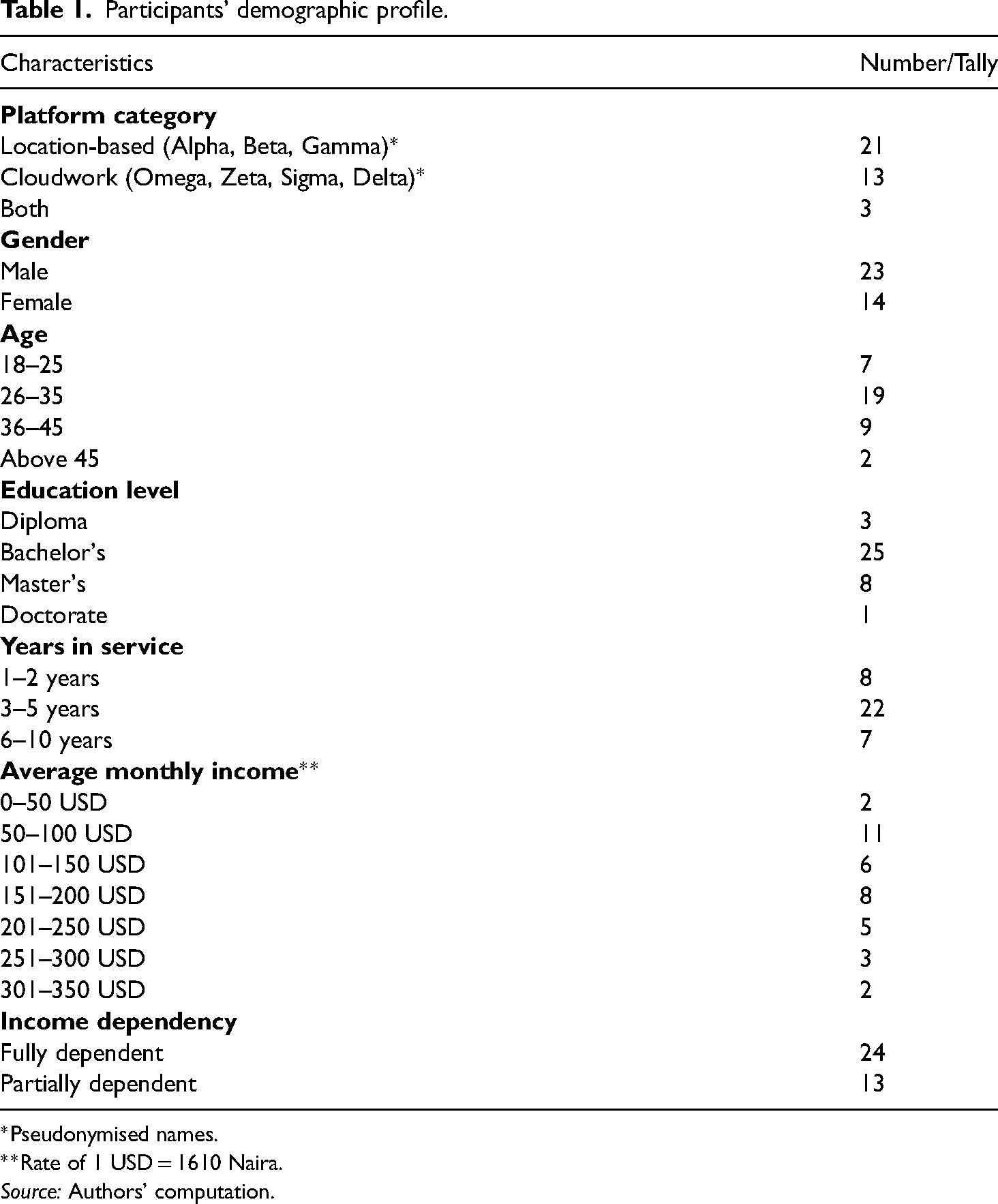
*Pseudonymised names.
**Rate of 1 USD = 1610 Naira.
Source: Authors’ computation.
Following ethics approval from the second author's university (Ethic Review ID: ER74284273) and obtaining informed consent from the participants, data collection commenced using semi-structured interviews. Given the absence of external funding and the data collection challenges previously mentioned, interviews were conducted virtually using Zoom and WhatsApp platforms. This approach enabled efficient and accessible data collection while ensuring participant convenience and privacy (Oliffe et al., 2021). The interviews were conducted using a set of predetermined open-ended questions (see Appendix 1) to ensure consistency in data collection and to allow participants to freely express their viewpoints and insights while also focusing on particular topics of investigation guided by the Fairwork and ILO decent work standards. Then we had follow-up questions, such as ‘give me some examples’, ‘how did that make you feel?’, ‘why did that happen?’ and ‘what influenced that decision?’, that allowed us to explore the responses further.
The interviews lasted between 35 and 50 min and were recorded to ensure accuracy in data transcription, enabling the researchers to record the responses of the participants verbatim. Despite reaching data saturation after 31 interviews, marked by thematic repetition and information redundancy (Saunders et al., 2019), we cautiously conducted six extra interviews to double-check for potential blind spots. To protect participant confidentiality and anonymity, we replaced their real names (e.g., Participant 1, 2…37) and those of the platforms with pseudonyms. This was especially important to our participants, who feared being identified for complaints they made on voice channels, or who did not want to jeopardise their primary source of income by openly criticising the platforms they work for. The interviews were transcribed and cross-checked by the researchers to ensure that the participants’ quotes were captured without distortion.
The data analysis process was guided by the six-stage thematic analysis procedure recommended by Braun and Clarke (2006). This rigorous approach enabled us to systematically identify, analyse, organise, describe and report recurring patterns or themes present within the dataset, providing valuable insights into the study's central questions. In the first phase, we familiarised ourselves with the data by noting down initial ideas and comparing notes aided by using an online spreadsheet. In the second phase, we generated initial codes, using colour-coding to identify similar words, texts and phrases within the data set. This led to the third phase, which involved searching for potential themes and categorising the codes into sub-themes. In the fourth phase, we reviewed the themes to check for coherence in patterns from the data extracts and the entire data set. In the fifth stage, following a back-and-forth process of agreeing and refining the themes, the researchers reached a consensus by defining and naming the themes (Table 2 presents the detailed thematic process). To ensure that the coded data was accurate, valid, consistent and resonated with the participants’ experiences, we carried out a member-checking process to validate our findings with the participants (Birt et al., 2016) and inter-coder reliability to ensure that all researchers agreed with the coding process to reach the same conclusion before finalising the main themes. The sixth phase entails producing the report, leading to the presentation of the findings.
Emerging themes with indicative quotations.
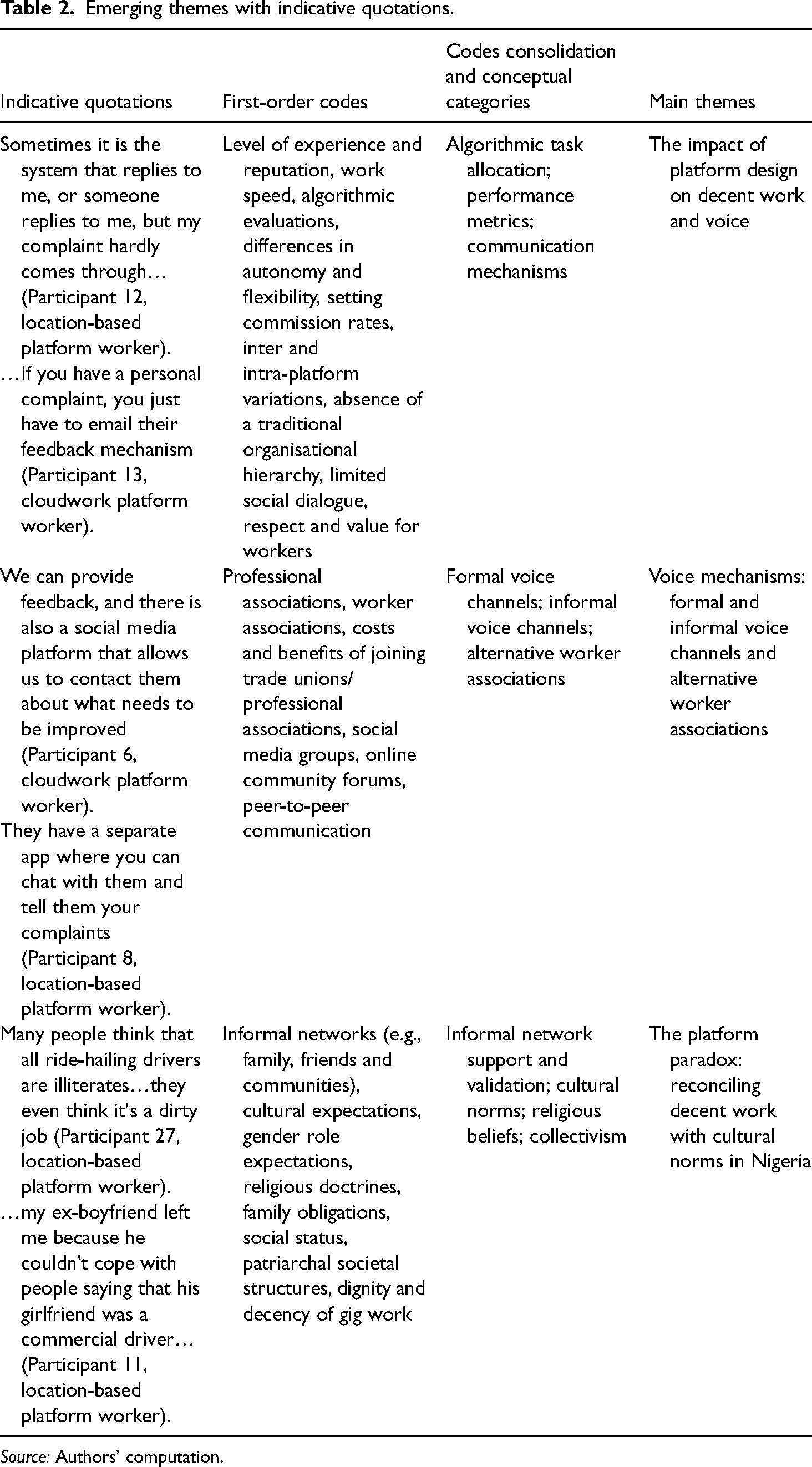
Source: Authors’ computation.
Findings
The findings are presented in three parts, based on the categorisation and clustering of codes and themes that emerged from the data, as outlined in Table 2. First, we found that platform design profoundly impacts the perception of decent work and workers’ voice. Second, we highlight the formal and informal voice channels and alternative worker associations for voicing among platform workers. Third, we evidence how cultural values in Nigeria influence what constitutes decent work for platform workers and its implications for voice.
The impact of platform design on decent work and voice
Extant research has often contested the extent to which platform work can be considered ‘decent work’, highlighting concerns regarding income security, worker autonomy and social protection (Bertolini et al., 2021; Heeks et al., 2021b; Sibiya and du Toit, 2022). We found instances of similar concerns among our participants, who emphasised that platform design features, such as algorithmic task allocation, performance metrics and communication mechanisms, can either facilitate or hinder decent work experiences for platform workers. While both categories of workers had common experiences of the lack of social security (or fair conditions) and irregular income (income insecurity) – influenced by their level of experience, work speed and algorithmic evaluations – platform design creates further distinctions between these categories. For example, location-based platforms often offer less autonomy and flexibility for workers, given that tasks are typically standardised and algorithms dictate work schedules and rates. However, these jobs are often easier to access as they require minimal skills. One participant said: Based on my previous encounters with Alpha, it was not fair. The passengers have more say than us [drivers]. It always feels like the passengers are the real bosses and have too much control over drivers (Participant 20, location-based platform worker). …they [Zeta] provide me with options that I can choose to work under. I can offer my services in many ways and at any time, it is up to me to choose what I want…Sometimes, I might submit a proposal and not get the work due to high competition on the platform…My goal is to learn other skills and upgrade my profile with more testimonials to expand my reach on the platform (Participant 6, cloud work platform worker).
More specifically, our findings highlight the significant role dispute resolution mechanisms play in shaping decent work experiences and opportunities for voice among platform workers, irrespective of platform categories. Consistent with existing research (Bucher et al., 2023; Waldkirch et al., 2021), our findings underscore the highly digitised nature of platform work and the absence of a traditional organisational hierarchy (e.g., supervisors), which often translates to limited or even absent opportunities for social dialogue, hindering workers’ ability to address grievances and advocate for improved working conditions. The following quotes illustrate the shared view: I do not see Gamma as a very friendly customer support company because I can’t communicate with them through the app… (Participant 4, location-based platform worker). I often have to use the chatbot on the Omega app. Even when you ask a question related to your work on the platform, it most likely will direct you to the FAQs (frequently asked questions), but it doesn’t always provide you with a satisfying answer, which can be very frustrating (Participant 26, cloudwork platform worker). I have never been disrespected on Beta or Alpha because I just go about my job and treat my customers with respect… (Participant 18, location-based platform worker). The platform is really straightforward, so there is no issue of disrespect. If there is any issue of disrespect, it most likely comes from clients (Participant 13, cloudwork platform worker). While I would say the respect given to us is fair, there were a few times when the clients tried to prove smart by rubbishing my work because they didn’t want to pay…they even said some hurtful and disrespectful words (Participant 3, cloudwork platform worker). If I were to rate the level of respect, I would say 4 out of 10. Respect is really low, especially among the passengers, and you have to condone all sorts of behaviours from them. The fact that the platforms don’t really do anything about it is also disrespectful to us drivers (Participant 14, location-based platform worker).
Voice mechanisms: formal and informal voice channels and alternative worker associations
While the nature of workers’ representation and social dialogue in the platform economy often varies from traditional employment models due to the absence or limited formation of unions or established forms of collective worker representation (Heeks et al., 2021b; Van Belle et al., 2023), our participants nonetheless demonstrate a strong desire for voice and improved working conditions, irrespective of the platform category. We found that only the location-based platform workers had a recognised professional association that provided them with a formal voice. Between 2017 and late 2022, there have been several worker associations for location-based platform workers in Nigeria, including the National Union of Professional App-Based Transport Workers (NUPABTW), Professional E-hailing Driver and Private-owners Association of Nigeria (PEDPAN), National Coalition of ride-hailing Professional (NACORP), among others. In late 2022, the Amalgamated Union of App-Based Transporters of Nigeria (AUATON) was officially recognised as a registered trade union. This recognition was a result of the merger of three worker associations (NUPABTW, PEDPAN and NACORP), which was facilitated by the Federal Ministry of Labour and Employment in Nigeria, and includes e-hailing or online transport drivers, app-based bike and bicycle food delivery and courier delivery workers (AUATON, 2023). In line with institutional theory, this exemplifies the regulative framework shaping formal worker representation, signalling a shift towards the formalisation and regulation of worker representation. However, despite the formation of AUATON, location-based platform workers exhibited a range of engagement with the union. While some workers actively engaged, others remained passively engaged, and a segment did not join the union altogether: Yes, I belong to a trade union (AUATON). I fight for my rights through this trade union by negotiating with the platforms… (Participant 19, location-based platform worker). Yes, we have a trade union, although I am not really active…sometimes, it's a waste of time because issues barely get resolved… (Participant 8, location-based platform worker). There is a particular association (AUATON) that fights for drivers, but I haven’t joined and have never been to their meetings before…I don’t trust unions… (Participant 12, location-based platform worker).
While State recognition of the trade union signifies a potential move towards formalised worker representation in the platform economy, concerns regarding its effectiveness persist. The absence of clear regulations and protections for platform workers within the Trade Union Act weakens their bargaining power and, consequently, the overall efficacy of worker representation. The following quotes exemplify the shared narrative: I don’t think the government is doing anything to ensure good working conditions. They are only after the tax the company pays. They are not interested in the drivers at all… (Participant 12, location-based platform worker). Because the government has failed to regulate the gig economy, we have no choice but to join associations and online communities… (Participant 31, cloud work platform worker). I don’t think any government policies consider freelancers like us. It feels like they don’t care whether we exist or not… (Participant 33, cloudwork platform worker). …We only talk to one another because there is no way you can complain on the platform (Participant 14, location-based platform worker). We have an online community where we can express our complaints… (Participant 10, cloudwork platform worker). There is a community of freelancers where we share our opinions and express our dissatisfaction…it's an online platform (Participant 17, cloudwork platform worker). There is a driver's forum on the Alpha platform, but I am not on the group because I am not a full-time driver… This forum is used to post complaints (Participant 20, location-based platform worker). …We just talk about it among ourselves on the forum, but there is nothing that can be done about it (Participant 3, cloudwork platform worker). You can post your complaint about the platform in the Zeta community forum, and sometimes, it can be resolved because people from the company monitor what is happening in the community… The same applies to Alpha and Beta community forums too, but I think many people say that the cloudwork forums are more responsive (Participant 9, cloudwork and location-based platform worker).
The platform paradox: reconciling decent work with cultural norms in Nigeria
The Nigerian gig economy presents a paradoxical situation for platform workers. While platforms offer potentially greater flexibility and autonomy than traditional employment models, cultural norms within the Nigerian social context shape what constitutes decent work. Unlike many individualistic societies where freedom and autonomy are prioritised, promoting independent career choices often with parental support, collectivist societies like Nigeria tend to emphasise group interests over individual pursuits (Akosah-Twumasi et al., 2021; Sovet and Metz, 2014). In such contexts, informal networks such as family, friends and communities play a crucial role as co-actors in decision-making, particularly regarding career paths. Our findings suggest that this reliance on informal networks further shapes the understanding of ‘decent work’ for platform workers in Nigeria. One participant remarked: …in Nigeria, our parents strongly influence the careers we choose, especially when they have sacrificed their comfort to support our education. So, you can’t just wake up with the idea that you want to be a ride-hailing driver; it will look like you have wasted all their efforts because it's not a stable job…the economic situation is mainly why people like me joined Alpha and Beta… (Participant 7, location-based platform worker). Because my work is done online, do you know I always have to convince my parents that I’m not involved in ‘yahoo-yahoo’ [Nigerian slang for ‘internet fraud’]? As Christians, that would break them if that were the case because it's a sin to cheat others… (Participant 23, cloudwork platform worker). The Nigerian economy has already made it difficult enough. Still, you must also be careful because when you tell some people your work is based online, they quickly assume you’re a ‘yahoo-boy’ (Participant 6, cloudwork platform worker).
Moreover, the perception of gig work as ‘decent’ is also shaped by prevailing gender role expectations within the Nigerian context. These expectations are often reinforced by stronger patriarchal societal structures than those prevalent in the West, as there are still widely held beliefs that a woman's role is primarily that of a caregiver and homemaker, while men should solely be recognised as breadwinners (Adisa et al., 2021). For example, two female participants explained: …It is difficult to see many women as Alpha drivers because it's not seen as a [decent] job…I do it because it's one of the ways that I can combine work and family duties…Despite the bias in the work, I can work any time I choose to accommodate other things… (Participant 8, location-based platform worker). Delta offers me flexibility, which is extremely important as a married woman with kids… Joining ride-hailing would be difficult and unsafe for women due to societal stigma that frowns upon women doing such jobs (Participant 24, location-based platform worker). …for example, every time I complain to my parents about the way we’re treated, they always say stuff like, ‘I have told you to leave this disgraceful job…it's not a woman's job…are you not ashamed because we are ashamed on your behalf?’. This lack of support from your loved ones doesn’t even motivate you to take any action against the company… As a woman, don’t even try complaining on social media because there are some men and even women who will criticise you… (Participant 29, location-based platform worker). …in fact, some of my friends don’t know these are the type of jobs I do. Since I lost my full-time job, it has been the only way to survive…so how do you even complain to them to get their support? The community forums are better because like-minded people are there (Participant 9, cloudwork and location-based platform worker).
Discussion and implications
This study examined the voice and representation mechanisms of platform workers and their implications for decent work within the Nigerian gig economy. This research amplifies previously underrepresented voices in the decent work literature and broadens the scope of voice studies within the non-Western context. From a theoretical perspective, using institutional theory, our findings deepen the understanding of how the regulative, normative and cultural-cognitive pillars influence voice and representation mechanisms within the Nigerian platform economy. It highlights how these institutional pillars interact to shape the experiences of platform workers, revealing the significant role of regulatory frameworks, societal norms and shared cultural beliefs in defining opportunities for voice and collective representation. This perspective illuminates the complexities of achieving decent work in a gig economy shaped by institutional power and contextual nuances, particularly where traditional forms of representation are limited, and new mechanisms must adapt to local norms and structures (Uzunca et al., 2018).
Through the lens of the regulative pillar of institutional theory (Scott, 1995) and building on prior research (e.g., Adekoya et al., 2023; Folawewo, 2016), our findings reveal the critical impact of Nigeria's legal framework on voice and representation mechanisms for platform workers. The absence of clear regulations and limited protections exacerbates tensions between established decent work standards and workers’ lived realities, significantly undermining their bargaining power and capacity for effective representation. While the formalisation of trade unions suggests progress, weak regulations – stemming from employment classification loopholes and broader systemic challenges peculiar to the Nigerian environment – limit their efficacy. This regulatory vulnerability not only curtails the effectiveness of unions but also shapes workers’ scepticism towards formal representation, further highlighting the complex dynamics between institutional frameworks and the mechanisms shaping voice in the gig economy (Anwar and Graham, 2021; Cieslik et al., 2021). These findings emphasise the critical role of robust regulatory frameworks in fostering meaningful worker representation and social dialogue.
From the lens of the normative pillar, this study reveals how entrenched norms within the Nigerian gig economy shape workers’ voice and representation mechanisms. Platform design, communication structures and algorithmic controls establish a normative framework that prioritises platform efficiency and profit over worker welfare (Adekoya et al., 2023; Wood et al., 2019), reinforcing expectations of flexibility and autonomy while masking exploitative practices. Workers internalise these norms, often lowering their expectations for fair wages, job security and collective representation (Anwar and Graham, 2021; Myhill et al., 2021; Rubery et al., 2018). Informal voice channels, such as social media groups and peer forums, emerge as coping mechanisms that align with these normative pressures but fall short of systemic change. These findings advance institutional theory by illustrating how normative forces within digital labour platforms not only influence individual behaviours but also perpetuate structural inequalities. This perspective deepens understanding of the gig economy's inherent contradictions – providing flexibility while undermining decent work – and offers a nuanced view of how norms constrain meaningful voice and representation.
The cultural-cognitive lens offers our strongest contribution to the literature. The unique Nigerian context, characterised by strong patriarchal structures and collectivist values (Adisa et al., 2021; Mordi et al., 2023), serves as a critical lens to examine how deeply ingrained societal beliefs and worker interpretations shape voice, representation and perceptions of decent work in the Nigerian platform economy. Our findings underscore the crucial role of cultural factors – collectivism, family obligations, religious beliefs and gender roles – in shaping platform workers’ voice behaviour and perceptions of decent work, therefore offering a critical departure from universalised models of decent work. For example, the emphasis on informal network support and validation within Nigerian culture can act as a gatekeeper, potentially influencing individuals’ decisions to enter the gig economy even when economic precarity might incentivise prioritising flexibility and income over formal protections. However, this prioritisation can come at a cost, potentially falling short of established decent work standards and hindering workers’ voice. This highlights a tension where cultural factors can both push and pull workers towards platform work while simultaneously shaping how they evaluate its alignment with decent work principles.
Additionally, within the cultural cognitive dimension, our study further contributes to the discourse on the feminisation of labour in the gig economy. While previous studies (Churchill and Craig, 2019; Cook et al., 2021) highlight gender disparities in platform work participation due to caregiving responsibilities, pay gaps and platform experiences, we argue for a deeper exploration of cultural norms. This study, situated within the strongly patriarchal social context of Nigeria, reveals how cultural expectations surrounding gender roles significantly shape perceptions of decent work, particularly for women. We contend that platform work, especially location-based roles, may be perceived as dishonourable or undignifying for women due to prevailing patriarchal structures. This perception contradicts the ‘productive work’ emphasis within decent work standards. In strongly patriarchal societies like Nigeria, women's domestic labour is often seen as more ‘productive’ because it aligns with their perceived conjugal duties (Pierotti et al., 2022). This potential incongruence between platform work and traditional femininity may disincentivise female participation and limit support from their informal networks when seeking fair working conditions, voice or representation. Recognising this dynamic, platforms may exploit this vulnerability, potentially exacerbating gender discrimination. In conclusion, our cultural-cognitive lens exposes the limitations of a universal definition of decent work and underscores the need for context-specific approaches that consider cultural norms alongside traditional economic factors to promote fair labour practices in the Nigerian platform economy.
From a practical perspective, this research provides actionable insights for enhancing voice and representation among Nigerian gig workers, even within weak institutional and legal frameworks, to promote decent work practices. Policymakers can use these findings to develop context-specific regulations addressing issues such as algorithmic bias, fair pay and platform accountability for worker well-being. Moreover, policy interventions should address employment classification, ensure fair wages and mandate platforms to implement worker protection. Strengthening social dialogue through alternative worker associations and digital advocacy can empower gig workers. Furthermore, from a social implication perspective, cultural perceptions of work significantly shape workers’ willingness and ability to voice concerns, particularly in collectivist societies like Nigeria, where traditional gender roles, family expectations and societal status influence employment choices. Many gig workers face stigma, limiting their advocacy for better conditions. Policy changes should address these socio-cultural barriers by promoting awareness of labour rights, supporting alternative representation mechanisms and encouraging community-driven initiatives that empower marginalised workers. Additionally, fostering inclusivity through targeted interventions, such as gender-sensitive policies and protections for informal workers, can reduce labour market vulnerabilities, ensuring a fairer and more equitable gig economy in Nigeria. Additionally, given the limited trade union representation and the prevailing norm of informality, alternative strategies such as informal voice channels remain more effective among Nigerian gig workers, providing accessible platforms for sharing grievances, organising collectively and addressing workplace concerns. Therefore, platforms can facilitate more transparent communication channels, enable feedback mechanisms such as platform ratings, and support informal voice processes such as chat groups and social media engagement to amplify workers’ collective voice (Soriano and Cabañes, 2020; Walker, 2021). Moreover, platforms can address workers’ needs by fostering a culture of inclusivity and engagement while aligning operational practices with decent work standards. Additionally, worker advocacy groups and informal associations can leverage these insights by fostering capacity-building initiatives that empower workers to articulate concerns and organise effectively. These efforts could include equipping workers with strategies to engage through social media, coordinate via chat groups and strengthen informal alliances.
Limitations and future directions
Our study, while offering valuable insights, is not without limitations. Firstly, the research focuses on the Nigerian context, limiting the generalisability of findings to other countries with different cultural norms and regulatory landscapes. Future research could explore how these dynamics play out in other non-Western contexts to broaden our understanding of the global platform economy. Secondly, we acknowledge that our sample, while diverse, did not capture the full spectrum of gig workers across various platforms (web and location-based) and locations in Nigeria, potentially affecting the generalisability of our findings. Additionally, our reliance on self-reported data from participants introduces potential biases. While invaluable, incorporating perspectives from platform companies and policymakers could offer a more comprehensive understanding of the challenges and potential solutions.
Footnotes
Open access statement
For the purpose of open access, the author has applied a Creative Commons Attribution (CC BY) licence to any Author Accepted Manuscript version arising from this submission.
Declaration of conflicting interests
The author(s) declared no potential conflicts of interest with respect to the research, authorship and/or publication of this article.
Funding
The author(s) received no financial support for the research, authorship and/or publication of this article.
