




Abstract
There is much still to be learned regarding the outcomes of transnational parenting for young people in labour-sending countries. In particular, a significant knowledge gap exists regarding young people's perspectives on transnational parenting at the time of the parent's absence outside of Central America or Asia. Thus, the purpose of this study is to increase understanding of young people's experience in the under-researched Pacific Islands region by examining: How does a parent's international labour migration impact young people left-behind in Tonga's work, leisure, education and aspirations? A theoretical framework utilising social remittances theory was adopted. Utilising a quick, ethnographic approach, 179 secondary school students participated. This 2017 study included interviews, time diaries, short surveys, focus groups and fieldwork observations to facilitate participant-led accounts of young people's experience of transnational parenting in Tonga. This study provides an important empirical contribution regarding young people in Tonga's experience of transnational parenting. These findings demonstrate that, as a consequence of labour migration schemes that disregard family accompaniment, young people in Tonga are paying a high price, a triple loss, as their right to family is diminished, they are unable to prioritise their education, and migration goals are elevated, all of which inhibit their potential.
Introduction
The persistent relationship between migrant labour and low-quality work (Wright and Clibborn, 2019) and the layered vulnerability experienced by temporary migrants (Underhill and Rimmer, 2016) have been areas of enquiry in the Journal of Industrial Relations previously. This paper expands the lens of enquiry to include consideration of another vulnerable actor within migrant labour frameworks: the children of migrant workers who are required to be left behind.
Transnational parenting occurs when a parent migrates without some or all of their children and performs parenting over a distance (Orellana et al., 2001). Some examples of transnational parenting communication pathways include telephone calls, internet and text messages, social media interactions, the sending of gifts, information passed through other family members, and visits.
Articles 7, 8, 9 and 10 of the United Nations Convention on the Rights of the Child expressly regulate a child's right to family and government responsibilities to ensure that families remain intact unless separation is in the child's best interests. Also widely ratified, the United Nations (UN) Declaration of Human Rights Article 16 (3) states that the family is fundamental to society, ‘entitled to protection by society and the State’ and in Article 23 (3) that: ‘Everyone who works has the right to just and favourable remuneration ensuring for himself and his family an existence worthy of human dignity …’. Despite these rights, temporary labour migration schemes, such as the Pacific Australian Labour Mobility (PALM) scheme, do not permit dependents to join their family members who participate in these schemes. As a consequence, families can be separated for years at a time.
As schemes such as the PALM scheme expand in scope and duration, this paper provides important new findings to increase understanding of the impact of transnational parenting on young people in the under-researched Pacific region, specifically in Tonga. Furthermore, as formal employment opportunities remain scarce in Tonga, today's generation of left-behind young people will likely become the future migrant workforce of nations such as Australia and New Zealand (Kingdom of Tonga, 2023).
This study considers the impact of transnational parent separation on young people's prioritisation of work, leisure and education. It explores whether transnational parenting alters the aspirations and ambitions of young people in Tonga. These findings are presented to inform the ongoing dialogue and policy development relating to migration controls and the sustainability of global temporary migrant labour markets. It will also provide a needed platform for the voices of young people who experience transnational parenting to be heard.
This paper begins by surmising the existing knowledge regarding the social impacts of transnational parenting. The conditions that sustain the increasing trend of transnational parenting in the global labour market and Tonga are then discussed to provide context to transnational parenting arrangements. The theoretical framework of social remittances and the methodology are then explained. Then, findings on the impact of transnational parenting on young people in Tonga's experience of leisure, work, education, aspirations and migration ambitions are offered. The implications of these findings within the theoretical context of social remittances are then discussed. Following this, policy considerations are presented. Finally, a summary of the main findings and research limitations is provided in the conclusion.
Transnational parenting
Graham and Jordan (2011) estimate that millions of young people live with the absence of a parent in labour-sending countries. However, the experience of transnational parenting is not universal, and findings cannot be generalised across regions and cultures (Dreby and Stutz, 2012). For example, Åkesson et al.'s (2012) study in Cape Verde found that transnational separations can be socially constructed as normal and acceptable aspects of children's transnational households and cannot be assumed to be regarded as traumatic or crises. Rather, consideration must be given to the diversity of cultural norms in the experiences of household structure, collaborative caregiving and their compatibility with mobility. In another example from Vietnam, children did not regard their transnational parents negatively, instead regarding them as they did themselves: ‘…powerless people making great sacrifices in the best interests of the family…’ (Hoang and Yeoh, 2015: 192).
However, despite established extended caregiving kinship structures, substitute caregivers are not always regarded as a proxy for the parent (Cunningham, 2022). In Tonga, Moala-Tupou's (2016) study found that young people reported being subject to increased discipline and struggling in the absence of usual parental support and guidance. In the Philippines, these caregiving arrangements are ‘contested’, and young people can regard caregivers as ‘just “there”’ physically, while their transnational parent ‘should be’ at home (Acedera and Yeoh, 2021: 188). In Mexico, Dreby (2010) found that a culture of out-migration did not decrease the difficulty or distress experienced from parental absence. Instead, depression following parental departure, behavioural issues, lack of discipline and a lack of educational support were all identified as contributors to poor school performance for young people experiencing transnational parenting (Dreby, 2010).
In the Philippines, young people who experienced transnational parenting and increased household wealth performed better in school pacing and class position than their peers (Asis and Ruiz-Marave, 2013). Asis’ (2006) previous study indicated school activities and friendships as factors facilitating young people's acceptance of transnational parenting arrangements (although this acceptance was strained at significant occasions such as birthdays, Christmas and graduations). Jordan et al.'s (2018) comparative time use study found young people in the Philippines with non-parental caregivers spent less time doing household chores. Yet, as Graham and Jordan (2011) cautioned from their study across four Southeast Asian nations, findings from the Philippines may not be generalisable to other regions.
For example, in the Caribbean, young people were more likely to experience school drop-out due to increased care responsibilities (Bakker et al., 2009). In addition, ‘…sadness, despondence, despair, anger, lack of trust, low self esteem, and an inability to concentrate at school’ were reported (Reis, 2008 in Bakker et al., 2009: 8). In China, Chang et al. (2011) found young people experiencing transnational parenting (particularly females) are required to perform increased household and farm duties, with potential adverse implications on schooling performance. In addition, in Mexico (Kandel and Kao, 2001) and Bangladesh (Kuhn, 2006), studies have found young people who experience transnational parenting are more likely to abandon educational aspirations.
However, only some studies consider the perspective of young people, at the time of separation, outside of the much-researched regions of Central America and Asia. Thus, minimal information is available on young people experiencing transnational parenting in the Pacific Islands: only one Master's study could be located. Moala-Tupou's (2016) exploratory study on the Lifuka Island of Tonga, included 16 participants aged 13 to 16, 10 of whom had a sibling who migrated, and 6 of whom had a parent who had migrated in the preceding 12 months, in addition to some parents and community leaders. This study reported mixed outcomes resulting from parent and sibling migrations, with remittances utilised to fund education and transport (that could facilitate improved health access), while at the same time, young people struggled in the absence of parental supervision and increased household responsibilities, ‘have poorer performance academically, drop out from school at an early stage, and run away from school’ (Moala-Tupou, 2016: 73–74). Further research was needed to delineate findings and to examine how the additional duties performed by young people to accommodate the transnational parent's absence impact their leisure, education, aspirations, and migration ambitions, and the role, if any, of gender within these.
Migration, labour and value
Firth (2007: 122) observed that ‘in a truly global world economy—one that matched the rhetoric of the globalizers – labor would cross national borders as easily as capital’. However, in recent decades, in what Castles (2014: 191) described as the ‘securitization of migration’, market policies of global free trade and competition have integrated with political responses to populist migration concerns linking unwanted national outcomes of globalisation with fears surrounding multi-culturalism. This problematisation of migration created an apparent contradiction: as the liberalisation of labour mobility continues to be demanded by globalisation, the act of migration has been increasingly regulated and restricted (Castles, 2013, 2014).
Within this context, Castles (2013: 130) described the emergence of a global labour market stratified by wealthy nations desiring ‘wanted’ high-skilled migrants who enjoyed enhanced global mobility while being offered favourable conditions such as permanency for themselves and their families. In contrast, ‘unwanted’ (but often needed) low-skilled migrants, usually from low-income nations, encountered the wealth of migration restrictions as a trade-off to their admission.
As migration opportunities in the Pacific increasingly favoured highly skilled workers (MacDermott and Opeskin, 2010), the World Bank (2006) observed that formal employment opportunities in many low-income nations remained scarce. Yet low-income nations possessed ‘an increasingly larger pool of young people from which industrialised countries with labour shortages’ could draw (World Bank, 2006: iii). For industrialised countries to access this unwanted (yet desired) low-cost labour, the ‘understandable’ reluctance of destination countries to open their borders permanently to low-skilled workers had to be overcome (World Bank, 2006: 19). Particularly as high-income nations such as Australia struggled with workers who were ‘too “free”’ to resist poor wages and conditions, which seasonal workers would resolve by being ‘less free’ (World Bank, 2006: 132). In this context, labour-sending and receiving countries embraced the concept of temporary migration as the pathway to development (Agunias, 2006).
Sectors of the economy unable to maximise profits by offshoring and outsourcing their production could now progress to an alternate opportunity: requiring migration frameworks where workers can be viewed by receiving nations as holding no value outside of productivity. Thus, they could require them to alienate themselves from the productive person (Marx, 1977), who can then be expected to offshore and outsource the parenting of their children. The advent of the Seasonal Worker Programme in Australia in 2008 represented a significant policy shift from the preceding focus on skilled (claimed as non-discriminatory) permanent migration (MacDermott and Opeskin, 2010).
Negative public perceptions regarding migrant inflows were overcome (despite countries such as Australia leaving these inflows uncapped) through the ideology of temporariness and distancing by the state (Dauvergne and Marsden, 2014): the private sector oversees the implementation of these schemes. With visas tied to the employer, seasonal workers can be preferred over alternate labour sources such as backpackers ‘who can state that they are leaving at the drop of a hat’ (Submission to the Joint Standing Committee on Migration, 2016: 54). Yet, when labour demand drops, the pool of just-in-time migrant workers is dispatched home with minimal obligations or social entitlements provided to the migrant worker and their family (Department of Home Affairs, 2021a, 2021b).
This remittance-as-development model, utilised to justify temporary labour migration schemes, such as the PALM scheme, is claimed as a triple win (United Nations, 2006). Underhill-Sem et al. (2019) provides a helpful outline of these wins (and some losses). Wins for the sending country can include the utilisation of an otherwise unemployed workforce, with the possibility that earnings could benefit trade, business development and investment. An obvious win for the destination country is access to a pool of just-in-time workers to overcome reported labour shortages. For the migrant worker, the win is employment, with the opportunity to acquire new skills, remit and amass savings before returning home.
Within this prioritisation of ‘efficiency over equity considerations’ that underpin these ‘demand-driven’ visa systems (Wright and Clibborn, 2019: 164–165), many migrant workers and their families persist in an invisible ‘permanently temporary condition’ where fundamental human rights, such as the right to family, can become negotiable (Garrapa, 2017: 201; for more detail regarding these inequities, see Clibborn and Wright, 2022). At the same time, an ‘almost exclusive focus on migration governance’ conceals the lack of any real labour governance (Piper and Withers, 2018: 571). Instead, access to employment in attempts to mitigate conditions of existing precarity in the home country requires migrant workers and their families to trade their rights to family for the opportunity to labour within this continuum of engineered ‘protracted precarity’ (Piper et al., 2017: 1094). Yet, both labour-sending and receiving nations largely ignore the disassembly of reproductive care and inequality perpetuated (Withers and Hill, 2023). In this context, the concentration of left-behind young people in geographical areas such as the Pacific Islands creates new challenges for protecting young people and migrant workers’ families’ rights.
Tonga and migration
In 2019, Tonga had the fourth-highest emigration rate (IOM, 2020) and was the top remittance-receiving country globally (World Bank, 2020) in proportions of population and Gross Domestic Product (GDP), respectively. Remittances equated to 37.6% of GDP (World Bank, 2020). This represents almost double the annual total gross aid from all donors (OECD, 2021), and these remittance trends persist (World Bank, 2021), evidencing how increasingly the economic stability of Tongan households is tied to overseas employment.
Within this context, Tonga contributed 35% of workers to Australia and New Zealand's seasonal worker schemes (Bedford et al., 2020). With such schemes offering earning potential of around five times higher than for equivalent local roles, migration from Tonga is emptying villages of productive workers, who are often also parents (Bedford et al., 2020; New Zealand Ministry of Business Innovation & Employment, 2016; World Bank, 2018). In 2019, 10% of children were reported to have a parent living overseas (Tonga Statistics Department, 2020). This can be expected to increase, as, by 2024, one-third of Tonga's working-age population is projected to participate in temporary labour schemes (Kingdom of Tonga, 2023). Yet, little is known regarding the impact of transnational parental separation on young people in Tonga.
Theory
The theoretical approach adopted for this study utilised Levitt's (2001) social remittances theory, as this provides a useful conceptual framework for analysing transnational exchanges that highlights the role of culture and recognises both the individual and the collective, making it well suited to being utilised in Tonga. Social remittances occur when migrants incorporate and blend new ideas and ways of doing things and then communicate these to their networks in the home country through, for example, phone calls, gifts and visits (Levitt, 1998).
Social remittances continuously circulate through transnational relationships, invoking positive and negative consequences that can modify values, ‘norms, practices, identity and social capital’, thus transforming families, societies and cultures (Levitt and Lamba-Nieves, 2011: 19). For example, Levitt (2001) describes how ‘migration fever’ and financial dependency decrease the perceived value of education with remittance income affording an increased living standard coupled with an increased dependence. Social remittances that align with existing norms or are transmitted from ‘large, powerful countries to smaller, weaker ones’ are likely to have more impact and be adopted quickly (Levitt, 1998: 940). In contrast, those that run counter to norms or originate from equivalent countries encounter more resistance.
Utilising the theory of social remittances, this paper will examine how, from the perspective of young people, transnational parenting is changing work obligations, leisure, education, ambition and aspirations in Tonga. These have implications for worker migration schemes as these young people will likely become the next generation of migrant workers (Kingdom of Tonga, 2023).
Method
The methodology of this study was informed by Dreby's (2010) work with children experiencing transnational parenting in Mexico, Aldridge's (2015) participatory action research approach that has been successfully utilised in Tonga (Aldridge, 2018), and the approach deployed by the ‘Young Lives’ study to utilise a child-centred methodology that allows for cultural and historical contexts. This 30-day quick ethnography included a mixed-methods ‘toolkit’ of observation, photography, short surveys, semi-structured interviews, group discussions, drawings and time-use diaries (Crivello et al., 2009). The approach of a quick ethnography, as proposed by Handwerker (2001: 12), allowed for various research activities to measure social remittances through ascertaining ‘what is typical and what is not; what is similar and what is not; the nature and content of accounts that confer and those that diverge; and a desire to understand what is seen’. All of which was needed to understand the social remittances occurring. This study was conducted with secondary school-age participants at two secondary schools in Tonga in October and November 2017.
This research was subject to University ethics approval in accordance with the Australian National Statement on Ethical Conduct in Human Research (2015). The Ministry of Education and Training and the Office of the Prime Minister in Tonga provided clearance for the research to be undertaken. The principles of informed consent were observed as follows. First, a clear explanation regarding the research purpose was provided to inform each participant's understanding, with a note outlining the study translated into Tongan sent home to parents and guardians. Second, all participation was voluntary, and all parties were appraised of the importance of this. Third, participants were informed that they were under no obligation to participate in the study, and that they could, in complete confidence, withdraw consent at any stage, and should they do so, it would be up to them if information they had already shared was included in the study or if they preferred that all information collected regarding them was destroyed. Fourth, participants were advised that while their names would not be used, the information that they shared was intended for publication. Finally, the principles of the process of consent were adhered to with ongoing opportunities for dissent provided and voluntary consent affirmed and repeated at every stage of the research process (Hammersley and Atkinson, 1995; Morrow, 2008).
Using a snowball sampling approach, teachers invited participants to participate during their free periods or breaks, and then participants also invited their friends to participate. In total, 179 short surveys and time diaries were generated, comprising 104 female and 75 male participants. All were attending secondary school and aged between 11 and 21 years.
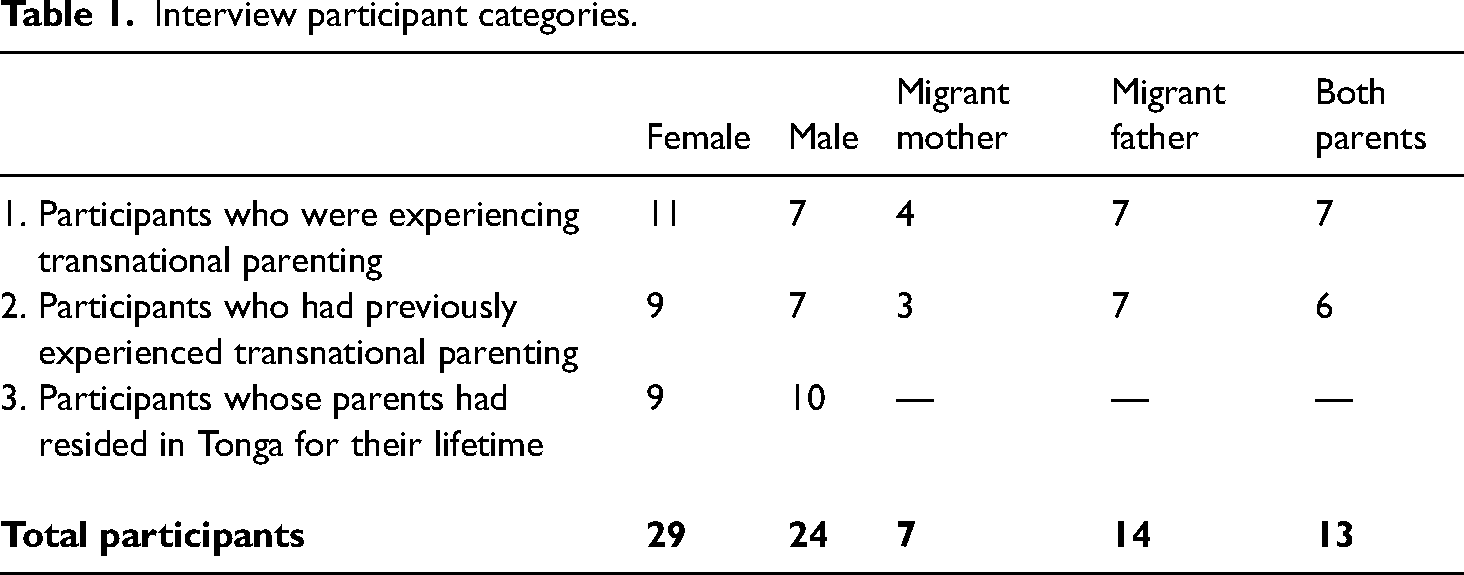
In addition, 53 interviews with secondary students were completed. Interview selection was based on the information provided in the survey to provide representation for the following categories:
Participants who were experiencing transnational parenting where at least one parent had migrated for more than six months at the time of the study.
1
Participants who previously experienced transnational parenting where the migration of at least one parent had exceeded six months in their lifetime. Participants with both parents living in Tonga for their lifetime where the parent had not migrated but may have undertaken holidays or visits overseas that were at most three months. This cohort was utilised as a comparison group to ascertain usual norms, practices, identities and social capital.
A further breakdown of participant categories for young people interviewed is outlined in Table 1. In addition, informal focus group discussions were conducted and audio recorded with key informants (including school staff, counsellors, adults who had experienced transnational parenting as a child or undertaken transnational parenting, a seasonal work employer and a recruiter) to provide cultural context to early themes.
Interview participant categories.
A draft interview schedule was devised according to the themes that emerged after undertaking an international literature review on transnational parenting. The proposed interview schedule was offered to Tongan families in Australia, the Minister of Education in Tonga, the secondary school principals, and the school counsellor to critique and ensure cultural appropriateness. Interviews were primarily conducted outside, often sitting together on the ground, which facilitated a more informal approach and assisted in equalising status between the researcher and participant.
Following consultation with teaching staff, it was determined that an interpreter was unnecessary, and interviews were conducted in English. While participants who had not experienced transnational parenting were included to provide insight into cultural norms, and consultation was undertaken with key informant focus groups in Tonga to reflect on early themes, these findings are unavoidably imbued with my Anglo-cultural lens. Pacific scholars are essential for expanding these findings, including structuring further studies with an appropriate cultural lens to incorporate more significant cultural insights, interpretations and solutions.
All data were deidentified for both participant and cohort using a unique identifier. Time diaries were coded to activity types in Excel. Survey findings were inputted to Nvivo as cases and interview audios were coded utilising a thematic analysis approach to develop a coding framework (Nowell et al., 2017). Data was then triangulated across sources and compared utilising queries across cohorts, household type, gender and so on. Emerging findings were then analysed to ascertain how transnational parenting culture conforms and departs from the established norms in Tongan culture as indicated by the comparison group, key informant focus groups, and by drawing on Morton Lee's (1996) observations of childhood in Tonga.
Several themes emerged during this analysis, and the study's findings will now be presented according to these themes: work and leisure, education, aspirations and migration ambitions.
Work and leisure
Participants with parents who have resided in Tonga throughout their lifetime enjoyed various leisure pursuits. They were more able to readily identify activities they enjoyed, with an increased number of responses offered. Their time diaries showed that they had the most leisure time (at 2.7 hours per day) and spent less time on chores than their peers experiencing transnational parenting. This increased leisure time was utilised playing sports (for male participants, and always rugby), watching movies, listening to music, playing in the band and daytime rest. Despite other male participants speaking of the bush in their interview responses, this was the only cohort to identify time in the bush as one of their favourite pastimes. This finding indicates an increased emphasis on traditional Tongan subsistence skills such as farming and working in the bush in non-migrant households.
In contrast, young people who were experiencing transnational parenting reported increased work obligations and placed more value on work than their peers. Cleaning and cooking were very important to this cohort, particularly when both parents had migrated. This increased emphasis on work obligations implies that contributions to household chores and the rituals of food preparation become important to cultivating a sense of belonging in transnational households, especially when the participant was residing in households without any parent present. That is, they needed to prove their worth within the household. Indeed, this cohort reported through their time diaries to undertake the most work hours, 1.8 hours per day, compared to one hour per day for their peers. They were also the only cohort to identify hard work and doing one's best as important indicators of whether a young person was doing well in life.
While having fun was valued by participants who were experiencing transnational parenting (particularly males), they were the least likely to report friendships and time with friends as important and present in their lives. This decreased prioritisation of friendship indicates that friendships were not being utilised as a proxy for family in the transnational parent's absence. Instead, it suggests that emotional and social capital depletes when young people navigate a transnational parenting period. This depletion of emotional capital almost certainly inhibits their availability to the relational investments required in friendship. Instead, they reported watching more television and movies than any other cohort. As nearly all television and movies consumed in Tonga are imported, this increased viewing could be viewed as another form of social remittances, as young people attempt to understand the culture and environment that the transnational parent is now inhabiting to increase connection.
The migration of a parent may be changing perceptions of gender roles in leisure in Tonga. Overall, the role of sport is less prevalent in the lives of participants who were experiencing transnational parenting. However, for those that did report engagement in sporting activities, this occurred across genders, unlike their peers whose parents had resided in Tonga throughout their lifetime, where only males identified sport as an activity. This suggests that social remittances between the transnational parent and young person are altering and challenging some aspects of gendered perceptions in Tonga.
Education
Attending school and receiving an education were regarded as important by participants with parents who resided in Tonga throughout their lifetime. This importance placed on education was consistent across genders. Time diaries showed that, on average, they would engage in 7–8 hours of study and education each day, much higher than the hours allocated by their peers with a transnational parent.
Conversely, young people who were experiencing transnational parenting were not able to prioritise their education. Supporting their children's education was a predominant rationale reported for a parent's migration, and young people regarded education as important. In other words, they internalised the migration rationale in their belief system: their parent had to migrate to pay school fees. However, their time diaries during the end-of-year exam period showed their days involved the least educational activity of all cohorts: only 4.1 hours per day compared to over 7 hours per day for their peers whose parents had resided in Tonga throughout their lifetime. Given this, it appears that young people in Tonga who experience transnational parenting are likely to experience decreased educational outcomes, as reported elsewhere (Bakker et al., 2009; Dreby, 2007; Lu, 2014; Moran-Taylor, 2008).
Prioritising education for young people with a transnational parent was influenced by gender. While the importance of education and study was recognised across both genders, unlike findings from Mexico, in Tonga, regard for education was only retained when the father migrated (Dreby and Stutz, 2012). This decreased prioritisation of education infers that when the mother (and likely caregiver) migrates, the guidance available to support the young person's education in the household is reduced. A decrease in educational guidance and support available to young people in Tonga experiencing transnational parenting would be consistent with some findings reported elsewhere (Giannelli and Mangiavacchi, 2010) and supports Lu's (2014) hypotheses of families being unprepared for the consequences arising from the disruptions induced by transnational parenting.
Alternately, the decreased prioritisation of education could be interpreted as young people exercising their agency to defy the reciprocation anticipated with a parent's migration (Dreby and Stutz, 2012). It could also indicate young people's attempts to utilise their agency to influence migration decision-making. The payment of school fees is the primary rationale provided to young people for their parent's migration. The potential problem arises that by always framing parents’ migration as necessary for schooling, young people must weigh their continued access to education against the longed-for physical co-presence of the transnational parent. As has been reported in Indonesia, by downgrading the prioritisation of schooling, young people can cultivate pathways to early school exit, negating the need (as they understand it) for the transnational parent to remain overseas (Arlini et al., 2019). However, given the increased workload undertaken by participants with a transnational parent outlined above, there is likely an enhanced requirement for the young person to assume household caregiving responsibilities in their migrant mother's absence, which conflicts with prioritising education.
This continued decreased prioritisation of education suggests that a migration contagion effect may also be at play. As Dreby (2007) and Levitt (2001) outline, this is where, as a consequence of financial and social remittances, the perceived value of education is downgraded as young people of transnational households embrace migration ambitions. Unfortunately, any later re-establishment of education as a priority following the transnational parent's return is not likely to address the impact of the lost years in educational focus experienced during the (often extended) migration periods.
Aspirations
Aspirations in Tonga continue to be influenced by gender, as illustrated in Figure 1. Participants with parents who had resided in Tonga for their lifetime aspired to educational achievement and particularly focused on passing their exams. However, male participants were far more likely than female participants to identify educational goals. Traditional Tongan perceptions of gender almost certainly influence how young people are encouraged and supported in prioritising their academic pursuits. Still, female participants with parents who had resided in Tonga for their lifetime sought professional occupations, although primarily in the traditional female-occupied vocations of librarian, nurse and teacher. The boys in this group were most likely to aspire to a rugby league sports career. Overall, the careers identified by these participants were likely to be in less lucrative professions than their peers experiencing transnational parenting (see Figure 2). In addition, making their family proud was more important to this cohort than their peers who experienced a parent's migration.

This advertisement in Nuku’alofa required a girl aged 18 to 45 years for work from Monday to Saturday. Author's Own Image.
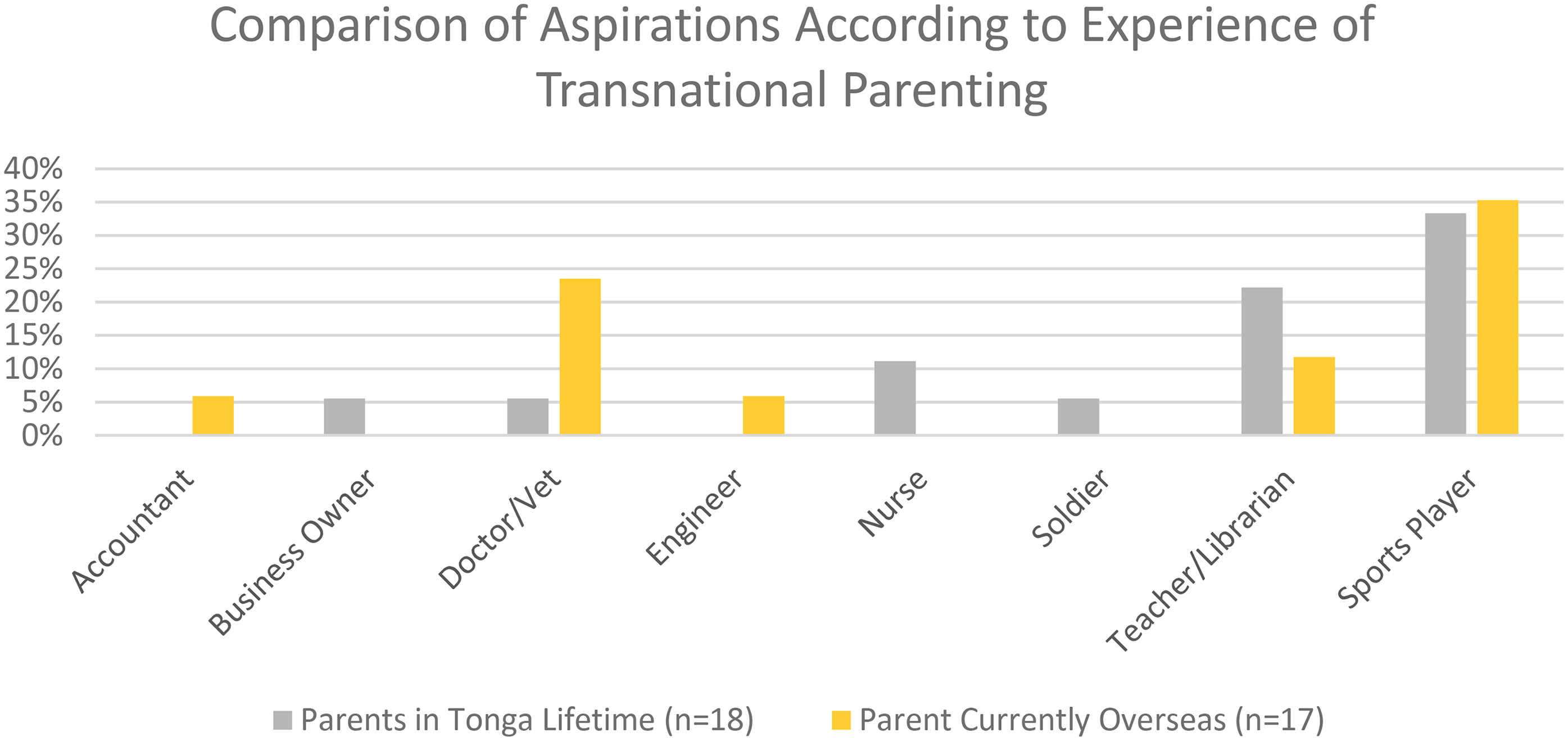
Comparison of interview participant's aspirations by cohorts.
In contrast, the migration of a parent preoccupied, enlarged and paradoxically constricted future aspirations for young people. For these participants, their dreams for the future centred around achieving entry into a profession (see Figure 2) and being reunited with their family (see Figure 3). The dream of reuniting with their family was particularly strong when both parents had migrated. In addition, evidencing the social remittances occurring, they demonstrated expanded ambitions compared to their peers. As shown in Figure 2, they were more likely to desire careers with higher remuneration, such as doctor, vet or accountant. These expanding aspirations demonstrate how a parent's migration can enlarge a young person's understanding of opportunity and wealth: The parent's migration establishes networks in the host country that expose and attract young people to educational opportunities outside of Tonga. This suggests that Levitt and Lamba-Nieves (2011: 13) findings that migrants enlarged their ‘vision’ and ‘outlook’ as ‘the spaces within which people imagined themselves and their aspirations for those spaces had radically changed’ are also being socially remitted from the transnational parent to their children.
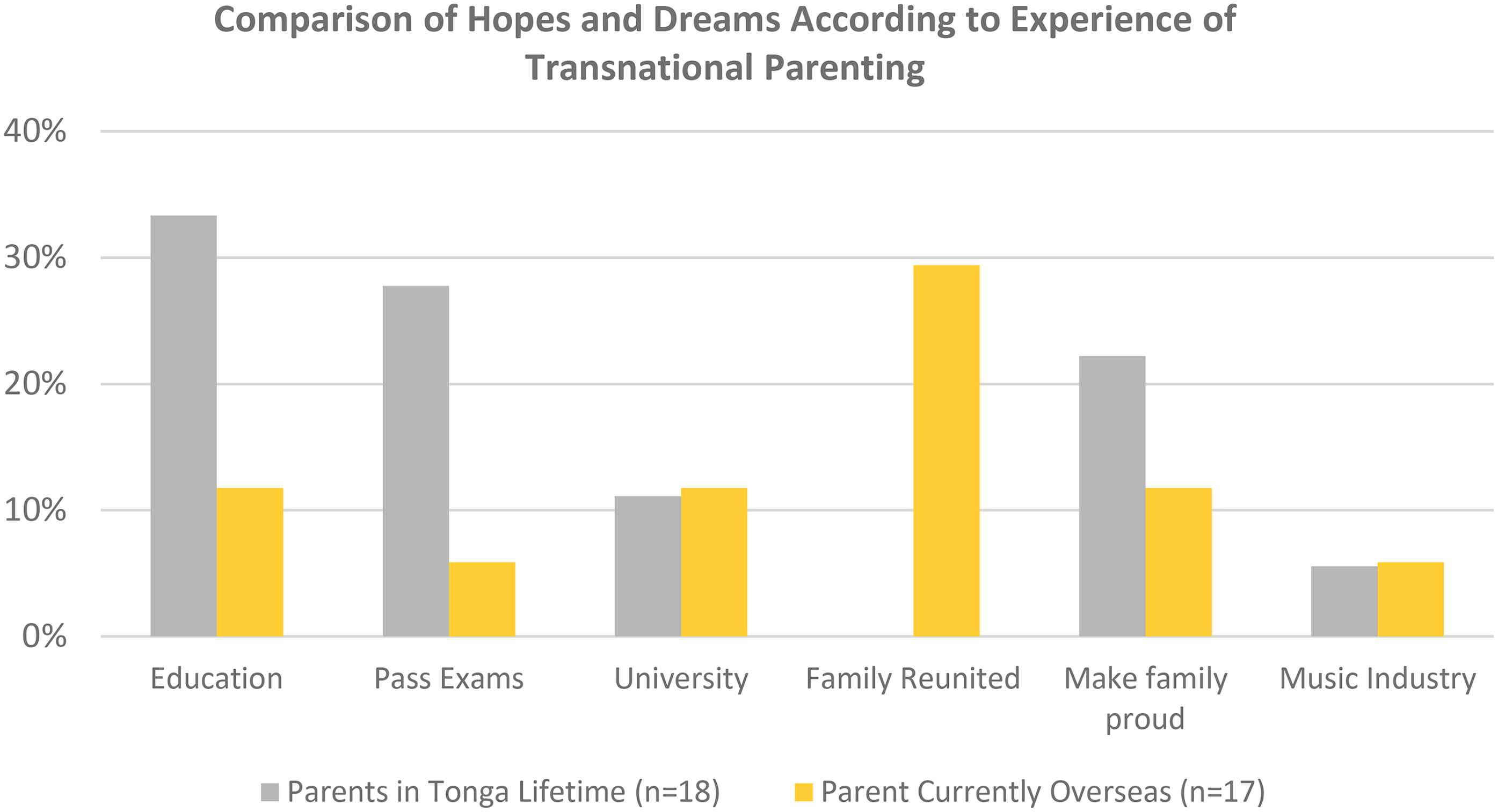
Comparison of interview participants’ hopes and dreams by cohort.
However, unlike their counterparts, participants who were experiencing transnational parenting showed limited interest in education as part of their dreams (Figure 3), with minimal reference to dreams of passing exams or gaining access to university. Indeed, no female participants with a transnational parent identified an educational goal. These reduced educational aspirations, coupled with the decreased prioritisation of education already mentioned, indicate how transnational parenting may result in insufficient support for young people to prioritise education.
Anticipated migration opportunities may also contribute to the decreased value placed on education by young people with transnational parents. The increased focus on professional occupations without requisite regard for the educational attainment required for access indicates the conflicting information that young people with transnational parents receive in social remittance flows. The transnational parent encourages them to obtain good employment (in highly-skilled, high-paying jobs). The young person incorporates this increased knowledge of professional employment opportunities but cannot connect these with their current educational achievement or progression. Yet, as Figure 4 illustrates, interview respondents indicated their transnational parents are predominantly employed overseas in low-skilled roles.
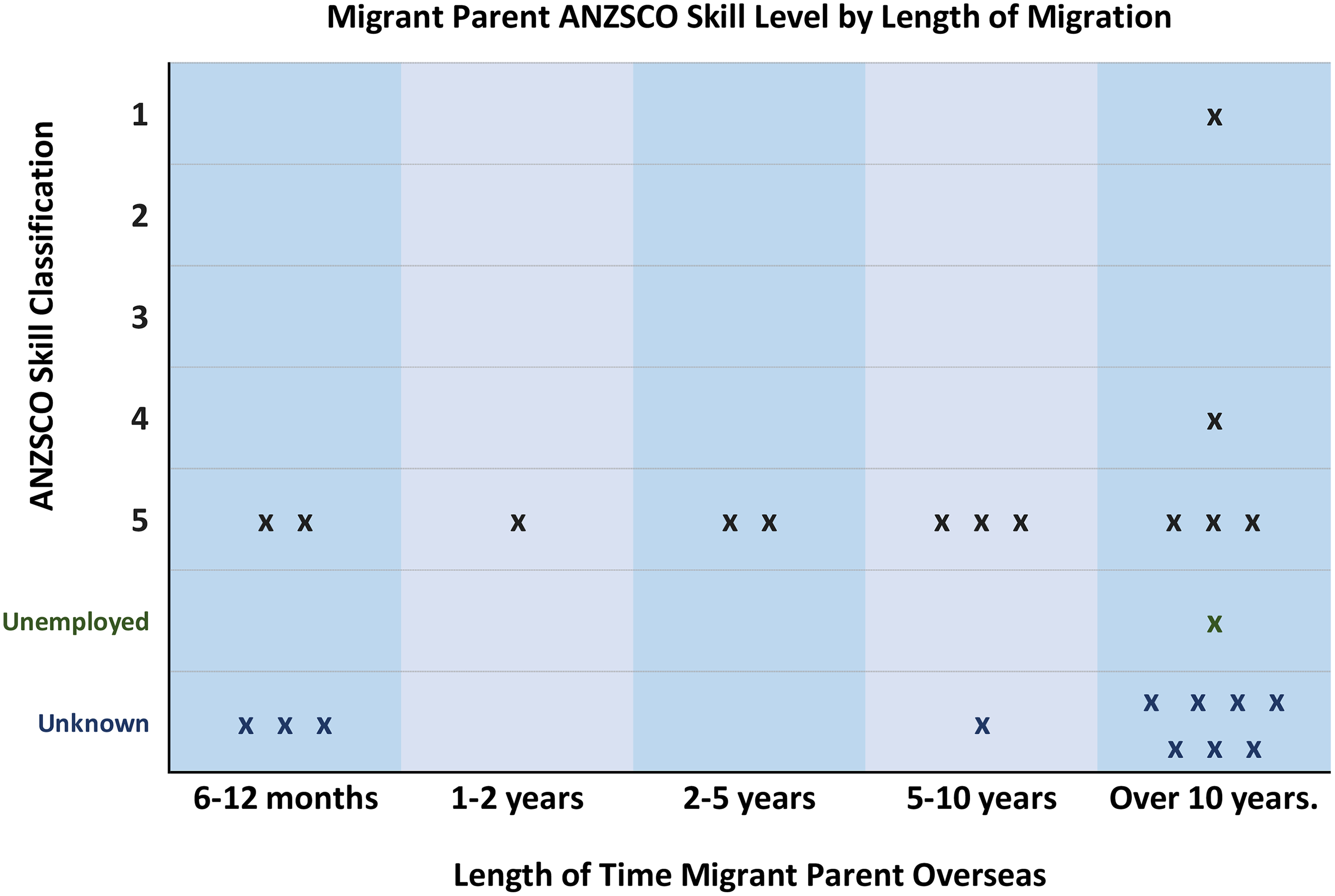
Participant reported employment skill level of transnational parents (utilising Australian and New Zealand Standard Classification of Occupations: ANZSCO (2019) skill rating mapped by the duration of the migration period.
Most participants reported reduced contact frequency with their transnational parent. This contact frequency reduced from the norm of daily or at least weekly contact enjoyed by their peers whose parents resided in Tonga, to only weekly, or for almost half (48%) monthly or less frequent contact with their transnational parent. Given this reduced contact frequency, the working conditions experienced by transnational parents are unlikely to be openly communicated through the migration period. Unaware of this, young people incorporated an increased knowledge of professional employment opportunities but could not connect these with their current educational achievement and progression.
In addition, as migration ambitions take hold, the increased emphasis on earning and employment potential remitted transnationally diminishes the perceived value of educational attainment. Thus, young people of transnational households embrace migration ambitions.
Migration ambitions
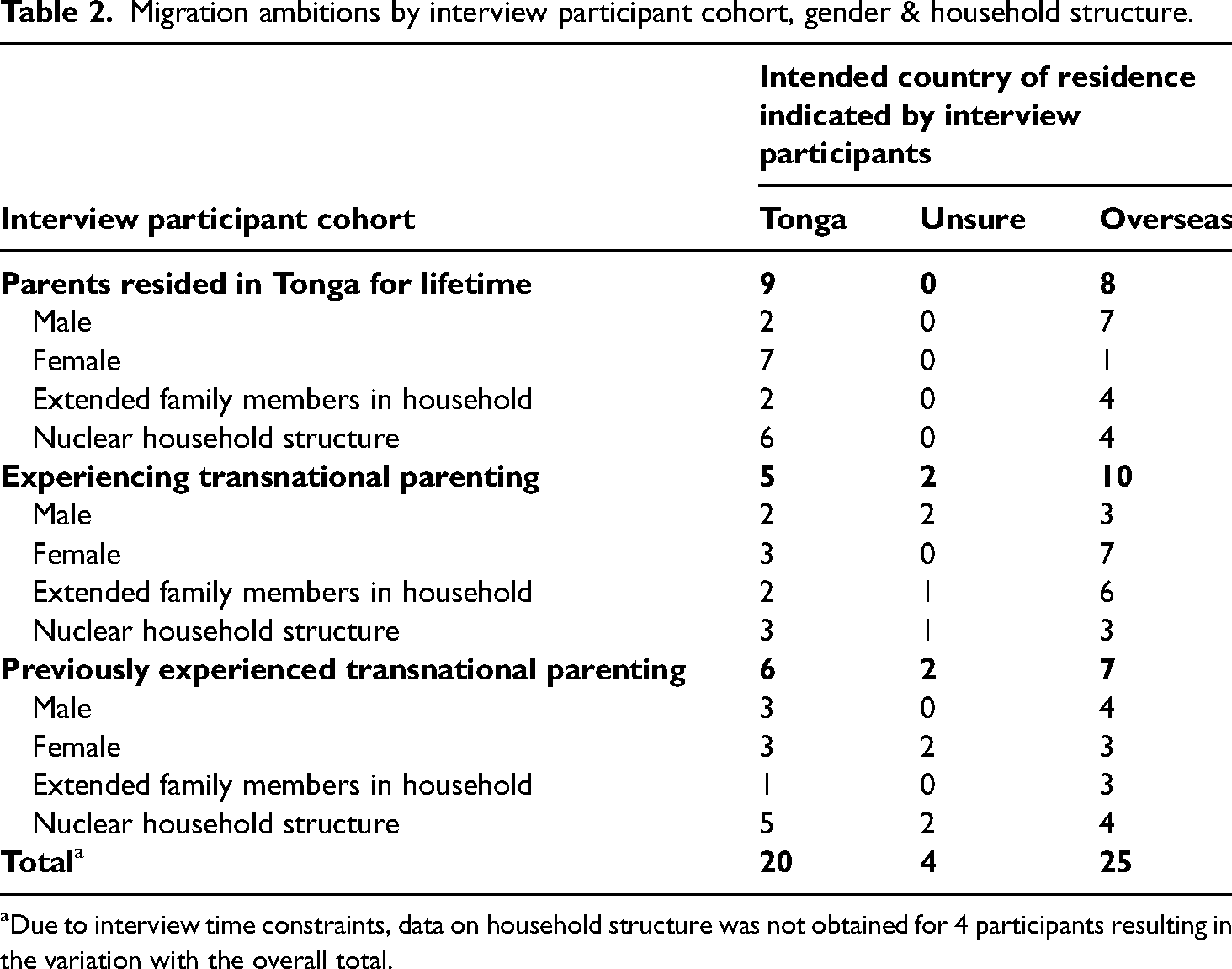
Migration and transnational parenting are altering migration ambitions for young people in Tonga. Over half of the participants interviewed desired to migrate. However, as illustrated in Table 2, the ambition to remain living in Tonga further diminished when participants experienced the migration of a parent.
Migration ambitions by interview participant cohort, gender & household structure.
Due to interview time constraints, data on household structure was not obtained for 4 participants resulting in the variation with the overall total.
Just over half of the participants whose parents had remained in Tonga throughout their lifetime desired to stay in Tonga. Their reasons included connection to family and a sense of pride, loyalty, and duty to the country. Interestingly, for these participants who had not experienced transnational parenting, the pull to migrate was often still present in their responses even when they desired to remain in Tonga.
Still, migration aspirations are prevalent for young people whose parents resided in Tonga throughout their lifetime, although this was divided by gender. Almost half of this cohort desired to live overseas; nearly all were male, while almost all females wanted to remain in Tonga (see Table 2).
Male participants’ desire to live overseas was linked to the perceived opportunity available outside Tonga, as shown in the comments below. I hope to live overseas… Because there's more opportunities for a job and [pause] and more opportunities to get a better life. Yea… getting the opportunities to help your family and helping your friends and get a good job.
These demonstrate how transnational remittances, regardless of parental migration status, influence boys in Tonga, sustaining a narrative that Tonga does not have enough opportunity and wealth. Given the level of migration occurring in Tonga, these comments also indicated how a culture of migration now permeates Tonga.
For young people whose parents had resided in Tonga throughout their lifetimes, the desire to remain in Tonga also varied according to household composition (Table 2). Most who resided with extended family advised of their plan to live outside Tonga. In contrast, those residing in nuclear households were the least likely to desire to migrate. Those residing in households with extended family members linked the plan to live outside Tonga to pursuing perceived opportunities overseas. Motivation to pursue opportunities outside of Tonga may be influenced for this cohort by experiences of household crowding, reliance on transnational remittances, and corresponding financial need to reciprocate across a larger family unit.
Young people experiencing transnational parenting were unlikely to imagine their future living in Tonga as they anticipated migrating. Their key rationale for planning to live overseas was to reunite with their transnational parent. This participant explains: I want to move to overseas and get a good works and help my family. And
Secondary to this was the perceived opportunity available overseas to provide for their family.
Migration aspirations for young people with a transnational parent were also divided by gender. But, unlike those whose parents had resided in Tonga throughout their lifetime, participants who were experiencing transnational parenting and planning to migrate were likely to be female (Table 2), especially when their father had migrated.
That the migration aspirations of girls enlarge supports the hypotheses that transnational flows from the father influence and expand gendered perceptions of potential. Interestingly, male participants who were experiencing transnational parenting were more divided between living in Tonga, migrating, or being uncertain about their future. This variation could attest to the increased freedom that boys traditionally experience in Tonga. In contrast, girls experience more restrictions and could potentially perceive a more liberated childhood if they resided overseas. However, this explanation does not hold, given the high ambition to migrate overseas reported by male participants with parents who lived in Tonga throughout their lifetime. A more workable explanation for the variance in migration ambition between male and female participants with a transnational parent is that boys struggle to retain connection with their parents when a parent migrates. Thus, the division between their desired futures illustrates how boys struggle to establish their identity between being present in Tonga and remaining connected with their transnational parent.
The gender of the parent who migrated also influences migration ambitions. For example, participants who had experienced a father's migration were more likely to plan to live overseas. In contrast, when the mother migrated, it was an even split between overseas and Tonga. Figure 5 shows the combined data for participants who were experiencing transnational parenting and those who had previously experienced transnational parenting to illustrate this trend in migration ambition according to the gender of the transnational parent.
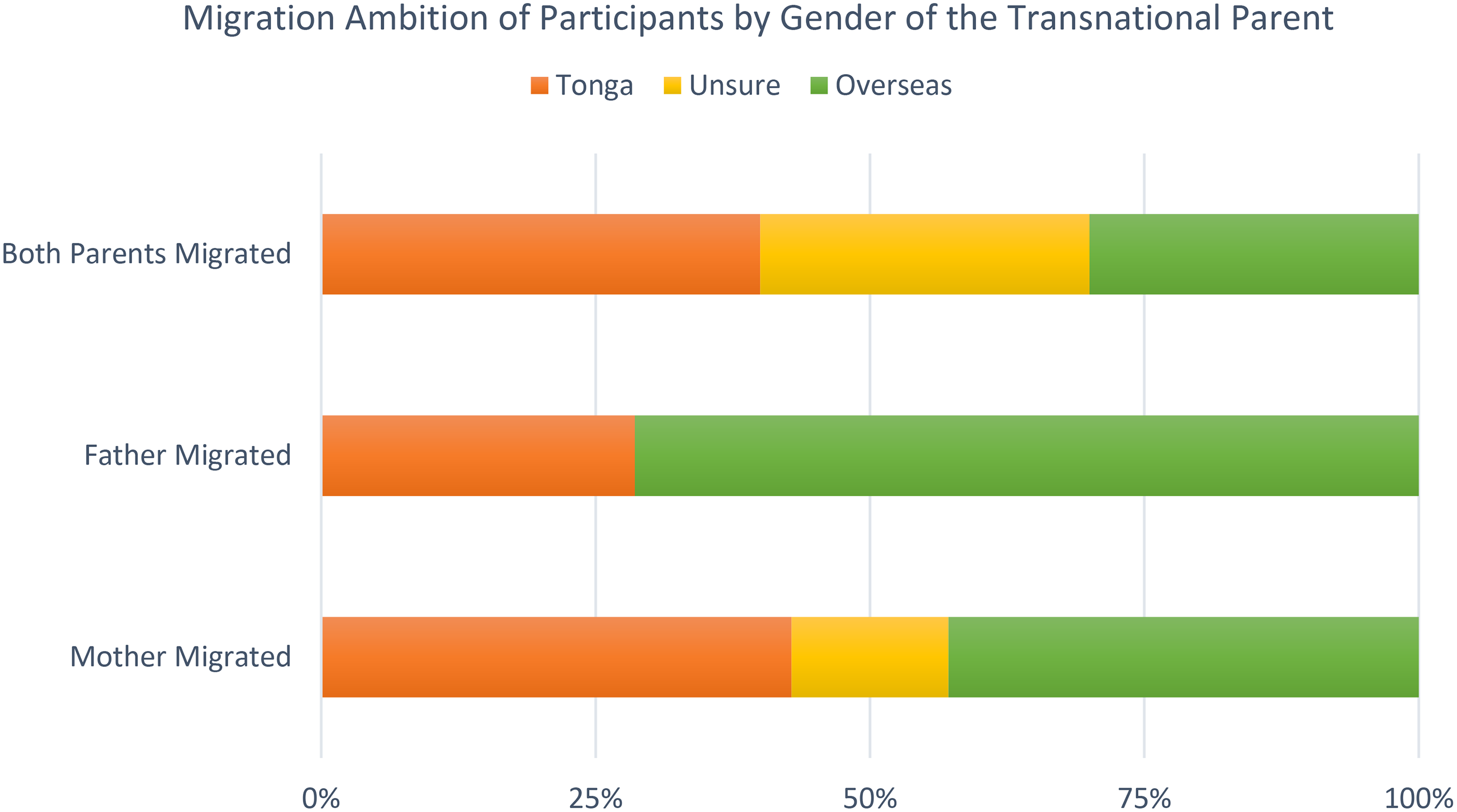
Migration ambition of interview participants by gender of the transnational parent.
That migration was perceived as desirable by participants when the father migrated and following the father's return suggests that young people deem the migration sacrifice worthwhile when undertaken by the father, as he fulfils his duty as a provider throughout the migration period. However, when the mother migrated, ‘the double standard in evaluating migrant mothers and fathers’ was applied (Dreby, 2009: 47). Thus, traditional gendered care norms inform perceptions that the mother cannot fulfil traditional mothering roles of caring and nurturing across distance. Therefore, young people perceive the mother's migration as less favourable, even following her return. As a result, young people perceived the migration sacrifice as less worthwhile and less desired.
When both parents migrated, participants were more likely to wish to remain in Tonga or experience uncertainty about where they would live. This uncertainty again evidences the struggle young people experience in establishing their identity between being present in Tonga and remaining connected with their transnational parent.
Young people consistently advised that their transnational parent had value to them, and they found the separation from their valued parent unacceptable. This participant explains: I want them to know that it's not only them that want to go, but children's want them, and we all need to stay as a happy family, and we all want our family to be complete at home. And if they want to go to overseas, they need to take us, because we want to go with them [emotion in voice] sometimes we miss them.
Discussion
Levitt and Lamba-Nieves (2011: 15) observed that social remittances ‘can cut both ways’, triggering both positive and negative effects. This study's findings go further, suggesting that social remittances compete. As new norms and practices are socially remitted, considered, and then either accepted or rejected, those accepted are also then prioritised. However, this prioritisation is not always according to the remitter's intent but, instead, according to the receiver's understanding of importance, which is determined within a diminishing context. That is to say, these new socially remitted norms (e.g. gendered norms for participation in sport and expanded ambitions and aspirations for both genders) and practices (such as decreased time and focus on traditional subsistence skills and education) occur within a context of depleted social capital (reduced communication with the transnational parent and time invested in friendships). In addition, young people must undertake increased work obligations to accommodate the transnational parenting arrangement, which depletes and affects what and how they can prioritise.
Thus, as young people recognise the sacrifice made by their transnational parent to provide for their education, they also alter and expand their aspirations to hold ‘big ideas’ about their futures (Levitt and Lamba-Nieves, 2011: 15). In doing so, they incorporate the belief that migration is their golden ticket to success. At the same time, their trajectory to success is being constrained by the conditions of transnational parenting. The result is a widening identity gap, where young people want more while having less: less access to their transnational parent, free time, educational goals and friendships. Thus far from being a development pathway, transnational parenting and the labour migration schemes that require it intensify existing global inequalities.
Levitt (1998: 944) makes the point that ‘certain kinds of remittance flows can be purposefully stimulated’. While this may be so, the findings from this study suggest that within the transnational parenting context, this is not sufficient to overcome the restructuring of young people's daily lives induced by transnational parenting arrangements. An example of this is the transnational parent's social remittances regarding the importance of education being received by the young person and internalised. But, due to increased responsibilities, depleted social capital, and the competing messaging of migration being the avenue to success, education cannot be prioritised.
Policy implications
As participation in labour mobility schemes across the Pacific continues to increase, the findings from this study present important implications for labour mobility policymakers in the Pacific. Firstly, they demonstrate the need for labour-receiving nations to evaluate visa arrangements according to their total costs, inclusive of the human rights of young people, the impact of family separation on care arrangements, and the moral responsibility of labour-receiving nations (Robertson, 2019).
Therefore, increased advocacy for workers’ rights to permanent visas and recognition of timely visa rights for their families (including social protections such as access to health and education to support family unity) are needed. Such a system would strengthen families’ opportunity to choose to migrate together or enjoy regular reunification. However, continued temporariness and the need to access reciprocal care from family members who do not qualify for visas may impede this (Westcott and Robertson, 2017). In addition, assessments are required within the ‘migration-care-development nexus’, as conceptualised by Withers and Hill (2023) of how migration and employment policies divide families and disassemble care.
At the time of writing, the Australian Government passed legislation enabling a Pacific lottery for permanent visas capped at 3000 per year (Dziedzic and Voloder, 2023). While this policy pivot represents an important step, it is questionable if such a small volume distributed via a lottery system will sufficiently mitigate the continued precarity experienced by families in labour-sending nations of the Pacific. One alternative is to provide pathways to access uncapped permanent migration visas for low-skilled migrant workers and their families (inclusive of social protections such as access to health, education and welfare) to address confirmed labour shortages. Such potential enhancements of migrant workers’ conditions present a major political challenge following decades of polarising rhetoric regarding workers’ rights and migration. Nonetheless, within the context of reported labour shortages persisting in low-wage sectors that necessitate continued access to a migrant workforce (Australian Chamber of Commerce and Industry, 2022; Business Council of Australia, 2023) and widespread union support for improving conditions for temporary labour migrants (Deloitte, 2022), an opportunity exists to elevate the often overlooked importance of low-skilled migration. In other words, if a migrant worker is genuinely needed, the same migrant could be politically constituted as both a valuable worker and parent.
Conclusion
Existing studies indicated parental migration had varying effects on young people's work, leisure and educational outcomes, with a need for more information regarding the unique context of the Pacific Islands. This study provides an important empirical contribution regarding young people in Tonga's experience of transnational parenting. It demonstrates that young people in Tonga are paying a high price, a triple loss, with regard to their right to family, their education and their potential, all as a consequence of labour migration schemes that disregard family accompaniment.
These findings should be interpreted with some important caveats. Early school leavers were not included in this study, yet they would provide invaluable insight into the impact of transnational parenting on educational outcomes. Young people outside of Tongatapu were also excluded. However, their experience of regionality, remoteness and higher poverty may offer a different perspective. In addition, while young people who had experienced reunification with the transnational parent in Tonga were included, those who had migrated to join the transnational parent were not. Thus, further study of transnational family reunifications outside of Tonga is warranted. Further longitudinal research would facilitate an increased understanding of changes in transnational strategies over the developmental life course and the migration duration. Despite these limitations, this study provides important insights regarding the under-researched impact of transnational parenting from the perspective of young people in Tonga.
The desired triple win of the migration-as-development ideology distracts from the global inequality and exploitation it perpetuates. Instead, these temporary labour migration schemes are being permitted by the governments of wealthy nations to dehumanise migrant workers to a just-in-time labour input, who are expected to offshore and outsource the parenting of their children. As a result, their children experience increased responsibilities, work harder and are consequently unable to prioritise their education or the usual activities of childhood. These impacts can be anticipated to influence their potential and contribute to further structural inequality as new forms of inequality are perpetuated between transnational and non-transnational families.
Most young people experiencing transnational parenting intend to migrate to pursue perceived opportunities and lucrative professions (without the drive to attain the requisite educational qualifications). As drivers fuelling Pacific migration combine with continued reliance on migrant workforces and remittances within a culture of reciprocity, the children of transnational parents today are likely to be the productive migrant workforce of tomorrow. Thus, this artificial market division of the transnational parent between the productive person and private person, without consideration of the social impacts, particularly for their children, presents a risky cost deferral. While employers enjoy the benefits of low wages and increased profitability, the burden of costs incurred to fund health, education and welfare services for migrants and their families are likely to be met by the governments and taxpayers of sending and receiving nations in the future. Thus, the opportunity exists for governments to urgently act and reframe improved migrant worker visa conditions that would enable family accompaniment.
Footnotes
Data availability statement
As this study utilised audio recordings of interviews, to protect the confidentiality of participants, there is no data set available with the paper. Instead, coded data is presented in tables and graphs as relevant.
Declaration of conflicting interests
The author declared no potential conflicts of interest with respect to the research, authorship, and/or publication of this article.
Ethics approval
This research was subject to ethics approval (Ethics number: 2016/945) from The University of Wollongong and Illawarra and Shoalhaven Local Health District Social Sciences HREC which is constituted and functions in accordance with the NHMRC National Statement on Ethical Conduct in Human Research. The Ministry of Education and Training and the Office of the Prime Minister in Tonga provided clearance for the research to be undertaken.
Funding
The author disclosed receipt of the following financial support for the research, authorship, and/or publication of this article: This research has been conducted with the support of the Australian Government Research Training Program Scholarship.
