




Abstract
This article explores two examples of worker housing in India, and compares these with China’s ‘dormitory labour regime’, arguing that these methods of labour accommodation are part of a broader, increasingly global, workplace-residence regime aimed at migrant labour control for the purposes of value extraction. Contrary to previous studies, it argues that China’s system is not unique, but part of the political economy of contemporary global capitalism. Although there exist historical and contextual variations between the two Indian case studies, drawn from the Delhi National Capital Region (NCR) garment sector and the Andhra Pradesh electronics industry, as well as between the Indian and Chinese contexts, the aims and many of the outcomes are similar. Moving beyond a focus on the country- and space-specific ‘dormitory labour regime’ facilitates a broader understanding of the crucial role contemporary workplace-residence systems play in enhancing control of migrant labour for the benefit of global accumulation networks.
Introduction: The dormitory labour regime
The role of dormitory accommodation for Chinese factory workers has been widely touted as a key element in China’s ascent to ‘world’s factory’ status. The ‘dormitory labour regime’ (DLR) from the 1990s allowed foreign-owned export-oriented firms to take unprecedented advantage of the country’s enormous, cheap internal migrant workforce (Smith and Pun, 2006; Pun and Smith, 2007). First-generation rural migrants were housed in crowded factory dormitories, giving employers extensive control over both their productive and reproductive lives. Factory managers could impose overtime without notice, restrict collective organisation, and extend labour discipline into workers’ living spaces. Since the state did not allow migrants to remain in the city without employment contracts, or to find alternative housing, workers were dependent on the factory and dormitory for their continued urban existence (Cheng and Selden, 1994). The DLR thus became an integral part of China’s export-led manufacturing model. However, it is less obvious that the DLR is, as has been argued, unique to 1990s–2000s China (Chan, 2009; Peng, 2011; Pun and Smith, 2007; Siu, 2015). This article examines two case studies of contemporary Indian accommodation, in the north Indian garment and south Indian electronics sectors, highlighting broad similarities with the DLR, and arguing that these workplace-residence regimes represent localised forms of a more general strategy of migrant labour control, closely related to the dynamics of the contemporary global political economy.
A ‘labour regime’ is a conceptualisation of the ways workers, labour processes and employment are regulated in particular spaces (Arnold, 2018). Bernstein (2007: 7) defines the term as the ‘interrelations of (segmented) labour markets and recruitment, conditions of employment and labour processes, and forms of enterprise authority and control, when they coalesce in sociologically well-defined clusters with their own discernible “logic” and effects’. The term became important during the last four decades’ globalisation of production, leading to new theorisation of the spatial politics of production, including spatial dynamics of control. Burawoy’s (1985) work was critical to a renewed focus on political effects of labour regimes, and the spatial dimension was addressed directly by Harvey (2001), Froebel et al. (1980) and others, who examined macro-level spatial production – for example, transnational processes of labour migration, division of labour and development of supply chains. Smith and Pun (2006) and Pun and Smith (2007) argued that these studies neglected micro-reconfigurations of spatial production, and directed their seminal analysis to one particular case: China’s DLR. Here, the Chinese state and transnational capital worked together to create an exceptionally productive set of labour arrangements involving systemic provision of dormitories for rural migrant labourers.
Pun and Smith (2007) characterise China’s DLR as an entirely new system out-competing others by providing access to large labour reserves, ensuring low labour costs, and facilitating worker control beyond the factory floor, ensuring productivity as well as limited labour solidarity. Using dormitories enabled firms to hire waves of fresh rural labour, available continually on-site for production, and restrict collective organisation. The DLR, allowing for both concentration and circulation of labour, therefore represented a powerful labour management system, which drove China’s integration with the global economy.
Of course, company provision of accommodation, even dormitories, is not new or uniquely Chinese. Living with one’s employer has a long history in industrialisation globally; for example, in 18–19th-century English mill villages; 19th-century European, US and Indian company towns; 20th-century North American and South African mining; and more recently in factories from Japan to Malaysia (Levien, 2013; Sanchez, 2012). Provision of accommodation helped employers secure a readily available, sometimes loyal and usually easily-disciplined labour supply, as well as providing rents. Nonetheless, Pun and Smith (2007) reject comparison with these examples, insisting China’s DLR is uniquely systemic. They cite three distinctive characteristics of the DLR: short-term employment of abundant young rural migrant labour; lack of paternal relationship between firm and worker; and co-construction of the system by the state, supplying dormitories for firms or restricting alternative residential options. Overall, they argue, the DLR became a unique institution aimed at maximising production by temporary migrant labour.
Pun and Smith’s analysis convincingly shows the DLR as a key configuration of work-residence for the daily reproduction of labour in globalising production networks, and illuminates the micro-level spatial arrangement of labour as well as its socio-political impacts. However, it is less obvious this is a uniquely Chinese phenomenon, particularly given recent expansion of manufacturing from China into lower-income countries (Krishnan, 2020). Indeed, recent work by Pun et al. (2020) on Foxconn’s Czech subsidiary points towards this: the use of dormitories is an essential element of the firm’s migrant workforce management, which the authors gloss as ‘an example of the importation of a labor model from China into the Czech Republic’ (Pun et al., 2020: 317). Yet it is not only firms moving from China that employ variations of the DLR; nor is it clear that the DLR can be divorced from historical underpinnings, in China or elsewhere. Empirical studies reveal what may be variants of a DLR in Qatar (Bruslé, 2012), Jordan (Azmeh, 2014), Mozambique (Wethal, 2017), Thailand (Pearson and Kusakabe, 2012) and Vietnam (Cerimele, 2018). These demonstrate adaptations to fit local and international labour dynamics and other historical, socio-cultural and economic institutions, suggesting that work-residence systems should be seen within a longer genealogy of attempts to extend employer control beyond the workplace. Nonetheless, in each case, the aim appears the same: maximising production by controlling daily reproduction of migrant labour power – challenging Pun and Smith’s assumption that this is a uniquely Chinese (or even Chinese-exported) phenomenon.
This article, therefore, examines two forms of Indian work-residence regime, comparing them with China’s DLR to demonstrate systemic similarities as well as local adaptations, and arguing that such regimes are a part of a globalised strategy for control of the migrant labour force on which contemporary capitalism depends. The next section reviews existing work on the Indian context. Following an outline of data and methods, the article examines China’s case in detail, highlighting key features for comparison, before setting out first the north Indian garment case, and then the south Indian electronics case. It then analyses similarities and differences between the three case studies, and draws broader lessons for understanding contemporary work-residence regimes.
Indian work-residence regimes
Beyond the studies listed above, focusing mostly on broader workplace relations, there exists little research on contemporary work-residence configurations as a strategy of labour control. In the Indian context, there is limited scholarly literature on worker housing, and almost no attempt to link accommodation of migrants to the nature or outcomes of the DLR. The exception is Mezzadri (2021), who briefly highlights the role of Indian industrial housing in contributing to labour surplus extraction, and suggests that such a labour regime may be considered ‘dormitory’ even though it is often managed by contractors rather than based on employer-run workers’ hostels. NGO reports have also highlighted forms of restrictive accommodation, such as Tamil Nadu’s sumangali, 1 but scholarly studies of on-site housing tend to gloss over labour control impacts (Carswell and De Neve, 2013; Jatrana and Sangwan, 2004), while those examining control beyond the workplace commonly focus on labour intermediaries (Dhillon et al., 2013; Iversen et al., 2009). There has thus been no detailed attempt to examine how Indian accommodation systems play a similar role to the DLR in the spatial dynamics of labour, or to connect this to broader aspects of the global structure of production.
Historical works by Banaji (2010), van der Linden and Breman (2020) and others have demonstrated many ways in which global capitalism has engaged in forms of exploitation, including forms of indentured, coerced or otherwise unfree migrant labour in India, for the purposes of value generation. Work-residence systems may be seen within this tradition, existing throughout the colonial era on plantations, and in Indian manufacturing at least since the early 1900s. After Independence, company towns became widespread: large tracts of rural land were acquired for factories with ‘industrial townships’, particularly public sector steel towns from the 1950s (Levien, 2013). More contemporary variations include Special Economic Zones (SEZs) and other industrial areas, most privately-owned, where factories and housing clusters aim to attract migrant labour for production and export (Goodburn and Knoerich, 2022). In both traditional company towns and newer SEZs, employers have been vested with immense power, extending beyond the workplace (Sivaramakrishnan, 2009).
In present-day India, migrant labourers both inside and outside SEZs are accommodated in many housing types, and there is certainly no near-universal system as in 1990s–2000s China. However, even without dormitories, the existence of a systemic workplace-residence regime can be detected, including pervasive extension of the labour relationship into workers’ private spheres, in the interests of profit maximisation. This regime shows important similarities compared with China. Just as Pun and Smith (2007) conceptualise the DLR, the Indian regime is characterised by short-term employment; lack of paternalism (Sanchez, 2012); and abundance of migrant labour, with at least 139 million internal migrant labourers in India by 2011, and an additional 9 million migrating each year since (Census of India, 2011; IOM, 2019). Unlike Southern Africa’s ‘compound system’, which Smith and Pun (2006) contrast with China, the Indian regime is not racialised 2 or openly coercive. Finally, as in China, the spatial politics of production ensures that collective mobilisation is limited.
Our Indian case studies here are drawn, first, from the north Indian garment industry, involving accommodation of inter-state migrant men in privately-owned colonies; and second, from electronics manufacturing in southern India, focusing on factory hostels for intra-state migrant women. In both examples, systemic-level similarities between Indian and Chinese regimes are explored. Key aspects in which they differ, at the micro-level, and the consequences of difference, are also highlighted. As Peck (1996) points out, strategies of localisation in terms of production processes and labour control are not only parts of the political economy of global capitalism, but both institutionally and locally embedded. This article therefore examines the role of local states in co-constructing the system, as well as that of local elites, patriarchal family structures and historical patterns of workplace accommodation. Taken together, analyses of these factors suggest the need to rethink the systemic nature of work-residence regimes, moving beyond the country- and space-specific DLR towards a broader picture of accommodation systems that are locally-adapted and historically-rooted, but which play a crucial role in enhancing control of migrant labour in contemporary global production networks.
Data and methods
Fieldwork was conducted in 2016–2018 in two anonymised Indian sites. The first is an industrial area within the Delhi National Capital Region (NCR), a metropolis spanning the northern states of Haryana, Rajasthan and Uttar Pradesh. The NCR contains a complex industrial cluster, with formal and informal, factory- and non-factory-based units, in which garment production plays a major role. The case study area contains garment factories mostly owned by Indian firms, including a SEZ where goods are produced for export as well as other areas targeting both domestic and international markets. Most factory-based workers are migrant men from the north-central Indian states of Bihar and Uttar Pradesh. The second fieldwork site is an industrial zone in the southern state of Andhra Pradesh, again containing a SEZ and a domestic production area. Unlike the NCR case, the zone is multi-sectoral, home to mostly international firms, and its manufacturing is formal and factory-based. The site has a concentration of electronics manufacturing, employing mostly migrant women from rural Andhra Pradesh.
The names of the exact field sites are not specified, and firms and individuals are anonymised to protect participants from potential negative consequences, including, for workers, retaliation in their workplace or accommodation; for zone and firm managers, damage to operations and the reputation of their business and the zone, as well as the possibility of personal exposure. In both sites, in-depth qualitative interviews were conducted with current and former migrant factory workers, migrant colony- and hostel-operators, zone and factory managers, and local government officials.
In the north Indian case, open-ended interviews, focus group discussions and observation was carried out by Mishra in 2016-2017. Interviews with factory owners, managers and supervisors were conducted inside factory premises, while interviews with bureaucrats took place in their offices. In-depth interviews of migrant workers (15) employed in garment factories inside and outside the SEZ were conducted in their living spaces, as well as three focus group discussions with garment workers. A labour contractor and two local landlords were also interviewed. Interviews with officials and managers often began in English before moving into Hindi; those with workers were conducted in Hindi and regional dialects. Workers were approached initially with help from local civil society organisations and labour activists, then through introductions from other participants, which helped build trust. Interview and focus group questions centred around workers’ migration; labour conditions; accommodation; and living experiences in the NCR including relations with locals.
In the south Indian case study, fieldwork was conducted by Goodburn in late 2018. Semi-structured interviews were conducted with zone and firm managers (9), local officials (4), labour contractors (3), migrant hostel operators (4) and assembly-line workers (29). Managers and contractors were contacted in their offices, while workers and hostel operators were approached in local hostels. A few were introduced by hostel wardens, while others, having shown interest in the researcher’s presence, were invited directly to talk. Interviews focused on workers’ motives for migration; their recruitment, living and working experiences; living conditions in the hostel; and longer-term plans. Data are drawn from these interviews as well as from publicly available materials, documents provided by zone managers, and local observations. Interviews with zone and factory managers, officials and white-collar workers were in English and Hindi, while those with workers were conducted with the help of Telugu-speaking research assistants.
The two Indian cases are compared with the Chinese context through an in-depth examination of the use of factory dormitories in China. This draws on a wide range of literature beyond Pun and Smith’s (2007) focus on the DLR as a tool of labour control, to identify key aspects for comparison, including not only the regime’s manifestation in post-1980s China but also its historical underpinnings – an understanding of which is essential to any assessment of the variety of context-specific accommodation systems making up the broader workplace-residence regime that has emerged as a feature of global production networks.
China’s ‘dormitory labour regime’
From the 1980s, China’s agricultural decollectivisation generated a vast rural labour surplus. Market reform, relaxed household registration (hukou) 3 system implementation, and re-commodification of basic goods allowed the growing urban private sector to absorb many of these labourers. The development of SEZs along the south-eastern coast and export-oriented zones elsewhere harnessed millions of migrants to work in the factories of multinational corporations (Goodburn, 2020b). In the 1980s–1990s, migrants were ineligible for urban housing. Factory dormitories therefore facilitated their temporary attachment to firms, but also constrained their mobility, since, without employer-sponsored temporary residence permits, workers could not stay in cities (Cheng and Selden, 1994). In addition to regulating Chinese labour mobility through hukou and residence permits, the state also directly provided many dormitories for factory owners to rent (Pun, 2007).
Dormitories were not new in 1980s China, and nor was the use of young female labour. An examination of the historical underpinnings of this labour regime is essential. In 1920s Shanghai, Japanese firms relied on young women workers housed in walled dormitories (Honig, 1986). By the 1930s, contractors commonly ‘purchased’ rural teenage girls from their parents for several years of labour in Shanghai’s cotton mills, where they were accommodated in crowded dormitory blocks. Hired thugs accompanied girls to and from factories as well as on the rare occasions they were allowed to leave the dormitory (Honig, 1986). In pre-1949 Tianjin, too, foreign-owned cotton and silk companies introduced dormitories. Shunned by locals, they housed cheaper female migrant labour (Hershatter, 1986). After 1949, these forms of work-residence were abolished by the new Communist government, and replaced by the work unit (danwei) system, which provided, through state-owned enterprises, long-term accommodation for urban workers’ families as well as a broad range of welfare (Nichols et al., 2004).
With the 1980s decline of the danwei and the advent of contract labour, the older dormitory system re-emerged on a much wider scale in the new SEZs. Migrant workers were contracted typically for one to two years, after which they returned to villages or found other temporary employment (Siu, 2015). Dormitories were therefore provided on a short-term basis, with workers – mostly women – housed in single-sex multi-storey buildings, sleeping in bunk beds with eight to 20 per room, with communal bathrooms. Unlike danwei housing, this accommodation was not for families; and unlike earlier workplace-residence systems in Europe and the US, did not aim to ensure labour loyalty or retention (Chan and Zhu, 2003). Much like pre-1949 variants, China’s dormitory system aimed to capture an abundance of individual migrant workers for short periods to maximise productivity (Pun, 2007). The difference was in scale, sector and relation to newly global forms of production: whereas pre-1949 dormitories were mainly in textile industries in treaty-port cities, producing for the Asian market, by the 1990s they dominated many sectors across a wide geographic area, extracting maximum labour utility in the context of just-in-time production for export through global supply chains.
Systematic use of dormitories in the 1980s–2000s gave managers extensive control over the workforce. With little access to independent space, time spent moving from home to factory could be eliminated and working hours extended to suit production schedules. Rapid circulation of labour made demands for wage increases less likely, and labour discipline was easily enforced through penalties not only in the factory but also in the dormitory. By controlling when workers could enter or leave dormitories, and by providing not only accommodation but also all food, and sometimes transport and leisure activities (Hsing, 1998), firms could control almost every aspect of the daily reproduction of labour. Workers laboured 10–12 hours a day, often six days a week, to meet targets (Siu and Unger, 2019). Overtime was compulsory during certain periods. Fines for lateness or mistakes were common, as well as for breaking workplace or dormitory rules (Chan and Zhu, 2003). Occasional physical abuse took place. Workers found it difficult to leave in search of better jobs, since factories often withheld documents and delayed payment (Chan and Zhu, 2003). Those leaving were usually unable to claim wages owed, but would quit when unable to withstand the conditions, re-migrating to home villages temporarily, and then returning in search of alternative jobs with dormitory accommodation (Goodburn, 2020a). Rapid horizontal job mobility thus took the place of widespread attempts at collective resistance.
As elsewhere in Asia since the 1960s (Elson and Pearson, 1981; Ong, 1987; Wolf, 1992), factories employed mostly women, whose sex, youth and first-generation migrant status were essential reasons for their employment (Lee, 1998). These ‘little sister workers’ (dagongmei) were preferred in many sectors – particularly garments, toys and electronics – because of their supposed ‘docility’ and ‘nimble fingers’, and were subject to abuse by male managers (Pun, 2007). In some firms in the 1990s, women were forbidden from leaving the dormitory other than to work, except for during set hours on Sunday, whereas male workers were permitted to come and go more freely (Hsing, 1998). Older or married women were not hired, and physical examinations were common, with pregnant workers dismissed (Wright, 2003). Without a temporary residence permit from the factory, workers had to leave the city. Factory work was thus seen by employers and the state, as well as by workers and their rural families, as a strictly temporary stage after which women returned to villages to marry.
After the mid-2000s, with decreasing surplus rural labour, shifts in this pattern took place: factories were forced to recruit more men, and it became common for migrant women to find migrant or even urban husbands and settle in the city (Siu, 2015). Residence permits were less strictly enforced, and detention and ‘repatriation’ of rural migrants without correct documentation ended in 2003 (Goodburn, 2020a). Many migrant couples chose private rental accommodation rather than dormitories, and although most remained excluded from the possibility of formal urban settlement, Pun and Smith’s DLR has been gradually eclipsed by the evolution of workers’ private and family lives in urban China (Siu, 2015).
Migrant men in north India’s garment industry
An examination of the north Indian garment industry suggests a new Indian regime of labour control that – like the DLR – goes beyond factory premises into worker accommodation. This regime differs from the Chinese case as it is ‘devolved’ to landlords without formal connection to the factory, but who have informal relationships with factory managers and share common interests with managers and firms in perpetuating the exploitative relationship with migrants for the purposes of labour discipline and profit maximisation.
The NCR’s garment manufacturing clusters are occupied by both Indian and, to a lesser degree, multinational firms, and surrounded by urban villages housing migrant workers. Locals from dominant Ahir, Yadav, Jat and Gujjar castes, often squeezed out of agriculture, have constructed informal, sometimes unauthorised, multi-storey settlements or ‘colonies’ of rooms to let to migrants, forming a profitable business (see Naik, 2015, for a typology of housing and landlords). Most migrants are former farm labourers or subsistence producers from north-central India, especially Bihar and Uttar Pradesh, and largely from lower castes (Lerche and Shah, 2018). They are employed in low-status, exploitative positions in the garment industry, usually via a contractor. Those in factories are overwhelmingly male. Women’s roles in the north Indian garment sector are predominantly home-based, since female labour migration here has historically been socially unacceptable (Mezzadri, 2017). Men labour for eight to 12 hours a day, often six or even seven days a week, sometimes with compulsory overtime to meet production targets, working until 2 a.m. and starting again at 8 a.m. Fines are imposed for breaking factory rules, and workers may be fired for being late, or even for taking permitted leave. This subjugation of male migrant factory workers is reproduced in the city through their interactions with locals, in which housing is a key node.
Workers’ colonies ranged from 30 to 100 rooms, each around seven square feet in size, costing Rs 3000–3500 (US$40–47) a month in rent – approximately half a garment worker’s wage. To save costs, five to seven male workers shared one room, which served as kitchen, bedroom and sometimes prayer room. Some workers hung aluminium trunks from the ceiling to make an additional suspended bed. Bathroom facilities were shared between around 30 tenants. Water was available for only two hours daily, illegally syphoned from the city’s supply, while electricity was diverted from local powerlines and charged to tenants at Rs 8 per unit, twice the usual cost. During monsoons, colonies were liable to flood, and open drains acted as breeding grounds for mosquito-borne diseases.
Colony occupants considered these living conditions inevitable if they wanted to work in the NCR. As one migrant commented, ‘We have left our home [for work]. If we had to live comfortably, we would have stayed at home’. Their accommodation was the cheapest available, located within 15–30 minutes’ walk of industrial clusters. Such arrangement of workers’ living spaces has a long history in colonial Indian industrialisation, in which male migrants were preferred and their living quarters were erected next to industrial clusters in Bombay and Calcutta (Chandavarkar, 1994; Sen, 1999). Historically, workers walked to worksites, while today many take shared auto-rickshaws to the industrial area. Unlike Chinese women factory workers of the 1990s, most male garment workers can come and go freely from their colonies, without curfews or passes.
Local landholders benefited significantly from the industrial sector bringing migrants to the NCR. Migrants’ perceived docility and potential for subjugation made them preferred employees in factories. In interviews, factory owners and managers contrasted locals with migrants: local men were seen as cavalier towards factory-work and prone to gundagardi (hooliganism) to force demands on their employer, whereas migrants were thought isolated and desperate enough for survival that they would not risk use of force. As one factory manager commented ironically, ‘Migrants are not interested in “extra-curricular” activities’. This exploitability of migrants was compounded by the system of accommodation. Not only could local workers mobilise resources through their social networks, but they usually had independent housing that did not require monthly rent payments. One male migrant, recently dismissed from his factory, summarised: ‘If we had our own homes [i.e. without rent to pay], we could [just] drink water and survive’, signalling the dependence of migrant workers on regular wages in order to remain in the city. Since migrants were tied to monthly wages to make rental payments, any strike action that required forgoing wages was extremely difficult.
Unlike Chinese dormitories, migrant colonies had no formal connection with the factory, yet they were nonetheless subject to stringent controls ensuring that labour discipline was extended into accommodation, that workers’ reproductive space was devoted to the productive cycle, and that collective mobilisation was limited. In the case of garment workers’ colonies, an additional motivation was the direct accumulation of profit. The controls imposed by this workplace-residence regime took three primary forms: restrictions on guests; restrictions on gathering; and restrictions on consumer practices. Restrictions were not enforced by landlords directly, but by colony-contractors (thekedaar), typically hired musclemen who collected rents, extorted fines and created fear among tenants by threats or use of force. Figure 1 shows a list of restrictions on migrant tenants, pasted in one workers’ colony, explicitly including the threat of physical violence.
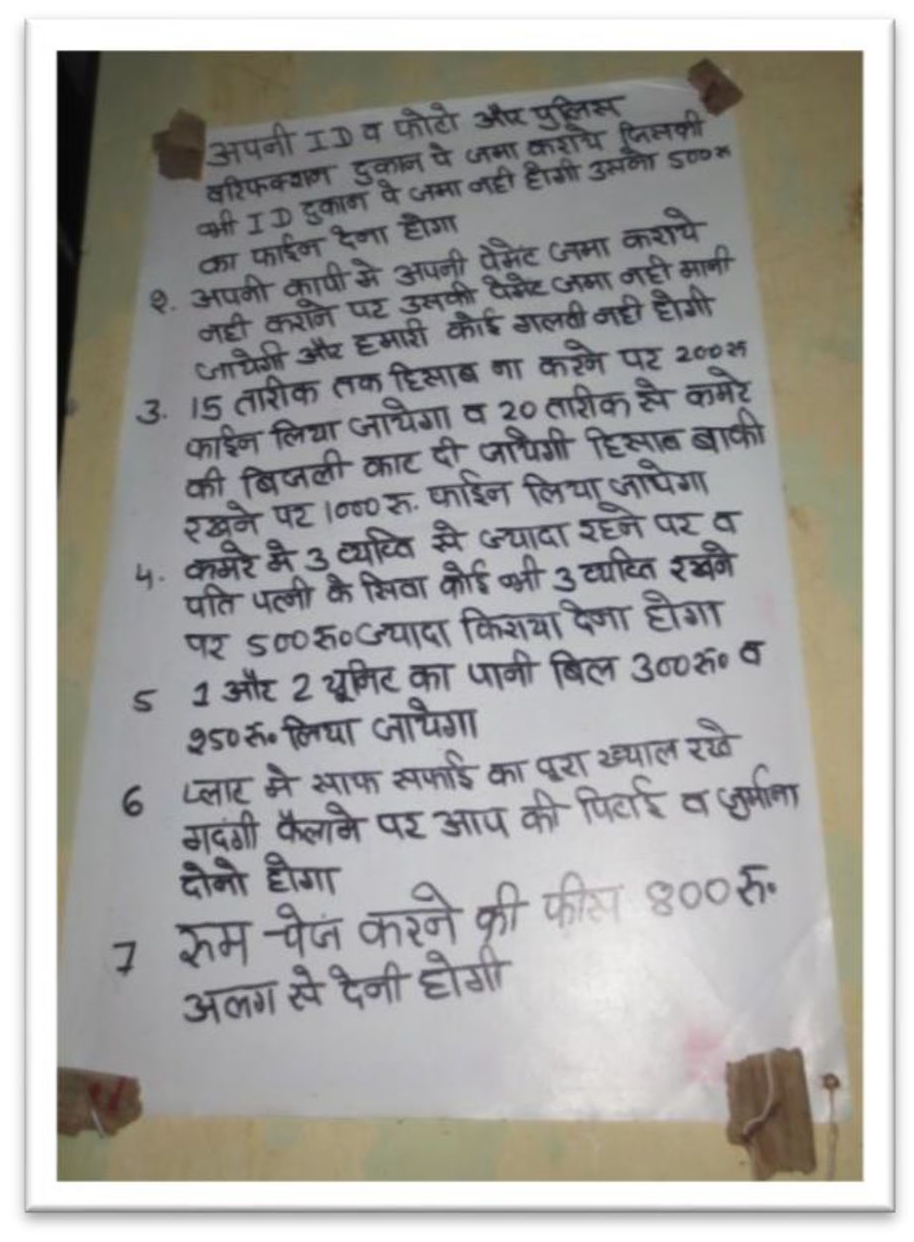
Example list of colony rules, Delhi NCR.a
The first form of restriction, on guests, was enforced through surveillance, dissuasion and financial penalties. Workers were discouraged from having visitors without advance permission and were required to pay an exorbitant 50 rupees per night per guest. Guests suspected of connections to labour organisations were particularly targeted for exclusion. Even gatherings of tenants were prevented – the second form of restriction – again especially where this resembled worker organisation or union activity. Here, landlords’ interests aligned with those of employers in wishing to prevent industrial action, since any action that could lead to closure or relocation of factories would destabilise their rental income, and since they wanted to prevent the emergence of organised complaints about accommodation. Workers were therefore policed in their organisational activities as the interests of landlords and employers overlapped, both relying on a highly-controlled migrant labour force. Trade unions thus faced substantial problems in reaching workers in either factories or living spaces. Moreover, unions experienced problems renting office space nearby, both because landlords themselves disliked unionising activities, and because their symbiotic relationship with factory managers meant they terminated leases when requested to do so by the factory. One major garment union associated with an NGO had to vacate its Gurgaon office overnight in 2017 when factory managers requested the landlord evict them immediately without explanation. Unions therefore had to rely on public spaces, such as parks, to contact workers beyond the reach of surveillance by firms or landlords.
In addition to restrictions on guests and gatherings, migrants were also subject to restrictions on consumer practices. These were aimed less at labour discipline, and more at directing profits towards outlets controlled by landlords or their intermediaries, but nonetheless represented an extreme degree of control over the daily reproduction of labour. The colony-contractor usually ran a shop leased from the landlord, from which all groceries must be purchased, at prices up to 30% above market rates. Workers were dissuaded from shopping elsewhere with threats of eviction or beatings. If a tenant was caught with items purchased outside the colony, the goods were confiscated and re-sold to the unfortunate tenant at the higher price. Since factory canteens were expensive, most garment workers prepared lunch in their colonies to take to work, meaning that there was a constant captive market for groceries, providing profits to the colony-contractor and rents to the landlord.
Although colony accommodation was both physically and managerially disconnected from the workplace, workers were nonetheless subject to stringent controls in their living spaces, creating a mutually-reinforcing system with the labour discipline of the factories. Workers’ colonies thus became an important part of the workplace-residence regime, as migrants experienced restrictions on their behaviour, punitive measures, and limits to their interactions with others. These restrictions, imposed by landlords and their intermediaries (sometimes directly at factory owners’ behest), aimed at limiting solidarity and preventing organisation; maintaining labour discipline and docility; and maximising profits for both firms and landlords.
As in the Chinese case, workers’ status as migrants was key. The economy of the NCR has been shaped by a continuous influx of migrants, creating a capitalism dependent on migrant labour. These migrants were excluded from local networks of power; have historically been subject to widespread discrimination on account of Bihari or Uttar Pradeshi origins; and depended on their monthly wage for continued inhabitation of the city. They were therefore more dependent on workplace-residences, less able to construct alternative leisure space, and less able to engage in any form of labour resistance. Just as in China, the daily reproduction of labour was controlled by the firm – here through a system of colony operators and contractors whose interests matched those of employers.
Migrant women in southern India’s electronics manufacturing
The case of south Indian electronics manufacturing provides an alternative window on contemporary Indian workplace-residence regimes. Here, where women’s labour is historically more socially acceptable and women are better educated than in north India (Drèze and Sen, 2002), predominantly female migrant workers are employed, accommodated in privately-operated hostels. These gendered hiring practices show obvious similarities with the Chinese context – indeed, some multinational firms in the case study site also operate in China and may have imported hiring practices from there, as Pun et al. (2020) propose for the Czech Republic – yet the system of accommodation (and the contexts contributing to it) differ from China’s DLR in various micro-level aspects, leading to differing outcomes.
Female migrants aged between 18–23 were preferentially chosen as electronics workers in the Andhra Pradesh site for two related reasons. First, as in China, women were seen as docile and unlikely to object to low wages. Some local young women were also employed, although insufficient numbers educated to at least age 16 made recruitment of migrants necessary. Second, the labour itself was seen as particularly suitable for women. Stereotypes about ‘nimble fingers’ and the idea that women are more willing to engage in tedious, repetitive work were frequently mentioned by firm managers. Some also highlighted positive social changes they thought would arise through women’s employment: girls become earning members of their families, marry later, and gain a greater say in household spending or even spouse selection. These purported gains fit with those highlighted by research on more general agrarian transition in India (Heyer, 2016). However, unlike in China, where positive social changes may occur specifically through rural-urban labour migration (Goodburn, 2020a), gains to migrant women’s autonomy in the south Indian case appear substantially offset by the repressive workplace-residence regime to which they are subject. This regime functions differently from both Chinese and north Indian cases, involving extensive cooperation between hostel-operator and employer, and is by far the most restrictive of the three.
Private hostels of 30–100 rooms were sub-contracted by firms employing the women, and allocated places to workers in shared rooms of five to 10 women, each sleeping in shifts on floor mats, and sharing washing facilities and a meagre leisure space – typically just a television area. The fees were around Rs 800 (US$11) per month, deducted from wages at source rather than paid as rent. Buses collected women from hostels before each factory shift and returned them when the shift was completed. Overtime was uncommon: shifts were typically eight hours with one 30-minute break, six days a week, to be completed in silence. A monthly maximum of three days’ unpaid absence for sickness was permitted; excess sickness would lead to dismissal, as would regular failure to meet hourly production targets. Snacks were available in the factory, but all other food was provided in the hostel, which women were not allowed to leave without a permit, granted only with permission from her employer. The exception was a weekly one to two-hour excursion in small groups, with a warden, to buy essential items such as toiletries. Other reasons for leaving the hostel, even to attend local temples, were refused. 4
Reasons for this given by hostel managers centred on the idea of women’s ‘safety’ (physical, sexual and moral). Women were ‘young’, ‘not from this place’ and ‘at risk of getting up to who knows what’. Hostel managers confirmed that restrictions were required by firms, and that women’s movements (as well as, in some cases, their diets, health and perceived psychological condition) were monitored and reported to the HR departments of their employers. Both firm managers and hostel operators emphasised that rural families would not allow daughters to migrate if their safety could not be guaranteed. Workers, who overwhelmingly expressed dissatisfaction with these living conditions, confirmed this: ‘Our families want to know that we are cared for properly, otherwise they wouldn’t let their daughters come. That’s why [firm] gives these rules to the hostel to take good care of us.’ Another added: ‘Girls only come here because their families need money. If there weren’t problems at home, no one would come.’ Controlling workers’ movements was therefore a way for firms to ensure an adequate supply of young, rural female labour.
One migrant pointed out another way that curtailing workers’ movement ensured labour supply: ‘It is also so that we do not leave for our villages after taking our wage’. Others commented that confinement to hostels made it challenging to seek alternative work: ‘We can’t get out to look for jobs. This may be why they keep us locked in!’ Restricting the movement of women workers thus served the interests of firms (maintaining labour supply), as well as, symbiotically, families (safeguarding women’s morality) and hostel owners (ensuring continued profitability). As in China, then, workers’ mobility was restricted by the disproportionate control exercised by employers through the workplace-residence regime, but here the key factor was the custodial conditions of accommodation rather than long working hours and control of workers’ time through the dormitory system.
As in the north Indian garment case, aspects of the workplace-residence regime were sub-contracted from firms to private entities, here hostel operators. However, south Indian electronics firms retained much tighter control over their female employees, with hostel operators and wardens reporting daily or weekly to firms and receiving direct instructions from them. The close connection between firms and hostels is illustrated in Figure 2, showing a list of instructions for wardens, including several forms of reporting to the firm’s HR department, as well as checking uniforms and communicating the firm’s instructions to workers. This close working relationship was reinforced by the financial relationship, in which firms paid hostel operators directly for accommodation, rather than landlords collecting rent from tenants as in the north Indian garment workers case. Moreover, not only did hostels report to employers, they also reported to women’s parents – for example, to confirm arrangements for leave before allowing ‘inmates’ to depart from the hostel – thus reinforcing the twin controls of factory and patriarchal family.
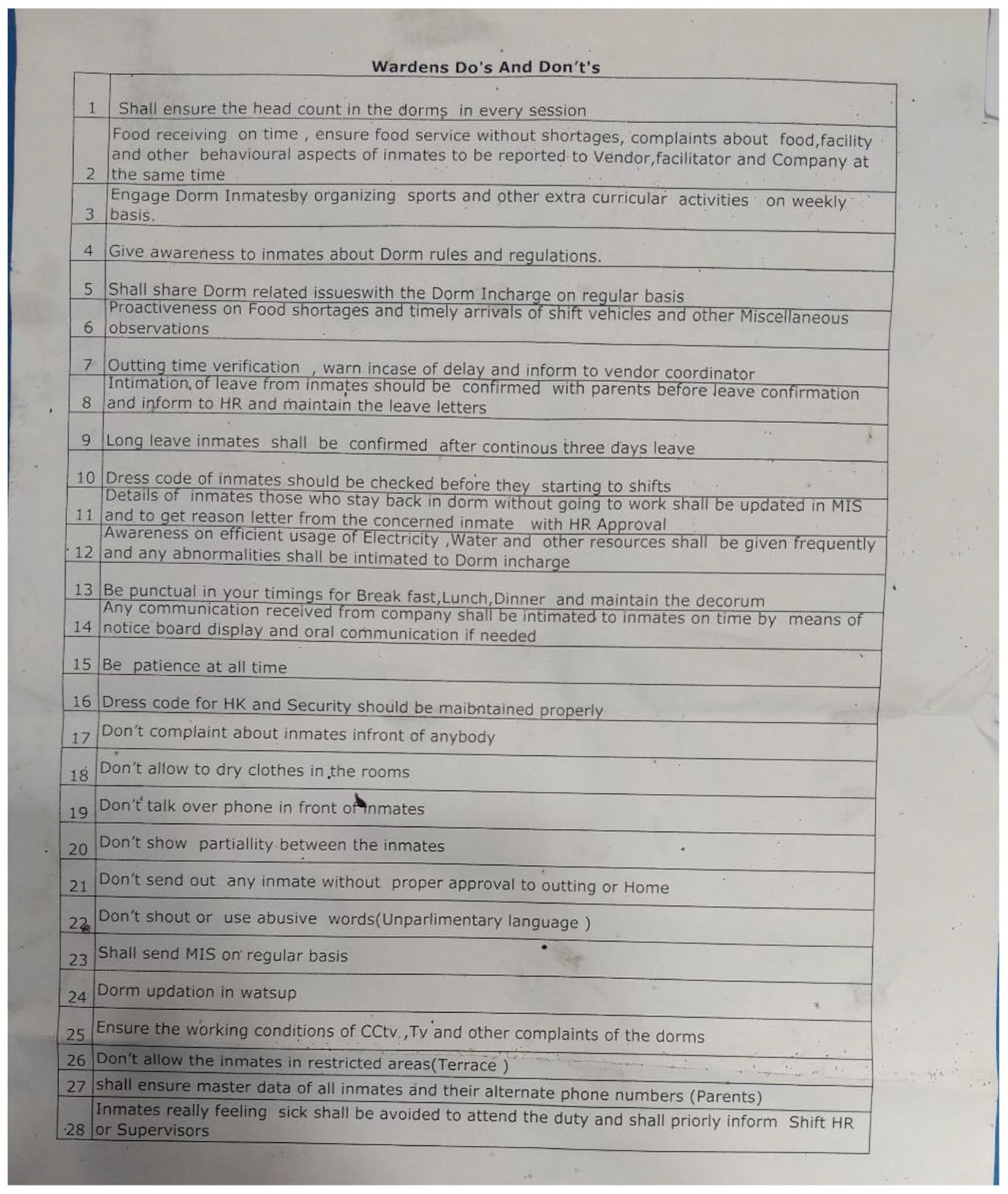
Instructions for wardens, Andhra Pradesh.
These repressive conditions, in which women were shuttled between hostel and factory only, meant that south Indian migrant women did not experience the emancipatory effects from labour migration that their Chinese counterparts, despite the DLR, experienced from the 1990s. Limited leisure time notwithstanding, the latter were typically much freer to come and go from their accommodation, and could thus experience the city into which some, in the longer term, chose to marry and/or settle (Goodburn, 2020a). By contrast, although migrant women workers in the south Indian case did not usually experience excessive overtime, they spent almost all non-working hours confined to hostels, unable to interact with locals or male migrants, preventing any integration or potential for autonomous spousal choice.
After a maximum of two to three years, migrant women in electronics firms typically returned to natal villages to marry, aged 20–23. Many interviewed were saving much of their wages as dowries, as well as remitting money to support ill or impoverished family members and pay off family debts. Although some expressed the wish to continue working after marriage, this would be closer to home (where paid work could be combined with domestic duties) and would depend on permission from husbands; none intended to remain in the city or re-migrate after marriage. Instead, factories procure new migrant labour. Since an agreement with the state government on preferential low-skilled employment for locals prevented firms from hiring inter-state migrants, factory recruiters made frequent trips to Dalit and other low-caste villages in northern parts of Andhra Pradesh –identified with assistance from local Rural Development Departments–to advertise assembly line positions. Interested young women were instructed to pack their luggage and were bussed to the factory for interviews and tests of English reading ability; if they passed, they were contracted through labour agencies and allocated hostel spaces, without returning home. A continual supply of new temporary labour is therefore assured, with assistance from the state-level government, to the benefit of both firms and hostels.
The women’s status as migrants is thus highly relevant, as in both Chinese and north Indian cases. In the south Indian case, the women were intra-state migrants and spoke the local language, Telugu, so were not subject to the discrimination faced by north Indian garment workers or inter-provincial Chinese migrants. However, they were even more excluded from local support, as the workplace-residence regime ensured that they were literally shut off from local populations, interacting only with factory supervisors, hostel staff and other (female) hostel residents. Wholly dependent on their residences, they experienced no leisure space other than the hostel, and were almost entirely unable to engage in labour resistance. Again, then, with access to space independent of the workplace-residence regime severely limited, almost every aspect of the daily reproduction of labour was controlled by the firm – here in tandem with hostel operators and with the agreement of the women’s families.
Discussion: Reconceptualising work-residence regimes
These Indian forms of workplace-residence, and the Chinese DLR, can be seen as parts of a broader global labour regime that seeks to control migrant labour for the purposes of value production and extraction. Although the case studies are locally shaped, and thus differ both from each other and from the DLR in some respects, they are all closely connected to the needs of global networks of accumulation, and employ similar strategies for labour control. Table 1 sets out the macro-level similarities and micro-level differences between the cases.
Similarities and differences between China’s DLR and the Indian case studies.
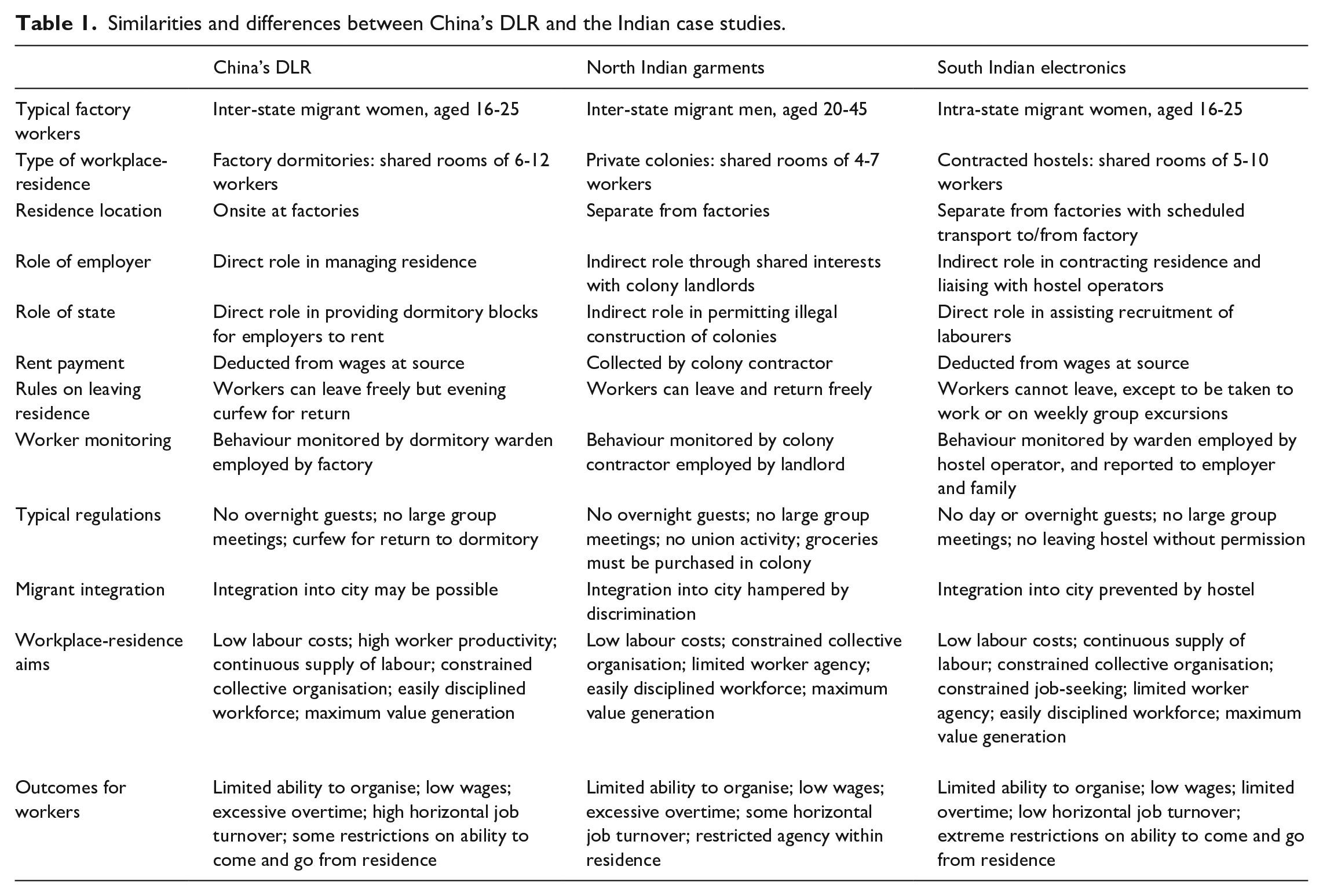
In both Indian cases, as in the Chinese system, housing is critical to labour management and the politics of production. The two Indian sites use different patterns of worker accommodation, but both suggest contextually-embedded forms of workplace-residence regime in India that parallel China’s DLR, for the same purposes. In both Indian cases, the labour relationship is extended into workers’ private spheres, to discipline labour for maximum value generation. Employers’ control over residences, albeit through intermediaries–some directly contracted, some more loosely connected through synergies of interests–performs the same function as in China, facilitating employment of large numbers of low-paid temporary migrants, separated from local networks and any form of labour organisation. Dependent on wages to retain their accommodation (north India), and/or accommodation to retain their wages (south India), workers have little ability to make demands on either employer or landlord, or to find alternative employment.
Local states play varying roles in co-constructing the system alongside domestic and global firms. Again, historical context is key. In China, legacies of pre-Communist factory dormitories and Mao-era institutions to restrict urban settlement, implemented by reform-era urban authorities, combined to produce a workplace-residence regime that facilitated the (ab)use of vast numbers of intra- and inter-provincial temporary labourers. Centuries of male-dominated labour migration from north-central states with a more recent flow towards the NCR, colonial-era land zoning schemes and the contemporary municipal government’s failure to regulate construction in urban villages together create a workplace-residence regime in which inter-state migrant men are accommodated on a short-term basis in informal colonies owned by landlords whose interests closely match those of employers. In Andhra Pradesh, the state’s emphasis on a development strategy of large-scale, low-cost factory production in SEZs (itself drawing on a legacy of company towns) and the longer history of female migration has led to a highly restrictive, gendered workplace-residence system that sees intra-state rural women targeted, with local state assistance, as temporary migrant labour and confined during non-working hours.
Conflictual relationships between locals and migrants (facilitated by workplace-residence regimes) play an important role in all three cases. This began early in China, where, in the 1920s–1930s, firms ceased hiring experienced locals in favour of less experienced but more socially isolated migrants, who lacked a family ‘buffer’ between them and the employer, and who would be tied to dormitories (Hershatter, 1986: 145). In contemporary India, by employing migrants and housing them in residences controlled through employers’ intermediaries, workers are removed from their family, becoming more vulnerable and less independent. In the NCR, hostility to inter-state migrants prevents the development of effective local networks. In Andhra Pradesh, extreme restrictions on intra-state migrant women have a similar effect. The workplace-residence regime in all three cases thus facilitates a form of migrant-dependent capitalism, allowing employers to extend their hiring pool to reserves of labour willing to work for lower wages, avoiding being restricted to local labour markets in which workers organise and negotiate, and to set wages in response to norms from migrant-origin areas, not the location of production, thus enabling increased value generation.
These cases therefore demonstrate the need to reconceptualise workplace-residence regimes, away from a uniquely Chinese system developing only since the 1980s towards a broader global regime formed of local variants. All three systems of migrant worker accommodation are historically rooted and context-specific, yet all serve the same purpose: the extraction of value through enhanced control of migrant labour in global production networks. Focusing on Indian worker housing challenges assumptions that there has been no attempt to extend employer control beyond the space and time of production, and no systemic regime comparable with that in China. It highlights important differences that depend on local states, local elites, patriarchal family structures, and historical patterns of workplace accommodation; but which do not fundamentally undermine the existence of a distinctive Indian variant of workplace-residence regime for the control of migrant labour, in which control is devolved to intermediaries but nonetheless conforms to the aims of employers. Nor is it likely that India is the only country besides China to have developed such a system; more work is needed on the emergence of similar regimes in other parts of the world, paying attention to adaptations to fit local and international labour dynamics and other historical social, cultural and economic factors.
Conclusion
This article has explored two examples of worker accommodation in India, and compared these with the Chinese DLR of the 1990s–2000s, showing important similarities between the two. Contrary to Smith and Pun (2006), it has argued that the Chinese system is not unique, but part of a more generalised strategy of migrant labour control for the purposes of value extraction, that forms part of the political economy of global capitalism, as well as being historically and locally embedded. The Indian workplace-residence regime similarly relies on temporary migrant labour, subject to extensive control beyond the factory, and lacks a paternal relationship between firm and worker. It differs from the Chinese case most significantly in that workers are not accommodated within the factory compound but by intermediaries, and that the state is not directly involved in restricting other residence options for migrants, yet its aims and many of its outcomes are similar. There are also important differences between the two Indian cases: far greater restrictions on (female) workers in south India; use of physical violence against (male) workers and attempts to profit from their consumer practices in north India; as well as, of course, different relationships between firms and colony/hostel operators. Analysis of these variations suggests that we should be attentive to locally-adapted, context-specific features of workplace-residence configurations, particularly when it comes to understanding their outcomes. Yet the fundamental similarities with China’s DLR at the systemic level suggest the existence of a far broader labour regime made up of locally-shaped workplace-residence systems, connected to global accumulation networks, that enable the control of migrant labour and the generation of value. This means that we need to move beyond a focus on the country- and space-specific role of the dormitory, towards a broader picture of how workplace-residence systems, along with the complex constellation of actors that enable them, play a crucial role in enhancing labour control for the purposes of value extraction worldwide.
Footnotes
Acknowledgements
We would like to thank all the interviewees who participated in the research, as well as research assistants Claire Crawford, Shilpa Shree and Tharrini Raj. Useful feedback on an early draft of part of this article was provided by participants at the 6th Regulating for Decent Work 2019 conference at ILO, Geneva, and on a later draft at the King’s College London Urbanisation, Rural Development and Social Transformation (URDST) research seminar. Special thanks too to Stephen John; Jane Hayward; Xiaxia Yang; Hugh Whittaker; Magda Leichtova; Shankar Ramaswami; and the three anonymous reviewers, all of whom provided helpful comments.
Funding
Research funding was provided by King’s College London and by a Commonwealth Doctoral Scholarship.
