



Abstract
This article contributes to debates about trade unions and the environment by studying international variation in the association between union membership and support for government spending on environmental protection. Building on research which demonstrates a positive membership effect on support for environmental protection, the article extends the geographical scope beyond the more economically developed contexts studied previously. Using World Systems Theory as a comparative framework, distinguishing between core, semi-periphery, and periphery states, the article explores whether the positive membership effect extends beyond more affluent core states and reveals an intriguing empirical puzzle: while public support for environmental spending is substantially weaker in core states relative to non-core states, the latter being subject to more extensive environmental threats, the reverse holds for the membership effect on environmental spending support which instead tends to be more positive in core states. Union membership thus tends to have the largest positive impact on environmental spending support in countries where public support for such spending tends to be lower. Theoretical and practical implications of these findings for the global effort to address an ongoing environmental crisis are discussed by considering the notion of a solidarity effect.
Keywords
There is growing interest in the relationship between trade unions and the environment, as reflected in a recent special issue of this journal (Flanagan and Goods, 2022). Early assumptions concerning union members’ reluctance to embrace environmental agendas have been contested (Chen, 2017). Indeed, it is now a fairly well-established insight extending from the US to Europe that union members tend to be more pro-environmentally inclined than their non-organized counterparts (Chen, 2017; Kojola et al., 2014; Ringqvist, 2022). Less is known, however, about whether this membership effect is observable beyond these economically more developed contexts.
Drawing on World Systems Theory (WST; Wallerstein, 2004)—a comparative framework widely used in environmental debates—the present article addresses this gap by extending the geographical scope beyond the US and Europe, studying international variation in the effect of union membership on support for government spending on the environment. Broadening the geographical scope allows for an exploration of whether the positive membership effect applies beyond what WST classifies predominantly as core states, which are relatively more affluent economically and tend to provide workers with stronger protection against labor market-related risks (Valizade et al., 2023). Extending coverage to non-core states in the semi-periphery and periphery also introduces considerable cross-national variation in the distribution of environmental burdens, as such burdens tend to be more extensive in non-core states (Mejia, 2020). WST hence offers potential as a comparative framework with regards to present purposes, elevating the level of analysis beyond the advanced capitalist economies and accommodating the clustering of several contextual country-level factors of potential relevance when exploring union members’ support for environmental policies.
The article offers an empirical analysis to test two hypotheses. The baseline expectation reflected in the first hypothesis is for the positive membership effect to be observable across world systems positions. A key mechanism underpinning this hypothesis pertains to the prevalence of environmental threats beyond core states, often manifested at the point of production and hence arguably constituting a core union concern (Barca, 2012; Bell, 2020). However, a second hypothesis is also offered which proposes that beyond core states, higher levels of environmental degradation and stronger public support for environmental spending among members and non-members alike might imply less of a distinction between members and non-members. In core states, where environmental risks tend to be relatively less extensive, a positive membership effect may instead be attributed partly to a stronger link in such contexts between environmental attitudes and leftist ideological orientation (Nawrotzki, 2012), and to more favorable macro-economic and labor market conditions allowing unions and their members to broaden their scope of concerns (Kojola et al., 2014).
The empirical analyses are based on 2016 data from the International Social Survey Programme (ISSP) “Role of Government” module (ISSP Research Group, 2018), covering 32 core, semi-periphery and periphery states varying in levels of environmental degradation, which is operationalized by use of the Ecological Performance Index (EPI; YCELP, 2016). The EPI ranks countries based on 20 ecological indicators including environmental risk exposure, air quality, and drinking water quality. Labor market conditions are proxied by the strength of active labor market policies (ALMPs).
The results of multilevel analyses (Hox et al., 2017) reveal systematic variation in the membership effect across world systems positions. Notably, whereas public support for environmental spending tends to be less widely held in core relative to non-core states, the membership effect is significantly more positive in core states, mitigating the tendency for environmental performance to suppress environmental spending support. A novel empirical observation is that union membership tends not to have a positive impact on environmental spending support in non-core states. This result should be interpreted in relation to the finding that overall levels of environmental spending support are high in such contexts among members and non-members alike, leaving less space for a positive membership effect. The most notable and indeed puzzling empirical outcome is that the membership effect tends to be most positive in countries with lower public support, a finding that may be interpreted by considering the notion of a solidarity effect (Mosimann and Pontusson, 2017), whereby union membership is associated with a higher propensity to support policies that transcend narrow self-interest. Such a solidarity logic may indicate that trade unions can play a role in transcending obstacles to global environmentalism and thereby contribute toward addressing the major collective action problem of global environmental degradation (Uzzell and Räthzel, 2013b). While it is prudent to acknowledge the authoritarian constraints to more pro-active union engagement in many non-core states, these insights may inform debates concerning an agenda for the development of international labor cooperation and networks (Gumbrell-McCormick and Hyman, 2015; Martínez Lucio, 2010; Schulze-Cleven, 2017) built around environmental issues.
The following section lays out theoretical considerations about the association between union membership and environmental spending support in a comparative perspective. Then follows a presentation of the data and measures used, after which the empirical findings are reported. A concluding section discusses theoretical and practical implications of the findings.
Union membership and environmental spending support in comparative perspective
Trade unions’ relationship to the environment is an area of increasing interdisciplinary interest including contributions from industrial relations scholars and the emerging field of environmental labor studies (Flanagan and Goods, 2022; Räthzel et al., 2021; Ringqvist, 2022; Uzzell and Räthzel, 2013a). Prominent accounts in the literature, which are predominantly qualitative studies with a particular focus on the level of union policy, point to recurring dilemmas between jobs and environmental protection (Räthzel and Uzzell, 2011; Thomas and Doerflinger, 2020). Crucially, however, and resonating with key insights in the industrial relations literature (Flanders, 1970; Hyman, 2001), studies observe that unions’ positions are not pre-determined, instead being mediated by such factors as their sectoral location—for example, the proximity to the fossil fuel industry—and, importantly, political identity (Kalt, 2022; Markey and McIvor, 2019; Thomas and Doerflinger, 2020; Thomas and Pulignano, 2021). With regards to sectoral variation, case-based accounts note, for example, some particular challenges to unions in the manufacturing sector, underpinned by concerns regarding the employment impacts of environmental policies (Thomas and Doerflinger, 2020; Thomas and Pulignano 2021).
Interestingly, as it pertains to union members’ attitudes, an established insight based on nationally representative studies extending from the US to Europe is that members tend to be more pro-environmentally inclined than their non-organized counterparts, a positive effect which is particularly pronounced in the sector of transport and manufacturing, and mediated by members’ tendency to identify to the left of the ideological spectrum (Chen, 2017; Ringqvist, 2022). In a comparative context, a recent multilevel analysis covering 22 European countries, while revealing significant cross-national variation in levels of public support for environmental protection, finds little systematic (although some indicative tendencies of) country-variation in terms of the positive membership effect (Ringqvist, 2022). In relation to present purposes, a plausible baseline assumption on this basis may be that the positive membership effect should extend also beyond these contexts. However, while there certainly is significant institutional variation across European countries (e.g., Rosetti, 2019), and between Europe and the US—many of these countries tend in a global perspective to be relatively homogenous, such as in terms of a higher level of economic development. While variation is not given, this raises the question of whether the positive membership effect is observable beyond the economically more developed contexts covered previously.
Engaging WST to broaden the geographical scope
Broadening the geographical scope, WST (Wallerstein, 2004) offers potential as a comparative framework as it brings a diverse set of countries into equivalence and elevates the level of analysis beyond the advanced capitalist economies—or core states—to include less developed economies in what is referred to, respectively, as the semi-periphery and periphery (Valizade et al., 2023; Wallerstein, 2004). Associated particularly with the writings of Immanuel Wallerstein (2004) dating back to the 1970s, the utility of WST has been corroborated in the industrial relations literature (Valizade et al., 2023: 191). Compared to alternative comparative approaches such as Varieties of Capitalism, recent contributions note that WST is less spatially and historically confined and that the distinctions offered “can accommodate the phenomenon of the new industrial countries (e.g., Brazil, India, and China) while being consistent with inequalities across the north-south divide” (Valizade et al., 2023: 191). As a comparative framework compatible with the notion that environmental issues cannot be isolated from global trends and dynamics, WST has much to offer environmental labor studies.
Within the framework, core states are wealthy industrialized economies with relatively established industrial relations institutions, as, for example, Australia, Sweden, and the US, whereas semi-periphery states are those transitioning in either direction between being developing and developed economies, such as India and South Africa. Periphery states in turn are the least developed economies, “plagued by weak or non-existent labor market institutions, informal work and insecurity” (Valizade et al., 2023: 190), represented, for example, by the Philippines and Georgia. Crucially, non-core states tend also to be particularly exposed to environmental degradation in connection to what is referred to as a “peripheralization” of environmental burdens (Mejia, 2020: 281; Muradian et al., 2002; Timmons Roberts et al., 2004: 35). Thus, while admittedly crude, the distinctions offered for a number of reasons provide a useful overarching comparative framework within which to explore members’ attitudes beyond the contexts covered in previous research.
First, as the level of economic development, or “affluence,” is a key distinguishing feature between world systems positions, ongoing macro-sociological debates concerning the impacts of affluence on environmental attitudes may offer some insights of relevance also when considering potential variation in the membership effect. Central to these debates is the theory of post-materialist value change advanced by Inglehart (1971), proposing a positive association between country-level affluence and pro-environmentalism. According to the theory, economic growth and modernization bring about a general cultural transformation through the emergence of so-called post-materialist values, whereby individuals increasingly prioritize freedom and “quality of life” above material security and standard of living. Somewhat simplified, environmental concern is posited to belong to the former category, constituting a luxury value to be embraced widely only after societies reach a certain level of economic development.
However, while some studies demonstrate a positive association between per capita GDP and environmental concern (Franzen and Meyer, 2009), there exists a voluminous literature of critical or alternative accounts, questioning the robustness or even documenting an inverted sign of such an association. In fact, while varying by output measure, country-level affluence tends to be associated negatively with several items capturing public concern and support for various environmental protection measures (Dunlap and Mertig, 1995; Dunlap and York, 2008; Givens and Jorgenson, 2011; Kulin and Johansson Sevä, 2019). A commonly advanced explanation for these findings relates to the tendency for environmental degradation to be concentrated in relatively poorer countries, where individuals indeed are more likely to perceive environmental threats (Givens and Jorgenson, 2011; Jorgenson, 2009; Lo and Chow, 2015). Such a pattern may be understood more comprehensively—or indeed relationally (Stevis, 2022)—through the lens of WST (Hornborg, 1998; Mejia, 2020; Timmons Roberts et al., 2003).
Proponents of WST hold that a nation's “wealth” can be understood in relation to a division of production processes with varying environmental impacts across core, semi-peripheral and peripheral states (Mejia, 2020; Timmons Roberts et al., 2003). While there is also significant heterogeneity within world systems positions, such a division holds implications for the distribution of environmental risks, as core states—partly through the proliferation of neoliberal globalization and the associated offshoring of production from the advanced capitalist economies (Shin et al., 2023)—are more likely to import material- and energy-intensive goods from non-core states, resulting in what has been labeled a “peripheralization” of environmental burdens (Mejia, 2020: 281; Muradian et al., 2002; Timmons Roberts et al., 2004: 35). A higher dependence on foreign direct investments and the threat of capital flight may also compel non-core states to appeal to foreign investors through tax reductions and exemptions to environmental regulations (Jorgenson, 2009: 137). As Mejia (2020: 281) concludes: “Overall, countries outside the core have more economic incentive to concede to capitalist interests compared with normative pressures to protect the environment, given the structures in global trade and the international organization of production.” Hence the simple but crude formula tends to be that “dirty production motivates greater concern in less affluent countries, and cleaner production motivates less concern in more affluent countries” (Summers and VanHeuvelen, 2017: 336).
Although it is not certain that these factors translate into the extension of a positive membership effect beyond core states, one could argue that as workers in less affluent countries often face particularly hazardous work environments, for example, relating to industrial pollution (Bell, 2020: 146; Ravi Rajan, 2021), they have strong vested interests in environmental protection which can be channeled through unionization. On a broader note Barca argues in this connection that political consciousness concerning the social and environmental harms “caused by industrialization begins in the work environment, and is physically embodied by working people in their daily interaction with the hazards of production […]” (Barca, 2012: 62; see also Hampton, 2015: 39–40). The prevalence of environmental threats, often manifested at the point of production and thus arguably constituting a central union concern, provides one reason for why the positive membership effect may extend beyond core states. Additionally, and as noted above, previous studies (while contextually bound) observe little systematic variation in terms of a positive membership effect. A reasonable baseline assumption is thus for the positive membership effect to be observable also beyond core states. The following hypothesis is proposed:
However, an alternative line of reasoning suggests that in non-core states, more extensive environmental threats—and thus potentially stronger public support for government spending on environmental protection—might result in less of a distinction between members and non-members, as higher levels of support among the general population leaves less space for a positive membership effect. As Bell (2020: 145) suggests: “poor people's and poor countries’ problems are entwined with environmental problems.” Such a conclusion resonates with the notion of an “environmentalism of the poor” (Martínez-Alier, 1995; Ravi Rajan, 2021; Satheesh, 2021; Wissen and Brand, 2021: 709), a concept articulated partly to defy the perception of environmentalism as a luxury good, instead emphasizing nature preservation “as an indispensable source for the production of the means of life” (Räthzel et al., 2021: 15).
In more affluent countries by contrast, research demonstrates that environmental attitudes tend to be linked more strongly with leftist ideological orientation (Birch, 2020; Nawrotzki, 2012), and given the previous finding that the membership effect is mediated by the same political orientation (Ringqvist, 2022), such an element of ideological polarization may leave more space for a positive membership effect. These patterns could then be reflected statistically in a more positive membership effect in core states relative to non-core states. Furthermore, a positive membership effect in core states may also reflect a tendency for broader or more long-term political agendas—such as those relating to environmental protection in contexts subject to relatively less immediate environmental threats—to be more likely to be supported by members when conditions relating to other union objectives are more favorable (Ahlquist and Levi, 2013; Kojola et al., 2014).
In an analysis spanning across multiple years, Kojola et al. (2014) find a significant positive union effect on the willingness to pay higher taxes and prices to protect the environment only under more favorable macro-economic and labor market conditions—viz. a growing economy and lower unemployment—which they suggest “likely allowed unions to focus on social issues beyond financial stability (such as protection of environmental quality)” (Kojola et al., 2014: 83). Important to note, Kojola et al. (2014) refer in their analyses to within-country change across time whereas the present study explores differences across countries, and the underlying mechanisms may differ substantially between these two types of analysis. Nevertheless, the broader logic concerning the impact of macro-economic conditions on members’ preferences for wider social agendas potentially extends to a cross-national setting as well, offering a rationale for why union membership may have a positive effect in more affluent core states despite environmental threats being relatively less extensive. Such an impact of cross-national variation in affluence reflected across world systems positions also links with the argument that labor market conditions moderate the membership effect on environmental policy support (Kojola et al., 2014). While unemployment levels are not readily comparable across developed and developing economies in ways serving present purposes (ILO, 2019), semi-periphery and periphery states face systematic disadvantages in their capacity to protect workers against various labor market-related risks (e.g., Silver, 2003: 80–81), as reflected, for example, in the unequal impact of the COVID-19 pandemic across world systems positions (Valizade et al., 2023). One potentially important factor to consider in this regard is the strength of ALMPs, that is, policies designed to assist unemployed workers to reskill and find new employment (e.g., Valizade et al., 2023), which ties into debates concerning the importance of a “just transition” for workers not to perceive environmental agendas as threats to their material interests (Flanagan and Goods, 2022: 483; Kalt, 2022: 513; Uzzell and Räthzel, 2013b).
Hence, while more widespread public support for environmental spending in non-core states may result in less of a distinction between members and non-members, ideological dynamics and more favorable macro-economic and labor market conditions—including the institutional foundations of labor markets proxied by ALMPs—constitute two potential reasons for why the membership effect may be positive in core states even as environmental threats tend to be relatively less extensive. Based on these considerations, the following hypothesis is offered:
Data and measurements
The empirical analyses are based on 2016 data from the most recent wave of the International Social Survey Programme (ISSP) Role of Government module, which has been used previously in similar studies (e.g., Engler and Voigt, 2023; Kulin and Johansson Sevä, 2019). The ISSP covers representative samples of a wide range of countries, economically developing and (to a higher extent) more affluent. The sample used comprises 36,086 individuals nested in 32 countries (see further below for a list of the countries according to world systems position). Three countries (Taiwan, Suriname, and India) are omitted due to lack of data pertaining to key variables. All contextual variables refer to 2015 or closest year with available data. The following key variables are used in the empirical analyses and described further below:
Support for environmental protection Trade union membership World systems position Environmental performance index (EPI) Active labor market policies (ALMPs)
Dependent variable
The dependent variable is based on a question listing various areas of government spending, among which one reads “The environment.” Respondents are prompted: “Please show whether you would like to see more or less government spending in each area. Remember that if you say “much more,” it might require a tax increase to pay for it.” The following response alternatives are offered: 1 = “spend much more,” 2 = “spend more,” 3 = “spend the same as now,” 4 = “spend less,” and 5 = “spend much less.” The variable is dichotomized: 1 or 2 are coded as 1, the others as 0.
Individual-level independent variables
At the individual level, the main independent variable is trade union membership (1 = current member). Ideally, the data would provide more detailed information on union type, as previous research highlights the impact of the heterogeneity of unions, not just cross-nationally but also within countries, for example, such that members of less inclusive, or more narrowly oriented “business unions,” may be less likely to embrace broader political agendas (e.g., Ahlquist and Levi, 2013). To a certain extent additional control variables (e.g., occupation and sector) capture variations in union type (Bledow and Busemeyer, 2021).
Models control for occupational category, age, education, gender, employment status (employed or not employed), and sector (public or private) (e.g., Givens and Jorgenson, 2011; Ringqvist, 2022). The occupation variable is based on the class schema developed by Oesch (2006). The collapsed eight-class version of the schema is used, further combining all occupations characterized by the independent work-logic, resulting in seven occupational groupings: technical professionals (and semi-professionals), production workers, service workers, socio-cultural professionals (and semi-professionals), clerks, managers, and self-employed/business owners.
Unfortunately, while ideological self-placement may have been a relevant addition (Mosimann and Pontusson, 2017; Ringqvist, 2022), there is no adequate item in the ISSP dataset. The ISSP is also thin in terms of data on working conditions (such as fixed-term employment); there is thus a risk that membership effects reflect employment conditions associated with membership (Mosimann and Pontusson, 2017; Ringqvist, 2022).
Contextual-level independent variables
World system position is a categorial variable, distinguishing between core (Australia, Belgium, Germany, Denmark, Finland, France, Norway, New Zealand, Iceland, Japan, Spain, Sweden, Switzerland, the United Kingdom, the United States), semi-periphery (Chile, Czech Republic, Latvia, Lithuania, Israel, Russia, Slovenia, Slovakia, South Africa, South Korea, Turkey, Venezuela), and periphery (Croatia, Georgia, Hungary, the Philippines, Thailand). The categorization is largely consistent with other studies (Mejia, 2020; Valizade et al., 2023). While representation of periphery states is lower than the other positions and scholars differ in the categorization of certain semi- and periphery states, such a distinction matters less in the present study as the main distinction is between core and non-core states.
As an alternative proxy for economic affluence, following previous studies (e.g., Givens and Jorgenson, 2011), the study also considers World Bank data on GDP per capita (Purchase Powering Parity in current USD). Whereas some research has documented a U-shaped association between GDP and environmental concern, a squared GDP measure is not significant when included in the models (not shown).
The 2016 EPI (YCELP, 2016) is used as measure of national-level environmental quality. Designed to facilitate international comparison, the 2016 version of the EPI is based on 20 indicators capturing countries’ performance (proximity to internationally established targets) in two areas: protection of human health and protection of ecosystems (Hsu et al., 2016). The index ranges from 0 to 100; a higher value signifies higher ecological performance.
To measure the strength of ALMPs, the study uses a sub-index of the Global Competitiveness index, gathered by the Executive Opinion Survey as part of the World Economic Forum. The variable—which has been used in other studies (Valizade et al., 2023)—is on a seven-point scale (“1 = not at all”; 7 = ”to a great extent”) based on a questionnaire which asks: “To what extent do labor market policies help unemployed people to reskill and find new employment?”
While bargaining coverage may have been a relevant addition (Ringqvist, 2022), such data are not available for all countries in the sample. Moreover, supplementary analyses (not shown) reveal that the membership effect is not moderated by bargaining coverage, nor union density.
Table 1 shows correlation coefficients as well as descriptive statistics for the contextual variables across the full sample and disaggregated across the three world systems positions. The standard deviation statistics reveal fairly high levels of variation between the countries covered. Consistent with previous findings (e.g., Jorgenson, 2009), more affluent countries tend to score higher on the EPI. GDP per capita is also correlated positively and strongly with the strength of ALMPs. Importantly, the indicators vary in the expected pattern across (but also within) world systems positions, tending to be highest in core followed by semi-periphery states. Due to their high degrees of correlation, the moderating effects of the contextual variables on the membership effect are explored in separate models.
Contextual variables. Pearson's correlations and descriptive statistics.
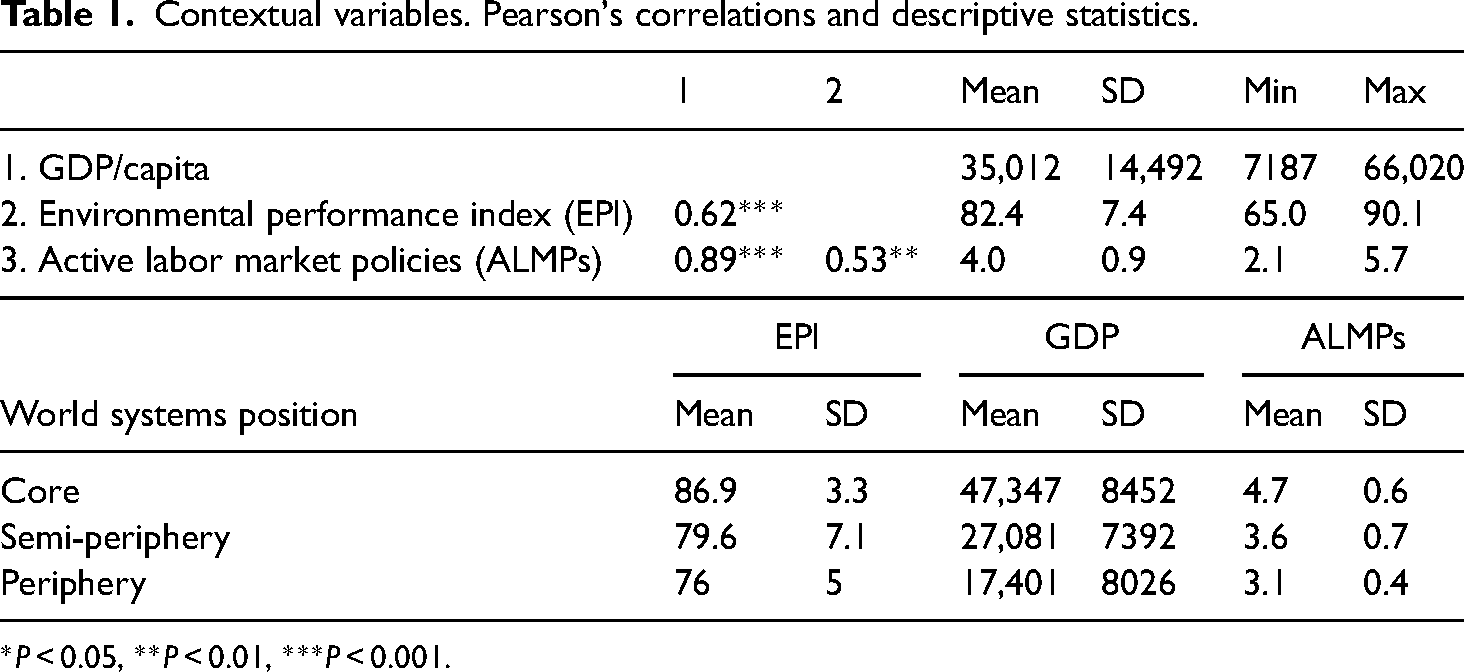
*P < 0.05, **P < 0.01, ***P < 0.001.
Statistical analyses
The method employed to test the hypotheses is multilevel analysis (MLA) (Hox et al., 2017). By allowing for specification of a country-level random intercept, MLA accounts for the hierarchical data structure, where observations (individuals) are nested in countries and hence unlikely to be independent. Therefore, and due to the ability simultaneously to assess individual- and contextual-level mechanisms, as well as their potential cross-level interactions, MLA is used commonly in similar studies (e.g., Kulin and Johansson Sevä, 2019). As MLA accounts for the hierarchical data structure, it is possible to calculate the proportion of total variance attributable to the country-level, referred to as the “intraclass correlation” (ICC). The ICC is derived on basis of an empty model, that is, a model with no independent variables. Initial analysis reveals an ICC (0.07) which justifies the MLA approach.
As the dependent variable is binary, logistic regressions are performed. Effects are reported in the form of odds ratios, where a value above 1 signifies a positive association and below 1 signfies a negative association. Logistic regression models have been claimed sometimes to generate misleading results from interaction effects (see Dorsch, 2014). However, in terms of sign and significance, hierarchical linear regression models yield results (not shown) identical to those reported below. The statistical software used is R (R Core Team, 2020) and the lme4 package (Bates et al., 2015). All quantitative variables are standardized (z-score).
Results
Table 2 shows the results of a number of hierarchical logistic regression models with support for government spending as the dependent variable. Notably, Model 1 reveals that across the full sample, the average effect of union membership is not significantly positive (or negative). These results hence do not support Hypothesis 1. The inclusion of a random slope for union membership, however, increases model fit, indicating that the membership effect varies across countries. Model 2 includes a cross-level interaction between union membership and world systems position (periphery states are the reference category) in order to explore whether the membership effect varies across world systems positions. It may be noted first that, overall, individuals (regardless of membership) in core states, as well as to a somewhat lesser extent in semi-periphery states, tend to be significantly less likely than those in periphery states to support an increase in government spending on the environment, and that these differences are substantial. Next, the result of the cross-level interaction shows that the membership effect does vary systematically according to world systems position, being significantly more positive in core states as compared to periphery states, where there is even a tendency toward a negative membership effect, which nevertheless is not statistically significant. In periphery states support for environmental spending is thus higher among members and non-members alike. There is also a non-significant tendency for the membership effect to be more positive (or less negative) in semi-periphery states as compared to periphery states. Results of further supplementary analyses (not shown) reveal that there is a statistically significant positive membership effect across the core states but not the semi-periphery states, where there is no such tendency (although as seen further below in connection with Figure 1, there is heterogeneity across the semi-periphery states in terms of the sign of the membership effect). The results support Hypothesis 2 and reveal a notable pattern: union membership is more likely to have a positive effect on environmental spending support in contexts where public support for such spending is substantially lower.
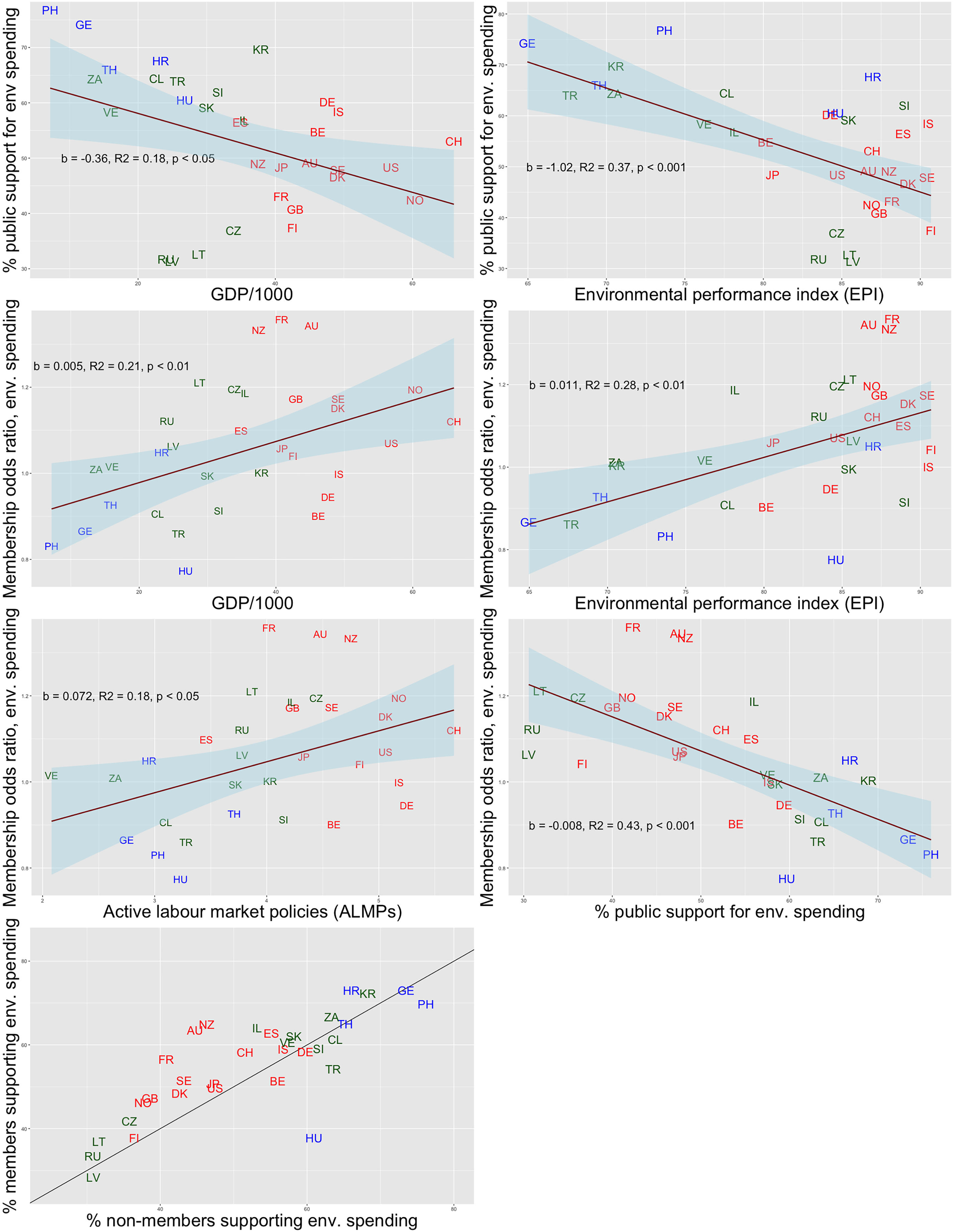
Visualization of the direct and moderating effects of the contextual variables, and of the association between the membership effect and public support for environmental spending. Note: Countries are color coded according to world system position. Red = core; green = semi-periphery; blue = periphery.
Multilevel logistic regression models (odds ratios).
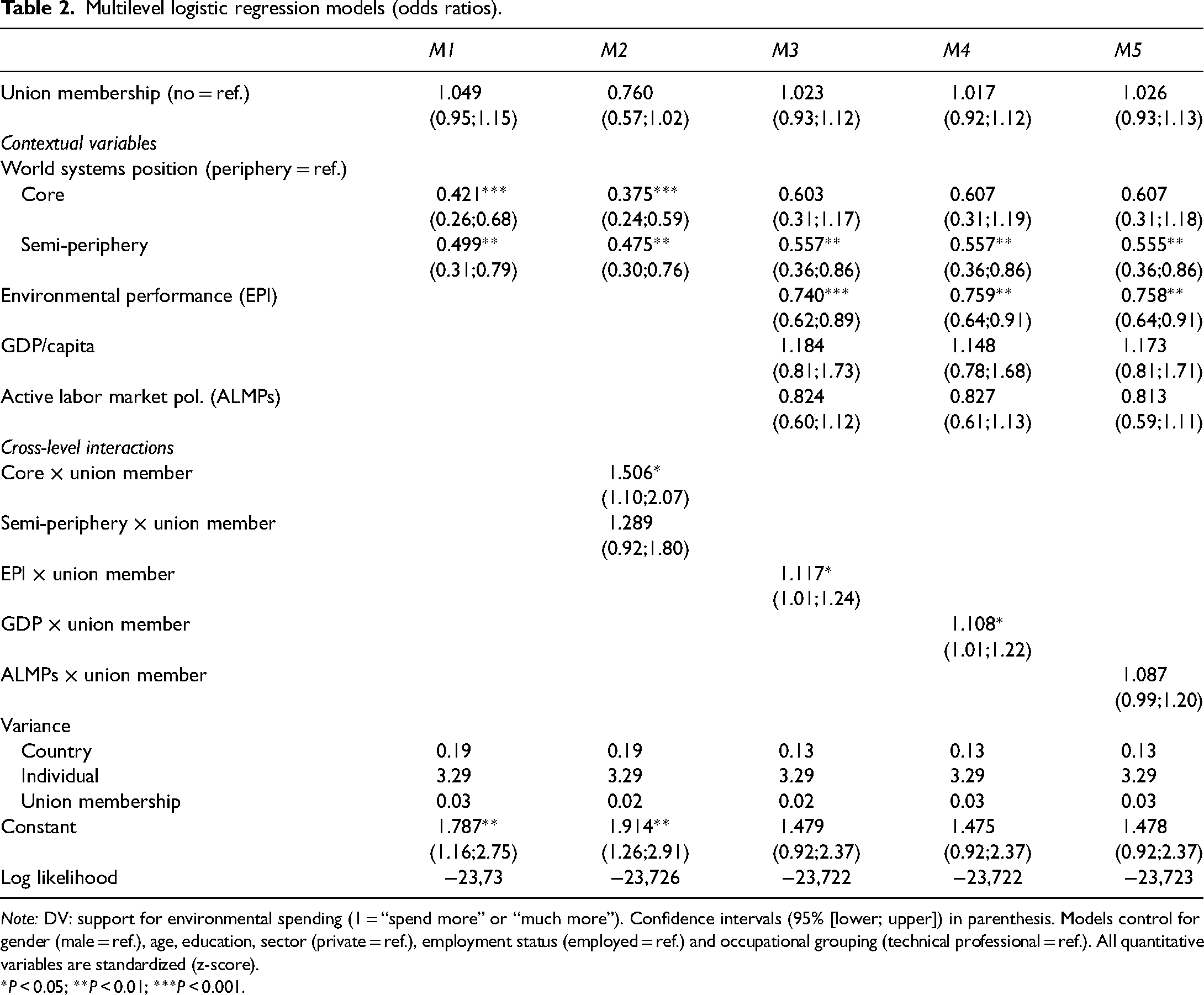
Note: DV: support for environmental spending (1 = “spend more” or “much more”). Confidence intervals (95% [lower; upper]) in parenthesis. Models control for gender (male = ref.), age, education, sector (private = ref.), employment status (employed = ref.) and occupational grouping (technical professional = ref.). All quantitative variables are standardized (z-score).
*P < 0.05; **P < 0.01; ***P < 0.001.
Models 3–5 include a complementary measure of economic affluence (GDP/capita) as well as discrete indicators of EPI and the strength of ALMPs, allowing for a more detailed account beyond the WST distinctions. As demonstrated above, these variables are strongly correlated and cluster across world systems positions: more affluent countries tend to have higher environmental performance and stronger ALMPs. The high correlation between these variables, in combination with the relatively low number of higher-level units, makes it difficult to disentangle their separate moderating impact on the membership effect. It is nevertheless useful to examine whether each measure moderates the membership effect in the same way.
Beginning with the association between these variables and overall levels of public support, EPI yields the most robust effect: regardless of union membership status, individuals in countries with higher EPI tend to be significantly less likely to support an increase in environmental spending. The result of the cross-level interaction between EPI and union membership further reveals that the membership effect on support for environmental spending tends to vary systematically depending upon levels of EPI, being more likely to be positive in countries ranking higher in environmental performance—where, again, support for environmental spending tends to be less widely held among the general population. Model 3 shows that the membership effect is also moderated by GDP per capita. Lastly, Model 4 shows that the cross-level interaction between the strength of ALMPs and union membership is not statistically significant, although there is a tendency toward a positive moderating effect.
Figure 1, row 1, plots the level of support for environmental spending aggregated at the country-level against GDP/capita and EPI, illustrating the negative effects of these variables on overall levels of support for environmental spending. The figure is color coded according to world systems position (red = core; green = semi-periphery; blue = periphery). As seen, countries in a core world systems position cluster around higher levels of GDP/capita and EPI, tending also to have lower levels of public support for environmental spending. The figure also reveals some heterogeneity among the semi-periphery states in terms of levels of public support, one group of countries belonging to this categorization (the Czech Republic, Latvia, Lithuania, and Russia) having very low levels of such support, but also scoring fairly high on the EPI. The next row plots the country-level random effects of union membership on support for environmental spending (odds ratios extracted from a multi-level model with the individual-level controls) against GDP/capita and EPI. As seen, the membership effect varies substantially, a group of countries (e.g., the Philippines, Georgia) showing tendencies toward negative effects, also having lower GDP/capita and EPI. Conversely, countries with a comparatively large positive membership effect include France, New Zealand, and Norway, all scoring high particularly in terms of EPI. These figures also reveal that there are several semi-periphery states with tendencies toward a positive membership effect (including those noted above as having low levels of public support).
The left-hand graph on row 4 plots the membership effect against aggregated levels of support for environmental spending, illustrating the puzzling tendency for these to be correlated negatively: as overall support increases, the membership effect tends to decrease. The right-hand graph in row 4 plots the country-level aggregated share of union members supporting environmental spending against the aggregated share of non-members supporting such spending. The diagonal line is designed to reflect the intersection of the values of the x-axis and the y-axis at each point in the graph, meaning that if a country is placed on the line, the share of members supporting environmental spending equals the share of non-members supporting such spending. In countries placed above the diagonal line, the share of members supporting environmental spending is higher than the share of non-members. For the most part, the share of members supporting environmental spending is higher than the share of non-members. Moreover, the share of members supporting an increase in environmental spending tends to constitute a majority in most countries. However, while, as seen above, the membership effect tends to be positive in countries with lower public support, in a few cases (e.g., Norway) the low baseline in such countries still renders the pro-environmental share of members a minority (slightly above 40 percent).
Supplementary analyses
A number of supplementary analyses are performed in order to evaluate the robustness and broader validity of the findings (results available upon request). First, the results may indicate a more general pattern, where country affluence leads to a higher likelihood for a positive membership effect pertaining to support for government spending and intervention more broadly. Additional analyses (not shown) using the same set of individual-level controls assess whether GDP moderates the membership effect on the following dependent variables (covered in Engler and Voigt, 2023), which are all dichotomized: support for ALMP, passive labor market policy, and government spending on pensions. Notably, neither of these models reveal a significant interaction between GDP and union membership, and there appear to be no tendencies toward such an effect. Country-level affluence hence appears positively to moderate the membership effect specifically regarding environmental spending, but not these other policy areas (arguably of more traditional union concern, Engler and Voigt, 2023). All the reported results are robust to country-variation pertaining to the occupational composition of different unions, as the models control for occupational location. Moreover, additional tests (not shown) reveal that inclusion of an interaction term between membership and occupational location (regardless of which occupational category is set as reference) does not affect the sign nor significance of the cross-level interactions in Table 2.
Discussion
This article contributes with new empirical insights concerning union members’ environmental attitudes (Chen, 2017; Ringqvist, 2022) by extending the geographical scope beyond the US and Europe and engaging WST (Wallerstein, 2004) as a comparative framework, revealing significant international variation in the association between union membership and support for government spending on the environment. Notably, whereas public support for environmental spending is shown to be substantially weaker in core as compared to non-core states, the latter being subject to more extensive environmental threats, the reverse holds for the membership effect which instead is significantly more likely to be positive in core states. Beyond core states, union membership does not tend to have a positive effect, a novel empirical observation which should be interpreted in relation to the generally higher level of support for environmental spending among members and non-members alike, in turn a finding which may be attributed partly to environmental degradation being more extensive in non-core states. Beyond core states, more generalized public support for government spending on environmental protection thus leaves less space for a positive membership effect.
Conversely, the fact that the membership effect tends to be more positive in core states, despite environmental threats being relatively less extensive in such contexts, may be attributable partly to a stronger link in developed economies between environmental attitudes and leftist ideology (Lewis et al., 2019; Nawrotzki, 2012) as well as macro-economic and labor market conditions being more favorable, the latter allowing unions and their members to embrace wider political issues (Kojola et al., 2014). Worthy of note in this connection is that supplementary analyses reveal no significant moderating effect of country-level affluence on the association between union membership and a range of other policy preferences of more traditional union concern, including ALMPs (Engler and Voigt, 2023). These findings lend some support on a cross-national basis to the suggestion by Kojola et al. (2014) that more favorable macro-economic conditions moderate the association between union membership and support for broader political agendas.
However, while these may seem fairly intuitive results, the most intriguing empirical puzzle is that public support for environmental spending is comparatively lower in the same contexts, viz. more affluent core states; a pattern that would appear to be due part to the tendency for environmental performance to be higher in the same contexts, implying a weaker link between immediate self-interest and environmental protection. In this regard, even as EPI correlates strongly with more favorable macro-economic and labor market conditions, it is thus notable that union membership counteracts the tendency for EPI to supress environmental spending support, indeed to the extent that membership tends to have a larger positive effect in contexts with higher EPI, where there arguably is a weaker link between immediate self-interest and environmental protection. This finding may be interpreted in relation to a body of literature which suggests that union members can become—or due to self-selection be pre-disposed to be—more willing to embrace policies that transcend their narrow or short-term self-interest (Ahlquist and Levi, 2013; Fiorito, 1992; Kirmanoğlu and Başlevent, 2012; Rosetti, 2019); what Mosimann and Pontusson (2017: 479) refer to as a “solidarity effect.” A solidaristic rationale is in fact proposed as partial explanation of the finding that European union members tend to be more willing than their non-organized counterparts to prioritize environmental protection above growth and jobs (Ringqvist, 2022). Such an effect is mediated by leftist ideological orientation, which is shown elsewhere to be associated with a predisposition toward self-transcendence (Kilburn, 2009; Kirmanoğlu and Başlevent, 2012). A more collectivistic or solidaristic orientation may thus partly explain why the membership effect on environmental spending support is of greater magnitude in contexts where environmental protection is linked less immediately with self-interest and public support is lower. To be clear, this is not to intimate that members’ preferences are driven purely by solidaristic concerns, but that norms and ideology constitute at least part of the mediating mechanism in the membership effect and that—due to a weaker link between immediate self-interest and environmental protection—there is more room in core states for such a mechanism to augment differences between members and non-members. Note that an absence of solidarity among members in non-core states must not be inferred from this line of reasoning, only that such a mechanism would matter less due to a stronger connection between immediate self-interest and environmental protection. This dovetails with a broader argument that values, or non-material factors, can have a larger impact when the “material stakes” are lower (Rueda, 2018), or in the specific case of pro-environmental orientations, in contexts subject to less extensive environmental problems (Dorsch, 2014; Inglehart, 1995). Read in conjunction, the direct negative effect of EPI and the inverse effect of the cross-level interaction between EPI and union membership can thus be construed as indicative of a solidarity effect—reflecting an internalization of other-regarding norms, or self-transcendent values (Kirmanoğlu and Başlevent, 2012; Mosimann and Pontusson, 2017)—meaning that membership is associated with a higher propensity to support policies that transcend narrow self-interest.
On this note, it is pertinent to acknowledge the complexities involved in the concept of interests (Hyman, 2001; Kelly, 1998). As argued by Kirmanoğlu and Başlevent (2012: 685): “in a broader sense, almost all actions could be seen as motivated by self-interest, since rational people support policies that might be detrimental to them in the short run in order to improve their well-being in the long run.” Central to the logic of collective organization, the concept of solidarity epitomizes some of these tensions by capturing “commonalities of interest and purpose which extend but do not abolish, consciousness of distinct and particularistic circumstances” (Hyman, 2001: 170). Arguably trade unions emerged historically to coordinate workers’ action around such broader commonalities. Even where more narrowly focused on sectional interests, unions are ultimately predicated on a collective logic (Offe and Wiesenthal, 1980), which may extend continually to new and evolving situations, including the major collective action problem of global environmental degradation (Uzzell and Räthzel, 2013b). Hence the notion of a solidarity effect may be applied usefully to insights derived from WST in order to understand the potential role of trade unions in transcending limits to global environmentalism stemming from international divisions in terms of the distribution of environmental burdens. Indeed, with regards to support for government spending on the environment, union membership plays the most positive role precisely in those contexts—affluent core states subject to less extensive environmental burdens—where such support tends to be least widely held. Such a transcending of divisions on an international basis may provide potential for developing international union cooperation and networks (Gumbrell-McCormick and Hyman, 2015; Martínez Lucio, 2010; Schulze-Cleven, 2017) based on environmental agendas. In this context it is however pertinent to note some constraints to more active union engagement particularly in developing economies lacking in democratic structures, where unions tend to hold a weaker bargaining position in relation both to employers and the state (Erol and Şahin, 2023; Shin et al., 2023: 7; Thomas and Pulignano, 2021: 525).
Some limitations of the study must be emphasized. An account such as the present one, spanning across such a broad range of national and institutional contexts, is necessarily partial and does not purport to be exhaustive: several issues remain to be explored in more depth. Research based on longitudinal data would be better equipped at uncovering the mechanisms underlying the observed associations and can shed light on the causal question of whether they reflect a transformative effect of union membership or the self-selection of more (or less) pro-environmentally inclined individuals into membership. It should also be noted that the focus in this article is on between-country effects, which sometimes differ from within-country effects across time (Givens and Jorgenson, 2011; Summers and VanHeuvelen, 2017). Future research may also address potential heterogeneity in the membership effect across different types of unions (beyond controlling for variations across occupational groups) (e.g., Keil and Kreinin, 2022), and studies drawing on data with more detailed information on working conditions can investigate the extent to which factors such as job security mediate the membership effect. Studies on larger samples of periphery and semi-periphery states can also examine further distinctions between, as well as heterogeneity within, these two categories; the empirical results indicate, for example, a (non-significant) tendency for a negative membership effect in periphery states, while variation in terms of the sign of the impact in semi-periphery states.
Lastly, the results speak to the role of trade unions in environmental policy debates. Although several questions remain to be explored pertaining to members’ support for and willingness to participate in specific forms of union action to address the ongoing environmental crisis, this article demonstrates widespread support for potential solutions at the policy level. Historically, unions have often played an important role in areas such as social policy and economic redistribution, reflected at the micro-level in the positive link between union membership and favorable attitudes toward such policies (Engler and Voigt, 2023; Mosimann and Pontusson, 2017). The results of the present article indicate that such a role may extend to the increasingly pressing ecological dimension (IPCC, 2021). Such an implication may be deduced regardless of causal ambiguities stemming from the cross-sectional data structure. As Bledow and Busemeyer (2021: 270) argue with regards to such causal matters: “even if the difference is exclusively due to self-selection, attitudinal differences between union members and non-members would still have political consequences as unions as intermediary organizations bundle and amplify their members’ interests.” However, and as stressed above, the effects of union membership must still be interpreted in relation to the baseline of environmental spending support among the general population. It is thus important to note that the non-significant or even negative membership effect in less affluent non-core states subject to higher degrees of environmental degradation should not be read as discouraging from the point of view of environmentally concerned unionists in these contexts: despite economic and labor market conditions being less favorable, support for environmental spending is widespread in such states among members and non-members alike.
In conclusion, within the context of global disparities in the distribution of environmental burdens, this article contributes with the first broader nationally representative analysis of union members’ support for environmental policies beyond the advanced capitalist economies, or core states. The article demonstrates that the previously reported positive membership effect on support for environmental protection tends not to extend to non-core states in the periphery and semi-periphery. In such states, however, environmental policy support is revealed to be more widely held among members and non-members alike. Through broadening the geographical scope, this article is thereby able to demonstrate that the membership effect on support for government spending on environmental protection tends to be more positive in contexts where public support for such protection is lower. The present contribution constitutes an early exploration into members’ environmental policy preferences across a wide range of institutional contexts, on which others may build by digging deeper into the dynamics within particular countries, unions, and sectors—and indeed whether such preferences and attitudes translate into a willingness to act.
Footnotes
Acknowledgments
The author would like to thank Robert MacKenzie, Danat Valizade, the editor and the two anonymous reviewers for many helpful comments and suggestions. The author is also grateful to Ingemar Johansson Sevä for the opportunity to discuss an early draft of this paper.
Declaration of conflicting interests
The author declared no potential conflicts of interest with respect to the research, authorship, and/or publication of this article.
Funding
The author received no financial support for the research, authorship, and/or publication of this article.
