



Abstract
Over the past few decades, policymakers have become increasingly intrigued by public procurement's potential to serve as a policy tool. In line with an increased prevalence of attempts to leverage public procurement for promoting employment-related goals, a growing body of research explores the linkages between public procurement and employment. Yet, while different aspects of the procurement process influence labour market outcomes and the linkages are multiple, current research focuses on individual aspects only. As a result, current understandings of the linkage between public procurement and its labour market effects remain fragmented. Considering choices between the initial identification of an object of purchase and the award and delivery of the contract, this article conceptualises the multi-faceted linkages between public procurement and labour market inequalities understood as issues of access to and (in)equality in employment. It argues that three key aspects (the design of the object, requirements set in the process of buying, and the type of provider) make distinct contributions to the overall impact that procurement processes have on labour market inequality and outlines a framework for analysing the implications of choices at these three core decision points.
Keywords
Introduction
In recent decades, regulation gained growing importance (Braithwaite, 2008), becoming the primary mode of governance in many European welfare states (Majone, 1994, 1997, 1999). With a shift towards regulation, the regulatory potential of public spending came into focus (Hartlapp, 2020; Sarter, 2022). 1 As policymakers in different countries and regions turn to public procurement as a policy tool, public contracts are used in a variety of contexts to foster an array of social goals. These include employment-related aims such as safeguarding minimum wage standards, creating employment opportunities for disadvantaged groups, promoting apprenticeships and vocational training, and fostering labour market equality and inclusion (among others, Sack et al., 2016; McCrudden, 2007; Troje and Andersson, 2021).
Research that brings together procurement and employment tends to display a strong empirical orientation and to focus on individual aspects, such as the use of public procurement to regulate wages (e.g. Holley, 2014; Howe and Landau, 2015) or to create training and employment opportunities (e.g., Troje and Andersson, 2021; Wright, 2014). Consequently, current considerations of the linkage between public procurement and its labour market effects remain fragmented. While different parts of the procurement process receive (albeit varying) attention, the focus on single aspects leads to a limited understanding of the multi-faceted ways in which public procurement and labour market (in)equality interact. This is compounded by a dominance of (single) case studies. Case studies are instructive as they shed light on different approaches that can be identified in practice, provide insights into what is done and features that facilitate or hinder the implementation and may identify the impact of actions. While they provide valuable detailed insights, they do not offer a comprehensive understanding of the multi-faceted interactions between public procurement and labour market inequality. Consequently, it has been argued that despite the growing prevalence of attempts to purposefully use public procurement as a policy tool for promoting employment-related goals, the strategic use of public procurement as a labour market and employment policy tool remains under researched and under theorised (Howe and Landau, 2015; Troje and Andersson, 2021). This holds particularly true for the relationship between public procurement and labour market inequality.
To date the literature on the relationship between public procurement and labour market inequality remains limited. While the literature explores wage-related stipulations and the impact of price-related practices on working conditions, much of the existing literature in this area neglects, or at least does not centre labour market inequality. Largely, research on public procurement and labour market inequality revolves around proactive measures that take existing inequalities as a starting point and aim to introduce specific measures, such as targets for the employment of underrepresented groups. Yet, structural differences in labour market integration and the social and personal conditionalities of employment persist not least along the lines of gender, class, disability, or what in the Anglo-Saxon context is termed ‘race’ and at the intersections of these categories (among others, Elson, 2022). With employment embedded in different conditionalities and conditions, also apparently neutral arrangements are likely to shed differentiated impacts (e.g. Himmelweit, 2002; Sarter, 2022). Against this background, it has been argued that any policy that does not take the diverse living circumstances and lived experiences into account may fail to successfully foster the aims it set out to achieve (Himmelweit, 2002), an argument that has also been put forth in relation to public procurement (Sarter, 2022). With a particular view to the post-pandemic recovery, Elson (2022) argues that for policies to have a substantial positive impact on equality in the longer term, they need to encompass considerations of ‘the institutions and configurations of economic power that give rise to incomes and wealth and wellbeing pre-tax and transfer (predistribution)’ (Elson, 2022: 136), including a reconsideration of competition policy and public procurement. In this vein, this article examines the interactions between public procurement and labour market inequality in a more holistic perspective.
Comprehending labour market inequality as equality of access to and equality in employment, this article aims to contribute to filling the existing gap in knowledge by approaching a holistic understanding of the relationship between public procurement and labour market inequality. It draws on existing research to first systematise the multi-faceted linkages between public procurement and labour market inequalities. It secondly draws attention to a hitherto neglected aspect of public procurement practices that shed important implications for labour market inequality: the design of the good, works project, or services purchased. This article adds to the literature not by virtue of presenting findings from new empirical research but by systematising, revisiting, and reconsidering existing knowledge on public procurement and combining it with insights from other fields to present a novel and more comprehensive approach for understanding the relationship between public procurement and labour market inequality. Public procurement is a broad process, ranging from the initial identification of a need and decisions on what exactly to buy and from whom to buy to the monitoring, the management, and the administration of the contract (ILO, 2022: 17). Even without considering monitoring and evaluation – important as they are for ensuring that the pursued goals materialise in practice (Jaehrling et al., 2015) – public procurement processes comprise a range of different decisions that interlink with labour market inequality. Starting with the area that has received the most attention, public procurement and the regulation of labour, this article highlights and subsequently examines three core decision points: requirements placed on the provider, decisions relating to the object of purchase, and decisions surrounding the type of provider. 2 Based on an examination of the relationship between these three key features and labour market inequality as issues of access to and equality in employment, this article proceeds to propose a systematic framework of the multi-faceted relationship between public procurement and labour market inequality. By doing so, it hopes to stimulate and inspire future academic research and to serve as an inspiration for policymakers and procurement practitioners.
Background
In the wake of a trend towards the marketisation of services, shared among a range of Western welfare states (Bode, 2009; Pollitt and Bouckaert, 2011; Veggeland, 2008), and a broader shift towards regulation as a primary mode of governance (Majone 1994, 1997, 1999; Levi-Faur, 2014, 2013), purposefully employing public procurement as a policy tool gained importance. Latest since the 1980s, concerns about public spending intensified. This led to a search for ways to constrain public spending and to make public administration and public services more efficient and cost-effective (e.g. Aucoin, 1990; O’Flynn, 2007; Pollitt and Bouckaert, 2011). Increasing concerns about public spending and a quest to foster efficiency translated, especially in countries following New Public Management (NPM) as a reform strategy, into the introduction of business and management principles to the public sector and an increased outsourcing and contracting out of services (e.g. Aucoin, 1990; Bode, 2009; Pollitt and Bouckaert, 2011). Shedding its shadow beyond the countries that adopted NPM as a reform strategy, NPM became a major paradigm (Pollitt and Bouckaert, 2011). Privatisation, outsourcing, and contracting out were widely adopted strategies for reforming the provision of public services (Bode, 2009; Pollitt and Bouckaert, 2011).
Whereas regulatory welfare states are committed to promoting certain social policy goals (Benish and Levi-Faur, 2020; Hartlapp, 2020; Levi-Faur, 2013, 2014), markets, among which those for public procurement, are not. In the words of Braithwaite (2008: 198): ‘Markets do not make moral judgements. If they work more efficiently, they will more efficiently produce bads as well as goods’. Thereby, the question of how to influence markets and how to shape the results they produce, attracted growing attention and the thinking of possibilities to steer markets towards social outcomes has become increasingly strategic (Braithwaite, 2008: 59). As welfare states aim to promote social goals on the one hand and increasingly use markets, which are indifferent to these goals on the other, marketisation created a need to align the market-based delivery of services with the goals of welfare states. Given a broader move towards regulation as a primary mode of governance (Majone, 1997, 1997) and the persistence of social goals as a core consideration of regulatory welfare states (Levi-Faur, 2014, 2013) interest in strategically using public spending as a regulatory lever has grown (Hartlapp, 2020). Public procurement, the mechanism through which goods, works, and services are bought or contracted, is an important market. On OECD average, it accounted for about 12.6% of GDP in 2019 (OECD, 2021: 162), making procurement ‘one of state and governments’ most important jobs’. (Potoski, 2008: S58) In the vein of a search for efficiency and reduced public spending and a broader turn towards regulation as a mode of governance, increased attention has been paid to the regulatory potential of public procurement for promoting a variety of social (as well as environmental) goals.
Public procurement and the regulation of labour
To date, the literature on public procurement and employment comprises a range of (especially single) case studies and analyses of sectors and occupations that examine the impact of public procurement practices in a particular setting (e.g. Benjamin (2016) on caring professions in Israel), explore how public procurement has been leveraged to foster decent work (e.g. Howe and Landau (2015) on the Victorian Government Schools Contract Cleaning Program in Australia or Ravenswood and Kaine's (2015) study of residential aged care in Australia and New Zealand), and investigate how public procurement is used to promote employment and training opportunities (e.g. Troje and Andersson (2021) on the use of procurement to promote employment and training opportunities for disadvantaged groups in Swedish construction or Wright (2014) on the Women into Construction project in the UK). These studies tend to focus on one particular aspect of public procurement practices, be it the impact of procurement practices on working conditions and job quality (e.g. Benjamin, 2016), the use of public procurement as a tool for regulating labour (e.g. Howe and Landau, 2015), or specific obligations placed on providers such as targets for the employment of underrepresented groups and people at a disadvantage (e.g. Troje and Andersson, 2021; Wright, 2014). Consequently, two streams of literature exist, which to-date remain largely isolated, one that examines public procurement as a tool for regulating labour and one that explores its proactive use for promoting labour market equality.
Cursorily neutral stipulations and practices
A first stream of literature explores how public procurement shapes wages and working conditions and how it is leveraged to promote decent or minimum wages and working conditions (e.g. Sack and Sarter, 2018; Howe and Landau, 2015; Ravenswood and Kaine, 2015). The past decades have been characterised by an increased marketisation of services. In an environment, where public budgets are facing increased constraints and strong concerns about public spending, the price is a core decision criterion for public bodies (among others, Roodhooft and Van den Abbeele, 2006: 493f; Rönnenbäck, 2012: 448). As a result, cost pressures in public procurement may be strong, so that the competition induced or strengthened by marketisation instigates price pressures for bidders. Given the interrelatedness of the price paid and wages and working conditions of staff, considerations of the price and procurement practices that reinforce a strong price pressure are likely to affect wages in the delivery of the contract (e.g. Jaehrling et al., 2015: 147). In general, a range of empirical studies seems to suggest a negative impact of competition on wages and working conditions (e.g. Dube and Kaplan, 2010; Flecker and Hermann, 2011). Particularly in labour-intensive sectors (Schulten and Brandt, 2012: 140), these contributed to pressures on labour costs (e.g. Sarter, 2022; Hermann and Flecker, 2012; Flecker and Herman, 2011; Kozek et al., 2012; Schulten and Brandt, 2012; Vrangbæk et al., 2015). This is compounded by the fact that contracting out implies challenges for collective bargaining as it leads to more fragmented provider structures and heterogeneous workforces that are harder to organise (Hermann et al., 2012; Ravenswood and Kaine, 2015; Schulten and Brandt, 2012). Pressures on labour costs are particularly pronounced when first labour costs account of a high amount of total costs and second strong competition exists (Schulten and Brandt, 2012: 147). Companies have responded not only by ‘shedding of employment’ (Kozek et al., 2012: 124) but also by lowering of wages, intensifying work (Kozek et al., 2012: 133) and increasing workloads and overtime (Kozek et al., 2012: 133; Schulten and Brandt, 2012: 140). Further, it has been argued that price-focussed procurement may have negative implications for equality (WBG, 2020: 41). Empirical studies on care services in England, for instance, indicate that commissioning and procurement practices have a significant impact on wages and working conditions. In particular, it has been shown that ‘overriding strong budget constraints’ (Rubery et al. 2012: 420) and a high importance given to the price shape the scope providers have. In this vein, Rubery et al. (2015: 767) found that ‘the commissioning environment restricts IDPs’ [independent providers, EKS] scope to develop good HR policies through its use of time-limited, electronically monitored, and low flat-rate fees’. (Rubery et al., 2015: 767) 3 In addition, using ‘cheaper forms of employment’ (Schulten and Brandt, 2012: 140) was a way to counter price pressures by reducing labour costs.
In the light of an increasing turn towards regulation as a primary mode of governance (Braithwaite, 2008; Levi-Faur, 2014, 2013; Majone 1994, 1997, 1999) and supported by an emerging ‘post-contractual reflexivity’ (Sack and Sarter 2016) – a growing awareness of the negative impacts of contracting out – public contracts have become an increasingly important tool for the regulation of labour (among others, Donaghey et al., 2014; Holley, 2014; Howe and Landau, 2015; Howe, 2017; Kaine, 2012; Ravenswood and Kaine, 2015). In Federal States, such as Australia or Germany, the growing interest in leveraging public procurement's potential to regulate labour by using public bodies’ purchasing power is in part also a reflection of the aspirations of sub-national governments to shape policy areas, which domestically have been delegated to the national level (Sack and Sarter, 2018; Howe and Landau, 2015). Against the background of differentiated labour market integration and labour markets that are characterised by inequalities and horizontal and vertical segregation, cursorily neutral regulations and practices may have the effect of promoting equality in employment (Sarter, 2022 ). Take the example of minimum wages. Women are overrepresented in low-paid jobs. Consequently, setting minimum wage standards, which raise the income of those in low-paid jobs will have gendered implications, disproportionately benefits women. While no empirical studies examined the equality implications of stipulations on minimum wages in public procurement, the introduction of a general minimum wage in Germany has been shown to benefit women in particular (Mindestlohnkommission, 2020).
Reductions of staff and the deterioration of wages and working conditions may furthermore have important repercussions for service users and may affect their ability to access (or remain in) employment. Particularly in soft, person-centred services, the person delivering the service, their qualifications, skills and how they treat the user have crucial implications for the service itself (Sarter and Karamanidou 2019). As has been rather widely highlighted, increasing workloads and worsening working conditions can affect the quality of services delivered (Apostolou, 2012; Benjamin, 2016; Epstein, 2013; Hermann and Flecker, 2012). They can furthermore contribute to processes of de-skilling (Benjamin, 2016) by making the specific occupation less attractive for skilled and qualified workers, impacting over time the qualifications of staff delivering a specific service and contributing to a further deterioration of service quality in the future. A range of publicly procured services supports individuals in accessing or remaining in employment (e.g. by providing training or crucial mental health support). If these services are affected by developments that incur (or contribute to) a deterioration of service quality, then this may in turn lower their effectiveness in supporting service users to enter or uphold paid employment, consolidating or worsening labour market inequality.
In brief, cursorily neutral regulations and practices are vital tools for regulating employment. Against the background of segregated labour markets and varying labour market integration and employment patterns, regulations and practices can have important implications for equality in employment. Because the delivery of (especially soft) services is closely linked to the person delivering the service, their wages, working conditions, and qualifications can furthermore have implications for the service and thereby for its users. This may result in ineffective services and suboptimal outcomes. If the service in question enables or facilitates engagement in and access to the labour market, this may impact labour market (in)equality.
Proactive measures
A second stream of literature explores the use of public procurement as a lever for promoting labour market inclusion of those at a disadvantage (e.g. Troje and Andersson, 2021; Wright, 2014). In contrast to cursorily neutral features, these 'proactive measures' (Sarter, 2022) take equality considerations as a starting point. Here, public contracts can for example oblige providers to integrate measures that specifically aim to support equality in employment and/ or access to employment for specific groups. Based on previous knowledge of inequalities, such proactive measures can for instance require providers to employ a certain percentage of disadvantaged individuals in the delivery of a contract or to create training opportunities for disadvantaged groups (e.g. Troje and Andersson, 2021: Wright, 2014). The Dutch version of the concept of Social Return for Investment as it is integrated in public procurement practices in the Netherlands for instance, focusses on creating and developing employment opportunities for individuals ‘who are at risk of exclusion from the labour market’ (Vluggen et al., 2020: 236), including long-term unemployed individuals as well as individuals with disabilities and impairments, and disadvantaged young people. By requiring that providers employ a certain number of marginalised individuals, public contracts can open employment opportunities, allow individuals to gain further skills, knowledge and working experiences, all of which can foster access to employment opportunities in the future. While most of the literature focusses on the use of public procurement as a tool for promoting employment opportunities, proactive measures may also address other issues. In the German federal state of Berlin, for instance, providers have to include a certain number of measures that aim to promote gender equality. These include, inter alia offering flexible working, telecommuting and/ or temporary working time reductions, participating in initiatives that aim to spark interests in women and girls to work in male-dominated areas, and instigating special trainings for women, which are designed to support promotions (Erste Verordnung zur Änderung der Verordnung über die Förderung von Frauen und die Vereinbarkeit von Beruf und Familie bei der Vergabe öffentlicher Aufträge, Frauenförderverordnung – FFV).
Despite the difference in foci, both aspects (cursorily neutral features and proactive measures) focus on requirements placed on providers and purchasing practices as a starting point for shaping the relationship between public procurement and labour market (in)equality. While cursorily neutral features and proactive practices that form part of the procurement process, which to date make up the core of the literature relating to labour market equality and public procurement, have important implications for labour market (in)equality, they are not the only aspects of public procurement that shape (in)equality in the labour market.
The object of purchase
Considering employment in a broader vein, access to and equality in employment depend on a range of pre-conditions. Employment relies on a physical infrastructure that enables individuals to reach and remain at a place of employment and to carry out their work. This infrastructure is, at least partially, the outcome of public works projects. Second, further to a physical infrastructure, the ability to successfully fulfil specific tasks relies on the availability of distinct goods that are needed in the process of carrying out a job (Sarter, 2023a). Third, many public services, among which several contracted services, directly or indirectly influence access to employment. Services that can facilitate access to employment include but are not limited to those that are directly linked to employment, e.g. services which offer training to gain new skills and supporting disadvantaged individuals in applications and recruitment processes. In addition, a web of services whose purpose is not directly linked to employment provides the context that shapes an individual's ability to access (or remain in) employment.
Many of these pre-conditions that shape an individual's ability to access employment and their situation in employment are linked to public procurement: It is a crucial tool for safeguarding the availability of essential construction works for vital infrastructure, for ensuring the maintenance of streets and the construction of (public) buildings and securing essential goods for public services. From desks and IT hardware to safety gear and personal protective equipment (PPE), publicly procured goods are essential pre-requisites for an array of occupations. With variations between countries, public procurement is used to safeguard the availability of a range of essential services, from public transport to the running of kindergartens. In brief, public procurement is used to secure the availability of a range of goods, works and services that form essential pre-requisites for employment. Yet, the impact of public procurement goes beyond merely securing the availability of vital infrastructure.
While a broad range of literature, which remains separate from the study of public procurement and employment, highlights the diverse implications of the design of goods, works, and services for users, the role of public procurement in shaping the design of vital infrastructure and the equality implications of the decisions made in this context remain underexplored. Maybe most obviously, the material outcome of architectural choices, particularly those relating to physical access, may impact access to the particular site. As accessibility has gained importance, different notions, such as ‘inclusive design’, ‘universal design’, ‘accessible design,’ or ‘design for all’ have emerged to capture design choices that facilitate accessibility – oftentimes not only but also for the outcomes of work projects (see Persson et al., 2015 for a detailed exploration of different concepts). Yet, accessibility is not the only concern. The International Labour Organisation's Guide on gender-responsive procurement for Employment-Intensive Investment Programmes (EIIPs) highlights that the design of workplaces can have implications beyond accessibility, indicating for instance, that a lack of separate facilities for changing may increase the risk of sexual harassment (ILO, 2022). Likewise, the design of goods can have important implications for their usability and effectiveness. Take the example of the design of PPE in healthcare settings. To effectively prevent health hazard, PPE needs to fit the users well (among others, Ahmed and Dumanski, 2020). Yet, to-date PPE is not designed with a diverse range of users in mind, who differ considerably relating to their body features. Designed with the average (North American) white male body in mind, it is less effective in protecting for instance women (Ahmed and Dumanski, 2020; Chakladra and Ascott, 2021). So, what does that mean for public procurement?
By virtue of its function as a tool for setting essential requirements for the objects bought, public procurement can exert a crucial importance for influencing how these are designed. By shaping the design of vital infrastructure, goods, and services, public procurement indirectly shapes how the diverse needs of individuals are met and how the purchased objects enable diverse individuals to access employment and how they can fulfil their jobs. To fully capture this point – and the following considerations – it is vital to acknowledge that public procurement processes are broader than only the decisions made regarding requirements placed on the provider. They span a broad range of choices, starting with the initial identification of the need to be addressed and the good, works project, or services needed to address it. This includes the definition of what is bought and how it is to be shaped or designed, including its necessary and desirable features.
Decisions on the object of purchase subsequently shape the good, service, or outcome of the works project, including the usability (goods and works), access requirements (works and services) and ways of working (services), all of which have implications for their suitability for an array of diverse users. While these considerations are to date largely absent from the literature on public procurement and employment, decisions on the design of the object of purchase have important implications for labour market inequality in terms of equality in access to and in employment. The lack of access to a particular site may have implications for access to work, in terms of physical access to wokplaces and beyond. The design of workplaces may furthermore impact employees, regarding the accessibility of workplaces as well as their appropriateness for different employees. Whereas impeded access to the site of work seems self-explanatory, the broader implications seem to warrant a closer look. To understand how architectural choices can shed an impact beyond access to the physical site of work, consider training that can facilitate access to employment. Choices of architectural design may impede some individuals, for instance those with reduced mobility, from entering the particular space where a specific training is offered, hindering access to the particular training. If the training is likely to have positive effects for attendees, being unable to attend the training, also means being hindered from reaping the benefits that would result from participating in this event.
Like the physical infrastructure created by public works projects, publicly purchased goods, from PPE to desks, can have a crucial part to play for labour market (in)equality, albeit in a distinct way that differs from construction projects. Depending on the design of the goods and individual features of users (e.g. such as height, weight, hearing or sight) these objects may be more or less suited for individual workers. Whether and how the features specified in public procurement processes safeguard that the purchased goods are usable for a wide range of employees, who may be very diverse in a range of features, including but not limited to features such as age, height, hearing, or sight, has the potential to shape equality in employment.
Similarly, the ways in which a particular service operates, especially explicit and implicit access requirements and whether the design of the services accounts for the needs and lived experiences of a diverse population, shape the impact that the service has for a wide range of diverse users (Sarter et al., 2023, for examples of specific services see among others, Cheung and Phillimore, 2017; dell’Olio et al., 2011; Mclean et al., 2003; Memon et al., 2016). The conditions that determine accessibility of services interact with inequalities in terms of, for instance, economic capital, mobility etc. Further than access requirements, the way that services are delivered may impact different groups and individuals differently (Sarter et al., 2023). The importance that acknowledging and understanding the diverse needs of users has for service outcomes forms the foundation for approaches of co-production of services, which seek to draw on service users’ insights and experiences to foster meaningful services and are becoming increasingly important in public services (Boivard and Loeffler, 2012; Loeffler and Boivard 2016).
In brief, by virtue of the ability to set requirements that subsequently shape the design of the building projects, and its accessibility and functionality, public procurement processes have a crucial influence for shaping the design of the physical infrastructure supporting employment. Given the effect that the design of goods, works, and services can have for access to and equality in employment, the ability to specify the design of the object of purchase has crucial implications for its impact on labour market (in)equality. While the design of services is particularly likely to influence access to employment and goods are particularly probable to influence equality in employment, the physical infrastructure may affect access to employment and have an impact on safety and wellbeing in employment.
The provider
Public procurement furthermore involves explicit (and implicit) decisions on buying from a distinct type of provider. Distinct types of organisations have been credited with abilities, values, and behaviours that can shed beneficial impacts for labour market integration of individuals facing disadvantages in accessing employment. Social enterprises 4 in particular can have an important role in creating employment and training opportunities. As part of their social purpose, social enterprises work to open employment opportunities for marginalised individuals (Defourny and Nyssens, 2010a, 2010b). By virtue of their social purpose and their engagement in creating employment and training opportunities, strategically procuring goods, works, and services from social enterprises can promote training and employment opportunities for marginalised groups. Implications relating to the type of provider are not limited to the positive impact that engaging with social enterprises may have. Awarding contracts to women-owned enterprises for example has been credited with positive implications for gender equality in the labour market as ‘women entrepreneurs are more likely to hire women, contributing to women's economic empowerment.' (ILO, 2022: 22) In brief, like requirements set in the process and the object of purchase may impact access to employment and equality in employment, distinct types of providers, such as social enterprises or minority-owned businesses, may further promote access to employment for people who face a disadvantage in accessing employment.
Further, distinct types of providers, namely third sector enterprises more broadly 5 may facilitate effective services. They have been argued to have ‘specialist knowledge of clients’ needs, expertise, and/or skills’ (Murray, 2011: 280), special links to specific communities and a particular knowledge of their needs. Third sector organisations have been credited with a particular ability to involve users and communities, to engage with ‘hard-to-reach’ groups (Chapman et al., 2007; Murray, 2011) and have been argued to be particularly suited to reach and involve service users and communities in the delivery of services. Drawing on these abilities and characteristics, third sector organisations may be more prone to deliver services that successfully engage with and address the needs of marginalised groups when providing support to access (or sustain) employment, adding to considerations about the design of services mentioned above. Taking these considerations into account, public procurement can purposefully engage with distinct types of providers – e.g. third sector organisations, women and minority-owned businesses – to further support labour market equality in terms of, particularly but not exclusively, access to employment.
Discussion: considering procurement and labour market inequality
Departing from the understanding that not only explicit stipulations relating to equality but also seemingly neutral features shape the impact of public procurement on labour market inequality (e.g. Sarter, 2022), this article argued that over the course of any procurement process, crucial choices are made, which shape the impact on labour market equality defined as access to and equality in employment. These comprise requirements set in the process (how something is purchased), the design of the object of purchase (what is purchased), and the type of provider (from whom it is purchased). Each of these three dimensions makes distinct contributions to the impact of any given procurement process (Table 1). More specifically, decisions relating to the design of the object of purchase can affect their suitability for a diverse range of users, including employees as users of for instance publicly procured goods, which has the potential to affect equality in employment, and shape the impact for a range of different users, which may again include employees as users. A range of requirements set in the process impact working conditions (including but not limited to pay) and may have implications for labour market equality, even though they may cursorily appear unrelated to it. Further, requirements may incentivise or oblige providers to adopt proactive measures, which may centre on or affect labour market access or working conditions. Lastly, specific providers, such as social enterprises, may add benefits by opening up training and employment opportunities for disadvantaged individuals (works, goods, services) and enhancing the engagement with marginalised communities (services). Thereby, decisions relating to the design (what is purchased or the 'object'), conditionalities of buying (how it is purchased or the 'process') as well as the type of provider (from whom it is purchased or the 'provider') shape access to employment and the design of the object, cursorily neutral regulations and practices and proactive measures can have tangible implications on equality in employment. Consequently, holistically examining the impact of public procurement practices on labour market inequality in terms of access to employment and equality in employment includes first exploring the impact of the design of the specific object of purchase on access to employment, assessing whether and how requirements set in the process of purchasing incentivise or require the provider to create employment and training opportunities and examining if the (type of) provider provides additional benefits for promoting access to employment. Secondly, it means exploring the impact that decisions in the context of public procurement processes have on equality in employment. This includes considering first, the suitability of the specific object of purchase for employees as users in their diversity and second, the impact of cursorily neutral regulations and practices and proactive measures for equality in employment.
Object, process and provider and labour market inequality as questions of access to and inequality in employment.
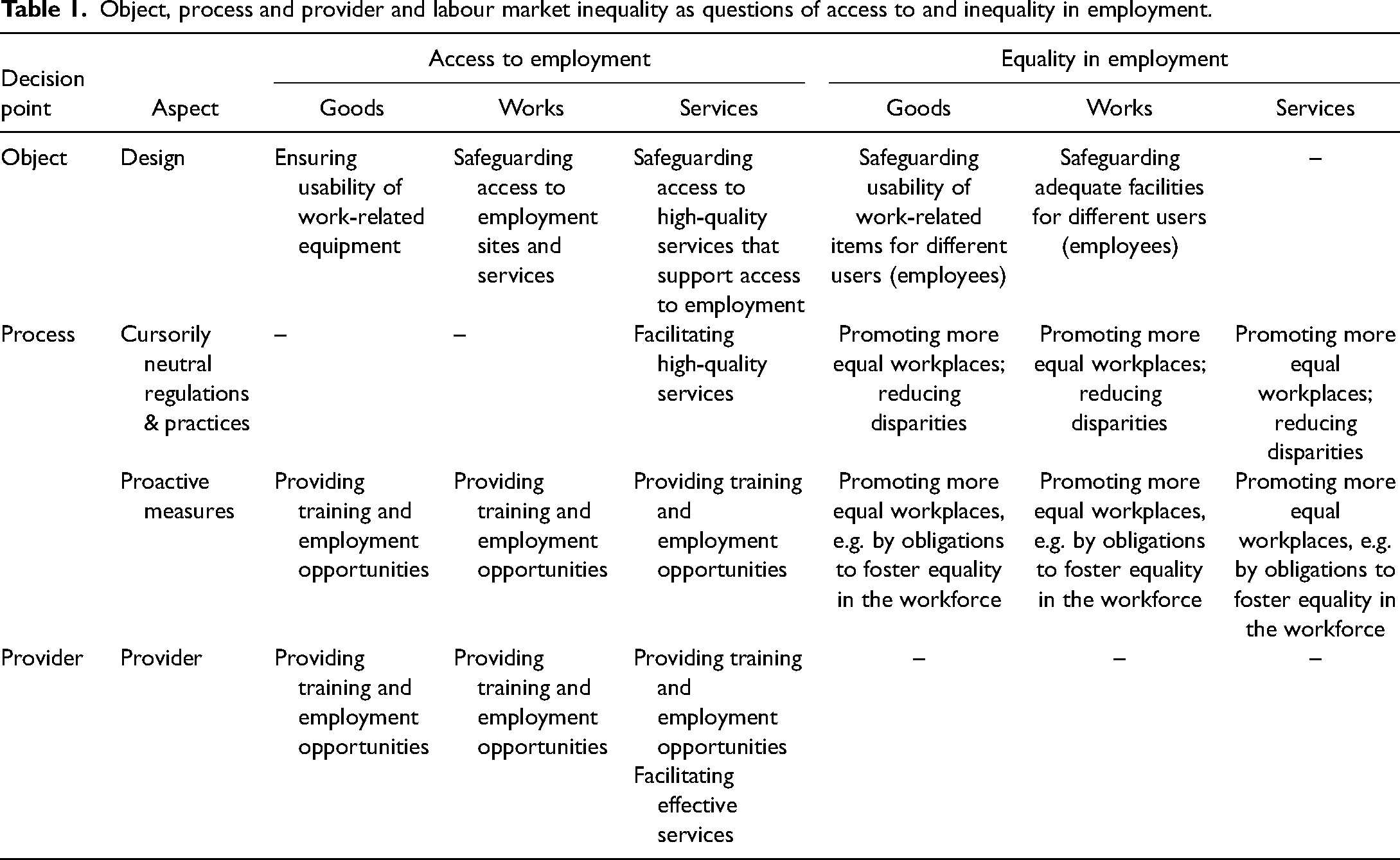
This article hence proposes to supplement the existing focus on requirements placed on the provider by considerations of the impact that the object of purchase and the provider have for labour market inequality. Decisions on the design of the object of purchase particularly shape the opportunities and experiences of individuals; consequently, they can remove or reinforce existing barriers and expand, maintain, or decrease opportunities. As the design shapes the opportunities and barriers for a wider population, we would expect design choices to shed a broader impact on users (and possibly beyond, as they can be establishing a normative base for change and serve as proof of concept) than targeted but limited actions. For instance, by removing barriers to accessing training and employment, consciously designed works, goods, and services may improve the effectiveness of services and its impact for diverse groups of users. This may support more people from marginalised backgrounds in accessing employment than imposing a target of employing individuals from marginalised groups. Likewise, particular types of providers may be more likely to understand and fulfil the needs of particular communities, thereby removing barriers and increasing the benefits of the services provided. Analytically, integrating these perspectives allows to capture wider-reaching impacts than the focus on cursorily neutral features and proactive measures alone. For procurement practice, integrating considerations of the impact that the design has implies the opportunity to generate a wider impact than the more localised practices relating to the process of buying. In neither case does this mean that design choices should substitute considering the benefits of cursorily neutral features and proactive measures. To fully comprehend the impact of public procurement, analytically a holistic assessment of the implications generated by the different layers (and their interaction) is required. Likewise, in practice, a combination of positive impacts resulting from the individual layers is likely to shed the best outcomes.
Practical implications
Assessing the impact of public procurement processes holistically across the three core procurement dimensions (object, process, and provider) and the two equality dimensions (access to and equality in employment) means first exploring the implications for access to and equality in employment generated by individual decisions made across each of the three core decision points and secondly assessing their joint impact. When assessing the impact of any given procurement process, two considerations are crucial. First, the implications of decisions at the three distinct levels do not necessarily align in individual procurement processes. For instance, the procurement process for a service that offers training for the unemployed may integrate requirements relating to working conditions and proactive measures to facilitate the reconciliation of work and family life for its staff, both of which may have a tangible positive impact on equality in employment. The service itself may however be designed without regard to the variety of potential users and their specific needs and purchased from a for-profit enterprise, forfeiting opportunities for further tackling labour market inequality, particularly in relation to access to employment. Consequently, holistically assessing the implications of a particular procurement process means considering the implications of each of the core dimensions as well as possible interactions and synergies between them and their (potential) broader impacts, e.g. for tackling structural inequalities and segregated labour markets. Second, it is important to acknowledge that in any given public procurement process, decisions relating to these three dimensions (object, process, provider) will be made – either explicitly or by omission 6 . Just as considering the implications for labour market equality at the key dimensions and devising strategies relating to the three dimensions (object, process and provider) can shed a positive impact on labour market inequality, omitting to do so can have important implications. In the absence of specified requirements individual providers may choose to provide an accessible product, construction project or service, pay decent wages, offer good working conditions, and/ or create employment or training opportunities for individuals from marginalised groups. Yet, if such considerations are not included as explicit requirements, the decision to do so lies in the sole discretion of the specific provider and beyond the public bodies’ control (Sarter and Karamanidou, 2019). So far, this article has argued that the linkage between public procurement and labour market inequality is multi-faceted, generated through three dimensions: object, process, and provider. By doing so, it aims to inspire future academic research on the linkage between public procurement and labour market inequality and hopes to support the development of inclusive procurement practice. However, shifting towards a more holistic conceptualisation of the relationship public procurement and labour market inequality raises the question of the implications that this has for the study and practice of public procurement.
Focussing on the academic study of public procurement, different approaches are conceivable. First, while acknowledging the complexity and multi-faceted nature of the relationship between public procurement and labour market (in)equality, future research may, as current research does, choose to examine one particular aspect of this multi-faceted relationship alone, seeking for example, to provide further insights into the impact of individual aspects. It may focus on process-related aspects such as cursorily neutral stipulations and practices and proactive measures. Research may examine the labour market implications that contracting from different types of organisations has for employees and users. Or, it may explore the implications of the object's design. Secondly, given the different decision points and their importance, research may seek to combine the study of the object, process-related features, and the type of provider (or any combination of these) in relation to access to employment and/or equality in employment, exploring the relationship in a more holistic perspective, in a particular case or across a number of cases.
Non-regarding the specific avenue chosen, the perspective outlined here draws attention to the importance of adopting a longer term perspective. Consider for instance, the design of building and goods, their impact for a range of diverse users may only become fully obvious after they have been in use for a certain period of time. As the procurement process ends with the delivery of the contract, observations regarding the impact of the design of a building or good may hence be posterior to this. Further, while initial implications for existing users may become clear shortly after the new building or goods is used, changing employee structures and new employees with a background different to that of existing employees may add further perspectives on the purchased building or good. To fully acknowledge the time difference between the delivery of the contract and its effect, continuous observation and longer term perspective are vital to assess the implications beyond the particular lifetime of a contract, to identify gradual changes and potential displacement effects that remain hidden from sight in short-term assessments.
In addition, the perspective outlined here suggests that the implications of choices may be less tangible and quantifiable than previous approaches imply. In particular, the focus on the object means acknowledging the impact that structures have for shaping barriers and opportunities (e.g. Sarter et al., 2023 relating to public services or Acker (1980) on the gendered implications of organisational structures more generally). In this vein, inequality not only presents at individual level or as an aggregation of individual points, which can be measured by numbers, but as a structural problem. Ideally, a focus on the object would complement not substitute existing approaches, so that measuring equality implications include conscious, honest, and in-depth qualitative assessment of the equality impact of structures, including an exploration of lived experiences 7 , in addition to quantitative measurements. In brief, advocating a more holistic understanding of the relationship between public procurement and labour market inequality seems to imply advocating to go beyond quantifying equality outputs measures at individual points in time (e.g. number of apprenticeships or weeks of training opportunities over the lifetime of a contract): It suggests that truly understanding the equality implications of choices at all levels and the impact of potential changes means exploring the equality implications of structures and the lived experiences of users (including in some cases employees as users) in a longer term perspective. 8 In practical terms, this means a combination of quantitative and more in-depth qualitative assessments, ideally conducted as continuous engagement, is needed to gain comprehensive and in-depth insights. Methodologically, these explorations can take different forms. In particular, a combination of longitudinal quantitative assessments, an external examination of access requirements, and repeated in-depths interviews with users may be beneficial to understand the equality implications of procurement practices. Given the complexity of the linkages between public procurement and labour market inequality, in practical terms, it may be sensible to explore each of the three dimensions (object, process, and provider) separately to then assemble the insights gained and holistically assess the impact.
For procurement practice, shifting towards a more holistic understanding of the linkage between public procurement and labour market inequality entails a renewed focus on the question what to buy and how to specify the design of the goods, works, or services in a way that a wide range of diverse users are to benefit. Integrating a stronger perspective on the object would thereby align with current shifts towards considering lived experiences of users, exemplified in a growing importance of co-production and co-design, and inclusive design. As argued elsewhere (Sarter, 2023b), shifting towards a nuanced and holistic understanding of equality and public procurement requires new insights and a reconsideration of existing knowledge and practices, which can be gained through exchange between procurement professionals and equality experts (knowledge transfer and exchange) and active engagement with stakeholders (knowledge creation). 9 While revisiting public procurement practices and reconsidering established design choices can draw on experiences in other areas (e.g. co-production of services), adopting a multi-layered approach means that procurement professionals are assigned additional tasks, heightening the often already straining demands on personnel, time, and financial resources. Without allocating additional resources, a more holistic approach to positively leveraging the impact of public procurement hence risks aggravating existing problems. At the same time, structurally, a shift away from easily quantifiable measures and towards a longer term perspective that exceeds the term of the contract means partially decoupling the assessment of equality impact from established ideas of monitoring, which relate to particular contracts. This would require a consideration of how to integrate these evaluations of procurement practices administratively and procedurally.
Conclusion
In the wake of an increased marketisation of services and a growing importance of regulation as a mode of governance (e.g. Braithwaite, 2008; Majone, 1994, 1997, 1999), the regulatory potential of public procurement has attracted increased attention (Hartlapp, 2020), also but not exclusively in relation to employment. Yet, the existing understanding of the relationship between public procurement and labour market inequality is hampered by fragmentation. Focussing on individual aspects, namely the impact of procurement practices on wages and working conditions (e.g. Holley, 2014; Howe and Landau, 2015) and the use of procurement as a tool for promoting employment and training opportunities (e.g. Troje and Andersson, 2021), the literature presents a fragmented picture. In particular, it neglects, hence the argument presented in this article, a pertinent feature that has tangible implications for labour market (in)equality: the implications of the design of goods, works, and services purchased. To address this gap, this article brings together different streams of literature to systematize the linkages between public procurement and labour market inequality and suggests a more holistic conceptualisation of this relationship.
This article argues that three decision points are crucial for shaping the impact that public procurement has on labour market inequality (understood as a question of access to and inequality in employment): the design of the object, requirements set in the process of buying, and the type of provider. Decisions surrounding the design of the object have the potential to shape access to and equality in employment by virtue of their ability to shape the functionality and usability of goods and buildings and the impact of services. Cursorily neutral regulations and practices relating to requirements set in the process of buying shape the conditions of employment, thereby potentially impacting equality in employment. Proactive measures can foster more equal workplaces and promote access to employment for underrepresented groups. Lastly, particular types of providers can offer benefits for promoting access to employment for disadvantaged individuals. It is through the different decisions taken at these crucial decision points and their interaction that a particular impact of public procurement on labour market inequality emerges. Consequently, hence the argument presented here, comprehending the linkage between labour market inequality and public procurement holistically means considering the implications that the object, requirements set in the process and the provider have for access to and equality in employment.
This article contributes to the literature by showcasing the importance that hitherto neglected aspects that shape the relationship between public procurement and labour market inequality, namely decisions on the design of the object of purchase and the type of provider, have for promoting access to and equality in employment. By systematising the ways in which three core decision points in the design of public procurement processes interact with labour market inequality as access to and equality in employment, this article hopes to contribute to the future development of research that examines the strategic use of public procurement as a policy tool, especially in relation to employment, labour market and equality. Conceptualising the multi-faceted interactions between public procurement processes and labour market inequalities and pointing to the implications for choices at these levels, this article furthermore hopes to inspire public procurement practice.
Footnotes
Declaration of conflicting interests
The author declared no potential conflicts of interest with respect to the research, authorship, and/or publication of this article.
Funding
The author received no financial support for the research, authorship, and/or publication of this article.
