



Abstract
Labour market dynamics are complex, limiting the capacity for consensus on a singular phenomenon to account for patterns. In this paper, we present a range of broader empirical trends from the Irish labour market that suggests the possible impact of neoliberal-type policies in the Irish market has been counterbalanced by strong human capital and skills development, growth in higher level occupations and employment protection. Though precarious work is a feature of parts of the labour market, the theoretical assumptions underpinning precarious work we argue should not be extrapolated to explain changes in job stability in the labour market at large.
Introduction
We welcome response and critique of our recent paper ‘Employment stability and decent work: Trends, characteristics and determinants in a liberal market economy’ in this journal. Essentially St-Denis, using the same data based on the Labour force survey in Ireland from 1998 to 2021, questions firstly the empirical foundations of our paper that indicate that job instability has not increased in this period. Secondly, the changes in job stability are ‘likely to have been driven by neoliberal reforms and increased use of flexible employment practices by firms’. Thirdly, that failure to identify the increase in job instability likely misses a fundamental shift in the nature of employment relationships and employer practices across liberal market economies. Fourthly, theoretically, the trends in the Irish labour market reflect the dominance of neoliberal hegemony and that ‘the influence of neoliberalism and flexible employment practices on job stability has in fact been hiding in plain sight’. Before addressing the empirical trends in the Irish labour market, it is useful to examine the potential consequences for workers of a neoliberal hegemony where increased marketisation, the commodification of public services and the repression of workers’ wages and freedom for capital to maximise surplus value prevail (Harvey, 2005). In a neoliberal-dominated labour market, we would expect that workers will experience an assault on their wages, jobs and quality of life generally (Crowley and Hodson, 2014). Specific elements include working increased number of hours sometimes without additional pay (Burchell, 2002; McBride and Lucio, 2021), increasing workloads and the removal of underperformers (Williams and Beck, 2018) and wage stagnation (Palley, 2013). While a decline in job tenure can be taken as a proxy for increased instability, attributed to an increasingly neoliberal regime, in truth the empirical data alone cannot support this claim. We acknowledge that there has been a proliferation of neoliberal-type policies since the late 20th century, particularly in the approach to public services, indeed our previous work supports this view (see Murphy et al., 2019); however, we argue that changes which have occurred in the Irish labour market are multifaceted and nuanced. In our response, we present new empirical data that indicates the significant expansion of the labour market, increased skill and education levels and expanded employment rights. These trends are then discussed in the context of neoliberal reform and flexible employment practices. We conclude with a discussion of likely drivers of job churn that help explain job stability patterns in the Irish labour market.
Empirical trends in the Irish labour market
Overall, our analysis showed that aggregate tenure levels for all employees in the private sector increased between 1998 and 2021. Three industrial sectors, Education, Health and public administration were excluded as they include all public sector employees. Unfortunately, these sectors also include a substantial number of private employments and cannot be reliably used in the Labour Force Survey to analysis trends in the public sector. For example, in 2021 these three sectors totalled 617, 574 employees, while data from government sources indicated that the actual number of employees in the public sector was 380,000 – a difference of 63%. Health and education are sectors which we have previously explored and indeed support the view that employment in these sectors displays the characteristics of precarious work for a significant proportion (see Murphy and Turner, 2014; O'Sullivan et al., 2020). The Labour Force Data as currently structured does not allow for a differentiation of employees within these sectors between those in private and public sector employment and hence our exclusion of these sectors in the original data. It should also be noted that the impact of this is likely to have a greater impact on the data on female participation as these sectors are disproportionately female.
These observations aside St-Denis are correct on the substantive point that the mean job tenure for the ten-year age groups between 20 and 60 actually declined in this period. In addition, the age composition has steadily shifted upwards between 1998 and 2021 and consequently given that older workers are associated with higher levels of job tenure the decline in mean tenure levels in the age groups is according to St-Denis even larger than the basic descriptives portray. However, this is an oversimplification lacking a more nuanced contextual analysis of the Irish labour market. St-Denis dismisses the evidence of stability in the incidence of temporary and part-time work as due to employers finding other means ‘to achieve numerical flexibility’. Along with atypical work patterns (which have increased substantially in Ireland), these are classical measures of precariousness. Based on neoliberal precepts these workers, typically in low-skill jobs (up to 70% of part-time workers are employed in low-skill jobs), should be the most vulnerable to employer-imposed job losses, particularly older workers who may be viewed as less productive and more expensive. However, as our analysis shows employment tenure has actually increased for all these categories partly as a result of the enactment of legislation throughout the 1990s and 2000s that increased individual workers’ rights in response to various European Union directives (Doherty, 2016). Furthermore, the share of involuntary part-time working decreased as Ireland's economy recovered post the recession (O’Connell, 2019). For example, part-time workers have gained protections under the Protection of Employees (Part-Time Work) Act 2001, the Protection of Employees (Fixed Term Work) Act 2003 and more recently trade union campaigned for legislation to address casualisation in sectors where part-time work is prevalent resulting in the Employment (Miscellaneous Provisions) Act 2018 (Murphy and O'Sullivan, 2021).
Neoliberal reforms and flexible employment
To understand the question of job stability in the Irish labour market, it is necessary to provide a more detailed picture of the trends after 1998. Firstly, the overall numbers employed in Ireland have increased substantially by nearly 60% (Figure A). Employment numbers decreased after the financial crisis from 2008 but picked up again after 2013. Up to 2007 and after 2018, the labour market was close to full employment. Even so concerns have been raised regarding the growth of employer-led flexibility in the form of zero-hours type work in the immediate aftermath of the global financial crisis (O'Sullivan et al., 2020). Nevertheless, an expanding market coupled with low unemployment levels is likely to have strengthened the power of workers. While there is a tendency for Ireland to be placed alongside the UK as a liberal market economy, there are substantial and arguably growing differences between Ireland and the UK in regards to labour market characteristics. Between 2010 and 2020, Irish average earnings were around 17% higher than in the UK, which according to Fitzgerald (2022) suggests a ratcheting-up in pay rates in Ireland in recent years. Furthermore, Fitzgerald highlights that while the level of human capital was similar in the two economies in the late 1990s, by 2020 the average human capital of the UK economy had fallen behind that for the Republic of Ireland. This suggests a divergence between the two labour markets, and while increases in human capital levels may point to support for the ‘hollowing out’ thesis associated with precarious work, overall, when combined with increased wage rates it does not align with a deskilling thesis and rapid expansion of precarious work. Overall, there appears to be declining evidence to support a tendency to commingle Ireland and the UK on employment indicators.
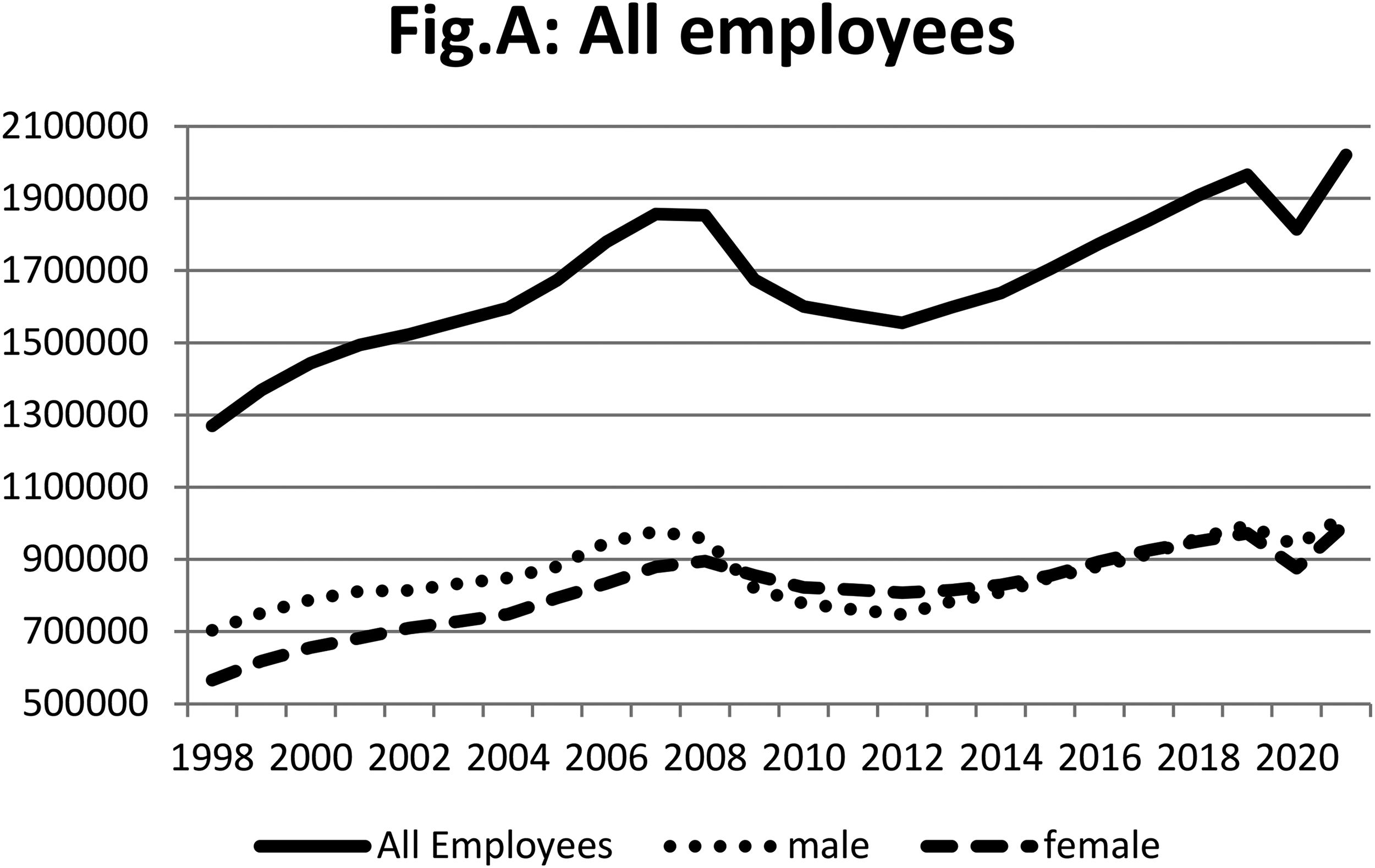
Overall numbers employed in Ireland 1998–2020.
Source: Labour force survey
False or bogus self-employment is a notable indicator of an increasingly precarious employment context. Yet the proportion of self-employed typically associated with precarious work and the gig economy in the labour force has essentially remained static between 1998 and 2021. As Figure B indicates the expansion is almost entirely in the number of employees. This suggests little or negligible false classification of employees as self-employed. An exception was the construction sector where it appears enforced bogus self-employment increased significantly after the economic crisis of 2008 as employers sought to curtail and reduce the number of employees in a recessionary climate (Wickham and Bobek, 2016). However, employment in construction rebounded strongly after 2015 with significant labour shortages currently a feature of the sector. Investments in upskilling in the sector since the financial crisis have been considerable shifting the educational composition of the sector from 28% with third-level qualifications in 2007 to 47 percent in 2017 and reducing by half the proportion with only primary education (Conefrey and McIndoe-Calder, 2018).
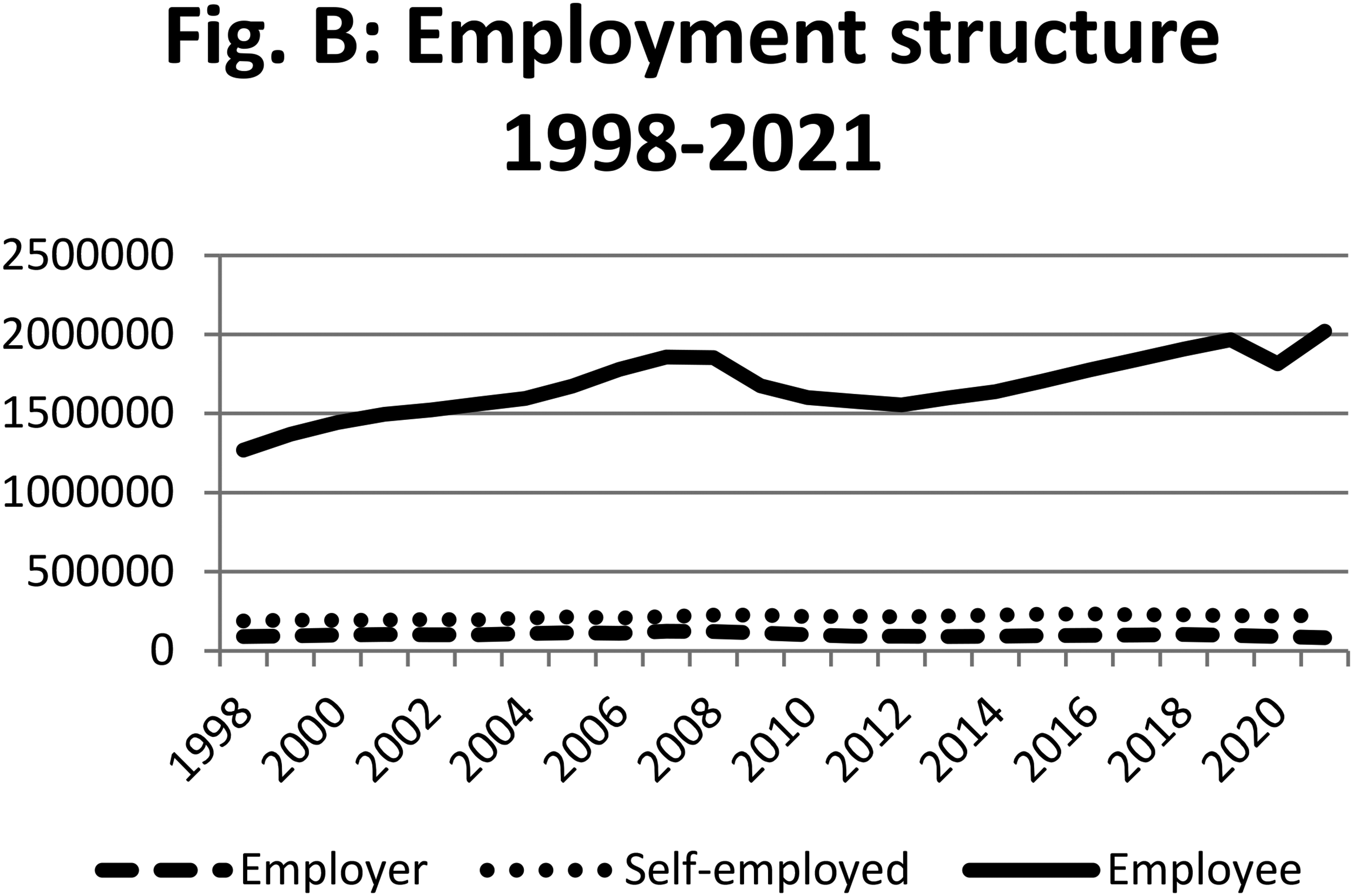
Employment Structure 1998–2021.
Indeed, increased levels of educational attainment are a feature more broadly in the Irish labour market. In the period between 1998 and 2021, the educational level of the workforce has shifted significantly with those with tertiary education increasing from about 12% in 1998 to just 50% in 2021 while those with only a lower level decreased from over 70% to less than 20%.
The increase in educational levels was accompanied by a shift in occupational levels. Higher level occupations (managerial, professional and associate professional) increased from 27% in 2007 to over 40% of all occupations in 2021 and lower level occupations declined from 44% to 35% in the same period (Figure D). Murphy and Oesch (2018) argue that the overarching shift in the employment structure has been towards job upgrading in Ireland during the 2000s.
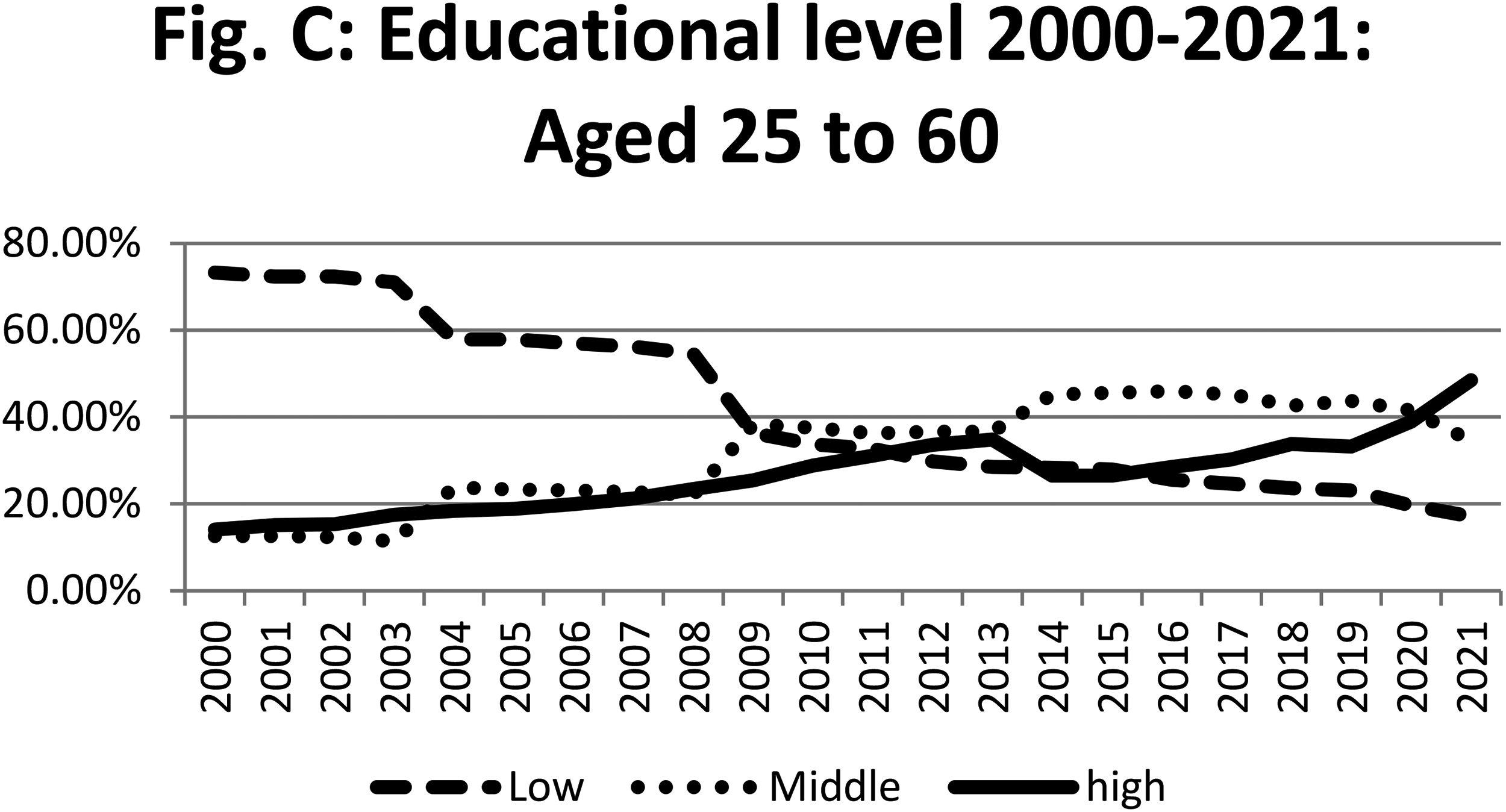
Educational Attainment Levels 2000–2021.
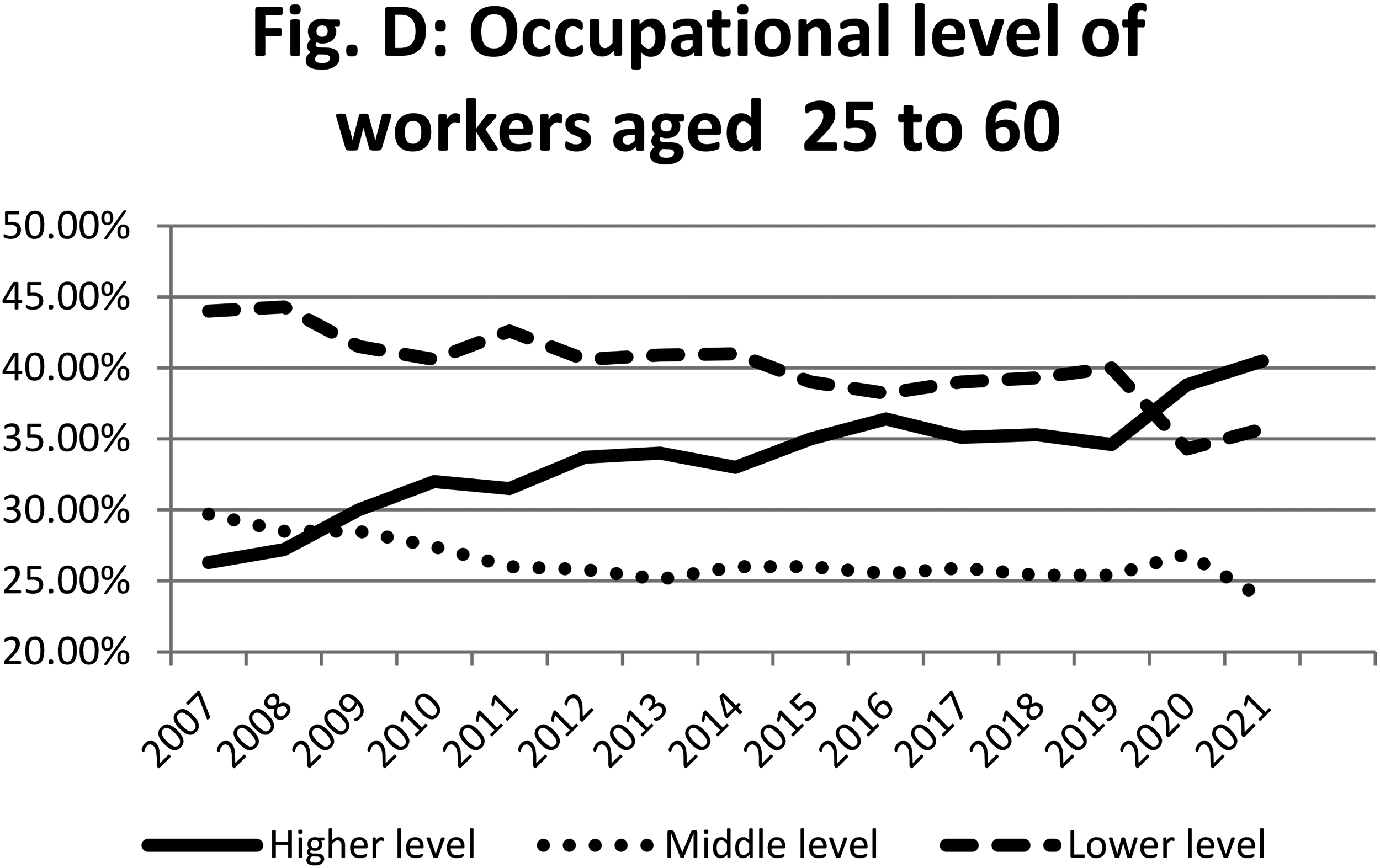
Occupational Levels.
Lastly, there is scant evidence of any attack on wages or working hours. As Figure E indicates real hourly earnings have consistently risen (top 4 graph lines) from 2000 to 2020 for both men and women aside from a dip as a result of the financial crisis. Moreover, the number of hours worked has declined particularly after 2000 (lower two graph lines).
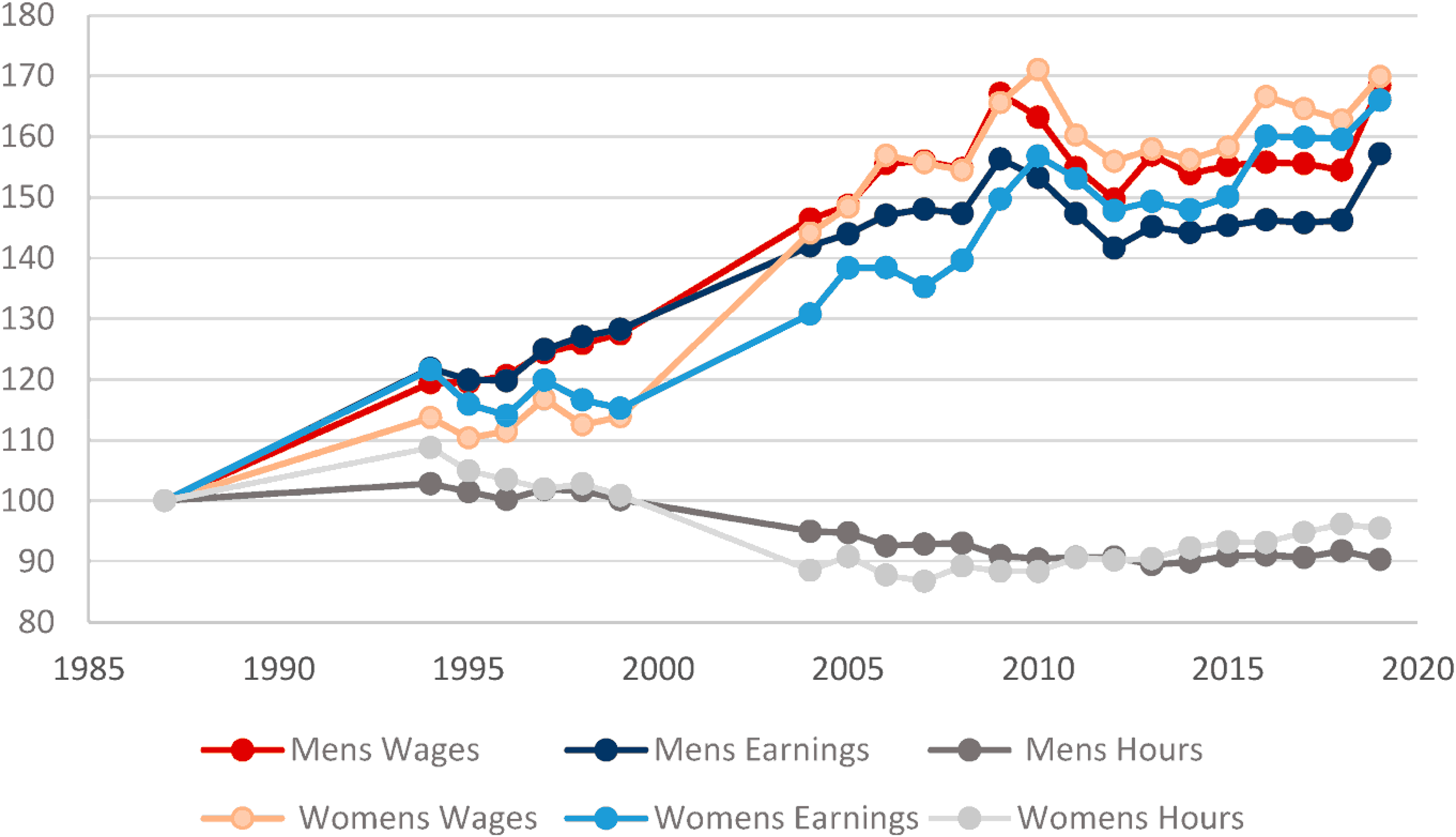
Real hourly wages, hours of work and real earnings of men and women.
In addition, between 1998 and 2021 at least 30 employment Acts have been enacted or augmented in areas like unfair dismissal, protection of employees on full and part-time contracts, redundancy, minimum wages, agency workers, sick leave, parental leave, working hours and legislation to limit the use of casual zero-hours type work (see Table 1). Taken together, these trends do not appear to support a new era of neoliberal reforms and employment flexibility.
Fundamental change in the employment relationship?
St-Denis (2023) argues that a failure to identify the increase in job instability likely misses a ‘fundamental shift in the nature of employment relationships’. We suggest that there is no evidence of a fundamental shift in the employment relationship consistent with a neoliberal hegemony such as the removal of underperformers, working increased number of hours and wage stagnation. Indeed, the expanding labour market has appeared to offer greater opportunities for job mobility and consequently a higher employee churn rate in the private sector. Employee churn is defined as the percentage of employees leaving an organisation over a specific period. While an employee's exit can be voluntary or involuntary it is likely that in a buoyant and enlarging labour market, there is a high likelihood that the majority of exits are in the main voluntary. As Figure F shows the churn rate for the private sector (top graph line) decreased significantly after the financial crash and increased after 2011.
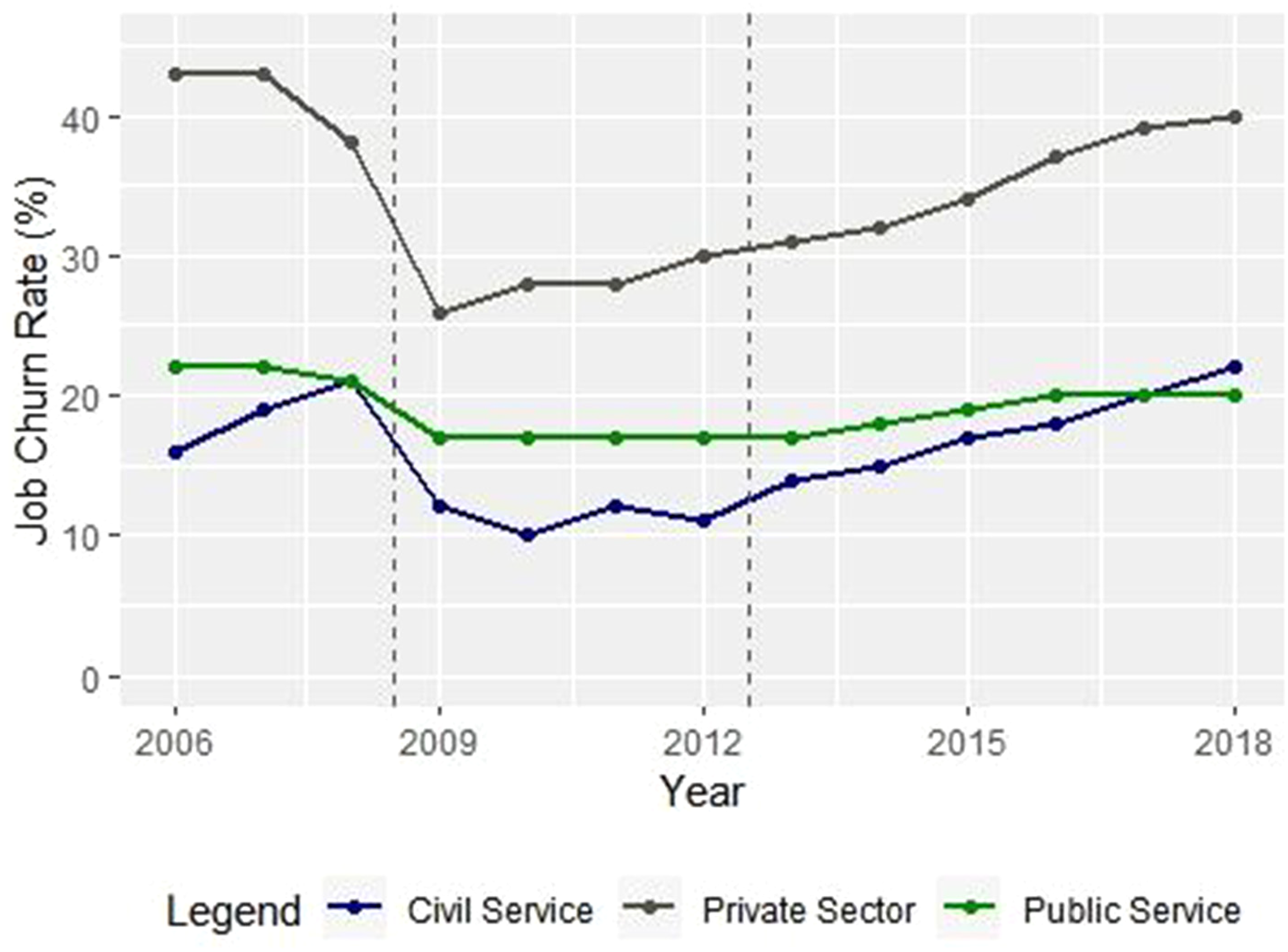
Job churn rates for the Public Service and Private Sector 2006–2018.
Overall the churn rate in 2006 reached the considerable rate of 45% declining after 2007 but steadily increased after 2009 back to 40% in 2020. Such a significant voluntary movement is likely to have dented average job tenure levels across all age cohorts and the data in St-Denis's paper should be interpreted in this context. Indeed in the four age cohorts, the average tenure declined from 2000 to about 2008 increased for a short time and then declined mirroring fairly closely the job churn rate in Figure F.
Conclusion
On the evidence provided here, it seems fanciful to accept the argument that the Irish labour market at large reflects the influence of neoliberalism and flexible employment practices. Undoubtedly, Ireland has been influenced by elements of the neoliberal agenda – not least the privatisation of state companies in the communications and electrical generation sectors and increased acceptance of new public sector management principles in both health and education (Murphy and O’ Brennan, 2019). However, those sectors are not within the remit of this paper, for reasons outlined earlier regarding the data. In the Irish labour market, trade union density has declined precipitously as unions face stiff opposition from employers, particularly in the multinational sector (Gunnigle et al., 2009). Despite this unions have remained a vital force in the labour market, particularly in the role they played during the austerity period (Geary, 2016). In any case aside from the financial crisis era, the expansion of the labour market and the resultant opportunities for job mobility with the increase in higher level occupations have acted to weaken the extent of neoliberal influence. Increases in real wages coupled with a decrease in hours worked run counter to the neoliberal agenda. Of course, this is contingent perhaps on continued economic growth and the avoidance of a prolonged recession. To accept St-Denis's contention that the influence of neoliberalism on job stability has been lying in plain sight is to reject all the empirical evidence provided here. It may be the case that such trends run counter to the putative general current of neoliberal market hegemony prevalent across Western and European labour markets. This issue requires further nuanced comparative research as labour markets are complex social institutions and require a multi-causal, holistic narrative, where in particular social agency, corporate interests, worker organisations and political policies feature prominently (Murphy and Oesch, 2018; Nolan and Slater, 2010). Finally, we acknowledge St-Denis's insightful and stimulating contribution to this debate.
Footnotes
Declaration of conflicting interests
The author(s) declared no potential conflicts of interest with respect to the research, authorship, and/or publication of this article.
Funding
The author(s) received no financial support for the research, authorship, and/or publication of this article.
