



Abstract
This paper uses micro-data from the Household, Income and Labour Dynamics in Australia (HILDA) Survey to examine the relationship between gender role attitudes and the labour supply of men and women. Using the Wellington decomposition technique, the paper also considers how much of the change in the gender gap in labour force participation (LFP) between 2001/5 and 2015/19 may be explained by changes in the gender role attitudes of adult women and men. The results show a 6.5 percentage point convergence in the gender gap in LFP between the two periods. Nearly half the convergence arises from a change in the schooling attainment of men and women. Just over one-third is due to changes in gender role attitudes (faster adoption of egalitarian gender role attitudes by women).
Keywords
Introduction
Over recent decades, one of the most significant labour market developments in high income countries has been the marked increase in female labour force participation (LFP) and, with it, a convergence in the gender gap in LFP. In Spain, for example, the female to male LFP ratio increased from 60.5% in 2001 to 84.4% in 2021 (a 23.8 percentage point improvement). In Ireland, the corresponding change was from 67.0% to 82.4% between 2001 and 2021 and in Australia the ratio increased from 76.6% to 86.5% over the same period. In North America the change was less dramatic, in part because of the relatively high female to male LFP ratio to begin with. In Canada, for example, the ratio changed by 4.5 percentage points to 87.2% between 2001 and 2021. In the USA, the corresponding change was by 2.7 percentage points to 83.1% in 2021 (see Figure 1).
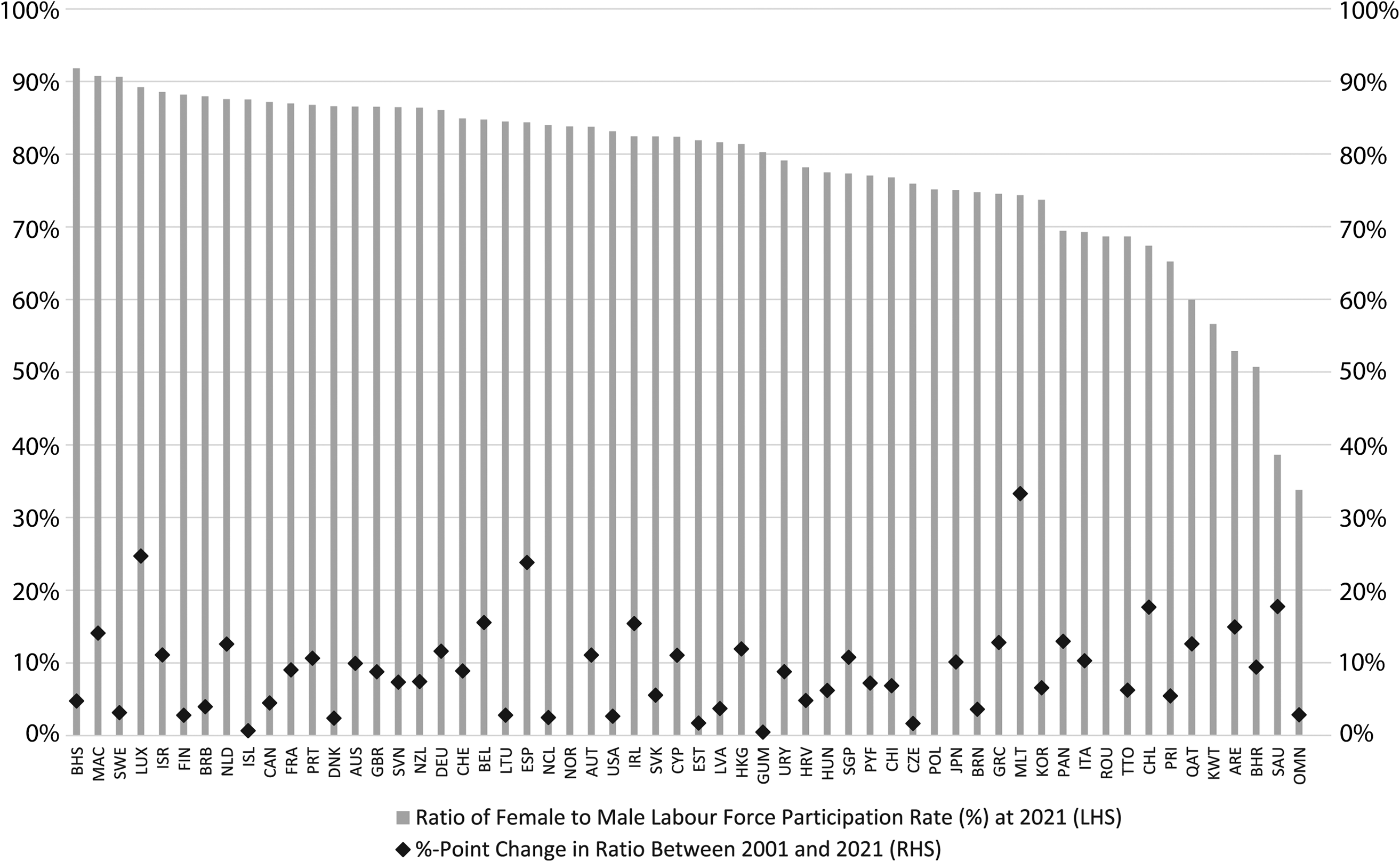
Ratio of female to male labour force participation rate (%) and change in the ratio between 2001 and 2021, high income countries.
Closing the gender gap in LFP is a priority goal in many countries. Indeed it is a specific goal in the G20 economies following the 2014 pledge to reduce the gender gap in LFP by 25% by 2025 (OECD-ILO, 2021) and a specific goal in European Union (EU) (European Commission, 2023). Within many countries, convergence in the gap has primarily been driven by increased participation amongst women rather than declines amongst men. It reflects numerous developments including (and not limited to): Age Pension reforms and increases in the eligibility age – particularly for women 1 ; increased schooling investments by women and the pursuit of professional careers; reduced fertility rates; a growth in the demand for female labour in areas such as health; and policies to maintain women's attachment to the labour market such as the strengthening of care leave provisions and childcare subsidies (Pfau-Effinger 2023; OECD, 2019).
One area where there is growing interest concerns the influence of culture or social norms on female labour supply (be it LFP or hours worked). This stems from a growing literature concerned with the association between gender role attitudes and the labour supply of women (Fortin 2015, 2005; Johnston et al., 2014; Lietzmann and Frodermann, 2021; Pfau-Effinger 2023; Uunk and Lersch, 2019). It also stems from a literature examining the drivers of gender role attitudes and the importance of socialisation effects. Olivetti et al. (2020), for example, show that where an adolescent female is exposed to a woman in paid employment (e.g. the mother of high school peers), she has a higher likelihood of being in paid employment in adulthood. Relatedly, Cavapozzi et al. (2021) find that mothers with peers with gender-egalitarian norms are more likely to be in paid employment. Fernández et al. (2004) show that men with a mother who worked for pay are more likely to have wives who also work for pay.
In this paper, micro-data from the Household, Income and Labour Dynamics in Australia (HILDA) Survey (2001, 2005, 2008, 2011, 2015 and 2019) for a sample of adults (aged 25–65) are used to contribute to this growing literature on the association between gender role attitudes and labour supply. A particular goal of the paper is to understand how much of the convergence in the gender gap in LFP during the 2000s is associated with a change in the gender role attitudes of women and men.
The paper makes several contributions to the extant literature on gender role attitudes and labour supply. The first contribution is via the use of a nationally representative sample of adults and an analysis that includes males and females. Several existing studies focus on specific groups such as partnered couples or mothers (Cavapozzi et al., 2021; Fernández et al., 2004; Khoudja and Fleischmann, 2018), daughters and sons (exploring intergenerational effects) (Johnston et al., 2014) or second generation women (Blau et al., 2013). Relatively few studies concerned with gender role attitudes investigate labour supply outcomes with an analysis that includes men (exceptions are Fortin (2005) and Lietzmann and Frodermann (2021)).
The second contribution is through an analysis that employs Australian data. Many existing studies in this area draw on data from the US (Blau et al., 2013; Cunningham et al., 2005; Fernández et al., 2004; Fortin, 2015) or the UK (Cavapozzi et al., 2021; Johnston et al., 2014; Uunk and Lersch, 2019). Australia, however, also makes for an interesting case study. Within the set of high income countries, it has an above average female to male LFP ratio and an above average convergence in this ratio between 2001 and 2021 (Figure 1). Australia also has a strong male breadwinner institutional framework, that is, it operates within a male breadwinner/female part-time carer cultural model and, in this respect, differs from countries such as the US (Baxter and Hewitt, 2013).
The third contribution is through an empirical approach that controls for selection effects when considering the effects of gender role attitudes on full-time and part-time employment participation. Finally, a fourth, and novel contribution, is the use of the Wellington (1993) dynamic decomposition technique. This technique allows one to examine how much of the change in the gender gap in LFP may be explained by a change in the gender role attitudes (the faster adoption of more egalitarian attitudes) of women vis-à-vis men.
Literature
Gender is a social construct that relates to how individuals behave, that is, how they ‘do gender’ (Risman, 2004). In conceptualising gender as a social structure, emphasis is placed on environmental and institutional factors (social processes, social organisations, social life) as opposed to biology or individual learning as factors shaping the behaviours and decisions of individuals. Risman argues that ‘As long as women and men see themselves as different kinds of people, then women will be unlikely to compare their life options to those of men. Therein lies the power of gender …The social structure is not experienced as oppressive if men and women do not see themselves as similarly situated’. (Risman, 2004: 432). Conceptualised in this way, environmental characteristics such as explicit and implicit attitudes to gender roles (identity norms) shape the decision of men and women and perpetuate the gender order (gender arrangements) and gender inequality (Aarntzen et al., 2023; Aboim, 2010; Pfau-Effinger, 2004; Pfau-Effinger, 2023).
Gender identity norms have a long historical origin (Alesina et al., 2013). They are not fixed – although are thought to be slow to change (Bertrand et al., 2015). Gender identity norms are influenced by macro/state factors such as welfare policies, wage setting institutions and family policy (Endendijk et al., 2018; Pfau-Effinger, 2023). A change in societal attitudes towards gender roles may occur when younger generations replace older generations (Baxter et al., 2015). Gender role attitudes are also shaped by life-course events such as participating in education, entering employment and becoming a parent (Baxter et al., 2015; Endendijk et al. 2018). Shocks such as the HIV/AIDs scare (Fortin, 2015) may also bring sudden shifts in gender identity norms, as might COVID-19 (EU, 2023; OECD-ILO, 2021). There is also an intergenerational dimension to gender identity norms. This is evident from studies showing a correlation between the labour supply decisions of second generation women and the characteristics of their parents, including source country characteristics (Blau et al., 2013; Fernandez and Fogli, 2009). The intergenerational nature of gender identity norms (captured via gender role attitudes) is also documented in Perales et al. (2021), Bredtmann et al., (2020) and Johnston et al. (2014).
Gender identity norms help explain why labour markets are segregated, why occupational segregation differs across countries and why segregation is slow to change (Aarntzen et al., 2023; Akerlof and Kranton, 2000; Arestis et al., 2014; Bertrand, 2011; Pfau-Effinger, 2023). Identity norms affect how individuals ‘do gender’ and are considered fundamental to the utility (payoffs) that individuals derive from their decisions or choices (Akerlof and Kranton, 2000). Guilt, for example, can be expected to reduce the utility derived from paid work. Guilt, in turn, is a function of own and society gender role attitudes. Recent experimental research by Aarntzen et al. (2023), for example, shows that where the implicit gender stereotypes of parents was more egalitarian they did not differ in their work–family guilt. Where the implicit gender stereotypes of parents were more traditional, mothers experienced stronger work–family guilt than fathers. 2
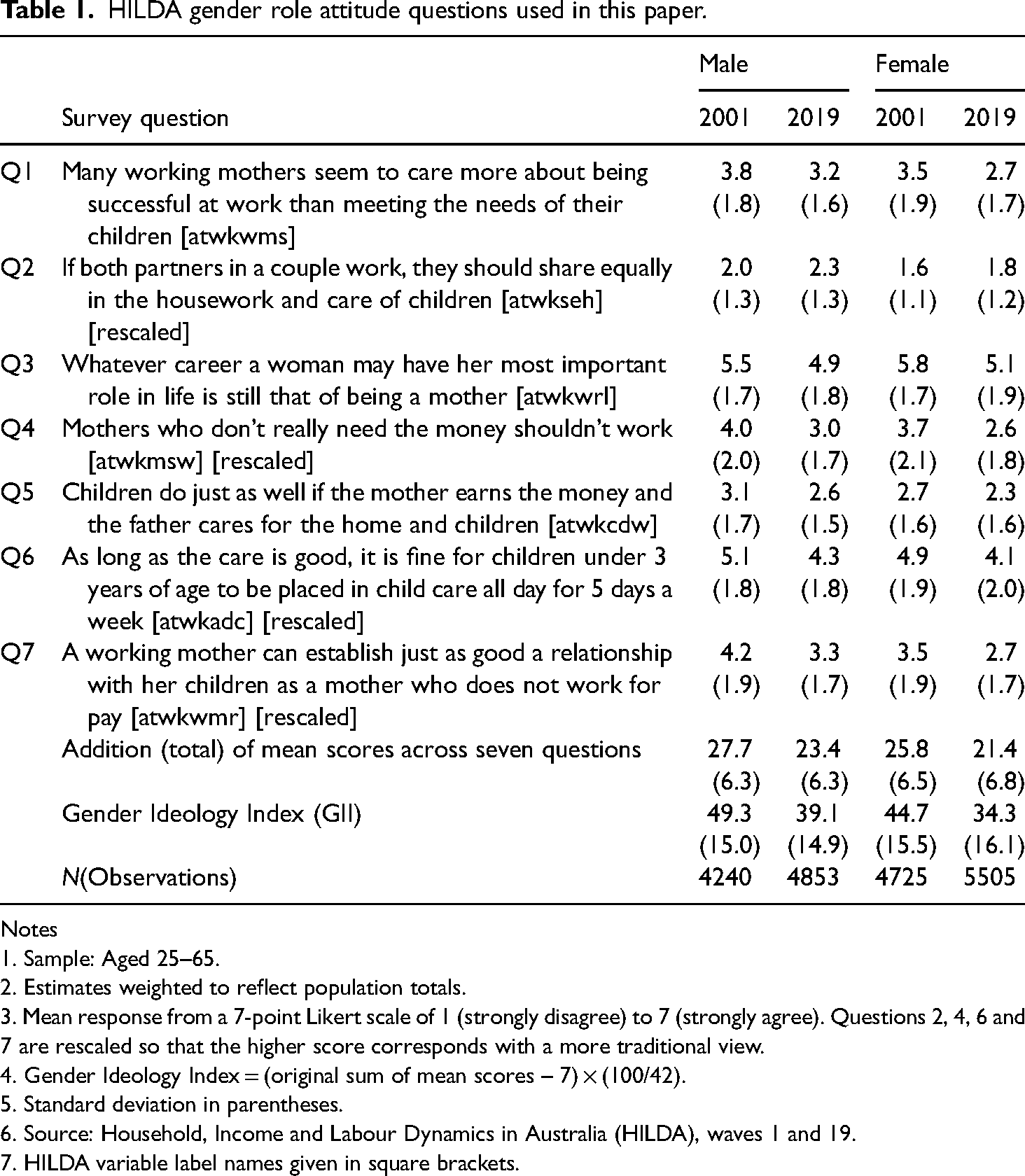
HILDA gender role attitude questions used in this paper.
Notes
1. Sample: Aged 25–65.
2. Estimates weighted to reflect population totals.
3. Mean response from a 7-point Likert scale of 1 (strongly disagree) to 7 (strongly agree). Questions 2, 4, 6 and 7 are rescaled so that the higher score corresponds with a more traditional view.
4. Gender Ideology Index = (original sum of mean scores – 7) × (100/42).
5. Standard deviation in parentheses.
6. Source: Household, Income and Labour Dynamics in Australia (HILDA), waves 1 and 19.
7. HILDA variable label names given in square brackets.
Gender identity norms influence the labour supply decisions of women (Pfau-Effinger, 2023). Fortin (2005), for example, using data from World Values Survey (1990, 1995, 1999) for adults (males and females) aged 18–64 for 25 Organisation for Economic Cooperation and Development countries shows that there is an inverse relationship between holding traditional gender role attitudes and the probability of being employed if female. She observed no such relationship amongst men. Lietzmann and Frodermann's (2021) analysis of German panel data shows that male gender role attitudes have no effect on their likelihood of being employed full-time but do correlate with their likelihood of working part-time (males with more egalitarian norms have a higher likelihood of working part-time). Gender role attitudes of women in Germany also influence their full-time and part-time employment probabilities (Lietzmann and Frodermann, 2021). Similar findings are observed in the UK (Uunk and Lersch, 2019) and the Netherlands (Khoudja and Fleischmann, 2018) (i.e. more egalitarian attitudes are positively associated with the likelihood of being in the labour market).
Few studies have examined how gender role attitudes relate to changes in LFP. Fortin (2015) is one exception. In her paper, she shows that the levelling off in the female LFP rate in the US in the 1990s (notwithstanding increased educational attainment amongst women) could be explained, in part, by a stalled progression (towards egalitarian values) in the gender role attitudes of US women (which she links to the AIDs scare).
The studies discussed thus far are predominantly aimed at understanding the effect of a woman's gender role attitudes on her labour supply decisions without disaggregating by characteristics such as household type. There is, however, a body of research directed at understanding the effect of gender identity norms on the labour supply of wives/partners in couple relationships. Bertrand et al. (2015), for example, show that in couples where the wife's potential earnings exceed that of her partner, she is less likely to be in the labour force, and if she does work, she earns less than her potential. They attribute this to gender identity norms. Khoudja and Fleischmann's (2018) study of couples in a long-term relationship in the Netherlands (based on longitudinal data from 2002, 2004, 2006) shows that a woman's labour market exits and entries were correlated with her having more traditional gender role attitudes, but not related to changes in her number of hours worked per week. Her partners’ gender role attitudes also had a marginal effect on her labour supply, affecting her labour market exits but not her entries or changes in her number of hours worked. Endendijk et al.'s (2018) study shows that egalitarian fathers had partners with higher working hours than other fathers. They also show that fathers with more egalitarian gender role attitudes were more likely to be older and partnered with women who were also non-traditional (older age when becoming a mother and career focused).
Data
The data used in this paper are drawn from the HILDA survey (2001, 2005, 2008, 2011, 2015 and 2019). HILDA is a nationally representative longitudinal household survey which, at the time of writing, spans 21 years (2001 to 2021). A somewhat unique feature of HILDA is that it surveys all members of households in scope who are aged 15 years and over. Aside from containing information on the qualifications and labour market characteristics of respondents, it also has records on parental characteristics, socio-characteristics and in waves 1, 5, 8, 11, 15 and 19 (corresponding to the years listed above) information on attitudes to gender roles. HILDA is a rich and, as yet, underutilised database with which to empirically explore the relationship between gender role attitudes and the labour supply decisions of women and men.
Sample
The sample for analysis is restricted to those aged 25–65. The lower bound has been selected to reduce the likelihood of sampling those who may still be completing post-school qualifications. Over the six waves of HILDA data considered here, there are 61,446 men and women in this age range.
Data in the HILDA survey is largely collected via face-to-face interviews. The attitudinal data on gender roles are, however, collected via a separate self-completion questionnaire (SCQ). A total of 6080 or 9.9% of the 61,446 observations in scope did not return the SCQ, reducing the sample to 55,366. A further 1256 (2%) of respondents are lost on account of missing information on the key variable of interest (attitudes to gender roles (discussed below)). This brings the sample for analysis purposes to 54,110 observations. SCQ population weights are used in the descriptive analysis and regression analysis as appropriate.
Descriptive analysis shows that there are 19,508 unique individuals in the sample. Only 5% of these individuals are observed in all six waves (spanning 2001 to 2019) and 25% appear in four waves. Half (50%) of the individuals are observed in two waves or less. This matters for the empirical strategy adopted (discussed further below).
Attitudes to gender roles
At wave 19 (2019), there were 17 gender role attitudinal variables with information for 12 variables available over the six waves of data listed above. Respondents were presented with a series of statements in the SCQ (e.g. ‘It is not good for a relationship if the woman earns more than the man’) and asked to rate their agreement or disagreement on a 7-point Likert scale (with (1) being strongly disagree and (7) being strongly agree). Five of the attitude questions in 2019 were not asked in 2001 (this includes the relative earnings question just stated). 3 Several questions substitute father for mother (e.g. ‘A working father can establish just as good a relationship with his children as a father who does not work for pay’). In this paper, the question set employed focuses on the questions concerned with mothering and the gender divisions of labour. In this regard, the approach follows Baxter et al. (2015). The question set is also restricted to those questions that are available over all six waves of data. Seven questions are employed. The specific wording of each question is given in Table 1 along with the mean level of agreement in 2001 and 2019 disaggregated by sex. As Johnston et al. (2014: 637) note, ‘there exists no universal instrument to elicit gender role preferences’. Variations of the statements employed in this paper have been used in other papers (e.g. Aboim, 2010; Bertrand et al., 2021; Fortin, 2005; Johnston et al., 2014). One noteworthy advantage of the HILDA data over other surveys is that, aside from asking a comparatively large number of gender role attitude questions, the 7-point Likert scale allows for more heterogeneity in responses.
As with others before (e.g. Baxter et al. 2015; Johnston et al., 2014; Perales et al., 2021), a ‘Gender Ideology Index’ (GII) or summary measure of gender role attitudes is constructed by adding the average scores on each item. Questions 2, 4, 6 and 7 in Table 1 are rescaled so that the higher score corresponds with a more traditional view. The score is then transformed into a value of between 0 and 100 as follows: new score = (original score – 7) × (100/42) and labelled ‘GII’. Table 1 shows that gender role attitudes in Australia have become more egalitarian over the 2000s. The male GII declined by 10.2 points (10.2 percentage points) between 2001 and 2019 and the female GII by 10.4 points. In both cases, the change was highly statistically significant. Men, on average, exhibit more traditional gender role attitudes, as demonstrated by their higher GII score. The change over time has also occurred within birth cohorts (see Figure S2 in the Supplemental appendix). (For a study of changing attitudes towards fatherhood in Australia, see Churchill and Craig, 2022).
Figure 2 shows the mean GII score disaggregated by sex and select characteristics for each of the six waves. There is more diversity amongst women in their GII scores than there is amongst men. Of note is the more traditional views held by men and women born in a non-English speaking country. Also of interest is the comparatively faster adoption of more egalitarian gender role attitudes amongst non-degree qualified females vis-à-vis non-degree qualified males. Similarly, there has been a faster adoption of more egalitarian gender role attitudes amongst women with pre-school children than there has been amongst men with pre-school children.
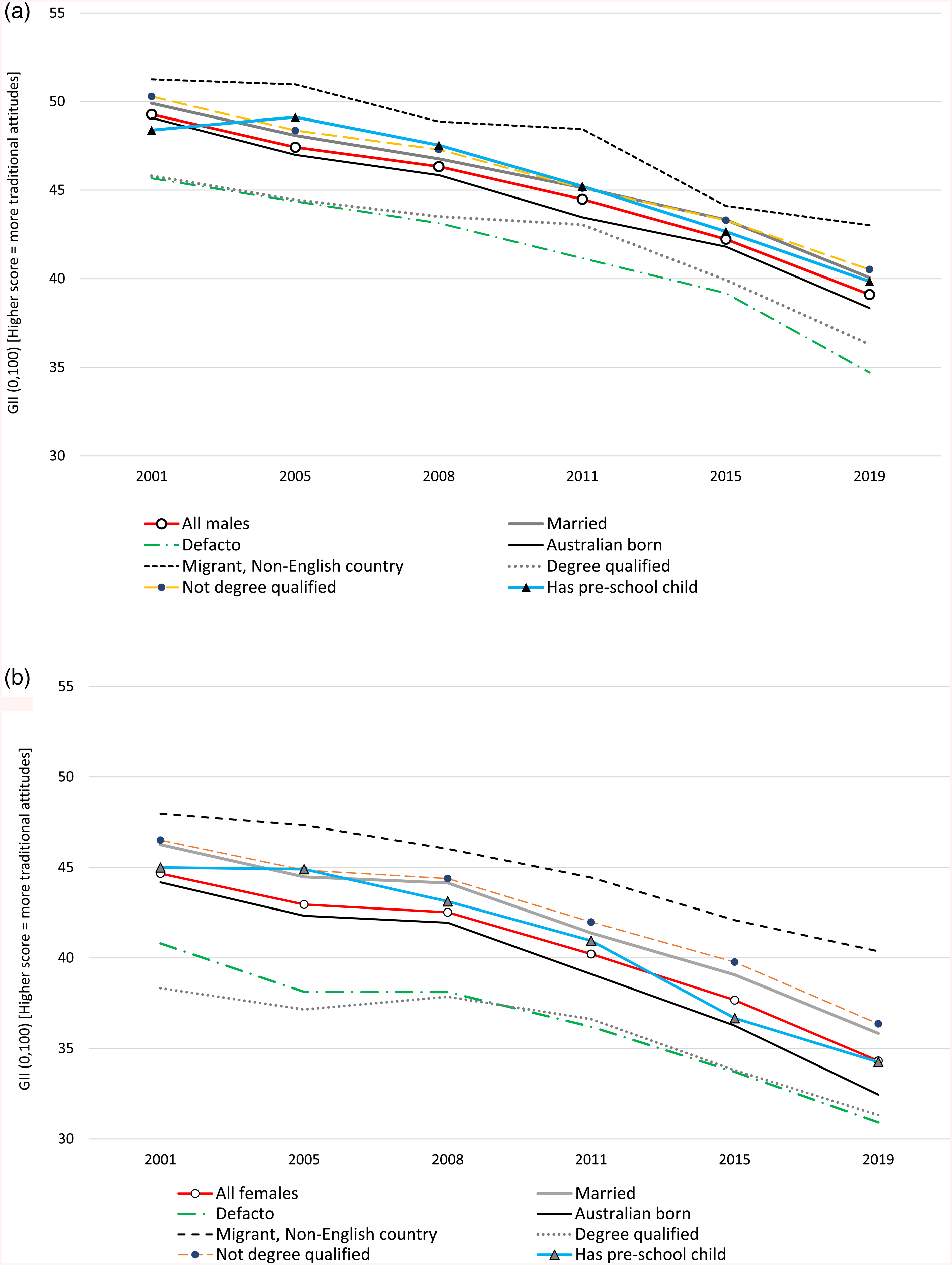
Gender role attitudes (Gender Ideology Index) by sex, Australia, 2001 to 2019. Panel A: Males. Panel B: Females.
Dependent variables
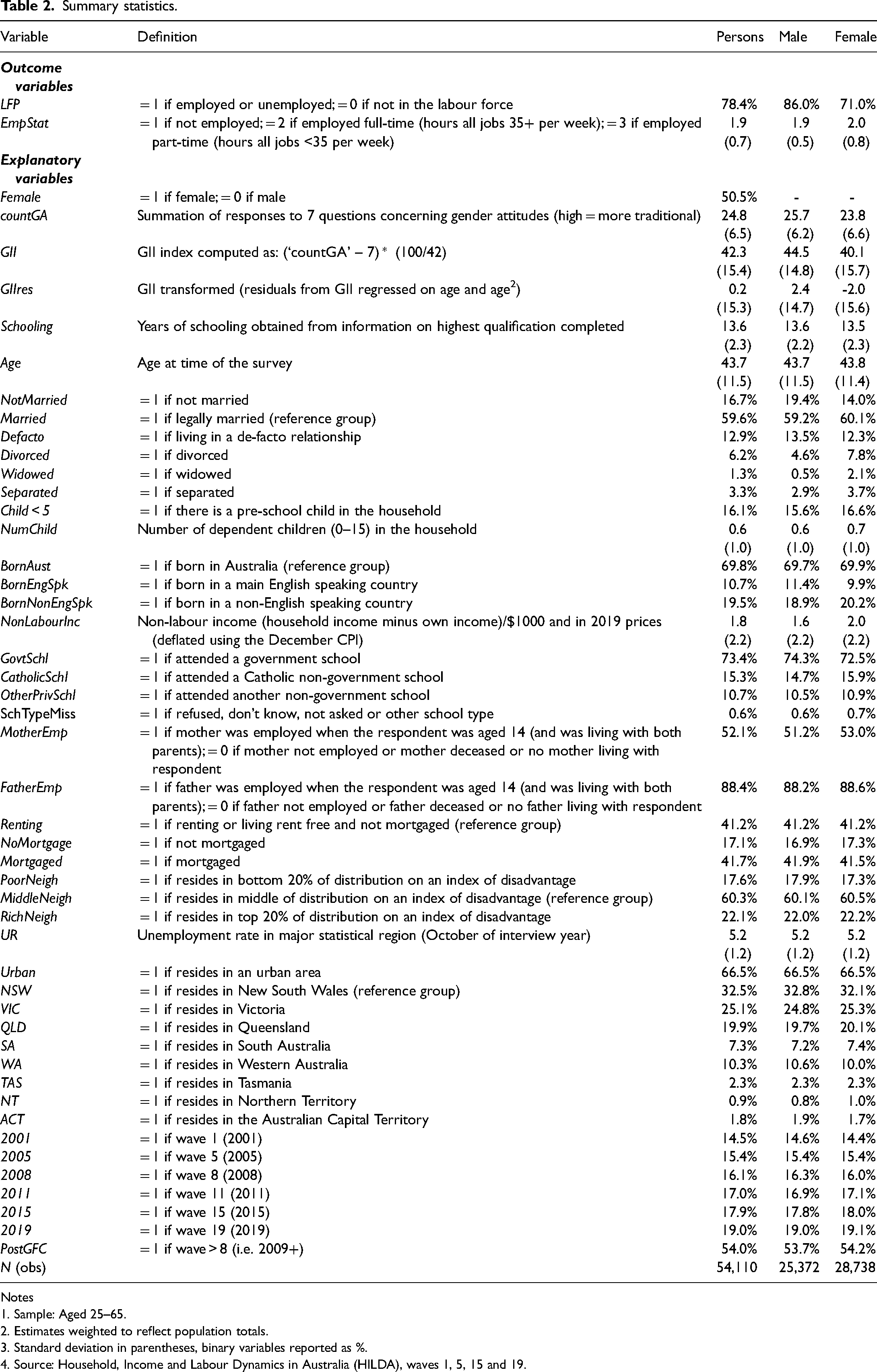
There are two outcome variables of interest. The first is a binary variable (‘LFP’) coded as 1 if the respondent is employed or unemployed (i.e. participating in the labour force) and 0 if not in the labour force. Summary statistics in Table 2 show that across all waves of data, 86.0% and 71.0% of men and women, respectively, were in the labour force. The second is a variable capturing employment status (‘EmpStat’), coded as 1 if not employed, 2 if employed full-time (35 or more hours per week in all jobs) and 3 if employed part-time (fewer than 35 h per week). Figure S3 in the Supplemental appendix shows that of men aged 25–65 and employed in 2015/19, 87.5% worked full-time and the balance (12.5%) worked part-time. Across the corresponding sample of employed women, 56.7% were employed full-time in 2015/19. In 2001/5, the corresponding full-time share was 54.9%. These shares are entirely consistent with a male breadwinner/female part-time carer gender order, as previously noted. The estimates also show that this employment arrangement is slow to change (see Pfau-Effinger (2023) for a discussion of women's employment behaviours).
Summary statistics.
Notes
1. Sample: Aged 25–65.
2. Estimates weighted to reflect population totals.
3. Standard deviation in parentheses, binary variables reported as %.
4. Source: Household, Income and Labour Dynamics in Australia (HILDA), waves 1, 5, 15 and 19.
Explanatory variables
There is a large literature concerned with understanding the determinants of labour supply. In the empirical analysis in this paper, the set of explanatory variables employed incorporates those common to labour supply studies (Killingsworth, 1983). The regressions control for age and its square, schooling (measured as a continuous variable based on highest qualification completed), marital status (five dummies), a dummy if there is a pre-school child in the household, number of children, migrant status (two dummies), non-labour income and other wealth indicators (whether mortgaged or not mortgaged with the reference group being renting or living rent free). The control set also includes two dummies capturing the socioeconomic characteristic of the area of residence, a regional unemployment rate and geographic and locational area of residence dummies (a dummy if resides in a metropolitan area and dummy variables capturing state or territory of residence).
In addition to these standard controls, variables controlling for parental (mother and father) employment status when the respondent was aged 14 and school type attended (government, non-government Catholic and other private school) are also included. Inclusion of these variables is designed to capture the effects of intergenerational gender norms and institutional influences on the labour supply decisions of respondents.
To control for time (wave) effects one binary variable is included (‘PostGFC’). This variable is set equal to 1 for the periods 2011, 2015 and 2019 and zero for the periods 2001, 2005 and 2008. The alternative would be to control for separate wave effects. The results are not sensitive to the single time dummy variable. The advantage of ‘PostGFC’ is that it accounts for changes in labour supply that may relate to changed preferences following the 2008 Global Financial Crisis (Jetter et al., 2020). It may also capture changed preferences following the enactment of the Paid Parental Leave Act 2010 in Australia (which came into effect in 2011) (Bass, 2020; Baird and Whitehouse, 2012). Variable definitions and descriptive statistics are given in Table 2.
Empirical strategy
Three empirical strategies are adopted. The first approach employs the dependent variable ‘LFP’ and a linear probability model (as opposed to a logit or a probit framework) to examine the relationship between gender role attitudes and LFP. Logit results are reported in a robustness check and are qualitatively similar (see Table S2 in the Supplemental appendix). Random-effect panel models are estimated across the pooled set of individuals with a ‘female*GII’ interaction to test for gender differences in the relationship between gender role attitudes and labour supply. Formally the following regression is estimated:
The second approach involves estimating a multinomial logit model using ‘EmpStat’ as the dependent variable. The advantage of this approach is that it permits an analysis of the effect of gender role attitudes on full-time and part-time employment while separately controlling for employment selection effects. A similar approach is adopted in Lietzmann and Frodermann (2021) where they shed light on the differential relationship between gender role attitudes and labour supply (full-time and part-time employment) of men and women. The equation to be estimated is as follows:
Endogeneity concerns
Ideally, the estimates in this paper identify a causal relationship between attitudes to gender roles and labour supply behaviour. Estimating a causal effect is, however, not without its challenges. Gender role attitudes, for example, have been shown to change over the life-course and, as a result, are strongly correlated with age. There is also the challenge of reverse causation – that is, does ‘GII’ explain ‘LFP’ or does ‘LFP’ explain ‘GII’? To isolate the causal effect various approaches have been used in the literature. These include the use of an instrumental variable (IV) strategy (Fortin, 2015) and, more commonly, the use of a lagged measure of attitudes to gender roles (Johnston et al., 2014; Khoudja and Fleischmann, 2018; Lietzmann and Frodermann, 2021).
Descriptive analysis of the sample data in this paper shows that the ‘GII’ measure and the age variables are highly correlated. The pairwise correlation coefficient of GII and age is equal to 0.108 and statistically significant (p < 0.001). Lagging the GII by one wave (with waves around three to four years apart) does not remove the correlation. The pairwise correlation coefficient of a lagged GII measure and age is 0.086 (p < 0.001). Additionally, the use of a lagged measure is also problematic as 25% of the sample are only observed in one wave of data, thus rendering the sample likely non-representative.
One way forward is to remove the effect of age on the GII measure. This may be achieved by regressing GII on age and age2 and using a predicted measure of GII based on the residuals (‘GIIres’). The coefficient from a pairwise correlation of ‘GIIres’ and age is equal to −0.0037 and, importantly, is not statistically significant (Figure S1 presents a density plot of ‘GII’ and ‘GIIres’).
Results
Labour force participation
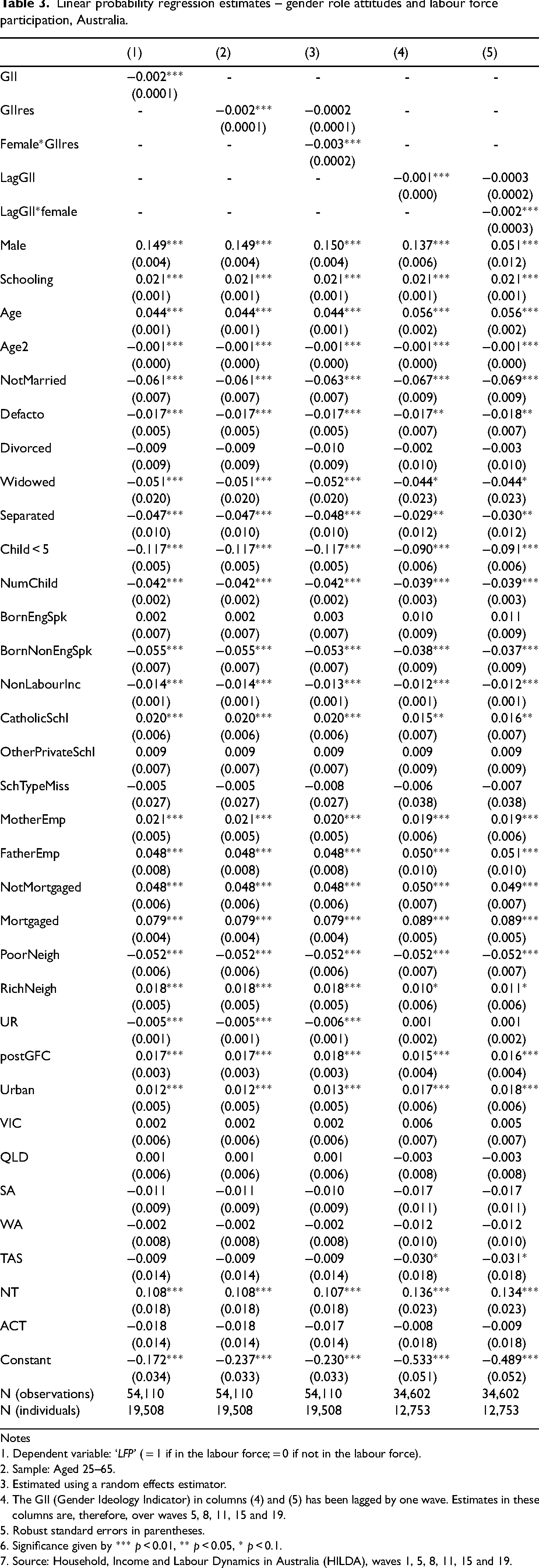
Table 3 displays the regression results associated with the estimation of equation (1). In column (1), the non-transformed measure of GII is employed for comparative purposes. Column (2) shows the results using the transformed measure (‘GIIres’). Column (3) includes a female interaction (female*GIIres). Column (4) uses a lagged measure of GII (‘LagGII’) and column (5) includes a female interaction in this lagged measure (female*LagGII). All measures in columns (1), (2) and (4) show an inverse relationship between the GII and the likelihood of participating in the labour force. Those with more traditional gender role attitudes are less likely to participate in the labour force. Columns (3) and (5) show that this relationship is driven by females. It suggests that female LFP is significantly associated with their gender role attitudes. Male LFP (on the extensive margin (i.e. in the labour force or not)) is not influenced by their gender role attitudes. It is a result consistent with Fortin (2005). The estimates from a Logit random effects regression are similar (see Table S2 in the Supplemental appendix).
Linear probability regression estimates – gender role attitudes and labour force participation, Australia.
Notes
1. Dependent variable: ‘LFP’ ( = 1 if in the labour force; = 0 if not in the labour force).
2. Sample: Aged 25–65.
3. Estimated using a random effects estimator.
4. The GII (Gender Ideology Indicator) in columns (4) and (5) has been lagged by one wave. Estimates in these columns are, therefore, over waves 5, 8, 11, 15 and 19.
5. Robust standard errors in parentheses.
6. Significance given by *** p < 0.01, ** p < 0.05, * p < 0.1.
7. Source: Household, Income and Labour Dynamics in Australia (HILDA), waves 1, 5, 8, 11, 15 and 19.
The coefficient estimates are marginal effects and show the change (probability of being in the labour force) associated with a one unit increase in the independent variable holding all else constant. In the case of GII (column (1) of Table 3), this shows that a one unit increase in the GII will reduce the probability of participating in the labour market by 0.2 percentage points (holding all else equal and assuming GII to be exogenous). The summary nature of the index evidently obscures an understanding of how responses to each of the individual questions correlate with the dependent variable. To shed light on the latter the model at Table 3 was re-estimated and standardised measures of each of the seven individual questions (z-scores) were used in the regression instead of the summary GII measure. The results are reported in Table S6 of the Supplemental appendix. The estimates show that Q1, Q2, Q4 and Q7 (see Table 1 for definitions) have the strongest relationship with the probability of being in the LFP, with the prediction strongest for Q4 responses (‘Mothers who don’t really need the money shouldn’t work’). For women, an additional one-point level of agreement (on the 7-point Likert scale) with this statement is associated with a 2.9% lower likelihood of being in the labour force. For men, the corresponding association is a 0.6% lower likelihood of being in the labour force. It is important to note that the individual attitudinal variables used in the regression in Table S6 have not been transformed (i.e. there are no lag measures or no residual measures). The ‘effects’ (association) described for Q4 should, therefore, be interpreted as correlation effects rather than causal effects. The results are, nevertheless, of interest.
Employment status
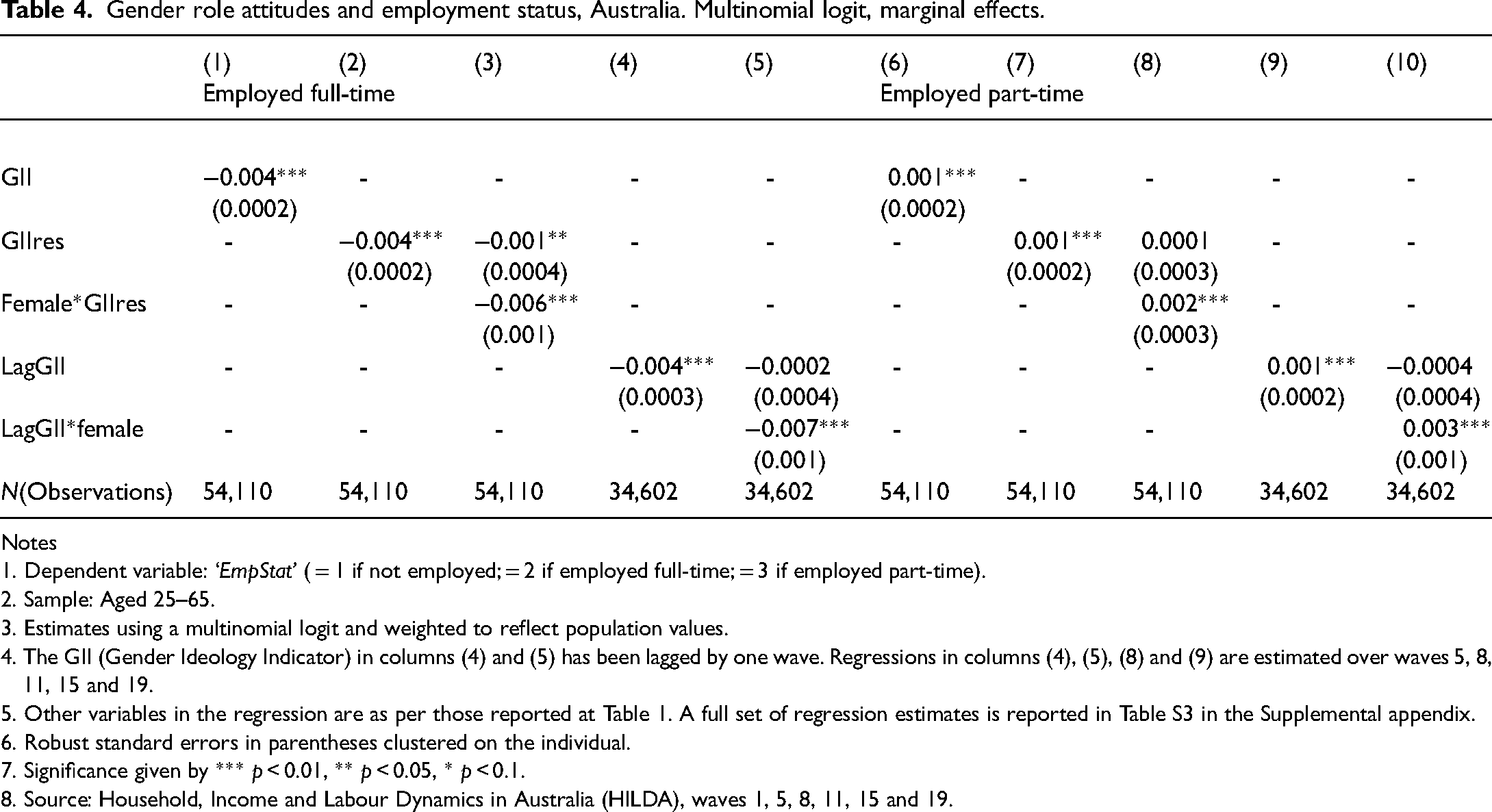
Table 4 reports the marginal effects from multinomial logit regressions for the key explanatory variable of interest (full results are reported in Table S3 in the Supplemental appendix). The focus is on the relationship between gender role attitudes and labour supply on the intensive margin (i.e. the probability of being employed full-time (columns (1) to (5)) and the probability of being employed part-time (columns (6) to (10))). The results show that gender role attitudes are associated with the number of hours supplied. Focusing on columns (3) and (8) of Table 4, the estimates show that women with more traditional attitudes are less likely to work full-time and more likely to work part-time (as given by the ‘female*GIIres’ interaction term). In the case of men, a significant association between their gender role attitudes and their employment status emerged for full-time employment but not part-time employment. Men holding more traditional gender role attitudes appear to have a lower likelihood of being employed full-time. These estimates may be compared to the multinomial logit estimates in Lietzmann and Frodermann (2021) using German data (covering 2008 to 2014 (waves 2 to 8)). In their study, women with more egalitarian attitudes were significantly more likely to be employed in both forms of employment (full-time and part-time). In the case of men, their gender role attitudes had no influence on their full-time employment probability and a marginal (p < 0.1) positive association with their part-time employment probability.
Gender role attitudes and employment status, Australia. Multinomial logit, marginal effects.
Notes
1. Dependent variable: ‘EmpStat’ ( = 1 if not employed; = 2 if employed full-time; = 3 if employed part-time).
2. Sample: Aged 25–65.
3. Estimates using a multinomial logit and weighted to reflect population values.
4. The GII (Gender Ideology Indicator) in columns (4) and (5) has been lagged by one wave. Regressions in columns (4), (5), (8) and (9) are estimated over waves 5, 8, 11, 15 and 19.
5. Other variables in the regression are as per those reported at Table 1. A full set of regression estimates is reported in Table S3 in the Supplemental appendix.
6. Robust standard errors in parentheses clustered on the individual.
7. Significance given by *** p < 0.01, ** p < 0.05, * p < 0.1.
8. Source: Household, Income and Labour Dynamics in Australia (HILDA), waves 1, 5, 8, 11, 15 and 19.
An analysis using each of the individual questions disaggregated by sex is presented in Table S7 in the Supplemental appendix. As before, the coefficients on the individual measures should be interpreted as correlation rather than causal effects. The variable Q6 (‘As long as the care is good, it is fine for children under 3 years of age to be placed in childcare all day for 5 days a week’ (reverse coded so that 7 is a more traditional response) has the strongest association with the employment form (full-time or part-time employment). For females, a one unit increase along the reverse-coded 7-point Likert scale sees a 5.1% reduction in the likelihood of being employed full-time and a 4.4% increase in the likelihood of being employed part-time. This is consistent with the ‘mother's guilt’ effect observed in Aarntzen et al. (2023). As with Aarntzen et al., the effect is stronger for women than men. A one unit increase on this 7-point Likert scale (corresponding with a more traditional response) is associated with a 0.8% reduction in the likelihood that a male is employed full-time and a 1.4% increase in the likelihood of a male being employed part-time.
Wellington decomposition
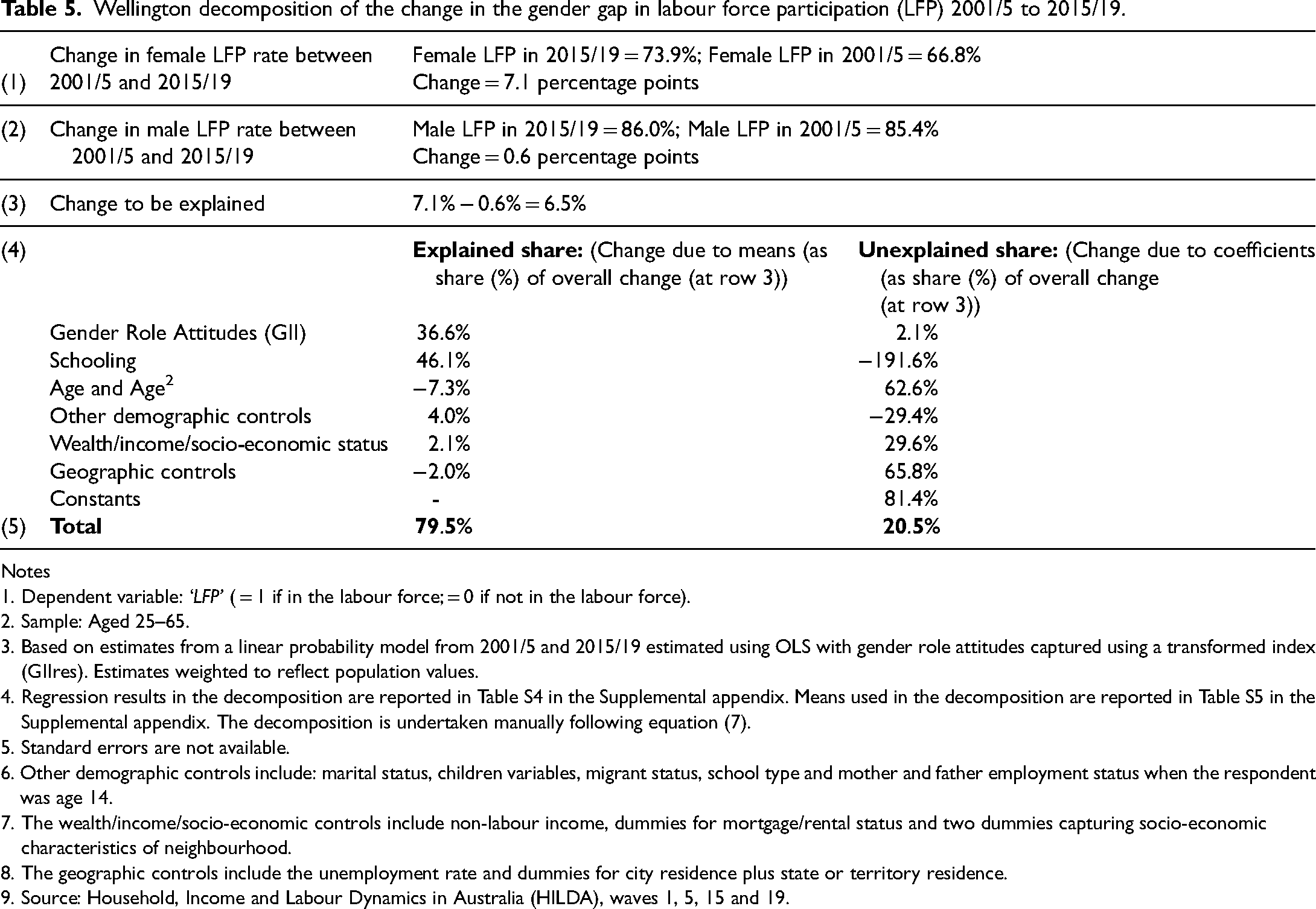
Table 5 reports the estimates associated with the decomposition of the changing gender gap in LFP. As shown, between 2001/5 and 2015/19 the female LFP rate increased from 66.8% to 73.9%, an improvement of 7.1 percentage points. Over the same period, the male LFP increased from 85.4% to 86.0%, an increase of 0.6 percentage points. The net effect was a 6.5 percentage point convergence in the gender LFP gap.
Wellington decomposition of the change in the gender gap in labour force participation (LFP) 2001/5 to 2015/19.
Notes
1. Dependent variable: ‘LFP’ ( = 1 if in the labour force; = 0 if not in the labour force).
2. Sample: Aged 25–65.
3. Based on estimates from a linear probability model from 2001/5 and 2015/19 estimated using OLS with gender role attitudes captured using a transformed index (GIIres). Estimates weighted to reflect population values.
4. Regression results in the decomposition are reported in Table S4 in the Supplemental appendix. Means used in the decomposition are reported in Table S5 in the Supplemental appendix. The decomposition is undertaken manually following equation (7).
5. Standard errors are not available.
6. Other demographic controls include: marital status, children variables, migrant status, school type and mother and father employment status when the respondent was age 14.
7. The wealth/income/socio-economic controls include non-labour income, dummies for mortgage/rental status and two dummies capturing socio-economic characteristics of neighbourhood.
8. The geographic controls include the unemployment rate and dummies for city residence plus state or territory residence.
9. Source: Household, Income and Labour Dynamics in Australia (HILDA), waves 1, 5, 15 and 19.
The Wellington decomposition technique set out at equation (7) allows us to ask ‘If the coefficients (effects of the explanatory variables) were constant at 2001/5 levels, what portion of the changing gender gap in LFP may be accounted for by changes in the gender role attitudes of males and females over the period studied, holding all else constant?’. Column (2) in Table 5 (‘Explained share’) provides an answer to this rhetorical question. All the estimates are from a regression using the transformed GII measure (i.e. ‘GIIres’). Starting with row (5), the estimates show that of the raw 6.5% (or percentage point) gap to be explained, four fifths (79.5%) of the convergence could be attributed to changes in the characteristics (explanatory variables) of males and females between 2001/5 and 2015/19. On its own gender, differences in schooling (education attainment) would have narrowed the 6.5% raw gap by nearly one half (46.1%). The increased education investments by females over the period examined have driven this result. (In 2001/5, the average years of schooling of males and females was 13.3 and 12.9 years, respectively. By 2015/19, the corresponding means were 13.9 and 14.0 years, respectively).
The more interesting result, as far as this paper is concerned, is the convergence in the gender gap in LFP arising from changes in average gender role attitudes of males and females. The combined changes in the means of the gender role attitude variable accounts for 36.6% of the overall observed convergence in the gender gap in LFP. When considered alongside the schooling effect this gender role attitude effect is substantial.
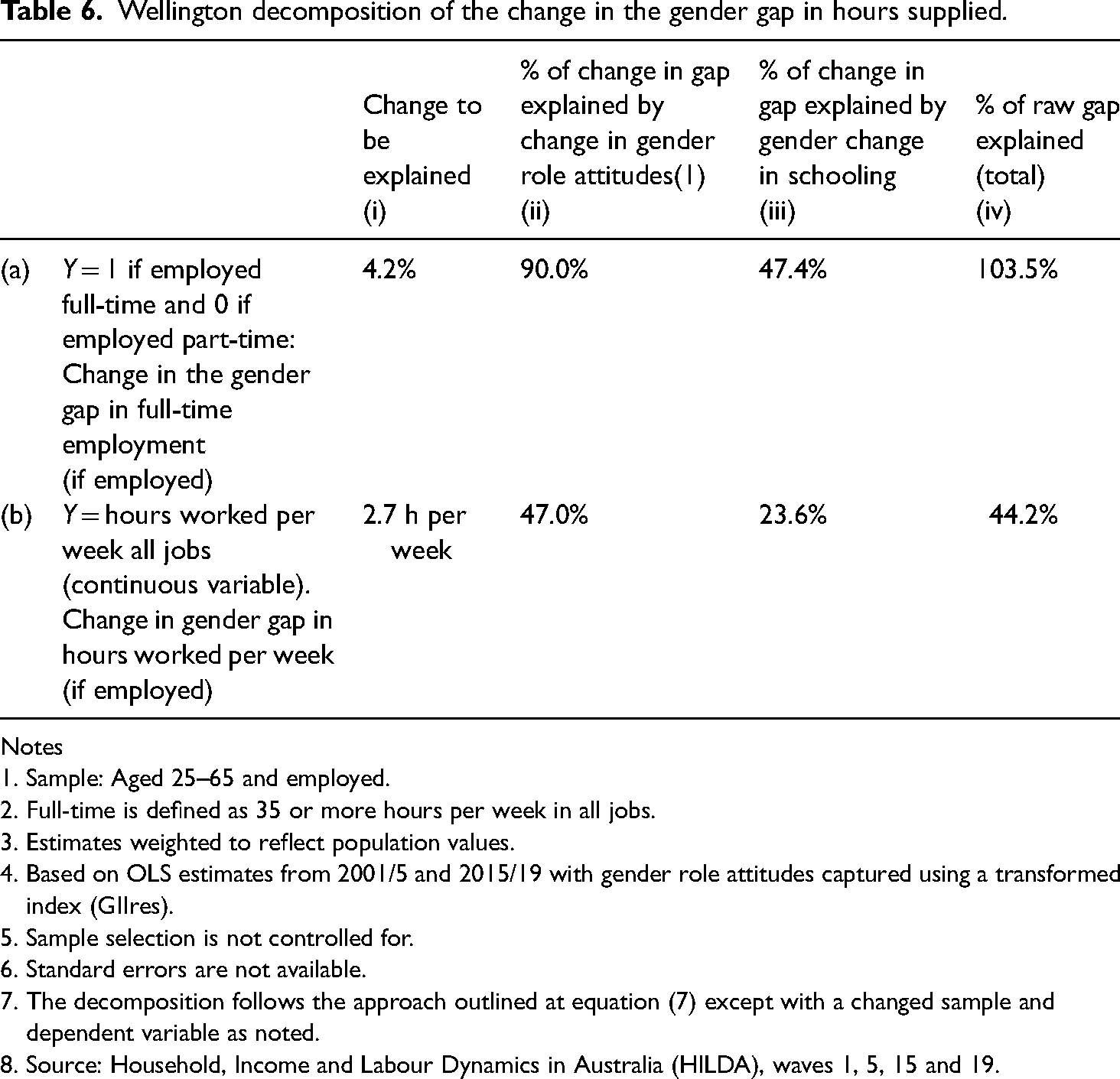
Table 6 summarises the results associated with a repeat of the decomposition exercise but with the sample constrained to be those in employment. The focus is on understanding the factors underpinning a change in the gender gap in full-time employment participation amongst those in employment. (It is important to note that the regressions do not control for selection into employment). As noted earlier, there is a stark difference in the employment patterns of males and females in Australia, with around 90% of employed males working 35 or more hours per week (full-time) while the corresponding share for women is around 55%. Between 2001 and 2021, the gender gap in full-time employment converged by 4.2 percentage points. Of this change, more than 90% of this change was underpinned by a change in gender role attitudes of males and females (see Table 6, row (1)). In row (2) of Table 6, the dependent variable is hours worked per week in all jobs. The analysis there shows that over the period studied (i.e. between 2001/5 and 2015/19), the gender gap in hours of work per week converged by 2.7 h. 4 Of this change, 23.6% could be attributed to changes in male and female schooling attainment while 47% of the convergence arose from changes in the gender role attitudes of males and females.
Wellington decomposition of the change in the gender gap in hours supplied.
Notes
1. Sample: Aged 25–65 and employed.
2. Full-time is defined as 35 or more hours per week in all jobs.
3. Estimates weighted to reflect population values.
4. Based on OLS estimates from 2001/5 and 2015/19 with gender role attitudes captured using a transformed index (GIIres).
5. Sample selection is not controlled for.
6. Standard errors are not available.
7. The decomposition follows the approach outlined at equation (7) except with a changed sample and dependent variable as noted.
8. Source: Household, Income and Labour Dynamics in Australia (HILDA), waves 1, 5, 15 and 19.
Robustness checks
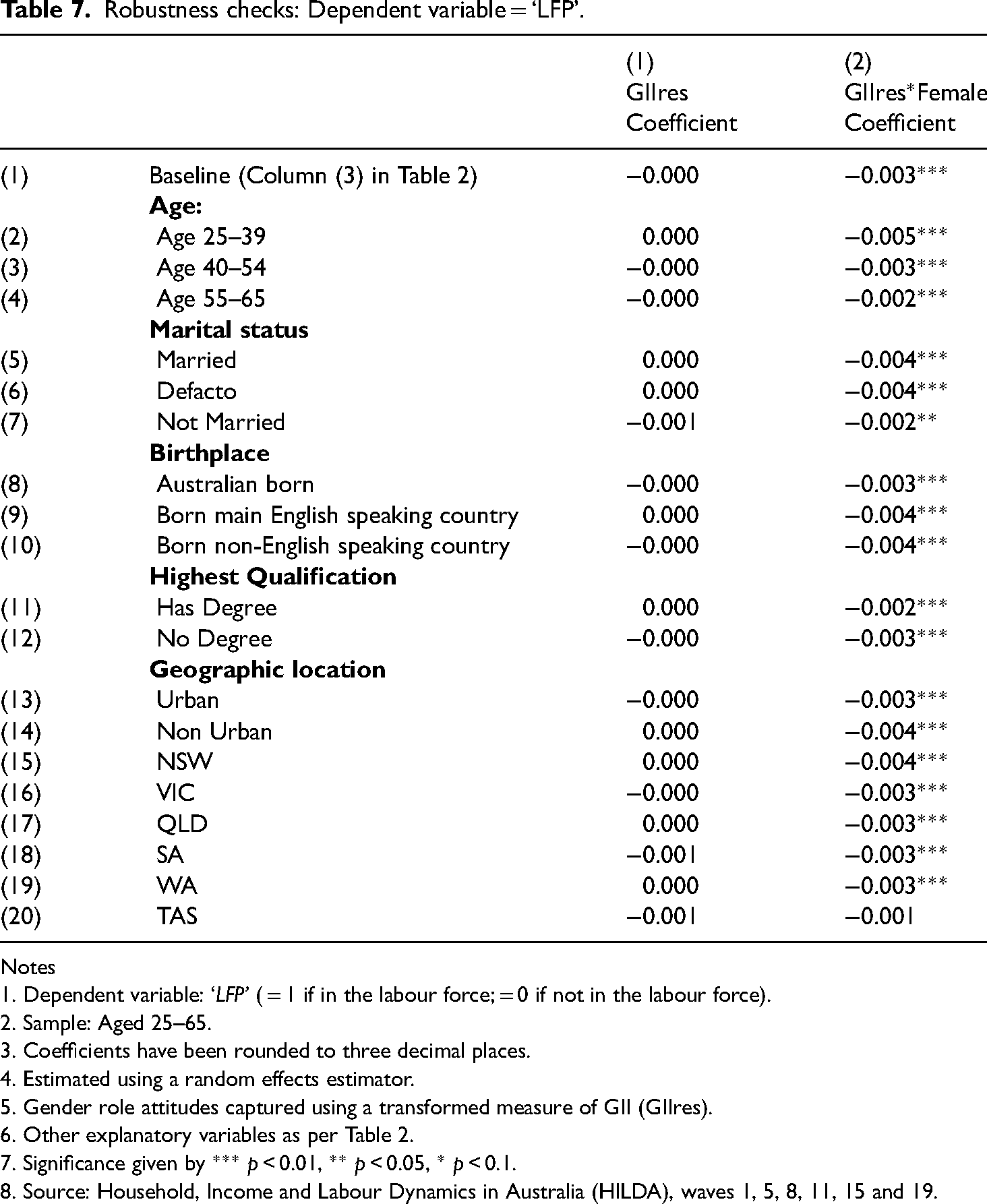
In this section, various robustness checks are reported. The focus is with respect to ‘GIIres’ and, where relevant, ‘GIIres*female’. In Table 7, the summary results are associated with the estimation of equation (1) with ‘LFP’ the dependent variable. Disaggregation is by age (three groups), marital status (married, de facto and not married), birthplace, qualification and geographic area. The coefficients and significance levels in column (2) (for females) show that in all cases examined (except Tasmania), there is a significant negative association between holding more traditional gender role attitudes and the likelihood of being in the labour force. Column (1) (for males) shows that in all groups studied, there is no association between male attitudes concerning mothering and the gender division of labour (i.e. their gender role attitudes) and their likelihood of participating in the labour force. This is not a particularly surprising result, particularly within the Australian context where the dominant social norm is that of male as breadwinner. The consistency of the result across the various groups studied is, nevertheless, worth noting.
Robustness checks: Dependent variable = ‘LFP’.
Notes
1. Dependent variable: ‘LFP’ ( = 1 if in the labour force; = 0 if not in the labour force).
2. Sample: Aged 25–65.
3. Coefficients have been rounded to three decimal places.
4. Estimated using a random effects estimator.
5. Gender role attitudes captured using a transformed measure of GII (GIIres).
6. Other explanatory variables as per Table 2.
7. Significance given by *** p < 0.01, ** p < 0.05, * p < 0.1.
8. Source: Household, Income and Labour Dynamics in Australia (HILDA), waves 1, 5, 8, 11, 15 and 19.
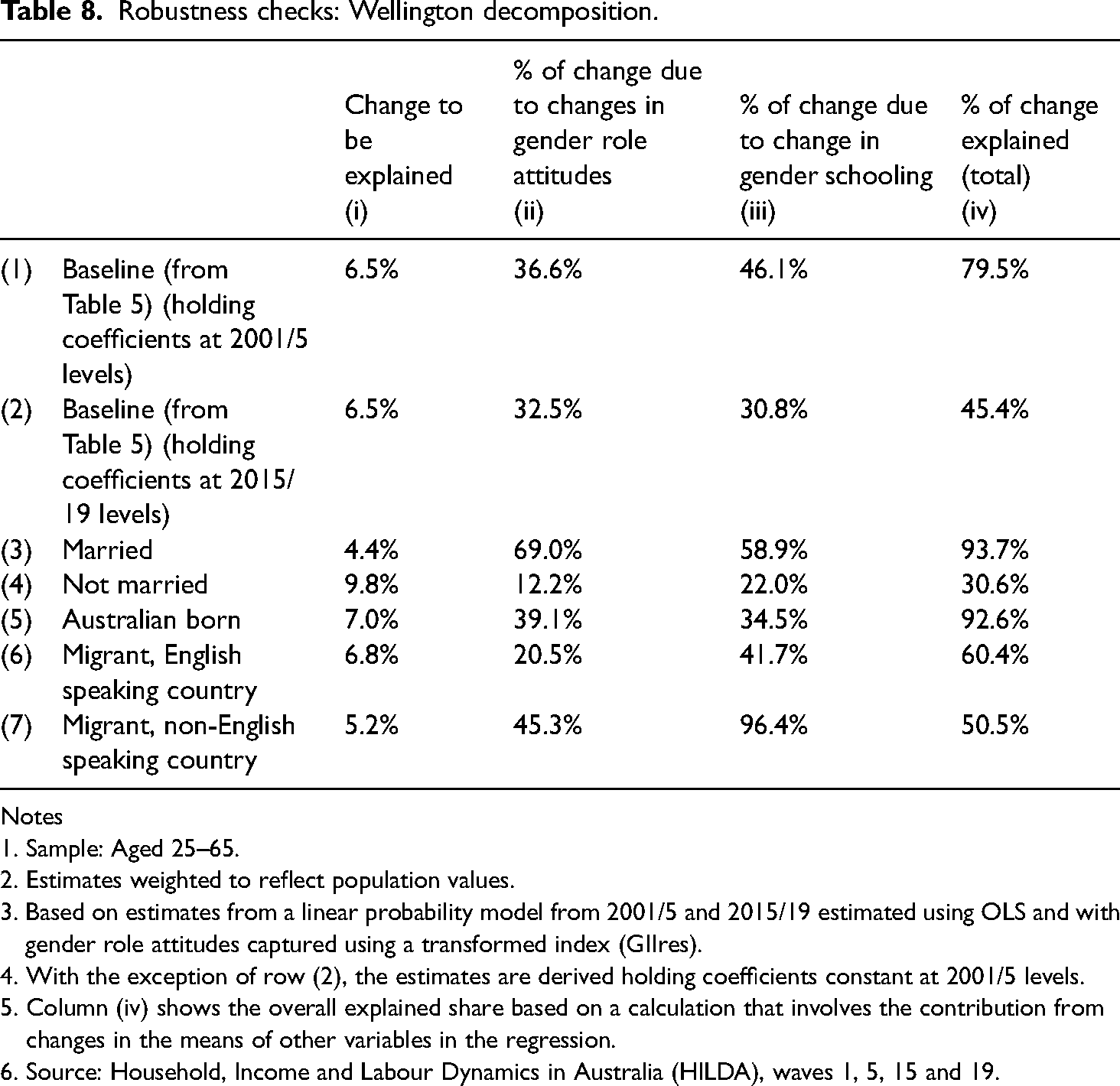
Table 8 reports the robustness tests associated with the Wellington decomposition. Row (1) shows the baseline results from Table 5. Row (2) shows the results holding coefficients constant at 2015/19 levels rather than at 2001/5 levels (as per Table 5). Holding the coefficients constant at 2015/19 levels reduces the size of the overall explained gap (from 79.5% to 45.4%), however, the importance of the gender role effect in terms of its contribution relative to schooling remains high (see row (2), column (v) of Table 8). Column (i) shows variation in the rate of convergence in the gender gap in LFP. It ranges from 4.4% amongst married men and women to 9.8% amongst non-married men and women. Column (ii) shows that the share of the change in the gender gap in LFP arising from changes in female gender role attitudes (more egalitarian) vis-à-vis male gender role attitudes is substantial within all groups. Row (7) estimates for migrants from a non-English speaking background show that 96% of the observed change in the LFP (the gap to be explained) is due to schooling investments (greater investments amongst women). Changes in gender role attitudes (faster adoption of egalitarian attitudes) explain 45.3% of the changing gap.
Robustness checks: Wellington decomposition.
Notes
1. Sample: Aged 25–65.
2. Estimates weighted to reflect population values.
3. Based on estimates from a linear probability model from 2001/5 and 2015/19 estimated using OLS and with gender role attitudes captured using a transformed index (GIIres).
4. With the exception of row (2), the estimates are derived holding coefficients constant at 2001/5 levels.
5. Column (iv) shows the overall explained share based on a calculation that involves the contribution from changes in the means of other variables in the regression.
6. Source: Household, Income and Labour Dynamics in Australia (HILDA), waves 1, 5, 15 and 19.
Summary and conclusion
In this paper, data from the HILDA survey (for the years 2001, 2005, 2008, 2011, 2015 and 2019) are used to examine the association between gender role attitudes and the labour supply (extensive and intensive margins) of adult males and females (aged 25–65). A particular focus of the paper is on understanding how much of the change in the gender gap in LFP between 2001/5 and 2015/19 may be explained by a change in the gender role attitudes of females vis-à-vis males. The paper contributes to the growing literature examining the link between gender role attitudes and the labour market outcomes of women.
The analysis carried out supports the findings in previous studies, namely that the gender role attitudes held by women (in particular) matter for their labour supply decisions. Women holding more traditional attitudes (as captured by a transformed summary attitude measure concerning mothering and the domestic division of labour) are less likely to participate in the labour force. Where they do participate (are employed) they are more likely to be employed part-time. Male labour supply decisions are less sensitive to their gender role attitudes, particularly on the extensive margin (participating in the labour force). Like women, males with more traditional attitudes are less likely to be employed full-time and more likely to be employed part-time, although the part-time association for males is not statistically significant. The estimates from the Wellington decomposition (on the source of the convergence in the gender gap in LFP) show that, for Australia as a whole, the gender gap in LFP narrowed 6.5 percentage points between 2001/5 and 2015/19. The main factor driving the result was a change in the average schooling (years) of women. The second most important factor was a change in the gender role attitudes of women and men. The effect of the latter was not trivial, accounting for just over one third (36.6%) of the observed 6.5 percentage point gap.
From a policy perspective, these estimates suggest that interventions aimed at shifting the gender role attitudes of males and females can be expected to have important effects on the labour supply of men and of women in particular. Example interventions might include direct campaigns such as the recently launched (March 2023) EU ‘#EndGenderStereotypes’ campaign (EU, 2023). 5 Other interventions include family policies that support dual-earner arrangements (e.g. paid maternity and paternity leave) and affordable and accessible child-care, particularly for pre-school children (Endendijk et al., 2018). This is particularly important as research suggests that implicit gender role stereotypes change (become more traditional) during the first year of parenthood (Endendijk et al., 2018).
In Australia, the current focus is on having a more affordable early childhood education and care (ECEC) system. Legislation providing for increased childcare subsidies has already been passed and an inquiry (with the Productivity Commission) has been established to review and recommend on an ECEC system, including how it might affect participation in the workforce. The particular challenge for Australia is not so much about increasing the female LFP rate but, rather, changing the prevailing gender order (male breadwinner/female part-time carer) and with it preferences for full-time and part-time work. Findings reported in this paper show that women's hours preferences are highly correlated with their attitudes to gender roles. This was particularly evident when the relationship with individual questions (as opposed to the summary measure) was explored. Those less supportive of long-day care arrangements were, for example, significantly more likely to preference part-time work with this effect significantly stronger for females than males. It suggests that in the absence of a shift in gender role attitudes at a societal and individual level (Aarntzen et al. 2023), an affordable, accessible and high quality ECEC system may only deliver a marginal change in the working time arrangements of men and women. If this occurs women will continue to be significantly disadvantaged in Australia. Research elsewhere, for example, shows that women in Australia, on average, accumulate half the labour earnings of men over their life-time and that women who work part-time have retirement income savings which are 24% lower than women who work full-time. This is due, in large part, to the fact that the Australian retirement income system is designed with a full-time worker in mind (Preston and Wright, 2023).
In concluding this paper, it is important to again note that the results discussed here are largely predicated on the assumption that gender role attitudes are exogenous. While efforts have been made to limit potential endogeneity through exploring lagged measures, transformed measures and panel estimation techniques, endogeneity cannot be ruled out. In other words, causality is not claimed. That said, the results show a strong association between gender role attitudes and labour supply and are suggestive of a directional flow from attitudes to supply rather than the other way around.
Related challenges involve further separating out the gender role attitudes of males and females. Male gender role attitudes may impact on female gender role attitudes through socialisation effects and through feedback effects associated with ‘doing gender’. Further research along the lines of Khoudja and Fleischmann (2018) for Germany will help shed additional light on the effect that male partners’ gender ideology has on their female partner's patterns of labour supply.
Supplemental Material
sj-docx-1-jir-10.1177_00221856231177118 - Supplemental material for Changing gender role attitudes and the changing gender gap in labour force participation
Supplemental material, sj-docx-1-jir-10.1177_00221856231177118 for Changing gender role attitudes and the changing gender gap in labour force participation by Alison Preston in Journal of Industrial Relations
Footnotes
Acknowledgements
The author wishes to thank two anonymous referees for extremely helpful comments on an earlier version of this paper.
Author’s Note
This paper uses data from the Household, Income and Labour Dynamics in Australia (HILDA) survey. I acknowledge that the HILDA Project was initiated and is funded by the Australian Government Department of Social Services (DSS) and is managed by the Melbourne Institute of Applied Economic and Social Research (Melbourne Institute). The findings and views reported in this paper, however, are those of the author and should not be attributed to either the DSS or the Melbourne Institute.
Declaration of conflicting interests
The author declared no potential conflicts of interest with respect to the research, authorship, and/or publication of this article.
Funding
The author received no financial support for the research, authorship, and/or publication of this article.

Supplemental material
Supplemental material for this article is available online.
Notes
Biographical note
References
Supplementary Material
Please find the following supplemental material available below.
For Open Access articles published under a Creative Commons License, all supplemental material carries the same license as the article it is associated with.
For non-Open Access articles published, all supplemental material carries a non-exclusive license, and permission requests for re-use of supplemental material or any part of supplemental material shall be sent directly to the copyright owner as specified in the copyright notice associated with the article.
