



Abstract
This paper examines the under-explored demand-side of active labour market programmes that aim to transition people without jobs into employment. The paper's contribution centres on understanding the benefits that government-funded employment services can offer to employers and how they can work with employment service providers to leverage these. Drawing on in-depth qualitative interviews with employers in Australia, our findings extend pre-existing concepts of employer engagement by illustrating the human resource, corporate social responsibility, and financial benefits to employers of engaging with employment services and how firm size affects their engagement. The findings offer improvements to policymaking and practice to facilitate the effectiveness of employment services in Australia and elsewhere.
Introduction
Labour market policies implemented through active labour market programmes (ALMPs) involve dedicated employment services designed to transition people without jobs into employment. While most developed countries deploy employment services providers (ESPs), their implementation strategies vary (Considine et al., 2020). So-called ‘work-first’ (quickest way into employment) approaches emphasise labour market participation, conditionality, monitoring and sanctions whereas ‘human capital’ approaches address skills development in response to shortages and changes in the economy (Carter and Whitworth, 2015). Australia's longstanding employment services model (Job Network, followed by Job Services Australia, job active and then Workforce Australia) has predominantly been based on a ‘work-first’ approach and Australia is a world leader in commissioning systems for the purchase of employment services from competing non-governmental (for-profit and not-for-profit) providers (Finn, 2008).
Since 1998, Australia's model has been underpinned by the principles of New Public Management, whereby the provision of public services is assumed to be more cost-effective and innovative if service provision is separated from policy development and competition-based private sector management systems adopted (Considine et al., 2015). Concomitantly, this delivery model has shifted away from demand-side (i.e. employer) dimensions, instead focusing on the supply-side and emphasising ‘activation’ of jobseekers to engage in active job search and preparation in order to increase employment. While this approach has proved effective in reducing short-term employment, long-term employment has remained persistent.
To date, research conducted both in Australia and internationally has predominantly focused on examining the supply-side of ALMPs. In contrast, research examining the demand-side, including employers and ‘employer engagement’, remains scarce, especially in Australia. Employer engagement refers to the active involvement of employers in addressing the labour market participation of vulnerable groups (van Berkel et al., 2017), i.e., what drives employers to participate in ALMPs and employment services and, by extension, how ESPs could engage employers to participate (Ingold and Stuart, 2015; Liechti, 2020).
Given the importance of employers as key ‘upstream actors’ (Wright, 2012) who are critical to the success of employment services, it is surprising that so little research has examined employer engagement (Ingold and Valizade, 2017; Valizade et al., 2022). Furthermore, extant scholarship has predominantly focused on the barriers to employer engagement (Ingold and Stuart, 2014, 2015), with limited attention paid to enablers. Exceptions include Bredgaard (2018), Bredgaard and Halkjær (2016), and Simms’ (2017) analysis of employer engagement in apprenticeship programmes in the UK. Notably, Simms identified that employers may accrue benefits related to human resources (HR) and corporate social responsibility (CSR) while also signalling the potential importance of firm size in employer engagement. Simms’ formative model provides the conceptual framework for this study.
This paper contributes to the existing literature by examining the demand side of employment programmes. More specifically, we explore through qualitative, in-depth interviews Australian employers’ experiences of engaging. In so doing, we draw upon Simms’ (2017) model of employer engagement to analyse (a) the benefits to employers of engaging with ESPs and (b) how firm size affects employers’ engagement in ALMPs through employment services. Our findings extend pre-existing conceptions of employer engagement and progress policymaking and practice directed towards improving employment programmes in Australia and beyond. This contribution is especially significant within the current post-pandemic environment, where employers face significant labour shortages whilst workers experience under-employment (Birch and Preston, 2022).
The remainder of this paper is structured as follows. The next section reviews the existing literature on ALMPs internationally and in Australia, followed by the methods and data section. The findings are then presented followed by the discussion and conclusions.
Literature
ALMPs and employer engagement: International evidence
During the 1990s ALMPs were advanced across OECD countries (Filges and Hansen, 2017) as a key policy response to long-term unemployment by assisting jobseekers into employment, or keeping them close to the labour market and ‘job ready’ until they can find work (Martin, 2014). In most countries, including Australia, the unemployed must participate in employment services as part of ALMPs in order to continue receiving benefits. Employment services comprise a variety of employability interventions including assistance with job search, short-term training, work placements, and wage subsidies. Additionally, policies and programmes have been developed to assist specific cohorts of jobseekers to gain employment, including disadvantaged groups such as single parents and people with disabilities (Valizade et al., 2022). Typically, policymaking has adopted a supply-oriented approach that scholarship has mimicked by examining jobseekers and their experiences of ALMPs, including their relationships with ESPs.
Supply-side focused research has revealed a range of problems related to the design and implementation of ALMPs. For example, international studies have highlighted that ESPs focus their attention on the most ‘work-ready’ clients, known as ‘creaming’, whilst ‘parking’ those clients perceived to have significant barriers to work (Carter and Whitworth, 2015). ‘Gaming’ the system in this manner allows ESPs to maximise financial rewards from the government as purchaser of services based on job outcomes. This has led to ESPs coercing potential workers to ‘fit’ employers’ preferences, regardless of any mismatch, aided by conditionality and sanctions (Ingold, 2018; Wright, 2012). It has also been argued that, in order to meet their placement targets, ESPs have the incentive to withhold negative information about candidates and/or providing candidates who are not ‘work-ready’ (Larsen and Vesan, 2012). Unsurprisingly, this has led to a lack of trust in employment services and ESPs on the part of employers, clients and the public (van der Aa and van Berkel, 2014). At the same time, longitudinal studies suggest that ESPs in Australia, the UK and the Netherlands have reduced their contact with employers (Considine et al., 2015), indicating that efforts to build trusting relationships have waned.
Research examining the demand-side – including employers and employers’ engagement with ESPs – remains scarce. Extant research has revealed employers’ limited engagement with ALMPs and employment services and the associated problems. This includes employers not perceiving benefits for their organisations compared with the transaction costs, particularly when compared with their existing recruitment methods (Bredgaard, 2018). In comparing employers in the UK and Denmark, Martin and Swank (2004, 2012) reported that UK employers viewed ALMPs as a means of accessing cheap labour whereas Danish employers accessed ALMPs to gain skilled blue-collar workers. Martin and Swank's analyses suggested the potential importance of firm size, noting how employers in large firms with structured HR departments were more likely to utilise ALMPs. Furthermore, Wiggan and Knuth (2023) found that in Germany small firms had a greater propensity to engage with ALMPs, whereas in the UK it was large firms.
Other studies reveal that employers’ limited reliance on government-funded employment services tends to reflect their negative experiences. For example, research by Ingold (2020) indicated that employers in Denmark and particularly in the UK were critical of employment services, perceiving them to lead to receipt of large numbers of poorly-targeted, unsuitable and unfiltered job applications, with resulting negative resource impacts for businesses. This significant cost outweighed potential benefits, making employers less likely to utilise employment services for their workforce needs. Additionally, employers in the UK find the array of employment services, providers and programmes at national and sub-national levels bewildering (Ingold and Stuart, 2014). This may be amplified in Australia given the large number of ESPs. There is also evidence of low expectations on the part of employers towards certain demographics covered by employment services such as young people with disabilities (Stafford et al., 2017).
In contrast, a more promising line of research suggests that employer engagement may be linked to specific employer motives and benefits. Based on research in the Netherlands, van der Aa and van Berkel (2014) identified three types of employer engagement: (a) employers who wished to recruit new workers through a public recruitment channel; (b) employers predominantly interested in reducing their wage costs; and (c) employers wishing to recruit disadvantaged workers as a result of CSR. Building on this work, Bredgaard (2018) tested the hypothesis that employers will participate in ALMPs if they consider this to be the ‘right thing to do for ethical or moral reasons’. However, Bredgaard (2018) highlighted that only a minority of Danish employers could be classified as ‘committed employers’, with the majority being either ‘dismissive’ or ‘passive’ in respect of ALMPs.
In seeking to better understand employer engagement, Simms’ (2017) study of the UK apprenticeship scheme highlighted the significance of HR and CSR in informing employers’ decisions to engage. With respect to the former, employer engagement was motivated by the employer's desire to develop their HR, including skills and workforce planning. Accordingly, employers identified HR benefits related to developing skills and a talent pipeline, along with the opportunity to access associated government funds for training. Such motivations demonstrate parallels with employers’ reasons for engaging with external organisations such as labour market intermediaries for their staffing needs including labour hire agencies (Bonet et al., 2013), or with training providers for learning and development. In terms of CSR, Simms found that employer engagement was motivated by the organisation's perception of its role as a ‘good citizen’ and the perceived reputational risks and benefits associated with engagement (or non-engagement). Such employers perceived engagement in apprenticeships as ‘socially valuable’ or necessary to be perceived as a ‘good corporate citizen’, with both extrinsic and intrinsic benefits to the organisation. These motivations share similarities with Moore et al.'s (2017) examination of how an Australian retailer embedded CSR into their strategies for candidate attraction and consumer branding in relation to disabilities.
Echoing earlier findings regarding the potential importance of firm size (Martin and Swank, 2004, 2012), Simms (2017: p.548) reported that large employers had more awareness of programmes than small- or medium-sized organisations and that the simultaneous presence of employer motivations related to HR and CSR facilitated employer engagement. However, Simms also noted that HR and CSR logics were sometimes in competition within organisations, reflecting or amplifying tensions between the preferences of individual managers and senior leaders, or the strategic aims of the organisation. For example, in large organisations CSR policy set by senior leaders or by equality, diversity and inclusion specialists must be enacted at the local level by hiring managers (p.558). It is at this level of implementation that conflict can occur with operational and immediate labour supply needs, job analysis and design and job role descriptors that may exclude particularly disadvantaged groups, as well as with perceptions of ‘fit’ (Noon, 2012). Critically, it is at this nexus that employment services have the potential to intervene (Ingold and Stuart, 2014).
The focus and contribution of this paper are to further identify the levers that impact employer engagement in employment services. In so doing, we adopt concepts developed in Simms’ (2017) study of employer engagement in UK apprenticeship programmes. This conceptual framework is transferable to the Australian employment services context for two reasons. Firstly, the framework focuses on benefits at both the level of the individual hiring manager and the organisation. Second, as with Australia, the UK apprenticeship system dovetails with employment services as part of the broader employment and skills ecosystem. In adopting this formative model, we also seek to further extend it by qualitatively examining how firm size affects employer engagement in employment services.
The next section analyses existing literature on employment services and employer engagement in Australia.
Employment services and employer engagement in Australia
In line with the international evidence base, research in Australia has tended to focus on the supply-side of employment services, examining purchasing arrangements and activity requirements and the experiences of frontline workers and jobseekers (Bennett et al., 2018; Considine et al., 2015; 2020; Moore, 2019; Stafford et al., 2017). As such, an Australian government-commissioned review criticised employment services as being standardised and compliance-oriented, with caseworkers managing high caseloads of jobseekers (DESE, 2018). According to the review, long-term unemployed clients have not received the case management, training, work experience or other supports needed to address health, housing and social problems. Moreover, providers were not well-connected to local employers or community services (DESE, 2018) and this has declined over time (Considine et al., 2015).
The Australian employment services model is hampered by the declining proportion of employers using publicly funded employment services, falling from 18% to 5% between 2007 and 2016 (DESE, 2018). Despite around $2bn of public investment in job active (2015–2022), it has been claimed that around 4% of employers utilise employment services in Australia (DESE, 2018). Employers have reportedly disengaged based on perceptions that jobseekers are of lower quality, reflecting problems of information asymmetry (Akerlof, 1970), raising questions around the effectiveness of ESPs’ strategies and approaches to engage employers.
According to Bennett et al. (2018), Australia's employment services model is unable to address the main barriers to employment because it does not address demand-side factors. Employment services staff spend the bulk of their time completing compliance and administration activities (34.6%) and little time working with employers (10.3%) (Considine et al., 2020). Similarly, research by Moore (2019) highlighted that the three employment services contracts in Australia since 1998 were predominantly supply-led, emphasising tight activation and compliance requirements for jobseekers and strong financial incentives for providers to achieve job outcomes measured at the 6-month point. Moore (2019) has argued that employer engagement with ESPs’ activities is necessary to create better employment opportunities. Firstly, employers could create opportunities for realistic job previews, benefiting both jobseekers and employers and improving ‘fit’ and retention. Secondly, stronger linkages between ESPs and employers could expand employment opportunities for jobseekers and facilitate more appropriate referrals to vacancies. Finally, strong relationships with employers could improve employer feedback in the early stages of jobseekers’ employment and enable early intervention to address problems and improve retention. Despite these potential benefits, Moore points out that actualisation has been limited by scarce resources and outcome-based funding contracts driven by supply-led approaches.
Given these oversights, there remains an urgent need to improve employment services for all stakeholders, perhaps most centrally in relation to employer engagement. Little is known about employers’ reasons for engaging with ESPs, particularly the benefits employers accrue as a result of engagement. Additionally, while Martin and Swank's seminal analyses (2004, 2012) suggested the potential importance of firm size, this requires further analysis, especially in light of Simms’ assertions around CSR and HR tensions evident in large organisations.
In redressing this paucity of knowledge, we utilise Simms’ (2017) conceptual framework of HR and CSR benefits to examine: (a) the benefits to employers of engaging with ESPs and (b) whether firm size plays a role in employers’ engagement in ALMPs in Australia. Our findings advance understanding of the hitherto neglected demand-side of employment programmes and suggest improvements to policymaking and practice that could boost the effectiveness of ESPs in Australia and beyond.
Methods and data
Drawing on qualitative research methods, we deployed non-random selection of participants to encompass potential variation in employers’ experiences based on firm size. In doing so, our sample encompassed a range of sectors and states, including the most populous Australian states. The research took place during 2020 and 2021, a particularly challenging period for employers due to the COVID-19 pandemic. Of a total of 50 potential participants, the final achieved sample was 30. Table 1 summarises our study participants, who were accessed via organisations operating in employment and skills services delivery. This ensured that the achieved sample encompassed employers with experiences of using employment services.
Summary of employer characteristics.
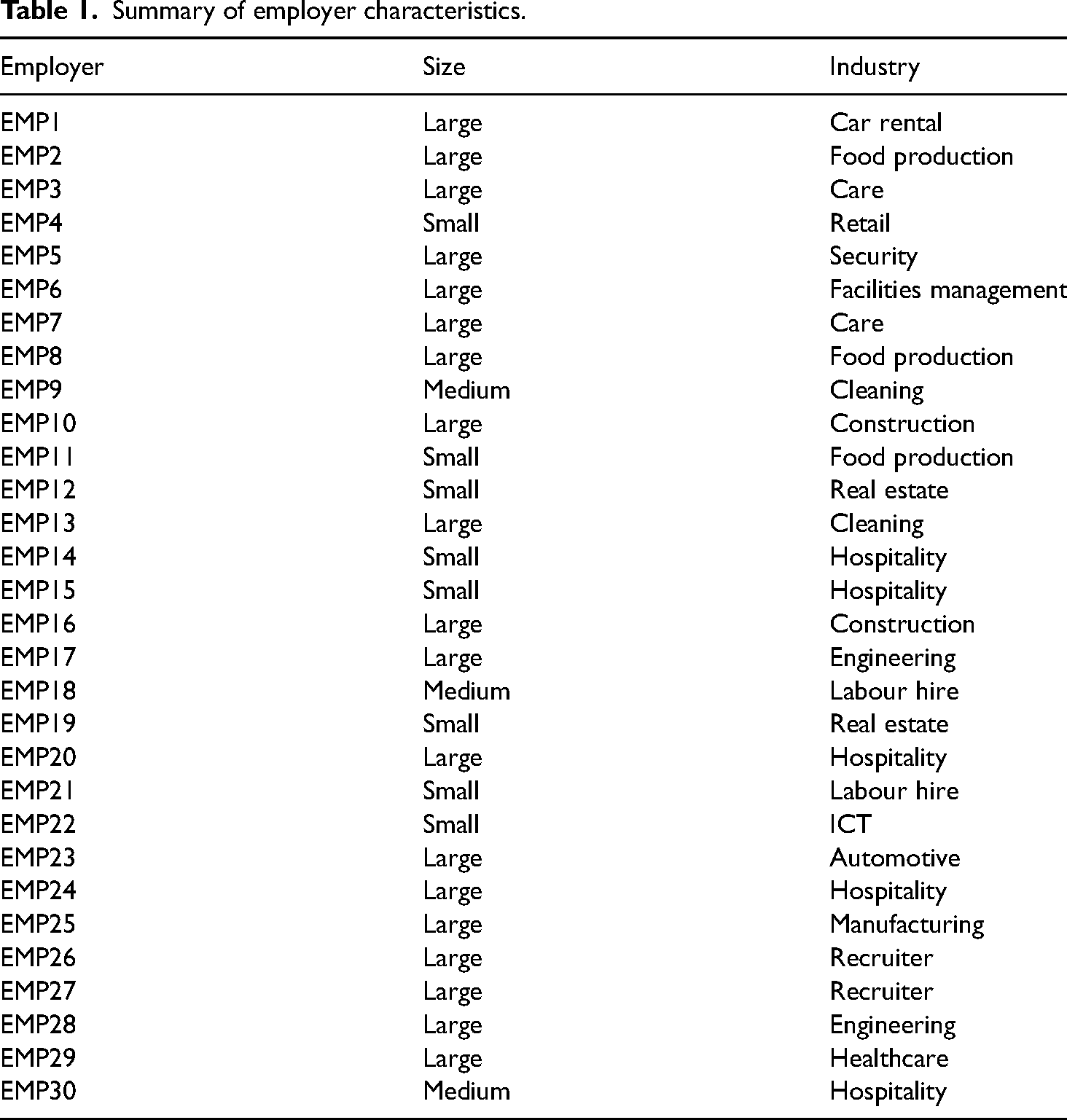
Our sample was not intended to be representative because the criterion for inclusion was participation in ALMPs; instead, it was purposive. Interviews were conducted with hiring managers from employing organisations representing a range of firm sizes. Respondents were based in New South Wales, Victoria, Queensland, and Tasmania. The achieved sample comprised eight small employers (27%), three medium-sized employers (10%) and 19 large employers (63%). The over-representation of large employers 1 is to an extent reflective of the focus of ESPs on large employers, who are more likely to employ jobseekers and in larger numbers (Ingold and Valizade, 2017). ESPs struggle to engage small employers due to the resource-intensiveness of this exercise (Ingold and Stuart, 2015) and possibly also as a result of the specialist knowledge and skills required. Unsurprisingly, industries that were more likely to employ jobseekers in ‘entry-level’ roles (requiring fewer skills and offering minimum wages) were strongly represented, including hospitality (five employers), food production (three), and care/healthcare (four). Additionally, three employers were engineering/manufacturing, one ICT, two real estate, and two were labour hire agencies, the latter being identified in extant research as important additional labour market intermediaries in the chain of employing participants in ALMPs (Ingold and Stuart, 2014).
The process of acquiring informed consent, firstly, involved potential participants giving consent to partner organisations for their details to be shared with the research team. This consent process ensured that there was no coercion of potential participants. Where consent was given, the research team subsequently followed up with a Plain Language Statement and Consent Form and arranged the format and timing of interviews at the convenience of participants. Informed consent to participate and to be audio recorded was confirmed before proceeding.
Semi-structured interviews were selected to enable a degree of thematic consistency, without imposing or constraining the respondents and to allow a deep exploration of emerging themes (Alvesson, 2011). Semi-structured interviews enable questioning in line with the research aims whilst allowing interviewees to discuss additional issues. This approach enables the interviewer to elicit interviewee viewpoints more effectively than a standardised interview or questionnaire (Flick, 1998). This design enabled a deep understanding of concepts and relationships in specific contexts as well as theory building (Yin, 2003).
Interview protocols included topics such as employers’ extent of involvement in ALMPs, the process of working with ESPs and the perceived benefits to the employing organisations, as well as recommendations to improve employment services. The duration of the interviews averaged 45 minutes. All interviews were recorded and transcribed verbatim and the transcripts were loaded into NVivo. The resulting data were content-analysed to identify common trends and relationships within and between key concepts (Yin, 2003) using an iterative thematic process (Corbin and Strauss, 2008). Firstly, the analysis focused on examining the benefits to employers of engaging with ESPs based on Simms’ (2017) themes of HR and CSR. Sub-themes and additional themes were added as they emerged from the data, as well as the revision of categories considered to be important a priori. Subsequently, a new, separate theme emerged relating to financial benefits, reflecting employers’ explanations of benefits and how they related to each other. Secondly, the analysis examined whether firm size affected employer engagement by exploring any differences among small, medium and large firms. While the impact of industry was analysed, no meaningful relationships were evident. All analyses were conducted using NVivo. The coding was undertaken by one member of the research team and the analysis by all researchers, bringing their own perspectives and resulting in a process of triangulation. In presenting our findings, all participants have been anonymised to protect their individual identities and those of their organisation and to ensure the confidentiality of both.
Findings
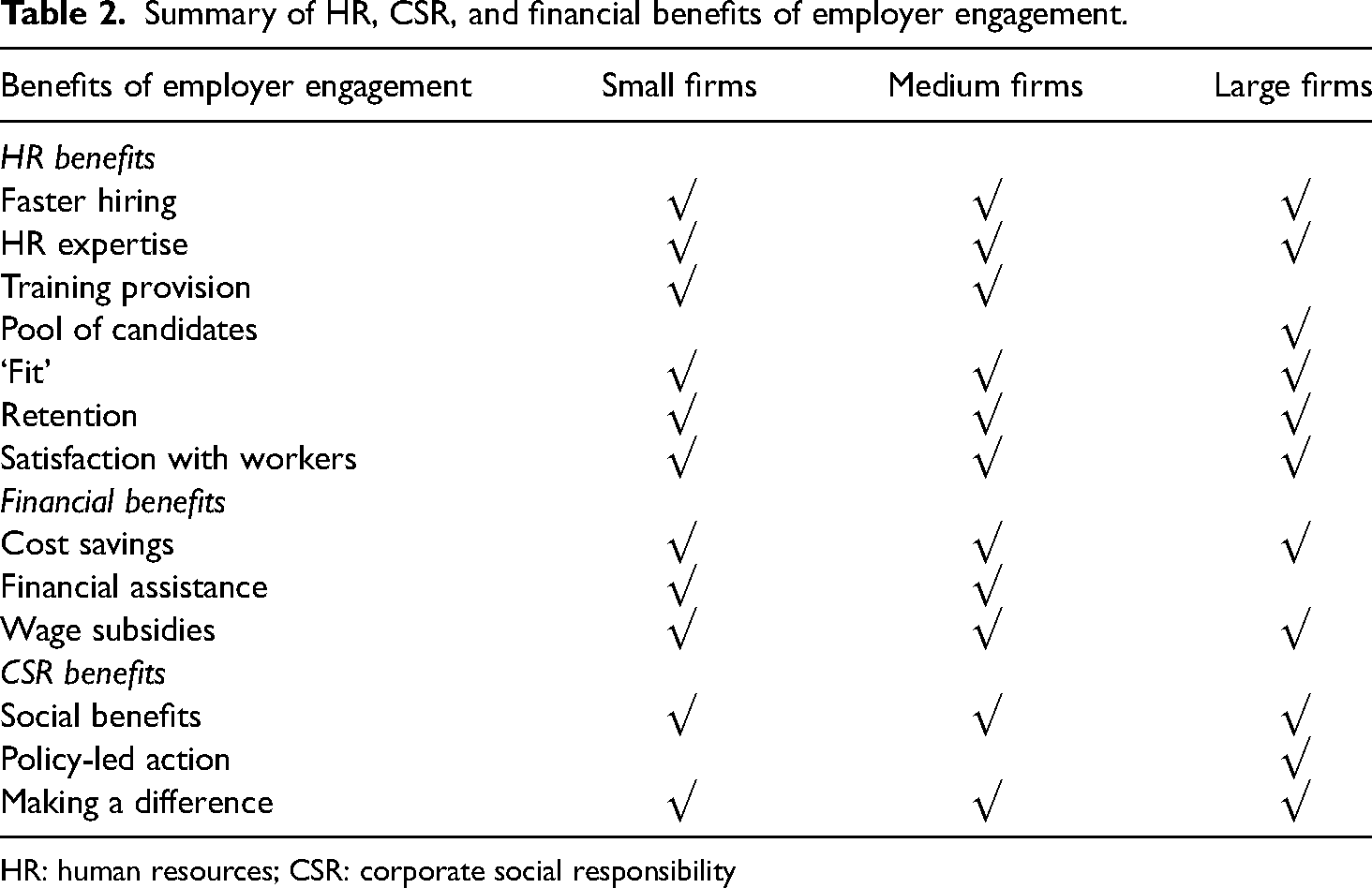
The findings examine the benefits to employers of engaging with ESPs and whether firm size plays a role in employers’ engagement in ALMPs. Based on these findings, we outline the HR, CSR and financial benefits and discuss the role of firm size, as summarised in Table 2.
Summary of HR, CSR, and financial benefits of employer engagement.
HR: human resources; CSR: corporate social responsibility
In terms of how employers initially connected with the ESPs, few employers were working with more than one and few had specifically selected a particular ESP from a range of providers. Five employers stated that they had been linked with the ESP via a professional or personal acquaintance. Only one employer stated that they had received information from the Commonwealth government. Nine employers reported proactive approaches from the ESP, in the form of either a general phone call or a targeted approach. Only two employers mentioned that they had proactively sought the ESPs, in one case to ‘try all options’, in another ‘a change in business need required consideration of new options’. The remainder could not recall the path by which they found the ESP. This is common in terms of recall; for example employers seldom know the names of ALMPs (Ingold and Valizade, 2017).
HR benefits
The following section examines the HR benefits to employers of engaging with ESPs. Employers noted that these included: quicker hiring processes; HR expertise and assistance; pre-employment training provision; quantity and diversity of candidates; improved ‘fit’; improved retention; and overall satisfaction with workers. Variation based on firm size was evident, as outlined below.
Employers indicated that ESPs enabled them to hire labour rapidly and efficiently when they had an immediate need for staff. Illustratively, a large employer noted: ‘I didn’t have time … I needed them to start, so that was all I was concerned about …I’d get workers, that was purely what was needed’ (EMP3 – large care). In such instances, ESPs were considered to provide a beneficial service and this trend was evident across all firm sizes. This is also in line with Bonet et al.'s (2013) conceptualisation of labour market intermediaries as ‘information providers’, introducing candidates who may not otherwise be noticed to employers, as well as bringing vacancies to the attention of jobseekers. This could be considered to be the most basic level of job matching. Employers also considered ESPs to provide HR expertise and assistance. Furthermore, while ESPs’ assistance was acknowledged as being useful by employers in large firms, it was even more critical for employers in small- to medium-sized enterprises (SMEs), where dedicated HR expertise was less inclined to be available (see also Martin and Swank, 2004). Within these SMEs, employers noted that ESPs provided HR skills and experience that they lacked: ‘we don’t have experience in getting, you know, I don’t what you call it, but giving, you know, performance indicators or whatever that stuff is … We’re not that skilled in HR’ (EMP15 – small hospitality). This points to the benefits offered in terms of HR expertise, in this case in relation to performance management and reward.
Subsequently, another small employer noted that the HR skills provided by ESPs created ‘a much better chance of getting the right person’ (EMP4 – small retail), suggesting that ESPs were important in ensuring ‘fit’ (discussed further below). For SMEs, the provision of initial, pre-employment training was another benefit, reflecting the usefulness of work preparation and also realistic job previews. A medium-sized employer indicated: ‘I’ve got less fact of worrying that they’re going to hurt themselves or anything like that because they’ve had that training’ (EMP9 – medium cleaning). Although employers of course have responsibilities for ensuring the health and safety of their employees, the initial training provided by ESPs to prepare candidates was considered beneficial in reducing employers’ HR-related costs by improving the effectiveness of the onboarding process.
Large employers were particularly inclined to value ESPs’ ability to generate a large pool of candidates, nuancing Ingold and Valizade's (2017) finding that ESPs prioritised large employers due to their large number of vacancies, increasing the probability of individuals becoming employed. However, our study also pointed to employers’ perceptions of the increased diversity of candidates within this large pool, suggesting HR needs intersecting with CSR. This allowed employers to access a pool of candidates who they would likely not otherwise encounter or consider and this was an attractive proposition in terms of both its volume and its diversity. For example, one large employer explained their reliance on ESPs to provide a pool of candidates: ‘because they have so many candidates in their network … if you need someone, you can just call them and they will already have 10 people’ (EMP7 – large care), and another emphasised that: ‘they most certainly provide you with a diverse group of people to choose from’ (EMP13 – large cleaning). This finding goes beyond Bonet et al.'s (2013) concept of ‘information providers’ towards ‘matchmaking’ by offering recommendations of candidates to employers, taking account of their needs (demand) and their caseload (supply). This finding also calls into question critiques suggesting that ESPs are not trusted by employers given their vested interest in misrepresenting candidates to meet their own performance measures (Larsen and Vesan, 2012). If ESPs are to obtain repeat business from an employer by servicing their ongoing needs, they need to provide added value through their candidates and service.
One way in which this was accomplished was by ESPs providing HR expertise such as assistance with sifting processes which employers considered improved both the efficiency and quality of their hiring processes, as well as conserving resources, specifically time. Large employers were notably more inclined to emphasize ’fit’ and noted how ESPs facilitated this process: So finding the right organisational fit is almost more important than the skills or experience fit, because we can fill that gap, but if people just aren't a good organisational fit, it's not just about today and tomorrow and this month and next year, it's actually about when we're investing in people's training and development, we're investing for the next five, 10, 15 years. And so having that right sense of fit is really important. And that's always something we would feel best about outsourcing unless it was the best alternative in that circumstance (EMP2 – large food production).
By noting the decision to approach their labour hiring through market rather than hierarchy (Williamson, 1975), this also underscores the similarity of ESPs to labour hire agencies (see also Ingold and Valizade, 2017). That large employers emphasised fit also demonstrated their own HR knowledge and awareness of the links between fit, commitment and retention. In relation to the intersection of HRM and CSR benefits, other large employers reported that ESPs assisted them with meeting quotas: ‘quite often we have clients who say we need two females on every shift or they’re looking for something specific and unique that we may not have. So we need to go out and find that particular type of talent that they’re looking for’ (EMP5 – large security). A small employer was similarly interested in diversity and inclusion quotas: ‘I would really love to be finding ways to recruit indigenous people … you need a programme. Or you need someone to assist you because like I won’t have multiple indigenous applicants for example just because I put an ad online, you know?’ (EMP4 – small retailer). This suggests that there is potential for ESPs to work more intensively with employers to increase diversity and workplace inclusion and, in particular, with small organisations without HR expertise.
That employers of all sizes associated the use of ESPs with increased workforce retention also has a financial dimension discussed later. Illustratively, a large employer explained that ‘you’re recruiting quality people that are going to stick with you for a number of years’ (EMP1 – large car rental). This counters the notion that employers are averse to recruiting from employment services, or that they only recruit for the short-term. Similarly, the following quote from a medium-sized labour hire agency underlines their recognition that effective retention reduces the costs of turnover: the biggest benefit for us is retention … To give you an idea, I would honestly say 50% of our people would not still be here today without the assistance … Now the benefit to us is if we’re not spending all the time recruiting people and we’ve got – we’re retaining people and they’ve had support all the way through, we can give them support in the workplace as well and ensure that you know… If you retain people, you don’t need to recruit so it cuts your job in half and gives you more time to spend with the people (EMP18 – medium labour hire).
Overall, the data regarding HR benefits suggested that employers believed that ESPs enabled these by facilitating more effective recruitment and selection, which ultimately improved their workforce retention rates. Importantly, employers were consistent in expressing their satisfaction with the workers provided by ESPs, again countering extant evidence on employment services that suggests that clients of employment services are of poor quality. Employers indicated that they received ‘very, very good recruits … who have received awards from clients’ (EMP5 – large security) and that ESPs ‘haven’t offered anyone that they know can’t do the job, which is really important’ (EMP20 – large hospitality), challenging the counter-productive approach of ‘spraying and praying’ highlighted by Ingold (2020). Another employer highlighted that ESPs helped them fill positions ‘very successfully’ (EMP23 – large automotive). Employers also referenced candidates’ willingness to work and being able to recruit particular skills or competencies of candidates. Together, these findings represent underexplored dimensions of the positive aspects of employment services and ESPs. The next section examines the financial benefits of employer engagement.
Financial benefits
In addition to, and intersecting with the HR benefits above, when outlining their reasons for engaging with ESPs employers also identified specific financial benefits. These involved cost savings associated with increased efficiencies; direct financial assistance provided by ESPs to candidates/employees; and wage subsidies provided by the government at Commonwealth and state levels (these ranged from $6500 to $10,000 for the former under job active and in Victoria up to $20,000 for the latter). Importantly, employers placed as much emphasis on financial benefits as they did on HR benefits.
Employers consistently highlighted the cost savings associated with using ESPs and the nature of these savings was both direct and indirect, particularly when utilising ESPs as an alternative to paid-for advertising or labour hire agencies. One large employer explained that: ‘the costs savings were around things like you know advertising costs obviously and things like that. Not having to go to agencies etc the cost savings were around you know minimising OT [wage] costs if we were able to get people in fairly quickly. As well as savings in financial penalties from our clients’ (EMP5 – large security). This dovetails with the benefits of assistance with recruitment outlined in the previous section, particularly for immediate labour needs. However, the concept of financial benefits provides greater nuance by illuminating the cost savings associated with reduced time spent on recruitment and increased inefficiencies of matching, as another large employer noted: I think it saves a lot of time. A lot of my time, or whoever is doing recruitment, because you get 100 applicants on one job ad and specifically, in this job – a care worker position – there are people from all over. They’re doing two or three jobs and they’re applying all over the place so it's very difficult to screen and to know where the real potential is, if you know what I mean? … But with this, they’re already doing that job. They’re calling 60 applicants and shortlisting 10 or five out of them (EMP7 – large care).
This counters evidence from other countries that ESPs (particularly the public employment service) produce poor-quality candidates. In our data, the ESP deployed their expertise to ensure that appropriate candidates were put forward to the employer, ensuring a better match. This could indicate that there are differences with the Australian system however it may also demonstrate the effectiveness of the ESP. One small employer indicated that ESPs provided a recruitment agency-like service that they could not otherwise afford, whilst also creating additional savings: [if] you're going out to an agency, their fees are horrendous. For a small business like me, I can't afford that. I've tried that in the past … apart from the fact that I'm not advertising and I'm not having … the cost savings is time … I think it's more to do that with that side, where we are time poor, very time poor (EMP11 – small food production).
For small or medium-sized employers, ESPs were a worthy alternative to advertising or using commercial recruiters and for these employers it was perhaps less about a choice between market or hierarchy than about having the opportunity to access a service akin to a recruitment agency that they would not ordinarily be able to afford. In fact, employers indicated that they recognised as a significant financial benefit that the services and support provided by ESPs were free of charge. However, in contrast to recruitment agencies, employers recognised the ‘added value’ of ESPs providing financial assistance and support to workers during their initial stages of employment (‘in-work’ or ‘post-placement’ support). This was particularly valued by SMEs. Illustratively, hiring managers in SMEs explained how support and direct financial assistance to the employee (rather than via a wage subsidy to the employer) included essential tools and equipment to workers to assist their transition into employment; this reinforced the HR benefits set out above focused on employment preparation and assistance with onboarding. Such support was critical to enabling some workers to retain their jobs when unforeseen circumstances occurred, often associated with costs when transitioning from unemployment to employment with a waiting period for pay. In one instance, for example, a new employee had an accident on his way to work and the ESP was able to ensure they could get to work: [h]e took a picture of the motorcycle's tyre. It was bent, broken and he said I need to fix this. I will not be able to come to work. I don’t know how long this will take and I said okay. He was registered. I forwarded the picture and the name to [the ESP]. I said [name], can you see if you can help because I want – the supervisor was calling me said no, we need him because he's doing an important job. But [name] you know, jumped in and organised that … Motorbike was fixed or whatever, you know? … He was able to organise that – to fix that end of the week and come to work during the week … He's helped also with a combination of things like that so – and temporary accommodation and this sort of assistance is as I said it is vital to us to keep people (EMP18 – medium labour hire).
The above quote underscores the importance of flexible, financial pre-employment assistance, as well as the importance of the role of the individual employment adviser or coach supporting the job seeker. Further cost savings mentioned by employers to facilitate transition into the workplace included work clothing, background checks, and Working with Children checks.
Finally, cost savings were also achieved through government wage subsidies, with benefits being acknowledged across the spectrum of employer sizes and sectors. Typically, these benefits were more critical enabling factors among SMEs, albeit less well-known, than they were among large employers. Nevertheless, while large employers valued the wage subsidies received for creating ‘some wages savings’ (EMP8 – large food production), subsidies did not appear to be a key factor: ‘Would the wage subsidy make a difference? No. We've turned people away who've had subsidies attached. That's not … the driver for us’ (EMP26 – large recruiter). This is perhaps not surprising in large organisations that may have more cost flexibility. However, for one micro-business wage subsidies enabled them to hire workers and grow their business: It's really important…. I wouldn’t have been able to afford them as soon as I could. It would have taken me longer to get to the place where I could have afforded to bring somebody in. So it helps speed up the growth – it sounds paradoxical because we’re spending all this time training them but at the same time it lets you do more things that you couldn’t do (EMP22 – small ICT).
Other employers suggested that wage subsidies eased the financial burden and potential risks associated with hiring, acting as an important incentive to engage with ESPs: ‘it definitely does help, of course … yes, it would convince you because you think, "Okay, well, I'm getting X amount for this person”. Let's take them on. And if it works, it doesn't work, it doesn't matter’ (EMP30 – medium hospitality). In this way, wage subsidies could mitigate the potential risks on both sides. This concurs with existing evidence in Australia, the UK and elsewhere that wage subsidies are a 'sweetener’ rather than compelling employers to recruit a candidate who they otherwise would not (Borland, 2016). At the same time, several employers indicated that there was less awareness of wage subsidies among SMEs. For example, one small employer noted: ‘I didn’t realise that you know in certain roles and certain people that you obviously get subsidised for taking on people that are looking for work. And especially this time, during COVID even one dollar helps…’ (EMP14 – small hospitality). Another small employer stated: ‘I tell my colleagues, ‘You should employ…‘What? They subsidise?’ And I said ‘yes. You get them involved and if they’re good, you train them up and they’ll be good. And if they’re not, you’re not risking all the money’ (EMP19 – small real estate). This underscores the importance of employers sharing ‘good news stories’ with their peers, as well as the value of employers’ networks (Valizade et al., 2022).
This section has identified the range of financial benefits associated with the use of ESPs by employers. The benefits included the reduction of costs associated with hiring as well as the benefits of wage subsidies. The data on wage subsidies supports existing evidence that they do not necessarily compel employers to recruit a candidate they otherwise would not, but they did mitigate some risks associated with engagement. Additionally, the data demonstrated a potential novel benefit regarding small business growth.
CSR benefits
In explaining their reasons for engaging with ALMPs through ESPs, employers also identified CSR benefits, albeit less frequently. Typically, employers noted that ESPs assisted them in creating social benefits, often based on supporting diversity, inclusion and affirmative action intentions. While these sentiments were evident among all employer sizes, perhaps unsurprisingly the presence of CSR policy-led action was more evident among large employers. Finally, making a difference was emphasised by employers of all sizes but differentiated in terms of ‘corporate’ or ‘local’ social responsibility.
Overall, employers highlighted that they could create social benefits by partnering with ESPs and providing job opportunities to individuals who may not otherwise be able to access them, or to ‘give people a chance’. In creating these opportunities, employers often nominated specific categories, including people with disabilities, Indigenous and female jobseekers. Indicatively, one employer stated: … we’ve got too many under-utilised or undervalued sectors of our community and just with a little bit of effort, we can actually reap those benefits. To me, those benefits are not only in the social justice area but often these are people who turn out to be extremely good employees (EMP21 – small labour hire).
The above quote suggests that, although there were clear benefits to the employer in terms of CSR – in relation to what they termed ‘social justice’ – this intersected with HR benefits. It also contradicts assumptions about poor candidate quality. Another employer discussed the importance of attracting more female staff to ensure diversity, with the ESP being important in enabling them to recruit more female workers; ‘we just don’t get enough females walking through our front door’ (EMP25 – large manufacturing). For large employers, the presence of more formalised CSR policies was evident, leading them to engage with ESPs: Since I've been with the business, we've centralised the recruitment and have been working with job active providers mainly to recruit individuals. And we're trying to diversify the workforce. So we're working with providers that have disability schemes in place and other sort of schemes and providers that offer traineeships as well, that we can partner with them … So that's part of our D&I strategic plan is to look at trying to provide jobs to disadvantaged workers, or disabled … (EMP26 – large recruiter).
The centralisation of recruitment as part of the organisation's CSR strategy leaves open the question as to whether there still exist the kinds of tensions found by Simms (2017) in relation to the intersection between and the balancing of HR and CSR benefits. Another large employer stated that the firm's CSR policy focused on fulfilling their social responsibility at the local level, which was facilitated by ESPs: we do quite a bit of work in regional Victoria and our motto has always been to employ people locally. And we figured the easiest way to do that was to associate ourselves with JSAs [‘Job Service Australias’ – sic]. And to establish relationships and that's how it all came about … I’ve hired some people that most would probably not look at twice. I’ve hired people that have been on the fringe or borderline homelessness (EMP27 – large recruiter).
For these employers, social responsibility motivations (whether or not formalised in policies) within their organisations created the foundations that led them to engage with ESPs. Employers of all sizes also suggested that their partnerships with ESPs allowed them to make a difference by creating opportunities that could change people's lives for the better. For example, a small employer stated: ‘And I don’t know how you explain this but, as I said to you before, I like the idea of giving someone an opportunity, if that makes sense?’ (EMP19 – small real estate). This speaks to ‘local social responsibility’ benefits (Ingold and Stuart, 2014) rather than what could be termed ‘corporate social responsibility’ benefits but adds nuance to Simms’ existing model (2017). In this sense, employers expressed a desire to act as enablers, capable of improving people's lives through employment, which contradicts the deficit model of ‘lemons’ in extant research (for example Larsen and Vesan, 2012).
As one small employer explained: ‘hopefully we were the catalyst for him to turn his life around and hopefully just stay on the straight and narrow’ (EMP14 – small hospitality). Similarly, for a medium-sized employer, it was especially important to be able to create opportunities for people with troubled histories or backgrounds, including interactions with the criminal justice system: ‘I have hired people before that have had a [criminal] record. If the record's 12 years old and there's been nothing in between it would be silly for me to not hire that person because everyone's made mistakes and I've got to give that person an opportunity to move on and prove otherwise’ (EMP9 – medium cleaning). Thus, a link was recognised between the CSR and HR benefits of offering opportunities to under-leveraged groups.
For other employers, the benefits extended to the wider community by reducing unemployment and creating infrastructure (EMP10 – large construction), for example. Thus, employers were not simply focused on policy or intention but were implementing CSR through their behaviours: you’re able to … you know, the social return to the communities that you’re working in and the fact that you’re a legend in that community because you’ve you know, lowered unemployment or you know, you’ve helped beyond just your delivery of some infrastructure’ (EMP10 – large construction).
This section has identified the range of CSR benefits associated with the use of ESPs by employers. These benefits included, at the individual level, offering opportunities to those with challenging employment and social backgrounds, as well as contributing to society by reducing unemployment. It also highlighted that firms of varying sizes leveraged the services of ESPs to meet their own CSR goals, as well as to recruit from a more diverse pool. For smaller businesses the importance of CSR benefits spoke to their own, often personal, goals of offering opportunities and making a visible difference.
Discussion and conclusions
Addressing a clear gap in pre-existing research, this article analysed the benefits to employers of engaging with ESPs and whether firm size affects employer engagement. The study found that employers reported a range of benefits from their partnerships with ESPs and that engagement was affected by firm size. We discuss these findings in further detail below.
In analysing the benefits of employer engagement our findings reveal that employers identified: HR benefits such as faster hiring and improved retention; CSR benefits such as ‘making a difference’ to jobseekers’ lives; and financial benefits stemming from direct and indirect cost savings to the organisation. The identification of these benefits contributes significantly to the limited research examining employer engagement internationally, and more specifically in Australia by redressing the hitherto singular supply-sided focus. It also shifts attention from the challenges experienced by employers and barriers that impede their engagement (Ingold, 2020; Martin and Swank 2012) to the benefits. Critically, by highlighting the breadth and depth of benefits our results provide an important counterbalance to previous findings suggesting that employers have little to gain from partnering with ESPs (Larsen and Vesan, 2012; Martin and Swank, 2004, 2012). While employment services and ESPs are not without problems (DESE, 2018; Ingold, 2020), the research highlights a range of potential benefits for both employers and jobseekers.
In identifying these benefits to employers, support is provided for Simms’ (2017) conceptualisation of employer engagement, which identified the importance of HR and CSR benefits. Significantly, while Simms research focused on apprenticeship programmes in the UK, our findings demonstrate similar HR and CSR benefits associated with employer engagement in the context of employment services in Australia. In applying Simms’ model, we not only provide support for it but also demonstrate its utility and wider application. Our findings highlight that Simms’ model provides a much-needed framework for understanding employer engagement more generally, thereby advancing the extant literature considerably (e.g., Ingold and Stuart, 2015; Liechti, 2020). At the same time, our Australian study provides a counterpoint to Simms’ findings. Whereas Simms’ evidence from the UK indicated that HR and CSR benefits operated in combination to create the momentum for employers to engage, we did not discover this to be necessary, although certainly CSR and HR logics could serve to reinforce each other. To this extent, our findings are consistent with Bredgaard (2018), who reported the significance of CSR independent of HR.
Moreover, the study extends Simms’ model by highlighting the importance of an additional type of benefit – financial – in its own right. Employers identified financial benefits as frequently as HR benefits, and both were emphasised more strongly than CSR benefits. Although Simms’ analysis considered the role of wage subsidies in employer engagement with apprenticeship programmes, these were considered as HR benefits. Our analysis reveals multiple types of financial benefits (wage subsidies, direct financial assistance to candidates/employees and direct and indirect cost savings), which employers considered to be separate and differentiated from HR benefits. This difference likely reflects our focus on ESPs rather than the apprenticeship programmes studied by Simms.
Notably, we also found that the benefits of employer engagement varied in accordance with firm size. Overall, HR benefits tended to be emphasised more strongly by SMEs as ESPs provided HR expertise and support that was less available in smaller firms (see also Martin and Swank, 2004). This ranged from ‘information provider’ labour market intermediaries offering information to employers about candidates (and to candidates about employers’ job vacancies) to ‘matchmakers’ who assisted employers with matching candidates to their opportunities (see Bonet et al., 2013). Similarly, SMEs emphasised more strongly than large employers the financial benefits and the financial assistance and wage subsidies offered through government funding, facilitating risk sharing between employers and government to facilitate the employment inclusion of under-served groups. While extant research highlights that wage subsidies act as ‘sweeteners’ rather than compelling employers to hire candidates they otherwise would not (Borland, 2016), it has not noted this potentially greater role for financial benefits to assist the growth of SMEs.
The importance of firm size was also borne out in terms of CSR benefits. Although CSR benefits were cited by employers regardless of size, our findings reveal that the greater presence of CSR policies among larger firms was associated with more policy-led CSR action, facilitated through partnerships with ESPs. In this sense, the presence of formalised CSR policies among larger firms was an important determinant of their engagement with ESPs. However, for smaller organisations, ‘local social responsibility’ (Ingold and Stuart, 2014) was critical to offering opportunities within communities, often speaking to ‘social justice’ principles. These CSR benefits suggest that there is significant potential for ESPs to work more intensively with employers to leverage the benefits of workplace diversity.
That only a small proportion of employers in Australia utilise ESPs for their hiring needs (DESE, 2018) raises the question as to whether we should consider the employers presented here as outliers. We assert that despite employers’ lack of knowledge of employment services and their benefits, previous negative experiences and/or misconceptions about their utility, our data suggest that employers are able to link with ESPs and leverage the benefits of employment services.
Aside from firm size, the study was unable to uncover any evidence to suggest that some employers are more likely to have the wherewithal to leverage the benefits of employment services than others. However, it may be that larger employers are better-equipped in terms of resources and structures to absorb any potential risks. Nevertheless, our findings suggest that employers more generally could benefit from using ESPs. Although the activities of ESPs observed in this study may not be common practice, such practice needs to be diffused in order to achieve successful outcomes from funded employment services, or employers will continue to be deterred from using employment services. ESPs need to demonstrate that they understand employers’ needs and, importantly, respond to them. This can mean delivering on employers’ requests, or managing their expectations by being clear about what they can and cannot provide. It could (and perhaps should) also involve challenging employers’ hiring requirements in order to overcome barriers to candidates from under-leveraged groups into employment.
From this small-scale study, it has not been possible to observe the ongoing relationships between ESPs and employers. However, this relationship is unlikely to be static and requires careful maintenance on both sides to continue to leverage the benefits, similar to other relationships with labour market intermediaries. Taken together though, the existence of potential HR, CSR and financial benefits provides researchers, policymakers and practitioners with a greater understanding of employer engagement in ALMPs and employment services. That employers were not using ESPs out of a sense of altruism but through recognition of the tangible business impact provides a compelling case regarding the potential for leveraging the benefits of employment services in Australia and beyond.
Given that the Australian Commonwealth government provides an online list of ESPs, it is surprising that so few employers have awareness of employment services or proactively approach ESPs. There are also common misconceptions of employment services and their clients, perpetuated by the media and the problematization of the supply side within policymaking, leading to a focus on the deficits rather than the strengths of candidates (Ingold, 2020). A number of recommendations are therefore advanced. Firstly, there should be more effective government marketing of employment services to employers, clearly articulating the benefits of engagement, including how to connect with ESPs in their local areas. Secondly, ESPs need to develop more effective strategies to engage employers, using ‘good news stories’ to illustrate the benefits of employment services. Thirdly, employers need to be equipped with skills to better utilise employment services to leverage the benefits for their businesses.
The limitations of this study include a relatively small and purposive sample, which was considered necessary for this exploratory research with employers with experience of engaging in employment services. Future research could involve a larger, more representative sample including more small and medium-sized employers to develop further understanding of potential variations in employer engagement. Further research could include examination of the factors that influence successful employer engagement in employment services, including further exploration of the importance of firm size. It could also examine whether the design of jobs, job advertisements and stated skills requirements play a role, and explore potential avenues for ESPs to input into the process of job design, in order to remove barriers for under-leveraged groups. Greater use of comparative research would also enable a more nuanced understanding of the factors that impact employer engagement and related benefits.
Given the severe labour shortage and the under-utilisation of labour in Australia, there is an unprecedented opportunity for government-funded ESPs to work with employers to address hiring challenges. The new Workforce Australia model marks a shift in employment services delivery by in-sourcing those closest to the labour market, overhaul of the provider market and, for the first time, measurement of service quality to employers. As one of few studies focusing on employers in Australia, this research provides critical insights on the demand-side of employment services, why employers engage with them, and how these may be leveraged to better assist jobseekers into employment.
Footnotes
Acknowledgement
The authors would like to thank Asuria, Jobsbank and Social Ventures Australia and to thank the Editors and the anonomyous reviewers for their helpful comments on earlier drafts.
Declaration of conflicting interests
The authors declared no potential conflicts of interest with respect to the research, authorship, and/or publication of this article.
Funding
The authors disclosed receipt of the following financial support for the research, authorship, and/or publication of this article: This work was supported by the Deakin Faculty of Business and Law.
