




Abstract
In Australia and Canada, working holidaymaking is rationalized on the basis of encouraging cultural exchange among youth. Yet, in both countries, there is mounting evidence that working holiday programs are operating as back-door migrant work programs to help fill demands for labor in occupations and industries characterized by precarious jobs undesirable to locals. As scholarship on working holidaymakers’ labor market participation is more developed in Australia than in Canada, and administrative data available are also more extensive therein, this article sheds new light on the Canadian case vis-à-vis the Australian example. In exploring regulatory strategies adopted by these two settler states and their effects, comparative analysis of administrative data and historical and contemporary immigration and labor and employment laws and policies reveals how nationally specific program design can foster similar ends: precariousness among participants in the industries in which working holidaymakers are concentrated, including agriculture, tourism, and accommodation and food services. It also shows that stratification between working holidaymakers more closely approximating the image of the “cultural sojourner” and those who are effectively migrating for work purposes takes shape principally along the lines of source country in both countries.
In the last several decades, there has been considerable growth in international migration for employment on a temporary basis to settler states. Part of the appeal of temporary migrant work programs for receiving states is the limited socio-economic rights, protections and entitlements accorded to workers, often on the basis of deeply racialized and colonial dynamics. Yet recent years have been characterized by shifts in the architecture of programs in response to public anxiety surrounding rising rates of unemployment among citizens and permanent residents and mounting evidence of exploitation among particular groups of migrants. One reflection of such shifts is the growth of cultural exchange programs – such as au pair, study abroad and working holiday programs – presumed to involve free movement of affluent migrants and designed to fulfill non-work objectives that nonetheless permit employment. Yet the nature of such programs is ill-defined and participant outcomes are poorly understood.
Australia and Canada, two geographically and industrially diverse settler colonial states with similar labor market needs, are at the forefront of these developments. Starting in the late 1990s, as international migration for employment on a temporary basis expanded in both receiving countries (Fudge and Tham, 2017; Howe et al., 2019; OECD, 2019; Vosko, 2020), working holiday (WH) programs grew in scope and magnitude (Figures 1 and 2). WH programs are characterized by significant structural consistency in Australia and Canada: they promote cultural exchange and tourism among youth; they are pursued largely via reciprocal interstate agreements; they provide entry on non-permanent bases; and, they involve the issuance of open work permits. In the Australian context, a well-developed body of literature reveals how WH programs fostering cultural exchange also help fulfill demands for labor in oft essential occupations and industries characterized by precarious jobs undesirable to locals; indeed, this scholarship illustrates how working holidaymakers (WHMs), like other migrant workers, can address what Sassen (1980: 60) originally described as “relative labor scarcities” and industrial relations scholars contemporaneously dub “qualitative labor shortages” (e.g. Baines and Sharma, 2002). Yet scholarship on WHMs’ labor force participation in Canada is less developed.
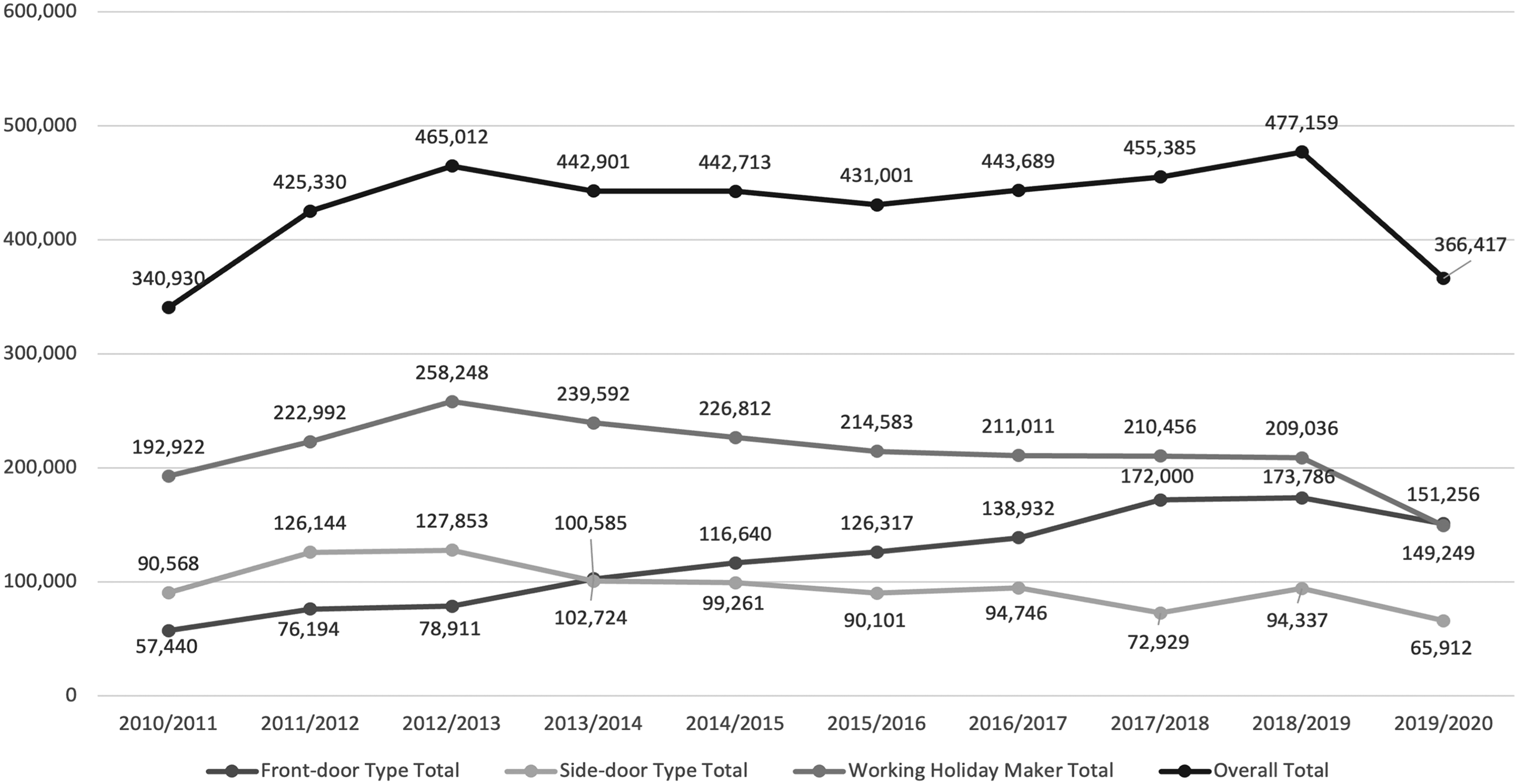
International migration for employment, Australia (visas granted), by overarching program type, 2010/11 to 2019/20.
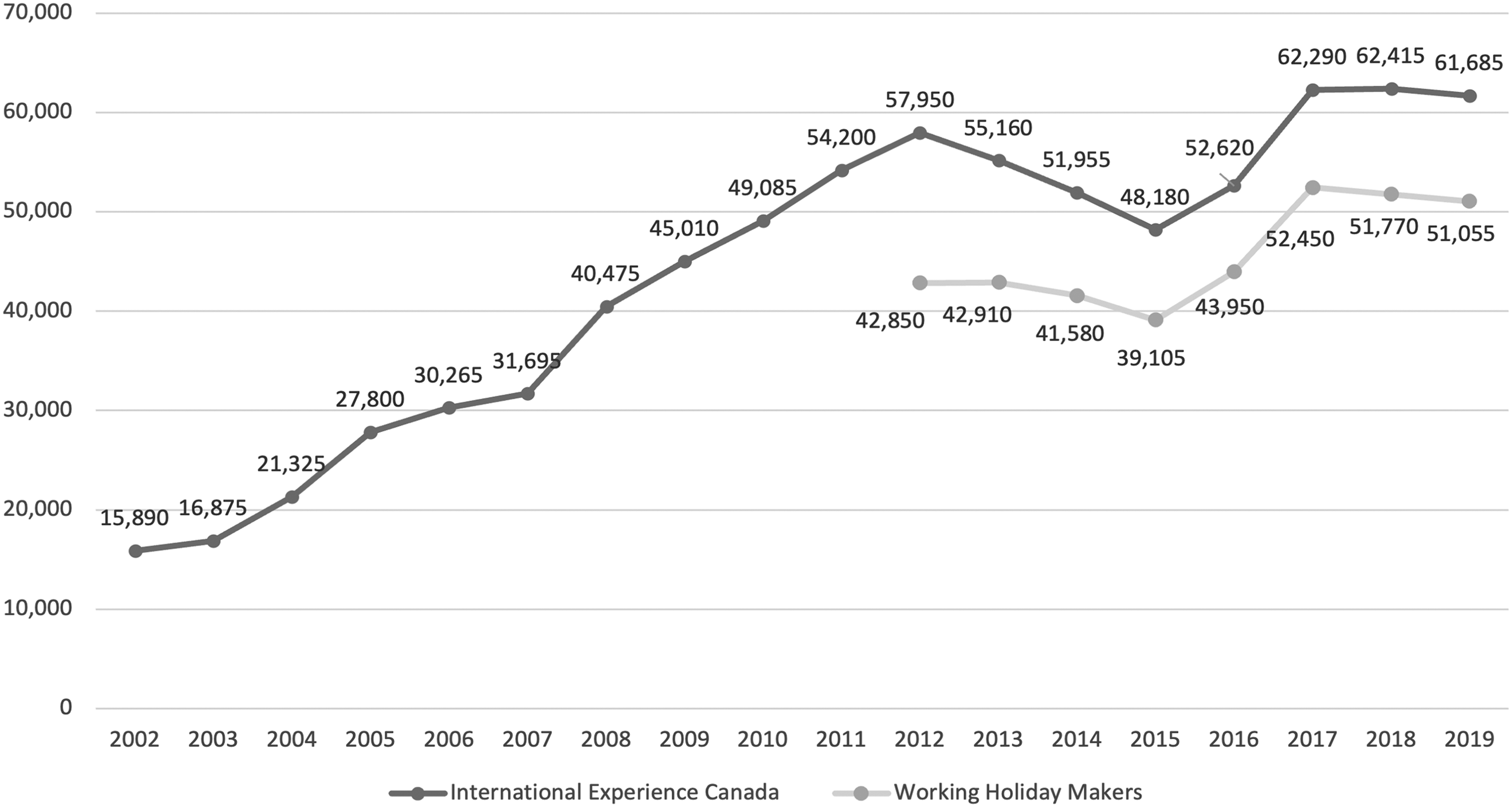
International Experience Canada and working holiday makers (work permit holders), 2002–2019 (calendar year).
Adding a comparative dimension to prevailing studies of working holidaymaking, this article seeks to shed greater light on the Canadian case via the Australian example, while exploring the logics of these countries’ different programs vis-a-vis exploitative processes shaping temporary labor migration to settler colonial states. In addressing these lacunae, it interrogates the nature and effects of WH programs. Sketching their contours, with attention to the industries in which WHMs labor and their associated conditions of work, it analyzes administrative data, historical and contemporary immigration and labor and employment laws and policies, as well as interstate agreements, shaping program design. The analysis reveals a common dynamic underlying the utilization of programs in Australia and Canada: while encouraging cultural exchange among youth is their common rationale, Australian and Canadian WH programs operate increasingly to fill “qualitative labor shortages.” They are a product of these large geographically dispersed settler colonial states, whose populations are concentrated in urban settings, struggle with chronic labor shortages in rurally located industries, such as agriculture and resource extraction, as well as service-economy occupations in urban centers. Yet these two settler states adopt somewhat different regulatory strategies to achieve this end, resulting in inverted trajectories. In Australia, WHMs are highly concentrated in agriculture, a rural industry defined by longstanding shortages of low-wage seasonal labor in high-income countries due to the undesirable conditions associated with this work. Moreover, due to persistent demands for labor flexibility, insofar as WHMs are not subject to the same regulations as those enrolled in agricultural migrant work programs, only those employed in this industry and a few others deemed essential are permitted extensions to their visas, producing a distinction between WHMs from relatively affluent source countries – more closely resembling “cultural sojourners” – less likely to seek extensions and WHMs from relatively less affluent countries, particularly those in which English is not a dominant language, more likely to engage in repeat participation. In this way, such Australian “cultural exchange” programs reproduce precarious employment and tenuous residency status associated with temporary labor migration programs characterized by greater exploitation. Albeit growing, Canada’s WH program is of smaller magnitude, and reflects a sharper policy distinction between cultural exchange and migrant work programs. Still, this distinction is not watertight. Canada extends lengthier visas, opening up greater access to permanent residency, to WHMs closely approximating “cultural sojourners” from a few affluent source countries in which one of its official languages is dominant. Yet, in this context, characterized by the contraction of tightly regulated side-door programs coupled with the limited scrutiny of WH program, existing data reveal that many WHMs are subject to corrosive conditions in the essential and/or frontline industries in which they are most concentrated (e.g. accommodation and food services) – emerging trends obscured by the image of the “cultural sojourner” as illustrated by the Australian case.
In developing these contentions, the ensuing analysis unfolds in four parts. Section one introduces the conceptual framework for the inquiry, utilizing the conception of doors of entry to locate where WH programs lie along a continuum of state-sanctioned 1 de facto labor migration programs. Section two offers an overview of the shifting architecture of international migration for employment on a temporary basis in Australia and Canada from the turn of the 21st century to the present. Tracing the character of this major subset of programs, section three sketches the contours of WH programs in Australia and Canada.
Next, section four profiles WHMs’ social location, the industries and regions in which they work, the duration of their participation, and their conditions of employment, finding that tenuous residency status and precarious employment among WHMs unify the Australian and Canadian cases and that neither country's WH program(s) promote cultural exchange exclusively. Administrative data available on Australia point to the acute and entrenched insecurities confronting WHMs, particularly those from source countries in which English is not a dominant language (FWO, 2016: 25), especially those working in agriculture. In turn, data available on the Canadian case suggest that many WHMs, of whom considerable numbers work in industries in which precarious jobs are common (accommodation and food services), confront insecurities akin to those facing racialized migrant workers enrolled in the country's longstanding migrant work programs in agriculture.
The inquiry concludes by suggesting that WH programs use the rhetoric of cultural exchange to justify recruiting young people in need of funds for overseas travel in attempt to fill essential yet undesirable jobs. In Australia, the assumption that WHMs are cultural sojourners leaves those in sectors such as agriculture devoid of sufficient rights and protections – factors that may lead employers to rely more heavily on WHMs than migrant workers entering through more regulated programs of relatively recent origin. Distinctively, despite similarities in program design, the expansion of WH programs in Canada is moderated by the country's resilient migrant work programs in agriculture, vital context for WH programs’ smaller magnitude. The comparison thereby underscores how these two settler states’ regulatory strategies lead to similar ends: internal stratification, principally on the basis of source country, between those WHMs more closely approximating “cultural sojourners” and those resembling “migrant workers” responding to qualitative labor shortages. It also highlights the consequential effects of this stratification within the expansive Australian WH programs, deeply relevant outcomes for the growing Canadian counterpart and industrial relations scholars studying program design and its effects.
Working holiday programs: cultural exchange or back-door entry for temporary labor migration?
To understand distinctions among those select migrants granted temporary entry into a receiving state, a large body of scholarship engages the conception of “doors of entry” – front, side and back (Zolberg, 1989: 406). Applied to analyses of state-sanctioned international migration for employment on temporary bases, the notion of “front doors” refers to “official… [and direct] channel[s of migration]… through a fortified regime” typically providing pathways to permanent settlement (see e.g. Wright and Clibborn, 2017: 166). Distinctly, “side-door” entry is said to involve labor migration, normally on a permanently temporary and often repeated basis (Rajkumar et al., 2012), via official channels often requiring a labor agreement to be made before the receiving country grants visas to workers (Howe et al., 2019: 217). In contrast, state-sanctioned “back-door” entry involves the provision of “visas with a non-work purpose” that nevertheless permit employment (Howe et al., 2019: 221). 1 With this type of visa, while migrants may engage in de facto temporary labor migration, albeit different from the prototypical agreement-based and regulated side-door variety, the degree to which they participate in the receiving country's labor force is often unknown – as is the impact of their participation where it takes place.
Front-door entry is presumed to accord migrants with relatively stable residency status and pathways to permanent residency. Entering in this manner also typically entails free movement in the labor market and family accompaniment, including in the short term – that is, security of presence, access to, minimally, spousal work permits as well as the full range of settlement services (Rajkumar et al., 2012). Side-door entry is, in contrast, associated with “vexed and contingent” pathways “embedding low wages and conditions” as it often involves programs recruiting migrants, assumed to be less economically desirable, to fill essential jobs undesirable to many locals in sectors such as agriculture and care work (Howe et al., 2019: 216). Canada's longstanding Seasonal Agricultural Worker Program (SAWP), for instance, functions as a prototypical side-door entry program recruiting migrant workers, many of whom are racialized and from relatively low-income countries (i.e. Caribbean states and Mexico) and many of whom migrate to Canada annually, under bilateral labor agreements. Yet the distinctions between programs providing for front- and side-door entry are not absolute. Investigation into the Canadian case points to stratification among participants enrolled in certain “front-door” mobility programs, such as the Post-Graduation Work Permit Program, which provides a pathway to permanent residency to those accruing sufficient qualifying employment, especially along the lines of source country and gender (Vosko, 2020). Such investigation suggests that migrants from countries that have been permitted entry historically yet restricted from permanent settlement on account of explicitly racist immigration policy, such as China and India (Cho, 2002; Mongia, 1999), may still experience precariousness in employment and residency status despite participation in such programs.
Unlike front- and side-door entry, there is a paucity of scholarship investigating state-sanctioned temporary labor migration through the back-door and its associated conditions. Yet, to the extent that back-door entry – as de facto temporary labor migration – has been studied in settler states, literature on cultural exchange programs reveals “a discursive and regulatory construction of work as primarily cultural, as opposed to economic, activity,” fostering precariousness among participants in programs imagined as fulfilling non-work purposes (Bowman and Bair, 2017: 8). It also illustrates how these same programs permit, and occasionally incentivize, participation in jobs cast as essential yet undesirable to locals, such as au pairs, WHMs, and other cultural exchange visa holders. Several studies focusing on Australia illustrate WHMs’ precariousness in employment and link it to their ambiguous status as both overseas travelers seeking extended cultural experiences and workers (Reilly, 2015; Robertson, 2014; Tham and Fudge, 2019). Studies on Canada taking this focus are few, although some emerging examinations of the experiences of youth engaged in cultural exchange programs point to the precariousness of their jobs (on WH programs, see Helleiner, 2017; on youth mobility programs under International Experience Canada (IEC), see Coderre and Nakache, 2021). Still, few investigate the nature and contours of “cultural exchange” programs designed to fulfill non-work objectives, specifically WHM programs, vis-à-vis longer-standing side-door programs aimed at filling essential jobs (for an exemption, see Howe et al., 2019). Fewer still examine such programs with attention to source country dynamics, as well as processes of racialization informing immigration policies in white settler colonial contexts historically. 2 This gap in the literature flows partly from the fact that some WHMs reflect the dominant conception of the “cultural sojourner” – in Australia and Canada, this segment is comprised of travelers, from relatively high-income source countries seeking to earn money to fund their long-term tourism. Yet, arguably, a growing proportion of WHMs are more accurately cast as migrants entering through the back-door, a form of entry that findings below suggest suits employers seeking “flexibility” (i.e. migrants enrolled in less closely regulated side- and/or front-door programs), to engage in employment and motivated to secure repeat participation. Despite the difficulty of separating such migrants from cultural sojourners within WHMs, an objective of this inquiry is to discern patterns fostering stratification among this group.
Programs geared to international migration for employment on a temporary basis: comparing Australia and Canada
In Australia and Canada, whose post-war migration regimes were founded, despite their exclusions, on notions of permanent immigration and settlement, in recent decades international migration for employment on a temporary basis has become the norm.
Australia long resisted introducing official guestworker programs such that, beginning in 2013, the number of visa grants under such streams was outstripped by an expanding variety of front-door programs, including those targeting post-graduates, business investors and highly specialized workers (Howe et al., 2019). Such groups came to constitute 41.3% of all temporary work visa categories in 2019/20 (Figure 1). 3 Alongside this development, enabled by the proliferation of reciprocal migration agreements with substantial quotas starting in the 1990, new state-sanctioned programs with a non-work purpose that nonetheless permit employment grew. Among such programs, WHMs stand out as a sizeable group, constituting fully 40% (or 149,249) 4 of the approximately 366,417 migrants permitted to engage in employment in 2019/20. Meanwhile, less than 20% of migrants entered through side-door programs – that is, programs classified as ‘for a work purpose’ normally involving a labor agreement (i.e. the Temporary Skills Shortage visa and the Seasonal Worker Program) (Figure 1). 5
The embrace of international migration for employment on a temporary basis has been more sustained in Canada partly owing to the country's longstanding side-door programs in sectors such as agriculture and domestic work. Migration for employment on a temporary basis grew dramatically in Canada from the early 2000s to the late 2010s. During this period, new temporary work permit holders went from a total of 132,215 in 2002 to 403,865 in 2019 (Figure 3). This growth was accompanied by the expansion of a variety of ostensibly front-door programs retroactively reclassified (Vosko, 2020) as falling under Canada's “new” International Mobility Program (IMP), an umbrella program encompassing various streams, including specialized knowledge workers, recent post-secondary graduates and intercompany transferees. By 2009, inclusive of IEC, the “front-door” IMP aimed formally at facilitating overseas employment among professionals and skilled workers, began to outpace the prototypically side-door subprograms of the Temporary Foreign Worker Program (TFWP) (Figure 3). As part of this growth, whereas Canada issued 15,890 new permits under the IEC in 2002, it issued 61,685 in 2019, fully 51,055 of which went to back-door WHMs.
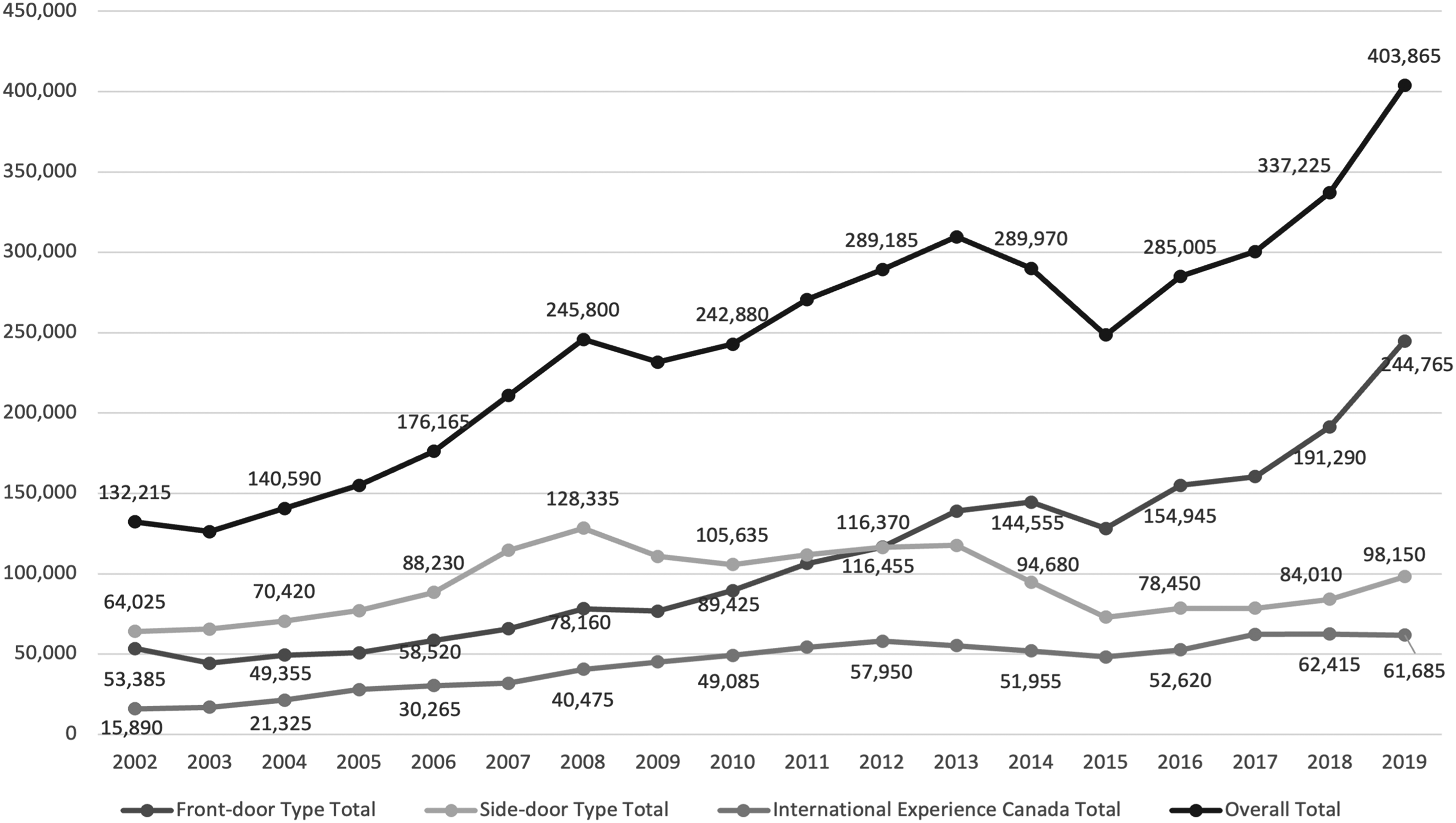
International migration for employment, Canada (work permit holders), by overarching program type, 2002–2019 (calendar year).
Working holiday programs in Australia and Canada: origins, design and operation
Inquiring into the origins, design and operation of WH programs in Australia and Canada suggests that while cultural exchange served as a rationale for programs in both countries at their inception, around the turn-of-the-21st century, they came to target young people for inclusion in the labor force to address qualitative labor shortages. Despite variation in the two countries concerning the industries and occupations within which demands for filling essential jobs is most acute, flowing from Australia's limited and Canada's longstanding resort to side-door temporary labor migration programs in sectors such as agriculture, the two countries adopt somewhat different regulatory strategies to analogous ends.
Australia
In Australia, the first WH program emerged in 1975 with the introduction of the Working Holiday Visa (417), at which point it was framed as a migration program facilitating “cultural exchange between Australia and partner countries, with particular emphasis on young adult” travelers to Australia, supplemented by an opportunity to work (Department of Immigration and Border Protection, 2014: 3; see also Phillips, 2016: 2). The goal was to encourage young holidaymakers’ spending on domestic travel by enabling them “to undertake incidental work … to supplement their holiday money” (Joint Standing Committee, 1997: iii). Accordingly, early on, WHMs had very little effect on the labor market (Harding and Webster, 2002: Appendix C), unsurprisingly given initial restrictions on length of stay (maximum one year), job tenure (maximum three months at one employer) and source country eligibility (exclusively available, at first, to WHMs from UK, Ireland and Canada) (Department of Home Affairs, 2020b, 3).
As Table 1 shows, in 2005 the Australian Government developed a new and more restrictive (in terms of criteria and quotas) WH program called the Work and Holiday Visa (462), under which all subsequent agreements have been negotiated. 6 That year, a second participation for up to 12 months became permissible under the original Working Holiday Visa (417). First time participants who performed specified “seasonal work,” defined subject to regulation, as the equivalent of three months (or 88 days) of full-time work in a “regional area,” 7 were eligible for the extension (Department of Home Affairs, 2005). Initially, specified work encompassed various types of agricultural work, however, the category expanded to encompass work in regional industries including mining in 2006, construction in 2008 and brushfire recovery and critical COVID work in the healthcare/medical sectors (anywhere in Australia) in 2020 (Department of Home Affairs, 2020a; Swoboda and Dosser, 2016).
Comparison of working holiday programs in Australia and Canada.
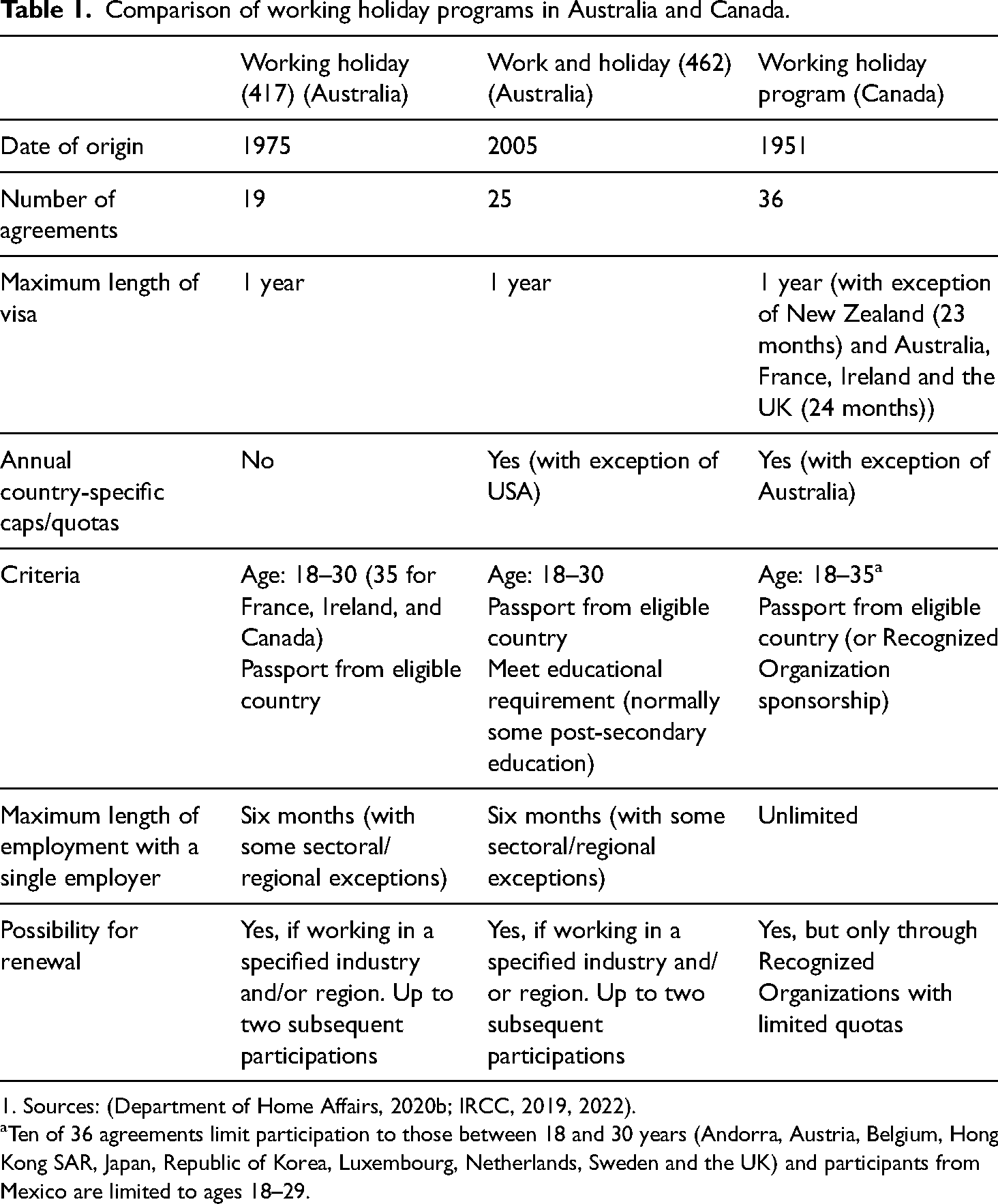
1. Sources: (Department of Home Affairs, 2020b; IRCC, 2019, 2022).
Ten of 36 agreements limit participation to those between 18 and 30 years (Andorra, Austria, Belgium, Hong Kong SAR, Japan, Republic of Korea, Luxembourg, Netherlands, Sweden and the UK) and participants from Mexico are limited to ages 18–29.
From the outset, a rationale for extension was to incentivize WHMs to work in agriculture, an industry forecasting medium- and long-term labor needs offering essential jobs in remote areas undesirable to locals. Other avenues for addressing shortages through temporary labor migration were considered, including an expansion of the existing employer-sponsored skilled labor streams and side-door seasonal schemes. However, a regulatory impact statement found that expanding guestworker programs posed the threat of creating “structural dependence on foreign labour” perpetuating “exploitation and abuse” among these “guest-workers” (Department of Home Affairs, 2005: 7). This concern may have contributed to the extension of a wider range of labor and social protections accorded to participants in the Seasonal Worker Program (SWP) as well as the adjunct Pacific Labor Scheme (PLS) compared to those in the highly de-regulated WH program. For instance, compared to those in loosely regulated WH programs, the side-door SWP permits employment for up to nine months annually among citizens of the Pacific Islands. On account of seasonal workers’ acknowledged vulnerabilities, among other requirements, employers must fulfill or exceed the minimum terms of the relevant industrial instrument (or award), make participants aware that they can join a union, guarantee a minimum average of 30 hours of work per week, engage in fair recruitment and demonstrate to government that seasonal workers will benefit financially from their participation (Department of Education, Skills and Employment, 2018). Accordingly, studies show that the costs of labor beyond wages to employers utilizing the SWP are considerably higher than those utilizing WH programs, a more likely rationale for the modest size of the SWP (Zhao et al., 2018: 1–2).
Going forward (i.e. as of 2006), as numbers of WHMs grew before stabilizing at around 210,000 visas 8 issued annually between 2016/17 and 2018/19 9 (Department of Home Affairs, 2020e), all bilateral agreements facilitating this growth fell under the more restrictive Work and Holiday (462) program. However, provision for a second visa under this new Work and Holiday program came into effect in 2016, at which point current and former visa holders could gain access to repeat participations if they engaged in specified work in tourism/hospitality or agriculture in designated areas of Northern Australia. Around the same time, where an applicant was working as an au pair or employed in certain industries in Northern Australia (e.g. agriculture, construction, mining, tourism), the government extended the 6-month cap on length of time participants may work for a single employer to 12 months under both programs. Such expansion was followed in 2018 by an extension of the age range in the bilateral agreements with Canada, France, and Ireland, such that anyone 18–35 years of age qualified as youth. Shortly thereafter, Australia also introduced the possibility of a third participation for those completing a minimum of an additional six months of full-time specified work in regional (or Northern, in the case of 462 visa holders) Australia.
In the four decades after their inception, therefore, despite continuing to encourage “cultural sojourning” among youth in a narrow age group, WH programs in Australia gradually expanded beyond their original cultural exchange and “non-work” purposes.
Canada
In contrast to its Australian counterpart, IEC, the umbrella through which Canada first facilitated travel and work exchange opportunities for Canadian and foreign youth (and within which its contemporary WHM program falls), originated earlier, in 1951. Prior to the program's introduction official immigration policy barred temporary visitors from working while in Canada (unless they were in-demand workers approved by the National Employment Service) (IRCC, 2019: 10). Since that time, IEC has grown – experiencing a near fourfold increase in work permit holders (from 15,890 to 57,950) between 2002 and 2019 – to represent Canada's second largest IMP subprogram.
The growth of the program through this period is especially notable given Canada's practice of limiting participation through country-specific quotas, a practice that Australia maintains only in the Work and Holiday stream. Structured around bilateral, reciprocal youth mobility agreements and arrangements negotiated between Canada and 36 other countries (as of 2022), agreements typically include one or more of three categories: Working Holiday, Young Professionals, and Co-ops. Within this triumvirate, the WHM category draws the largest numbers of participants. Between 2013 and 2017, 81% of foreign youth participating in IEC fell under this program, representing the fourth largest such program in the OECD (behind Australia, the US and New Zealand) (IRCC, 2019; OECD, 2019: 27).
Canada issues open work permits to youth participating in the WH program allowing them to work for virtually any employer in the country (IRCC, 2019). The standard length of work permits issued varies by participants’ country of origin. Agreements with the vast majority of countries set out a 12-month maximum, yet those with Australia, France, Ireland, New Zealand, and the UK have terms of 24 months. These longer permits make it more feasible for WHMs from these “culturally compatible” source countries, to quote Canada's former Minister of Immigration (Kenney as cited by Helleiner, 2017: 300), typically imagined to be cultural sojourners, to transition to permanent residency. 10 Their more generous duration is particularly notable as these countries are among the top eight countries of citizenship of youth admitted under the WHM program, constituting fully 59% of participants in 2019. 11 This source country dynamic is also linked to the fact that Ireland and France have the two highest quotas, standing at 10,500 and 7100 in 2020, respectively, while Australia's quota is unlimited (IRCC, 2021a; IRCC, 2021b; IRCC, 2021c).
In contrast to Australia, repeat participation as a WHM is highly restricted in Canada; Recognized Organizations (universities and various non-profit organizations), through which a small quota of youth access the program, can grant limited repeat participations annually independent of where the WHM plans to engage in employment – both the region and the industry (or occupation) in which these open work permitholders aspire to work (IRCC, 2020a). Thus, unlike in Australia, repeat participation as a WHM is not tied explicitly to documented labor shortages. The absence of such incentive structure reflects the existence of temporary labor migration programs of significant magnitude in industries in which employer demands to fill essential jobs are unmet by nationals, such as agriculture. Most participants in agricultural subprograms of the TFWP migrate from countries in the Caribbean and Latin America, whereas over half of Canada's WHMs are from Australia, France, Ireland, and the UK (as of 2019). It might therefore appear that Canada's WH program more closely approximates a cultural exchange program, attracting travelers from affluent countries, than its Australian counterpart. Yet WHMs’ considerable labor force participation in Canada, alongside the contraction of those subprograms of the TFWP outside agriculture, in which many labor (e.g. accommodation and food services), suggests that this characterization – and its attendant comparison – is not straightforward. A closer look at Canada's WH program and its participants, especially alongside the more well-documented Australian case, reveals key similarities in these settler states’ WH programs and especially their effects (i.e. qualitative outcomes).
Working holidaymakers and their conditions of work and residence in Australia and Canada: continuities through back-door entry
Demands for workers to fill vacancies undesirable to locals that Australian and Canadian WH programs address are distinct, shaped by these settler states’ historical approach to encouraging international migration for employment on a temporary basis. Comparison of the two contexts nevertheless reveals internal stratification between genuinely mobile WHMs reflecting the image of the “cultural sojourner” and those effectively migrating for work purposes through the back-door in both instances. Furthermore, while data reveal less well-entrenched insecurities among WHMs in Canada than in Australia, larger trends highlight the potential for convergence where conditions of work and residency are concerned.
Australia
In the Australian case, WHMs – that is, participants in both the Work and Holiday and Working Holiday programs – numbered 209,036 in 2018/2019. In 2019/2020, during the COVID-19 pandemic, numbers dropped below 200,000 (Figure 1) but were considerably higher than those engaged in post-study work (54,021) and highly specialized (or “skilled”) work (30,296).
Demographic make-up
As for the composition of the WH workforce, in 2018/19 about 14% (28,813) and 86% (180,233) participated in the Work and Holiday and Working Holiday programs respectively. However, between 2012/13, when the overall total of WHMs peaked, and 2018/19, participation in the Working Holiday program declined by 28% whereas it grew by 195% in the Work and Holiday program. Given that the less restrictive Work and Holiday Program facilitates participation of migrants from lower-income countries where English is not a first language, this program's growth, in relation to its counterpart's decline, complicates the image of working holiday makers as affluent tourists or cultural sojourners.
Breaking down visas granted by age into the discrete categories of 18–25 and 26+, among those enrolled in the Working Holiday program, from 2005/06 and 2019/20 trends in age were relatively consistent. Specifically, the bulk of participants fell in the younger age group (though from 2017/18 to 2019/20 the percentage of participants in the 26+ category grew modestly). From 2005/06 to 2019/20, there was near gender parity among participants in the Working Holiday (417) program. In contrast, whereas men and women represented fully 75% and 25% of participants, respectively, in its Work and Holiday (462) counterpart in 2005/6, over this period women came to hold higher concentrations such that the ratio for 2019/20 was 60% to 40% women to men. Meanwhile, with regards to repeat participation, women participants have exceeded 60% of repeat participants every year since such opportunities became available.
Additionally, examining trends in source country reveals that the Working Holiday program, in which a more limited number of countries participate by way of bilateral agreement, a higher percentage of such program participants from Taiwan and South Korea opt for repeat participation. 12 This trend is more prominent among those enrolled in the Work and Holiday program, suggesting sustained participation of WHMs from lower-income countries for whom English is not a mother tongue (i.e. Chile, China and Indonesia) (Table 1). These findings are consistent with past trends, insofar as China and Chile have been in the top five source countries for first and second participations since 2016/2017, while Indonesia entered the top five for second participations in every year between 2017/18 and 2019/20 (Department of Home Affairs, 2017, 2018, 2019, 2020a, 2020b, 2020c, 2020d, 2020e, 2020f, 2021a, 2021b). Such gender and source country dynamics shaping repeat participation reflect a program designed to ensure that repeat participants engage in employment addressing qualitative labor shortages – as discussed above (Table 2).
Australian working holiday (417) and work and holiday (462) visas granted, first and second participations by top five source countries, 2019/20
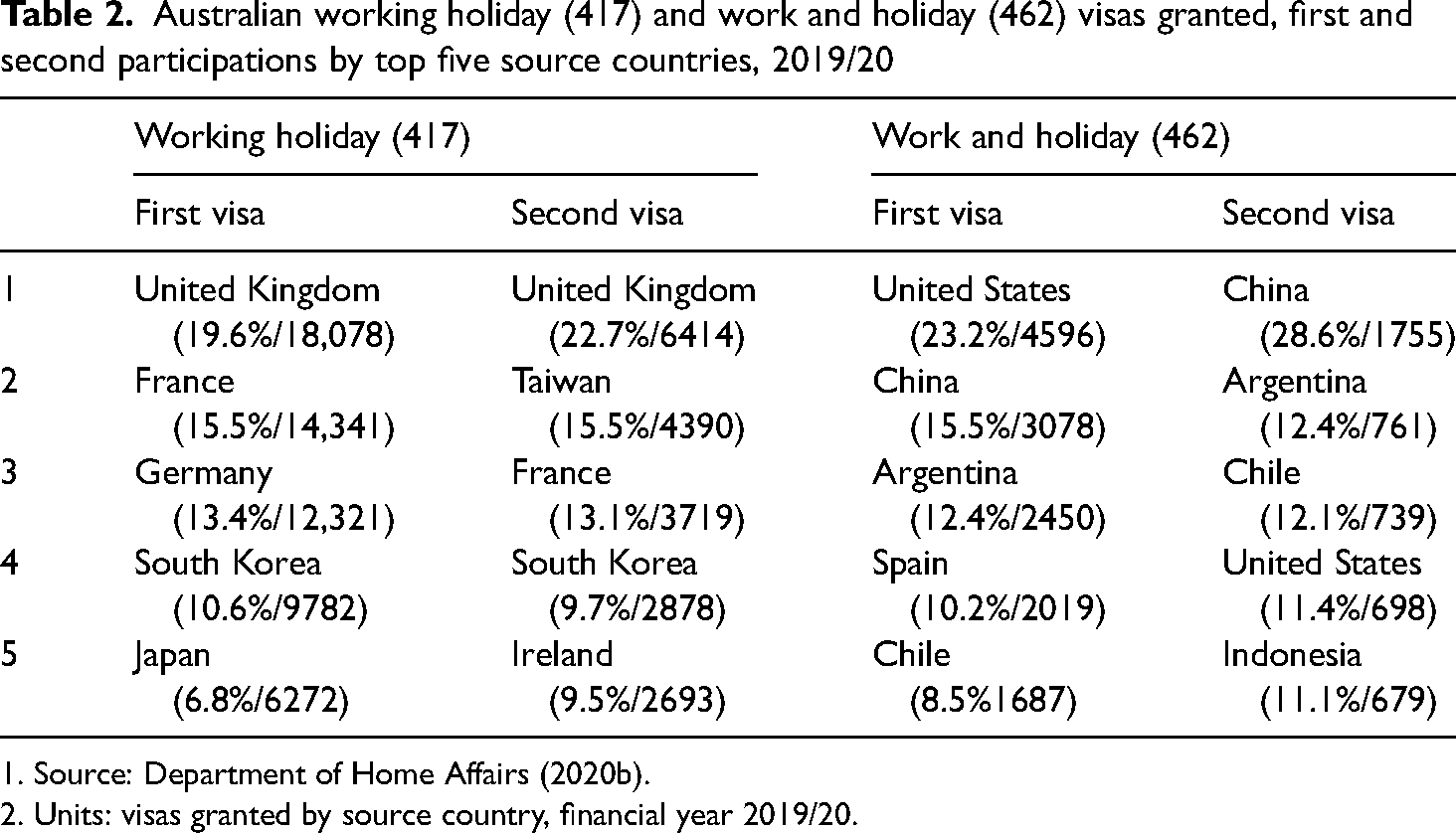
1. Source: Department of Home Affairs (2020b).
2. Units: visas granted by source country, financial year 2019/20.
Industrial location and working conditions
Australia's two WH programs are structured to ensure that repeat participation addresses labor shortages in select occupations and industries undesirable to nationals; consequently, the only industry-based data publicly available on WHMs pertains to second participations, although data on third participations is emerging. In 2019/20, those granted a subsequent (second or third) participation in the Working Holiday program overwhelmingly accessed subsequent participations through agricultural labor (82% and 75.3%, respectively). In contrast, as specified industries are more varied among those enrolled in the Work and Holiday program, in 2019/20, 51.3% of participants accessed second participations through agricultural work, while 46.2% did so through work in the hospitality sector. WHMs’ concentration in certain industries characterized by labor shortages is a source of concern given the conditions of employment therein (Wright & Clibborn, 2017: 184). Attesting to such concern, a third of Working Holiday Program participants surveyed by the FWO (2016: 4) in 2016 reported that they were paid less than the minimum wage. Relatively low hourly wages are exacerbated by differential taxation rules for Australians and temporary residents – WHMs are taxed at 15% from the first dollar earned (which is automatically withheld from their pay) unlike citizens and permanent residents who had an $18,200 tax-free earnings-threshold in 2021 and distinct from WHMs in Canada who, akin to other labor force participants, likewise had a $13,229 threshold in 2021 (Government of Canada, 2021). 13 A lack of access to jobseeker payments in periods of unemployment, sickness or injury due to residency requirements heightens this insecurity (Robertson, 2014: 1923). Furthermore, during the global health pandemic in 2020/21, WHMs were ineligible for COVID-related sick leave payments. Such exclusions diminished already limited access to subsidized healthcare in the first instance: while Australia maintains reciprocal arrangements that allow visitors to enroll in basic Medicare benefits (subject to a levy on their taxes) with a subset of high-income countries participating in the Working Holiday Program (i.e. Belgium, Finland, Italy, Malta, the Netherlands, Norway, Ireland, Sweden and the UK) and one country participating in its Work and Holiday counterpart (i.e. Slovenia), WHMs migrating from other source countries must rely on purchasing private health insurance.
Additionally, WHMs lack access to unfair dismissal protection given the 6-month limit on working for a single employer prescribed under both programs, an exclusion discouraging them “from raising issues about occupational health and safety or wage theft because they are not protected… when their employer takes adverse action against them” (Migrant Workers Centre, 2020: 3). In sectors such as agriculture, such exclusions reinforce dependence on employers, upon whom WHMs also rely for accommodation, transportation, and access to other services (FWO, 2016). 14
Given these conditions, unsurprisingly, in 2012, nearly a quarter of disputes filed with Australia's FWO by temporary visa holders (23%) were from WHMs, specifically, 417 visa holders (FWO, 2016). The number of disputes that go unreported is also likely significant as a 2016 survey conducted by the FWO found that 59% of the WHMs surveyed were unlikely to complain out of fear of employer reprisal, fueled by their lack of access to unfair dismissal protection and the threat of repatriation.
Still, pointing to the reliance on WHMs as a labor-cost containment strategy in industries characterized by unmet demands for essential labor locally due to the precarious nature of particular jobs, even during the 2020–21 COVID-19 pandemic, employers in such industries lobbied for the easing of visa renewals among existing WHMs (Joint Standing Committee on Migration, 2020). Those in agriculture were, moreover, most vocal in raising concerns about impending labor shortages with the diminution of this labor supply. Accordingly, in a submission to a 2020 Inquiry into the Working Holiday Maker Program, Australian Fresh Produce Alliance (AFPA) and Deloitte Access Economics claimed that “the removal of WHMs from the fresh produce industry would [prompt]…a $6.3 billion reduction in the value of the [Australian] horticulture industry” (Joint Standing Committee on Migration, 2020: 5). Raising further alarm, large industry associations claimed that the resultant job loss would also increase the price of fruits and vegetables for Australian consumers appreciably (AFPA and National Farmers’ Association (NFA) as cited by Joint Standing Committee on Migration, 2020: 3, 5).
Across submissions to this Inquiry, there was a recognition that agricultural employers, particularly those reliant on harvesters, are able to utilize WHMs’ because of the requirement to undertake this work to secure subsequent visas (AFPA and NFA as cited by Joint Standing Committee on Migration, 2020: 4). Employers also acknowledged that WHMs likewise provide a more flexible agricultural workforce, enabling them to cope with fluctuations in demands for labor, compared to the SWP and PLS, side-door entry programs which are more regulated to limit exploitation. 15 The “flexibility” offered through the back-door by the WH schemes – wherein, as revealed above, women and those from lower-income countries where English is not a first language predominate as repeat participants – was also tied to preserving secure jobs for Australians since, according to the Northern Territory Farmers Association (as cited by Joint Standing Committee on Migration, 2020: 1), “every permanent job performed by an Australian citizen or permanent resident in the industry is dependent on 3 harvest roles, usually performed by visa holders.” Thus, while entries of WHMs, many of whom were destined for agriculture, declined in 2020/21 overall, the decline of first Working Holiday and Work and Holiday grants were steepest while second Work and Holiday grants actually increased, 16 as provisions were made to ensure their continued participation.
Canada
Alongside the overall contraction of the side-door TFWP, coupled with the continued growth of agricultural subprograms under its auspices, WHM programs also grew in Canada in the 2010s. Canada was host to a cumulative total of 322,620 WHMs in the 2013–2019 period. Between 2002 and 2019, the annual number of migrants to Canada under the IEC program quadrupled, approaching 60,000 permit holders in 2019 (before the COVID-19 pandemic) and, in the 2013–2019 period, considered cumulatively, WHMs represented fully 85% of this group (Figure 2).
Demographic make-up
Considering the years 2012–2019 cumulatively, there was near gender parity among WHMs. With respect to age, nearly 55% of WHM in Canada were over the age of 25 in this period, consistent with trends in both Australian programs (IRCC, 2020b). In turn, Australia, France, Japan Ireland and the UK were the top five countries of citizenship of those participating, representing 16.8%, 14.0%, 12.3%, 11.3% and 10.7% respectively, a group of countries characterized by socioeconomic profiles akin to the top source countries of first participants in Australia (Table 1). Attesting to the significance of labor force participation among WHMs in Canada, a program evaluation in 2017 found that an overwhelming majority (93%) also reported engaging in employment, of whom fully 78% reported working full-time. Of those who were employed, most surveyed (82%) reported receiving financial compensation, although a larger percentage of respondents employed as Young Professionals (90%) than as Working Holidaymakers (84%) received financial compensation for their work (IRCC, 2019: 24).
Industrial location and working conditions
In an overlapping period, specifically between 2004 and 2015, in which the Canadian government undertook an evaluation of IEC and its subprograms, the incidence of employment among IEC participants as a whole also grew steadily as did their average annual employment earnings, which rose from $5200 to $15,300. However, average annual employment earnings of $15,300 is a relatively low figure given that over three-quarters of IEC participants reported working full-time in the 2013–17 period, prompting the Canadian government to infer that these visa holders may primarily be occupying lower skilled and/or entry level positions (IRCC, 2019: 24). Adding to this precariousness, although all IEC participants must hold private (often costly) health insurance that covers medical care, hospitalization, and medical repatriation as a condition of their entry, an inability to access unemployment insurance (i.e. redundancy) payments is the norm as qualifying requirements pivot on hours and duration of employment.
Although there is a dearth of accessible administrative data on patterns of labor force participation among WHMs, a review conducted by the federal government in 2018 shows that in each year between 2010 and 2015 the top five industries in which IEC participants worked were accommodation and food services, retail trade, arts, entertainment, and recreation, administrative and support and waste management services, and construction. As of 2015, the largest percentage (fully 36%) worked in accommodation and food services. The high concentration of IECs in this industry is notable given the announcement of a moratorium on the hiring of migrant workers in food services and retail trade sectors under the TFWP a year prior (ESDC, 2014). Following this review, the moratorium was retained only for “positions that require little or no education or training” in economic regions with employment rates lower than 6%. 17
The scandals sparking such action included those involving large franchises, revealing that WHMs are working for employers accessing migrant workers through the TFWP for concerning reasons, such as the ability to deny them legal rights and entitlements, in the pre-2014 period (Fudge and Tham, 2017). Of particular import, engaging in employment in low-waged industries, such as food services, effectively thwarts WHMs’ access to the limited routes available for securing permanent residency for participants falling into this demographic group – for example, the Canadian Experience Class stream, through which WHMs are most likely to apply for permanent residency, requires the equivalent of one year of full-time skilled work experience in Canada – a stiff requirement for WHMs – as evidenced by their self-reports (Coderre and Nakache, 2021), especially those from a majority of source countries for whom open work permits are issued for 12 months maximum (i.e. except Australia, France, Ireland, New Zealand and the UK).
Somewhat distinct from Australia, during the COVID-19 global health pandemic, Canada put all invitations via IEC on pause; simultaneously, it introduced extensive restrictions for new entrants with the effect that few prospective participants could enter. 18 The government permitted IEC participants present in Canada working in any field to apply for extended work permits up to the maximum duration specified in each country's mobility arrangement with Canada. In comparison to Australia, which issued what were essentially 12-month long sector-specific closed work permits to WHMs seeking an extension and willing to work in a critical occupation, 19 Canada required WHMs whose permits were about to expire to apply to stay as visitors (rendering them unable to work). In this context, IEC permitholders dropped to 17,640 in 2020 (a decrease of 71.4% compared to 2019); yet WHMs continued to account for 83% (14,725) of all such permit holders (IRCC, 2021e). This policy response underscored the Canadian government's continuing assumption that WHMs are cultural sojourners. However, that businesses in accommodation and food services had to scale back or close due to public safety requirements throughout 2020 and into 2021 is not incidental. Declining provision of such services during the global pandemic moderated employer demands for WHMs to fill front-line jobs therein. Meanwhile, classifying migrants in agriculture as “essential workers,” the Canadian government continued to admit participants, most of whom migrated from Latin America and the Caribbean, under its agricultural temporary migrant work programs such that 50,585 arrived from January to November 2020 (vs. 56,690 in 2019), a modest decline in arrivals compared to that experienced in Australia (IRCC, 2021d).
Policies and programs prioritizing employer demands for migrant workers in essential sectors such as agriculture, documented in the analysis of the Australian WHM schemes above, are thereby evident in the Canadian context (via the TFWP). And though the demand for workers in accommodation and food services was clearly impacted by COVID-19 safety protocols, there is nothing to suggest that, outside of the pandemic, Canada's WHM program is exempt from such demands within these industries.
Conclusion: lessons learned
In Australia and Canada, WH programs use the rhetoric of cultural exchange to justify recruiting young travelers for work in essential jobs undesirable to many permanent residents and citizens. By treating WHMs as cultural sojourners, albeit to different degrees and via distinct regulatory strategies, these countries’ respective programs heighten their precarious residency and job status overall while fostering internal stratification among differently located social groups. By using WH programs to promote employment in specific industries, in Australia WHMs are highly concentrated in agriculture—a degree of concentration sustained by permitting only those WHMs willing to work in this and a few other industries and occupations to extend their visas. This strategy of linking participations to engaging in employment therein is seemingly contributing to a distinction between largely younger WHMs resembling “cultural sojourners” less likely to engage in repeat participation as opposed to somewhat older WHMs whose profiles do not conform neatly to this image. Moreover, while WHMs from the UK and France remain prominent in the mix of second and third participants, Australia's WHM programs have seen increasing concentrations of participants from certain less affluent countries (e.g. Taiwan) from participation to participation, despite conditionalities attached to extensions (i.e. that repeat participants engage in occupations and industries associated with heightened forms of exploitation). As such, Australian back-door “cultural exchange” programs reproduce labor market insecurities associated with longstanding temporary migrant work programs in high-income receiving countries, such as Canada, programs under scrutiny for exacerbating racialized precariousness in their reliance on workers migrating from relatively low-income source countries source countries in Latin America and the Caribbean. 20
Approached through this lens, Canada's prevailing side-door migrant work programs, especially in agriculture, seemingly moderate the expansion of WH programs to the degree that it has occurred in Australia. In comparison to Australia, Canada's WH program is of smaller magnitude and its formal program parameters more closely approximate “cultural exchange.” Still, its holidaymakers work for pay and many of the industries in which they are most concentrated (e.g. accommodation and food services) are characterized by corrosive conditions – of sufficient concern to spur a moratorium on the hiring of migrant workers in food services and retail under the TFWP in the mid-2010s. Moreover, lengthy visas, providing pathways to permanent residency, are only extended to WHMs from a few affluent source countries where Canada's two official languages are dominant – Ireland, Australia, France, New Zealand, and the UK. Comparing WH programs and their uptake in Australia and Canada thus underscores how the two countries’ regulatory strategies share corresponding a purpose – they aim to contribute to rectifying qualitative labor shortages through the back-door – threatening to reproduce source country-based stratification in ways poised to heighten precariousness. The complex character of these countries’ different programs thus merits closer scrutiny. It also underlines the need for further comparative analyses of mobility programs assumed to involve liberated global movement among migrants with varying (often non-work) objectives.
Footnotes
Acknowledgement
I thank Keelin Griffin and Cynthia Spring for their research assistance, anonymous reviewers and JIR editors for their helpful comments, and the SSHRC for its support via Insight Grant #435-2021-0291.
Declaration of conflicting interests
The author(s) declared no potential conflicts of interest with respect to the research, authorship, and/or publication of this article.
Funding
The author(s) received no financial support for the research, authorship, and/or publication of this article.
