



Abstract
‘Modern slavery’ describes various forms of severe relational labour exploitation. In the realm of global value chains and global factories that are led by multinational enterprises, modern slavery encompasses practices such as forced labour and debt bondage. Multinational enterprises organise and orchestrate global value chains into global factories that are highly adaptive to market pressures and changes in the external environment. We employ the global factory framework to conceptualise when and how global value chains become more vulnerable to modern slavery. We argue that combinations of the three global value chain characteristics: complexity, appropriation arrangements, and obligation cascadence, jointly form an environment in which modern slavery can evolve and take root. The degree to which forms of modern slavery become visible and recognisable depends on the particular combination of these characteristics. External factors can moderate the relationship between these factors (e.g. involvement of non-governmental organisations) or exaggerate their effect (e.g. a pandemic).
Introduction
Modern Slavery is a relatively recent term used to describe various forms of severe relational exploitation. It lacks a definition in international law and has been described as ‘a concept in search of a clear legal definition’ (Nolan and Bott, 2018: 44). The challenges in defining a universal understanding of modern slavery and the notion that businesses in the global factory may, to varying degrees, feel pressured to engage in exploitative practices, suggest that how we perceive modern slavery, conceptualise and identify this phenomenon, is best thought of as a continuum of exploitative practices that are context dependent. There is strong support for conceptualising modern slavery as existing on a continuum (Hsin, 2020; Marshall, 2019; Nolan and Boersma, 2019). This is particularly in the context of the organisation and orchestration of global value chains (GVCs) into global factories by multinational enterprises (MNEs) that are highly adaptive to market pressures and changes in the external environment (Buckley, 2009a; Buckley and Ghauri, 2004). In these dynamic settings, the configuration and set up of the global factory is shaped by how the MNE as the lead firm can derive greatest value from the geographically and organisationally dispersed production process (Buckley, 2009a). That is, location choices for productive activities and the type of work that is outsourced and handed to (overseas) suppliers, are fine-tuned to maximise efficiency and productivity for the global factory.
These configurational adjustments bring benefit to the lead firm while the inclusion in global value chains can lead to upgrading of the firms and development of the locations included in the network (Buckley, 2009b; Gereffi, 1989). Yet, the dynamic adaptation of the global supply network may lead inadvertently – or by default as some have argued (Anner et al., 2013; Phillips and Mieres, 2015) – to unfavourable outcomes for suppliers across the tiers. Dindial et al. (2020), for example, have argued that lead firms have such significant power and influence over their suppliers that any additional value that is created through economic upgrading is likely to be appropriated by the lead firm and not by the supplier. The supplier is then caught between higher investment costs and lower margins. This strategic decoupling between lead firm and supplier (Rainnie et al., 2013) can be a contributing factor to suppliers seeking any means to lower their operational costs which may subsequently lead to forms of modern slavery (Clarke and Boersma, 2017; Davies and Ollus, 2019).
In this paper we employ the global factory framework (Buckley, 2009a, 2009b; Buckley and Ghauri, 2004) to conceptualise when and how GVCs become more vulnerable to modern slavery. We ask what GVC characteristics combine to create an environment in which modern slavery can evolve and take root? Guided by the literature, we suggest that there are three characteristics of governance and network configuration that shape interactions along the network. These are complexity, appropriation arrangements, and obligation cascadence. Drawing on these we propose that there is a continuum of exploitation that can culminate in forms of modern slavery, and argue that the degree to which forms of modern slavery become visible and recognisable depends on the particular combination of these characteristics, which by themselves do not lead to modern slavery.
We illustrate our framework by mapping out existing research gathered on the football manufacturing industry in Sialkot, Pakistan – an industry long-recognised as a site for modern slavery. Sialkot used to be the global epicentre for the production of hand-stitched footballs. The industry's operations in Sialkot came to prominence in the mid-1990s for their extensive use of child labour within a cottage industry. Since then numerous studies have traced and documented the drivers for child labour and labour exploitation in Sialkot and changes to the industry (see for instance Khan et al., 2010; Lund-Thomsen and Coe, 2015; Save the Children Fund, 1997). This empirical corpus provides us with a rich, 25 year-long narrative to interrogate our framework. The study thus has two aims: the first is to conceptualise the conditions when and how global value chains become more vulnerable to modern slavery by identifying how combinations of characteristics create an environment in which modern slavery can form. Our second aim is to show how, as a result, modern slavery extends beyond being an ‘event’ or confined to a particular act of severe labour relational exploitation, but instead occurs on a continuum of practices. The paper makes a number of contributions. The first is to contribute to the discourse on how to define and identify modern slavery by providing a conceptual framework that is embedded in the global factory. We extend this discourse by conceptualising and empirically illustrating how, by using this lens, modern slavery moves beyond being considered as an event but rather as a continuum that is embedded by the practices and operations of the global factory in global value chains. The paper thus contributes a fine grained understanding of how lead firms of global value chains, and the so-called global factories influence and exacerbate conditions of modern slavery. This perspective complements the call by Schulze-Cleven, Herrigel, Lichtenstein, and Seidman (2017) for more cross-disciplinary perspectives on global labour. In developing the framework, we synthesize literature from the international business, economic geography and law literature and explore its efficacy using work published in economic geography, development studies and labour relations journals. We thus contribute a framework that can be used by those from a variety of disciplinary backgrounds.
In the following section, we introduce the key concepts of the global factory and modern slavery, before presenting the conceptual framework. We show the applicability of the framework by relating it to research that investigates how the football manufacturing industry in Sialkot has evolved since the mid-1990s until today.
Key concepts
The global factory
International business transactions are dominated by MNEs. About 30 per cent of global trade has been estimated by the United Nations Conference on Trade and Development (UNCTAD) (2016) to be intra-firm activities. This figure illustrates the immense geographical and organisational spread of MNEs. Subsidiaries and affiliates are established in locations where the internalisation of particular activities makes economic sense to the MNE as it supports the MNE in creating, protecting, and maintaining value. The global network of subsidiaries and affiliates is part of the MNEs’ global factory that is complemented by contracted suppliers and non-contracted suppliers of suppliers. Bringing these two networks together, it is estimated that about 80 per cent of global trade is directly and indirectly related to GVCs that are led and orchestrated by MNEs (UNCTAD, 2013). In other words, there are very few economic activities today that occur without the involvement of an MNE somewhere along the process. The above figures reflect this for international trade, yet the reach of economic activities of MNE is also reflected in purely domestic economic transactions. The ubiquity of the MNE has consequences for how global networks operate, which directions they follow, and how they develop and spread codes of conducts and legal compliance.
Buckley (2009a) suggests that the MNE as the lead firm has the capabilities and means to ‘orchestrate’ its global factory. The emphasis on orchestrating the global factory is distinctively different to the previous conceptualisation of the MNE as a lead firm in GVCs (Gereffi et al., 2005). Implied in the latter framing of how the MNE interacts with the GVC is the understanding that the MNE is the ultimate contractor of goods and services. Yet, its influence over how individual actors within the network operate is limited. It is only within a captive governance structure that the MNE, as the lead firm, exerts considerable influence over firms outside the hierarchical boundaries of the MNE.
Buckley's (2009a) framing of the MNE as an orchestrator of the global factory and its GVC adopts a different perspective. Here, the MNE is not only seen as the instigator of a production process and recipient of the final good, but as an organisation that has the ability and capability to engage with the length and breadth of its global factory. The MNE orchestrates the types of activities that are carried out in various locations – activities are fine-sliced into discreet operational activities that allow for production processes being placed in locations that make most economic sense for the MNE. Because the MNE is seen as an orchestrator of the global factory, it is also assumed that the MNE has responsibility for how firms within the global factory conduct their business and to what extent this is in line with societal expectations and legal requirements (Enderwick, 2018).
However, the MNE does not orchestrate its global factory through ownership. Buckley (2009a) conceptualises governance within the global factory as enacted through ‘control’ by the MNEs. Control is exerted through the financial, technological and managerial superiority and power of the MNE which translate into a strong bargaining position concerning, inter alia, the appropriation of value created within the global factory (Clarke and Boersma, 2017; Dindial et al., 2020; Rainnie et al., 2013; Taylor et al., 2013) and the dissemination and enforcement of codes of conduct across the global factory (Christmann and Taylor, 2006; Narula, 2019). The latter implies that the MNE is not only capable of monitoring and enforcing product and quality standards that benefit the goods created and by default MNE; but that the MNE is by extension also capable of monitoring and enforcing activities that relate to social and environmental standards.
Modern slavery
The term modern slavery was introduced in the academic discourse on labour exploitation and unfree labour around 2007 (Smith and Johns, 2020). Modern slavery is used today as an umbrella term to describe various forms of severe relational exploitations in the workplace, at home and elsewhere (Nolan and Boersma, 2019; Parliament of Australia, 2017; Voss, et al., 2019). Modern slavery includes a range of exploitative practices that are separately defined in law, as is done directly in the Modern Slavery Act 2015 (UK; UK Parliament, 2015) and indirectly by reference in the Modern Slavery Act 2018 (Australia). Modern slavery includes practices such as child labour – although Cullen (2019) argues there is not complete overlap between the worst forms of child labour and modern slavery – human trafficking, various forms of bonded labour, and forced labour. Beyond the immediate context of the global factory and global value chains that is relevant for this research, the term has also been used to describe forced marriage and organ removal, for example. Bales (2005; 2012) and Kara (2014; 2017) and others have shown that workplace practices associated with un- or low-skilled labour also constitute modern slavery because these workers are forced to accept any employment they can find. Moreover, these practices often engage migrant workers because they are vulnerable, less aware of their rights and may not speak the language of the host country or region (David et al., 2019).
Yet, notwithstanding the efforts by the Walk Free Foundation (2018) to empirically account for modern slavery through the Global Slavery Index, identifying instances of modern slavery remains difficult given the lack of a hard and unequivocal definition. Furthermore, Nolan and Boersma (2019) question whether modern slavery is an appropriate ‘overarching term’ for the practices which it typically embraces, given the associations with historical slavery and its emotive and sometimes racially charged implications. Nonetheless, they conclude that it is now a commonplace term, and is modern in the sense that it is a response to the abolition of legal forms of slavery which existed in the past Instead of ownership, it is characterised by extreme levels of control (Allain, 2012).
Conceptualising the modern slavery continuum in the global factory
Modern slavery is typically, but not only, found at activities that require fewer skills and are of lower value-adding quality. Indeed, Crane (2013) proposes that modern slavery exists and persists within a particular industrial, socio-economic, geographical, cultural and regulatory context. Nolan and Boersma (2019) argue that even without human trafficking or captivity, modern slavery can develop from a deterioration of labour conditions – without recourse to remedy either in law or in practice – that moves workers along a continuum of exploitation which can end in modern slavery. This has also been termed a continuum of unfreedom by Hodgkinson et al. (2014) who argue that workers may move along the continuum, but will struggle to exit exploitation altogether. The concept of the continuum of exploitation was developed to address the complex and dynamic nature of modern slavery, but was initially intended to enable identification of a remedy (Skrivankova, 2010) rather than to suggest a shifting but inescapable situation. The contextual factors that could therefore contribute to modern slavery include, but are not limited to, the labour intensity within an industry, the legitimacy of a firm or industry, persistent poverty and unemployment, geographic isolation and thus lack of enforcement of legislation, entrenched inequalities based on local traditions and values, and the overall strength of government and the rule of law (Crane, 2013). Private governance initiatives such as the Ethical Trading Initiative have attempted to provide a framework and guidance for participating firms on how to operate within such environment while supporting local workers (Hughes, 2001). These risk factors are brought together in the following section where we discuss particular characteristics of how the global factory is structured and governed and consider the implications for the manifestation of forms modern slavery. Guided by the literature, we identify three dimensions which we argue capture relational engagements that contribute to a context specific continuum of modern slavery: the complexity of the global factory, the appropriation mechanisms and possibilities, and the capabilities and effectiveness of cascading societal and legal expectations through all levels of the global factory. Although not in the same vein as a relational engagement we further note the importance of external factors in influencing the modern slavery continuum in the global factory, and illustrate the importance of external factors in the case of the football stitchers.
Complexity
Global Factories are geographically dispersed, straddling multiple legislative, cultural and socio-economic locations. Depending on the market forces with any given industry sector and depending on proprietary know-how which the MNE seeks to internalise to protect its competitiveness, the structure of their global factories and GVCs vary in complexity. They vary from short GVCs with only a few tiers to GVCs that are many tiers in length, crossing national boundaries and are often opaque and difficult to navigate (Kano et al., 2020). The length of the GVC is compounded by the breadth of the network, that is, how linear or networked GVCs are. More linear GVCs are captive and can ‘belong’ to one global factory. They are more likely to be found in vertically integrated businesses. Networked GVCs, on the other hand, supply into multiple, often competing global factories and are more common today; in these cases, the network is not owned or managed by one single MNE, but is reacting to multiple MNE requirements for supply.
Therefore, the nature of the global factory that the MNE is leading and orchestrating has implications for how the MNE establishes, controls, monitors and enforces conditions on firms across its GVC (Wright and Kaine, 2015). GVCs that are shorter and include fewer firms at each tier are, all else being equal, relatively more difficult to establish because they involve a greater degree of vertical integration which binds assets and reduces organisational and operational flexibility. Nonetheless, they are easier to monitor and enforce, as opposed to longer, complex and opaque GVCs over which the lead firm may exert relatively limited influence on supplying firms because it is not the only organisation sourcing from it. The most complex GVCs are long and have significant network breadth (Dindial et al., 2020).
The ability of the lead firm to monitor and enforce its code of conduct and values arguably decreases with the increasing length of the value chain and the broadening scope of actors involved. More complex and fluid structures become less transparent and create an environment where exploitation of institutional deficiencies (Wright and Kaine, 2015) and thus modern slavery, can occur more readily undetected (LeBaron, 2021; Lund-Thomsen, 2008). Consequently, a contributor to the vulnerability to modern slavery can be the breadth of the network and its geographic dispersal. (Anner, 2020; Anner, Bair, and Blasi, 2013).
The case of Sialkot is illustrative of the potential complexities of a global factory. The global football industry predominantly sourced its footballs from Sialkot, Pakistan (Khan et al., 2010). Within Sialkot, multiple suppliers provided the services needed to produce footballs. Until the late-1990s, individual panels of a football were stitched together by hand. This was a time- and labour-intensive activity that required access to an abundant workforce (Boje and Khan, 2009). At the same time, it required a flexible workforce because the demand for football balls fluctuates with the occurrence of major tournaments, the main one being the World Cup which is played every four years. Footballs are stitched for professional and leisure consumption. Sialkot-produced footballs were especially highly regarded within professional circles because of their attributes. Global brands such as Nike and Adidas sourced from Sialkot-based suppliers – who orchestrated their own, miniature global factory. These suppliers outsourced production of footballs to individual households and families, including children (Lund-Thomsen, 2013; Lund-Thomsen and Nadvi, 2010). These households, in turn, may have shared contracts with their extended families – that is, a form of hidden outsourcing.
The complexity of the football stitching GVC is shaped by the structure of the industry and the arrangement of production (Nadvi, 2011). Nike and Adidas dominate the sector and have created a duopoly, especially in the area of professional football balls. A duopoly reduces the relative complexity of the industry as the global factories of Nike and Adidas dominate production. This level of control by the brands should have reduced instances of modern slavery, but in practice did not.
For instance, production was geographically clustered around the city of Sialkot, an area known within Pakistan for its advanced level of industrialisation and export-oriented industries (Nadvi, 1999). Within this space, some 300 suppliers produced footballs, employing about 40,000 workers (Nadvi, 2011). These suppliers outsourced production to the informal sector, namely to private households (Das, 2016; Delany et al., 2015). The spatial clustering of production would suggest, prima facie, that oversight of production and labour standards should have been possible (Giuliani, 2016; Lund-Thomsen et al., 2016). The participation of households in the production of hand-stitched of footballs, however, added that extra level of opacity that moved oversight over activities in the GVC outside the immediate sphere of knowledge and control of the global brands because they did not inform themselves of the outsourcing arrangements (Chattha, 2016; Fayyaz et al., 2017).
In response, major retail brands such as Nike, together with the International Labour Organization (ILO), The United Nations Children's Fund (UNICEF), and the Sialkot Chamber of Commerce and Industry (SCCI) agreed in the Atlanta Agreement of 1997 to eliminate child labour through the creation of centralised stitching centres (Boje and Khan, 2009) – that is, through a reduction of complexity by removing the known informal segment from the football stitching GVC – and through the creation of the Independent Monitoring Association for Child Labour (IMAC 2021). As of March 2021, some 1600 stitching centres are now monitored for their business conduct towards the nearly 17,000 workers they employ (IMAC, 2021).
Appropriation
Participation In GVCs is often seen as a precursor for product, process and functional upgrading (Lee, 2016). These forms of economic upgrading are argued to support the business to become more competitive internationally, and to create more economic value for itself and its economy (Blažek, 2016). Upgrading is achieved through the sharing of product protocols and standards, introduction of advanced machinery, production processes, and managerial techniques. Numerous case studies have found that these processes can upgrade the technical expertise of the supplier (Alwang et al., 2019; Evers, Amoding and Krishnan, 2014). Thus, for the supplier, the objective of economic upgrading is the ability to enter and remain with a given GVC (Buckley et al., 2020). Without the upgrading efforts, it is likely that the supplier will be replaced by another firm that is able to produce similar items at a lower cost (Lund-Thomsen, et al., 2012; Siegmann, 2008; Xue and Chang, 2013). As the supplier works towards continuously upgrading its processes to remain within the GVC, the supplier must also work towards capturing the additional economic value it is able to generate as a consequence of the upgrading.
Yet, while the supplier may be able to, prima facie, technologically and managerially upgrade processes, no upgrading pathway leads automatically to the supplier capturing the additional economic values that have been created through the upgrading (Dindial et al., 2020; Nachum and Uramoto, 2021; Xue and Chang, 2013). Suppliers can find it difficult to retain the additional value when the upgrading has locked them in the GVC and thus reduced their bargaining power. Firms up the GVC, and ultimately the MNE, can exploit this situation and enforce a price and sourcing squeeze (Anner, 2020). Because the firm has committed itself and its technology to a particular GVC, switching costs can be prohibitive and force the firm into the clutches of the MNE.
These challenges are not restricted to economic upgrading. Changes to the operations that aim to support social upgrading by enforcing occupational safety and health protocols and standards, can likewise lead to productivity and income gains (Hasle and Vang, 2021). Just like gains from economic upgrading, these additional gains can be appropriated by the lead firm through contractual arrangement or its bargaining position.
Failure to capture the additional returns despite the investments made into upgrading increases the economic pressure on suppliers to identify alternative means of sustaining or increasing their margins. This situation becomes even more precarious when the lead firm assumes that suppliers can and will achieve economic upgrading and therefore establish in the contract with the supplier that an increasing share of value-added needs to be passed onto them by means of setting a declining buying price (Anner et al., 2013). A supplier who cannot achieve the implied returns increase through economic upgrading, or considers the retained returns after upgrading insufficient, will seek alternative measures to improve its own economic situation while working towards remaining in the GVC as this offers a stable income.
When the additional economic value is appropriated by the GVC, the business can retain its operational margins by passing on the pressure to its workforce by way of demanding increases in productivity and output. This typically translates into longer working shifts and lower wages; and can contribute to negligence of health and safety standards. Such downward pressure can also engender practices such as sourcing workers who may be from migratory or vulnerable groups. Because they are either less knowledgeable about local standards and their enforcement or because they are in dire need of employment, respectively, they are more willing to accept a steady erosion of working conditions, pay and worker rights for secure employment; thus the seeds for modern slavery are sown within the GVC as a result of the appropriation of any additional economic value within the GVC by the MNE.
Continuous efforts by the suppliers to achieve economic upgrading can therefore be characterised as ‘running to stand still’. Depending on the bargaining relationship with the GVC, upgrading will make no material difference to the supplier if the additional returns that can be created after the upgrade end up with the lead firm.
The technological shifts in football production illustrates these challenges. Sialkot produced footballs in the traditional, labour-intensive manner by stitching together hexagonal panels. This particular practice was economical because of the low labour cost but came under stress because the process involved child labour (Nadvi, 1999). A solution to this practice came in the form of innovation and the mechanisation of the football production. In order for suppliers to participate they had to have the capabilities, or means to acquire the capabilities, to mechanically produce footballs, as well as the production volume to recuperate the expenditures. Producers in Sialkot have not adapted their production processes though (Raza, 2016). Chinese manufacturers were significantly better positioned to produce football at high volume to captured the mechanised football production market. Sialkot therefore has come under pressure as a production location, despite any efforts to address labour exploitation (Lund-Thomsen et al., 2012; Nadvi et al., 2011).
Obligation cascadence
Lead firms have responsibility to respect human rights in their global value chain and avoid any infringement of them (Arnold, 2016). This is enshrined in the UN Guiding Principles on Business and Human Rights which have – to varying degrees – been incorporated into various laws and guidelines in a number of jurisdictions (Ruggie, 2013; Nolan, 2017). The Modern Slavery Acts in Australia (Modern Slavery Act, 2018) and the UK (UK Parliament, 2015) and the French Duty of Vigilance Law (Loi n° 2017-399) are examples of recent legislation that oblige businesses to identify modern slavery risks and train their GVCs to understand what falls under the umbrella term modern slavery (Greer and Purvis, 2016; Voss et al., 2019). The OECD Guidelines for Multinational Enterprises provide detailed frameworks and guidance for responsible business conduct in agriculture, extractives and mining, garments, and finance. Businesses address the responsibility of informing, identifying, and eradicating modern slavery through GVC mapping and, arguably, by cascading up their value chains codes of conduct and training on modern slavery awareness and engagement (Narula, 2019).
These activities can enable and support social upgrading (Kumar and Beerepoot, 2019). Yet, cascading such obligations to directly contracted suppliers and to those that are not contractually linked to the lead firm and thus removed from its direct oversight and control, is challenging (Mamic, 2005). Suppliers tend to engage in the guidance and training provided to the extent required to appear engaged, auditable and trustworthy enough to receive the contract. Beyond that, they pay lip service to the investment in human and organisational resources that diminish their margins (Hasle and Vang, 2021; Huq et al., 2014). This challenge is exacerbated when the network of suppliers extends over multiple tiers and is geographically dispersed across national boundaries (complexity), with a particular vulnerability for the informal sector, due to its inherent lack of transparency. Furthermore, codes of conduct and training for suppliers typically focus on the communication of standards the lead firm and its salient stakeholders expect the supplier to adhere to. They do not aim to establish or enforce fundamental rights within a GVC (Anner, 2012; Reinecke and Donaghey, 2021). As such, the MNE also works towards a minimum obligation that absolves it from any supplier misconduct as ‘necessary’ and ‘essential’ training are provided.
Essentially, attempts to cascade rules of business engagement and obligations down the GVC become ineffective where they lead to decoupling of organizational structures and processes (Jamali et al., 2017) that is organizational structures and practices appear in line with expectation from stakeholders but they are not practiced and enacted (Hasle and Vang, 2021). This decoupling is particular pertinent when the lead firm focuses on a specific aspect of operation and thereby misses how this practice is embedded in the wider organisational context and reinforced by it (Hasle and Vang, 2021). Cascading of obligations is further curtailed by a lack among all involved firms of sufficient social management capabilities to support human safety and welfare (Huq et al., 2016; Huq and Stevenson, 2020). The lead firm and its suppliers both need to develop this capability if they seek to address underlying conditions that enable modern slavery. Yet, the particularities of this capability vary by the firm's position with the GVC and whether or not it involves the development of this capability amongst other firms.
The case of football stitching in Sialkot illustrates these tensions. Prior to external interventions into the business practices in Sialkot, production of hand-stitched footballs was decentralised and mainly undertaken at home (Nadvi et al., 2011; Naz and Bögenhold, 2020). The geographically dispersed means of production across hundreds of households meant that the supplier arrangement was purely output driven. Any oversight and transparency of how and by whom footballs were stitched was missing; however, had monitoring of individual households for use of child labour been organised and enforced, then the model of production in households would not have been economical (Nadvi, 2011). Thus, cascadence of instructions on business conduct in a GVC that relied extensively on the informal sector and the cottage industry, was not feasible at the time.
In response to the challenges of cascading business conduct in a dispersed and partially informal GVC, a multi-stakeholder coalition of brands, non-governmental organisations (NGOs) and the ILO developed a model to centralize production in the so-called stitching centres (IMAC 2021). Such centres hosted between three and several hundred stitchers at various times. Because these centres were registered and publicly known, it was possible to enforce business conduct at these sites and, for instance, ensure that children were no longer employed. The model of creating centres of production to ease monitoring was seen as a success and imported, for example, to Jalandhar, India where similar production centres operate (Jamali et al., 2017).
However, the centralisation of production created new challenges. Production in the cottage industry is dominated by female workers. They produce footballs in-between taking care of their household. Carrying out this work from home is thus regarded as compatible with their other duties as well as being safe (Nadvi, 2011; Khan et al., 2007). Thus, although workers in the cottage industry were underpaid and insecure because of the absence of contracts and labour standards, they could work because this work aligned with their parental role (Delaney et al., 2016). When production became centralised, the new production environment was no longer considered appropriate for women and they stayed at home (Delaney et al., 2016).
However, the attempted enforcement of business conduct through centralization led to exclusion of women and children from the workplace which created two novel tensions. As Delaney et al. (2016) describe, households which previously might have had three income earners (parents plus one child), suddenly had to rely on one earner only and cope with a loss of income. This in itself increased the vulnerability to forms of modern slavery as households needed to make up for the lost income. A new informal sector thus emerged in the form of non-registered stitching centres to which production was outsourced (Nadvi, 2011; Naseem, 2010). Because of their precarious situation, female workers in these centres were forced to accept lower pay and a less secure environment than they previously enjoyed when working in their own households (Naz and Bögenhold, 2020).
The case of football stitchers in Sialkot thus illustrates that the cascadence of codes of conduct and related measures to raise awareness of labour rights or new legislation reaches a natural boundary where the GVC includes an informal labour sector. Oversight and monitoring of this sector is notoriously challenging because of a lack of transparency (Anner, 2012). Codes of business conduct that attempt to mitigate worker exploitation are not disseminated through the entire GVC. As the case of the football stitchers shows, workers in the informal sector subsequently become exposed to modern slavery risks. Yet, formalizing the informal sector is likewise ineffective in reaching all workers where it collides with social norms and expectations as explicated here. The ability to cascade downwards diminishes with the complexity of the global factory and increases the possibility of modern slavery, or as McGrath-Champ et al. (2015) suggest, the opportunities for further global destruction networks of labour.
External factors
The modern slavery framework in the global factory is complemented by two factors that lie outside the global factory and are therefore less open to influence: non-governmental organisations (NGOs) and external shocks. Interactions with NGOs and civil society complement a global factory perspective. NGOs are involved in the monitoring of business conduct and their exploitation of institutional deficiencies in the countries in which they operate. Their oversight of modern slavery obligations of GVCs can offer independent insights into potential risks and infringements (Burmester et al., 2019; Liu et al., 2020).
Although their involvement can support lead firms in identifying and addressing labour exploitation issues, the MNE-NGO relationship is not friction free (Liu et al., 2020). The ILO (2021) identifies three types of governance of global supply chain operations – public, private, and social where social governance can include a role for NGOs (Donaghey et al., 2014; Marginson, 2016). NGOs have been instrumental in identifying and reporting on labour exploitation and forms of modern slavery such as in the case of Sialkot and they have contributed to finding and monitoring solutions that would reduce modern slavery. But their involvement has not been without friction. Khan et al. (2010) argue that within the context of Sialkot, international NGOs were often regarded suspiciously because they were seen as pursuing an agenda that is shaped by Western perceptions and objectives, not one that is informed by local understandings of the problem and local needs. Fair wages and safe and hygienic workspaces were seen as more important than eliminating child labour. Local NGOs that are working with their international counterparts and global brands were likewise regarded as culprits because they were seen as the extended arm of Western interests. As explicated above, attempting to eliminate one form of exploitation (child labour) by centralising production has led to the creation of new, potentially more severe forms of exploitation in a newly created informal businesses, and undermined trust in NGOs because they did not work towards local but Western objectives. Constrained by lack of organisational and financial resources and dedication to the single cause of eliminating child labour, NGOs face the same threat of decoupling as businesses do (Jamali et al., 2017). Their organisational structure and focus is turned towards eliminating one form of exploitation (child labour) while neglecting the consequences of their actions and their unintended implications as well as neglecting the real local needs, creates a rift between what the NGOs are setting out to achieve and their actual achievements.
External shocks can be caused by natural disasters or by humans. The COVID-19 pandemic is a recent example of a natural disaster of global reach that has been an external shock to the configuration of global factories. It has brought into question the global interconnectedness and interdependence of value chains as well as their reliance on labour. Acknowledged as increasing risks of modern slavery (UN Special Rapporteur on Contemporary Forms of Slavery, 2020), shocks such as COVID-19 the pandemic may also function as a catalyst in certain industries to ameliorate a reconfiguration of global factories to be closer to their respective markets. The higher labour costs in more proximate production locations can be compensated through greater automation of production; which also reduces downtime due to COVID-19 cases and restrictions. A consequence of such a reconfiguration of global factories could be a retreat from labour-intensive locations that are geographically distant from the target market. For American and European producers this could therefore reduce their presence across common source countries across Asia. A reconfiguration of the global factory to reduce the impact of external shocks and increase its resilience, as well as its easier compliance with legislation that targets global business and human rights conduct, has been identified as a contributing factor for higher risks of exploitation and modern slavery (Tripathi, 2020; Voss, 2020).
Although analysis is lacking about how a reconfiguration of the global factory as a result of COVID-19 is affecting football stitchers in Sialkot, in the related garment manufacturing industry throughout Asia, falling consumer demand, supply chain bottlenecks, order cancellations along with concerns about virus transmission through work has led to a collapse of the industry and widespread lay-offs of workers forcing many to find work in the informal sector (ILO, 2021). Lack of social protection enhances their vulnerability to exploitative work practices that may resemble modern slavery.
Figure 1 summarises our conceptual framework as discussed and applied. Against the backdrop of external factors (that is, NGOs and external shocks) sit the three dimensions – complexity, appropriation arrangements, and obligation cascadence. These dimensions are independent of each other and by themselves contribute to modern slavery vulnerabilities (areas 1–3). Under certain conditions, these dimensions can overlap and then mutually reinforce each other's modern slavery vulnerabilities (4–6). The vulnerability is greatest when the global factory has a very complex, multi-tier set-up that is geared towards extracting any additional income generated at any tier for the benefit of the lead firm while not monitoring and enforcing human rights obligations (7).
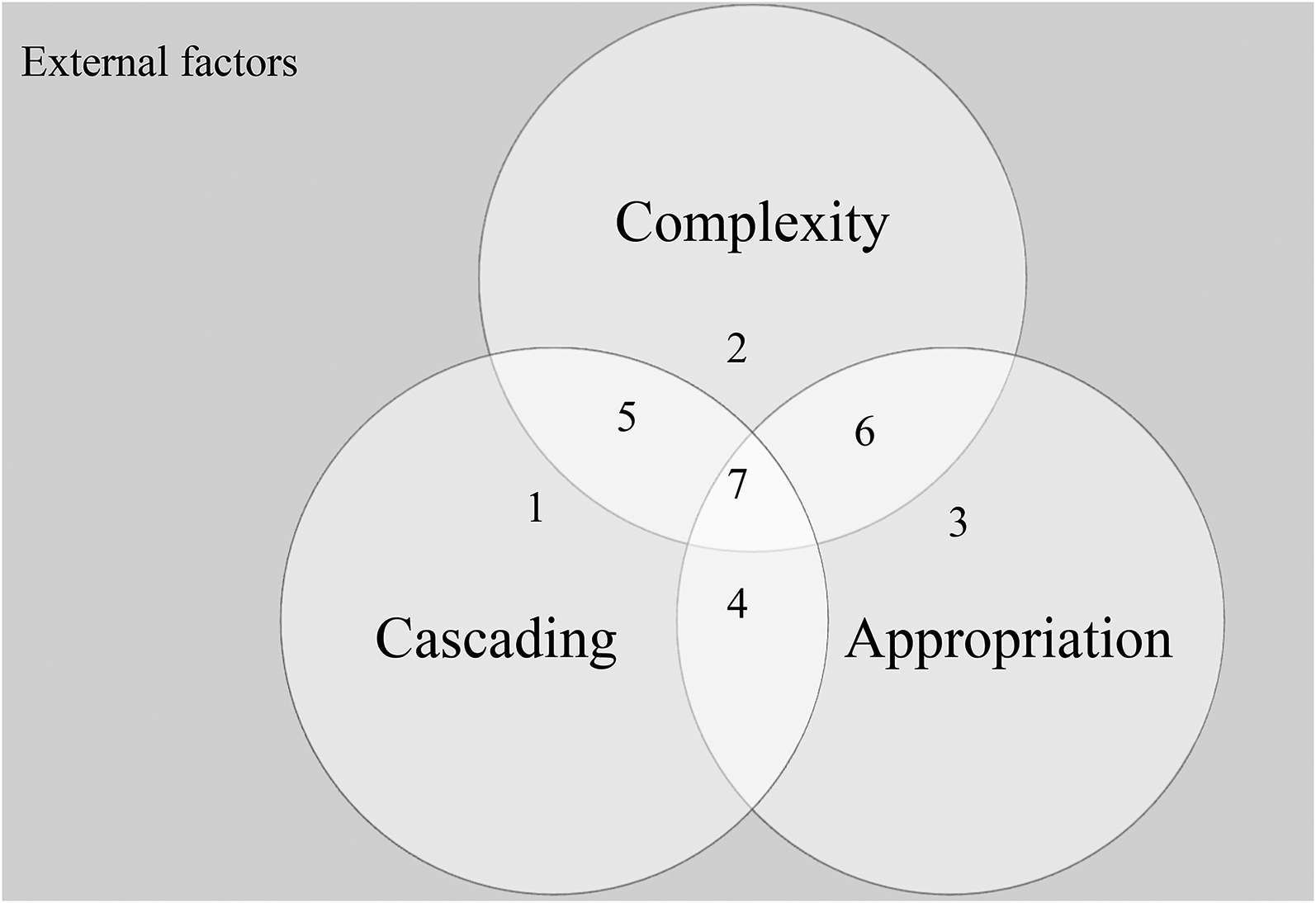
Conditions for the modern slavery Continuum.
Discussion and conclusion
Investigating modern slavery through the prism of the global factory has highlighted that characteristics that are typically used to explain the competitiveness of the global factory's lead firm and that reflect industry characteristics can be contributing factors of modern slavery. The analysis also shows that modern slavery does not uniformly occur in GVCs and that particular factors align as enabling factors. The discussion presented here mainly focuses on internal factors pertaining to the global factory. However, contextual factors such as the local presence and engagement by NGOs, although not a panacea, can cushion modern slavery risks while external shocks such as the COVID-19 pandemic heightens the risks (Voss, 2020).
Nonetheless, the analysis shows that even where external actors such as NGOs are actively involved in representing workers’ rights, the multi-layered nature of the relationship between the lead firm and supplier firms still leaves workers vulnerable and exposed to various forms of modern slavery. That is, while the activism of NGOs is crucial in mitigating their exploitation, at the same time NGOs and voluntary codes thus far have been unable to stem the exploitation of workers (Donaghey et al., 2014; Marginson, 2016; Robinson, 2010). This is especially when, as the case of the football stitchers shows, a complementary informal sector of labour emerges in response to the effects that formal obligations faced by lead firms may place on suppliers.
Thus it is combinations of the three global value chain characteristics – complexity, appropriation arrangements, and obligation cascadence – that jointly create an environment in which modern slavery can evolve and take root. As the case illustration shows, the complexity of the football stitching GVC suggests that although oversight of production and labour standards should have been possible by lead firms such as Nike and Adidas the ability of these lead firms to monitor and enforce their own private governance code and and others such as the UN Guiding Principles on Business and Human Rights and the Ethical Trading Initiative that they undoubtedly have a commitment to, arguably decreases with the increasing length of the value chain and the broadening scope of actors involved. However, the case also shows that the complexity of the global factory interconnects with our concept of the appropriation mechanisms and cascading societal and legal expectations whereby because lead firms require economic upgrading to evidence that they are fostering improvements in supplier standards in line with their commitment to the aforementioned private governance codes, suppliers – such as the football stitchers – push production ‘down the line’ into an invisible realm of production (namely, child labour) that lead firms are unable to monitor through the macro level governance framework that they utilize. However, by appropriating the upgrading that suppliers have undertaken to remain within the lead firm's GVC, lead firms – such as Nike and Adidas – are able to claim an improvement of employment practices, whilst these characteristics combine to create ‘new’ sources of labour whose work falls within the broad umbrella of modern slavery.
Moreover, the case is also useful in illustrating how, when we analyse modern slavery using the characteristics as outlined here, we can identify a modern slavery continuum in the context of the global factory. That is, production of footballs was originally outsourced to individual households and families, including children who, in turn, shared contracts with their extended families. Although lead firms attempted to manage the effects of child labour for instance by becoming signatories to the Atlanta Agreement of 1997 to eliminate child labour by creating centralised stitching centres and various other mechanisms, the case shows that the interconnection of the complexity of the global factory, and the appropriation mechanisms which required suppliers to economically upgrade their production (by eliminating child labour) created a ‘chain of suppliers’ whereby the formal sector of suppliers who then became responsible for ensuring that the lead firm's commitment to obligations in private governance codes such as the UN Guiding Principles on Business and Human Rights and the Ethical Trading Initiative were adhered to created an informal sector of suppliers residing with thin the extended families linked to the ‘lead supplier’. As the case illustration shows, not only were these informal football stitchers women workers in cottage industries able to juggle this work with their household work; the cycle once again returned to conscript child labour as non-registered stitching centres developed to which production was outsourced.
Finally, although the context shaping the employment conditions for football stitchers in Sialkot has unique characteristics, at the same time the phenomenon of worker exploitation as a result of lead firms using an informal labour market emerges elsewhere. The case of the 7 Eleven franchise workers in Australia has generated a great deal of debate not only about levels of worker exploitation but also whose responsibility is it to uphold employment regulations when the status of workers is informal (Farbenblum and Berg, 2017). Whether these acts of exploitation constitute modern slavery is a moot point; however, as has already been suggested, what this and other cases suggest is this exploitation appears to involve migrant workers (though not to our knowledge in the case of Sialkot), especially those whose status in a jurisdiction is temporary (Wright and Clibborn, 2020).
In summary, although the specifics of contexts may differ, key points for consideration emerge from the discussion presented in this paper in terms of the future of regimes to tackle modern slavery. The first is that given the dimensions of appropriation, complexity and cascading as discussed here, regimes of modern slavery need to carefully consider processes of implementation rather than the specifics of the legislation itself. As the cases of the football stitchers in Sialkot and even 7 Eleven franchise workers show, capital has multiple avenues to secure labour. Thus, careful attention should especially be given to how ‘cascendence’ of legislative effects may (inadvertently) create unintended consequences for certain groups of workers when regulatory frameworks create an impost that capital interests consider to be too great to bear. Related to this is the further principle that regimes to tackle modern slavery need to be time sensitive. That is, as cases of exploitation become known for representing exploitation and subsequently attract a regulatory response to negate this exploitation, new instances of exploitation emerge. Again, the case of the football stitchers illustrates this.
Undoubtedly a key limitation of the analysis is that we rely on secondary material to substantiate our framework. Thus, future research could use the framework and assess its efficacy using primary data. Further, we assess our framework using traditional forms of work, that is, craft manufacturing activity by football stitchers. Thus, future research could assess the framework in the context of changes to work caused by the application of technologies associated with Industry 4.0. We expect that research in both these areas would both fine-tune and nuance the framework identifying new boundaries within the scope of the characteristics that we identify. Finally, current events highlight how external shocks can disrupt the global configuration of a global factory in parts or in whole and lead to an adaptation response by the lead firm that is too rapid and/or too substantial for downstream suppliers to follow. Pulling out of labour intense activities in distant countries may produce detrimental outcomes whereby the risk of modern slavery actually increases as there are less employment opportunities or the industries refocus to produce for local and other markets where the lead firms have less interest (external pressure) in reducing forms of modern slavery or enforcing higher labour standards. Likewise, excluding the informal sector from participation in a global factory can increase the lead firm's compliance and appear to eliminate forms of modern slavery, but it is likely to reduce the power and control individual workers have over their own work conditions and reduce their agency. Any legislative and regulatory response therefore must be cognisant of these potential effects.
In conclusion, while shocks created by COVID-19 have challenged a rethink by capital of the approach to production, in particular how the global factory and GVCs are now structured, the status of workers has undoubtedly increased in precarity. Arguably, as economies and society move towards a post COVID scenario, understanding the sources that foster modern slavery become as important as finding solutions to redress this phenomenon. These need to address the dynamic nature of modern slavery as a continuum of exploitation where workers’ experiences may move along the continuum, and thus requires a variety of interventions to remedy the exploitation (Skrivankova, 2010). The framework presented here provides one pathway to responding to this challenge.
Footnotes
Declaration of conflicting interests
The author(s) declared no potential conflicts of interest with respect to the research, authorship, and/or publication of this article.
Funding
The author(s) disclosed receipt of the following financial support for the research, authorship and/or publication of this article: The authors would like to thank the British Academy/DfiD (TS170074) and the University of Western Australia’s Faculty of Arts, Business, Law and Education for financial support.
