



Abstract
The study investigates the extent to which the type of employment, specifically nonstandard work, may contribute to a better understanding of Indigenous earnings disparities. We find that Indigenous workers are overrepresented in nonstandard jobs and that such forms of work are associated with sizable earnings penalties. Although Indigenous earnings disparities are smaller in nonstandard work than in standard employment, the relatively low earnings of many nonstandard jobs are an important factor contributing to the overall economic inequalities experienced by many Indigenous Canadians. Policy responses aimed at improved human capital accumulation are likely to have limited efficacy unless additional barriers that prevent many Indigenous workers from accessing better quality employment and internal labor markets are identified and removed.
Introduction
Nonstandard forms of work are common around the world and Canada is no exception. For Canada’s Indigenous workers, 1 whose earnings are known to lag behind those of their non-Indigenous counterparts, this trend toward nonstandard work is particularly significant because it may widen historical disadvantages in earnings. While previous research has examined overall earnings gaps between Indigenous and non-Indigenous Canadians, the disparities for different types of employment, i.e. standard vs. nonstandard, are not well known. It is important to understand the effects of nonstandard work on earnings disadvantage if research findings are to inform policies aimed at improving Indigenous earnings inequalities. Typical policy interventions stress the importance of human capital characteristics with relatively less emphasis on the type of employment.
Through the lens of human capital and labor market segmentation theories, the present study seeks to explore the intersection between nonstandard employment and earnings inequality among Indigenous workers in Canada to determine if the shift to nonstandard work has exacerbated (or mitigated) Indigenous–non-Indigenous earnings gaps. We know that nonstandard work is generally not as well paid as standard work, and many benefits are also lower. For these reasons, most workers prefer standard employment and accept nonstandard employment mostly when they have no other option. In a segmented market, it is possible that disadvantaged groups such as Indigenous workers find it easier to obtain nonstandard employment. If their ranks are overrepresented in nonstandard work, this trend would make Indigenous–non-Indigenous earnings gaps even wider. On the other hand, if some nonstandard jobs offer compensating premia for lack of job security or other demanding conditions, then it is possible that overrepresentation of Indigenous workers in nonstandard work could mitigate the overall earnings gap relative to non-Indigenous workers. To our knowledge, our study is among the first to examine the intersection between the earnings disadvantage of Indigenous workers by type of employment.
In their quantitative analysis of earnings disparities across various ethnic groups in Canada, Pendakur and Pendakur (1998) acknowledge the heterogeneity in the comparison group of non-Indigenous workers. Therefore, we similarly repeat our analysis both including and excluding immigrants. Immigrants, a significant proportion of the Canadian population (21.9% according to Statistics Canada, 2017), also face earnings disadvantages relative to Canadian-born workers (i.e. Boudarbat and Lemieux, 2014). Including them in the non-Indigenous comparison group understates the true disadvantage of Indigenous workers relative to Canadian-born non-Indigenous workers. This research design provides a better understanding of earnings disparities experienced by Indigenous workers within the broader context of earnings inequalities in Canadian labor markets.
Accordingly, our analysis seeks to answer four key questions: (i) To what extent are Indigenous workers over (under) represented in nonstandard forms of work? (ii) What is the overall earnings gap between Indigenous and non-Indigenous workers? (iii) Are Indigenous–non-Indigenous earnings disparities larger (smaller) across various forms of nonstandard work arrangements? and (iv) How does the inclusion or exclusion of immigrants in the comparison group change the Indigenous and non-Indigenous earnings gap? We begin by discussing the two primary theoretical frameworks underpinning the analysis: human capital theory and labor market segmentation theory. We then contextualize our hypotheses by providing a brief overview of relevant literature and background information. Then, the Data and methods section provides a detailed overview of the empirical strategy and data used in the analysis, followed by a presentation of our results in the Results section. The article concludes with a discussion of our findings in light of human capital and labor market segmentation theories.
Theoretical framework
Our analysis addresses a principally empirical question: what is the effect of nonstandard employment on the earnings of Indigenous workers relative to those of other comparable workers? To guide our analysis, we draw on two theoretical frameworks: human capital theory (Becker, 1964) and labor market segmentation theory (Doeringer and Piore, 1971). 2 Each one is discussed here but only briefly as they are well established theories in the literature. Furthermore, we examine the important intersection between the two theories as they relate to race and, more specifically, to Indigenous identity.
Human capital theory (Becker, 1964) 3 is one of the earliest and most used theories to explain wages and earnings. It posits that earnings are a function of workers’ human capital characteristics, such as education, skills, and experience, as these traits are expected to determine a worker’s marginal productivity and, thereby, wages. Early studies in labor economics emphasized the positive relationship between education, experience, and earnings over the lifecycle as a way of explaining income growth over time in that younger people would forgo present earnings to invest in education/training with the expectation of higher earnings in the future (e.g. Benjamin et al., 2002). Therefore, differences in individual incomes are attributable to differences in education, age (a proxy for experience), and occupation (a proxy for skills and training) (Mincer, 1958). Additionally, competitive labor markets would reward every worker in proportion to their human capital endowments. In this view, any difference in earnings can be attributed largely to differences among workers’ human capital (Leontaridi, 1998: 69). Empirical findings since the 1960s have lent significant support to the predictive power of this theory which in turn explains its widespread application in empirical research. The prescription arising from the application of human capital theory to the studies of earnings inequality over recent decades is that increasing investment in education, skills, and training is the antidote to low incomes among the poor (Dickens and Lang, 1984: 2).
Within the human capital framework, structural characteristics of the labor market as determinants of earnings were only added later in the development of the theory; however, their role in many niches, such as explaining the earnings of Indigenous workers, remains underexplored. For example, even contemporary techniques that acknowledge and attempt to measure the role of factors, such as discrimination in labor markets, often do so indirectly through inference (see Pager and Shepherd, 2008 for an overview of the methods for measuring discrimination in labor markets).
Labor market segmentation theory arose, at least in part, as a critique of human capital theory as some studies showed that workers from certain segments did not experience the same wage gains from education and training as did other workers. Cain (1976: 1218) notes that ‘The SLM [segmented labour market] critics of human capital theories have argued that education and training programs failed to deliver their promised cure for poverty’.
Labor market segmentation theory suggests that the labor market is segmented hierarchically into primary and secondary segments, each with different attributes and wage-determination mechanisms. Leontaridi (1998: 69) explains, The primary sector contains all the ‘good’ jobs, normally to be found within firms with internal labour market structures, where institutional rules are substituted for market purposes. Those jobs are characterised by high negotiated wages, economic security and rapid turnover leading to career advancement. The secondary sector on the other hand, contains the ‘bad’ jobs which are typically unskilled, offer no regular career ladders and wage rates are low and determined competitively.
Labor market segmentation theories offer a better explanation for understanding the persistence of racial inequalities in labor markets (Kreckel, 1980: 533). Reich et al. (1973) emphasize race as being one of the key dimensions along which labor markets are often divided. The fact that racialized workers, women, and immigrants are dramatically more likely to be employed in nonstandard and/or precarious forms of work, a dominant form of work in the secondary segment of the labor market, has been well documented (e.g. Cranford et al., 2003; Fuller and Vosko, 2008; Hira-Friesen, 2018; Leontaridi, 1998; Noack and Vosko, 2011; Wiens-Tuers, 1998). Although to our knowledge, previous literature has not empirically addressed the intersection between Indigenous labor market outcomes and nonstandard work, several studies have highlighted that Indigenous workers are less likely to be employed in full-time, full-year work (Feir, 2013; George and Kuhn, 1994). Such research evidence suggests that labor market segmentation theory can be employed to our advantage in understanding the intersection of nonstandard work and its possible impact on Indigenous earnings.
The labor market context and hypotheses
Conceptualizing nonstandard work
The International Labour Organization (ILO, 2016: xxi) defines nonstandard employment as any employment relationship ‘that deviates from the “standard employment relationship,” i.e., work that is full time, indefinite, as well as part of a subordinate relationship between an employee and an employer.’ The ILO further cautions that nonstandard work should not be viewed as being synonymous with precarious work. For our purposes, it is important at the outset to clearly delineate nonstandard work from other definitions and constructs. Most forms of nonstandard work exhibit multiple characteristics of precariousness and hence can be used as a proxy for precarious jobs. However, this overlap is not perfect in that some standard jobs may also exhibit characteristics of precarity (ILO, 2016: 18). Thus, while nonstandard work and precarity are overlapping terms, they need to be understood as distinct constructs. Early studies of nonstandard work in Canada typically included employment arrangements that are part-time, temporary and/or contract, own account self-employment, and multiple job holding (Krahn, 1995). Our definition of nonstandard work relies on the variables available in the Labour Force Survey, which includes part-time and temporary work but excludes self-employment.
Next, we address the issue of nonstandard work’s comparability to standard work in terms of key job characteristics such as wages, benefits, job security, working conditions, worker voice, etc. The ILO (2016: 19–20) notes several dimensions along which work may be more or less precarious, including employment security, earnings, stability in working hours and/or schedule, access to training, benefits and occupational health provisions as well as the protection of rights in the workplace, including collective representation. The idea here is to determine (through measurement) how a nonstandard job may compare with a standard job. If it were that a nonstandard job offers less protection on all these outcomes compared to a similar standard job, then we may infer that nonstandard work is more precarious than otherwise comparable standard jobs. Recent research suggests that job quality ranks highest among permanent jobs (i.e. open-ended contracts) (Arranz et al., 2018: 222) and that nonstandard work is frequently associated with poor-quality work on a number of dimensions including limited-term contracts (Chen and Mehdi, 2019). In addition to the obvious risks related to lower earnings and economic insecurity, precarious work has also been linked to stress and social isolation, factors that may be further detrimental to worker health and well-being (Kalleberg, 2009: 9). Fang and Gunderson (2015: 825) capture the intersection of nonstandard work and earnings inequality to argue after Jackson (2004) that ‘Vulnerable workers may be permanently and involuntarily trapped in low quality jobs often involving nonstandard employment that is not a steppingstone to more permanent jobs’. The finding that nonstandard work is inferior to standard employment and that vulnerable workers are more likely to occupy nonstandard roles has been well documented (see, for example, Cranford et al., 2003; Fuller and Vosko, 2008; Noack and Vosko, 2011; Vosko et al, 2003).
Overrepresentation of Indigenous workers in nonstandard employment
Nonstandard work now forms a significant part of the labor market, and it is generally accepted that such jobs are here to stay and may even grow their share of employment in the future. Under these circumstances, it is important to ask if nonstandard employment is disproportionately occupied by certain demographic groups such as racialized workers. A recent summary of Indigenous employment in Canada noted that, while Indigenous workers had similar rates of part-time employment, they were more likely than non-Indigenous workers to hold a temporary job (Moyser, 2017: 14). As noted, there is a dearth of research on Indigenous workers in nonstandard employment.
From the foregoing discussion of previous research findings and the specific objectives of our study, we may conclude with three arguments. First, nonstandard jobs are more precarious than standard jobs; second, nonstandard jobs offer less income, benefits, job security, worker voice, and worse working conditions than comparable standard jobs requiring similar skills; and third, Indigenous workers are overrepresented in nonstandard work. Based on this review, we may hypothesize that: H1: Indigenous workers are overrepresented in nonstandard employment as compared to non-Indigenous workers.
Overall Indigenous–non-Indigenous earnings disparities
It is well known that differences in human capital endowments alone do not fully explain the observed earnings disparities between Indigenous and non-Indigenous workers.
Numerous studies have documented an often sizeable and statistically significant earnings penalty for Indigenous workers. Differences in human capital characteristics (i.e. education, age, and occupation) are most consistently found to contribute to the ‘explained’ portion of the Indigenous–non-Indigenous earnings gap, while the ‘unexplained’ disparity is often attributed to discrimination in labor markets and systemic inequalities arising from a long history of colonialism 4 (DeSilva, 1999; Feir, 2013; George and Kuhn, 1994; Hossain and Lamb, 2012; Hum and Simpson, 1999; Lamb, 2013; Lamb et al., 2018; Mueller, 2004; Pendakur and Pendakur, 1998, 2002, 2011a, 2011b).
Accordingly, we may hypothesize that: H2: Indigenous workers’ earnings are significantly lower than the earnings of non-Indigenous workers even after controlling for human capital characteristics.
Indigenous earnings in nonstandard work
Next, we consider how Indigenous workers, as disadvantaged workers, may fare in the secondary job market of nonstandard work. A number of factors would lead us to expect either a smaller earnings gap or, at the limit, no gap relative to non-Indigenous earnings. First, variance in wages at relatively low levels of earnings is likely to be smaller than variance in the mid-to-higher ranges. So, we may expect an earnings compression across nonstandard jobs relative to standard jobs. Second, various groups of disadvantaged workers can expect to be crowded into nonstandard jobs where no identifiable order of preference may preexist across these workers. So, it is more likely that Indigenous workers would be randomly distributed across nonstandard jobs relative to non-Indigenous workers. Lastly, it is possible that Indigenous workers may not be so disadvantaged compared to other groups such as immigrants. For example, Indigenous workers are likely to have more social capital than immigrants and especially those recently arrived in Canada.
Accordingly, we may hypothesize that: H3: Indigenous–non-Indigenous earnings disparities will be significantly smaller in nonstandard forms of employment than in standard work.
Benchmarking Indigenous earnings: The importance of comparison group
Finally, we consider the issue raised earlier regarding the appropriate comparator group for Indigenous workers. Canadian studies have used ‘White’ Canadian-born workers or all non-Indigenous workers as the comparison group. There are two shortcomings of this latter approach. First, the non-Indigenous group can be highly heterogeneous in its composition. In Canada, immigrants form a significant share of the labor force and this group also faces numerous disadvantages in the labor market. Second, comparison of Indigenous earnings to all non-Indigenous groups or nonracialized Canadian-born workers does not allow us to see exactly where Indigenous workers stand relative to earnings of other significant groups such as immigrants.
Pendakur and Pendakur (1998) analyzed earnings disparities for Indigenous, immigrant, and visible minority workers relative to Canadian-born, nonvisible minority workers. The authors estimate adjusted earnings disadvantages for Canadian-born visible minority men and Indigenous men to be 8% and 13%, respectively, relative to Canadian-born White men. Nonvisible minority immigrant males earn 2% less than White, Canadian-born males, while the earnings disadvantage for visible minority immigrant men is 16% relative to the reference group (Pendakur and Pendakur, 1998: 520). Our study not only updates these results, but it also augments our understanding of these earnings relativities by type of employment, namely, standard and nonstandard work.
The non-Indigenous workforce can be divided into native-born and immigrant groups. Numerous studies have established that immigrants face a significant earnings disadvantage relative to their native-born counterparts (e.g. Boudarbat and Lemieux, 2014). So, when these two groups are lumped together, the average earnings for the group become lower than the average earnings for the native-born workers of non-Indigenous origin. This implies that a simple Indigenous–non-Indigenous earnings comparison (Lamb, 2013; Lamb et al., 2018) would understate the true gap because the inclusion of immigrants lowers the earnings of the comparison group. So, if we were to control for immigrant status in an earnings comparison, then the Indigenous–non-Indigenous earnings gap would be still larger than if were to ignore immigrant status in the comparison.
Further, we can theorize that Indigenous workers can be expected to have some advantage over immigrants, especially in terms of social capital, and would have slightly higher earnings than immigrants in general but recent immigrants in particular. So, we may hypothesize that non-Indigenous native-born earnings would be the highest, followed by Indigenous earnings and immigrant earnings, in that order. Hence, H4a: Indigenous workers’ earnings after adjusting for human capital endowments would be higher than immigrant workers earnings’ but lower than for native-born, non-Indigenous workers for standard employment.
H4a corollary: The Indigenous–non-Indigenous earnings gap would be even larger if immigrant workers are excluded from the non-Indigenous group.
H4b corollary: In nonstandard employment, Indigenous workers’ earnings after adjusting for human capital endowments would be nearly the same as the earnings of immigrant workers and non-Indigenous workers.
Data and methods
Many studies of Indigenous earnings differentials have generally used data from the Canadian Census. The main drawback of using census data from our perspective is that it does not ask for information relating to the type of job that would allow us to distinguish between standard work and nonstandard work. Hence, this study uses data from the Canadian Labour Force Survey for the years 2008–2018 inclusive. The Labour Force Survey is a nationally representative survey of Canadians living in private residences across all 10 provinces. The main file of the Labour Force Survey does not include persons living in the territories. Also excluded are those living on Indigenous reserves and communities, as well as those who reside in institutions (i.e. correctional or health-care facilities) (Statistics Canada, 2016). The Labour Force Survey is a cross-sectional survey that employs a 6-month rotating panel sample. To ensure that respondents are captured only once in the dataset, we stack data from May only for each year from 2008 through to and including 2018. Questions related to Indigenous persons and measures of identity were phased into the Labour Force Survey in the territories beginning in 2004 and extended to all provinces by January of 2007 (Statistics Canada, 2016: 5). Indigenous identity is self-reported. Respondents can also identify with one or more of the following Indigenous groups: First Nations, Métis, and Inuk (Inuit) (Statistics Canada, 2016: 10). In the present analysis, we use only one indicator of Indigenous identity and do not further disaggregate the sample into the different Indigenous identities noted. We restrict our sample to include employees with positive, nonmissing earnings who are between the ages of 15 to 65 years old. 5 Models are weighted using STATA’s probability sampling weight option with a unique Indigenous weight provided in the Labour Force Survey, rescaled to reflect the use of 11 months of data.
The analysis begins by estimating a series of ordinary least squares earnings equations regressing the natural logarithm of hourly earnings (expressed in constant 2018 dollars) on a number of observable characteristics, including age, age-squared, education, if the respondent is currently in school, multiple job holding, marital status, the presence of own children, industry of employment, firm size, collective agreement coverage, and two sets of variables related to geography (i.e. region and residence in an urban area). We also include a set of dummy variables to control for the year. Models are estimated separately by sex for Indigenous and non-Indigenous workers. The difference in mean hourly earnings between Indigenous and non-Indigenous workers is decomposed using the well-established Blinder – Oaxaca (1973) decomposition technique, whereby earnings gaps are separated into an ‘explained’ portion, that is due to differences in the observable characteristics between the two groups, and an ‘unexplained’ portion, which reflects differential returns to those same characteristics. 6 We begin by considering the entire sample of non-Indigenous workers (including immigrants) relative to Indigenous workers. However, since the earnings of immigrants in Canada are often lower than those of the Canadian-born, non-Indigenous population, we repeat the models and decompositions excluding immigrants from the non-Indigenous sample.
With these baseline estimates of Indigenous–non-Indigenous earnings gaps, following Lamb et al. (2021), we then explore how employment in standard versus nonstandard work may exacerbate (mitigate) prevailing earnings disparities. We first employ multinomial logistic regression to determine the probability of employment in several categories of standard and nonstandard work conditioning on the same set of characteristics noted above. Models are again estimated separately by sex; however, now a dummy variable denoting Indigenous identity is also added to the regressions. We define four mutually exclusive employment states: full-time, permanent (i.e. standard employment); full-time, nonpermanent; voluntary part-time; and involuntary part-time. The latter three categories are conceptualized collectively as nonstandard work. A full-time job is one in which the respondent usually works 30 or more hours per week (Statistics Canada, 2016: 18).
Finally, we repeat the decomposition of mean earnings gaps across the four possible employment categories, thus comparing similarly employed Indigenous and non-Indigenous workers. To situate the earnings of Indigenous workers, we also decompose the earnings gaps between Indigenous and immigrant workers across the four employment categories.
Results
The summary statistics are displayed by sex in Table A1 (see supplemental material online). Noteworthy is the fact that overwhelmingly the majority of respondents hold a standard job with 80% and 68% of males and females, respectively, having a full-time, permanent position. A higher proportion of females work part-time, while the rates of temporary full-time work are comparable at 9% and 8% for males and females, respectively. H1: Indigenous workers are overrepresented in nonstandard employment as compared to non-Indigenous workers. H2: Indigenous workers’ earnings are significantly lower than the earnings of non-Indigenous workers even after controlling for human capital characteristics.
Summary results from multinomial logistic regressions, probability of employment type.
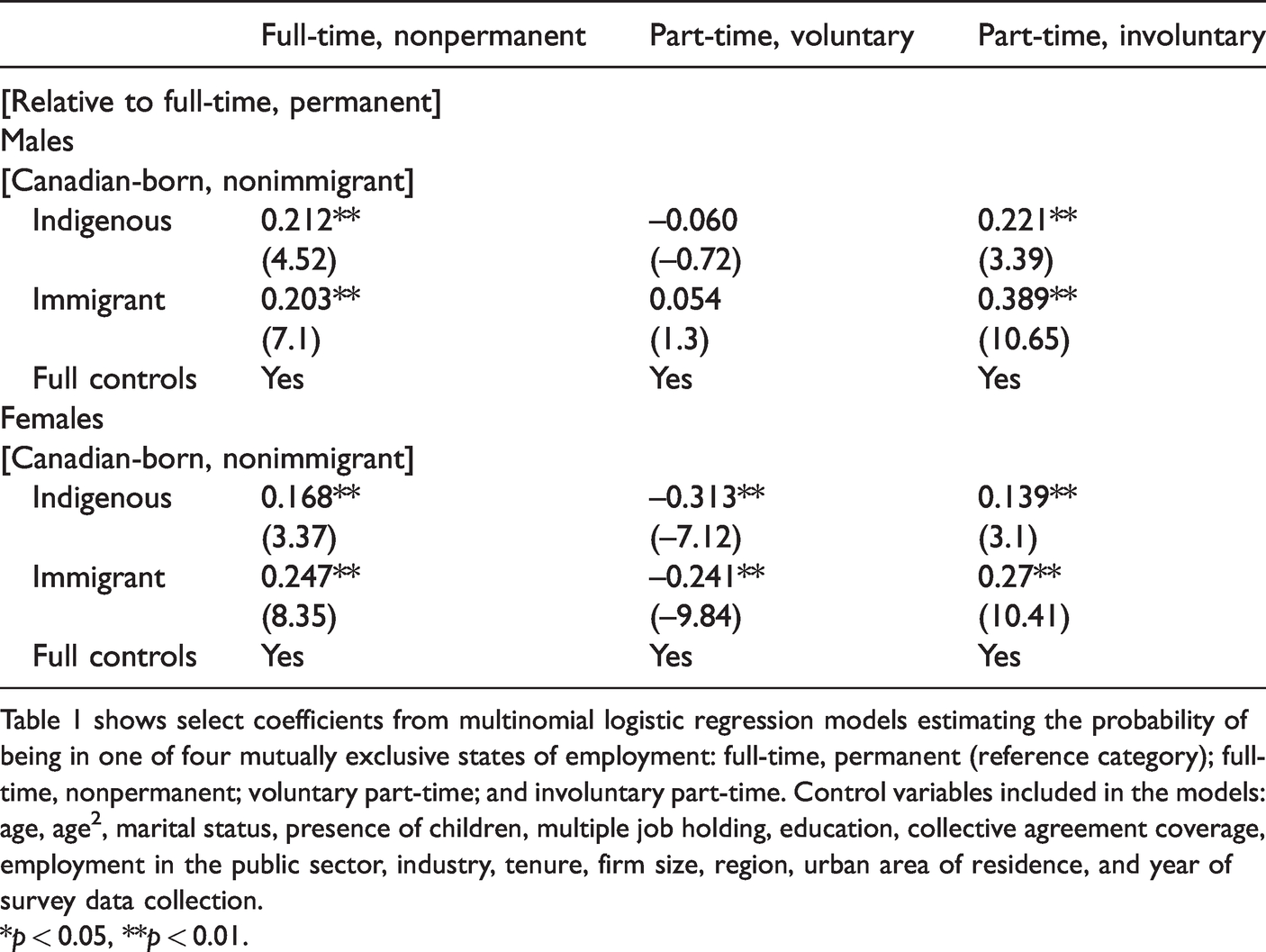
Table 1 shows select coefficients from multinomial logistic regression models estimating the probability of being in one of four mutually exclusive states of employment: full-time, permanent (reference category); full-time, nonpermanent; voluntary part-time; and involuntary part-time. Control variables included in the models: age, age2, marital status, presence of children, multiple job holding, education, collective agreement coverage, employment in the public sector, industry, tenure, firm size, region, urban area of residence, and year of survey data collection.
*p < 0.05, **p < 0.01.
OLS earnings regressions controlling for employment type.
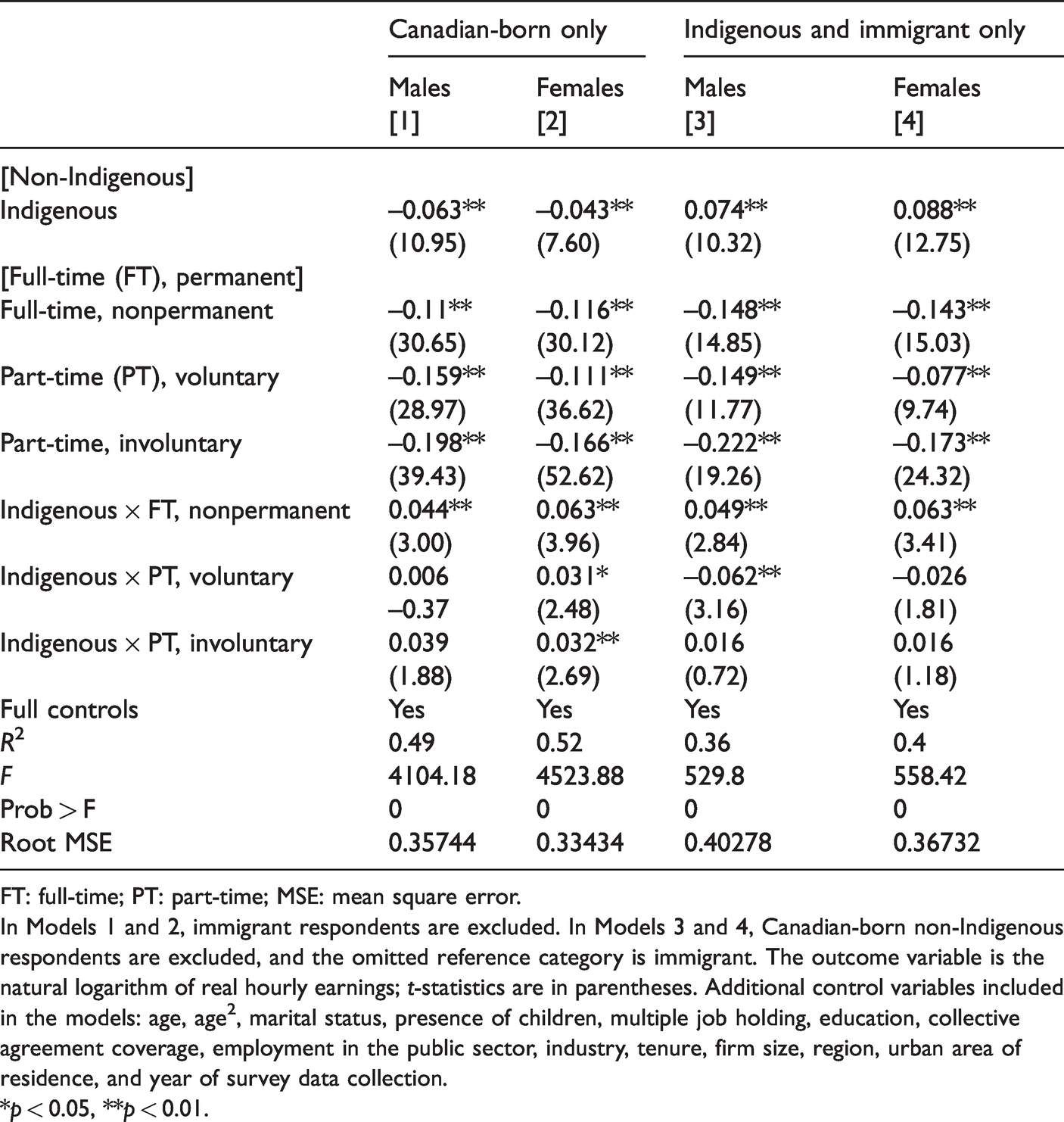
FT: full-time; PT: part-time; MSE: mean square error.
In Models 1 and 2, immigrant respondents are excluded. In Models 3 and 4, Canadian-born non-Indigenous respondents are excluded, and the omitted reference category is immigrant. The outcome variable is the natural logarithm of real hourly earnings; t-statistics are in parentheses. Additional control variables included in the models: age, age2, marital status, presence of children, multiple job holding, education, collective agreement coverage, employment in the public sector, industry, tenure, firm size, region, urban area of residence, and year of survey data collection.
*p < 0.05, **p < 0.01.
H3: Indigenous–non-Indigenous earnings disparities will be significantly smaller in nonstandard forms of employment than in standard work.
The results of the models in Table 2 (columns 1 and 2) show that, as expected, all categories of nonstandard work are associated with statistically significant earnings penalties. The largest is found in involuntary part-time employment with an associated earnings penalty of nearly 18% for males and 15.3% for females. Males and females in voluntary part-time work earn 15% and 11% less, respectively, than those with standard jobs. Finally, full-time, nonpermanent work is associated with a 10.4% and an 11% earnings disadvantage for males and females, respectively.
The third hypothesis, however, seeks to examine whether Indigenous persons are relatively more (less) disadvantaged by nonstandard employment as compared to non-Indigenous, Canadian-born workers. To answer this question, we interact the various forms of nonstandard work with Indigenous identity. Among males, the interaction between being an Indigenous person and full-time, nonpermanent work is statistically significant and positive (Table 2, column 1, row 5), suggesting that, all else being equal, Indigenous males in full-time, nonpermanent work experience a smaller earnings disadvantage than Indigenous male workers employed in standard jobs. Among females, all interactions between Indigenous identity and nonstandard work are positive (Table 2, column 2, rows 5–7), meaning that, controlling for observable characteristics, Indigenous women in nonstandard employment have smaller earnings disadvantages than Indigenous women employed in standard work. It is important, however, to bear in mind that the coefficients on the interaction terms cannot be interpreted independent from the main negative effects associated with Indigenous identity and nonstandard employment. Although these findings lend support to the third hypothesis, considering the implications for overall earnings inequality, the fact that Indigenous earnings disparities are smaller in nonstandard work does not overcome the large earnings disadvantages associated with nonstandard employment relative to full-time, permanent work.
The results of the earnings equations show the different returns to nonstandard forms of work and their interaction with Indigenous identity assuming a constant distribution of all other observable characteristics. Since it is plausible that earnings-determining characteristics may vary not only between Indigenous and non-Indigenous Canadians, but also across forms of work, we reestimate and decompose mean Indigenous–non-Indigenous earnings gaps for each category of employment.
The results of these decompositions are summarized in Table A4 (see supplemental material online). Looking across the categories of standard and nonstandard work, we find the largest disparities among those with full-time, permanent (i.e. standard) jobs. Indigenous workers in standard employment experience a raw earnings disadvantage of roughly 10% relative to similarly employed non-Indigenous, Canadian-born workers. The decompositions reveal that among males, less than half is explained by differences in observable characteristics between the two groups. For females, again, roughly two-thirds of the earnings gap between Indigenous and non-Indigenous women in standard employment is explained. The earnings gaps among those in full-time, nonpermanent work are not statistically significant. The earnings of Indigenous males in involuntary part-time work are also statistically indistinguishable from similarly employed non-Indigenous men. Indigenous women in involuntary part-time employment experience a raw earnings penalty of roughly 4.4% relative to similarly employed non-Indigenous women. The raw earnings gaps found among those in voluntary part-time work are large and statistically significant at roughly 9.5%; however, of less concern insofar as the part-time work is voluntary, a choice that in and of itself could be the subject of much debate. In the present analysis, we define anyone who worked part-time but who wanted full-time hours as an involuntary part-time worker, regardless of whether or not they actually searched for a full-time job. The Labour Force Survey documents reasons for voluntary part-time employment to include ‘own illness, personal or family responsibilities, going to school, personal preference and other’ (Statistics Canada, 2016: 16). The amount of worker agency exercised in each of the aforementioned reasons for part-time work is clearly variable and unique to particular respondents; however, this level of nuance is not captured in the data. The small and/or statistically insignificant raw earnings gaps estimated in other forms of nonstandard work, namely full-time, temporary (roughly 0.2% for males and 1.3% for females) and involuntary part-time work (roughly 2.0% for males and 4.4% for females), are consistent with the expectation of a segmented labor market. H4a: Indigenous workers’ earnings after adjusting for human capital endowments would be higher than immigrant workers earnings but lower than for native-born non-Indigenous workers for standard employment.
H4a corollary: The Indigenous–non-Indigenous earnings gap would be even larger if immigrant workers are excluded from the non-Indigenous group.
H4b corollary: In nonstandard employment, Indigenous workers’ earnings after adjusting for human capital endowments would be nearly the same as the earnings of immigrant workers and non-Indigenous, Canadian-born workers.
Discussion
Our analysis has examined the intersection of Indigenous earnings and nonstandard work in the Canadian context. This study is the first, to our knowledge, to explore the nexus between type of employment and earnings disadvantage among Indigenous workers. Consistent with previous literature, we find that Indigenous workers experience a statistically significant earnings disadvantage relative to their Canadian-born, non-Indigenous counterparts (DeSilva, 1999; Feir, 2013; George and Kuhn, 1994; Hossain and Lamb, 2012; Hum and Simpson, 1999; Lamb, 2013; Lamb et al., 2018; Mueller, 2004; Pendakur and Pendakur, 1998, 2002, 2011a, 2011b). Controlling for observable characteristics, Indigenous workers are also more likely to hold a nonstandard job, with the exception of voluntary part-time work. Most interestingly, we find Indigenous earnings disparities to be largest in standard employment. When employed in nonstandard forms of work, Indigenous males experience smaller earnings disadvantages and, conditioning on observable characteristics, Indigenous women’s earnings are statistically no different from Canadian-born, non-Indigenous women. A feature of our study is the inclusion of immigrants as an additional reference group for benchmarking Indigenous earnings. The fact that recent immigrants have much lower earnings, including immigrants in the non-Indigenous comparison group, masks some of the earnings disparities experienced by Indigenous workers. We find that overall, as well as across employment categories, immigrant workers experience larger earnings disadvantages than do Indigenous workers. 9
It is important to note serval limitations of the present analysis, some of which arise from data constraints in the Labour Force Survey. First, while the estimates of Indigenous earnings gaps obtained here using the Labour Force Survey are comparable to more recent estimates obtained from studies using the Canadian Census (Lamb, 2013; Lamb et al., 2018), the Labour Force Survey does not include persons living in the Territories or on Indigenous reserves. Therefore, the results obtained here are not representative of the entire Indigenous population in Canada. Presently, a dearth in data sources makes extending the examination of nonstandard work to Indigenous workers in the Territories and/or on reserves impossible. The labor market situation of Indigenous persons living on reserves is particularly challenging. One study notes an increase in the earnings gap between persons living on and off reserves, much of which is owed to differences in weeks worked (Feir, 2013). Nonetheless, the labor market dynamics on Indigenous reserves are important areas for future research.
Second, we do not formally correct for selection bias into employment and its various categorizations. Again, the practical difficulty in finding appropriate variables to serve as instruments in selection-corrected models is a challenge with the Labour Force Survey given that the overwhelming majority of variables in the data are related to both employment and earnings.
Third, we distinguish between voluntary and involuntary part-time using the questions in the Labour Force Survey which ask participants currently working part-time if they want a full-time job, regardless of whether or not they looked for full-time work or if such an employment arrangement is feasible for them at the time of the survey. We recognize that the choice between part-and-full-time hours is complex (also, difficult to measure accurately) and a function of a number of individual, social, and economic considerations that we are not adequately able to capture in our dataset.
Fourth, our conceptualization of nonstandard work is based on the measures available in the Labour Force Survey and therefore does not capture all forms of nonstandard employment. For example, while self-employed persons are included in the data, the earnings of the self-employed are not measured (Statistics Canada, 2016). Our focus is on nonstandard work and as such, where possible, we control for additional factors (i.e. union representation, multiple job holding, employment in the public sector, and firm size) 10 but do not delve deeply into some of the features that make all forms of work more (less) precarious. A recent analysis of various factors contributing to job quality has been conducted by Chen and Mehdi (2019).
Finally, related to concerns over selection bias, distinguishing between various forms of employment and their associated earnings provides insight into the mechanisms that contribute to earnings disadvantages for Indigenous workers beyond individual human capital characteristics, namely, access to jobs in the primary segment of the labor market. What is not considered, however, is access to employment and labor force participation in the first place. Indeed, if, as we have found, unequal access to standard employment contributes to economic inequality, how much more so does access to any employment serve to marginalize Indigenous Canadians? This important question is not addressed in the present analysis but has been explored in previous work (e.g., Kuhn and Sweetman, 2002) and continues to be an important topic for future research.
By exploring the nexus between nonstandard work and Indigenous earnings disparities, we have extended the traditional human capital explanation of Indigenous earnings disparities to include structural features of the labor market. Among males, with the exception of those in voluntary part-time work, Indigenous earnings penalties are actually the largest in standard employment and less than half of this disparity is attributable to the observable characteristics included in the model. This finding highlights some of the inadequacies of the human capital explanation for a better understanding of Indigenous earnings gaps. Undoubtedly, educational attainment, experience, and industry of employment are related to earnings, but policies aimed at improving endowment characteristics do not fully address the problem because Indigenous workers do not enjoy the same returns to those characteristics as compared to their non-Indigenous counterparts. Unobservable and/or unmeasured factors including discrimination in hiring, both external and internal, toward Indigenous workers remain a significant barrier to full parity. Additionally, such factors may also be at play in sorting mechanisms which result in Indigenous workers being overrepresented in nonstandard forms of work. As noted, access to employment may serve as the first barrier to improved labor market outcomes among Indigenous workers. Kuhn and Sweetman (2002: 348) find the Indigenous–non-Indigenous disparities in employment rates are larger than the difference in earnings between the two groups. Even when employed, DeSilva (1999: 72) states, ‘Streaming Aboriginals into low earnings, dead end occupations may be a form of discrimination’. Echoing DeSilva (1999), Mueller (2004: 45) suggests, ‘It appears that Aboriginals tend to be concentrated in industries and/or occupations where earnings are lower. This could be indicative of labour market segmentation, a form of discrimination’.
Labor market segmentation theory may help to provide a more fulsome explanation reconciling the persistent Indigenous earnings inequalities with the expectations of human capital theory if, as our findings suggest, many Indigenous workers are relegated to employment in the secondary labor market. The finding that earnings disparities are smaller in nonstandard jobs, although counterintuitive, is consistent with a segmented labor market in which Indigenous workers are disproportionately crowded into the lower tier of the market. Birch and Marshall (2018: 24), for example, examine Indigenous–non-Indigenous earnings disparities in Australia and also note the importance of improving Indigenous representation in the primary labor market. Our finding of a smaller Indigenous–non-Indigenous earnings gap within nonstandard jobs, however, is of little consolation given the dramatic earnings discount associated with nonstandard work itself. This is particularly important for informing policy responses for addressing overall Indigenous earnings disparities in that the efficacy of the typical prescriptions for increasing human capital accumulation is likely to be unrealized because of the structural and discriminatory barriers Indigenous workers face in moving out of nonstandard employment into standard work. Although some recent studies have found higher levels of education to be positively related to the probability of having a standard job (Lamb and Chatoor, 2019), it is not clear if these benefits of education accrue equally to Indigenous workers. The role of education as a bridge to better employment outcomes cannot be assumed for all groups in a segmented labor market. A recent Organisation for Economic Co-operation and Development report notes that ‘[…] even when Indigenous and non-Indigenous groups have the same level of education, they still do not experience the same employment rate success […]’ (Organisation for Economic Co-operation and Development (OECD), 2018: 30). Further evidence of Indigenous workers’ location in a secondary labor market is found in a recent study that finds Indigenous ‘workers with less than university education were more likely to be overqualified than non-Aboriginal workers with the same education’ (Park, 2018: 17).
Some studies using longitudinal data suggest that such jobs are typically not permanent states of employment for many workers. Gomez and Gunderson (2005: 188), for example, find that ‘few workers are “permanently” in the various categories of nonstandard employment […] only 3.8% are always non-standard workers’. Generalizations from such findings still need to be examined in the particular case of Indigenous workers. These results may or may not be true for all groups. Public policy concerns should be focused on those workers who become ‘stuck’ in nonstandard forms of work because of any factor (e.g. race, sex, or country of origin) that is beyond the control of the worker and does not have a bona fide connection to performance on the job. The accumulated research evidence cited here in addition to our findings seems to suggest most Indigenous workers, along with other disadvantaged groups, are trapped unfairly in the secondary labor market with few realistic opportunities to climb out. Nonstandard work is often used as an alternative to unemployment rather than as a matter of preference for the flexibility such employment provides (Rubery et al., 2018). Workers who face numerous barriers to accessing quality employment opportunities would naturally take any form of employment. An important direction for future research would be to not only focus on factors that hinder Indigenous workers from gaining employment in the primary labor market but also examine the rates at which Indigenous and non-Indigenous workers transition in and out of nonstandard work. Such insights can help develop more effective public policy responses to these inequities faced by Indigenous workers.
Supplemental Material
sj-pdf-1-jir-10.1177_00221856211021128 - Supplemental material for Nonstandard Employment and Indigenous Earnings Inequality in Canada
Supplemental material, sj-pdf-1-jir-10.1177_00221856211021128 for Nonstandard Employment and Indigenous Earnings Inequality in Canada by Danielle Lamb and Anil Verma in Journal of Industrial Relations
Footnotes
Acknowledgements
Data are owned by Statistics Canada; the authors would be glad to make any tables or coding available upon request. Information on how to obtain access to Statistics Canada data can be found at  . We are also grateful for the comments received at the International Labour and Employment Relations Association Regional Congress of the Americas in June 2020 in Toronto, Ontario, Canada (held virtually).
Declaration of conflicting interests
The author(s) declared no potential conflicts of interest with respect to the research, authorship, and/or publication of this article.
Funding
The author(s) disclosed receipt of the following financial support for the research, authorship, and/or publication of this article: Although this research was not directly funded, access to the data for this research was made possible through the Canadian Research Data Centre Network (CRDCN), which is supported by funds from the Social Science and Humanities Research Council (SSHRC), the Canadian Institute for Health Research (CIHR), and the Canadian Foundation for Innovation (CFI) and Statistics Canada. Although the research and analysis are based on data from Statistics Canada, the opinions expressed do not represent the views of Statistics Canada or the Canadian Research Data Centre Network (CRDCN) and any errors contained herein are solely those of the authors.
Notes
Supplemental material
Supplemental material for this article is available online.
Biographical notes
References
Supplementary Material
Please find the following supplemental material available below.
For Open Access articles published under a Creative Commons License, all supplemental material carries the same license as the article it is associated with.
For non-Open Access articles published, all supplemental material carries a non-exclusive license, and permission requests for re-use of supplemental material or any part of supplemental material shall be sent directly to the copyright owner as specified in the copyright notice associated with the article.
