




Abstract
This article explores why equality bargaining appears to remain underdeveloped despite its widely acknowledged potential for tackling workplace inequalities. The concept from social movement theory of ‘framing’ is utilised to assess the prospects of moving from ‘where we are’. Findings from a study of UK-based union equality actors discuss unceasing efforts on their part to shift equality from the margins to the centre of union bargaining activity. As regards ‘where to next’, Equality Officers’ strategic deployment of the longstanding union equality frames of ‘women’s issues’ and ‘gender mainstreaming’ challenges taken-for-granted social practices within unions, offering some optimism that creative strategies can help to inject equality frames into traditional union frames, thus producing an expanded and inclusive notion of union solidarity. However, this framing activity occurs within existing opportunity structures with all their facilitative and inhibitive factors, including resistant union officers and reps, which previous research has highlighted. Therefore, a less optimistic vision is that the weight of union tradition that has long privileged male interests, combined with contemporary hostile bargaining conditions, are just too great for equality bargaining to reach its full potential.
Introduction
Scholars argue that as well as being part of the solution to the attenuation if not elimination of gender inequalities, historically unions and collective bargaining have been part of the problem (Blackett and Sheppard, 2003; Briskin, 2014b; Tailby and Moore, 2014). Some 20 years ago in an analysis of collective bargaining in the UK, Dickens (2000) argued that the union equality agenda was narrow in scope, sometimes adding on gendered issues such as work–life balance and flexible work arrangements, but generally failing to integrate broader equality dimensions in all bargaining content and activity. Dickens (2000: 197) concluded that collective bargaining remained an underdeveloped equality tool, but an important one for its potential to give voice to women’s concerns, and an opportunity to define their own needs and priorities. Blackett and Sheppard (2003: 421) also write enthusiastically about the potential of collective bargaining in their international review of the links between collective bargaining and equality: Collective bargaining, whose rationale is deeply rooted in notions of social justice, egalitarianism, democratic participation, and freedom, holds great potential to enhance equality.
Equality bargaining
In early work when the equality agenda focused largely on women’s equality, Colling and Dickens (1989) positioned collective bargaining as a potential vehicle for change in moving towards greater gender equality in employment. They provided a three-dimensional definition of equality bargaining: (i) collective negotiation of provisions that are of particular interest or benefit to women and/or are likely to facilitate gender equality; (ii) equality awareness on the part of negotiators in handling commonplace bargaining agenda items such as pay; and (iii) injection of an equality dimension to the negotiation of change. Colling and Dickens’ (1989) UK-based empirical research found little equality bargaining, a state of affairs they attributed to an array of conditions, namely: (i) negotiators’ lack of detailed knowledge about women workers; (ii) lack of meaningful union commitment to equality at national level; (iii) absence of understanding or commitment by union negotiators; (iv) women not pushing for action or having their interests disregarded; (v) women being in a minority within the workplace; (vi) unfavourable economic climate; and (vii) lack of employer interest in equality action (Colling and Dickens, 1989: 49). The first four items arguably highlight deficiencies or gaps in equality framing on the part of union actors, such that equality resides only on the periphery of the bargaining agenda. Meanwhile, the remaining three items are related to the structural conditions in which bargaining takes place, conditions which empirical research has shown militate against prioritisation or even visibility of an equality agenda. Research internationally has revealed that these conditions are remarkably similar across industrialised countries at least (Briskin, 2014b; Hart, 2002; Milner and Gregory, 2014; Pillinger, 2014; Williamson, 2012).
Gender is the equality area where unions globally have invested the greatest effort and where they have made the most progress (Baird et al., 2014; Blackett and Sheppard, 2003; Pillinger, 2014) including recent innovative agreements that stretch the bargaining scope, for example, to paid domestic violence leave (Williamson and Baird, 2014). In the UK, bargaining objectives that address long established ‘women’s issues’ – equal pay, work–life balance and flexible work arrangements – persistently feature among unions’ declared national bargaining priorities (Trades Union Congress (TUC), 2016). In addition to women’s issues, collective bargaining can also represent employees effectively on a range of mainstream issues with gender equality dimensions, including reward systems (Moore et al., 2019). Thus, some 30 years on, while the obstacles highlighted by Colling and Dickens (1989) may still resonate, the significant contribution of collective bargaining to improving women’s (and to some extent marginalised minorities’) working conditions is acknowledged across countries (Briskin, 2014a, 2014b; Tailby and Moore, 2014; Williamson, 2012).Studies find that equality bargaining is most likely where facilitative factors or opportunity structures are in place relating to the external environment (e.g. legislative framework), the bargaining relationship (e.g. quality, strength), organisational characteristics (e.g. sector, external profile/reputation) and the gender of negotiators (i.e. presence of women) (Baird et al., 2014; Heery, 2006; Williamson, 2012). The precise nature and strength of these facilitative factors/opportunity structures vary across contexts (national, sector, occupational, workplace and union), producing unevenness in the potential of equality bargaining.
Furthermore, some of those facilitators are fragile and ephemeral. For example, maintaining or even gaining female representation among negotiators can be difficult due to gender segregation and a variety of other work-related factors discussed in extant literature (Cooper, 2012; Munro, 2001). Periods of economic recession and public sector austerity can upend employers’ willingness to work with unions on equality issues (Milner and Gregory, 2014; Tailby and Moore, 2014). Furthermore, despite high-level commitment to equality, there also persist several inhibitive internal factors internationally, which resonate with Colling and Dickens’ (1989) UK-based findings some 30 years ago. These include male-dominated local unions, local unions with traditional values and cultures that exclude women and lack of local female leadership (Berg and Piszczek, 2014; Cooper, 2012; Kirton and Healy, 2013).Thus, what goes on internally, inside unions, has a bearing on the building of opportunity structures for equality bargaining (Heery, 2006; Williamson, 2012).
In addition to structural conditions, another large part of the explanation for equality bargaining being an ‘underdeveloped tool’ is thought to lie in a deeper conceptual tension between majority and minority interests and the strong perception that equality is divisive rather than a basis of solidarity (Blackett and Sheppard, 2003; Tailby and Moore, 2014). Again, this tension exists globally and can result in neglect of the concerns of minority groups (Tailby and Moore, 2014). Troublingly, Munro’s (2001) study highlights that neglect at workplace level of women’s interests can occur even when women comprise a majority of members/workers as their specific concerns are often socially constructed as minority concerns. Hence, despite some progress, scholars still draw attention to the barriers and challenges of equality bargaining (Briskin, 2014a; Williamson, 2012) that suggest discursive struggle and contestation around how to frame priorities.
Nevertheless, there can be no doubt that the global union movement now displays strong rhetorical and declarative commitment to equality, which external regulatory and social factors such as increasing membership diversity are driving as well as internal union politics and shifting gendered power dynamics within at least some unions (Cooper, 2012; Kirton, 2019; Stuart et al., 2013). However, historic bias towards the concerns and needs of the majority workers (read white males) (Colling and Dickens, 2001; Rigby and O’Brien-Smith, 2010) has endured long after white males have ceased to be the predominant group of trade union members in many contexts and since they lost their total monopoly on power in union decision-making structures (Cooper, 2012; Kirton, 2015). That said, gender transformation of leadership in the global union movement is incomplete. For example, 60% of national paid officials (who undertake negotiating) are still male in the largest 10 UK unions, many of whose memberships are majority female (Kirton, 2015). Moreover, at workplace level, where much bargaining activity occurs, latest UK evidence reveals that two-thirds of senior workplace representatives – the ones likely to be setting workplace bargaining priorities and undertaking negotiating – remain male (van Wanrooy et al., 2014). Furthermore, while women and other socially marginalised minorities may participate in unions’ equality structures, research has also identified a persistent need for those structures to improve links with collective bargaining structures in order to ensure that equality concerns reach the core agenda (Briskin, 2014b; Dickens, 2000; Parker and Douglas, 2010). Overall though, the conceptual rift between traditional notions of collective bargaining (as concerned with economic and industrial issues) and a broader agenda incorporating notions of equality has narrowed (Blackett and Sheppard, 2003: 432; Williamson 2012).
Framing the union agenda
Applying a framing lens to the question of where we are, as well as where to next for equality bargaining, involves exploring the union agenda as an artefact that owes its existence to an ‘active, processual phenomenon’ achieved through ‘agency and contention at the level of reality construction’ (Benford and Snow, 2000: 614). Framing is a concept borrowed from social movement theory (SMT), which has highlighted the significance of language and discourse in shaping employment relations issues and problems (Kelly, 1998). Briefly, social movement theorists Benford and Snow (2000: 614) define ‘collective action frames’ as ‘action-oriented sets of beliefs and meanings that inspire and legitimate the activities and campaigns of a social movement organization’. These theorists point out that because social movement organisations comprise a multiplicity of interests, political beliefs and ideologies, internal framing disputes and contests can occur among actors who compete for finite resources to pursue their aims. As regards the agency of union actors, the gender inequalities mentioned above – historical white male domination of union leadership and decision-making structures – has impeded women trade unionists’ individual and collective capacity to expand the union agenda to incorporate gender equality concerns (Healy and Kirton, 2000). In terms of contention of the agenda, it is clear from previous research on collective bargaining that the conventional frame that privileges economic and industrial issues determines what is legitimate and worthy of action (Cooper, 2012; Kirton and Greene, 2006; Munro, 2001). Despite the predominance of an ‘economic and industrial’ frame, the literature does offer some empirical examples of what SMT calls ‘frame extension’ defined as how union actors are able to modify dominant frames towards embracing previously neglected constituencies including women (Briskin, 2014a; Foley, 2003; Heery and Conley, 2007; Kirton and Greene, 2006). Foley (2003), for example, highlights how despite internal political struggles, a union women’s committee was able to direct a new gender frame against union tradition and established leaders and towards women’s concerns.
Thus, how the union agenda is set – the union structures and groups of union actors involved – constitutes a framing process, which occurs within internal structural power inequalities and which is consequential for determining substantive priorities. In summary, there are manifold challenges and some opportunities confronting equality actors engaged in union framing activities as they seek to establish the legitimacy and dominance of their preferred frames, and thereby garner wider support for expanding the agenda beyond traditional economic and industrial concerns (Blackett and Sheppard, 2003; Briskin, 2014a).
Union gender equality frames
While feminist authors and union activists acknowledge that women and men share many bargaining interests (Briskin, 2014b; Munro, 2001), unions’ understanding of the question of women and their differences from men influences the ways in which they frame gender problems and their solutions (Yates, 2010). Yates (2010: 400) argues that some unions acknowledge women but view them through a class lens as workers doing particular jobs in particular industries where their interests are fundamentally the same as those of men. Through a gender lens, others acknowledge women as having distinctive issues that they bring to the workplace arising from their gendered relationship to the public and private spheres. The two main gender equality frames that have shaped how unions understand and represent women – ‘women’s issues’ and ‘gender mainstreaming’ – are both influenced by the gender lens but have different implications for bargaining activity.
The ‘women’s issues’ frame owes its genesis to feminist claims that women were neglected subjects in the employment relationship who had specific interests related to the gendered structure of the labour market and the salience of family responsibilities for their employment participation (Wajcman, 2000). This frame calls for bargaining around specific measures (e.g. flexible work arrangements; sexual harassment policies) to address women’s distinct gendered experiences in the labour market. The problem is that typically these ‘women’s issues’ get addressed in unions’ women’s groups, rather than in mainstream committees (Foley, 2003; Parker, 2006). Syphoning off women’s issues to a separate space carries the very real risk that they are side-lined – they do not reach or they fall off the union bargaining agenda, with the main priority to defend economic and industrial interests remaining uncontested (Wajcman, 2000).
In contrast, gender mainstreaming recognises that women have distinctive interests/issues, but sees that even seemingly general bargaining issues, such as pay, have gender dimensions that require attention (Munro, 2001). Therefore, for unions gender mainstreaming involves: ‘the (re)organisation, improvement, development and evaluation of policy processes, so that a gender equality perspective is incorporated in all policies at all levels and at all stages, by the actors normally involved in policy-making’ (ETUC, 2007). This implies that equality cannot simply be siphoned off to the equality committee or the EO to deal with but must be integrated. While this sounds straightforward, to execute mainstreaming requires structures capable of incorporating equality as well as political will and effort on the part of union actors. As Walby (2005: 322) notes, there is a dualism between gender equality and mainstream agendas because ‘established goals may compete with the prioritization of gender equality even if they are not directly opposed’.
As regards union adoption of these gender equality frames, ‘women’s issues’ became common currency as a result of feminist union activism in the late 1970s at a time when women were a severely neglected constituency group. The problem was that emphasis on gender difference rather than worker solidarity, and on specific actions to address women’s inequality rather than general actions supposedly of benefit to all workers, meant that the predominantly male hierarchy paid little attention to ‘women’s issues’ (Briskin, 2014b). Put another way, ‘women’s issues’ did not amount to an agenda-setting frame that would transform the policy paradigm (Walby, 2005). Hence, women activists switched tack and began to argue for gender equality dimensions to be included in all union work in a mainstreaming frame thought capable of transforming the way that unions approach gender equality (Kirton and Greene, 2002; Williamson and Baird, 2014).
Stuart et al.’s (2013) study of union projects concerned with the role of women in unions funded by the UK government’s Trade Union Modernisation Fund confirms the purchase that the mainstreaming frame has gained over time. All but one of 18 projects adopted a gender-mainstreaming approach, which aimed to stretch the equality agenda across all aspects of organisation from the senior officials and executive committees down to branch and regional structures. Nevertheless, ensuring that gender issues are actually mainstreaming in unions is identified as a huge task (ETUC, 2007; Pillinger 2014). One practical challenge has been around securing commitment of union officers/reps in the context of the masculine union cultures (Cooper, 2012; Stuart, et al., 2013). Another has been around creating and maintaining a discursive focus on gender equality. At discursive level, Briskin (2014a: 127) argues that growing socio-economic inequalities have encouraged unions to reinvest equality language with ‘class content’, in other words, to reassert an ‘economic and industrial’ frame.
To summarise, unions are highly politicised contexts where different factions and constituency groups vie for scarce resources, predominance and legitimacy vis-à-vis bargaining priorities. How unions decide priorities reflects deep-seated masculine culture and values as well as internal gendered dynamics that limit women’s collective capacity to access power and influence the agenda (e.g. Cooper, 2012; Healy and Kirton, 2000). Building on studies that have investigated bargaining in specific workplace settings (Munro, 2001; Williamson, 2012) or labour markets (Milner and Gregory, 2014; Pillinger, 2014; Tailby and Moore, 2014), exploring frames, and in particular framing processes in the context of the national union agenda, is another useful way of contributing to the debate about why equality bargaining has not reached its potential (cf. Yates, 2010).
Methods
The data comprise 22 in-depth interviews (typically lasting 1.5 hours and producing around 450 pages of transcript altogether) with UK union officers holding national responsibility for equality (here called EOs) carried out June–August 2017. The sample includes two national TUC officers responsible for equality. Nineteen interviewees were females, three were males and six were black and minority ethnic. The TUC officers provided an overview of union equality activity based on their experiences of working and interacting with a range of unions.
The 16 unions (see Table 1) account for approximately 5 million of the UK’s 6.2 million members. The unions selected had earlier participated in the 2016 TUC biennial equality audit, and therefore they were judged as engaging with the equality agenda. All of these unions have some kind of national equality strategy as well as at least one EO.
Selected details of participating unions.
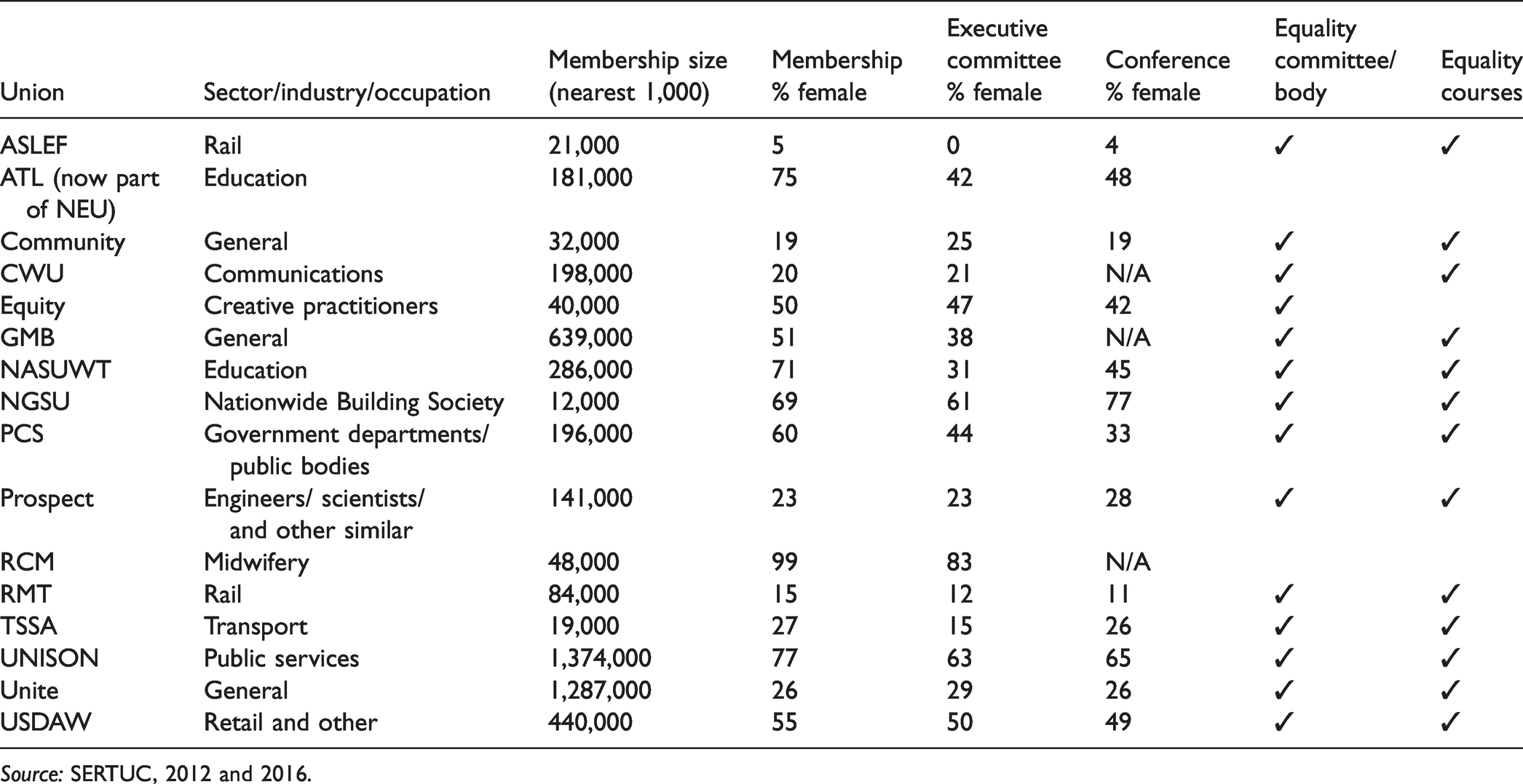
Source: SERTUC, 2012 and 2016.
As can be seen from Table 1, the union sample includes small, medium and large unions; unions representing members in a range of sectors, industries and occupations; two gender balanced, seven female-dominated and seven male-dominated unions. Table 1 also provides information on female representation in membership and in two key governance structures (executive committee and conference). Although this article does not delve into the question of internal equality, this provides gender context with regard to who runs the unions relative to who their members are. We can see that male domination of governance structures prevails overall but with some unevenness among unions (cf. Kirton, 2015).
Most unions in the UK and elsewhere, position equality as a specialist activity supported variously by committee structures and a designated national officer, usually with some kind of channel for communicating with the mainstream. The EO role typically involves servicing national equality committees, reporting to the senior leadership on the work of equality committees, working with national negotiating officers on industry or workplace equality campaigns, providing advice on equality issues to national negotiating officers, carrying out research on equality issues, equality-proofing collective agreements. EOs are therefore a critical group of union officers to interview for a study exploring how unions frame equality and how that framing shapes the construction of national union strategy vis-à-vis equality bargaining. Although they are not usually included in bargaining teams, more than half of UK unions claim to involve EOs in setting the overall collective bargaining agenda (TUC, 2016). Importantly, they act as advocates for union equality action in the wider union. Moreover, their work and working relationships usually afford them insight into national and local bargaining activity as well as the activities of equality structures (committees, networks, self-organised groups, etc.).
Being a small sub-set of national union officers, EOs are easily identifiable and, since equality work can be a contentious area within unions, interviews were confidential, and to maintain interviewee anonymity quotations are unattributed to unions. However, this does not negatively affect the discussion here since the intention of the research was not to focus on specific unions’ policies, rather to discuss equality framing processes and experiences across the union movement in the context of the enduring white male domination of the movement’s governance structures experienced internationally (cf. Cooper, 2012; Kirton, 2015). The main interview themes included how and by whom national bargaining priorities are decided, how those priorities are framed and targeted, internal dynamics that enable and inhibit equality work, tactics EOs deploy to influence the mainstream union agenda and perceived barriers to union equality work/action. Although there was some variation according to union size as well as gender composition of membership and leadership, interviewees’ responses on these issues did not vary hugely across the unions.
UK equality bargaining context
A brief outline of the contemporary UK equality bargaining context sets the scene for the empirical study. However, it is worth emphasising that the UK bargaining environment is by no means unique among industrialised countries. While many UK unions have now long established national equality strategies and strong policy positions that have led to changes in the way they negotiate, the capacity of unions to set the bargaining agenda vis-à-vis employers appears to have diminished in the context of declining collective bargaining coverage (Milner and Gregory, 2014). Worryingly, latest available comprehensive data revealed that equality did not appear in a list of seven items of terms and conditions over which union–employer negotiations normally occurred (van Wanrooy et al., 2014: 81). In other evidence, despite some indicators of the positive effects on equality of workplace union presence, Tailby and Moore’s (2014) analysis of a sample of UK collective agreements found equality specified in only 8% and specifically excluded in 31%, leaving equality outside the scope of collective bargaining. Overall, it appears that bargaining on equality is at low levels of both activity and success. The TUC explains this as a function of the increased difficulties unions experience in getting employers to address equality issues compared with formerly (TUC, 2016). While this article fully acknowledges the difficult bargaining climate, it focuses on union framing of priorities as another explanatory factor that is both embedded in and a product of internal and external structural conditions.
Research findings
The findings sections discuss how the bargaining agenda is set, scope for equality actor influence and dilemmas of gender equality frames, using the framing lens to highlight ‘where we are’ currently and ‘where to next’ for equality bargaining, quoting directly from the interviews with EOs. The discussion is situated in the context of historic and currently existing structural barriers impeding the efforts of equality actors.
Dynamics of setting the union agenda
In order to appreciate ‘where we are’ as regards equality bargaining, it remains important to understand how unions set the bargaining agenda. While in the UK collective bargaining is largely decentralised and carried out at workplace level, all unions have a national bargaining agenda which is intended to influence and set the general tone of, although not entirely determine or prescribe, local bargaining priorities. The national agenda influences workplace bargaining via national rules and policies that are set out in negotiators’ toolkits and training courses as well as disseminated at branch/workplace committee meetings. The perspectives of EOs presented here provide insights into the processual and relational dynamics of setting the national union agenda.
For most UK unions, national conferences are the key mechanism for determining the union’s overall collective bargaining priorities. Their primacy in the process appears to be a major barrier standing in the way of integrating equality into the agenda. On the one hand, conferences are an opportunity for equality actors to make their arguments for expanding the collective action frame. On the other hand, according to EOs equality motions are routinely crowded out of conference deliberations due to other matters always taking precedence, such as pay, health and safety, current disputes, and so on. It does not stretch the imagination too far to suggest that a significant factor here is that in many unions, regardless of gender composition of membership, conferences often remain male dominated (cf. Kirton, 2015). Several interviewees, especially those in male-dominated unions, scathingly related how delegates would vacate their seats in the equality debating session, leaving the conference hall half-empty.
|In addition to national conferences, most UK unions claim that national equality bodies and EOs are also involved in setting the national union agenda (TUC, 2016). However, interviewees frequently referred to ‘union silos’ whereby equality actors typically operated in a separate space that afforded few opportunities for influencing the overall collective action frame (cf. Briskin, 2014b). While EOs were critical of mainstream structures for their role in sustaining the silo effect, some were equally critical of national equality structures for not acting strategically by putting pragmatic equality motions forward to national conference, but instead focusing their activity on arcane internal politics or on international solidarity campaigns. Most EOs attempted to deploy their agentic capacities and persuasion skills to mobilise members of national equality structures to develop a workplace focused equality agenda: Equality is an area where you have incredible amounts of passion [among activists] and my responsibility is about grabbing that passion, directing it in a direction that’s workplace orientated and providing the resources and the support required to get more members to deal with the issues there. (Gender balanced professional union) …it can be frustrating because you might have something that you think is an amazing idea and yes, it might push some members a bit, but that’s what your role is, it’s not just to sit back and agree with everything members say. So sometimes members are going to be upset with the things that you do…Sometimes people need to be a little bit upset. (Male-dominated industrial union) … let’s be honest, maybe we don’t try hard enough. Maybe we don’t push these reps hard enough to be doing it [bargaining on equalities] and saying this is really important… Because it’s so traditional and male dominated that sometimes it’s just not thought about and … a lot of the time it’s just basically about money. (Male-dominated general union) We don’t say, right our national priority is that every workplace will have a dignity at work policy, send our officers and reps dignity at work policies and say right, your job is to go and negotiate that in the workplace … well it wouldn’t happen … it’s entirely their decision to decide what their priority is. We don’t have the authority to say this must be your top priority, that’s not how we work … (Female-dominated service sector union) They [negotiating officials] all interface with the senior managers in businesses. I don’t interface with anybody. I don’t go to negotiations. They do all the agreements and equality is an afterthought… we’re supposed to equality proof every agreement which would be a hard task if I was doing it, but it’s very rare… I do feel to a lot of people that equality is just a side issue. (Female-dominated service sector union)
To prevent the marginalisation of EOs and equality, support from the very top of the hierarchy, those with strong credibility in the mainstream, was important: We are fortunate that we have a General Secretary who is very, very committed to equalities and takes it very seriously, so she was able to convince through our democratic process and our officers, to put money in as an extra resource for equalities training [for officers and reps]. (Female dominated professional union) If you have education or equalities in your title, no one takes you seriously in terms of union strategy… I can’t convince my peers in the senior team that we should put a whole lot of money on X, Y or Z if it is not going to deliver any kind of recruitment or visibility, or anything that meets all the rest of our other brief. (Male-dominated industrial union)
Potential for EOs’ framing activity to influence workplace representatives’ priorities
It was abundantly evident from interviews that EOs believed that equality was an issue that the national union had to lead on because it was not something that ‘just comes up’ from the grassroots. To this end, some EOs worked closely with regional/local equalities networks/groups that bring activists together to discuss the equalities issues of most concern to members. They would then take these to formal national committees such as the national executive/negotiating committee to seek resources to mount local campaigns, or they would discuss possible strategies with negotiating officers. This proactive engagement with the grassroots gives their framing claims much-needed legitimacy within the mainstream union structures. Equally though, EOs recognised inhibitive factors at workplace level where much bargaining takes place, particularly the time and resource constraints facing workplace negotiators. Lack of thinking space impedes expansion of the bargaining agenda beyond its traditional economic and industrial scope: Everybody has a finite amount of time … they’re not on full-time release, they’re still doing their jobs and so you get the industrial stuff that’s at the top, pay, that kind of thing, then you’ve your health and safety stuff and then the equality stuff, it’s lumped at the bottom. (Female-dominated service sector union)
As regards training, earlier research has found that union training makes a difference in terms of shaping officer/rep behaviour in relation to the equality agenda (Heery 2006; Kirton and Healy, 2004). Between 2005 and 2016, the provision of training declined for all groups of UK union negotiators in almost every equality area, but local lay negotiators are the ones most likely to receive training in all equality areas (TUC, 2016). EOs noted that while useful, equality courses often ‘preach to the converted’ with the most intransigent, or less cynically perhaps the most time-pressed, union officers/reps the least likely to attend. To counter this, they believed that equality should be mainstreamed, i.e. a learning component of basic negotiating courses, which are usually compulsory. Moreover, some criticism was expressed about the content of union equality courses, specifically that they do not necessarily support equality bargaining and that instead they tend to focus on equality law and how to obtain legal redress for discrimination against individuals. Interviewees found this too individualistic an approach to have any broader impact on tackling endemic workplace inequalities.
In terms of where to go with their critique of union resources in support of equality bargaining, EOs encountered the silo obstacle, which as discussed can impede opportunities for productive dialogue with those responsible for bargaining resources. One solution was to come up with their own interventions. For example, as a supplement to formal training courses, some EOs designed and delivered regular briefings for representatives. These sessions were intentionally not categorised as training (where EOs often had no jurisdiction) and would be on subjects that have equality dimensions but again were intentionally not always categorised as equality briefings for fear of returning to the same problem of ‘preaching to the converted’. This deliberate strategy created opportunities for EOs to inculcate an alternative (equality) collective action frame among representatives.
The next section highlights the framing dilemmas that they face in the context of two established union equality frames discussed earlier – ‘women’s issues’ and ‘gender-mainstreaming’ – that shape union approaches to equality.
Dilemmas of union gender equality frames
The question of how to achieve a discursive integration of equality into the bargaining agenda that results in more than rhetorical commitment but also action was something of which EOs were very mindful. To some extent, this came down to how equality issues are framed. As discussed earlier, ‘women’s issues’ and ‘gender mainstreaming’ are the equality frames most utilised in unions. Whichever the equality frame, the challenge, as stated earlier, stems from the fact that unions generally see economic and industrial issues as the collective action frame capable of uniting and mobilising workers as well as gaining traction with employers. Anything beyond these issues is merely distracting noise that negotiators often disengage from. Nevertheless, the ‘women’s issues’ frame has had some purchase in terms of advancing workplace gender equality, but based on their experiences EOs were also acutely aware that it does not resonate sufficiently with male negotiators. In the words of one interviewee: We need to talk about women, but I also think there’s an argument that if you’re trying to make the case that childcare and all that goes with it shouldn’t just be a women’s issue … if you keep talking about it as a women’s issue over there, then men don’t pay attention … which has implications for bargaining, considering men comprise the majority of negotiators. (Female-dominated service sector union) I did some work a couple of years ago on domestic violence and the impact on the workplace and was looking at some examples of where other countries had successfully negotiated paid leave. Whilst there was a lot of interest in the findings … when it came to it, is this something we could actually put on the bargaining agenda, could we talk about this as a collective issue? The view was no, that’s just not doable. (Female-dominated service sector union)
Deploying a mainstreaming frame in order to mobilise support for what one might argue are women’s issues was sometimes the tactical approach to extending the agenda. For example, one interviewee had originally met resistance to a campaign around caring from the majority male workplace reps in a female-dominated union. Consequently, she changed the gendered language and images in the campaign materials that had very clearly signalled caring as a women’s issue, to position it as an issue for all workers within a mainstream wellbeing frame. Reps then began to engage with the mobilising and collectivising potential of caring: They began to see that when Jeannie on the checkout has the right to go home because her mother has fallen down the stairs, the climate in the workplace is just better. Reps feel more confident about the rights of the member they’re representing and the member feels this is an issue I should go to the union with rather than it just being something I’ve got to sort out myself. (Female-dominated service sector union) …it’s even become harder to say there’s a gender dimension because whenever you say that something is clearly gendered like domestic violence or domestic abuse, whenever that’s raised in the union at whatever level, the almost immediate response is yes, but it affects men too and that has become increasingly apparent … (Male-dominated general union) … somewhere along the line we have lost a lot of the language and the things that we feel confident we can say … it isn’t about sex anymore, it isn’t about gender, it is about just unfortunate bullying in the workplace and it can happen to anyone … that inability to talk in feminist terms. (Male-dominated general union) So it’s really about linking to our national organising strategy objectives … that allows our equality structures to talk about how they are ensuring equality really is at the heart of everything we do, when we’re dealing with organising, recruiting members … (Female-dominated general union) I do know that there are officers who are interested in mainstreaming equality and getting equality on their bargaining agendas, but as I say they are too few in number. (Female-dominated professional union) I anticipate there will be some resistance to that [the union’s renewed attempt to mainstream equality] but also some positive embracing. The challenge for those people [who are resistant] is ‘are you representing everyone else or are you representing the homogenous group that you’re a part of?’ People need to understand the importance of standing up for those who are different from them. (Male-dominated professional union) … even though we are a progressive union, even some of the progressives … believe that this is all a class issue. So if something is all a class issue you can’t actually deal with the issues of systemic racism. If something is only a class issue then you can’t deal with access to society for disabled people. (Male-dominated industrial union)
Discussion and conclusion
This research was motivated by an interest in why equality bargaining remains an underdeveloped tool that has yet to achieve its potential. Drawing on SMT, the underlying premise of the article is that the nature of collective action frames (Yates, 2020) and the dynamics of framing processes (Benford and Snow, 2000) are highly relevant to understanding how bargaining agendas are constructed. Therefore, rather than analysing empirically the conditions of the bargaining climate, the content of collective agreements or outcomes of negotiations in specific contexts/workplaces, the article’s contribution is an investigation of the framing processes that surround and precede bargaining activity in UK unions. There are just a few previous studies focusing explicitly on unions’ framing of gender and other equality issues. Extant studies explore how framing mobilises women’s union participation (Kirton and Healy, 2013), how it activates worker grievances (Cox et al., 2007), how it defines the nature and scope of collective problems (Yates, 2010) and how it can shift the union agenda (Foley, 2003; Heery and Conley, 2007). Building on this earlier work, this article’s findings address the relationship between equality framing processes and the union agenda from the perspective of EOs who in SMT vocabulary emerge as important articulators of an equality frame that seeks to extend the bargaining agenda (Benford and Snow, 2000). Examining the dynamics of union framing activity goes some way to illuminating why the pursuit of gender equality through collective bargaining has proved so elusive when commentators have promoted its huge potential (Blackett and Sheppard, 2003).
The article started from the premise that despite the fact that most unions promulgate rhetoric in support of equality aims, the bargaining agenda remains predominantly framed in economic and industrial terms, often without obvious or prominent equality claims or goals (Briskin, 2014b; Munro, 2001). To contribute to an understanding of why this is the case, critical questions about equality framing processes in the union environment were addressed: (i) How do unions set the bargaining agenda including scope for EO influence? (ii) How effective are competing gender equality frames in promoting women’s advancement? Even with the framing focus, it is important to emphasise that framing activity and processes inevitably occur within external and internal structural conditions including an enduring difficult bargaining climate for unions internationally as well as persistent unequal gendered power relations inside unions (Blackett and Sheppard, 2003; Kirton, 2015).
In addressing the first research question, the article first considered the framing processes involved in constructing the national bargaining agenda, which is important insofar as it sets the parameters of workplace bargaining. Deliberative democratic processes determine the agenda (primarily national conference motions and debates), which suggests that there is scope for change if equality actors are persuasive enough to win the framing contests that determine priorities. In practice, the findings tend to confirm the SMT argument that ‘strategic scripts’ of the past – in the union case, the privileging of economic and industrial issues – have enormous staying power (Lévesque and Murray, 2010). This staying power is aided and abetted by union officers/activists who are able to disengage with equality framing processes that attempt to extend the collective action frame, including the very physical example given earlier of vacating the room during equality debating sessions at conference. Yet the study also illustrated how EOs work at various levels (national and local) and in various union structures to challenge the taken-for-granted privileging of economic and industrial issues. They seize various opportunities to have an input into collective agreements, to mount workplace campaigns and to inject equality issues into training and other resources available to negotiators. However, EOs are somewhat constrained by their relatively low status in the union hierarchy and by their marginal position vis-à-vis mainstream structures, including negotiating teams that uphold the established class-based frame as well as by the democratic principles by which unions operate and which can serve to reproduce the predominance of the class-based frame. Therefore, trying to extend the collective action frame requires effortful, continual activity on the part of EOs, particularly in order to be impactful at the workplace level. Thus, while the study shows that frame extension can result from the agency of EOs, they inevitably face intense discursive and practical struggles in this project.
Turning to the second research question on the effectiveness of gender equality frames, unions’ early attempts to address gender equality issues drew mainly upon a ‘women’s issues’ frame pursued largely through feminist activism in separate equality structures, including EOs. While this frame is credited with putting many issues of specific concern to women on the agenda, most EOs had experienced how easy it was for unions to discursively acknowledge the importance of those issues, to dedicate resources to equality structures and yet to neglect to include those same issues in the real (rather than rhetorical) list of priorities that actually reach the employer-union negotiating table. As an alternative, interviewees expressed a strong preference for the gender-mainstreaming frame as the most expedient basis for integrating equality into the bargaining agenda. For EOs, this could mitigate the risks of putting the spotlight firmly on women’s specific concerns because it merely talks about gender dimensions, which is less disruptive to the economic and industrial issues frame. For example, EOs would introduce issues such as flexible work arrangements into a working time conversation, emphasising the benefits for both men and women rather than attempting to argue a case around women’s socially mandated family caring responsibilities. However, while this approach could end up extending the solidarity frame (Heery and Conley, 2007), its potential is inherently limited because it still merely integrates women into the existing agenda rather than transforming the agenda fundamentally (Walby, 2005). Earlier research tells us that while women or gender dimensions may be added, they can easily fall off the agenda in real bargaining situations (Dickens, 2000). Moreover, as the interviews revealed, even the rather modest aim of extending (rather than transforming) the frame requires incessant efforts behind the scenes to garner support, hence equality frames emerge as a fragile power resource (Lévesque and Murray, 2010), whichever specific one is chosen. To this extent, it is evident that while at the level of discourse both generic (economic) conceptions of inequality and gender can be accommodated within the union agenda, at the level of resource allocation for bargaining, campaigns, training, and so on, there might not be sufficient resources or political will to pursue all issues (Rubery and Hebson, 2018).
Thinking about whether the potential of equality bargaining can/will ever be realised, a pessimistic view of the future is that unions have made far more progress on becoming internally inclusive as regards leadership and decision-making than they have on delivering an inclusive bargaining agenda beneath high-level discursive commitment and that there is little to suggest a likely future shift. The EOs in this study had found that branch officers and workplace representatives, among whom women and minorities are under-represented, are often resistant to national imposition of priorities (cf. Munro, 2001). Thus, the danger remains that white men are de facto setting the workplace bargaining agenda, largely to the exclusion of equalities because there is little to no meaningful input into the agenda from outside the mainstream. An optimistic view of the future is that the high-level commitment unions declare, combined with the circumstances facing them (i.e. need to appeal to women members), create an opportunity for critical equality actors’ agency, for them to engage in purposeful framing activity to shift the agenda towards greater integration of gender and equality. However, as discussed, the agenda of long established social movements shifts only slowly. While the study discussed here was UK-based, the global ‘women and unions’ literature makes it abundantly clear that the findings are far from local (e.g. Briskin, 2014a, 2014b; Cooper, 2012; Parker, 2006). Internationally, the framing activity of critical union equality actors remains highly important because the struggle to integrate equality routinely into overall bargaining is not over; framing contests occur continually, especially in the current difficult bargaining climate which merely encourages if not compels unions to take a defensive stance just to retain bargaining scope within the traditional economic and industrial agenda.
To conclude, in terms of ‘where we are’, this article was written at a time when not just the coverage but also the scope of collective bargaining has contracted substantially in many countries, including the UK (Tailby and Moore, 2014). In the current industrial relations climate, which is hostile to bargaining in many countries and certainly in the UK (TUC, 2016), it is unsurprising that many union negotiators defensively pursue familiar priorities (i.e. economic and industrial issues) rather than embrace new agendas (including women’s specific concerns). However, as regards ‘where to next’, those tasked with responsibility for equality (EOs) remain determined to deliver on the union ‘sword of justice’ promise, interpreting that as including integration of equality within the bargaining agenda. Seeing how they utilise their agentic capacities in framing activity towards this goal offers some hope that the potential of equality bargaining is still being pursued, even if not fully achieved within the ever difficult bargaining climate.
Footnotes
Declaration of conflicting interests
The author(s) declared no potential conflicts of interest with respect to the research, authorship, and/or publication of this article.
Funding
The author(s) received no financial support for the research, authorship, and/or publication of this article
