




Abstract
This article applies the concept of frames of reference to contemporary work and welfare dynamics by focusing on the growing relevance of company welfare in Italy after the 2008 crisis. The analysis considers how this occurred along three phases: in the first, a path-breaking case, Luxottica, demonstrates the potential of company welfare; then, Renzi’s government promotes company welfare through tax breaks; finally, trade unions try to affect the diffusion of company welfare, displaying contrasting ideologies as well as pragmatic joint solutions in the process. Overall, two contiguous sub-frames – consultative unitarism and collaborative pluralism – offer the mainstream justification to the events and the policy debate around them, a debate in which the industrial relations scholarship played a key role. However, a critical interpretation is present too, suggesting that the relevance of company welfare is driven by the mobilisation of a political and economic elite and results in few cases of positive employment relations alongside broad social and economic imbalances.
Keywords
Introduction
Frames of reference (FoR) – unitarist, pluralist and radical, plus a few combinations – reflect a particular perspective on the nature of employment relations (Heery, 2016a). It is a concept that emphasises the ideological and normative aspect of the study of industrial relations (IR) (Fox, 1974; Tapia et al., 2015) and, as such, it has so far encountered mixed academic fortunes. On the one hand, scholars have used it extensively to examine IR as a subject of study and discuss its theoretical boundaries and foundations, usually by categorising approaches and academics into a particular frame (Barry and Wilkinson, 2016; Kaufman, 2004). On the other hand, the application of FoR to explain industrial relations practices seems rather limited, as if the ‘political’ properties of FoR mentioned above would bring into question researchers’ impartiality and objectivity. We argue, instead, that FoR offer a powerful interpretative tool for understanding, both in practice and in theory, social phenomena that are outside of their customary area of application, the employment relationship (Ackers, 2002). To demonstrate it, our study appreciates FoR in relation to wider work and welfare dynamics by using them to investigate company welfare provisions, here defined as a broad basket of non-monetary forms of compensation that are set at the company level and usually include healthcare insurance and retirement plans, canteen and recreational facilities, paid vacation and educational tuition reimbursement, and that, more recently, extend to childcare assistance, wellness programs and even discounts in supermarkets and gyms (Society for Human Resource Management (SHRM), 2018).
The focus here is on the growing relevance of company welfare in Italy after the 2008 financial and economic crisis, which resulted not only in serious challenges to the public budget and the reproduction of the welfare state, but also opened lucrative opportunities for private initiatives in key areas of social policy (Ascoli et al., 2018; Guardiancich, 2019; Negrelli and Rossi, 2019). How can we illustrate and explain this phenomenon, and what are its implications on the broader employment and welfare system? On the basis of a strategically selected mix of primary and secondary sources (Bowen, 2009; Yin, 2014), we apply the FoR to identify and discuss three stages of the recent diffusion of company welfare in Italy. The first stage – expression of collaborative pluralism and, secondarily, consultative unitarism – evolved around a widely known case (Luxottica) that, since 2009, has become instrumental in nourishing a debate on the potential of welfare benefits (Eurofound, 2012), led by an academic think-tank with strong IR connections (Secondo Welfare) (Ferrera and Maino, 2014) and, to a lesser degree, consultancy groups (McKinsey, 2013). The second stage – marking a unitarist drift – captures the boost given to company welfare provisions by Renzi’s government in 2015 and 2016 through tax breaks (Eurofound, 2016). This fiscal convenience, meant to promote company agreements focused on productivity (Leonardi, 2018), created business opportunities and, eventually, a market for an industry which specialised in welfare services, along with an interest organisation (Associazione Italiana Welfare Aziendale (AIWA)) and the support of another IR academic think-tank (ADAPT). In the third stage, the focus is on trade union responses, in particular by Confederazione Generale Italiana del Lavoro (CGIL) and Confederazione Italiana Sindacati Lavoratori (CISL), to the diffusion of company welfare. At first, these responses followed the ideological standpoints of diverse union confederations – radical pluralism for CGIL, neo-pluralism for CISL – and ranged from resistance to acceptance. In practice, we examined two relevant industrial relations outcomes – the 2016–2019 collective agreement valid for the metal sector, and the pact on worker participation signed in October 2019 by the social partners active in the Milan area – in which trade unions tried to integrate company welfare provisions within a negotiation agenda compatible with the principles of social inclusivity and workers’ empowerment, in so doing striving for a ‘balanced’ form of pluralism.
Overall, our examination of the growing relevance of company welfare in Italy through the analytical lenses provided by FoR aims for a thorough understanding of the employment relationship vis-a-vis societal and political developments. Specifically, we expand preliminary insights by scholars who investigated similar issues in the Italian context and noted a possible ‘paradigm shift’ (Colombo and Regalia, 2016) and a ‘seemingly minor [change] but with a strong transformative potential’ (Sacchi, 2018: 41). Fundamentally, we contribute to academic conversations at the crossroad of IR and other social sciences in three ways. First, by reconstructing key events in terms of FoR, we identify how company welfare affects the reproduction of other forms of social protection (Titmuss, 1955): social welfare (provided by the state), fiscal welfare (as tax incentives for individuals and firms) and occupational welfare (based on employment status and, recently, related to collective actors) (Natali et al., 2018; Seelkopf and Starke, 2019). Second, by uncovering the unitarist drivers behind the growth of company welfare, we give credit to power-based welfare theory (Esping Andersen, 1985, 1990; Korpi, 1983) but reverse its core argument. Our evidence, in fact, illustrates a dynamics of capital’s class struggle against labour. Third, by using FoR to shed light on the role of intellectuals in shaping the policy agenda, we clarify how policy discourses contribute to the creation of institutional opportunities for employment and welfare reform (Schmidt, 2002). In this sense, our study demonstrates that the IR conversation on company welfare evolves, albeit under unitarist pressure, around the pluralist fulcrum (Gasparri, 2017), but only those intellectuals in-between the pluralist and unitarist frame – respectively, the ‘sage’ and ‘merchant elite’ (Heery, 2016a: 65) – have an influence on the policymaking.
Reviewing, debating and expanding frames of reference
Each FoR – unitarist, pluralist and radical – reflects a particular perspective on the nature of employment relations (see Fox, 1974 for the original illustration and Heery, 2016a for a thorough overview). The unitarist frame assumes a common purpose and shared goals between employers and workers, with conflict as pathological. The pluralist frame assumes competing interests and tensions between the parties, with potential conflict organised by effective institutions, to the benefit of all. Finally, the radical frame assumes that the employment relationship is symptomatic of the structural contradictions underlying capitalism and advocates workers’ resistance against the resulting exploitation and coercion. Controversies between FoR are a constant in the reproduction of IR theories which remain anchored in pluralism, albeit amid contrasting pressures and partial deviations (Barry and Wilkinson, 2016; Kaufman, 2004; Tapia et al., 2015). What is at stake goes beyond IR as an academic endeavour and, ultimately, concerns the state of its underlying pluralist project (Gomez et al., 2004; Meardi, 2014; Heery, 2016b). In this regard, the specific object of this research, company welfare, is significant: it features consistently in IR scholarship and has already provided fertile ground for debating controversies between FoR, as the two following theoretical positions demonstrate.
On the one hand, company welfare fits into the unitarist frame when at its core is ‘the key relationship in which unitary scholars are interested – the impact of management practice on worker attitudes and behaviour,’ and when this relationship is matched with Human Resource Management (HRM) policies that are focused on engagement (Heery, 2016a: 124–130). At the same time, company welfare might substantiate different types of unitarism, either hard/autocratic or soft/consultative, depending on how the business case imperative is dealt with, but also on the extent to which such benefits are unilaterally designed and directly implemented by management. Early contributions, in particular, noted that company welfare tends to express ‘soft unitarism’, often with paternalistic traits (Fox, 1974; Purcell, 1987; recently proposed by Cullinane and Dundon, 2014). A radical critique of the unitarist kind of company welfare focuses instead on how rhetorical, manipulative and instrumental to managerial control and discipline it can be (Warren, 1999).
On the other hand, company welfare fits into the pluralist frame when workers have an actual say, especially through their representatives, about its design and implementation. Here the rationale for labour management partnership (Donaghey, 2016) emerges: workers cooperate with managers and accept their prerogatives when this is exchanged for employment security, wage increases or other types of benefits, including welfare provisions. However, only ‘collaborative’ pluralists agree on the terms of this exchange, whereas ‘adversarial’ pluralists, sharing the above-mentioned concerns by radicals, meet it with scepticism (Bray et al., 2020). The available evidence indicates that company welfare provisions can indeed substantiate ‘positive employment relations’ (Johnstone and Wilkinson, 2016) and that such outcome is more likely to occur when the benefits are tailored to workers’ needs and local trade unions are involved in the process. However, the existence of negative cases and the appreciation of the limits and risks underlying labour management partnership (Danford, 2016) give rise to a radical critique also of the pluralist kind of company welfare (Heery, 2016a: 119–122). Essentially, the main issues are about the degree of influence that workers have in setting up company welfare schemes, the effects of such schemes in terms of workers’ bargaining power, and finally, the implications for the broader society (Kelly, 1996).
In any case, IR tends to use FoR with a traditional concern for workplace dynamics bargaining (Ackers, 2002), applying the concept at the individual cognitive level, on key industrial relations actors. Typically, it is management under the spotlight, with discussions revolving around whether they promote workplace relations in a unitary (either in its ‘soft’ or ‘hard’ version) or a pluralist manner, if accepting or even supporting forms of workers’ consultation and representation (Cullinane and Dundon, 2014; Purcell, 1987). When trade unions are concerned, instead, what matters is the orientation towards reaching a compromise with employers (pluralist) or the continuation of the struggle for workers’ emancipation (radical), with several options in between, clashing on how best to promote workers’ interests (Dundon and Dobbins, 2015; Kelly, 1996). We propose to extend the use of FoR beyond workplace dynamics to appreciate the connections between employment relations and welfare policies. Such connections were evident in the Webbs’ Industrial Democracy (1897) and The Prevention of Destitution (1911) – classics for IR and welfare studies, respectively – but remained largely overlooked and rarely, if ever, considered with explicit use of FoR. Reasons behind this gap abound (Ramia, 2020), and we single out the essential ones by following a context-based approach (Hyman, 2004), for simplicity developed around intellectual mainstreams (US, UK, Continental Europe) and outliers (Australia and New Zealand, Sweden, Italy).
Examining intellectual mainstreams, we first look at the US and note the influence that the ‘cold war’ politics exerted on IR (Kelly, 1999). This resulted into a version of ‘pluralism’ that reproduced, domestically, anti-mobilisation biases (Godard, 2009) and, abroad, the ‘American normalism’ project (Streeck, 2006). In practice, employers emerged as pivotal actor of the welfare system (Jacoby, 1998) and mainstream trade unions, unable to propose a sound alternative, conformed (Swenson, 2002). In theory, the dominance of a structural–functionalist perspective in the US academia popularised the idea of an industrial relations system – a relatively autonomous, decentralised and depoliticised system, which censored radical voices (Hillard and McIntyre, 1999). We then move to the UK, where instead all FoR are well established – even predating Fox’s categorisation, as Hyman’s (1978) widely debated ‘pluralism’s pluralism’ illustrates. Such debates, however, have largely overlooked the connections between employment relations and social policy, focusing on the former for three reasons: an intellectual tradition marked by workplace case study (McGovern, 2020); some reluctance, justified by the Oxford pluralist school with the reference to ‘voluntarism’, to appreciate the state-political arena (Ackers and Wilkinson, 2005; Howell, 2005); the presence of critical thinkers reproducing a rather ‘orthodox’ version of Marxist thought, interested in economic militancy at the shopfloor level but overlooking those broader links between work and society that inspired Gramscian and Eurocommunist approaches (Ackers and Wilkinson, 2005; Ackers, 2014). Finally, the last intellectual mainstream relates to corporatist theories, largely about Continental Europe. In either its early or contemporary version, these theories appreciate the nexus between employment relations and social policy, often investigating the institutional and organisational preconditions upon which labour movements gain access to policymaking (Baccaro, 2003). Nonetheless, this literature eschews the application of FoR: the concept of corporatism, in fact, emerged to mark the social, political and economic differences between Continental European countries and the icon of pluralism at that time, the US (Schmitter, 1974; Streeck, 2006).
By turning to three intellectual outliers, we consider theoretical contributions which are original in two ways: by shedding light on overlooked connections between employment relations and welfare dynamics; and by applying FoR or, at least, their underlying logic to new subjects. The first outliers are Australia and New Zealand, whose employment relations’ and welfare regimes’ classifications have been disputed. Originally placed within the liberal cluster (Esping Andersen, 1990), Castles and Mitchell (1992) underlined instead some radical features. Previously, Castles (1985) looked closely at how employment relations and social policy combined in these two countries, defining their peculiarities in terms of ‘wage-earners’ welfare state’, a unique model that integrates forms of industry protection, restrictive immigration policy and residual social security provisions. The second outlier is Sweden, long associated with corporatism (Schmitter, 1974) and, as such, the case has offered a good opportunity for assessing corporatist arrangements and, in particular, the role trade unions play in them. Higgins (1985) engages with the two leading perspectives – corporatist scholarship and the Marxist counterpart – contesting flaws on both sides. In the former, corporatist developments are a response to the transformations of post-war capitalism and trade unions are only passive adapters to these responses. In the latter, corporatist developments undermine working class mobilisation and trade unions seem incapable of using the political arena to their own advantage. Contrasting both assessments, Higgins draws inspiration from the concept of ‘democratic class struggle’ (Korpi, 1983) and points to the type of unionism present in Sweden, which he defined as ‘political’ or ‘class-oriented’: the key, essentially, is to promote vigorous mobilisation at the workplace and acquire, centrally, the tactical finesse necessary to recognise and counter the roots of bourgeois interests. Finally, our third ‘outlier’ is Italy, a case that combines what conventional IR wisdom considers contradictory features. The industrial relations system is inspired by both ‘voluntarism and institutionalisation’ (Regalia and Regini, 1998); trade unions act as ‘consolidated organisations’ as well as ‘social movements’ (Regalia, 2012). As a result, in order to understand it, one is required to look at different areas and levels of interventions and revisit established theories. For instance, three contributions – ‘political exchange’ (Pizzorno, 1978), ‘micro-corporatism’ (Regini, 1995) and ‘new social pacts’/‘democratic corporatism’ (Baccaro, 2002) – have both advanced corporatist theory and the application of FoR, expressing the influence of, respectively, ‘progressive pluralism’, ‘political pluralism’ and ‘neo-pluralism’ among Italian scholars (Gasparri, 2017: 322).
Having examined IR obstacles and potential for applying FoR to both employment relations and welfare dynamics, we now draw three insights from outside IR, within the literature on social policy and welfare studies. First, we adopt the tripartite characterisation of a ‘welfare system’ – ‘social’, ‘fiscal’ and ‘occupational’ – a seminal framework proposed by Titmuss (1955) to illustrate the heterogenous, sometimes unconventional or unexpected, ways in which welfare measures emerge. ‘Social’ welfare, the most visible and referred to as the ‘public’ welfare, is the broad array of social benefits and services provided by the state. ‘Fiscal’ welfare consists instead of tax breaks for individuals and firms to help them provide welfare, an area of welfare largely overlooked within the IR field despite its distributive effects across social classes. Finally, ‘occupational’ welfare refers to benefits and services ‘provided by virtue of employment status, achievement and record, and may take the form of social security provisions in cash or in kind’ (Titmuss, 1955: 50). A research gap, already contested by Titmuss and still partly present, concerns the connections between these types of welfare. Only few scholars have contributed to fill this gap. Rein (1981), in particular, suggested the consideration of all sources of welfare, moving from the idea of ‘welfare state’ to the one of ‘welfare economy’. On this basis, Rein and Rainwater (1986) pushed the analysis further, embracing the even broader concept of ‘welfare society’ and launching a pioneering comparative project that looked at the intersections between public and private forms of social protection. Contemporary scholars in social policy and IR have increased their focus on these matters, upgrading for instance the definition of occupational welfare, which presumes collective actors and might differ from company welfare, which is in the remit of single employers, either with or without a role for trade unions (Natali et al., 2018: 436). The connections between different types of welfare are discussed either in Titmuss’ terms (Natali et al., 2018) or by the broader concept of ‘social protection by other means’ (Seelkopf and Starke, 2018). The issue is highly relevant for the Italian case, where private forms of welfare are so far – comparatively speaking – underdeveloped (Ascoli et al., 2018) and, therefore, their growing relevance constitutes an unprecedented challenge.
Second, by considering together work and welfare dynamics, FoR display synergies with power-based approaches to welfare studies (Castles, 1985; Esping Andersen, 1990; Higgins, 1985; Korpi, 1983). In fact, by design, FoR are an essential instrument to identify and illustrate power (im)balances in industrial relations which, with a more sophisticated understanding of power dynamics, can clarify how and why power shifts between the actors involved in such relations and with what consequences (Heery et al., 2008). Power-based welfare theories, in this regard, offer strong analytical tools and, drawing on Esping Andersen (1985), the three most important are as follows. First is the idea that welfare policies constitute the arena in which workers’ demands are given a collective, political expression. Decommodification and destratification are guiding principles to determine the effectiveness of such policies and, broadly speaking, their contribution is to the ‘social democratisation’ of capitalism. Second is the role of party politics in advancing working class demands, which mostly depends on how united or fragmented the two sides, labour and capital, are and whether/with which other social groups they might forge alliances. Third is the recognition of the main limits of the conservative and liberal approach to social policy. In the former, social rights are present but attached to occupation and status, not to citizenship; while in the latter universal benefits are present but residual, based on targeted means-testing and relying as much as possible on private market provision. Once we understand the sources of power in employment relations and welfare, we can use the FoR to shed light on their transformations. The growing relevance of company welfare in Italy, in fact, can be informed by either unitarist or pluralist logics (not the radical, which would push for their irrelevance, as seen above), depending on the capacity and ability of industrial relations actors to mobilise the necessary power resources to affect the process.
Third and finally, the advantage of applying the FoR analysis to work and welfare dynamics is that FoR – by virtue of their ideological content – address the question of how/when discourses underlying policy reforms help to shape the perceptions of advantages/disadvantages produced by these reforms, something rather overlooked in the politics of welfare regimes (Schmidt, 2002). As highlighted by the extensive literature that applies the FoR, IR scholars have often played a key role in these policy discourses (Kaufman, 2004). Heery develops this role in terms of FoR by suggesting that pluralists act as a ‘sage elite’ with ‘a bias towards addressing the mandarinate’, the unitarists as a ‘merchant elite’ primarily engaged with corporate managers, and critical intellectuals as ‘organic’ intellectuals within the labour and other social movements (2016a: 65). In this research, we consider influential academics and think-tanks and examine whether and how they solve the IR quest for balancing contrasting perspectives about work and welfare and, specifically, about a controversial topic such as company welfare. The task has two challenges. First, the pluralist fulcrum is questioned with scholars detecting signs of unitarist drift (Meardi, 2014; Gasparri, 2017 for the Italian case), but also signs of polarisation, to the advantage of not just unitarists but also the radical frame (Tapia et al., 2015). Second, IR as an academic field is shrinking and universities are an increasingly indifferent, if not hostile context for the subject (Whalen, 2008). In fact, while Djelic notes that ‘universities are competing for money and resources’, eventually transforming their mission ‘towards serving the market’ (2012: 104–105), Edwards reminds us that ‘the final challenge [for IR] is the demand for relevance’, adding that ‘independent, critical analysis may be more difficult to sustain if the research agenda becomes influenced by the policy concerns of particular interest groups’ (1995: 57).
Researching company welfare provisions in Italy
The Italian context constitutes a promising research avenue for investigating company welfare provisions through the application of FoR. The traditional features of the Italian employment and welfare regime are well known: the Italian case belongs to the conservative model of European ‘welfare capitalism’ (Esping Andersen, 1990) but has some peculiar features, expressed in ‘dualistic’ labour markets and a marked reliance – both economically and socially – on families (Ferrera, 2013; Schmidt, 2002). In fact, despite some universalistic and egalitarian – at least on paper – components, especially as regards education, health and wage setting, state weaknesses and inconsistences produce chronical distortions. These are functional, with overprotection for old age at the expense of other risks such as youth unemployment; and distributional, between insiders and outsiders and between geographical areas. To remedy such distortions and follow European Union (EU) cost-containment recommendations, path-breaking reforms occurred in the mid-to late 1990s, broadly agreed with social partners and covering tenets of the ‘social’ welfare. For example, pensions moved from a defined-benefit to a defined-contribution system, income policy removed wage indexation and favoured decentralised wage bargaining, labour markets liberalised and the public monopoly over employment services was removed. All of these happened amid cutbacks in key areas such as the public healthcare sector (Ascoli et al., 2018; Jessoula and Alti, 2010). At the same time, the reforms set in motion two dynamics relevant for the diffusion of company welfare.
First, major confederal unions and employers’ organisations began to evaluate the potential of ‘occupational’ welfare, negotiated either centrally (the preferred choice by unions) or locally. The latter, in particular, emerged as a strategic level for encouraging collaborative relations focused on mutual gains (Colombo and Regalia, 2016). Second, ‘fiscal’ welfare measures were introduced to support company bargaining and, possibly, occupational welfare. Since 1997, productivity-related bonus pay has been taxed with a 10% fee, instead of much higher social contributions, but criteria to measure productivity remain largely undefined. Since 2004, the number of tax-exempted employee benefits have expanded, when offered unilaterally by employers. From the late 1990s to the early 2000s, additional social insurance packages, in particular integrative pension and healthcare programmes, have enjoyed a convenient fiscal treatment, if social partners are involved in their design and implementation. The resulting framework, although opening opportunities for work and welfare dynamics at the company level, was far from coherent and legally certain, eventually bringing mixed results. Collective agreements signed at the company level are still rather limited (Pedersini, 2020), whereas occupational health insurance and occupational pensions developed at the sector level, albeit both remain a relatively marginal phenomenon, covering considerably less workers and attracting much lower resources than in most other European countries (Ascoli et al., 2018).
It is under such circumstances that, in the last 10 years, company welfare has emerged as a critical topic of policy discourses and reforms of the Italian employment and welfare regime (Negrelli and Rossi, 2019). Tellingly, leading IR and social policy academics discuss this and related trends in terms of a ‘seemingly minor [change] but with a strong transformative potential’ (Sacchi, 2018: 41), a sign of a possible ‘paradigm shift’ (Colombo and Regalia, 2016) or even an ideological shift from neoliberal market regulation to ‘liberal neo-welfarism’ (Ferrera, 2014). In this article, we draw on the FoR literature and Titmuss’ framework (1955) to ask the following research questions: How can the growing relevance of company welfare in Italy be explained, and what are its implications on the broader employment and welfare system? We develop the analysis around three sections. In the first, we examine the potential for company welfare, using what we consider a path-breaking case (Luxottica and its employment benefits plan for 2009, 2011 and 2013) and the scrutiny it received by an academic think-tank (Secondo Welfare) and a consultancy group (McKinsey). In the second, the promotion of company welfare through tax breaks is investigated, along with the underlying policy process (Renzi’s government from 2014-2016 and its IR policy advisers) and relevant business interests, especially in the industry of welfare providers (AIWA). In the third, the focus is on trade unions, in particular CGIL and CISL, the largest organisations with clear ideological differences. We study their perspectives on company welfare using two illustrative cases: the 2017-2019 renewal of the collective agreement in the metal sector, and the local pact on workers’ participation signed in Milan in October 2019 by social partners.
In order to make sense of such events, evidence was collected on the basis of a strategically selected mix of primary and secondary sources (Bowen, 2009; Yin, 2014). First, a wide array of secondary sources was considered in order to illustrate, reconstruct and understand key developments and dynamics underlying the diffusion of company welfare. Beyond academic contributions, this part of the analysis also relied on the abundance of material directly produced by the actors with a stake in company welfare, that is, policy-makers and state agencies, academic think-tanks, employers and their associations, trade unions, welfare benefit providers, consultancy firms, other interest organisations and experts. The material was analysed around five main themes: the emerging market/industry of company welfare; the analysis of costs and benefits of company welfare provisions for the public budget and workers; the impact of the diffusion of company welfare on the welfare system and on wage dynamics; the industrial relations dynamics brought about by company welfare, especially at the local level; and finally, the state of the IR debate on company welfare provisions. The secondary sources were then integrated with 14 interviews, conducted between December 2018 and January 2020: eight trade unionists from different organisations and active at different levels, two officials of a leading employers’ organisation and four scholars engaged with relevant think-tanks. Two workshops on company welfare were also attended and observed: one organised by the largest trade union and the other by the employers’ organisation active in the area where most company welfare schemes have been adopted, which were, respectively, for union delegates and for human resource managers. During the interviews – recorded and lasting on average 1 hour – we discussed the five themes set out above and interviewees were given the opportunity to comment on existing documents, produced either by themselves directly or by the organisation that they were affiliated to, as suggested by experts on documentary analysis (Bowen, 2009).
Framing the recent diffusion of company welfare in Italy
The potential for company welfare under the spotlight
The 2008 financial crisis, followed by a harsh public budget crisis in 2011, exacerbated the fragilities of the Italian social system. Reforms pushed by the EU triggered processes of decentralisation and liberalisation (Guardiancich, 2019) that were only partly compensated by some resilience of social partners (trade union density is stable at around 34%) and collective forms of regulation (collective bargaining coverage is still very high, at 97%) (Pedersini, 2020). At the same time, Italian policymakers have had to cope with low levels of economic growth and high levels of public debt eventually leading them to focus on how to reduce public expenditure and increase business productivity (Regalia and Regini, 2018). Private initiatives favouring these goals were particularly appreciated. For these reasons, the case of Luxottica, which puts company welfare at the centre of a virtuous circle between business innovation and productivity, an enlightened and inclusive management, engaged employees and recognised trade unions, is particularly interesting. We associate it with the early phase of the diffusion of company welfare, a phase that, as we illustrate in the following paragraphs, brings to the fore its potential and triggers a corresponding policy debate among academics and practitioners at the highest level of the policymaking.
In 2009, Luxottica, the world’s largest eyewear company (with about 7,000 employees in Italy and 60,000 globally), launched an extensive and innovative employee benefits plan for all its Italian units after a trade union–management joint governance committee established an ‘index to make it possible to calculate savings made by improving the production process, and reallocate them to welfare projects’ (Eurofound, 2012). This company welfare scheme consisted of three kinds of benefits: ‘a Shopping Card with market value of about €110 to purchase food products manufactured by leading Italian brands’; ‘refund for school and university textbooks’ and ‘award merit-based scholarships’ for employees’ children; and healthcare insurance for employees and their families, including a maternity package (about 65% of the workforce are women) (Luxottica, 2013). In 2011, Luxottica’s company agreement renewed the welfare scheme and integrated employee benefits with work–life balance initiatives, including an increase of ‘banked hours’ (up to 120 hours, or unlimited for new parents); more opportunities for switching to part-time contracts, especially for employees with caring duties; and the introduction of so-called job-sharing in the family, for an employee and his/her spouse if they were unemployed, inactive or close to completing education. In 2013, Luxottica and the local trade unions confirmed existing measures and even strengthened some, in particular measures for young people (e.g. more and generous scholarships; refunds of all university fees for high-achieving employees’ children; career counselling for all young people living near to Luxottica’s factories; paid internships on condition of completion of professional qualifications; international summer camps for employees and their families) (Mallone, 2013). While the Luxottica case was still unfolding, a wider conversation about the potential of company welfare provisions and their benefit to business organisations and their employees alike took off, treating this case as an example of best practice.
A prominent role in shaping this debate was played by the academic think-tank Secondo Welfare. Created in 2011 with the support of a mainstream newspaper (Corriere della Sera), major financial institutions, and companies such as Luxottica, its aim was to find and collect positive and replicable examples of innovative forms of non-public welfare provisions, subsequently presented in biennial reports (2013, 2015, 2017, 2019) (see details on secondowelfare.it). This welfare approach encompasses heterogenous policy areas that include but also go beyond company welfare, such as education and training, employment, housing, health, social economy and inclusion. It is ‘second’ in three senses: temporal, in that it comes after the golden age of welfare capitalism; functional, in that it complements public initiatives and compensates for their gaps and limitations; and financial, in that it relies on additional, non-public funding coming from actors like ‘private and occupational insurance funds, the social partners (often at the local/company level), territorial associations of various sorts, banks, foundations, philanthropic subjects, and, last but not least, the asset-richer households’ (Ferrera and Maino, 2014: 6). Secondo Welfare engages with academic analyses of welfare transformations, substantiating expectations associated with the ‘social investment’ approach to welfare, also promoted as an EU flagship policy approach (European Commission, 2015). It stresses the criticality of finding additional resources for and more tailored responses to increasingly diversified complex social needs in the delicate context of public budget constraints (Morel et al., 2012). Resulting practices are potentially so innovative that they express an ideological shift from neoliberal market approaches to welfare reforms to a more inclusive orientation inspired by ‘liberal neo-welfarism’ (Ferrera, 2014).
At the same time, it is noted that such transformative potential of emerging forms of welfare, especially company welfare, comes with two risks attached. One concerns the distributive implications, inasmuch as ‘by its very nature, this kind of welfare tends to accentuate the segmentation of the labour market’ (Ferrera, 2013: 14). The other relates to political consequences: if the middle classes get used to having dedicated (and presumably high quality) social benefits before the welfare state has consolidated a decent and uniform network of services for all, building this network will become more and more difficult. America’s experience stands as proof of this, especially in the area of healthcare. (p. 14)
Another key, early contribution in the debate about company welfare consists of research by the consultancy group McKinsey on subsidiary welfare (2013), commissioned by a network of senior female managers in big corporations (including Luxottica). Here we find the first estimate, subsequently widely used by scholars and practitioners alike, of the added value of welfare benefits, which McKinsey’s consultants believe convenient to employers for three reasons. First, companies, especially large ones, spend less than the market price for these benefits, thanks to bulk buying and, sometimes, physical assets (e.g. space for a nursery): benefits worth €125 would cost companies about €100. Second, when tailored to employee needs (e.g. a nursery’s opening hours compatible with work hours and located near the workplace), welfare provisions bring an intangible extra value: benefits worth €125 can be valued by employees as worth €170. Third, company welfare provisions are estimated to increase employee engagement (up to 30%) and labour productivity, resulting in a 15% reduction in days off (up to €1.350 per year), a 5% increase of extra work (up to €1.600 per year, or 30 min on the top of a regular 8 h shift) and 1.6 months shorter maternity leave (up to €1.200) (McKinsey, 2013).
Overall, company welfare gained new currency in Italy after the 2008 crisis, with Luxottica standing out for its ambitious, innovative and inclusive provision of occupational welfare. The company also demonstrated how to apply an apparently chaotic and untrustworthy set of fiscal welfare measures, either tax-exempted benefits provided unilaterally or reduced social contributions, granted to productivity agreements negotiated with trade unions. Soon the Luxottica case became a common starting point for conversations about the potential of company welfare. A prominent role in shaping this debate was played by an academic think-tank, Secondo Welfare, with the aim of discovering and collecting positive and replicable experiences of innovative forms of non-public welfare provisions. Another key contribution was brought by the consultancy firm McKinsey (2013), which linked the financial benefits of company welfare schemes to cost-reduction opportunities for companies and improved employee engagement and productivity. We underline that McKinsey’s consultants do not deal with the fiscal conditions available for company welfare, possibly because, in 2013, the relevant legal framework suffered from some lack of certainty. As illustrated in the next section, this was to be addressed by a government led by the then secretary of the centre-left Partito Democratico (PD), Matteo Renzi, and formed by a broad party coalition.
The promotion of company welfare through tax breaks
Renzi’s government was moved by the idea that company welfare had the potential to create the conditions, especially if underpinned by local negotiations with trade unions, for cooperative employment relations and business productivity, an eventuality that deserved some form of fiscal promotion. Company welfare was therefore greatly enhanced through fiscal advantages under the 2016 and 2017 budget laws (Eurofound, 2016). The 2016 budget brought three main innovative features: first, a broader definition of company welfare benefits eligible for fiscal advantages; second, the inclusion of benefits negotiated with trade unions at company level among those eligible for income tax relief; and third, the opportunity to convert productivity-related bonus pay, normally taxed at 10%, into non-monetary welfare benefits completely exempt from tax, providing that the bonus pay does not exceed €2.000 (€2.500 if set up by a joint committee) and the recipient does not earn more than €50.000 per year. In 2017, the Renzi government increased these two thresholds (bonus pay up to €3.000–€4.000 if set up by a joint committee – for a recipient earning less than €80.000 per year). They also included integrative pension and health insurance schemes, as well as all welfare provisions defined by the national sector agreements, among the welfare benefit subject to the new fiscal advantages. Overall, Renzi’s reforms widened considerably the fiscal gap between company welfare benefits, bonus pay in cash, and pay rises, with all our interviews confirming the following: when €10 is to be paid out to the employee, a cash solution would cost the company €14 and result in €6 of net income, whereas the welfare benefit solution would cost the company €10 and also result in €10 of expendable welfare benefits, therefore without any tax contribution.
Following these fiscal advantages, the recourse to company welfare provisions has grown remarkably: companies without any welfare benefit decreased from 18.4% in 2016 to 7.6% in 2019, while companies with at least five welfare benefits increased from 26.2% to 44.6%. In addition, the number of company agreements containing welfare measures passed from 10% in 2013 to 20% in 2016 (Welfare Index PMI, 2019: 13). This growth was accompanied by a mushrooming of welfare providers, ranging from start-ups and social cooperatives to multinational companies and major financial national organisations (Razetti and Santoni, 2019). Although variegated and fast-changing, the business model present in the welfare provision industry typically emerged around a digital platform and, over time, increased its ties with the banking and insurance sector. In 2017, some of the main welfare providers joined forces to launch the first, so far the only existing, interest organisation of private welfare operators, the AIWA (see details on aiwa.it). The general secretary of AIWA, Emmanuele Massagli, is also the president of ADAPT, a key academic think-tank that is increasingly involved in the study of company welfare and the provision of training for new organisational roles such as welfare managers (Massagli et al., 2018). AIWA’s website 1 stresses its non-profit nature and the cultural challenge involved, which resonates well with the unitarist HR discourse and is summed up in the bottom-line message (the only content available in English) that ‘Being happy at work really makes people more productive!’. Dismissing those who argue that the diffusion of company welfare provisions was purely a result of the favourable tax conditions since 2015, AIWA campaigns for an orderly growth of the industry, which has, as is clear from different contributions to its website, already benefitted from substantial market opportunities and still expects to grow further.
In examining the policy-making processes, attention was paid to who proposed and designed the legal and fiscal reforms that promoted the diffusion of company welfare. Following the 2013 general election, a parliamentary majority in Italy was formed by a coalition between main centre-left and centre-right parties (respectively, PD and Il Popolo della Libertà, PdL). Enrico Letta took office as PM but, after a turnaround within PD, he was quickly replaced by Matteo Renzi. As emerged in our interviews, the fiscal incentives for company welfare were proposed and then supported in parliamentary audits by a working group composed of scholars, in particular from academic institutions in Milan, as well as the think-tanks Secondo Welfare and ADAPT. A few corporate lawyers joined the group but not, at least in its original phase, social partners – in line with the ‘disintermediation’ approach to industrial relations adopted by Renzi (Tassinari, 2019: 179–185). PdL, meanwhile, maintained a key role with Maurizio Sacconi, who chaired the Committee on Labour in the Senate (formerly Minister for Labour and Social Policy in 2008-2011 Berlusconi’s governments, now Head of the Steering Committee of ADAPT). Marco Leonardi, a professor acting as Economic Counsellor to PM Renzi, wrote about the policymaking underlying these reforms, stating that the government approach to company welfare followed the idea that, by creating opportunities for trade union-management cooperation, company productivity would have increased and, as such, it deserved to be rewarded for the positive externality to the whole country (Leonardi, 2018: 55, 59).
A more critical outlook on this policymaking pointed instead at the ‘neoliberal’ nature of the fiscal reforms promoting company welfare and illustrated the ‘asymmetrical’ process underpinning such reforms, which eventually express a case of ‘strong politics’. This is driven by the emergence of a ‘bloc bourgeois’, led by the main employers’ organisation (Confindustria) and assisted by Renzi’s party (PD) along with the moderate union (CISL) (Mallone et al., 2019: 62–63). At the same time, with a declining influence of Matteo Renzi over the centre-left polity, more critical voices questioned the labour market and welfare policy reforms approved under his leadership. As regards company welfare provisions, the discussion evolved around their total costs and benefits for the public budget. On the one hand, Treu (2019), a leading academic (Past President of ILERA, The International Labour and Employment Relations Association) and former Minister for Labour and Social Policy (1995–1998), now president of Consiglio Nazionale dell'Economia e del Lavoro, a tripartite commission on welfare and work matters (CNEL) (a tripartite commission on welfare and work matters), asks whether the cost for the collectivity is justified by a general interest. He suggests that more controls and a more stringent classification of benefits – favouring, for instance, long-term care over benefits such as entertainment – are needed. On the other hand, Massagli (2019), AIWA’s chief, underlined the financial advantages for the collectivity potentially brought about by company welfare. For example, employee benefits cannot be saved and so their consumption brings VAT; these benefits cover services that otherwise would likely be in the informal economy, such as babysitting and caring; and finally, company welfare means better organisational well-being and eventually productivity, and therefore output, jobs and taxes.
In summary, although this policy initiative was meant to create the incentives for cooperative and participative industrial relations, especially at the company level (Leonardi, 2018), the more the process unfolded, the more other players came onto the scene. Among them, we focused on private welfare providers, their interest organisation (AIWA) and affinity with another academic think-tank (ADAPT), arguably more interested in seizing a market opportunity than promoting general interests and the common good (Massagli et al., 2018). More critical assessments of the diffusion of company welfare have recently emerged: some highlight the ‘neoliberal’ nature of the policymaking behind the approval of fiscal incentives to company welfare (Mallone et al., 2019: 62–63); others question the convenience of such incentives for the public budget (Treu, 2019). Finally, the preliminary evidence on the diffusion of company welfare tells a story of wide imbalances in terms of geographical area, sector and company size, resulting in the concentration of these provisions in the northern part of the country (especially in the Lombardy region), manufacturing (especially the metal sector) and larger enterprises (Razetti and Santoni, 2019), eventually reproducing chronic inequalities of economic and social developments in Italy (Pizzuti, 2019). The next section looks at how, whether, and to what extent trade unions responded to the diffusion of company welfare and tried to redress these problematic features.
Trade unions and company welfare
Trade unions came late to discussions about company welfare, being initially excluded from policymaking and in a rather delicate position. In fact, although external constraints following the crisis translated into a limited capacity to call for wage increases, trade unions still needed to deliver results to existing members and attract new ones (Regalia and Regini, 2018). According to its proponents, company welfare provisions tied to productivity outline a solution for trade unions, inasmuch workers remain free to opt for converting a productivity bonus into a cash lump sum (subject to taxation) or to have it in the form of welfare benefits (tax-free) (Leonardi, 2018). However, discussions about the implications of such solutions for the industrial relations and welfare system brought to the fore different ideological positions. As known, the identity of Italian unionism resides in between class and society, at some distance from the ‘market pole’ (Hyman, 2001). Looking at the two largest union confederations, CGIL’s identity tends towards class (and the logic of industrial democracy) and CISL’s tends towards society (and the logic of partnership and associational membership) (Gasparri et al., 2019).
As reported in published interviews (translated and, for stylistic reasons, slightly edited), CGIL was critical and sceptical of the potential of company welfare. Focusing on tax breaks for company welfare, a national secretary noted their ‘regressive’ nature, a ‘paradox in times of public budget constraints’ and a ‘contradiction for a welfare system aiming for solidarity’ (Dettori, 2017). Another national secretary added that ‘CGIL should not contribute to set up a company-based welfare system, where eventually company power prevails in negotiations, as it happened in the US’ (Colla, 2013). By comparison, CISL was relatively open and favourable to company welfare provisions, reflecting a positive orientation towards non-monetary forms of compensation, a possible legacy of the Catholic social doctrine. In the words of one of their national secretaries company welfare plays a strategic function, complementary rather than substitute to the public welfare, a function beneficial to companies as well as workers and not just due to the existing fiscal advantages, but providing that we become part of the process, also to tie company welfare benefits to real, rather than consumeristic, needs of workers and their families. (Petteni, 2018)
The renewal of the collective agreement valid in the metal sector is arguably the most important in the country both for its substantive and its symbolic value. On the occasion of the 2017–2019 renewal, the agreement covered 1.6 million workers and followed an intense period of negotiation with 20-hour of strikes. It was eventually signed by all three major union confederations after the proposal of agreement (26 November 2016) was approved by the majority of workers (80%), leaving behind years of union division and failure to agree due to the lack of approval from the largest organisation, FIOM-CGIL (Benassi et al., 2019). An innovative element introduced by the contract dealt with company welfare benefits. It required employers to provide employees with ‘flexible welfare benefits’ of the value of €100 for 2017, €150 for 2018, €200 for 2019, a credit to be spent on existing measures – bipartite health and retirement funds – or on others from the broadest range of possible benefits such as cultural and sport events, pay-tv and magazine subscriptions, pilgrimage, fuel cost, mobile recharge, etc. The aim of these measures was twofold: first, they could foster more participatory experiences at plant level (Telljohann, 2019: 410); second, as the general secretary of FIOM-CGIL stated, the fact that they were tied to an industry agreement could prevent a disorganised decentralisation of industrial relations dynamics and preserve social components underlying an effective welfare system (Re David, 2017). In addition, as all trade union officials we interviewed stressed, the renewed metal agreement included another, rather overlooked, key component, the individual right to training (24 hours in 3 years, either in-house or outsourced with workers entitled to paid leave). This aspect, in their view, was at the core of the idea of economic participation that trade unions were trying to promote, an idea in which company welfare also played a role, albeit of minor importance.
In relation to the local agreement on workers’ participation signed in Milan in October 2019, we remind that Milan and the Lombardy region are often perceived as national frontrunners in terms of economic and social progresses, as well as that the above-mentioned evidence demonstrates that the diffusion of company welfare is highly concentrated in Lombardy (Razetti and Santoni, 2019). The agreement, known as ‘Participation Deal’, affirms the principles underlying the ‘Factory Deal’ signed by social partners at the national level in late February 2018, which stressed the relevance of collective bargaining in times of business restructuring due to technological advancements (Gasparri and Tassinari, 2020; Pedersini, 2020). It then identifies a set of concrete practices to fulfil them, such as joint workshops and training activities, including engagement with experts and academics to identify positive cases and best practice for the implementation of digital and technological innovation. Company welfare provisions, albeit not directly covered in the agreement, can fit into what inspires the deal. In this case an idea of consensual employment relations, focused on practical ways to maximise workers’ participation in company decisions as well as the business imperative of enhancing productivity. Interestingly, the way the signatories advertised the ‘participation deal’ varies considerably. On one side, the employers’ organisation (Assolombarda) claimed it is about the promotion of company welfare. Conversely, the general secretaries who signed the agreement for CGIL and CISL, alongside the functionaries supervising its implementation, consider company welfare as only a possible outcome secondary to the main goal underlying the deal, which is the search for effective organisational solutions to enhance workers’ participation.
In this section we focused on trade unions and, in particular, CGIL and CISL, the largest confederations with straightforward ideological differences. The evidence we collected confirmed a ‘battle of ideas’ (Hyman, 2001) between trade unions based on contrasting perspectives on company welfare. CGIL is sceptical of the virtues of company welfare, seeing its diffusion as hardly compatible with a sustainable reproduction of the public ‘social’ welfare, but remains open to discussion, providing that it addresses real workers’ needs and that it becomes an instrument to strengthen workers’ voice in business decisions, in line with the union’s aspiration to industrial democracy. CISL is instead more positively oriented to the emergence of company welfare, considered as expression of the consensual basis and the win–win prospect that positive employment relations presume. This is consistent with a partnership approach and values present in the Catholic social doctrine, such as social harmony between classes. At the same time, we also noted that, over the last years, trade unions have engaged with pragmatic discussions about how to affect the diffusion of company welfare. In doing so, they have bridged their ideological differences in order to propose joint solutions to current problems in the regulation of work and employment, as demonstrated in two illustrative cases.
Balancing frames on company welfare in Italy
In Table 1, we map along the FoR spectrum the key facts and positions, combining the theories that we consider relevant to explain the diffusion of company welfare with the practice that we observed for the Italian case and illustrated around three phases.
Balancing frames on company welfare (CW) in Italy.
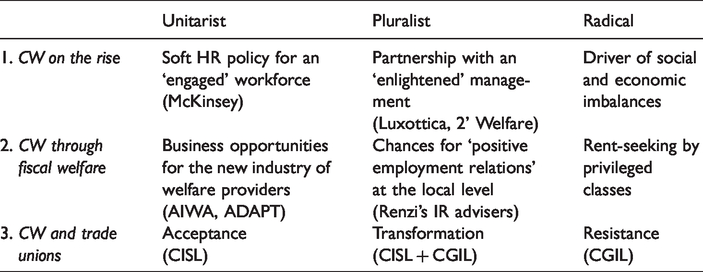
The first phase consists of the emergence of company welfare provisions as a promising form of occupational welfare after the 2008 economic crisis and the 2011 public budget crisis severely questioned the capacity of social welfare in Italy. A cutting-edge case, Luxottica, acted as sparkle to light up a debate on the potential of such provisions. A think-tank related to academia, Secondo Welfare, has nourished this debate since 2011, joined by business-driven actors such as financial major organisations. In terms of FoR, it is straightforward to see Luxottica’s and Secondo Welfare’s approach to company welfare in terms of pluralism, arguably of the collaborative kind (Bray et al., 2020). Luxottica, in fact, expresses an ‘enlightened’ management, to some extent paternalistic but also inclusive of trade unions (Grandi, 2017; Mallone, 2013); Secondo Welfare instead draws inspiration from this company best practice and promotes a debate on factors conducive to win–win organisational solutions (Ferrera and Maino, 2014), seen as expression of ‘social investment’ (European Commission, 2015; Morel et al., 2012) and ‘liberal neo-welfarism’ (Ferrera, 2014). Vice versa, McKinsey (2013) advocates the ‘business case’ for company welfare provisions and stresses its link with employee satisfaction, well-being and productivity, therefore conceiving such measures as convenient ‘soft’ HRM techniques and reflecting a perspective inspired by consultative unitarism (Bray et al., 2020).
The second phase expresses the fiscal welfare measures that boosted the diffusion of company welfare in Italy. These tax breaks, introduced by Renzi’s governments in 2015 and 2016, opened business opportunities that translate into a new market for welfare providers and an industry whose main operators team up to create an interest organisation (AIWA). In terms of FoR, we move to a controversial position, much closer to the unitarist pole. The unitarist drift is manifest in the case of AIWA and the related IR think-tank ADAPT, whose contributions on company welfare reflect an enthusiasm for growing opportunities, in terms of business and practitioners-led research (Massagli et al., 2018). It is instead more nuanced in the case of Renzi’s IR policy advisers, whose analyses include clear pluralistic elements. In fact, although Renzi’s policy-making was marked by ‘disintermediation’ and the exclusion of social partners from structured political exchange at the national level (Tassinari, 2019: 179–185), his IR policy advisers underlined the opportunities that such reforms would create for social partners at the decentralised level, increasing the chances for pragmatic solutions, both consensual and productivity oriented (Leonardi, 2018: 55–59). The prospects of ‘positive employment relations’ is, indeed, backed by evidence from even more difficult, market-oriented contexts (Johnstone and Wilkinson, 2016). However, what observed in relation to the diffusion of company welfare in the Italian case suggests that ‘positive’ experiences are so far rather episodic and concentrated (Pizzuti, 2019; Razetti and Santoni, 2019), as corroborated in our interviews even by most sympathetic supporters to such developments (Secondo Welfare). As seen, a more critical assessment emerged recently and pointed at the ‘neoliberal’ nature of the fiscal reforms supporting company welfare (Mallone et al., 2019: 62).
The third phase focuses on trade unions – here only the two largest ones, CGIL and CISL – and how they reacted to the growing relevance of company welfare. At first, when company welfare provisions boomed in the aftermath of 2015 and 2016 fiscal reforms and trade unions were excluded from the relevant policymaking, their reactions matched their different ideological standpoints (Gasparri et al., 2019; Hyman, 2001). CISL, whose identity tends towards ‘society’, welcomed the prospects of company welfare provisions, seen as expression of industrial relations inspired by collaborative pluralism, although – in practice and in particular at the early stage – CISL played a relatively marginal role in the diffusion of such provisions, something that makes CISL’s position compatible with consultative unitarism (Bray et al., 2020). Vice versa, CGIL, whose identity tends towards ‘class’, opposed the diffusion of company welfare provisions, noting the risks for the social welfare, and contested policy reforms that, as fiscal welfare measures introduced by the Renzi’s government, can be considered as employers’ friendly. Displaying an 'adversarial' orientation, CGIL’s position reflects typical concerns present within the radical and critical pluralist frame (Danford, 2016; Heery, 2016a: 119–122; Kelly, 1996). However, over time, and in particular after 2017, trade unions regained the initiatives and tried to integrate company welfare provisions in their negotiating agenda. As our two examples demonstrate (the 2017–2019 contract renewal for the metal sector; the ‘Participation Deal’ signed in Milan in October 2019), company welfare became one factor among others – beginning with training opportunities – that trade unions consider as enabling constructive discussions, if not partnership, with management and through which workers strive to participate meaningfully in company decision-making, in particular as regards organisational innovation, competences and skills (Gasparri and Tassinari, 2020). In this sense, moving beyond their ideological differences, trade unions engage with challenges brought about by company welfare and indicate possible solutions in which their concerns are met, delineating the prospects for ‘positive’ industrial relations (Johnstone and Wilkinson, 2016) which, in terms of FoR, substantiate a relatively well-balanced form of collaborative pluralism (Bray et al., 2020).
Conclusion
In this article, we have examined the growing relevance of company welfare that occurred in Italy after the 2008 crisis, testing FoR in an original manner by enlarging the perspective beyond workplace-level dynamics to include welfare and employment policies. Making the most of the double-edged nature of FoR, the analysis advances our understanding of the corresponding controversies in practice as well as theory (Barry and Wilkinson, 2016; Kaufman, 2004; Tapia et al., 2015; Heery, 2016a). As for the practice, our findings demonstrate that best practice in one company (Luxottica) and fiscal welfare policies (tax breaks for the provision of employee benefits) have played a key role in the promotion of company welfare (Grandi, 2017; Mallone, 2013). However, its diffusion has so far disproportionally focused on some sectors (large companies in manufacture) and areas (Northern region, especially Lombardy), therefore questioning the reproduction of a more universalistic and egalitarian form of social welfare (Pizzuti, 2019; Razetti and Santoni, 2019). Company welfare practices, in other words, express a mix of unitarist and pluralist employment relations, with two factors standing out as crucial to determine their developments: one is the political landscape and, in particular, the political positions of the institutional left, as the Renzi’s parabola within the main centre-left party demonstrates (in the ascending phase, unitarist components grew; in the descending phase, critical positions gained relevance). The other is the degree of involvement of trade unions in the policymaking as their involvement strengthened pluralist employment relations, in both collaborative and, depending on the leftist CGIL, adversarial versions (Guardiancich, 2019). The assessment of these practices is, however, mixed. On one side, if the emphasis is put on the pluralistic features, the relatively few but promising good practices of company welfare fit well into expectations attached to both the ‘social investment’ welfare paradigm (European Commission, 2015; Ferrera, 2014; Morel et al., 2012) and ‘positive employment relations’ (Johnstone and Wilkinson, 2016). On the other side, upon critical reflection on all FoR, we conclude that the growing relevance of company welfare is mostly driven by a political and economic rent-seeking elite (Mallone et al., 2019: 62), mobilised to affirm unitarist employment relations and to dismantle the universalistic and redistributive components present in the welfare system. This conclusion confirms Titmuss’ caustic assessment of occupational welfare (1955, 1959) and Esping Andersen’s concerns regarding private forms of welfare (1985: 237). It also reverses the ‘democratic class struggle’ principle behind power-based welfare theory (Korpi, 1983): we claim, in fact, that the case here under examination offers an example of capital’s class struggle against labour.
As for the theory, two contiguous sub-frames, consultative unitarism (expressed by the IR think-tank ADAPT) and collaborative pluralism (expressed by another think-tank, Secondo Welfare, and Renzi’s IR advisors), set the tone for the debate on company welfare. A more critical perspective emerged only more recently (Mallone et al., 2019; Pizzuti, 2019: 15). On the basis of Heery’s application of FoR to IR intellectuals (2016a: 69), we identify in mainstream contributions a ‘merchant elite’ primarily engaged with corporate managers and inspired by unitarism (Massagli et al., 2018), and a ‘sage elite’ of ‘would-be institution-builders’ aligned with a collaborative pluralism (Ferrera and Maino, 2014; Leonardi, 2018). Looking instead at IR as a subject of study, this analysis substantiates recent developments of IR in Italy (Gasparri, 2017), where leading institutions moved, albeit in different manner, the pluralist fulcrum towards the unitarist frame. As far as the IR think-tanks are concerned, we urge them to address ‘questions of the conditions under which co-funding is appropriate, and of the problems of retaining complete independence from interest groups’ (Edwards, 1995: 57); in this case, welfare providers and the financial sector. At the same time, we believe that IR, to preserve the emancipatory traits underlying its project, has to take care to balance the debate on contemporary transformations of work in a larger sense, which can be done by constantly renewing the application of FoR (Gomez et al., 2004). As Heery wrote (2015: 38–39), ‘it is through advancing and defending positions against rival frames that arguments are strengthened, interpretations are clarified, and new research is born’. Our goal is to offer a contribution in this direction.
Footnotes
Acknowledgements
The author thanks Rosa Celadon, Hazel Conley, Sue Durbin and the HRWE Research Group at UWE for invaluable support and encouragement, plus the Editors and two anonymous reviewers for their insightful and constructive comments.
Declaration of conflicting interests
The author(s) declared no potential conflicts of interest with respect to the research, authorship and/or publication of this article.
Funding
The author(s) received no financial support for the research, authorship and/or publication of this article.
