



Abstract
There has been much recent enthusiasm for stoicism as a way of thought and life. This enthusiasm highlights, among other things, the beneficial aspects of stoicism on relationships with others, although the interpersonal nature of stoicism has not yet been examined empirically. In this study, we examine this, measuring the projection of stoicism across the interpersonal circumplex (IPC) in a sample of men and women recruited online (N = 447). Results indicated that stoicism projected into the cold area of the IPC, suggesting that it is associated with a tendency to rate oneself as detached. However, these findings may not fully characterize stoics’ interactions with others, as the stoic philosophy and way of life emphasize interpersonal engagement. Study findings add nuance to a psychological understanding of stoicism and provide numerous directions for future research on the interpersonal nature of stoicism.
Introduction
There has recently been much popular enthusiasm for stoic philosophy (e.g., Evans, 2012; Holiday, 2014; Pigliucci, 2017; Robertson, 2019), aspects of which have been both implicitly and explicitly incorporated into contemporary humanistic psychology (Moss, 2015). The traditional understanding of stoicism focuses on logical reasoning and the regulation (perhaps suppression) of emotion. However, contemporary advocates of stoicism also highlight that stoicism facilitates deeper interpersonal connection, although there has been limited research on its interpersonal aspect.
Stoicism in Brief
The roots of stoicism are in post-Aristotelian Greek (e.g., Zeno of Citium, Cleanthes, Chrysippus, and Posidonius, writings by whom largely no longer exist) and Roman philosophers (e.g., Aurelius, 170-180/2006; Epictetus, 108/2008; Seneca, 64/2007), which arose in part as a response to the political decline of Greek and Roman societies, respectively. The cornerstone of stoicism is the primacy of reason as a human faculty and its use in working toward a happy (i.e., eudaimonic) life. Part and parcel with this focus on reason is the admonition that one should concentrate one’s attention and efforts on things one can control (e.g., behaving virtuously) rather than things out of one’s control (e.g., external forces and events, material objects that may be lost or taken away). Related to this is acceptance of, but a detached, objective relationship with, impulses and emotions, preoccupation with which may cloud logical thought. This aspect of stoic philosophy is the origin of the proverbial “keeping a stiff upper lip” in the midst of times of adversity and high emotion. The sum of these ideas is a sense of stoicism characterized by an acceptance of events as they happen and a dispassionate, logical understanding of and response to the world as it is (for review and history of stoic thought see Inwood, 2018; Sellars, 2014).
Importantly, contemporary proponents of stoicism typically focus on a narrow range of stoic thought, specifically those components dealing with understanding the nature of emotional experience and how best to deal with it (so as to achieve a peaceful and ethical life). This is in contrast to stoicism as originally understood, taught, and practiced in antiquity, which was a holistic philosophic system that included teachings on physics, theology, and logic (see Inwood, 2018; Sellars, 2014). In this way, it was comparable to other (post-Socratic) philosophical systems practiced at the time (e.g., Epicureanism, Skepticism; see Nussbaum, 1994). Contemporary stoicism has not only retained but elaborated on the classical stoic understanding and treatment of emotion, expanding beyond basic emotions like anger, fear, and grief by inquiring into more complex emotions like shame and disgust (Nussbaum, 1994, 2001). The deep (albeit narrow) range of contemporary stoicism has had an impact on modern life, including in religion (Sorabji, 2000) and medicine (specifically, psychotherapy; see Evans, 2016; Robertson, 2020). This latter application is particularly relevant to the recent applications of stoicism in psychology.
There is some research to suggest that contemporary stoicism may be useful in attenuating a range of aversive experience. Namely, emerging studies suggest that endorsing stoic beliefs is negatively associated with psychological distress and physical fatigue, as well as positively associated with a range of positive outcomes including sense of self-efficacy (Akrim et al., 2021; Brown et al., 2022; LeBon, 2014; MacLellan & Derakshan, 2021; McAteer & Gillanders, 2019). However, a criticism of stoicism lies in its popular misconception—that this reduction in feeling bad may come at the expense of feeling in general, resulting in a detached, cold orientation toward other people—indeed, this is what the colloquial use of the word “stoic” often connotes (MacLellan et al., 2022). This interpretation conflicts with stoic teachings that love, kindness, and relationships with other people are central to living a eudaimonic life (e.g., Aurelius, 170-180/2006). Contemporary advocates of stoicism likewise argue that limiting preoccupation with things out of one’s control and not having one’s behavior driven by impulse and emotion leads to deeper and more fulfilling relationships with others (Pigliucci, 2017; Robertson, 2019). There are thus conflicting views on the interpersonal nature of stoicism, which philosophy as a discipline may not have the tools to address.
The Interpersonal Nature of Stoicism
One tool that may be useful in inquiring into the interpersonal nature of psychological constructs is the interpersonal circumplex (IPC; Leary, 1957; for review see Fournier et al., 2011). The IPC is a map with which psychologists can understand people’s behavior (overt and covert, including thoughts and motivations) with respect to other people (Horowitz, 2004; Wiggins, 1991). These people need not be in the proximal here and now, but may be real or imagined, different versions of the same person (e.g., arguing with oneself), or occur at any point in time (i.e., past, present, or future; Sullivan, 1953). The IPC has two axes upon which a person (or their behavior) is located: warmth (vs. coldness) is the degree to which a person is connected to and can cultivate a sense of love for others, and dominance (vs. submissiveness) is the degree to which a person achieves self-definition and mastery relative to others (see Figure 1). A person’s constellation of traits (and/or their behavior) is often a combination of warmth and dominance (e.g., leading friends to a party is warm-dominant, sulking is cold-submissive) and the further out these characteristics (and/or their behavior) are on the IPC, the warmer and/or more dominant they are (e.g., insulting someone is cold-dominant, but assaulting them is even more so). The IPC and the dimensions that comprise it have analogues across time, culture, and worldview (Bakan, 1966; Wiggins, 1991). Moreover, recent work has connected the IPC with the principles of existential-humanistic psychology, including agency, authenticity, and genuineness (for review see Yalch, 2023), which is reflected in recent empirical work applying the IPC in humanistic contexts (e.g., Newman et al., 2023; Yalch et al., 2024).
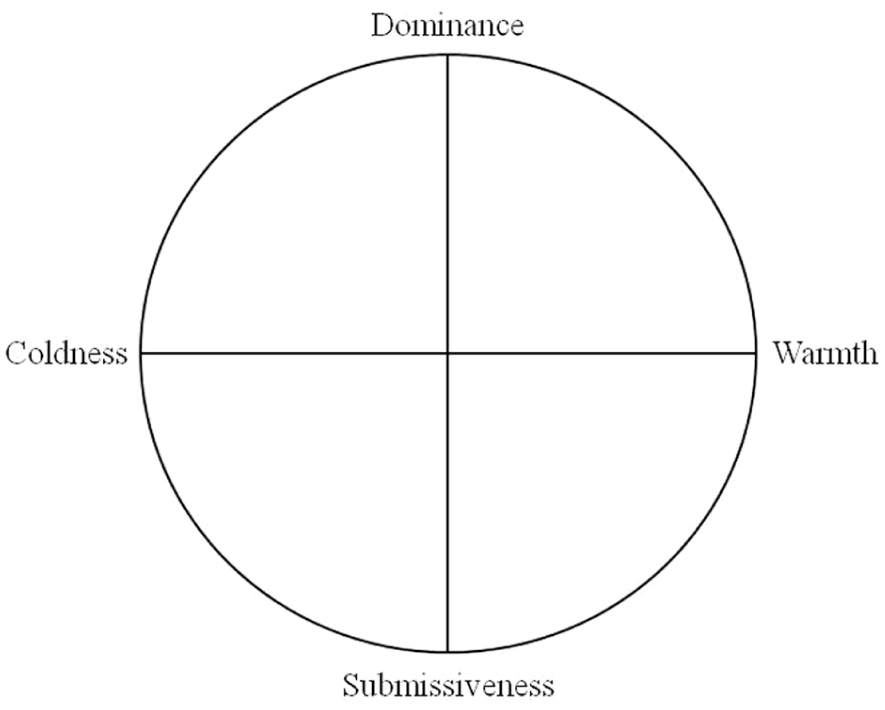
The Interpersonal Circumplex (IPC).
The IPC is also useful in examining empirically the interpersonal valence of discrete variables of psychological significance. Namely, we can examine how a variable projects across the IPC. This entails analyzing the area of the IPC with which a variable is most associated (e.g., warm, warm-dominant, dominant, cold-dominant, etc.), how far into that area it projects, and how specific the projection is (e.g., is the projection primarily in the dominant area of the IPC, or does it ramify into the warm-dominant and/or cold-dominant areas?)—that is, if there is a consistent interpersonal projection at all (Gurtman, 1992). We can use this framework to understand the interpersonal nature of stoicism. Namely, given the argument that by directing attention away from external events and immediate impulses, stoicism may facilitate greater connection to others (Pigliucci, 2017; Robertson, 2019), we would expect that stoicism would project into the warm area of the IPC. However, this has not yet been examined empirically.
Current Study
In this study, we examined the interpersonal nature of stoicism. We hypothesized that stoicism would demonstrate a consistent projection into the warm area of the IPC. An alternative hypothesis would be that the suppression of emotion that is part of the popular misunderstanding of stoicism would coincide with a detachment from other people, in which case stoicism would demonstrate a consistent projection into the cold area of the IPC.
Method
Participants
Participants in this study were 609 workers in the United States on Amazon’s Mechanical Turk (MTurk), an online crowdsourcing platform on which people complete tasks (e.g., complete surveys) in return for compensation. MTurk samples tend to be more representative of populations from which they are drawn (e.g., with respect to demographic characteristics) than other methods of “convenience” sampling and tend to provide high-quality data (for review see Buhrmester et al., 2016, 2018). Nevertheless, we incorporated several measures to ensure our data were of high quality. First, we programmed a captcha in our survey to prevent bots from providing responses. Second, we directed out of the survey anyone who answered incorrectly on any one of three attention check items (e.g., “What is 2 + 4?”). Third, we removed from the initial set of survey responses anyone missing more than 10% of their item responses (n = 7). Finally, we removed from analysis anyone who scored above 84T on the Infrequency scale of the Personality Assessment Inventory (Morey, 2007), which is empirically validated to detect unusual or inattentive responding (n = 155). This yielded a final sample of 447 participants.
Participants had an average age of 41 years (SD = 13, range: 20–84) and were majority male (54%). The majority of participants identified as White (83%), with smaller numbers identifying as Black (7%), Asian (4%), Native American (2%), and as either multi-racial or as another race that was not listed in the survey (3%). The majority of participants (90%) identified as non-Latiné. Participants provided informed consent before completing the online survey, which was posted on the MTurk platform available to all English-speaking workers in the United States with a neutral label (“Personality Traits Study”) to limit response bias. The study received approval from the Palo Alto University Institutional Review Board.
Measures
We measured study constructs using well validated instruments and calculated each scale using mean item ratings (see Table 1 for psychometric information).
Correlations Between and Psychometric Information About Stoicism and IPC Subscales.
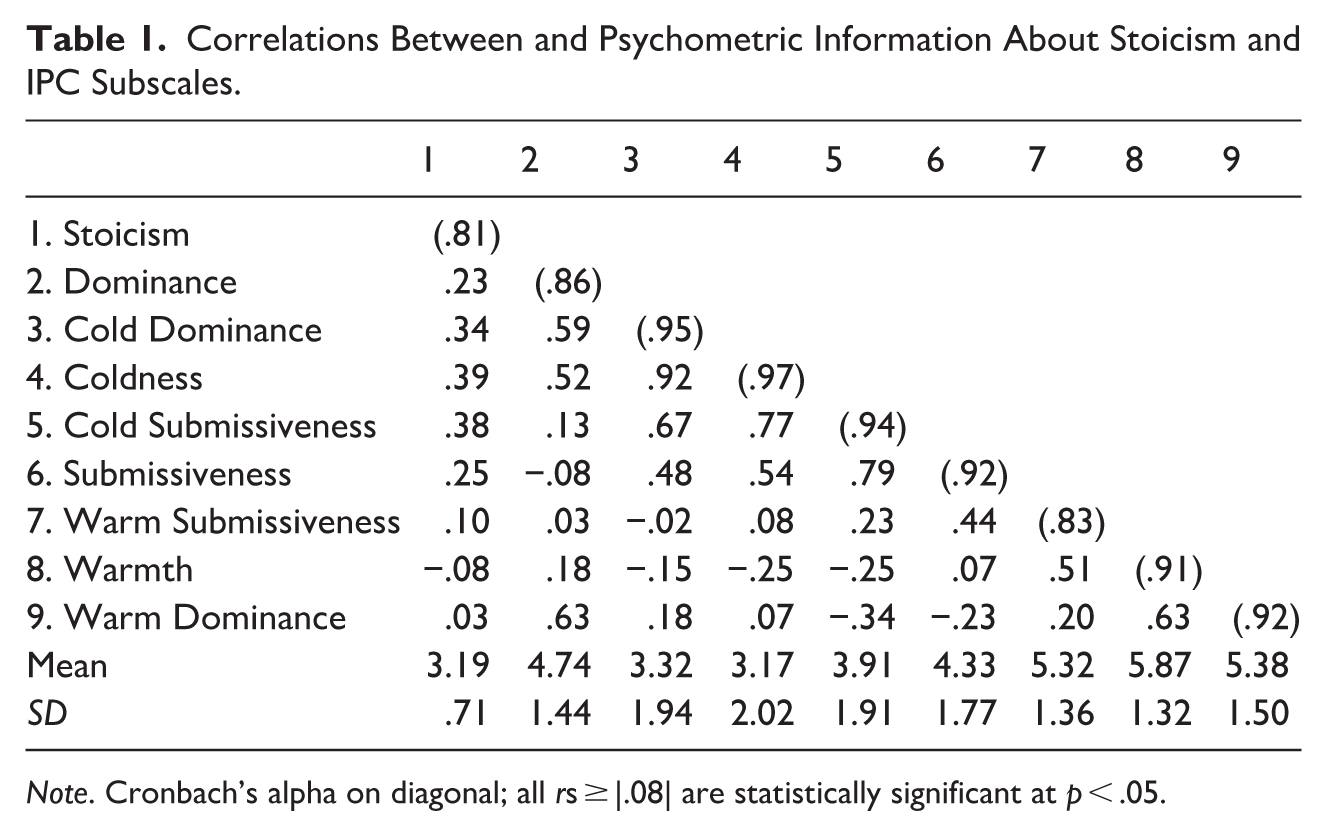
Note. Cronbach’s alpha on diagonal; all rs ≥ |.08| are statistically significant at p < .05.
Stoicism
We assessed stoicism using the Pathak-Wieten Stoicism Ideology Scale (PW-SIS; Pathak et al., 2017), a 12-item scale measuring beliefs characteristic of stoicism. Participants rated how much they agreed with each PW-SIS item on a 5-point scale ranging from disagree to agree. Examples of items include “when the time for my death comes, I believe I should accept it without fear” and “I believe my physical pain is best handled by just keeping quiet about it.” Previous research suggests that the PW-SIS has strong internal consistency (Pathak et al., 2017) and convergent validity with respect to normative (e.g., Big Five) personality traits and a number of philosophically relevant outcomes (e.g., subjective happiness, flourishing, meaning in life; Furnham & Robinson, 2024; Karl et al., 2022). Of note, although the PW-SIS has four subscales, two of these subscales did not demonstrate adequate internal consistency in this sample (see Supplementary Materials).
Interpersonal Characteristics
We assessed interpersonal characteristics using the Revised Interpersonal Adjectives Scale (IAS-R; Wiggins et al., 1988), a 64-item list of adjectives associated with eight different areas of the IPC (warm, warm-dominant, dominant, etc.), each of which comprised a subscale. Participants rated how much each IAS-R item described them on an 8-point scale ranging from extremely inaccurate description of yourself to extremely accurate description of yourself. Examples of items include “charitable: generous and benevolent, likes to help others” (warm subscale) and “introverted: not outgoing or lively, avoids the company of others” (cold-submissive subscale). We examined the circumplex structure of the IAS-R in this sample using the RANDALL algorithm (Tracey, 1997): we found that the IAS-R met 263 of 288 predictions, yielding a correspondence index of 83% (p < .05), thus indicating adequate circumplex structure. The IAS-R is commonly used in mapping the interpersonal valence of personality traits, both normative and maladaptive (Du et al., 2021; Williams & Simms, 2016), and previous research suggests strong internal consistency of its octant subscales and circumplex structure (Wiggins et al., 1988).
Data Analysis
We examined how stoicism projected across the IPC using a bootstrapped structural summary approach (for review see Zimmermann & Wright, 2017), which we implemented using the circumplex package in R (Girard et al., 2021). The structural summary approach estimates projections across the IPC based on patterns of correlations between the projected variable and the circumplex scales. Major elements of the structural summary include model fit (R2, for which values ≥.70 indicate good fit), elevation (how strong the association is between a projected variable and IPC scales on average, for which values ≥.15 indicate marked elevation), angular displacement (the area in which a variable projects in the IPC; ranging from 0° to 360° going counterclockwise), amplitude (how specific a variable’s IPC projection is, for which values ≥.15 indicate a differentiated interpersonal projection), and general levels of warmth and dominance (Gurtman, 1992). We estimated 95% confidence intervals (CIs) for each of these metrics using 5,000 iterations of bootstrapping.
Results
Stoicism had on average modest correlations with the areas of the IPC (rmean = |.23|; see Table 1). This suggested that the measurement of stoicism was related to but not the same thing as interpersonal characteristics.
We clarified these bivariate results in our structural summary analysis. In this analysis, stoicism had a strong interpersonal profile (R2 = .96; see Table 2). Specifically, stoicism had a moderately elevated (Elevation = .21) and differentiated (Amplitude = .23) projection into the cold area of the IPC (Angle = 186.05°; see Figure 2).
Results of IPC Structural Summary Analysis.
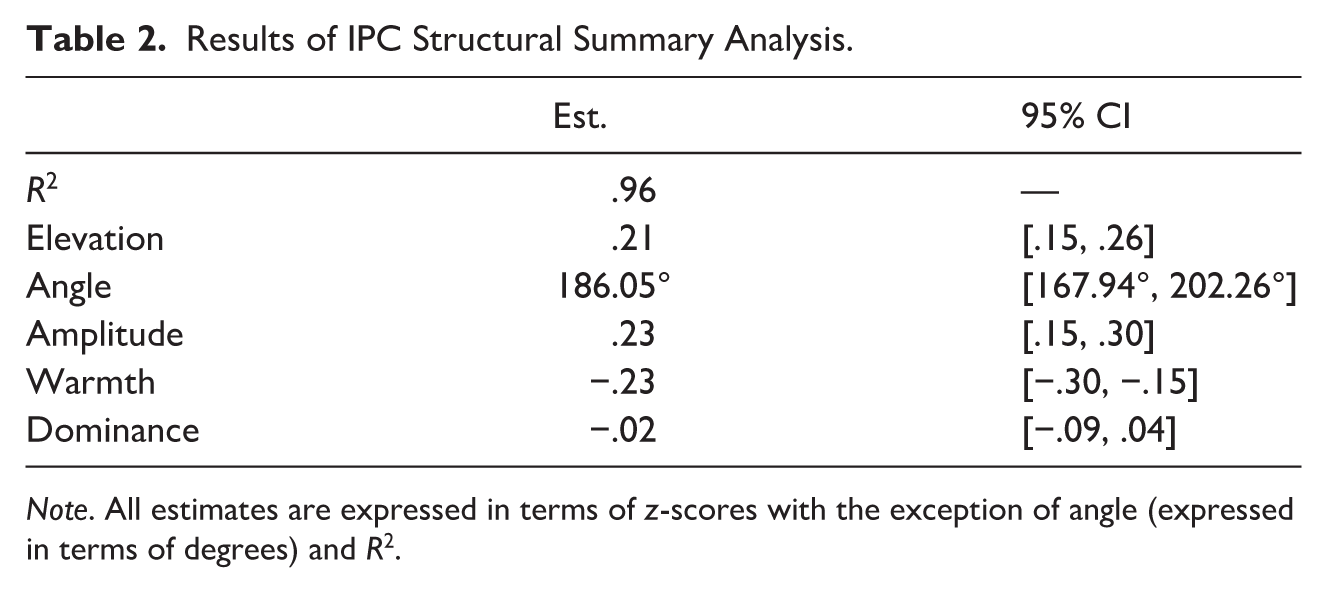
Note. All estimates are expressed in terms of z-scores with the exception of angle (expressed in terms of degrees) and R2.
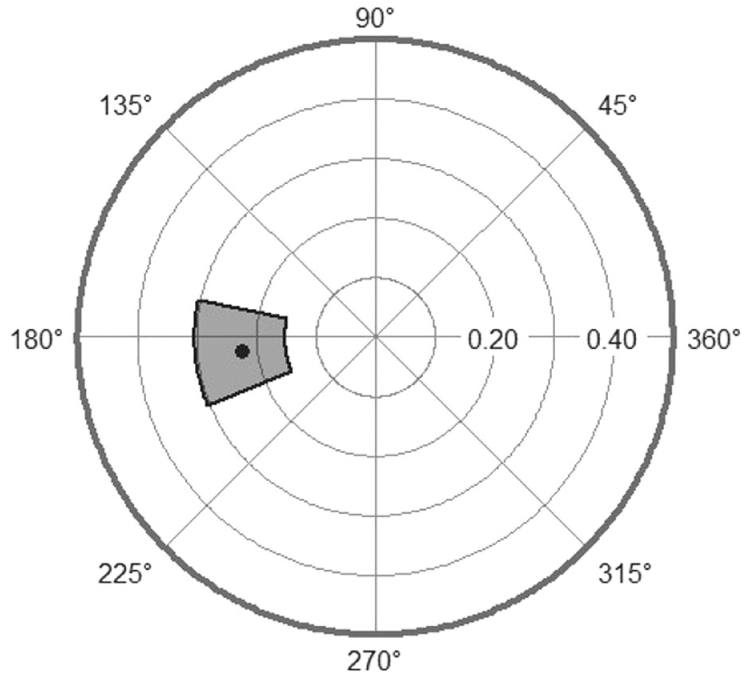
Projection of stoicism across the IPC.
Post hoc Analyses
Men are stereotypically “more stoic” than women, which may suggest sex differences in the projection of stoicism across the IPC. We examined this in a series of post hoc analyses. We first examined whether there was a sex difference in mean levels of stoicism, finding that men were slightly higher in stoicism than women (t = 2.07, d = .20). We next examined whether there were any differences in the projection of stoicism across the IPC, finding a trivial difference in model fit and no substantive differences in any other aspects in aspects of the IPC structural summary (see Table 3).
Sex Differences in Projection of Stoicism Across IPC.
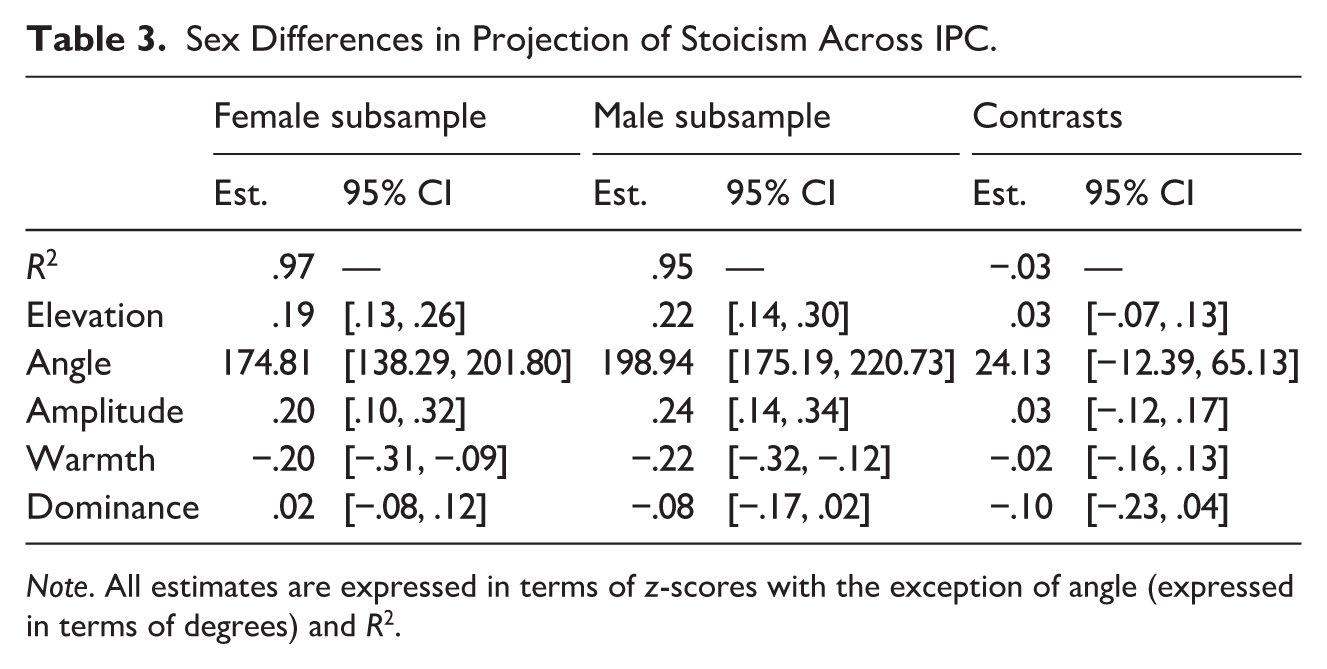
Note. All estimates are expressed in terms of z-scores with the exception of angle (expressed in terms of degrees) and R2.
Discussion
In this study we examined the interpersonal projection of stoicism across the IPC. Inconsistent with our primary hypothesis, we found that stoicism was associated with cold interpersonal characteristics. These findings have implications for understanding the interpersonal nature of stoicism as well as for future inquiry.
Stoicism’s projection in the cold area of the IPC was substantial but not excessive, suggesting an association with aloofness but not outright detachment or isolation. This is consistent with the colloquial understanding of stoicism as having a contemplative rather than actively engaged interpersonal quality. This is not necessarily a bad thing. That stoicism is empirically associated with lower levels of psychological distress (e.g., Akrim et al., 2021; MacLellan & Derakshan, 2021; McAteer & Gillanders, 2019) highlights its beneficial aspects (which is likely why many professions whose members are especially vulnerable to distress, such as the medical and military professions, value stoicism; MacLellan et al., 2022; Sherman, 2005). The findings of this study thus highlight a way in which stoicism is an adaptive aspect of the cold area of the IPC. Reflecting the bias toward warmth and in particular warm dominance (i.e., extraversion) in western culture (for popular review see Cain, 2012), findings thus contribute the interpersonal lexicon for describing adaptive interpersonal coldness.
That stoicism is associated with coldness on the IPC does not necessarily conflict with claims of its advocates that stoicism promotes more meaningful engagement with others. Stoicism’s cold projection in this study could reflect the potential to engage in a state of reflection that may promote deeper connection later. Indeed, the necessity for individual contemplation prior to meaningful engagement with others is a key feature of many humanistic psychologists’ thought (e.g., Fromm, 1947, 1992; May, 1953, 1975; for review see Yalch, 2023). Examining the interpersonal behavior of people high in stoicism (i.e., how stoic people actually engage with others vs. how they describe their interpersonal characteristics) would clarify this further. This is also a feasible area of future inquiry, as observational coding of interactions in terms of the IPC is an increasingly common way of assessing the interpersonal nature of behavior between people (for review see Lizdek et al., 2012). Such an approach would enable researchers to examine the association between stoicism and interpersonal characteristics in real life rather than (or in addition to) in a contrived setting. Another option would be to measure interpersonal characteristics via informant-report, asking other people to rate one’s interpersonal characteristics. This may be especially useful since people who endorse high levels of stoicism may see themselves as more introverted and aloof than they actually come across to others.
There are also a number of limitations of this study that may suggest other areas for future research. For example, we measured all constructs via self-report survey. With respect to stoicism, qualitative measurement may have yielded a more personal and “experience-near” assessment of participants’ stoic attitudes, beliefs, and practices (rather than just how people describe themselves), which in addition to providing a more holistic estimate of stoicism, would also be more consistent with humanistic (and existential-humanistic) psychology as a discipline (Wertz, 2015). Another approach would be less to measure stoicism than to provide a stoic (and non-stoic) prompt as part of an experimental design, with interpersonal behavior (e.g., coded behaviorally as suggested above) serving as a dependent variable. Such a design would provide some indication of causality, in this case whether stoicism causes (cold) interpersonal behavior (or whether people who tend to be more aloof also tend to gravitate toward stoicism). The idea of causality also highlights another limitation, that of this study’s cross-sectional design. A longitudinal study (quantitative or qualitative in nature) examining stoicism and interpersonal characteristics over time would provide not only additional information about causality, but also the degree to which these two constructs were associated with each other dynamically. We also recruited a sample for our study that predominantly identified as White and non-Latiné, which does not reflect of the population of the United States from which it was drawn and thus limits its generalizability to this population. Moreover, the association between stoicism and interpersonal characteristics may differ in different subcultures (e.g., in terms of nationality, ethnicity, profession). For example, people from more collectivist cultures may either value stoicism more negatively than in individualistic cultures (reflected in a more extreme cold projection) or, alternatively, perform stoicism in a more engaged way (reflected in a warmer, and also perhaps more dominant projection). Future research could thus expand upon this study by recruiting more diverse samples, implementing a multi-method approach to measuring study variables, and incorporating an experimental and/or longitudinal study design.
In this study we examined the interpersonal nature of stoicism, finding that stoicism was associated with a tendency to be interpersonally aloof. Study findings provide some clarity to our understanding of stoicism, which both adds some psychological insight to a venerable philosophical movement and presents many areas for potential future research.
Supplemental Material
sj-docx-1-jhp-10.1177_00221678261426415 – Supplemental material for The Interpersonal Nature of Stoicism
Supplemental material, sj-docx-1-jhp-10.1177_00221678261426415 for The Interpersonal Nature of Stoicism by Matthew M. Yalch and Kaleigh M. Newcomb in Journal of Humanistic Psychology
Footnotes

Ethical Considerations
This study complied with all ethical standards (including participants’ consent for research participation) and received approval from the Palo Alto University IRB (app # 2022-009).
Funding
The authors received no financial support for the research, authorship, and/or publication of this article.
Declaration of Conflicting Interests
The authors declared no potential conflicts of interest with respect to the research, authorship, and/or publication of this article.
Data Availability Statement
Data from it are available upon request.
Supplemental Material
Supplemental material for this article is available online.