




Abstract
Extended reality holds the potential to alter human experiences. This project explores user perceptions of peak experience (PE), a state of self-actualization and fulfillment, within augmented spaces and the potential role it can play for designers and developers to effectively engage immersive World Wide Web (Web3) communities. Semi-structured interviews, including an interactive experience stimulus, with key stakeholders in the Web3 space (staff from global immersive technology entities, brand collaborators, and community members, n = 15) were conducted. The findings reveal rich opportunities for users to experience surprise, delight, and a sense of connection and belonging in these spaces. They further suggest the potential to reshape and extend current user experiences by moving the focus of design toward crafting PEs. This holds great value for users to achieve a fuller sense of self-actualization and for content creators to connect to their communities in more meaningful ways.
Keywords
Introduction
Extended reality (XR) is fostering the creation of new immersive environments. The term encompasses Augmented Reality (AR), Virtual Reality (VR), and Mixed Reality and constitutes a new, digital world that includes the current web along with new persistent and lifelike platforms (Ball, 2020). With the advent of faster and greater technological capability, the world is rapidly moving toward the decentralized, community-controlled, third iteration of the World Wide Web (Web3) where machines interact with data to offer an integrated user experience across multiple devices and networks (McKinsey, 2023; Rudman & Bruwer, 2016). This may take us into an age of decentralized systems of living, thinking, and being as we break away from authoritarian politics and corporate financial agendas (Jones, 2022). As digital items and content become interoperable across Web3, growth in digital assets that redefine user experiences is to be expected (Ball, 2022). This transformation stands to disrupt global industries, such as fashion and gaming, as we move into pixelated futures where apparel, accessories, and various tangible items will transform from physical to digital (Amed et al., 2022), generating objects and experiences not possible in the actual world.
XR companies will transform available experiences from simple, wasteful consumption into powerful new encounters where the status of ball gowns and bags will be transferred onto virtual hoverboards and jet packs (e.g., Jadu, Niantic, and Snap Inc.) that allow users to partake in collaborative experiences. Avatars and bots, embedded with AI, will offer a new source of companionship, giving users access to thus far unrealized forms of self-actualization. Together, this may lead to increases in peak experience (PE), a state of heightened experience, awe, complete fulfillment, and pure uninhibited joy that transcends beyond expectation (Maslow, 1961, 1962; Privette, 1983).
To create these heightened levels of experience, companies will look to the decentralized spaces of Web3 for guidance as they contemplate new ways to reach their communities (Hinchcliffe, 2022). Although users can be motivated by PEs (Walls et al., 2011), there is little empirical evidence to date on what they represent or how to recreate them in Web3, emphasizing the importance of empirical work in the area. This study aims to understand user perceptions of PE to provide XR stakeholders with the knowledge they need as they consider how to connect their growing Web3 communities with these heightened states of experience. This research is crucial since companies are beginning to place significant investments in the space (e.g., Ball, 2020), but the development of these spaces should not solely be guided by the market.
This study will proceed in the following way. First, an overview of the extant literature on PE and XR, as well as how technology shapes and mediates human experiences, is provided. Following this, findings from in-depth, expert interviews with key stakeholders in the XR industry (n = 15) are presented. Finally, insights from the interviews and recommendations for implementation and further research on PE in immersive environments are discussed.
Related Work
Peak Experience
Self-Actualization and PE
Before discussing PE, it is important to capture what Maslow referred to as self-actualization as part of his hierarchy of needs (see Figure 1). It should be acknowledged that although Maslow’s hierarchy has been subject to criticism and revisions (Taormina & Gao, 2013; Wahba & Bridwell, 1976), there has also been considerable empirical work establishing support for it (Davis-Sharts, 1986; Noltemeyer et al., 2021). A note of equal importance is that Maslow envisioned his theory of motivation (and hierarchy of associated needs) as an integrated model, not as a ladder or pyramid (Bridgman et al., 2019; Kaufman, 2023; Maslow, 1943; see Figure 1). The popular hierarchical pyramid representation was originally developed by Charles McDermid (1960; Bridgman et al., 2019). It is not the focus of this study to discuss the hierarchy and its validity in detail; however, its premise must be established as a foundation for Maslow’s conceptual understanding of PE. As outlined in Figure 1, Maslow established five needs as he looked to understand human motivation. Initially, he suggested needs had to be met sequentially as a person progressed up toward the top of the hierarchy (Maslow, 1943). His later work led to an understanding that no individual need had to be satisfied for the next to emerge (Maslow, 1987). Needs, he found, were distributed as deficiency needs (D-Needs) and growth needs (B-Needs), the latter relating to the top of his hierarchy: self-actualization (Maslow, 1943).
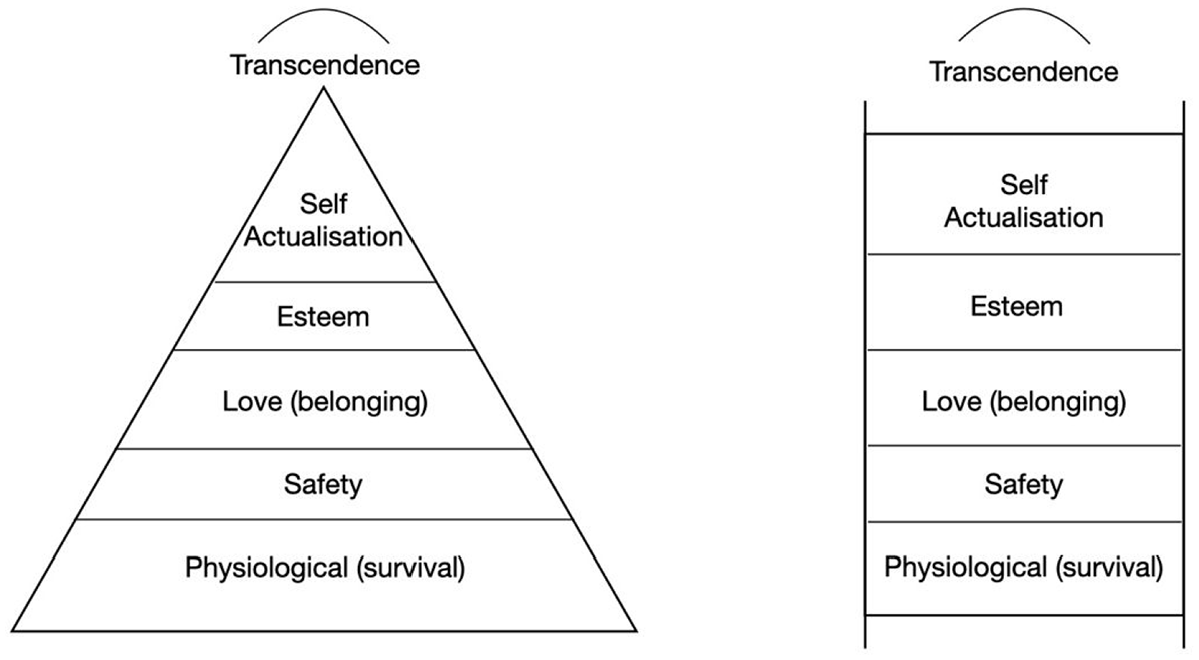
Maslow’s hierarchy of needs.
According to Maslow, self-actualization involves “people’s desire for self-fulfillment, namely, the tendency for them to become actualized in what they are potentially. This tendency might be phrased as the desire to become more and more what one idiosyncratically is” (Maslow, 1987). Kaufman (2023) suggests that once basic needs are satisfied, people can turn their attention toward growth, integration, and a sense of wholeness. Self-actualization is working toward what one wants to do, realizing one’s fullest potential, and finding deeper meaning in life (Maslow, 1943; Papaleontiou–Louca et al., 2022). Maslow (1962) postulated that PE was a transient or temporary form of self-actualization.
Akin to PE, Csikszentmihalyi (2008) speaks of flow when individuals reach heightened states (Larsen & Buss, 2008). Sometimes referred to as being “in the zone,” flow states are where people become completely absorbed in a task they are doing. Although sometimes confused with PE, Privette (1983) clarifies that a flow state does not necessarily indicate peak levels of joy or performance but can include both. Csikszentmihalyi (1975) found the flow to exist most in rewarding patterns of actions, such as games and play. Although both PE and flow could be described as playful, Csikszentmihalyi found flow to have a presence of motivation in the activity itself, while Maslow found PE to be meta-motivated or non-motivated and more receptive in nature (Privette, 1983). As users go beyond simple transactions, these meta-motivated states are a key factor in delivering PE (Kazmi et al., 2021).
This brings us to the question of what Maslow meant by PE. Let us think of a person being captivated by a moment and lost within it. Initially, their attention may have been alerted by something different from the ordinary. As they go deeper into the experience, internalizing thought and emotion, they are faced with an awareness to take into their real lives and worlds. This person would have experienced what is known as PE, which is defined by the American Psychological Dictionary as “a moment of awe, ecstasy, or sudden insight into life as a powerful unity transcending space, time, and the self. PE may at times occur for individuals in their pursuit of self-actualization” (APA Dictionary, n.d.). Interestingly, Maslow (1962) found sex and music to be the most frequently reported triggers of PE (Warmoth, 1963).
Maslow (1961) himself defined PE as “moments of highest happiness and fulfillment.”. His notes referred to PE causing people to experience reality more vividly and sometimes even altering one’s self-view (Maslow, 1962; Warmoth, 1963). He considered them to be “rare, exciting, oceanic, deeply moving, exhilarating, elevating experiences that generate an advanced form of perceiving reality and are even mystic and magical in their effect upon the experimenter” (Maslow, 1964). Yet, they were more common than he ever expected, and he noted many reports where subjects felt as if they had experienced a great truth and the essential essence of life, free of any veils (Maslow, 1962).
Parallels can be drawn between these ideal-type moments and experiences in XR, such as Travis Scott’s record-breaking immersive concert that entertained over 12 million people and included reality-shifting effects such as perceived gravity loss, dancers made of fire, and a simulated trip through space (Goslin, 2020). As humans continue to be motivated to improve, thrive, and achieve well-being in our surroundings, beyond just entertaining ourselves, properly crafted immersive and interactive content may have the ability to help humanity move toward states of self-actualization where PEs are sought out and increased encounters of self-transcendence may manifest (Kaufman, 2023; Maslow, 1943, 1962).
Characteristics of PE
Maslow (1962) believed people encounter PE temporarily in a state closest to when they are self-actualized. While being careful to leave this definition fluid, he went on to describe 16 characteristics of PE (Maslow, 1961, 1968; see Table 1). He was cautious to point out that all PEs overlap, with similar meanings across characteristics (Maslow, 1962, 1968). It should be noted that the number of characteristics and levels of overlap may be overwhelming for content creators to consider all at once; we will discuss this further in the “Discussion” section.
Maslow’s 16 Characteristics of Peak Experience.

Source. Adapted from “Toward a Psychology of Being” (Maslow, 1968).
Aftereffects and PE
Finally, we must also consider what happens to individuals after PEs. This will be helpful to understand the potential implications of inducing PEs. It will also give Web3 communities a sense of what to expect after encountering PEs. Maslow (1968) proposed seven testable aftereffects of PEs (see Table 2), against which we evaluate the findings of this study.
Aftereffects of Peak Experience.

Source. Adapted from “Toward a Psychology of Being” (Maslow, 1968).
Technology and Human Experience
Technology Mediation
To understand perceptions of PE within the context of XR, it is key to discuss the role technology mediation plays in human-machine interactions. Postphenomenologists suggest that perceptions of and interactions with the world occur through technology (Ihde, 1990; Verbeek, 2016); technological mediation is the notion, then, that technology mediates peoples’ relation to the world around them (de Boer et al., 2018). As the world races toward Web3, we increasingly come to rely on technology to provide connections and a sense of presence with people whom we perhaps have never met in person (Clegg, 2022). Social presence theory looks to understand how immediacy, intimacy, and presence are affected by digital interfaces (Short et al., 1976). With people spending more time on their personal devices, they appear less present with one another due to technology (Heitmayer, 2020, 2021, 2022, 2025; Heitmayer & Lahlou, 2021; Oulasvirta et al., 2012; Turkle, 2015). Yet, we must consider the changing dynamics as users adjust and accept technologies like XR that can add intimacy and a sense of being with each other. Gunawardena and Zittle (1997), therefore, suggested understanding social presence as “the degree to which a person is perceived as a ‘real person’ in mediated communication”. As it becomes increasingly difficult to distinguish humans from nonhuman agents (there is heated debate at the moment whether state-of-the-art large language models pass the Turing test; see e.g., Biever, 2023; Mei et al., 2024), this sense of reality will become even more pronounced. Further to this, research highlights human attachment to digital assets such as avatars as well as embodiment through them (Coulson et al., 2017). Assigning human states and familiar characteristics to digital assets can allow humans to fulfill social, belonging, and emotional needs by adding sentimental value, thereby increasing perceived levels of connection (Epley et al., 2007).
Technology and Human Behavior
As technology improves, people’s perceptions of the world are affected and their behaviors are shaped (Verbeek, 2016). The technological mediation of human experience leads to a co-constitution between people and technology; “rather than existing independently, the relevant features of a person, a technological medium and the world appear as a result of their mutual relatedness” (de Boer et al., 2018). This is important to consider as humanity adopts technologies such as AR and VR, where the potential to experience and bond with different forms of interactive and creative PEs is continually reaching more people. In Asad Malik’s award-winning AR experience Terminal 3, users interact intimately with a hologram and decide their fate through a series of interactive conversations (BUILD Series, 2018). This experience was noted for its ability to evoke real emotions and to alter participants’ perceptions of themselves and others (BUILD Series, 2018; Wan, 2020). By shaping our goals, emotions, and values, interactive technologies can affect our well-being and influence our interactions with the world around us (Anderson & Rainie, 2018; Tromp et al., 2011; Wan, 2020). PE thus holds the promise of inclusivity, waiting for a diverse population of participants to lose themselves in the magic of the moment. It is paramount, however, that technology facilitates seamless and effortless connection in immersive environments as people bond, build communities, and experience PEs. When technology becomes difficult to use, it can create a digital divide (Fernández-Lores et al., 2021).
Gap in the Literature
This rich literature on PE and the impact of technology on human experiences suggests there is ample opportunity to consider PE when researching and designing immersive spaces. While there is extensive work on immersive experiences utilizing XR technologies in both recreational and professional settings (e.g., Heitmayer et al., 2021; Lahlou et al., 2021; Marto & Gonçalves, 2022), the concept of PE has not been investigated scientifically in the context of XR environments and computer-mediated interactions so far. With growing interest in and adoption of Web3 and XR, we identified the need for a greater degree of scientific understanding of what drives PEs in XR. Following Maslow as a pioneer of understanding transcendence into worlds different from the ordinary, this study sets out to document and explore the perceptions of PE in XR among key stakeholders in the Web3 community as an anchoring point for this research field. It also aims to assist content creators to embrace the possibilities presented by Web3 and to begin to intentionally craft PEs for their communities.
Methods
Background
To explore experiences and perceptions of PE within immersive XR spaces, exploratory interviews with stakeholders in the immersive technology field who were also connected with the immersive XR open-world game developed by Jadu (n = 15) were conducted. Participants were recruited from three groups: Jadu community members, external brand collaborators, and Jadu professionals. Jadu community members were selected based on whether they held a Jadu digital asset and were active members of their digital community. Potential collaborators were selected based on their experience with and knowledge of XR. Leading directors, cutting-edge creatives, and C-suite level executives were recruited from industries including VR, AR, fashion, sports, and globally leading social media companies (see Table 3). The Jadu professionals were selected to represent different facets of an XR gaming company, from design and development to community or consumer-facing roles and leadership and management.
Participant Professional Role Descriptions.

Note. XR = extended reality; VR = virtual reality; Web3 = World Wide Web.
The final sample consists of 10 male and 5 female participants representing a global population. 1 Participants’ ages spanned from 21 to 75 (mean = 38), with a relatively even distribution across each decade. More specific demographics for individual participants cannot be provided as this may make them identifiable within their companies and communities.
Ethical approval was sought from the Institutional Ethics Board at the University of the Arts London. Participants gave informed consent prior to data collection and were reminded of their right to stop participating in the study at any time. Following the interviews, participants were debriefed. Semi-structured interviews were conducted in randomized order across the three groups via Google Meet. Interviews lasted between 46 and 100 min (74 min on average). The coding of themes took place iteratively in four rounds over 3 weeks.
Interviews were transcribed literally and analyzed using thematic analysis to uncover trends and overarching themes in the data (Braun & Clarke, 2021). Interviews adopted an experiential orientation to highlight meaning, views, and experiences from participant’s subjective perspectives (Braun & Clarke, 2022). At the beginning of the interview, participants were invited to interact with a two-dimensional immersive experience on their own devices (Honda, 2015). Participants were informed by the researcher that as they watched the video (a pre-designed interactive video advertisement), the simple intermittent de-pressing of their “R” key would allow them to travel between two versions of the video as much as they liked. The encounter with the experience served as an anchoring point for the shared understanding of immersive experiences, allowing participants and researchers to fully enter the conversation around PE in immersive spaces.
Reflexivity
With limited professional experience in immersive technologies, the first author presents a deep understanding of consumerism and trend analysis as a former fashion buyer who represented global brands for over three decades and recognized a growing interest in digital assets and immersive forms of entertainment. As a Jadu community member, this study was aligned with the company, which facilitated access to participants, but the research was not influenced in any way by Jadu.
One of the reasons for this interest in immersive spaces is that aside from leading advocacy work in the diversity space, the first author identifies as a brown, queer, Muslim male, which has led to a life full of discrimination in varying degrees, often based on appearances. They feel that Web3 may afford many people a chance to connect with equality and beyond prejudice.
As a Gallup-certified CliftonStrengths coach, the first author has an affinity toward positive psychology and helping people and companies thrive. Positive psychology and strengths psychology have their rooting in Maslow’s hierarchy in that they look to assist others in reaching a level of thriving and being what they think they are capable of being.
Findings
The thematic analysis resulted in five themes, each with four subthemes respectively. The five themes are Surprise, Delight & Differences, Expansion Beyond, Reshaping Realities, Interactivity & Achievement and Connection & Belonging (see Figure 2). Participants have been assigned a letter based on the group they belonged to (C for community members, B for External Brands, J for Jadu Professionals) and a number in order of their respective interviews (1–5).
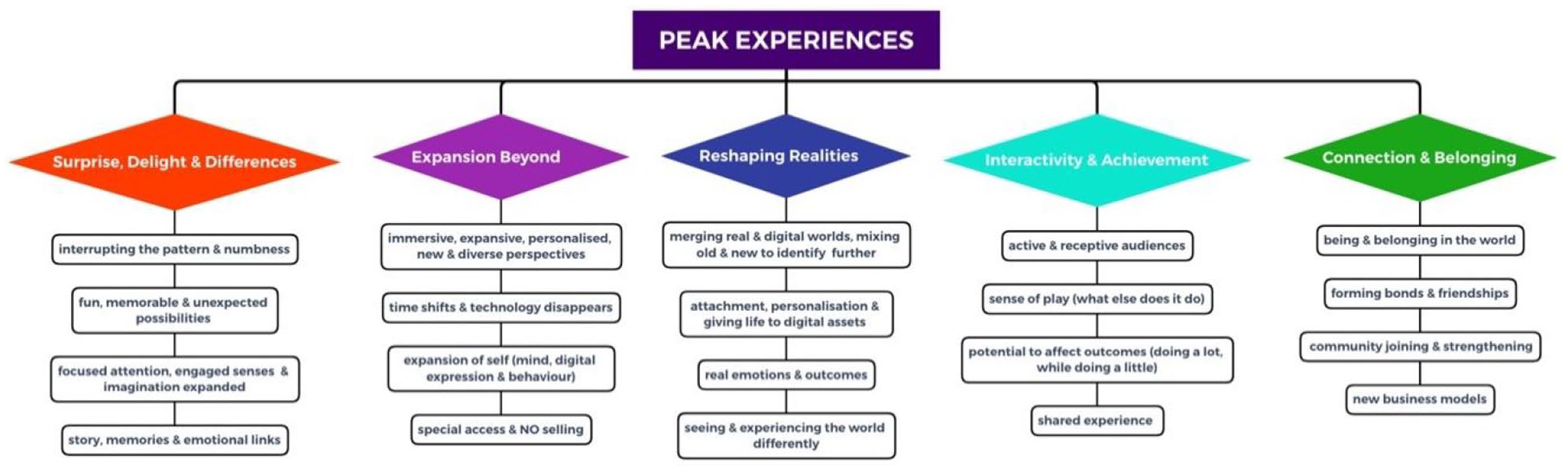
Thematic map.
Surprise, Delight, and Differences
Participants spoke of memorable PEs beginning with an interruption to their automatic, sometimes numb everyday routines, leaving them in a heightened state.
It really surprises you, and you feel like, oh my God, I’ve never seen something like this before. You feel excited and inspired. (C3)
Regardless of being positive or negative, these “attention-getting” or “sticky” experiences allowed people to go in further or stand by to see what happens.
The experiences that are sticky are the ones that are outside of the norm. Ones where I’m engaged with you in some way, shape, or form, where I’m present. I’m either engaged in a positive way or a negative way, you know, an accident or something extreme or a horror movie. But it’s something that is really taking all of my senses and screaming for me to pay attention. (B3)
Even if they were just a quiet moment of empty space, they were moments different from the ordinary, which in itself was memorable for people.
Sometimes the most impact you can give somebody is something devoid of anything, like blackness, even if it’s for just a minute before something else happens. There’s a power in that. (B1)
Fun, dark, or familiar, experiences such as surprises, delights, and differences engage the senses, triggering minds and emotions. Powerful stories evoking emotional links, memories, and a state of wonder that stretched people’s imaginations created impact.
There’s nothing ahead that tells you that this is what’s going to happen or what this thing is about. A very, very memorable experience that kind of had that element of surprise, uncertainty, I don’t know, a bizarrely positive feeling at the end. Both of them did, despite the second one having quite a dark undertone. (C2)
Expansion Beyond
Participants reported going deeper into experiences when being presented with different, broadening, and personalized perspectives. In this stage, participants reported behaving, seeing, and understanding themselves and others in new expansive ways.
A little bit like an out-of-body experience. Because it’s a perspective that’s very uncommon … it was more about being moved from a sort of a mental and emotional place that I don’t often go to, or perhaps I didn’t even know existed. (C2)
As they became immersed, several participants reported losing their sense of time or even traveling through it.
Interacting with a digital or virtual world, or even like a board game world, and they’re very immersive, like you lose so much time. (J5)
There was a huge, like, adult-sized playground, basically, to start you off, to get you in that mindset, like shrink you, or move you back in time. (C2)
Considering the possibility of brands entering the digital space collaboratively, almost all participants explicitly expressed not wanting to be sold to. They preferred to have value-added creatively, showing an understanding of the community and space.
I don’t want it to feel like I’m part of an advertisement. And it’s just for their profits or whatever, I want it to be really something special and engaging and something that you will remember because, you know, time is valuable, you don’t want to spend your time on an experience just so they can sell more. (C3)
There was a desire for access to experiences in Web3 and in life they could not attain otherwise. This created value for users and potentially further exploration and connection to the brand.
That’s where I think the value is. It’s getting you access into a world that you couldn’t normally get access into. Now that to me is the holy grail of the NFT space at the moment. That’s true value … you’re driving into what is the existing exclusivity or access to an exclusive level within an existing brand. (C4)
Reshaping Realities
Participants, now more engaged and comfortable in the experience, also shared accounts of real attachment to and excitement about digital objects and worlds which shifted their physical worlds and emotions. Building upon the Expanding Beyond theme, participants reported experimenting with digital assets to bring them into reality as the physical and digital worlds they inhabit merged. Sometimes feeling as if these assets have come into existence, and filled with emotion, participants discussed how they create attachment.
It’s a character that I talked to using just like Alexa, for example. And I programmed it to do the very basic of “hey, give me a dance” and it dances, and I go, “that’s not very good.” And it gets sad. And I go, “Okay, I’m sorry, you can keep dancing,” and it continues. Everyone who watched that video, including me for a minute there had a small spark of, oh, gosh, I’ve changed the emotional state of this thing by just being me. Subconsciously communicating with it, I have changed the state. Whether or not it holds that state of “you have made me sad once” doesn’t matter, I have internalized it as such … so I know everyone else who sees that video of that content goes “Oh, my God, you made that thing sad. Like, is it going to trust us?” (B5)
Bringing together what’s familiar and what’s new in personal ways leads to emotions, connection, and even companionship as exhibited by J4 when they spoke of their digital avatar.
I think the biggest thing for me is just what I connect with is the companionship of it. You know, looking at the fact that these [avatars] can be utilized in AR, and they can pop up in our actual, you know, real life world, to me creates not just an avatar, but really a companion. And I think that that companionship is something that people want. (J4)
With aspects of XR layered upon participants’ worlds, their reality is enhanced while shapeshifting it into something new and exciting. This offered them the imaginative possibility to experience the world entirely differently.
I mean the experiences themselves that I’d love to have … I would love to get inside a molecule. I really would and understand … I’d love to fly with the geese … somebody did that in a movie once. (C5)
Interactivity and Achievement
With a new outlook and sense of wonderment, participants also discussed a desire for “more” from immersive experiences and digital assets. As an active audience, they want something to interact with, to make a difference to the outcome of the experience or to the digital asset; a sense of co-creating their own story.
I think we’re at a point where you see things like open worlds gaming, and kind of choose your own adventure style stories are much, much, much more popular than anything single tracked, or double or triple tracked or whatever … the opportunity to really do exactly that, kind of choose your own adventure and build their own story. (J2)
They also discussed the joy of connecting with one another in a sense of play, wondering what else the experience or digital asset can do or be. This shared experience can sometimes be to solve challenges or to compete in friendly ways.
Cheerful competitiveness, where you’re definitely working toward a goal that you really want to achieve. You don’t necessarily have to put others down to achieve it, though. Often, these are things that you’ll achieve only through working with other people. That would probably be the biggest one for me, a sense of progression. (C1)
Several participants also expressed the importance of effortless interactive moments, which increased the level of enjoyment and a sense of presence within the experience.
I think that as we look to having immersive brand experiences in the digital space, having those experiences have fluid communication and dialogue, and the ability to have a shared social experience with another human being that is not interrupted by technology, but perpetuated by technology, are really important attributes of where we’re headed. (B4)
It should be noted that several participants were considerably engaged by this theme. While finding joy and excitement in the idea of competition and gamification, they appreciated a sense of autonomy in what they experienced, which gave them a feeling of accomplishment. This theme was also joined to a sense of regular interactivity and achievement with the decision-makers and taste-makers of the experience.
Connection and Belonging
Forming memories, bonds, and new ways of behaving or feeling gave people a deepened sense of belonging in the digital community, in their own lives, and in society. Some participants shared how they became who they wanted to be through exploration in Web3 communities.
The knock-on effects of that were finding a place that I felt safe to be myself behind a mask. It allowed me to take off the mask in my real life. And I started showing up with more vulnerability and authenticity to the people that knew me. And that was really, really beautiful. For me that was, it was a whole healing journey. (J1)
Participants spoke of forming bonds and connections with one another and the stakeholders that created experiences and hosted communities. Deepening their sense of belonging and feeling valued, participants expected to connect and grow together. They also discussed their expectations of real-time interaction and input with businesses and brands in Web3, which they believed afforded an opportunity to extend a meaningful contribution.
On Discord, it’s different because it’s a real-time interaction. So, when a question comes up, they are expecting an answer. Right away. They are expecting that interaction. If brands manage to be more authentic and create a connection, I think that’s something. And then the other is creating a two-way street, opening it up, and not just come there to present. But also to hear, to listen, to engage. (B2)
Participants also shared a desire for flexible consent around when they shared data, and for what purposes it would be used. They explained how this level of flexibility and transparency was important in establishing further levels of trust, thereby deepening a sense of connection and belonging. Companies seemed to understand this, too.
The more we establish trust, the more we educate, the more we prove that we have secure systems in place to protect this data. And, as mentioned, the more opportunities we give users to have ownership of that data … If we give these tools back to users, establishing that trust and gaining that confidence in providing the data is much easier in my eyes. (J2)
It was also expressed that the opportunity to come together safely, unobtrusively, and anonymously added to the desirability of experience in Web3 communities. With anonymity respected and the ability to build their digital persona free of biases, people reported a sense of freedom and equality to others, which fostered a sense of community and togetherness.
You know, they don’t have to worry about preconceived notions or biases; it’s hard to really discriminate against a Pudgy Penguin, whereas it’s easy to discriminate against someone based off a worldview that they’ve created. So, it kind of levels the playing field a bit. (J4)
Discussion
Summary of Findings
The findings reveal an unexpected clarity for participants about which experiences they want to encounter. Participants look for a surprising, different, and perhaps delightful break from the ordinary that takes them into PEs which have the potential to reshape reality itself. The arising themes support accounts that describe technologically mediated experiences in immersive spaces as inviting an expansion beyond and within the self. A key to this interruption and expansion is that technologies and experiences remain simple, effortless, and work correctly. If this is not the case people are left frustrated and dissatisfied and the magic and immersion of the experience is lost (Eber et al., 2004; Lee et al., 2021).
Prior work suggested that users’ willingness to participate is motivated through co-creation and their own contributions (Martínez-Cañas et al., 2016). Similarly, this study’s findings point to a desired sense of autonomy through interactivity, reportedly leading to heightened levels of accomplishment, contribution, and connection. In some instances, there were direct lines of communication with brand decision-makers, which helped with implementing change. This sense of co-creation through technology enables PE through contribution, which in turn shapes behavior, creating connection and belonging in digital and physical communities. Previous work found that people create new expectations and shift behaviors toward heightened performance while embracing new technological platforms (Venkatesh & Davis, 2000). Similarly, participants shared accounts of adopting new technologies to enter worlds where they can experiment and expand on idealized versions of themselves. In some accounts, this behavior in immersive worlds led to PEs that gave them the courage to shift behaviors in the real world.
Technological mediation can create shifts in users’ perception of the world and behaviors within it (Verbeek, 2015). This holds the opportunity to use Web3 technology for good. Focusing on creating PEs, as opposed to commercially driven experiences designed to sell (which participants in this study rejected), content creators can build engaged communities that engender a sense of connection and belonging, as well as user loyalty.
As suggested by Maslow (1969) in his discussions of PE and transcendence (Llanos & Verduzco, 2022), we can infer that users who encounter PEs in Web3 are likely actualizing their growth needs by creating meaningful bonds with other users and with digital assets, as they progress into states of serving one another. Data in this study supports this, with accounts of immersive experiences providing users with a sense of joy, self-reflection, transcendence, autonomy, and community. This has the potential of bringing them together by contributing to one another instead of being self-serving.
Moreover, the findings underline previous suggestions that immersive environments afford people the opportunity to transcend physical constraints, transforming themselves and their surroundings into idealized and potentially actualized versions (Oh & Bailenson, 2017). Similarly, users who interacted with stories in XR found them to be more expansive, creative, and liberating than those who did not (Chen et al., 2021). It appears that, given the opportunity, people are more likely to encounter PEs in immersive and interactive environments.
Aside from having therapeutic effects, Maslow (1961) theorized that the aftereffects of PEs may also change how people see themselves and the world. PEs were also found to be associated with happiness, peace, and a healthy sense of awareness (Messerly, 2017). Participant accounts concerning shifting behaviors in real life therefore invite research to investigate the potential well-being benefits that can be derived from more frequent experiences of PE.
Limitations and Suggestions for Future Research
There are several limitations to this paper that can open avenues for future research. Firstly, outside of common XR filters (e.g., Instagram and Snap), immersive experiences are still in an early stage. Consequently, the empirical study of the impacts of XR on users’ lives, as well as the data, is just emerging, making it harder to fully understand the experiences and behaviors of users as they try out the technology and experiential journeys that are offered (Armstrong, 2023; Hamad & Jia, 2022; Wang et al., 2021). Further to this, PE as a concept to understand user experiences in immersive contexts is not as well-developed as, for example, Csikszentmihalyi’s (2008) flow.
A key strength of this study lies in its participants. Fifteen industry-leading professionals and users from globally recognized immersive and user-focused organizations shared their personal experiences in depth. Their experience and contributions are actively shaping the immersive experience industry as it emerges. A grounded theory approach could have been suited to go into further depth with this novel line of research but would have required a significantly higher time commitment from our participants (Tie et al., 2019). Thematic analysis, on the other hand, allows looking at individual perceptions of PE with an experiential orientation (Braun & Clarke, 2021).
Secondly, sample composition is one of the most important things to consider when it comes to the validity of qualitative research (Sargeant, 2012). Given that the participants in our sample are leaders and innovators in the industry, as well as our experience-focused method of data collection, our findings evidently depict a technology-optimistic view of PE in Web3. Of course, there are several pitfalls and side effects that users can encounter, and that researchers and designers alike should be mindful of. While Web3 holds the opportunity to be inclusive, it can also lead to participation gaps and outright exclusion (T. Kim et al., 2024). Similarly, while users may encounter peak moments, there may also be nadir experiences where digital assets or connections are reset or lost. People who place emotional value on digital assets may become too attached to them, ultimately affecting their psychological well-being (Sweeten et al., 2018).
Moreover, PEs in Web3 may accelerate patterns of escapism or withdrawal from the physical world, since they exacerbate the competition for user attention (Crogan & Kinsley, 2012; Franck, 2019; Heitmayer, 2024) and feelings of peer pressure or the fear of missing out (Gupta & Sharma, 2021), and because they can aid in glossing over real-world inequalities as envisioned in Horkheimer and Adorno’s (2002) Culture Industry. Indeed, it has been suggested that virtual, immersive environments may lure users into an altered sense of reality that can spill over into the physical world (Nagy & Koles, 2014; Žižek, 2008). The emergence of “digital brides” highlights that while immersive technologies can offer interpersonal connection and enjoyment, they can also lead to an unhealthy dependence of the user on the technology and the reinforcement of stereotypical social narratives in their real-life experiences (Liu, 2021).
Given their technology-positive attitude, our participants only discussed potential negative impacts of PEs in Web3 in the context of how concerns over data use and privacy can lead to exclusion, hesitation, and even fear to engage in immersive experiences, thereby limiting access to their potential positive effects. Dedicated research looking into the dark side of PE in Web3 will be paramount to prevent unintended outcomes that can arise from unchecked development.
Future research should investigate how research into how personality types may shape individual perspectives of PE will be valuable for the design of personalized interactions and would also be in alignment with Maslow’s (1961, 1968) considerations of individual differences as he discussed the characteristics of PE (see Table 1). Individual differences also are important factors to consider when designing experiences intended to elicit PE (Fernández-Lores et al., 2021).
Similarly, research should investigate more explicitly how to proactively design for PE and transformative experiences more broadly. Beyond Maslow’s (1961) 16 characteristics of PE, which he himself acknowledged can be repetitive and overlap, researchers and designers may find referencing the five themes developed in this study useful to test whether their experiences meet audience expectations. Reflecting on Transformative Experience Design, Kitson et al. (2019) state, “we do not design the experiences themselves but rather create the conditions to invite them.” This further supports the potential to use the five themes of this study for the design of transformative experiences, as they point toward the transformative conditions that enable PEs and highlight the importance of understanding how user-technology interactions shape and are shaped by the digital social norms that govern interactions in immersive spaces (Heitmayer & Schimmelpfennig, 2023).
Moreover, our findings suggest that self-actualization and increased PE in immersive user experiences can help to connect profoundly with people instead of simply “selling them more.” Efforts to bring users closer to their actualized selves may increase brand identification and loyalty, as well as product and experience satisfaction (Calvar & Paoli, 2023; Y. K. Kim & Sullivan, 2019; Lutz, 2017), and could thus play a role in increasing sufficiency and reducing overconsumption.
Finally, research needs to pay close attention to how PEs can potentially lead to inequalities locally and globally. As of now, only 12% of the global population has access to 5G mobile networks that offer the speeds required for seamless immersive experiences (Taylor, 2024), and only 1.3% of the global population has access to headsets capable of delivering fully immersive experiences (Armstrong, 2023). This means that access to potentially life-changing experiences is still limited to the privileged few. Similarly, the discussion of diversity, equality, and inclusion in the context of Web3 is nascent at best (see e.g., Hunter, 2022; Saka, 2023), and a significant future effort to explore the potential adverse effects it may have on societal inequalities will be required.
Industry Implications
On October 28, 2021, at an XR conference, Mark Zuckerberg boldly changed the name of Facebook to Meta, shifting global attention to the Metaverse. Microsoft followed suit and invested over $10 Billion into OpenAi (Metz & Weise, 2023) and Apple released its own XR headset, the Apple Vision Pro (Gans, 2023). Considering this incredible movement from leading global tech companies, it is clear we are moving toward an age where users will increasingly be invited into branded immersive spaces as consumers. If tech giants consider Web3 as yet another self-serving cash grab, they risk inauthenticity, leaving people feeling disparaged instead of in peak states of experience (Revell, 2022). While corporations prioritize profitability, something much larger is at stake here. Experience designers have an opportunity to lead positively by understanding the power of possibility lying within and beyond PE. Instead of simply selling more things, they can join with communities in profound ways. This deepened connection through technological means may then afford “empathy to scale” (Anderson & Rainie, 2018), whereby people who are enjoying self-actualized peak levels of experience move toward what Maslow termed self-transcendence, affording people to expand beyond self-interests while connecting with the world in a state of oneness (Kaufman, 2023). Overall, this shows the significant role that experience designers could play in leveraging immersive technology to create heightened levels of self-actualization.
Examining the seven aftereffects of PEs in Table 2 (Maslow, 1961) is interesting when the implications of this study are contemplated along with the difference that can perhaps be made in people’s lives through immersive technology. In the Expanding Beyond theme, participants spoke of seeing themselves and others in more expansive ways. For the first aftereffect, Maslow (1961) shared reports of “mystic or oceanic experiences so profound as to remove certain neurotic symptoms forever after.” In line with this, VR has been shown as an effective treatment of psychological disorders (Riva et al., 2016), which points to the powerful well-being impacts content creators may have with their immersive experiences.
Through aftereffects 2, 3, and 4, Maslow (1968) suggested that a person may change their view of the world, of themselves, of others, and even how they interrelate in these aspects. The Reshaping Reality theme confirmed these conjectures. Could immersive experiences change people’s behavior and have a positive effect on their communities and society at large? As we become more accustomed to immersive environments, XR will afford opportunities to transcend the limitations of physicality and lift us into different realities (like the participant who explained wanting to fly with geese). One participant lucidly explained what is possible with XR and how it connects them through and beyond the technology: You have an experience, you put the video out, and then you see other people’s experience of the same thing. And suddenly you realize it was the same thing, but it was different all across and you kind of see it from different perspectives as someone in a different country doing it, and I think that’s kind of this collective expansive thing that starts happening, which is, you know, something I’m really excited about. (J3)
Further examples of this are emerging where immersive experiences allow users to experience becoming human-animal or human-machine hybrids, trees, or mushrooms, intended to develop their sensitivity to the environment and their impact on it (Thompson, 2023).
Maslow (1961) mentioned “greater creativity, spontaneity, expressiveness, idiosyncrasy” as a fifth aftereffect. Similarly, this study found a desire to be more interactive and feelings of achievement or contribution during and after PEs, and content creators appear to be moving toward co-creative story-building experiences already (Thompson, 2023).
The sixth aftereffect states that a person having encountered PE will do so again (Maslow, 1968). This suggests that designing to create states of self-actualization and increased PEs, may increase user loyalty and lead to higher subsequent engagement and increased willingness to participate in such experiences (Bulearca & Tamarjan, 2010).
The seventh aftereffect, finally, is a general sense that life is worthwhile (Maslow, 1968). With the industry aiming to create higher levels of user loyalty through satisfaction (Şahin et al., 2011), it seems natural for them to work toward understanding and increasing the frequency of PEs to increase a sense of Connection and Belonging, the fifth reported theme of this study.
XR holds the potential to bring people together, leave them in higher mental states, and inspire radical shifts in global societal structures. Due care, however, must be exercised in immersive spaces to heed the resistance of people being tricked into sneaky (or obvious) selling tactics. While this study’s participants admonished brands not to oversell to people in immersive spaces, it is no secret that corporations will try to circumvent these warnings with “over-hype and under-deliver” approaches and may thus alienate people from the real potential of Web3 (Revell, 2022).
Finally, if the importance of these possibilities is understood as the world embraces Web3, PEs may afford humanity to go beyond mindless consumption, enjoying a new chapter in possibility, connection, and belonging to all things.
Conclusion
This research set out to explore perceptions of PE within XR spaces created for Web3 communities. In-depth interviews with 15 experts revealed five overarching themes.
The expert insights presented in this research show the immense potential immersive spaces hold to facilitate heightened states of experience for users and increase their well-being, as well as to develop stronger community ties. They can further serve as a reference for researchers and content creators as they consider designing experiences that enable PE. As experiences become more individualized, this deeper understanding of experience in immersive spaces may prove helpful in increasing occurrences of PE by adding nuance to current metrics when creating immersive experiences. This paper may also be a starting point for researchers who wish to undertake further studies into PE and immersive experiences as they look to generalize and validate the findings presented here. As PEs become more frequent, they may shape societies and lift humanity toward new emotional and psychological states. In closing, it seems appropriate to leave the reader with the words of Abraham Maslow (1968): The emotional reaction in peak experience has a special flavor of wonder, of awe, of reverence, of humility and surrender before the experience, as before something great.
Footnotes
Declaration of Conflicting Interests
The author(s) declared no potential conflicts of interest with respect to the research, authorship, and/or publication of this article.
Funding
The author(s) received no financial support for the research, authorship, and/or publication of this article.
