



Abstract
Emergency responders often lack adequate training for mass casualty incidents due to cost and accessibility challenges, leading to poor coordination and fatalities. Extended Reality (XR) technologies offer accessible, cost-effective, and customizable training scenarios. However, their adoption is slow due to the lack of personalized, high-quality training integrating XR into emergency response scenarios. We have developed an adaptive training framework for AR applications like SALT triage to practice triaging skills with virtual patients in XR through spatial learning tasks, providing a personalized learning experience. This framework leverages user learning performance data, enhancing context and interaction-based learning experiences. Our evaluation with 15 public safety personnel shows higher knowledge retention, improved skills, and positive response toward adaptation. This suggests our adaptive training framework enhances the learning experience for emergency responders, improving skills and performance in real-world emergencies.
Keywords
Objectives
A significant number of emergency responders (ER) are inadequately prepared for responding to mass casualty incidents, largely due to the prohibitive costs and accessibility challenges associated with the necessary training (Furbee et al. 2006). This lack of adequate training skills has been found to result in poor physiological and mental co-ordination, resulting in fatalities (Nelson et al., 2022). Extended Reality (XR) technologies while accessible, cost-effective, and customizable to user needs, offer potential improvements in safety, performance, and quality of life for ER workers through immersive, risk-free training scenarios (Bugli et al., 2023; Zhu & Li, 2021). However, their slow adoption in ER work is primarily due to the lack of personalized, high-quality training that effectively integrates XR into ER scenarios. There is a need for a framework to guide future XR training designs that increase user engagement and technological acceptance by focusing on user’s learning needs (Mehta et al., 2022). To address this, we have developed an adaptive training framework that facilitates a learner-focused, accessible, and customizable coursework for fielded AR applications for triage. Existing adaptive frameworks follow a standardized approach and cannot be tailored to the user’s learning style differences (Fernandez et al., 2022). Our framework includes adaptive models that leverage user learning performance data in terms of conceptually understanding the training content (i.e., context), and their ability to familiarize, learn, and perform spatial tasks (i.e., interaction) within an AR training environment. This dual approach provides a personalized, novel, and efficient learning experience for responders not only to reskill but also to acquire new skills as the technology evolves. This work investigates and explores the role of adaptation in XR-based training scenarios and evaluates its impact on enhancing context-and interaction-based learning experiences. We do this by developing adaptation models and integrating them in fielded ER training coursework comprising four modules spanning from web-based contextual information on SALT (Sort, Assess, Lifesaving Interventions, Treatment/Transport) mass casualty triage principles (Figure 1) to practicing triaging skills with virtual patients in XR through spatial learning tasks. The adaptive models are designed such that they assess user performance after each course module based on knowledge check surveys and spatial performance to determine if the current or future modules require additional learning support for the learner. We evaluate the adaptation framework through an extensive user study involving a diverse group of 15 public safety personnel going through the entire training coursework. However, due to one participant dropping out mid-study and missing data two others, we analyze data for the remaining 12 participants. Our analysis of the user-reported cognitive load theory (CLT) survey (Sweller, 1988), triage principles, and the overall learning experience shows higher knowledge retention (i.e., germane load), improved skills & knowledge, and positive response toward adaptation aiding the participants in their learning endeavor. These findings suggest that our adaptive training framework is a step in the right direction for designing XR training that can enhance the learning experience for ER personnel, leading to improved skills and performance in real-world emergencies.
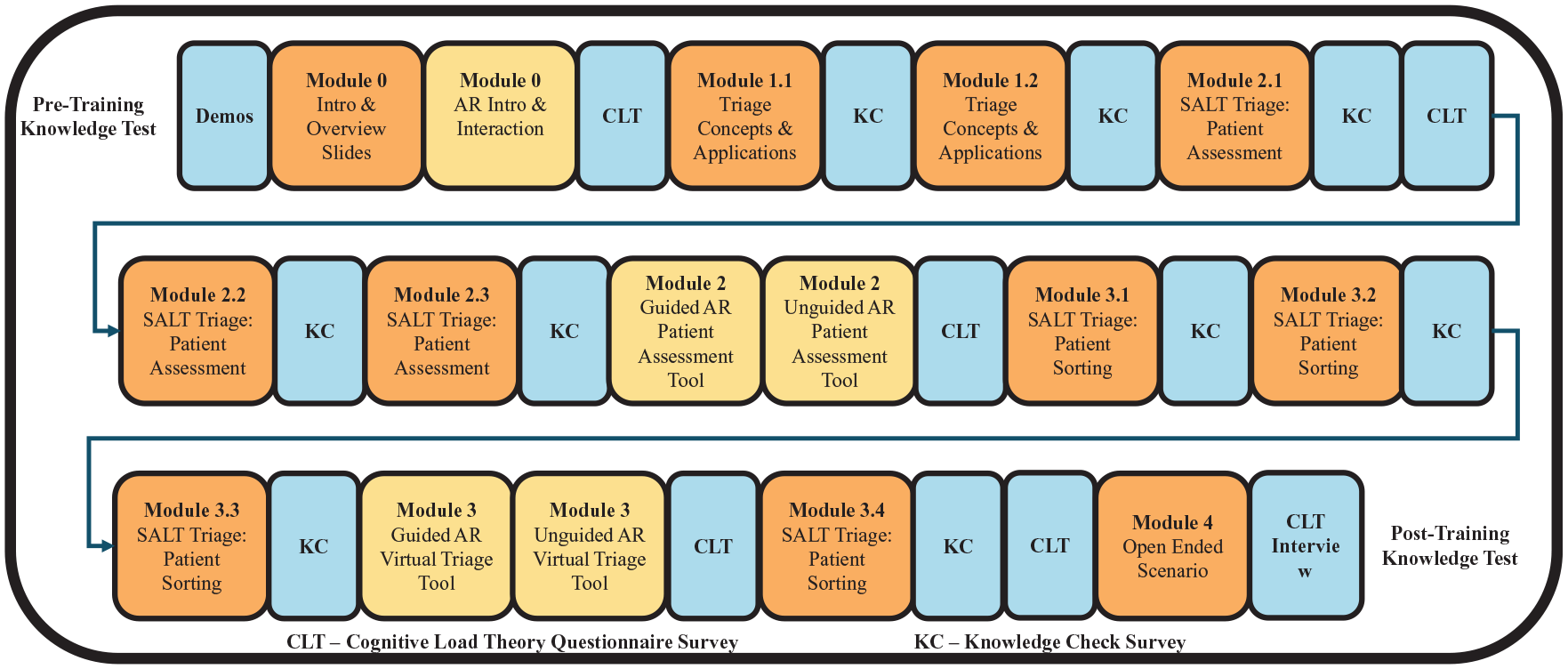
A flowchart of our four-module adaptive and hybrid (web-based and XR) training framework for training on SALT mass casualty incident principles and virtual triage activities.
Approach
Our AR-based adaptive training on SALT triage principles focuses on reinforcing contextual and spatial interaction skills. The model includes web-based modules for theoretical concepts and spatially interactive learning activities using a Microsoft Hololens 2 AR headset. Our adaptation models were developed through an extensive user study that focused on triage outcomes and interaction qualities (n = 23) and underwent multiple user-centered design iterations with seven emergency medical technicians (EMTs) to identify contextual training elements (Vyas et al. 2023). The updated models (Figure 2) leverage user performance in their ability to understand web-based training and apply it to spatial tasks via embodied learning. In the present work, we evaluated our training framework with 15 public safety personnel, recruited from agencies across a southern state, in a triage scenario simulating an industrial explosion at Disaster City. Of the participants, nine were EMTs with extensive experience, the remainder were instructors from a national EMS training facility, and ten had preliminary experience with XR. The participants went through our four-module triage coursework. They were administered a knowledge quiz, developed by SMEs, before and after the training to assess their understanding of the learning content. Self-reports on cognitive load were obtained from the CLT survey (Sweller, 1988) for each module to identify if our framework offered sufficient learning complexity (intrinsic load) across modalities with long-term knowledge retention (germane load) with minimal distraction (extrinsic load). Adaptations were offered across all modules except one with an open-ended AR triage activity and confidence in the learned content (knowledge and spatial interactions) was assessed using self-reports.
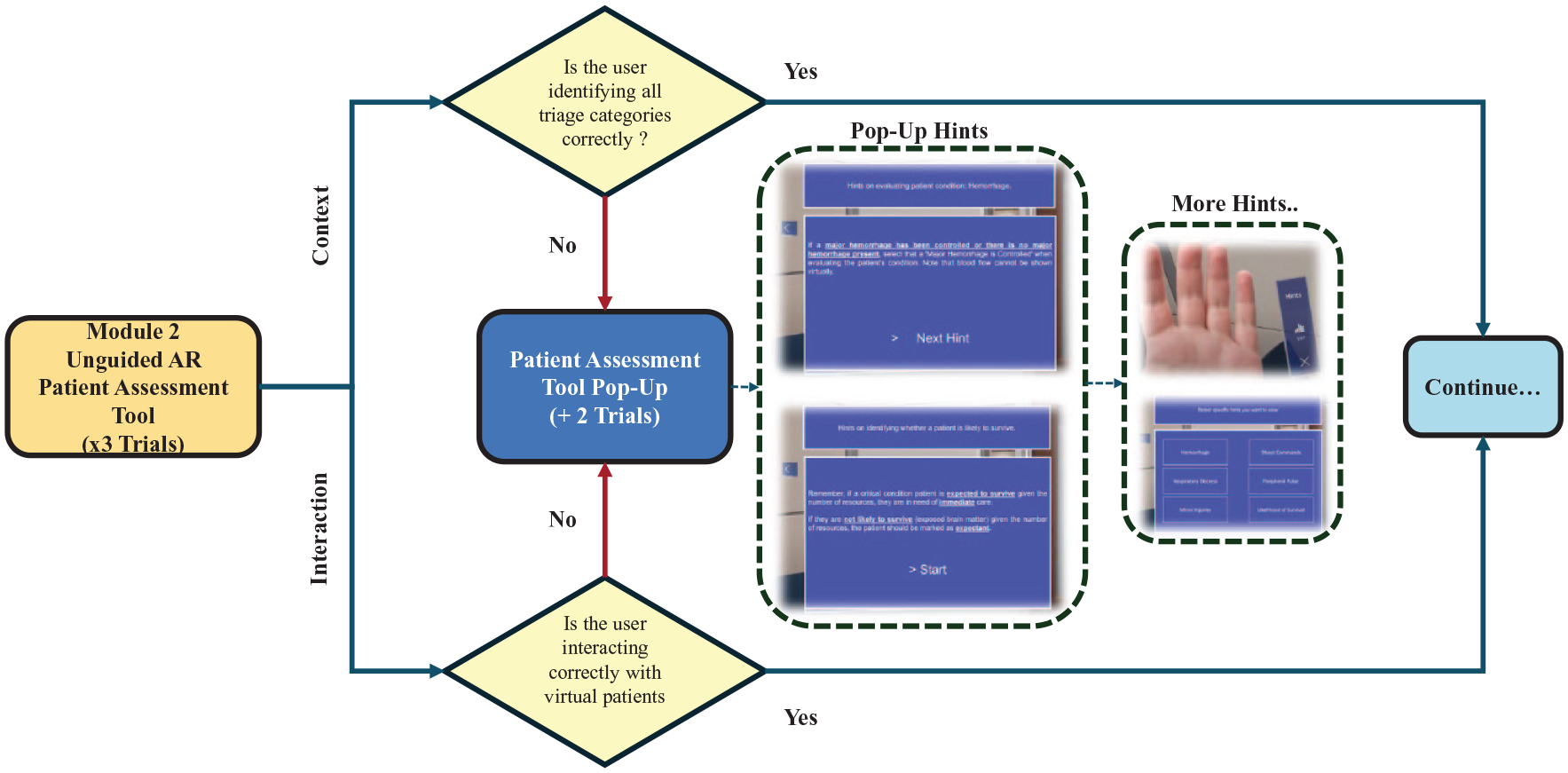
Example of an adaptation model implemented in Module 2 for unguided training on patient assessment in SALT triaging. The model learns from user performance in contextual and spatial knowledge to decide if a user needs adaptations for filling knowledge gaps, for example, pop-up hints in this scenario.
Findings
One participant did not complete the course due to simulation sickness and data for two participants was missing. Across the remaining 12 participants, we noted a 33% increase in post-training quiz scores, signifying improved learning, skill, and knowledge acquisition than before. As the course transitioned from contextual slides to interactive AR scenarios, participants’ adaptation needs rose by 53.33% (Figure 3), mirrored by a 20% increase in intrinsic load scores between modules 0 and 4. Despite the course’s complexity, participants reported a consistently low extrinsic load (1.8) and a high germane load (4.41) on a 5-point scale (Figure 4), underscoring the efficiency of the hybrid instructional design. Participants needing adaptation reported greater confidence post-adaptation in the acquired knowledge and skills (learning content: 4.48; adaptation: 4.45; on a 5-point scale). Thereby highlighting the effectiveness of our adaptation models in bridging knowledge and skill gaps through real-time adaptive training. The additional training trials and slides introduced by the adaptive models were found beneficial by most participants. Our six participants with prior EMS experience consistently rated their experience with the highest score. However, very few participants needing adaptation almost throughout their training didn’t find the additional learning content helpful and thereby scored their confidence with the adaptation 40% lower compared to their prior learning experience within a module. This was also visible in their consistently high intrinsic load across all four modules, with an average rating of 3.7 on a 5-point scale, contrary to a rising pattern that was observed for other participants.
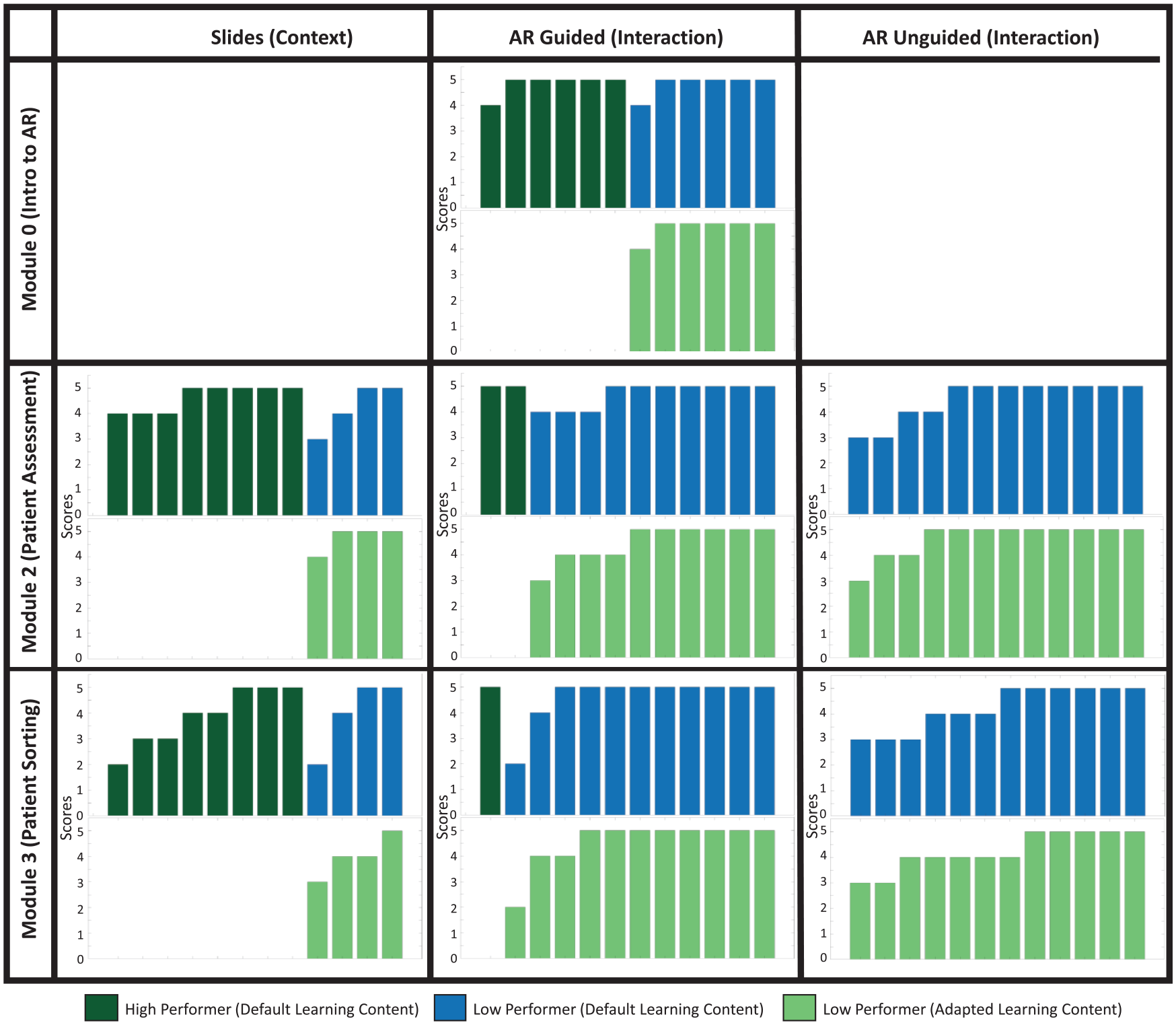
Our analysis of the user’s learning confidence in our study showcases an increasing trend in need for adaptation as they progressed in the course from web-based to spatial learning. Also, how their confidence scores evolved for a given module post-adaptation.
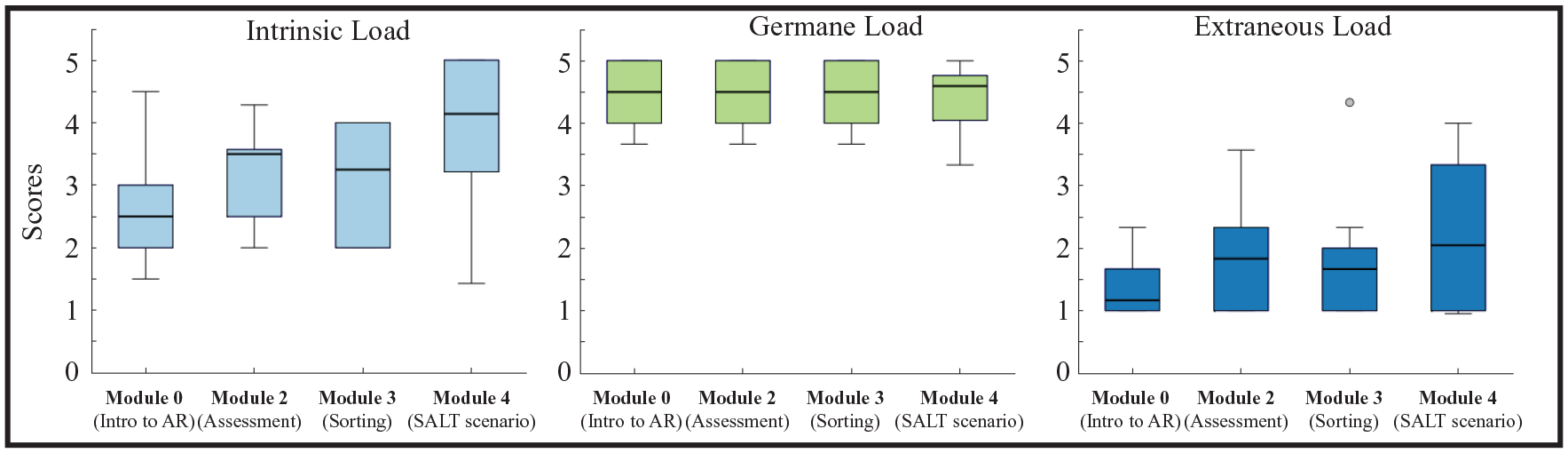
User reported CLT survey scores (Sweller, 1988) show an increasing trend in intrinsic load as the course progressed whereas the germane load remains consistently high across all modules. Extraneous load remained low throughout the training indicating a desirable outcome for designing XR trainings.
Takeaways
In summary, we introduced a novel adaptation training framework that leverages a user’s contextual and interactive performance in an XR-based spatial learning environment. The adaptation models within our framework were designed, developed, and iterated with a user-centered approach by gathering inputs from SMEs and user feedback through extensive iterations with EMS and non-EMS individuals across a southern state in the USA. These models assessed user performance in situ during the training and facilitated either contextual or spatial adaptations catering to the user’s learning needs and space for a holistic training experience. We evaluated the framework by conducting an extensive study with public safety personnel and observed consistently high germane loads with low extrinsic loads as reported by participants throughout the training coursework (Figure 4). This is indicative of how participants were actively processing and storing essential information in long-term memory without overloading their working memory throughout the web and AR-based learning modules. We also observed a moderate rise (38%) in intrinsic load as the training progressed toward a fully immersive spatial learning instructional medium, something that we hypothesized as an outcome of the AR instructional medium. This was also echoed by the increase in the number of participants needing adaptation (Figure 3) in later modules of the coursework. By understanding these cognitive loads, educators and instructional designers can optimize learning outcomes. These findings reinforce the importance of designing adaptive training which is crucial for creating effective and efficient learning environments that cater to individual learner needs and prepare them for future challenges.
Footnotes
Declaration of Conflicting Interests
The author(s) declared no potential conflicts of interest with respect to the research, authorship, and/or publication of this article.
Funding
The author(s) disclosed receipt of the following financial support for the research, authorship, and/or publication of this article: This research was supported by the National Science Foundation Innovation and Technology Ecosystems Program (NSF-ITE Award #2033592).