



Abstract
Flow theory describes the highly focused state of being absorbed into an activity, causing a loss of self-consciousness and track of time. Research has suggested that this can lead to a happier and more fulfilling life. This study used interpretative phenomenological analysis (IPA) to understand art students’ experiences of flow while making art and to acknowledge any emotional responses they have to this experience. Semi-structured interviews (conducted in 2021) were used to gain an enriched understanding of flow in six art students. The analysis found that all participants experienced flow while making art, and this experience was incredibly similar for all participants. In addition, no emotions were reported while the participants were in the flow state, yet positive emotions were associated with the experience of flow afterward. Interestingly, the participants reported negative emotions toward art without flow, suggesting that flow could be the incentive for wanting to produce art. These findings point to the importance of flow for experiencing happiness, and, unlike previous research, suggest that flow states can play a role in the motivation to make art. Future research should attempt to replicate these finding using other qualitative methods, such as event sampling, and explore the flow state in other activities.
Keywords
Introduction
Becoming a professional artist takes an outstanding amount of practice, hard work, and talent. Even some of the best-known artists understand the struggle of starting a work of art. In the words of Vincent Van Gogh: “You do not know how paralysing that is, that stare of a blank canvas” (Van Gogh’s Letters, 1884, p. 1). Despite the challenges, anyone who has ever produced art knows how enjoyable and satisfying the experience can be. It is interesting to consider why, when making art can be such a daunting task, do we still enjoy it? One explanation is found in the psychological state of “flow” (Csikszentmihalyi, 1990, 2000). The present research project set out to further understanding the flow by exploring emotional responses to being in the flow state.
Defining Flow Theory
Developed by Csikszentmihalyi (1990), flow theory describes the seemingly effortless, yet highly focused state of being absorbed in a task, causing one to lose consciousness and awareness of surroundings. The experience stretches one’s abilities and allows them to operate at full capacity (Deci & Ryan, 2013). Other defining characteristics include a distortion of temporal experience and intense concentration on the present task (Nakamura & Csikszentmihalyi, 2014).
In the 1960s, while observing artists, it occurred to Csikszentmihalyi that once a painting was going well the artist would persist single-mindedly ignoring signs of fatigue, hunger, or discomfort (Nakamura & Csikszentmihalyi, 2014). This is where flow research began, with the initial desire to understand the phenomena of intrinsically motivated activities. Csikszentmihalyi (2000) began by exploring the nature and conditions of enjoyment in activities such as rock climbing and dancing, as well as work related tasks such as surgery. Interviewees reported feeling increasingly focused as the experience unfolded from moment to moment; this was an experience, which was remarkably similar across all activities (both work and play). Since then, research has established flow to be a surprisingly robust theory with similar experiences being reported in art (Csikszentmihalyi, 1997a), music (MacDonald et al., 2006), sport (Jackson, 1995), literacy (Elwood et al., 2017), and other activities. Along with various kinds of activities, the experience is the same across lines of culture, gender, and age (Nakamura & Csikszentmihalyi, 2014).
Importantly, there is a balance between challenges and skills that must be achieved for the flow to occur. In flow, our abilities must be well matched to the opportunities for action, and so the challenge must not be too hard in relation to our skills (Csikszentmihalyi, 1997a). For instance, playing chess against a much better opponent causes frustration, but a weaker opponent causes boredom (Csikszentmihalyi, 1997a). Flow occurs on the fine line between frustration and boredom where we can be entirely focused and in control, and then emerges with a sense of achievement and enjoyment. In addition, flow is unlikely to occur in activities that are easy or effortless, regardless of whether there is a balance of challenge and skill. For example, Kubey and Csikszentmihalyi (2013) found that television viewing caused no flow, despite the skill and challenge being balanced. Thus, it is understood that flow will occur when engaging in activities that are above the average level for the individual (Massimini & Carli, 1992).
Csikszentmihalyi acknowledged nine factors of flow. The first four elements are characteristics of the experience: undivided focus and concentration, increased sense of control, loss of reflective self-consciousness, and distorted phenomenological experience of time (Beard, 2015). Four other elements acknowledge the conditions for flow to occur: challenge and skill of the activity are balanced, action-awareness are merged, clear proximal goals to allow one to progress, and unambiguous feedback (Beard, 2015). These are not the only requirements of flow as researchers have also recognized engagement in the activity (Chen, 2007) and having no distractions as potential conditions (Csikszentmihalyi, 1997a). Csikszentmihalyi (1997a), suggested that distractions still exist, but they are excluded from consciousness. The final factor of flow is that the task becomes an autotelic experience (Beard, 2015). This is an activity that is rewarding in and of itself (auto = self, telo = goal) (Nakamura & Csikszentmihalyi, 2014). While not all the suggested requirements are essential for experiencing flow, it is clear from past research that there are conditions that allow for a person to enter this state.
The Flow of Creativity
One area of interest to researchers is the connection between flow and creativity. It is understood that the flow state can contribute to an increase in creative ability. The need to concentrate, have clear goals, and not get distracted allows for creativity to thrive (Csikszentmihalyi, 1997a). Csikszentmihalyi was the first to suggest this in his early research on creativity. He interviewed art students and identified the artistic personality, a beneficial trait for succeeding in creative processes (Csikszentmihalyi, 2015). He found that individuals high in this personality trait could more easily access the flow state, enabling them to be more creative (Csikszentmihalyi et al., 2018).
Following Csikszentmihalyi’s example, a high proportion of flow scholarship has explored the creative advantages of the experience of flow. Quantitative research has linked the experience of flow to greater creativity and curiosity (Schutte & Malouff, 2020). Flow has also been found to mediate the effects of leadership styles on creativity, meaning that effective leadership can initiate a state of flow and increase creativity (Sosik et al., 1999). Cseh et al. (2015) even suggested that the flow experience could improve one’s creative potential. Accordingly, to advance the research on flow theory, the use of creative individuals is necessary.
Understanding the Link Between Flow and Happiness
Flow theory is of considerable interest to positive psychologists as it is an optimal state that can improve one’s life (Rich, 2013). Csikszentmihalyi argued that the key to a good life can be found in the complete absorption in what one chooses to do (Nakamura & Csikszentmihalyi, 2009). This in essence is what flow theory states. Seligman (2002) even included engagement as one of the five pillars of his well-being theory, suggesting that the need to immerse in a task is essential to leading a good life.
If flow is an optimal experience that can improve well-being, then it is tempting to conclude that happiness and flow are the same thing. However, their relationship is more complex than this. For many people flow can be experienced in activities such as gambling. Research has correlated the flow state with the amount of time and money spent gambling (Lavoie & Main, 2019), but such experiences of flow do not add up to life satisfaction and overall happiness (Csikszentmihalyi, 1997b). Thus, for the experience to bring happiness it must lead to new challenges and hence to personal and cultural growth (Csikszentmihalyi, 1997b). That is not to say that one cannot find enjoyment in activities like gambling, but not all forms of enjoyment are equally worth pursuing.
The relationship is also complex because some researchers believe that happiness is not experienced during the flow state. Csikszentmihalyi (1997b) stated that: “Only feelings relevant to the activity are experienced during flow, and it is only once the experience ends that one can indulge in feeling happy.” Csikszentmihalyi (1997b) suggested that a surge of well-being and satisfaction comes once the work is complete.
So, the more flow we experience in daily life, the happier we are overall. This has been concluded by existing quantitative research using flow experience questionnaires (Sahoo & Sahu, 2009; Tsaur et al., 2013). Other research has shown several aspects of flow, including clear goals, challenge-skill balance, and concentration, to be associated with emotional subjective well-being. The authors found that these dimensions of flow could predict the presence of positive emotions (and absence of negative emotions) in life in general better than cognitive judgment by the individual (Fritz & Avsec, 2007). However, a review of the existing literature on subjective well-being and the flow experience suggests there are not enough data to support this relationship (Nistor, 2011). Although Nistor (2011) did conclude that the relationship appeared intuitive, more data are needed to support the claim. Thus, it appears necessary to qualitatively explore the emotional responses to the flow state to understand the positive or negative effects it may evoke.
Research Questions and Aim
The present research project was intended to explore the lived experience of the flow state through the individual accounts of art students, within the context of creating art. The aim was to contribute to the understanding of flow theory by recognizing whether there are any emotional responses to this experience. The use of highly educated art students is advantageous because, due to the link between flow and creativity, they are likely to experience flow, which is needed for their emotional responses to be analyzed.
As previously noted, the majority of literature on flow theory is based in quantitative research methods, especially research related to the emotional responses to flow. When studying flow, it is important to deeply probe people’s experiences and situations (Alase, 2017) and qualitative methods provide the tools to do so. As such, this research employed interpretative phenomenological analysis (IPA) to inform and progress the existing research on flow theory.
The following questions framed the research agenda: First, how do art students describe their experiences of flow while creating art? And second, how do art students describe their emotions in response to experiencing flow? The second research question probes in detail the emotional patterns of the flow experience to recognize whether it is the experience of flow that causes us to feel a sense of enjoyment after we have emerged from the state.
Method
Participants and Recruitment
Six art students participated in the study, which is consistent with the methods of IPA whereby a small, homogeneous sample (who are likely to share similar perspective on a particular phenomenon) is preferable. With IPA, participants should represent a perspective, as opposite to a population (Smith, 2004). Participants were recruited through opportunity sampling via an email sent around undergraduate art students. Fifteen individuals replied to the email of which six were selected to be interviewed based on their availability. Of these six, three were male and three were female, with an age range of 19 to 23 years old (see Table 1 for more details). At the time of the interview, all participants were completing an undergraduate degree in Fine Art at a university in the United Kingdom.
Summary of Participant Information in Order of Which They Were Interviewed.

Note. Includes gender, age, year at university, and art specialty.
Design
The primary goal of IPA is to make sense of individual’s lived experiences, with the assumption that they are “self-interpretive,” meaning they actively engage in interpreting the happenings in their lives. Therefore, IPA is an appropriate design for this study as it allows for a holistic view of the experience of flow and can unearth participant’s understandings and emotions connected to the experience. The interpretive aspect also allows for a deeper understanding beyond what the participants say, as researchers must “make sense of participants trying to make sense of their experiences” (Smith et al., 1999). IPA draws upon fundamental concepts of phenomenology, hermeneutics, and idiographic approaches, making it an essential design mechanism for research on flow theory.
Ethics
This research received approval from Newcastle University Research Ethics Committee [Ref: 16139/2021]. Participants received an information sheet prior to the interviews outlining the aim and design of the research. Written consent was sought before interviews began and steps taken to guarantee confidentiality were communicated.
Data Collection
Semi-structured interviews were used to guide and facilitate the participants’ own train of thoughts, while still leaving enough space for the participants’ personal reflections. This is the most common data collection method for research using IPA (Smith, 2017). In designing the schedule, three main topic areas were acknowledged: feelings toward producing art, flow experiences while producing art, and feelings surrounding the experience of flow. Open-ended questions were formulated based on these topics to help guide the interview process. An example of an open-ended question is: “How do you feel when you create artwork?” Although the interview schedules varied with each participant’s individual experiences, all three-topic areas were covered in every interview. They lasted an average of 30 min, ranging from 20 to 38 min. Every interview took place in the test cubicles of the Psychology building at Newcastle University in November of 2021.
Each interview started by building a rapport with the participants through general conversation and asking about their university life. Once the study had been introduced, participants were invited to discuss their artistic style to establish the interests of each individual. From here, the feelings and emotions connected with producing art were explored. Around halfway through each interview, the participants were asked whether they feel that they lose themselves then creating art. After their responses, they were then asked whether they knew of flow theory, and if not, the concept was described to them. The interviews then progressed into a discussion about the flow state and the feelings connected to it.
Data Analysis
Data were analyzed using the procedures of IPA, as outlined by Smith et al. (1999). The analysis sought to understand the complex layers of meaning as they arose in the data, which required prolonged engagement with each transcript. Analysis occurred at two time points. First in 2021 immediately after data collection, and again in 2023. On both occasions, the primary researcher conducted several close readings of the first transcript, making detailed notes in the left margin. These notes were then used to identify any experimental statements, which were noted in the right margin. Finally, thematic interconnections were identified using a color coding system across the transcript. The above steps were then repeated in the remaining five transcripts and theme interconnections were considered across transcripts (Howitt, 2019). The researcher moved between both etic and emic perspectives to gain a psychological understanding, while ensuring there was no reductionism in the analysis.
Once all transcripts were coded, a systematic table of themes was created with three levels of themes. The themes were labeled using the guidelines from Smith and Fieldsend (2021). After the initial completion of data analysis (in 2021) member checking was undertaken by providing each participant with a summary of the analysis and themes. None of the participants disagreed with the summaries or coding of transcripts.
Positionality
It is important to reflect on how the researcher has shaped the research, as their individual experiences and opinions can influence how data are analyzed. The researcher had an active role in describing and presenting the voices of the participants (Hayfield & Huxley, 2015). Although the researcher was not an art student, making art was one of their hobbies, and they could relate to the process of making art and I understand the struggles and rewarding aspects of the activity. Along with this, the researcher had experienced elements of flow, including losing track of time and awareness of their surroundings. By acknowledging the position of the researcher, epoché could be used to conduct this phenomenological study, whereby the researchers’ judgments are suspended from influencing the direction of the research.
Findings
The analysis of the six interviews generated two Group Experimental Themes (GETs), A: “Kind of In-Between” and B: “The One Place Where I Don’t Feel Frustrated.” The first GET contains three Personal Experimental Themes (PETs) and seven subthemes, The second GET contains two PETs and five subthemes, as demonstrated in Table 2.
A Visual Representation of the Structure of the Table of Themes, Including One Example Quotation for Each Subtheme.
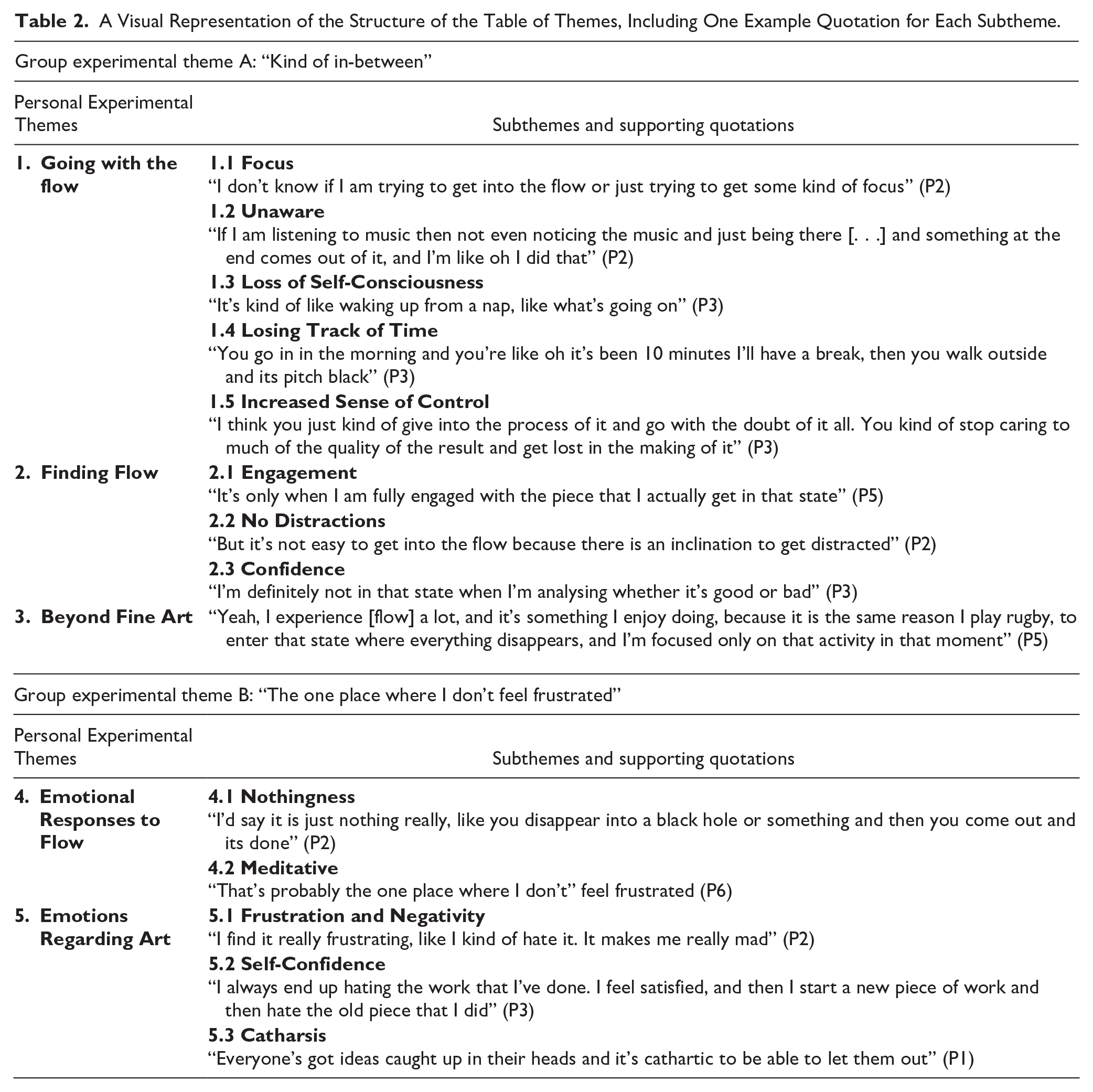
GET A: “Kind of In-Between”
This GET articulates the experiences of flow reported by each participant, to understand whether they experienced flow while creating art and how the state manifests itself. It therefore answers the first research question: How do art students describe their experiences of flow while creating art? The theme is broken down into three sections that look at the elements of flow (PET 1), the requirements of flow (PET 2), and flow in other areas of participant’s lives (PET 3). All participants reported experiencing flow and were able to describe the experience well.
Generally, the flow experience appears to be a liminal one, whereby the malleability offers opportunity for creativity. P4’s quotation that titles the theme, “Kind of in-between,” sums up the experience of flow described by the participants. It is a subconscious state that can only be recalled after it has occurred. Beyond this, P4 may have described flow as “in-between” due to her emotions being in an in-between state.
Going With the Flow
This PET details exactly how the participants described the flow experience. Of the nine elements of flow outlined by Csikszentmihalyi, the participants recalled four of them: focus, merging action-awareness, loss of reflective self-consciousness, and distorted perception of time. Remarkably, all four themes were developed before the realization that they aligned with Csikszentmihalyi’s elements of flow.
Focus
The participants perceived the flow experience to be a point in time where they were hyperfocused on their artwork. They believed flow was simply just an experience of intense concentration like every other experience of hyper focus. This suggests that flow is not an isolated experience for artists, and instead can be experienced in any activity that allows one to focus. For example, I think [flow is] probably just hyper focus really. Because I think it’s the same with anything, when your sole focus is one thing your brain puts all its energy into that one thing [. . .] I’ll put a canvas on the desk and get a paintbrush in my hand. I’ll start doing some strokes and my brain is thinking right now we are in this state, lets focus on doing this and nothing else is important. (P5)
Unaware
All participants reported feeling unaware of their surroundings while in this state. It was a common experience for them to forget the music that they were listening to, or not hear their phone ringing. For example, During the making of a painting when I’m really into just doing it I feel quietness and not feeling anything. It feels really good, that’s my favourite place to be, like not really thinking about anything and if I’m listening to music then not even noticing the music and just being there and then making something, and something at the end comes out of it, and I’m like oh I did that. (P2) My phone can go off for about two hours and I will have missed 6 calls from my friends. I’m just like sorry, was not aware that you called me. (P5)
Interestingly, participants were unable to recall what they were doing during the flow state. Instead, they reported seeing their artwork after emerging from the state as a surprise to them, as though they were not the ones producing it. P4 provides a good example of this: I’m unaware it feels like I’m in a daze. And then afterwards I will kind of look back and think oh I did a lot more than I thought. I think because I’m less focused on the drawing, I usually like what comes out of that experience more. (P4)
Loss of Self-Consciousness
The words “out of body” were used by every participant to describe the experience of flow. For some, this appeared to be a transcendent-like experience as they felt they were looking down on their own body doing the art. P2 even suggested that she is completely dissociated from herself when in flow by referring to herself during flow as a different person. This can be seen in the following quotation: It’s like a feeling of being higher up somewhere, and your flow person is further down, and you are looking down on what you have done. It’s like astral projection. (P2)
Losing Track of Time
This theme was a common experience among the participants. Interestingly, the participants seemed dissociated as they not only lost track of time but also had a misconception about how much time had passed. For example, You go in in the morning and you’re like oh it’s been 10 minutes I’ll have a break, then you walk outside and its pitch black. I think for me when I’m editing and putting it together at the end, that’s the time when I really lose awareness of what’s going on around me. My flatmate, who’s also an art student, always wonders where I’ve gone. I’m still there working away. (P3)
Increased Sense of Control
The participants describe flow as something that they give into, demonstrating the loss of self-consciousness and awareness, For example, I think you just kind of give into the process of it and go with the doubt of it all. You kind of stop caring to much of the quality of the result and get lost in the making of it. (P3)
When they give into the process the participants appeared to be more focused and in control when making art. This increased sense of control comes not from them but from flow. The lack of self-consciousness and awareness means they feel as though it is the experience that is controlling what they do.
Finding Flow
This PET outlines the requirements that participants believed must happen for the experience of flow to occur. Csikszentmihalyi acknowledged multiple conditions for flow to occur, two of which are engagement (2.1) and having no distractions (2.2), which were both recognized by the participants. The final theme, confidence (2.3), has not been considered by previous research.
Engagement
This is defined by the participants being fully occupied by creating their art. Participants reported the need to be engaged for flow to take place. For example, The most I have ever had flow is with anything that gets me to engage fully. So, it will probably be a life drawing or a painting that is quite highly detailed. (P5)
No Distractions
Assuming people must engage and focus for flow to happen, this is an obvious requirement for experiencing flow. Participants reported specific distractions, the most common ones being going on their phones and listening to music. For instance, Having that undivided focus towards a task when you are sitting down and trying to focus on something, that’s kind of not compatible with also listening to music. Although when you are in that concentrated state you can just tune it out, but if you are trying to get into the state, I think listening to music makes it harder. (P2)
Confidence
It was common among the participants to not experience the flow when overanalyzing and doubting their abilities to do art. Confidence was a necessary requirement for experiencing flow. Being sure of their ability and having confidence in themselves allowed for relaxation and thus the chance to enter flow. When the participants lacked confidence and felt pressure to produce art, they struggled to experience flow. For instance, I’m definitely not in that state when I’m analysing whether it’s good or bad. (P3)
Doubt was also a distraction for entering the flow state. For example, P3 does not experience flow when she is painting because. . .
With paint I’m just constantly doubting myself. I loved playing around with it, but I didn’t really like it. When it came to critique and somebody would rip into it and I didn’t feel confident about that, so I didn’t have flow with that. (P3)
Beyond Fine Art
This PET deals with flow experiences outside of producing art. Despite not being asked, all six participants reported an experience of flow in a different activity to producing art. These activities included playing rugby, writing, knitting, walking, and listening to music. For example, My poetry especially does. I like to write rhymes and get immersed in the words [. . .] I get court in the rhythm of rhyming words. I think music does this for me as well, as I feel in sync with what I am listening to. (P1)
GET B: “The One Place Where I Don’t Feel Frustrated”
This theme was used to examine the emotional responses to the flow state (explored in theme four). In doing so, it answers the second research question: How do art students describe their emotions in response to experiencing flow? The title of this GET is a quotation from P6 that perfectly encompasses how the participants felt during and after flow. It summarizes the difference in emotional responses to flow and art reported by the participants.
Emotional Responses to Flow
This PET delineates whether participants reported emotions during flow (Theme 4.1), and the associated emotional responses to the flow state (Theme 4.2). It is appropriate to distinguish the feelings the participants had during flow and the feelings they had about flow, as Csikszentmihalyi claimed it was only once out of the flow state that one can encounter positive emotions.
Nothingness
The participants reported no emotional response to the flow experience. They were incapable of associating any emotions with the state, which supports Csikszentmihalyi’s understanding of the flow experience. For example, That’s probably the one place where I don’t [feel frustrated], because I wouldn’t associate the flow state with feeling much of anything. You are just sort of there. (P6)
The lack of emotions reported by the participants during flow also further demonstrates the dissociation that people experience when in the flow state. For instance, P5 and P2 said the following: Eventually I get to a point where I don’t even think, I’m just doing work, and I enter this kind of mode where nothing really happens around me. I do feel disassociated in a way. (P5) I’d say it is just nothing really, like you disappear into a black hole or something and then you come out and its done. (P2)
As discussed in Theme 4.2, the flow experience was associated with positive emotions. One explanation for this could be found in the lack of emotions reported during flow. For instance, P3 alludes to the idea that experiencing flow detaches her from the worry and judgment she experiences when producing art. The lack of emotions reported during flow means that negative emotions can be forgotten which in turn brings about feelings of positivity. To illustrate this point, P3 said, I think it’s kind of neutral [. . .] When you are making it you are detached from the need for validation and then when you come out of it you crave the validation. (P3)
Meditative
When discussing the associated emotions participants had with the flow state, they believed it was a calming and mediative experience. Some even went as far as to suggest it was a form of therapy, for instance, I feel calmness. I know it sounds ridiculous because I get stressed making art. But it’s the feeling of losing yourself to something that creates the calmness. Sometimes when I’m not making art I’m just caught up in my thoughts, but then when I do art, it just flows out of me. It’s very peaceful, like a form of therapy really. (P1)
It was also evident that flow was retrospectively a positive experience for them as they described it as “amazing,” “fascinating,” and “enjoyable” (P1 and P5). What was most intriguing was the emotional difference between being in the flow state and not being in the flow state. For example, P6 believed the flow state was . . .
Probably the one place where I don’t feel frustrated. (P6)
And P5 still enjoyed the process of creating art even when he was not enjoying the artwork he was doing. This is demonstrated in the following quotation: Even if I hate my work, the process of creating art is quite therapeutic for me. I can just forget what’s going on outside. I can just focus on my artwork, so it’s almost like a meditation at that point. (P5)
Here P5 describes the flow state as being an enjoyable experience on reflection. He does not report emotions during the state of flow, but instead suggests his mind is clear and able to focus. This further supports the notion that no emotions are experienced during flow, but positive emotions are associated with the state.
Emotions Regarding Art
This theme communicates the emotions participants had about producing art outside of the experience of flow. Within the interviews, this was discussed prior to mentioning the flow state, and it was an area the participants all understood very well and had a lot to say on. Surprisingly, the emotional responses to art and flow were contrasting, suggesting that enjoyment in art comes from the experience of flow.
Frustration and Negativity
The most reported feelings when discussing art were negative. Four of the six participants used the word frustrating to describe their opinion on producing art. To illustrate: I find it really frustrating, like I kind of hate it. It makes me really mad. When I’m making stuff, I am such a bad perfectionist that the process is very frustrating. Because I want everything to look good and when it doesn’t it’s really frustrating. (P2)
Moreover, for some, making art even triggered feelings of anxiety as P6 demonstrates in the following quotation: Maybe anxiety [I feel that] the whole way through. It’s constantly a very nerve-racking experience, but that’s why I like it. (P6)
P2 and P6 appear to overthink when they create art causing them to feel stressed and anxious. This is likely a result of wanting to do well and create art that they can be proud of. However, this perfectionist mentality has led them feeling frustrated with their art.
Self-Confidence
It was a prevalent experience for participants to dislike their art after completion. However, this dissatisfaction was different for each individual. Some participants were dissatisfied immediately after, and satisfaction grew as time went on. A supporting statement of this is: I often like them more after a while has passed. Especially like looking back at the work from foundation, I sort of felt meh about it, but I went through my portfolio I while a go and thought you know what I actually really like a lot of this. So yes, my perspective of it becomes kinder over time. (P6)
Others were more satisfied at the time of completion and grew to dislike the work. For example, I usually get really nervous before showing work because it does feel like you’ve got a piece of your sole that you have just carved out. But then there is a while after you are showing it, when people have seen it, a feeling of satisfaction. But also, I always end up hating the work that I’ve done. I often feel satisfied, and then I start a new piece of work and then hate the old piece that I did. (P3)
P6’s satisfaction growing for his artwork could show an improved confidence in his ability. The anxiousness that he experiences when producing art causes him to dislike the work, however as time passes and he loses the negative emotional association, he learns to like it. Alternatively, P3 values the opinions of others to determine her satisfaction for her artwork. She also demonstrates a lack of self-confidence as she grows to hate her work suggesting that she looks for faults within the art.
Catharsis
Three of the participants described the process of producing art to be cathartic. In this case, the participants were releasing their negative emotions surrounding art, by producing more art. It was unclear whether this was during the flow state. P1 demonstrates this nicely: Everyone’s got ideas caught up in their heads and it’s cathartic to be able to let them out, and then look at them through your art. (P1)
It was also unclear as to whether participants saw this as a positive or negative experience. For some, the releasing experience of catharsis was a positive one. However, P2 had more of a mixed opinion, as she was unsure as to whether the catharsis caused excitement or lack of satisfaction. For instance, It can be a very cathartic thing, that I just feel like I have to do this now. I would say it’s a feeling of excitement [. . .] But I never trust the excitement because when I am doing something purely out of catharsis then it’s never satisfying to me. (P2)
Discussion
This study found that art students can experience the state of flow when creating art. Interestingly, no emotions were reported while the participants were in the flow state, but positive emotions were associated with the experience of flow afterward. Furthermore, the experience of flow was consistent across all the participants, some even using the same words to describe it. This study reinforces Csikszentmihalyi’s research and his nine elements of flow (Beard, 2015).
Despite its accessibility, it was evident that the flow experience has conditions that must be met for flow to occur. This is in line with previous research, which has acknowledged many requirements of flow. For instance, Chen (2007) recognized the need for engagement and Csikszentmihalyi noted the need for clear proximal goals and unambiguous feedback (Beard, 2015). None of the participants in the current study recalled experiencing flow every time they produced art, suggesting that the requirements for accessing flow are important. The PET Finding Flow dealt with these conditions. The Themes Engagement (2.1) and No Distractions (2.2) emphasize the need for focus when entering the flow state. Both of these themes have previously been acknowledged by Csikszentmihalyi (1997a) who suggested that distractions still exist but they are excluded from consciousness. The current research reinforces Csikszentmihalyi’s statement because once successfully in the flow state participants could ignore distractions. For example, P2 could easily ignore the music that she was playing (shown in Theme 1.2). However, in the process of entering flow, music was problematic for P2, as she described it as “not compatible” with flow (see Theme 2.2). Interestingly, P2’s opinion of music changed between entering flow and being in flow. This further emphasizes the loss of self-consciousness when in flow, as although music is a distraction for creating art it becomes unnoticeable when in the flow state.
The participants also reported needing confidence to access the flow state. The perceived need for confidence suggests that flow requires practice and ability in a task, Confidence takes time to develop, and one cannot simply feel confident in a task they have never completed before. This is supported by Csikszentmihalyi’s research that states completion of a challenging task with low skill levels causes worry and anxiety (Nakamura & Csikszentmihalyi, 2014). In this case, the participants doubted themselves when they were not feeling confident in their ability. This finding reinforces the challenge and skill element of flow theory. For the participants, if their skills were not matched with the artistic challenge, they would doubt their ability and, in turn, not experience flow. In addition, the need for confidence may explain why being better at an activity makes flow more likely. For instance, flow is often reported in activities done by professionals (Jackson, 1995) who are likely to have more confidence than non-professionals.
Although the participants were only questioned about their artistic activities, they all reported experiences of flow in activities other than art. This can be seen in the PET Beyond Fine Art. Previous research has explored the flow experience in various activities. For instance, there is an extensive research into the flow experience in both sports and literacy (Elwood et al., 2017; Jackson, 1995), which two of the participants in this study connected with the flow experience. The other activities reported by the participants—knitting, walking, and listening to music—are yet to be researched, therefore this is a valuable area for future study.
The second aim of this research project was to explore the emotional responses to the flow experience. According to Csikszentmihalyi (1997b), only emotions connected to the activity can be experienced during flow, and it is only after emerging from the state that one can indulge in feeling happiness. The GET “The One Place Where I Don’t Feel Frustrated” encompassed the participants’ emotional responses. A key finding was the emotional experience of Nothingness (4.1) described within the PET Emotional Responses to Flow. All six participants reported experiencing “nothing” when in the flow state and this finding is supported by Csikszentmihalyi’s (1997b) claim that only emotions concerning the activity can be experienced. However, it only partially supports this claim as no emotions whatsoever were experienced by the participants, even those associated with the activity as Csikszentmihalyi suggested. The participants in this study may have experienced emotions while in the flow state but were unaware of them and therefore could not report them during the interviews. Based on the nature of the elements of flow a lack of awareness for one’s emotions is likely to be the case.
The IPA also explored the emotions associated with and emerging from the flow state. This was done in the theme Meditative (4.2), which found flow to be a positive experience that was closely associated with relaxation and meditation. The participants in this study only reported positive feelings associated with the flow experience. This elucidates prior research on flow theory and happiness that has shown the more flow we experience the happier we are overall (Sahoo & Sahu, 2009; Tsaur et al., 2013).
One explanation for why positive emotions were associated with the experience of flow could be due to the lack of emotions reported by participants during flow. As discussed in Theme 4.1 of the analysis, the ability to detach from negative emotions could lead to the positivity and happiness experienced when emerging from the flow state. During flow, the participants experienced complete focus, concentration, and unawareness, meaning that they could not be burdened by their negative thoughts. This, in turn (once we have emerged from flow), could result in a sense of fulfillment and enjoyment.
The final PET, Emotions Regarding Art, dealt with how the participants viewed producing art when they were not experiencing flow. Generally, participants’ emotions about art were negative. In Theme 5.1, they reported feeling frustrated and anxious with the process of producing art, suggesting that making art is not something they enjoy doing. Likewise, participants’ low self-confidence (reported in Theme 5.2) resulted in a lack of satisfaction and at times hatred for their artwork. Notably, the participants were university students and so the frustration of making art could be explained by the pressure of university. Regardless, they had positive affiliations with the flow state suggesting that the enjoyment for making art could come from experiencing flow.
The feelings about flow compared with art were best summarized by P6 who said “[flow] is the one place where I don’t feel frustrated.” Interestingly, this suggests that flow is preventing the negative emotions associated with making art. Perhaps the flow state was not a positive experience for the participants but instead a barrier to negative emotions. In other words, the experience of flow was perceived as positive not because it is but because it created an absence of negative emotions. The worry, stress, and anxiety about making art is gone once one enters a state of unawareness and loss of self-consciousness, that is, flow. This idea is supported by the emotions experienced by the participants, reported in Themes 4.1 and 4.2.
Finally, as identified in the PET Emotions Regarding Art the participants described producing art to be a cathartic experience (see Theme 5.3). It is debatable as to whether this theme opposes the research agenda, as it is a positive experience. Regardless, this finding is fascinating as it supports the use of art in therapy practices. Research has found that art therapy can promote positive mental health and well-being (Van Lith, 2016), and participants in these studies often report feelings of catharsis (Heenan, 2006). Even outside art therapy, cathartic practices have been shown to elevate individual’s mental health (Groves, 2017). This view suggests that experiencing catharsis while creating art could explain why people enjoy producing art; it is a releasing experience that improves mental health. However, this does not refute the findings in the current study as it was unclear whether cathartic experiences happened during flow or not. Since much good art is the result of flow, future research should explore the relationship between flow and catharsis.
Limitations and Direction for Future Research
Conducting this study raised several methodological questions because flow is a complex experience, that is, challenging to express in words. Therefore, the use of interviews that required verbal descriptions of the experience long after they had happened, makes it less likely for the participants’ experiences to be captured accurately. For these reasons, the study is limited, as the use of semi-structured interviews cannot completely reflect the experience of flow. Event sampling methodology should be considered for use in future research to capture experiences of flow as and when they happen (Reis & Gable, 2000).
A further limitation is found in the participant demographics. The study is limited due to its lack of diversity. All participants were students with similar backgrounds and life experiences. Thus, the findings cannot be generalized to other groups of people. In addition, art students were used to gain a specific understanding, as advised by IPA researchers (Smith, 2004). However, in using art students, the negative experiences of art that were reported could be due to the discipline of an art degree. Other individuals that engage in art for fun may have more positive associations with art. Thus, future research should investigate this difference. Nevertheless, there was a clear difference in the emotional responses to flow and art, indicating that even when art is stressful, participants will gain a sense of enjoyment once they have emerged from the state of flow.
There is also need for quantitative research in this area. If, as suggested, there is a link between flow and enjoyment in an activity then this association would be implicit. No one seeks the experience of flow; it is just something that occurs that we happen to enjoy. Thus, if flow causes enjoyment and gives an incentive for completing a task numerous times then this would be implicit. Assuming this, it may be beneficial to quantitatively measure flow and enjoyment, rather than directly asking individuals about their experiences. Response latencies may be of use here, specifically dual measurements (Jong, 1999).
This research has shown that flow is retrospectively an enjoyable experience, and so it may be of interest to investigate explanations for why we feel a sense of enjoyment when emerging from the state of flow. As mentioned in the analysis, the participants’ experienced no emotional responses during the flow state, although in general they had extremely negative emotional responses toward art. Thus, one explanation for enjoying flow could be the disconnection from our emotions that allows an escape from the pressures that emotions impose, and in turn, enjoyment.
Future research should also explore the need for confidence to experience flow. Previous scholars have indicated that confidence is an indicator of flow in competitive athletes (Koehn, 2012, 2013), but there is little research on why this is and whether improving confidence can increase experiences of flow. Since we know that flow improves happiness and well-being (Sahoo & Sahu, 2009; Tsaur et al., 2013), understanding whether improved confidence leads to more experiences of flow could be pivotal in flow theory research.
Finally, this study viewed flow as a motivator, meaning the reason one would engage in an activity is to attain the flow state. However, it is important to acknowledge that flow may not be the main motivation for completing a task. The flow experience could instead be an epiphenomenon. In this sense, the engagement in the activity may be the prime motivation, and the flow experience could be a by-product of the engagement. In viewing flow in this way other explanations for why the state of flow results in positive feelings, such as enjoyment, can be identified. Thus, future researchers should take into consideration the different ways of viewing the flow experience.
Conclusion
Creating art can be enjoyable for those who want to try something new, or who want to achieve financial success through their artwork, or those who simply enjoy socializing with other artists. Consequently, it would be reductionist to conclude that the state of flow is the sole reason we enjoy producing art. However, the findings of this research show that flow contributes to the enjoyment we get from creating art, and may provide an incentive for producing art. If anything, the experience of flow is a relaxing and enjoyable one. The findings also enhance the understanding of flow theory, as they are consistent with prior literature, and thus support the existence of the theory. More importantly by demonstrating the emotional responses to flow, this exploration lays the groundwork for much future research, which together with the findings of the current study may be useful in determining what makes life enjoyable.
Footnotes
Acknowledgements
We would like to acknowledge the School of Psychology at Newcastle University for providing us with the opportunity to complete this project as well as the facilities to conduct this research in. We would also like to thank Newcastle University for granting us the funding to attend the British Conference of Undergraduate Research.
Declaration of Conflicting Interests
The author(s) declared no potential conflicts of interest with respect to the research, authorship, and/or publication of this article.
Funding
The author(s) received no financial support for the research, authorship, and/or publication of this article.
