



Abstract
Terror management theory has been used to explain our penchant for materialism. While materialism includes both the desire for products and the desire for money, research has generally examined the former. Consequently, this article aimed to examine the effects of mortality salience on desire for money in Singapore. Study 1 found that mortality salience did not increase self-reported desire for money but increased the size of a drawn coin. Study 2 found that mortality salience did not increase the preferred selling price of a used laptop. Finally, Study 3 found that mortality salience did not increase the willingness to listen to unpleasant sounds in exchange for money. Furthermore, attitudes toward money did not moderate the effects of mortality salience on desire for money. The nonsignificant results could be due to data collection during the coronavirus disease 2019 (COVID-19) pandemic and the use of a Singaporean sample. Future research directions include examining the effects of the pandemic on terror management theory research and examining both the desire for products and the desire for money concurrently as dependent variables.
Terror management theory is a broad integrative theory that has been used to explain a variety of behaviors (Greenberg et al., 1986; Solomon et al., 1991). Specifically, the theory has been used to explain our penchant for materialism: the consumption of goods (desire for products) and accumulation of wealth (desire for money; Arndt et al., 2004; Solomon et al., 2004). As most of the studies examined desire for products, the current article aimed to extend the literature by using terror management theory to explain the desire for money among Singaporeans.
Terror Management Theory
All living things have a preference for life. However, unlike other living things, humans are cognitively aware that they are alive and that they must eventually die. According to terror management theory, the conflict between these two premises results in the potential for overwhelming and paralyzing anxiety (i.e., terror) (Greenberg et al., 1986; Solomon et al., 1991). Indeed, a literature review reported that the awareness of death increases death anxiety and decreases psychological well-being (Juhl & Routledge, 2016). To manage this terror, humans employ both proximal and distal defenses (Pyszczynski et al., 1999).
Proximal defenses occur immediately after a confrontation with death-related thoughts in the consciousness (Pyszczynski et al., 1999). These defenses include suppressing those thoughts or denying the problem of death. In contrast, distal defenses occur after a delay, when death-related thoughts are accessible but no longer in the center of conscious attention (Pyszczynski et al., 1999). These defenses include efforts to (a) defend one’s cultural worldview and (b) obtain self-esteem. A cultural worldview provides meaning to life and a set of standards for individuals to strive for. In turn, meeting those standards will provide individuals with self-esteem, and the possibility of achieving literal or symbolic immortality. For example, an individual could achieve literal immortality by subscribing to the concept of an afterlife and meeting its entry criteria, or achieve symbolic immortality by leaving an inheritance to family members or society, increasing the chances of being remembered after death (Maxfield et al., 2014). However, because cultural worldviews and standards for value vary between cultures, much of human behavior is driven by a need to constantly validate and defend one’s cultural worldview. Taken together, both proximal and distal defenses enable us to manage the terror associated with the awareness of death.
Terror management theory has been supported by mortality salience studies (Burke et al., 2010). In a typical mortality salience study, participants are reminded of their mortality by asking them to write about their own death (Rosenblatt et al., 1989) or to complete a death anxiety measure like the Death Anxiety Scale (Templer, 1970). Subsequently, participants complete filler questionnaires to provide a delay after the mortality salience manipulation. The delay allows death-related thoughts, initially suppressed by proximal defenses, to be increasingly accessible outside of conscious attention (Greenberg et al., 1994), resulting in the activation of distal defenses to reduce the accessibility of those thoughts (Pyszczynski et al., 1999). Finally, participants complete measures designed to assess the various distal defenses.
According to the mortality salience hypothesis, since cultural worldviews and self-esteem provide protection from death-related thoughts, reminders of mortality should increase our need for those defenses (Harmon-Jones et al., 1997). In a meta-analysis of 277 mortality salience experiments, 221 (80%) experiments yielded positive results for the mortality salience hypothesis (Burke et al., 2010). For example, reminders of mortality increased prejudice toward out-groups (Das et al., 2009) and increased prosocial behavior (Hirschberger et al., 2008). These behaviors represent efforts to defend one’s cultural worldview (e.g., by denigrating others) and obtain self-esteem (e.g., by showing that one is a helpful and valuable member to society). Across the 277 experiments, effect sizes for the mortality salience manipulation ranged from −.48 to .99, with an overall effect size of .35, providing support for the mortality salience hypothesis (Burke et al., 2010).
Nevertheless, there have been some replication failures in recent years. For example, a “Many Labs” project consisting of 21 labs and a total of 2,220 participants failed to replicate the findings of a classical mortality salience study (Klein et al., 2019). In response, the study has been criticized for deviating from its preregistered criteria of at least 40 participants per cell. By excluding ineligible studies, a reanalysis of the data successfully replicated the original study (Chatard et al., 2020). Despite this result, it should be noted that the classical study found significant results with only 11 to 12 participants per cell (Study 1 of Greenberg et al., 1994). Overall, while the theory was used to provide a framework for the current study, more replication research is needed to clarify these findings.
Terror management theory has been used to explain our penchant for materialism (see Arndt et al., 2004; Solomon et al., 2004 for reviews). The consumption of goods (desire for products) and accumulation of wealth (desire for money) are often used as indicators of success in capitalist cultures (Kasser & Sheldon, 2000). Consequently, individuals from such cultures obtain self-esteem by the successful pursuit of those endeavors. Accordingly, reminders of mortality among these individuals should increase materialistic tendencies as it satisfies their need for the two distal defenses (Pyszczynski et al., 1999). A number of studies have found support for this proposition (Dar-Nimrod, 2012; Johnson et al., 2005; Kasser & Sheldon, 2000; Mandel & Heine, 1999; Zaleskiewicz et al., 2013).
Most of the studies have examined the effects of mortality salience on the desire for products. For example, both American and Japanese participants reminded of their mortality were more interested in high-status products (e.g., a Lexus automobile) than low-status products (e.g., a Chevrolet Metro automobile; Heine et al., 2002; Mandel & Heine, 1999). In addition, American participants who wrote about their own death showed greater greed in a forest-management game: They wanted to harvest more acres of forest than their counterparts in the control condition (Kasser & Sheldon, 2000). More recently, Canadian participants who watched video clips with a death scene expressed a greater desire for products than participants who watched video clips with no death scene (Dar-Nimrod, 2012).
A smaller number of studies have examined the effects of mortality salience on the desire for money. For example, American participants who wrote about their own death expected a higher overall financial worth in the future than their counterparts in the control condition (Johnson et al., 2005; Kasser & Sheldon, 2000). In addition, Polish participants who completed a death anxiety measure expressed a greater desire for money (implicitly via an overestimation of coin sizes), set a higher criteria for the definition of being rich, and required higher compensation in exchange for forgoing an immediate payment (Zaleskiewicz et al., 2013). In summary, it appears that our penchant for materialism is partly driven by mortality concerns.
This article aimed to extend the literature by using terror management theory to explain the desire for money among Singaporeans. Materialism is an important value in the Singaporean cultural worldview. The Singaporean dream consists of the successful acquisition of 5Cs: Cash, Credit card, Car, Condominium, and membership in a Country club (Chong, 2010). While there were some changes to the 5Cs in recent years, Cash remains a top priority for Singaporeans (Tigerhall, 2019). In fact, cross-cultural studies have shown that Singaporeans are more materialistic than Americans (N. P. Li et al., 2011; Swinyard et al., 2001). From a terror management theory perspective, the successful acquisition of money enables Singaporeans to meet the standards prescribed by the cultural worldview and obtain self-esteem. Consequently, it was expected that mortality salience would increase the desire for money.
Study 1
Study 1 aimed to examine the effects of mortality salience on the explicit and implicit desire for money. The explicit and implicit desire for money was assessed using the Perceived Importance and Value of Money Scale (Jiang et al., 2018; Lasaleta et al., 2014) and a Coin Drawing Task (Bruner & Goodman, 1947), respectively. It was hypothesized that participants in the mortality salience condition would have higher explicit desire for money and implicit desire for money than their counterparts in the control condition.
Method
Participants
Participants were a convenience sample of 121 (57% females) university students who were Singaporeans and Permanent Residents of at least 10 years. Their ages ranged from 18 to 55 years (M = 25.86, SD = 7.77).
Instruments
The Mortality Attitudes Personality Survey
The Mortality Attitudes Personality Survey is a two-item task designed to manipulate mortality salience (Rosenblatt et al., 1989). The task was presented to participants as a “Projective Life Attitudes Assessment,” an innovative method for the assessment of an individual’s personality via content analysis. The two items are: (a) please briefly describe the emotions that the thought of (your own death [mortality salience] OR watching television [control]) arouses in you and (b) jot down, as specifically as you can, what you think will happen to you as you (physically die and once you are physically dead [mortality salience] OR watch television [control]). In a meta-analysis, 79.8% of the 277 studies used the Mortality Attitudes Personality Survey for mortality salience manipulation (Burke et al., 2010).
The Positive and Negative Affect Schedule
The Positive and Negative Affect Schedule is a 20-item instrument designed to assess two factors of affect: (a) Positive Affect (e.g., Attentive) and (b) Negative Affect (e.g., Distressed) (Watson et al., 1988). Participants were asked to report on their feelings and emotions in the present moment. Responses are made on a 5-point Likert-type scale that ranges from 1 = Very Slightly or Not at All to 5 = Extremely. Appropriate item scores are summed for each factor, with higher scores indicating higher levels of positive or negative affect. Scores on the instrument range from 10 to 50 for each factor. The two-factor structure of the instrument has been supported by exploratory factor analysis and had acceptable internal consistencies that ranged from .84 to .90 (Watson et al., 1988).
The Perceived Importance and Value of Money Scale
The Perceived Importance and Value of Money Scale is a seven-item instrument designed to assess explicit desire for money (e.g., Money is important to me) (Jiang et al., 2018; Lasaleta et al., 2014). Responses are made on a 7-point Likert-type scale that ranges from 1 = Strongly Disagree to 7 = Strongly Agree. Four negatively worded items are reverse scored, and the item scores are summed, with higher scores indicating higher levels of explicit desire for money. Scores on the instrument range from 7 to 49. The instrument had an acceptable internal consistency of .82 (Jiang et al., 2018).
The Coin Drawing Task
The Coin Drawing Task asks participants to draw a coin from memory and is designed to assess implicit desire for money (Bruner & Goodman, 1947). Specifically, for this study, participants were asked to draw the approximate size of an SGD 1-dollar coin from memory. The diameter of the drawn coin (in mm) is measured, with a larger coin size indicating higher levels of implicit desire for money. The validity of the task has been supported by empirical research (Dubois et al., 2010; Lasaleta et al., 2014; Zhou et al., 2009).
Procedure
Participants reported to a laboratory for a double-blind experimental study. To hide the true nature of the study, participants were told that the study aims to examine the effects of self-esteem, personality, and mood, on perception of money. Consistent with previous mortality salience research, the true purpose of the study was concealed from the participants to avoid priming them with thoughts of death. First, participants completed the Rosenberg Self-Esteem Scale (Rosenberg, 1965) to support the cover story of the study. Second, participants were randomly assigned to either the mortality salience condition or the control condition using the Mortality Attitudes Personality Survey (Rosenblatt et al., 1989). Third, participants completed the Positive and Negative Affect Schedule (Watson et al., 1988). This instrument was administered to (a) support the cover story of the study, (b) introduce a delay between the mortality salience manipulation and the assessment of the dependent variables, and (c) potentially serve as a covariate in data analysis. Finally, participants completed the Perceived Importance and Value of Money Scale (Jiang et al., 2018; Lasaleta et al., 2014), the Coin Drawing Task (Bruner & Goodman, 1947), and a demographic form that asks for nationality, age, and sex. At the end of the experiment, participants were verbally debriefed about the true nature of the study. Data collection took place from November 2019 to January 2020. This procedure was approved by the university’s Human Research Ethics Committee (Approval number: H7802).
Results
The data were analyzed using SPSS version 25 and JASP (JASP Team, 2019) with the α level set at .05. The descriptives are presented in Table 1. The data were normally distributed, and there were no floor or ceiling effects. A series of two independent samples t-tests showed that there was no significant effect of mortality salience on positive affect and negative affect, p = .36 and .10, respectively. A series of two independent samples t-tests were conducted to examine the effect of mortality salience on explicit and implicit desire for money. There was no significant effect of mortality salience on explicit desire for money, t(119) = 1.36, p = .18. There was a significant effect of mortality salience on implicit desire for money, t(119) = 2.50, p = .01, Cohen’s d = .45 (medium effect size). Participants in the mortality salience condition drew a larger coin (M = 22.93, SD = 3.88) than their counterparts in the control condition (M = 21.23, SD = 3.61).
Means, Standard Deviations, and Internal Consistency Coefficients of the Variables.
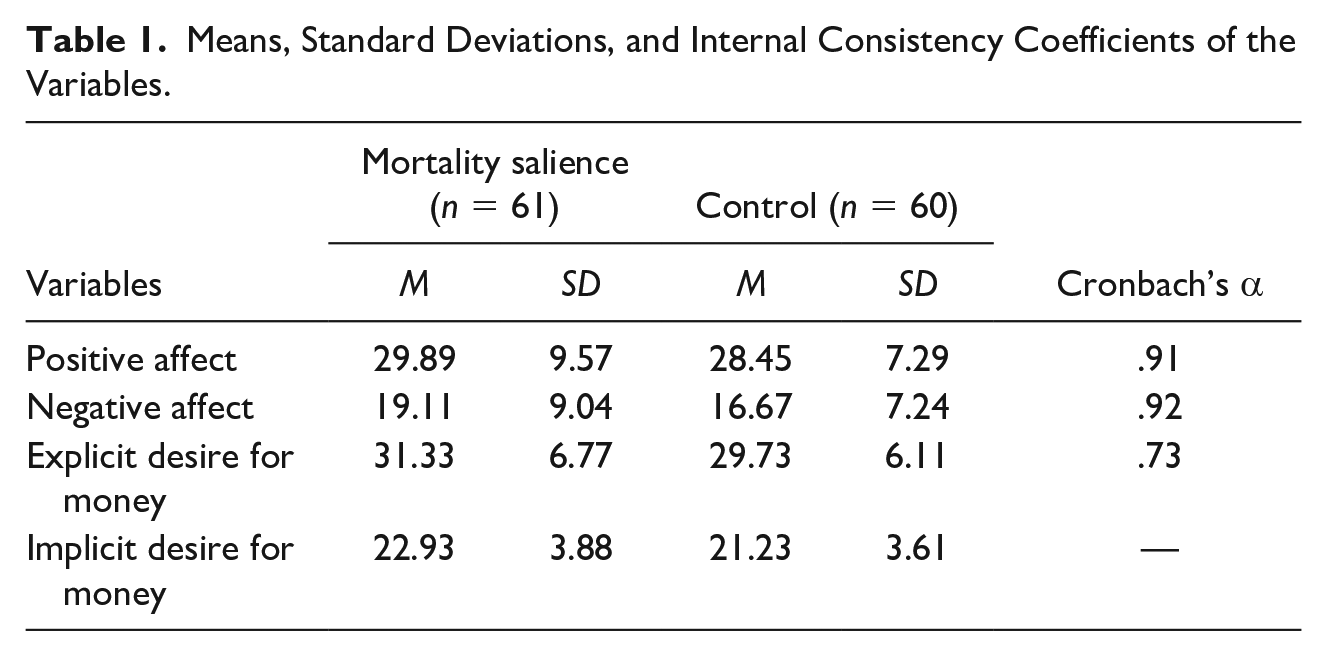
Because frequentist analyses are unable to quantify the evidence in favor of the null hypothesis, Bayesian analysis was conducted to examine the non-significant results (Wagenmakers et al., 2018). Specifically, a Bayesian independent samples t-test was conducted to examine the effect of mortality salience on explicit desire for money. The Cauchy prior width was set to JASP’s default value of r = .707. The Bayes factor is 1.25 in favor of the null hypothesis. According to the classification scheme for Bayes factors, the results provided anecdotal evidence for the null hypothesis (Lee & Wagenmakers, 2013).
Discussion
The results showed that participants in the mortality salience condition had higher implicit but not explicit desire for money than their counterparts in the control condition, providing partial support for the hypothesis. This was consistent with previous studies that found that mortality salience increases indirect (e.g., higher overall financial worth in the future; Johnson et al., 2005; Kasser & Sheldon, 2000) and implicit (e.g., an overestimation of coin sizes; Zaleskiewicz et al., 2013) desire for money. However, mortality salience did not have a significant effect on explicit desire for money. This might be explained by the social desirability bias. Specifically, given that participants completed the explicit measure in a laboratory, they might be inhibited from providing honest responses due to a fear of appearing greedy. This inhibition might discourage participants, even when reminded of mortality, from expressing a desire for money.
Study 2
Study 2 aimed to conceptually replicate Study 1 by using a different method to manipulate mortality salience and a different operationalization of the desire for money. Specifically, mortality salience was manipulated by having participants complete either the Death Anxiety Scale (Templer, 1970) or the Fear of Dental Pain Scale (Quirin et al., 2012). Furthermore, the operationalization of desire for money in Study 1 has poor ecological validity (i.e., we do not need to draw the size of a coin from memory in our daily life). In the current study, given the proliferation of e-commerce, desire for money was operationalized as the preferred selling price of a used laptop (Xu et al., 2020). Finally, the study was conducted online to maximize anonymity and reduce the social desirability bias. It was hypothesized that participants in the mortality salience condition would have higher desire for money than their counterparts in the control condition.
Method
Participants
A total of 185 participants were recruited via convenience sampling. Data from 48 participants were removed because they had missing data, did not meet the inclusion criteria of being a Singaporean or Permanent Resident, or were aware of the true purpose of the study. The final sample consisted of 137 (50.4% females) university students who were Singaporeans and Permanent Residents of at least 10 years. Their ages ranged from 18 to 52 years (M = 25.24, SD = 5.52).
Instruments
The Death Anxiety Scale and the Fear of Dental Pain Scale
Mortality salience was manipulated by having participants complete either the 15-item Death Anxiety Scale (e.g., I am very much afraid to die; Templer, 1970) or the 15-item Fear of Dental Pain Scale (e.g., I am very much afraid of dental work; Quirin et al., 2012). Responses for both instruments are made on a True/False scale. One study found significant differences in neural activity as participants complete the instruments, suggesting that death-related thoughts are distinct from dental pain-related thoughts (Quirin et al., 2012). In a meta-analysis, 7% of the 277 studies had participants complete close-ended instruments for mortality salience manipulation (Burke et al., 2010).
The Seller Behavior Scenario
The Seller Behavior Scenario asks participants to indicate their preferred selling price of a used laptop and is designed to assess desire for money (Xu et al., 2020). Specifically, for this study, participants were asked to imagine that they have previously purchased a laptop for SGD1300 and are now planning to sell it through an e-commerce website. Participants were told that similar models were sold between SGD570 and SGD930 and were asked to indicate their preferred selling price, with a higher selling price indicating higher levels of desire for money. The validity of the task has been supported by empirical research (Xu et al., 2020).
Procedure
Participants completed the double-blind experimental study online via Qualtrics. To hide the true nature of the study, participants were told that the study aims to examine the effects of attitudes and emotions on seller behavior. First, participants completed the Attitudes Towards Gambling Scale (Wardle et al., 2011) to support the cover story of the study. Second, participants were randomly assigned by Qualtrics to either the mortality salience condition or the control condition by having them complete the Death Anxiety Scale (Templer, 1970) or the Fear of Dental Pain Scale (Quirin et al., 2012), respectively. Finally, participants completed the Positive and Negative Affect Schedule (Watson et al., 1988), the Seller Behavior Scenario (Xu et al., 2020), and a demographic form that asks for nationality, age, and sex. At the end of the experiment, participants were debriefed about the true nature of the study. Data collection took place from April 2020 to June 2020. This procedure was approved by the university’s Human Research Ethics Committee (Approval number: H8007).
Results
The data were analyzed using SPSS version 25 and JASP (JASP Team, 2019) with the alpha level set at .05. The descriptives are presented in Table 2. The data were normally distributed, and there were no floor or ceiling effects. A series of two independent samples t-tests showed that there was no significant effect of mortality salience on positive affect and negative affect, p = .65 and .05, respectively. An independent samples t-test showed that there was no significant effect of mortality salience on desire for money, t(135) = 0.22, p = .83.
Means, Standard Deviations, and Internal Consistency Coefficients of the Variables.
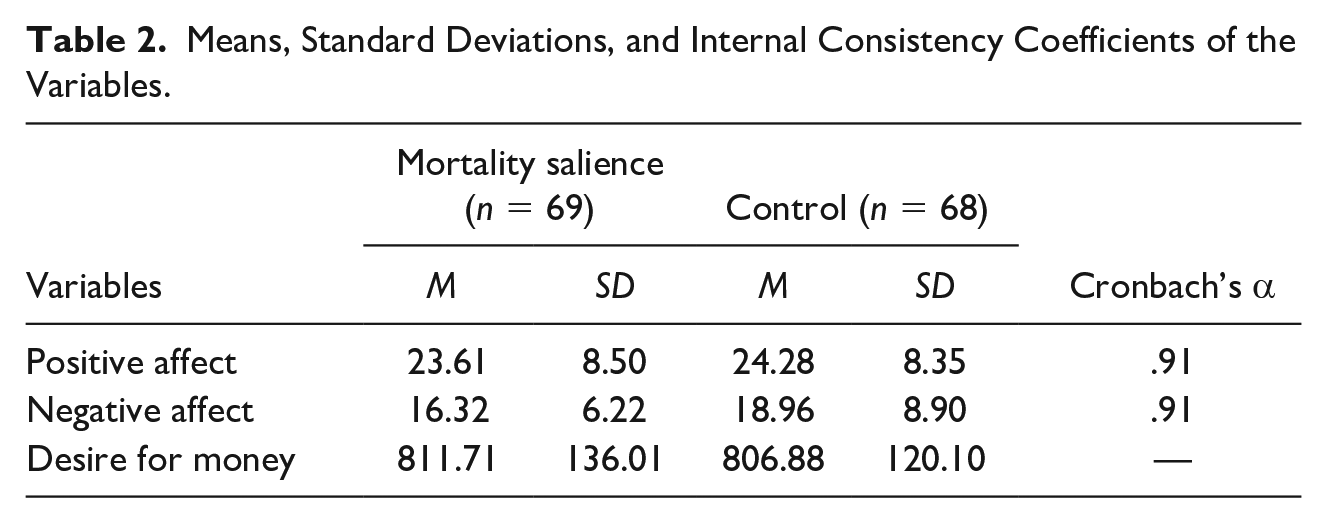
Bayesian analysis was conducted to examine the non-significant results (Wagenmakers et al., 2018). Specifically, a Bayesian independent samples t-test was conducted to examine the effect of mortality salience on desire for money. The Cauchy prior width was set to JASP’s default value of r = .707. The Bayes factor is 4.58 in favor of the null hypothesis. According to the classification scheme for Bayes factors, the results provided moderate evidence for the null hypothesis (Lee & Wagenmakers, 2013).
Discussion
The results of the study did not provide support for the hypothesis that participants in the mortality salience condition would have a higher desire for money than their counterparts in the control condition. This was partially consistent with Study 1 but inconsistent with previous studies that found that mortality salience increases the desire for money (Johnson et al., 2005; Kasser & Sheldon, 2000; Zaleskiewicz et al., 2013). This might be explained by the short delay between the mortality salience manipulation and the assessment of the dependent variable. Specifically, the Positive and Negative Affect Schedule (Watson et al., 1988) consists of only 20 items and could be completed quickly by participants. Although a specific length of delay for the activation of distal defenses has never been identified, a meta-analysis found that studies with longer delays produced larger effect sizes than studies with shorter delays (Burke et al., 2010). In the current study, the short delay might have precluded the activation of distal defenses, resulting in nonsignificant differences between the two conditions.
Study 3
In Study 2, although the validity of the Seller Behavior Scenario as an assessment of desire for money has been supported by empirical research (Xu et al., 2020), the higher asking price could also be an indicator of frugality. In other words, participants might set a higher price to save on the original cost of the laptop. Consequently, Study 3 aims to conceptually replicate Studies 1 and 2 by using a different operationalization of desire for money. In the working world, we often must exchange resources (e.g., time, effort, and skills) for money. Therefore, desire for money was operationalized as the willingness to listen to unpleasant sounds in exchange for money (Lasaleta et al., 2014). Furthermore, the 60-item Positive and Negative Affect Schedule–Expanded Form (Watson & Clark, 1999) was used to introduce a longer delay between the mortality salience manipulation and the assessment of the dependent variable. Finally, attitudes toward money was assessed as a potential moderator.
While reminders of mortality should motivate us to defend our cultural worldview (Harmon-Jones et al., 1997), the worldview to be defended could be different for individuals even if they are from the same culture. Specifically, individuals form their own personalized version of the worldview due to their personality and prior life experiences (Landau et al., 2004). For example, individuals who value tolerance as a key component of their worldview are less likely to respond to mortality salience with out-group derogation than individuals without such a value (Greenberg et al., 1992). In the current study, attitudes toward money was operationalized using the Money Ethic Scale it consists of six factors: money is (a) good, (b) bad, (c) a form of achievement, (d) a source of self-esteem, (e) to be budgeted, and (f) a form of power (Tang, 1992). These attitudes should affect responses to mortality salience. For example, individuals who view money as a source of self-esteem should be more likely to respond to mortality salience with a higher desire for money. Accordingly, it was hypothesized that participants in the mortality salience condition would have higher desire for money than their counterparts in the control condition. It was also hypothesized that attitudes toward money would moderate the effects of mortality salience on desire for money.
Participants
A total of 110 participants were recruited via convenience sampling. Data from 24 participants were removed because they had missing data. The final sample consisted of 86 (70.9% females) university students who were Singaporeans and Permanent Residents of at least 10 years. Their ages ranged from 20 to 60 years (M = 26.17, SD = 8.15).
Instruments
The Money Ethic Scale
The Money Ethic Scale is a 30-item instrument designed to assess six factors of attitudes toward money: (a) Good (e.g., Money is valuable), (b) Bad (e.g., Money is evil), (c) Achievement (e.g., Money is a symbol of success), (d) Self-esteem (e.g., Money makes people respect you in the community), (e) Budget (e.g., I budget my money very well), and (f) Power (e.g., Money means power; Tang, 1992). Responses are made on a 7-point Likert-type scale that ranges from 1 = Disagree Strongly to 7 = Agree Strongly. Appropriate item scores are summed for each factor, with higher scores indicating higher levels of the respective attitudes toward money factor. Scores on the instrument range from 9 to 63 for Good, 6 to 42 for Bad, 4 to 28 for Achievement, Self-esteem, and Power, and 3 to 21 for Budget. The six-factor structure of the instrument has been supported by exploratory factor analysis and had acceptable internal consistencies that ranged from .68 to .81 (Tang, 1992).
The Positive and Negative Affect Schedule—Expanded Form
The Positive and Negative Affect Schedule—Expanded Form is a 60-item instrument designed to assess two higher order factors of affect: (a) Positive Affect (e.g., Attentive) and (b) Negative Affect (e.g., Distressed) (Watson & Clark, 1999). The instrument also assesses 11 specific affects: Fear, Hostility, Guilt, Sadness, Joviality, Self-Assurance, Attentiveness, Shyness, Fatigue, Serenity, and Surprise. Participants were asked to report on their feelings and emotions in the present moment. Responses are made on a 5-point Likert-type scale that ranges from 1 = Very Slightly or Not at All to 5 = Extremely. Only the two higher order factors of affect were used in the current study. Appropriate item scores are summed for each factor, with higher scores indicating higher levels of positive or negative affect. Scores on the instrument range from 10 to 50 for each factor. The two higher order factors have been supported by exploratory factor analysis and had acceptable internal consistencies that ranged from .79 to .93 (Watson & Clark, 1999).
Unpleasant Sounds Listening Scenario
The Unpleasant Sounds Listening Scenario asks participants to indicate their willingness to listen to unpleasant sounds in exchange for money and is designed to assess desire for money (Lasaleta et al., 2014). Specifically, for this study, participants were asked to listen to three sound samples: (a) nails scratching on a chalkboard, (b) an alarm clock ringing loudly, and (c) buzzer noise from construction site. Each sample lasted 8 s. After listening to each sample, participants were asked to indicate their willingness to listen to the sound for 5 min in exchange for SGD5. Responses are made on a 9-point Likert-type scale that ranges from 1 = Not at All to 9 = Extremely. The scores are summed across the three samples, with higher scores indicating higher levels of desire for money. Scores on the instrument range from 3 to 27. The validity of the task has been supported by empirical research (Lasaleta et al., 2014).
Procedure
Participants completed the double-blind experimental study online via Qualtrics. To hide the true nature of the study, participants were told that the study aims to examine the effects of attitudes, affect, and personality on decision-making skills. First, participants completed the Attitude Toward Learning Scale (Kara, 2009) to support the cover story of the study. Second, participants completed the Money Ethic Scale (Tang, 1992). Third, participants were randomly assigned by Qualtrics to either the mortality salience condition or the control condition by having them complete the Death Anxiety Scale (Templer, 1970) or the Fear of Dental Pain Scale (Quirin et al., 2012), respectively. Finally, participants completed the Positive and Negative Affect Schedule—Expanded Form (Watson & Clark, 1999), the Unpleasant Sounds Listening Scenario (Lasaleta et al., 2014), and a demographic form that asks for nationality, age, and sex. At the end of the experiment, participants were debriefed about the true nature of the study. None of the participants reported ill effects associated with the Unpleasant Sounds Listening Scenario. Data collection took place from July 2020 to September 2020. This procedure was approved by the university’s Human Research Ethics Committee (Approval number: H8105).
Results
The data were analyzed using SPSS version 25, Hayes’ (2017) PROCESS macro, and JASP (JASP Team, 2019) with the alpha level set at .05. The descriptives are presented in Table 3. The data was normally distributed and there were no floor or ceiling effects. A series of two independent samples t-tests showed that there was no significant effect of mortality salience on positive affect and negative affect, p = .24 and .60, respectively.
Means, Standard Deviations, and Internal Consistency Coefficients of the Variables.
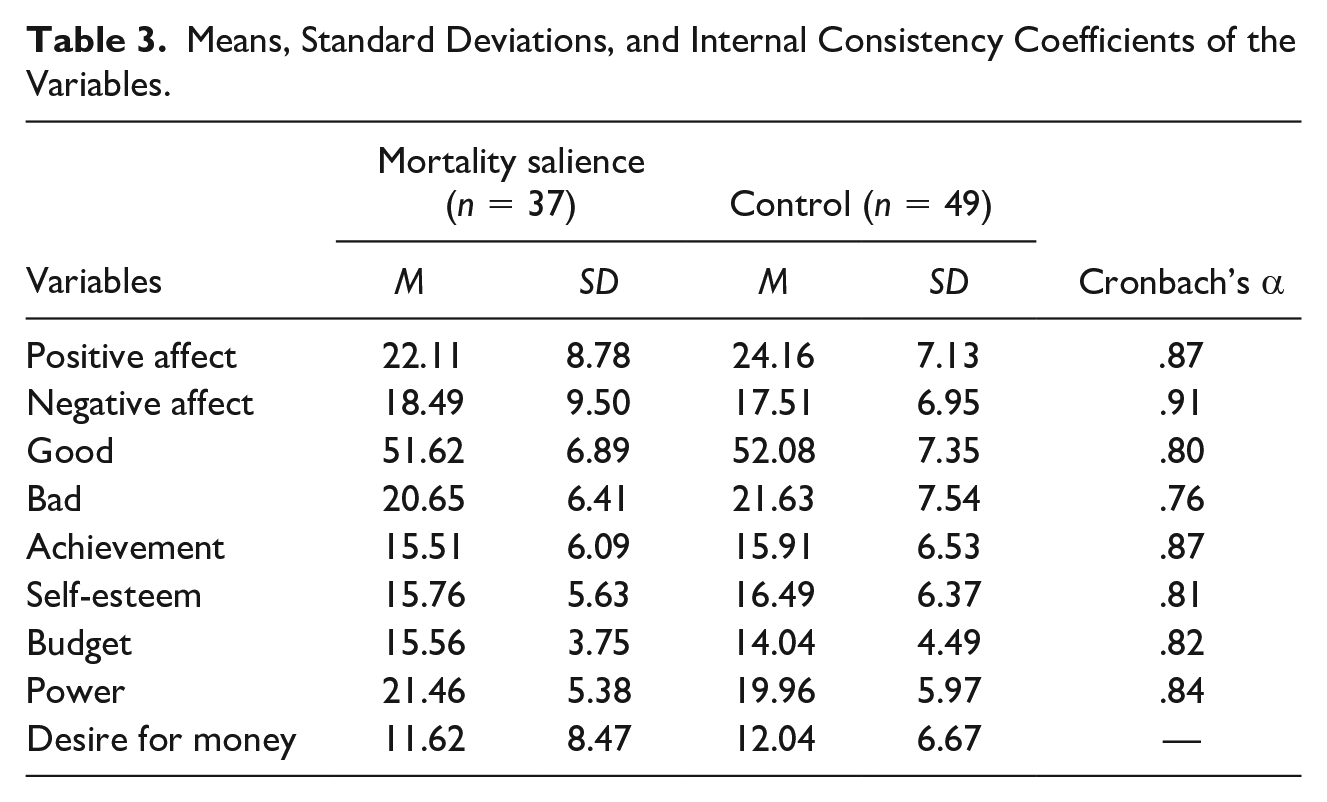
Hayes’ (2017) PROCESS Model 1 was used to conduct a series of six moderation analyses with mortality salience (dummy coded with control condition as zero) as the independent variable, the six factors of attitudes toward money (i.e., good, bad, achievement, self-esteem, budget, and power) as the moderators, and desire for money as the dependent variable. There were no significant main effects for mortality salience, and no significant interaction effects between mortality salience and the six factors of attitudes toward money, on desire for money. The results are presented in Table 4.
Six Factors of Attitudes Toward Money as Moderators of Mortality Salience on Desire for Money.
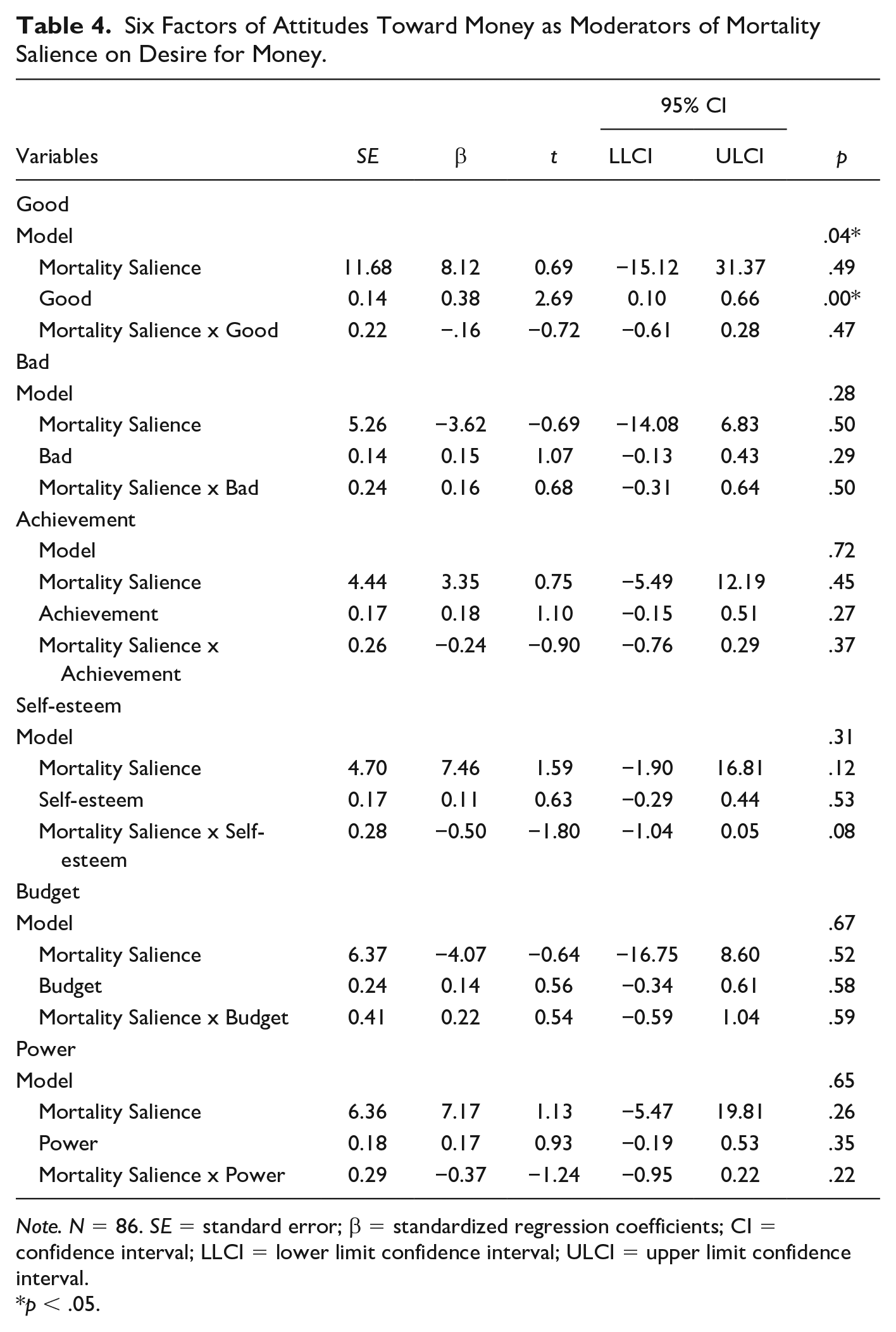
Note. N = 86. SE = standard error; β = standardized regression coefficients; CI = confidence interval; LLCI = lower limit confidence interval; ULCI = upper limit confidence interval.
p < .05.
Bayesian analysis was conducted to examine the non-significant results (Wagenmakers et al., 2018). Specifically, a Bayesian independent samples t-test was conducted to examine the effect of mortality salience on the desire for money. The Cauchy prior width was set to JASP’s default value of r = .707. The Bayes factor is 5.28 in favor of the null hypothesis. According to the classification scheme for Bayes factors, the results provided moderate evidence for the null hypothesis (Lee & Wagenmakers, 2013).
Discussion
The results of the study did not provide support for the hypothesis that participants in the mortality salience condition would have a higher desire for money than their counterparts in the control condition. This was consistent with Studies 1 and 2 but inconsistent with previous studies that found that mortality salience increases the desire for money (Johnson et al., 2005; Kasser & Sheldon, 2000; Zaleskiewicz et al., 2013). The results also did not provide support for the hypothesis that attitudes toward money would moderate the effects of mortality salience on the desire for money. This was inconsistent with the notion of a personalized worldview (Landau et al., 2004) and previous studies that found that individual difference variables moderate the effects of mortality salience (e.g., Greenberg et al., 1992). Overall, the current study provided a conceptual replication of Studies 1 and 2.
General Discussion
Three studies were conducted to examine the effects of mortality salience on the desire for money. Mortality salience was manipulated by asking participants to complete open-ended questions (Study 1) or close-ended instruments (Studies 2 and 3). The desire for money was operationalized by asking participants to complete a self-report desire for money instrument and draw an SGD 1-dollar coin from memory (Study 1), indicate their preferred selling price of a used laptop (Study 2), and indicate their willingness to listen to unpleasant sounds in exchange for money (Study 3). Furthermore, the studies were conducted onsite in a laboratory (Study 1) and online via Qualtrics (Studies 2 and 3). Finally, attitudes toward money was assessed as a potential moderator (Study 3).
Overall, with the exception of results on the Coin Drawing Task (Bruner & Goodman, 1947), the three studies did not provide support for the hypothesis that participants in the mortality salience condition would have higher desire for money than their counterparts in the control condition. Furthermore, Bayesian analysis found that there were anecdotal (Study 1) and moderate (Studies 2 and 3) evidence for the null hypothesis. The moderate evidence suggests that mortality salience did not increase desire for money. Alternative explanations for the nonsignificant results, such as the social desirability bias or the short delay between the mortality salience manipulation and the assessment of the dependent variable, have been addressed in Studies 2 and 3, respectively. Taken together, the results was inconsistent with previous studies that found that mortality salience increases desire for money (Johnson et al., 2005; Kasser & Sheldon, 2000; Zaleskiewicz et al., 2013). The nonsignificant results could be due to data collection during the coronavirus disease 2019 (COVID-19) pandemic and the use of a Singaporean sample.
First, data collection for the three studies took place during the COVID-19 pandemic. Given the severity of the pandemic, researchers have argued that it could act as a form of persistent and prolonged mortality salience (Courtney et al., 2020; Pyszczynski et al., 2021). Indeed, big data analysis of Google searches and social networking sites found increased mortality salience during the pandemic in China (S. Li et al., 2020), the United States (Evers et al., 2021), and Singapore (Chew, 2022). The increased mortality salience could result in the activation of distal defenses (e.g., increased desire for money) among the control condition, resulting in nonsignificant differences between the mortality salience and control conditions (Chew & Yap, 2021).
Alternatively, the mortality salience associated with the pandemic might change our relationships with people and money. According to the expanded theory of social change, cultural evolution, and human development, mortality salience should result in a change in attitudes and behaviors to those that are found in an earlier form of society (Evers et al., 2021). Earlier forms of societies tended to be small-scale, rural environments with scarce resources. In those environments, people are more likely to be collectivistic and less likely to be materialistic. Indeed, the same big data analysis found increased collectivism and decreased materialism during the pandemic (Evers et al., 2021). Consequently, that might explain the nonsignificant results in the three current studies.
Second, Singaporeans might not respond to reminders of death with an increase in desire for money. This might seem inconsistent with the Singaporean dream of acquiring Cash, Credit card, Car, Condominium, and membership to a Country club (Chong, 2010; Tigerhall, 2019), and Singaporeans’ penchant for materialism (N. P. Li et al., 2011; Swinyard et al., 2001). However, materialism consists of two components: the consumption of goods (desire for products) and the accumulation of wealth (desire for money; Kasser & Sheldon, 2000). There is some evidence that East Asian participants are more likely to enjoy life in response to mortality salience than American participants because they endorse the idea that life requires the coexistence of both “yin” (i.e., bad) and “yang” (i.e., good) (Ma-Kellams & Blascovich, 2012). Consequently, if Singaporeans respond to reminders of death like East Asians, they might be more likely to report a desire for products (i.e., items that they can use and enjoy) rather than money.
Limitations of the study should be noted. First, there was a significant proportion of missing data for Studies 2 and 3. Participants might drop out of the studies because they were distressed by the mortality salience manipulation, resulting in a bias to the results. Unfortunately, there was insufficient data to conduct dropout analysis to examine this possibility. Second, G*Power suggested a minimum sample size of 128 for Study 3 (Faul et al., 2009). The current sample size of 86 participants suggested that Study 3 did not have sufficient power to detect an effect. Third, participants were recruited via convenience sampling from a private university in Singapore. This procedure resulted in non-representative samples and the results might not generalize to the Singaporean population. Finally, given the high cost of education in the private university (i.e., SGD84,530 for a 4-year psychology degree in 2020), it is likely that the participants belong to middle-to-high socioeconomic status families. Consequently, they might not appreciate the need for money given their relative affluence (e.g., there is no need to listen to unpleasant sounds for a mere SGD5). In the future, these limitations might be controlled by recruiting large diverse representative samples from Singapore and providing an incentive appropriate to the socioeconomic status of the participants.
Future research directions might include conducting mortality salience studies during and after the COVID-19 pandemic. Although mortality salience has increased during the pandemic (Evers et al., 2021; S. Li et al., 2020), its effects on terror management theory research are currently unclear. The results could provide clarifications to the current paper and inform future mortality salience studies. Future research could also examine both the desire for products and the desire for money concurrently as dependent variables. This approach provides a holistic view of the effects of mortality salience on materialism and could also clarify the different manners in which Singaporeans respond to reminders of death.
Footnotes
Declaration of Conflicting Interests
The author(s) declared no potential conflicts of interest with respect to the research, authorship, and/or publication of this article.
Funding
The author(s) received no financial support for the research, authorship, and/or publication of this article.
