




Abstract
Questions about private experiences such as future-related thinking or anger rumination are standard repertoire in many types of psychological research. Evaluating the quality and reliability of participant reports in response to such questions is, however, a complex endeavor—especially for third-person research where observer and observed are distributed across two different individuals and disparate scales of reference may hence challenge the interpretation of findings. Reliable tools to assess an individual’s actual experience are thus needed. In the present article, we conceptually specified and empirically explored the sense of certainty as a vehicle to assess participant’s access to their experience. We conducted semi-structured interviews with 20 participants performing mathematical calculation, imagination, and memory tasks and cross-validated the qualitative reports with their certainty ratings. The results of the Thematic Analysis revealed affective, cognitive, somatic, and rudimentary behavioral dimensions of the sense of certainty. The qualitative data provide the basis for a sense of certainty scale that we argue can assess the sense of certainty as an internal criterion for access to inner experience in a more differentiated manner than standard rating tasks.
Psychology as a science has long struggled with the challenge of accessing a person’s inner experience (e.g., Ericsson & Simon, 1980; Petitmengin et al., 2013). Yet, illuminating this inner territory is of core relevance—not only with regard to qualitative research and first-person approaches. Rather, it also provides the foundation and ultimate scale of reference for quantitative research and third-person approaches in a range of disciplines. Apart from psychology as a basic science, domains such as psychotherapy and public health are highly reliant on accessing inner experience (Beitman & Soth, 2006; Frayn, 1992; Khalsa et al., 2018). There is hence a broad, interdisciplinary interest to assess the quality and methods of such access; and to find criteria to evaluate the reliability of the emerging data (Petitmengin & Bitbol, 2009). One way to make progress on this front would be to use third-person methods and thereby establish external validation criteria. However, such procedures are not able to record the actual experience of a person because observer and observed are distributed across two different individuals, thus lacking relevant internal validation criteria. Therefore, the present article seeks to explore the sense of certainty as an internal criterion for classifying the access to—and the quality of—inner experience.
We commence with an overview of the relevance of access to inner experience for psychology, psychotherapy, and public health. Following this, we will briefly review related concepts of the sense of certainty in both philosophy and psychology with a particular focus on the feeling of rightness, intuition, and confidence ratings. Finally, we will properly introduce the sense of certainty as our core psychological entity under enquiry.
The Relevance of Access to Inner Experience
For qualitative research and first-person approaches, the relevance of access to inner experience is obvious: The degree of access to the inner experience of interviewees in interview studies or participants in introspective diary studies directly determines the quality of the emerging data. Introspective reports and their reliability and suitability as a research method in general are hence extensively debated (for overviews, see Bitbol & Petitmengin, 2013; Peels, 2016; Schwitzgebel, 2008) and many studies show that our access to inner experience is often—though not always (Questienne et al., 2018)—limited or even flawed (e.g., Bratzke & Bryce, 2019; Nisbett & Wilson, 1977). Yet, a range of studies up to now show that this access can be improved with training and then lead to more reliable data (e.g., Miyahara et al., 2020; Petitmengin et al., 2013). Perhaps less obvious, but all the more important, access to inner experience is also of core relevance for quantitative research and third-person approaches. The widely used self-report methods that are inextricably linked with quantitative measures allow us to quantify experiential qualities to some extent. Yet, they are ultimately rooted in first-person reports of inner experience. For instance, in developing a new scale for measuring a psychological construct or relating a particular cortical area to a corresponding psychological domain (such as the amygdala to emotional states), we have to ask participants what they are experiencing. To answer the respective question, they have to conduct some form of introspection. The most sophisticated third-person methods like cerebral neuro-imaging techniques thus ultimately rely on self-reports—at least for the initial validation process (Majorek, 2012; Weger et al., 2016). Therefore, it would be helpful to establish criteria that allow us to assess how reliable and accurate people’s access to inner experience is and how we can identify people who have better/worse access to their inner experience so that we can capitalize on their sensitivity when it comes to validating our quantitative measurement instruments. Our enquiry into the sense of certainty is a first attempt to contribute to addressing these issues.
Access to inner experience is also a fundamental prerequisite for self-regulation and self-realization. Only in the ongoing confrontation with inner states, emotions, and needs can the individual successfully unfold and develop a self (e.g., Rogers, 1959). Every form of human growth is dependent on the extent to which access to inner experience can be attained. From a humanistic point of view, an ascent in the hierarchy of needs (Maslow, 1943) would not be possible without a reciprocal exchange between inner experience and outer reality. The exploration of the sense of certainty as an internal criterion for accessing inner experience is thus also of great interest from the perspective of the psychological inquiry into human development and the self.
Apart from psychology as a basic science, psychotherapy in particular is also highly reliant on the access to inner experience of the individual. For many psychotherapeutic approaches, the individual experience of the patient is the ultimate starting point of the therapeutic work (e.g., Greenberg, 2004; Rogers, 1951). Self-report measures and verbal statements of patients play a major role in the diagnostic process and in the evaluation of therapy progress (Barlow, 2021). The importance of access to inner experience is also reflected in the exploration of patient’s inner life by means of mood protocols, individual weekly schedules, or diaries in the early stages of psychotherapy and in the association between the degree of insight and outcome of therapy (Jennissen et al., 2018).
Finally, access to inner experience is relevant to prevent mental and physical illness. Most types of illness—for example, depression and burnout—do not start abruptly but unfold in a gradual cycle of escalation. Developing strategies that allow people to detect the early symptoms of pathology, for instance, via a systematically cultivated form of interoception, illustrates how important inner experience is in preventing mental and physical illness (Bornemann & Singer, 2017; Farb et al., 2015). Despite the great interdisciplinary interest, related concepts of the sense of certainty have been sparsely explored in a systematical way as an internal criterion for classifying access to inner experience.
Related Concepts of the Sense of Certainty
Philosophical Concepts
In philosophy, the two most eminent scholars who dealt with concepts related to the sense of certainty during the past century were Franz Brentano and Ludwig Wittgenstein. Brentano stated in 1915 that we are capable of immediately self-evident judgments of facts since we exclusively rely on inner perception—in contrast to outer perception. Hence, as long as we perceive an ongoing, evolving act of consciousness, there is no doubt about its imminent reality. Our inner perception may fluctuate in terms of clarity, but otherwise, it constantly reveals the degree of clarity so that its factual nature remains unaffected. According to Brentano, “we are never mentally active without being perceived inwardly by ourselves as mentally active—and this with certainty” (Brentano, 1958, p. 149). Wittgenstein emphasized the role of doubt and complemented Brentano’s statement by pointing out that certainty only makes sense when juxtaposed with the possibility of uncertainty (Wittgenstein, 1977). Both these philosophical precursors laid the foundation for an understanding of the sense of certainty involving an inner point of reference—under the condition of inner perception in the current moment—that can be the source of certain knowledge.
Feeling of Rightness
Moving on to psychology, constructs related to the sense of certainty are, as pointed out before, widely explored using third-person methods of documentation, though they are mostly discussed in the context of metacognition research (Ackerman & Thompson, 2017; Smallwood & Schooler, 2015). One such related construct is the feeling of rightness. Thompson (2009) describes it as a powerful intuitive impact on reasoning, which also accounts for cognitive illusions and the early termination of mental search efforts. Thus, the feeling of rightness is a metacognitive experience emerging as a spontaneous initial sensation. It has a possibly counterproductive influence on judgment and decision-making, indicated by a low correlation with accuracy (Shynkaruk & Thompson, 2006)—resulting in deficient suitability as a reliable internal criterion.
Intuition
Another construct related to the sense of certainty is intuition—a heterogeneously defined and complex construct from the problem-solving literature. In the absence of a unitary definition, Zander et al. (2016) describe intuition by means of four core aspects: (1) non-conscious processing with the potential to be made conscious, (2) automaticity or uncontrollability reflecting in an unintentional nature, (3) experientiality in the sense of rooting in lifelong learned knowledge, and (4) initiation of action as inevitable incitement to behavior (italics taken from the cited study). The heterogeneous conceptualization of intuition becomes apparent in the variety of mechanisms that evoke it—such as type 1 processes in dual-process theories of thinking, implicit and associative learning, recognition memory, metacognitions, and others (Thompson, 2014). Especially the automatic and uncontrollable nature of intuition and its position as the counterpart of deliberate processes, as indicated for instance in type 1 processes of thinking, points to limits of intuition as a reliable internal criterion.
Confidence
An operationalization of the access to inner experience that is related to the sense of certainty is so-called confidence ratings. They are discussed in many areas of basic psychological science as one of the few standard measures of consciousness (Dienes et al., 1995; Wierzchoń et al., 2012). Typically, they are retrospectively stated self-report ratings of the degree of confidence in one’s own judgment or decision. Confidence ratings are widely used in psychological research on processes of memory, perception, and cognition in general. They have even resulted in the foundation of a systematic database of confidence studies (Rahnev et al., 2020). As second-order judgments about a given first-order task performance, these confidence ratings represent people’s capacity to introspect (i.e., people’s access to inner experience). From the perspective of metacognition research, metacognitive operationalizations, such as confidence ratings, can map access to inner experience. Strong correlations with accuracy, response speed, and brain activity indicate that confidence ratings survey relevant internal processes in face of a given task (Weidemann & Kahana, 2016). The association between confidence ratings and accuracy reveals the ability of individuals to correctly judge the accuracy of their own decisions—a phenomenon also referred to as metacognitive sensitivity (Fleming & Lau, 2014).
In psychological literature, the terms confidence and certainty are often used interchangeably, although there are computational and neural coding arguments that clearly distinguish between both. Pouget et al. (2016) point out that confidence is always choice-dependent and only refers to the probability of being correct or incorrect concerning the current choice, while the term certainty is used in a wider framework in the realm of neural circuits. Hence, in contrast to confidence, the concept of certainty appears to be a more complex phenomenon that reaches beyond the field of metacognition research and third-person approaches. Due to methodological problems of confidence ratings in measuring consciousness (selective mapping of conscious experience and interaction with stimulus characteristics), the direct introspective way remains the method of choice for some researchers (Sandberg et al., 2010). In summary, despite their weaknesses in measuring consciousness, confidence ratings establish a relevant point of reference concerning internal processes indicated by strong correlations with accuracy.
Moving Toward a New Concept of Certainty
To differentiate the concept of the sense of certainty that underlies the present study, we start by further contrasting our ideas with related concepts of certainty and confidence described above. Following Brentano’s statement about the sense of certainty, we here consider the possibility of coming closer to—and benefiting from—the inner perception of self-evident certainty in the moment of actual evolving acts of consciousness. Even though the problem of the time gap between an actual act of consciousness and the moment of report is a reality, there are promising approaches to work with (and even around) this problem and to allow people to get into contact with past experience, for example, in the form of Descriptive Experience Sampling (Hurlburt & Akhter, 2006) and Micro-Phenomenology (Petitmengin, 2006).
In contrast to the concept of the feeling of rightness and in line with Brentano, we consider the sense of certainty to play an important role in judgment and decision-making. As a quick initial sensation, the feeling of rightness does not picture inner experience in sufficient detail. This may explain why it fails to build a reliable bridge to reality—reflected in low correlations with accuracy; and why it has a possibly misleading influence on thinking and behavior. Intuition, by contrast, as it is defined in the literature, shows indeed common features with our understanding of the sense of certainty as a phenomenon (1) placed on the edge of consciousness, (2) rooted in (universal human) experience, and (3) causing active behavior. On the other hand, an important distinction with certainty is the automatic and uncontrollable nature of intuition since we consider the sense of certainty to be systematically accessible and applicable. Finally, confidence ratings seem to capture only the peak of the iceberg and tend to neglect the wealth of inner experience underneath—note that this assessment typically comes in the form of merely a single question like “How confident are you that your response is correct?” Responding to a question like this is a highly complex and vague endeavor, risking a quick and generic or even unfounded response. It stands to reason then that correlations between confidence ratings and accuracy are highly variable and depend on task type and a variety of other factors (Koriat, 2007; Sporer et al., 1995). Nevertheless, despite being a non-exhaustive measure of consciousness, the overall association with accuracy as the basis of an existing metacognitive sensitivity suggests that confidence ratings dip into relevant areas of inner experience. Therefore, they are a suitable and necessary starting point for the qualitative exploration of the sense of certainty we intend with the present study.
Metacognitive and Introspective Routes to Inner Experience
Another important aspect in contouring the concept of the sense of certainty is the distinction between metacognition and introspection. From a theoretical perspective and in light of empirical evidence there are significant differences between metacognitive and introspective reports. Whereas metacognition is a higher-order process relating to cognition, introspection is a higher-order process relating to conscious experience (Overgaard & Sandberg, 2012). On that basis we consider the sense of certainty not exclusively as metacognition revealing information about cognitive processes but rather as an introspective vehicle to get a more holistic access to consciousness and its contents of experience. First-person approaches (like introspective reports in written form) and second-person approaches (like interviews) hold the potential to move beyond metacognitive reports by seeking to explore the unfolding processual character of psychological phenomena. Therefore, we consider introspective first-person and second-person approaches—here, in the form of exploring the sense of certainty—to be particularly helpful in establishing and evaluating an internal criterion of access to inner experience. A thorough qualitative exploration will be the basis for an accurate assessment of the individual sense of certainty, enabling people to distinguish between high vs. low-quality reflections of their inner state.
Previous Investigations
A first step in the exploration of the sense of certainty was made by Sparby et al. (2020), who used micro-phenomenological self-inquiry. In the course of a mind-wandering task, the authors investigated certainty and uncertainty about past mental events and identified a set of characteristics of the sense of (un)certainty. For certainty, they found experiential dimensions like direct knowing, clarity, activity with a response, and internal coherence; for uncertainty, they came upon features like not knowing, vagueness, activity without a response, and a sense of confabulation. Concurrently, this investigation of the sense of (un)certainty by using micro-phenomenological self-inquiry suggested that a first-person approach can be an appropriate method to study subtle nuances of an elusive consciousness phenomenon. We wish to capitalize on this work by using it as a guiding compass in searching for relevant dimensions of the sense of certainty.
Purpose of the Present Study
In accordance with Sparby et al. (2020) and Wittgenstein’s idea to contrast certainty with uncertainty, we conceptualize the sense of certainty as a bipolar construct. We intend to explore the sense of certainty and uncertainty by complementing first-person methods (introspection protocols in the course of memory tasks) with second-person methods (interviews in the context of mathematical calculation tasks and imagination tasks). Apart from the exploration of the sense of (un)certainty, we aim to survey performance strategies during the processing of the mathematical calculation tasks to examine a potential influence on the participant’s sense of (un)certainty. The exploration of the sense of (un)certainty intended in this study will build on and extend the previous findings of Sparby et al. (2020) and provide a differentiated picture of this phenomenon. In search for criteria to determine the reliability of self-reports—and the degree of access to inner experience—the multiple dimensions of the experience of certainty can be used as an anchor of reference. Furthermore, by moving beyond the metacognitive realm of confidence ratings and by addressing more layers of the experience of certainty, the probability of a reliable measurement should increase. In the long term, the qualitative data of this study can hence form the basis for the development of a sense of certainty scale as a more comprehensive and differentiated alternative to confidence ratings. Therefore, the central research interest in the present study is an exploration of the sense of certainty/uncertainty and its experiential dimensions via a qualitative approach of data collection. In order to stimulate high and low levels of certainty with mental processing situations being as everyday life-like as possible, we choose mathematical calculation tasks, an imagination task, and a memory task. Mathematical calculation tasks can easily be piloted regarding difficulty and certainty. Imagination and memory are universal human activities that are directed to future events (imagination) as well as past events (memory) and also have the potential to trigger different states of certainty.
Method
Participants
As we consider the sense of (un)certainty to be a universal experiential phenomenon, our selection criteria for recruiting participants were limited to the following: (1) an overall healthy condition, (2) no present dyscalculia, (3) an unrestricted ability to concentrate, and (4) at least 18 years old. Between March 2021 and May 2021, 20 psychology students (1 male) were recruited via social media and a university online platform. Their ages ranged from 20 to 35 years (M = 25.1). All of them received course credit for participation. Informed consent forms were signed by all of them and submitted via e-mail. The study procedures were conducted in accordance with the Declaration of Helsinki and approved by the local ethics committee.
Procedure and Measures
The first part of the study was conducted via video conference. Participants were asked to solve 14 mathematical calculation tasks of varying difficulty. After each individually presented task, participants were asked to articulate their solution and to rate their certainty. When participants gave a certainty rating of 1 (completely uncertain) or 7 (completely certain) for the first time each, an interview was conducted. In cases where these ratings did not show up until task 8, the ranges were expanded to 1 to 2 or 6 to 7. If necessary, the ranges were further expanded to 1 to 3 or 5 to 7 on the level of task 10. Tasks 7 and 14 were followed by questions concerning performance strategies. For participants 11 to 20, we subsequently integrated an imagination task upon completion of the mathematical calculation tasks.
The second part consisted of an online survey concerning demographic data. Finally, we offered all participants to take part in an extended exploration of the sense of certainty by keeping records of introspection exercises (memory tasks) at home. The study was conducted in Germany, and instructions as well as quotes from the interviews and introspection protocols, were only subsequently translated into English. All instruments employed in this study are described below.
Mathematical Calculation Tasks
In a pilot study with n = 6 participants, 30 mathematical calculation tasks (multiplication of two double- or three-digit numbers) were rated regarding difficulty and certainty to avoid floor or ceiling effects. Seven tasks with extreme values on difficulty and certainty and seven tasks with an even distribution on these two dimensions were selected. This final set of 14 tasks was arranged in 2 different versions: Tasks for version A were arranged according to the principle of alternating difficulty (easiest, most difficult, second easiest, second difficult, and so forth). Then, tasks 1 to 7 and tasks 8 to 14 were exchanged to start with moderate challenges. Version B was similar to version A except for the addition that task pairs 8 and 9, 10 and 11, and 12 and 13 were flipped to prevent sequence effects.
Certainty Ratings
Certainty was rated on a 7-point Likert-type scale (1 = My answer is completely a guess; 7 = I am completely certain that my answer is correct). In addition, the endpoints of the scale were labeled as 1 (complete uncertainty) and 7 (complete certainty). We chose this additional labeling to address a possible misunderstanding of the definition of uncertainty, which can be seen either as low certainty about the outcome or high certainty about being incorrect (Moreira et al., 2018). Based on our theoretical framework as outlined above, it was important for us to picture certainty/uncertainty as a bipolar concept. Certainty ratings applied in the present study are equivalent to confidence ratings—we preferred this term in order to use consistent terminology regarding the concept under investigation.
Performance Strategies
After mathematical calculation tasks 7 and 14, participants were interviewed about their performance strategies (“Which performance strategies did you apply so far?”). If they only mentioned mathematical strategies, a question concerning their general approach ensued (“Which performance strategies for a general approach did you apply other than mathematical strategies?”). The answers were audio-recorded for further analysis.
Interview Method
The interview method consisted of a phenomenological inquiry containing elements of the access to consciousness which are also used by the micro-phenomenological interview (formerly known as the Elicitation Interview; Petitmengin et al., 2013). The micro-phenomenological interview aims for an in-depth exploration of experience on a procedural dimension. With the assistance of a trained interviewer, the interviewee is helped to evoke a past experience and plunges into it so that a precise description of the process of experience is possible (Petitmengin, 2006). It is a widely used interview technique now, especially in the fields of cognitive science (Przyrembel & Singer, 2018), clinical research (Bremond et al., 2021), and therapy (Duarte et al., 2020). The phenomenologically inspired interview applied in the present study included elements like
guiding away from metacognitions like beliefs, explanations, and abstract knowledge and toward pure descriptions of actual experience;
directing attention to the activity and the process of actual experience;
evoking the past experience by focusing on different sensory impressions of inner and outer perceptions (visual, auditory, tactile);
navigating through the past experience on a synchronic (“what happened at the same time?”) and diachronic (“What happened just before/afterwards?”) level;
and carefully exploring the past experience without inducing content from an external perspective.
Imagination Task
In order to create a setting that stimulates high and low certainty, we also used a simplified and adjusted (to every day life) version of a complex imagination task we have already applied in several previous studies (Ziegler & Weger, 2018, 2019). Participants were introduced to the imagination task by the following invitation at a time of widespread lockdown and corona-related restrictions: “Imagine a world without Corona (the corona virus), without political interventions, and without incidence rates. You are completely free to do anything you like. Please name three activities you would carry out without hesitation if it would be possible tomorrow.” Following this, they were asked to rate each activity regarding how certain they were that this was the right thing to do the next day. Certainty ratings were provided on a scale from 1 (complete uncertainty) to 7 (complete certainty). Participants were invited to close their eyes, compare the three imagined activities for a moment, and linger over the most likely activity. Finally, they were asked to disengage from the image of the activity and to dive into the experience of certainty for one minute. The imagination task was immediately followed by an explorative interview as described above.
Memory Task
To explore further qualities of the sense of certainty, a memory task (that we have already used in a similar way in a previous study; Weger et al., 2018) was conducted independently at home. Participants were asked to take their time for at least four introspection exercises on the sense of certainty/uncertainty during memory recall. They got a guideline for the implementation of the introspection exercises and a protocol sheet for the write up of their experience. As a sample exercise, we proposed to participants to sit at a quiet place—not the kitchen—and to try remembering in detail how it looked like in the kitchen the last time they were there. Instead of using the sample exercise, participants had also the possibility to think up a memory task of their own. Finally, we asked them to pick two conditions with high certainty and two conditions with high uncertainty during the process of recollection and to write down their experiences in as much detail as possible.
Data Collection
Being interested in experiential facets of the sense of certainty, we collected our data in the context of a qualitative research design that followed phenomenological principles (Laverty, 2003; Neubauer et al., 2019). The interviews were carried out by a research assistant who was trained by the first author and an expert in micro-phenomenological interview technique. For the implementation of the study procedure via video conference, participants were asked to be situated alone and in a comfortable and quiet environment. To minimize possible distraction and to maximize a private atmosphere, cameras were turned off during interview sessions. Two interviews were conducted with each participant when they reported extreme values on the certainty scale (one following a high rating, one following a low rating). In two cases, we were able to carry out just one interview in the absence of an appropriate certainty rating. The total duration of interviews per person ranged between 11 and 28 min (M = 19). They were digitally audio-recorded, manually transcribed verbatim by two research assistants, and checked for accuracy by the first author. We determined the completion of data collection by the principle of data saturation (Guest et al., 2006). More precisely, we decided to end data collection when two consecutive participants did not report a single novel feature (sub-theme) of certainty or uncertainty.
Data Analysis
The interview transcripts (mathematical calculation task, imagination task) and the introspection protocols (memory task) were analyzed using Thematic Analysis (TA) according to the procedures of Braun and Clarke (2006). This data analysis approach met our requirements because of its theoretical and epistemological independence. We needed a flexible method of data analysis, as we had to bring together a phenomenologically inspired approach to data collection with the aim to reach a certain level of intersubjective validity through a large sample of participants that was confronted with (un)certainty in different contexts. While phenomenological principles were taken into account in the data collection phase, the material was analyzed on the basis of a TA.
Data analysis was primarily carried out by the first author. Following an essentialist epistemological paradigm, it was assumed that the participant’s experience is reflected on a semantic level. The data analysis was therefore driven by a search for semantic themes (Braun & Clarke, 2006). The procedure involved familiarizing with the data, generating codes from the transcripts and protocols, searching for relevant overarching categories and sub-themes, and reviewing as well as clustering categories/themes. According to a data-driven approach, every transcript/protocol was examined open-mindedly concerning new categories/themes. When each transcript/protocol was finally analyzed, a master table of categories and themes was created. Every theme had to be substantiated with quotations from at least two different participants. To check for accuracy of coding and generating categories, a sample of four transcripts and four protocols was independently analyzed by a research assistant. Nine of 11 categories were substantively equivalent to categories of the analysis of the first author (82% agreement on the level of categories). Discrepancies were discussed with a third person (the second author) and consensus reached in generating a final compilation of categories.
Results
The survey of performance strategies during the processing of the mathematical calculation tasks showed no considerable results relating to the sense of certainty. Participants mostly reported mathematical calculation strategies. Only in a few cases, they mentioned self-regulatory strategies, such as silent self-verbalizations, in order to calm down or encourage themselves.
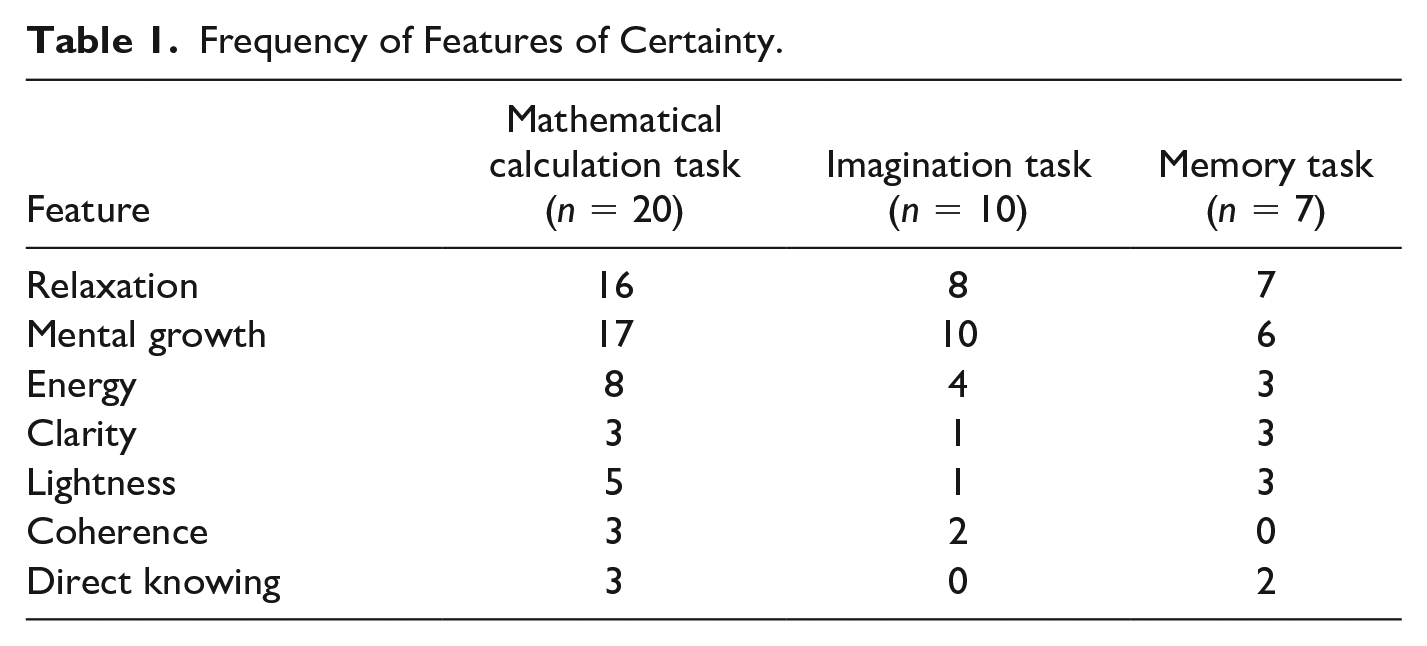
The exploration and analysis of the sense of certainty and uncertainty—based on three different tasks (mathematical calculation, imagination, memory)—revealed seven contrasting features: (1) relaxation/tension; (2) mental growth/stagnation; (3) energy/exhaustion; (4) clarity/diffuseness; (5) lightness/heaviness; (6) coherence/incoherence; and (7) direct knowing/not knowing. The category striving for compensation was only found in relation to uncertainty and had no certainty-related counterpart. Tables 1 and 2 show the frequency of features of certainty and uncertainty for the three different tasks. In response to the mathematical calculation task, all categories of certainty and uncertainty were reported by a minimum of three and a maximum of up to 17 of all 20 participants. When exploring certainty in the imagination task, the category direct knowing was never mentioned but all ten participants reported the experience of mental growth. The memory task revealed no evidence for the category coherence but all seven participants involved in this task reported content for the category relaxation.
Frequency of Features of Certainty.
Frequency of Features of Uncertainty.
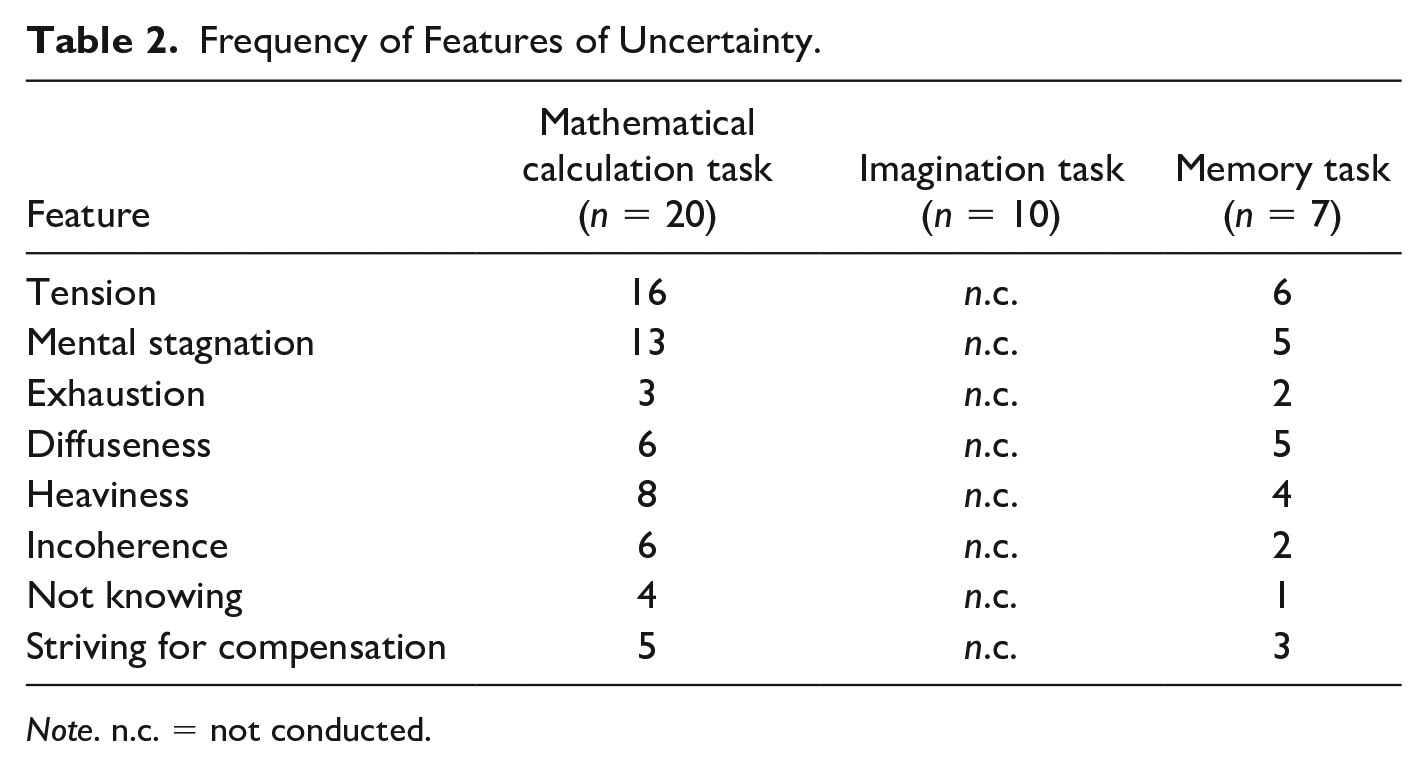
Note. n.c. = not conducted.
Separately dealing with certainty and uncertainty, the seven categories mentioned above will now be described in more detail. We mostly use verbatim quotes with corresponding participant numbers in brackets. Where we do without verbatim quotes, our descriptions are still closely informed by the original data—which we then do not quote again for redundancy purposes.
Certainty
Following our data analysis, the sense of certainty can be characterized by the following expressions on the seven dimensions introduced above: Relaxation, mental growth, energy, clarity, lightness, coherence, and direct knowing.
Relaxation
One central aspect of this category was a comfortable feeling of relaxation, a “pleasant condition” (participant 19). This relaxation was not only described as a mental event (“was able to somehow let it go and then it was completely relaxed”, 15) but extended to a physical experience (“my thorax and the area of the stomach relaxed”, 12). For a few participants, this mental and physical experience resulted in a relaxed body posture. Another aspect was the relief that can be experienced when getting rid of pressure or burden. Also very prominent was the feeling that “it is very peaceful and quiet and not so loud anymore” (5). Similar to the feeling of relaxation, inner peace and quietness furthermore showed physical correlates like “a relaxed and deeper breathing” (12) and a normal or even warmer body temperature (“a pleasant warm feeling in my thorax”, 1). Some participants reported an inner warmth that rose up in their body and spread. In a few cases, the relaxation manifested in a feeling of serenity or lightheartedness (“it is not something floating, lifting up from the ground, but, yes, maybe something buoyant”, 6). These last-mentioned feelings are located on the edge of the more passive category relaxation and near the transition to the more active category mental growth.
Mental Growth
This category comprises mental events and a few associated behaviors representing a more active process of situational inner evolvement. Most of the participants either spoke about an unspecific positive feeling or reported a specific feeling of “a short moment of joy” (8), “an experience of happiness” (14), “satisfaction” (7), “lack of concern” (4), “a mixture with pride” (7), or “confidence” (19). Sometimes, these positive feelings result in behavioral expressions like a smile or a loving gesture toward oneself or the world (“simply looking outside through the window and simply sending the number out to the world”, 9). On a visual level, there were statements about positive inner images, such as the “brilliant sun” (12). Another aspect of mental growth was the experience of self-confidence. Although the participants used different German words (“Selbstbewusstsein”, 4; “Selbstvertrauen”, 8; “Selbstsicherheit”, 6), they all described an increasing confidence in oneself or the currently required skill (“there is a self-assurance in it and something like: everything fine”, 6). In concert with self-confidence, an experience of competence or control was reported. For example, participants mentioned “a feeling of feasibility, of manageability. A little bit like: yes okay, I see it now, I can tackle it and then I have it” (11). They had the impression of an overview of the development of the situation and spoke about “predictability” (1) in relation to the task. For some participants, the result was a feeling of superiority in general or “superiority over their previous self” (18). Finally, the reports revealed experiences of mindfulness and widened awareness. Participants mentioned, for example, that their “awareness is more there for the room, more for the here and now” (19) and realized small details in their environment like “these single threads that are worked into it” (5).
Energy
This category primarily consists of a fundamental feeling of energy, for example, described as “physical energy boost” (10). Participants spoke about a feeling of “stability” (5) in general, regarding their sitting posture or a straightened-up body posture (“feels a little bit like having remained on the ground. So I would be really save, so it would give me such a support”, 20). A few participants reported an increased physical presence (“as if the cells would be already totally, yes, totally present”, 5) or physical radiance originating from the center of the body. Apart from these bodily experiences, participants also mentioned feelings of being “awake” (1) and “physically vigilant” (5). Another aspect was a sense of determination manifesting in a feeling of decreasing hesitation or “strong will” (19). The final preparation for active behavior was an excitement with an explicitly positive connotation “as if one would have had a little palpitation. Before a performance or so. . . like as if all would have gone well then” (10).
Clarity
The reports revealed: what was described as a general feeling of clarity and the experience of clear inner images. Regarding the feeling of clarity the participants reported they felt in command of the mental operation (“ah I understood, I understood the system”, 10) and had the feeling of being clearly right (“the feeling: yes, exactly, that is right now”, 17). Another description was the impression of a “veil that was removed from [her or him]” (5) in the moment of finding a solution. About the experience of clear inner images, participants reported accurate imaginations of objects manifesting in “sharply outlined contours” (12) and “concrete colors” (19).
Lightness
Core aspect of this category was an experience of easiness and fluidity in mental processes. First, participants spoke about an effortless process of thinking (“easier conceiving of thoughts”, 19; or “free thoughts”, 4) and a fluent transition from one thought to the other (“more this lighter thinking. Yes, when the one thought is over, the next one slowly arrives”, 14). Second, they reported that the “visualization [is] easy possible” (4) and smooth in emergence. Finally, a few participants mentioned a flow experience and described it for instance as “fluent, but also enjoyable” (5).
Coherence
Regarding this category, two central aspects were reported: a general feeling of coherence and the experience of parts making up a whole. Participants described the feeling of coherence as the impression of “somehow everything being in place” (15) or “everything somehow like successively being the correct order” (10). In one case, the feeling of coherence was something “that felt like giving strength” (17) to the participant. For the experience of parts making up a whole, participants reported a “kind of feeling as if one solved a puzzle” (18) or spoke about “pieces [. . .] that fit together” (15).
Direct Knowing
This category comprises only one theme: the experience of a prompt outcome. Participants were told about mental content that “directly emerged in front of [their] inner eye” (1), results that show up “without having thought about it” (9), or a feeling of “something that succeeds straightaway” (16).
Uncertainty
In contrast to the seven dimensions of the sense of certainty, the sense of uncertainty can be characterized by the following expressions on the eight dimensions introduced above: Tension, mental stagnation, exhaustion, diffuseness, heaviness, incoherence, not knowing, and striving for compensation.
Tension
The most central theme of this category was a feeling of tension, mainly described as a physical experience. Some participants reported a general condition of tension (“I was somehow more tense”, 3), but the majority mentioned a specific body area (“I would locate it in the region of chest and heart. With such a slight contraction”, 6). Other symptoms of tension were clenched teeth, braced jaw or forehead, and body sensations in areas of back, neck, shoulder, or stomach. On a mental level, participants expressed “a little unease” (16), a “feeling of [. . .] trepidation” (4) or they realized “that it is also onerous” (7). Another central aspect was physical discomfort also arising in different body areas. Reports revealed, for example, a “feeling of pressure in the thorax” (1), an “uncomfortable slack feeling in the chest region” (7) or “a very little lump in the throat” (14). Further physical experiences were a “tingling sensation” (19) and a cold feeling in different parts of the body. Some participants reported a changed breathing, either a “somewhat heavier breathing” (12) or the feeling that “pulse and [. . .] breathing rate slightly increased” (2). An important theme was also the experience of restlessness. On a behavioral level, participants spoke about “restless feed and hands” (12) and the need to play around with an object in their close environment. On a mental level, they reported feelings of “nervousness” (14) and “stress” (19). Concurrently, participants noticed that they were in a state of high concentration, partly with a negative connotation. Finally, the reports revealed an urgent need for termination of the current state (“Now I can finally stop racking my brain”, 12).
Mental Stagnation
This category comprises themes regarding the stagnation of situational inner evolvement. One important aspect of this category was an unspecific negative feeling (“slight negative tendency”, 17) or specific negative emotions like “dissatisfaction and resentment” (4) and “slight anger” (20) culminating in being “annoyed” (12) or “frustrated” (19). Other aspects were a feeling of helplessness, for example, manifesting in questions like “but how many tea lights were there?” (12), or a feeling of duration described by terms like “boredom” (19) or “this moment would last forever now” (5). Participants also reported a general feeling of “doubt” (6) as well as “self-doubt” (5) and self-skepticism. In some cases, the critical view at oneself resulted in self-reproaches (“you see these pictures every day, you still have to know it”, 2). Further facets of experience were a feeling of “inferiority” (1) and loss of control (“something like internally unstable”, 6). Apart from these negative connoted feelings, participants noticed a narrowed awareness of their environment, for example, described as “tunnel vision” (9).
Exhaustion
Regarding this category, the reports revealed three themes: weakness, fatigue, and sunken posture. Weakness was described by words like: “My body feels powerless” (1). Regarding fatigue, participants reported “heavier getting eyelids” (12) or “a fatigue effect” (15). The sunken posture was not only perceived as a general body experience (“then also lacks the whole body tension”, 5) but also for specific parts of the body (“slightly hanging shoulders and corner of the mouth”, 12).
Diffuseness
The two aspects of this category were the perception of diffuse images and the struggle for clarity. Concerning the former, participants spoke about a “very blurred, vague image” (12) or “contrasts, colors, and edges [that] become blurred, objects [that are] less well tangible” (19). Apart from these detailed descriptions of diffuse images, they reported more general experiences of diffuseness like a “bustle” (13) or a “confusing mess of figures” (12). The struggle for clarity consists, for example, of an “effort of intellectual focusing” (4) or “something like being at odds with” (17). In other cases, participants tried to penetrate something with their eyes or even noticed a less lucid and purposive way of speaking.
Heaviness
One central aspect of this category was an effort during the thinking process. Participants either told about a “heaviness” (9) established in the process or noticed “that [they] think significantly strained about it” (2). Another aspect was the perception of resistance during the mental process. They reported being stuck at one point and tried to break through “barriers in the head” (11). Heaviness also manifested in rumination or circles of thoughts (“Then came this, yes, roundabout of thoughts”, 14). Associated with being trapped in circles of thought was a search for orientation. Participants asked themselves for “even more information” (11) or searched for “points of reference” (1). Finally, the heaviness of the process led to a feeling of wasted effort, for example, described as “resignation” (12).
Incoherence
This category consists of three themes: Mental unreliability, incoherent thinking, and feeling of incompleteness. Mental unreliability is considered as a lack of coherence regarding all mental processes and comprises a moment of unpredictability and loss of control. Participants reported memory processes where “objects appear on different positions” (19) or mentioned a “back and forth movement” (6) in general mental activity. However, incoherent thinking refers to the specific experience of an interrupted (“tearing-off,” 19) or inconsistent (“it shortly did not fit with what I have been thinking before”, 2) stream of thoughts. Regarding the feeling of incompleteness, participants spoke about incomplete processing of the task or a general feeling of “not very completed” (17).
Not Knowing
Single aspect of this minor category was unknowingness concerning the contents of memory or the solution of a task. Participants gave statements like “having hardly a clue” (12), “honestly said, I do not know if it is the correct result” (17), or “in this moment [. . .] I felt stupid” (5).
Striving for Compensation
As a reaction to the experience of uncertainty, participants developed two strategies of compensation: acceptance of the situation and confabulation. They reported “find it not bad not to be sure about every detail” (2) and that “it not work better, right. But it is fine” (12). Another expression of acceptance of the situation was the claim to deal with failure and to put it into context concerning one’s personal life. As the second strategy of compensation, confabulation illustrates the tendency of participants to take the bull by the horns and to find creative solutions for the psychological gap left by uncertainty. This creative approach was described, for example, by “imaginations [that] are amplified, more fanciful, objects [that] become more colored, more intense” (19) or by invented solutions for too difficult tasks.
Discussion
Our main goal in the present study was to explore qualitative facets of the sense of (un)certainty in order to provide criteria for assessing the access to inner experience. Our qualitative investigation revealed the sense of (un)certainty as a complex experiential pattern consisting of affective, cognitive, somatic, and rudimentary behavioral dimensions. The experience described by the category relaxation, for instance, consists of strong affective (feeling of relief and inner peace) and somatic (relaxed stomach and inner warmth) qualities but also contains cognitive (being able to let it go) and behavioral (relaxed body posture) element. A closer look at the compilation of categories of certainty leads to the conclusion that the more central aspects of mental growth, clarity, lightness, coherence, and direct knowing—which are also paramount in the work of Sparby et al. (2020)—range exclusively on an affective and cognitive level. In contrast, categories like relaxation and energy also include somatic and behavioral dimensions. Somatic sensations, in particular, were an important part of the experience for a series of participants. Such a more holistic exploration of (un)certainty that includes somatic experience is in line with the core claim of embodiment, namely that the body is constitutively involved in—and reciprocally related to—cognitive processes (Shapiro, 2019). Likewise, the concept of the “felt sense,” a core element of the focusing technique (Gendlin, 1996), is inherently anchored in bodily experiences, which are used as a gate to inner knowledge and to verify thoughts and feelings. Although Gendlin himself pointed out that the felt sense is a vague concept, his idea underlines the significance of bodily experience for a holistic view at the sense of (un)certainty. Gendlin also developed an Experiencing Scale (EXP; Gendlin, 1962), which can be used to assess patients’ ability to experience the full range of feelings on the basis of verbal expressions. This scale captures access to inner experience in the broadest sense for practical application in the field of psychotherapy. A sense of certainty scale based on the results of the present study, on the other hand, would allow us to classify access to inner experience based on concrete qualities of experience. This is relevant, for instance, for tracking the emergence of experiences, for more subtle differentiation, and for attributing them to the right source. This in turn is relevant for both applied settings as well as a basic research context.
Support for our conclusion also comes from two other lines of research: The finding that positive feelings are associated with broadened perception (both facets of certainty) and negative feelings are associated with narrowed perception (both facets of uncertainty) is in accordance with previous research (Fredrickson, 2013). Likewise, the association between a flow experience and positive feelings that we observed in our study has also been reported, for example, by Landhäußer and Keller (2012).
Comparing our results with the findings of Sparby et al. (2020), additional overlaps can be noticed. For their categories, direct knowing/not knowing, clarity/vagueness, internal coherence, and sense of confabulation, we found appropriate equivalents in our study, and the corresponding descriptions are largely similar. The experience of sympathy is partially reflected in our category of mental growth, especially in themes like joy, satisfaction, or a general positive feeling. Sparby et al.’s (2020) category activity with a response comprises a flow experience, which is described as being in continued resonance with the respective experience, and a bodily feeling of “that’s the way it was” being located in the center of the body and suggesting an embodied dimension to the sense of certainty. In accordance with these descriptions, we also found evidence for a flow experience (aspect of the category lightness) and for a feeling of warmth in the thorax (aspect of the category relaxation). The counterpart activity without a response complies partially with our category heaviness, specifically with the experience of wasted inner effort and the search for orientation and more information. In summary, our data confirm the results of Sparby et al. (2020) in almost every facet.
Against the background of the introductory theoretical considerations and results of this study, one might think that high certainty is always desirable and that uncertainty should be avoided. In our view, it is important to maintain a differentiated view of the context and the processual nature of (un)certainty. For example, a high degree of certainty can also occur in the context of psychopathological phenomena (e.g., personality disorders, schizophrenia) or ideological (political or religious) convictions. At the same time, uncertainty can be an important and productive part of our lives. For example, a low level of ambiguity tolerance (i.e., uncertainty tolerance) is associated with reduced psychological well-being (Hancock & Mattick, 2020). However, we see the sense of certainty not as an expression of convictions or the firmness of convictions—but on a processual level—that is, as a reflection on the accuracy of the progress of our thinking, not as a reflection on the legitimacy of the outcomes of this thinking. Likewise, a rigid degree of high certainty in people with mental illness or ideological attitudes is expressed at the level of mental content (e.g., delusions), whereas our understanding of a sense of certainty relates more to the level of mental processes (e.g., processual sequence of thought activity).
As part of our qualitative investigation, we also assessed performance strategies, and these analyses revealed that the mathematical calculation tasks were a substantial challenge for participants. By mentioning almost exclusively mathematical strategies and, in some cases, indicating self-regulatory strategies to calm down or encourage themselves, participants expressed that they had no free capacity to think about and try different approaches to handle the sense of certainty. Forthcoming explorations of individual strategies concerning the sense of certainty should therefore consider a different task type.
Theoretical and Methodological Implications
The results of the exploration complement the findings of Sparby et al. (2020), providing an additional and broader overview of the experiential qualities of the sense of (un)certainty. This extended overview was possible because we chose a multi-method (not only a first-person but also a second-person—namely interview-based) and a multi-context (not only a memory task but also a mathematical calculation and imagination task) approach and involved a sample of participants to collect data. By choosing a first-person (and second-person) approach, we attempted to get a holistic and fine-grained insight into the experience of (un)certainty. Instead of relying only on metacognitive access via confidence ratings, we suggest capitalizing on a broader set of experiential facets of (un)certainty as an anchor of reference—including affective and bodily dimensions as first identified in the present study. In accordance with the findings of Sparby et al. (2020), the results provide a basis for the construction of a sense of certainty scale. One potential obstacle to this endeavor could be the wide variability in accessing inner experience—illustrated by the wide range of the number of themes in our interviews. At this point, the question arises whether a sense of certainty scale can be administered to naïve participants or likewise requires some previous training (Miyahara et al., 2020) or at least the support of an interviewer as applied in our study. A possible pathway could be to limit the sense of certainty scale to experiential dimensions being easily accessible for naïve participants.
Limitations
There are also potential constraints to our approach. One constraint could be that our sample lacked diversity in terms of gender (19 female and 1 male). Note that the gender distribution resulted from the selection method, and it was not the purpose of the present study design to differentiate by gender. Regarding our method of qualitative exploration, one could criticize that we did not choose a stringent micro-phenomenological approach since we applied neither in-depth interviews nor an exhaustive self-inquiry of trained subjects. We decided against this option primarily due to the wider applicability of the approach: With the ultimate goal of creating items for a sense of certainty scale in mind, access to relevant experiential qualities should also be possible without the help of an interviewer or a training session. It is largely unproportional to implement micro-phenomenological interviews uncovering pre-reflective dimensions of experience in a task in the average psychological study, merely to enable participants to complete a scale. Hence, we intended to explore qualitative facets of the sense of (un)certainty beyond metacognitive judgments like confidence/certainty ratings but on a level of experiential depth that can be addressed in a questionnaire. Finally, the significant overlaps of our data with the results of the micro-phenomenological study by Sparby et al. (2020) indicate the relevance of our findings.
Conclusion
This enquiry by means of first-person and second-person approaches substantiated a set of experiential facets of the sense of (un)certainty found by Sparby et al. (2020) and provided a significant extension emphasizing somatic and rudimentary behavioral dimensions. A systematic and comprehensive way of focusing on experiential qualities of certainty can form the basis for an internal criterion of reliability regarding access to inner experience. Given the wide interest in collecting information and promoting self-awareness via the route of individual access to inner experience, illuminating such a criterion seems important. The present study also provides the basis for a sense of certainty scale, which can contribute to the assessment of access to inner experience. The different qualities of the sense of certainty found here (e.g., clarity, lightness, and coherence) can thus be used as criteria for individual access to inner experience. The next step could be the construction and evaluation of a psychometric scale to assess the sense of certainty. At the same time, the investigation of the sense of certainty as an internal reliability criterion is still in its infancy. Whereas confidence ratings as a metacognitive access to inner experience are established fundamental measures in psychological research, the qualitative dimensions of certainty from a first- or second-person perspective are largely neglected. The present study contributed to this endeavor. Even though first- and second-person approaches are time and cost-intensive, complementary research methods hold the potential to shed new light on the character of the access to inner experience.
Footnotes
Declaration of Conflicting Interests
The author(s) declared no potential conflicts of interest with respect to the research, authorship, and/or publication of this article.
Funding
The author(s) disclosed receipt of the following financial support for the research, authorship, and/or publication of this article: Work on this study was supported by grant nr. 442000817 from the German Research Foundation (DFG).
Ethics Approval
The study procedures were approved by the local Ethics Committee of Witten/Herdecke University.
Informed Consent
Written informed consent was obtained from all participants included in the study.

Data Availability
The datasets generated and analyzed during the current study are not publicly available because individual privacy could be compromised due to the nature of the raw data (interviews).