




Abstract
Maslow’s hierarchy of needs, in its pyramidal representation, is one of the most recognizable visual figures in psychology and management. Recently, there have been attempts to incorporate Maslow’s Theory Z, which encompasses the highest level of human motivation beyond self-actualization, into this pyramid. However, this pyramidal representation of Theory Z encompasses many of the misconceptions of Maslow’s theory of human motivation, and it fails to convey the richness of Theory Z. As a result, this article aims to address and rectify the shortcomings of previous pyramidal representations of both Maslow’s original hierarchy of needs and Theory Z; it also aims to provide a revised visual representation of Theory Z. This article will first summarize and build on Kaufman’s recent “sailboat” approach to depict Maslow’s hierarchy of needs. Next, it will present the method and results of a content analysis on several of Maslow’s writings, revealing the necessary components and subcomponents of the revised visual representation of Theory Z. This revised representation will then be discussed in detail, and a description of each component and subcomponent will be provided. The goal is to provide students and researchers alike with a more accurate visual depiction of Theory Z.
Keywords
Maslow’s hierarchy of needs (see Figure 1), in its pyramidal representation, is one of the most recognizable visual figures in psychology and management (Kaufman, 2019). Attributed to Abraham H. Maslow (1908–1970), it is taught in nearly every introductory psychology course, found in nearly every introductory psychology textbook, and continuously shared through online social media networks and websites. Organizations, researchers, and educators continue to use this figure in psychology and management studies, believing that it contains the crux of Maslow’s ideas.
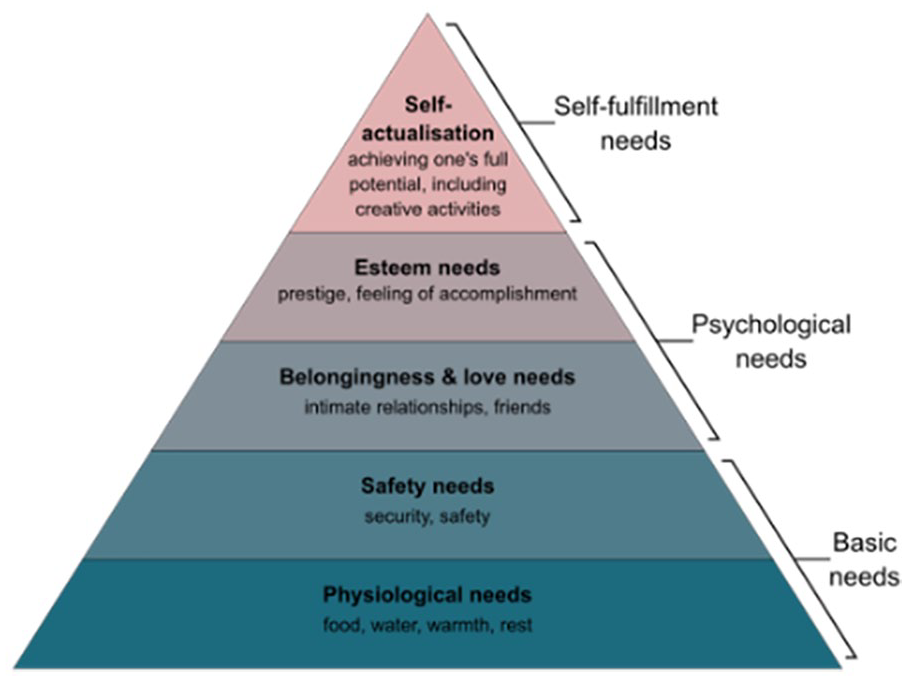
A Visual Representation of Maslow’s Hierarchy of Needs From Wikipedia (2021).
However, this widely known pyramid contains many misconceptions of Maslow’s theory of human motivation. First, the pyramid has been misattributed to Maslow as he had never depicted his theory of human motivation in this way (Bridgman et al., 2019; Chan, 2020). According to Bridgman et al.’s research, the first triangular representation of the hierarchy of needs originated from K. Davis’s (1957) book Human Relations in Business, whereas the first pyramidal representation originated from McDermid’s (1960) article, “How Money Motivates Men.” Second, the pyramid does not capture Maslow’s later revision of the hierarchy of needs, such as the interactions between deficiency needs (D-needs) and growth/being needs (B-needs; Maslow, 1971). These misconceptions about Maslow’s model have seeped not only into later academic discussions and psychology textbooks (Wininger & Norman, 2010), but also into the pyramidal visual representations (for a discussion on why these misconceptions still exist, see Koltko-Rivera, 2006). Third, some of these pyramids do not include the level of transcendence (e.g., Figure 1). Transcendence is the core of Maslow’s amended Theory Z (Maslow, 1969b), arguably his greatest contribution to the understanding of human motivation, and a major step beyond his initial hierarchy (Maslow, 1943). When the representations do include Theory Z, “Transcendence” is usually haphazardly stacked at the top of the pyramid where “Self-actualization” used to be (e.g., Kowalski, n.d.).
In sum, all of these flaws in the pyramidal visual representation prevent educators and students alike from fully understanding Maslow’s theory of human motivation. This is a problem for several reasons. For students, effective learning comes from studying effective diagrams (Davenport et al., 2008; Gates, 2018). Bridgman et al. (2019) noted that a better understanding of Theory Z could provide a better theoretical foundation for management students. For researchers, Koltko-Rivera, (2006) predicted that a better understanding of Theory Z could have important implications in generating personality and social psychology research. In addition, in a broad survey of recent psychology research topics, from healthy self-compassion (Neff, 2015) to hope theory (Rand & Cheavens, 2009), Kaufman (2020) found that many of these topics touch on or build off of Theory Z, showing that Maslow’s contribution is evidently still relevant half a century later. Furthermore, Kaufman makes it clear that the principles drawn from Theory Z could enrich society as a whole, from education and therapy to religion and politics. Therefore, an accurate visual representation will not only allow for a better understanding of Theory Z, but also allow current researchers to relate their work to “Maslow’s forgotten pinnacle” (M. Davis, 2019).
Recently, there has been much interest in Theory Z (e.g., M. Davis, 2019; Harper, 2021; Messerly, 2017), especially after the publication of Kaufman’s (2020) best-selling book Transcend: The New Science of Self-Actualization. These psychology and management articles are focused on revealing the richness of Maslow’s ideas about transcendence in Theory Z and extending them into new domains (e.g., Kenrick et al., 2010). However, the writing in these articles, along with quotes from Maslow, are not reflected in the outdated and inaccurate pyramidal representation that accompanies them. It would be much better if the writing and diagrams were “on the same page,” so to speak.
As such, this article aims to address and rectify the shortcomings of previous visual representations of both Maslow’s original hierarchy of needs and Theory Z. Note that this article will not be critiquing later interpretations of Maslow’s work, or Maslow’s work itself; rather, it is an attempt to integrate Maslow’s various ideas, as well as those interpretations, into a more accurate and nuanced visual representation. This article will first summarize and build on Kaufman’s (2020) recent “sailboat” approach to present a more accurate picture of the hierarchy of needs. Next, it will present the method and results of a conceptual content analysis on several of Maslow’s writings (Maslow, 1969a, 1969b), revealing the necessary components and subcomponents of the revised visual representation of Theory Z. This revised representation will then be discussed in detail, and a brief description of each component and subcomponent will be provided (for a more detailed discussion of Theory Z, see (Maslow, 1969a, 1969b, 1971).
Kaufman’s (2020) Sailboat Metaphor of Maslow’s Hierarchy of Needs
The following section is an overview of Kaufman’s (2020) sailboat metaphor, 1 which is a major step forward from the misleading pyramid-shaped hierarchy of needs. The old pyramid representation suggests that Maslow’s hierarchy is an unrelated set of invariant needs which have to be fulfilled one after the other until one becomes self-actualized. However, Maslow’s later work tells a different story. In fact, Maslow’s hierarchy is an interrelated set of variant needs that work together toward a higher purpose, can be pursued simultaneously, and can serve as one’s worldview (Kaufman, 2020).
Contrary to the pyramidal representation, there are D-needs and B-needs as well (Maslow, 1967). Individuals that pursue D-needs are driven by a lack of satisfaction by one or more needs in Maslow’s hierarchy. These D-needs are usually where past misinterpretations of Maslow’s hierarchy are focused. Individuals that pursue B-needs, on the contrary, are driven by the acceptance and love of others and oneself.
Given this new understanding of Maslow’s hierarchy of needs, Kaufman (2020) proposed that instead of the “clunky pyramid” that cannot adapt to the ebbs and flows of life, a better visual depiction of Maslow’s hierarchy comes in the form of a sailboat (Figure 2). He identified six kinds of needs from Maslow’s writings: (a) safety, (b) connection, (c) self-esteem, (d) exploration, (e) love, and (f) purpose. He then grouped them into two groups of three: the hull represents security (or deficiency) needs, which are safety, connection, and self-esteem; and the sail represents B-needs, which are purpose, love, and exploration, which comprises Maslow’s self-actualization (Kaufman, 2020, p. xxxiv). The three security needs are interrelated to the three B-needs: safety to exploration, connection to love, and self-esteem to purpose (Kaufman, 2020, p. xxiv).
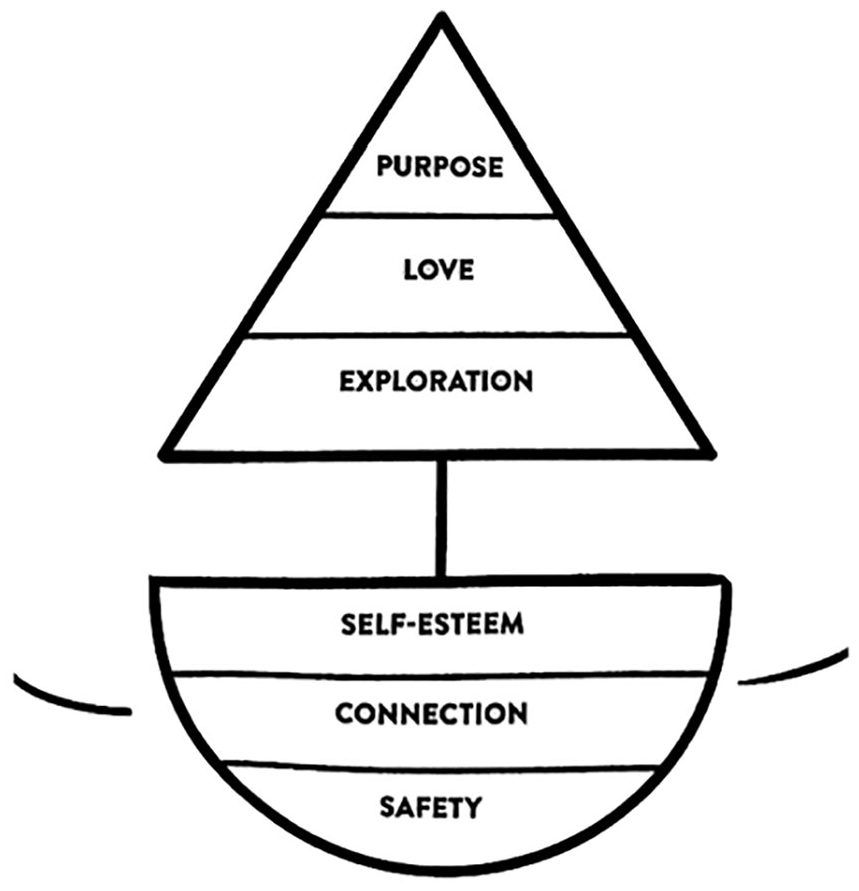
Kaufman’s (2020) Sailboat Metaphor Representing Deficiency and Growth Needs.
In addition, unlike some descriptions of Maslow’s hierarchy of needs that suggest “B-Needs (B for Being) are the high-level needs that we are motivated to fulfill once all of our basic needs [or D-needs] are met” (McClure, 2019), both these kinds of needs are dialectical in nature. To live an optimal life that consists of the ability to explore and grow one’s potential while being able to react and adapt to threats, there needs to be a balance between fulfilling D- and B-needs (Kaufman, 2020). In the sailboat metaphor, this is the equivalent of raising and lowering the sail of B-needs. Focusing too much on either group of needs not only hinders one’s unique potential, but also leads to problematic outcomes in the long run. This model is similar to other models of human well-being that emphasize this sort of dialectic (e.g., Wong, 2012), echoing the idea that “two halves make a whole,” and that “a good life is a balancing act.”
Although the sailboat metaphor reflects this understanding of Maslow’s revised hierarchy of needs, it does have its shortcomings; primarily because the visual representation is static. Like the pyramid, the sailboat gives the impression that one would need to fulfill all of the D-needs prior to fulfilling the B-needs in an invariant way. Therefore, the revised hierarchy of needs proposed in Figure 3 simply places the three D-needs in the D-realm and mirrors them with the three B-needs in the B-realm, whereas the arrows show the dynamic interaction between both sets of needs.
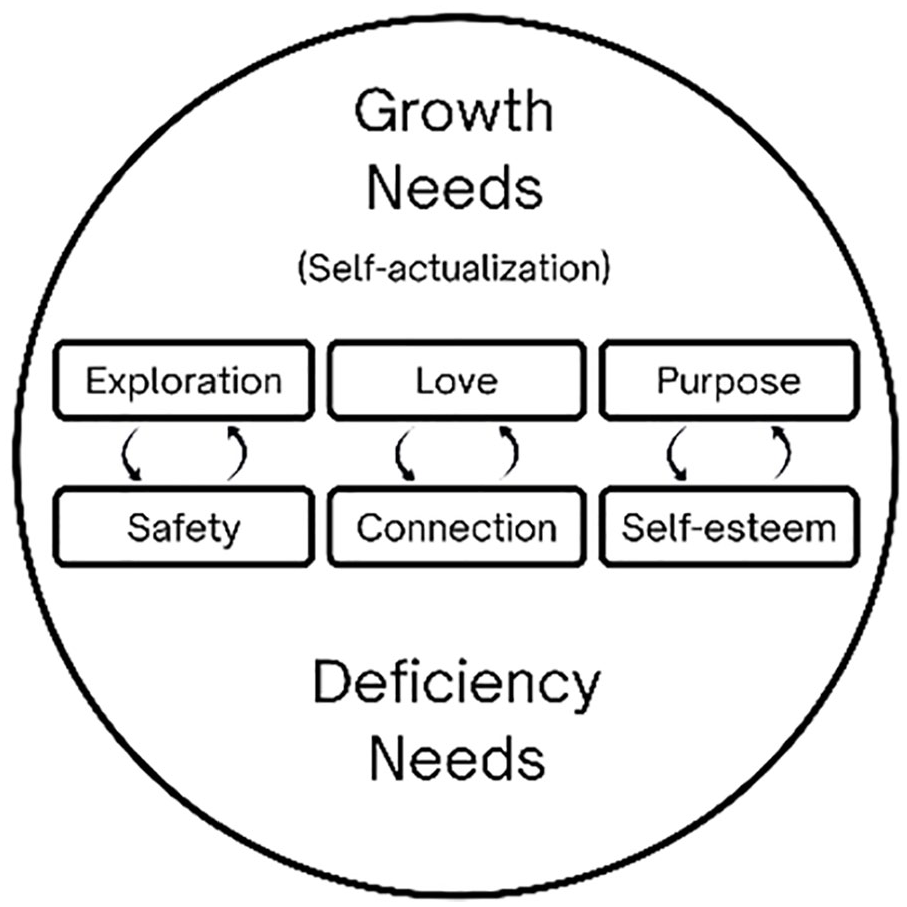
Adding on to Kaufman’s (2020) Sailboat Metaphor.
Previous Attempts to Integrate Transcendence Into the Hierarchy of Needs
As discussed in the introduction, previous attempts to integrate transcendence into the pyramidal representation do not reflect the richness of Theory Z (e.g., Figure 4, Yoshida, 2020).
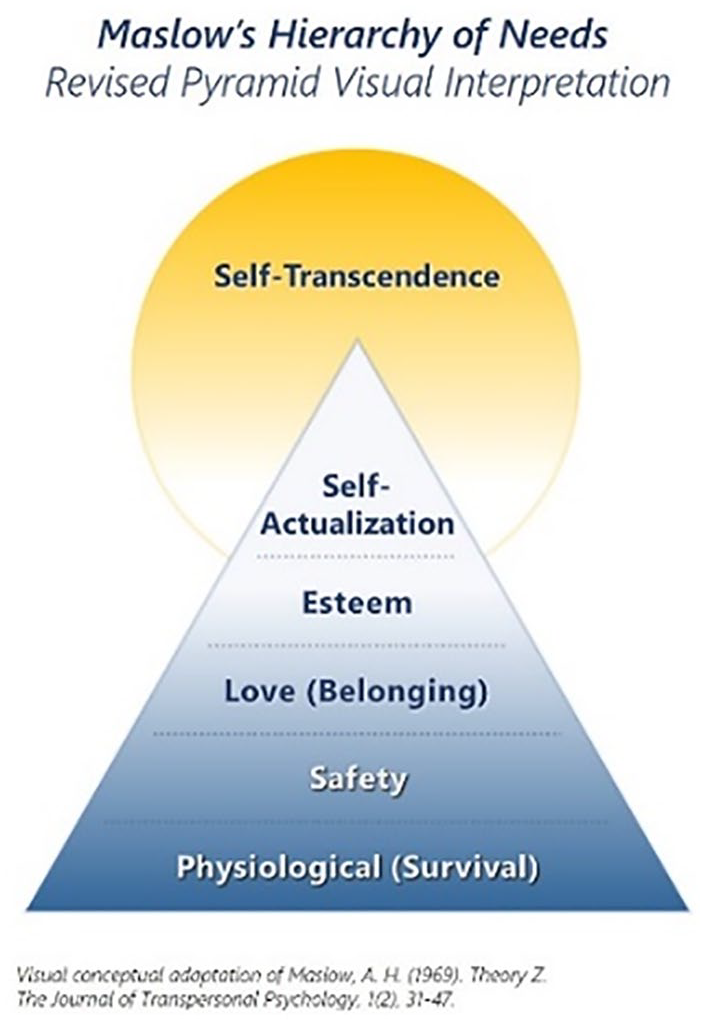
A Visual Representation of Theory Z From Yoshida (2020).
Kaufman’s (2020) sailboat model of Maslow’s hierarchy of needs also places transcendence in roughly the same location (see Figure 5). However, like the pyramidal representations before it, the sailboat model could be improved by emphasizing the dialectical nature of D- and B-needs, breaking down transcendence into its various components, and including other aspects of Theory Z. By conveying the main ideas of Theory Z clearly, it would place this representation on par with other modern, well-known visual representations, such as Park’s (2010) meaning-making model or Baddeley’s (2000) model of working memory.
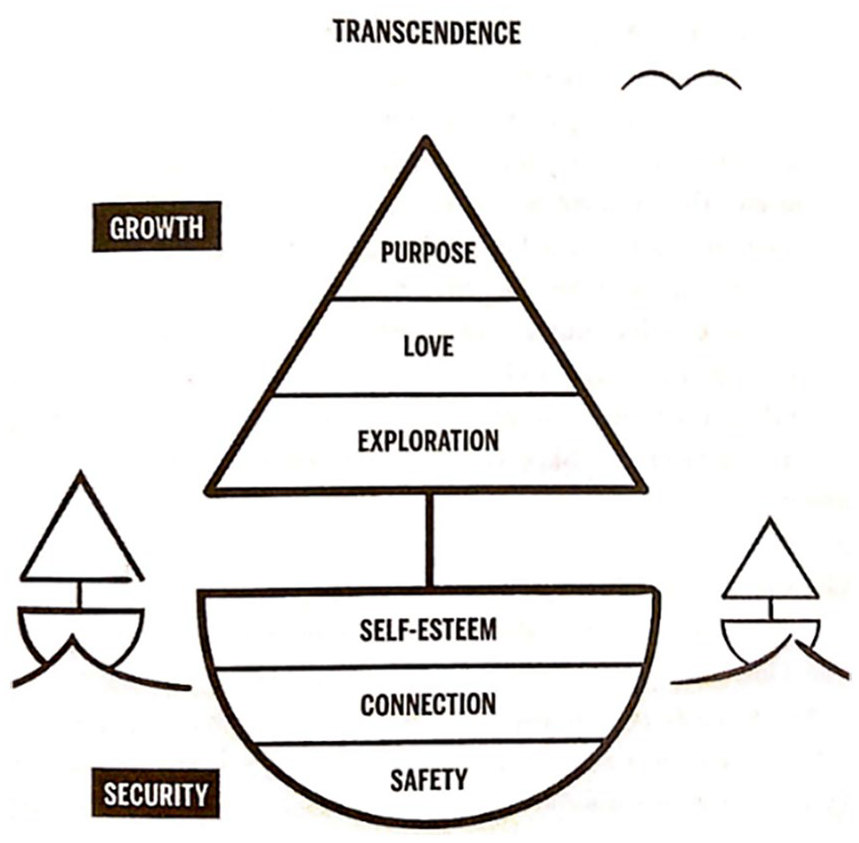
A Visual Representation of Theory Z From Kaufman (2020).
Method
A conceptual content analysis (Columbia Public Health, 2021) was performed on two of Maslow’s later papers (Maslow, 1969a, 1969b), where he listed some of the characteristics of transcenders.
First, the initial five components (B-values, B-cognition, B-love, B-language, and transcendent experiences) to be included in this analysis were drawn from the aspects of Theory Z described by Kaufman (2020). However, after a preliminary analysis, I found that it was necessary to include subcomponents of Theory Z, such as “wholeness,” a subcomponent which belongs under the component of “B-values.” This was because in these later papers, Maslow carefully specified the different aspects of these components, such as describing cosmic consciousness and narrowing down as two sorts of B-cognition (Maslow, 1969a, pp. 63–64). No new components were found during the preliminary analysis. A definition of each component and subcomponent drawn from Maslow (1971) and Kaufman (2020) was created for coding purposes.
Next, the items for analysis were collected. In “Various Meanings of Transcendence,” Maslow (1969a) put forward 35 interrelated meanings of transcenders, describing the characteristics that make them stand apart from the mere self-actualizers. In “Theory Z,” Maslow (1969b) first lists 35 descriptions of Theory Z individuals in the context of Theory Z organization and relates these characteristics to other types of organizational management styles, and then focuses on 24 characteristics of Theory Z individuals in daily life. Each meaning, description, and characteristic of transcenders was included as an item for analysis during the screening phase, initially yielding a total of 94 items: 35 descriptions from the first paper (Maslow, 1969a) and 59 descriptions from the second (Maslow 1969b). Eleven items were discarded because they did not describe the components or subcomponents of Theory Z, and therefore not meeting the analysis requirements. The remaining 83 items that met the requirements were analyzed.
Then, the frequencies of each component and subcomponent were counted based on whether the description of transcenders explicitly mentions a component or subcomponent, or if it matched any of the key terms in the definitions. An item may be coded under multiple components in the initial list of components because it mentions or is related to numerous aspects of Theory Z. Therefore, the totals (see Table 1) represent the total number of items from both papers that explicitly mention or are related to that component or subcomponent.
Summary of the Major Components and Subcomponents of Theory Z.
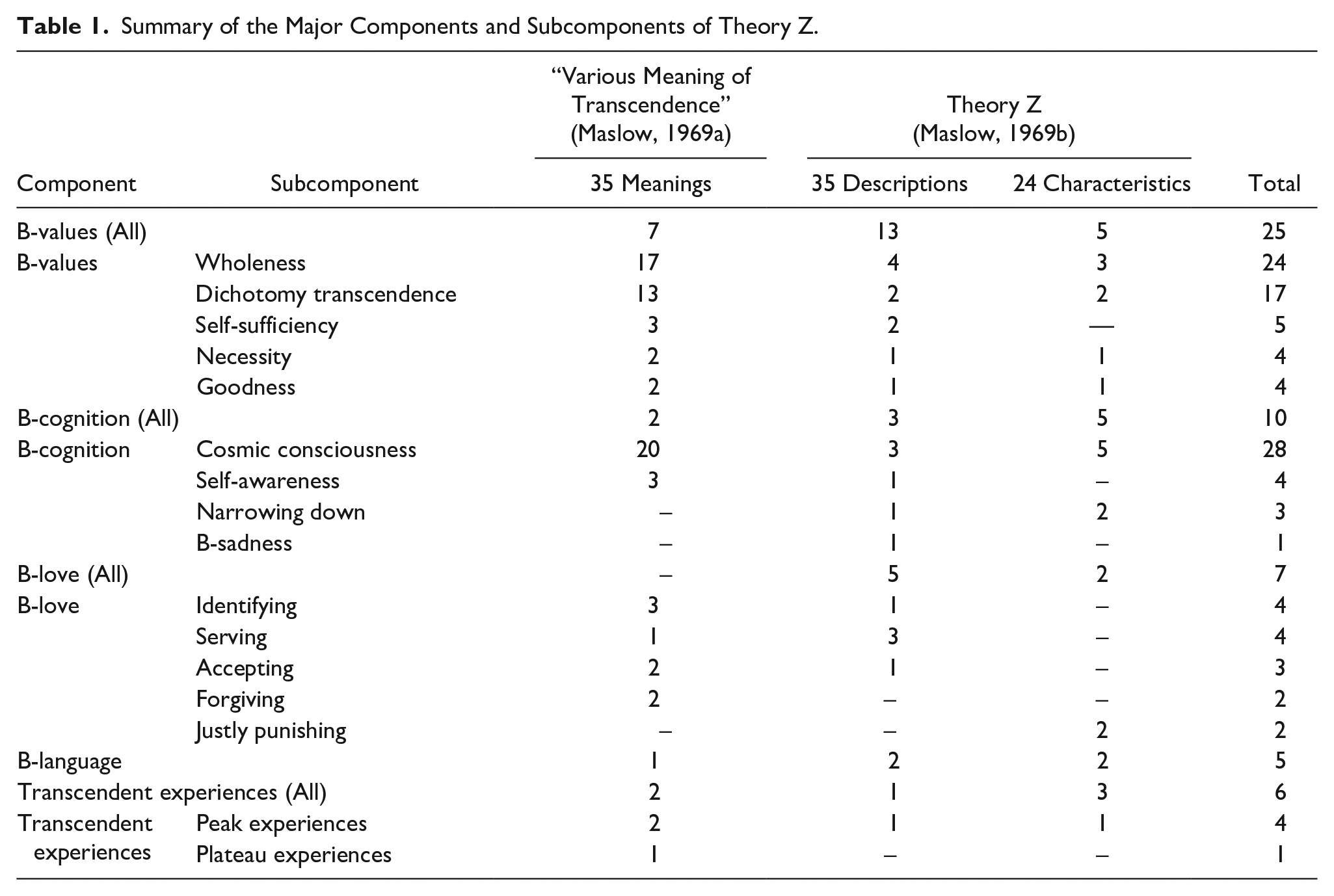
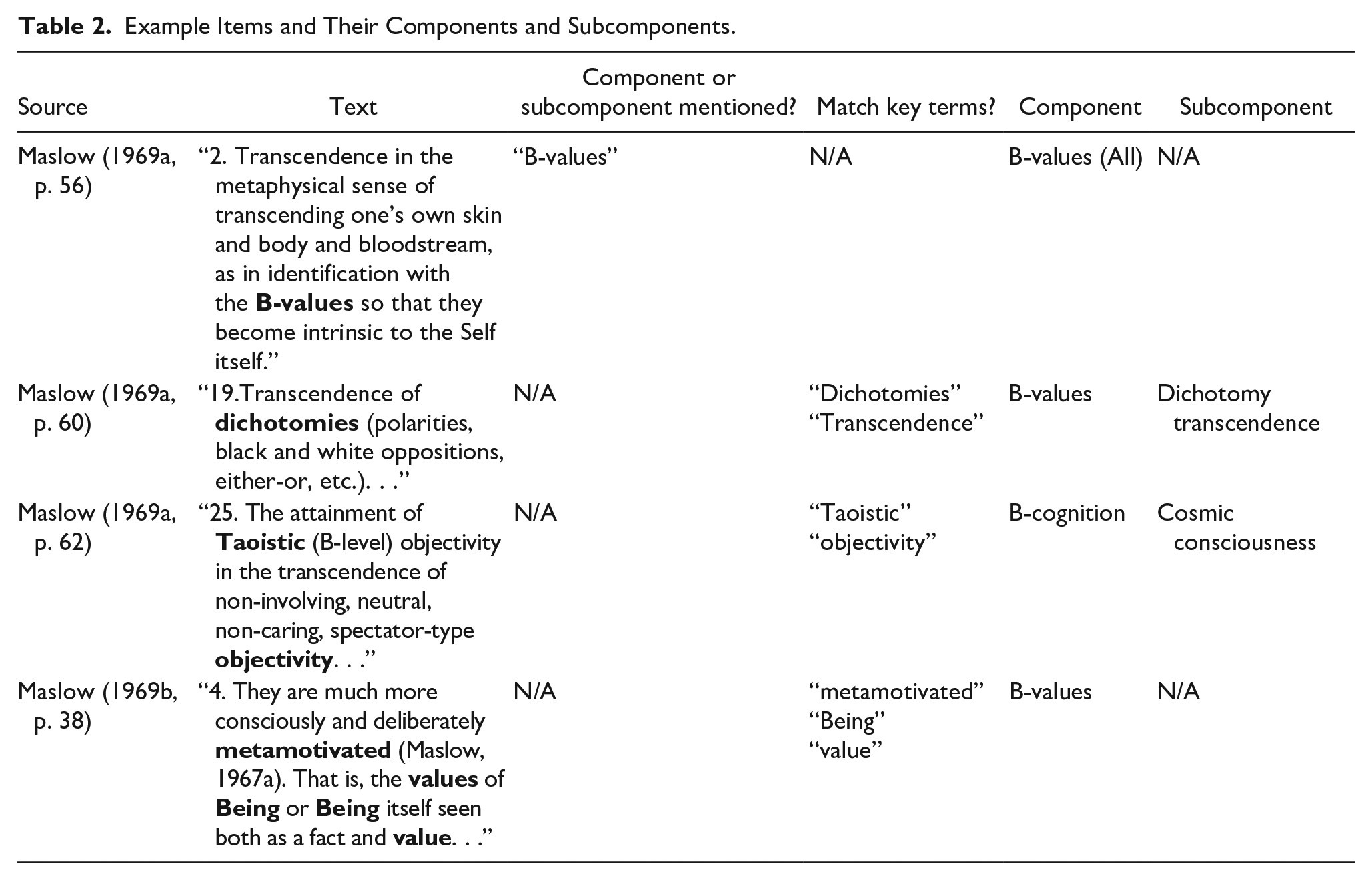
Finally, if the item refers to all of the aspects of a component, then it would be coded as “All.” If the item refers to only one aspect of these four components, it would be coded under the subcomponent. For a flow diagram that represents the entire process of this content analysis, please see Figure 6. Example items and how they would be categorized under the various components and subcomponents are depicted in Table 2. This analysis was manually performed three times to minimize coding errors.
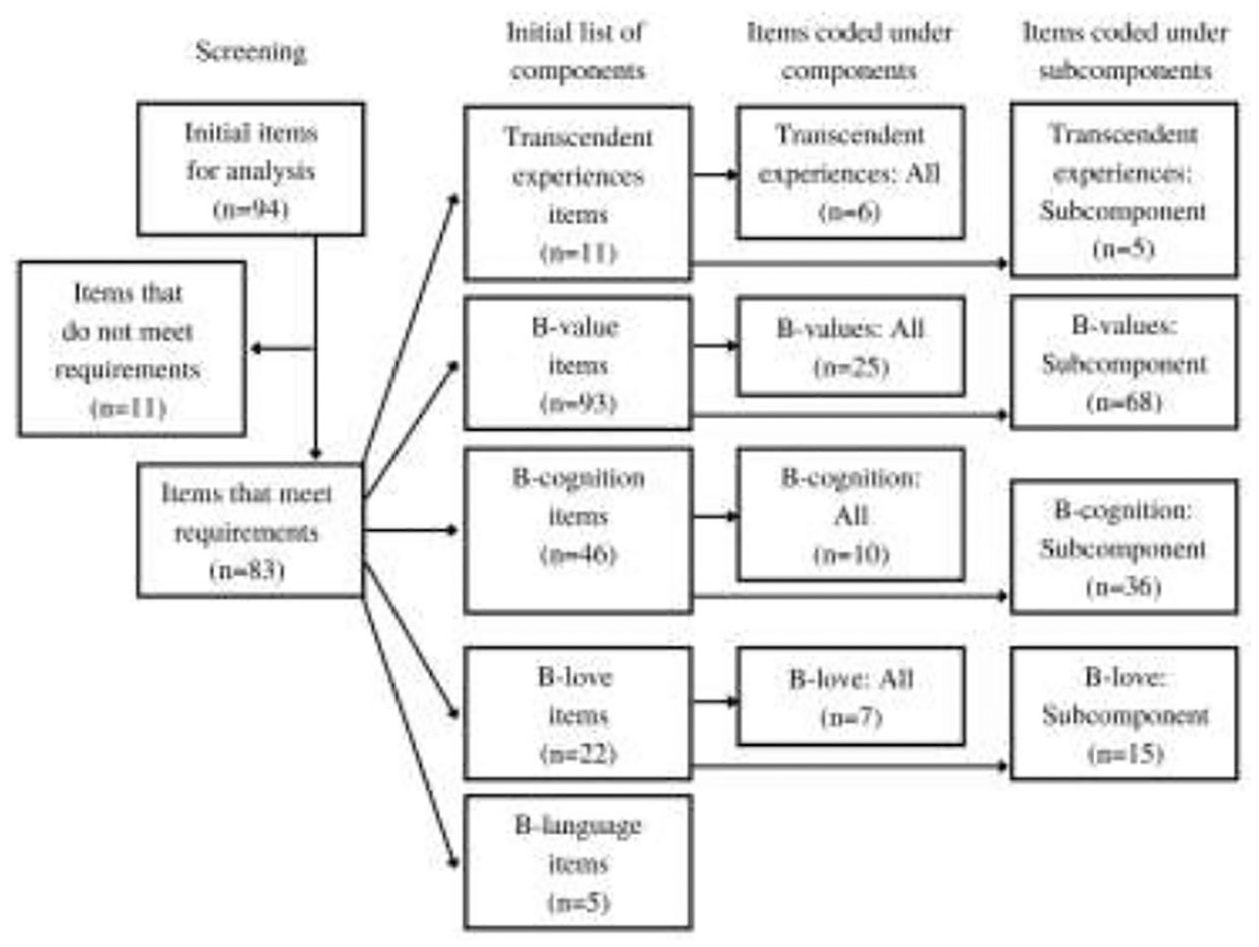
Flow Diagram of Content Analysis.
Example Items and Their Components and Subcomponents.
Results
The results of the conceptual content analysis are presented in Table 1. Over half the coded items in the initial list of components were under B-values (93 items). The majority of the coded items under B-values (68 items) fell under the following B-value subcomponents: wholeness (24 items), dichotomy transcendence (17 items), self-sufficiency (5 items), goodness (4 items), and necessity (4 items). The rest of the B-value subcomponents had less than 4 items each, clearly indicating that Maslow did not emphasize them as much. Given the limited amount of space available in the diagram, the author decided to leave them out.
Regarding B-cognition (46 items), the majority of the coded items fell under the following B-cognition subcomponents: cosmic consciousness (28 items), self-awareness (4 items), and narrowing down (3 items). Regarding B-love (22 items), the majority of the coded items fell under the following subcomponents: identifying (4 items), serving (4 items), accepting (3 items), forgiving (2 items), and justly punishing (2 items). Regarding transcendent experiences (11 items), items were coded under peak experiences (4 items) or plateau experiences (1 item). Of the components, B-language (5 items) had the least items. Other aspects of the B-realm that were not significant include B-amusement, B-sex, B-humility, B-authenticity, B-playfulness, B-politics, and B-analysis (one count each; Maslow, 1969a, 1969b).
Discussion: A Revised Visual Representation of Maslow’s Theory Z
The revised visual representation of Theory Z, which attempts to capture the most salient aspects of Theory Z while making it as parsimonious as possible, is presented in Figure 7. As previously shown in Figure 3, Maslow’s original hierarchy of needs occupies the center of the representation and straddles both realms. This article will now go through the components and subcomponents of Theory Z starting in the D-realm.
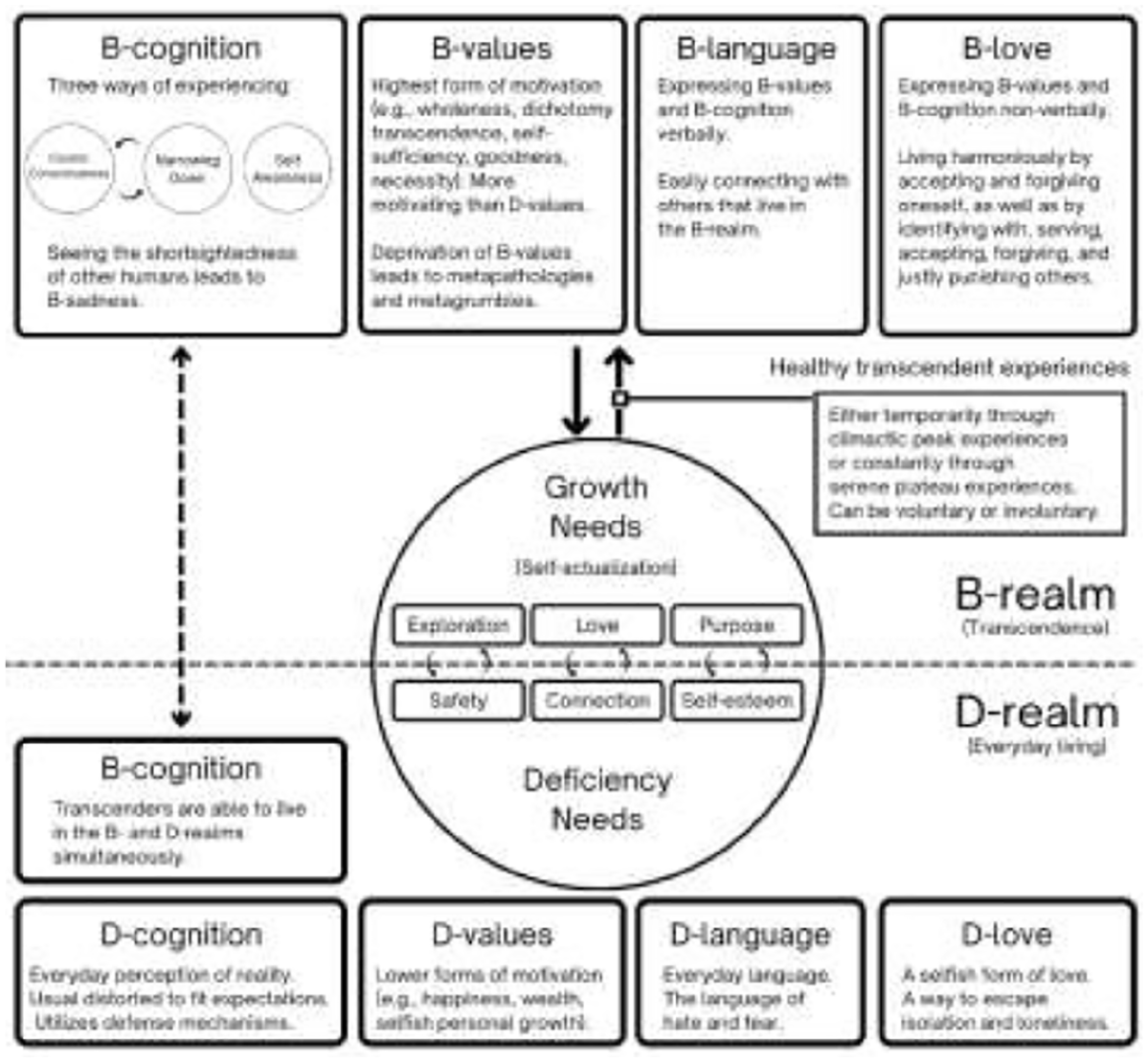
A Revised Visual Representation of Maslow’s Theory Z.
The D-Realm
The D-realm consists of “ordinary, everyday humanness” (Maslow, 1969a, p. 65) where individuals are “practical, realistic, mundane, capable and secular people, living more in the here-and-now world” (Maslow, 1969b, p. 31). For this reason, the D-realm is situated below the B-realm in Figure 7. The D-realm offers security and defense, providing short-term evolutionary advantages. However, living in the D-realm is only useful in certain situations: If an individual is to grow and become fully human, Maslow posits, they would need to step out of the D-realm and step into the B-realm (Kaufman, 2020).
Healthy Transcendent Experiences
Healthy transcendent experiences represent the gateway to fully living in the B-realm (Maslow, 1969a). This gateway is represented by an arrow pointing upward in Figure 7. Unlike other forms of unhealthy, or “negative,” transcendence (Wong, 2017), healthy transcendence involves contributing to the greater good of all humanity by being principled, consistent in intentions and actions, courageous, inspiring, humble, and loving others selflessly (Kaufman, 2020; Koltko-Rivera, 2006).
Unlike the pyramidal representation, which suggests that one can only transcend by fulfilling all of the other needs and self-actualizing, in reality, it is possible to transcend without self-actualizing (Kaufman, 2020; Maslow, 1969b). Like self-actualization, Maslow believed that everyone was capable of transcendence. Self-actualization is really just the springboard for further human development through transcendence, not the end goal. Yet self-actualizers who have fulfilled D-needs are more likely to transcend, since they are already living more in the B-realm, than non-self-actualizers, and are therefore less motivated by D-needs (Maslow, 1967). In addition, there are two types of transcendent experiences: peak experiences and plateau experiences (Maslow, 1969b).
Peak Experiences
Peak experiences are transient transcendent experiences, which may change one’s life dramatically and lead to a whole new understanding of everything, including oneself and the world (Maslow, 1969a). Peak experiences are also known as “the biological experience” or “biological mysticism” (Maslow, 1967), as well as “religious or spiritual” experiences (Maslow, 1969b). Compared with non-transcending self-actualizers, transcenders experience more peak experiences (Maslow, 1969b).
Plateau Experiences
Plateau experiences, also known as “plateau-living” or “the plateau state,” are longer lasting, more frequently occurring, but less intense transcendent experiences (Maslow, 1969b). Although unexpected, involuntary events, such as encounters with death, could trigger plateau experiences, they are still more voluntary than peak experiences and could be learnt through what Maslow called “B-exercises” (Kaufman, 2020, p. 243). Plateau experiences are longer lasting than peak experiences, but both types of transcendent experiences are transient; transcenders must return to the D-realm eventually. Therefore, in Figure 7, next to the upward pointing arrow, there is a downward pointing arrow.
The B-Realm
The B-realm is a higher order worldview that can be experienced through healthy transcendent experiences. This realm is also known as the “realm of Being,” the “unitive life,” the “metalife,” or the “life of being” (Maslow, 1967, p. 123), and is often referred to as “self-transcendence” by others after Maslow. It is the key to attaining full humanness (or “B-human”; 2 Maslow, 1969a). Individuals living in the B-realm, or transcenders, move every aspect of themselves into the B-realm. They live for a purpose that is greater than themselves, and balance their desires and responsibilities (Maslow, 1967).
In Figure 7, there is a dotted line separating the two realms because individuals are able to transcend from the D-realm to B-realm through gratifying or conquering D-needs (Maslow, 1969a), or through transcendent experiences. In addition, individuals living in the B-realm using B-cognition can be in both the B- and D-realms at the same time (Kaufman, 2020), meaning that the divide between the two realms essentially disappears. There are four major components that make up the B-realm which will now be discussed: B-values, B-cognition, B-language, and B-love.
B-Values
Compared with other lower forms of motivation (D-values), such as money, health, personal growth, or happiness, transcenders are more highly and intrinsically motivated by B-values—a group of related values which are worth living and dying for (Kaufman, 2020; Maslow, 1967). B-values (or “B-facts”) is a form of “metapay” for individuals that are “metamotivated”; this is because the intrinsic values of transcenders mostly align or entirely overlap B-values (Maslow, 1967). The five examples of B-values listed in Figure 7 are the five most mentioned B-values reported in the content analysis. Other B-values include truth, beauty, aliveness, uniqueness, perfection, completion, justice, order, simplicity, richness, effortlessness, and playfulness (Maslow, 1971), as well as meaningfulness (Maslow, 1967) and excellence (Maslow, 1969b). These values may be hierarchical, with some being more important than others, based on individual difference or different situations, but in general, it is possible for each B-value to be the most important for transcenders (Maslow, 1967). Maslow hypothesized that both transcenders and non-transcenders are metamotivated by B-values to some degree (Maslow, 1967), but transcenders are more metamotivated and, as a result, may experience more transcendent experiences (Maslow, 1969a).
In addition, transcenders deprived of B-values experience “metapathologies” and “metagrumbles” (Maslow, 1967, 1969a). This subcomponent is included in Figure 7 under “B-values” because it is important in Maslow’s crucial insights into health and illness. In this way, Theory Z not only explains the highest forms of human motivation, but also explains why certain illnesses or metapathologies exist, 3 as well as why transcenders living in the B-realm do not necessarily have greater “psychological health” than mere self-actualizers, but are closer to attaining “full humanness” (Maslow, 1967, 1969b).
B-Cognition
B-cognition, also known as “plateau cognition,” is a more philosophical, holistic, and objective way of looking at the self, the world, and the cosmos. This cognition consists of both the “cosmic consciousness” and “narrowing down” forms of B-cognition, which are dialectically intertwined ways of experiencing, as well as the “self-awareness” form of B-cognition (American Psychological Association, n.d.; Maslow, 1969a, 1969b). The cosmic consciousness type is being objectively aware of the interrelatedness of the universe in a Taoistic way (Stanford Encyclopedia of Philosophy, 2007); the narrowing down type is excluding everything else, including oneself, out of one’s focus and becoming entirely immersed on a single object; and the self-awareness type is becoming extremely aware of one’s inner self (American Psychological Association, n.d.; Maslow, 1969a; Wedaman, 2013). In addition, these three interrelated types of B-cognition can each be further divided up into two categories: “climactic peak experience kind of B-cognition,” which occurs during peak experiences, and “serene B-cognition,” which occurs during plateau experiences (Maslow, 1969a, p. 62).
Conversely, D-cognition is the everyday perception in the D-realm, which tends to distort reality to fit our expectations, and is more attuned to recognizing the usefulness or dangers of things and people, utilizing all sorts of defense mechanisms (Wedaman, 2013). Yet it is through B-cognition that one is able to see things with a clear lens and to grow as a result. Another feature of B-cognition, that sets it apart from D-cognition, is it allows transcenders to live in both the D- and B-realms simultaneously; this is because they are able to perceive the sacred within the secular, and able to put anything under the cosmic context (Kaufman, 2020). This feature of B-cognition is reflected in Figure 7 by the dotted two-sided arrow between the two “B-cognition” sections.
Related to B-cognition is the experience of B-sadness. This type of “cosmic-sadness” is present when transcenders look down at the D-realm and see the “stupidity of people, their self-defeat, their blindness, their cruelty to each other, [and] their shortsightedness” (Maslow, 1969b, p. 40). Although “B-sadness” was only mentioned once in the analysis, like metagrumbles and metapathologies, it is also included in Figure 7 because this is another important subcomponent of Theory Z. In other words, transcenders may not only be less “healthy” than self-actualizers, but also be less “happy” (Maslow, 1969b, p. 40).
B-Language
B-language refers to “the language of poets, of mystics, of seers, of profoundly religious people, [and] of men who live . . . under the aspect of eternity” (Maslow, 1969b, p. 38). It is “a language to describe getting used to the conversion or the illumination or to living in the Garden of Eden” (Maslow, 1969a, p. 62). It is the language of “the awakened, the illuminated, the ‘high plateau’ people who normally B-cognize and who have the B-values very firmly and actively in hand” (Maslow, 1954, pp. 203–204), which can connect transcenders instantaneously. To develop this component of transcendence, Maslow held several B-language workshops to convert B-values and B-cognition into a workable language (Maslow.com, n.d.; Sutich, 1976), recognizing that individuals will use certain words to describe their needs in each realm (Maslow, 1967). For example, those that live in the D-realm use words such as “craving,” “striving,” or “needing,” whereas those that live in the B-realm use words such as “desiring,” “wishing,” or “choosing,” and those that are metamotivated use words such as “yearning,” “devoted,” or “aspiring” (Maslow, 1967, p. 122). Conversely, D-language is “the language of hate and fear” (Kaufman, 2020, p. 232). Yet there is another way to express B-values that goes beyond language and is rooted in selfless actions: B-love.
B-Love
B-love is a growth-oriented, harmonious, sustainable, and selfless kind of love. A B-loving individual expresses their B-love by identifying with others through their common humanity, and by serving, accepting, forgiving, or justly punishing others for the highest good in pursuit of B-values (Maslow, 1969a, 1969b). A B-loving individual also accepts and forgives their past self (Maslow, 1969b). Like B-language, B-love is a way to communicate B-values and B-cognition, but non-verbally (Maslow, 1969b); therefore, “B-love” is placed next to “B-language” in Figure 7 because they are so similar. On the contrary, D-love is used to escape isolation and loneliness. It is a “grasping, possessive love. In this state, we cling to the loved one out of desperate dependency and see the loved one as a means to fill some kind of deficiency in ourselves” (Cohen, 2016). It is driven by the need for belonging and the need for intimacy to escape isolation and loneliness.
Contrastingly, B-love goes beyond D-love, not only because it is growth-oriented rather than deficiency-oriented, but also because it is a love for all of humanity. This kind of love leads to selfless actions as transcenders pursue the highest good (Maslow, 1967). Although nontranscenders may already be loving others and themselves through B-love, it is not until they transcend into the B-realm that they are immersed entirely in this form of love.
As stated earlier, B-love sets healthy transcenders apart from negative transcenders. This is the difference between the “staircase to spirituality” and the “staircase to terrorism” (Wong, 2017). In addition, B-love really sets transcenders apart from self-actualizers, many of whom are self-centered and selfish people. B-love is how Maslow distinguishes the “Eisenhower–Truman” type with other individuals that he deemed “B-people,” such as Huxley, Schweitzer, Buber, and Einstein (Maslow, 1969b). For this reason, transcenders tend to be more selfless than mere self-actualizers. Perhaps this is what Picasso had in mind when he said, “The meaning of life is to find your gift [to self-actualize]. The purpose of life is to give it away [transcendence].”
Conclusion
It has been more than half a century since Maslow laid out his bold vision, Theory Z, for humanistic and transpersonal psychology. This article has presented a visual representation that adequately captures his bold vision. In addition, it has explained the rationale for revising previous representations, detailed how the new representation was constructed, and provided detailed descriptions of the various aspects of Theory Z, including the D-realm, healthy transcendent experiences (encompassing peak and plateau experiences), and the B-realm (encompassing B-values, B-cognition, B-language, and B-love).
There are several limitations to this revised visual representation. First, it is impossible to know if Maslow would agree with this representation because he passed away many years ago. To address this problem, this article has tried to capture the essential aspects of Theory Z by drawing heavily on Maslow’s later writings. Second, Maslow did say that he could “no longer be theoretically neat” when describing the difference between self-actualization and transcendence, implying that a nuanced visual representation of Theory Z would be difficult (Maslow, 1969b, p. 31). However, this article has made an attempt nonetheless because of how problematic the old pyramidal representation has become (Chan, 2020). The author’s hope is that this revised visual representation of Theory Z will replace the old misleading pyramidal representation, and will help students, educators, and researchers alike explore what Maslow could only describe as the “wonderful possibilities and inscrutable depths” of human beings.
Footnotes
Acknowledgements
I would like to thank Jacquelyn Chan and Zoe Lam for their preliminary review of this article. I would also like to thank Dr. Scott Barry Kaufman, for his writings provided the inspiration for this article.
Declaration of Conflicting Interests
The author(s) declared no potential conflicts of interest with respect to the research, authorship, and/or publication of this article.
Funding
The author(s) received no financial support for the research, authorship, and/or publication of this article.
