




Abstract
Meaningful moments are specific events in life that are felt to be of great value and significance. This empirical study presents a framework on the way a sense of meaning emerges from these moments. Out of an existing data set of narratives of meaningful moments, a purposeful sample of nine narratives was chosen from different participants, all middle-aged, higher educated, and with an interest or profession in personal development. Interviews were conducted about the way these moments were experienced to be meaningful. A holistic content analysis led to the distinction of five main themes in the process of meaning emergence. The study showed how meaning discovery may lead to meaning creation, which in turn may lead to retrospective meaning discovery. Results highlighted the crucial role of the awareness of contrasts and letting go. Finally, the study showed a variety of ways in which meaningful moments have a lasting impact on life. The value of the developed framework lies in its focus on meaning as a process, integrating the concepts of coherence, purpose, significance and self-transcendence, and illustrating how meaning emerges through forward acts and discoveries as well as in retrospect.
Introduction
Meaning in life is essential to well-being, yet a sense of meaning may easily get lost—not only to people living in difficult circumstances but also to “ordinary” people, caught in the disenchanting mechanisms of modern life (Rosa, 2013, 2016). This study focuses on the recollection of meaningful moments as a means to connect to meaning in life. Meaningful moments are specific events in life that are felt to be of great value and significance. However, as yet there is no clear understanding of the way these moments work. In this study, the emergence of meaning is addressed as a process, investigating the way meaning is elicited from moments in life that people note to be distinctly meaningful.
The Emergence of Meaning
The question how people obtain a sense of meaning in life has been approached from a range of perspectives that highlight different aspects of meaning and its emergence. Although there is no clear consensus on the conceptualization of meaning, four dimensions are predominant across various perspectives: coherence, purpose, significance, and self-transcendence.
Coherence is the cognitive dimension of meaning that refers to the comprehension of life (e.g., Antonovsky, 1987; Heintzelman & King, 2013). Meaning is detected when events fit in with existing beliefs and expectations, taking the form of passive awareness or of intentional enactment of beliefs and values (King & Hicks, 2009). On the other hand, when confronted with events that are inconsistent with core assumptions, meaning requires construction, that is, the revision of these beliefs and assumptions to restore coherence. In the literature, this distinction is also addressed in terms of global and situational meaning (C. L. Park, 2010; C. L. Park & Folkman, 1997) and the presence and search for meaning (Steger et al., 2008). While the presence of meaning is mentioned to be a state, the search of meaning is a process (Wong, 2017).
Purpose is the motivational dimension of meaning (e.g., Baumeister, 1991, Deci & Ryan, 2000; Ryan et al., 2008). Purpose is essentially future-oriented and gives direction to life through the identification and the pursuit of higher goals (Martela & Steger, 2016; Reker & Wong, 2012). It is value-driven and sets the norms for behavior (Heintzelman & King, 2014). Coherence may form the natural basis from which purpose emerges, a coherent framework for life being the “springboard” for motivational, goal-oriented action (Steger, 2012). In Maddi’s (2004, 2013) works, the motivational component of meaning is related to choice making, and a distinction is made between “choosing the past,” in line with the familiar and comprehended, and “choosing the future,” choosing the new and unknown, which expands a person’s frame of meaning.
Significance is the evaluative component of meaning (Martela & Steger, 2016; C. L. Park, 2010). Significance, also referred to in terms of self-worth and moral worth (Baumeister, 1991) or mattering (George & Park, 2014) is about the value and importance of life and the feeling that life is inherently valuable and worth living. It follows from the evaluation of life as a whole, and thereby differs from happiness in the present moment (Wolf, 2010). A sense of significance seems to follow from both coherence as well as purpose: it is related to feeling “a valued member of a reality that transcends death” (George & Park, 2014) as well as to eudaimonia, to the creation of a “good life” by behaving in a way that fits one’s purpose and values (Martela & Steger, 2016; Ryan et al., 2013).
The final dimension of meaning addressed in this study is self-transcendence. While coherence, purpose, and significance are often approached from a personal perspective, that is, in regard to one’s own life, a more spiritual interpretation is also found within the body of literature, based on the notion that humans are not a closed system (Frankl, 1966). Self-transcendence is acknowledged to be a prominent source of meaning in most studies on meaning in life (Delle Fave & Soosai-Nathan, 2014; Emmons, 2005; Wong, 2012a), and seems to run through each of the other dimensions. Coherence then is the sense of being connected to something larger than the self, transcending one’s own life story, while purpose is related to serving a goal that is significant beyond the self (Firestone et al., 2003; N. Park et al., 2010; Peterson et al., 2005; Wong, 2014, 2017). A self-transcendent sense of significance is the outcome of these. This transcendent perspective on meaning goes back to the works of Frankl (1966) and Maslow (1971), who clearly acknowledge the mystery of life, a larger whole and higher truth. Frankl mentions three ways to experience meaning: through a creative path of purposeful action, through an experiential path of openness and receptivity toward the world, and through an attitudinal path of choosing a positive stand in any situation, specifically toward suffering (Frankl, 1962; Wong, 2012a).
Meaningful Moments
From these general insights on the emergence of meaning, the focus now shifts on the emergence of meaning through reminiscence of meaningful moments. Reminiscence, the recollection of personal memories, has proven to contribute to a sense of meaning in life (Westerhof, 2019; Westerhof & Bohlmeijer, 2014; Westerhof et al., 2010). It occurs as a natural process and is applied in interventions, of which specifically life review, which focuses systematically on the entire life span, has shown to be of value. However, memories of single, particularly salient life events are also recognized for their potential to enhance a sense of meaning (Van de Goor et al., 2017; Wong, 2012b). These particular events, from now on referred to as meaningful moments, are the object of this study.
Meaningful moments are addressed by a variety of concepts, such as momentous events, self-defining memories, personal memories, nuclear episodes, and contrast experiences (Anbeek et al., 2018; McAdams, 1985; Pillemer, 2001; Singer & Blagov, 2004; Thorne, 2000). Empirical studies tend to focus on specific types of meaningful moments according to their valence, setting, impact, and/or the domain or period of life in which they appear (e.g., Antalíková et al., 2011; Bluck et al., 2008; Hoffman et al., 2012; Hoffman & Muramoto, 2007; McDonald, 2008). Overall, there is a focus on atypical, out of the ordinary moments, in which something positive or negative accidentally happens that is disrupting (e.g., Anbeek et al., 2018; Hoffman et al., 2012, Thorne, 2000). However, moments may also be deliberately created to be meaningful, and be part of the ordinary routines of everyday life (e.g., Ganzevoort & Roeland, 2014; Spagnola & Fiese, 2007; Van de Goor et al., 2017; Van de Goor et al., 2018).
The impact and function of meaningful moments have been adequately summed up by Wong (2012b), mentioning them to be (1) deeply felt, (2) deeply processed, (3) enlightening, and (4) transforming. With regard to the first, meaningful moments are generally noted to be emotionally disruptive and intense (e.g., Anbeek et al., 2018; Blagov & Singer, 2004; Pillemer, 2001; Wong, 2012b). The experienced emotions are often a paradoxical mix of positive and negative, thereby relating to wonder and awe (Hoffman, 1998; Schneider, 2009; Thorne, 2000; Van de Goor et al., 2017). Meaningful moments are also deeply processed: they connect people to deeper layers of meaning beyond the factual and superficial. The intense emotions are signs that something of extreme importance is revealing itself: the most important concerns of people’s lives, core values, the mystery of life, the bigger picture of life and creation (Anbeek et al., 2018; Blagov & Singer, 2004; Cova & Deonna, 2014; Maslow, 1959; McDonald, 2008; Schneider, 2009). In these descriptions a clear relation to self-transcendence can be found. Wong’s third and fourth characteristics highlight the lasting impact of meaningful moments: their power to transform perspectives on life and to motivate, inspire, and guide action long after their original occurrence (Anbeek et al., 2018; Cova & Deonna, 2014; Hoffman et al., 2012; McDonald, 2008; Pillemer, 2001; Schneider, 2004). They are often deliberately recalled, providing persistent affirmation and guidance (Blagov & Singer, 2004; Pillemer, 2001). There are many references to their enlightening quality: how they lead to new discoveries, to a change in personal identity, a reorganization of values, and a “stretching of the mind” (Bennett, 2001; Cova & Deonna, 2014; McDonald, 2008; Pillemer, 2001; Vasalou, 2015; Westerhof et al., 2010). Concerning the transformative impact of meaningful moments, Wong (2012b) mentions how they may change life’s direction and restore a sense of purpose and passion. They have the potential to influence morality and guide the pursuit of long-term goals (Anbeek et al., 2018; Pillemer, 2001; Westerhof et al., 2010; Wong & Watt; 1991). In this way, they may increase a sense of life’s significance, make life fuller, richer and more worthwhile (Anbeek et al., 2018; Maslow, 1959), and contribute to a self-transcendent orientation toward life (Wong, 2011).
Reviewing the literature, many insights were found on the occurrence of meaningful moments, their impact and functions, with parallels to the meaning dimensions of coherence, purpose, significance, and self-transcendence. However, the body of literature lacks a cohesive picture of these aspects in relation to the emergence of meaning from meaningful moments over time. Therefore, in the present study, attention is directed to meaning as a process, with the purpose to develop an integrated view of the way people experience meaning to emerge from meaningful moments as they naturally occur in the flow of life. The research question is as follows: How does meaning emerge from meaningful moments?
Building on the proposition that people make sense of events and give meaning to life through the stories they exchange (e.g., Bamberg, 2012; Bruner, 1991; Murray & Sools, 2014), a narrative approach was taken to answer this question. The study therefore focuses on accounts of personal experiences with the process of meaning emergence: on narratives of meaningful moments and on the subjective interpretations of how this meaning unfolds over time.
Method
Participants and Their Meaningful Moment
An existing data set of memories of meaningful moments formed the basis for this study. The memories in this set were collected in various ways: in storytelling workshops aimed at personal development, through a form on the public website of the research project and through email. Through each of these channels, people were asked to choose and write down one meaningful moment from their life in answer to the Wonderful Life Question: What if there is an afterlife. There, all your memories will be erased, except for one. Which memory do you choose to take with you to eternity? This question has proven to be a powerful way to elicit meaningful moments that stick out in the evaluation of a whole life, without directing to specific types of experiences (Van de Goor et al., 2017). In this way, a total of 43 meaningful moments were collected from a variety of people, of whom only sex and contact information were known beforehand, and in some cases also age and profession.
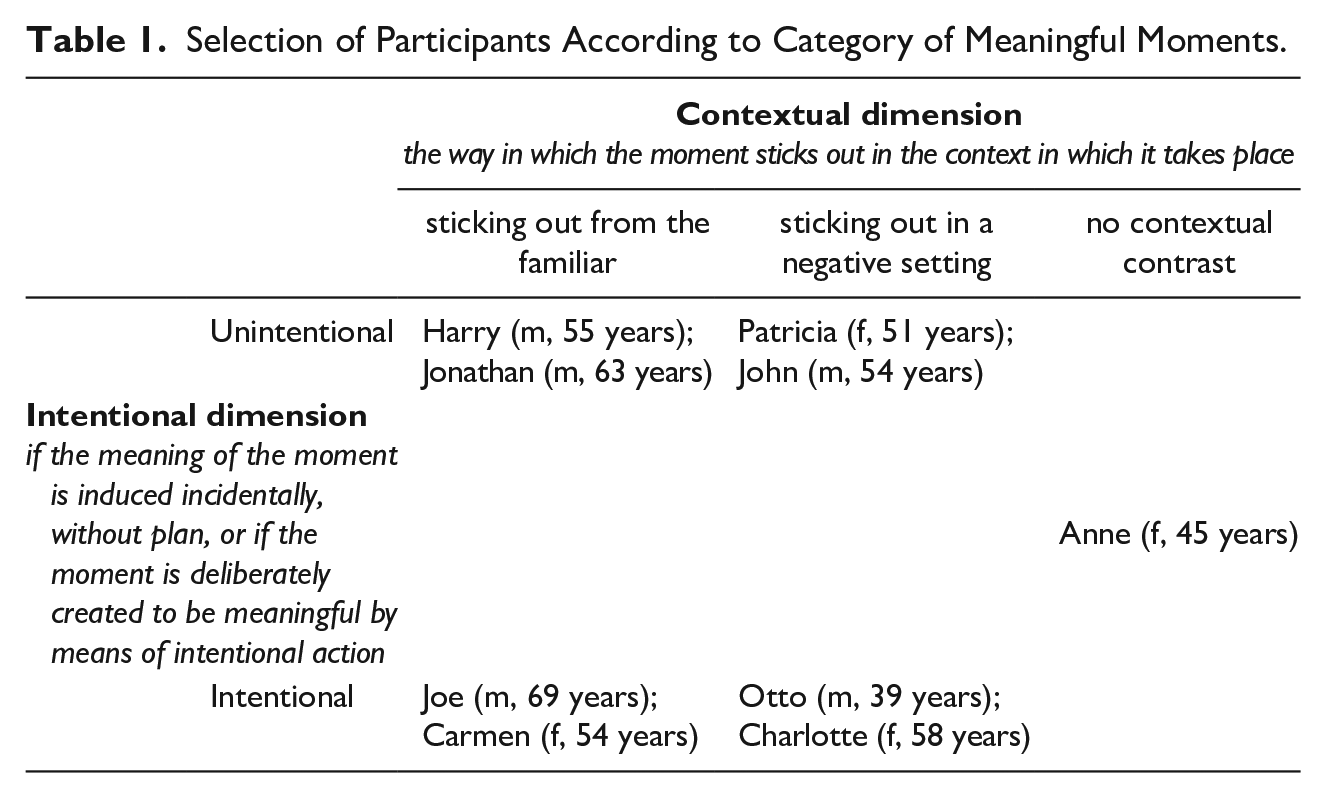
For this study, a mixed criterion and maximum variation strategy was used to select a purposeful sample of meaningful moments from this set (Palinkas et al., 2015). The sample was chosen to represent each of five categories of meaningful moments as distinguished by Van de Goor et al., (2017), from a mix of both male and female participants. As other demographic information was not available for all participants, it was not employed in the selection process. Nine participants were selected in this way. Table 1 gives an overview of the participants (whose names are pseudonyms) and the categorization of their meaningful moments along the dimensions of context and intention. All participants were native Dutch by nationality and higher educated; many of them have a degree or interest in psychology, philosophy, spirituality, and/or personal development; their professions vary from teacher, philosopher, psychologist, trainer, and counselor to musician and civil servant.
Selection of Participants According to Category of Meaningful Moments.
Materials and Procedures
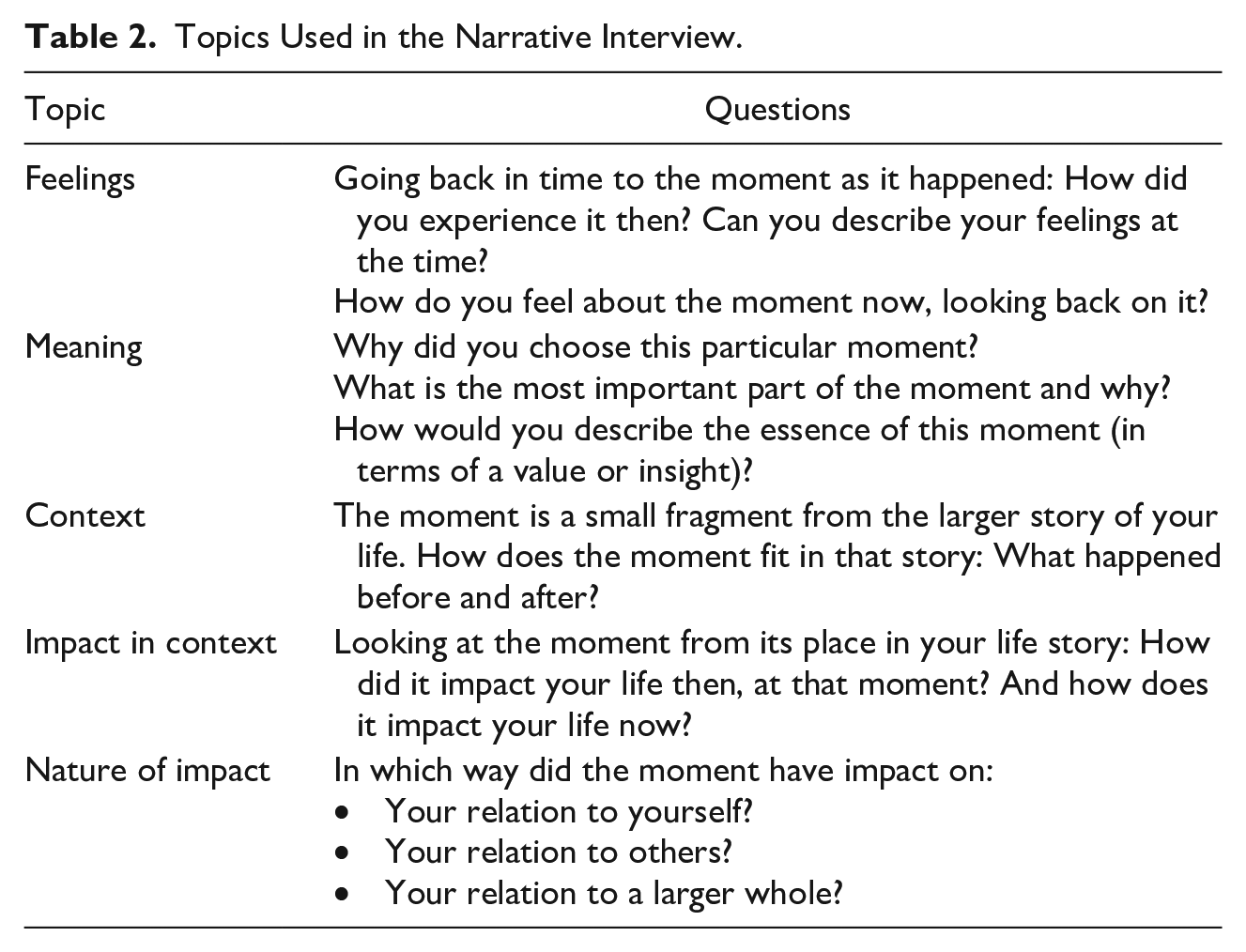
Narrative interviews (Bauer & Gaskell, 2000) were conducted with each of the participants to discover the way they elicit meaning from their chosen memory. In a narrative interview, the researcher asks open-ended questions that stimulate the participant to respond in a narrative form. To support the interview, a topic list was prepared by the three researchers collaboratively. It was designed to give room for participants to address various aspects of the emergence of meaning from their chosen moment; the topics loosely relating to Wong’s (2012b) aspects of meaningful moments and the four dimensions of meaning, without addressing them directly. The topic list is presented in Table 2.
Topics Used in the Narrative Interview.
In the interview, conducted by the first author of this article, the participant was first asked to retell the chosen memory and freely elaborate on it. This enabled the participant to “relive” the chosen moment and gave the researcher insight into spontaneously mentioned aspects of the emergence of meaning. Next, the interview was conducted with support of the topic list; topics only actively being brought in by the researcher if not spontaneously addressed by the participant. To stimulate the participant’s reflection on the emergence of meaning from the chosen moment, the interviewer asked follow-up questions in response to both the content and to the emotions expressed during the interview (e.g., “can you elaborate on that?” “can you tell how this moves you?”), sometimes relating given answers to what participants mentioned earlier in the interview.
Each interview was audio recorded and transcribed verbatim. After the interviews Joe’s memory, initially categorized as intentional, was replaced in the category unintentional, as the interview gave more clarity on the deliberateness of the moment than initially interpreted from the text.
Data Analysis
In order to develop a holistic understanding of the emergence of meaning from the chosen memory in the participant’s life, it was of importance to take into account the stories as a whole instead of focusing on separate elements. A holistic content analysis (Lieblich et al., 1998) was found to be particularly appropriate for this, as it retains the temporal dimension of the story in order to understand its elements in relation to each other. Holistic content analysis is an interpretative process, in which each interview is read and reread several times to let the whole narrative speak, and to discover specific themes that stand out in the story. For a description of the steps in this process, see Lieblich et al. (1998).
In this study, the holistic content analysis was performed by the researcher who held the interviews, interpreting the data and noticing themes in regard to the research question concerning the emergence of meaning. A general impression was written of each interview, including these themes, as well as other characteristics that stood out. These general impressions were discussed with the other two researchers, after which the method of constant comparison (Hallberg, 2006) was employed to oversee all interviews and select the themes most relevant to the emergence of meaning. Next, the first author of this article coded these themes in the interviews and followed them through the texts, paying attention to their (dis)appearance, context, and prominence. These results were discussed again with the other researchers, thereby working toward an integrated framework on the emergence of meaning from meaningful moments.
Results
First, to give an impression of the interviews, the portraits of three different participants are presented. Doing justice to their stories as a whole, these portraits illustrate the way these participants experienced the emergence of meaning from their chosen meaningful moment. Next, a description is given of the themes in relation to the emergence of meaning that were found to run through the three portraits and all of the other interviews. Finally, these themes are brought together in an integrated framework.
The Emergence of Meaning: Three Portraits
John’s Moment of Meaning Discovery
In John’s chosen memory, he and his wife are in the hospital, and he holds their baby daughter while she is dying. Though the moment is a deliberate farewell, it is the new, unknown experience of death within this moment that striked him the most: “Slowly, I felt life leaving her. And I felt, then, what death was . . . It had a tremendous impact on me. Yes, a depraving experience. Like something is cut through, and says: this really isn’t here anymore.” John elaborated on the horror of the experience, though at the same time, he was aware that it was special, mentioning that “it is awful. Like holding a bag of potatoes: there’s no life in that either, it’s just mass. So that’s very, very miserable, but at the same time you feel this is something very special and unique.” To John, this intense experience of death was at the same time a moment in which he discovered meaning: what it is like to be really alive, to be connected to the essence of life: Connection to yourself, [experiencing death] brings you deeply in contact with who you are and what you feel. Also because it is burdensome. And because it is burdensome, it is pure, it is real, and by experiencing, feeling it and saying it, you think yes, apparently, this is life. This is the essence, what you feel.
As these quotes show, John unexpectedly experienced a strong contrast between life and death in the moment, a polarity. This contrast contributed to the salience of the moment and to the discovery of meaning: to the experience of being connected to the essence of life. In this polarity between life and death the characteristics of self-transcendence can be recognized: connecting to life’s universal forces. The emotions that John experienced also relate to this polarity, as he mentioned the moment to be both horrible as well as special and unique in a positive way—a combination typical for wonder and awe, as is John’s heightened sense of awareness: “You see everything very differently. Clearer, sharper, more from a higher viewpoint. You just feel that you experience things in a different way than normal.”
John mentioned that he went through these emotions several times in his life, reliving the moment of his daughter’s death. During the interview, this also happened. He elaborated on his comprehension of the value of going through this emotion: Yes, certainly, it strengthens you. You do not feel any doubt anymore. Yes . . . that’s why you have to admit it [the emotion]. Of course you’re afraid of it, because it always precedes that, that moment of loss of control, you lose control, are overwhelmed by emotion. [ . . . ] But every time it feels like a liberation. If you would hide it, yes, then then then you would die. So by making room for it, it feels like a relief.
In this explanation, John described how he learned the necessity of letting go of control and surrendering to these emotions as a precondition to feel the connection to life. He mentioned that if you don’t admit the emotions, “you lose contact with yourself. And through this experience, I have learned not to avoid things. However difficult they may be, and how hard it is to express your emotions, you just have to do it.” Here, it becomes clear how this discovery seamlessly led to the purposeful creation of meaning in John’s life: the insights guided his attitude toward life. His higher purpose lying in being connected to the self, he deliberately endured the emotions that he encountered in order to fulfill this purpose. Reflecting on this, John mentioned that most of the trouble in the world is caused by that. That people experience things, don’t get room to process them properly [ . . . ] and because of that get completely messed up, and cause a lot of damage . . .
Here, John created a contrast by zooming out to society, thereby emphasizing the value of processing emotions. This zooming out relates to the motivational aspect of self-transcendence: serving himself as well as humankind.
Finally, looking back on the moment and what followed, John mentioned how it had a lasting impact on his life: “Well it enriched my life, but I don’t wish it on anybody. It’s crazy to say yes, actually everybody should lose a child, that’s absurd!” He explained this paradox by saying that “if I can find my way in this, well then things must become really crazy for me not to withstand them.” The experience has given John “a sense of self-respect, self-confidence, it makes you stronger, because you know you can handle that.” These quotes illustrate how the experience has strengthened him as an individual. Alongside this, it has also led to a strengthened self-transcendent connection to humankind and life as a whole. John mentioned how it strengthened his belief in “human resilience and the power of human life” and how it helped him to accept death as part of life, for that is just what life is: being born, dying, that’s not so special. That happens every day. But of course for the individual and also for me of course the birth or death of a child is a very intense experience. But after all, that’s life!
Anne’s Moment of Meaning Creation
Anne’s memory is of the ritual of having breakfast with her husband and daughters on the weekends, a ritual still actively performed in her ongoing life: “Everybody is relaxed. Sometimes all is calm, sometimes the girls have the giggles. It is a moment without obligations. Actually the world consists only of the four of us at that moment, and that is a lovely feeling.” Anne mentioned that she purposely creates this moment to be meaningful, the essence of the moment lying in “the connection between the four of us.” This essence relates to her childhood dream: “I always wanted to become a mother, have a family, and this is the ultimate family moment.” Anne was found to affirm and justify this meaning in several ways: Well, maybe that it is given to us, that we can be so happy together. Maybe it has to do with the fact that of course my parents are divorced, [ . . . ] so I haven’t, I don’t have my home family anymore you know, it doesn’t exist anymore.
In this quote, Anne created a contrast by zooming out to a different time frame in her own life history. She expressed how special the connection in her family is, as she has experienced the absence of this connectedness in her youth. Anne created many more contrasts to highlight the importance of the moment. She also zoomed out to the dynamics of daily life outside of the routine: “it is like an island in the hustle and bustle of family life [ . . . ], yes an island of peace. Maybe also that you, that I don’t have to care and organize and plan.” Apart from this, she zoomed out to a different aspect of her life, that is, the serious diseases that three of them deal with: “It [disease] just doesn’t matter then. People say well health, that’s the most important thing in life. But we know that that’s not true, it’s just this [connection], yes.” Also, she created a contrast by zooming out to society: Trump, or Putin [ . . . ], they should have breakfast with us! [laughs]. If they see it can be this way, then everything is possible, I would say.[ . . . ] I wish it for everybody, that connection, and I think it is important for people to have it, in a family or otherwise.
While the first three contrasts relate to Anne’s own life and put emphasis on the value of connection for her personally, the last contrast transcends the personal, showing how connection is of value to humankind. Anne expressed this self-transcendent motivation also through generativity, the concern for establishing and guiding the next generation (Slater, 2003): “that we pass it on in some way, because to the girls breakfast is also very important. [ . . . ] And when they make breakfast, they also do eggs and juice and a cup of tea.”
Next, by reflecting on this ritual in the interview, Anne discovered additional meaning within the moment. In the interview, Anne introduced a contrast by mentioning how she feels like a “participant” during the breakfast ritual, more than a mother. When asked about the difference between these roles, she answered: “Then [as a mother] I have more responsibility, more care, really. Strange huh. Maybe I can make a better connection at that moment because I’m not in the caretaker’s role.” The researcher then went on to question her:
So when you don’t have to be a caretaker, you experience that connection?
Gee, that is a confrontational observation. [ . . . ] I’m always caretaking.
Yes, it was your dream!
Yes, yes. But if the bottom line is that I don’t really connect at those moments . . .
And is that right?
Yes I think so. Because then . . . I’m more in a role, than that I am just myself. That responsibility, is has less of me in it, then I’m busy with what the other needs.
So you mean that when you feel connected, you are more yourself?
Yes, yes. Pfff [sigh, laugh]. Yes! I’ll have to think about what that means!
In this quote, Anne discovered that letting go of the responsible mother role is a precondition to be herself and thereby experience the connection to her family.
Finally, Anne elaborated on the lasting impact of the ritual on her life. She mentioned “how it makes her more human,” that it gives her “a feeling of value, mattering” which she mentions to be “a basic need for people.” Also, the ritual gives her confidence in the strength of the connection in her family, as “at times when it is difficult, I just know that at a deeper level, it’s just okay. So then that other stuff is not, it’s not nice but it’s not that bad.” She concluded by stating how the ritual helps her to set priorities: “when I have to make choices because I don’t have so much energy, then this is always something that like, oh wait, this is what really matters to me, so all other choices become easier.”
Otto’s Moment of Meaning Creation and Discovery
Otto chose the teenage memory of playing his grandmother’s favorite song to her on the piano, her last request to him before dying. He mentioned how special she was, and willful, choosing to leave life through euthanasia: And as a teenager I’m there. Together with my parents and grandpa. But it was a few days before, while all preparations were being made, that my grandma asked me to play the piano to her one more time. And that’s what I did. I played her favorite song. And then, also, my parents and grandpa were in the room.
Otto’s memory clearly involved deliberate action: he is creating meaning by fulfilling his grandmother’s wish. However, he also seemed to sense that there is more meaning enclosed in the moment than just that, though he could not grasp it. This additional meaning, yet to be discovered, can be found in Otto’s confusion: when asked to reflect on his feelings at the time of happening, he noted how he felt “a strange mix of completely not knowing what’s going on, about life and death and euthanasia, [ . . . ] of purposeless bobbing or, no idea what I’m up to, and pride or happiness, that I could do that then.” He mentioned how playing the piano gave him “grip, guidance,” and “the idea that this is my island, kind of, the fact that I’m behind my familiar thing, my piano, and can do my own thing.” However, Otto remarked that it is difficult for him to distinguish his feelings then and now, commenting that “maybe it is wishful thinking that I felt that then. But I think it is true, though maybe I wasn’t completely aware of it.” These feelings and confusion seem to be related to several contrasts within the moment, which take the form of a polarity: life and death, purposeless bobbing and purposeful action, the known and the unknown, the positive emotions of pride and happiness and the—less articulated, but plausibly also experienced—negative emotions related to not understanding the situation and death. These polarities clearly contribute to the salience of the moment, and possibly to feeling wonder, though Otto did not mention this directly. In his confusion over these polarities, the chosen memory apparently is not only a moment of meaning creation but also of meaning discovery; they seem to be intertwined and do not appear in a linear way. Later in the interview, Otto mentioned another contrast in the chosen moment: “that she’s there, my grandma, her uniqueness, I’m doing my own thing, making music; and that my parents are there, who, well, that really characteristic, iconic side that grandma had, my parents taught me to ‘just be normal’.” It is through this contrast between the authenticity of his grandmother and the conforming attitude of his parents that Otto discovered that there is another layer to the meaning he is creating within the moment: that by playing the piano, he was being true to himself: “the contrast between, at least that’s how I see it now, just being yourself and not giving a shit, and on the other side: just be normal, just work hard, and.”
This “doing his own thing” is his personal purpose in life, Otto mentioned later in the interview. He discovered that at the chosen moment, he was actually realizing that purpose, though he “was not ready to realize that” at the time of happening—the creation of meaning preceded its understanding. In the interview, the researcher noticed that the boy in the memory was already realizing that purpose, after which Otto commented:
Yes, yes, yes, and and maybe there’s yet another layer, because that boy was doing that there, but somehow it started with . . . “will you do that for me . . . ”
Okay. And what does that mean, grandma’s question?
[emotional] Well yes, the beautiful image I have now is that . . . with that question she put me on that stage
Yes, and which stage is that? What would you call it?
Yes . . . do your own thing!
In the last part of this fragment, Otto discovered that it is actually his grandmother who puts him on the stage: through her question, she calls him to realize his purpose. Reflecting on this purpose, Otto mentioned that this is not an end-state but a process of becoming more and more authentic. In this process, he mentioned letting go as an important precondition: “letting go of my parents and thus doing my own thing . . . giving up my job,” “not by adding safe layers, masks and whatever, but by daring to let go of those layers and [ . . . ] have the courage to keep the higher purpose in mind and just stand there almost naked . . . ”
Though in the interview Otto elaborated mainly on the value of this purpose in his personal life, a self-transcendent motivation was also found: zooming out to society, he mentioned how it serves not only himself but that “by crossing that threshold, yes that I can contribute to other people’s feelings or well, make the world a bit more beautiful. [ . . . ] It is important, really of value to others.”
The moment has had a lasting impact on Otto’s life; and in the interview he referred to the moment as “an anchor,” stating that “an anchor was dropped there, because I would need it later on. [ . . . ] And probably there’s still extra layers underneath that I cannot grasp now, but at least that’s how I see it now.” This anchor motivates him to continue to live his purpose, “it’s like an encouragement, [ . . . ] yes that anchor . . . that I take it for what it is and that I, more and more try to live up to it, now.” Otto said that he keeps the sheet music he played as a reminder of this anchor, and, showing a picture of this to the researcher, mentioned how he “once put the sheet music in a frame, but lost sight of it. After [the invitation to the interview] I brought it back out again and gave it a prominent place in my studio.” In this last comment, it can be seen how the Wonderful Life Question triggered Otto to revalue this moment. Finally, he valued the interview itself for giving him extra insights on this anchor: “it helps me to come closer to the memory, to relive it, understand it better. . . . Without it becoming an in-depth ‘lie down on the couch’ session.”
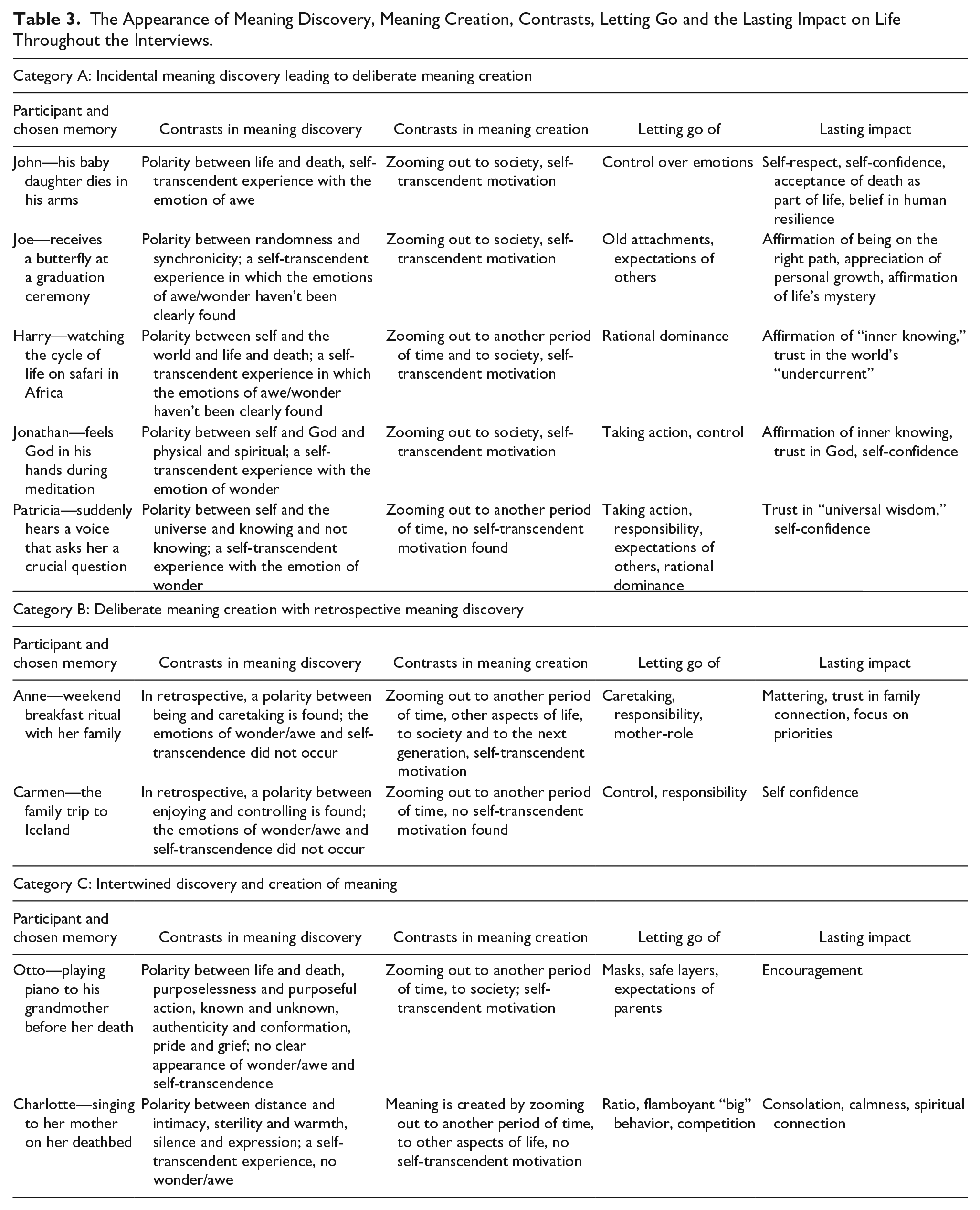
Overseeing the portraits of John, Anne, and Otto, five themes were found that also ran through the stories of each of the nine participants, with (1) meaning discovery and (2) meaning creation as the main themes. The additional themes of (3) contrasts and (4) letting go were found to contribute to the discovery and creation of meaning, a process that has a (5) lasting impact on the participant’s life. Table 3 gives an overview of the appearance of these themes in all of the interviews. Category A comprises moments like John’s, in which incidental meaning discovery leads to deliberate meaning creation; Category B consists of moments like Anne’s, in which meaning is deliberately created and additional meaning is discovered retrospectively; and Category C contains moments like Otto’s, in which meaning creation and discovery are more intertwined and seem to appear simultaneously.
The Appearance of Meaning Discovery, Meaning Creation, Contrasts, Letting Go and the Lasting Impact on Life Throughout the Interviews.
An Integrated Framework
In this section, the five themes are brought together in an integrated framework on the emergence of meaning from meaningful moments (Figure 1).
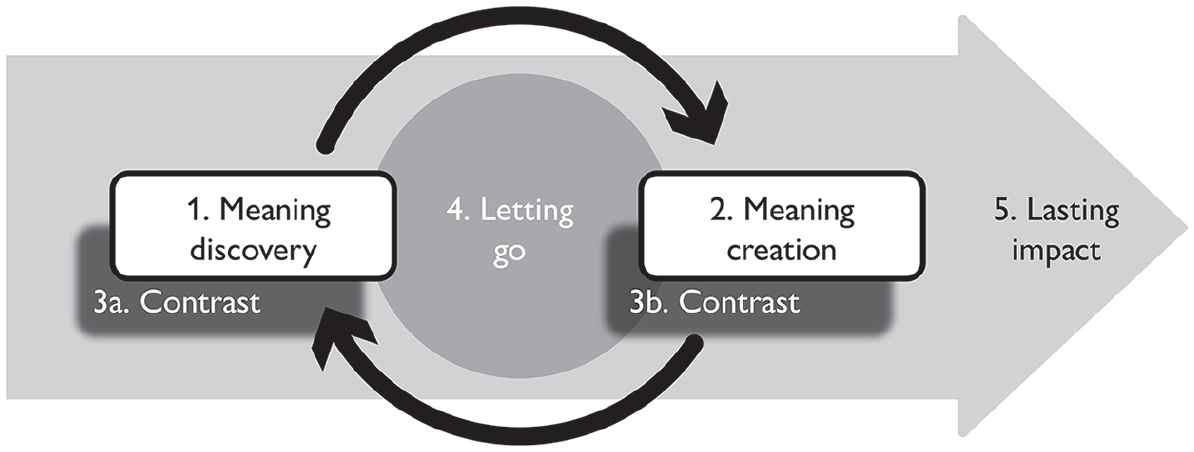
The emergence of meaning from meaningful moments: an integrated framework.
Meaning Discovery
Moments were described as meaningful because they incidentally trigger the discovery of meaning. Meaning discovery related to a broadening of perspective, the development of new or deepened insights on life, humanity, and/or the self by opening up to aspects of life and reality not previously encountered or forgotten and now reseen. Though the moment was sometimes deliberately created to be special in the context of everyday life or in a precarious setting such as illness or death (e.g., meditating in church, going on safari), the meaning drawn from the memory emerged from what unintendedly happens within this setting. This meaning was often not fully understood directly, but discovered and “peeled off in layers” over time. Here, a relation to coherence can be found.
1 → 2 Meaning discovery may lead to meaning creation. In all of the memories that triggered meaning discovery, the discovery of meaning led to the creation of meaning. The created meaning sometimes took the form of a higher life purpose, for example, helping others in their personal development, but at other times it was more attitudinal, a life lesson put into practice, for example, letting go of dominant rational thinking.
Meaning Creation
Meaningful moments were sometimes planned and created to be meaningful, to stand out in the context of everyday life or in a precarious setting. Meaning creation thus concerned deliberate acts, attitudes and choices that were considered to be valuable and contribute to fulfilling a higher purpose in life. In these moments, participants were intentionally taking part in purposeful action.
2→1 Meaning creation may lead to retrospective meaning discovery. Deeper layers of meaning were also discovered retrospectively from deliberately created moments. All of the participants that chose a deliberately created moment mentioned how the full meaning of what they were creating was not yet clear to them within the moment itself. Reflecting on the moment, they discovered additional meaning within the memory of creation of meaning.
Contrasts in Meaning Discovery
Contrasts played an import role in the discovery of meaning (1). These contrasts took the form of a polarity: of opposing values, states of being or realities emerging together within the moment, such as life and death, the universal and the personal, distance and intimacy. The awareness of this polarity contributed to the salience of the moment, and in the descriptions of their feelings the characteristics of the emotions of wonder and awe were found several times: a combination of not knowing, of strangeness, confusion or even fear, and of knowing: recognizing that this is a special experience in a positive way. The characteristics of self-transcendence were frequently found in the polarities. While one end of the polarity often related to the personal, the other end was found to relate to something that transcends the self, such as God, universal wisdom, or oneness with others. Polarities also emerged in the retrospective discovery of meaning from deliberately created moments (2→1).
Contrasts in Meaning Creation
Contrasts also played an important role in the creation of meaning (2). In this case, the value of what is created is affirmed through contrasts resulting from zooming out of the memory to, for example, a different period of time (e.g., an earlier period in life), a different aspect of life (e.g., a hectic household), or a different setting (e.g., society) in which the created value is absent. Through this contrast, participants found extra motivation, justification and validation for their choices, goals and purposes, that is, the meaning they are creating. While polarities were found to relate to the experiential component of self-transcendence and meaning discovery, zooming out clearly relates to the motivational component of self-transcendence and meaning creation. By zooming out to a setting that surpassed participants’ personal lives, they emphasized how the created meaning served not only the self but also other people or humanity as a whole.
Letting Go
In all of the interviews, the same precondition to the emergence of meaning was found: letting go of control, or to surrender. Participants described this as an important lesson they have learned: in order to discover and create meaning, it is necessary to let go of (over)attachments to, for example, ratio, responsibility, expectations of others, and to develop an attitude toward life that is more open, vulnerable, appreciative, and responsive.
Lasting Impact
The chosen memories had a lasting impact on life; participants referred to them as “enriching,” a “gift” or “anchor-moment,” and mentioned feeling grateful. Several participants cherished an object (such as a picture of the chosen memory, used as a screensaver) that reminded them of this gift in their daily life. Gifts were found that positively affected participants’ connection to life as a whole, and gifts that strengthen participants’ connection to the self. In the first category, memories reaffirm participants in their (tacit) knowledge about life and its deeper mysteries (gift of truth), giving confidence in life, humanity and/or the spiritual (gift of trust), which may be seen as the self-transcendent aspect of significance. In the second category, participants mentioned the gift of growth, relating to personal development, cherishing this process and the lessons learned. As this process was often still continuing, the memory may be seen as a gift of encouragement: it reaffirms and stimulates to continue. It was also referred to in terms of a gift of self-confidence: showing participants that they mattered and were able to make a difference. Finally, participants mentioned the gift of focus, as the moment has brought clarity about what is meaningful in life, helping to set priorities.
Conclusion and Discussion
In answer to the research question of how meaning emerges from meaningful moments, an integrated framework was developed in which meaning discovery and creation stand central. The framework illustrates that meaning is not just an outcome or experience, but a process in which the receptive component of discovery and the active component of creation belong together like breathing in and out. The results of the study resonate with many threads on the emergence of meaning found in literature, such as Frankl’s pathways to meaning, the enlightening and transforming impact of meaningful moments, significance as an evaluative component of meaning and self-transcendence as a dimension running through the whole process. In the framework, these threads are brought together by means of a temporal dimension, which leads to a deeper understanding of meaning as a continuing process in life.
Meaning discovery has been clearly found to thrive on paradox and incomprehension; it is a broadening and enriching process that opens up to a greater, mysterious reality; to the “grand narrative of creation” (Wong, 2014, p. 175) or, as an atheist humanist may interpret it, to the “awe and wonder of evolution” (Wilkinson & Coleman, 2011, pp. 99). The findings thereby align with recent studies that point to openness, existential wonder and awe as a precondition for meaning (Alma, 2018; Schinkel, 2018; Schneider, 2009; Wong, 2011). While the process of meaning discovery starts with this wonder-invoking component of meaning, the study shows how the understanding of this meaning unfolds over time, thereby indicating that coherence is a component that naturally follows in this process. Meaning discovery thus involves both the embrace of the unknown, the disruptive and disturbing, as well as comprehension and coherence—both openness and closure. Wonder and coherence thereby seem to form a polarity, contrasting, and complementing each other in the process of meaning discovery.
Additionally, findings indicate that the discovery of meaning is for many participants an ongoing process that remains present also in the creation of meaning, that is, in the dimension of purpose. Here, results align with Maddi’s (2004, 2013) “choosing the future”: the choice to not solely act from an existing, coherent frame of meaning, but to step into the unknown and develop a deeper understanding on the way. Coherence thereby may be a springboard for purpose, as Steger (2012) states, but it also develops on the go, whilst fulfilling this purpose. The finding of letting go as an important precondition to experience meaning also falls into place here, as choosing the future entails openness instead of control and preexistent comprehension. Purpose therefore is paradoxical, as it involves both focus and direction as well as the willingness to detach from proven paths and patterns.
In the study, contrasts prominently emerged as vital mechanisms in the discovery and creation of meaning. Contrasts created by zooming out were found to be a means to see and affirm the value of what is being created. Findings show that meaning emerges by zooming out in time, thereby aligning with Baumeister et al. (2013), but also by zooming out to other settings and other aspects of life. Polarities were found to contribute to the discovery of meaning, frequently reflecting the characteristics of self-transcendence and in some cases also of wonder and awe. It is of interest to deepen insight in the relation between the awareness of polarities and the experience of meaning in more extensive research.
Reflecting on the methods used, the holistic content analysis has been of great value, as its focus on the story as a whole does justice to the process of meaning emergence. Also, the Wonderful Life Question appeared to be particularly adequate to give insight into the emergence of meaning, as its dual temporal focus—a moment from the past to take to the future—leads participants to choose a moment that has explicitly or implicitly triggered a process of meaning discovery and creation. Participants spontaneously mentioned how they had become aware of this process when choosing and writing their memory in answer to the Wonderful Life Question; the interview giving this an extra impulse. Their experiences plead for the Wonderful Life Question not only as a method to collect data, but also as a meaning eliciting intervention.
Finally, there are several limitations of this study. First of all, the selection of participants on the basis of their meaningful moment (and not on demographic characteristics) lead to a quite homogeneous group: all participants were middle-aged and had affinity with personal development. Therefore, it is necessary to validate the findings on a larger and more diverse group of participants, in age as well as profession and background. Also, it would be of value to work with participants to whom a coherent life story is at stake. Another limitation to be mentioned is the role of the researcher in both the interviewing and analysis. Though the interviews were carefully prepared and a topic list was employed, it is impossible to rule out effects of the interaction between interviewer and participant. This interaction, of which the last block quote in Anne’s interview is a clear example, will therefore to some degree have influenced the results. Finally, though multiple researchers were involved, narrative analysis always entails a risk over overinterpretation.
Overseeing the study, its main value lies in the recognition of meaning as a process of both discovery and creation, highlighting the interplay between the dimensions of coherence, purpose, significance and self-transcendence, and addressing the role of contrasts and letting go within this process.
Footnotes
Declaration of Conflicting Interests
The author(s) declared no potential conflicts of interest with respect to the research, authorship, and/or publication of this article.
Funding
The author(s) received no financial support for the research, authorship, and/or publication of this article.

Author Biographies