




Abstract
This report demonstrates the stability of NBT substrate after multiple exposures to alkaline phosphatase. Perhaps more important than the ability to reuse substrates, the report provides some insight into the mechanisms by which tetrazoliums are reduced and evidence for the formation of an intermediary product, i.e., a half-formazan that is reduced more rapidly. (
Keywords
T
Serial dilutions of von Willebrand factor (vWF) purified from pooled human plasma (Haematologic Technologies; Essex, VT) were adsorbed onto nitrocellulose membranes using a Minifold II dot-blot manifold (Schleicher & Schuell; Keene, NH). The membranes were dried, then rehydrated and blocked for 1 hr in TBST (10 mM Tris, 150 mM NaCl, 0.05% Tween-20, pH 8.0) containing 1% BSA. The membranes were incubated for 1.5 hr in rabbit anti-human vWF antibody (Diagnostica Stago; Parsippany, NJ) diluted 1:450 in TBST. Membranes were washed twice for 5 min, then incubated for 1 hr in goat anti-rabbit IgG–AP conjugate (Promega; Madison, WI) diluted 1:7500 in TBST. Only the blocking solution contained BSA. Finally, membranes were washed twice for 5 min and allowed to dry. Before their initial use, concentrated NBT and BCIP solutions (Promega) were diluted to 330 and 165 μg/ml, respectively, in AP buffer (100 mM Tris, 100 mM NaCl, 5 mM MgCl2, pH 8.5). Membranes were rehydrated for 5 min in AP buffer before immersion in the NBT–BCIP solution (1 ml/cm2 membrane area). Color development was halted after exactly 20 min by removing the NBT–BCIP substrate and washing the membrane copiously with distilled H2O. Image analysis of dot-blots was performed as described elsewhere (Smejkal and Shainoff 1997) but used a ScanMaker V scanner and ScanWizard Pro 1.21 scanner controller (Microtek Labs; Redondo Beach, CA). Quantitation was derived using IMAGE software (NIH; Bethesda, MD) with supplemental macros from BioImaging Technologies (Brookfield, WI). Spectral analysis of substrate solutions was performed on a UV-1601 UV-Visible Spectrophotometer (Shimadzu; Kyoto, Japan).
NBT-BCIP substrate solutions could be used several times within 3 days of their preparation when stored at 4C between each use (Figure 1a). When stored at room temperature, used substrate solutions can be reused at least once within 24 hr of their initial use. Alternatively, used NBT–BCIP solutions stored at −70C for at least 3 months can be reused once (Figure 1b). No decrease in sensitivity or increase in background was observed, nor did color development require additional time. Over repeated uses, a slight precipitate frequently formed in the substrate solution, but this had no deleterious effect. In fact, a 15–20% increase in color intensity was observed when previously used substrate solutions were recycled.
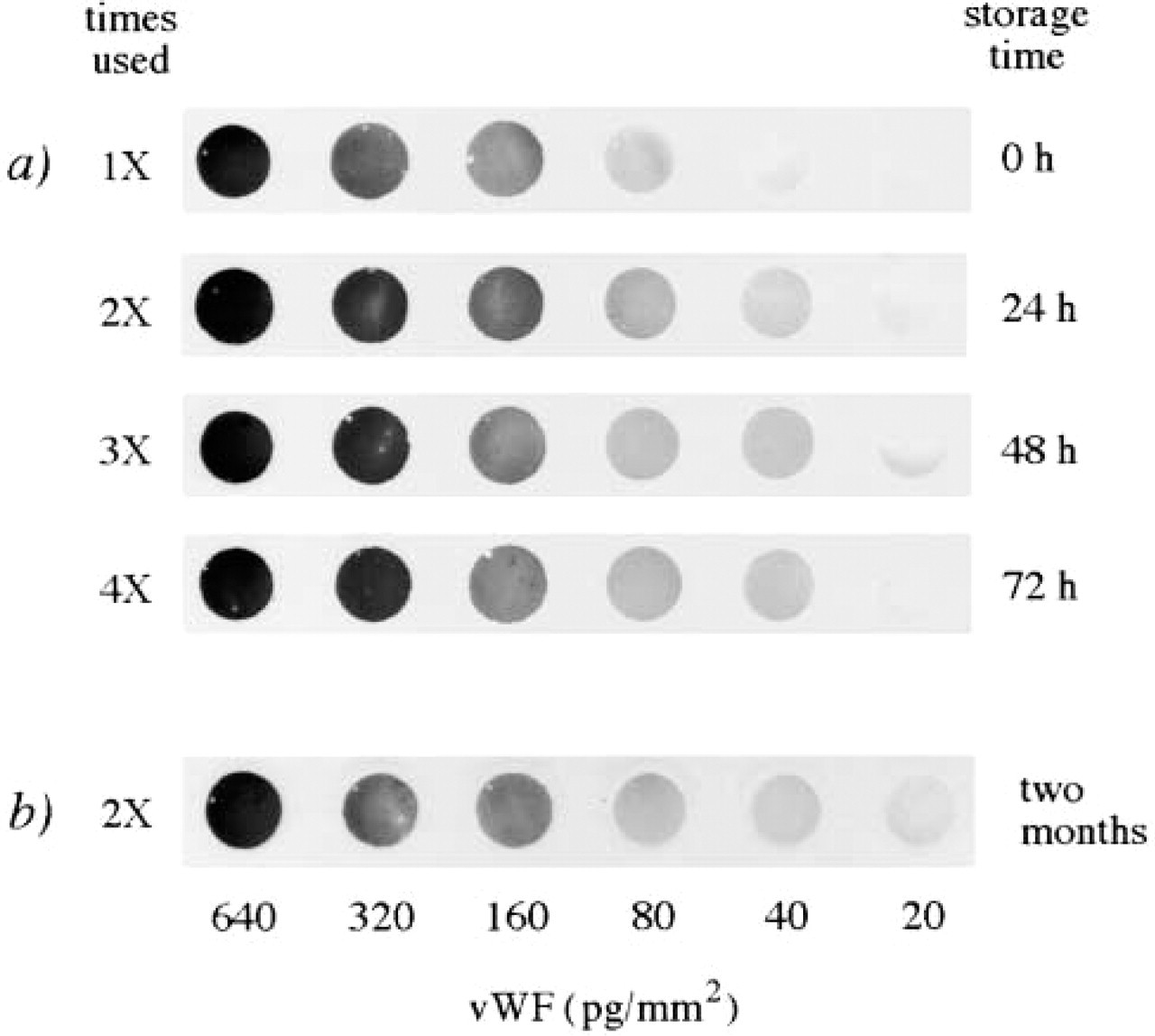
. Repeated use of NBT–BCIP substrate solutions for development of multiple dot-blots over the course of (
Because NBT is a ditetrazolium, incomplete reduction of NBT yields three species in variable proportions: (a) the unreacted ditetrazolium, (b) an insoluble diformazan, and (c) a soluble half-formazan in which only one of two tetrazoles is reduced (Figure 2). Spectrophotometry of used NBT–BCIP solutions showed the appearance of a broad peak centering near 530 nm that was not present in freshly prepared substrates and which corresponds to formation of the half-formazan (Altman 1976; Lippold 1982). The half-formazan represents an intermediate form of NBT that is more rapidly reduced in subsequent incubations and likely contributes to the observed increase in color intensity. The 530-nm peak diminished over time in lieu of a peak forming at 605 nm corresponding to the fully reduced diformazan. The consumption of NBT coincided with a color transition observed on Western blots, from the usual purple color to blue.
The stability of NBT–BCIP substrate solutions is probably influenced by the conditions of storage between uses and by whether any enzyme accumulates in the substrate solution after each use. Although the stability of these substrates and their reliability under different experimental conditions will have to be determined empirically, the potential to reuse reagents such as antibodies and substrates could appreciably extend the economy of Western blotting. Furthermore, the possibility exists for development of an enhanced AP substrate that utilizes a stabilized NBT half-formazan rather than the ditetrazolium.
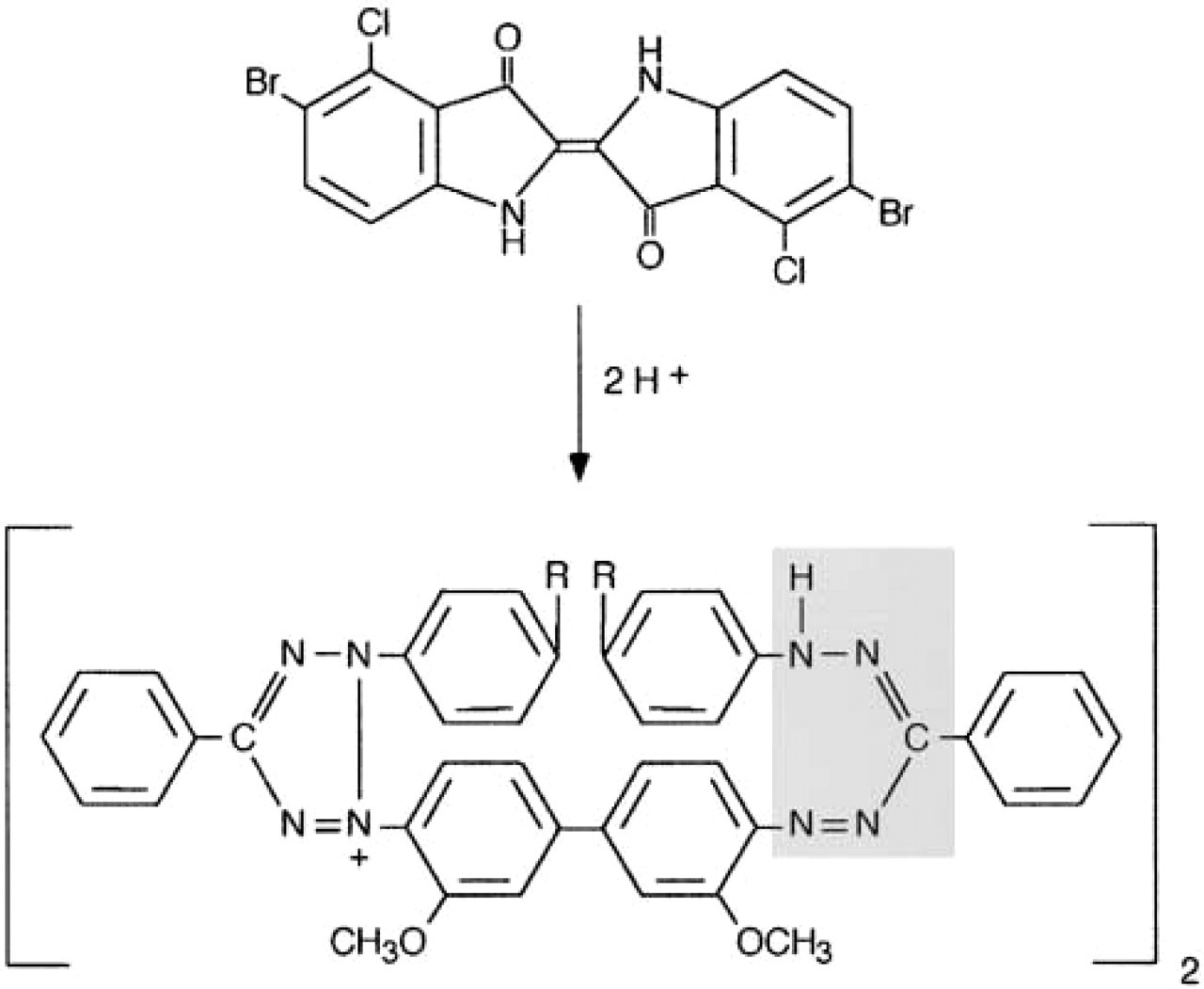
. After dephosphorylation of BCIP by AP, the dimerization of two moles of the resulting indoxyl (top) can partially reduce two moles of ditetrazolium to yield two moles of half-foramazan (bottom). The opening of one tetrazole ring of NBT is indicated in the shaded area. Each R represents a nitro group. In the idealized reaction, two moles of indoxyl would fully reduce one mole of ditetrazolium to produce one mole of insoluble diformazon.
Footnotes
Acknowledgments
Supported by Research Programs Council Grant No. 6299 from the Lerner Research Institute of the Cleveland Clinic Foundation.
We wish to thank Micheal Kalafatis of Cleveland State University, Olga Mitkevich of the Russian Cardiology Research Center, and David Urbanic of AMRESCO for their critical reviews of this manuscript.