




Abstract
We have observed extensive mast cell degranulation in the reperfused hind-limb muscle of the mouse, accompanied by pathological changes within the muscle. As quantitated by the tissue:blood 125I permeability ratio, both the hindlimbs and lungs exhibited a significant increment in permeability during hindlimb reperfusion. In lungs of the same mice, mast cell-derived chymase mMCP-1 coats alveolar macrophages, an event noted by us in acid-induced direct lung injury. Mast cells in the lung contain mMCP-1, whereas those in the muscle do not. Neither extensive muscle injury nor an increased pulmonary permeability index occurs in the mast cell-deficient W/Wv mice. We conclude that the mast cell is a key mediator in both local ischemia–reperfusion injury (I–R) of muscle and consequent remote lung injury. (J Histochem Cytochem 49:1055–1056, 2001)
P
Two male congenic strains of mast cell-deficient WBB6FlJ- W/Wv and mast cell-sufficient WBB6FlJ-+/+ mice were subjected to bilateral hindlimb ischemia with rubber band tourniquets. After 2 h of ischemia, an IV injection of bovine 125I-albumin was administered and the tourniquets were released. Three hours later, the ratios of radiolabeled albumin in the muscle and bronchoalveolar lavage (BAL) fluid to blood were measured and used to calculate skeletal muscle and lung vascular permeability indices (PI), respectively. Identical preparations minus the administration of radiolabeled albumin were used for histological examination. Sections of muscle were evaluated histologically by chloroacetate esterase staining to visualize mast cells and PMN leukocytes, as well as by standard histochemical stains. Immunohistochemical staining for two of the mast cell secretory granule chymases, mMCP-1 and mMCP-2, also were performed (Friend et al. 1996). The study was carried out in accordance with the guidelines of the Committee on Animals of Harvard Medical School and those prepared by the Committee on the Care and Use of Laboratory Animals of the Institute of Laboratory Animal Resources National Research Council [DHSS publication no. 85–23 (NIH), revised 1985].
The results (mean ± SEM) were analyzed by oneway ANOVA and Bonferroni correction for multiple comparisons. Percentage reduction in PI was calculated after subtraction of background values in sham (+/+) animals. Hindlimb I–R injury markedly enhanced the skeletal muscle and lung permeability indices in the mast cell-sufficient (+/+) mice. The muscle PI was 1.602 ± 0.064 (n = 4, p < 0.05) compared to 0.0250 ± 0.019 in the sham mice. In the mast cell-deficient (W/Wv) mice there was a 52% reduction in muscle PI to 0.883 ± 0.047 (n = 4, p < 0.05). Remote lung injury was significantly elevated in the I-R +/+ mice, PI 0.015 ± 0.003 (n = 4, p < 0.05) in comparison with the sham mice, PI 0.003 ± 0.001(n = 4), and with W/Wv (–/–) mice subjected to I-R, PI 0.005 ± 0.001 (n = 4).
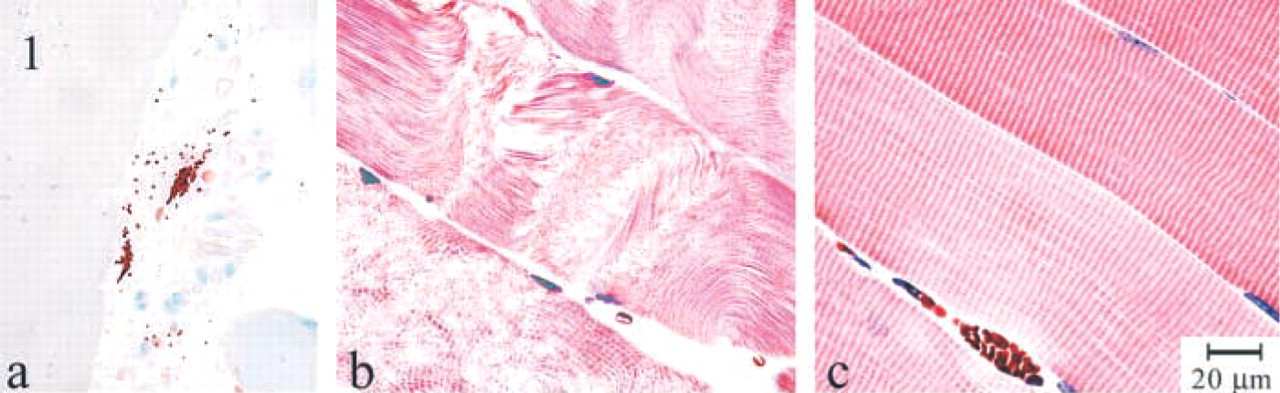
Gastrocnemius muscle in ischemia–reperfusion injury. (
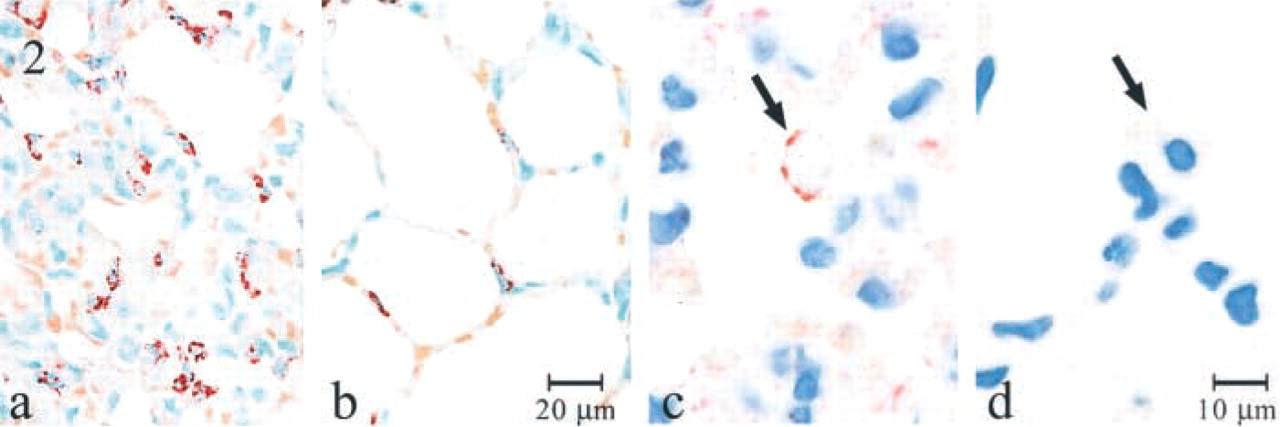
Lungs of WBB6F1 mice (
Histologically, mast cell degranulation along with neutrophil margination and extravasation from the capillaries, myofibril disruption, and myonecrosis were demonstrated in the biopsied muscle of the +/+ mice. In contrast, aside from the wavy fibers, muscle structure was generally preserved in the mast cell-deficient (W/Wv) animals (Figure 1). Although the PI for remote lung injury was 1000-fold less than for the directly involved hindlimb, the lungs also demonstrated extensive injury with interstitial edema and neutrophil sequestration in the mast cell-sufficient (+/+) group. The congenic W/Wv group did not demonstrate such morphology. Some mast cells in the (+/+) lungs stained for mMCP-1 and mMCP-2 by immunohistochemistry before and after the I-R event. After the I-R injury, the MMCP-1 IgG also coated clusters of alveolar macrophages (Figure 2). The muscle mast cells did not stain for mMCP-1 but were positive for mMCP-2 before and after I-R.
Post-ischemia reperfusion of hindlimbs is known to lead to muscle and remote organ injury. Mast cell activation is followed by the elaboration of many mediators of three general categories: preformed, residing in the secretory granules, amines, proteases, proteoglycans; newly generated from released arachidonic acid (prostanoids and leukotrienes); and induced (cyto-kines and chemokines). This study demonstrates a definitive role for mast cells, either directly or indirectly, in initiating local muscle injury and in lung leukosequestration and edema after hindlimb ischemia–reperfusion. The study also suggests that the mast cell protease mMCP-1 may act as a cell signaling factor for alveolar macrophages.