



Abstract
Republicans and conservatives report better self-rated health and well-being compared to Democrats and liberals, yet they are more likely to reside in geographic areas with heavy COVID-19 morbidity and mortality. This harmed health on “both sides” of political divides, occurring in a time of rapid sociopolitical upheaval, warrants the revisiting of psychosocial mechanisms linked to political health differences. Drawing on national Gallup data (early 2021), we find that predicted differences in health or well-being vary substantially by ideology, party, voting behavior, and policy beliefs, with model fit depending on how politics are measured. Differences in self-rated health, psychological distress, happiness, trouble sleeping, and delayed health care tend to reveal worse outcomes for Democrats or liberals. Such differences often are reduced to insignificance by some combination of mastery, meritocratic beliefs, perceived social support, and COVID-19–related exposures and attitudes. Policy beliefs predict health differences most robustly across outcomes and mechanism adjustments.
Politics play an important yet complex role in American life. Over the last few decades, political polarization has fundamentally reshaped the relationship between party and ideology (Barber and Pope 2019), while voting behavior has taken unanticipated turns in recent elections (Morgan and Lee 2019). Despite the rise of “party sorting”—in which beliefs and attitudes tend to cluster by partisanship—most Americans fall somewhere in the middle (Abrams and Fiorina 2015), and they endorse policy stances or beliefs in ways not fully captured by political affiliation or voting behavior (Boutyline and Vaisey 2017; Brandt and Morgan 2022; Grumbach 2018; Kiley and Vaisey 2020).
However, even with this heterogeneity across dimensions of political background, political divides in mortality and prophylactic health behavior during the COVID-19 pandemic have been strikingly clear. Epidemiological research finds higher COVID-19 infection and mortality rates in conservative or Republican-leaning geographic areas compared to more liberal or Democratic areas, even after adjusting for demographic confounders (e.g., Eden et al. 2021; Sehgal et al. 2022)—with some notable exceptions early in the pandemic (e.g., New York City; Chen and Karim 2022). Meanwhile, stark differences in attitudes about the pandemic, including lower perceived risk, less endorsement of masking, and weaker support for public health agencies, have been observed among conservatives or Republicans compared to liberals or Democrats (Barrios and Hochberg 2020; Gadarian, Goodman, and Pepinsky 2021; Kwon 2023; Stroebe et al. 2021; Wolaver and Doces 2022; Young et al. 2022).
Despite greater pandemic mortality and fewer health precautions, Republicans generally report better physical health than Democrats (Kannan et al. 2019; Pabayo, Kawachi, and Muennig 2015; Subramanian and Perkins 2010) and higher rates of happiness and well-being (Gelman 2009:38; Newport 2007). Such patterns have been observed for decades, but they are striking in light of the pandemic, during which Republicans have consistently reported less distress than Democrats (Collins, Mandel, and Schywiola 2021; Kwon 2023; Piltch-Loeb, Merdjanoff, and Meltzer 2021).
Existing studies have covered widely varying time frames, and estimated magnitudes of associations vary considerably, making it important to revisit how politics and health relate in the context of COVID-19. Here, we leverage unique data from a national Gallup survey conducted in early 2021. We implement four measures of political background: party, ideology, voting behavior, and policy beliefs. Although these facets of political background have long been recognized as distinct, they could help sort through multifaceted political health differences in the post-Trump era (Boutyline and Vaisey 2017; Feldman and Johnston 2014; Kiley and Vaisey 2020; Sosnaud, Brady, and Frenk 2013). Likewise, it remains unclear how psychosocial mechanisms might inform these political health differences. We consider numerous socioeconomic and psychosocial explanations of political health differences while also extending them to include beliefs about social inequality and the course of the pandemic.
Background
Political and economic systems structure population health through processes of democratization, industrialization, and welfare state formation (Beckfield et al. 2015; Reynolds 2021). Lived realities of inequality, marginalization, segregation, environmental injustice, and health care access shape health and well-being, instantiating what Dawes (2020) identified as upstream political determinants of health (see also Montez 2020; Reynolds 2021). Within political regimes, individual political background predicts substantial variation in health and well-being. For instance, conservatives have reported greater happiness and life satisfaction than liberals, both within and outside of the United States, for decades (Huijts, Perkins, and Subramanian 2010; Jost 2019; Napier and Jost 2008). Similarly, Republicans or conservatives report greater happiness and self-rated mental health than Democrats or liberals (Newport 2007; Schlenker, Chambers, and Le 2012). At the aggregate level, the election of Donald Trump in 2016 was linked to worsened mental health for those living in states that Hillary Clinton won (Yan et al. 2021).
Physical health research distinguishes between mortality and self-reported measures. Subramanian and Perkins (2010) found that Democrats were more likely to report poor self-rated health and smoking behavior compared to Republicans, net of sociodemographic background (see also Chan 2019). Similarly, Pabayo et al. (2015) found that liberals had lower self-rated health and happiness than conservatives and moderates—yet they also had a lower risk of mortality. (No mortality differences by political party were observed net of socioeconomic status.) Altogether, these findings suggest that morbidity and mortality may follow a different pattern than subjective health indicators and that this could depend on distinguishing party from ideology. Where liberals and/or Democrats exhibit greater mortality (than conservatives and/or Republicans), differing time frames of measurement or geographic or sample compositions seem to matter (e.g., Kannan et al. 2019; Montez 2020; Pabayo et al. 2015).
Proposed Mechanisms for Political Differences in Health
Prior research into health differences by individual political background finds broad support for various socioeconomic and psychosocial explanations (e.g., Kannan et al. 2019; Newman et al. 2019; Pabayo et al. 2015; Schlenker et al. 2012). Socioeconomic explanations have focused on income and educational attainment, whereas psychosocial explanations have centered on nonmaterial resources such as mastery and social support. In this study, we extend psychosocial mechanisms to include meritocratic or system-justifying beliefs (Jost and Thompson 2000; van der Toorn et al. 2015), and we also incorporate individual-level exposures to behavioral risks and viral infection or death during the COVID-19 pandemic. Our proposed mechanisms connecting individual political background to health and well-being are summarized in Figure 1.
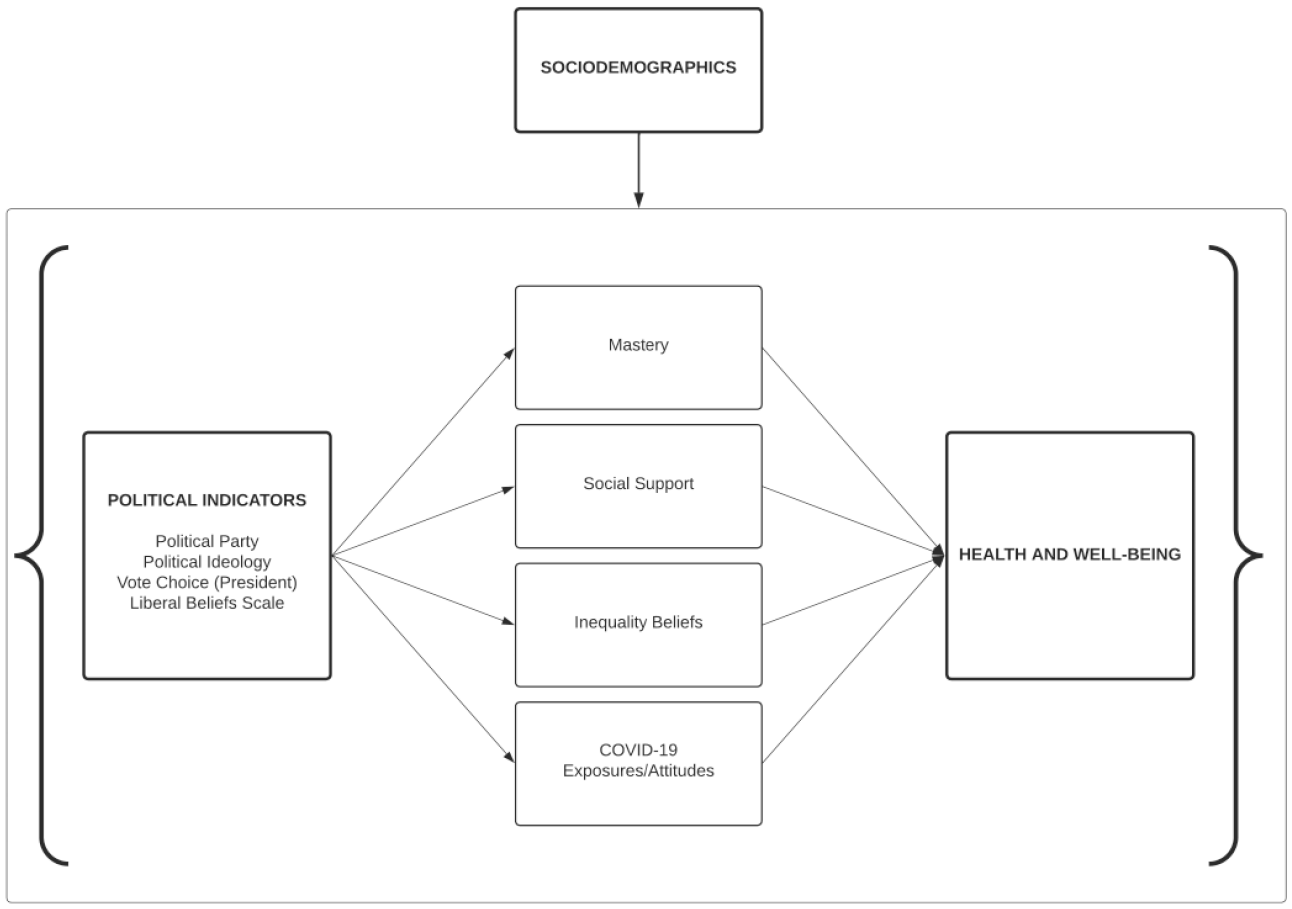
Conceptualizing Political Differences in Health and Well-Being.
Mastery
A prominent theory linking politics to individual well-being is system justification theory (Jost 2019; Napier and Jost 2008). This theory suggests that individuals have an inherent need to defend the social systems in which they are enmeshed (Jost 2019); their ability to do so successfully helps to improve life satisfaction and decrease negative affect (Napier and Jost 2008). For instance, “Political conservatism is a system-justifying ideology in that it is associated with the endorsement of a fairly wide range of rationalizations of current social, economic, and political institutions and arrangements” (Napier and Jost 2008:565). Following this logic, conservatives are likely to be healthier or happier than liberals because they perceive less of a gap between how the world is and how it ought to be and thus feel empowered within the status quo (Jost 2019; Schlenker et al. 2012; Wright et al. 2022). The conservative view that individuals control their destiny—and that no structural barrier is insurmountable—may explain their higher rates of mastery. However, even disadvantaged groups who do not endorse dominant social institutions often show health benefits from mastery (Cichocka and Jost 2014), which suggests the importance of disaggregating general mastery beliefs from more specific beliefs about inequality (see also Jost 2019).
Inequality beliefs
van der Toorn et al. (2015) argue that people justify sociopolitical systems in part by placing responsibility on individuals for their socioeconomic success or failure. Consequently, although conservatives generally report a greater sense of control than liberals, it is unclear to what extent the conservative health advantage linked to mastery is based in individualistic beliefs about inequality and hard work. Napier and Jost (2008) found that the relationship between conservatism and subjective well-being was significantly mediated by the endorsement of individualistic or meritocratic beliefs and the rejection of structural inequality beliefs. However, more recent evidence is mixed (e.g., Butz, Kieslich, and Bless 2017; Jetten, Haslam, and Barlow 2012; Schlenker et al. 2012).
Social support
From a sociological perspective, political beliefs are determined in part by social ties and their contribution to the agentic self. In addition, Schlenker et al. (2012) contend that political differences in health are rooted in social relationships that confer psychosocial resources. Although social support can take diverse forms, a sense of mattering to others and interpersonal closeness both are critical dimensions of social ties that have robust associations with health behaviors and overall well-being (Thoits 2011; Umberson and Montez 2010).
Existing, nonsociological research into political health differences has tended to cast social ties in terms of narrower dispositional residues, however. For instance, Schlenker et al. (2012) found that conservatives scored higher on measures of self-worth, optimism, personal control, and religiosity and that these differences explained conservative–liberal differences in happiness. Yet self-worth is itself an outgrowth of mattering to others (Rosenberg and McCullough 1981), and optimism in part reflects broader embeddedness in trusting, close relationships (Thoits 2011). Considered separately, religiosity and religious attendance are related to political background and offer a variety of psychological benefits. Differences in religious attendance could contribute to explaining political health differences (e.g., Butz et al. 2017; Newman et al. 2019).
COVID-19 exposures and attitudes
Political background has acted as a lens through which to view the COVID-19 pandemic, shaping coping strategies, meaning-making, and emotional responses. In general, liberals and/or Democrats have perceived greater risk from the coronavirus and have been more likely to engage in health-protective behaviors (Barrios and Hochberg 2020; Gadarian et al. 2021; Kwon 2023; Stroebe et al. 2021; Wolaver and Doces 2022; Young et al. 2022). While individuals personally impacted by the pandemic may be more likely to take health precautions, this effect appears to be much smaller than that of political party (Collins et al. 2021).
Behavioral Health during the Pandemic
Although existing research on political health differences usually focuses on general health indicators, behavioral health has shown unique trajectories during the pandemic. With work and family routines disrupted and working from home and homeschooling becoming more common, sleep disturbances have been widely reported (Yuksel et al. 2021). Health care access has also been variably restricted throughout the pandemic, with some individuals electing to forgo care as a precautionary measure or due to economic strain experienced during the pandemic (Czeisler et al. 2020; Gonzalez et al. 2021). Although widespread constraints on health care led to the delay of elective procedures or nonemergency treatment, politicized perceptions of health risk likely shaped individual decisions about seeking continued care for acute health problems or routine care when it was available. Some evidence suggests that sleep and delaying health care have been patterned by political background during the pandemic, with liberals reporting impaired sleep and putting off health care compared to conservatives (Czeisler et al. 2022; Robillard et al. 2020).
Political Background in the Post-Trump Era
Rapid social change restructures not only ideology but also how political ideology or background relate to health outcomes (Kwon 2023; Pearlin and Bierman 2013). For instance, natural disasters and economic crises exact disproportionate tolls on the socioeconomic standings and hazardous exposures of vulnerable groups (e.g., Benevolenza and DeRigne 2019; Howell and Elliott 2019), who are more represented among liberal or Democratic individuals than among conservatives or Republicans. Similarly, political leaders often grant or deny aid depending on the perceived political makeup of the victims (Husted and Nickerson 2014). The COVID-19 pandemic represents an unprecedented situation for the United States in that it has tended to consolidate and amplify the relationship between political ideology and health outcomes and practices (Gadarian et al. 2021; Young et al. 2022).
The Trump presidency redefined the nature of individual political orientation, however, complicating its dynamics and its measurement. Although research into politics and health typically relies heavily on ideological measures, recent years have yielded a marked decoupling of ideology from party and of voting patterns from positions on specific social issues, making political orientation itself a function of several distinct facets (Boutyline and Vaisey 2017; Brandt and Morgan 2022). For instance, individuals who classify themselves as liberal or conservative have expressed considerable discontent with the Democratic or Republican party (see Barber and Pope 2019), individuals have switched their voting patterns in ways strongly at odds with their ideological or party identification (consider Obama-to-Trump voters; Morgan and Lee 2019), and positions on social issues related to minority rights, gun control, reproductive health, immigration policy, and the environment may change separately from how individuals or parties relate to broader ideologies (Grumbach 2018; Kiley and Vaisey 2020; Sosnaud et al. 2013).
Overview of the Present Study
In this study, we draw on national Gallup data collected in January to March 2021 to document and analyze political differences in individual health. We extend past research by assessing political background and putative mechanisms more comprehensively. We pose the following research questions:
Research Question 1: Is individual political background associated with health and well-being indicators during the COVID-19 pandemic?
Research Question 2: Do associations between politics and health depend on the approach taken to measuring political background?
Research Question 3: Do socioeconomic and psychosocial mechanisms (including COVID-19 exposures and attitudes) offer potential explanations for these political health differences?
Data And Methods
Data
The Values and Beliefs of the American Public survey was fielded by the Gallup Organization from January to March 2021. The survey was designed to assess Americans’ diverse experiences during the COVID-19 pandemic, along with their personal, demographic, political, and religious backgrounds. Gallup mailed a self-administered questionnaire to a random sample of 11,000 U.S. households in all 50 states and the District of Columbia identified using an address-based sampling frame. Respondents were allowed to respond to the survey on paper or via a provided web link; 63% of surveys were completed via paper and 37% via web. Surveys were conducted in English and Spanish. The final response rate, using the AAPOR1 calculation, was 11.3% (n = 1,248).
The 2021 Gallup survey was uniquely suited to our study because of its distinctive, diverse set of key physical and mental health, political, psychosocial, COVID-related, and sociodemographic measures. We implemented a probability weight constructed by Gallup to account for selection probability and nonresponse, including weighting to match the demographic characteristics of the U.S. adult population based on the 2020 Current Population Survey (Gallup Methodology Document, 2021 Values and Beliefs of the American Public Survey). Under survey weighting, the 2021 General Social Survey and the 2021 Gallup survey were similar in gender, racial, age, and educational composition. 1 Rates of voluntary item nonresponse were low; household income had the greatest missingness at 4.5%. We accounted for missing data in our full-information maximum likelihood estimation procedure (see Analytic Strategy).
Key Independent Measures: Political Background
We employed four distinct measures of political background: political party, political ideology, vote choice (2020 presidential election), and a liberal beliefs scale. Political party was a 7-point item ranging from strong Republican to strong Democrat; we recoded this item into three categories (Republican, Independent, Democrat), with individuals “leaning” Republican or Democrat coded as Republican or Democrat, respectively. Political ideology was a 7-point item ranging from extremely conservative to extremely liberal; again, we recoded this item into three categories (conservative, moderate, liberal), with individuals leaning conservative or liberal coded as conservative or liberal, respectively. Vote choice referred to the respondent’s preferred 2020 presidential candidate (Trump or Biden) and was coded as missing if the respondent did not vote. 2 Finally, the liberal beliefs scale measured whether respondents favored or opposed a set of 11 items, where 1 = strongly oppose, 2 = oppose, 3 = favor, and 4 = strongly favor. The items are as follows, with the stem reading “Do you favor or oppose the following?”: (a) government funding for abortions, (b) government provided health insurance, (c) requiring children to be vaccinated in order to attend public school, (d) laws to reduce differences in income levels, (e) sending all unauthorized immigrants back to their home countries, (f) tighter restrictions on the sale and use of guns, (g) stronger environmental laws to fight climate change, (h) stronger laws to protect religious liberty, (i) stronger laws to protect LGBTQ+ rights, (j) government providing free college tuition, and (k) reforming police to prevent racial bias. Items were recoded so that higher scores reflect more progressive or liberal beliefs, and the mean of the 11 items was computed (Cronbach’s α = .90).
Dependent Variables: Health and Well-Being Indicators
Self-rated health asked, “In general, would you say your health is . . . ?” (0 = fair, poor, or good; 1 = excellent or very good). Psychological distress was computed as the mean of five items: (a) I felt depressed, (b) I felt sad, (c) I worried a lot about little things, (d) I felt tense and anxious, and (e) I felt restless (1 = never, 2 = hardly ever, 3 = some of the time, and 4 = most or all of the time; α = .88). Happiness asked the respondent, “In general, how happy are you with your life these days?” (0 = not too happy or pretty happy, 1 = very happy). We also examined health-related behavioral measures: how often the respondent had trouble falling asleep in the past month (0 = never or hardly ever, 1 = some of the time or most of the time) and whether the respondent had put off going to the doctor for routine care as a result of the pandemic (0 = no, 1 = yes). 3
Mechanisms Linking Political Background to Health and Well-Being
Mastery
Mastery was computed as the mean of four items, reverse-coded as necessary: (a) I have little control over the things that happen to me, (b) There is really no way I can solve some of the problems I have, (c) I often feel helpless in dealing with problems of life, and (d) I can do just about anything I really set my mind to (1 = strongly disagree, 2 = disagree, 3 = agree, and 4 = strongly agree; α = 0.73, similar to Mirowsky and Ross 2007).
Inequality beliefs
Following Reynolds and Xian (2014), we measured inequality beliefs with six items, separated into two factors using principal components factoring with varimax rotation. Meritocracy beliefs included the importance of “having a good education” or “hard work” for getting ahead in life, from 0 = not important at all to 3 = very important. The total for this subscale was the sum of the two items (0–6) divided by the maximum possible (6) and multiplied by 100 to produce a meritocracy score of 0% to 100%. Nonmeritocracy beliefs included the importance of “coming from a wealthy family,” “knowing the right people,” “a person’s race,” or “being born a man or woman.” Again, the sum was divided by the maximum possible (12) and multiplied by 100. Finally, an overall score was computed by subtracting the nonmeritocracy score from the meritocracy score, for a final range of −100 to 100. Higher scores indicate a greater belief in meritocracy.
Social support
Our social support measures included mattering and closeness to others and religious attendance. Mattering was the sum of five items: (a) How much do you feel other people pay attention to you? (b) How much do you feel others would miss you if you went away? (c) How interested are people generally in what you say? (d) How much do other people depend on you? and (e) How important do you feel you are to other people? (1 = not at all, 2 = a little, 3 = somewhat, and 4 = a lot; Rosenberg and McCullough 1981; α = .81). Closeness was the mean of four items that asked how close respondents feel to family, friends, coworkers, and neighbors (1 = not close at all, 2 = not too close, 3 = somewhat close, and 4 = very close; α = .68). Finally, attendance at religious services estimated the number of services attended yearly (never = 0, less than once a year = 0.5, once or twice a year = 1.5, several times a year = 4, once a month = 12, two to three times a month = 30, about once a week = 52, several times a week = 208).
COVID-19 exposures and attitudes
A final set of proposed mechanisms examined exposure to COVID-19 in oneself or others in one’s network along with attitudes about the pandemic (e.g., Kwon 2023). The first three items measured exposure: “As a result of the COVID-19 pandemic, have you . . . ” (a) been infected by COVID-19, (b) had a close relative or friend of yours infected, and (c) lost a close relative or friend to COVID-19. We treated each of these as distinct binary measures. The next two items, COVID-19 attitudes, reflected skepticism about the pandemic or the attempt to address it. Respondents were asked for their view on two statements, from which a mean was computed: (a) The dangers of the COVID-19 pandemic are exaggerated by mainstream media and (b) A vaccine for COVID-19 should not be trusted (1 = strongly disagree, 2 = disagree, 3 = neither agree nor disagree, 4 = agree, and 5 = strongly agree; α = .61). 4
Sociodemographic covariates
Following previous studies, we included a wide variety of socioeconomic and demographic covariates: gender (1 = male, 2 = female, 3 = other), 5 age, years of education (8th grade or less = 8; 9th–12th grade = 10; high school graduate = 12; technical, trade, vocational, or business school or program after high school = 13; some college = 14; two-year associate degree = 14; bachelor’s degree = 16; some postgraduate schooling = 17; postgraduate or professional degree = 18), household income (reported as seven categories, recoded at midpoints with top bracket estimated, following Hout 2004), employment status (0 = not currently employed, 1 = currently employed), race-ethnicity (1 = non-Hispanic White, 2 = Black, 3 = Latinx, 4 = other race-ethnicity or multiracial), marital status (0 = not married or cohabitating, 1 = married or cohabitating), and urbanicity (0 = living in a small city, town, or rural area; 1 = living in a large city or a suburb near a large city).
Analytic Strategy
To estimate associations between health or well-being and political background, we fitted linear regression models. For each health or well-being outcome, each political background measure (political party, political ideology, vote choice, and liberal beliefs) was evaluated in a separate set of models. All political indicators and potential mechanisms showed low to moderate intercorrelations (see Appendix A in the online version of the article). Variance inflation factors for all fitted regression models were below 2.5.
For each set of models, we started with an unadjusted model (Model 1) and then added sociodemographic covariates in Model 2; these sociodemographic covariates remained in all subsequent models. Models 3 through 6 introduced proposed mechanisms separately. Model 3 included mastery; Model 4 included inequality/meritocracy beliefs; Model 5 included social support–related variables: mattering to others, closeness, and attendance at religious services; and Model 6 included COVID-related exposures and attitudes: personal experience with the virus (respondent infected, close other infected, close other died) and skepticism about the public response. Model 7 was comprehensive, specifying all variables from Models 1 through 6 at once.
All statistical analyses were conducted with Stata SE 17. Full-information maximum likelihood was used to minimize bias associated with missing data and recover accurate point estimates (Allison 2002; Enders 2010). Listwise analyses yielded unchanged findings concerning well-being or health differences by politics and their general patterns of attenuation (available on request). We display results from linear or Gaussian full-information maximum likelihood models to improve the interpretability of coefficients both within and across our models (e.g., Idler and Cartwright 2018). All reported coefficients refer to unit change or change in predicted probability.
Results
Survey-weighted descriptive statistics for all study variables are provided in Table 1. Within the 2021 Gallup sample, 46% of respondents report excellent or very good self-rated health, and psychological distress averages between hardly ever (2) and some of the time (3) (M = 2.36, SD = .77). Demographically, mean education is 14 years (M = 14.09, SD = 2.52), 52% of respondents are female, 64% are non-Hispanic White, 11% are Black, and 17% are Latinx.
Survey-Weighted Descriptive Statistics (2021 Gallup National Survey; N = 1,248).
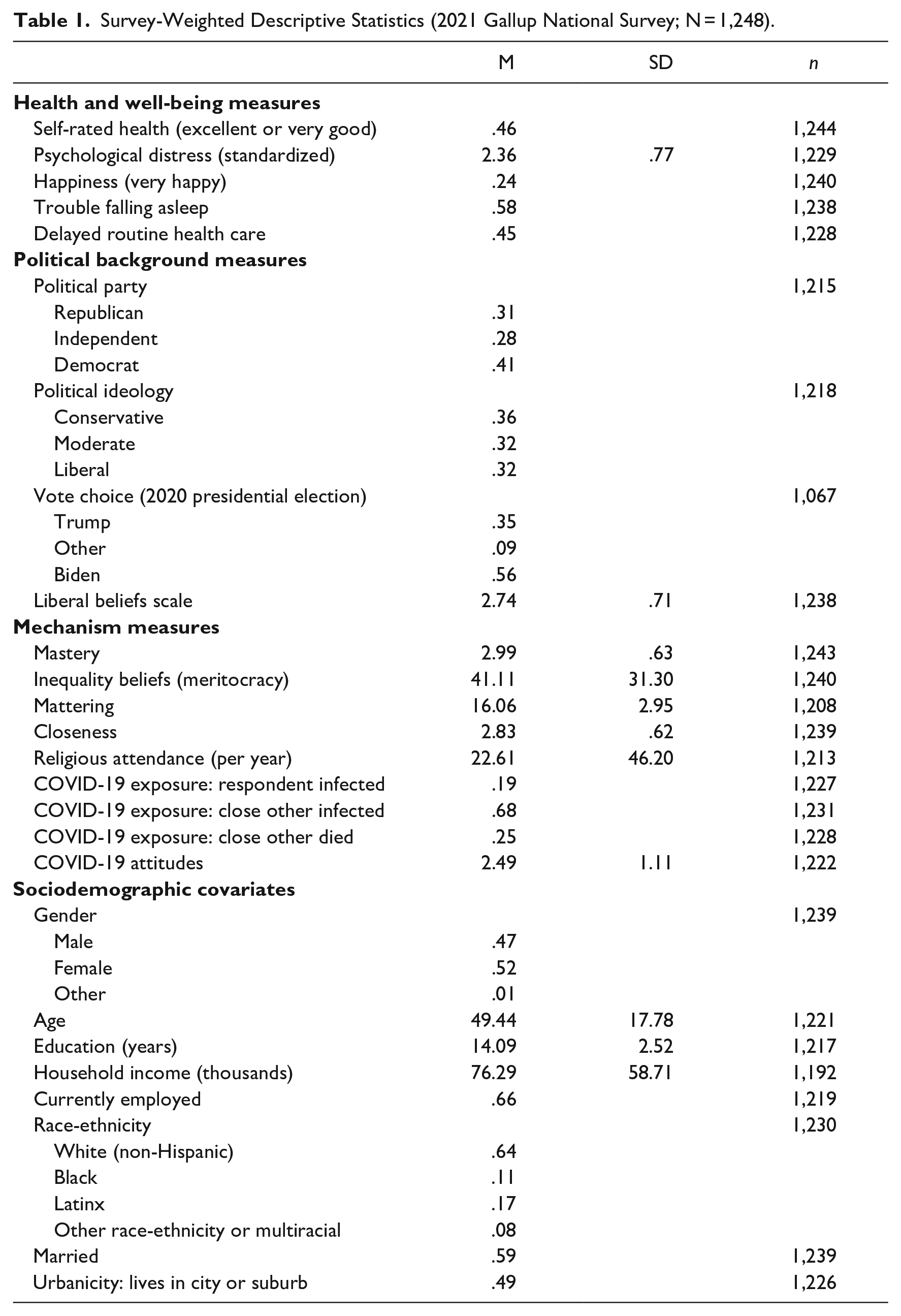
While we analyze political background measures separately, respondents show considerable variation within and across party, ideology, voting behavior, and policy beliefs, all of which attest to considerable decoupling of these indicators during the post-Trump era. For instance, correlations between 7-point party identification, 7-point ideology, and liberal policy beliefs are strong but not determinative (rs = .66–.75), given that any two indicators have about 50% shared variance. By party and ideology, 31% of respondents are Republican, 28% are independent, and 41% are Democrat; 36% are conservative, 32% are moderate, and 32% are liberal. Across party and ideology, 69% of conservatives identify as Republicans, and 78% of liberals identify as Democrats. Although independents are most likely to be moderate (51%), they may be conservative (26%) or liberal (23%) instead. In terms of voting, 95% of Democrats chose Biden, whereas 87% of Republicans chose Trump. Finally, liberal policy beliefs are not substitutes for Democratic partisanship (r = .59) or liberal ideology (r = .61).
General Health and Well-Being Indicators
Self-rated health
Model fit (R2) statistics for self-rated health, presented in Appendix B in the online version of the article, reveal quantitative differences in fit across the political background indicators. For instance, political ideology (R2 = .014) provides a doubling of variance explained compared to vote choice (R2 = .007), with political party (R2 = .013) and liberal beliefs (R2 = .008) falling in between.
Table 2 displays coefficients from survey-weighted regressions of general health and well-being indicators. Panel A reports results for self-rated health, with Models 1 through 7 estimated separately for each political background measure. In terms of political party, independents (b = −.11) and Democrats (b = −.13) show lower probabilities of reporting excellent or very good self-rated health compared to Republicans (p < .05) in a baseline model (Model 1). These significant differences remain virtually unchanged once demographic covariates are adjusted (b = −.10 and b = −.13, respectively; Model 2). Subsequent models (Models 3–7) show that COVID-19 exposures and attitudes reduce the independent difference to insignificance (b = −.09, p > .10; Model 6), whereas combined psychosocial mechanisms render the Democrat difference insignificant (b = −.08, p > .10; Model 7).
Coefficients from Weighted Regressions of General Health and Well-Being Indicators (2021 Gallup National Survey).
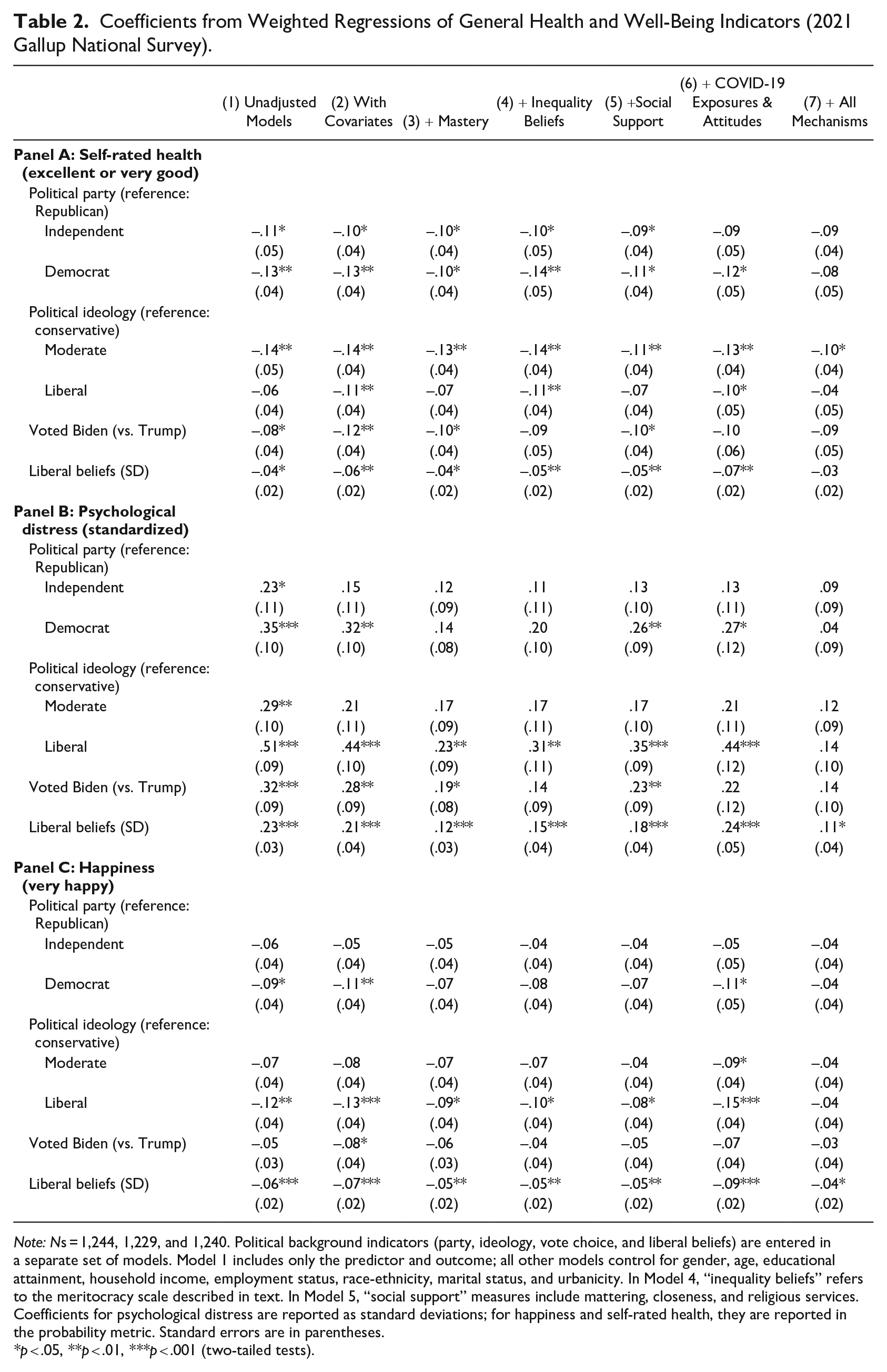
Note: Ns = 1,244, 1,229, and 1,240. Political background indicators (party, ideology, vote choice, and liberal beliefs) are entered in a separate set of models. Model 1 includes only the predictor and outcome; all other models control for gender, age, educational attainment, household income, employment status, race-ethnicity, marital status, and urbanicity. In Model 4, “inequality beliefs” refers to the meritocracy scale described in text. In Model 5, “social support” measures include mattering, closeness, and religious services. Coefficients for psychological distress are reported as standard deviations; for happiness and self-rated health, they are reported in the probability metric. Standard errors are in parentheses.
*p < .05, **p < .01, ***p < .001 (two-tailed tests).
Political ideology shows that moderates differ from conservatives (b = −.14, p < .01), whereas the liberal difference is only inconsistently significant across models (e.g., b = −.06, p > .10 in Model 1).
Respondents who voted for Biden show worse self-rated health (b = −.08, p < .05), although this difference is insignificant once inequality beliefs or COVID-19 exposures and attitudes are adjusted (bs = −.09 to −.10, p > .10; Models 4 and 6).
Liberal beliefs in particular show persistent associations with self-rated health (liberal beliefs b = −.04, p < .05 in Model 1; bs = −.04 to −.07 in Models 2–6, p < .05), but not once all mechanisms are adjusted simultaneously (b = −.03, p > .10; Model 7).
Psychological distress
Model fit comparisons for psychological distress reveal considerable variation. For instance, R2 = .051 for liberal beliefs, but R2 = .020 for political party, representing a greater than twofold difference across political background indicators.
As shown in Panel C, independents (b = .23) and Democrats (b = .35) report greater levels of psychological distress compared to Republicans (p < .05) in a baseline model (Model 1). The independent difference becomes insignificant once demographic background is adjusted (b = .15, p > .10; Model 2), whereas the Democrat difference persists (b = .32, p < .01). However, mastery (Model 3) and inequality beliefs (Model 4) each reduce the Democrat psychological distress difference to insignificance (bs = .14 to .20, p > .10).
Political ideology shows that the moderate difference is of a higher estimated magnitude (b = .29, p < .01), as is the liberal difference (b = .51, p < .001; Model 1). The moderate difference does not hold once demographic background is adjusted (b = .21), but the liberal difference does hold (b = .44, p < .001; Model 2). The liberal difference persists across mechanism adjustments, except when all mechanisms are adjusted in Model 7 (b = .14, p > .10).
Respondents who voted for Biden show greater distress (b = .32, p < .001), although inequality beliefs and COVID-related exposures attenuate this pattern to insignificance (bs = .14 to .22, ps > .10).
However, liberal belief shows robust associations with psychological distress net of these mechanisms (liberal beliefs b = .23, p < .001 in Model 1; bs = .12 to .24 in Models 2–6, p < .001).
Happiness
Model fit comparisons for happiness reveal some sizable differences, such as R2 = .013 for political ideology but R2 = .005 for vote choice. As shown in Panel C, independents do not differ from Republicans (b = −.06, p > .10), whereas Democrats report less happiness (b = −.09, p < .05; Model 1). The Democrat difference becomes insignificant once mastery, inequality beliefs, or social support is adjusted (bs = −.07 to −.08, p > .10; Models 3–5).
Political ideology shows no difference between moderates and conservatives (b = −.07, p > .10), whereas the liberal difference is significant (b = −.12, p < .01). The liberal difference persists across all individual mechanisms, rendered insignificant only in Model 7, when all mechanisms are adjusted at once (b = −.04, p > .10).
Respondents who voted for Biden show no consistent difference in distress across models (e.g., Model 1 b = −.05, ns).
However, liberal beliefs show robust associations with happiness across all demographic and mechanisms adjustments (liberal beliefs b = −.06, p < .001 in Model 1; bs = −0.07 to −0.04 in Models 2–7, p < .05).
Behavioral Health: Trouble Falling Asleep and Delayed Routine Health Care
Model fit comparisons reveal some initial discrepancies for trouble falling asleep, such as R2 = .014 for political ideology but R2 = .006 for political party. Table 3 presents regression estimates. As shown in Table 3, Panel A, independents do not differ from Republicans in trouble falling asleep (b = .06, p > .10), whereas Democrats (b = .09) report greater difficulty (Models 1 and 2). However, mechanism adjustments render the Republican–Democrat difference statistically insignificant (Models 3–7; bs = .04 to .08, p > .10). Political ideology shows that the moderate difference is of a higher estimated magnitude (b = .14, p < .01), as is the liberal difference (b = .10, p < .05). The moderate difference persists across all demographic and mechanism adjustments (Models 2–7; bs = .09 to .11, p < .05), whereas the liberal difference becomes insignificant once accounting for mastery or inequality beliefs (Models 3 and 4; bs = .08 to .09, p > .10). Respondents who voted for Biden do not report greater trouble sleeping on average than those who voted for Trump (b = .05, p > .10). However, liberal beliefs are linked to greater trouble sleeping (b = .05, p < .001 in Model 1), which is then reduced to insignificance by psychosocial mechanisms.
Coefficients from Weighted Regressions of Behavioral Health Indicators (2021 Gallup National Survey).
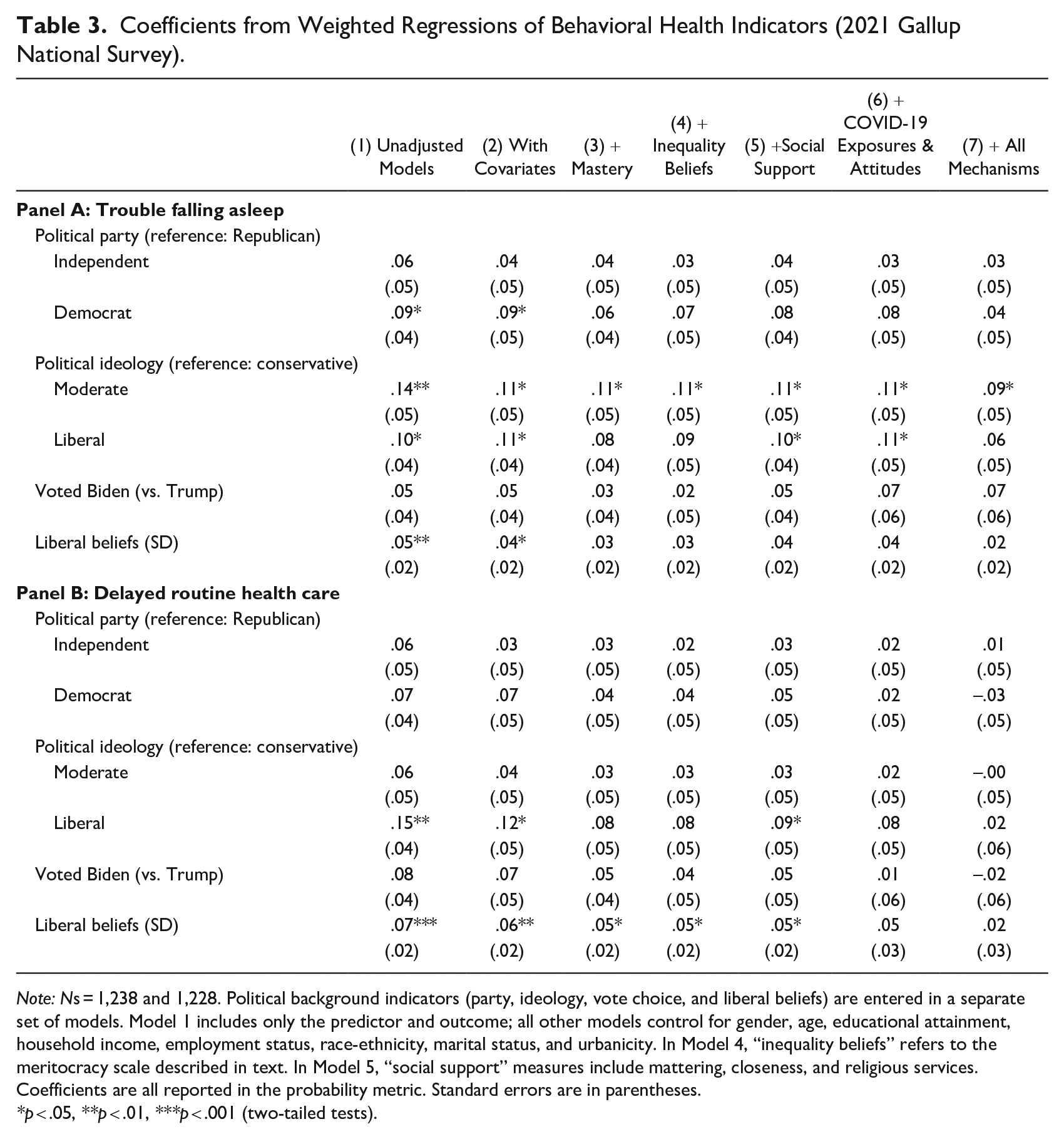
Note: Ns = 1,238 and 1,228. Political background indicators (party, ideology, vote choice, and liberal beliefs) are entered in a separate set of models. Model 1 includes only the predictor and outcome; all other models control for gender, age, educational attainment, household income, employment status, race-ethnicity, marital status, and urbanicity. In Model 4, “inequality beliefs” refers to the meritocracy scale described in text. In Model 5, “social support” measures include mattering, closeness, and religious services. Coefficients are all reported in the probability metric. Standard errors are in parentheses.
*p < .05, **p < .01, ***p < .001 (two-tailed tests).
For delaying routine health care, there again is considerable variation in model fit, such as R2 = .019 for liberal beliefs but R2 = .007 for vote choice. As Panel B shows, no significant differences in delaying health care are found among Democrats relative to Republicans (Models 1–7; bs = −.03 to .07, p > .10). Political ideology shows no difference between moderates and conservatives, either (Models 1–7; bs = −.00 to .06, p > .10). However, liberals are more likely to delay health care (Models 1 and 2; bs = .12 to .15, p < .001). Some mechanisms reduce this difference to insignificance (Models 3, 4, and 6; b = .08, p > .10). Respondents who voted for Biden show no difference in delaying health care relative to Trump voters (Model 1; b = .08, p > .10). However, liberal beliefs are associated with delayed health care (b = .07, p < .001 in Model 1), and this becomes insignificant when adjusting for COVID-19 exposures and attitudes (Model 6; b = .05, p > .10).
Discussion
Analyzing national Gallup data collected in early 2021, during one of the peaks of the COVID-19 pandemic, we find consequential differences in subjective health and well-being by political background. At the same time, our multifaceted approach points to the complicated nature of politics and health in a contemporary context. Overall, differences in fit to health or well-being across party, ideology, voting behavior, and liberal beliefs are not trivial, often amounting to a twofold difference or greater—and translating to divergences in statistical significance or robustness to demographic or mechanism-based adjustments. Although party and ideology are perhaps the most typical approaches to measuring political background, they can produce different estimates compared to voting behavior and liberal policy beliefs. Moreover, associations between political background and measures of health or well-being vary in their robustness to particular psychosocial or exposure-based mechanisms, which is consistent with the possibility that they are organized by or reflect different social-psychological processes related to health.
Republicans generally have better self-rated health than Democrats and independents, whereas liberals and conservatives generally have better self-rated health than moderates. By contrast, Democrats and liberals have consistently higher psychological distress than Republicans and conservatives, whereas independents and moderates do not differ from their right-leaning counterparts. Patterns of happiness mirror those found for distress.
Across all of these general health measures, liberal beliefs are the most reliable differentiator of political health differences, holding across all demographic and mechanism adjustments. Measuring political background in terms of beliefs is far less common than party or ideology—but it may help to capture useful variation in politics missed by party or ideology. In terms of behavioral health, trouble falling asleep is differentiated mainly by ideology, whereas delaying health care is differentiated by ideology and policy beliefs.
In addition to revealing the value of a multifaceted approach to political background, our study generates new, updated knowledge about how classic mechanisms relate to these political divides. Mastery and related inequality beliefs show consistent associations with these political health differences, whereas differences in social support and viral exposure during the COVID-19 pandemic also show promise in helping to explain health inequalities, depending on how political background is measured. Contrasting findings across health indicators could be instructive for future research and theory development.
Around the time the Gallup data were collected, President-Elect Joe Biden was inaugurated, and the January 6 insurrection had just taken place. Meanwhile, the first single-dose COVID-19 vaccine became available in the United States even as the death toll surpassed 500,000 during one of the peaks of COVID transmission in the United States (Swan et al. 2021). As Stavrova and Luhmann (2016) observe, differences in happiness or well-being by political background are significantly moderated by sociocultural context, and the events of January 2021 contribute crucially to such context.
A decade ago, Pearlin and Bierman (2013) noted that ideology is rarely pursued as a source of variation in psychosocial mechanisms that shape health and well-being. Our study suggests that political background—ideology but also partisanship, vote choice, and policy preferences—patterns a wide range of mechanisms, including mastery, meritocracy beliefs, religious attendance, and closeness to others. These differences may help to explain divergent patterns of health and well-being during the COVID-19 pandemic. Perhaps relatedly, scholars of religion and health have long argued that divine beliefs play an important role in the stress process, shaping individuals’ access to coping resources and their appraisal of stressful circumstances as threatening or manageable (Louie et al. 2022; Schieman and Bierman 2011; Upenieks and Ellison 2022). An analogous, broader process might occur in the political arena, as novel social threats are interpreted through a political lens. Indeed, Wright et al. (2022) observed divergent stress appraisals by political ideology during the COVID-19 pandemic. Conservatives were more likely to believe the pandemic was in their control, leading to reduced anxiety. Consistent with this insight, McLeod (2012) has argued that the subjective meanings of social stress condition health outcomes. Altogether, we believe that political background inflects social reality with varying degrees of urgency, salience, or perceived suffering, and as such, it deserves closer attention as a meta-mechanism organizing resource and stress trajectories.
The data analyzed here carry several limitations, which identify potential ways forward for contemporary research into political health differences. First, cross-sectional analysis precludes tests of within-person change in resources or well-being, which are important in times of upheaval (Kiley and Vaisey 2020). Second, although we draw on national Gallup data and implement poststratification weighting, lower response rates obtained during the COVID-19 pandemic point to a need for continued research using additional data sources. Finally, although we considered political differences in psychosocial resources, future work should incorporate measures of stress mindset or appraisal to examine the role of politics more directly.
We have taken a multifaceted, multioutcome approach to studying political health differences, but other approaches certainly are possible. For instance, Xu, Burton, and Plaks (2022) found that different dimensions of conservatism are differentially associated with well-being: Those scoring higher on moral traditionalism and ethnic separateness suffered from negativity bias, whereas respondents scoring higher on libertarian independence showed positive adjustment. Moreover, detailed measures of smoking, drinking, and drug use would provide a fuller portrait of behavioral health. Moving forward, state- and institution-level explanations of political or structural health differences (e.g., Brown and Homan 2022; Homan 2019; Montez 2020; Torche and Rauf 2021) could be integrated into a multilevel conceptual model. Mismatches between individual political background and the larger political context, for example, might constitute a unique source of distress. Finally, the nexus of politics and religion deserves attention as an engine of political health differences. For instance, Christian nationalism represents a unique confluence of politics and religion with distinctive consequences for health (Whitehead and Perry 2020).
Conclusion
In a post-Trump era oriented by pandemic coping and survival, Republican or conservative disadvantages in COVID-19 infection and mortality are juxtaposed with Democratic and liberal disadvantages in subjective, overall health. Amid this hurting on both sides of political divides, our examination of potential pathways suggests that mastery, inequality beliefs, social support, and COVID-19 exposures and attitudes all might help to explain politics-based differences in self-reported mental and physical health during the COVID-19 pandemic. Our results also draw attention to the importance of multifaceted measurement of political background and to political inequalities in sleep and health care utilization. We find that differences in health or well-being prediction are not trivial across ideology, party, voting behavior, and policy beliefs, with model fit depending on how political background is measured. Liberal policy beliefs predict health differences most robustly across outcomes and mechanism adjustments. As the political landscape of the United States continues to shift, scholars must continue to track the effect of these changes on political differences in health and well-being.
Supplemental Material
sj-docx-1-hsb-10.1177_00221465231200500 – Supplemental material for Hurt on Both Sides: Political Differences in Health and Well-Being during the COVID-19 Pandemic
Supplemental material, sj-docx-1-hsb-10.1177_00221465231200500 for Hurt on Both Sides: Political Differences in Health and Well-Being during the COVID-19 Pandemic by Max E. Coleman and Matthew A. Andersson in Journal of Health and Social Behavior
Footnotes
Acknowledgements
The authors would like to thank Paul Froese and the Baylor Department of Sociology for designing and funding the 2021 Gallup Values and Beliefs of the American Public Survey.

Supplemental Material
Appendices A and B are available in the online version of the article.
Notes
Author Biographies
References
Supplementary Material
Please find the following supplemental material available below.
For Open Access articles published under a Creative Commons License, all supplemental material carries the same license as the article it is associated with.
For non-Open Access articles published, all supplemental material carries a non-exclusive license, and permission requests for re-use of supplemental material or any part of supplemental material shall be sent directly to the copyright owner as specified in the copyright notice associated with the article.
