




Abstract
While studies have linked culturally responsive teaching to positive student outcomes, developing teachers’ dispositions and practice for culturally responsive teaching remain challenging. This study investigates the antecedents and conditions that facilitated increases in culturally responsive dispositions among middle school teachers following the summer of 2020. Using survey data from 533 middle school teachers and follow-up interviews with 15 teachers, the study explores changes in teachers’ personal commitments to culturally responsive teaching and examines factors influencing their increased attention to race and equity. The findings have implications for developing teachers with the commitments to advance equity and inclusivity in schools.
While research and efforts to address racial bias have been circulating for decades, the summer of 2020 marked a national reckoning that catalyzed new commitments among educators who had not previously prioritized this work. High-profile incidents of racial injustice—including the murder of George Floyd, subsequent protests, and the growing Black Lives Matter movement—illuminated urgent needs to address systemic oppression and inequity in the US. In response, many educators reaffirmed or adopted new commitments to culturally responsive-sustaining pedagogies, which use students’ cultural and racial identities, knowledge, and interests to promote academic success, sociopolitical consciousness, cultural awareness, cultural pluralism, and anti-racist competencies (Ladson-Billings, 2006; NYSED, 2019; Paris, 2012). At that time, instilling these capabilities in K-12 students fit the moment and aligned with a national sentiment focused on fighting for equity and social justice. However, in fall 2024, the US re-elected a former president known for making racist remarks and policies, disparaging and imprisoning immigrants, and inciting hate and violence (Giroux, 2022; Kang et al., 2024). The election signaled public endorsement of systemic oppression and inequality, threatening the national movement toward equity and social justice. Now, it is even more imperative that educators commit to understanding and enacting culturally responsive-sustaining pedagogies to foster a new generation of Americans who will continue the fight for equity and social justice. However, developing teachers’ culturally responsive dispositions, mindsets that undergird culturally responsive-sustaining pedagogy, can be difficult (Gay, 2015; Villegas & Lucas, 2002). In this regard, heightened national attention to racial injustice in 2020 provided a unique opportunity to examine the experiences of teachers whose views on equity and teaching about racism shifted during that time. Understanding how that time period may have provided conditions and antecedents that heightened some teachers’ interest in being culturally responsive and sustaining may better position us to advance equity through teacher development in the coming years.
This mixed-methods study explores conditions and antecedents that enabled increases in culturally responsive dispositions among a sample of US middle school teachers after summer 2020. A survey of 533 teachers in fall 2021 and follow-up interviews with 15 teachers in summer 2022 examined reported increases in culturally responsive dispositions. We consider two research questions: (1) To what extent and in what types of schools did participating middle school teachers report an increase in attention to race and equity at the school, student, and personal levels since before 2020? (2) What conditions and antecedents did teachers report enabled increases in culturally responsive dispositions?
By identifying conditions and antecedents for increasing culturally responsive dispositions, we can better support teachers in developing interests and commitments that foster equitable and inclusive schools. Although societal issues underlying practices like police brutality toward Black Americans are systemic, not individual, expanding culturally responsive-sustaining pedagogy is a critical building block for fostering critical consciousness to create a citizenry that fights for and pursues a more just society (NYSED, 2019; Spencer Foundation, 2024). Culturally responsive-sustaining teachers foster students’ sociopolitical consciousness, which can develop their identities as change agents who improve our world and our society (Ladson-Billings, 1995). By studying teachers whose culturally responsive dispositions increased, we seek to inform design of social and contextual conditions that develop teachers’ culturally responsive dispositions.
Literature Review
Dispositions Toward Culturally Responsive-Sustaining Pedagogy
Asset-based pedagogies—which recognize, build upon, and center students’ individual and cultural strengths—increase equity in academic and disciplinary outcomes while enhancing student motivation, academic success, and sense of belonging (Aronson & Laughter, 2016; Milner, 2017; Strauss & Ingram, 2019). Such pedagogies include Ladson-Billings’ (1995) culturally relevant pedagogy, Gay’s (2002) culturally responsive teaching, and Paris’s (2012) culturally sustaining pedagogy. While all these pedagogies share asset-based commitments, they differ in focus. Culturally relevant pedagogy emphasizes affirming students’ cultures and challenging inequitable social systems, culturally responsive teaching focuses on using culture to support student learning, and culturally sustaining pedagogy stresses sustaining and revitalizing students’ cultural and linguistic practices. In this paper, we use the term culturally responsive-sustaining pedagogy, following NYSED (2019), to signal the synthesis of these traditions.
Collectively termed culturally responsive-sustaining pedagogy (CR-SP), these instructional approaches draw upon students’ cultural knowledge, experiences, and interests to foster academic success, sociopolitical consciousness, sociocultural responsiveness, and ability to challenge oppressive societal systems (NYSED, 2019). Paris’s (2012) introduction of sustaining as an element of asset pedagogies captures the focus on maintaining and strengthening students’ heritage cultures and languages for a pluralistic society. To be a CR-SP teacher means affirming students’ cultural knowledge, histories, and identities while simultaneously sustaining and revitalizing their heritage languages and practices (Ladson-Billings, 1995; Paris, 2012). CR-SP teachers design instruction that builds on students’ lived experiences, integrate multiple cultural perspectives into curricula, and foster classrooms that affirm racial and cultural identities while challenging systemic inequities (NYSED, 2019). Research demonstrates that these approaches benefit students by increasing engagement, motivation, and achievement, as well as developing critical consciousness and pride in cultural identity (Aronson & Laughter, 2016; Ladson-Billings, 1995; Paris, 2012). At the school level, CR-SP teaching contributes to more inclusive climates and reduces inequities by countering racialized patterns of discipline and achievement (Khalifa et al., 2016). For colleagues, CR-SP practices can encourage collaboration, shared learning, and professional communities oriented toward equity, thereby influencing collective norms and expectations within schools (Coburn & Russell, 2008; Warren, 2018). These benefits underscore why cultivating teachers’ culturally responsive dispositions is a critical foundation for advancing equity in education.
To prepare students to challenge oppressive societal systems, culturally responsive-sustaining pedagogy includes anti-racist practices such as identifying and deconstructing racial biases in curricula, engaging in critical discussions about systemic inequities, and creating classroom environments that affirm students’ racial and cultural identities (Darling-Hammond, 2017; NYSED, 2019). To enact such teaching, educators must hold culturally responsive dispositions—habits of mind and beliefs aligned with asset-based and equity-focused instruction (Ladson-Billings, 2006; Seriki & Brown, 2017). Recent studies affirm that dispositions remain central in shaping teachers’ evolving practice: Pevec-Zimmer and co-authors (2024) found that fostering awareness and self-efficacy for culturally responsive teaching is key to sustaining practice, while Ford (2024) highlighted the importance of dispositions in guiding secondary teachers’ equity-oriented instructional choices.”
In responding to questions about what teachers can do to be culturally relevant, Ladson-Billings (2011) asserts that asking what to do is the wrong question. Instead, culturally relevant teachers think in asset-oriented ways about the inequitable social context of education, capabilities and potential of poor students of color, problems with hegemonic curricula, and how to ensure access to learning through instructional decision-making. These orientations constitute culturally responsive dispositions. Other researchers pose similar conceptualizations. Villegas and Lucas (2002) describe culturally responsive teachers as socioculturally conscious, affirming of diverse students, equity-focused, knowledgeable about students’ lives and learning, and skilled in building on their knowledge. To operationalize culturally responsive dispositions for quantitative analysis, Comstock et al. (2023) assessed teachers’ beliefs in the ability of all students to be successful regardless of demographics, beliefs in the value of cultural diversity, and beliefs in the importance of race-consciousness in teaching. In surveys with over 400 urban middle school teachers, Comstock (2025) found strong links between these beliefs, self-efficacy for culturally responsive teaching, and reported use of such practices—demonstrating that culturally responsive dispositions underpin asset-based instruction. Our decision to use the term culturally responsive dispositions reflects the use of this term in the literature (e.g., Comstock et al., 2023; Warren, 2018), and we note that these orientations form a necessary foundation for culturally relevant, responsive, and sustaining practices (see Paris & Alim, 2017; Warren, 2018).
Synthesizing across scholars, we assert that teachers with culturally responsive dispositions possess seven key orientations: (a) recognizing inequitable social contexts for low-income students of color, (b) seeing students in affirming ways and believing all students can learn, (c) critiquing dominant curricula, (d) understanding students and how they learn, (e) designing instruction that builds on students’ knowledge and interests, (f) believing in the value of cultural diversity and race-consciousness in teaching, and (g) promoting equitable access to learning (Comstock et al., 2023; Ladson-Billings, 2011; Villegas & Lucas, 2002). Our emphasis on teacher dispositions aligns with broader research showing that dispositions—defined as the inclination, sensitivity, and capacity to act—shape instructional practices and influence openness to adopting new approaches (Perkins et al., 1993; Stephens, 2019).
How Teachers Develop Culturally Responsive Dispositions
Early work on asset-based pedagogies studied effective teachers of African American or African Canadian students, most of whom shared students’ cultures. These teachers not only taught using referents and speech styles known to students; they contributed to students’ cultural pride, refuted racial stereotypes, and believed in students’ capabilities (Irvine, 1989; Ladson-Billings, 1995). Ensuing research has examined how teachers whose cultures differ from their students develop culturally responsive dispositions. Broadly, such dispositions stem from life experiences and professional development (Ladson-Billings, 2006; Seriki & Brown, 2017). In a study of 19 predominantly-white teachers, Parkhouse and colleagues (2023) found that affirming views of students and sociopolitical consciousness were foundational for any other changes in dispositions or practice. Teachers’ awareness of racism and systemic oppression was particularly critical for changing dispositions. Such awareness came from life experiences, books, documentaries, and strong relationships with students. Other researchers have also found that increasing some teachers’ racial and cultural awareness requires more interactions with students, families, and communities of different cultures (Aujla-Bhullar, 2011). Scholarship on developing culturally responsive-sustaining teachers also finds a need for empathy and perspective-taking skills that help educators acquire cultural viewpoints that shape beliefs, values, and attitudes for culturally responsive-sustaining teaching (Ladson-Billings, 2011; Warren, 2018).
This research suggests that, while some teachers independently develop the racial and cultural awareness necessary for culturally responsive dispositions, educational contexts can also support and encourage teachers’ development of such dispositions through frequent social opportunities for teachers to (a) increase their knowledge of racism, their students, and the communities where they teach, (b) interact with students and families from cultural backgrounds different from their own, and (c) engage in perspective taking and empathy building. Without support for understanding culture from the first-person perspectives of diverse students and families, some teachers are left to reproduce and center hegemonic cultural assumptions (Fasching-Varner & Seriki, 2012; Ford, 2024; Pevec-Zimmer et al., 2024).
Conditions and Antecedents for Developing Culturally Responsive Dispositions
While teacher dispositions are shaped by broader social influences (Lerner, 2006), schools and districts can still create conditions that actively support their development (Nelsen, 2015). A key condition for fostering culturally responsive dispositions is culturally responsive school leadership, where formal and informal leaders, colleagues, and coaches offer resources and guidance to support teachers in becoming more culturally responsive (Khalifa et al., 2016; Lopez, 2015; Warren, 2018). A second condition for fostering culturally responsive dispositions is professional learning opportunities that enable teachers to develop cultural competence (Howard & Milner, 2014; Warren, 2018). Collaborative opportunities and learning communities can enable teachers to learn from each other and deepen their understanding of cultural diversity (Ladson-Billings, 1995, 2006). Participation in routines like professional learning communities can provide meaningful interactions that support development of new understandings, norms, and practices (Coburn & Russell, 2008). Self-reflection and metacognition can also influence teachers’ dispositions by helping teachers identify their implicit biases and develop strategies for modifying assumptions in response to new experiences and feedback (Pit-ten Cate et al., 2016). Collectively, research suggests that teachers are more likely to develop culturally responsive dispositions when they interact in culturally diverse communities, process their experiences in collegial dialogue and safe spaces, and engage in metacognitive reflection (Ladson-Billings, 2006).
However, not all schools have leaders or instructional coaches that can or care to foster these types of conditions. Further, even when necessary leadership and learning conditions exist, efforts to develop culturally responsive dispositions may be hindered by organizational routine. Routines encourage repeated action, which legitimizes practice and ingrained knowledge in ways that hinder change (Spillane & Coldren, 2011). Routines also reflect embedded ideologies that normalize cultural majorities while promoting dominant group interests, such as those of white, middle-class, English-speaking identities (Bonilla-Silva, 2017). Established routines often promote cultural logics rooted in white supremacy, racism, and cultural marginalization through practices such as tracking (Lewis & Diamond, 2015) and grading (Irizarry & Cohen, 2019). Thus, even when school leaders do strive to provide conditions for strengthening culturally responsive dispositions, routines may work against intention.
Yet, routines can be disrupted. Diamond and Gomez (2023) note how exogenous or endogenous shocks may disrupt regular practice and the deeply institutionalized nature of routine. In this way, COVID-19 and the heightened Black Lives Matter movement in 2020 may have provided exogenous and endogenous shocks to organizational routine, serving as antecedents for educators to examine their practice and develop new interests in culturally responsive-sustaining pedagogies. This conjecture aligns with other research and theory, suggesting that conflict and tension arising from interaction can inspire reflection and awareness for personal growth (Freire, 2012). Together, this research suggests the necessity of understanding how some educators’ culturally responsive dispositions increased following summer 2020 as they navigated school conditions amidst the antecedents of social and organizational shocks, enabling them to encounter new information, relationships, tensions, and opportunities.
Adolescent Development and Anti-Racism During Middle School
We focus on middle schools because early adolescence is a crucial period for exploring social identity and establishing a sense of self through interactions and group affiliations (Nakkula & Toshalis, 2006). During this period, students experience significant cognitive and socio-emotional growth and begin developing worldviews, identities, and critical consciousness about political and social systems (Godfrey et al., 2019). Increased peer group exposure in middle school, compared to elementary, can also provide opportunities for early adolescents to question their assumptions and beliefs about culture, race, and people who are different from them and to develop a nuanced understanding of societal forces like racism and oppression and their impacts, all of which are central facets of culturally responsive-sustaining pedagogy (New York State Education Department, 2019; Tatum, 2017). Thus, middle school is an important time for culturally responsive-sustaining pedagogy, as early adolescence provides a crucial opportunity for fostering students’ empathy, activism, and equity-oriented identities. Tatum (2017) notes that racism becomes personally relevant for youth of color at this age, making them more likely to challenge dominant narratives. Fu et al. (2024) similarly identify middle school as a critical window for shaping anti-racist, culturally inclusive mindsets among white youth. A growing body of research also shows that culturally responsive teaching fosters adolescents’ political and geo-political consciousness. When young people learn to analyze structural inequities, they develop the political efficacy and sociopolitical awareness needed to understand and respond to broader national and global injustices (Watts et al., 2011). Studies of culturally relevant pedagogy similarly find that such instruction deepens students’ understanding of political movements and global power relations, extending the benefits of culturally responsive teaching to informed civic and political engagement (Aronson & Laughter, 2016). With support, students of all racial backgrounds can come to understand racism and their role in fighting it (Fu et al., 2024; Tatum, 2017). Thus, part of optimizing middle school learning environments should focus on preparing teachers to create culturally responsive-sustaining classrooms that meet early adolescents’ developmental needs and increased cognitive abilities. This, in turn, requires understanding conditions and antecedents that spark and shape middle school teachers’ dispositions to enact such instruction.
Theory of Change
We sought to understand factors influencing how a sample of teachers increased their culturally responsive dispositions between 2020 and 2022, recognizing that some teachers already had strong culturally responsive dispositions and others likely experienced no change. We theorized that certain conditions and antecedents would increase some teachers’ culturally responsive dispositions. Antecedents act as specific and acute catalysts, while conditions are ongoing structures and resources that shape a teacher’s dispositions. We conjectured that as Black Lives Matter gained momentum in response to the unjust and highly publicized killings of George Floyd and Breonna Taylor in summer 2020, these events may have increased some teachers’ culturally responsive dispositions because they were personally impacted or witnessed impacts on their students. These events may have influenced teachers’ awareness of their beliefs about students, cultural diversity, or race-conscious teaching (Comstock et al., 2023).
At the same time, the broader political climate amplified these dynamics. The presidential administration in power during this period routinely disparaged immigrants, denied systemic racism, and characterized equity initiatives as unpatriotic or divisive (Giroux, 2022). Such national leadership and rhetoric intensified public debate and polarization around issues of race and equity, creating a climate in which teachers could not easily ignore systemic injustice. For some educators, this context heightened urgency and reinforced the moral imperative to reconsider their own dispositions, while for others it underscored the risks of being perceived as political when addressing race in the classroom (Diamond & Gomez, 2023). Thus, the social movements of 2020 interacted with national political conditions to create an especially powerful impetus for teachers to reflect on and sometimes shift their culturally responsive dispositions.
We also theorized that as some teachers became more aware of racial inequality, they interacted with school conditions that facilitated heightened culturally responsive dispositions. Such conditions included increased attention to race and equity, more interaction with culturally diverse students and colleagues (Coburn & Russell, 2008; Warren, 2018), safe spaces for dialogue (Gay, 2002; Milner, 2017), and opportunities for reflection on race and culture (Howard, 2003; Milner, 2017). Our theory of change highlights the roles of school, community, and national contexts in changing some teachers’ culturally responsive dispositions.
Method
This analysis uses data from a larger study on how a sample of middle school teachers perceived that the COVID-19 pandemic and racial uprisings of 2020 impacted their students, teaching, and schools. We used an explanatory sequential mixed-methods design (Creswell & Plano Clark, 2011), beginning with a quantitative survey followed by qualitative interviews, and concluding with integrated interpretation. This design allowed us to examine broad patterns in teachers’ reported changes in culturally responsive dispositions and then explore personal and organizational antecedents through in-depth interviews.
Quantitative Methods
Sample
First, in the quantitative phase, we collected and analyzed survey data in fall 2021 to determine broad trends in how participating teachers perceived that middle school teaching conditions had changed since 2019. To reach a broad sample of middle school teachers, we used the Common Core of Data from the National Center for Education Statistics to randomly select 360 public schools serving students in grades 6, 7, and/or 8, and we used school websites to collect available email addresses for teachers who might teach these grades. In November 2021, we sent 7,368 emails to these addresses inviting teachers to complete a survey seeking “to understand how middle school teaching experiences have changed over the last 2 years” given the “challenges of engaging middle school students as the COVID-19 pandemic continues.” Because teachers’ email addresses were publicly available and came from 360 schools across the country, we did not seek permission from school leaders. Rather, we used our university IRB process to ensure ethical treatment of potential study participants, and the survey introduction notified teachers that survey completion constituted consent.
Survey sample descriptive statistics for teachers in grades 6, 7, and/or 8 (n = 533)
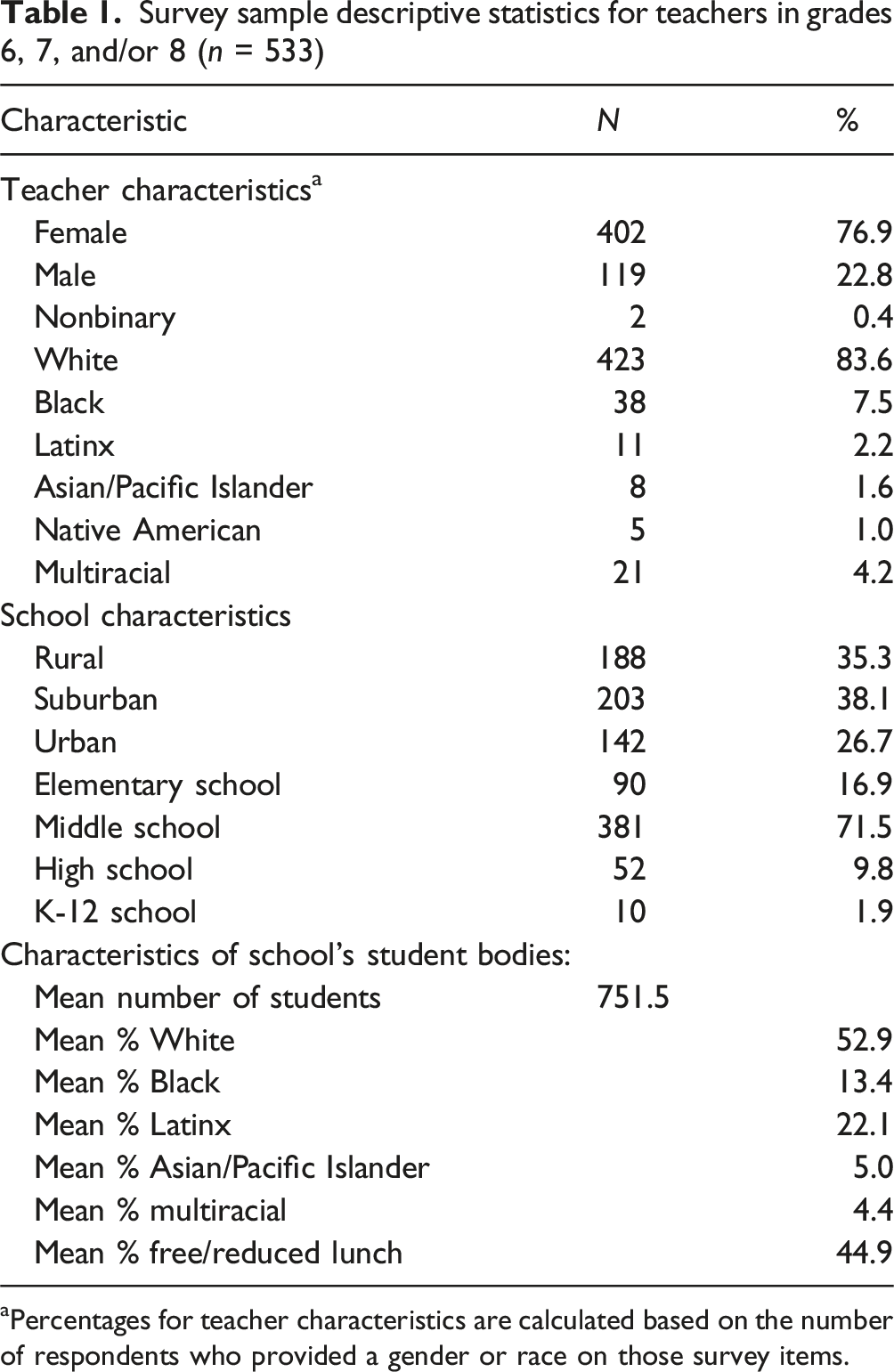
aPercentages for teacher characteristics are calculated based on the number of respondents who provided a gender or race on those survey items.
Data Collection
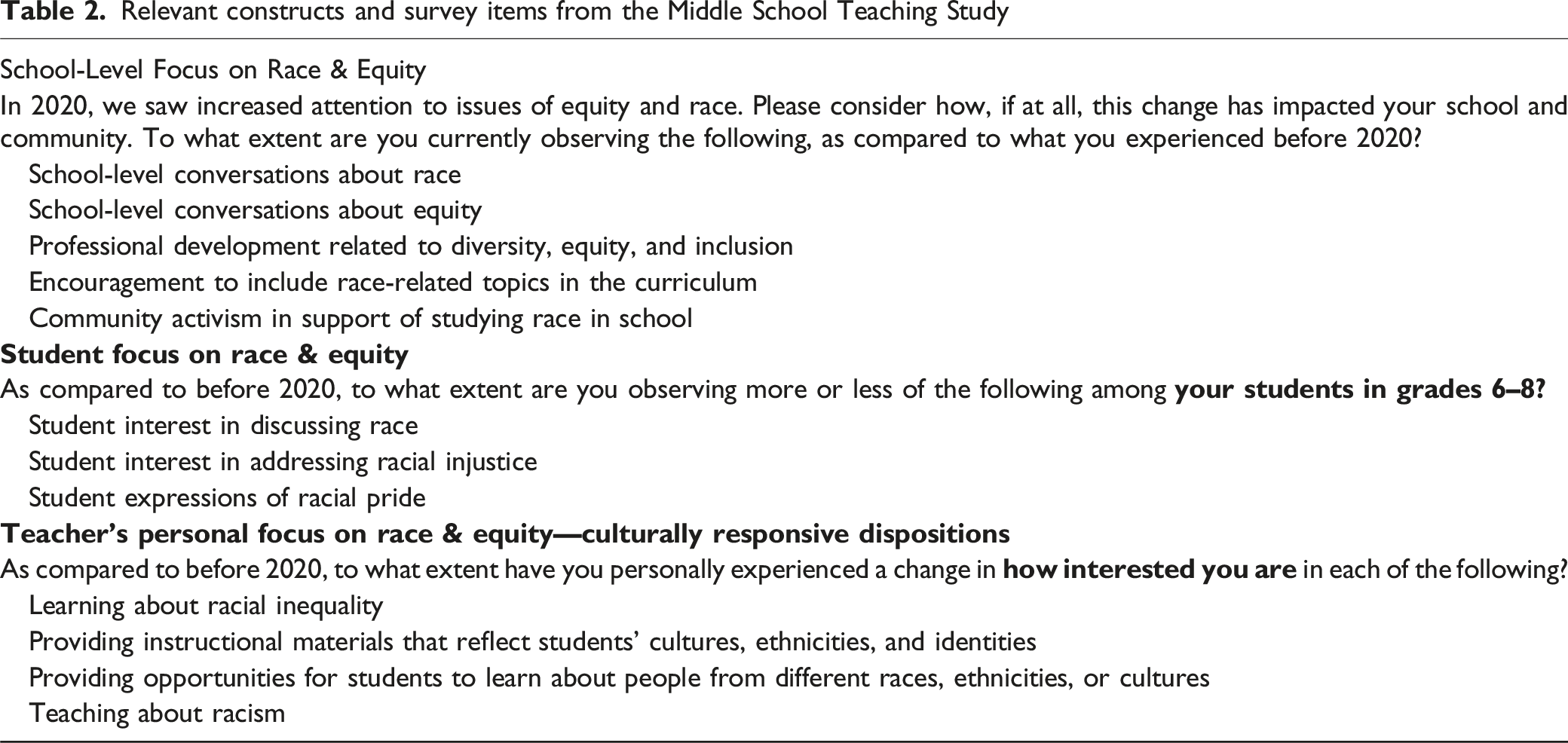
Relevant constructs and survey items from the Middle School Teaching Study
Data Analysis
We used Excel and STATA to clean and analyze survey data. We averaged survey items to create constructs (school-level focus on race and equity, student focus on race and equity, and teachers’ dispositions as revealed by their personal focus on race and equity). We used descriptive statistics, including frequencies, means, and standard deviations, to examine trends for constructs and items. We also used school characteristics from the Common Core of Data, such as urbanicity or percentage of students receiving free and reduced lunch, to assess the types of schools in which participants reported various changes. T-tests and ANOVAs allowed us to examine whether differences across contexts were statistically significant, and we examined correlations to assess relationships among constructs.
Qualitative Methods
Participants
Overview of interview participants (n = 15)
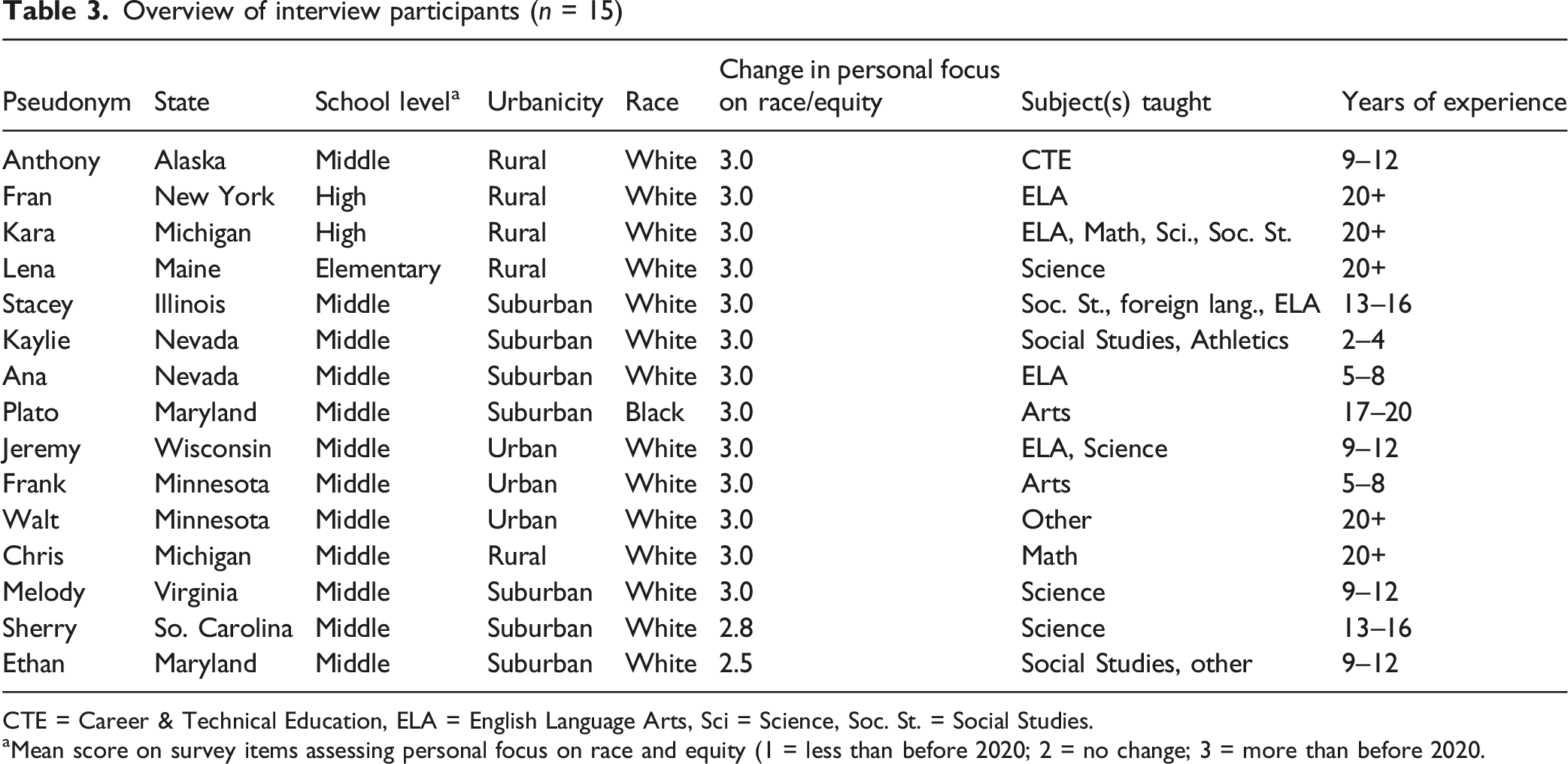
CTE = Career & Technical Education, ELA = English Language Arts, Sci = Science, Soc. St. = Social Studies.
aMean score on survey items assessing personal focus on race and equity (1 = less than before 2020; 2 = no change; 3 = more than before 2020.
Data Collection and Analysis
Follow-up teacher interviews were conducted in June 2022 over Zoom, lasted 30–60 minutes, were recorded using Zoom, and were transcribed using an online service. Interviews explored participants’ increased interest in learning and teaching about race and equity (i.e., increased culturally responsive dispositions) as identified in their survey results. The protocol, included in Appendix A, explored why and how these dispositions had increased (e.g., “You reported being more interested in learning about racial equity; what spurred this change?”). The protocol also addressed teachers’ school context and how it supported or hindered their interests in teaching about race, equity, and culture (e.g., “Do you think your teaching colleagues care about race and equity? Why do you think so?”). To capture rich description, follow-up questions elicited stories about how and why teachers’ dispositions had changed (Seidman, 2006).
For interview data, we used a priori codes based on our research questions to code all transcripts descriptively in Dedoose (Cohen et al., 2018). We then divided codes among the three members of our research team and used emergent codes to analyze trends in antecedents and conditions for increased culturally responsive dispositions. Throughout, we used analytic memos to track our thinking and develop our findings (Miles et al., 2014).
Integration of Quantitative and Qualitative Findings
The mixed methods design intentionally linked quantitative and qualitative phases at two points: during sampling and in interpretation (Creswell & Plano Clark, 2011). We purposefully sampled interview participants from among survey respondents based on reported increases in culturally responsive dispositions and varied school contexts, enabling explanation of patterns in the quantitative data (Cohen et al., 2018). We used survey data to determine the extent to which and contexts in which some teachers reported increased culturally responsive dispositions, and then we used interview data from a purposive sample of 15 of those teachers to identify conditions and antecedents that enabled those increases. Integrated interpretation triangulated findings from both strands, allowing us to identify how national, local, and school-level dynamics may have contributed to teacher development in the wake of 2020’s social and political upheaval (Cohen et al., 2018).
Researcher Positionalities
We leaned on our collective experiences as K-12 teachers, researchers, parents, and students to inform our theory of change, our data analysis, and our interactions with teachers during this overwhelming time. Although we are three white women, we bring diverse intersectional assets and lenses that stem from our professional, academic, cultural, and personal backgrounds. The first author is a doctoral student studying improvement practices in urban school districts, who leans heavily on her experience as a middle school teacher in large urban districts in the Northeast. The second author is an associate professor with expertise in culturally responsive-sustaining instructional improvement and teaching experience in urban and suburban schools in Southern California. The third author is a doctoral student who teaches English Learners in a rural high school in the Pacific Northwest. Throughout the analytic process, we challenged each other to consider where our identities may have biased us to privilege some explanations over others. This approach helped us identify and address personal biases, leading to a more comprehensive, nuanced understanding of our data.
We recognize that our positionalities as white women, while providing certain perspectives as educators and researchers, also mean that we do not share the lived experiences of the students and communities of color at the center of this study. For us, explicitly naming positionality is important because research on culturally responsive-sustaining pedagogy risks reproducing dominant narratives if authors do not account for their own social locations and potential biases (Milner, 2007). We believe it is significant to amplify this work because, as scholars committed to equity and justice in education, we see it as our responsibility to use our access to research, publishing, and professional networks to highlight how teachers’ dispositions toward race and equity are shaped in this moment. At the same time, we approach this work with humility and reflexivity, seeking to elevate teachers’ voices rather than position ourselves as authorities on communities of color. Naming our positionalities is one way of holding ourselves accountable to the ethical and scholarly responsibility of contributing to the advancement of equity-focused education. As Milner (2007) argues, researchers must grapple with the “seen, unseen, and unforeseen” dangers of race and positionality in qualitative work. For us, naming our identities as white women is not only a matter of transparency but also a way to hold ourselves accountable to avoiding the reproduction of dominant narratives.
Findings
Our research explored how much, where, and why teachers’ culturally responsive dispositions increased after summer 2020. We begin with quantitative findings on the extent and contextual variation of increased attention to race and equity, followed by qualitative findings on the personal and organizational antecedents that shaped these shifts.
Quantitative Findings: Increased Attention to Race and Equity
Participating teachers’ reports on changes in school, student, and personal interests in race and equity (n = 533)
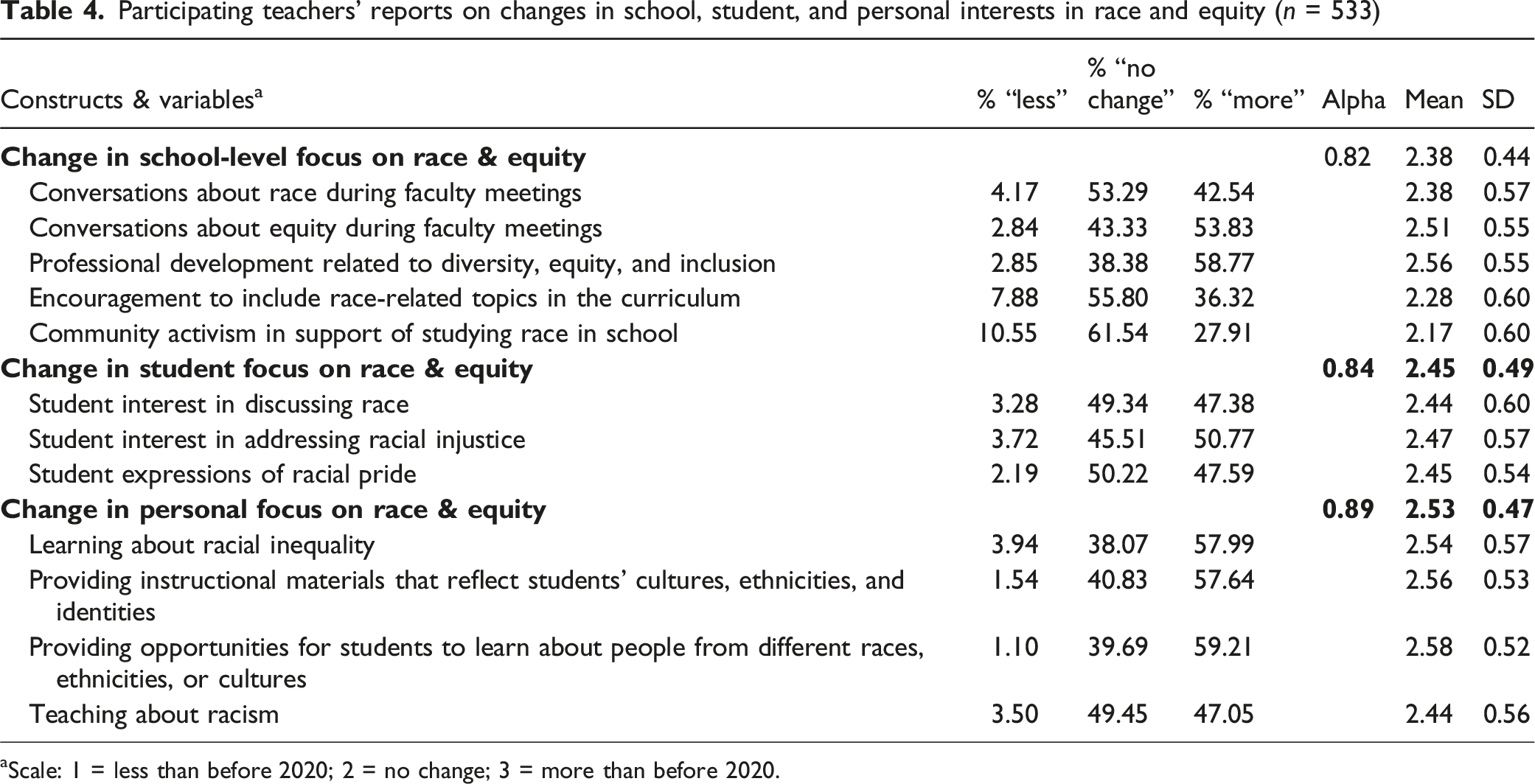
aScale: 1 = less than before 2020; 2 = no change; 3 = more than before 2020.
Construct-level means (and standard deviations) for participating teachers working in different types of school communities (n = 533)

aScale: 1 = less than before 2020; 2 = no change; 3 = more than before 2020.
bUsing NCES guidelines, we define schools with free/reduced lunch below 25% as low poverty schools and schools with free/reduced lunch above 75% as high poverty schools.
cUsing the same cut points noted in footnote b, we define schools with fewer than 25% students of color as low and schools with more than 75% students of color as high.
d. Mean values in each row that share the same letter are significantly different, as determined by a t-test or one way ANOVA using a Scheffé test to account for multiple-comparisons (p < .05).
The importance of context was reflected in teachers’ comments in a final, open-ended survey question that asked respondents if they had anything else they wanted to share. For some respondents, the pertinent context was their school. One Wisconsin teacher commented that their school “does things very differently from other schools; there is an active movement in talking about current problems about gender, race, and equality.” Yet, a teacher from a different Wisconsin school noted, “The topics of Critical Race Theory and Black Lives Matter have essentially been censored at my school for being ‘too political.’” For others, their state was a critical contextual factor. A Texas teacher stated, “Living in a state that opposes teaching race/racism issues in the classroom has unfortunately affected my interest in teaching about racism and inequalities due to legal reasons.” Another Texas teacher shared, “Teaching history in the south right now is very hard…. The state has made it hard to address these issues.” Further illustrating the role of context, we found moderate correlations among participants’ reports of increased attention to race and equity at the three levels: school, student, and personal. When participants reported increased personal attention to race and equity, they were more likely to note increased school-level attention to race and equity (r = .270) and student attention to race and equity (r = .543). Relatedly, teachers reported that in schools with increased student interest in race and equity, school leaders were also likely to have increased attention to race and equity (r = .339). Seemingly, local context was a factor in increased culturally responsive dispositions.
Qualitative Findings: Conditions and Antecedents for Increasing Culturally Responsive Dispositions
Survey results showed some teachers developed stronger culturally responsive dispositions. To understand why, we interviewed these teachers about personal and organizational factors that supported this growth. Analysis of interviews indicated four enabling conditions or antecedents for their increased culturally responsive dispositions: district- and school-sponsored learning spaces, community support for culturally responsive-sustaining pedagogy, proximity to racial injustice and privilege, and perceived changes in students. We also found one condition, political dynamics among parents and community, that tempered some teachers’ culturally responsive dispositions.
District- and School-Sponsored Learning Spaces
One condition that fostered culturally responsive dispositions was district- and school-facilitated learning spaces, such as PLCs and working groups, focused on equity. Such spaces provided shared purpose and community for acquiring new knowledge, and they conveyed the district or school’s valuing of racial equity, which validated and supported teachers’ culturally responsive dispositions. For example, Frank began to recognize disparities among his students while teaching remotely during the pandemic, noting, “There were students for whom schooling from home was a conducive environment and for others it just was not.” Because Frank worked in close geographical proximity to the 2020 murder of George Floyd, which he described as “a flashpoint for the area,” his district began examining racial disparities. Frank noted, “Our district, I’m happy to say, has made good on their promise that they would continue to ask hard questions. And last year, once a week, we would have racial equity meetings.” Through his district’s focus on racial equity, Frank began to recognize the central role of race in educational disparity, and he reflected, “Sometimes you have to be very concrete… this is about race.” Similarly, when asked what spurred his increased interest in learning about race, Walt credited three things—sharing an office with a new Black colleague and being “able to ask him things directly,” being “about 11 miles from where George Floyd was killed,” and a focus on race in his district. Walt explained, “Our district had done some studies and found that we needed to get better in areas around race.” So, teachers at Walt’s school “started meeting weekly in small teams and talked about racial issues.” He recounted his group reviewing focus-group data from Black eighth-graders and then discussing racial privilege with their predominantly white students. These examples illustrate school-level approaches to addressing race and equity, which helped teachers such as Frank and Walt focus more explicitly on race and expand their culturally responsive dispositions to see direct connections between race and inequality.
Community Support for Culturally Responsive-Sustaining Pedagogy
As an antecedent for change, many participants’ culturally responsive dispositions increased as their personal and professional communities became more vocal in supporting equity, such as the Black Lives Matter movement or the movement against Asian hate. For example, Lena described how her Asian friend felt othered and scared by the uptick in anti-Asian rhetoric during the COVID-19 pandemic. Reflecting on the cultural otherness her friend experienced, Lena deepened her commitment to culturally responsive-sustaining pedagogy. Lena shared, We read a book where the protagonist is an African American girl who is an orphan separated from everything she knows after her parents are killed. She ends up in a foster home with a single Vietnamese mother. We were able to touch on a lot of things last year in a way that I hadn’t before because of all the stuff in the news at the time about the anti-Asian hate crimes that were happening. I had my Vietnamese-American friend Zoom with my kids to talk about her experiences as a child, some of the bullying that she faced, and some of the racist, awful things other kids said to her. That was the first time I’ve ever brought a human in who really exposed her emotions… That was probably one of the most powerful lessons of the entire year.
Others, like Kara, spoke of the impact of their professional community. Kara described a previous school where she taught, noting, “The racism was really bad, like really bad.” In contrast, she praised her current school: “We’re an international school…. There’s many different races from many different continents. It’s just the culture here that we respect everyone’s diversity.” With 2020’s national zeitgeist on racial equity, Kara explained that her colleagues’ vocal commitments to creating safe, culturally responsive-sustaining classrooms deepened her interest in culturally responsive-sustaining teaching. Collectively, participants’ supportive communities included family, friends, colleagues, and school leaders who provided affirmation and safety for exploring culturally responsive-sustaining practices.
Proximity to Racial Injustice and Privilege
Many white interviewees described increased culturally responsive dispositions being spurred by physical proximity to racial injustice and racially motivated brutality. Jeremy shared how unrest in his hometown near Kenosha, Wisconsin changed his perspective. In August 2020, the police shooting of Jacob Blake in Kenosha stirred local protests that reflected larger Black Lives Matter protests nationwide. Discussions on systemic injustice, privilege, and racism consumed his community and made participation virtually non-negotiable. This physical proximity deepened Jeremy’s interest in serving students outside the white cultural majority: Where I teach is literally 10 miles north of Kenosha, where we had some riots during the whole summer… I graduated from high school in Kenosha… And I finally recognized some of my privileges. Some of what I experienced, I didn’t realize how much of it was rooted in privilege, like mouthing off to the cops when they stopped me as I’m walking home at night. But then also a lot of my teaching. Since getting into teaching, I’ve been teaching in minority communities or diverse communities.
Like other interviewees, Jeremy described his culturally responsive dispositions as pre-existing but furthered by anti-racist movements. The same was true for Anthony, a white man who taught at an Alaskan school serving a “native community” and many Filipino students. Anthony described how social media brought Black Lives Matter into students’ lives and his classroom: They’re constantly bombarded with everything on social media and news. So it’s one of those things that you can either run from it or you can just embrace it…. All the stuff in Minneapolis when the George Floyd stuff was going on, that was like really bringing a light. It’s been very eye opening for a lot of people, and this younger generation can’t get away from their phone.
With pervasive technology, social media made distant events feel proximate to Anthony’s teaching. Jeremy and Anthony’s experiences of proximity to the Black Lives Matter movement made their privilege as white men in the cultural majority visible to them. Their subsequent involvement in conversations on race and cultural differences became personally significant antecedents that spurred their attention to racial injustice in their teaching.
Perceived Changes in Students
Perceived changes in students also served as antecedents for teachers’ increased culturally responsive dispositions. Some participants perceived changes in how students treated each other, often behaving in ways they described as “racist” and “problematic.” Teachers attributed this change to social media or emboldened racist rhetoric in students’ homes. On her students voicing more racist and xenophobic viewpoints Lena theorized: I think the former presidency emboldened people to say and do things that they wouldn’t have before because societally it was unacceptable. Now suddenly these kinds of mindsets, words, and signs in this contingent of our society are deemed acceptable, which to me is appalling.
Other participants observed increased student interest in exploring and advocating for race, identity, culture, and equity. Ethan described how his African American journalism students demonstrated an increased “sense of pride in their heritage.” He said, In journalism, we pick current events. Since Black Lives Matter hasn’t really been in the news as much as it was a year or two ago, it began to feel like less of a ‘current event.’ However, these students advocated for themselves successfully. So I ultimately let them track that movement.
In cases like Ethan’s, students’ increased sociopolitical consciousness inspired teachers’ interests in culturally responsive-sustaining teaching. Some interviewees also noticed racial disparities in how COVID-19 impacted their students, which increased their interest in understanding and addressing racism and injustice. For example, when asked why her interest in culturally responsive teaching increased, Sherry described deepening academic disparities along racial, ethnic, and cultural lines: “The shutdown made it really clear who had access and who didn’t, and who had parents at home who didn’t have significant trouble trying to keep their house afloat.” As Sherry noticed patterns in how COVID-19 impacted the experiences of her Black and Latine students compared to her white, socio-economically advantaged students, she was motivated to teach in ways that could combat systemic inequities.
Political Dynamics Among Parents and the Community
Although many interviewees described increased culturally responsive dispositions, several noted that local political dynamics tempered their willingness to act. Political dynamics among parents and the broader community tempered some teachers’ culturally responsive dispositions, underscoring the importance of situating these findings within the national political climate. In recent years, increased polarization around equity-related issues in education—such as debates over Critical Race Theory, book bans, and legislation restricting classroom discussions of race, gender, and identity—has created a climate of heightened scrutiny and fear for many teachers (Diamond & Gomez, 2023; Giroux, 2022). Several participants described how these national discourses influenced their local contexts, shaping parental expectations and constraining their willingness to act on culturally responsive commitments. For example, teachers worried about being “written up” or facing community backlash if they addressed topics related to race or privilege, even when their own dispositions had shifted toward more equity-focused perspectives. This finding highlights the tension between personal or professional growth and the broader sociopolitical environment, suggesting that efforts to cultivate culturally responsive-sustaining pedagogy must attend to not only individual teacher development but also the political conditions that enable or inhibit such practice. For example, Walt commented on teaching about privilege, “My fear is when you talk about those things, parents now are so revved up about anything that you say the wrong thing and all hell breaks loose.” Sherry shared, “I can’t hang a rainbow flag in South Carolina” to show allyship with LGBTQ youth, but she used her “own possessions like my purse and my water bottle” to display such messages. While teachers found subtle ways to resist, political pressure clearly influenced how—and how much—they engaged in culturally responsive-sustaining pedagogy.
Integrated Findings
The integration of survey and interview data provides a fuller picture of how teachers’ culturally responsive dispositions developed and how these dispositions were enacted in practice. Quantitative results indicated that a majority of teachers reported heightened awareness and commitment to equity-oriented practices following 2020. These shifts were evident in statistically significant increases on survey items related to valuing students’ cultural identities, recognizing systemic inequities, and expressing willingness to adapt instruction to meet diverse needs.
Qualitative findings provided insight into the lived experiences that shaped and complicated these shifts. Teachers described how the racial reckoning of 2020, community dynamics, and political debates created both urgency and constraint in their practice. For example, while some participants described new commitments to addressing racial equity in their classrooms, others expressed hesitation due to fear of backlash from parents or administrators. This nuance suggested that while dispositions had shifted, enactment of culturally responsive-sustaining pedagogy was uneven and context dependent.
When analyzed together, the quantitative and qualitative findings highlight both convergence and divergence. Convergence is evident in the consistent evidence that teachers developed stronger orientations toward equity; survey data revealed increased disposition scores, and interview narratives illustrated the personal and professional experiences that undergirded these changes. Divergence emerged in how these dispositions were enacted. Surveys alone might suggest that increased dispositions would naturally translate into more equitable practice, but interviews revealed that sociopolitical dynamics and organizational constraints limited some teachers’ ability to fully act on their commitments. Thus, the integrated findings demonstrate that growth in culturally responsive dispositions is a necessary but not sufficient condition for sustaining practice.
Discussion
This study examined how teachers’ culturally responsive dispositions evolved after the disruptions of 2020, focusing on (1) the personal and organizational factors that enabled these shifts and (2) how changes in dispositions related to changes in practice. Our findings reveal that events in 2020 increased culturally responsive dispositions among some middle school teachers. We found that contextual factors of these teachers’ work environments exerted stronger influence on altered dispositions than individual characteristics. For example, increased school and student attention to race and equity were related to teachers’ increased culturally responsive dispositions, and equity-focused learning spaces within schools and professional communities supported increased interest in culturally responsive-sustaining education. Teachers’ personal lives were also influential, as personal communities and proximity to racial injustice shaped dispositions. Additionally, greater national attention to racial injustice, including Black Lives Matter and increased anti-Asian hate, created a national context in which some teachers felt morally compelled to address injustice with their students. Yet, local political sentiment tempered some teachers’ culturally responsive dispositions, as they strategized how to avoid political backlash. Collectively, these findings illustrate antecedents and conditions that spurred increases in some middle school teachers’ culturally responsive dispositions.
These findings must also be interpreted within the broader political climate of 2020 and beyond. National debates over Critical Race Theory, book bans, and legislation restricting classroom discussions of race, gender, and identity have created an atmosphere of heightened scrutiny for teachers (Diamond & Gomez, 2023; Giroux, 2022). Such rhetoric amplified the stakes of engaging in culturally responsive-sustaining practices and, as our participants indicated, shaped parental and community expectations in ways that constrained their instructional decisions. This broader political context complicates efforts to cultivate CR-SP: even as teachers developed more equity-oriented dispositions through professional learning and lived experiences, they simultaneously confronted external pressures that tempered their willingness to act on these commitments. These dynamics highlight the importance of understanding teachers’ growth not only as a function of individual or organizational factors (e.g., leadership support, collaborative learning opportunities) but also as embedded in contested sociopolitical conditions. As such, sustaining culturally responsive-sustaining pedagogy requires attending to the interplay between teachers’ dispositions, organizational supports, and the broader political environment.
Contributions to the Literature
Existing literature documents two foundational conditions—culturally responsive school leadership and collaborative professional learning opportunities promoting cultural competence—that can foster development of culturally responsive dispositions (Khalifa et al., 2016; Ladson-Billings, 2006; Lopez, 2015; Warren, 2018). This study illuminated some ways these conditions played out within the unique context of heightened national attention to race and equity after 2020. For school leadership, we found that survey respondents who reported increased culturally responsive dispositions also tended to report school-wide increases in attention to race and equity. Such attention primarily manifested in conversations about equity during faculty meetings and professional development related to diversity, equity, and inclusion, which over 50% of survey participants reported had increased since before 2020. Interviews revealed that structured school-wide support for equity fostered increased culturally responsive dispositions for some teachers (Comstock, 2025). Walt, for example, described PLCs using focus group data from Black students to analyze racial inequities. These findings reveal some unique ways in which culturally responsive school leadership emerged during this time. Even as leaders grappled with daily challenges of resuming in-person instruction with the COVID-19 pandemic still raging, those who promoted commitments to equity, justice, and culturally responsive-sustaining pedagogy were able to support increased culturally responsive dispositions for some teachers.
For teacher learning, prior research shows that culturally responsive dispositions arise primarily from teachers’ life experiences and professional development (Ladson-Billings, 2006; Seriki & Brown, 2017). Structured learning experiences for white teachers have utilized books, documentaries, and relationships with students as sources for understanding systemic inequality (Parkhouse et al., 2023). However, with the events of 2020, we found that many white teachers had life experiences that provided new insight into racial inequality. Some teachers’ culturally responsive dispositions increased directly from these experiences without any additional support, while for others, professional opportunities to process these experiences in supportive communities enabled the experiences to become fruitful for learning and growth. Additionally, dialogue and interaction exposed some participants to new narratives, experiences, information, and advocacy efforts, which provided social impetus for recognizing the value of cultural diversity and acknowledging the significance of race-consciousness in teaching, both of which are culturally responsive dispositions. For example, Kara’s professional community shared reinvigorated commitments to respecting cultural pluralism, which provided context for her deepened interest in culturally responsive-sustaining pedagogy. Anecdotes like this demonstrate how school conditions can help teachers develop culturally responsive dispositions by providing opportunities for teachers to engage with new information, narratives, and experiences they encounter in and outside of school.
As antecedents for change, we found that COVID-19 and response to police brutality in 2020 spurred some teachers to develop interest in and critical insights for culturally responsive-sustaining pedagogy. In Diamond and Gomez’s (2023) work on unsettling organizational routines that uphold anti-Blackness, they assert the need for exogenous and endogenous shocks that disrupt “business as usual.” Our research illustrates how the pandemic and police brutality against Black life shocked organizations and individuals, inspiring some teachers to re-examine their teaching and develop new insights. For example, teachers like Ethan and Lena perceived changes in students, including increased racial pride and racist statements, that were powerful antecedents for renewed commitment to culturally responsive-sustaining pedagogy. We also found that proximity to students’ experiences and challenges, especially heightened inequality during the pandemic and exposure to systemic injustice, were antecedents that fostered empathy and increased interest in teaching about race and culture. Survey respondents in schools with more students of color showed increased inclination toward culturally responsive-sustaining pedagogy, suggesting that proximity to more students of color during this time intensified dispositions for teaching about race and culture. Interviews reflected his notion. For example, Jeremy’s physical proximity to the police shooting of Jacob Blake spurred his participation in discussions on systemic injustice, and he began to view his privilege in new ways, thereby bolstering his culturally responsive dispositions. Examples like these underscore the importance of not only supporting educators in developing empathy and understanding through proximity (Ladson-Billings, 2011; Warren, 2018) but also of providing space and time for teachers to process events that can change their thinking.
Importantly, our findings apply to only some of the seven culturally responsive dispositions we describe in our literature review. While events in 2020 spurred increased culturally responsive dispositions for many teachers in our study, these changes largely centered on only two orientations: (a) increased recognition of inequitable social contexts for low-income students of color and (f) greater belief in the value of cultural diversity and race-consciousness in teaching. Police brutality against Black Americans and the Black Lives Matter movement emphasized structural inequality and racism, making these events antecedents for teachers to develop new insights in these areas. We also found some evidence that teachers increased their interest in (e) designing instruction that builds on students’ knowledge and interest, particularly regarding cultural diversity. However, we did not find changes in teachers’ perceptions of (b) academic abilities of students of color, (c) hegemony of the dominant curriculum, (d) students and how they learn, or (g) equitable access to learning for all students. Thus, we only identified changed culturally responsive dispositions regarding sociopolitical consciousness and awareness of racism and inequality. While research has shown these insights to be fundamental for culturally responsive dispositions (Parkhouse et al., 2023), they do not represent the full spectrum of such dispositions. This finding illustrates the need to distinguish among learning opportunities that foster different orientations within culturally responsive dispositions.
Our findings show that teachers’ development of culturally responsive dispositions was most evident in orientations related to sociopolitical consciousness and awareness. While these are foundational elements of culturally responsive-sustaining pedagogy (Paris, 2012; Parkhouse et al., 2023), our findings suggest they are necessary but may not, on their own, capture the full range of orientations needed for sustained CR-SP practice. Prior scholarship has emphasized that CR-SP requires not only critical awareness but also enduring commitments to asset-based views of students, adaptive instructional practices, and efforts to sustain students’ cultural and linguistic resources (Gay, 2002; Ladson-Billings, 1995). By comparing our findings to these broader orientations, we highlight both the promise and the limitations of the dispositions we observed. Returning to the orientations outlined in our literature review, this study demonstrates that teachers’ growth was concentrated in awareness, while other orientations remained less evident. By integrating the survey results and interview narratives, we underscore that sociopolitical awareness is a critical first step, but not, in itself, sufficient. The contribution of this study lies in demonstrating both the potential and limits of disposition shifts: these early changes signal movement toward equity, but lasting CR-SP pedagogy requires additional orientations and supportive organizational conditions.
Finally, we must note that our participants were mostly white. We believe this is because teachers of color likely held stronger pre-existing commitments to culturally responsive-sustaining pedagogy and therefore experienced less change after 2020. As such, our findings may be especially useful for understanding how to cultivate culturally responsive dispositions among white teachers from culturally dominant backgrounds—a common focus in this area of research (Parkhouse et al., 2023; Seriki & Brown, 2017). In our study, prominent national conversations on systemic injustice and racial oppression in 2020 provided white teachers with fresh opportunities for perspective-taking and closer engagement in discussions surrounding race and equity in the US.
Implications and Directions for Future Research
This study has several implications for those seeking to prepare and develop culturally responsive-sustaining educators. First, educators will need opportunities to take the perspectives of people from cultures different from their own. Although a national crisis was the antecedent for perspective-taking in this study, schools could create other relevant antecedents. Racial injustice is pervasive in US society, and school leaders who possess culturally responsive dispositions themselves could unearth new insight into such injustice in locally meaningful ways. For example, Walt’s school used focus-group data with Black students to foster teacher discussion. School leaders could use similar local data to prompt teachers to take new perspectives. Second, while the shocks of COVID-19 and the increased social movement for Black Lives may be specific to this time period, perceptions of student changes were powerful antecedents for increasing culturally responsive dispositions. School leaders might support teachers in developing culturally responsive dispositions by providing conditions for teachers to reflect upon and discuss observed changes in students through lenses of equity, justice, and culturally responsive-sustaining pedagogy. Of course, this strategy is only applicable when school leaders have the dispositions and skills to lead such reflection, which is not always the case.
Moreover, an important tension emerged in our study. Teachers’ perceptions of students’ relational and academic changes motivated them to create classrooms that were safe, joyful, and inclusive—fueling interest in culturally responsive-sustaining pedagogy. While these perceptions reflected genuine concern for students’ well-being, they also revealed that teachers’ orientations were still developing toward fully asset-based perspectives. Culturally responsive-sustaining pedagogy emphasizes recognizing and building on students’ cultural strengths (Gay, 2002; Ladson-Billings, 1995; Paris, 2012). Our findings suggest that initial shifts in teacher dispositions, even when catalyzed by challenging observations, can serve as a starting point for developing stronger equity orientations. As Parkhouse et al. (2023) found, sociopolitical consciousness and affirming views of students are foundational, interactive tenets for culturally responsive-sustaining pedagogy. Our study shows that teachers can develop sociopolitical consciousness through life experiences as well as professional learning, but that additional support is needed to ensure their perspectives consistently reflect an asset-based view of students.
These findings carry several implications for teacher preparation and professional learning. For institutions of higher education, the results highlight the need to integrate culturally responsive-sustaining pedagogy into coursework and field experiences so that teacher candidates enter the profession with both conceptual grounding and equity-oriented dispositions. Teacher education programs can embed case-based inquiry, reflection protocols, and fieldwork that engages candidates in analyzing sociopolitical dynamics and sustaining students’ cultural practices (Kang et al., 2024; Bhatnagar et al., 2024). For school districts and administrators, the findings point to the importance of creating systemic supports for culturally responsive practice. District leaders and principals can reinforce teacher growth by embedding CR-SP into professional learning systems, allocating time for collaborative inquiry groups, and fostering partnerships that connect educators with students’ communities. While many teachers in this study attributed their sociopolitical consciousness to lived experiences and national events, professional development remains a crucial mechanism for transforming this awareness into sustained practice. Professional learning can be designed to critically engage teachers with current events, provide equity-centered coaching, and offer sustained, collaborative structures for reflection and inquiry. Together, these implications suggest that both higher education institutions and K-12 systems can play complementary roles in cultivating teachers’ dispositions and building organizational conditions that sustain culturally responsive-sustaining pedagogy over time.
This study raises important questions for future research. First, it provides evidence that some individuals are more positioned than others to experience increases in culturally responsive disposition, and an interesting question is who they are. Many participants described their interest in culturally responsive-sustaining pedagogy as something that was “re-energized” rather than new. Future research could examine the characteristics, experiences, and contexts that prime folks for developing culturally responsive dispositions. Further, this study reflected a particular moment in time, one in which national conversations about race and equity were prompted by a national outcry against racially motivated acts of brutality. Future studies might consider how schools can help teachers develop culturally responsive dispositions more routinely within everyday professional spaces and in times when the national agenda is not in tune with educational efforts to promote equity and social justice.
There are also several limitations that future research could address. First, we asked participants to self-report changes in their interests. Research has shown that respondents may provide socially desirable responses (Groves et al., 2009). They might feel pressured to reflect societal expectations or choose what they perceive as the “correct” response rather than expressing genuine views. As Table 3 shows, teachers reported the greatest increase in personal dispositions toward teaching about race and equity and smaller increases in student and school attention to race and equity. In a highly politicized context around race and equity during a time with national momentum around realizing and repairing historic harm done to people of color, contextual conditions may have incentivized folks to self-report greater increases in their personal interests. Moreover, participants may not accurately recall their true feelings about race and equity. Responses might be influenced by current events, recent experiences, or other factors that affect their mood or mindset at the time of data collection, leading to inconsistent or unreliable responses (Groves et al., 2009). Given this limitation, future research could measure changes in interests and dispositions using other data collection tools, such as interviews or observations. Another limitation is that our participants were predominantly white. Future research could investigate a more diverse sample to better understand antecedents and conditions for teachers of color to become more culturally responsive and sustaining.
Conclusion
Inequity and oppression are systemic issues rooted in structural conditions that can only be redressed by widespread systemic change. Culturally responsive-sustaining pedagogy contributes to this change by fostering youths’ critical consciousness and identities as agents of social justice (Ladson-Billings, 1995). The current presidential administration makes this educational focus especially urgent. Supporting teachers in developing culturally responsive dispositions is a central component of making our educational systems and our nation places of robust equity, thriving, and justice. To this end, this study examined enabling factors for increases in culturally responsive dispositions among US middle school teachers following 2020’s heightened social movement to honor Black lives. We found that this movement shaped some middle school teachers’ dispositions toward culturally responsive-sustaining pedagogy, as support for racial equity grew in the nation and in schools. However, we also noted that political pressures increased some teachers’ perception of threats that somewhat stymied interests in culturally responsive-sustaining pedagogy. These insights illustrate the nuanced, incremental, context-dependent nature of developing culturally responsive dispositions while also providing a greater understanding of how organizations and social forces—as conditions and antecedents—can create fertile ground for developing heightened interest in culturally responsive-sustaining pedagogy.
Supplemental Material
Supplemental material - Increasing Teachers’ Culturally Responsive Dispositions: Conditions and Antecedents
Supplemental material for Increasing Teachers’ Culturally Responsive Dispositions: Conditions and Antecedents by Mary-Louise Leger, Kristy Cooper Stein, Ann DeChenne in Journal of Education.
Footnotes
Funding
The authors received no financial support for the research, authorship, and/or publication of this article.
Declaration of Conflicting Interests
The authors declared no potential conflicts of interest with respect to the research, authorship, and/or publication of this article.
Supplemental Material
Supplemental material for this article is available online.
References
Supplementary Material
Please find the following supplemental material available below.
For Open Access articles published under a Creative Commons License, all supplemental material carries the same license as the article it is associated with.
For non-Open Access articles published, all supplemental material carries a non-exclusive license, and permission requests for re-use of supplemental material or any part of supplemental material shall be sent directly to the copyright owner as specified in the copyright notice associated with the article.
