




Abstract
This study explored the life experiences of care experienced adults in higher education to understand the factors that impeded or enhanced their journeys. Care experienced refers to someone who has been in the care of the state at some point in their life. Six students with a history in the care system took part in semi-structured interviews. Thematic analysis identified global themes of self-reliance, resilience, intrinsic motivation and optimism which derived from underlying experiences of support, attachment, trust, expectations and placement experiences. Findings suggest that more could be done to enable looked after children to proceed into higher education.
Introduction
Care experienced adults are individuals who have been in the care of the state at some point and are more prone to social marginalisation and commonly experience poor outcomes in life (Stein, 2006b; Driscoll, 2013). They are also at greater risk of developing mental health disorders (Butterworth et al., 2017), involvement in crime (Van Breda & Dickens, 2017), and there is a greater likelihood of homelessness, poverty and unemployment (Kelly, 2017; Wade & Dixon, 2006). The statistics of poor outcomes for care leavers highlight a need for research which focuses on factors which facilitate care leavers in making good choices for their futures and furthering their education.
The gap in educational attainment between care experienced individuals and their peers starts in childhood and remains generally consistent through emerging adulthood (Cotton et al., 2014; Sebba et al., 2015). The numbers of care experienced young people entering higher education (HE) falls far short of the numbers from non-care experienced peers (Harrison, 2018), and varies by age of entry from 6% at age 18 to around 12% by age 23 (Sebba et al., 2015). Many of those who do enter HE are likely to have a less positive experience of student life because they are older, studying part-time and living in their own accommodation (Donaldson & Townsend, 2007; Mallman & Lee, 2017). In addition, care leavers are 50% more likely to drop-out of university than their peers (Cameron et al., 2018).
A major factor in the underachievement of care experienced adults is the self-fulfilling prophecy as demonstrated effectively many years ago in (Rosenthal & Jacobson, 1968). Evidence shows that social service and school systems rarely consider university as a likely option for looked after children (Jackson & Cameron, 2014), which leads to low levels of expectation in children from care backgrounds (Allnat, 2020) and ultimately to lower levels of entry to HE (O’Higgins et al., 2017).
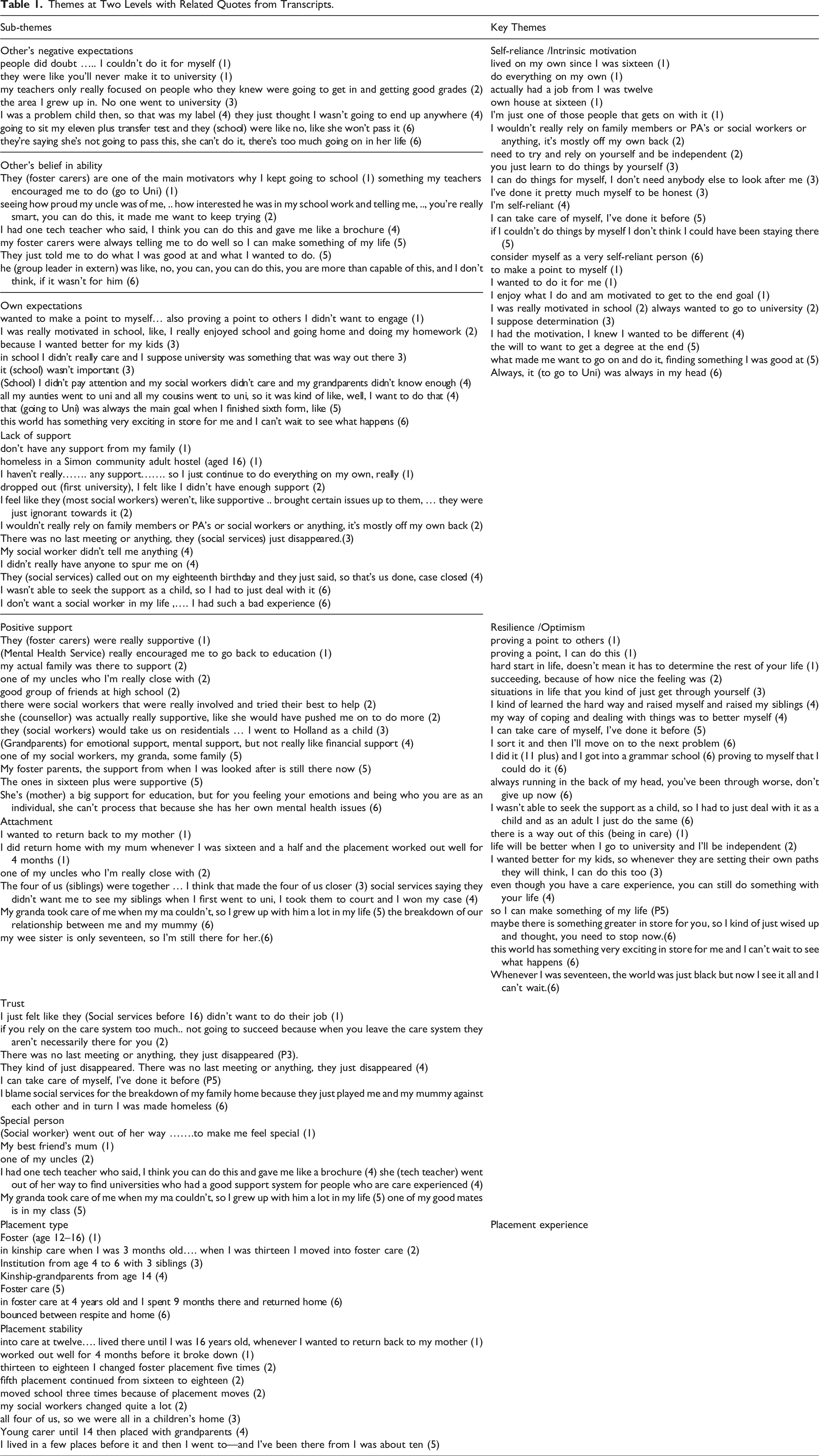
Themes at Two Levels with Related Quotes from Transcripts.
Ajayi and Quigley (2006), identified several facilitating factors for care leaver’s continuing education; early education, encouragement from birth parents, fosters carer support and placement stability. However, this is not the reality for most care leavers, particularly those leaving residential care. Because of the ‘by degrees’ study (Quigley et al., 2003), local authorities and universities within the United Kingdom increased assistance and support for care leavers entering higher education. The Universities and Colleges Admissions Service (UCAS) also added a ‘tick box’ on their application forms for students who have experienced time in care so they could receive support throughout their higher education from outreach officers. Additionally, a yearly care leaver bursary was introduced for those seeking to go to university.
Thus far, this project has been an influential piece of research; however, care leavers entering education are likely to have, ‘strong KS4 attainment, a managed transition process, successful integration into the higher education community, high levels of resilience and/or determination, high-quality disability support; and access to ‘second chance’ educational pathways’ (Harrison, 2018). This would appear to resemble Stein’s (2007) moving on group of care leavers and exclude both the survivor and victim groups. It begs the question as to whether those in the two excluded categories can enter, and succeed, in HE.
Harrison (2018) suggests a ‘possible selves’ model of access to HE which allows an analysis of factors that might impede or facilitate care leavers entering the arena. It essentially sets in context the self-fulfilling prophecy theory of expectations (Rosenthal & Jacobson, 1968). It places the personal beliefs and expectations of the person in the context of the sociocultural environment and the limits set by possibility. The evidence suggests a need to understand the educational development of care experienced individuals within an ecological model (Bronfenbrenner, 1994). See Figure 1. An ecological model of care for looked after children.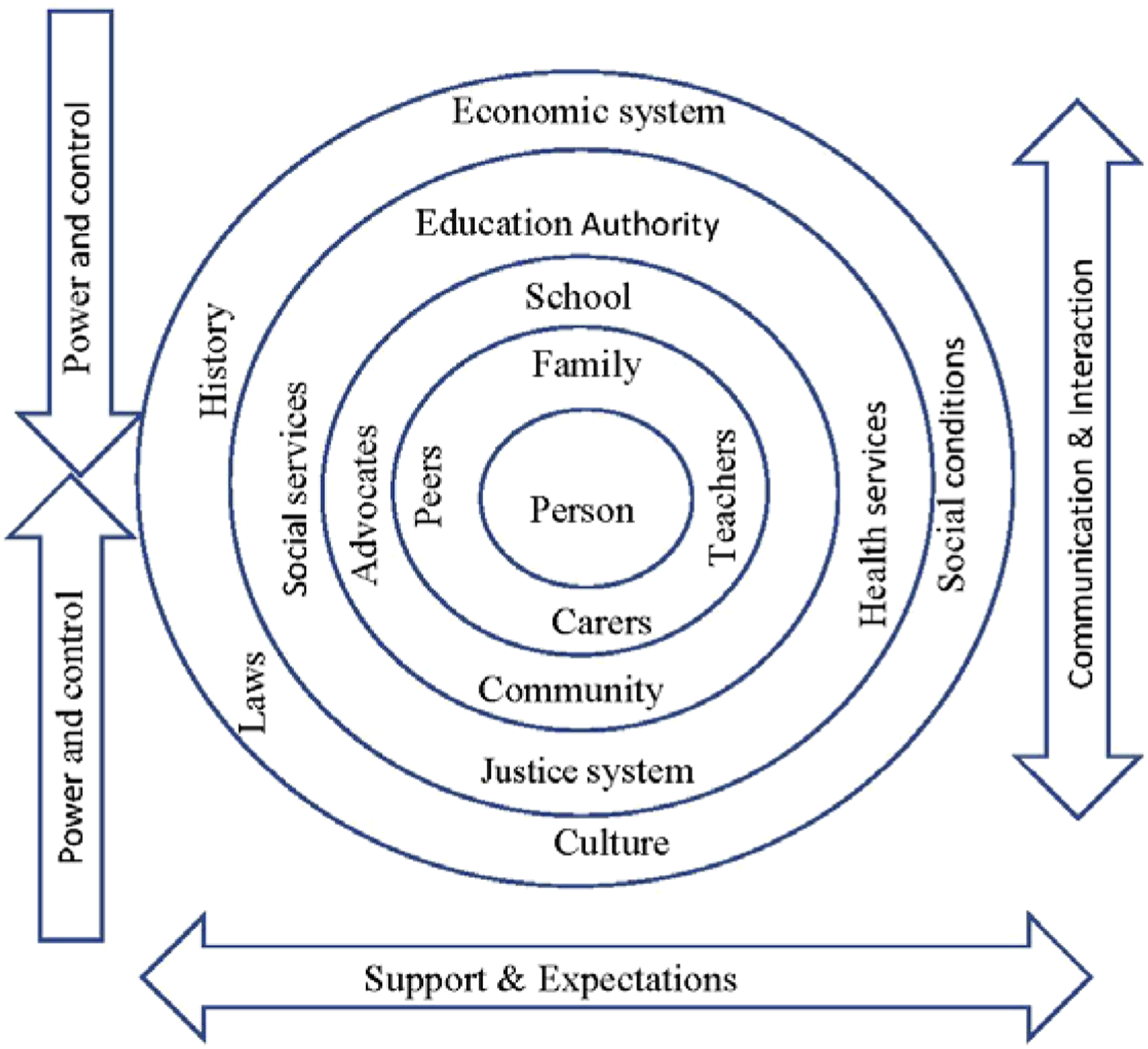
The model is based on Bronfenbrenner’s Ecological Systems model of child development (Bronfenbrenner, 1994). Sometimes referred to as the Social Ecological Model, it provides a multi-level model of the social world and how it impacts on the developing child. The child’s world is defined in terms of different social systems that interact and are interdependent in relation to the child. These systems vary in terms of how direct or indirect their relationship is with the child, but all combine to impact development. The microsystem is most directly involved with the child and includes family, school and peers. The ecosystem includes extended family, school board and health services, which are less directly involved with the child, but have their effect through the mesosystem which is the interlink between the ecosystem and the microsystem. The macrosystem is the social and cultural attitudes, political systems of government and social policies and laws, which are more distant form the child’s everyday experience but nevertheless have a big impact on important aspects of life. Bronfenbrenner recognised the dynamic and developmental aspect of all of this in terms of the chronosystem which reflects changes that occur over the life course. Clearly, both power and support are embedded in these systems and delivered through their interaction.
Figure 1 reflects a modification of Bronfenbrenner’s model to reflect the social ecology of the child in care. The model nests the individual within a series of systems some of which directly impact and others which indirectly impact on the child through their care journey. Evidence suggests that factors at these different levels combine to create the ‘possible self’ (Harrison, 2018). Communication and interaction occur between levels and the support or lack of support produced either nurtures or restricts the development of motivation and resilience. Power is located within the interactions and is generally downward or inward from the more distal systems. The product is measured in terms of support and expectations both external and internal to the child. We are suggesting this as a useful way of conceptualising the process to avoid blaming the person and to remind us of the complex, dynamic and interdependent life experience of the child in care.
In essence, what the complex ecology provides for a child is social capital, and social capital theory has been shown to provide a good explanatory mechanism for children’s educational attainment (McClung & Gayle, 2013). Social capital is a sociological construct which refers to resources that people may have through their relationships in the different levels of their social ecology (Lin & Erickson, 2008). It is about the relationships we have in the networks of which we are a part (McClung & Gayle, 2013). The origins of social capital for a child lie in attachment bonds with parents and carers and continue through their attachment to other key figures such as peers, carers and teachers (Downey et al., 2004). Positive relationships are essentially about secure attachment and secure attachment in childhood forms a solid basis for positive relationships throughout the lifespan (Downey & Feldman, 1996; Downey et al., 2000; Downey et al., 2004). Attachment experiences over childhood and adolescence form an attachment state of mind which is fundamental to forming later relationships (Larose & Bernier, 2001; Zajac et al., 2019). Attachment state of mind impacts on adjustment to school (Bernier et al., 2004) and is related to social support in complex ways (Struck et al., 2020). Insecure attachment state of mind is linked with ineffective support seeking (Khodarahimi et al., 2016; McLeod et al., 2020) and social withdrawal and loneliness (Watson & Nesdale, 2012).
In terms of the ecological model there are a wide range of opportunities for attachment and support from family through peers, teachers, social workers, carers and the systems the child encounters can provide the bases for support and attachment or the lack of both. Social capital theory also espouses trust as a core element and the direct and indirect connections that a child encounters can engender or damage trust. In essence the social ecology of the child can provide a safe space for the development of secure attachment, encouragement and support. Alternatively, it can provide an unsupportive space with low expectations, insecurity and lack of attachment. It is argued that the balance between these alternative social ecologies will explain a substantial portion of the variance in educational attainment for looked after children.
Rationale
An ecological model can provide a useful framework within which the educational development of a child through to young adult can be understood. Within that it can be argued that social capital theory can encompass the range of social resources that can enable or restrict a child’s progress through to higher education. This can be observed in terms of the level of expectation for the child embedded in their social structures as in the self-fulfilling prophecy explanation.
Aims
There are still many unanswered questions within this framework in relation to care experienced individual’s educational attainment. The current study aimed to explore the experiences of a sample of care experienced adults currently in higher education to try and elucidate some of the potential barriers and facilitators.
Methods
Design
The research used semi-structured interviews to explore the experiences of care experienced individuals on their journey to higher education. The interview schedule is included in Appendix 1.
Participants
Six university undergraduate students, all female, voluntarily responded to an invitation to participate in this research. They ranged in age from 22 to 26 and all were in the final year of their degree. All those who had self-identified as having a care background and who were registered on the degree programme in the year of the study were contacted by the university outreach worker. A brief description of their histories is provided below.
P1: Went into care aged 12 on a Court Order and had supportive and continuous Foster placement until aged 16. Returned to mother but that placement broke down after 4 months, following which she spent time homeless in the Simon Community before getting her own flat at age 16. One social worker and best friend’s mum provided support and inspiration.
P2: In kinship care from 3 months and then fostered at age 13. She had four placements between the ages 13 and 16 then one from 16 to 18. She was emotionally close to an uncle who supported her throughout.
P3: Second youngest in family of four and became a young carer for the others. All four went into a care home for 8 months when she was aged six. Had a poor relationship with some social workers. She married young and had her own children. She still feels traumatised by the experience of being taken from her birth home.
P4: Grew up with alcoholic parents and helped raise self and three siblings (young carer) before being placed with grandparents at age 14. Other siblings were fostered. She had little contact with or support from social services. One Tech teacher provided inspiration. She is still a carer for her siblings while at university.
P5: Fostered from age 6 and had several unstable placements before a stable foster placement from aged 10. She maintained constant contact with a Grandfather. Foster carers provided encouragement to go to university.
P6: Grew up with mother who had mental illness and was care experienced. She has two siblings, both from different fathers. She spent 9 months in foster care aged 4. There followed a period of being in and out of respite care. Started to self-harm as a teenager. She was homeless for a period and blames social worker for coming between her and her mother.
Procedure
After ethical approval from the School of Psychology ethics committee students with a care background were contacted and asked if they would take part in an interview. As part of their university application prospective students are asked if they have ever been in care. Names of those who disclose this information are lodged with the university outreach service which offers financial and other support. All sixteen undergraduate students currently known to the university outreach service were contacted by the university outreach worker independently from the researcher. They were provided with an information sheet and a consent form which they signed if they agreed to take part. All those who responded were included in the study. The researcher arranged with those who responded and consented to participate in terms of time and place for interview. Interviews were audio-recorded and transcribed verbatim, ensuring that all identifying information was removed. This study was conducted in accordance with the General Data Protection Regulations (GDPR) and the British Psychological Society’s (BPS) ethical guidance. Six of the sixteen students contacted responded and took part in the study, a response rate of 37.5%.
Data Handling and Analysis
Qualitative thematic analysis (Miles & Huberman, 1994) was applied to analyse and describe the data. During the first stage, data reduction and transcripts were read repeatedly, and recordings were listened to several times to ensure the accuracy of the transcription. This repeated reading and the use of the recordings to listen to the data, results in data immersion and ensures the researcher’s deeper relationship with the data. During the second stage coding categories were formed which identified aspects of the data that were pertinent to the research question. The third stage involved identifying themes which combined relevant codes into descriptors of larger portions of the data which were presented in a thematic map as shown in Figure 2. All relevant codes were included and themes that seemed less supported at this stage were revisited in the data to ensure that no relevant codes had been missed. The next stage involved naming the themes by reviewing the underlying codes to ensure relevance to the research aims. The final stage in the process involved identifying examples from the transcript that evidenced the theme. Triangulation was used in that coding was reviewed by two researchers working independently to ensure codes were reliably identified. Resulting themes and quotes were discussed by both researchers, and all discrepancies were identified and resolved, which improved the reliability of the analysis process. An illustration of the themes at different levels that underpin transition to higher education for these care experienced students.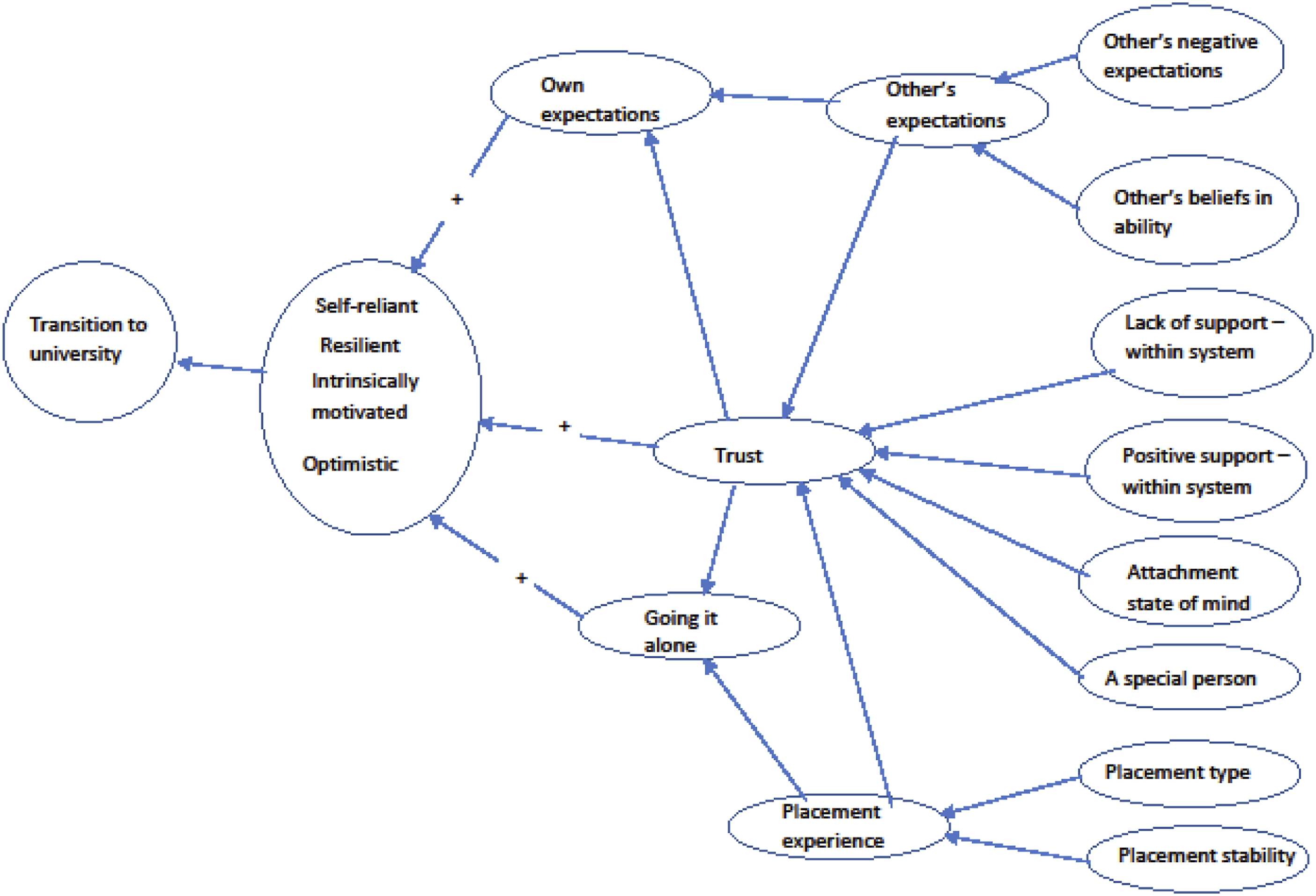
Interpretation of themes was guided broadly by the social ecological model in that the child is embedded in a multi-level context of social relations which ultimately contribute to the personal characteristics which help to explain the child’s journey into higher education.
Results
The key themes identified were self-reliance, resilience, intrinsic motivation and optimism which were built upon subthemes around other’s expectations or beliefs about ability, support, attachment, a special person and placement. The impact of others was linked to own expectations, sense of trust and going it alone, as illustrated in Figure 1. In order to explicate these after some discussion of placement there will be an outline of each subtheme and in the last part the key themes which emerge from the subthemes.
Based on the children’s descriptions of their world the key themes reflect the personal qualities of the child which are shaped through interaction with their social ecology.
Placement and the Care Journey
The care journey through placements provided the context for the children’s lived experience. There were a range of placement types, foster care, kinship care, institutional care and various combinations of these. For example, in kinship care when I was 3 months old…. when I was thirteen I moved into foster care (P2)
Institution from age 4-6 with 3 siblings (P3)
in foster care at 4 years old and I spent 9 months there and returned home …. bounced between respite and home (P6)
Regardless of care placement, all participants experienced relationships with social services throughout a substantial part of their childhood, and all experienced some disruption and instability. into care at twelve…. lived there until I was 16 years old, whenever I wanted to return back to my mother ….. worked out well for 4 months before it broke down (P1)
thirteen to eighteen I changed foster placement five times ……fifth placement continued from sixteen to eighteen (P2)
Young carer until 14 then placed with grandparents (P4)
I lived in a few places before it and then I went to --- and I’ve been there from I was about ten (P5)
There seems to be a consistent pattern of experiencing several placements before eventually finding some stability in the older childhood years. We know that lack of stability in care is one of the key predictors of distress (Kelly, 2017), and is also a source of economic cost to social services (Hannon et al., 2010). Education is not a priority for children and young people who experience placement disruption (O’Neill et al., 2018).
Sub Themes
The subthemes were other’s expectations or beliefs about ability, support, attachment and a special person, all of which impacted on the child’s own expectations, sense of trust and sense of going it alone.
Expectations and Beliefs About Ability
All the children experienced negative expectations from one or other of family, teachers or social workers. The social systems which should have been supportive generally had a limited view of the child’s potential.
people did doubt ….. I couldn’t do it for myself ….. they were like you’ll never make it to university (P1)
my teachers only really focused on people who they knew were going to get in and getting good grades (P2)
the area I grew up in. No one went to university (P3)
I was a problem child then, so that was my label …. they just thought I wasn’t going to end up anywhere (P4)
going to sit my eleven plus transfer test and they (school) were like no, like she won’t pass it (6)
This is the classic Pygmalion in the classroom effect (Rosenthal & Jacobson, 1968), whereby negative expectations of children become self-fulfilling prophecies. The impact of teacher expectations on student achievement has generated a substantial body of research (Rubie-Davies, 2010) most of which has focused on the negative effects. The negative expectations were not just within school but were also located by the children in their community.
In contrast most also had someone who believed in their ability to succeed.
They (foster carers) are one of the main motivators why I kept going to school ….. something my teachers encouraged me to do (go to Uni) (P1)
seeing how proud my uncle was of me, .. how interested he was in my school work and telling me, .., you’re really smart, you can do this, it made me want to keep trying (P2)
I had one tech teacher who said, I think you can do this and gave me a brochure (P4)
my foster carers were always telling me to do well so I can make something of my life ….. They just told me to do what I was good at and what I wanted to do. (P5)
he (group leader in extern) was like, no, you can, you can do this, you are more than capable of this, and I don’t think, if it wasn’t for him (P6)
It seems that this contrast between negative expectations and at least one encouraging voice created a can-do attitude and influenced the children’s own expectations. Evidence would suggest that negative expectations can be reversed by the intercession of a key positive voice (Zhan & Sherraden, 2003). Jackson and Cameron (2014) suggest that at least one positive key person is essential in enabling children from care to enter higher education.
Support
Most also had a mixed experience regarding support. All experienced some elements of lack of support.
don’t have any support from my family (P1)
dropped out (first university), I felt like I didn’t have enough support (P2)
I feel like they (most social workers) weren’t, like supportive .. brought certain issues up to them, … they were just ignorant towards it (P2)
There was no last meeting or anything, they (social services) just disappeared. (P3)
I didn’t really have anyone to spur me on (P4)
I wasn’t able to seek the support as a child, so I had to just deal with it (P6)
Support is essential to mental health as attested by a vast literature of empirical evidence (Bauer et al., 2021).
However, all also experienced positive support.
They (foster carers) were really supportive ………(Mental Health Service) really encouraged me to go back to education (P1)
my actual family was there to support ………one of my uncles who I’m really close with (P2)
they (social workers) would take us on residentials … I went to Holland as a child (P3)
(Grandparents) for emotional support, mental support, but not really like financial support (P4)
one of my social workers, my granda, some family …. My foster parents, the support from when I was looked after is still there now (P5)
She’s (mother) a big support for education, but for you feeling your emotions and being who you are as an individual, she can’t process that because she has her own mental health issues (P6)
Just as with expectations, all of the participants experienced both negative and positive support. While all children potentially experience both, for these children the point of importance is the fact that the lack of support often came from those who would normally be expected to care. Those with whom one would expect a positive attachment relationship. Core to a Social Ecological Model of development is the social capital that exists at all the different levels. The balance of social capital for these children was negative.
Attachment
Evidence of attachment came through reference to some sense of a close relationship with one or more others in their family. I wanted to return back to my mother………I did return home with my mum whenever I was sixteen and a half and the placement worked out well for 4 months (P1)
one of my uncles who I’m really close with (P2)
The four of us (siblings) were together … I think that made the four of us closer (P3)
social services saying they didn’t want me to see my siblings when I first went to uni, I took them to court and I won my case (P4)
My granda took care of me when my ma couldn’t, so I grew up with him a lot in my life (P5)
my wee sister is only seventeen, so I’m still there for her.(P6)
Participants did not speak directly of attachment, but some sense of positive attachment can be inferred from the comments above. For the most part children wanted to maintain a relationship with some kinship member. There seemed to be a particularly strong connection with siblings. The latter is important given that children taken into care often end up in different placements. Secure attachment relates to positive adjustment to school (Bernier et al., 2004) and is related to social support in complex ways (Struck et al., 2020). It is the basic building block of social capital.
A Special Person
There was also evidence of a ‘special person’ who encouraged or inspired the child to progress and succeed. Someone who clearly believed in them. This relates to both attachment and social support in that that self-belief engendered by at least one person who consistently believes in the worth of the child underpins their sense of being supported and having a human bond. It can negate the negative expectations placed on the child and overcome the lack of support from carers.
(Social worker) went out of her way …….to make me feel special (P1) one of my uncles (P2)
I had one tech teacher who said, I think you can do this and gave me like a brochure ………..she (tech teacher) went out of her way to find universities who had a good support system for people who are care experienced (4)
My granda took care of me when my ma couldn’t, so I grew up with him a lot in my life (P5)
one of my good mates is in my class (P6)
Having that one person who believed emerged spontaneously as important in eventually going into higher education. It was the key factor that children identified as directly related to their decision to continue education. These experiences contributed essentially to the individuals’ own expectations, their sense of being supported and their sense of trust.
Children’s core motivation to continue education while engendered by having the one special person seems to hinge on a reaction against the negatives in their life. In essence they children were motivated to prove the negative people in their life wrong. A desire to prove a point.
I didn’t want to engage (at school) .. wanted to make a point to myself… also proving a point to others (P1)
I was really motivated in school, like, I really enjoyed school and going home and doing my homework (P2)
because I wanted better for my kids ………in school I didn’t really care and I suppose university was something that was way out there …….it (school) wasn’t important (P3)
(School) I didn’t pay attention and my social workers didn’t care and my grandparents didn’t know enough ……..all my aunties went to uni and all my cousins went to uni, so it was kind of like, well, I want to do that (P4)
that (going to Uni) was always the main goal when I finished sixth form, like (P5)
this world has something very exciting in store for me and I can’t wait to see what happens (P6)
Going it alone. It appears that despite some negative expectations of others most came out with some self-belief even if it was to prove others wrong. Throughout, there was a sense that education was not important as a child but somewhere along the line it became a target and a means of proving a point.
In response to the mixed support experienced each child seemed to develop a strong sense of going it alone. Of having no other choice but to stand on their own feet.
I haven’t really……. any support……. so I just continue to do everything on my own, really (P1)
I wouldn’t really rely on family members or PA’s or social workers or anything, it’s mostly off my own back (P2)
I just feel like I can do things for myself, I don’t need anybody else to look after me (P3)
I never really went to an adult for help, it was more myself, figure it out, that’s just what I did (P4)
I can take care of myself, I’ve done it before (P5)
I didn’t know how to go and ask my mummy for help …….I would find it hard to reach out to the people around me because I would see myself as a bother, so for that, I would keep things to myself (P6)
Trust/Mistrust
Related to going, it alone was a sense of general mistrust which seemed to inspire further self-reliance and intrinsic motivation. The children felt they had no choice but to go it alone which was exacerbated by a sense of being unable to trust the system around them.
I just felt like they (Social services before 16) didn’t want to do their job (1)
if you rely on the care system too much.. not going to succeed because when you leave the care system they aren’t necessarily there for you (2)
There was no last meeting or anything, they just disappeared (P3).
they kind of just disappeared. There was no last meeting or anything, they just disappeared (4)
I can take care of myself, I’ve done it before (P5)
I blame social services for the breakdown of my family home because they just played me and my mummy against each other and in turn I was made homeless (P6)
Just as with expectations and support, somewhere in there was a sense of trusting that special person or the person who believed in them and provided support.
Key Themes
The subthemes reflected the children’s direct lived experience and underpinned the key themes of optimism, intrinsic motivation, self-reliance and resilience.
Optimism
Amid a general lack of support, low expectations and mistrust, all children were able to cling trustingly to the small bits of hope they were offered. This theme of optimism shone through.
There is a way out of this (P1)
Life will be better (P2)
You can still do something with your life (P4)
The world has something very exciting in store for me (P6)
Intrinsic Motivation
Again, despite all the negatives, a sense of wanting to prove a point emerged which underpinned a theme of intrinsic motivation.
I wanted to do it for me (P1)
I was really motivated at school (P2)
I suppose determination (P3)
I had the motivation (P4)
Across all the negative experiences, there was a consistent sense of having to do it for oneself. Having at least one trusted special person who enabled a general sense of self-belief and self-reliance to triumph.
do everything on my own….. I’m just one of those people that gets on with it (P1)
need to try and rely on yourself and be independent (P2)
I don’t need anybody else to look after me (P3)
I’m self-reliant (P4)
I can take care of myself, I’ve done it before (P5)
consider myself as a very self-reliant person (P6)
In essence, the combined effect was a sense of resilience.
Resilience
There was clear evidence that participants felt because they had survived many difficult situations and found one reason to believe in themselves, they had learned how to cope and bounce back. They had clung on to optimism, nurtured an intrinsic motivation and a confidence in their self-reliance which made them resilient.
hard start in life, doesn’t mean it has to determine the rest of your life (P1)
succeeding, because of how nice the feeling was (P2)
situations in life that you kind of just get through yourself (P3)
I kind of learned the hard way and raised myself and raised my siblings …….my way of coping and dealing with things was to better myself (P4)
I can take care of myself, I’ve done it before (P5)
I sort it and then I’ll move on to the next problem ……. you’ve been through worse, don’t give up now (P6)
tIn summary, the children had all experienced instability, negative expectations and poor support which generated a general lack of trust in others, but at the same time there had been that one positive thread of belief, support and encouragement. Although relatively limited, the positivity experienced had been sufficient to enable the child to retain some optimism, to value education and be intrinsically motivated to attain it, to believe in themselves and ultimately remain resilient.
to make a point to myself ……..I wanted to do it for me ….. I enjoy what I do and am motivated to get to the end goal (P1)
I was really motivated in school …….always wanted to go to university (P2)
I suppose determination (P3)
I had the motivation, I knew I wanted to be different (P4)
what made me want to go on and do it, finding something I was good at (P5)
Always, it (to go to Uni) was always in my head (P6)
Despite everything, there was evidence of an optimistic theme running through each life.
there is a way out of this (being in care) (1)
life will be better when I go to university, and I’ll be independent (2)
I wanted better for my kids, so whenever they are setting their own paths they will think, I can do this too (3)
even though you have a care experience, you can still do something with your life (4)
I can make something of my life (P5)
this world has something very exciting in store for me and I can’t wait to see what happens (6)
Discussion
This study set out to explore the experience of care experienced individuals who had made it into higher education. The percentage of care experienced individuals entering higher education in the UK varies from 6% at age 18 to around 12% by age 23 compared to up to 50% of the general population (Sebba et al., 2015). The question asked in this study concerns the life experiences that might impede or facilitate care experienced individuals on this journey. The study was couched within a Social Ecological Model of development within which Social Capital Theory can explain the balance of support and encouragement available as evidenced by the level of educational expectations for the child.
The profile of the care experienced individual entering higher education is one of self-reliance, resilience, intrinsic motivation and optimism. In line with the social ecological model proposed in Figure 1, a future in higher education becomes part of the ‘possible self’ through a range of social and contextual factors that combine to enable that ‘possible self’ to emerge (Harrison, 2018). While the general picture for young adults in higher education is one of wide-ranging social support and encouragement, the care experienced individual thrives on a much slimmer diet. The evidence suggests that in a world where lack of support is the norm the care experienced individual holds on to a sense of attachment to someone (parent, grandparent, uncle or sibling) and has someone (parent, aunt, uncle, grandfather, social worker, teacher) in their social ecology who believes in them and nourishes their aspirations. Perhaps, in the context of neglect, trauma and lack of general support, those few (sometimes just one) sources of support are of a higher quality both on behalf of the giver and the receiver. In other words, recognising the need, the giver pulls out all the stops, and in the shade of negative support the efforts of the giver shine bright in the eyes of the receiver. This fits with the description of ‘guardian angel’ (Martin & Jackson, 2002). In terms of attachment, these participants experience some deprivation, but they still seemed to maintain a positive attachment state of mind which enabled them to engage with education (Bernier et al., 2004; Struck et al., 2020). Lack of a supportive relationship with parents was in many cases replaced by a trusting relationship with another (grandad, uncle, social worker, teacher) which has been shown in previous research to compensate in the developmental process (Mantovani et al., 2019).
Previous research suggests that stability of placement is necessary for individuals who go on to higher education (Ajayi & Quigley, 2006), yet those in this sample all had some placement disruption. It may be that other factors such as the special person support and positive attachment state of mind mediated the impact of placement instability. Placement experience in this sample seemed to generate a sense of going it alone or standing on one’s own feet. An element of self-reliance is the tendency for looked after children to take on a caring role themselves and there was evidence of this in the current study. Some participants took on a direct caring role for siblings, but others demonstrated a sympathetic attitude towards mothers who had neglected them but were nevertheless seen as in need of help themselves. In essence, it is the balance of social capital provided within the social ecology which empowers the emerging adult from a care experienced background to proceed to higher education.
Individual’s own expectations reflect the expectations and support of others. Yet, in this sample, own expectations were based on selective foci on supportive experiences combined with a sense of wanting to prove the disbelievers wrong. It is as if the positive support and belief in their ability enabled individuals to reject the views of those who voiced negative expectations and respond by wanting to prove a point both to them and the self. This sense of proving oneself was also linked to a lack of trust in others to provide for one’s needs and a sense of independence. Participants seemed to have the ability to hang onto the positive support and generate positive expectations while at the same time rejecting the negative voices and learning not to trust them. This combination of lack of trust leading to independence coupled with a growing self-belief and desire to prove a point contributed to the self-reliance, resilience, motivation and optimism that sustained them on their journey to higher education.
The core of the journey and transition to higher education is based on support and expectation from whatever source. The most obvious source lies in social workers who were identified by some of the participants as their special person. In particular, the post 16 teams were positively reported in a number of cases and perhaps that is not surprising as their focus is on the stage in development where future careers come into stark focus. Social work involvement in earlier years seemed to be less supportive in this sample. This may relate to the fact that education is not a priority at this stage for either the child or the social worker and the demands placed on social workers to take on the impossible role of ‘corporate parent’. Only the most dedicated and committed can come anywhere close to a replacement parent and anecdotal evidence would suggest that the litigation culture and the organisational restrictions placed on social workers take away from the possibility of developing a personal relationship with a looked after child. There is evidence that the mentoring role provided by independent advocacy organisations can to some extent compensate.
One particular gap identified in social care was in the area of kinship care. In the examples, herein, it appears that social workers backed off from children once they returned to kinship care, which one could justify on some grounds. However, the evidence seems to point to a need for more continuity and involvement of social service to ensure the quality of care is not just about providing the very basic needs. In some cases, those providing kinship care may need support themselves and may lack the experience and knowledge of rights and available services. Knowledge that is necessary for a child to grow and develop to the full.
The support may alternatively come from a teacher, but the evidence is that teachers often lack the training or support to be able to provide what looked after children need. It goes beyond the general skills of teaching into the realms of being able to identify vulnerability and applies not only to looked after children but a range of child vulnerabilities.
The sample was self-selecting volunteers who were willing to discuss their experiences in some detail. Although the data was rich, there may be other issues that were missed and could be picked up in a more wide-ranging sample. While thematic analysis was appropriate perhaps a more in-depth outcome might have come from using Interpretive Phenomenological Analysis. The data were based on young adult reflections and future research might attempt to interview different cohorts of care experienced individuals through from childhood. This would have identified factors that contribute to decisions not to pursue higher education.
A recommendation for future research would be to explore care experienced youth who had goals to enter university but failed to, as well as those who have dropped out of university. A very basic recommendation coming from this study would be to learn from where and when services have been shown to be effective in supporting the young person and empowering them on their educational journey. For example, taking some lessons from the post 16 teams and applying them earlier. Social workers need to be better supported, trained and resourced to be able to devote the time and effort required as was demonstrated in the successful cases identified. In essence, in being able to go above and beyond the requirements of the role. There is a need for better training for teachers to be able to recognise the needs of these children and sufficient resources and support available for them to be able to act on the recognition. There is a need to provide more continuity of support in kinship care both for the child and the carer while respecting the autonomy of the career. Above all, there is a need for all involved in caring for looked after children to recognise that they have the potential to achieve great things and not to see them as doomed to achieve less than their peers.
Footnotes
Declaration of Conflicting Interests
The author(s) declared no potential conflicts of interest with respect to the research, authorship and/or publication of this article.
Funding
The author(s) received no financial support for the research, authorship and/or publication of this article.

Appendix
The interview was opened by asking the participant about how they were doing at university. Once they were comfortable, the schedule below was followed with probes and prompts as necessary. In general, participants were quite forthcoming and did not need to be prompted. 1. I would like to start by asking if you can you tell me a bit about your family background and current circumstances? 2. Can you tell me about your experience of being in care? 3. Can you comment on the reasons as you understand it for being taken into care? 4. How would you describe your experiences in school in regard to your educational development? 5. Did you receive support from anyone in relation to your educational journey? 6. What or who influenced your decision to go to university? 7. Can you tell me anything more about more about contributing factors which have helped or hindered your progression to university? 8. Can you give any suggestions for how things could be improved for educating care experienced individuals as they progress to university? 9. Is there anything else you wish to add that I haven’t covered?