



Abstract
The COVID-19 pandemic has provided a period for reexamination of how the world schools its children. Policy makers are considering how to address myriad challenges during this tenuous post-COVID era in primary and secondary education. This paper discusses potential school calendar change in the aftermath of the COVID-19 pandemic. Modifying the traditional school calendar to a balanced approach has been attempted and scrutinized for decades providing varying results on academic achievement. The question is whether a year-round or extended school calendar could counteract COVID-19 learning loss, in addition to addressing achievement gaps, reducing viral transmission, and supporting vulnerable student populations.
Introduction
The COVID-19 Pandemic has upended primary and secondary education throughout the entire world since early 2020. When school closures peaked in Spring of 2020, nearly 1.5 billion students were not in classrooms worldwide (Carvalho & Hares, 2020). With distribution of COVID-19 vaccines, and recent studies indicating students are not primary viral transmitters in schools (Yung et al., 2021; Viner et al., 2021), the 2021 to 2022 school year has witnessed more students re-entering school buildings in lieu of virtual learning. Although research is just now starting to accumulate as to the effects of the pandemic on education, and effects of long-term, systemic virtual learning, early indications point to learning loss and stagnation, especially among disadvantaged students (Engzell et al., 2021). Buonsenso et al. (2021) report the transition back to in-person education is occurring worldwide but considerably faster in developed countries, which will likely exacerbate achievement gaps.
Educational leaders are considering how to effectively reopen and situate schools for success in a post-COVID world (Melnick & Darling-Hammond, 2020; Li et al., 2021). To this end, mitigating COVID-19 slide and closing achievement gaps will be a priority. Zhao (2020) states while virtually all schools have experienced disruption, the current pause in traditional education allows leaders an opportunity to reexamine myriad educational processes. The structural change to education examined in this paper is whether school systems should consider altering the traditional school calendar in favor of a balanced calendar approach. Such a revision could help mitigate COVID-related learning loss and be a mechanism for supporting disadvantaged students and closing achievement gaps. This paper weighs benefits and drawbacks of potential school calendar change in impacting academic achievement in a post-COVID world. Additionally, the influence of a balanced calendar approach on achievement gaps and viral transmission will be explored, as these are pertinent issues school leaders are contending with, and will be for the foreseeable future. Implications presented here could best inform policy makers and school administrators in effectively educating students in what will be a tenuous learning environment for years to come.
To derive such implications, recent and salient research has been reviewed regarding the impact of the Coronavirus pandemic and school calendar construction on academic achievement and the achievement gap. By examining literature surrounding the impact of the school calendar on achievement, and even viral transmission, suppositions can be codified about how schools may most effectively operate in a post-COVID world. Essentially, this paper draws on current research to provide policy makers with school calendar considerations aimed to address achievement gaps and provide agile learning environments prepared for the unpredictable nature of the still omnipresent Coronavirus.
Instructional time in school is a vital resource for all students, especially for the most vulnerable and marginalized. Being at school has shown to reduce the inequalities many disadvantaged children face in daily life (Alexander et al., 2007). Although compulsory school time is being examined in this paper, it should be noted the principal consideration is not time per school day, but rather year-round schooling or the addition of days to the typical 180 to 190 day school calendar—or a combination of either approach. The question posed here is—during this current restructuring in education—if schools should move some of summer break to other times of the year or add additional days to alleviate COVID slide.
An Overview of School Calendar Models and Compulsory School Days
The world’s primary and secondary schools feature disparate calendars that distribute compulsory hours and days throughout the calendar year based on factors such as weather, geography, economics, holidays, and other traditions (Fischel, 2006; Weiss & Brown, 2013). Determining the traditional or average number of hours, or days, schools are in session is not straightforward. The Organization for Economic Co-operation and Development (OECD, 2021) tracks education data for 38 member nations, subnational regions, and additional partner countries. Their database lists both the number of compulsory hours children are in school and how many of those hours teachers are instructing. According to the OECD, primary school teachers average 791 instructional hours per year over the course of 184 days. For secondary schools, it was reported lower secondary teachers average 723 hours and 184 days, while upper secondary average 685 hours and 183 days. When looking at total compulsory hours, primary schools reported 807 and lower secondary 923.
Hours per School Year According to NCEE Statistics from 2017 to 18 and Arrangement of Summer Breaks.
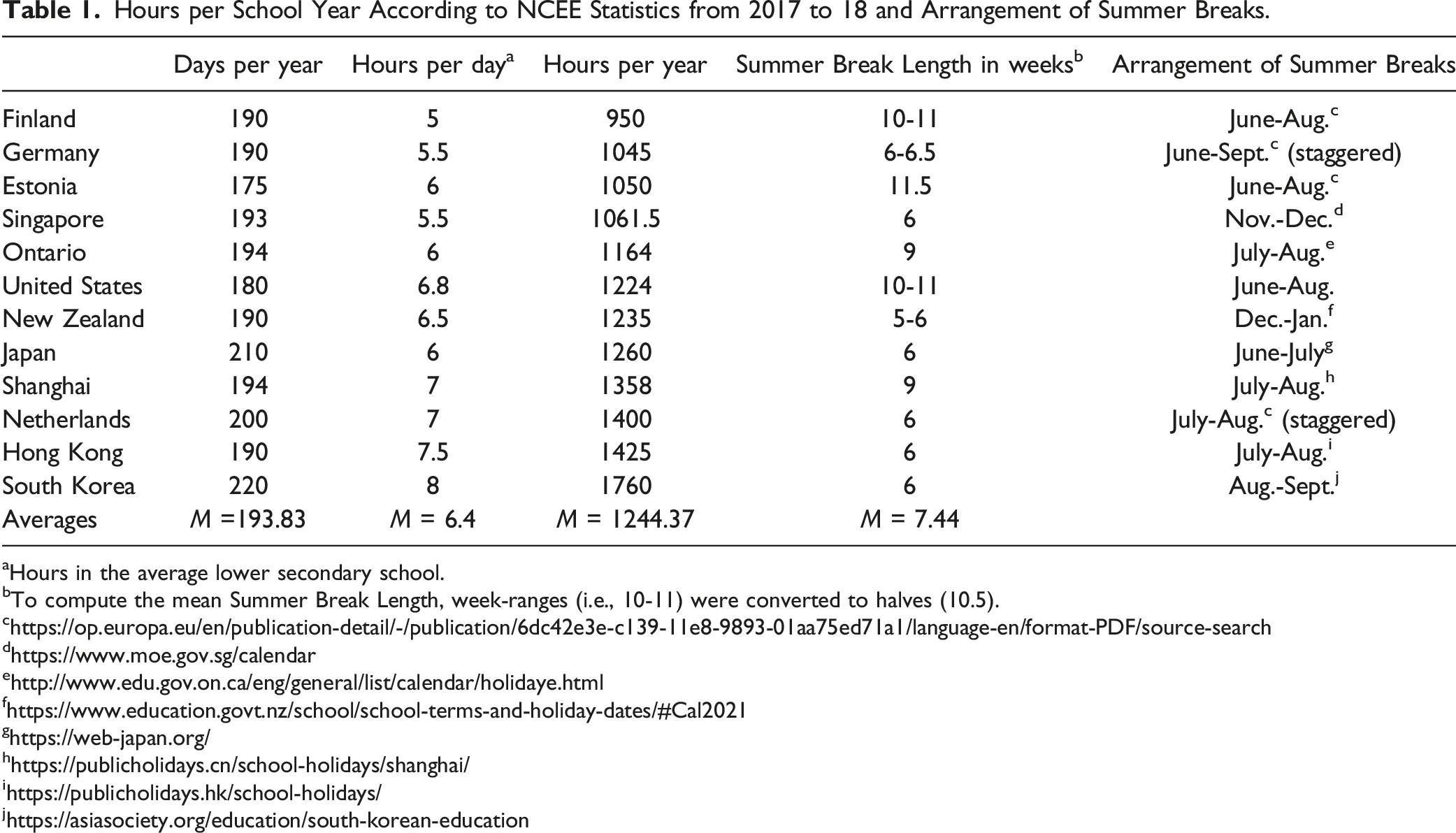
aHours in the average lower secondary school.
bTo compute the mean Summer Break Length, week-ranges (i.e., 10-11) were converted to halves (10.5).
There are two overarching deviations from the TCS model that can be termed a balanced calendar approach (Kneese & Ballinger, 2009): year-round education (YRE) and extended school year (ESY). ESY can be considered a form of YRE—a term encompassing alterations to the traditional 10-month school calendar (Orellana & Thorne, 1998). YRE provides one to three-week intersessions interspersed throughout the school year with a shorter summer break, thus striving to balance parts of term. These longer intersessions are often accompanied with enrichment opportunities for students (Finnie et al., 2018). According to Fitzpatrick (2018), YRE is generally restricted to around 180 days, but can be divided into different tracks dispersed to various times around the year. Extended school year (ESY) is a term which can be used interchangeably with YRE, but it also allows for the addition of compulsory hours or days (Patall et al., 2010). As established, TCS features summer breaks, varying in lengths according to district and state guidelines. Where YRE looks to establish intersessions throughout the year, yet maintain 180 days, the ESY model can also encompass such longer intersessions, but may combine these breaks with added compulsory school time—up to as many as 265 days in certain cases (Kneese, 2000).
The movement to YRE, and subsequently to ESY, has been gaining some momentum in recent decades, largely due to a growing body of research suggesting summer learning loss is harmful and preventable (Pitcock, 2017). According to the National Center for Education Statistics (NCES) in 2011-2012, approximately 3700 YRE schools—roughly 4% of public and non-for profit charter schools—operated in the United States (National Center for Education Statistics, 2014). That figure was about 56 schools in 1975 and 410 in 1985 (Orellana & Thorne, 1998). ESY is not as prevalent with under 1000 schools in the United States utilizing an extend-day calendar (Von Hippel, 2019). It is difficult to pinpoint the proclivity toward YRE and ESY schools currently in operation throughout the world; however, with several countries having only 6 weeks of a summer break, their calendars will inevitably resemble a YRE model—especially when taking into consideration the average OECD country has 14 weeks of school breaks distributed throughout the year (Gromada & Shewbridge, 2016). Of recent research available on the actual amount of YRE or ESY schools around the world, little has been published. One example from Takyi et al. (2019) reports Ghana has recently introduced 400 multi-track YRE schools to alleviate space concerns.
The Case for a Balanced School Calendar Approach
This section emphasizes COVID-related learning loss in addition to synthesizing literature highlighting positive student outcomes, from schools that either utilize YRE or ESY, in order to provide insight as to whether such balanced approaches can address learning loss in the post–COVID-19 era. Although modifying the school calendar can be advantageous for a variety of educational sectors, this section specifically highlights YRE and ESY’s impact on disadvantaged student achievement—both calendar options could also be considered for schools throughout the world to help remedy COVID-19 learning loss.
Based on summer learning loss research cited in this paper, coupled with emerging COVID-19 slide investigations, it can be assumed the majority of students have been, or continue to be, negatively affected since the onset of the pandemic, especially low SES and vulnerable students for whom access to resources and technology may not be readily available (Carvalho & Hares, 2020; Agostinelli et al., 2022). Özer and Suna (2020) contend the transition to distance education widened education inequalities throughout the world. Bailey et al. (2021) also surmise the pandemic has widened achievement gaps and those gaps will likely not decline significantly during the 2021 – 2022 school year.
Before investigating potential COVID slide, it is important to consider previous studies that measure the effects of elongated school breaks on academic attainment in order to better ascertain COVID-induced learning loss. Cooper et al. (1996) concluded in their meta-analysis of summer learning loss that, on average, achievement-test scores decline from spring to the next fall—in some cases a month of learning on a grade-level equivalent scale. Low-income students experienced some of the largest negative effects, especially in math and reading. In the United Kingdom, Shinwell and Defeyter (2017) found a small but significant decline in low SES student-spelling abilities from just a seven-week summer break. Vale et al. (2013) concluded learning just is not decelerated during the summer break, but also in the weeks preceding and succeeding the time off—again disproportionately affecting low SES students. Furthermore, Alexander et al. (2016) report cumulative “summer slide” can have long-term deleterious effects on student achievement. COVID-19 has the potential to worsen these negative outcomes and inequalities (Cai et al., 2020; Blundell et al., 2020), as school for the majority of students has been disrupted since spring 2020.
Recent studies have projected the learning loss students could experience from truncated schooling during the COVID-19 pandemic. In 2020, Azevedo et al. predicted students worldwide may lose 0.3 to 0.9 years of total schooling. The World Food Bank’s most recent figure supports this in a working paper from Patrinos et al. (2022) whereby on average about one-half year’s worth of learning was lost from March 2020 to March 2022. Looking into studies from individual counties and regions since 2020, similar findings have been reported. Dorn et al. (2020) estimated learning loss in the United States will likely be greater for low-income, Black and Hispanic students; existing achievement gaps may increase by 15 to 20%. In the Netherlands, Engzell et al. (2020) estimated learning loss for low SES students will be up to 55% larger than the general population. Kaffenberger (2020) suggested current 3rd graders may lose up to 1.5 years’ worth of learning by the time they reach 10th grade. In Ghana, Sabates et al. (2021) estimated students out of school lost nearly 20% of numeracy learning gains for each month they were at home. Angrist et al. (2021) reported students in Sub-Saharan Africa could lose as much as 2.8 years of learning between third and 10th grade. Fundação Getulio Vargas, the Center for Learning on Evaluation and Results for Brazil and Lusophone Africa (FGV EESP Clear), estimates Brazilian students could experience learning loss anywhere between 14% and 72% (Costin & Coutinho, 2022).
This is not the first article to discuss the possibility of modifying the school calendar in the wake of COVID-19. Writing in the LA School Report in April of 2020, David Osborne, director of the Reinventing America’s Schools Project at the Progressive Policy Institute, called for policy leaders to try year-round schools (YRS) starting summer of 2020 (Osborne, 2020). Likewise, Denisa Superville also suggested a balanced calendar model in an Education Week article, supposing intersessions in YRS could be used for additional educational enrichment (Superville, 2020). Grätz und Lipps (2021) recommend a broad based response to reverse COVID-19 learning loss by adding school days, and potentially Saturdays. More recently, George et al. (2021) recommend YRS for students in higher stress and poverty situations. Since the onset of the pandemic in 2020, it is unclear how many school switched to YRS, or ESY, but a case from Nara City, Japan warrants attention. Asakawa and Ohtake (2021) report drastically shortening summer break was part of a solution that witnessed improved math scores among elementary students.
In terms of Coronavirus transmission, establishing a balanced calendar approach could potentially reduce spread. Although spontaneous lockdowns proved effective in lowering transmission rates among school children (Sorg et al., 2022; Alfano, 2022; Klimek-Tulwin & Tulwin, 2022) having pre-established breaks, or longer intercessions, may be prudent moving forward. Johnson et al. (2021) surmise schools can remain open for 20 to 60 days, and in some cases up to 100, before COVID-19 cases become sizable to the point where closure may be considered. Before the COVID-19 pandemic, it had already been proposed YRS is healthier for students concerning viral outbreaks. School closures, whether planned or spontaneous, slow the spread of infectious diseases among students and their communities (Jackson et al., 2013; De Luca et al., 2018). When studying norovirus outbreaks in developed countries, Kraut et al. (2017) suggested YRS may play a role in reducing outbreaks and transmission rates because of the frequent intersessions. They specifically looked into southern hemisphere YRS in Australia and New Zealand, where students would have an intersession just days after the typical seasonal peak begins and a few weeks after the peak. De Luca et al. (2018) found lengthening the holiday break during peak influenza season, in late December and early January, is beneficial in managing potential outbreaks; however, most important is the timing of breaks as a proactive measure to minimize transmission. Chao et al. (2010) recommend even starting school later in the fall, around mid-September, to reduce influenza transmission.
Not only is society still grappling with the COVID-19 pandemic, but future viral outbreaks may become a recurrent educational challenge. Kavanagh et al. (2020) cite the increased frequency of pandemics since 1980, which is due in part to increased globalization and climate change. Li et al. (2020) and Walsh et al. (2020) state future waves of COVID-19 are likely and it can be ascertained where the outbreaks may originate based on such aspects as SES, intersectionality with animals, population density, and climate. Based on such information school systems can evaluate proactive scheduling to continue educating through future pandemics and viral outbreaks.
An issue this paper examines, that could be addressed with YRE and ESY, is persistent achievement gaps between high and low SES—often intensified by long summer breaks (Finnie et al., 2019). The standard summer break in TCS often accounts for learning loss that can lead to cumulative academic deficiencies, especially prevalent among low-income and low-achieving students (Tiruchittampalam et al., 2018; Lenhoff et al., 2020). Alexander et al. (2007) explain “disadvantaged children need year-round, supplemental programing to counter continuing pressure of family and community conditions that hold them back” (p. 176). Green et al. (2011) emphasize low-income students generally fall further behind with every summer, compared to their more affluent peers, due to lack of access to intellectual resources. In addition, rural and special education students often incur more pronounced summer slides partially due to a dearth of qualified teachers (Pindiprolu & Marks, 2020). Entwisle et al. (2001) describe this phenomenon as the “Faucet Theory.” Essentially, learning runs like a faucet during the school year, but completely stops for disadvantaged students during the summer months; all the while, privileged students can benefit from ancillary resources and enrichment opportunities during the long break.
As noted, recent studies provide disparate positive results surrounding academic achievement in YRE schools, with the majority of findings describing potential benefits for disadvantaged students. Ramos (2011) compared reading and math test scores between elementary students and reported the YRE students outperformed TCS students, with statistically significant results in math. McMullen et al. (2015) found a small, positive impact on low-performing learners. Fitzpatrick (2018) reported single-track YRE helped science and social studies students in grades 3 to 8 gain a month of additional learning in each subject area. Poppink et al. (2019) in analyzing recent YRE studies, reported YRE assists economically disadvantaged and low-performing students more than affluent, average, or high-achieving students.
Regarding the implementation of ESY, research points to gains when adding additional days to the traditional calendar. Downey et al. (2004) found that although school is a great equalizer, it cannot always overcome inequalities students face outside of school. To this point, Cattaneo et al. (2017) recommend judiciously applying extended time to those who could most benefit and more instructional time in school yields greater academic attainment for all students (Dreeben & Gamoran, 1986; Fisher, 2009; Mandel et al., 2019).Van der Graaf (2008) reports students in schools with added days scored higher on the Missouri Assessment Program, as opposed to students in TCS. Hansen (2011) estimated additional school days lead to better performance on state-mandated tests. Woods (2015) cites the Massachusetts Expanded Learning Time (ELT) initiative, in which 300 hours—the equivalent of 50 six-hour days, or about 7 additional weeks—was available for participating schools, greatly increasing their proficiency rates in English Language Arts (ELA), Math, and Science compared to other schools in the state. Carlsson et al. (2015) suggest lengthening the school year can raise cognitive abilities among all students. Poppink et al. (2019) write both adding more time to the school day, and starting school earlier in the year, are effective in achieving Adequate Yearly Progress (AYP).
Another arena where ESY is often employed in schools to assist student growth is special education (Burke & Decker, 2017). ESY is routinely utilized to help students with an Individual Education Program (IEP) and was even recommended as a potential option to aide students with IEPs by the Individuals with Disabilities Education Act (IDEA) in 2004. According to a recent study by Barnard-Brak and Stevens (2019), students with IEPs who have access to ESY are far less likely to regress academically over the summer. The authors claim their study was “the first of its kind to examine the association of ESY services with academic achievement outcomes among students” (p. 9). The Barnard-Brak and Stevens’ results beg the question of whether ESY could be beneficial to all students, especially those who are economically disadvantaged. Numerous other researchers have also delved into this question, but largely focused on the 180-day YRE model as a means to assist low-income students. Therefore, it needs to be considered whether ESY is a more impactful version of YRE, but more research needs to be completed in order to best inform calendar reform.
Von Hippel (2019) is skeptical if YRE is the answer to boosting achievement, but thinks ESY carries more potential going forward. Frazier and Morrison (1998) concluded that when given an additional 30 days of school, for a total of 210, kindergartners maintained higher levels of cognitive competence over the summer. They discovered ESY has an impact on psychological development and was largely responsible for achievement gains. Fryer (2014) found adding days to the calendar helped to boost math scores in low SES schools in Houston, Denver, and Chicago. When comparing charter schools to public schools in Boston, Therriault et al. (2010) reported the highest achieving charter schools were in session for 192 days, as opposed to 180. Conversely, Sanz and Tena (2021) show when 2 weeks are removed from a school calendar, students can experience significant negative outcomes.
As both YRE and ESY have shown to reduce summer learning loss, and assist economically disadvantaged students, modifying the school calendar should be discussed by educational policy makers in addressing current post–COVID-19 societal conditions and demography. Although summer school programs have also shown to help close achievement gaps (Cooper et al., 2000), they should not be considered a safety net (Gold, 2002); therefore, districts could consider lengthening and balancing school years for all students. Summer School is not always a viable option for students who could most benefit (Leefatt, 2015). Moreover, traditional summer learning programs, which are often voluntary and extend school time for only a portion of students, must also concertedly engage disadvantaged students and address inequalities to be effective (Green et al., 2011). Consequently, policymakers and school leaders could consider designing school years which harness the effectiveness of summer learning by balancing parts of term and adding additional days for their school or school systems.
The Case for Maintaining TCS
Despite research summarized in this article touting academic gains fostered through calendar alterations, overall the body of literature concerning the adoption of YRE and ESY may not be convincing enough for some educational systems to vastly alter TCS as several studies only show minimal gains or even negative effects. Grooms (2009) studied math and reading assessments of secondary students in YRE school districts and reported that scores from students in YRS demonstrated limited, or no, superiority or TCS students. Graves (2011) in examining YRE’s impact on disadvantaged students and in stemming summer learning loss, claimed that although much of the research suggests YRE is marginally effective, it may not be a strong enough argument for altering the traditional calendar model. Graves notes YRE cannot always consistently provide gains for disadvantaged students since the number of days are still the same in a given school year regardless of the type of YRE model. Graves’ 2011 study showed YRE had negative effects on standardized test scores of various student subgroups. Finnie et al. (2019) analyzed and summarized the most recent YRE research and concluded that, although Graves’ results were not the only statistically significant negative findings, the majority of existent literature suggests only minimal positive results on academic achievement. They also note what numerous other researchers have also concluded that the body of research yields insufficient evidence to definitively claim YRE will consistently benefit disadvantaged students.
Some researchers report no effects on academic achievement when analyzing YRE while others question which confounding variables may be spurning achievement in extended-year schools. In analyzing data from over 345,000 North Carolina students, McMillen (2001) found YRS did not significantly outperform TCS. Also in North Carolina, McMullen and Rouse (2012) found no impact of YRE on achievement when investigating 22 schools who redistributed their 180 days throughout the year. Adelman et al. (1996) and Evans and Bechtel (1997) both contend ESY may garner small increases in achievement, yet it stands to be a singularly weak argument for deviating from TCS. Marcotte and Hansen (2020) reported positive results when studying ESY, but stated such results are comparable to other interventions that boost performance such as teacher quality or reduced class size; thereby, also questioning whether major calendar alterations are necessary when other steps could be taken to lift performance.
Student absenteeism is another major factor contributing to achievement gaps (Gottfried, 2009; Liu et al., 2020), and is also heightened by the COVID-19 pandemic (Santibañez & Guarino, 2020) A major calendar alteration, however, may not necessarily remedy this issue. Although it has been suggested districts can proactively add breaks in attempts to boost academic performance and decrease viral transmission, Rodriguez et al. (2009) cite an instance where school closure did not decrease absenteeism. Aucejo and Romano (2016) when studying math and reading standardized test scores among 3rd to 5th graders in North Carolina reported extending the school year by ten days would increase math and reading scores modestly; however, reducing absenteeism would yield larger increases. Recent truancy figures from the first year of the pandemic estimated at least three million students, largely from vulnerable populations, were missing from school in the United States alone (Korman et al., 2020). The Macro Poverty Outlook (MPO) reported as of May 2020 nearly seven million students had dropped out of school worldwide and this number is likely rising (Azevedo et al., 2020). These students will most certainly experience learning loss that will need to be addressed if and when they are reincorporated into school systems.
Regardless of calendar model, the actual utilization of compulsory time in school matters greatly in efforts to address achievement gaps and learning loss. Evans and Bechtel (1997) state, “time is a necessary but not sufficient condition for improving achievement” (p. 2). Aronson et al. (1999) posit additional time in the classroom can only boost achievement if that time is dedicated to academic-learning. Silva (2008) explains, “Clearly, any extended time proposals must focus on expanding the right kind of time” (p. 14). In other words, YRE or ESY are only valuable if the additional time is used effectively featuring high-quality pedagogy and schools are well managed (Silva, 2008). Furthermore, Agüero and Beleche (2013) found additional school days were more beneficial for schools with higher SES; thereby, potentially increasing achievement gaps between wealthier and poorer schools. Slates et al., 2012 and Patall et al., 2010 also voice concerns about calendar alterations widening achievement gaps. Lavy (2015) reported a similar outcome in researching PISA test scores from 50 different countries, demonstrating that although additional instructional time rendered significant positive effects on PISA results, the effects in developed countries were twice as those in developing countries.
As stated, more research needs to be completed in the coming years to determine if, and how, balancing the school calendar and potentially adding more days is effective in boosting achievement and addressing inequality in schools in a post-COVID world. Although existing studies suggest YRE and ESY are beneficial, the findings often do not exhibit large effects or statistical significance. Kneese (2000) also warns of the Hawthorne Effect, in that much of calendar change research is not longitudinal, but rather focused on only a short period of time in which YRE schools, knowing they are being scrutinized, may exhibit an extraordinary effort, thus producing problematic results. Furthermore, calendar changes may not be the direct cause to improved achievement; rather, a calendar modification could foster ancillary structural alterations which affect academic performance (Kneese, 2000). Alltogether, little is known about the long-term effects of YRE and ESY on achievement and the overall body of literature is scant.
Regarding viral transmission in schools, the emerging body of research has provided mixed results on the effectiveness of closure to stymie outbreaks of Coronavirus (Walsh et al., 2020). A comprehensive literature review completed by Tan (2021) indicated the role students play in transmission was overestimated near the beginning of the pandemic and school closures were marginally effective. Furthermore, prolonged closures appear to be a catalyst for a bevy of other issues related to child-wellbeing. As cited in this article, students are unlikely to be major drivers of viral transmission (Yung et al., 2020; Esposito & Principi, 2020). Taken all together, such findings may indicate lengthening breaks throughout the school year to reduce infectious disease may not warrant significant calendar alterations.
Conclusion
For schools to mitigate pandemic-related learning loss and stagnation, and to anticipate potential future waves of Coronavirus, a modified calendar may provide a structural alteration allowing students to achieve at higher levels, especially vulnerable and marginalized students. Although research is mixed on the effectiveness of school breaks on viral transmission, additional compulsory learning time, with intersessions, could provide opportunities for enhanced knowledge acquisition and enrichment, which should be worth serious consideration for school systems adversely affected by the pandemic.
As emphasized, YRE and ESY have been studied for decades yielding dissimilar results; however, the majority of the literature does point to positive academic outcomes, especially for vulnerable students. Nevertheless, a major calendar modification may not be the best solution for all schools and policy makers will need to consider which type of calendar will be best for their schools and demographics in addressing their particular set of challenges in the post-COVID era. To this end, McMillen (2001) raises an interesting point in writing TCS may be more beneficial for students whose parents have high levels of education. Perhaps a combination of both balanced calendar approaches could be a mechanism for addressing the issues raised in this paper: COVID-19 learning loss, summer slide, and achievement gaps. Regardless of any potential calendar modification, far more longitudinal research needs to be conducted moving forward to better inform policy makers whether YRS, or ESY, can provide long-term positive academic gains over TCS (Patall et al., 2010). An opportunity for future research may be to investigate schools who alter TCS, in the aftermath of the COVID-19 pandemic, to track if a balanced calendar approach helps to boost achievement and mitigate educational setbacks brought on by almost two years of interrupted schooling.
For policy makers leaning toward ESY, the question becomes how long should summer break be and how many days, or hours, should be added to TCS? In their meta-analysis of increased instructional time initiatives, Kidron and Lindsay (2014) concluded not one single approach was universally beneficial to students. The act of balancing instructional days with intersessions generally demonstrates positive outcomes, according to Ballinger (2004). Some studies have even concluded there may be a point of diminishing returns if the school year becomes too long (Baker et al., 2004, Dağlı, 2018). Consequently, each individual school or school system considering a calendar alteration may need an iteration of YRE or ESY that best suits its needs.
One point is clear, no matter how many days or hours a school is in session, the quality of instruction is paramount (Baker et al., 2004; Silva, 2008). Added compulsory time can only be effective if the specific needs of students are adequately identified and addressed. It should also be reiterated that well-intentioned calendar alterations may provide other unintended consequences, or greatly benefit students who need the least support at the expense of vulnerable students. A school considering a shift from TCS to YRE or ESY still needs to prioritize how the additional time will be utilized and if such changes will provide equitable opportunities for increased student success.
The COVID-19 Pandemic is still affecting the educational world and exacerbating existing achievement gaps—neither issue is likely to abate expeditiously; however, the current situation of educational latency and has afforded governing bodies, policy makers, and education leaders a rare opportunity to consider seismic calendar changes that have long been discussed, but not ubiquitously implemented nor fervently studied. Could an extended or balanced school calendar approach help improve academic performance moving forward in a post-COVID world? School systems will need to position themselves to realize academic success but simultaneously and proactively anticipate future pandemic-related disruptions.
Footnotes
Declaration of conflicting interests
The author(s) declared no potential conflicts of interest with respect to the research, authorship, and/or publication of this article.
Funding
The author(s) received no financial support for the research, authorship, and/or publication of this article.
