




Abstract
The present study examines the effectiveness of an After-School Life Skills (ASLS) intervention to improve the life skills of 110 students from socially disadvantaged backgrounds at public schools of urban Bangalore in south India. These students completed ASLS intervention from 2014 to 2018 during which the life skills were assessed on a yearly interval and the data were analyzed using repeated measure ANOVA. The results show that ASLS intervention significantly improved the students’ life skills. Post hoc comparisons at time 1 shows that young students who participated in ASLS intervention significantly improved their life skills over the 4 years’ time, although no significant variances were observed between measurement periods. The overall effect was found to be significant in improving the life skills, which shows that integrating life skills education in the school curriculum is critical and a timely need.
Introduction
Adolescence or the second decade of life (10–19 years) is characterized by accelerated growth and development. This is a period when adolescents are full of positive energy and have a strong urge to adopt risky behaviors (Crosnoe & Johnson, 2011; Elder, 1998). There are approximately 1.8 billion estimated adolescents worldwide (UNFPA, 2014), whereas in India there are about 243 million adolescents as per the Census of India (2011). However, health and educational status of adolescent population is not promising (Samal & Dehury, 2017; Sivagurunathan et al., 2015) and can be largely attributed to growing expectations, stress, confusions, difficulties in comprehending and abstraction faculties that pose a series of challenges for adolescents in both academic and real life situations (Credé & Kuncel, 2008; Deffenbacher et al., 1996; Rao et al., 2011).
India’s National Crime Record Bureau (NCRB, 2013) estimates that academic distress results in six suicides among adolescents every 24 h. Kamalja and Khangar (2017) in their study of NCRB data reveal that death by suicides among girls and boys peaks at the age of 14 years after failing in their school examinations. The same study reveals that there is a gendered aspect to this as well because failure in the examination has been found to be a major reason for death by suicides among adolescent males in the age group of 15–18 years. The major reason for suicide in girls was failure in love. In Kerala, a recent survey of 4133 children aged between 6 to 16 years whose parents were alcoholic had high rates of internalized and externalized behavioral disorders in general (Jose & Cherayi, 2020). Out of these 4133 children, 4.9% boys and 6.2% girls expressed suicidal thoughts, whereas 5.4% boys and 6.7% girls showed deliberate self-harm behaviors (Jose & Cherayi, 2020).
Owing to a variety of familial and school-related reasons, there are evident academic distress, interpersonal problems and poor coping abilities associated with poor and inadequate life skills competencies. Additionally, the Indian educational system predominantly emphasizes numeracy and literacy skills, and imparting life skill competencies has been relatively less recognized. United Nations Children’s Fund (2012) leveraged its “Education for All,” which is an initiative to which 164 nations have committed to impart life skills as basic learning needs for young students. Since then, there has been a growing interest in life skills in the academia.
The training of adolescents in life skills enhances their social development (Soheila et al., 2009), promotes emotional adjustments (Ahadi, 2009), helps sustain development (Hamidi, 2005) and improves social compatibility (Roodbari et al., 2013). It enables adolescents to successfully cope with distress and manage problems in interpersonal relationships. Srikala and Kishore (2010) established the significant role of life skills in empowering adolescents with life skills education as part of school mental health program in South India. Evidence suggests that life skills help adolescent school children improve their emotional maturity and stress resilience (Shwetha, 2015). It also improves their concept of self with a positive relationship between core affective skills and self-concept (Khera & Khosla, 2012). In addition, there is a strong association between physical, cognitive, psychosocial, and psycho-sexual development and life skills (Robinson & Zajicek, 2005).
However, relatively little is known about the life skills challenges faced by, and needs of adolescents from socially disadvantaged backgrounds (Kennedy et al., 2014; Pearson et al., 2021). Situating within this, Dream a Dream, a registered, charitable trust empowering children and young students from vulnerable backgrounds to overcome adversity and flourish in the 21st century using a creative life skills approach, has implemented an After-School Life Skills (ASLS) intervention. To test the effectiveness of ASLS intervention, this study hypothesized that “there would be significant improvement of life skills of young students over the years with significant pair-wise difference among four repeated measures.”
Project Background
Traditionally, schools have done very little to foster children’s social and emotional development and character (Blum & Libbey, 2004; Collins & Coleman, 2008). The lack of poorly developed social and emotional competencies in children make them less connected to their schools as they grow and develop. This negatively affects their academic performance, behaviors and health (Blum & Libbey, 2004; Elias et al., 1997; National Research Council, 2012). Thus, Social and Emotional Learning (SEL) has been a “missing piece” in education even though it is a promising approach that enhances students’ success in school and life (Elias et al., 1997; Bear et al., 2015). However, schools in general have continued to face resource deficits to address the SEL needs of children.
The Fetzer group postulated a conceptual framework of SEL to promote social, emotional and academic competence of young students and to coordinate a school-family-community program to address educational goals (Elias et al., 1997). Social and Emotional Learning is thus defined as a process of acquiring core competencies to recognize and manage emotions, set and achieve positive goals, appreciate the perspectives of others, establish and maintain positive relationships, make responsible decisions and handle interpersonal situations constructively (Elias et al., 1997). It encompasses a variety of social-emotional skills and traits, and yields positive effects on prosocial behavior, reduces conduct problems and improves academic achievement in students (Durlak et al., 2011; Greenberg et al., 2003).
Dream a Dream’s ASLS intervention formulated SEL as a process through which individuals learn to care about others, make responsible decisions, recognize and manage emotions, behave ethically and responsibly, avoid negative behavior, and develop positive relationships (Dream a Dream, 2021; Pearson et al., 2021). The core competencies of SEL are self-awareness, self-management, social awareness, relationship skills, and responsible decision making (Dream a Dream, 2021).
This study examines the influence of ASLS intervention to improve life skills competencies with respect to five critical areas, namely interacting with others, overcoming difficulties and solving problems, taking initiatives, managing conflict, and understanding and following instructions. After-School Life Skills intervention used the media of sports and arts to engage and to develop life skills in students.
From 2015 to 2018, 110 students completed the ASLS sessions conducted by Dream a Dream, which consisted of structured life skills activities by trained facilitators and comprised of 25 sessions with one session per week for 8 months (June to January each academic year).
After-School Life Skills Intervention Process
After-School Life Skills is an innovation lab for young students from disadvantaged communities that uses non-traditional experimental learning strategies for life skills development. It engages students and develops in them important life skills through the media of sports and arts. After-School Life Skills believes that sports and arts are unique media to improve interpersonal abilities like teamwork, communication, negotiation and coping skills; cognitive skills like decision making, problem solving and critical thinking; and creativity, confidence, self-awareness alongside passion for learning (Pearson et al., 2021). The ASLS serves children from disadvantaged communities. The learning opportunities are divided into two categories, namely life skills via arts and life skills through sports. Also ASLS uses both structured and unstructured sessions. The organized sessions focus on ASLS curriculum for life skills. Unstructured sessions allow the group facilitators to use situational and need-specific strategies to address the felt needs of the group.
After-School Life Skills contains six phases: (a) pre-session, (b) wake-up, (c) warm-up, (d) cool-down, (e) reflection circle, and (f) wrap-up. During the pre-session, the facilitator arrives early to the school before the session starts to organize and to initiate informal interaction with the players for 15–30 min. The wake-up session has two aspects, namely team check-in and team agreement. During team check-in, the facilitator instructs the players to check-in while during team agreement the facilitator asks players and volunteers to give inputs on their progression and share insights into identifying areas of improvement. In the warm-up session, there is a series of physical activities that last for 5 min, which further progresses into life skills sessions for 45 min. Subsequently, the participants engage in football playing and/or creative arts for 40 min with a break for 5 min. During the cool-down session, the participants are encouraged to rest and relax for 5 min and subsequently to engage in a reflection circle for 20 min. This is when the discussions on key messages are taken up while feedback is collected on the lessons learned to personalize the learning. The lessons focus on identifying conflicts, if any, and making efforts to resolve them. With the 5 min’ wrap-up session, ASLS session concludes. Each ASLS program duration is for 90 min to 2 hrs.
After-School Life Skills has been implemented across 10 low-cost private schools in urban Bangalore. Each session typically lasts for 90 min to 2 h with 25–30 students on a weekly basis. After-School Life Skills begins in June (i.e., the beginning of an academic year) and lasts until January the next year. The ASLS curriculum therefore implements over 8 months period while students enroll at 4th grade and continue until they complete the 9th grade (Pearson et al., 2021).
Method
Interrupted Time Series (ITS) Analysis within the broader framework of quasi-experimental design provides an alternate design with methodological rigor and which is arguably the strongest design in quasi-experimental studies (Fan et al., 2010; Shadish et al., 2002; Wagner et al., 2002). Hence, ITS is considered as a simple but powerful design to evaluate the effect of a program or policy interventions. A time series refers to ‘repeated observations of a particular event collected over an equally spaced time (e.g., year wise observations in the present study) and is divided into two or more segments before, during and after the interventions’ (Penfold & Zhang, 2013, p. S39).
Using an ITS design, we conducted a 4-year long life skills intervention study to improve the overall social and emotional skills of students with five series of observations or data which began with a baseline and continued on a yearly basis for the next 4 years, which gave us five series of data. In four academic years from 2014 to 2018, 110 young students from 10 partner schools completed the ASLS program. The ASLS curriculum consisted of structured life skills activities facilitated by trained facilitators. The curriculum comprised of 25 sessions with one session a week for 8 months (June to January) every year.
Study Participants
The study participant was defined as “a student in 4th or 5th grade from selected schools of Bangalore, who enrolled in the After-School Life Skill Program.” For the purpose of this study, we included 110 students who completed the ASLS sessions and assessments in all 4 years.
Inclusion and Exclusion Criteria
We selected 10 urban schools for the Dream a Dream’s ASLS intervention. The students were selected for participation with following inclusion criteria. An adolescent who has made an informed choice to participate for the entire duration of four academic years in the ASLS intervention, which lasted from June 2015 to January 2018, was included as a participant. The second criterion was that the adolescents should be aged between 12 to 17 years. Finally, those adolescents were excluded who had previously participated in a life skills training or were currently participating in a similar program.
Study Producers
In 10 low-cost urban private schools of Bangalore in Karnataka, 193 students were enrolled in the 2014–15 ASLS program who were in their fourth or fifth grade. In 2015–16, 147 students continued the program while the rest dropped out. In 2016–17, 138 students were still enrolled but only 110 students completed the whole program that lasted from 2014 to 2018. For this study, we have selected only those students who completed all 4 years of the ASLS program.
The life skills interventions were provided from June to January during every academic year from 2014 to 2018 on school days after the school hours. The session on a typical day lasted for 90 min to 2 h. In each school, a trained facilitator was appointed who imparted life skills education to the enrolled students. Dream a Dream has trained and employed a pool of facilitators to implement ASLS in schools. In addition, trained observers are also employed to observe and rate the life skills level in both pre-assessment and periodic assessments. These observers are recruited and trained for domain knowledge in life skills and assessment using the Life Skill Assessment Scale (LSAS) through a series of workshops and capacity-building programs.
All observers were trained in using LSAS and oriented about ASLS. Each observation typically lasted for 15–20 minutes and was recorded on the digital tablets. The observers observed the participants for two consecutive sessions prior to recording their observations on the third session. In some instances, the facilitators also acted as observers.
Measures
Alongside the collection of socio-demographic details of the study participants, the trained observers also rated the critical variables of interest by using the LSAS. The following sections individually describe the measures used for data collection over the study period.
Children’s Profile
For student’s profile, we recorded their age, gender, educational grade, and name of the school. Age was tapped in completed years and gender was coded as 1 = male and 0 = female. In the educational grade, in 2015 the participants were either in the 4th grade or the 5th and reached 8th or 9th grade in 2018.
Life Skill Assessment scale
A 5-item LSAS (Kennedy et al., 2014) was used, which is an observer rated measure designed for measuring life skills of disadvantaged children in the developing countries. The five items are not discrete; they represent the dimensions of child development milestones and are consistent with the WHO’s (1994) definition of life skills. The items represent five life scale dimensions, namely interacting with others, overcoming difficulties and solving problems, taking initiatives, managing conflict and understanding and following instructions and indicate the areas of competence. Each item rates on a 5-point Likert scale (1 = does not yet do; 2 = does with lots of help; 3 = does with some help; 4 = does with a little help; and 5 = does independently). The LSAS has excellent internal consistency (α = .92) temporal reliability (r = .95, p < .001) and inter-rater reliability. The scale was standardized for three age groups, namely 8–10 years, 11–13 years, and 14–16 years (Kennedy et al., 2014; Pearson et al., 2020).
Data Analyses
We used descriptive statistics to analyze the socio-demographic variables. The key hypothesis was tested using repeated measure ANOVA (within-subjects) design since there was no comparison group. Post hoc Bonferroni test was used for pair-wise comparisons.
Ethical Considerations
Informed consent was obtained from each participant while written informed consent was obtained from school principals/head teachers.
Results
Age, Gender and Educational Grades of ASLS Participants.
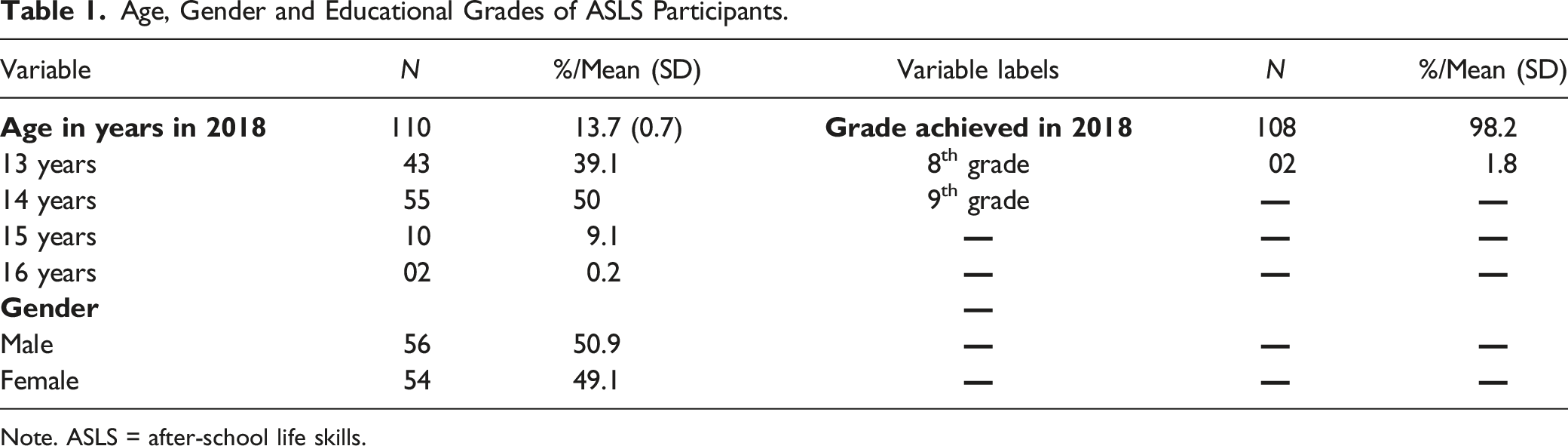
Note. ASLS = after-school life skills.
The repeated measure ANOVA (within-subjects) was used to examine the effect of the ASLS intervention among school-going students to improve their life skills over the 4 years (Table 2). The guided hypothesis was: ‘There would be a significant improvement in life skills of young students receiving ASLS intervention with significant pair-wise variance among repeated measures over the measurement periods’. Repeated Measure ANOVA (Within-Subjects Effect) Examining the Effect of ASLS Intervention. Note. ASLS = after-school life skills. *** significant at 0.001 level, NS = statistically non-significant.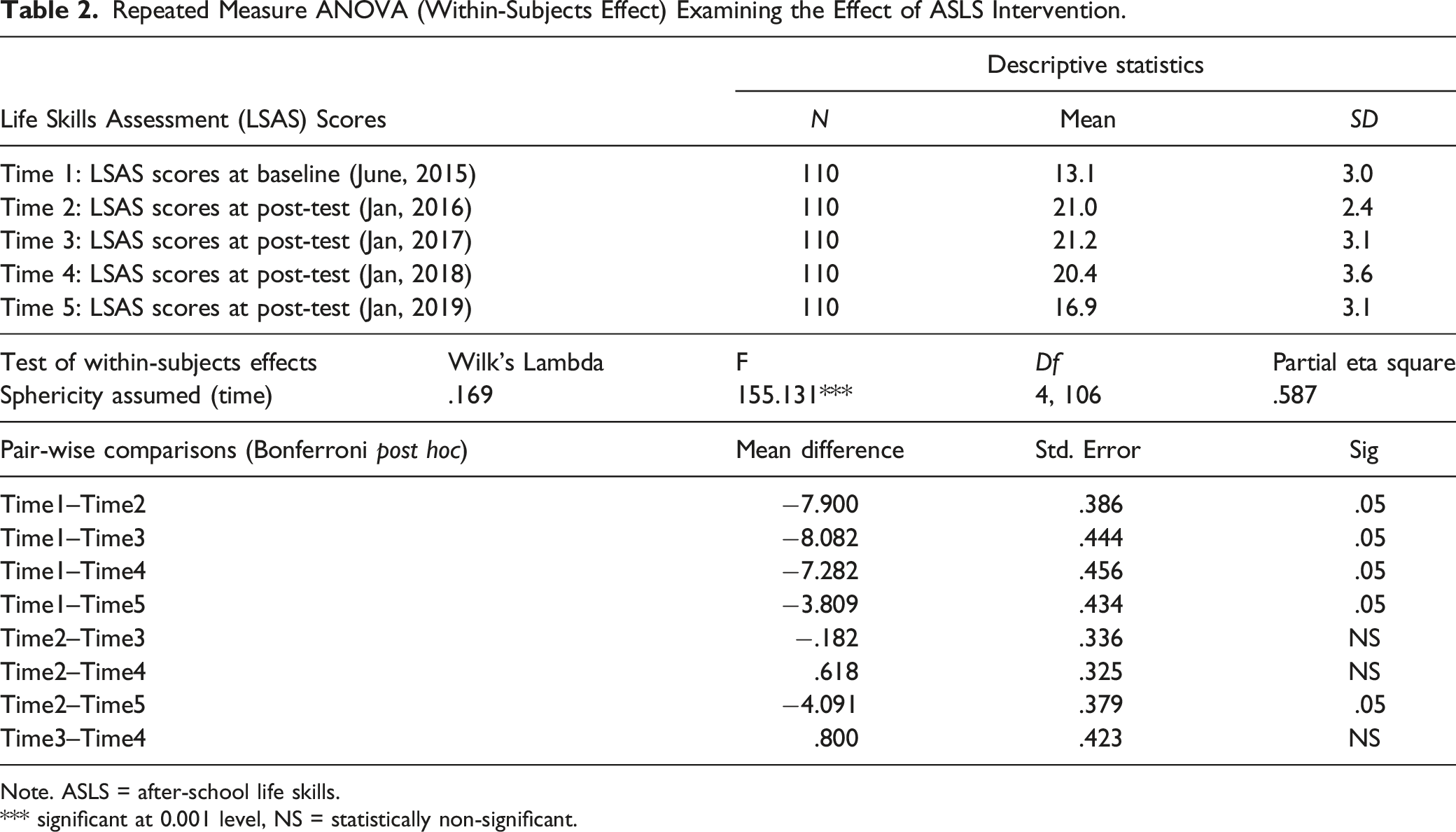
The analysis reveals a significant overall improvement of life skills of young students who received the ASLS intervention (Wilk’s Lambda = .169, F (4, 106) = 155.131, p = .001). Figure 1 shows the mean plot of life skills intervention. Mean plot of life skills intervention.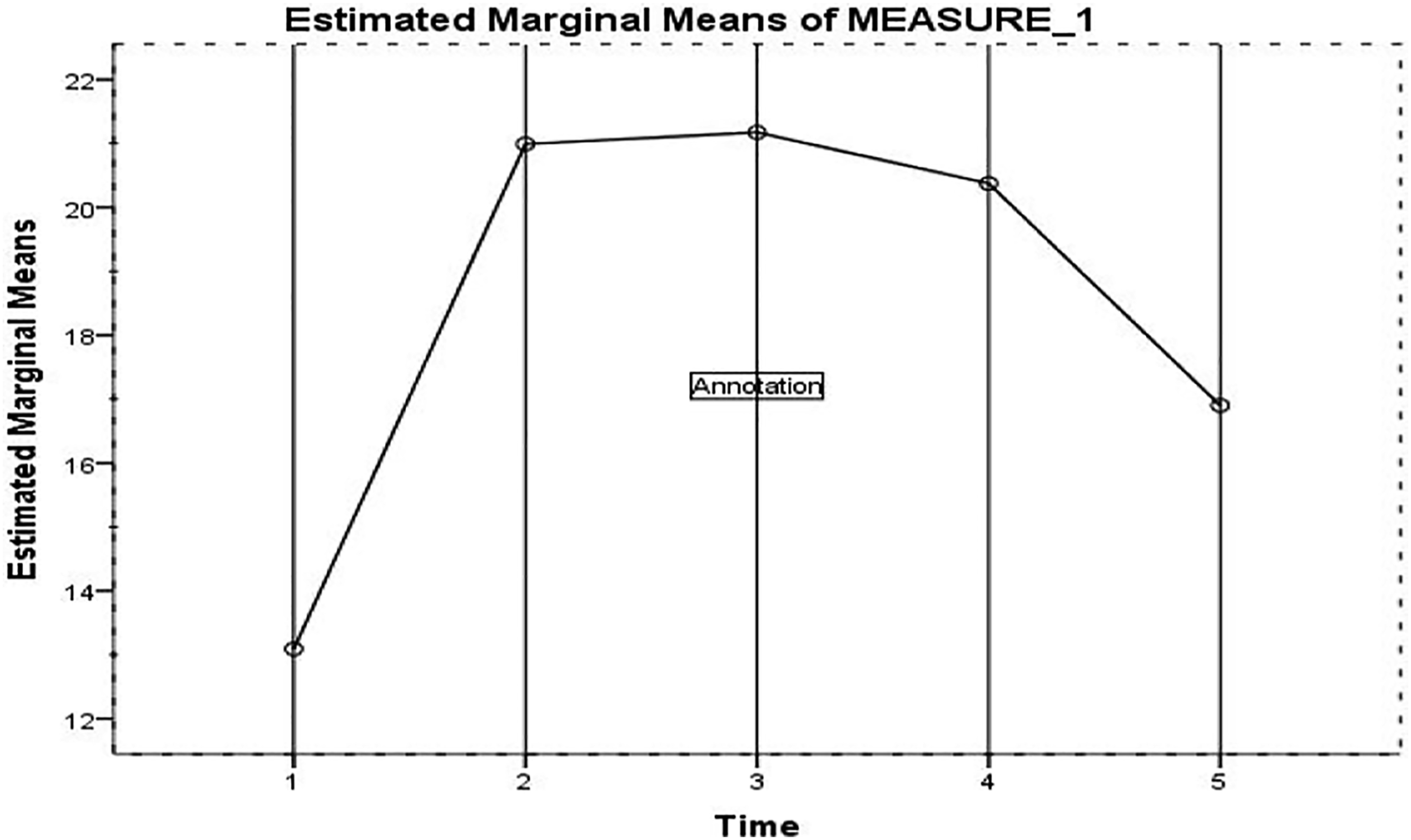
In the absence of a control group, this study adopted a repeated measure ANOVA within-subjects effects design to examine the overall changes over the four measurement periods (2015–2018) with between measurement difference by using a pair-wise comparison through Bonferroni post hoc test. The Bonferroni post hoc pair-wise comparison reveals a significant difference between time 1 and time 2 (−7.900; p < .05), time 1 and time 3 (−8.082; p < .05), time 1 and time 4 (−7.282; p < .05), time 1 and time 5 (−3.809; p < .05). The post hoc results suggests that, in comparison to pre-test scores on LSAS at time 1, young students who participated in the ASLS program significantly improved their life skills over the 4 years’ time, which indicates that ASLS is effective over time. Nonetheless, time 2 and time 3 showed no statistically significant difference (−.182; p > .05). Similarly, there was no significant difference between time 2 and time 4 (.618; p > .05). Time 2 and time 5, however, differed significantly (−4.091; p < .05). There was no significant difference between time 3 and time 4 (.800; p > .05). Figure 1 shows estimated marginal means over time 1 to time 5, suggesting an overall improvement of life skills over the years but the curve flattens from time 2 to time 3 and slowly reduces in time 4 while significantly reduces at time 5, showing the result of pair-wise comparison.
Discussion
The results of this ITS analysis shows that ASLS intervention significantly improves life skills of young students in five critical areas of competence, namely interacting with others, overcoming difficulties and solving problems, taking initiatives, managing conflict and understanding and following instructions. As pair-wise comparisons reveal, post-test scores at time 2, time 3, time 4, and time 5 significantly improved from baseline or time 1. However, time 2 and time 3, and time 2 and time 4 did not show such significant mean differences, although there was a significant reduction of life skills in children from time 2 to time 5.
The overall ASLS intervention significantly improved life skills of children over the 4 years’ time. This result partly supports the hypothesis that “there is a significant change of life skills of young students over the years.” Using a similar sample, Pearson et al. (2021) in a pragmatic RCT examined 909 children of disadvantaged background in South India aged between 8 to 15 years, who participated in a simple enrichment sports or creative arts program and demonstrated significant changes of life skills measured by LSAS in comparison to the control group. Similarly, the studies suggest that life skills intervention significantly improves emotional intelligence (Lolaty et al., 2012), social and emotional intelligence (Parker et al., 2005).
We further examined the significant pair-wise variances with respect to measurement times. Time 2 and time 3 and time 2 and time 4 did not show a significant mean difference. In other words, the greatest improvement occurred in year 1 but over the years, especially in year 5, there was a decline! Plausibly, advancing ASLS over the years, the curriculum needs to be revised to be more grade-specific so that intervention components may meet the growing age specific social-emotional and cognitive development needs of the students, as the social-emotional development has an expected trajectory where children experience transition to adolescence (Cohen et al., 2005; Malik & Marwaha, 2022). This suggests the need to accommodate the growing need for life competencies of young students over the years alongside advancing age and grades. Such an approach would yield a significant mean difference between post-test scores in repeated measures, implying a more sustained increase of overall socio-emotional learning among young students.
The result suggests that there was a significant improvement in all five life skills that were measured by the end of year 4 of the ASLS intervention. The overall results are thus preliminary evidence for the usefulness of ASLS intervention in improving social-emotional competencies in young students and to enable them be ready for everyday life challenges. The findings further provide preliminary evidence to justify the need for implementing such interventions in schools.
Study Limitation
The inherent weakness of a quasi-experimental design used in this study needs to be considered when weighing the evidence generated with respect to the confounding effects of extraneous variables, which were not controlled in the analysis. Future studies may consider RCTs if possible. If RCTs are not possible due to ethical issues or government policies, ITS should to considered for two or more pre-test assessment before introducing the intervention or implementing projects as time and budget permit, which may offset the inherent weakness of quasi-experimental design to a large extent.
Conclusion
The ASLS intervention for 4 years (2014–2018) in urban private schools of Bangalore significantly helped in improving the overall life skills from the baseline in five critical areas of life, namely effective communication, problem solving, taking initiatives, managing conflicts, understanding and following instructions. There is, however, a decreasing trend of life skills scores from the time first year is complete (time 2) to the third year (time 5). Still, the ASLS intervention overall was effective in improving the life skills over the years. Nonetheless, it also important that the ASLS curriculum is revised appropriately for increasing age and grade.
Footnotes
Acknowledgments
The authors acknowledge the contributions of Khushboo Kumari, Pavithra K. L., Revanna M. and Chandrasekhar. S.
Declaration of Conflicting Interests
The author(s) declared no potential conflicts of interest with respect to the research, authorship, and/or publication of this article.
Funding
The author(s) received no financial support for the research, authorship, and/or publication of this article.
