




Abstract
This study sought to develop and validate an instrument to measure teacher professional identity of student teachers. Through a literature review, three indicators, namely teacher self-efficacy, commitment to teaching and professional orientation, were chosen to form the construct for validation. The factor structure was first tested through confirmatory factor analysis using a sample of 185 student teachers and cross-validated using a new sample of 412. Evidence from goodness-of-fit statistics, parameter estimates and internal consistency indicated that the three indicators are valid factors of the construct. The instrument can provide information to better meet the developmental needs of student teachers.
Keywords
Introduction
The research interest in the topic of teacher professional identity has gathered much momentum over the past four decades (Beijaard, 2017). Beijaard explains that the increase in interest in this topic primarily originated from the research efforts to understand teachers’ practical knowledge. The findings from these qualitative studies revealed that a teacher’s practical knowledge is very personal, and teachers involved in these studies not only talked about their knowledge but also articulated the type of teacher they were. These historical developments sparked the exponential growth in the number of studies conducted to gain more insight into the topic of teacher professional identity.
The rapid growth in this research topic has seen the concept of teacher professional identity being used variedly to provide insights into a range of topics related to teaching and teacher education (Beijaard, 2017). Studies have shown that teacher professional identity has an influence on the performance of teachers, affects the attrition rate, and teachers’ sense of self-efficacy with regard to their practices (Hong, 2010; Ingersoll, 2003; Mahan, 2010). Other scholars have found that having a strong professional identity could lead to a deepening of teacher’s values and beliefs (Mockler, 2011), enhance decision-making ability in the classroom (Beijaard et al., 2000) and have an effect on one’s general well-being (Sammons et al., 2007). The development of one’s teacher professional identity, therefore, has a significant impact on the outcome of teacher education (Coward et al., 2015; Hsieh, 2015; Karlsson, 2013), teachers’ career lifecycle (Brown & Manktelow, 2016; Day et al., 2005) and professional growth (Farrell, 2011; Goodnough, 2011).
In the field of initial teacher education, Bullough (1997) stresses the significance of giving attention to identity development during the teacher preparation period and explains that: Teacher identity – what beginning teachers believe about teaching and learning as self-as-teacher – is of vital concern to teacher education; it is the basis for meaning making and decision making… Teacher education must begin, then, by exploring the teaching self. (p. 21)
Several other authors (e.g., Alsup, 2006; Beijaard & Meijer, 2017; Izadinia, 2013) have subsequently also highlighted the importance of teacher professional identity development as a key element in learning to teach, arguing that the development of one’s professional identity is vital in the process of becoming an effective teacher.
There are several efforts to provide a review of the development in this research area to consolidate and make sense of the various scholarly works done to understand this topic from multiple perspectives (e.g., Beauchamp & Thomas, 2009; Beijaard et al., 2004; Izadinia, 2013). Schutz et al. (2018) have recently found it necessary to bring together the work of like-minded scholars to address the challenges faced in this relatively new research area. One of the challenges highlighted by the authors is the complex and multi-dimensional nature of teacher professional identity, which give rise to diverse approaches being adopted to understand and foster teacher professional identity.
While there is agreement that teacher professional identity and its development have a significant impact on the outcome of teacher education and professional growth, there is still little consensus over the definition and construct of teacher professional identity (Beauchamp & Thomas, 2009; Beijaard et al., 2004; Rodrigues & Mogarro, 2019). Therefore, this paper sought to focus on understanding the possible content of teacher professional identity of student teachers through a review of the literature and henceforth develop and validate a scale to measure this construct. This study would add to the scholarly knowledge on the theory of teacher identity development in student teachers and provide critical information for teacher educators, curriculum designers and policymakers to better support this important developmental task for the student teachers.
Teacher Professional Identity in Student Teachers
In a systematic review, Beijaard et al. (2004) pointed out that identity development is an ongoing process in which identity is not stable but dynamic, shifting over time. Additionally, teacher professional identity implies the social nature of the concept, involving both a person and a context, meaning that teachers develop professional attributes that are agreed upon socially in a specific context. In a more recent review of the literature, Akkerman and Meijer (2011) identified similar findings, where they highlighted the three most commonly observed themes as (1) the multiple dimensions of identity; (2) the fluid and shifting nature of identity and (3) the social nature of identity.
In line with the existing literature, teacher professional identity of student teachers is viewed in this research as the result of ongoing interaction between the person and context, and it is constructed in discourses and practices (Akkerman & Meijer, 2011; Beijaard et al., 2004). Olsen (2016) also states that influences from multiple internal and external sources form teachers’ perceptions of how they view themselves as teachers. Therefore, teacher professional identity in student teachers generally relates to how these aspiring student teachers see themselves as teachers in relation to their understanding of their ongoing interaction with their context during their initial teacher preparation.
Construct of Teacher Professional Identity in the Various Studies.
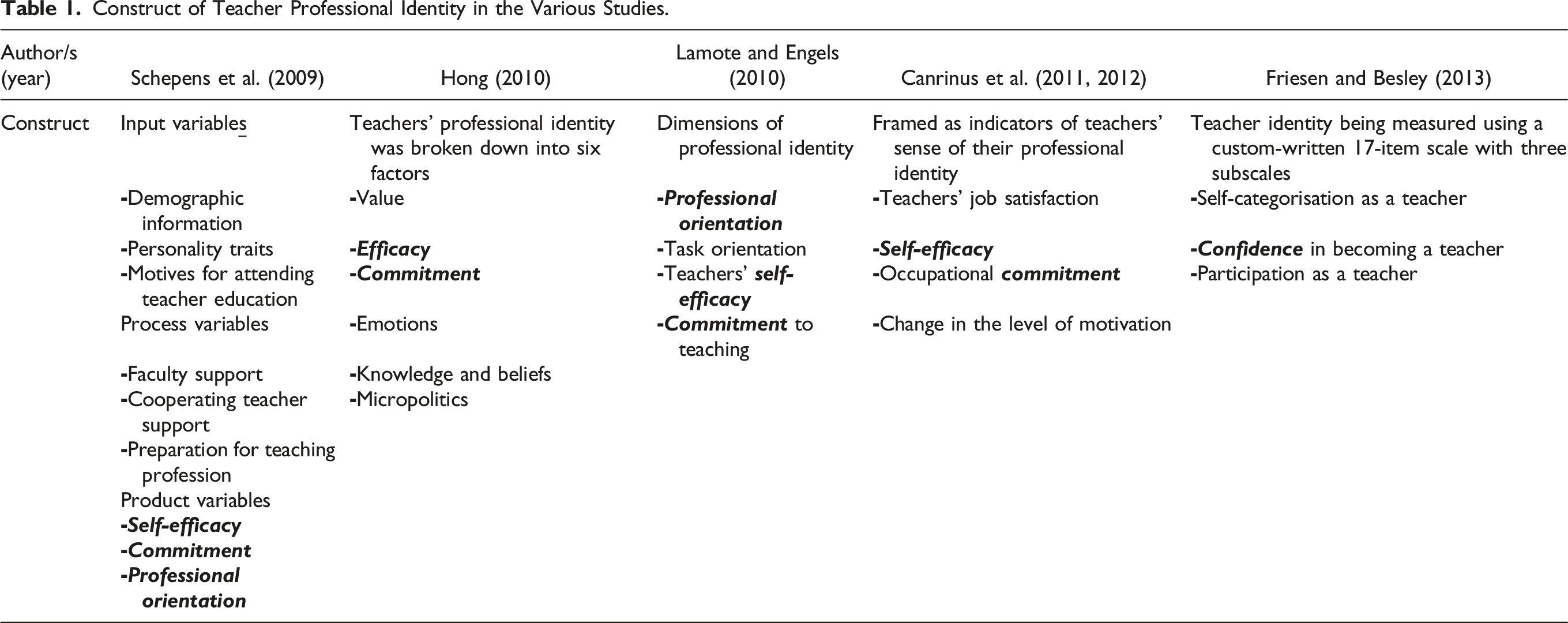
Based on the literature review, different researchers have formulated different models to study the same topic based on their own set of assumptions and perspectives, and there is no consistent direction in the focus of the various studies. For instance, Canrinus et al., (2011, 2012), based on their literature review, hypothesised that four main indicators could be used to measure teachers’ sense of professional identity. The four indicators are (1) job satisfaction, (2) self-efficacy, (3) occupational commitment and (4) level of change in motivation. However, job satisfaction may not be a relevant indicator for student teachers since they have yet to enter the profession. It is also conjectured that the level of motivation for student teachers would generally be high and therefore may not be a good indicator for student teachers as well.
In order to understand student teachers’ perception of their professional identity, Lamote and Engels (2010) adopted and modified a framework used in the context of small enterprises. In their study, four indicators have been used, and they are (1) professional orientation, (2) task orientation (3), teachers’ self-efficacy and (4) commitment to teaching. The indicators, professional orientation and task orientation, are explained as how student teachers interpreted their roles and responsibilities as teachers. However, since the focus is on the broader understanding of and identification with the roles of teachers and not the more intricate understanding of personal theories in student teachers, task orientation may not be relevant for this study.
Therefore, based on the review of the quantitative and mixed-methods studies that looked at teacher professional identity, there are three indicators (i.e., teacher self-efficacy, teacher commitment and professional orientation; bolded and italicised in Table 1) that are commonly used and deemed relevant for the formation of the construct in this study (see Table 1 for the summary of the indicators of teacher profession identity used in the various studies). For example, teacher self-efficacy has been used in all the reviewed studies as one of the indicators of teacher professional identity. Although Friesen and Besley (2013) have used the subscale ‘Confidence in becoming a teacher’ (p. 27), it is explained that this subscale reflects student teachers’ ‘confidence in their ability to develop the skills and resources necessary in order to be a successful teacher’ (p. 27), which is akin to self-efficacy.
Further review of the literature was therefore conducted to ensure that other scholars indeed support the three indicators as important professional characteristics (Tickle, 2000) in the teaching profession.
Teacher Self-Efficacy
Professional identity research focusing on the education sector has identified that teacher professional identity is dependant not only on an individual’s knowledge of a profession but equally important on the confidence to successfully undertake a particular professional role (Sachs, 2001). Niemi (2015) comments that the driving force of teacher effectiveness is ‘the sense that teachers can make a difference to students’ lives (p. 73)’. In other words, the sense of self-efficacy is critical to the professional identity of a teacher. Day (2017) adds that a strong sense of self-efficacy is key to teachers’ sense of positive professional identity. Therefore, for aspiring student teachers, their sense of efficacy is an important indicator of their teacher professional identity.
Commitment to Teaching
Additionally, the strength of one’s professional identity has also been linked to the strength of belongingness and attachment, which positively impacts career success (Slay & Smith, 2011). Various studies have shown that teachers’ level of commitment significantly impacts the quality of teaching and learning and the broader aspect of school outcomes (Day et al., 2011; Hakanen et al., 2006). Therefore, self-efficacy and an individual’s occupational commitment are important elements of professional identity in student teachers as they provide a personal perspective on how individuals view themselves as professionals (Canrinus et al., 2012).
Profession Orientation
A teacher’s orientation has also been found to be a key factor in understanding how teachers respond to educational reforms and changes (van Veen & Sleegers, 2006; van Veen et al., 2001), with orientation being defined as the teachers’ perception of what is important and meaningful in their work. Vähäsantanen et al. (2008) put forth the idea that to develop one’s professional identity, opportunities to continuously refine their individual professional orientations by actively negotiating and renegotiating what is important and meaningful in their work would be critical for teachers. Considering that student teachers would have limited experience with a teacher’s actual work, it is therefore hypothesised that societal expectations like prescribed standards or teacher competencies would have a larger influence on their professional orientation.
Present Study
Based on the literature review on studies that have formulated certain indicators to measure the construct of teacher professional identity and scholars who have written about the topic, the concept of teacher professional identity in student teachers has been defined as the student teacher’s sense of self-efficacy, commitment to teaching and professional orientation. As described above, the three factors of teacher self-efficacy, commitment to teaching and professional orientation have been used in several studies as indicators of teacher professional identity, but there is no established instrument that measures the construct of teacher professional identity. There is, therefore, a need to develop and validate a scale that can be used to measure student teachers’ professional identity.
This study, therefore, sought to validate a scale to measure the construct of teacher professional identity among student teachers through confirmatory factor analysis (CFA). More specifically, this study sought to answer the research question of whether teacher self-efficacy, commitment to teaching and professional orientation are valid factors of teacher professional identity for student teachers.
Method
Participants and Procedure
The student teachers from the Postgraduate Diploma Education (PGDE) programme and final year students from the Degree and Diploma programmes with mixed teaching subjects were recruited for this study. These three groups of participants were at a similar point in their initial teacher preparation programme, which was the point of completing their coursework learning and preparing to enter their final teaching practice, and thus considered an appropriate sample for exploring the construct of teacher professional identity in student teachers. In total, a sample of 185 student teachers was recruited for this portion of the study.
Of the 185 student teachers, 116 (62.7% of the sample) were in the Primary school track and 69 (37.3% of the sample) in the Secondary. The sample consisted of 43 student teachers (23.2% of the sample) who were enrolled in the Degree programme, 65 (35.1% of the sample) in the Diploma programme, and 77 (41.6% of the sample) in the PGDE programme. There were a variety of subjects that the student teachers were prepared to teach. 39 (21.1% of the sample) were prepared to teach Art or Music, 37 (20.1% of the sample) English Language, 27 (14.6% of the sample) Humanities subjects, 3 (1.6% of the sample) Mathematics, 53 (28.6% of the sample) Mother Tongue Languages, 16 (8.6% of the sample) Physical Education and 10 (5.4% of the sample) Sciences.
A second independent sample was recruited from the PGDE programme enrolled in the following year to provide verification of the factor structure obtained with the first sample of participants. In total, 412 student teachers were recruited for this purpose.
Of the 412 student teachers, 187 (45.4% of the sample) were in the Primary school track and 225 (54.6% of the sample) in the Secondary. There were a variety of subjects that the student teachers were prepared to teach. Forty one (10.0% of the sample) were prepared to teach Art or Music, 120 (29.1% of the sample) English Language, 76 (18.4% of the sample) Humanities subjects, 19 (4.6% of the sample) Mathematics, 87 (21.1% of the sample) Mother Tongue Languages, 16 (3.9% of the sample) Physical Education and 53 (12.9% of the sample) Sciences.
Ethical clearance from the University’s Institutional Review Board (IRB) was obtained before any recruitment and data collection activity was carried out. The landing page of the electronic questionnaire informed the participants of the purpose of the study and requested their consent before willing participants were able to access the survey. Therefore, participation in this study was strictly voluntary, and student teachers’ responses were kept confidential, with no personal data collected in the data collection process. Participants were informed that they could refuse or discontinue their participation at any time on the introduction page as well.
Participants were recruited through two means in both phases. Firstly, for the student teachers from the PGDE programme, an email was sent through a third party, who is not connected with the research, nor has any power or authority over the students, to request for participation. For the student teachers from the degree and diploma programmes, a recruitment announcement was made at the end of a briefing that involved the whole cohort of the student teachers. Time was provided for the briefing attendees to access the online survey to provide their consent before completing the questionnaire.
Measure
The process of developing the scale was guided by the work of DeVellis (2017). The initial development of the items for the instrument was first guided conceptually and theoretically by the review of the literature. This effort was also practically informed by experts in the field of teacher education who have a particular interest in this research topic to establish face validity. The instrument was, therefore, proposed to be made up of three subscales of teacher self-efficacy, commitment to teaching and professional orientation. Items from each subscale were generated with reference to existing instruments that measured these subscales (Chan et al., 2008; Jongmans et al., 1998; Tschannen-Moran & Hoy, 2001; Van Huizen, 2000).
The developed scale to measure teacher professional identity in this validation study was named the Teacher Professional Identity Scale (TPIS). Student teachers made use of this self-report scale and rated each item on a 5-point Likert scale ranging from 1 (not well at all) to 5 (very well) for the teacher self-efficacy subscale and 1 (strongly disagree) to 5 (strongly agree) for commitment to teaching and professional orientation subscales.
Teacher Self-Efficacy
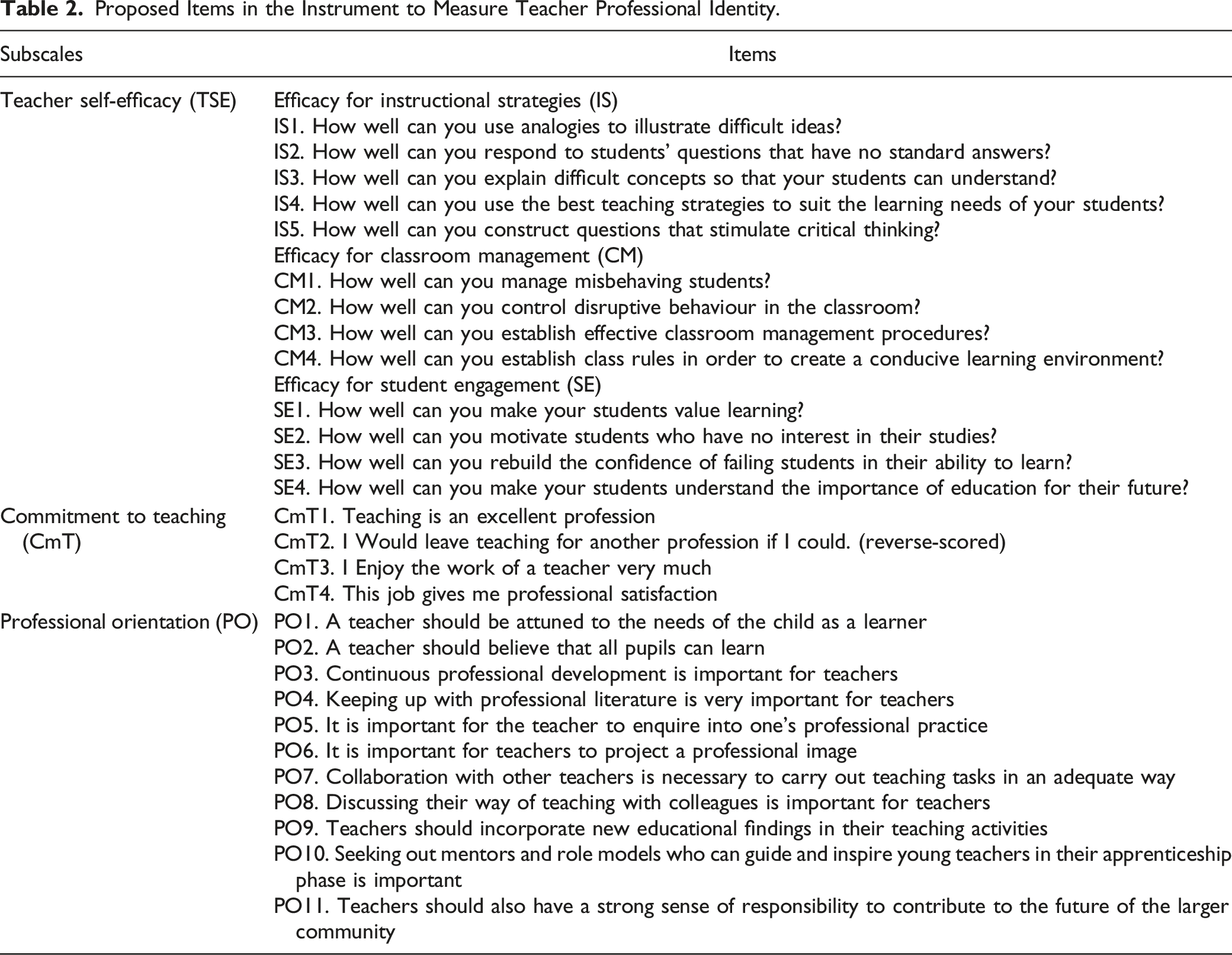
Proposed Items in the Instrument to Measure Teacher Professional Identity.
Commitment to Teaching
van Huizen (2000) developed a 4-item subscale, commitment to teaching, to measure the degree to which teachers feel the psychological connecting and identification to the work of a teacher (e.g., ‘I enjoy the work of a teacher very much’). In this study, this can be understood as the degree to which student teachers feel committed to the teaching profession and the work of a teacher (see Table 2 for details).
Professional Orientation
Professional orientation can be understood as teachers’ perception of what teachers’ work is significant and meaningful (Vähäsantanen et al., 2008; van Veen et al., 2001). The initial reference point when developing this subscale came from Jongmans et al. (1998). The original scale was modified to suit the Singapore context and had 11 items that reflected the institutional perspective of the work that is significant and meaningful to the Singapore context (e.g., ‘Continuous professional development is important for teachers’. and ‘Collaboration with other teachers is necessary to carry out teaching tasks in an adequate way’.) (see Table 2 for details).
Statistical Analysis Procedures
To answer the research question regarding whether teacher self-efficacy, commitment to teaching and professional orientation are valid factors in teacher professional identity, CFA was conducted to examine the fit between the hypothesised model of TPIS and the data collected in this study. To further verify the factor structure of the TPIS, CFA was performed on a second independent sample.
Confirmatory factor analysis is used when the researcher has ‘a firm a priori sense … of the number of factors that exist in the data, of which indicators are related to which factors, and so forth” (Brown, 2015, p. 1). In other words, the researcher must already have some theoretical understanding of the underlying latent variable structure to be able to hypothesise a structure for testing (Byrne, 2016). Since the development of the TPIS was guided theoretically and conceptually by the review of the literature, CFA was deemed an appropriate statistical procedure to test how well the measured variables represented the latent construct.
However, before testing the construct validity of the overall model, the unidimensionality of each subscale was ascertained through separate CFA. This step was deemed important since each subscale was used separately by different researchers in different contexts but not for the target population in this study. Additionally, the subscale of professional orientation was adapted, and separate CFA to assess its factorial validity was essential. A process of data screening and preparation was also carried out to ascertain that the data collected was suitable for CFA to be conducted.
Confirmatory factor analysis was conducted using AMOS 23 in this study to examine the fit between the hypothesised model of TPIS and the data derived. The estimation method used was Maximum Likelihood (ML), using the variance–covariance matrix.
Model Evaluation and Respecification Process
The goodness-of-fit of the hypothesised and revised measurement models were first evaluated against four widely used descriptive fit indices (Brown, 2015; Jackson et al., 2009), including (1) the ratio of chi-square to degrees of freedom (
The various models were evaluated for localised areas of ill-fit through an examination of the factor loading, residuals and modification indices. Items with factor loading smaller than 0.5 were considered for removal based on the recommendation by Hair et al. (2010). Also, large standardised residuals may indicate either under- or overestimation of the relationship between two indicators. The cut-off value of 2.58 was used based on the recommendation by Byrne (2016). In addition, the presence of localised areas of ill-fit can be detected by observing the presence of large modification indices and expected parameter change values. In general, good fitting models will have modification indices that are small in values, and any indices with values greater than 4 is an indication that the overall fit of the model can be significantly improved if the constrained parameter is freely estimated (Brown, 2015). These statistics provided prompts for possible respecification if a compelling substantive basis existed (Jackson et al., 2009). Respecification involved the removal of items or the addition of freely estimated parameters to the model based on the modification indices. This process was done first by examining the items associated with the error terms to determine the soundness of each addition based on conceptual and practical considerations. This process was done one step at a time, starting with the error terms with the largest modification indices.
Lastly, the finalised model was evaluated for the interpretability and size of model parameter estimates as recommended by Brown (2015). According to Byrne (2016), three criteria were of specific concern. Firstly, the feasibility of the various parameter estimates was scanned for their correctness in terms of direction and magnitude. Secondly, the standard errors were ascertained to be of an appropriate magnitude and not questionably too big or too small. Thirdly, the statistical significance of the parameter estimates was tested through the observation of the critical ratio to be > ±1.96 (Byrne, 2016).
Results
Data Screening
There was no missing data from the respondents. However, responses from two unengaged respondents who provided the same score for every item were removed. The data collected was then put to further statistical test to ascertain its suitability for the CFA procedure.
Multivariate normality of the data based on Mardia’s coefficient was equal to 100.944, and its critical ratio was 16.658 and therefore indicated multivariate non-normality. However, the data was considered only moderately non-normal, with skewness and kurtosis of all items below the value of |2| for skewness and |7| for kurtosis, and ML estimation is fairly robust under these conditions (Finney & DiStefano, 2013). The data set was therefore deemed suitable for further analysis using CFA.
Descriptive Statistics
Summary of Means, Standard Deviations and Correlations (Phase 1 & 2).
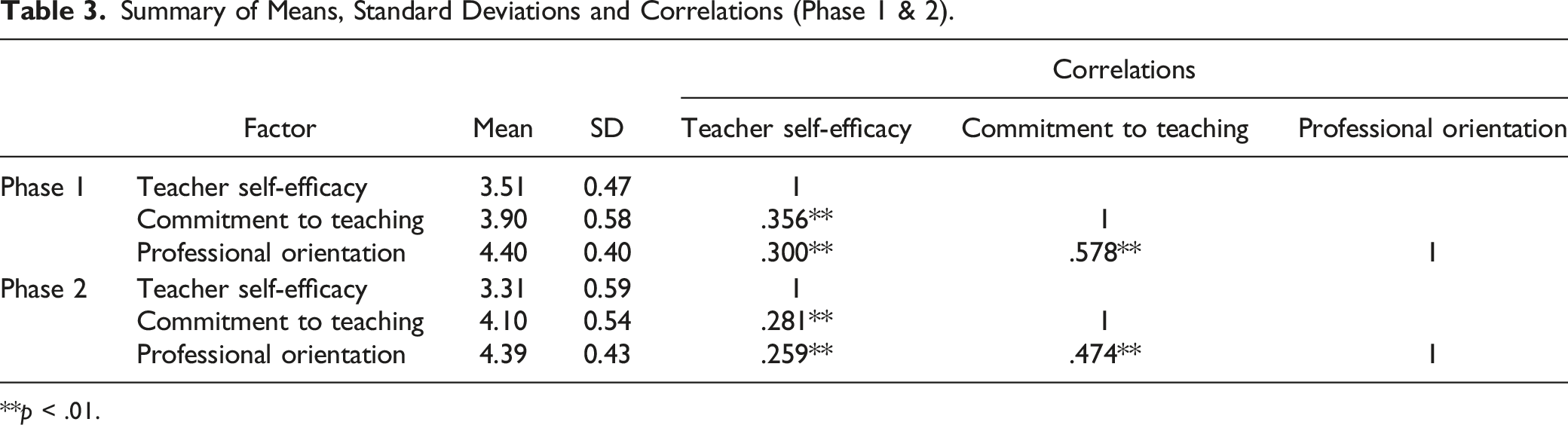
**p < .01.
Checking for Unidimensionality
The correlations between the factors provided information on the relationships between the factors. However, it was crucial to ascertain that each factor was measuring a single construct or was unidimensional and had good psychometric properties on its own. Although each of the factors has been validated and used, they have been used separately and in different contexts. This process of checking for unidimensionality was therefore deemed important. Each of the factors (i.e., teacher self-efficacy, commitment to teaching, and professional orientation) was henceforth analysed separately using the CFA approach.
Model Evaluation and Respecification Process for Teacher Self-Efficacy
The initial testing of the subscale of Teacher self-efficacy produced a poor model fit. A process of respecification was therefore undertaken. Upon inspection of the factor loadings from the AMOS output, Item IS1 had a low factor loading of .43 and was therefore deleted.
Next, based on the examination of the modification indices related to covariance, there was evidence of misspecification associated with the pairing of error terms associated with CM3 and CM4 (eCM3 <—> eCM4; MI = 15.1). Based on the inspection of the items involved, there was evidence of content redundancy. CM3 asked about effective classroom management procedures, and CM4 asked about class rules for creating a conducive learning environment. Participants might have seen the two items as similar. It was therefore decided that CM4 should be removed.
Upon further inspection, there was evidence that SE4 was problematic, demonstrating covariance with several other variables, and was deemed an ambiguously phrased question. The item also had a relatively low factor loading of .57 and was thus removed.
Subsequent examination of the modification indices for the Regression Weights (i.e., factor loadings) indicated that item effIS2 might be a problematic item that had a relatively low loading of .55, and at the same time, loaded on two other items. Upon examination of the item, it was concluded that the item was too ambiguous and was therefore not a good item. Together with the evidence from the modification indices, the item effIS2 was removed.
In the end, the subscale teacher self-efficacy retained nine out of the original 13-items with very good overall goodness-of-fit indices. (
Model Evaluation and Respecification Process for Commitment to Teaching
The initial testing of the subscale Commitment to teaching yielded very good overall goodness-of-fit indices (
However, upon inspection of the factor loadings from the AMOS output, CmT2 had a low factor loading of .40. However, CmT2 was retained because it was an important item that fitted directly into the factor Commitment to teaching.
Model Evaluation and Respecification Process for Professional Orientation
The initial testing of the subscale Professional orientation produced a moderate model fit, and further respecification was made. A higher cut-off value of 0.6 was set for this subscale with the intention of reducing the number of items under this factor. Based on this more stringent criterion, items PO1, PO2 and PO4 were removed based on the sequence of their factor loadings, starting with the lowest. Subsequently, based on the examination of the modification indices related to the covariances, there was evidence of misspecification associated with the pairing of error terms associated with PO7 and PO8 (ePO7 <—> ePO8; MI = 9.864). Item PO8 was removed based on the inspection of the two items, which revealed evidence of content redundancy.
In the end, the subscale professional orientation retained seven out of the original 11 items with very good overall goodness-of-fit indices. (
Evaluation of the Finalised Model
The overall goodness-of-fit indices suggested that the initial full model fitted the data well, with all selected goodness-of-fit indices falling within the recommended cut-off values. However, an inspection of the standardised residuals showed that item PO10 was a problematic item. PO10 item had a low factor loading of .54, and further examination of the item indicated that the item was a double-barrelled question and was thus evaluated as a poor item to be removed. Further inspection of the standardised residuals and modifications indices for the Regression Weights indicated that PO5 might be a problematic item that crossed loaded with other items. After looking through the items in this subscale, it was concluded that PO5 and PO3 might be viewed as having content overlap. Therefore, together with the further consideration to reduce the number of items in this sub-scale, it was decided that PO5 be removed.
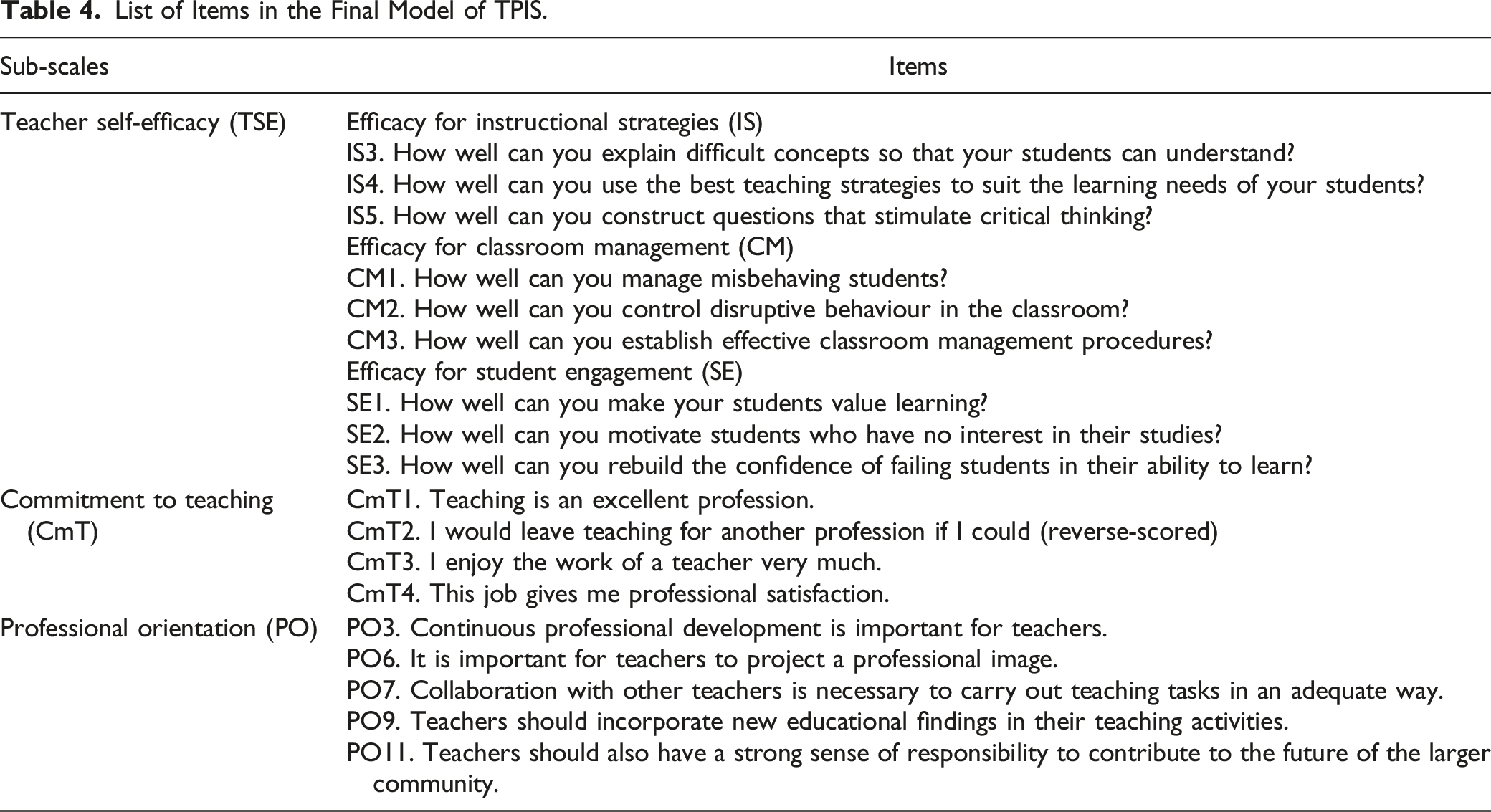
After respecification, the final model fitted the data very well: Final model of TPIS with its standardised factor loadings and regression weights. List of Items in the Final Model of TPIS.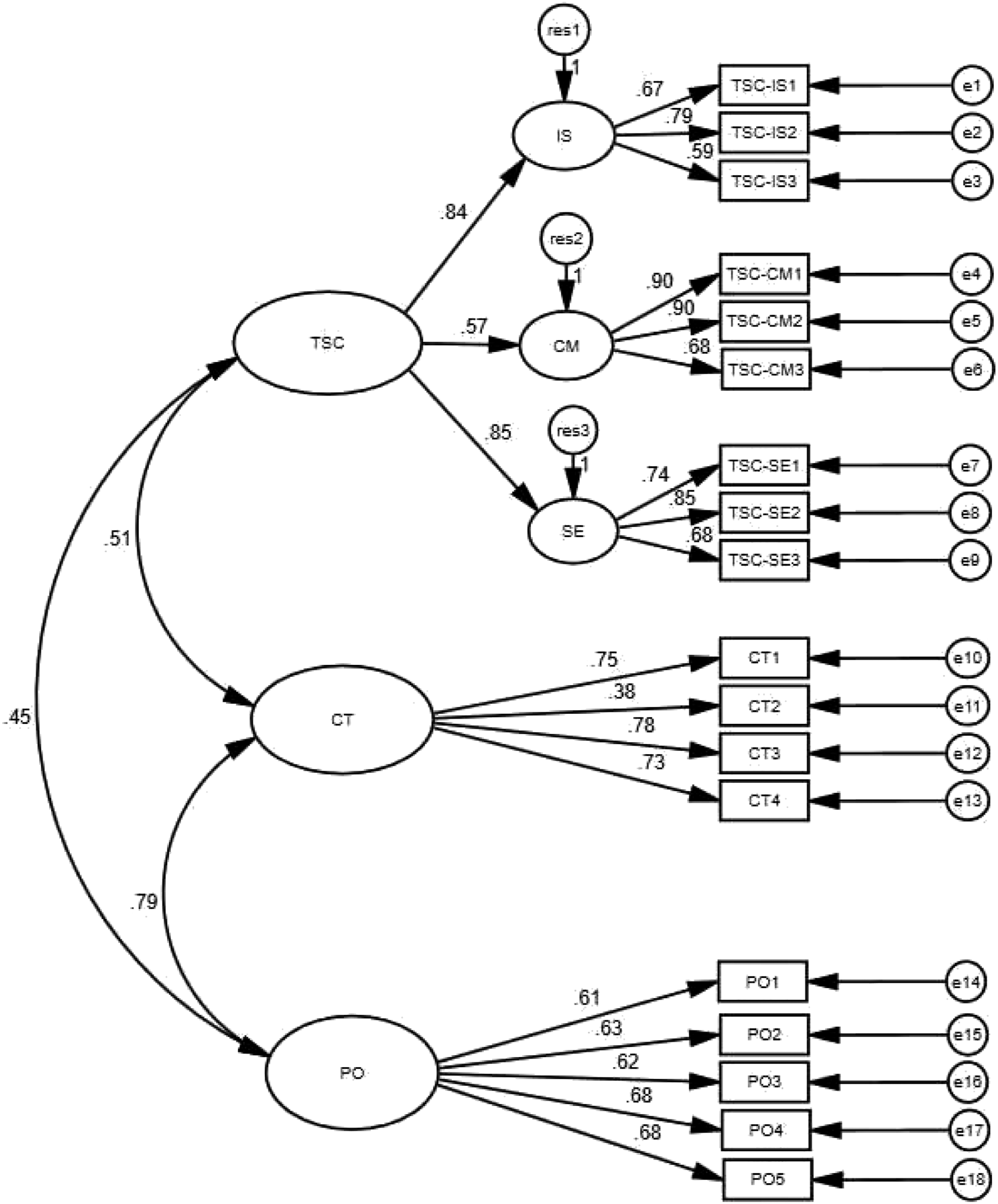
Upon further investigation of the localised areas of strain statistics (i.e., modification indices and expected parameter change), it was decided that there were no substantive reasons to further the respecification process. An inspection of the parameters showed that all parameter estimates exhibited the anticipated direction, magnitude and statistical significance.
Evidence for Discriminate Validity and Reliability
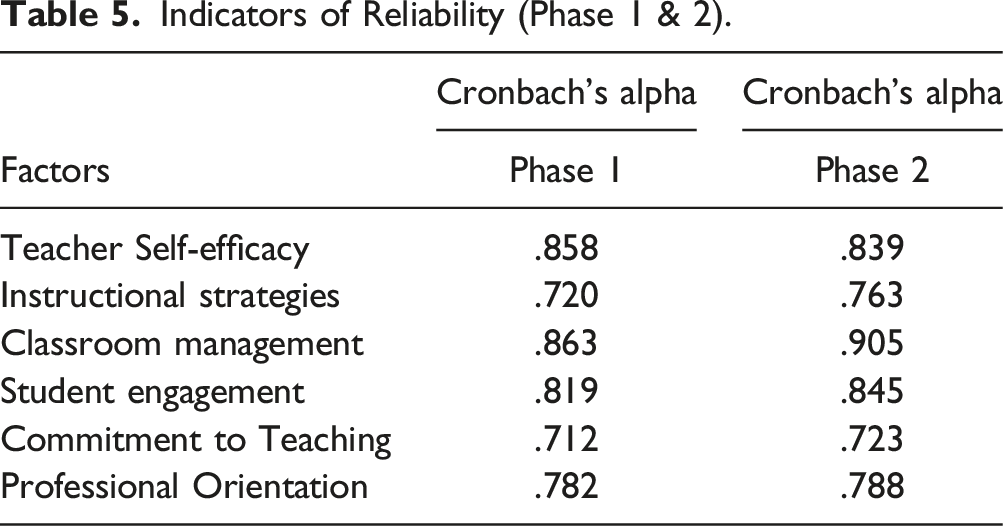
Indicators of Reliability (Phase 1 & 2).
Cross-Validation of the Factor Structure of the TPIS
The data collected from the second independent sample was used to verify the factor structure obtained earlier. (See Table 3 for a summary of the descriptive statistics for the sample in Phase 2). The data fitted the model well, producing reasonable goodness-of-fit statistics:
The results from the second independent sample lend further support to the suitability of the TPIS to be a reliable and valid instrument for measuring the construct of teacher professional identity of student teachers.
Discussion
The primary purpose of this study was to develop and validate an instrument to measure teacher professional identity of student teachers. A systematic process of referring to the literature, important local documents and experts in the field of teacher education was followed before arriving at the proposed structure of the TPIS. In the end, the TPIS was made up of the three subscales of teacher self-efficacy, commitment to teaching and professional orientation.
Several statistics have been used to provide evidence of a good fit to the data. Firstly, the various goodness-of-fit statistics provided a ‘global, descriptive indication’ (Brown, 2015, p. 97) of the good fit of the CFA solution in the final model after several rounds of respecification where all chosen model fit indices met the recommended cut-off value. Each of the respecification steps was taken with careful consideration, prompted first by statistical evidence from examining localised areas of ill-fit statistics and followed by well-measured conceptual and empirical rationale. The examination of localised areas of ill fit was, therefore, an essential process in arriving at the final model. The examination of parameter estimates of the finalised model provided further evidence of the factorial validity of the model with all parameters meeting the criteria set forth by Byrne (2016), showing that all parameter estimates were statistically significant and, therefore, were important to the model.
A second independent sample was recruited to provide further evidence for the validity and reliability of the factor structure of the TPIS. The data fitted the final model reasonably well and produced statistics that lent further support that the TPIS was a valid and reliable instrument for its intended purpose. There were acceptable levels of reliability or internal consistency of the factors based on Cronbach’s alpha values greater than 0.70 for both the samples. This result provided evidence that the items for the various latent variables indeed were measuring that same latent variable.
The proposal of the three factors has been validated and supported in this study and other literature as well. Various literature has shown the link between teacher professional identity and teacher self-efficacy, commitment to teaching, and professional orientation (c.f., Canrinus et al., 2012; Day, 2002, 2017; Friesen & Besley, 2013; Hong, 2010; Lamote & Engels, 2010; Niemi, 2015; Sachs, 2001; Schepens et al., 2009; Slay & Smith, 2011; Vähäsantanen et al., 2008; van Veen & Sleegers, 2006; van Veen et al., 2001). Hanna et al. (2019) did a systematic review of the literature to better understand the various domains that researchers have used to operationalise the concept of teacher professional identity, and their findings also showed that the factors, self-efficacy and commitment, used in this study were some of the most common indicators that exist in the literature.
Based on the literature review, most existing quantitative studies adopted the exploratory factor analysis (EFA) approach rather than the CFA approach, except for the study by Schepens et al. (2009). This could largely be because we were at a more exploratory stage of understanding the research topic on teacher professional identity. However, there are more studies in recent years (e.g., Hanna et al., 2020; Lentillon-Kaestner et al., 2018) that have started using the CFA approach to provide more statistical evidence to confirm the factor structure of the construct. This study therefore adds to the increasing knowledge of the research topic.
On the whole, there is good evidence provided by this study that teacher self-efficacy, commitment to teaching, and professional orientation are valid factors of teacher professional identity, and the final 18-item instrument has been found to be a valid and reliable instrument to measure teacher professional identity of student teachers. Based on the findings in this study, the 18-item TPIS can therefore be a viable tool for use in future studies related to teacher professional identity in student teachers. The availability of a scale to measure the construct of teacher professional identity provides an opportunity to have a more systematic approach to conduct more quantitative studies to complement the many qualitative studies and move this research area forward by contributing to the growing interest in this research area.
Implications, Limitations and Future Research
The findings in this study are based on the Singapore context, and generalising the findings should be done with caution. Any attempt to make use of the validated scale in another context should be accompanied by a careful review of the items and factorial validity to suit the localised context. Therefore, it is recommended that larger and cross-cultural samples of student teachers be considered to validate the scale further to be used across different education systems.
Furthermore, this study adopted an exploratory approach to the CFA process, which is not without controversy. The pros and cons of conducting related post hoc model-fitting through the process of respecification have been rigorously contested in the literature (Byrne, 2016). While there are strong criticisms from some scholars regarding the practice (Cudeck & Browne, 1983; as cited in Byrne, 2016), some others supported the practice, explaining that the exploratory approach to CFA can be essentially important when considering the practical and statistical significance (Tanaka & Huba, 1984; as cited in Byrne, 2016). When discussing the issues related to post hoc model-fitting, Byrne (2016) suggests that one strategy to address the issues is to employ a cross-validation strategy whereby the final model derived from the post hoc analysis is tested on a second independent sample. In this strategy, the initial sample functions as the calibration sample on which the initially hypothesised model is tested and has any post hoc analyses conducted to attain a well-fitting model. The validity of the structure can then be tested using the second validation sample, as what has been done in the current study.
Also, even though the study followed an established method for scale development by DeVellis (2017), there are limitations associated with the selection of subscales that formed the TPIS. First, the selection of subscales was mainly informed by the review of the literature, and therefore the meaning and understanding of the various subscales might not be fully contextualised to student teachers. It is therefore debatable that the selected subscales should also have been verified through qualitative studies to ascertain the applicability and thoroughness of the conceptualisation of teacher professional identity in this study. Although it would be an impossible task to arrive at a fully comprehensive construct for teacher professional identity, there are new factors, such as adaptability (Neto et al., 2019) and resilience (Day, 2018), that are becoming increasingly important aspects of becoming a teacher, and therefore worth examining.
Although the TPIS presents some limitations, it could still be useful from both research and practice point of views. From a research point of view, the instrument could be used to track both cross-sectional data as well as longitudinal growth trajectory of teacher professional identity of student teachers during their initial teacher preparation programme. It is then also possible to investigate the predictive power of various mediating factors. One example would be to investigate the impact of perceived satisfaction of basic psychological needs (Ryan & Deci, 2017) on student teachers’ development of professional teacher identity to better meet the needs of these aspiring teachers.
From the policy and practice point of views, the TPIS would be useful to provide data on student teachers’ sense of their teacher professional identity at different stages of their initial teacher preparation programme and investigate the differences between various initial teacher preparation programmes in order to evaluate their strengths in supporting the development of one’s teacher professional identity. This information can, therefore, be beneficial for teacher educators and policymakers to understand student teachers’ sense of efficacy, commitment and professional orientation in order to develop and implement programmes or policies that can positively influence the development of one’s teacher professional identity during initial teacher education.
Conclusion
This study set out to develop and validate a scale to measure the construct of teacher professional identity for student teachers. This was accomplished through an in-depth literature review to surface the three factors (i.e., teacher self-efficacy, commitment to teaching and professional orientation) to form the construct. CFA was the primary statistical method used to investigate the factorial validity of the construct, and the results provided strong evidence that student teachers’ professional identity is made up of the three factors. The validated scale can be useful for both researchers and practitioners in the research or educational domain. The use of TPIS can help teacher educators, curriculum designers, and policymakers better assess and evaluate the development of teacher professional identity in student teachers, thus better supporting them in their journey in becoming full-fledged teachers.
Footnotes
Declaration of Conflicting Interests
The author(s) declared no potential conflicts of interest with respect to the research, authorship and/or publication of this article.
Funding
The author(s) received no financial support for the research, authorship and/or publication of this article.
