




Abstract
Intergenerational transmission of disadvantage remains a problem despite political and educational initiatives. This study explored the role of personality and psychosocial factors in occupational status in a survey of 383 participants (174 males and 209 females) over 39 years from age 16 to 55. Mother’s education, extraversion, and mastery motivation were the best predictors of current socioeconomic status. A focus on education and academic development as the single solution to social immobility has been ineffective. Instead a broader approach which includes realistic lifelong educational opportunities and an education system which enables socioemotional development as well as academic growth is recommended.
Introduction
The intergenerational transmission of socioeconomic disadvantage is evidentially still a problem across Organization for Economic Cooperation and Development (OECD) countries despite a variety of policy initiatives in education and social welfare (Chetty et al., 2014). A correlation between social disadvantage across generations is indicative of social immobility and breaking this relationship is indicative of social mobility which can be either upward or downward (Eberharter, 2018). Despite some issues related to using occupational status as a measure of social class, it still offers a reasonable indicator (Connelly et al., 2016). For this study, difference or similarity between parental occupational status and that of participants is an operational definition of social mobility or immobility.
Differential educational opportunity is a key factor in social mobility, and evidence shows that these differences persist across generations (Eberharter, 2018; Torche, 2018). Intergenerational immobility shows common trends across a range of outcomes such as occupation (Eberharter, 2013; van Houten et al., 2013), physical health (Scorza et al., 2019; von Fintel & Richter, 2019), mental health (Landstedt & Almquist, 2019), educational attainment (Dong et al., 2019; Torche, 2016, 2018), emotional intelligence (Costa et al., 2018), subjective well-being (Zhao et al., 2017), personality (Anger, 2011), parenting style, fear of failure (Elliott & Thrash, 2004), and internalizing and externalizing behaviors (Kim et al., 2009). Clearly many, if not all, of these variables are interlinked, and their causal relationship needs to be more fully understood to bring about substantial change. Health outcomes, education and social welfare are outcomes likely to have similar causal determinants which need to be informed by comprehensive longitudinal data (Bradley & Greene, 2013; Suhrcke & de Paz Nieves, 2011). For example, a question raised is whether parenting style and personality are drivers of social mobility. However, as much of the research is cross-sectional, this question remains equivocal. It is only through longitudinal data that an answer can be found. While education plays an important role in social mobility, the persistence of social immobility suggests that other factors are equally, if not more, important (Torche, 2015). Mother’s educational status has been previously identified as a predictor of social mobility (Augustine et al., 2010; Cassidy & Lynn, 1991), but its long-term impact and the mechanisms through which it has its impact needs to be explored.
There is also clear evidence that intergenerational immobility is not equally dispersed across countries but is located in specific regions or neighborhoods (van Ham et al., 2012). The geography of social mobility indicates that immobility is very much anchored in more deprived areas and thus the real depth of the problem may be underestimated in cross-national studies (Chetty et al., 2014). These authors found that the spatial variation in intergenerational mobility was “strongly correlated with five factors: residential segregation, income inequality, school quality, social capital, and family structure” (p. 3). In a related paper, Chetty et al. (2014) found that the level of intergenerational mobility remained stable for the 1971–1993 birth cohorts in the United States, especially in comparison to the degree of variation across areas. In other words, the level of social mobility was stratified by the level of economic advantage in the areas studied (Sirniö et al., 2016). The cohort followed up in the study reported in this article is representative of a region which has experienced high levels of social and economic disadvantage as well as a period of civil unrest and conflict, making it particularly interesting in terms of how the context and human characteristics have impacted on social mobility.
Social mobility is complex and influenced by a wide range of social, environmental, psychological, and even biological processes (Crawford et al., 2011; Scorza et al., 2019; Stuhler, 2018). Longitudinal data can usefully add to the knowledge base by identifying new concepts and pathways and by replicating previous findings thus strengthening the case. This study is based on an opportunity presented to follow-up a sample which had initially been assessed in 1979.
The overall aim of this study was to explore the predictors of occupational status as an indication of social mobility/immobility in a longitudinal sample of participants who were initially assessed at age 16 and are now in their mid-fifties.
Method
This was a longitudinal survey following up a stratified sample initially assessed in 1979. The participants, procedure, and measures are described below.
Participants and Procedure
This was a longitudinal study of 383 participants (174 males and 209 females) assessed at three time points over a period of 39 years. In 1979, all 701, 15- to 16-year-old children (347 boys and 354 girls), in their 5th year of secondary schooling in eight secondary schools in one Local Education Authority area in Northern Ireland (NI), comprising approx. 43,000 inhabitants were assessed (Lynn, Hampson, & Magee, 1983). This was a stratified sample as NI was divided into a number of Education Authority areas, each responsible for all the schools within their area. The full range of types of schools in NI were represented in the sample. All of the schools were located around a small town with a population of approximately 14,000 which is the main focus of business in the area. The area would be described as largely rural.
In 1986 in a follow-up survey, 451 of these participants (199 males and 252 females) were assessed at age 23 years of age approximately. This follow-up was carried out at a time when (a) NI was in the middle of a violent conflict and (b) technology such as internet was in its early stages and tracking people was much more difficult. At the time, 451 responses were considered quite a success. The current survey represents a second follow-up of 383 of these participants (Table 1). Questionnaires with stamp addressed envelopes were sent out to participants from the original study using their original identification number on the questionnaire to protect anonymity. In the 1986 survey, addresses were updated, but it was recognized that many may have moved address more recently. For many, the address held was the parental home. Census information for the region was accessed and other data sources such as telephone directories searched which enabled the identification of contact details for 286 individuals. For the remainder, a letter with the questionnaire was sent to the original address. In the letter, parents or others now living at the address were asked to pass the survey on to the participant if they had their contact details. As the study was not funded, there was not available the resource to engage in a more intensive search. In the end, usable responses were received from 54.6% of the original sample.
Assessment Stages/Ages.

Measures
The variables measured and the instruments used at each stage of assessment are listed below.
Stage I (initial assessment at age 16 years)
Demographic data
Data were recorded on age, sex, parental socioeconomic status, father and mother’s education level and employment status, family size (as the number of children in the family), and type of school attended. Socioeconomic status was recorded as father’s occupation and recoded in line with the National Statistics Socioeconomic Classification (Rose et al., 2003). Parental education was scored as highest qualification and recoded in line with the International Standard of Educational Classification (OECD, Eurostat, and UNESCO Institute for Statistics, 2015). All of the samples were white and Northern Irish.
Intelligence
The Abstract Reasoning Scale from the Differential Aptitude Test, a nonverbal abstract reasoning test lasting 25 minutes approximately (Bennett et al., 1973). Abstract reasoning (or inductive reasoning) is used to test general intellect and ability to work out new concepts and abstract ideas, rather than testing prior knowledge. These tests are closely correlated with Intelligence Quotient (IQ) tests and rely upon the ability to see the underlying logic in a pattern of symbols or shapes (instead of relying on words or numbers). This type of test is useful because the ability to answer abstract reasoning questions is independent of educational experience and cultural background and can be used to provide an objective indication of intellectual potential.
Personality
The Junior Eysenck Personality Questionnaire (H. J. Eysenck & Eysenck, 1975). This test allows personality testing of the three traits of extraversion, neuroticism, and psychoticism in children aged between 7 and 17.
Parental encouragement
This was a 13-item forced-choice scale constructed for the study. Items were designed to assess the amount of interest shown by parents in their children’s study behavior. For example, “Do your parents usually check that you have done your homework?” The scale has a Cronbach Alpha of .91 (see Appendix).
A crowding index was produced by dividing the number of family members by the number of available bedrooms. A more crowded home environment might be considered a disadvantage. A crowding index is used as a proxy measure of economic disadvantage.
Stage 2: Assessment at age 23
A personal data form requesting details of educational achievement and socioeconomic status. Educational status was scored as highest qualification and recoded in line with the International Standard of Educational Classification (ISCED: UNESCO, 2011). Socioeconomic status was recorded as current occupation and recoded in line with the National Statistics Socioeconomic Classification (2010).
Achievement motivation
The Cassidy–Lynn Achievement Motivation Questionnaire (Cassidy & Lynn, 1989). This is a multifactorial measure which taps the seven factors of Work Ethic (α = .78), Acquisitiveness (α = .74), Dominance (α = .81), Excellence (the pursuit of) (α = .77), competitiveness (α = .92), Status Aspiration (α = .75), and mastery (α = .89).
Personality
The Eysenck Personality Questionnaire (H. J. Eysenck & Eysenck, 1975). This included the revised psychoticism scale (S. B. G. Eysenck et al., 1985). This is a widely used measure of Eysenck’s three-factor model of personality, extraversion, neuroticism, and psychoticism.
Stage 3: Assessment at age 53
A personal data form requesting details of educational achievement and socioeconomic status. Educational status was scored as highest qualification and recoded in line with the International Standard of Educational Classification (ISCED: UNESCO, 2011). Socioeconomic status was recorded as current occupation and recoded in line with the National Statistics Socioeconomic Classification (2010).
Results
Data were analyzed using the Statistical Package for the Social Sciences (version 24) (SPSS 24). As we were interested in identifying factors at age 16 and age 23 which are predictive of current socioeconomic status (SES), the data was submitted to a hierarchical multiple regression analysis (HMRA) involving six steps as shown in Table 2. On the first step which looked at family demographics at age 16, the only significant factor was mother’s education (β = −.566, p < .001). Higher levels of education of mothers correspond with higher SES (SES scored as lower score equals higher status). This step accounted for 32.8% of the variance in SES. The addition of crowding and parental encouragement on step 2 did not add to the variance explained. On step 3, the addition of personality and IQ at age 16 added 2.3% to the variance explained with IQ (β = −.101, p = .037) producing a significant beta value. On step 4, educational status and SES at age 23 were added and accounted for an additional 7% of the variance. This was attributable to educational status at age 23 (β = −.345, p < .001). On step 5 personality at age 23 was added increasing the variance by 2.5% with significant beta for extraversion (β = .195, p = .003). This suggests that higher extraversion corresponds with higher SES. On the final step, the seven dimensions of achievement motivation were added and increased the variance by 7.3% to a total explained variance of 49.7%. The only significant dimension was mastery (β = −.387, p < .001).
Series of HMRA Analysis With Current SES as the First Dependent Variable.

Note. HMRA = hierarchical multiple regression analysis; SES = socioeconomic status; IQ = intelligence quotient.
p<.05. **p<.01. ***p<.001.
With each step, some of the variables (e.g., family position and IQ) became nonsignificant, suggesting that later variables were accounting for their effect. For example, with IQ, the addition of educational status at age 23 diminished its effect. Overall, the variables that remained significant on the final step were mother’s education (β = −.233, p < .001), educational status at age 23 (β = −.359, p < .001), and mastery (β = −.387, p < .045). Mastery motivation is defined as the drive to possess consummate skill and would be exhibited in working diligently on a task until one felt in control of the skill required. Those scoring higher on this dimension also attained higher levels of SES.
Educational status at age 23 is a strong predictor of occupational status and seems to moderate the impact of IQ. Because of this, a second HMRA was applied with educational status at 23 as the dependent variable as shown in Table 3. The first step which looked at family demographics at age 16 accounted for 39.5% of the variance in education at age 23 and the most significant individual variable was mother’s education (β = −.581, p < .001). Higher levels of education of mothers corresponds with higher levels of education. Family position (β = −.128, p < .01), home ownership (β = .102, p < .01), and parental SES (β = −.098,p < .01) also accounted for significant variance on this step. This suggests that an older child, whose parents own their own home, and where parents are in a higher social status bracket will have higher levels of education. The addition of crowding and parental encouragement on step two added 1% to the variance explained though this was not statistically significant. On step three the addition of personality and IQ at age 16 added 4% to the variance explained with IQ (β = −.168, p < .001) and extraversion (β = −.114,p < .01) producing significant beta values. On step 4, personality at age 23 was added increasing the variance by 2% with significant beta for extraversion (β = −.192, p < .01). This suggests that lower extraversion (or higher introversion) corresponds with higher education level. On the final step, the seven dimensions of achievement motivation were added and increased the variance by 7% to a total explained variance of 50%. The significant dimensions were pursuit of excellence (β = −.581, p < .001), status aspiration (β = −.581, p < .001), and mastery (β = −.387, p < .001). Pursuit of excellence is also described as competition with ones’ own standard of excellence and would describe the individual driven to do everything well. Status aspiration describes the motivation to attain social status. Those who scored higher on these three dimensions also attained higher levels of education at age 23.
Series of HMRA Analysis With Education at Age 23 as the First Dependent Variable.

Note. HMRA = hierarchical multiple regression analysis; SES = socioeconomic status; IQ = intelligence quotient.
p<.05. **p<.01. ***p<.001.
Finally, we looked at the profile of occupations (i.e., SES) for the sample across the three time points. This allows a comparison of the distribution of SES of parents when the sample were aged 16, against the same distribution for participants at age 23 and at age 55. We used cross-tabulation analysis with a chi-square statistic to assess if the distributions were significantly different. Comparing parental SES with SES at age 23 produced a significant relationship, χ2 (49) = 173.905, p < .001. Comparing parental SES with current SES also produced a significant relationship, χ2 (49) = 143.703, p < .001. This is illustrated in Figure 1.
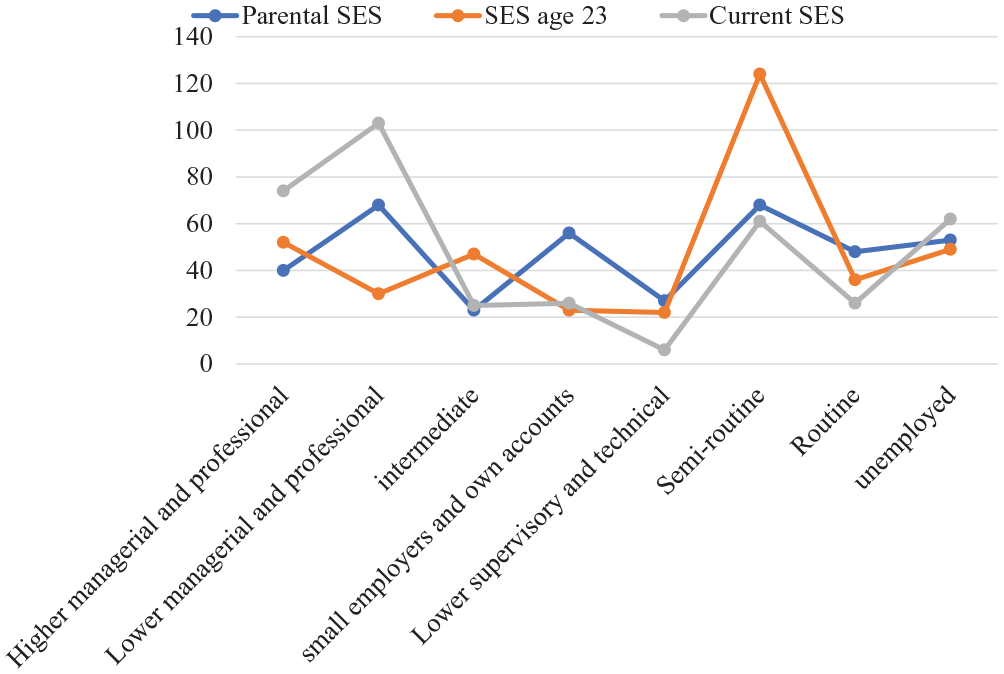
Distribution of SES across the three time points.
What it shows is that compared to their parent’s SES, our sample at age 55 contained significantly more individuals in both managerial and professional categories, and significantly fewer in the lower supervisory and technical, and routine categories. The effect at age 23 reflects a large percentage in semiroutine jobs which would reflect the many individuals who are in temporary jobs around this age.
Discussion
The sample upon which this study is based can be considered relatively representative of large portions of the United Kingdom. The original samples were all of the 16-year-old school children in one local education authority area representing a county town and its rural surrounds. The current sample were 54.6% of those original respondents and tests comparing them with those who did not respond to the recent study suggest that they did not differ, hence the argument that they are representative of the original cohort. The samples were assessed at 16 years old, 23 years old, and currently aged 55 years approximately. Our interest in the data herein reported was to explore factors that might be predictive of social mobility based on current socioeconomic status as the outcome measure.
Based on the variables measured, it would appear that the best direct predictors are mother’s education, educational status as a young adult, and mastery as a measure of motivation. In other words, those who had a better-educated mother and themselves achieved higher levels of education, and those who were motivated by the desire to overcome challenge (mastery) were more successful in terms of the measure used. The findings show a direct link between mother’s education, educational status at age 23, mastery and current SES. The analysis also helps to unpick the role of mother’s education which has an indirect effect through, extraversion, mastery, and educational status at age 23. In other words, it appears that mother’s with higher educational status impact their offspring’s personality, motivation, and educational status in early adulthood. In terms of personality, more educated mothers tend to rear children who are less extraverted (more introverted) and more optimistic. The relationship between mother’s education and introversion in offspring may reflect the fact that children of educated mothers are more likely to engage with education and be more studious. Their offspring are also more likely to be motivated by challenge in terms of mastery. Educated mothers impact on their offspring’s educational status has been previously demonstrated (Cassidy & Lynn, 1991). One could argue that NI was (and possible still is to an extent) a very traditional society in terms of sex and gender roles. In such societies, the nurturing and education of children was left mainly to mothers and mothers who had a better education themselves would advantage their children. This may well be changing as society has changed and may not be an enduring effect. The role of IQ in the process is overshadowed by other variables including personality and motivation and while IQ is predictive of educational status at age 23, its long-term impact is better explained through the impact of the education level achieved. It would appear that once a good level of education is attained as a young adult, it is the way in which that is used through motivation to overcome challenge that impacts on SES in later life. On the contrary, IQ is predicted by mother’s education, home ownership, and crowding. Again those with more educated mothers exhibit higher IQ. While parental SES did not predict IQ, home ownership and crowding, both indicators of financial status, did.
In regard to the question of intergenerational transmission, it would appear that a significant number in this sample have raised their SES above the level attained by their parents. The difference in distribution of occupational status is significant, and from Figure 1, we can see that the number in higher managerial and managerial occupations is significantly higher than their parents achieved, while those in lower level occupations is consistently lower. Although these numbers are significant, it must be said that there is still a consistent intergenerational trend.
The evidence from this study suggests that to break the intergenerational trend societies need to ensure equality of opportunity, and perhaps even more so encouragement, for girls in education. This sample came from NI which was a very traditional society and impeded in development by the violent conflict during the period 1969 to 2012. Perhaps there are lessons for other nations where the education of girls is restricted or denied. There is also a need to focus on the development of more intrinsic motivational styles. It is a criticism of our education system that the singular focus on academic development is in fact destroying the motivation to learn.
The study is limited in terms of measures not used; for example, more comprehensive models of personality have since been developed. However, some of the potential measures were not available when baseline assessment was carried out. More recent studies have identified the personality dimension of conscientiousness as important in social mobility. In retrospect, there are many different variables that could have been measured. Perhaps more pertinently, the opportunity to use a wider range of measure at the age 55 follow-up would have increased the scope of the study.
The recommendations from our findings are fairly simple and clear. First of all, opportunities for a good education are clearly important and especially so for girls. Mothers in this cohort have had an immense impact on their children’s educational and socioeconomic futures, although this may be changing if in fact fathers are playing a more involved role in child rearing. It is important that the restrictions placed through expectations on girls in terms of further and higher education needs to change. More financial and other support for young mothers to be able to continue their education is needed, and this requires changes in social attitudes in many countries.
The singular focus on academic attainment in our education system may be questioned as indicated by the impact of personality and motivation over and above IQ. The growing concern for mental health in schools (Hanley et al., 2017) and (Maykel et al., 2018) and the increasing prevalence of stress-related symptoms in school children suggest a need. Currently in many OECD countries, education policy is focused on academic curricula and pastoral care comes low down on the agenda. Yet we know that happy children learn more effectively. The evidence here suggests that enabling children to develop motivation to learn may be more effective than a focus entirely on an academic outcome. We know that intrinsic motivation is more likely to develop when the task is in itself enjoyable. For children learning through play is one of the most effective pedagogic strategies. Perhaps a change of focus from academic attainment to the development of motivation to learn might enable children to treat education as a positive challenge rather than a negative demand.
Footnotes
Appendix
Compliance With Ethical Standards
All procedures performed were in accordance with the ethical standards of the Institutional Research Committee and with the 1964 Helsinki Declaration and its later amendments.
Declaration of Conflicting Interests
The author(s) declared no potential conflicts of interest with respect to the research, authorship, and/or publication of this article.
Funding
The author(s) received no financial support for the research, authorship, and/or publication of this article.
Informed Consent
Informed consent was obtained from all individual adult participants included in the study.
