



Abstract
This research examined how women are recruited into drug trafficking. Previous findings indicate that women are recruited into drug trafficking due to economic hardship. Data for this research study is taken from in-depth interviews with 13 female offenders incarcerated at the Trinidad and Tobago Prison Service. The findings in this study suggest women become involved in drug smuggling for reasons that are far more complex than simple financial need. Specifically, the majority of women fell prey, under the guise of friendship, to an unscrupulous individual, interested in furthering his or her cause. Under systems of patriarchy and capitalism, the findings from this study suggests that women became involved in drug trafficking because of how they are socialized.
A young woman gets off the plane at an international airport on a beautiful and peaceful Caribbean Island; but the thought of a wonderful vacation is soon disturbed when the customs agent says, ‘You are under arrest for trafficking in drugs.’ She may have lost everything, her freedom, her children, her family; her parents will be disappointed, her business may fold, her children might be brought up by someone else, and that money she was promised is nowhere in sight. Now she is paying the price. Why did she do it? It is not certain, given that scant scholarly inquiry has been made into why women become involved in the trafficking of drugs from one country to another.
Drug trafficking has been identified by the United Nations Office on Drugs and Crime (UNODC) as a global issue. For instance, in 2016, the UNODC (2018) reported an estimated 2.5 million drug seizure cases in 69 countries around the world. Even more, the UNODC (2018) reported that, between 2012 and 2016, approximately 151 countries reported drug seizures for marijuana, with approximately 146 countries reporting drug seizures for cocaine, approximately 139 countries reporting drug seizures for opioids, and approximately 136 countries reporting drug seizures for opiates (UNODC, 2018). While the UNODC (2018, p. 27) estimated that, between 2012 and 2016, approximately “90% of people brought into contact with the criminal justice for drug-related offenses were men,” the remaining 10% were comprised of females. While the largest number of women arrested for drug trafficking were reported in south-eastern and eastern Asian countries as well as western, eastern, and central European countries, the UNODC (2018) reported the highest proportion of females arrested for drug trafficking in Central America and Oceania, which consist of Australia and New Zealand (22% and 20% respectively). In India, Delhi criminal justice agencies reported a rise of approximately 15% from 2005 to 2006 in female offenders arrested for drug trafficking, as well as the Punjab police in Malawi who reported a 12% increase in arrests of women during the first 5 months of 2012 (Tandon, 2012). Correspondingly, in Zambia, a Zambian official, the Public Relations Officer for the Drug Enforcement Commission in Lusaka, stated that four women had been arrested within 7 days at their international airport and he was “saddened with the emerging trend of drug trafficking as it is degrading to the dignity of women in our society” (“Three Women Arrested,” 2010).
Previous research reveals that drug trafficking is conducted by people on the fringes of society, those of low socioeconomic status, those desiring to uplift their personal identity within mainstream society because of past victimization or childhood abuses, and by those who are criminally inclined or have anti-social behaviors. However, the recruitment strategies and techniques used by leaders of drug empires to enlist female drug traffickers, an area understudied, is a key focus of this study. In focusing on the drug trafficking experiences among females transiting through one of the Caribbean nations, this study aims to fill a void in the literature by addressing the question, how are females recruited into drug trafficking? Specifically, this research study collected qualitative data from 13 female offenders incarcerated at the Trinidad and Tobago Prison Service (TTPS) on their recruitment into drug smuggling.
Survey of Drug Smuggling Literature
Using a university library database and keywords such as “female drug smuggling,” “recruitment,” and “involvement,” the authors identified available research on female drug smuggling. Once these studies were identified, the authors only focused on those studies detailing the recruitment strategies and techniques used to enlist females into drug trafficking. The reference lists of these studies were also used to secure additional research on this topic. In reviewing available research, the authors collected information about the purpose, methodology, and findings of each research study. Once this information was collected, the authors used thematic coding to categorize studies that were similar in their findings on the recruitment of females into drug trafficking and develop the themes outlined below.
In doing so, a survey of the literature revealed several themes associated with female drug smuggling. These include recruitment strategies and techniques used by leaders of drug empires to enlist drug traffickers, to include, friendship ties and intergenerational family ties, the impoverished economic status of women, and history of oppression women experience.
Friendship, Familial, and Intergenerational Ties
According to findings from Adler (1993) and Adler and Adler (1983), in a study of drug traffickers in the border region of southwestern California, approximately half of recruited drug traffickers are socialites who have no prior history of drug trafficking. Likewise, findings from Decker and Chapman (2008, p. 98) suggest that “friendship provided a large number of contacts for new sources of labour” for the organizational kingpins looking for drug trafficking recruits. As well, findings from Decker and Chapman (2008, p. 96) suggested that “ethnic ties,” such as kinship and/or friendship, contributed greatly to the recruitment of traffickers. Specifically, the researchers contend that leaders of drug organizations tended to lean towards self-protection and protection of the product by utilizing relatives and life-long friends to transport their goods. Furthermore, Decker and Chapman (2008) observed that because new recruits were known to members of the cartel families, they were specifically chosen to perform the illicit activity. Additionally, findings from Matos, Cunha, and Santos (2019), who examined the socio-penal dimensions of 148 foreign women prisoners arrested in Portugal for drug trafficking, suggest that female involvement in drug trafficking is more associated with “the opportunities these women find in their social contexts” given that it affords them access to “a better economic situation” (11). In a later ethnographic study, Edberg (2001, p. 261) found that for narco-traffickers on the Mexico and United States border, recruitment to trafficking “often occurs across generations” where family members and long-time friends are used to traffic drugs across borders. The prevalence of using family members to traffic drugs seems to be related to three issues: socialization, family trust and family obligation, and protection of family members. First, family members who are exposed to the drug trafficking behaviors exhibited by other family members are socialized to see drug trafficking as a legitimate opportunity to make money. As Chomczyński and Guy (2021) noted in their study, exposure to drug trafficking behaviors from a young age normalizes the activity in such a way that some women may knowingly enter trafficking based on socialization. In addition, family ties are connected to issues of trust an obligation. Persons involved in drug trafficking are more likely to trust family members (Desroches, 2007). Furthermore, family members feel an obligation to help or do a favor for family members. In some instances, family members may know they are transporting drugs, while in other instances, they may be unaware of what the favor involves. Finally, involvement in drug trafficking may be the result of attempts to help family members who find themselves indebted to persons involved in illegal activities. As Campbell (2008) noted, family members may feel obligated to help get their loved ones out of a “jam” by trafficking drugs.
Impoverished Economic Status
Empirical evidence also suggests that women are recruited because of economic hardships. For example, in a study of female offenders in the women’s prison in Cuenca, Ecaudor, Olmo (1990) reported that women were recruited to work as secondary participants, such as becoming drug mules or couriers, and used these opportunities to work in the illegal trade when unemployment was high. Specifically, economic hardships resulted in more opportunities for illegal employment than for legal work (Olmo, 1990, p. 43). Similarly, in a later ethnographic study of drug traffickers in southwestern United States, Adler (1993, p. 99) noted many entered the drug trafficking business because of a need for economic gain and “easy money.” The author explained women who were struggling to support families as heads of households would agree to work as couriers to provide for children regardless of the risk (Adler, 1993). By the same token, in an examination of female offenders in prison in New York state, Huling (1995, p. 59) reported lifestyles and socioeconomic status seemed to be the decision maker for many of the women confronted with recruitment to engage in illicit drug trafficking. They saw the opportunity as a “survival strategy when there [were] more opportunities for illegal employment than for legal work.” Likewise, Davies (2003, p. 290), argued that women, because of being victimized are pushed and driven into drug trafficking to escape economic hardship. Finally, Geiger (2006, p. 582), noted that female offenders in the Neve Tirza Women’s Prison in Israel, struggled against intolerable socioeconomic deprivation, given such, engagement drug trafficking to improve their economic well-being.
History of Oppression and Victimization
Campbell (2008, p. 242) research suggests that women traffickers are generally marginalized and the most vulnerable in the hierarchy of the drug trafficking business. Further, Joseph (2006) analysed data collected between 1993 and 2005 from prisons in England and Wales and concluded that women who have been faced with oppression, marginalized, or disempowered through gender, race and nationality were a sizable group who committed drug crimes. Likewise, an earlier study completed by Green, Mills, and Read (1994, p. 479) who used female offenders arrested at “Heathrow and Gatwick Airports between 1990 and 1992” further suggested that nationality and gender proved to be determinants of those recruited to become drug traffickers, and West African women were overrepresented. In addition, Fleetwood (2010) conducted ethnographic research of female offenders in Ecuador and reported that coercive tactics used against women in recruitment attempts varied, such as serious threats against her children, and the use of manipulation, or coercion through debt. Many of the participants in Fleetwood’s (2010, p. 8) study revealed that they were recruited because of “circumstances of deprivation.” In their findings, Jefferies and Chuenurah (2018), who examined stories of Thai women imprisoned in Cambodia for cross-border international drug trafficking, found that interlocking vulnerabilities of various degrees, whether it was economic, social, psychological, physical, and/or emotional, increased the likelihood of Thai women being manipulated by men into drug trafficking and being exploited as drug couriers. As well, examples from Campbell’s (2008) research revealed that women recruited to traffic in drugs were often victims of threats of physical harm, arrests and imprisonment, and the possible loss of children or other important family members. Furthermore, findings from Huling (1995) and Fleetwood (2010) underscore the impact of victimization and abuse of women, in the form of manipulation and trickery, contributing to women’s involvement in drug trafficking. For instance, Huling (1995, p. 15) cited victimization, specifically female offenders who claimed they were “tricked…by people who planted drugs in their belongings.” For Fleetwood (2010, p. 7), findings revealed that respondents had been “manipulated” by boyfriends or family members and were often victimized by threat and coercion into drug trafficking.
Methods
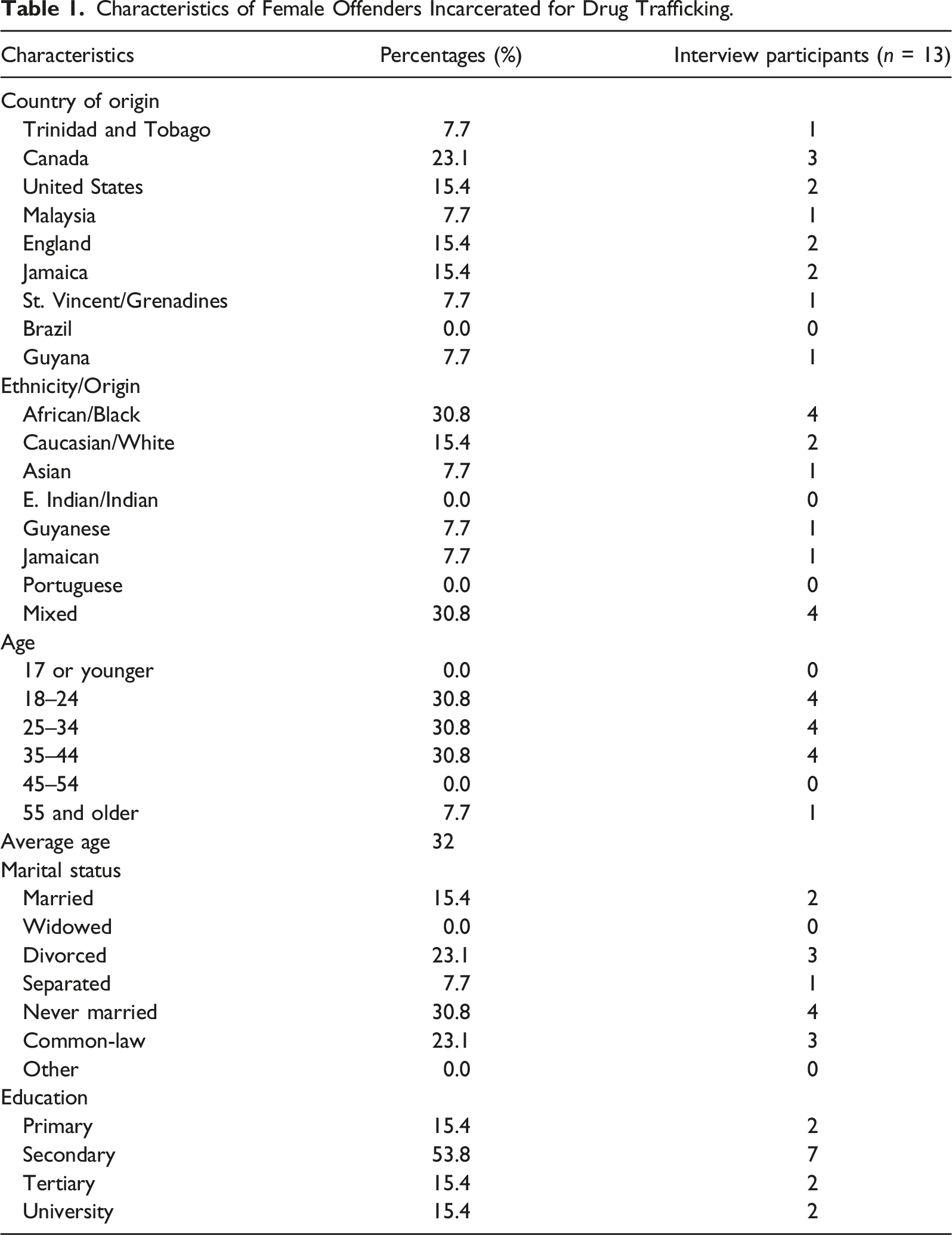
This research is an exploratory, qualitative research study designed to examine drug trafficking among female offenders. The data for this research study is taken from a larger study designed to explore motivations for drug trafficking among female offenders incarcerated at the TTPS. At the time of this study, there were 120 female offenders under the care of TTPS. Of this population, 65 volunteered to participate in the initial study. Of the 65 who volunteered, 13 participated in in-depth interviews pertaining to their involvement in drug smuggling. The female offenders included those previously convicted (N = 45) and those awaiting judgment (N = 20).
Purposive, then stratified sampling was used to explore drug trafficking among female offenders in the Caribbean. First, the TTPS compiled a list of female offenders (remanded and convicted) incarcerated for drug trafficking. Afterwards, the female supervisor at the Women’s Prison gathered the offenders together and provided an overview of the research project and asked for volunteers to participate in the study. In explaining the confidential nature of study, potential participants were advised their names would not be used during the interview process; as such they would be given a pseudo name. The officer in charge utilized a systematic sampling technique, whereby every other female was selected for the study.
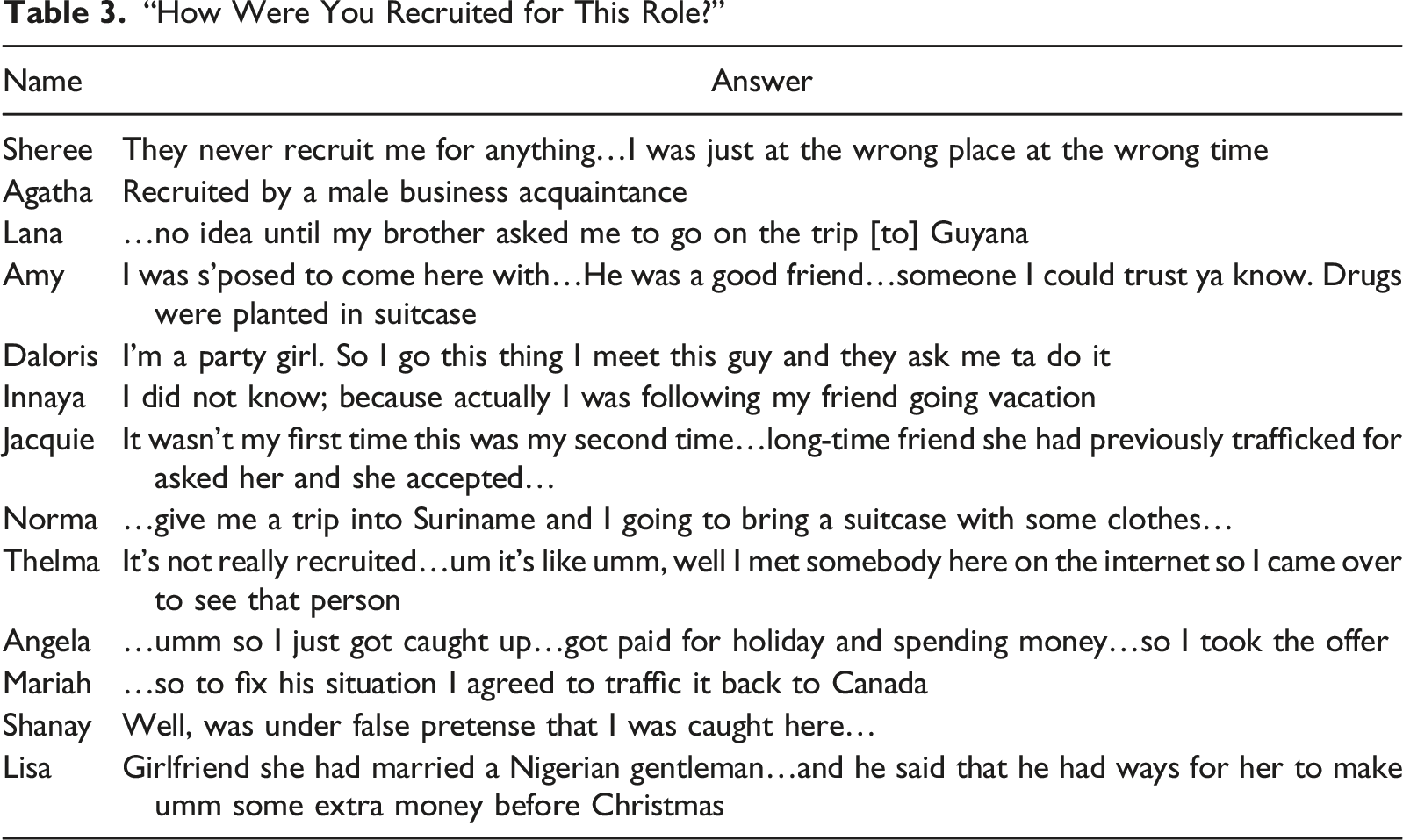
Data collected from the 13 female offenders incarcerated for drug trafficking is explored through the four questions guiding this research. These questions include: “How were you recruited for this role?”, “Why did you decide to get involved in drug trafficking?”, “Did you join in with friends, were family members or relatives involved in the activity, or did you initiate it on your own?”, and “Can you describe for me how you think your childhood experience influenced you into getting involved with drug trafficking?” Both the lead researcher and a graduate student conducted interviews with the female offenders incarcerated for drug trafficking. During the interview process, all participating female offenders were placed in a large room together. The interviews were conducted in a private and secure room that was closed off to ensure that data collection was confidential. Each female offender was interviewed one at a time by the graduate student. To ensure the safety of the graduate student and the privacy of the conversations, two officers were stationed outside of the closed off room. All interviews were recorded and transcribed.
Analysis of the transcripts used for the in-depth interviews revealed certain themes were present in the stories of those female offenders incarcerated for drug trafficking. The process of open coding was utilized to break down the data into discrete parts, then closely examine and compare for similarities and differences (Babbie, 2010, p. 401). Themes were coded to reflect how the females were recruited into drug trafficking.
Results
Characteristics of Female Offenders Incarcerated for Drug Trafficking.
Thematic Coding
Thematic Summaries.

“How Were You Recruited for This Role?”
Preyed Upon
Over half of the females (n = 7) believed they were victimized. These females were at a vulnerable point in their lives, and the co-conspirator(s) were aware of their challenges, which was used to his/her advantage. Moreover, the respondents stated that they were unaware of being recruited to traffic drugs and expressed strong sentiments of being deceived by family, friends, and/or acquaintances. The co-conspirators, under the guise of friendship, would feign being a friend by offering emotional support or providing the women with an opportunity for a vacation to escape their problems.
For example, Innaya was a young female with no prior history of drinking or using drugs, much less drug trafficking. She was 20 years old and had never travelled outside her country of Malaysia. Innaya was recruited to traffic drugs by a family friend who promised her a free holiday. Specifically, the long-time family friend, an older woman who was trusted by Innaya’s parents, offered to take her on a vacation, as well as take care of all the paperwork, including taking Innaya to get her passport. Innaya expressed her excitement at the chance to travel. Innaya stated, …imagine, at my age 20 years old yeah right 20 years old when you going to vacation in a different country. It’s like the best thing in your life that you can share with your friend that you can say I go and met this people and that’s why I was so excited! I was really, ya know I was thinking about it like this ya know…
Although it was a legitimate vacation, Innaya had no idea she would be trafficking drugs, for her luggage was filled with drugs. Similarly, Shanay, who was an older woman without a drug trafficking history, was manipulated by a man she thought was her friend. Shanay explained that, she often took vacations because she worked good jobs and was financially stable. On a previous trip to Panama, she met this man who she befriended and began corresponding with him. Shanay described that, over time, their friendship grew to the point of intimacy. She had told this man about her domestic problems, including her attempt to commit suicide. In addition, Shanay revealed that she felt as though they were becoming closer in their relationship, stating that …ya know as a woman and becoming close in the relationship and things and when a man offers you to meet his parents and family you thinking he’s taking you serious and I was more than glad.
Shanay described the friend as a ‘nice guy and everything’ and the purpose of the trip was to strengthen their burgeoning relationship. Believing this man to be genuinely concerned, Shanay accepted his invitation to visit him in Trinidad to escape her problems. However, Shanay stated she was recruited ‘under false pretense.’
In the case of Norma, a woman with financial issues and no prior history of drug related activity, she was duped by someone she thought was a friend. This ‘friend’ enticed her with an opportunity to earn additional income. Specifically, Norma described how her friend used her financial shortcomings to lure her into taking a trip to Suriname and bringing back a suitcase. Norma explained that the co-conspirator tricked her into drug trafficking by providing her with an airline ticket and telling her that all she needed to do was pick up the airline ticket, along with the suitcase. Norma indicated she did not believe she was not doing anything illegal since she would merely be transporting clothes. Norma believed she was at the wrong place, at the wrong time, given that she trusted her friend. According to Norma, Is a genteleman from Jamaica Axe me to come in Suriname on a visit, And he tell me that when ‘a coming, I going to get a suitcase just to deliva…so that is what I end up here. Was at de right place de wrong time. De wrong place at…give me a trip into Suriname and I going to bring a suitcase with some clothes.
There is also Thelma, who also did not have a history of drug trafficking, even so, did not feel as though she was recruited, but was deceived by someone she thought was her friend. Thelma met her friend through social media on Facebook and had known him for about a year. She explained that while she was visiting Jamaica, she decided to visit her friend in Trinidad, since it was close to Jamaica. After she met him in Trinidad, Thelma described him as being ‘cool, friendly and nice.’ However, just before she was due to leave, the friend told her there was something he needed to be taken back to England. When she questioned as to what she was going to be taking back to England, he explained that she would be transporting drugs. She shared her fears about trafficking drugs, however, felt she did not have a choice, saying, ‘cause I was already there.’ Thelma also described what took place after he told her about the drugs, which substantiated her belief that she did not have a choice. Thelma stated, …while I was locked up for the two days…I said, I’m scared to do this kind of thing. He’s like ‘no it’ll be alright’ ting ting ting but anyway ‘you don’t have a choice’ whatever, ‘cause I was already there’…
Thelma also stated that her return was delayed since she could not locate her passport. Later, Thelma’s friend shared that he found her passport, stating, And then he goes ‘Oh, um I found the passport in my friend’s taxi car’ and ting ting ting and then when he said to me that was the mission I realized he probably took my passport.
In another case, Lana was victimized by her brother who, during the time she had medical and financial problems, was the only person who provided her with support. As well, Lana worked for her family at a bar while taking business management classes to improve her economic stability. Lana believed the trip to Guyana with her brother would provide an opportunity to further her education as well as give her brother the opportunity to take care of what she termed his ‘export, import’ business. Lana was excited about going to Guyana and seeing other family members, explaining that, after they arrived, she stayed with family and her brother stayed at a hotel. Lana was not aware she was being recruited to traffic in drugs until it was time for them to leave Guyana. Lana’s brother used her sense of loyalty and obligation to manipulate her into trafficking drugs. Even though she was initially unaware she was being recruited, she did agree, stating, …he picks me up it was maybe eleven twelve o’clock at night and we go back to the hotel and he starts explaining stuff to me and I’m like O MY GOD.
Finally, Agatha, reported being manipulated by a friend to engage in drug trafficking. Agatha’s narrative involved a business acquaintance who offered her a management position in his company. The friend offered to pay all her flight and hotel expenses, so she agreed to travel to Trinidad to determine if the market was viable for a seamstress business. While in Trinidad, Agatha described the week she spent there as that of taking care of business, to include such activities as ordering and buying materials and fitting clothes. However, Agatha noted what she called ‘red flags’ during the week. She pondered how her business acquaintance could afford to provide an all-expense paid trip for her, since only minimal amount of work was being performed. Agatha also began to question the potential partner about his ability to fund the business venture and take care of all her expenses. She said her acquaintance explained that if she transported a package during her return trip, he would be able to afford the venture and all the expenses. Agatha noted that she continued to question the man about what she would be transporting, and he finally advised that it would be drugs. Agatha explained, …and he said and I’ll give you $10,000 I said well I don’t need 10,000 dollars said I have a good job and I’m getting a severance pay and I don’t do things like that! I said I have grandchildren I am NOT bringing drugs into the country because I don’t want my grandchildren getting a hold of drugs…cocaine or whatever so I’m not going to be a person to bring it into the country.
Agatha told her business acquaintance that she did not want to be involved in anything illegal, saying, ‘I work too hard, I have too much to lose if I ever got caught.’ However, not giving up, the gentleman made several more attempts to get Agatha to agree to be a part of the legitimate management side of the seamstress business in Trinidad. Initially, Agatha refused out of fear. However, incessantly, the acquaintance persisted, and Agatha shared that he begged her by saying, ‘please, please, please!’ Finally, she gave in to his request. She explained her involvement in the business was under the agreement that she would not be involved in any illegal activity, and that he promises to never ask her again or attempt to force or trick her into drug trafficking. Agatha felt she had given the business acquaintance a firm refusal to engage in trafficking drugs and believed that she could trust their agreement.
While some of the women’s experiences described in this section indicated that they were eventually complicit in smuggling drugs, their initial involvement with those who recruited them for drug trafficking did not involve this knowledge. Several of the women were lured into some type of relationship with the trafficker because of what the trafficker initially offered them: a vacation, help with a business, much needed money. All reported some gain that was related to finances. Traffickers often gained the trust of these women by offering them attractive experiences. Once they gained access to their lives and their trust, it became easy to manipulate them to smuggle drugs.
Earn Extra Money
Three of the female offenders in this study were looking for ways to earn extra money. One of the females, Jacquie, reported being a single, unemployed mother lacking adequate child support and intolerable living conditions. Moreover, Jacquie described her financial and living situations at the time as difficult because she was having problems collecting child support. She explained that she took her child’s father to court for additional support; however, the magistrate did not provide a sufficient increase to cover her monthly expenses. Jacquie further stated that, even though she was collecting child support every month, it was only spent on her child and was not sufficient to cover living expenses. Jacquie explained that the lady she was living with was demanding additional money for living expenses. Simultaneously, Jacquie had a friend who joined the navy in England. Her friend encouraged her to consider moving there to take the enlistment exam. However, to do so, Jacquie needed the money for the plane ticket and did not have anyone who could help her. Jacquie attempted to secure funds from her father as well as her boyfriend but was unsuccessful in eliciting support. In the meantime, a friend contacted her and proposed an opportunity to earn money by drug trafficking. Jacquie felt doing so was a means to an end. She described being recruited as, …I knew the kinda business he was in, but then ya know, as I said desperate time call for desperate measure so…I was in need and while I was in need my phone rung and it was him because the year before I went and it was for him. And then he called and say…I say right now I need ‘TING TING TING’ he know the situation and he said ‘well I will send the ticket ‘TING TING TING’ and then you will come’, WHATEVER WHATEVER.
Jacquie explained that although this was her first conviction, it was not her first-time trafficking, and she stated the timing of the opportunity to traffic was an opportunity to improve her financial circumstances and provide a better life for her child.
Another case is that of Lisa, who had been involved in drug-related crimes, however, she was never arrested. Lisa revealed that, since she was 11 years old, she was involved in smoking and selling drugs, such as crack cocaine and marijuana. However, at the age of 19, Lisa had her 2 sons, so she stopped smoking and selling to minimize the risk of possibility being arrested. Given this, she found a safer, but still illegal, way to earn money. She began to work in massage parlours and for escort services, earning an excellent income. However, her fiancé did not approve of her work in the sex industry, so she decided to quit. As she did so, Lisa described how a friend shared an opportunity to earn additional income. Her friend, who was married to a Nigerian man on paper only, explained that he had opportunities for them to make extra money for Christmas and to cover the expenses for her wedding. Lisa’s friend explained that they would be carrying profiles from one country to another, even hinting at the possibility of them trafficking drugs. Lisa, however, was adamant that she did not want any part in drug trafficking or doing anything illegal. Particularly, Lisa stated, …cause I told her right off the bat I’m not interested in anything that has to do with trafficking, I’m not interested in anything that has to do with drugs. I’m not doing nothing like that… [they were to] pick up profiles and hand deliver them to the people in the other countries and they will pay us $3,000 per person to do that, with a fully paid vacation.
Lisa also questioned what profiles were and was told repeatedly that it was not illegal. When her friend’s husband explained how the profiles would be placed in her suitcase and that she would not be handling them, she decided to take the opportunity to earn the extra money. However, after she arrived in Trinidad, she discovered the profiles were stolen identities such as passports, credit cards, and birth certificates that were illegal. Since she was already there and needed the extra money, Lisa decided that she would proceed with the transactions. Lisa noted, Soo, while I’m here I realize that the profiles are illegal. So now I’m here already and I was like okay, well it’s only paper…you know I was like…I was still kinda nervous…but I was like it’s only paper I’ll be alright, you know it’s just in the suitcase, I’m like…you know…Soo for myself I was like I didn’t have any reason to suspect that it had anything to do with drugs because they had already gone and come back… Lisa explained that she planned to put the money towards her wedding, and she said, ‘I was supposed to get married in June last year. My first marriage…’
Lastly, Angela and her fiancé accepted an offer to traffic drugs to earn extra money. In her case, Angela explained that she had been involved in illegal activities as a young person. As such, her friends referred to her as a Ride or Die type of person. Along with her fiancé, Angela met with friends in Tobago to receive the drugs to transport and found they were already packaged and ready for the two of them. Both Angela and her fiancé were to swallow 80 pellets each. Angela knew that she was trafficking drugs to earn additional income, stating, …just got caught up I said I need…that’s fine everything go paid for holiday and spening money…so I took the offer.”
In the case of women who engaged in smuggling to earn extra money, one was experiencing financial hardships while others engaged in smuggling to meet expenses associated with life events and their lifestyles. While the three women in this category had previous involvement in illegal activities including involvement with illegal drugs, the primary reason for their involvement in trafficking was the desire to earn extra money.
Previous Involvement With Drug Trafficking
Three of the female offenders noted previous involvement with drug trafficking as an explanation as to how they were recruited to traffic drugs. One of the females, Sheree, who had previously been arrested four times for drug-related offenses and convicted three times, knew about the drugs because her common-law husband had friends who brought the drugs into her home. Although she did not want to be a part of the drug dealing, she never questioned exactly what was going on. Sheree said, ‘I never asked any questions about it because I never want to be much of a part of it.’ In Sheree’s case, she believed that she was in the wrong place at the wrong time, as she was at her home in Trinidad when some friends of her common-law husband were there with drugs in their vehicles. As the owner of a retail clothing store, Sheree travelled back and forth to the United States to see her family and to buy for her business. Sheree also shared details about how she was able to garner support from her family in the States to get her clothing business running by borrowing money from them. Upon return from her last trip from the States, Sheree stated that she was awakened by officers pounding on her door. She then noted that officers transported her to the police station and questioned her, leaving her common-law husband at her home. She was frustrated given that this was the fourth time within 2 years she had been detained and taken to the police station upon her return to Trinidad from the States. Sheree explained that she would be implicated along with her common-law husband and his friends for drug involvement. Sheree shared the following account of her experience, They never recruit me for anything any roles, I was just at the wrong place at the wrong time…No, they never like had me in-depth in it, I know like to say you would see them or you would know, well these are these people who deal with them should but to say like…you see it you know what it is but to say like like you know exactly who is going to or what they gonna do with it…So you know, not like yah don’t know stuff or not know like they do shit wit it, but like you nevah question it or wanna be a part of it asking or like you volunteering yourself ta leave the county wit it o nuttin’ like dat no. I nevah add myself to the problem but I get added to the problem so I’m in this mess.
She was also angry because, at the time of her arrest, her common-law husband was not detained. Sheree stated, So I question him and I ask him whose gonna help? Look at the problems I already got into...and you wasn’t even there, you wasn’t even there at the house, you wasn’t even there…the officers just take away…so tell me what, what’s goin’ on I didn’t even know it had any stuff in there…
Self-identified as a party girl, Daloris, who had a history of drug-related activities, to include, three previous arrests, however, received her first drug-related conviction. Daloris explained that she wanted to earn additional money to help establish a new business. Daloris further explained that she met a guy at a party in Jamaica, and he asked her to traffic his drugs. Since she needed the money, accepting the offer was easy. Daloris said, Yeah so, I gone tell ya I’m a party girl. So I go this thing I meet this guy and they ask me ta do it. He didn’t force me nor do anything I just give him the answer. Yes. I know say it was like a money ting. Yeah it was like a money ting I was trying to make for MYSELF and so that’s the reason why I do it.
Finally, there was Mariah, who believed she was not recruited into the role, even though she had a history of drug trafficking and other drug-related activities. Being a single mother and living in Canada, Mariah had made it clear that she was not new to trafficking, stating that, I’m not new to trafficking…I’ve done a lot of trafficking since I was younger and I have a lot of connections EVERYWHERE
Mariah also shared that she had been surrounded by drugs, lived the lifestyle, and used to sell drugs when she was younger, though, she never used the drugs. She also explained that she made good money and did not need to traffic to make money at the time of her conviction. Mariah then shared her narrative as to how she became involved in drug trafficking for her current offense. Specifically, she explained that her daughter’s father was deported when she was pregnant. On previous occasions, Mariah had taken the child to see her father. Mariah explained that while she and her child, who at the time was 2 years old, were visiting the father, some men showed up, indicating they wanted their money or the weed. The men advised Mariah that 40 pounds of marijuana was supposedly lost, even so, they wanted it returned, or her child’s father would suffer the repercussions. To avoid harm to the child’s father, Mariah agreed to traffic drugs. Mariah shared, ….I found out him and another guy ended up stiffing somebody else for 40 pounds of weed in Saint Marteen, but it wasn’t him it was the guy he went with. So to fix his situation I agreed to traffic it back to Canada…not [to make money] for him but for the people that showed up, …so I told them that if I fix it to traffic for them to get back their money if they’ll rest the issue. They said yes.
While the women who had previous involvement in drug trafficking had different motives for becoming involved in the smuggling incident that landed them in prison, they were all involved with men who were trafficking drugs. The combination of having this previous experience as well as involvement with someone who was immersed in this lifestyle, seemed to create a fertile ground for further involvement in trafficking.
Discussion
This research examined how female offenders were recruited into drug trafficking. Findings from the current study revealed commonalities with previous research, such as recruitment methods utilizing friends and family (Decker & Chapman, 2008; Edberg, 2001) as well as the recruitment of females who were often suffering from financial hardships (Campbell, 2008; Olmo, 1990). Additionally, coercive tactics and manipulation were reported to be a recruitment technique discussed by previous research and equally in the current study (Fleetwood, 2010). Also, past research showed that females who were marginalized were chosen to traffic drugs, and the same held true in this study (Hutton, 2005). Finally, other female offenders in this study who clearly made conscious decisions to become involved in drug trafficking may not have been recruited through manipulation, because they were aware of the criminal activity beforehand, but may have been exploited because of their need to improve their financial circumstances by earning income. More specifically, previous research suggest that female offenders take part in drug trafficking for the simple purpose of economic gain. In this study, the findings were more nuanced. While the women who were included in the category “Preyed Upon” and “Previous Involvement “stated reasons other than economic gain for participating in trafficking, they did benefit financially from their involvement. Some even reported having financial problems before agreeing to smuggle drugs. As such, these finding differ from previous research as other factors are intertwined with financial incentives (Adler, 1993; Adler & Adler, 1983; Campbell, 2005, 2008; Davies, 2003; Fleetwood, 2010; Geiger, 2006; Griffith, 1997; Olmo, 1990). Still, a common thread interwoven throughout these narratives is either the financial hardship women are experiencing and or the desire to improve their economic status as a basis for their involvement in drug trafficking.
This research contains examples of females victimized by systems of patriarchy and capitalism, socialization processes that reinforce their subjugation by males, exploitation by males, marginalization, and subsequent forms of manipulation precipitated from their underprivileged statuses (Akers & Sellers, 2009; Cullen, Agnew, & Wilcox, 2003; Parker & Reckdenwald, 2008; Ritzer, 2011; Siegel, 2008; Williams & McShane, 2004). Thus, in the process of becoming involved in drug activity, many of these females fell prey, under the guise of friendship, to an unscrupulous individual, interested only in furthering his or her cause. Here, according to the critical feminist theory, females are socialized to believe they need men for socioeconomic survival and find themselves being exploited, manipulated, and dominated by men (Ritzer, 2011). When considered alongside oppressive systems of gender-based exploitation, manipulation, and domination, it is likely that the lower socioeconomic statuses of females who are single mothers, unemployed, or struggling to meet basic family needs compels them to participate in drug trafficking. Hence, critical feminist theory suggests that female offending is partially a consequence of the way males and females are socialized. Specifically, Ritzer (2011) argues that women are oppressed through their domination by men and socialization processes that normalize a feminine identity depicting women as cooperative, caring and nurturing, a pacifist and non-violent, and virtuous. Consequently, the seduction of women into drug trafficking is heightened. In Norma’s case, her victimization by manipulation, coupled with her need for the safety and security of having enough money to take care of her family, made her vulnerable to being recruited into drug trafficking. More specifically, Norma, who had never been arrested, lived in Jamaica where she considered the cost of living expensive and providing for her family was foremost in her mind. Norma explained that she knew of people delivering goods for a fee, and when presented the opportunity, she viewed it to provide her family with a better life. Norma’s friend, aware of her financial issues, promised her an all-expense paid vacation, and all she needed to do was bring back a suitcase containing clothing. Norma believed she was not doing anything illegal because she trusted her male friend who never explained to her that she would be transporting drugs. Norma’s experience revealed the manipulation used by her friend to convince her that he was helping her financially and there were only clothes in the suitcase she was transporting back on the return trip to Jamaica.
According to intersectionality, the involvement of women in drug smuggling is conditioned by interlocking systems of oppression and privilege (i.e., patriarchy, racism, sexism, classism) that intersect with various axes of oppression (i.e., race, ethnicity, class, gender, etc.) to create socioeconomic landscapes of limited access and availability to capital (i.e., human, social, and economic) and opportunities for socioeconomic advancement, which, in turn, perpetuates inequalities that render these women more susceptible to manipulation, exploitation, the domination of men, and involvement with the justice system through practices of stop and frisk and sentencing decisions (Collins, 2019; Romero, 2018). In Norma’s case, interlocking systems of patriarchy, sexism, and classism contributed to her socioeconomic marginality which, in turn, increased her vulnerability to being recruited into drug trafficking as a means of survival for herself and her family. Specifically, the docility narrative, which reinforces women’s submissiveness and subordination to the domination of men, coupled with the powerlessness of being socioeconomically disadvantaged and compelled to safeguard the well-being and stability of the home converged with Norma’s need to survive to render her susceptible to being manipulated by her male friend and recruited into drug trafficking.
Similarly, the two stories that follow provide examples of how female offenders were recruited and exploited by friends because of their need to provide financial support or earn extra money. Jacquie, an unemployed single mother, was not new to drug trafficking as she had trafficked before and had been successful. Jacquie’s situation was complicated because of being unemployed, having a child, having less than desirable living conditions, and receiving minimal child support from her child’s father. Jacquie was in a desperate situation and wanted to join her friend who had joined the navy in England. Jacquie thought this might be her way out of her financial difficulties, but also, she knew she could not afford the plane ticket for her and her daughter, the living expenses before she enlisted, the expenses connected to day care for her child, and the possible expenses of studying to take the navy’s entrance exam. Jacquie tried to find help with the finances but was unsuccessful. So, while Jacquie was in this dilemma of raising enough funds to make this move, a friend she had previously trafficked for, happened to call her with an opportunity to make the much-needed money. Jacquie believed this was her way out and gladly accepted the offer made by her friend, who was aware of her dire financial needs. In a patriarchal society, Jacquie would believe that her protector (Maslow, 1943) was not exploiting her but helping her by providing the opportunity to earn money for her trip. However, the paternalism that has shaped the lives of females suggests that because she is female, and females take the ‘obey position’ (Akers & Sellers, 2009, p. 277), she would likely employ the criminal behavior of drug trafficking without the realization that she had been exploited. From the standpoint of intersectionality, Jacquie’s socioeconomic circumstances combined with her gender to create an opportunity for her male friend to exploit her vulnerabilities to his advantage. As Jacquie stated, “I knew the kinda business he was in, but then ya know, as I said time call for desperate time call for desperate measure so …. I was in need […].” The socioeconomic hardships of marginalization, in combination with gendered conceptions of motherhood, likely forces women like Jacquie into drug trafficking as a means to survive and reinforce to themselves that they are “caring mothers, daughters, and partners,” even at the risk of being imprisoned (Fleetwood & Leban, 2022, p. 13, citing Fleetwood, 2014).
Exploitation, a product of patriarchy, is not confined to friendship, but also happens between business acquaintances. Siegel (2008) addressed the power men hold over women in a capitalist-driven society, stating that not only does that power hold true from fathers, husbands, and significant others, but this power can also be used to exploit and manipulate those in the business sector. Agatha, an older female offender, was exploited by a business acquaintance, a man she knew through her business, and who wanted her to take a management position in his seamstress business in Trinidad. This business acquaintance paid all Agatha’s expenses and paid her to take care of his business arrangements during her week in Trinidad. Although Agatha began noticing ‘red flags,’ she continued to work throughout the week. When she confronted the man and questioned his ability to cover her expenses and fund the business venture, he told her about the drugs he wanted her to take back to Canada and offered her $10,000. She refused to take the drugs and told him she no longer wanted to be a part of his business. The acquaintance continued to ask her about working for him in his legitimate business, and after he begged, she finally gave in, insisting he agree that he would never ask or trick her into trafficking drugs. Agatha shared that this was not the first time she had been exploited by people she trusted and that was the reason she gave into her business partner when he begged her repeatedly. She trusted his promise that he would never involve her in anything illegal, in particular drugs, and that she did not’ want to ‘let him down.’ Since Agatha was asked to fill a role as a business manager, and, regardless of the fact the man had tried to trick her into transporting drugs, she felt the need to fill that social role and trusted him to follow through with their agreement (Zavalloni, 1973). Additionally, given her own perceived ‘self-definition’ (Ritzer, 2011, p. 466), and since men have greater opportunities for self-definition because of females’ circumstances being directly linked to power relationships with men, Agatha’s lack of power in the relationship with her business acquaintance provided the avenue for her to be duped into trafficking drugs and exploited by a trusted friend.
Davis (2008) explained how interactions between one’s gender, race, class, and other indicators of human difference, to include the interactions of these categories of difference with “social practices, institutional arrangements, and cultural ideologies,” foster power differentials (p. 68). For Agatha, being an older woman involved in the business sector, she is more likely to confront narratives of inferiority and powerlessness that are associated with interlocking institutional ideologies of patriarchy and ageism. In this vein, Agatha’s agency is undermined; she lacks the power to negotiate the social role given to her by her male business acquaintance, even if said role resulted in her being recruited to traffic drugs.
Literature also states these kinship or friendship ties are used to protect the product and the drug dealer (Decker & Chapman, 2008). An example is Lana who was exploited by a family member, her brother. Lana’s brother was the only person offering any help for several months while she was having health issues which resulted in her having financial problems because she was forced to leave a good paying job. Although she was initially unaware of the victimization by her brother, it was because of those close ties, that he was able to exploit her and use her to traffic drugs. Lana’s brother asked her to go on a trip to Guyana and she thought it was for him to make connections for his import/export business. Lana was also excited to go because she would be able to visit with family as well as to help further her education as she was enrolled in business management classes at Everest Institute and thought this trip would help her to better understand foreign markets. After arriving in Guyana, and a few days into the trip, her brother told her about trafficking drugs. He believed this would be a quick fix to his financial problems and because Lana felt so indebted to him, she agreed to participate. Feelings of indebtedness are those feelings that could be construed as being negative, and often bring with them feelings of guilt (Schaumberg & Flynn, 2009). Those feelings of guilt could have easily been the case with Lana, as she reluctantly agreed to help her brother.
Drug trafficking has also been romanticized and glorified to appear as easy money, and previous research proves that an element of acceptance can be seen in the pop culture associated with drug trafficking (Campbell, 2005; Edberg, 2001). Angela, a young woman in her late teens, came from a single-parent home, had become very successful as a manager of a call center. Angela was not exploited; she was not tricked as she jumped at the chance to traffic drugs and make extra money. Angela described her childhood as being meagre because her mother did not work but went to school to better herself and there was never enough money for her. Angela explained that she wanted designer clothes and all the things a teenager wanted, but that her mother could not provide. She explained that she had to ‘live up to certain expectations’ and that without money, she would lose the respect of her peers and be bullied. For those with low self-efficacy, gaining approval or being accepted by others is important (Huitt, 2007). Angela felt without the money she needed to gain that approval; she could not live up to the expectations of her generation. Past research has also suggested that drug dealers and traffickers maintain a tight-knit community and have lavish lifestyles (Adler, 1993). Angela also wanted that type of lifestyle, in fact, had she and her fiancé been successful in drug trafficking, they planned to move to Tobago and open their own trafficking business. As such, Angela and her fiancé accepted the opportunity to go to Tobago, pick up the drugs that were already packaged for them to swallow, and hoped to use the money they earned to put a down payment on a house, to buy a luxury car, and to start their own business of drug trafficking. Having a house, a car and owning a business could potentially give Angela and her fiancé the status they were looking for, and with that status would come higher self-actualization, even if the wealth came from illegal drug trafficking.
The current scholarship examined how female offenders were recruited into drug trafficking. Overall, over half of the female offenders were recruited into drug trafficking by means of exploitation or victimization by friends, while two were manipulated by family members. However, the current study showed that the majority of female offenders fell prey, under the guise of friendship, to an unscrupulous individual, interested only in furthering his or her cause. While some findings indicated female offenders were recruited into drug trafficking due to economic hardship, it is crucial to underscore how interlocking social, psychological, and emotional vulnerabilities experienced by these women converged with their impoverished economic status, thereby contributing to their involvement in drug trafficking. In accordance with previous research literature, marginalized or disempowered females will turn to drug trafficking to overcome socioeconomic hardships and survive (Adler, 1993; Adler & Adler, 1983; Campbell, 2008; Cullen et al., 2003; Fleetwood, 2009; Geiger, 2006; Jefferies & Chuenurah, 2018; Joseph, 2006).
The findings in this study suggests women become involved in drug smuggling for reasons that are far more complex than simple financial need. As demonstrated by this exploratory study, as women living in a capitalist society, these women are likely to confront interlocking ideologies of patriarchy, racism, classism, and ageism that converge with their various social identities to engender inequalities that marginalize these women in ways that forestall their socioeconomic mobility and diminishes their agency and power. Under such circumstances, these women are easily seduced, if not manipulated by drug traffickers who prey on these intersectional vulnerabilities to advance their own socioeconomic interests. Even more, when these circumstances combined with societal expectations placed on women to comply with the requests and demands of family members, love interests, friends and acquaintances, these women become even more vulnerable to being recruited into drug trafficking. While strengthening access to education, job training and welfare programs that are designed to address poverty may reduce the need for women to turn to illegitimate means to meet their needs, such programs do not address why women who seemingly have legitimate access to resources still become involved in drug smuggling. Hence, addressing the issue of female drug smuggling will not only require policies that strengthen the socioeconomic status of women, but also broader changes in how girls and young women in society are socialized the development of targeted approaches as well that address the social, psychological, and emotional vulnerabilities of these women.
In addition, while this paper examined how women became involved in smuggling, it is important to note that there are important structural factors that result in poor women of color being overrepresented in drug smuggling arrests and ultimately incarceration. Among these factors is the feminization of poverty as well as the biases in the criminal justice system. Poor women are often forced to engage in illicit behaviors to meet financial needs. In addition, they are more likely to come under the scrutiny of the criminal justice system when they engage in these activities. While this paper did not explicitly address these issues, these are indeed important contextual issues that should not be overlooked.
While this study provided a rich source of data on the recruitment experiences of female offenders into drug trafficking, there are limitations in the current research. Given that this small sample of females may not be similar in demographics to other female offender populations in the Caribbean and the world, these findings are not generalizable to females in prisons in the Caribbean and across the globe. Additionally, given the methodological issue of interviewing female drug traffickers already apprehended and incarcerated in prisons, future research should consider exploring this topic with a sample of female offenders who have not been incarcerated or currently residing in prisons to further add to this burgeoning body of research scholarship.
Footnotes
Declaration of Conflicting Interests
The author(s) declared no potential conflicts of interest with respect to the research, authorship, and/or publication of this article.
Funding
The author(s) received no financial support for the research, authorship, and/or publication of this article.
