




Abstract
Findings regarding the mechanism underlying the impact of supervisor incivility on subordinate alcohol misuse remain equivocal. Specifically, some studies indicate that stress mediates the impact of supervisor incivility on subordinate alcohol misuse, while others, find no evidence for such an effect, suggesting the need to investigate other mechanisms. Extending Conservation of Resource (COR) theory and employing a longitudinal study design, this study examines two alternative mechanisms grounded on social isolation. The first suggests drinking as a resource-mobilizing response, with social isolation eliciting the perception of more permissive injunctive drinking norms, thus facilitating problematic drinking. The second suggests problematic drinking as a mode of coping with a negative emotional state elicited by social isolation, namely depression. Findings indicate that supervisor undermining’s association with subsequent subordinate problematic drinking is serially mediated by social isolation and depression, with no support found for the first mechanism. Implications for research, practice and policy are discussed.
Supervisor undermining and similar constructs, such as abusive supervision (Tepper, 2000) and workplace incivility (Andersson & Pearson, 1999), all represent aggressive behaviors engaged in by one’s direct supervisor (Aquino & Thau, 2009). Workplace incivility – “low intensity deviant behavior with ambiguous intent to harm the target, in violation of workplace norms for mutual respect” (Andersson & Pearson, 1999, p. 457) – is ubiquitous (Cortina et al., 2001). Supervisor-instigated incivility such as supervisory undermining, the focus of the current study, is estimated to cost employers in the United States over US$23 billion annually via its detrimental effects on a wide range of employee attitudes and behaviors (Tepper, Duffy, Henle, & Lambert, 2006). Indeed, research indicates that victims of such incivility experience diminished well-being, often manifested in terms of heightened emotional distress and depression, lower levels of energy and motivation (Schilpzand, De Pater, & Erez, 2016), increased work-family conflict (Lim & Lee, 2011) and healthcare costs (Tepper et al., 2006), and reduced marital satisfaction (Ferguson, 2012). At work, these same individuals experience reduced job satisfaction, work engagement, organizational commitment, and fairness perceptions (Duffy & Ferrier, 2003; Jawahar & Schreurs, 2018; Liu, Zhou, & Che, 2019; Schilpzand et al., 2016), higher turnover intentions (Bowling & Beehr, 2006; Bunk & Magley, 2013; Lim & Lee, 2011; Liu et al., 2017; Miner, Settles, Pratt-Hyatt, & Brady, 2012) and decrements in performance-related domains such as task performance (Chen et al., 2013; Giumetti et al., 2013), attendance (Tepper et al., 2006), creativity (Liu, Chen, He, & Huang., 2019), and citizenship performance (Dalal, 2005; Porath & Erez, 2007; Taylor, Bedeian, & Kluemper, 2012).
An important, health-related consequence of incivility with direct workplace implications involves alcohol use. Researchers examining the impact of various forms of supervisor incivility on employee alcohol use and misuse have generally found a positive and robust relationship (Bamberger & Bacharach, 2006; Bamberger & Cohen, 2015; Richman et al., 1996, 1997, 2001, 2002). Nevertheless, the mechanisms underlying this relationship remain poorly understood. Specifically, while much of the workplace alcohol literature adopts a tension-reduction or self-medication perspective (Conger, 1956; Cooper, Frone, Russell, & Mudar, 1995; Khantzian, 1997; Steele & Josephs, 1990) and assumes that a negative emotional state (e.g., stress, depression) serves as the primary mechanism linking supervisor incivility to alcohol misuse (Richman et al., 2002), findings regarding such an underlying mechanism are equivocal, with some researchers finding support for a stress-based mediator (Richman et al., 2002), and others (e.g., Bamberger & Bacharach, 2006) not. This raises the possibility that an entirely separate, social resource mobilization mechanism, operating via social isolation and its effects on employees’ perceptions of injunctive drinking norms (Delaney & Ames, 1995a), might underlie an association between supervisor incivility and employee problem drinking.
To better understand the impact of supervisor incivility on alcohol misuse, we examine the link between supervisor undermining and problematic drinking (i.e., a pattern of alcohol use associated with negative consequences). Supervisory undermining is a widely prevalent form of supervisor-instigated incivility characterized as “behavior intended to hinder, over time, the ability (of a subordinate) to establish and maintain positive interpersonal relationships, work-related success, and favorable reputation” (Duffy, Ganster, & Pagon, 2002, p. 332). Such behavior may be direct and explicit in nature, such as when a supervisor intentionally says something derogatory about a subordinate, rejects them outright, or belittles their ideas. Alternatively, it may be more implicit, such as withholding of needed information or not defending a subordinate (Duffy et al., 2002). Although holding abusive supervisors accountable for their actions serves as the primary means by which to address such workplace problems in most organizations, understanding the mechanisms driving the alcohol-related consequences of such behavior is important as such insight may facilitate efficacious approaches to prevention that can complement efforts aimed at changing managerial behavior by enhancing employee resilience.
In examining the association between supervisory undermining and subordinate problem drinking we adopt an ecological perspective in an effort to enhance our understanding of such mechanisms. Specifically, we base our hypotheses on Conservation of Resources (COR) theory (Hobfoll, 1989). COR theory proposes that people “strive to obtain, retain, foster, and protect those things they centrally value,” and act to conserve or protect those resources when they are threatened or when incurring actual resource loss (Hobfoll, Halbesleben, Neveu, & Westman, 2018, p. 104). Building on this logic, we examine two alternative pathways potentially linking supervisory undermining to problematic drinking. The first pathway, consistent with the widely applied tension-reduction perspective noted above, builds on recent findings that supervisory undermining, by socially isolating the target and limiting key supportive resources (Xu et al., 2020), elicits or exacerbates depression as a negative emotional state for which subordinates adopt a maladaptive form of coping, namely alcohol-based, self-medication (Khantzian, 1997). The second pathway, also grounded on social isolation, is not dependent on tension-reduction, but rather on social resource mobilization. According to this logic, the social isolation prompted by supervisory undermining elicits a recalibration of coworker injunctive drinking norms such that these norms are perceived as more permissive and thus facilitative of drinking as a means by which to mobilize social resources. Ethnographic research suggests support for both pathways, highlighting that supervisor undermining’s association with problematic drinking may operate through a sense of social isolation and lost support (Ashforth, 1997), but not detailing whether the sense of lost support drives drinking as an emotion-focused mode of coping with the aim of tension reduction, or alternatively, as a problem-focused mode of coping that may go to excess (Cacioppo & Patrick, 2008).
We test the associations suggested above using a sample of recent college graduates entering career employment for the first time and applying a longitudinal study design. Such a sample is ideal for assessing the alcohol-related consequences of supervisory undermining in that: (a) young adults tend to be at a heightened level of vulnerability to problematic drinking (Naimi et al., 2003), and (b) being new to the labor force and to career employment, such individuals may be more vulnerable to supervisor undermining (Kammeyer-Mueller, Wanberg, Rubenstein, & Song, 2013), and more susceptible to feeling socially isolated.
Our findings offer several important contributions to the literature on supervisory undermining and work-based alcohol misuse. In terms of the former, they identify social isolation as a key mechanism linking such supervisory behavior to depression as a negative emotional state potentially driving subordinate problematic drinking. This is important in that it suggests the need to address the deeper affective implications of such supervisory behavior in order to nip even more detrimental secondary effects in the bud. Furthermore, with the effect of supervisor undermining on problematic drinking being fully mediated by social isolation and depression, our findings lend strong support to the COR-based notion of resource depletion leading to maladaptive coping, an explanation consistent with tension reduction. They also largely rule out the alternative explanation, namely that problematic drinking stems from victims’ efforts to address the sense of social isolation generated by supervisor undermining by self-justifying and engaging in drinking that, while perhaps social, may end up going to excess.
Practically, our findings suggest that work-based support networks may assist in preventing newcomers' problematic drinking, by reducing the negative emotional states resulting from supervisor undermining. Moreover, increasing newcomers’ awareness to the potential link between the negative emotional states they may experience to their supervisor undermining behavior may encourage newcomers to use problem-focused techniques to cope with their negative emotional states (such as complaining about their supervisor or transferring to a different work unit) rather than emotion-focused ones (Lazarus & Folkman, 1984), thereby reducing the likelihood that they will use drinking as a mode of self-medication.
Supervisor Undermining and Problematic Drinking
Alcohol misuse is not only widely prevalent (Frone, 2013, 2019), it is also costly both to the individuals engaging in such behavior (Rehm, Taylor, & Room, 2006; Reynolds et al., 2003; Roehrs & Roth, 2001), as well as to the organizations employing them (i.e., heightened risk of work-related accidents and injuries, absenteeism, and lost productivity; Frone, 2019; Normand, Lempert,& O’Brien, 1994; Rehm et al., 2009). Research on the etiology of such behavior suggests that workplace incivility is among the most robust work-based risk factors, with consistent evidence of a positive relationship between several forms of supervisor incivility and alcohol misuse. For example, a study conducted among blue-collar workers (Bamberger & Bacharach, 2006) found abusive supervision – supervisory engagement in displays of hostile (but not physical) behavior (Tepper, 2007) – to be positively related to subordinate problematic drinking. Similarly, work-based psychological abuse and humiliation, discriminatory treatment and sexual harassment, have all been positively related to various drinking outcomes such as problematic drinking, escapist drinking and modal alcohol consumption (Bamberger & Cohen, 2015; Richman et al., 1996, 2002).
Despite consistent findings of a positive link between supervisory incivility and subordinate alcohol misuse, our understanding of the mechanism driving this relationship remains limited. Much of the literature adopts a tension-reduction or self-medication perspective (Conger, 1956; Cooper et al., 1995; Khantzian, 1997; Steele & Josephs, 1990), assuming that some negative emotional state (NES) such as stress or depression serves as the primary mechanism linking supervisor incivility to alcohol misuse (Bamberger & Cohen, 2015; Richman et al., 2002). However, how supervisory undermining affects subordinates emotional state remains uncertain. Furthermore, while the tension reduction mechanism is the most widely accepted explanation, other alternative explanations – such as the idea that victims of such incivility may respond by engaging in alcohol-based relationship-building gatherings as a means by which to mobilize and strengthen social resources – have been proposed (Bamberger & Bacharach, 2006) and warrant further investigation.
In the sections that follow, we address each of these issues, developing a dual-path, mediation model of supervisory undermining and subordinate problematic drinking grounded on ecological or resource-based principles. More specifically, drawing from Conservation of Resource theory, we propose that because supervisory undermining often involves elements of ostracizing the target at work (Bowling et al., 2015), it can pose a robust threat to a key socio-psychological resource for such individuals (i.e., social support), generating a sense of social isolation and potentially initiating a pattern of maladaptive coping in the form of problematic drinking. The dual paths explicated below each offer a different resource-based explanation for how such isolation results in the emergence and/or exacerbation of problematic drinking (For the full conceptual model, see Figure 1). The hypothesized theoretical model.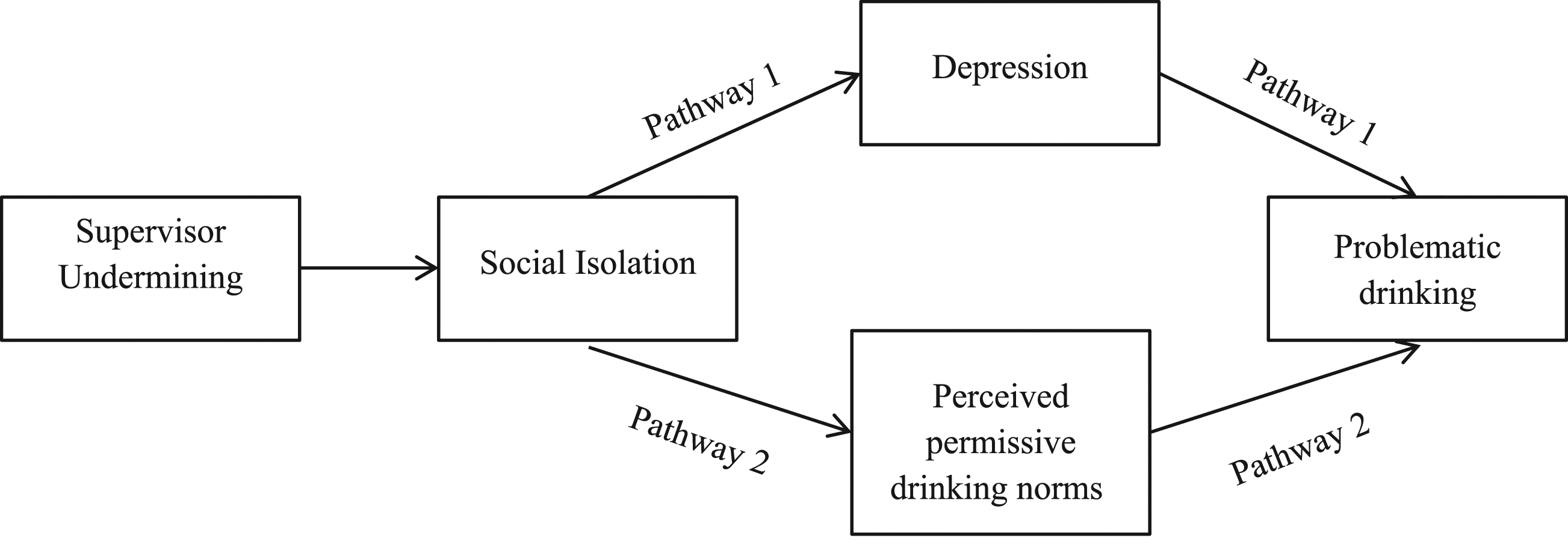
Supervisor Undermining and Social Isolation
Perceived social isolation (an analogue of loneliness) is defined as a situation experienced by the individual characterized by “an unpleasant or inadmissible lack of (quality of) certain relationships” (Gierveld, 1998, p. 73). A person may perceive social isolation even if she/he has an outwardly broad social circle (Hawkley & Cacioppo, 2010), because social isolation in workplaces is experienced when employees’ perceived social network fails to address their desires and needs (Wright et al., 2006).
Previous, COR-based models of supervisor abuse suggest that abusive supervision threatens subordinates’ peer relations, an essential basis of social support in the face of work-based stressors (Aryee, Sun, Chen, & Debrah, 2008; Harris, Winskowski, & Engdahl, 2007; Hobfoll & Shirom, 1993). Supporting this notion, studies indicate that a negative relationship with the supervisor can indeed spillover to and affect relations with workplace colleagues, undermining the subordinate’s overall sense of belongingness (Xu et al., 2020). Indeed, recent research has consistently demonstrated that on days when employees perceived a higher quality leader-member exchange (LMX) relationship with their leader, they were more likely to report a sense of belongingness (Ellis, Bauer, Erdogan, & Truxillo, 2019). In contrast, when subject to undermining behavior by their supervisor (e.g., intentionally derogatory statements about them, belittling of their ideas, and explicit or tacit efforts to make them feel disliked and unwanted), subordinates report to have difficulty maintaining positive social relationships with others in the workplace (Duffy et al., 2002).
In fact, studies indicate supervisory incivility poses a direct threat to the relationships that subordinates have with others at work; supportive relationships upon which they often depend for both instrumental assistance in managing tasks, as well as emotional support (Aryee et al., 2008; Harris et al., 2007; Harvey, Stoner, Hochwarter, & Kacmar, 2007; Hobfoll & Shirom, 1993). For example, several studies find employees witnessing others’ abuse tend to report a sense of contentment when targets of abuse are considered deserving of mistreatment (Leon & Halbesleben, 2015; Mitchell, Vogel, & Folger, 2015), with these peers motivated to ostracize the abused coworker (Mitchell et al., 2015) and/or make the abused coworker a target of their own abuse (Kim & Glomb, 2010; Lam, Van der Vegt,Walter,& Huang, 2011). Indeed, in a recent study, Xu et al. (2020) found that peer-observed supervisory incivility was positively associated with a peer sense of schadenfreude (“evil pleasure”), which in turn was associated with peer undermining of the same target, particularly among peers expressing a sense of rivalry with the target. Not surprisingly therefore, various forms of supervisor incivility have been found to be associated with heightened feelings of social isolation for those targeted (Padilla, Hogan, & Kaiser, 2007; Tepper, 2007), as well as a diminished sense of work-unit cohesiveness, a construct capturing the degree to which group members are viewed as friendly and easy to approach (Ashforth, 1997). Accordingly, we posit:
Supervisor undermining is positively associated with subordinates’ sense of social isolation.
Path 1: Social Isolation, Depression and Problematic Drinking
From the perspective of COR theory, the sense of isolation stemming from supervisory undermining represents a threat to or actual loss of a key type of conditions resource, namely supportive interpersonal relationships (Hobfoll et al., 2018). Such relationships are a particularly valuable resource in that they provide an essential basis for resource restoration and acquisition, and – by enabling individuals to cope with a wide variety of extant stressors – may be essential to preventing or at least slowing the rate of resource depletion (Aspinwall & Taylor, 1997). Because of the centrality of this resource, its threatened or actual loss in the form of some increased sense of isolation is likely to be highly aversive, thus triggering a negative emotional state such as stress or depression (Hobfoll, Freedy, Lane, & Geller, 1990). Indeed, given the centrality of supportive relationships as a basis for both resource retention and gain, those experiencing social isolation are at heightened risk of resource depletion, which can elicit a more severe emotional state manifesting in depressive symptoms (Neveu, 2007).
The relationship between social isolation and negative emotional states such as depression has been documented in numerous studies (Heinrich & Gullone, 2006; Mahon, Yarcheski, Yarcheski, Cannella, & Hanks, 2006; Monroe, 1983; Paykel, 1994; Stice, Ragan, & Randall, 2004; Windle, 1992). For example, using a sample of college students, Vanhalst et al. (2012) found that loneliness was a consistent predictor of subsequent depressive symptoms. Similarly, in a study conducted among individuals living in independent living retirement communities, loneliness scores explained about 8% of the unique variance in depression, suggesting it is an independent risk factor for depressive symptoms (Adams, Sanders, & Auth, 2004). Accordingly, we propose that:
Subordinates’ social isolation is positively associated with subordinates’ depression. From an ecological perspective, negative emotional states such as depression are manifestations of resource depletion. COR theory proposes that when individuals approach or experience a state of resource depletion, their natural response is to engage in resource conservation and restoration. Whereas various forms of problem-focused coping could facilitate resource coping and restoration, COR theory’s desperation principle suggests that individuals experiencing more negative emotional states are likely to adopt other, more maladaptive and often counter-productive means of resource restoration (Hobfoll et al., 2018). In particular, those experiencing depressive symptoms may be more myopic in their efforts at resource conservation, adopting escapist models of coping which, while demanding limited resource investment, often result in only further or secondary resource loss, potentially generating a downward spiral of increasing resource depletion (Bacharach, Bamberger, & Doveh, 2008). Alcohol misuse, as a form of self-medication, may serve as one such means of escapist coping. According to the self-medication hypothesis, affective disturbances may increase the risk for the onset and maintenance of substance use, as alcohol is applied as a self-medication tool for managing negative affective states, such as depression (Conger, 1956). According to Khantzian (1997, p. 233), “although they are not good antidepressants, alcohol and related drugs create the illusion of relief because they temporarily soften rigid defenses and ameliorate states of isolation and emptiness that predispose to depression”. Studies have found consistent support for alcohol misuse as a form of self-medication for the negative emotional states elicited by aversive situations or conditions (Conger, 1956). Moreover, the work-site alcohol literature offers strong and consistent evidence of the role played by negative emotional states such as depression in mediating the link between the exposure to some work stressor such as supervisory undermining, and alcohol misuse (Frone, 2013a, 2016). Accordingly, we posit that:
Subordinates’ depression is positively associated with subordinates’ problematic drinking. Building on the rational presented above, we propose that the predicted positive association between supervisor undermining and problematic drinking is serially mediated by social isolation and depression. Supervisor undermining, which involves behavior intended to hinder the ability of a subordinate to establish and maintain positive interpersonal relationships and positive reputation (Duffy et al., 2002), is likely to increase subordinates’ sense of social isolation. The sense of isolation, which poses a threat to or actual loss of a key resource, namely supportive interpersonal relationships (Aspinwall & Taylor, 1997), is likely to arouse depressive emotional state. Therefore, problematic drinking serves as an emotionally driven coping strategy, or in other words a form of self-medication escapist coping that is perceived as having the potential to mitigate the negative emotional state they experience. Accordingly, we posit that:
Social isolation and depression serially mediate the association between supervisor undermining and subordinates’ problematic drinking.
Path 2: Social Isolation, Perceived Injunctive Drinking Norms and Problematic Drinking
Social isolation may also have an indirect relationship with problematic drinking grounded more on the mobilization of social resources than on tension-reduction. Central to this hypothesis is the gain paradox principle of COR theory which argues that resource gains increase in salience and importance in situations characterized by high resource loss (Halbesleben, Neveu, Paustian-Underdahl, & Westman, 2014; Hobfoll, 1989; 2001; Hobfoll et al., 2018). Based on this principle, a sense of social isolation should, in theory, increase the saliency of restoring social resources. Workplace drinking (a potential problematic drinking behavior) may serve as one means by which socially isolated employees may restore social resources. Indeed, as social isolation is an aversive condition, those experiencing it often have a natural incentive to take problem-focused measures to alter the situation and attempt to restore or establish social relationships (Cacioppo & Patrick, 2008). In the work context, such efforts at establishing or restoring social relationships may revolve around workplace alcohol consumption such as having one or more drinks during or around work hours (Heath, 1995; Lee, Park, Lee, Kim, & Kim, 2007). Social isolation may enable such problematic drinking behavior by eliciting the recalibration of perceived drinking norms as more permissive, thus facilitating such behavior (Ames, Grube, & Moore, 2000).
Research offers indirect support for such a pathway, with several studies suggesting an association between social isolation and the perception of more permissive injunctive drinking norms(Bennett et al., 2000; Delaney & Ames, 1995a) and others suggesting that the framing of such behavior not as pathological but rather as “communicative” and “symbolizing social solidarity” can facilitate drinking as a mode of social resource mobilization (Cosper, 1979, p. 886). Moreover, researchers have proposed and found that perceived injunctive workplace drinking norms often play a key role in affecting employee risky drinking (Frone, 2013). For example, Ames et al. (2000) found that injunctive workplace alcohol norms were positively related to drinking at work. (Bacharach et al., 2002) found permissive injunctive drinking norms to have the strongest, direct effects on employee drinking behavior, far outweighing the effects of stressors and other workplace risk factors. It was also found that injunctive norms regarding workplace alcohol use predicted substance use and impairment overall and across all contexts of use (Frone & Brown, 2010). Based on this logic and the findings consistent with it, we posit that:
Subordinates’ social isolation is positively associated with subordinates’ permissive perceived injunctive drinking norms.
Social isolation and perceived injunctive drinking norms serially mediate the association between supervisor undermining and subordinates’ problematic drinking.
Method
Data were taken from a longitudinal study entitled “The College-to-Work Transition & Alcohol Misuse: An Etiologic Study” (C2W), which sampled future graduates of four universities in the United States. C2W is sponsored by the U.S. Department of Health and Human Services, National Institute of Health, National Institute on Alcohol Abuse and Alcoholism, and the Smithers Institute for Alcohol-Related Workplace Studies at Cornell University.
Sample and Procedures
For the C2W project, names and contact information for over 22,000 seniors in their final quarter/semester before graduation were collected from the registrars of four universities in 2015 and 2016, each university being located in a different part of the United States, upon approval of the planned study by each university’s respective Institutional Review Board. Participants were randomly selected from these universities’ roster lists and emailed with an invitation to participate toward the beginning of their final quarter/semester. Of those randomly selected, 5401 responded to the initial screening survey, which collected information about their graduation status and intentions to enter the labor force. Thus, the sampling coverage rate was about 24%, indicating sufficient sampling. Further, participation was proportionate to each school’s representation in the full graduating cohort (i.e., the proportions of students responding from each school in the 5401 were comparable to the proportions of students from each school in the initial list of over 22,000 graduating seniors), such that 18.1%, 31.8%, 27.7%, and 22.4% of the 5401 were from the Pacific Northwest, Midwest, Southeast, and Northeast schools, respectively.
Among these 5401 students, 2250 indicated that they were not graduating or were graduating but not entering the U.S. labor market (e.g., continuing their studies, traveling), and were excluded from further participation. The remaining 3151 students indicated that they were graduating and planning to begin working upon graduation. Thus, these respondents were eligible to participate in the main study. Among them, 1330 responded to the screening survey after their school-specific sample size targets (determined by a priori power analysis for detecting small effects) had already been reached. Accordingly, these students were further excluded. Another 83 students refused consent when invited to further participate in the study. The remaining 1738 students consented to participate and were immediately directed to a second pre-graduation online survey via an email. As such, the two pre-graduation surveys were separated by only minutes. Across these surveys, participants provided information on a vast array of variables including their demographics (e.g., gender, race), individual differences (e.g., personality traits), and alcohol use. Among these students, 1682 completed both pre-graduation surveys, and received a US$15 e-gift certificate for their participation.
Those who completed both pre-graduation surveys were then asked to complete another survey 1 month after graduation, and received an additional US$25 e-gift certificate for their effort. Among those responding to both pre-graduation surveys, 1649 participants (98% retention rate) responded to this post-graduation survey. Time lags ranged from about two to 3 months between the pre-graduation and post-graduation surveys. This post-graduation survey assessed alcohol consumption and employment status (i.e., working vs. not working). Those not reporting to be employed in this first post-graduation survey were surveyed every 4 months until they reported being employed. Once reporting employment, participants received follow up surveys at least two more times, each spaced 1 year apart.
As our study examined the impact of supervisor undermining on problematic drinking after a year, we included only participants reporting continuous employment (albeit not necessarily with the same employer) across the two waves (i.e., for at least a year). Each participant received US$25 for each survey completion. The 371 participants who did not meet this criterion were excluded from the analysis, leaving us with a sample of 1278 participants. Sample bias analyses indicated no significant differences between those meeting inclusion criteria and those dropped from the analysis with respect to the focal and control variables. Because 288 participants had missing values for the required analyses, missing data was estimated using full information maximum likelihood (FIML) estimation. Recent years’ extensive research into ways of dealing with missing data strongly suggests that full information maximum likelihood (FIML) currently is the most efficient method for dealing with item nonresponse, because it leads to the most unbiased parameter estimates, even in the case of non-normal data (Arbuckle, Marcoulides, & Schumacker, 1996; Enders, 2001). The final sample in our main analyses included 1046 participants. Women made up 59% of the sample, 68.3% of the sample were Caucasian, 19.3% were Asian, 3.5% Black or African American, 0.7% were American Indian, Alaska Native, Native Hawaiian or Other Pacific Islander, 8% were biracial or multiracial, and 0.2% didn’t indicate. Mean age just prior to graduation was 21.3 (SD = .82).
Procedure and Measures
Means, Standard Deviations, Correlations and Cronbach Alphas.
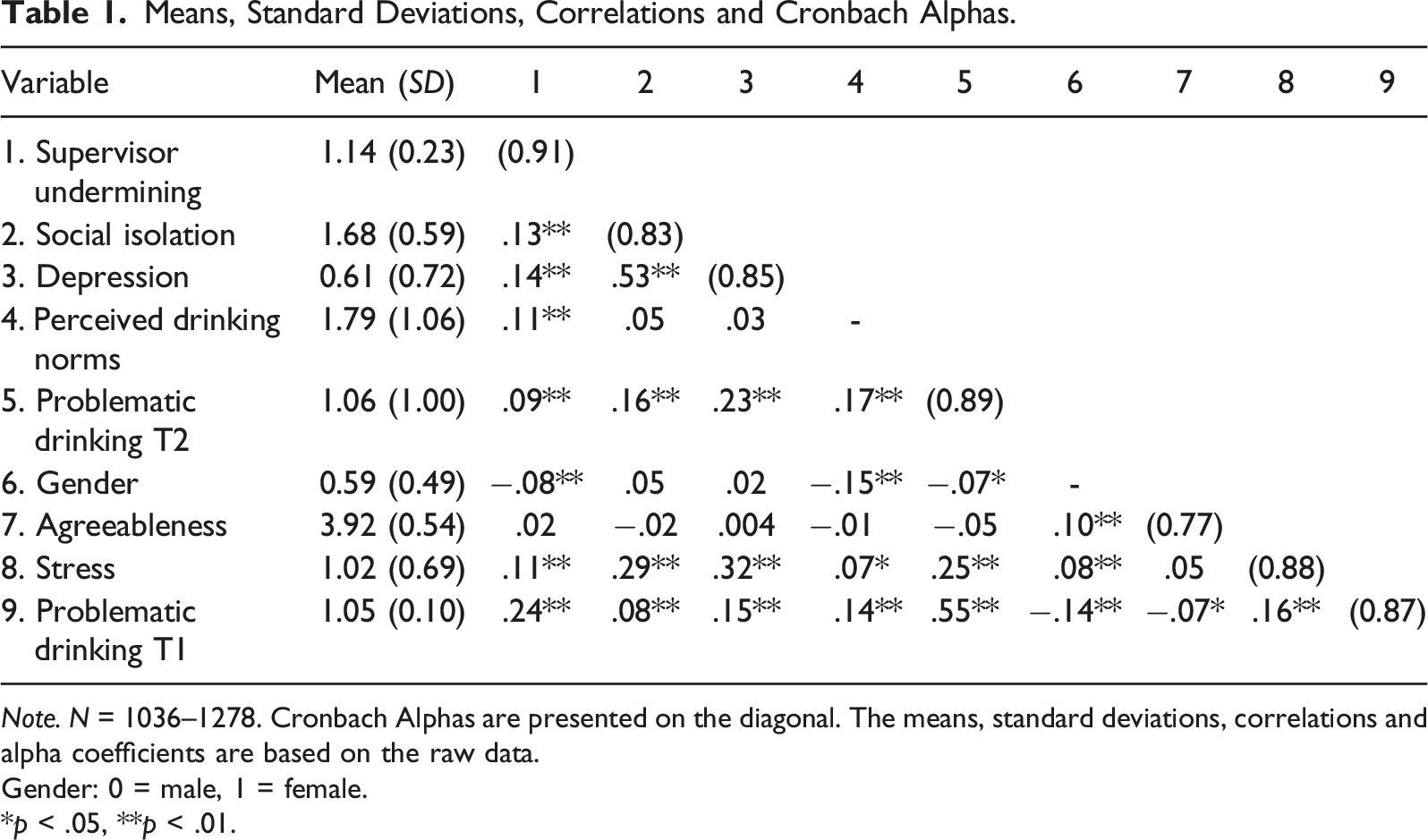
Note. N = 1036–1278. Cronbach Alphas are presented on the diagonal. The means, standard deviations, correlations and alpha coefficients are based on the raw data.
Gender: 0 = male, 1 = female.
*p < .05, **p < .01.
Supervisor Undermining
Supervisor undermining was assessed at T1, using the measure developed and validated by Vinokur & Van Ryn (1993). Participants rated the extent to which their most direct supervisor exhibited particular undermining behaviors (e.g., “Act in an unpleasant or angry manner toward you?” and “Makes you feel unwanted?”) on a 5-point scale ranging from 1 (not at all) to 5 (a great deal). Because the distribution of scores on this measure displayed a statistically significant positive skew (i.e., tail to the right), we applied a square root transformation prior to analysis (Tabachnick & Fidell, 2007). The transformation is used to produce normality by reducing the impact of the outliers.
Social Isolation
Social isolation was assessed at T2, using the short version of the R-UCLA Loneliness scale (Russell, Peplau, & Cutrona, 1980). This short version, developed and validated by (Hughs, Waite, Hawkley, & Cacioppo, 2004) includes three items (i.e., “In the past week, how often have you felt: (a) that you lacked companionship, (b) left out and (c) isolated from others”), each rated on a 3-point scale ranging from 1 (hardly ever) to 3 (often).
Depression
Depression was assessed at T2, using the PHQ-2 measure developed and validated by Kroenke et al. (2003) which includes two items (i.e., “Over the past month, how often have you been bothered by the following problems: (a) Little interest or pleasure in doing things, (b) Feeling down, depressed or hopeless), each rated on a 4-point scale ranging from 0 (not at all) to 3 (nearly every day).
Perceived Workplace Injunctive Drinking Norms
Perceptions of the social legitimacy of drinking at work was assessed at T2, by asking participants to rate the extent to which they believed their colleagues at work, would approve/disapprove if the participant were to have 1-2 drinks at work, using a 5-point scale ranging from 1 (disapprove very much) to 5 (approve very much; Ames & Grube, 1999).
Problematic Drinking
Problematic drinking was assessed at T1 and T2, using the short-form Rutgers Alcohol Problem Index (S-RAPI; Earleywine, LaBrie, & Pedersen, 2008; based on the original RAPI in White & Labouvie, 1989), which includes sixteen items. Participants indicated how many times several drinking consequences happened to them while they were drinking or because of their alcohol use during the past month, using a 5-ponit scale ranging from 1 (never) to 5 (more than 10 times). Sample items included “Neglected your responsibilities” and “Missed a day (or part of a day) of work”. Here also, prior to analyses, a square root transformation was applied due to a statistically significant positive skew.
Control Variables
In our analyses we controlled for gender because males generally consume more alcohol than females (Wilsnack, Vogeltanz, Wilsnack, & Harris, 2000) and have more negative drinking consequences (Geisner, Larimer, & Neighbors, 2004). Furthermore, we controlled for agreeableness, because agreeable individuals tend to be more forgiving, slow to anger, considerate and tolerant (McCrae & John, 1992), and to perceive aversive conditions less negatively (Mount & Barrick, 1995), and thus may be less likely to perceive undermining behavior as aversive and/or to experience consequent social isolation and depression. Moreover, because agreeable individuals tend to be more likeable and popular (Mervielde & De Fruyt, 2000; Nikitin & Freund, 2015; Selfhout et al., 2010; Van der Linden, Scholte, Cillessen, te Nijenhuis, & Segers, 2010), they may have a more extensive network of supportive relationships, thus reducing their vulnerability to the social isolation that might result from supervisor undermining. In contrast, more disagreeable individuals are often selfish, aggressive, hostile, irritable, uncooperative and rude (Costa & McCrae, 1985; McCrae & Costa, 1987), which may provoke others to, at the very least, isolate and remain distant from them. We measured agreeableness using the four agreeableness items of the Mini-IPIP scale, a short form of the Big Five measure, which was developed and validated by Donnellan et al. (2006; e.g., “Sympathize with others’ feelings”). Participants rated their agreement with each item on a 5-point scale ranging from 1 (strongly disagree) to 5 (strongly disagree). Moreover, because stress has consistently been found to serve as the primary mechanism linking supervisor incivility to alcohol misuse (Bamberger & Cohen, 2015; Richman et al., 2002), we controlled for this factor in T2. Controlling for stress enables us to examine the two proposed mediation effects (via social isolation and depression vs. social isolation and perceived injunctive drinking norms) over and above the previously found mediating effect of stress. We measured stress using the five stress items in the Depression Anxiety Stress Scale (DASS; Lovibond & Lovibond, 1995; e.g., “Please indicate how much each of the statements below applied to you over the past month. Over the past month, I felt that I was using a lot of nervous energy”), each rated on a 4-point scale ranging from 0 (did not apply to me at all) to 3 (applied to me most of the time). Finally, we took problematic drinking upon job entry (i.e., at T1) into account in assessing the indirect effects of supervisor undermining (via social isolation and depression vs. social isolation and perceived injunctive drinking norms) on post-entry problematic drinking (i.e., problematic drinking at T2).
Results
Means, standard deviations, and correlations between all the variables in the study are reported in Table 1. As is apparent from the bivariate relationships shown in Table 1, supervisor undermining is positively related to problematic drinking (r = .09, p < .01). Moreover, supervisor undermining and problematic drinking are positively related to social isolation (r = .13, p < .01 and r = .16, p < .01, respectively), and depression (r = .14, p < .01 and r = .23, p < .01, respectively).
A confirmatory factor analysis was conducted to assess the discriminant validity of the social isolation and depression measures. Accordingly, a single-factor model was compared to the assumed 2-factor model. The results indicate that the two-factor solution provided a significantly better fit to the data than the one-factor solution (χ2 = 5.18, p = 0.27, CFI = 1.00, RMSEA = 0.02, SRMR = 0.006, and χ2 = 611.24, p < 0.001, CFI = 0.80, RMSEA = 0.31, SRMR = 0.10, respectively; Δχ2 = 606.07, p < .001).
Regressions for the Moderated Serial Mediation Model.
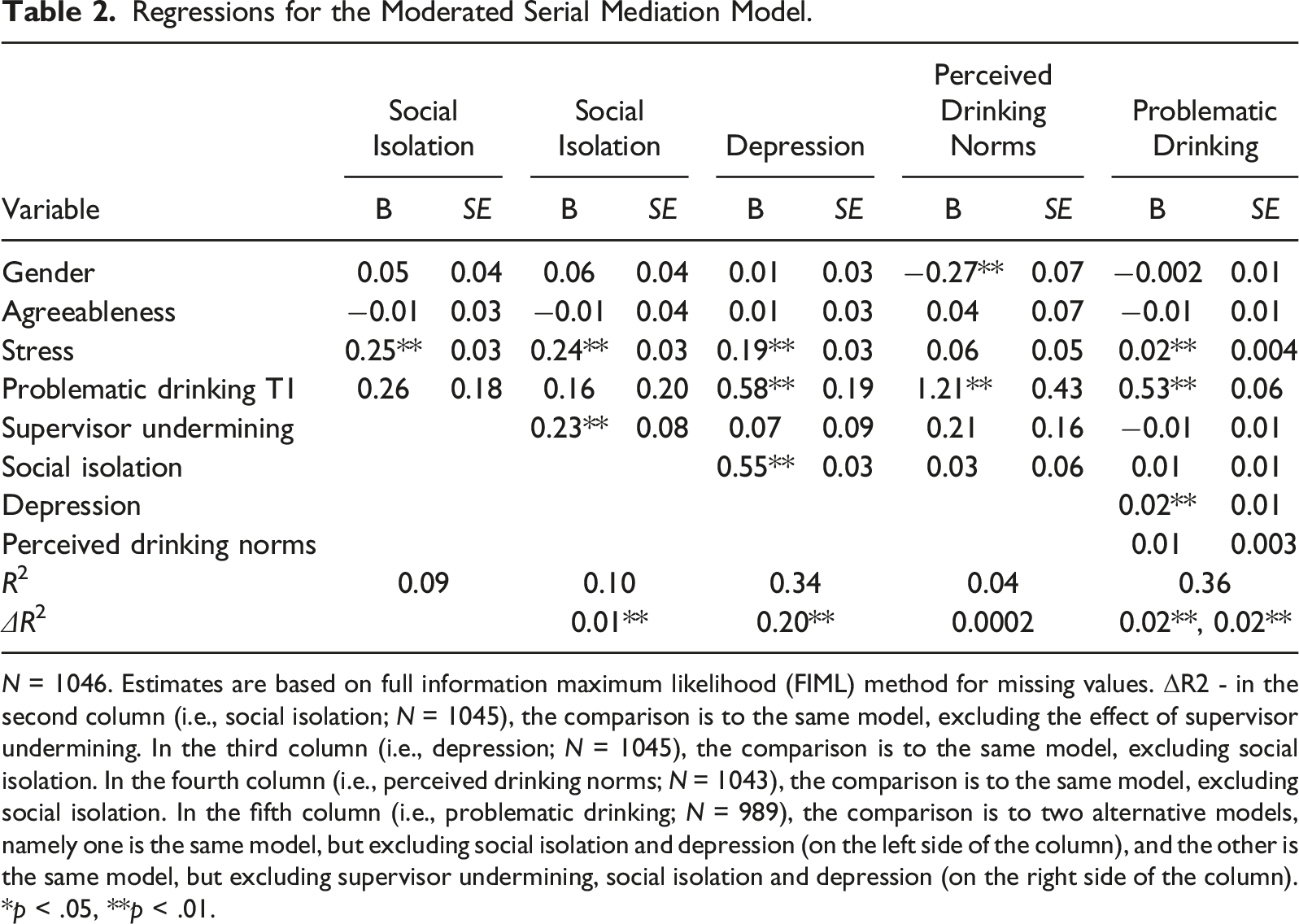
N = 1046. Estimates are based on full information maximum likelihood (FIML) method for missing values. ΔR2 - in the second column (i.e., social isolation; N = 1045), the comparison is to the same model, excluding the effect of supervisor undermining. In the third column (i.e., depression; N = 1045), the comparison is to the same model, excluding social isolation. In the fourth column (i.e., perceived drinking norms; N = 1043), the comparison is to the same model, excluding social isolation. In the fifth column (i.e., problematic drinking; N = 989), the comparison is to two alternative models, namely one is the same model, but excluding social isolation and depression (on the left side of the column), and the other is the same model, but excluding supervisor undermining, social isolation and depression (on the right side of the column).
*p < .05, **p < .01.
Supporting H1, there was a positive association between supervisor undermining and social isolation (b = 0.23, p = .006). Moreover, supporting H2, social isolation was positively related to depression (b = 0.55, p < .001). The change in R-squared when social isolation was added to the model predicting depression (by supervisor undermining and the control factors), was significant (ΔR 2 = 0.20, p < .001). The results also indicate support for Hypothesis 3a, in that depression was positively related to problematic drinking (b = 0.02, p = .004). Moreover, consistent with the first path suggested by Hypothesis 3b, our findings suggest a significant indirect effect of supervisor undermining on problematic drinking, serially mediated by social isolation and depression (Estimate = 0.002, CI = 0.0004, 0.005). Furthermore, when social isolation and depression were added to the direct effect model predicting problematic drinking by supervisor undermining and the control factors alone, the change in R-squared was significant (ΔR 2 = 0.02, p < .001).
We found no evidence to support the second proposed pathway, namely one involving an indirect effect of supervisor undermining on problematic drinking via social isolation and perceived injunctive drinking norms. More specifically, in contrast to Hypothesis 4a, social isolation was not related to perceived injunctive drinking norms (b = 0.03, p = .655). Furthermore, in contrast to Hypothesis 4b, although perceived injunctive drinking norms were positively related to problematic drinking (b = 0.01, p = .007), social isolation and perceived injunctive drinking norms did not mediate the association between supervisor undermining problematic drinking (Estimate = 0.0001, CI = −.0002, .0004).
Robustness Checks
Because social isolation, depression and problematic drinking were all assessed at T2, an alternative explanation to the positive impact of social isolation on depression, as well as for the positive impact of depression on problematic drinking, is that the pathways may operate in the opposite direction (i.e., with depression causally preceding social isolation, and problematic drinking causally preceding depression). To rule out these alternative explanations, we tested two cross-lagged models each incorporating the same control factors used in the hypothesized models, 1 namely one with social isolation and depression, and the other with depression and problematic drinking. In the first cross-lagged model (i.e., social isolation and depression), results indicated that although the relationship between depression in T1 and social isolation in T2 was significant (b = .11, p < .001), the relationship between social isolation in T1 and depression in T2 was stronger (b = .14, p < .001), implying that while a reciprocal effect is possible, the effect of depression on social isolation is weaker than that of the hypothesized, social isolation to depression effect. In the second cross-lagged model (i.e., depression and problematic drinking), results showed that the relationship between problematic drinking in T1 and depression in T2 was not significant (b = .23, p = .201), while the relationship between depression in T1 and problematic drinking in T2 was significant (b = .01, p = .001), suggesting that the reverse causality is an unlikely alternative explanation.
Because one of the supervisor undermining measure’s items may share some unintended content overlap with the social isolation measure, we excluded an item (i.e., “Make you feel unwanted”) from the supervisor undermining measure and conducted the main analyses using this cleaner measure which consists of four (rather than five) items. Even with this change, consistent with the first path suggested by Hypothesis 3b, our findings still indicate a significant indirect effect of supervisor undermining on problematic drinking, serially mediated by social isolation and depression (Estimate = 0.002, CI = 0.0003, 0.004).
Next, because it is unlikely that people that abstain from drinking alcohol will report symptoms of problematic drinking, we excluded 114 subjects that reported in both T1 and T2 that they don’t drink alcohol at all and conducted the main analysis on this subsample (N = 1046). Even with this more constrained sample, consistent with Hypothesis 3b, our findings continue to indicate a indirect effect of supervisor undermining on problematic drinking, serially mediated by social isolation and depression (Estimate = 0.002, CI = 0.0004, 0.005).
Importantly, although supervisor undermining was only modestly related to problematic drinking (r = 0.09), our findings indicate that it may have highly consequential practical implications: For every increase of 1 unit in the score of supervisor undermining the undermined employee’s problematic drinking score increases by 0.04 units. Practically, this means that supervisor undermining links to a greater frequency of problematic drinking behaviors that can have significant harmful effects on both the employee and others at work (e.g., harming others because of drinking, acting irresponsibly because of drinking, feeling physically or psychologically dependent on alcohol, etc.). Moreover, these effects if anything, likely err on the conservative as the problematic drinking measure is based on retrospective self-reports and is thus subject to underreporting (Monk, Heim, Qureshi, & Price, 2015). Moreover, the effect size of supervisor undermining with respect to problematic drinking (r2 = 0.008) is consistent with and even larger than the effect size reported in prior studies examining supervisor abuse and problematic drinking (r2 = 0.004; Bamberger & Bacharach, 2006) or the association of problematic drinking with other work-related risk factors (e.g., role conflict; r2 = 0.006; (Bacharach et al., 2002)).
Discussion
Using data collected longitudinally from recent college graduates entering career employment for the first time, we examined the mechanism underlying the impact of supervisor undermining on problematic drinking. Building on COR theory, we posited and found that above and beyond the effects of problematic drinking upon job entry, supervisory undermining was positively associated with subordinates' problematic drinking behavior after a year on the job, with this association serially mediated by higher levels of social isolation and depression.
Notably, we found no support for an alternative indirect effect of supervisor undermining on problematic drinking via social isolation and perceived permissive injunctive drinking norms. The lack of support for the alternative indirect effect suggests that social isolation resulting from supervisor undermining may be more likely to lead to problematic drinking via negative affect (manifested in the form of depression), than via the recalibration of alcohol use justifications (manifested in perceived permissive injunctive drinking norms). Although we may only speculate, it is possible that the absence of an indirect effect via the recalibration of alcohol use justifications stems from social isolation’s potential to drive problematic drinking without the need for an adjustment in perceived workplace drinking norms. This could happen, for example, if individuals consciously violate perceived workplace drinking norms in order to mobilize the social resource needed to address feelings of social isolation.
Theoretical and Practical Implications
Our findings offer several meaningful contributions to the literature on work-related substance misuse and supervisory incivility. First, the findings from this study extend our understanding of how supervisory undermining as a particular form of incivility may impact alcohol use (Bamberger & Bacharach, 2006; Bamberger & Cohen, 2015; Richman et al., 1996, 2002). They do so by shedding light on two alternative mechanisms, one based on COR theory’s desperation principle and the other based on COR theory’s gain paradox principle. At the most basic level, our finding – that supervisory undermining contributes to target problematic drinking via depressive symptoms – is consistent with the tension-reduction explanation dominant in the prior literature (Bamberger & Cohen, 2015; Richman et al., 2002). However, we also demonstrate that the mediating effects of social isolation and depression supplement the already documented indirect effect of supervisor incivility on alcohol misuse via stress (Bamberger & Cohen, 2015; Richman et al., 2002). Moreover, our findings are notable in that they isolate social isolation as a key mechanism linking supervisory incivility to depression. This is important in that by identifying the mechanism by which undermining links to alcohol misuse, we may be able to develop more efficacious approaches to helping those targeted by such supervisory behavior. Moreover, the fact that we found no evidence of a supplementary, indirect effect of supervisor undermining on problematic drinking via social isolation and perceived injunctive drinking norms, suggests the need to question the role of social resource mobilization as an alternative explanation for the association between supervisory incivility and target alcohol misuse.
These theoretical contributions, in turn, suggest a number of practical implications.
First, particularly for organizations employing young adults often lacking experience in managing undermining from authority figures, and who are highly impacted from undermining experiences in their very first months of employment (Kammeyer-Mueller et al., 2013), our findings suggest the benefit of facilitating the establishment of work-based support networks. Enmeshment in such networks of support, or alternatively, the provision of stable, mentor-based support, may help reduce newcomers’ vulnerability to a sense of social isolation if such individuals encounter supervisory undermining, and hence to the kinds of negative emotional states potentially driving alcohol misuse. Moreover, because newcomers might be less inclined to complain about supervisor undermining, more veteran workers might be trained to be aware of the emotional signs (i.e., a sense of loneliness and/or depressed mood) that can result from supervisory undermining, and report these to some independent authority such as a Human Resources officer. Human resource managers may themselves take steps to increase newcomers’ awareness of such behaviors and to the consequent emotional states as part of their entrance training. Newcomers’ ability to attribute the negative emotional states they may experience to their supervisor behavior is critical because of their lack of experience in such circumstances and because it may boost their attempts to make active efforts to reduce these negative emotions using problem-focused coping methods such as filing a grievance or requesting to transfer to an alternative work unit led by a more supportive supervisor.
Finally, and perhaps most importantly, given the link between supervisory undermining on the one hand and employee emotional well-being and risky behavior on the other, our findings suggest that organizations should redouble their efforts to prevent supervisory undermining from occurring in the first place. Indeed, although the costs of problematic drinking, while largely on the employee, may also accrue to the individual’s employer (Frone, 2013a), our findings indicate that organizational leaders should not only establish policies that sanction such supervisory behavior, but also take steps to vigorously enforce such policies.
Limitations and Directions for Future Research
Several study limitations suggest the need to consider our findings with a reasonable degree of caution. First, although data were collected longitudinally, and thus some of the constructs were measured at different times, all of the data are self-report by subordinates. Accordingly, common method variance is a potential source of bias in our estimates, with the relationship between the measures potentially inflated by factors other than the relationship between the variables themselves (Richardson, Simmering, & Sturman, 2009). However, as suggested by Spector (1994), when the constructs measured reside in the mind of the focal respondent, self-reports are arguably the best source of data. Accordingly, because we are interested in the undermining supervision experienced by a particular subordinate, an experience that other sources, such as the subordinates’ peers, may not be completely aware of, and supervisors are likely to diminish or deny, it is doubtful that anyone other than the respondent (i.e., the subordinate) can offer an accurate response. Moreover, the subjective undermining experience is the one most likely to be related to the subordinates’ perceived social isolation, depression, perceived injunctive drinking norms and subsequent drinking, which are also constructs that reside in the mind of the subordinate. This is because people act not so much on the basis of workplace characteristics as they “are” objectively, or are perceived to be by others, but rather as they themselves perceive them to be (Thomas & Thomas, 1928). Thus, using the same source in the current research may have greater validity than using different sources (Edwards, 2008). Furthermore, the risk of common method variance in the current research is diminished by controlling for dispositional factors such as agreeableness, which could otherwise serve as the basis for common method variance (Edwards, 2008). Nevertheless, future research may focus on replicating these findings using data from non-self-report sources, such as peer-based assessments of supervisory behavior and/or spouse/partner-based assessments of the drinking behavior of targeted co-workers.
Another limitation of this study is that given the age and work experience characteristics of the sample (i.e., recent college graduates entering their first job), we are unable to attest to the generalizability of our findings to older employees for which the tested workplace is not their first one following graduation. Supporting such a concern regarding the external validity of our findings is the finding that the prevalence of problematic drinking tends to drop after age 30 (Frone, 2013a). Furthermore, findings indicate that the relationship between alcohol tension reduction expectancies and alcohol use is conditioned on age (Nicolai, Moshagen, & Demmel, 2012). Specifically, expectancies related to alcohol’s tension reduction effect, were the most important predictor of drinking in individuals older than 30 years, but not in younger age groups. To the degree that age may amplify the way in which subordinates perceive and use alcohol as a means to reduce negative emotional states such as depression, our focus on younger workers may have yielded estimates of the depression-mediated impact of supervisory undermining and problem drinking that err on the conservative. In the future, researchers may wish to test the applicability of the current findings to older groups of workers and those with more employment experience.
In the current study we focused on supervisor undermining, a highly prevalent but relatively benign form of supervisor incivility. This raises the question as to the generalizability of our findings with respect to the consequences of other more severe or toxic forms of incivility, such as intimidation, bullying, and manipulating (Machiavellianism; Pelletier, 2010). Accordingly, we encourage research aimed at assessing the generalizability of our findings to situations in which individuals are exposed to higher intensity forms of incivility from supervisors or other work-related sources (e.g., peers, customers).
Also worth investigating is what it is about supervisor undermining that leads to subordinates’ perceived social isolation. Is it that undermining events becomes overly-generalized and cognitively distorted so as to be perceived as the absence of support or caring from others at work such as one’s peers or coworkers (Beck, 1979; Ellis & Grieger, 1977)? Or might it be that targets’ perception of social isolation reflects actual, objective isolation by one’s peers (Harris, Harvey, Harris, & Cast, 2013; Priesemuth, 2013). Regarding the latter, research indicates that while peers may attempt to assist a coworker subjected to supervisory undermining (Priesemuth, 2013), they may also distance from targets deemed deserving of mistreatment (Mitchell et al., 2015), or when they fear being targeted by association by the same supervisor. Teasing out these effects and understanding how social isolation elicits a sense of social isolation is important in that a better understanding of this effect would likely facilitate the development of more efficacious interventions.
Conclusion
Using a longitudinal study design, the current research suggests that the impact of supervisory undermining on subordinates’ perceptions, emotions and behaviors may be more nuanced than implied by the models proposed and tested to date. In particular, we posit and show that social isolation plays an important role in linking supervisor undermining and the subordinate targets’ depressive symptoms potentially driving problematic drinking as a maladaptive coping behavior.
Footnotes
Acknowledgments
We are grateful to Katie Briggs for her assistance in collecting the data on which this study is based.
Declaration of Conflicting Interests
The author(s) declared no potential conflicts of interest with respect to the research, authorship, and/or publication of this article.
Funding
The author(s) disclosed receipt of the following financial support for the research, authorship, and/or publication of this article: This research was funded by the United States Department of Health and Human Services, National Institutes of Health, National Institute on Alcohol Abuse and Alcoholism (NIH/5R01AA022113), and by the Smithers Institute for Alcohol-Related Workplace Studies, Cornell University. The contribution of Dr Bamberger was partially supported by a grant from the Henry Crown Institute for Business Research, Tel Aviv University.
Ethical approval
This study was approved by Cornell University’s Office of Research Integrity and Assurance (Protocol No. 1408004876, title: College to Work Study).
