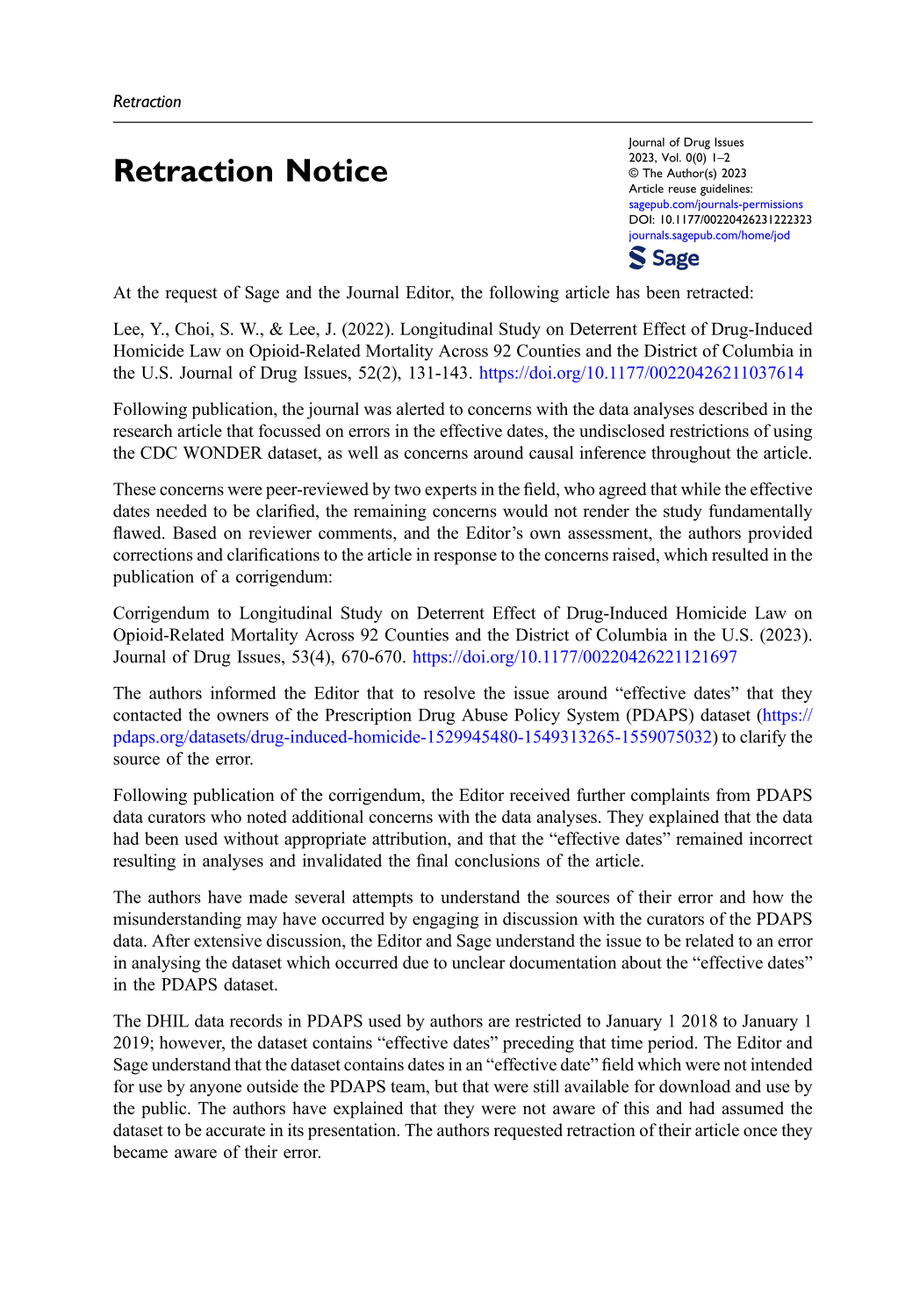
Retracted: Longitudinal Study on Deterrent Effect of Drug-Induced Homicide Law on Opioid-Related Mortality Across 92 Counties and the District of Columbia in the U.S.
Restricted accessResearch articleFirst published online April, 2022
Retracted: Longitudinal Study on Deterrent Effect of Drug-Induced Homicide Law on Opioid-Related Mortality Across 92 Counties and the District of Columbia in the U.S.
AboukR.PaculaR. L.PowellD. (2019). Association between state laws facilitating pharmacy distribution of naloxone and risk of fatal overdose. JAMA Internal Medicine, 179(6), 805-811. doi: 10.1001/jamainternmed.2019.0272.
2.
AndersonR. N.RosenbergH. M. (1998). Age standardization of death rates; implementation of the year 2000 standard.
3.
ArellanoM.BondS. (1991). Some tests of specification for panel data: Monte Carlo evidence and an application to employment equations. The Review of Economic Studies, 58(2), 277-297.
4.
ArellanoM.BoverO. (1995). Another look at the instrumental variable estimation of error-components models. Journal of Econometrics, 68(1), 29-51.
5.
BachhuberM. A.SalonerB.BarryC. L. (2015). What ecologic analyses cannot tell us about medical marijuana legalization and opioid pain medication mortality—reply. JAMA Internal Medicine, 175(4), 656-657.
6.
BachhuberM. A.SalonerB.CunninghamC. O.BarryC. L. (2014). Medical cannabis laws and opioid analgesic overdose mortality in the United States, 1999-2010. JAMA Internal Medicine, 174(10), 1668-1673.
7.
BarbarescoS.CourtemancheC. J.QiY. (2015). Impacts of the Affordable Care Act Dependent coverage provision on health-related outcomes of young adults. Journal of Health Economics, 40, 54-68.
8.
Berecki‐GisolfJ.Hassani‐MahmooeiB.ClappertonA.McClureR. (2017). Prescription opioid dispensing and prescription opioid poisoning: population data from Victoria, Australia 2006 to 2013. Australian and New Zealand Journal of Public Health, 41(1), 85-91.
9.
ButlerJ. C. (2017). 2017 ASTHO president's challenge: Public health approaches to preventing substance misuse and addiction. Journal of Public Health Management and Practice, 23(5), 531-536. doi: 10.1097/PHH.0000000000000631.
CerdáM.PonickiW. R.SmithN.Rivera-AguirreA.DavisC. S.MarshallB. D. LMartinsS. S. (2020). Measuring relationships between proactive reporting state-level prescription drug monitoring programs and county-level fatal prescription opioid overdoses. Epidemiology, 31(1), 32-42. doi: 10.1097/EDE.0000000000001123.
12.
ChihuriS.LiG. (2019). State marijuana laws and opioid overdose mortality. Injury Epidemiology, 38. doi: 10.1186/s40621-019-0213-z.
13.
ConferL. M.BomanJ. H.IVPryorC.MowenT. J.HemezP. (2021). Theft, Opioid Pills, Unemployment, and Insurance: A Longitudinal Analysis of American Counties in the Wake of the Opioids Crisis. Journal of Drug Issues, 0022042621998690.
14.
DavisC. S.CarrD. (2015). Legal changes to increase access to naloxone for opioid overdose reversal in the United States. Drug and Alcohol Dependence, 157, 112-120. doi: 10.1016/j.drugalcdep.2015.10.013.
15.
DavisC. S.JohnstonJ. E.PierceM. W. (2015). Overdose Epidemic, Prescription Monitoring Programs, and Public Health: A Review of State Laws. American Journal of Public Health, 105(11), e9-e11. doi: 10.2105/AJPH.2015.302856.
16.
DelcherC.WagenaarA. C.GoldbergerB. A.CookR. L.Maldonado-MolinaM. M. (2015). Abrupt decline in oxycodone-caused mortality after implementation of Florida's Prescription Drug Monitoring Program. Drug and Alcohol Dependence, 150, 63-68.
17.
DoleacJ. L.MukherjeeA. (2019). The moral hazard of lifesaving innovations: Naloxone access, opioid abuse, and crime. Opioid Abuse, and Crime ((March 31, 2019).
18.
Drug Policy Alliance (2017). An overdose death is not murder: Why drug-induced homicide laws are counterproductive and inhumane. Retrieved fromhttps://www.drugpolicy.org/resource/DIH.
19.
ErfanianE.CollinsA. R.GrossmanD. (2019). The Impact of Naloxone Access Laws on Opioid Overdose Deaths in the U.S. The Review of Regional Studies, 49, 45-72.
20.
FlorenceC.LuoF.XuL.ZhouC. (2016). The economic burden of prescription opioid overdose, abuse and dependence in the United States, 2013. Medical Care, 54(10), 901-906.
21.
GilesM.MalcolmM. (2021). Prescription opioid misuse and property crime. Social Science Quarterly, 102(2), 663-682.
22.
GrecuA. M.DaveD. M.SafferH. (2019). Mandatory access prescription drug monitoring programs and prescription drug abuse. Journal of Policy Analysis and Management, 38(1), 181-209. doi: 10.1002/pam.22098.
23.
HaffajeeR. L.LinL. A.BohnertA. S.GoldstickJ. E. (2019). Characteristics of US counties with high opioid overdose mortality and low capacity to deliver medications for opioid use disorder. JAMA Network Open, 2(6), e196373.
24.
HeaveyS. C.ChangY. P.VestB. M.CollinsR. L.WieczorekW.HomishG. G. (2018). ‘I have it just in case’—Naloxone access and changes in opioid use behaviours. International Journal of Drug Policy, 51, 27-35.
25.
HedegaardH.WarnerM.MiniñoA. M. (2017). NCHS data brief no. 294. Hyattsville, MD: National Center for Health Statistics, 1999-2016.
26.
HedegaardH.MiniñoA. M.WarnerM. (2020). Drug overdose deaths in the United States, 1999-2018.
27.
HollingsworthA.RuhmC. J.SimonK. (2017). Macroeconomic conditions and opioid abuse. Journal of Health Economics, 56, 222-233.
28.
HumphreysK.WagnerT. H.GageM. (2011). If substance use disorder treatment more than offsets its costs, why don't more medical centers want to provide it?: A budget impact analysis in the Veterans Health Administration. Journal of Substance Abuse Treatment, 41(3), 243-251.
29.
KediaS.AhujaN.WyantD. K.DillonP. J.AkkusC.RelyeaG. (2020). Compositional and contextual factors associated with drug overdose deaths in the United States. Journal of Addictive Diseases, 38(2), 143-152.
30.
KimB. (2020). Must-access prescription drug monitoring programs and the opioid overdose epidemic: The unintended consequences. Journal of Health Economics, 75, 102408. doi: 10.1016/j.jhealeco.2020.102408.
31.
LangabeerJ. R.ChambersK. A.Cardenas-TuranzasM.Champagne-LangabeerT. (2020). County-level factors underlying opioid mortality in the United States (pp. 1-7). Substance abuse.
32.
LeeY. H.ChangY. C.LiuC. T.ArndtS. (2020). Is medical Marijuana legalization associated with prescription drug misuse, illicit drug use, or combination of both among adults in the United States?Journal of Drug Issues, 50(4), 566-578.
33.
LiangD.ShiY. (2020). The association between pain clinic laws and prescription opioid exposures: New evidence from multi-state comparisons. Drug and Alcohol Dependence, 206, 107754.
34.
MaJ.BaoY.WangR.SuM.LiuM.LiJ.LuL. (2019). Effects of medication-assisted treatment on mortality among opioids users: A systematic review and meta-analysis. Molecular Psychiatry, 24, 1868-1883. doi: 10.1038/s41380-018-0094-5.
35.
McClellanC.LambdinB. H.AliM. M.MutterR.DavisC. S.WheelerE.PembertonM.KralA. H. (2018). Opioid-overdose laws association with opioid use and overdose mortality. Addictive Behaviors, 86, 90-95. doi: 10.1016/j.addbeh.2018.03.014.
36.
MurphyJ.RussellB. (2020). Police officers’ views of naloxone and drug treatment: Does greater overdose response lead to more negativity?Journal of Drug Issues, 50(4), 455-471.
37.
PatrickS. W.FryC. E.JonesT. F.BuntinM. B. (2016). Implementation of prescription drug monitoring programs associated with reductions in opioid-related mortality rates. Health Affairs, 35(7), 1324-1332. doi: 10.1377/hlthaff.2015.1496.
38.
PearV. A.PonickiW. R.GaidusA.KeyesK. M.MartinsS. S.FinkD. S.CerdáM. (2019). Urban-rural variation in the socioeconomic determinants of opioid overdose. Drug and Alcohol Dependence, 195, 66-73.
39.
PetersonM.RichJ.MacmaduA.TruongA.Q.GreenT.C.BeletskyL.Brinkley-RubinsteinL. (2019). “One guy goes to jail, two people are ready to take his spot”: Perspectives on drug-induced homicide laws among incarcerated individuals. International Journal of Drug Policy, 70, 47-53. doi: 10.1016/j.drugpo.2019.05.001.
40.
PowellD.PaculaR. L.JacobsonM. (2018). Do medical marijuana laws reduce addictions and deaths related to pain killers?Journal of Health Economics, 58, 29-42. doi: 10.1016/j.jhealeco.2017.12.007.
41.
ReesD. I.SabiaJ. J.ArgysL. M.DaveD.LatshawJ. (2019). With a little help from my friends: The effects of good Samaritan and naloxone access laws on opioid-related deaths. The Journal of Law and Economics, 62(1), 1-27. doi.org/10.1086/700703.
42.
RomeiserJ. L.LabriolaJ.MelikerJ. R. (2019). Geographic patterns of prescription opioids and opioid overdose deaths in New York State, 2013-2015. Drug and Alcohol Dependence, 195, 94-100.
43.
RoodmanD. (2009). How to do xtabond2: An introduction to difference and system GMM in Stata. The Stata Journal, 9(1), 86-136.
44.
ShiptonE. E.ShiptonA. J.WillimanJ. A.ShiptonE. A. (2017). Deaths from opioid overdosing: Implications of coroners’ inquest reports 2008–2012 and annual rise in opioid prescription rates: A population-based cohort study. Pain and Therapy, 6(2), 203-215.
45.
ShoverC. L.DavisC. S.GordonS. C.HumphreysK. (2019). Association between medical cannabis laws and opioid overdose mortality has reversed over time. Proceedings of the National Academy of Sciences, 116(26), 12624-12626.
46.
SmithR. A. (2020). The Effects of Medical Marijuana Dispensaries on Adverse Opioid Outcomes. Economic Inquiry, 58(2), 569-588. doi: 10.1111/ecin.12825.
47.
TomlinsonK. D. (2016). An examination of deterrence theory: Where do we stand. Fed. Probation, 80, 33.
van DraanenJ.TsangC.MitraS.KaramouzianM.RichardsonL. (2020). Socioeconomic marginalization and opioid-related overdose: a systematic review. Drug and Alcohol Dependence, 214, 108127.
50.
WeisbergD. F.BeckerW. C.FiellinD. A.StannardC. (2014). Prescription opioid misuse in the United States and the United Kingdom: cautionary lessons. International Journal of Drug Policy, 25(6), 1124-1130.
51.
WilsonN.KariisaM.SethP.SmithH.IVDavisN. L. (2020). Drug and opioid-involved overdose deaths—United States, 2017–2018. Morbidity and Mortality Weekly Report, 69(11), 290.