




Abstract
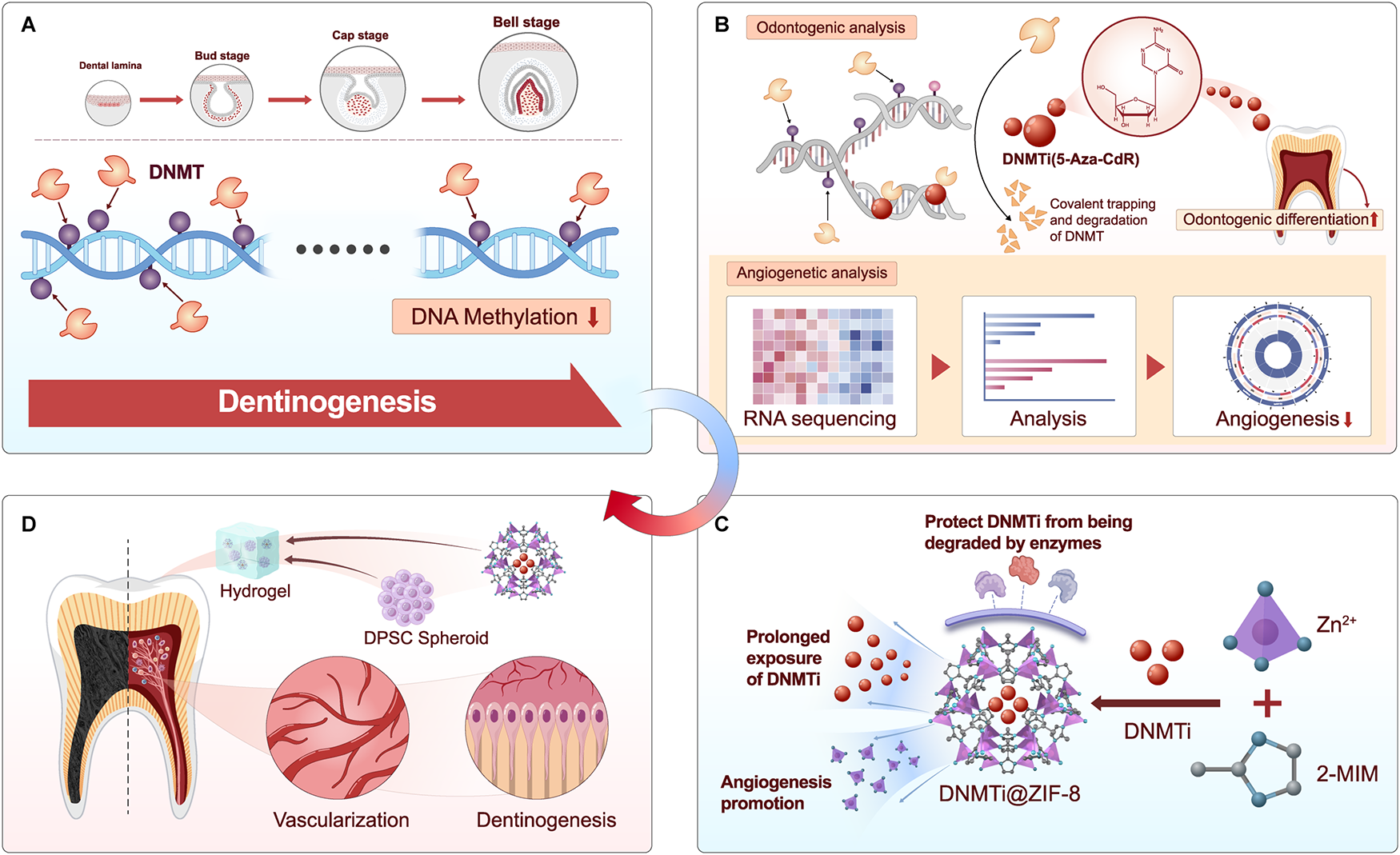
Regenerating the functional dentin–pulp complex remains a significant challenge in endodontics. Conventional regenerative endodontic therapies often result in the formation of non–pulp-like tissue due to the uncontrolled induction of stem cells and cytokines. Mimicking developmental processes to promote regeneration represents a promising yet challenging approach in regenerative medicine. This study aimed to develop a biomimetic regenerative therapy that integrates a DNMTi@ZIF-8 nanoplatform with dental pulp stem cell (DPSC) spheroids to effectively regenerate the dentin–pulp complex. First, a progressive reduction in 5-methylcytosine content was revealed to be a core signal in the odontogenic differentiation process. Based on this discovery, DNA methyltransferase inhibitors (DNMTi) were further used to simulate this regulatory process. The results showed that DNMTi not only significantly promoted odontogenic differentiation but also inhibited the angiogenesis process. To address this dual effect, in situ synthesized zeolitic imidazolate framework-8 (ZIF-8) was used for the delivery of DNMTi. This DNMTi@ZIF-8 system not only prolonged drug activity but also enhanced angiogenesis-promoting efficacy by activating the PI3K-AKT signaling pathway through the sustained release of zinc ions, assessed via angiogenic assays including scratch assays, tube formation assay, and chick chorioallantoic membrane assay. When integrated with DPSC spheroids engineered via agarose microwells, analyzed through odontogenic differentiation assays, this system demonstrated significantly enhanced odontogenic differentiation capabilities. Moreover, the introduced biomimetic regenerative therapy successfully regenerated the dentin–pulp complex in a semi-orthotopic in vivo model. This biomimetic developmental approach not only addresses critical gaps in dental tissue engineering but also highlights a new direction for treating pulp and periapical diseases, underscoring its broader implications in regenerative medicine.
Keywords
Get full access to this article
View all access options for this article.
References
Supplementary Material
Please find the following supplemental material available below.
For Open Access articles published under a Creative Commons License, all supplemental material carries the same license as the article it is associated with.
For non-Open Access articles published, all supplemental material carries a non-exclusive license, and permission requests for re-use of supplemental material or any part of supplemental material shall be sent directly to the copyright owner as specified in the copyright notice associated with the article.
