




Abstract
The cultural distance (CD) between migrants’ origin and destination countries has long been considered important for adjustment. Past research predominantly followed a cost perspective, emphasising rising adjustment costs with increasing CD and postulating a negative linear relationship. Previous studies, therefore, overlooked the potential benefits of CD for adjustment. We address this gap by testing an integrated theoretical framework and taking a more differentiated perspective on country-level CD and adjustment. Using probability-based survey data on recent German migrants worldwide (N = 3,368), we examined their sociocultural and psychological adjustment at different country CD levels, whereby country-level CD refers to aggregated individual-level value differences. Employing multilevel regressions, we reveal an inverted U-shaped relationship between country-level CD and both adjustment dimensions, and find similar patterns for two other frameworks of national culture. This result extends the cost perspective, indicating that the “optimal” country-level CD range for adjustment lies between minimum and maximum distances. While the study’s insights directly apply to German migrants, they also provide first empirical indication that the prevailing view on the negative consequences of country-level CD for adjustment may underestimate the challenges in culturally similar settings and overlook that certain levels of cultural dissimilarity can facilitate migrants’ adjustment.
Keywords
Introduction
While moving across national borders may involve attractive monetary returns and gains in personal development and competencies (e.g., Geeraert & Demoulin, 2013), international migration can also have pitfalls. Even voluntary migration implies significant life changes with acculturative challenges, which can be experienced as stressful and negatively affect individual well-being (Berry, 2006). When individuals arrive in a new destination country, a certain level of adjustment both in terms of physical or structural needs, but also in terms of sense of belonging in a social and cultural sense are deemed necessary for personal functioning and individual well-being (e.g., Haslberger et al., 2013; Polek et al., 2010). A factor that is considered crucial for the adjustment of migrants is the extent of dissimilarity between their original culture and that of their destination country—a factor called cultural distance (CD; Kashima & Abu-Rayya, 2014). When the role of CD for adjustment was recognised, it was under the assumption that greater CD implies higher adjustment costs (Babiker et al., 1980; Bartlett, 1928). Following the cultural learning paradigm (Wilson et al., 2013), CD is assumed to increase learning efforts of migrants, but also interaction barriers, and social distancing by the majority population (Berry, 1997). Consequently, the various disciplines that study adjustment processes of individuals typically assume that greater CD implies lower adjustment levels to the destination country (e.g., Hechanova et al., 2003; Nauck & Genoni, 2019; Wilson et al., 2013). This cost perspective on CD focuses on potential adjustment problems and fails to recognise the potential benefits of CD for adjustment. For example, studies on expatriates suggest that greater CDs may actually increase the awareness of cultural differences, prompting greater engagement and thereby facilitating the adjustment to the destination country (Brewster, 1993; Selmer, 2007). Following the theoretical arguments derived from social production function (SPF) theory (Lindenberg, 1996; Ormel et al., 1999; Wippler, 1987), such benefits may only exist for the intermediate CD range as large CDs would imply excessive adjustment costs and existential fears, overwhelming both migrants and majority members. At the lower end of CD, differences may be too small to be noticed. Consequently, the association between CD and migrants’ adjustment levels should be non-linear, resembling an inverted U-shape: Some—but not too much—CD should be optimal for the adjustment of migrants, as has already been suggested by acculturation scholarship (Tadmor & Tetlock, 2006). We therefore argue that considering both costs and benefits of CD has its merits. However, this optimal distance hypothesis has not been addressed empirically so far. This article aims to fill this gap by exploring how CD is related to the adjustment level of migrants.
For this purpose, we drew on a large probability-based sample (N = 3,368) of recently emigrated Germans across 34 destination countries. The experiences of migrants from highly developed countries are not well-researched (Ette & Erlinghagen, 2021). Their decision to migrate is typically voluntary, and while some have the intention to return to their homeland, others may want to emigrate permanently. We focus on the experience of adult recent migrants with an average stay of just over 1 year and a maximum stay of 36 months. This sample helps minimise selectivity bias due to renewed migration, which most likely affects those with lower adjustment levels (Spanner & Diehl, 2021). Moreover, adjustment challenges will be pertinent during this initial time of arrival, and CD is expected to play an important role in navigating the new environment (e.g., Kashima & Abu-Rayya, 2014; S. J. Schwartz et al., 2010).
We measure CD at the country level, conceptualising it as the extent to which shared values differ between nations (Beugelsdijk & Welzel, 2018; Hofstede, 1983; Inglehart, 1997). Nationally aggregated values are used as indicators for culture because national cultures have been found to constitute powerful gravitational forces that socialise individuals within their reach (Akaliyski et al., 2021; Minkov & Hofstede, 2012). The study further acknowledges the multidimensionality of migrants’ adjustment (S. J. Schwartz et al., 2010) and provides empirical evidence for its behavioural and emotional-affective dimension.
In line with our theoretical assumptions, the empirical results indicate that the relationship between country-level CD and migrants’ adjustment is indeed not linear, and rather resembles the shape of an inverted U. We find this pattern for both adjustment dimensions, but evidence is mixed across additional frameworks of national culture. Overall, the findings provide initial empirical indication for the optimal distance hypothesis and extend the prevailing view of solely equating larger distances with higher costs, possibly pointing to a far more complex relationship between country-level CD and adjustment than studies in the field currently imply.
Previous Research, Theory, and Hypotheses
The term adjustment is utilised differently within different fields of research (e.g., Baneviciene et al., 2024). We thus draw on Aycan’s (1997) comprehensive definition, which describes adjustment as the increased fit between internationally relocated individuals and their new environment by means of individual change to enable personal functioning. By highlighting similarities between different concepts of adjustment, her own concept is applicable to all kinds of migrants such as international students, immigrants, expatriates, and refugees.
With sociocultural and psychological adjustment, her model differentiates between two dimensions of general adjustment that are widely recognised in acculturation research (e.g., Nguyen & Benet-Martínez, 2013). Whilst the sociocultural dimension has been associated with the ability to deal with everyday life—doing well (Ward & Kennedy, 1999, p. 660), the psychological dimension is related to cognitive facets but also emotional-affective facets of feeling well, such as satisfaction and cultural identity (Berry, 1997, p. 14; Wilson et al., 2013). Both dimensions of adjustment have been argued to be influenced by CD (Berry, 1997, p. 21).
Considering Potential Benefits of Cultural Distance: An Integrated Perspective
In research on CD, the prevailing assumption about its effect on adjustment is captured by the so-called cultural distance hypothesis (e.g., Ward et al., 2001), which suggests a negative effect of CD on migrants’ adjustment. However, while the cultural distance hypothesis focuses on the costs of adjustment in culturally distant contexts, it ignores the potential benefits of CD that may actually facilitate the adjustment of migrants. In his work on expatriates’ adjustment, Brewster (1993) noted that an increase in CD increases the individual awareness of cultural differences. This heightened awareness may increase reflection and guide behaviour, which can support individual adjustment. Thus, culturally more distant migrants may benefit from heightened awareness of cultural differences in the sense that cultural gaps and differences become more obvious to them. This heightened sensibility for cultural differences helps migrants to better assess the cultural contact situation and to act more prudently. Brewster further argued that larger CDs can also positively affect majority members’ awareness of cultural differences. Expanding on this claim, Selmer (2007, pp. 188–189) suggested that the increased awareness of majority members can result in higher tolerance in encounters with culturally distant migrants, giving the latter more latitude for culturally deviant behaviour, ultimately facilitating adjustment.
On the other hand, culturally closer migrants may be less likely to expect problems for reasons of culture and may attribute interaction problems to personality mismatches rather than culture. A consequence of the cultural closeness may be a lack of cultural stimulation, which lowers the ability to detect cultural differences and also the motivation for cultural learning and individual change, ultimately impeding adjustment (Brewster, 1993; Selmer, 2007). Tadmor and Tetlock (2006) suggested that culturally closer migrants may be less willing to expend effort for minor adjustments as migrants do not see any additional benefit. This refusal of minor behavioural change can lower migrants’ adjustment levels as it may increase the risk of being sanctioned in intercultural encounters with majority members (cf. Brewster, 1993; Selmer, 2007). Selmer (2007) noted that majority members have comparably high expectations that culturally closer migrants will act in accordance with the norms and values of the majority, and these expectations minimise the latitude for culturally deviant behaviour. Of course, the small latitude also exists for culturally closer migrants who lack awareness of cultural differences, amplifying their potential adjustment problems.
Majority members’ expectations of culturally close migrants’ similarities can also increase fears of losing indigenous benefits, (inherited) privileges and status positions, which may increase boundary drawing by majority members and distant or even hostile behaviour towards migrants ( van Zomeren et al., 2023). For example, Adida (2011) argues that culturally similar migrants pose a greater threat to majority members than more culturally distant migrants because greater similarity facilitates integration into the local labour market and the community. This makes culturally similar migrants unwanted competitors for resources (e.g., jobs, housing, partner) and attractive status positions, spurring exclusionary behaviour or even hostility among majority members.
The idea that some CD could be more beneficial for migrants’ adjustment than high cultural similarity stands in contrast to the cultural distance hypothesis. However, the costs and benefits of CD can in fact complement each other. As explicated above, the cost perspective proposes that large CDs result in high adjustment costs and low adjustment levels. According to the benefit perspective, being culturally distant can be more beneficial than being culturally close as small CD may actually impede adjustment. Tadmor and Tetlock (2006) integrated both perspectives and concluded that the most beneficial spot for adjustment should lie somewhere between the CD extremes. As a result, some—but not too much—CD should be optimal for migrants’ adjustment. We refer to this conjecture as the optimal distance hypothesis, which implies an inverted U-relationship between CD and the general adjustment of migrants. Figure 1 provides a schematic representation of the optimal distance hypothesis (right panel) and contrasts it with the cultural distance hypothesis (left panel).

The relationship between cultural distance and migrants’ adjustment: A comparison of the cultural distance and optimal distance hypotheses.
A Theoretical Framework for the Optimal Distance Hypothesis
Tadmor and Tetlock (2006) laid the theoretical foundation for the optimal distance hypothesis by introducing comfort and stimulation as two factors that non-linearly influence the way CD affects general adjustment. Culturally closer migrants are assumed to rather experience stimulus deprivation and comparably high comfort, culturally more distant migrants, in turn, should experience more overstimulation and discomfort, and migrants with intermediate CDs more adequate stimulation and still acceptable comfort levels. In addition, the authors point to social approval as a third factor, which captures the role of CD for boundary drawing. Thus, being either too similar or too different, culturally close and distant migrants can be assumed to receive less social approval by majority members than is the case for migrants with intermediate CDs.
The idea of comfort, cultural stimulation, and social approval fits well with the SPF theory, which offers a useful framework to better understand why and how contextual factors such as CD affect the adjustment of migrants. SPF theory posits that all individuals strive to maximise their well-being, which is promoted through the reception of social approval by others and in states of optimal arousal in mental, sensory, and physical ways (Ormel et al., 1999). Individuals find themselves in such states if unpleasant states (e.g., pain, social conflicts) are absent (referring to comfort) and if they feel adequately stimulated or activated (referring to stimulation). If individuals enter unpleasant states and either feel under- or overstimulated, their level of arousal turns suboptimal, threatening their well-being (Lindenberg, 1996; Wippler, 1987). The suggestion here is that the adjustment level of migrants may serve as comprehensive indicator for the level of comfort, cultural stimulation, and social approval experienced among individuals of a different cultural group.
CD, on the other hand, can be interpreted as an indicator for migrants’ level of arousal associated with living abroad among individuals of a different cultural group, and for the likelihood of received social approval by these individuals. Thus, CDs may impact the adjustment of migrants by providing different bases for social approval, and different comfort and stimulation levels. CDs at the extreme ends imply greater social distancing and a depressed or excessive level of arousal, respectively.
In case of small CD, migrants may experience high levels of comfort due to the similarities between their origin and destination countries, but this comfortable situation may entail stimulus deprivation in the form of unawareness of cultural differences, and it may trigger exclusionary behaviour by majority members, altogether negatively affecting adjustment.
In case of large CD, migrants may experience unfamiliarity as overstimulation and lack in comfort, aggravating adjustment. Culturally distant migrants can feel overwhelmed and uncomfortable by the large cultural differences, which promote acculturative stress, diminishing the ability to adjust to the destination country. In addition, reservations and resentments among members of the majority population can increase, burdening migrants even further.
Intermediate CDs, in turn, should provide more room for social approval, acceptable levels of comfort and adequate stimulation that promote adjustment. Intermediate CDs can be considered small enough to make adjustment affordable and large enough to make adjustment worthwhile. Intermediate CDs should also spur motivation for culture learning as they are large enough to increase awareness of cultural differences and small enough to notice them. Intermediate CDs should further reduce acculturative stress as they are large enough to provide room for culturally deviant behaviour and small enough to lower social distance and reduce its potentially negative consequences. Eventually, intermediate CDs should reduce majority members’ perceived threat and provide room for social approval as CDs are large enough for similarities not to become a threat, and small enough for differences not to become a threat, thereby preserving internal cohesiveness of the group and its existence (Jetten et al., 2004).
This bundle of mechanisms provides several reasons to assume an inverted U-shaped relationship between CD and migrants’ adjustment. However, it is important to acknowledge the temporal dynamics of the mechanisms: migrants’ levels of social approval and arousal are likely to shift with length of stay. For example, migrants experiencing large CD might initially feel overwhelmed and uncomfortable given the completely new situation with few points of reference. Over time, their level of arousal may decline as they get used to their new environment or become detached from their place of residence. The latter situation, however, could also result in permanently increased arousal due to persistent practices of othering and distancing by the majority population. In this study, we focus on the situation of recent migrants, that is persons who have already been living in their destination country for up to 36 months.
To our knowledge, no CD study has so far empirically investigated the existence of a curvilinear relationship among recent migrants. Given the outlined theoretical arguments and the fact that the “optimal” range of CD for migrants’ adjustment can only be determined empirically (Tadmor & Tetlock, 2006, p. 185), an empirical test seems overdue.
Cultural Distance and the Adjustment of Recent Migrants
The present contribution investigates the potential consequences of country-level CD on migrants’ adjustment levels, testing the optimal distance hypothesis for two dimensions of adjustment:
In line with the theoretical reasoning, we should further observe differences in how smaller and larger country-level CDs affect migrants’ adjustment levels. While culturally close migrants are expected to experience high levels of comfort and potentially deal with stimulus deprivation and exclusion, culturally distant migrants are potentially overstimulated, excluded and should face particularly low levels of comfort or even conflict situations (Figure 1). We thus postulate that larger country-level CDs will put more strain on migrants’ adjustment than smaller country-level CDs do, and propose the following second hypothesis:
Data and Methods
Data
We used first-wave data from the emigrant sample of the German Emigration and Remigration Panel Study (GERPS; Erlinghagen & Schneider, 2021), which was collected between November 2018 and February 2019. GERPS is particularly suited to examine the relationship between CD and recent migrants’ adjustment for three reasons: First, GERPS was designed to study the period immediately after arrival, allowing researchers to examine the short- and mid-term consequences of international migration. Thus, the data cover the period when the challenges of migrants tend to culminate (Ward et al., 2001), CD exerts its strongest influence on adjustment (Kashima & Abu-Rayya, 2014), and issues related to selective out-migration of migrants with poor adjustment are minimised (Spanner & Diehl, 2021). Second, GERPS is a large-scale survey with high-quality data (Ette & Erlinghagen, 2021), which is based on a probability sample using local population registers. This approach aims to generalise results for a defined population and enabled us to tackle reliability issues of previous CD studies that have often been based on small non-probability samples (e.g., Jenkins & Mockaitis, 2010). Third, since GERPS only sampled German migrants, their cultural background is fairly constant. This is a strength as most CD studies are typically based on data from specific countries of residence, thus including migrants from many different cultural backgrounds.
By design, GERPS includes 3,593 adult recent migrants located in specific destination countries across the world who have already been living abroad for up to 3 years (36 months). Of these, we had to exclude 21 cases because national culture scores were unavailable (2 countries, the United Arab Emirates and the Republic of Korea). Additionally, 35 cases were omitted due to missing values in one of the dependent variables, and 169 cases due to missing data in one of the control variables (no further countries were excluded). As a result, the final analytical sample consisted of N = 3,368 recent migrants in 34 destination countries (see Supplemental Table A1 for all destination countries and distribution of migrants across countries).
Dependent Variables
With sociocultural and psychological adjustment, we investigated the behavioural and emotional-affective dimensions of adjustment. Sociocultural adjustment was captured by a question also used in other migrant surveys (e.g., Ette et al., 2015): “Now please think about your first weeks and months in [(the) destination country]: How easy or difficult was it for you to find your way around?” Participants were able to answer on a Likert scale ranging from 1 “very difficult” to 6 “very easy.”
Psychological adjustment was captured by participants’ emotional attachment to their place of residence, reflecting the overall negative or positive feelings related to the new environment. Emotional attachment represents a core aspect of collective identity (Ashmore et al., 2004), thus focusing on the emotional-affective facet of psychological adjustment—a facet less researched in the context of cultural differences and adjustment of recent migrants (but see Diehl et al., 2016). Respondents were asked whether they felt attached to (a) their destination country and its citizens, and (b) to the region where they live and its citizens. The scales ranged from 1 “not attached at all” to 4 “strongly attached.” Both items are based on the German General Social Survey, where they are used regularly since 1991. Based on these two items, we formed an additive index, summing up migrants’ answers to both questions (tau-equivalent reliability: 0.73; Cho, 2016).
We z-standardised both dependent variables to improve comparability of obtained findings for the two adjustment dimensions.
Explanatory Variable
The explanatory variable depicts a measure of country-level CD which is based on the concept of national culture. Acknowledging the variety of subcultures within nations and large cultural differences that can exist between individuals within the same country ( Fischer & Schwartz, 2011; Messner, 2021), empirical evidence also shows that national cultures exert a strong gravitational pull on a country’s inhabitants (Akaliyski et al., 2021; Minkov & Hofstede, 2012). This suggests that national cultures are meaningful units for analysing cultural differences between countries and how such differences affect the lives of migrants.
Country-level CD was calculated by using the national culture framework and scores of Beugelsdijk and Welzel (2018). Since these scores are based on macro-level data from the destination countries and unrelated to the survey data we use, we can rule out reverse causality issues, that is, the possibility that country-level CD is influenced by the adjustment of the migrants in the analytical sample. Beugelsdijk and Welzel’s approach is theoretically and methodologically sound, and available for a large number of countries. Moreover, it is based on eco-logic to capture the societal nature of culture (Akaliyski et al., 2025; Minkov et al., 2024), making it less prone to measurement error if analysed at the country level (Hofstede, 2006). The approach of Beugelsdijk and Welzel builds on the seminal work of Hofstede (1983) with the intention to address the criticism it has faced over the past decades (e.g., McSweeney, 2002; Taras et al., 2010) and to develop it further—an approach that has been applied by other scholars as well (e.g., Minkov & Kaasa, 2022). Beugelsdijk and Welzel re-examined items considered by Hofstede and screened the World Values Survey (WVS) and European Values Study (EVS) for items matching Hofstede’s six dimensions of national culture. Importantly, Beugelsdijk and Welzel focused on repeatedly measured items on preferences and beliefs, ultimately making their framework a dynamic framework that accounts for cultural change (Inglehart, 1997). Conducting a series of correlation and factor analyses, the authors arrived at three distinct dimensions, showing low intercorrelations and high correlation with Hofstede’s dimensions of national culture: “Distrust-Trust,” “Duty-Joy,” and “Individualism-Collectivism” (see Beugelsdijk & Welzel, 2018, pp. 1474–1475).
To arrive at a composite measure of country-level CD for each migrant, we calculated CD values between Germany and the respective destination country based on the standardised Euclidean Distance formula for each of the three cultural dimensions and added up these dimension-specific distance values to an overall distance. 1

Using this standardised measure allowed us to address variance differences across the cultural dimensions (Beugelsdijk & Welzel, 2018; Konara & Mohr, 2019). We considered all available country scores to calculate the dimension variances. Since Germany’s national culture scores are in the middle of the distribution of all culture dimensions, the conflation between cultural distance and cultural level effects was minimised ( van Hoorn & Maseland, 2016). 2 Dealing with conflation allowed us to approach “pure” distance estimates that would otherwise be biased by countries’ unique cultural traits—characteristics that can contribute to asymmetrical effects of CD (i.e., effect of CDA→B ≠ effect of CDB→A; Shenkar, 2001).
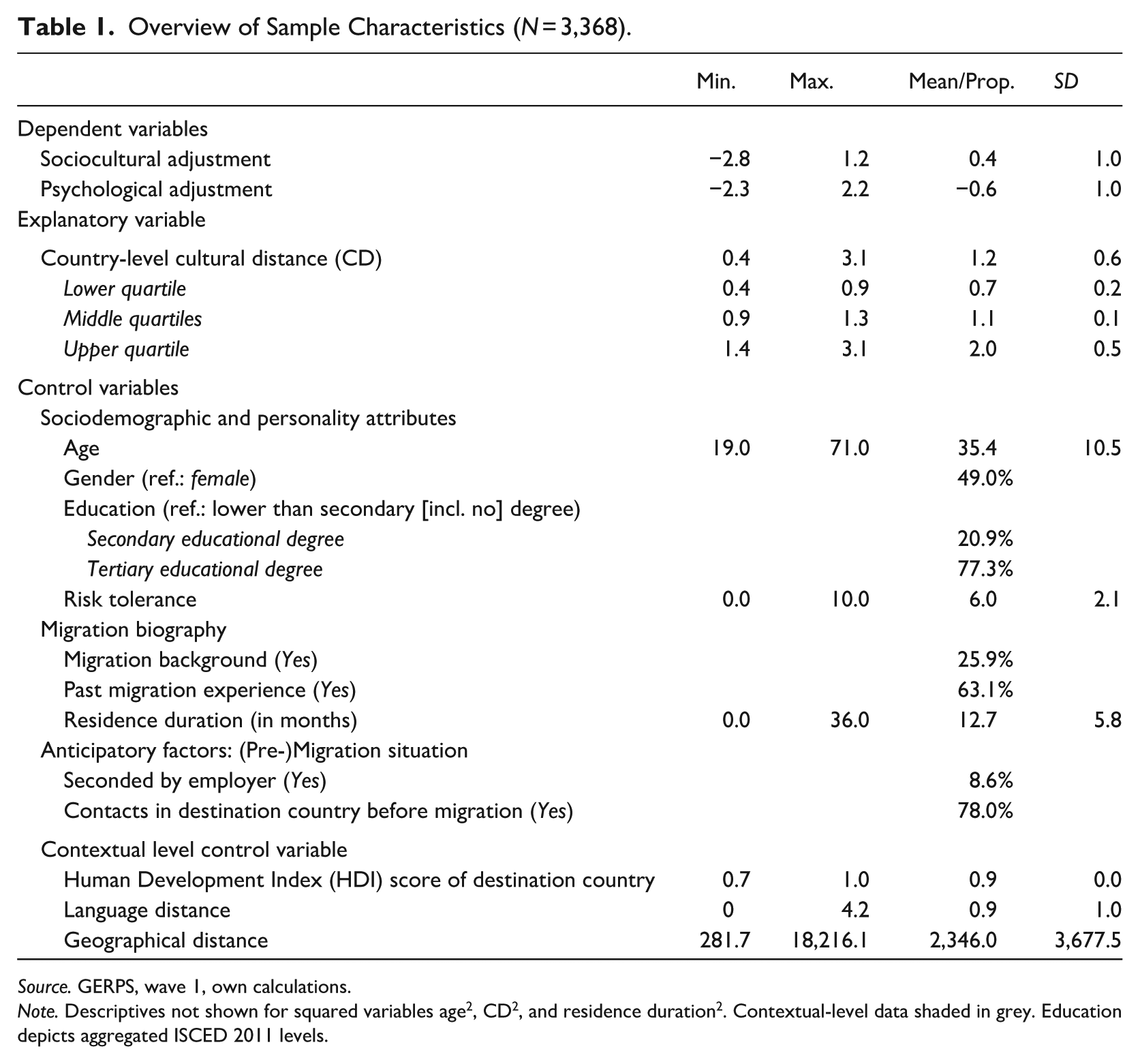
Table 1 below shows that the average country-level CD of our respondents is about 1.2 with a relatively wide standard deviation of 0.6, indicating a good distribution and that a higher proportion of our respondents lived in destination countries considered culturally closer to Germany. Note that this country-level CD measure only allows quantitative instead of qualitative interpretations of distance—as is the case for any other CD measure that consists of more than one cultural dimension. Thus, two countries with similar CD to Germany do not necessarily differ from Germany in exactly the same cultural way and do not necessarily have the same cultural characteristics.
Overview of Sample Characteristics (N = 3,368).
Source. GERPS, wave 1, own calculations.
Note. Descriptives not shown for squared variables age2, CD2, and residence duration2. Contextual-level data shaded in grey. Education depicts aggregated ISCED 2011 levels.
Control Variables
Our empirical models controlled for four sets of variables aimed at capturing intervening mechanisms. These variables mainly feature migrant characteristics or contextual conditions that affect both country-level CD (by means of sample composition) and adjustment, therefore potentially confounding the effect of country-level CD on migrants’ adjustment. The first set includes respondents’ sociodemographic and personality attributes (age, age2, birth cohort, gender, education, and risk tolerance) that can be related to both the willingness to emigrate (to culturally distant countries) and the capacity to adjust. Concerning risk attitude, for example, less risk-averse individuals may be more open to moving to culturally distant countries (Lübke et al., 2021) and more able to cope with stressful situations (López-Vázquez & Marván, 2003), which most likely increases their chance to adjust after migration (Décieux & Mörchen, 2021). The second set comprises variables related to respondents’ migration biography (migration background [participant or at least one parent born outside of Germany], past migration experience, residence duration in destination country, and residence duration2). Taking past migration experience as an example, it is likely that experienced migrants are generally more aware of cultural differences and have advanced skills in dealing with them. Moreover, past migration experience should also help to develop cognitive strategies that ease future realignments with new environments. The third set of control variables reflects anticipatory factors, that is, variables indicating preparation and adjustment by respondents prior to migration (Black et al., 1991). Specifically, we controlled if respondents were seconded by their employer and whether they had social contacts in the destination country before migration. These factors may raise awareness of cultural differences and promote strategies to effectively bridge CD prior to migration—processes we would normally expect to become apparent with increasing duration of stay. Finally, we included a fourth set of variables on the contextual level by accounting for the geographical distance between countries using the distance between capital cities (Mayer & Zignago, 2011), linguistic distance (adjusted value of language proximity, ASJP; Ginsburgh & Weber, 2015), and destination countries’ Human Development Index (HDI) scores. For example, as Germans often emigrate to other economically developed countries (Ette & Erlinghagen, 2021), controlling for destination countries’ HDI score rules out facilitated adjustment due to similar states of prosperity, independent of CD. Table 1 provides a variable overview based on our sample.
Analytical Strategy
To investigate the analytical value of studying the relationship between country-level CD and recent migrants’ adjustment, we first performed bivariate non-parametric local regressions (loess; Jacoby, 2000). Loess is a fitting technique that does not require a priori specification of a relationship between independent and dependent variables. Thus, it is a useful tool to explore the relationship between CD and adjustment without imposing any predefined (linear or squared) relationship. Next, we estimated mixed multilevel linear models to assess whether there is support for the optimal distance hypothesis (Hox et al., 2017). Multilevel model techniques are considered essential to investigate the link between psychological (i.e., individual-level) constructs such as migrants’ adjustment and contextual-level constructs of “culturology” such as CD (Smith & Bond, 2019). Moreover, they allow separate variance decomposition at the individual and contextual level, and the estimation of random effects (accounting for selection into migrating to specific countries) and random slopes in each country (destination-country-specific relationships between CD and adjustment), altogether addressing the problem that individuals with certain characteristics could mainly migrate to certain countries (Heisig et al., 2017; Hox et al., 2017; Theobald, 2018). In a final step, we visualised the results to identify potential patterns between CD and adjustment. For this, we used fractional polynomial regressions to automate the process of selecting the best-fitting fractional polynomial model (Mitchell, 2021).
Results
Initial Analysis of Cultural Distance and Adjustment
Figure 2 shows that the loess curves for sociocultural and psychological adjustment do not indicate a negative linear relationship between country-level CD and adjustment, as suggested by the cultural distance hypothesis. The curves rather resemble an inverted U-shape with different locations of an “optimal” adjustment range on the CD continuum, justifying further investigations.

Non-parametric loess smoother of the relationship between country-level cultural distance and adjustment.
Testing the Optimal Distance Hypothesis
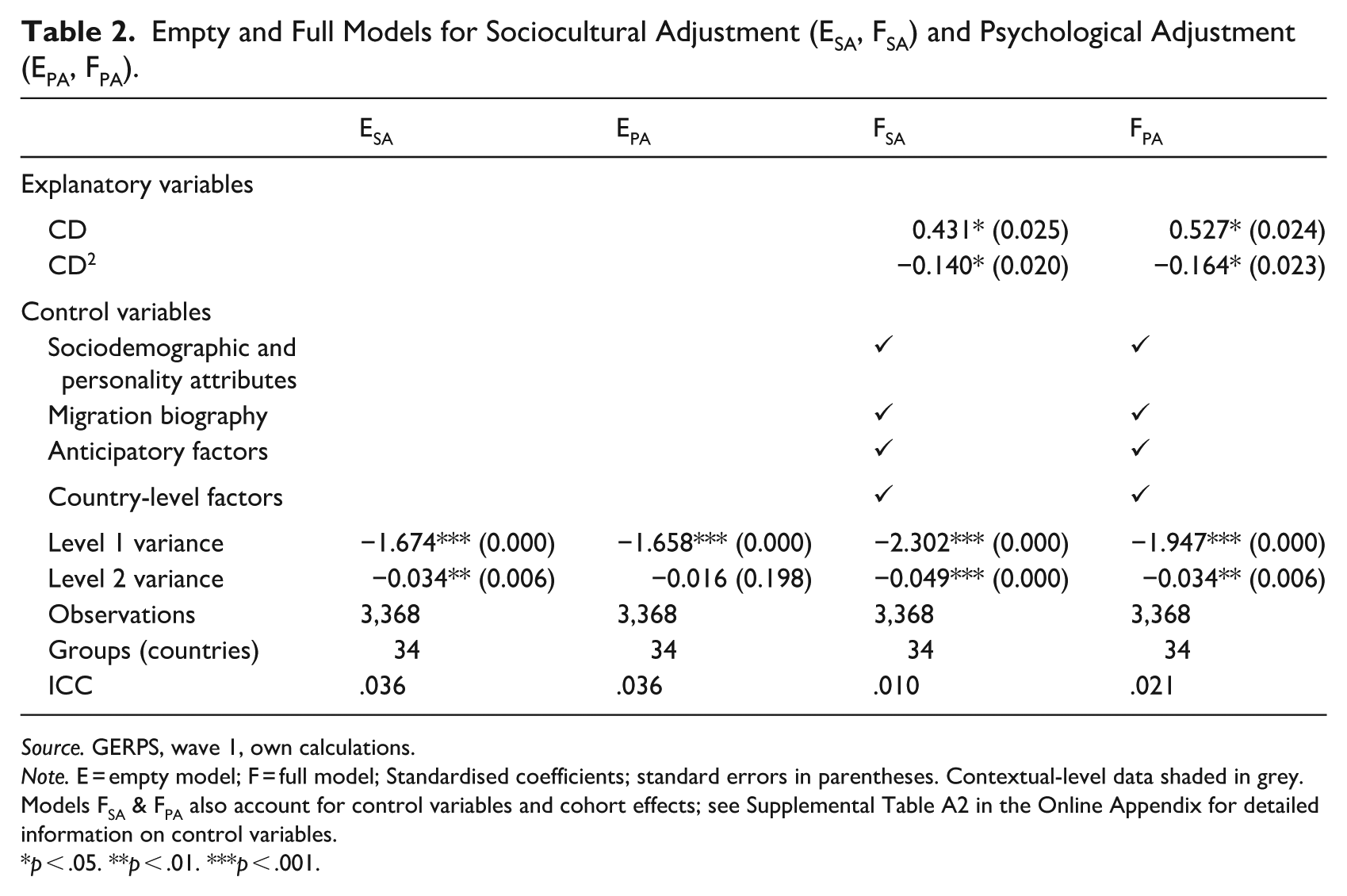
We first assess the soundness of our methodological approach, which is nesting migrants in destination countries by estimating multilevel models. For this purpose, we need to look at the intraclass correlation coefficients (ICC) of multilevel models ESA and EPA shown in Table 2 (see Supplemental Table A2 for extended version). ESA and EPA represent empty models for sociocultural and psychological adjustment. These models are considered empty because they do not include any independent variables. The ICCs of models ESA and EPA indicate the extent to which migrants’ sociocultural adjustment and psychological adjustment can be explained by the country-specific context. The ICCs of models ESA and EPA suggested that about 3.6% of the variance of migrants’ sociocultural and psychological adjustment is due to country-level differences. The statistically significant LR- and Breusch-Pagan Tests (p > .000) suggest accounting for the hierarchical structure in the data to explain this country-level variance.
Empty and Full Models for Sociocultural Adjustment (ESA, FSA) and Psychological Adjustment (EPA, FPA).
Source. GERPS, wave 1, own calculations.
Note. E = empty model; F = full model; Standardised coefficients; standard errors in parentheses. Contextual-level data shaded in grey. Models FSA & FPA also account for control variables and cohort effects; see Supplemental Table A2 in the Online Appendix for detailed information on control variables.
*p < .05. **p < .01. ***p < .001.
Second, we compare the ICCs of the empty models ESA and EPA with the full model versions FSA and FPA, which consider all independent variables (Table 2). Since the ICCs of the empty models depict the total country-level variance of migrants’ adjustment, the ICCs of the full models should be comparably smaller if their included country-level CD measures contribute to explaining country-level differences in adjustment. The results revealed that this is the case for both comparisons. In the case of sociocultural adjustment, the ICC of model FSA was over two-thirds smaller than the ICC of model ESA (3.6%–1.0%). In the case of psychological adjustment, the ICC of model FPA decreased by more than one-third compared to the ICC of model EPA (3.6%–2.1%).
Concerning the explanatory variable country-level CD, we found similar and statistically significant effects on both adjustment dimensions (Models FSA and FPA in Table 2). CD significantly positively affected sociocultural and psychological adjustment while its squared version, CD2, significantly negatively affected them. Hence, the coefficients suggest that CD’s influence on adjustment resembles the shape of an inverted U, indicating support for the optimal distance hypothesis (H1). Figure 3 visualises the relationship between individual adjustment and country-level CD using fractional polynomial regressions based on models FSA and FPA.

Country-level cultural distance and its relationship to sociocultural and psychological adjustment.
Figure 3 indicates support for hypotheses H1 and H2. The findings corroborate the optimal distance hypothesis (H1) as the distribution of sociocultural and psychological adjustment across country-level CD is non-linear, resembling the shape of an inverted U. This indicates the existence of an “optimal” range of CD somewhere between the CD poles, within which migrants show comparably higher adjustment levels than their culturally-close and culturally-distant counterparts in both adjustment dimensions. However, the location of this range on the CD continuum differs between sociocultural and psychological adjustment. For sociocultural adjustment, it appears to be around a CD of 1.4, which roughly corresponds to CDs between Germany and countries such as Switzerland (CH), Luxembourg (LU), or Finland (FI). For psychological adjustment, the “optimal” CD range is around 2, which roughly corresponds to CDs between Germany and countries such as Brazil (BR), Poland (PL), or Thailand (TH).
The data also provide support for hypothesis H2 for both adjustment dimensions: Large CDs have a stronger negative effect on recent migrants’ adjustment level than small distances. However, note that the effects of large CDs on adjustment strongly depend on Germans in China (CN; see discussion).
Further Analyses and Robustness Checks
First, we conducted an analysis without squaring the country-level CD to check whether imposing a negative linear relationship between CD and adjustment—as proposed by the cultural distance hypothesis—might fit the data better. The results were in favour of the optimal distance hypothesis as we found insignificant linear CD effects on both adjustment dimensions (Supplemental Table A3, models SA and PA), and worse model fits compared to the models with squared CD (Table 2, models FSA & FPA).
Second, we explored whether we find similar patterns by using the same CD calculation method but different national culture scores from the frameworks by S. H. Schwartz (2008), Minkov and Kaasa (2022), and Inglehart and Welzel (2023) (correlation matrix in Supplemental Table A4). 3 Most results for the optimal distance hypothesis are not statistically significant, and neither are the tests for the cultural distance hypothesis (Supplemental Tables A5–A7). Regarding the visualisations, the results for sociocultural adjustment based on Schwartz’s framework do not show a pattern in line with the optimal distance hypothesis (Supplemental Figure A1). Also, we observe contradictory patterns for both adjustment dimensions based on the framework of Inglehart and Welzel (Supplemental Figure A2), but whose framework might underidentify dimensions of national culture as Welzel himself indicates (Beugelsdijk & Welzel, 2018, p. 1476). For the remaining visualisations based on S. H. Schwartz (2008), and Minkov and Kaasa (2022), we observe curvilinear patterns that are in line with the optimal distance hypothesis (Supplemental Figures A1 and A3). Notable is the fact that we find the same tendencies from our main analyses in both cultural frameworks: Adjustment issues related to large CDs loom larger than those related to small CDs, and while a potentially “optimal” CD range for sociocultural adjustment is always closer to small distances, the “optimal” CD range for psychological adjustment is always closer to larger distances.
Third, we examined whether the effect of CD on migrant adjustment differs between migrants with different educational levels. Additional models with cross-level interactions between CD and education indicate that this is not the case (Supplemental Table A8). Further robustness checks were conducted, additionally controlling for the following potential confounders: the English proficiency level of the populations in destination countries (Education First, 2018), religious and ethnic heterogeneity (i.e., religious and ethnic fractionalization; Alesina et al., 2003), the proportion of the German population in the destination country relative to the overall population size (Spooner et al., 2022), the degree of civil liberty (using the civil liberty index CLI; Freedom House, 2020), whether countries are considered western or not (Huntington, 2003), and EU countries or not. None of these models changed the interpretation of our findings (Supplemental Figure A4).
Fourth, we investigated whether the main results are conditioned by specific destination countries, with Russia and Turkey as likely cases. Participants who emigrated to Russia could be German repatriates (“Spätaussiedler”) with established ties to Russian culture and society. Likewise, participants who emigrated to Turkey may have a Turkish (family) background since Turks represent one of the largest and most established immigrant groups in Germany. Results remained significant and did not change interpretation after dropping these destination countries from the models and rerunning the estimations (Supplemental Figure A5). Moreover, countries with small case numbers (<20) could have also biased the estimations because the results then depend on fewer individual adjustment levels (Schunck, 2016). Estimations based on models without the eight countries with less than 20 migrants (125 participants in total) also produced robust findings (Supplemental Figure A5).
Fifth, we examined the sensitivity of the results by conducting more conservative analyses. We thus dropped migrants with leaving plans within the next 12 months, which yielded robust results (Supplemental Figure A6). Also, we estimated models only for economically active migrants because some research on how CD relates to adjustment focuses on the situation of international employees such as working (im)migrants and expatriates (e.g., Baneviciene et al., 2024). The CD effects were robust for sociocultural adjustment but not psychological adjustment (Supplemental Figure A6). The same was true in an analysis that additionally controlled for whether migrants’ destination country represents their parents’ birth country (Supplemental Figure A6). However, an inverted U-shaped relationship between CD and psychological adjustment still fitted the data better than imposing a negative linear relationship (Supplemental Table A3, models PABC and PAECO). We obtained robust relationship patterns after investigating CD and adjustment in EU countries only (Supplemental Figure A7, Supplemental Table A9). Results were not statistically significant, which can be explained by the reduced sample size (n = 1,483) and coverage of a smaller range of the CD continuum.
Lastly, we explored whether our more country-level measure of CD and migrants’ perceived CD are in line. For this, we drew on the fifth wave of GERPS (collected from November 2021 to January 2022), where participants were asked about the perceived CD between Germany and their destination country (differences concerning mentality, the standard of living, language, eating habits, religion, behaviour, gender roles, leisure activities, and friendships; α = .87). Using a restricted sample of migrants from the first wave who also participated in wave 5 (n = 1,144), the correlation between CD and perceived CD in the group with countries above the median of our CD measure was .35 (p < .000), while it was −.09 (p < .042) in the group with countries below the median (Galchenko & van de Vijver, 2007; Suanet & Van de Vijver, 2008).
Discussion
Empirical research about the effects of CD on migrant adjustment predominantly adhered to the cultural distance hypothesis, suggesting a negative linear relationship between CD and the adjustment level of migrants due to rising adjustment costs with increasing CD (e.g., Wilson et al., 2013). The potential benefits of CD for migrant adjustment or the potential problems of low CD have rarely been considered. Bringing together insights from different areas of cross-cultural psychology (Brewster, 1993; Selmer, 2007; Tadmor & Tetlock, 2006), we draw on an integrated theoretical framework to examine this gap in the literature by exploring the optimal distance hypothesis, which suggests an “optimal” range of CD between minimum and maximum distances to be most beneficial for migrants’ adjustment.
Our study offers four main findings with implications for CD research. First, the analysis suggests that migrants’ adjustment to the destination country not only depends on individual attributes but also factors at the country level—and country-level CD in particular. Previous studies have shown that individual-level characteristics are crucial for explaining migrant adjustment (e.g., Décieux & Murdock, 2021). Our multilevel analysis additionally provides empirical evidence that country-level factors significantly contribute to explaining why migrants show different adjustment levels depending on the country to which they moved. Most notably, country-level CD explained over two-thirds of these country differences in the sociocultural adjustment and more than half in the psychological adjustment of recent German migrants who have already been living abroad for up to 3 years. We derive two conclusions from these results. If researchers are interested in assessing the effects of CD, we recommend accounting for the multilevel structure of the social world and the societal aspect of culture by using multilevel modelling and treating CD as a country-level factor (Minkov et al., 2024; Smith & Bond, 2019).
Second, the findings are broadly consistent with the optimal distance hypothesis (H1) instead of the cultural distance hypothesis, which suggests a linear and negative relationship between CD and adjustment. We found a curvilinear relationship between country-level CD and recent migrants’ adjustment that resembles an inverted U-shape. These curvilinear patterns could not be replicated for all of the three additionally considered national culture frameworks, and only one of these patterns was statistically significant. Thus, they should be interpreted with caution. However, none of the additional analyses instead supported the cultural distance hypothesis. All corresponding tests were falsified. Overall, these results suggest that the relationship between CD and adjustment is not linear, and provide first empirical indication for Tadmor and Tetlock’s (2006) assumption that there is an “optimal” range of CD between minimum and maximum distances facilitating recent migrants’ adjustment. First and foremost, this supports existing criticism on the prevailing view of solely equating larger CDs with higher costs (e.g., Beugelsdijk et al., 2018; Brewster, 1993). The findings also suggest that the relationship between CD and adjustment is far more complex than studies in the field currently imply. Assuming that there is general credibility to the optimal distance hypothesis and that CD between countries varies depending on the cultural foci (i.e., national culture framework used), migrants might frequently end up in challenging situations no matter where they live, because they will encounter cultural aspects within the same country that are less and more familiar (or distant) to them. Thus, they have to constantly adapt to new cultural circumstances, for example deal with stimulus deprivation at one moment and with overstimulation at the next (Figure 1). Since “optimal” distance does not seem to depend on the chosen destination country but on the cultural aspects that are focused on, our study encourages future research to explore the conditions for an “optimal” distance.
Third, culturally distant migrants reported lower psychological and sociocultural adjustment than their culturally close counterparts, supporting H2. The finding was echoed in two of three culture frameworks that we additionally used for sensitivity checks. Overall, these results can be brought in line with the established cost perspective since they suggest that adjustment issues related to large CDs loom larger than those related to small CDs. This seems reasonable as migrants confronted with large CDs not only deal with potentially unwelcoming locals and stimulation problems associated with small CDs but may find themselves in considerably more challenging situations regarding mastery of practices and value differentials, resulting in costlier adjustment than in culturally more similar environments.
Fourth, the findings—across the applied cultural frameworks—suggest that sociocultural adjustment profits more from smaller intermediate CDs. In contrast, psychological adjustment benefits more from larger intermediate CDs. Social integration research assumes that sociocultural behaviour is more dependent on resources than feelings of attachment (Nauck, 2008). On the one hand, this means that adjustment costs weigh less heavily on psychological adjustment, which facilitates psychological adjustment at comparably larger intermediate CDs. On the other hand, it implies that sociocultural adjustment benefits disproportionally more from lower adjustment costs, thus facilitating it at comparably smaller intermediate CDs. Although the results of this study indicate that the effects of CD on adjustment are not all about adjustment costs, the outlined peculiarities may ultimately contribute to differences in the “optimal” range of CD for sociocultural and psychological adjustment, which warrants research into further dimensions of adjustment.
There are limitations to this study that open up future research possibilities. Most importantly, although the majority of the cultural distance patterns indicate a non-linear relationship with adjustment that is in line with the optimal distance hypothesis, we did not find robust evidence based on statistical significance, which calls for a cautious interpretation of the findings. There is need for further research using alternative samples but also alternative ways to operationalise CD. Moreover, the calculated country-level CDs between Germany and destination countries most likely represent the CDs of the whole German population to local populations of given destinations, which could deviate from the CDs of German emigrants—and particularly from the highly educated among them—to these local populations—a potential mismatch faced by all empirical studies that combine aggregated culture scores with individual-level data of migrants. Future studies could address this issue by computing aggregated culture scores based only on countries’ emigrant subpopulations. Another avenue would be to circumvent this issue by exploring migrants’ perceived CD as an alternative form of distance measure. Using an individual-level instead of a country-level CD measure would also enable researchers to better examine the diverse sub-contexts within the country of residence. Country-level measures of CD such as the one used in this study are not designed for such a task. Although they rely on individual-level cultural value differences, they are aggregated on the country level and capture culture as a collective-level phenomenon, aiming to make a more general statement about what it means for a group who has been socialised in a specific cultural system and then exposed to another one (Akaliyski et al., 2025). To further improve our understanding of the dynamics between CD and adjustment, future research could jointly analyse individual- and country-level CD measures within an interaction model, capturing how macro-level structures and individual value orientations or perceptions jointly shape outcomes.
Moreover, we caution against treating different national culture frameworks as equal and comparing CDs that are calculated using different methods (e.g., the Euclidean Distance or Fixation Index). They are all idiosyncratic, with their own cultural foci and methodological nuances. An important next step in CD research is to develop more sensitive comparative studies of different frameworks of national culture and related effects of CD on various outcomes.
The available data and correlational study design do not enable us to clearly identify the proposed theoretical mechanisms linking CD and adjustment. We tried alleviating this issue by accounting for intervening mechanisms in our models. In addition, we ran further analyses based on a restricted sample, supporting the assumption that individual perceptions of CD should be more accurate the larger the distance. However, it remains an open question to what extent culturally more similar individuals not only under- but also overestimate CDs. We encourage future research to test the discussed causal mechanisms and to further assess the congruency between country-level CD measures and individual perceptions of CD.
Furthermore, the correlational study design cannot address whether and how CD influences changes in adjustment change over time. Many scholars assume that the CD effect diminishes after 2 to 3 years. However, these assumptions are either based on theoretical arguments or on empirical studies that do not extend beyond this period (e.g., Kashima & Abu-Rayya, 2014). Thus, we advocate for longitudinal studies to investigate whether the influence of CD weakens over time and apply the here tested theoretical framework to longer-term migrants.
Moreover, the results on the negative influence of larger CDs on adjustment mainly depend on individuals who moved to China. However, this issue can be relativised to some extent as the negative association between larger CDs and migrant adjustment has already been documented by studies adopting the cost perspective (e.g., Wilson et al., 2013). Nevertheless, future research, especially that which considers CD-related costs as well as potential benefits, needs to validate our findings further.
Also, we recognise that the operationalisation of the dependent variables lacks the nuance of a multi-item scale, which can be problematic from a psychometric perspective, and calls for further research with additional measures of adjustment. Item constraints are often necessary for large-scale surveys such as GERPS to minimise respondent burden (Jin & Kapteyn, 2022). Such trade-offs can typically be justified by improved data quality for all variables in empirical models and enhanced representativeness, which ultimately also contributes to the generalizability of the findings for the group of German migrants studied here. Moreover, studies show that single-item scales are not, per se, inferior to those with multi-item scales in many applications (see e.g., the meta-analytical studies by Allen et al., 2022; Ang & Eisend, 2018; Fisher et al., 2016; Heuckmann et al., 2019). In this regard, the results are complemented by empirical evidence from the Netherlands, where culturally closer German migrants showed lower destination attachment compared to culturally more distant Eastern European migrants (Polek et al., 2010). Nevertheless, we advocate for caution regarding the transferability of the results to other migrant groups and encourage further research on non-linear CD effects by studying different groups of migrants.
Finally, the sample comprises voluntary migrants, which increases the risk of selectivity bias. Voluntary migrants can consciously opt for specific destination countries, for example, smaller or larger CD countries or countries with strong economies. These migrants may thus develop a specific mindset before their emigration, which could help them deal with issues related to CD. We accounted for such personality traits, socioeconomic characteristics such as education, and anticipatory factors at the individual level but recommend future studies to also investigate other populations with less freedom in their migration decisions and destination choices (e.g., refugees) to better understand the consequences of CD for migrant adjustment.
Overall, our study offers a more differentiated view of migrants’ adjustment by considering the beneficial effects of intermediate CDs. The findings point to the possibility that some—but not too much—CD may be associated with more favourable adjustment outcomes. This understanding of CD acknowledges the challenges for culturally distant but also culturally close migrants, who often go unnoticed.
Supplemental Material
sj-docx-1-jcc-10.1177_00220221261455885 – Supplemental material for Is It All About the Costs? Cultural Distance and Adjustment of Recent German Migrants
Supplemental material, sj-docx-1-jcc-10.1177_00220221261455885 for Is It All About the Costs? Cultural Distance and Adjustment of Recent German Migrants by Andreas Genoni, Jean Philippe Décieux and Elke Murdock in Journal of Cross-Cultural Psychology
Footnotes
Acknowledgements
We are grateful for valuable feedback from three anonymous reviewers and Nicolas Geeraert. We also thank Marcel Erlinghagen, Christiane Lübke, Bernhard Nauck, Heiko Rueger, Stephen Vaisey and the Kenan Institute for Ethics at Duke University on an earlier draft of this paper. Special thanks also to Amanda Seyle Jones for editing the manuscript.
Author Note
An earlier version of this paper was presented at the 18th IMISCOE conference, hosted by the University of Luxembourg, and at the 117th annual ASA meeting in Los Angeles.

Ethical Considerations
GERPS is conducted under the supervision of the Federal Institute for Population Research (BiB), Germany, and the University of Duisburg-Essen. All procedures performed in GERPS are in accordance with the General Data Protection Regulation of the European Union (GDPR) and the German national data protection legislation (Federal Data Protection Act, BDSG). A detailed data protection concept was developed together with the responsible data protection official and IT security official of the Federal Statistical Office (Destatis) who are both also responsible for the protection of information, communication, and data at the BIB. The necessary steps are taken to protect participants’ confidentiality according to national and international regulations of data security.
Consent to Participate
Participation in GERPS is voluntary and based on the informed consent of participants. This consent to participate in GERPS can be revoked at any time.
Funding
The authors disclosed receipt of the following financial support for the research, authorship, and/or publication of this article: This work was supported by the German Research Foundation (DFG) under Grant 345626236 and by the Federal Institute for Population Research, Germany. This publication was supported by the Open Access Publication Fund of the University of Bonn.
Declaration of Conflicting Interests
The authors declared no potential conflicts of interest with respect to the research, authorship, and/or publication of this article.
Data Availability Statement
Supplemental Material
Supplemental material for this article is available online.
Notes
References
Supplementary Material
Please find the following supplemental material available below.
For Open Access articles published under a Creative Commons License, all supplemental material carries the same license as the article it is associated with.
For non-Open Access articles published, all supplemental material carries a non-exclusive license, and permission requests for re-use of supplemental material or any part of supplemental material shall be sent directly to the copyright owner as specified in the copyright notice associated with the article.
