




Abstract
This research investigates the experiences of cultural code-switching among Black middle-class professionals in post-apartheid South Africa. By virtue of the unjust and inhumane laws imposed during South Africa’s discriminatory apartheid regime, salient dominant and minority cultures have prevailed in the post-apartheid era. The discrimination against and hegemony over previously oppressed cultures have engendered layers of trauma and unhealed scars in contemporary South African society. Using in-depth interviews with a sample of professionals, the research shows how the dominant Western culture has shaped the perceived hierarchy of professionalism in the South African workplace and an unconscious demand has been placed on Black individuals to adapt their cultural beliefs, values, and norms. This study is the first to clearly identify a taxonomy of specific codes like lifestyle and appearance, and critically examine the psychological states and experienced emotions that influence code-switching among Black middle-class professionals. The qualitative findings were used to create a framework that includes the relationship between formative influences, internal and external pressures, and coping strategies. The study supports a core argument that South African Black middle-class professionals have presented as a quintessential example demonstrating the concept of cultural code-switching, although there was also strong evidence of change as the country has evolved, which has allowed for greater cultural authenticity.
Cultural code-switching is the change in behaviors, such as mannerisms and attire, to unauthentically comply with a different cultural norm (Washington-Harmon, 2022). Given their disproportionate prevalence in management and white-collar jobs, White men have historically held the power and influence to establish the standards of professionalism in Western nations (Mayiya et al., 2019). For this reason, cultural code-switching has been considered a survival tactic, especially for Black individuals in the workplace, where they sometimes adapt their behaviors to conform to White cultural values (Washington-Harmon, 2022). For instance, cultural code-switching can create identity conflicts by placing pressure on the code-switcher to conform to the dominant cultural norms and downplay aspects of their cultural identity to fit into predominantly White professional spaces (Ong et al., 2006). Moreover, continual cultural code-switching can lead to an emotional and psychological toll for the code-switcher. While cultural code-switching may be seen as a professional necessity for Black individuals, it is typically not expected of White individuals. As a result, this disparity can perpetuate stereotypes, limit opportunities for advancement, and create a sense of inequality in the workplace (Fordham & Ogbu, 1986; Ibrahim, 2011).
This study used an adaptation of Molinsky’s (2007) paper that defined the mediating psychological states and experienced emotions of cross-cultural code-switching. By exploring the domain of South Africa’s workplace, the research was able to highlight the factors that elicit cultural code-switching by Black middle-class professionals, as well as how this code-switching is experienced. In the post-apartheid era, South Africa still has layers of entrenched hegemony, which creates an environment conducive to the pressures of code-switching. The behavior of consumers differs in various aspects, shaped by the forces influencing their income segments (Lappeman et al., 2019). For the South African middle class, addressing post-apartheid legacy issues significantly influences and shapes the adaptation and consumption behavior of its middle class (Southall, 2016). Although addressed in the post-apartheid era, the entrenched inequality between White citizens and oppressed Black communities remains evident in income, accessibility, and consumption patterns in many parts of South Africa (Louw, 2022; Seekings & Nattrass, 2005). The aim of the study was to explore the experiences and emotions that influence cultural code-switching among Black middle-class professionals.
Cultural Code-Switching
Grounded in the theoretical literature of linguistic code-switching, Molinsky (2007, p. 624) defines cross-cultural code-switching as “the act of purposefully modifying one’s behavior in an interaction in a foreign setting in order to accommodate different cultural norms for appropriate behavior.” Furthermore, Molinsky (2007) asserts that the interaction requires unfamiliar norms or conflicting identity values to the switcher for the code adaptation to be classified as cross-cultural code-switching. Successful cultural code-switching is beneficial to the switcher; promoting a positive perception of oneself, while averting the possibility of violating cultural norms and stereotypes (Earley & Ang, 2003; Francis, 1991; Leary, 1995; Montagliani & Giacalone, 1998; Schlenker, 1980; Schlenker & Weigold, 1992). In conjunction with its benefits, however, are the various psychological challenges imposed by code-switching (Molinsky, 2007). The severity of the individual’s psychological damage can depend on aspects like personal values, prior cultural knowledge, and the complexity of the new culture’s norms (Center for Creative Leadership, 2023). While clearly defined, cultural code-switching is still in an early stage of theoretical development and the emergent topic is grounded in several contextual variables discussed below.
Psychological Safety Norms
Psychological safety is experienced by an individual when they know they will not receive repercussions for voicing their ideas, questions, concerns, mistakes, or opinions (Fenner et al., 2023). A psychologically safe environment enables an individual to express themselves without being embarrassed, ridiculed or rejected (Center for Creative Leadership, 2023; Fenner et al., 2023; Molinsky, 2007). Studies show that an unsafe setting may consequently impose a psychological toll on the employee. The importance of psychological safety in the workplace has significantly increased and its importance is expected to grow further (Fenner et al., 2023). Social and cultural norms dictate how one should behave and the rules by which the societal and cultural member should abide (National Academy of Sciences, 2018).
Norm discrepancy is the degree of discrepancy between the norms of the situation in the new group and the norms for the same situation in the native group (Sassenberg et al., 2011). In the context of the South African workplace, organizational ethics, values, and subsequently the professional standards, which they demand of their employees differ drastically. Furthermore, a professional standard significantly differs with respect to the individual’s employment status (Nayar, 2018). According to Nayar (2018), individuals with a high employment status exhibit a lower norm complexity than employees with a lower employment status. The freedom related to high employment status generally allows an individual to deviate from conformity norms in the workplace. A global study by Cheng and Groysberg (2020) explored the cultural attributes and manner in which individuals interact in the workplace. Their research revealed that norm discrepancy in South African organizations is high due to its complex history and substantial flexibility. Thus, cultural code-switching may elicit a psychological toll on the individual if adapting to the norm discrepancy is insufficiently executed (Molinsky, 2007).
South Africa’s emergent Black middle class has been particularly vulnerable to a lack of psychological safety from this norm discrepancy (Southall, 2014). The more that norms are discrepant in an unfamiliar culture, the lower the degree of psychological safety. In addition, the level of experienced threat is higher when an individual endeavors to culturally code-switch (Molinsky, 2007). For Black people, adhering to dominant cultural standards to prevent racial discrimination entails additional pressure tied to professional achievement, supplementary to the universal human urges to be accepted and connected to others (Johnson et al., 2021). The decision to use code-switching or not depends on how much individuals weigh the potential benefits and costs of changing their self-expression. Communication choices intended to avert discrimination can likely reduce the consistency between an individual’s perceived authentic identity and their outward presentation, necessitate more cognitive effort, cause additional stress, and have a negative impact on their health (Johnson et al., 2021).
Formative Factors: Cultural Knowledge, Personal Values, and Identity
The importance of cultural knowledge prior to any form of interaction is imperative for an individual to successfully code-switch in a culturally complex environment. The propensity to code-switch depends on stages of development (Morton, 2014; Zakaria & Ab Rahman Muton, 2022) and learned identities (Altarriba & Basnight-Brown, 2022). Formative factors should, therefore, be included in any holistic perspective of code-switching. Cultural knowledge is defined as exhibiting knowledge regarding the characteristics, history, values, beliefs, and behaviors of an ethnic or cultural group (Brownlee & Lee, 2023). According to Black and Mendenhall (1990), there is a positive association between cultural knowledge and cultural adjustment. Individuals with an abundance of cultural knowledge possess a higher probability of successfully adapting to the behavioral norms of a new culture. In addition, Earley and Ang (2003) highlight the importance of metacognitive ability, the awareness of an individual’s acquired knowledge. Possessing metacognitive ability and a sense of cultural awareness enable the individual to identify situations, interactions, and environments in a familiar or unfamiliar culture that require an adaptation of behavior to conform with the respective cultural and behavioral norms. Ultimately, individuals who exhibit cultural knowledge possess a lower probability of experiencing a psychological toll, due to their developed understanding of the culturally appropriate style, content, and timing of behavior (Molinsky, 2007).
Molinsky (2007) describes personal values as the internal moral compass of a person, which is influenced in part by the culture in which the person grew up. Moreover, the professional environment of an individual and their country’s culture can significantly influence their personal values. Although Black cultural expressions have been known to be undervalued in some South African professional settings, Black people tend to value a visible display of cultural identity and cultural authenticity (McCluney et al., 2021). Naturally, individuals want to connect with those who are similar, relying on group members to exhibit the behaviors and norms of a typical member of their group (McCluney et al., 2021). As a result, sometimes those who code-switch might receive negative responses from those who perceive this as violating intragroup norms (McCluney et al., 2021). As a result, choosing to code-switch can cause some external pressure, implying that personal values also play a critical role as to whether an individual decides to code-switch or not (McCluney et al., 2021).
Identity conflict refers to the internal struggle that individuals experience when their personal identities and values clash with those of the dominant culture or the social norms of a particular group (McCluney et al., 2021). People may experience this when their various social or cultural identities conflict with one another or when they feel under pressure to live up to standards that do not reflect their own values. Code-switching is performed at major social and psychological risk to individuals in the workplace. Code-switching means that Black people are forced to repress their cultural identity, which can be emotionally, mentally, and physically draining (McCluney et al., 2021). Cultural code-switching plays a significant role in an individual’s identity conflict because they are faced with a difficult dilemma of choosing between displaying their authentic self and adjusting their identity to be considered acceptable (Johnson et al., 2021).
Research Context: Black Middle-Class Professionals in South Africa
There is a general consensus that the term “middle class” describes a stratum of individuals who fall somewhere in the center of the hierarchy of income, wealth, property ownership, or occupation (Chikweche et al., 2021). The concept of the middle class has recently been used to describe the rate of social change and economic growth in emerging and developing nations (Burger et al., 2014). Although definitions vary (Bhorat et al., 2023), the term is commonly used in this study to refer to autonomy and empowerment that enable people to successfully manage their own prospects and realize their own potential (Burger et al., 2014).
Since South Africa became a democracy in 1994, changing income and spending patterns—which are occasionally connected to shifting behavioral patterns—have been the most prominent factors in profiling the emerging Black middle class (Southall, 2014). Seekings and Nattrass (2005) identified a new Black elite entering the upper classes, supported from below by a developing Black middle class. As a result, the accelerating growth of these classes has caused one of the most significant changes in South Africa’s social landscape since the end of apartheid (Swingler, 2022). Although the association between race and class is still prominent in South Africa, many Black professionals are hesitant to classify themselves as middle class (Schlemmer, 2005). Despite the changing socio-economic landscape, South Africa is still characterized by deep cleavages between White and Black, wealthy and poor, highly educated and low skilled, suburbs, and township (Simpson & Lappeman, 2017; Southall, 2014). Schlemmer (2005) observed that well-educated, skilled Black South Africans are often uneasy with the middle-class label and are hesitant to describe themselves in this way, owing to the category’s strong historical association with being White. It is apparent that the country’s apartheid past and the reaction of the government post-apartheid to it had a significant impact on both the composition of the middle class in modern South Africa and the personal behaviors of those who belong to it (Lappeman et al., 2019). In addition, there is a prevalent perceived vulnerability among the Black middle class. This is in part because they lack the resources necessary to fully embrace a middle-class lifestyle and in part because their middle-class position is ill-defined (Southall, 2014).
In South Africa, as in other parts of the world, Black middle-class professionals have engaged in cultural code-switching to avoid stereotyping and to portray a professional image in their professional lives (McCluney et al., 2021). Given that code-switching is often rooted in a fear of failure and the desire to disprove negative preconceptions, additional pressure to succeed can threaten work performance (Johnson et al., 2021). While Johnson et al. (2021) explored the impact of cultural code-switching on aspects like group creativity, working memory, fear of failure, and pressure, little work has been done to fully articulate the types of code-switching performed by Black South African professionals (Lappeman et al., 2019). This phenomenon was explored using the methodology explained below.
Method
Research Background
This cross-cultural research study followed an exploratory qualitative design, which is consistent with other studies on code-switching (Jones, 2023). The core aim of the study was to explore the cultural code-switching experiences of Black middle-class professionals in the South African workplace. A semi-structured approach allowed the respondents to freely express their thoughts and feelings. The interview guide was based on a combination of Molinsky’s (2007) core findings and more recent literature that highlights the importance of norms, face threat, and identity. Given the personal and exploratory nature of the subject, an open-ended question was added to allow for free narrative and additional emergent themes.
Participants and Data Collection
The target population of this study was Black middle-class professionals, male and female, within the South African workforce. They were required to have at least 10 years of workplace experience. The study made use of traditional non-probability sampling without replacement, specifically convenience and snowball sampling. While the study was exploratory, participants were sought from a variety of industries and regions to improve generalizability, as summarized in Table 1. Gender differences were not explicitly explored but both genders were sought in the sample. Participation was voluntary, and all data were anonymous and confidential. The interviews were recorded and transcribed with the consent of the respondents. Interviews were immediately paused or stopped if the interviewee felt uncomfortable with the line of questioning and all ethical guidelines were observed.
Summary of Participants.

Data Analysis
The data from the interviews were analyzed thematically, drawing on a systematic six-step thematic-analysis process (Braun & Clarke, 2019; Saldaña, 2021), with the purpose of developing a conceptual model that would be helpful practically and to build on for future research (Naeem et al., 2023). The process was selected because it focuses on identifying and reporting patterns in a dataset to facilitate interpretation and uncover meaning (Liebenberg et al., 2020; Saldaña, 2021). Following the development of emergent codes from the interviews (Supplementary Appendix 2), provisional themes were developed. In addition, given the personal and subjective nature of the study, the findings were analyzed independently by the authors for intercoder reliability. The validation process involved two rounds of coder comparison. There was no statistical reliability score, as McDonald et al. (2019) warn against this in exploratory social research with strong contextual elements. Validation also included the cross-checking of interim findings with participants to refine explanations and create rigor (Barbour, 2005).
Findings
The findings of the study were grouped into themes and sub-themes (Supplementary Appendix 3). Given that the participants had over a decade of corporate experience, their recollections include a combination of both recent and past findings. The first set of findings categorized the cultural codes to which participants experienced pressure to switch. The second set of themes were the formative indicators, experienced internal and external pressures, as well as the sentiment that an evolving society has created more space for authenticity. These findings are developed below.
Code Categories
Lifestyle and Social Codes
In the South African context, lifestyle code-switching often involved embracing unfamiliar interests, such as sports like golf or rugby, which are considered popular among White individuals to build connections and inclusivity within the corporate environment. Although these sports have become less racialized as the country has experienced a socio-economic transition, participants recalled situations where lifestyle code-switching felt required. Participant 13 mentioned using golf as a means “to get proximity to the decision makers or important clients.” Furthermore, participant 13 stated that “those are the maneuvers outside of just good work.” This underscores the importance of social and recreational activities as strategies for networking and fostering business relationships. In predominantly White corporate cultures, certain activities hold substantial importance, and participation can enhance one’s likability and accessibility. Participant 3 expressed that they would “go to meetings; then you’ll see the guys going forward talking about cricket scores or rugby. I did not know what a scrum was.”’ By showing an interest in activities or subjects that may not naturally appeal to them, there was a desire to bridge gaps, build rapport, and foster a sense of connection with colleagues and clients. Participant 12 expressed that there is a “need to impress” superiors in the workplace, as well as a need “to be liked by them.” This indicates that, in a corporate setting, impressing those in positions of authority is essential. Beyond one’s skills and job performance, the need to be liked and approved of by instructors and superiors means that social dynamics play a significant role in career success. Participant 10 expressed that the “black middle class acquire positions through education, not social capital,” inferring that social hierarchies were not always easy to access. Participant 13 stated, “I have come to realize that there is a lot of socializing that can happen outside of work that gives you advantages.” This aligned with Participant 7, who stated that “you are disadvantaged subtly if you aren’t in those circles.” The participant expressed that, while hard work is crucial, access to social networks, relationships, and gatherings outside of work is equally important. Participant 13 stating that “There is an element that is working hard and an element that is playing the game,” succinctly encapsulating the pressure to be a competent code-switcher to make career progress.
Appearance Codes
Participants expressed the pressure to conform to corporate appearance codes in the workplace. Participant 19 reinforces this idea by expressing that Most of our other African people have got what we called dreadlocks. Because of the corporate uniform and the corporate attire, you’d find that the policies of the employer define how you should have the length of your hair, how you should have your hair tied up.
Moreover, participant 12 voiced how this pressure to adjust appearance “was a big culture shock.” Another emergent appearance code was that of an apparent unwritten “dress code.” For instance, employees felt required to dress in a specific manner to conform to the respective corporate culture. Participant 5 expressed that There was an expectation that you should dress a certain way and definitely your starting salary is not providing enough to dress like that . . . that’s why people at the younger age end up getting themselves into debt to try and accommodate that.
Language Codes
In South Africa, English is accepted as the language of business (Casale & Posel, 2011). While this blanket acceptance of the English language is convenient for Black Africans who attended English-speaking secondary schools, those who did not expressed associated stigma. Participant 6 expressed that some would “end up not getting the opportunity only because they weren’t able to articulate their skills and they weren’t as confident in the interview as somebody who’s used to speaking English all the time.” Participant 10 spoke of “the pressure to speak the English language.”
Culinary Codes
Culinary code-switching involves adapting food preferences, dietary choices, and eating habits to navigate different cultural and social situations (Nguyen, 2022). While interviewing the participants, a common theme was the need to adapt food preferences due to the lack of traditional African food options. Participant 17 stated, “You will have to adjust to food that you don’t normally eat,”’ with Participant 17 further stating that, “There was pressure to drink wine, since this was the norm.” However, “wine is not something that we’re used to drinking growing up in the African community.”
Character Codes
A perceived pressure to shift character codes was expressed by several participants. Participant 11 declared that We tend to be less frank as Africans. Maybe we think it’s out of respect or of humility. But sometimes we can do it in ways that could be detrimental. It may come across as offensive, when none is intended.
The participant expressed how, in their opinion, African culture differs from the parts of workplace culture that favor being aggressive and direct. Participant 2 expressed that they felt that White peers were able to engage with managers with more freedom, due to intrinsic confidence. They expressed that, “As black South Africans, we are raised to not look at our elders in the eyes, since it is a sign of disrespect.” Other norms that created pressure to conform through character code-switching included approaches to formality, hierarchy, and timing.
Integrated Influences on Cultural Code-Switching
While the study was able to define specific codes relevant to the experiences of Black middle-class professionals throughout their employment history, the data were also useful for modeling an integrated perspective on cultural code-switching. This includes formative influences, pressures, coping strategies, and how the changing corporate environment has created more space for inclusivity.
Formative Influences
In the domain of cultural code-switching, formative influences are defined as the constituent factors that give rise to cultural code-switching (Rigdon et al., 2014). From the interviews, three formative influences emerged. First, whether someone had a background in a rural or an urban environment played a role. Participants from rural backgrounds grew up with little to no experience interacting with different cultures and in different environments. These participants perceived themselves as often exhibiting insufficient cultural knowledge to successfully code-switch. Prior learning experiences were also seen as key. Participants who attended secondary and tertiary educational institutions that did not have regular interactions with White people found it harder to code-switch. Participant 16 said, “I came from a local school, and everybody spoke the same language and had pretty much the same culture . . . so me moving to university was actually the first time that I came in contact with White lecturers.” Conversely, participants who attended multicultural schools exhibited less difficulty in transitioning to South African corporate norms. The final formative influence examines the individual’s mother tongue and the individual’s engagement with the English language prior to entering the South African workplace. Individuals who had sufficient experience interacting in the English language, whether it is at a tertiary institution or in general, perceived that they had less difficulty adapting to the workplace. In contrast, those with less familiarity with the English language expressed experiences of enduring a psychological toll and identity conflict and often felt mischaracterized.
Internal Pressures
The participants from this study encountered various internal pressures that promoted the likelihood of performing a cultural code-switch. These internal pressures include having an established culture that conflicts with the new environment, the fear of failure, and the motivation not to be left behind. Participant 13 revealed the pressure of being among “one or two black people, surrounded by a predominantly White staff.” Having a strongly embedded culture of origin often created a sense of isolation and exclusion. As a result, participants felt the internal pressure to conform to “White norms” to build corporate-culture rapport out of fear of “not wanting to be left behind” (Participant 10). Evidence suggested that code-switchers exhibit this internal pressure and compulsion to culturally code-switch, as they would rather endure the identity conflict and psychological toll of conforming than compromise their careers.
External Pressures
The external pressures that many Black middle-class professionals in South Africa have experienced include pressure from family to succeed, the transition back to the home environment, and the pressure to fit in. Participant 12 described the “pressure to assimilate” into the corporate culture, which (in his experience) was dominated by White, middle-aged men. As Black middle-class professionals enter this environment, there was an experienced pressure to conform to established norms and expectations. When it came to family, Participant 12 described his experience of success in a perceived “White culture” as “getting an opportunity to become something” those back home “have never seen before.” This, in itself, was experienced as an external pressure to maintain a certain image and reputation. On the other hand, Participant 18 stated that she actually had more difficulty in my area where I stayed, than at school. As much as I stayed in the township, I was often labeled as acting better than everyone else; so there was a lot of comments indicating that they thought I was better than them.
The pressure to conform to the norms of one’s community while simultaneously code-switching in the corporate world was not only emotionally challenging, but also meant that the participant experienced a tension between psychological safety at work and at home.
Coping Strategies
Learning and skills development were predominant coping strategies that came to the fore in the interviews. Participants expressed how continuous learning empowered them to perform in the corporate setting. Participant 4 expressed how “performance buys you freedom.” A general sentiment was that they could assimilate with the respective corporate culture through code-switching and that gratitude for just having a job was a source of strength, considering the participants’ historical subjugation during the apartheid regime. “I was just too excited to get a job” (Participant 6) was a common theme that drove the impetus to code-switch despite the psychological toll.
Long-Term Transition to Authenticity
Despite the clearly experienced pressure to code-switch, the participants expressed that they also had experienced a gradual shift toward a more inclusive and open-minded South African corporate environment. The changing South African socio-cultural environment was evidenced by most participants expressing how their experiences of code-switching had eased up as the Black majority has occupied more spaces that they had previously been excluded from. Many corporate spaces have also evolved from being predominantly White to being predominantly Black, having a direct impact on the perceived need to culturally code-switch. Participant 17 expressed how corporate cultures have evolved to become more accepting of diverse cultural and personal backgrounds: “I think most employees now find it easier to adjust because we’ve tried to be open and make sure that there is no judgment.” The flattening of hierarchies and the emphasis on inclusive leadership styles have reduced the need for extensive code-switching in many instances. Participant 5 pointed out that, “Policies might have been challenging when you look at them from a black and White perspective” but addressing these gaps has shown a move toward allowing greater authenticity. As discussed in the formative influences, the pressure and experience of cultural code-switching is still highly dependent on how Black South African professionals grew up economically and culturally.
Conclusion
This study evaluated the experiences and feelings influencing cultural code-switching among Black middle-class professionals in post-apartheid South Africa. In doing so, the researchers were able to identify a taxonomy of specific codes and critically examine the experiences and factors that influence code-switching. The findings were modeled in Figure 1 to provide a foundation for generalizability by including the relationship between formative influences, internal and external pressures, and coping strategies.
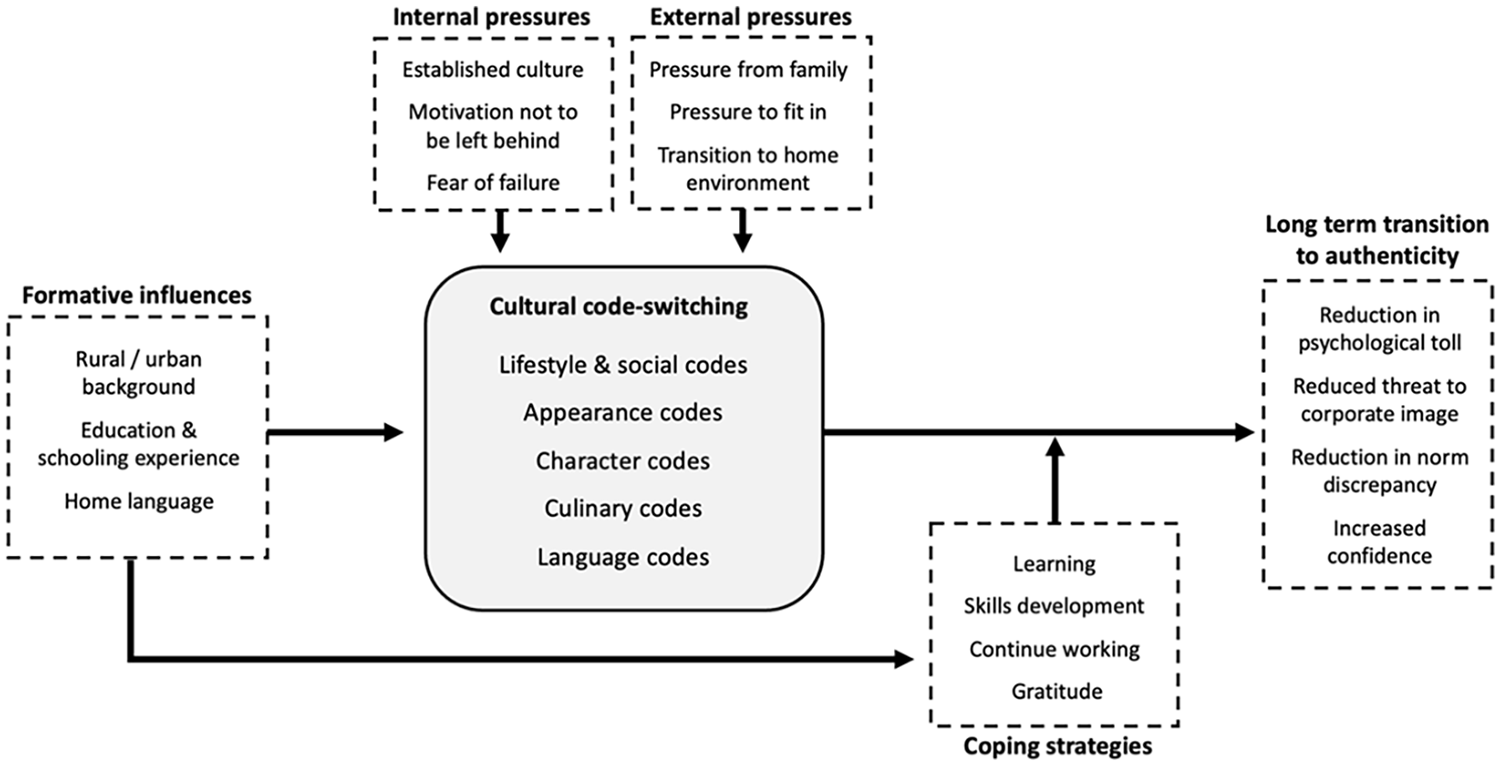
Cultural code-switching model (CCSM).
The model emphasizes that the extent and experience of cultural code-switching is impacted by formative influences, and both internal and external pressures. In a practical sense, the extent and psychological toll of this code-switching now varies significantly across South Africa as power continues to evolve. The findings suggest that, although cultural tolerance is improving, cultural code-switching is still commonplace and various coping strategies are still in place. While there are potential limitations in terms of sample size and generalizability, the practical implications of the study and directions for further research are explored below.
This study has a few significant implications for employment, inclusion, and business relating to Black middle-class professionals. First, understanding and acknowledging the cultural code-switching experiences of employees and colleagues in the workplace is critical. Managers should acknowledge the psychological toll, threat to corporate image, and identity conflict that cultural code-switching imposes on switchers. Strong working relationships need cohesion and unity, whether it be manager–employee or between colleagues. Managers should invest in relationship-building and strive toward establishing a community in their organizations, especially where employees can be comfortable with their native cultures in the workplace (Nichols, 2023). This promotes an increase in cultural knowledge, decreasing norm discrepancy and norm complexity for these employees (Molinsky, 2007). The cognitive and emotional demands of cultural code-switching must be acknowledged in organizations seeking cultural sensitivity. Participants in this study expressed being exposed to situations like corporate team building events (mainly in their early career) where they felt the need to code-switch to assimilate into perceived protocols. Some of these situations included fine dining (under apartheid rule, participants did not grow up eating in expensive restaurants) and being exposed to sports that they did not grow up with. Being aware of this may shape approaches to recruitment. In addition, promoting language and cultural inclusion in the workplace requires proactive measures by management. To address the challenges of code-switching and create a more inclusive environment, managers could establish mentorship programs to guide newcomers and develop diverse language policies that respect employees’ native languages (Impactly, 2023). Inclusive leadership, which values diversity in communication styles and languages, is pivotal for fostering an environment in which employees feel comfortable expressing themselves (Bourke & Titus, 2021). Management practice should also be sensitive to the fact that some geographic areas, industries, and places of work are still experienced as being structurally “White” and emotionally unsafe even though they might have the appearance of being inclusive (Nsibirwa et al., 2021).
The future of cultural code-switching research will continue to branch into multiple disciplines, including psychology, sociology, management studies, and more. As cross-cultural relations are debated globally with no consensus over what shape global citizenship should take (Akkari & Maleq, 2019; Kim et al., 2020), code-switching research will be relevant. The insights derived from this study suggest several important avenues for further exploration. First, research could investigate the similarities and differences in code-switching practices across various cultures, focusing on how individuals adapt their behavior, language, and communication styles in culturally diverse settings. Furthermore, studies could explore the impact of historical, societal, and economic factors on the dynamics of code-switching in different regions, helping to provide a deeper understanding of the drivers behind this practice. Gender differences did not emerge from this study but could be an avenue to explore in future research. Second, studies could focus on how code-switching influences specific professions, for example, in the health care sector or education. In health care, exploring the psychological and emotional aspects of code-switching in patient interactions can lead to better care (Anwar, 2023; Zhao, 2023). Similarly, research could examine how students and educators adapt to cultural imbalances in tertiary-education settings. This could help identify the challenges and opportunities for fostering a more inclusive and diverse learning environment (Markey et al., 2023).
Third, research could delve into the power dynamics and implications of code-switching in manager-employee relationships, exploring how employees navigate different cultural expectations while communicating with their superiors (Chartered Institute of Personnel and Development, 2018). A focus on effective communication strategies for managers and employees engaged in code-switching could lead to more harmonious and productive workplace relationships. Fourth, interdisciplinary research and international research hold much potential to expand the understanding of cultural code-switching. Research, for example, that combines sociolinguistics, psychology, sociology, and organizational behavior can provide a comprehensive view of the complexities and dynamics of cultural code-switching. Finally, research could explore how code-switching affects client-agent relationships, especially in service-oriented industries. Understanding how professionals adapt to meet the needs and expectations of diverse clients can lead to improved client satisfaction and relationship-management strategies (Durst, 2008; Rufan et al., 2019).
Supplemental Material
sj-pdf-1-jcc-10.1177_00220221241286448 – Supplemental material for Investigating the Experiences of Cultural Code-Switching Among Black Middle-Class Professionals in South Africa
Supplemental material, sj-pdf-1-jcc-10.1177_00220221241286448 for Investigating the Experiences of Cultural Code-Switching Among Black Middle-Class Professionals in South Africa by James Lappeman, Amu Mathebula, Jared Brien and Stephanie Jay in Journal of Cross-Cultural Psychology
Supplemental Material
sj-pdf-2-jcc-10.1177_00220221241286448 – Supplemental material for Investigating the Experiences of Cultural Code-Switching Among Black Middle-Class Professionals in South Africa
Supplemental material, sj-pdf-2-jcc-10.1177_00220221241286448 for Investigating the Experiences of Cultural Code-Switching Among Black Middle-Class Professionals in South Africa by James Lappeman, Amu Mathebula, Jared Brien and Stephanie Jay in Journal of Cross-Cultural Psychology
Supplemental Material
sj-pdf-3-jcc-10.1177_00220221241286448 – Supplemental material for Investigating the Experiences of Cultural Code-Switching Among Black Middle-Class Professionals in South Africa
Supplemental material, sj-pdf-3-jcc-10.1177_00220221241286448 for Investigating the Experiences of Cultural Code-Switching Among Black Middle-Class Professionals in South Africa by James Lappeman, Amu Mathebula, Jared Brien and Stephanie Jay in Journal of Cross-Cultural Psychology
Footnotes
Acknowledgements
The authors would like to thank the research participants for their vulnerability and for the work of the proofreaders to sense check and look for any prejudicial ideas. A special thanks to Amu Mathebula for identifying the need for this study and his wisdom as a co-author. Finally, the authors appreciate the editorial and review team for their useful suggestions and comments.
Author’s Note
Amu Mathebula is currently affiliated with Henley Business School Africa, Johannesburg, South Africa.
Author Contributions
J.L. and A.M conceived the research ideas; J.L. and A.M. collected data; J.B., S.J., and J.L. analyzed data; A.M. checked the results; S.J. and J.B wrote the first draft; and J.L. revised it.
Declaration of Conflicting Interests
The author(s) declared no potential conflicts of interest with respect to the research, authorship, and/or publication of this article.
Funding
The authors received no financial support for the research, authorship, and publication of this article.

Supplemental Material
Supplemental material for this article is available online.
References
Supplementary Material
Please find the following supplemental material available below.
For Open Access articles published under a Creative Commons License, all supplemental material carries the same license as the article it is associated with.
For non-Open Access articles published, all supplemental material carries a non-exclusive license, and permission requests for re-use of supplemental material or any part of supplemental material shall be sent directly to the copyright owner as specified in the copyright notice associated with the article.
