




Abstract
The present study examined heritage culture influences on the roles of adult and child in the conversations Latina immigrant mothers in the United States have with their young children. Spanish monolingual Latina mothers (n = 17), Spanish-English bilingual Latina mothers (n = 30), and English monolingual European American mothers (n = 22) were recorded in toy play interaction with their 2.5-year-old children; the bilingual Latina mothers were recorded twice, once interacting in Spanish and once in English. Analyses of transcripts of those conversations revealed that the monolingual Spanish-speaking Latina mothers talked more and asked fewer questions of their children and their children talked less compared with the monolingual English-speaking European American mothers and their children, consistent with differences that have been observed between mothers in Latin America and in the United States. The Spanish and English conversations between the bilingual mothers and their children similarly differed in the ratio of adult to child speech, although the Latina mothers’ English conversations still differed from the English conversations of European American mothers. In addition, the ratio of mother to child speech in the immigrant mothers’ Spanish language conversations declined as their years of U.S. residence increased. These findings argue that children of Latina immigrant mothers in the United States are socialized to talk less (and listen more) in conversation with adults compared with children from European American families. These findings also provide new evidence for cultural frames as the mediators of cultural influences on behavior and for language priming of cultural frames.
Keywords
The way parents interact with their children varies across cultures, shaped by the beliefs and values of each culture (Harkness & Super, 2002). When people emigrate, they may bring cultural practices with them. Thus, childrearing practices that parents bring from their countries of origin can shape the early experience of children born in the new country (Fischer et al., 2009; García Coll & Patcher, 2002; Harwood et al., 2002). In the present study, we focus on a particular domain of parenting practices—how parents talk with their young children, and we focus on a particular immigrant group—Latina mothers in the United States. We ask whether previously observed differences between mothers in Latin America and mothers in the United States are also observable in comparison of Spanish monolingual Latina immigrant mothers in the United States and English monolingual, U.S.-born European American mothers. Furthermore, we ask whether bilingual immigrant mothers evince similar differences as a function of whether they are speaking Spanish or English with their children.
The purpose and potential value of the present study is twofold. First, this study investigates the early language experience of a large segment of the school-aged population in the United States. Children from immigrant families constitute nearly 25% of children in the United States, and the large majority of those immigrant families are Spanish-speaking (Kids Count Data Center, 2020). Children’s early experiences shape the skills and behaviors that predict their future academic performance (Kieffer, 2008; Morrison et al., 2005). A better understanding of the early experience of children in immigrant families might yield a better appreciation of the skills and behaviors children from immigrant families bring with them when they enter school and, thus, might support the development of better-suited educational practices.
Second, this study tests two hypotheses regarding the influence of culture on behavior. We test the hypothesis that heritage culture influences how immigrant parents talk with their children by asking whether differences previously observed between mothers in Latin America and in the United States are also observed between mothers who are immigrants to the United States from Latin America and mothers who are U.S. born. We further test the hypothesis that heritage culture is source of any observed differences by asking whether heritage culture influences are attenuated either by the acquisition of English (comparing immigrants who are monolingual Spanish speakers to immigrants who are Spanish-English bilinguals) or by years of residence in the United States. Finally, by comparing how the bilingual immigrant mothers conduct conversations with their children in Spanish and in English, we test the cultural frame switching hypothesis, according to which bilingual, bicultural individuals switch the culture that guides their behavior in response to culture-specific triggers such as the language they are speaking (Hong et al., 2000).
Culture and Parents’ Conversations With Children
Cultural differences in the way adults interact with and talk to children are well-documented and have been attributed to adults’ differing beliefs in the nature of children and in their childrearing goals. In pioneering work, Ochs and Schieffelin (1984) described differences between White middle-class mothers in the United States, mothers in Papua New Guinea, and mothers in Western Samoa. Mothers in the United States treat their children as communicative partners. They talk to their children from infancy, adapt their speech to their children’s verbal competence, and from an early age they try to engage their children’s participation by posing questions the children can answer. In contrast, the Kaluli in Papua New Guinea that Ochs and Schieffelin studied did not treat their infants as communicative partners. Furthermore, once their children began to talk, Kaluli mothers tended not to adapt their speech or to engage them in conversation but rather to instruct them in how they should talk to others. In Western Samoa, Ochs and Schieffelin (1984) found that caregivers did not engage in conversations with young children, and speech directed at children tended to be instructions of what to do or not do. They traced these differences to theories of the nature of children held by Kaluli and Samoan mothers that are not shared by American mothers. The Kaluli did not talk to their infants because they believed that babies are not capable of understanding. Caregivers in Samoa instructed their children in what to do and not do because they believed the nature of young children is to be mischievous.
Differing childrearing goals are argued to be the source of other observed cultural differences in parents’ language use with their children. In Japan, succinctness is valued and Japanese mothers do not try to elicit long descriptions when talking to their children (Minami & McCabe, 1995). Working-class Americans value toughness, and they tease their children (Miller, 1986). Mainstream parents in the United States value assertiveness and independence (Bornstein, 2012; Paradis et al., 2021) and a high degree of verbosity in their children (van Kleeck, 1994), and they talk to their children and encourage their children’s talk (Keller et al., 2006; Snow, 1977). A large literature has described many more cultural differences in beliefs and attitudes about children and associated differences in the children’s communicative experience (e.g., Casillas et al., 2021; Heath, 1983; Keller et al., 2006; Weber et al., 2017).
Latin American Culture and Parents’ Conversations With Children
The focus of the present study is on how Latin American mothers living in the United States use language with their preschool-aged children and on how their language use may differ from that of European American mothers in the United States. Although Latina mothers are not a single or homogeneous group, there appear to be shared values and childrearing goals and practices across former Spanish colonies and hence Spanish-speaking countries outside of Europe (Fischer et al., 2009). Those values and practices have also been observed among immigrants from Latin American and Caribbean Spanish-speaking countries, and they differ from those among middle-class, mainstream, European American parents in the United States (Fischer et al., 2009; Harwood et al., 2002). In terms of broad values and goals, Spanish-speaking cultures are more collectivist compared with U.S. culture, which is highly individualistic (Leyendecker et al., 2002). At a descriptive level closer to parenting practices, Spanish-speaking, Latino parents share the values of familismo (familism, commitment to family over individual needs and desires) and respeto (respect, maintaining harmonious interpersonal relationships through respect for authority) as Latino values. A central Latino childrearing goal is bien educado, which literally translates as well educated but is more accurately translated as knowing how to behave (Calzada et al., 2012; Goldenberg et al., 2005; Halgunseth et al., 2006). Consonant with these values, Latino parents have been described as valuing obedience and collaboration in their children more than verbal skills and self-expression (Greenfield et al., 2006). This stands in contrast to the high value mainstream parents in the United States place on self-expression (Bornstein, 2012; van Kleeck, 1994).
Previous work has described a difference between the mother–child conversations of mothers in Latin America and European American mothers in the United States that is consistent with a greater value placed on familism and respeto in Latin America and a greater value placed on independence and self-expression in the United States. In sharing a wordless picture book with their 3- and 4-year-old children, middle-class mothers in Peru have been found to act as the sole narrators of the story; the children’s role is primarily to listen. In contrast, middle-class European American mothers in United States were found to encourage their children’s participation (Melzi & Caspe, 2005; Melzi et al., 2011). The prevalence of this adult-as-sole-narrator style in talk with their 4-year-olds has also been found among low-income Spanish-speaking immigrant mothers from Mexico and the Dominican Republic in New York (Caspe, 2009). This difference in adult and child roles in story telling leads to a measurable difference in the ratio of mother talk to child talk—it is substantially higher in the conversations of Latina mothers and their children than in the conversations of European American mothers and their children. Based on such findings, Melzi et al. (2011) have proposed participation as a dimension on which Latina and European American mothers differ in narrative production with their children. The present study seeks to extend this finding beyond the narrative context and beyond a low-income sample of immigrants (Caspe, 2009).
Cultural Influences on Bilinguals: The Cultural Frame Switching Hypothesis
Bilinguals have been described as also bicultural, if they have had extensive exposure to the cultures of both languages they speak (Marian & Kaushanskaya, 2004; Ross et al., 2002). Bicultural individuals may switch cultural frames depending on the context (Hong et al., 2000), and the language in use is one contextual factor that elicits cultural frame switching (Gibbons et al., 1999; Marian & Kaushanskaya, 2004; Ramírez-Esparza et al., 2006). For example, Rodriguez-Arauz et al. (2017) found that when Mexican American bilinguals living in the United States were asked to describe themselves in English, they focused on characteristics particularly valued in the United States, such as their academic achievement, and when they described themselves in Spanish, they focused on characteristics more valued in Mexican culture, such as devotion to family (Ramírez-Esparza-Esparza et al., 2006). For example, Rodriguez-Arauz et al., 2017). The notion that bilinguals have, in a sense, two personalities—one in each language—is also supported by findings that Spanish-English bilingual Mexican Americans provide more Mexican-like responses to the Big Five Inventory of personality traits (John & Srivastava, 1999) when assessed in Spanish and more American-like responses when tested in English (Ramírez-Esparza et al., 2006). In more naturalistic contexts, bilinguals have been found to express different emotions, intentions, and preferences depending on which language they are speaking and consistent with cultural values associated with each language (Lechuga & Wiebe, 2009; Marian & Kaushanskaya, 2004; Pavlenko, 2005). Thai-English bilingual mothers have been found to have a conversational style more like those of monolingual Thai mothers when speaking Thai and more like monolingual English mothers when speaking English (Rochanavibhata, 2022).
In the United States, a study of mothers’ conversations as they played with blocks with their 4-year-old children found that Latina mothers who spoke English during the block play session behaved more like typical descriptions of White, middle-class (European) American parenting (e.g., they did more explicit teaching) than the Latina mothers who spoke Spanish during the block play session (Tamis-LeMonda et al., 2013). In this between-group comparison, language choice could be the source of the behavioral differences or both language choice and behavior could reflect the same influence of acculturation. However, a within-group comparison of the Spanish and English use of bilingual mothers talking to their children, including some from the same sample as the present study, found differences in how much bilingual mothers talked about emotions, volition, and cognition, depending on which language they were speaking (Shiro, 2016). This latter finding suggests that the participation differences between the mother–child conversations in Latino and mainstream U.S. families that are reported in the literature may also appear between the Spanish and English conversations that bilingual mothers have with their children. The present study pursues this suggestion, testing the hypothesis that language triggers differences in participation roles when bilingual mothers interact with their children.
The Present Study
In sum, the present study pursues previous findings that Spanish-speaking and English-speaking mothers differ in the roles that they take and that they expect their children to take in conversation. We compare the toy play conversations of monolingual Spanish-speaking immigrants in the United States with their children with the conversations of monolingual English-speaking U.S.-born mothers with their children, seeking to replicate previous findings that Spanish-speaking mothers do more of the talking and their children do more of the listening compared with their English-speaking counterparts (Caspe, 2009; Melzi et al., 2011). We next compare the Spanish- and English-language conversations of bilingual immigrant mothers with their children, asking whether similar differences are observed within the same participants as a function of whether they are speaking Spanish or English. Finally, we ask whether length of residence of in the United States influences these aspects of immigrant mothers’ language use.
The data for this investigation come from the mother–child conversations of three groups of mothers in the United States whom we recorded in interaction with their 2.5-year-old children: Foreign-born, monolingual Spanish speakers; foreign-born, Spanish-English bilingual speakers; and U.S.-born, monolingual English speakers. All were living in the United States at the time of the study, and all the children were born in the United States. We test four hypotheses, with the following predictions:
Method
Participants
Participants were 69 mothers and their 2.5-year-old children living in South Florida. Substantial previous research has established that group and individual differences in multiple properties of mother–child conversations can be measured with children at this age (Hoff, 2006; Rowe & Snow, 2020). Seventeen mothers were born in a Spanish-speaking country and, according to self-report, were monolingual Spanish speakers; 22 mothers were born in the United States and, according to self-report, were monolingual English speakers; and 30 mothers were born in a Spanish-speaking country and, according to self-report, were bilingual speakers of Spanish and English. The English monolingual mothers were recruited through advertisements in local parenting publications, soliciting monolingual English speakers who used only English with their children. The native Spanish speakers were recruited through advertisements in local parenting publications—including Spanish language outlets, soliciting families in which one or both parents had been born in a Spanish-speaking country and Spanish was spoken with the children in the home. The mean level of maternal education in English and in Spanish is reported for each group in Table 1. Maternal education is a widely used and recommend index of socioeconomic status (SES) in developmental research (Hoff, 2003), and it is directly linked with characteristics of mothers’ talk with their children (Hoff & Laursen, 2019). For bilingual children, their mothers’ levels of education in each language are relevant to language outcomes (Hoff et al., 2018). As is typical of Spanish-speaking immigrants in South Florida, this immigrant sample is relatively well educated (Eilers et al., 2006).
Sample Characteristics.
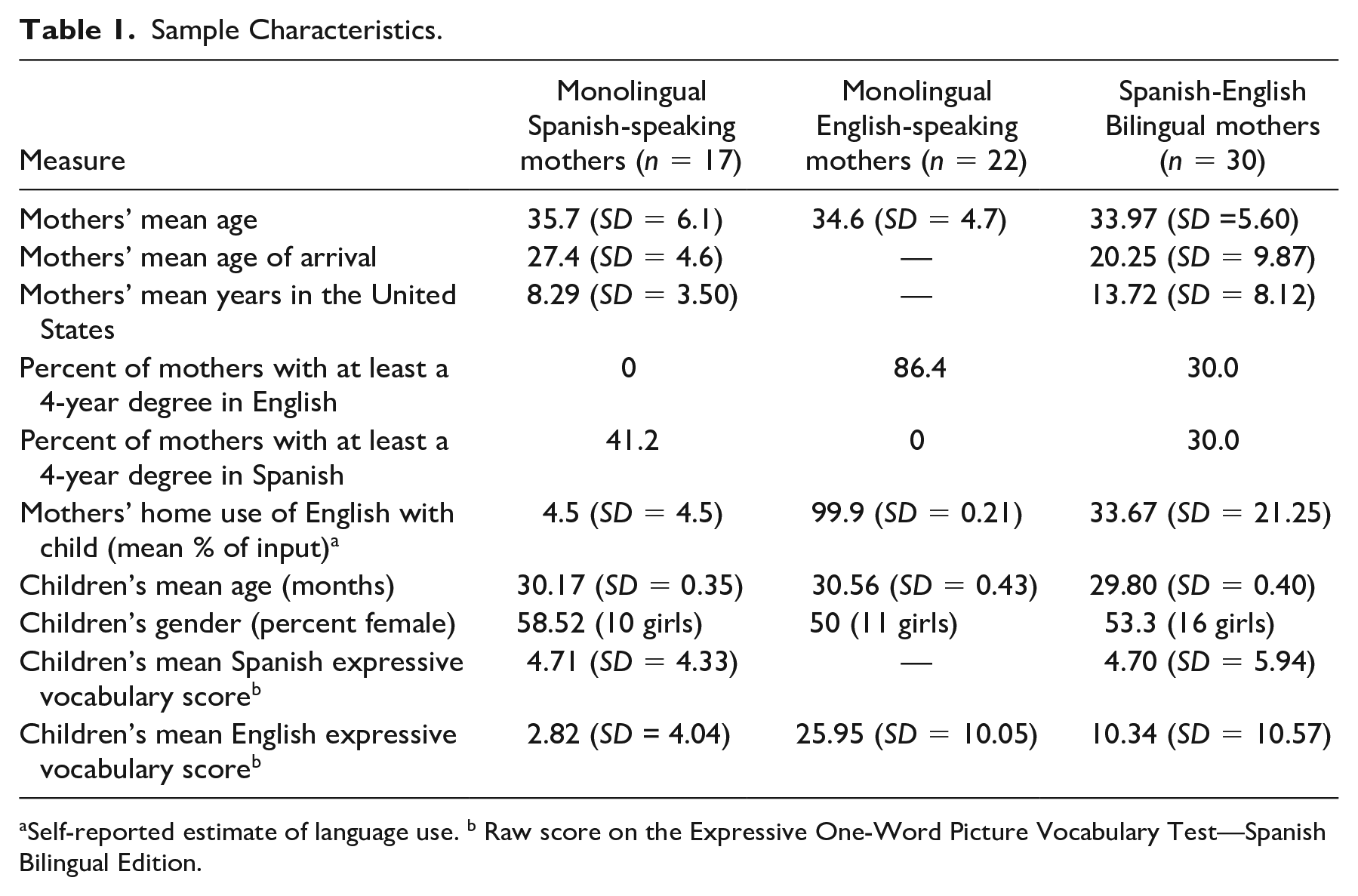
Self-reported estimate of language use. b Raw score on the Expressive One-Word Picture Vocabulary Test—Spanish Bilingual Edition.
The Spanish speakers identified themselves as monolingual or bilingual, responding to a yes/no question that was put to them, with various wording, in the context of an extensive interview about the languages known and used by family members. The bilingual speakers all reported that they used both languages in talking to their children. They provided estimates of their own English proficiency using a three-category self-rating scale, based on a questionnaire that has been previously used to obtain assessments of children’s language proficiency (Restrepo, 1998). The categories were (a) “cannot speak the indicated language, has a few words or phrases, cannot produce sentences, understand only a few words”; (b) “limited proficiency with grammatical errors, limited vocabulary, understand the general idea of what is being said”; and (c) “good proficiency with few grammatical errors, good vocabulary, understand most of what is said.” Seven of the bilingual mothers rated their English proficiency as “limited” (dominio limitado), and 23 rated their English proficiency as “good” (buen dominio). The foreign-born mothers had immigrated from Spanish-speaking countries in South America (n = 34), the Caribbean (n = 10), Central America (n = 2), and Mexico (n = 1). The prevalence of immigrants from South American and the Caribbean is typical of Spanish-speaking immigrants in South Florida (Eilers et al., 2006).
All the children were U.S.-born. The children of the monolingual Spanish mothers had exposure to English from other sources, and their expressive vocabulary test scores in Spanish and English (reported in Table 1) were not significantly different from each other, t(16) = 1.227, p = .119, Cohen’s d = .298. The children of the bilingual mothers had significantly higher expressive vocabulary test scores in English than in Spanish, t(28) = 2.102, p = .022, Cohen’s d = .39. The children of monolingual English mothers were all monolingual English language learners and were not assessed in Spanish. Descriptive statistics, including these vocabulary test scores for the children, details of the children’s home language exposure and other participant information are presented in Table 1.
These participants were drawn from a larger longitudinal study. They initially included all the monolingual mothers who were willing to be videorecorded in interaction with their children and all the bilingual mothers who were willing to be videorecorded in interaction with their children in both English and Spanish. Three bilingual mothers and their children were removed from the sample after preliminary data analyses because they were extreme outliers with respect to the ratio of mother to child speech.
Procedure
The mothers and their children met with a bilingual examiner in their homes (82%) or at a university laboratory site (18%), depending on the mothers’ preferences. Data were collected in two sessions for the English monolingual participants and three sessions for the Spanish-speaking monolingual and Spanish-English bilingual participants. Each session included up to 90 min of assessment and recording of interaction, interspersed with breaks. For all participants, the first session consisted of an extensive interview with the mother to collect background information and information about home language use. For the English monolingual participants, a subsequent session consisted of recording mother–child interaction and administering language assessments to the child. For the Spanish-speaking participants (including both those who were monolingual and those who were bilingual), the two subsequent sessions consisted of one day on which mother–child interaction and child language assessment occurred in Spanish and another day on which child assessment occurred in English. The order of the languages was counterbalanced.
For the recorded interactions analyzed in the present study, the mothers and children were provided with two sets of toys, each for approximately 10 min. The toy sets were (a) miniature land and sea animals, fencing, and a piece of cardboard painted to represent a body of water and surrounding land, and (b) plastic food replicas and picnic accessories. The mothers were asked to interact with their children as they normally would with such toys, with the exception that the bilingual mothers and their children were asked, on separate days, to speak only English or only Spanish. The mothers largely complied with this latter request; less than 3% of their utterances were partially or fully in the nondesignated language. The children switched languages more frequently, and for the present purposes their utterances in both languages were counted. The mean duration of the recordings included in the present analyses were as follows: 20.99 min (SD = 1.32) for the monolingual Spanish mothers, 20.59 min (SD = 2.21) for the monolingual English mothers, 21.41 min (SD = 2.89) for the Spanish interactions of the bilingual mothers, and 21.25 min (SD = 3.86) for the English interactions of the bilingual mothers.
The video recordings were transcribed in CHAT format, which is the transcription system used by the Child Language Data Exchange System (CHILDES; MacWhinney, 2000). This format allows using the CHILDES programs to calculate speech measures from the transcripts. The transcription was done by research assistants trained to a level of 90% line-by-line agreement with a set of training transcripts that had been extensively checked by multiple transcribers. All Spanish was transcribed by native Spanish speakers. Utterances to or from outside sources (e.g., talking with the experimenter or another child) were not transcribed.
Measures of Conversation Participation
To test the hypothesis that Spanish- and English-speaking mothers would differ in their participation roles in conversation, we measured (a) the quantity of maternal speech, (b) maternal use of questions—as indicators of maternal efforts to solicit child participation, and (c) the quantity of child speech. From the quantity measures, we calculated the ratio of mother to child participation. All measures are defined below.
The Quantity of Maternal Speech
The quantity of mothers’ talk was measured in terms of the number of maternal utterances, the number of maternal word tokens (i.e., the total number of words), and, to capture monologuing on the part of mothers, the mean length of maternal conversational turns (in words).
Maternal Conversation Eliciting
Maternal efforts to elicit participation from their children were measured in terms of the percentage of maternal utterances that were questions, with separate counts of the frequency of wh-questions and all other question forms, on the logic that wh- questions have been associated with higher rates of child response than other utterance types (Rowe et al., 2017). Questions were identified, using CLAN commands in the CHILDES system, as utterances ending in a question mark. Wh- questions in Spanish utterances were utterances that included quién, qué, dónde, adonde, cómo, cuánto, cuánta, cuándo, or cuál and any conjunctions; in English, they included who, what, where, why, when, how, or which.
Child Conversational Participation
The children’s participation in conversation was measured as the number of child utterances, which included speech and nonspeech vocalizations—all of which were indicated on the transcript and included in assessments of transcriber reliability.
Ratio of Maternal to Child Utterances
A measure of the ratio of maternal utterances to child utterances was calculated by dividing the total number of maternal utterances by the total number of child utterances, which included speech and nonspeech vocalizations.
Descriptive Measures and Control Variables: Child and Mother Characteristics
Demographic Measures
In interview, mothers reported their age on arrival in the United States, their current age, their child’s age and gender, and the highest level of education they had attained. The foreign-born mothers reported their educational attainment in Spanish, prior to immigration, and any subsequent educational attainment in English.
Child Language Proficiency Measures
Children were administered the Expressive One-Word Picture Vocabulary Test-Spanish Bilingual Edition (EOWPVT, Brownell, 2001) in the language or languages they spoke. The bilingual EOWPVT is designed to be administered conceptually, allowing the child to provide labels in either language. In the present study, we administered this test separately in each language to yield comparable Spanish and English expressive vocabulary scores, as have others (Anthony et al., 2009). As a result, standard scores for each language do not exist. Because the same items, screened by the developers for bicultural appropriateness, are presented in testing each language, raw EOWPVT scores are directly comparable across languages.
Results
Preliminary Analyses
The data were inspected for outliers using Tukey’s method in SPSS, and three bilingual mother–child dyads were removed from the initial sample because of extreme outlying values on the ratio of mother to child speech. One of the removed dyads had an extremely high ratio in their English conversation and two of the removed dyads had an extremely high ratio in their Spanish conversation. (Thus, had these dyads not been removed, the size of the difference between the Spanish and English conversations on this measure would have been larger.) No remaining participants had a score more than three standard deviations from the mean on any measure used in analyses. In the following analyses of between-group and between-language differences, gender was not included as a variable because none of the previous findings in the literature suggested effects of gender and because power limitations precluded such exploratory analyses.
Differences Between Latina Spanish Monolingual and European American English Monolingual Mothers’ Conversations With Their Children
To compare the conversations of monolingual Spanish and monolingual English mothers with their children, separate independent samples t-tests were conducted for each measure. Mean values, standard deviations, and t-test results for each measure are presented in Table 2. The Spanish-speaking mothers produced significantly more utterances and proportionately fewer questions that were not wh- questions than the English-speaking mothers, and their children produced significantly fewer utterances than the children of English-speaking mothers. The ratio of mother to child utterances was significantly higher in the Spanish conversations than in the English conversations. The conversations did not differ in the number of word tokens mothers produced, in the length of their speaker turns in words, nor in the mothers’ use of wh- questions.
Means, Standard Deviations, and t-Test Comparisons a of Measures of Mother–Child Conversation for Monolingual Spanish-Speaking (n = 17) and Monolingual English-Speaking (n = 22) Mothers Talking With Their 2.5-Year-Old Children.
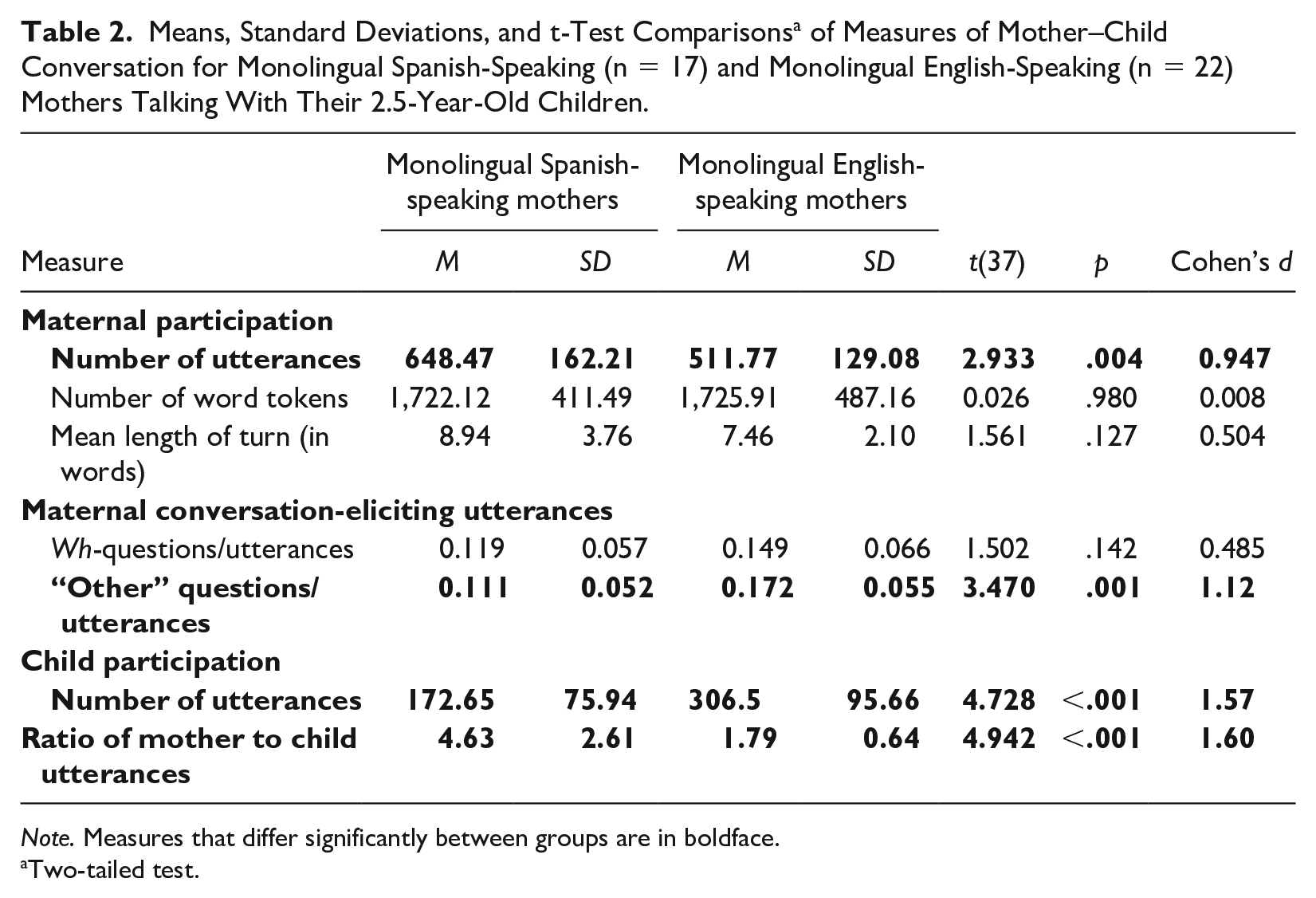
Note. Measures that differ significantly between groups are in boldface.
Two-tailed test.
Two follow-up analyses were conducted. First, because the children of English-speaking mothers had numerically higher expressive vocabulary scores in English than the children of Spanish-speaking mothers had in Spanish—both measured with the EOWPVT, we asked whether either group of mothers or their children showed evidence that their contributions to conversation were related to the children’s expressive skills, as measured by these vocabulary tests. Correlations between the children’s expressive vocabulary scores and the properties of conversation that differed between groups were calculated within each group; none were significant. (Those correlations are included in the Supplementary Material, Table S1).
Second, because the mothers in these two groups differed in the proportion who were college-educated, we repeated the between-group comparisons that yielded significant differences using only the seven monolingual Spanish-speaking mothers and the 19 monolingual English-speaking mothers who had college degrees in the language they were using with their children. These two groups’ mean values for those measures, standard deviations, and t-test results are presented in Table 3. One-tailed significance tests were used because we predicted that the outcomes observed in the full sample would replicate in these college-educated subsamples. As predicted, every difference that was significant in the full sample was also significant in the comparisons of college-educated mothers, although the sizes of the differences between the monolingual Spanish speakers and the monolingual English speakers were numerically smaller between the college-educated samples than they were between the full samples.
Means, Standard Deviations, and t-Test Comparisons a of College-Educated Monolingual Spanish-Speaking (n = 7) and Monolingual English-Speaking (n = 19) Mothers Talking With Their 2.5-Year-Old Children.
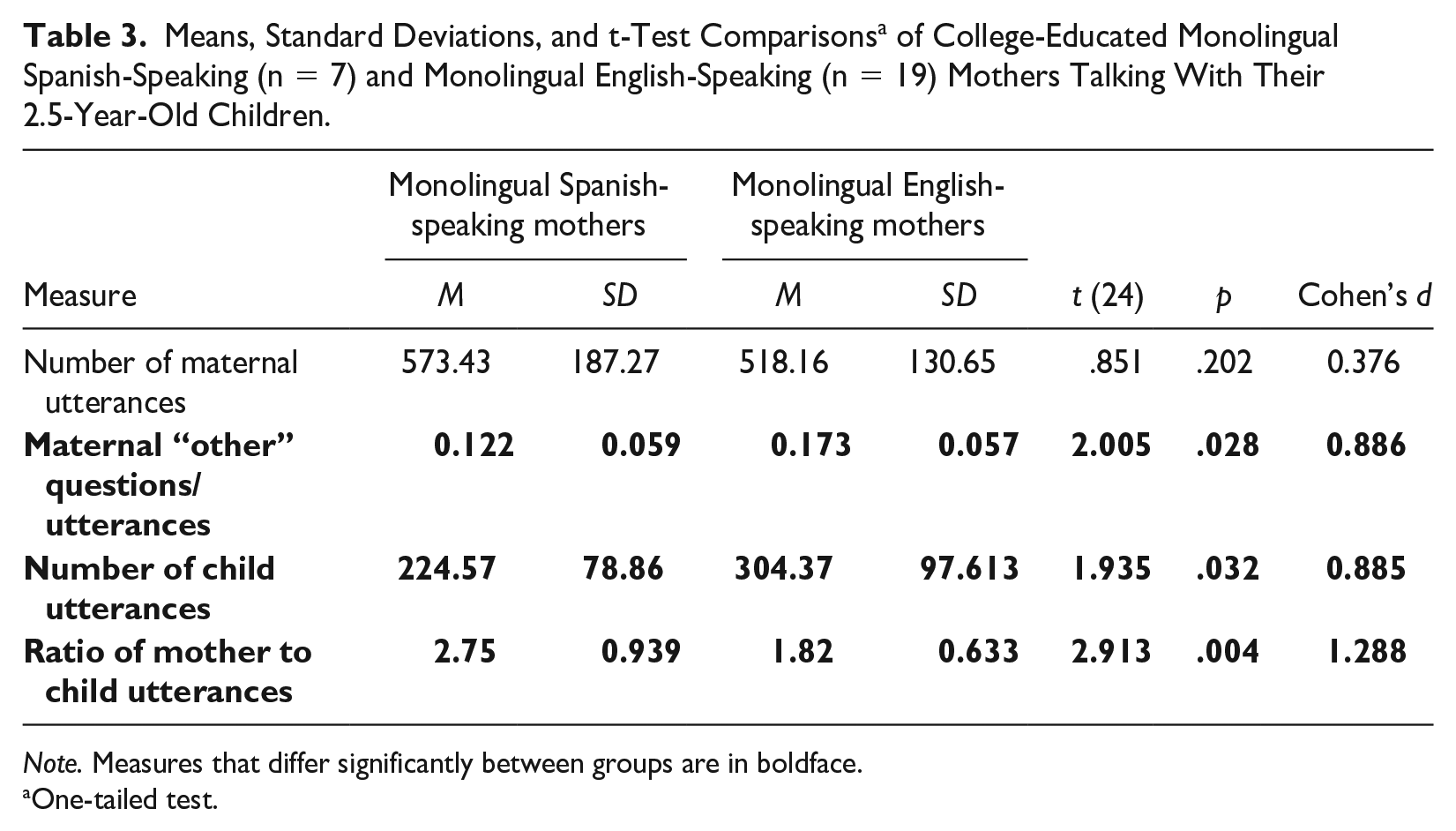
Note. Measures that differ significantly between groups are in boldface.
One-tailed test.
Differences Between Latina Bilingual Mothers’ Spanish and English Conversations With Their Children
To ask whether the Spanish and English conversations of the Spanish-English bilingual mothers differed in the same way as the Spanish and English monolingual mothers, separate paired sample t-tests compared the Spanish and English conversations of the bilingual mothers and children on those measures of conversational participation that differed between the monolingual Spanish and monolingual English mothers and their children. Means, standard deviations, and t-test results are presented in Table 4. All the differences were significant. The bilingual mothers’ Spanish language conversations were characterized by significantly more maternal utterances, fewer questions other than wh- questions, fewer child utterances, and a higher ratio of maternal to child utterances than their English conversations. The size of the observed differences was slightly attenuated in the bilingual mothers’ speech compared with the size of the differences between the monolingual groups. However, the size of the difference in the summary measure, that is, the ratio of mother to child speech, was similarly large—greater than one standard deviation higher in Spanish than in English conversations—in both the between-subjects comparison of the Spanish and English monolingual speakers and the within-subjects comparison of the Spanish and English conversations of the bilingual speakers.
Means, Standard Deviations, and Within-Subjects t-Test Comparisons a of Measures of Mother–Child Conversation in Bilingual Mothers’ Spanish and English Conversations With Their 2.5-Year-Old Children (n = 30).
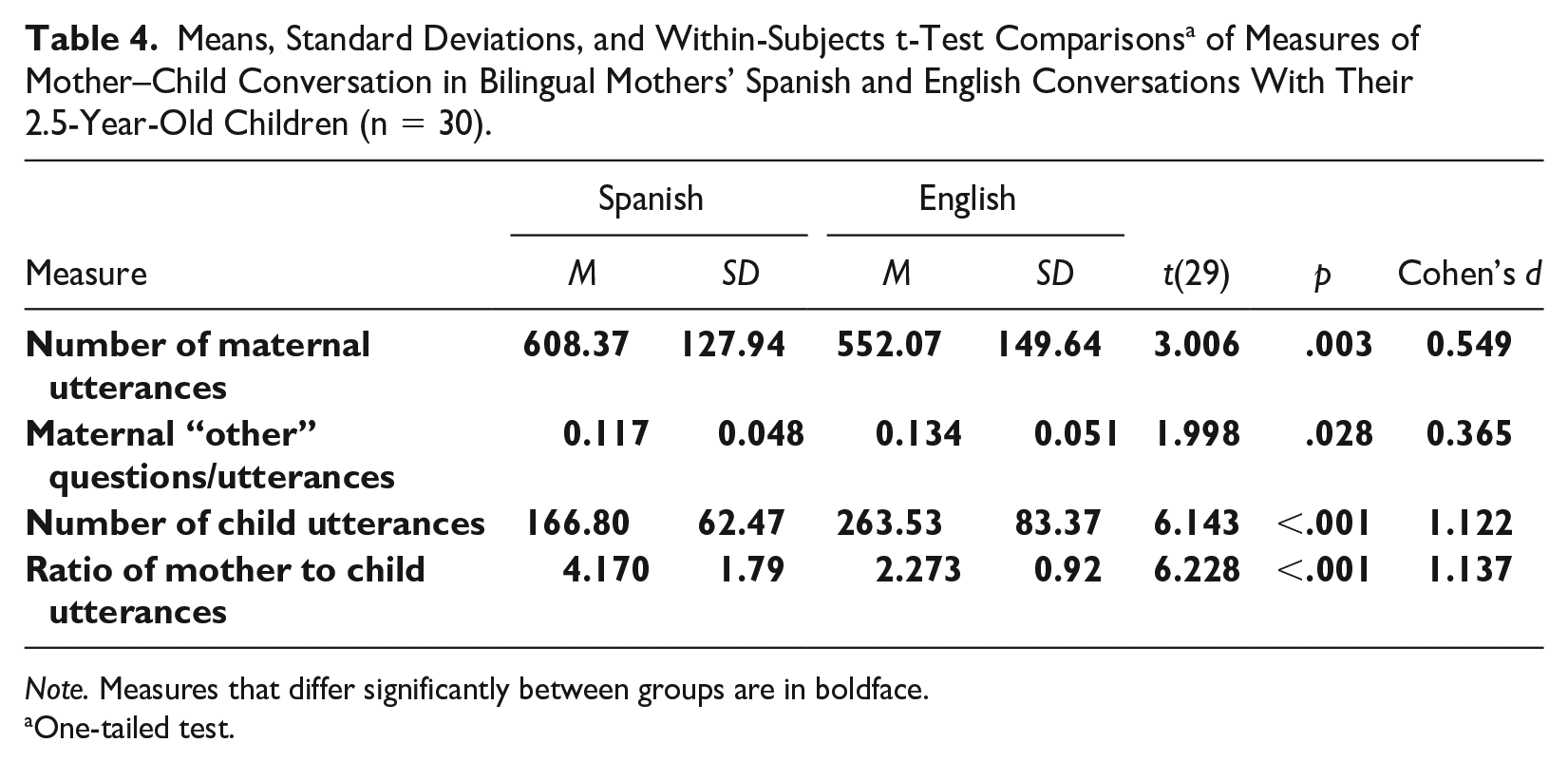
Note. Measures that differ significantly between groups are in boldface.
One-tailed test.
An additional finding was that differences among dyads were consistent across languages. That is, individual differences among the bilingual mothers in this aspect of their conversational style were stable across languages, even as the mothers differed between languages. The bilingual mothers who talked more and asked more questions in Spanish compared with the other bilingual mothers, also talked more and asked more questions in English compared with the other bilingual mothers. The correlations between language measures calculated for the Spanish and English conversations were r (n = 30) = .737, p < .001 for the number of maternal utterances; r (n = 30) = .544, p = .002 for the proportion of maternal speech that was questions other than wh- questions; and r (n = 30) = .384, p = .036 for the ratio of maternal to child utterances; all tests were two-tailed. The number of utterances the children produced in the Spanish and English conversations were marginally related in a two-tailed test, r (n = 30) = .328, p = .077. Although this finding is not directly relevant to the hypotheses at hand, the consistency of individual differences suggests that these measures capture something more than random variation or effects of transient influences.
Follow-up analyses asked whether these bilingual children’s stronger expressive language skills in English than in Spanish could account for the observed differences in the ratio of mother to child speech. We used the same approach as we used to test for effects of child proficiency on the conversations between monolingual mothers and their children. That is, we asked whether there was any evidence of effects of individual differences in proficiency within the Spanish conversations and within the English conversations. There was not. The correlation between children’s expressive vocabulary score and the ratio of mother to child speech in the Spanish conversations was r(n = 29) = −.144, p = .449, two-tailed and in the English conversations was r(n = 29) = −.298, p = .117, two-tailed.
Differences Between Bilingual and Monolingual Mothers’ Conversations With Their Children in the Same Language
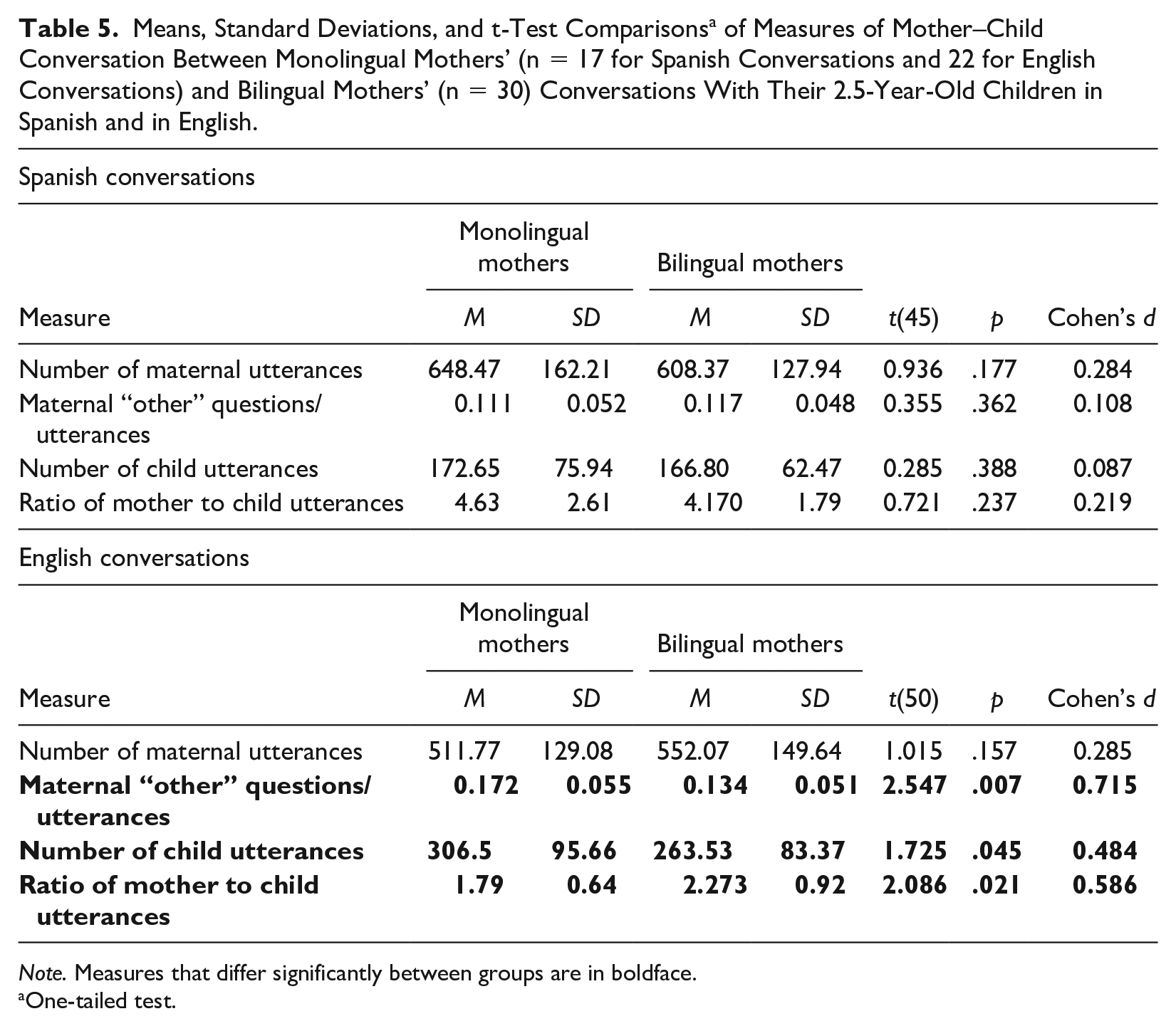
In the next analyses, we asked whether the bilingual mothers were different from the monolinguals in their use of each language. Independent samples t-tests compared the conversations of the bilingual mothers speaking Spanish with those of monolingual Spanish mothers and the conversations of the bilingual mothers speaking English with those of the monolingual English mothers. Table 5 repeats the means and standard deviations for each measure that were presented in Tables 2 and 4 and provides the results of these t-tests. There were no significant differences between the bilingual and monolingual mothers on any measure of their conversations in Spanish. In contrast, the bilingual mothers’ conversations in English differed from those of the native English monolingual mothers in questions being a lower proportion of maternal utterances, in the children producing more utterances, and in the ratio of maternal to child utterances being higher. In sum, the bilingual mothers’ Spanish conversations were not more American-like than those of the monolingual Spanish mothers, but their English conversations were more Spanish-like than those of the native and monolingual English speakers.
Means, Standard Deviations, and t-Test Comparisons a of Measures of Mother–Child Conversation Between Monolingual Mothers’ (n = 17 for Spanish Conversations and 22 for English Conversations) and Bilingual Mothers’ (n = 30) Conversations With Their 2.5-Year-Old Children in Spanish and in English.
Note. Measures that differ significantly between groups are in boldface.
One-tailed test.
To provide a visual overview of the central finding in these results, the number of utterances produced by mothers and children in the conversations between Spanish monolingual mothers and their children, between English monolingual mothers and their children, and between the bilingual mothers and their children when speaking Spanish and when speaking English are plotted in Figure 1.
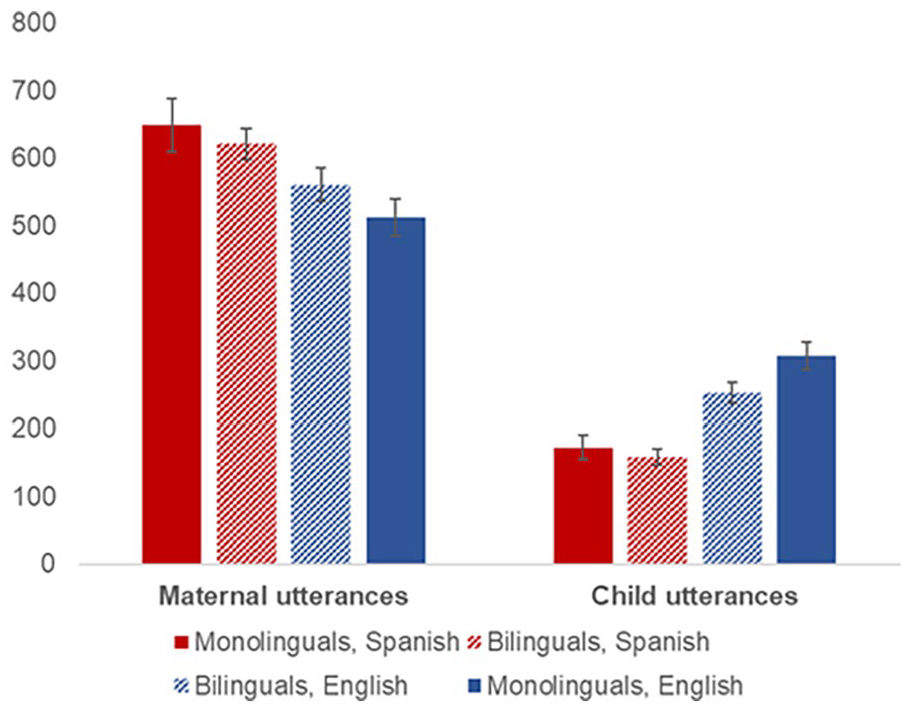
Mean Number of Utterances Produced by Mothers and Their 2.5-Year-Old Children in 20 Min of Toy Play Conversation for Mothers Who Are Monolingual Spanish Speakers (n = 17), Bilinguals Speaking Spanish (n = 30), the Same Bilinguals Speaking English (n = 30), and Monolingual English Speakers (n = 22).
Correlates of Acculturation in Latina Immigrant Mothers’ Conversations in Spanish and English
As an additional test of the influence of culture on immigrant mothers’ conversations with their young children, we asked whether the length of time the mothers had lived in the United States was associated with a more European American–like conversational style. To test this hypothesis with respect to the mothers’ use of Spanish, we used regression analysis with number of years in the United States as the predictor, the ratio of maternal to child utterances as the outcome, and all the foreign-born, Spanish-speaking mothers as the sample. The findings were that the number of years the mothers had lived in the United States was a significant, negative predictor of the ratio of maternal to child utterances in the Spanish conversations (β = −.313, p = .032) and that this relation was not different for the monolingual and bilingual mothers: the effect of the Group × Years in United States interaction term was not significant (β = −.277, p = .783). That relation is plotted in Figure 2. The effect of number of years living in the United States on the English-language conversations of the native Spanish, bilingual mothers was tested in a simple correlation; it was in the same direction as the relation to Spanish conversations, but it was not significant, r(n = 30) = −.263, p = .161, two-tailed.
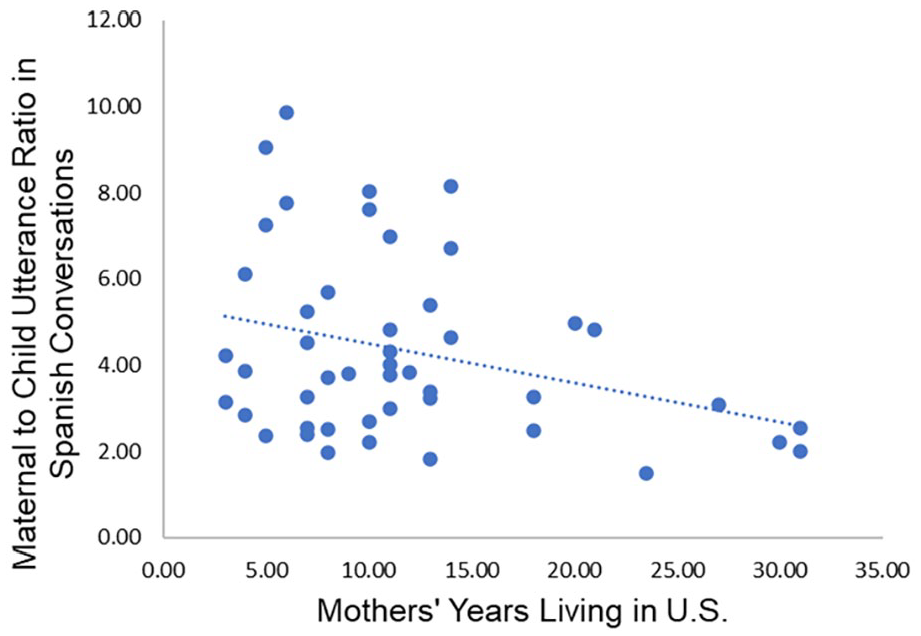
Relation Between Number of Years Residing in the United States and the Ratio of Maternal to Child Speech in Foreign-Born, Native Spanish-Speaking Mothers’ Spanish Language Conversations With Their 2.5-Year-Old Children (n = 47).
Discussion
The present study of immigrant Latina mothers and native European American mothers in the United States found (a) that the conversations of Spanish monolingual Latina mothers and their children were characterized by a higher ratio of adult to child talk than the conversations of English monolingual European American mothers and their children; (b) that the Spanish- and English-language conversations of Spanish-English bilingual Latina mothers and their children similarly differed in the ratio of mother to child speech, (c) that the bilingual mothers’ English conversations were nonetheless different from the English conversations of the European American mothers with a mother to child speech ratio closer to that of the Spanish conversations, and (d) among Latina immigrant mothers, length of residence in the United States was associated with a lower (i.e., more American-like) ratio of adult to child talk in their Spanish language conversations with their children. Below, we interpret these findings and discuss their theoretical and practical implications.
Evidence of Cultural Differences in Talk With Children
A difference between Latina and European American mothers in the roles the adult and child take in conversation was first described by Melzi and Caspe (2005) and by Melzi et al. (2011), based on their observations of middle-class mothers sharing wordless picture books with their children in Peru and the United States. They found the adults talked more and the children less in Latin America compared with the United States. In the present study, we observed a similar difference between monolingual Spanish-speaking immigrant Latina mothers and monolingual English-speaking native mothers in the United States during toy play with their children. Follow-up analyses found that this difference was observable even in the subsamples where there were not differences between the Latina and European American mothers in their levels of educational attainment.
This finding of a similar difference between the Latina and European American mothers in the roles they adopt in conversation with their children—across continents and contexts—supports the view that cultural frames (i.e., beliefs and values) shape behavior (Geertz, 1973). The particular cultural frames that underlie this difference in participation, according to Melzi et al. (2011), are the child-centeredness of European American childrearing practices and the situation-centeredness of Latin American childrearing. In a child-centered approach to parenting, activities with children are designed to match the children’s abilities and interests, creating contexts in which children often participate as equals. In a situation-centered approach, children are expected to adapt to what the adults are doing and to listen and observe until they can participate in an adult-like manner (see also Schieffelin & Ochs, 1986). Children absorb these different expectations and participate accordingly. Alternatively, culturally related differences in communicative patterns between mother and child have also been explained in terms of cultural differences in models of the self—with independence and interdependence as contrasting positions on one dimension of difference (see Keller et al., 2006). On this account, the communicative practices of European American mothers might reflect a view of children as independent and a socialization goal of encouraging of children’s self-maximization. In contrast, the practices of the Latina mothers might reflect a model in which the self is more related to others in the family and a socialization goal of integration with the family. Other accounts of the cultural difference that underlies these different approaches to conversation with children might also be offered, and the present data cannot distinguish among them. What is relevant to the present finding is that there are differences in mothers’ language use and, hence, in the communicative experiences they provide their children that are associated with their culture of origin. Furthermore, these differences persist after immigration.
Support for the Cultural Frame Switching Hypothesis
The bilingual Latina mothers’ conversations with their children differed depending on whether they were speaking Spanish or English in a manner similar to the differences observed between the conversations of monolingual Spanish and English speakers. In their Spanish conversations, the bilingual mothers talked more and asked fewer questions and their children talked less compared with their English conversations. Follow-up analyses indicated that the differences in the ratio of mother to child speech between their Spanish-language and English-language conversations could not be explained as effects of differences between the children’s Spanish and English language skills.
These findings of differences between the Spanish and English conversations of bilingual mothers with their children support the cultural frame switching hypothesis, according to which bicultural individuals switch cultural frames in response to culture-specific triggers, including language (Hong et al., 2000; Marian & Kaushanskaya, 2004; Ramírez-Esparza et al., 2006).
Evidence of Acculturation in Immigrant Mothers’ Native Language Conversations
Two findings suggest that cultural frames can be adopted in degrees. Although the bilingual Latina mothers were more European American–like when speaking English than when they were speaking Spanish, their English conversations still differed from those of the U.S. native, monolingual English-speaking mothers in ways consistent with the Latina, Spanish language approach to conversation with children. The bilinguals’ Spanish-language conversations, in contrast, were not significantly different on this dimension of participation from those of the monolingual Spanish-speaking mothers. It may be that the Spanish monolingual immigrant mothers, despite not speaking English, were somewhat acculturated and were Americanized in their use of Spanish, or it may be that Spanish use is more resistant to the influence of U.S. culture than is English use. Whichever explanation applies, the evidence indicates that cultural frames do not operate in an all-or-none manner.
The notion that cultural frames have a graded influence on behavior as a function of acculturation is further supported by the finding that the Spanish-language conversations of immigrant Latina mothers, both monolingual and bilingual, varied in the degree to which the mothers dominated the conversation as function of the length of their residence in the United States. The longer the mothers had resided in the United States, the more American-like their Spanish conversations became.
Limitations
The present study has limitations. We had no direct measure of culture, but inferred culture from the mothers’ country of origin and first language. Also, the contrast between the group representing Latin American practices and the group representing mainstream, European American practices in the United States was not as clean as it could have been. Taking language knowledge as an index of acculturation, as have others (Cabrera et al., 2006; Lee et al., 2013), we made the assumption that the Spanish monolinguals were less acculturated to American practices than the Spanish-English bilinguals, and we interpreted the monolinguals’ behavior as representative of the cultural practices of their countries of origin. However, it is still the case that the Spanish monolingual mothers were living in the United States and, thus, may have been somewhat influenced by U.S. cultural practices. Also, their children were not monolingual Spanish speakers; they were bilingual in Spanish and English and thus were likely more Americanized than their mothers.
Another limitation is that we examined interaction in only one context, toy play, and interpreted this as evidence that the findings previously observed in book sharing in Latin American samples (Melzi et al., 2011) generalized not only to immigrants in the United States but also to contexts other than book sharing. Observations of the same sample in multiple contexts that are more representative of how the mothers and children in each group interact in each language would provide stronger evidence. Joint toy play with examiner-provided toys has proven a fruitful method for studying individual differences in parent–child conversation (Rowe & Snow, 2020), but it is not how parents and children typically spend their days and may be particularly atypical outside of mainstream American samples.
We did not identify what mothers did in their talk to children that gave rise to the observed differences in child participation. We did not find that the European American mothers asked more wh- questions, which we had predicted based on previous findings that wh- questions are a means by which adults elicit conversation from children (Hoff-Ginsberg, 1990; Rowe et al., 2017). However, other studies have found that fathers ask more wh- questions than mothers (Rowe et al., 2004) and that fathers ask more wh- questions in book reading than in toy play (Salo et al., 2016). Thus, mothers interacting with their children during toy play, as in the present study, may not have been the best context for examining rates of wh- questions in parent-to-child speech. The European American mothers did ask more other forms of questions than the Latina monolingual Spanish-speaking mothers, and the bilingual Latina mothers did ask more other questions when speaking English than they did when speaking Spanish. However, the frequency of these were unrelated to the amount the children talked; all correlations were nonsignificant. It is possible that the participation differences observed in the children may reflect differential socialization that occurred before this study began. North American mothers have been described as treating their children as conversational partners from infancy (Keller et al., 2006; Ochs & Schieffelin, 1984; Snow, 1977).
Last, the present study focused on between-group and between-language differences more than on the within-group and within-language variability that exists. Neither Spanish-speaking Latina mothers nor English-speaking European American mothers are monolithic. The present study found evidence of education and acculturation as sources of within-group variability among Latina mothers, and there are certainly more sources that were not examined in the present study.
Theoretical and Practical Implications
These limitations notwithstanding, the present findings provide new evidence regarding the source and reach of cultural influences on behavior. The present study provides a rare experimental test of the hypothesis that culture shapes behavior via socially acquired mental entities such as beliefs, concepts, and values and that cultural differences in behavior are not solely immediate responses to different conditions of living. Bilingual individuals afford an experiment in which the cultural frame can be manipulated by instructions regarding language use, while external circumstances remain constant. The present study is such an experiment. The findings that bilingual individuals behave differently as a function of which language they are using is powerful evidence of the causal impact of language-associated mental entities (by inference, cultural frames) on behavior.
With respect to the practical concern of understanding the language socialization and language skills of the many children in the United States from immigrant Latino families, the present findings point to a characteristic of Latino children’s early language interactions that may explain observed characteristics of their behavior and language skill. Multiple studies have described children from Spanish-speaking families as higher in measures of self-control and interpersonal skills, and lower in levels of problem behaviors, compared with English-speaking monolinguals (e.g., Halle et al., 2014). Multiple studies have also found that the expressive language abilities of Latino Spanish-English bilingual children in the United States underestimate their language knowledge. The gap between what they understand and what they can say is larger than is typical of European American monolingual children (Gibson et al., 2012; Giguere & Hoff, 2022).
We suggest both the behavioral and language development differences are effects of differences between Latino and European American childrearing, which was manifest in the different participation roles in conversation observed in the present study. That is, children in Latino families are expected to show respect for others by comporting themselves in a way that is not disruptive to the group and by listening to adults. And compared with children of European American mothers, they do. Children in European American families are encouraged to express their individuality and to contribute to conversations, and compared with children of Latina mothers, they do. These different childrearing approaches, as manifest in differing levels of participation in conversation, may also have effects on children’s language acquisition, per se. Several findings in the first and second language acquisition literature suggest that language output, not just exposure, is particularly important for the growth of expressive language abilities (Giguere & Hoff, 2022; Ribot et al., 2018; Sénéchal, 1997; Swain, 2005), and the present findings suggest that children of European American mothers produce more output than children of Latino parents from an early age.
The literature also offers a finding of within-Latino differences that is consistent with this suggestion that Latino cultural practices advantage the development of receptive over expressive language skills. Song et al. (2012) found that children of Spanish-speaking immigrant mothers from the Dominican Republic had stronger expressive skills relative to their receptive skills than children of Spanish-speaking immigrant mothers from Mexico. Song et al. (2012) hypothesized that cultural factors might explain this difference but left identification of that cultural factor to future research. We suggest that the cultural factor at work was degree of acculturation in the United States: In that study, the Dominican mothers had younger ages of arrival in United States and spoke English more than the Mexican mothers. Important avenues for future work are to identify cultural influences that shape the skills in other immigrant groups and the consequences of those varying skills for best educational practices.
To conclude, the present study found that immigrants retain their cultural practices in play conversations with their children—particularly when speaking in their heritage language.
These findings add to the description of the early language experience of U.S.-born children in Spanish-speaking immigrant families by extending earlier findings (Caspe, 2009; Melzi et al., 2011) to a different Spanish-speaking immigrant population in the United States and to a different interactive context than they previously studied. These findings also add to the body of evidence that the influence of culture on behavior is mediated by cultural frames (i.e., mental entities, including beliefs and values), that bilinguals switch cultural frames when they switch languages (e.g., Marian & Kaushanskaya, 2004; Ramírez-Esparza et al., 2006), and that these effects of culture and cultural frame switching extend to language use with young children (Rochanavibhata, 2022; Rochanavibhata & Marian, 2022). The present findings add new evidence that the shift of cultural frames accompanying language shifts may not be complete. As a result, even the English language use of Spanish-speaking immigrant mothers reflects heritage cultural practices. These theories of cultural influence offer an explanation for observed differences between immigrant and native mothers in how they interact with their children in conversation. And, via the influence of the early experiences that mothers (and other caregivers) create for their children on children’s development, these accounts of cultural influences offer an explanation for observed differences in the behavior and language skills between children of Latino immigrant families and children of European American families. The findings of the present study are evidence that the reach of culture extends to the second generation in immigrant families.
Supplemental Material
sj-docx-1-jcc-10.1177_00220221231212420 – Supplemental material for Mother–Child Conversations of Latina Immigrant and U.S.-Born Mothers in the United States
Supplemental material, sj-docx-1-jcc-10.1177_00220221231212420 for Mother–Child Conversations of Latina Immigrant and U.S.-Born Mothers in the United States by Erika Hoff and Katherine F. Shanks in Journal of Cross-Cultural Psychology
Footnotes
Acknowledgements
The authors are grateful to Karla Hoff, Viorica Marian, Sirada Rochanavibhata, and Adriana Weisleder for conversations about culture and behavior.
Declaration of Conflicting Interests
The authors declared no potential conflicts of interest with respect to the research, authorship, and/or publication of this article.
Funding
The authors disclosed receipt of the following financial support for the research, authorship, and/or publication of this article: This research was supported by NICHD grant HD068421 to Erika Hoff.

Supplemental Material
Supplemental material for this article is available online.
References
Supplementary Material
Please find the following supplemental material available below.
For Open Access articles published under a Creative Commons License, all supplemental material carries the same license as the article it is associated with.
For non-Open Access articles published, all supplemental material carries a non-exclusive license, and permission requests for re-use of supplemental material or any part of supplemental material shall be sent directly to the copyright owner as specified in the copyright notice associated with the article.
