




Abstract
The current study examined the associations between parentally perceived child effortful control (EC) and the parenting styles of 122 Chinese mothers (36 first-generation Chinese immigrants in the United Kingdom, 40 first-generation Chinese immigrants in the United States, and 46 Taiwanese mothers) of 5- to 7-year-old (M age = 5.82 years, SD = .805; 68 boys and 54 girls) children. The findings showed significant cultural group differences in mothers’ reported authoritarian parenting style. Significant associations also emerged between mothers’ reports of their children’s EC and some parenting dimensions, although there were no cultural group differences in perceived child EC. Different patterns of associations between perceived child EC and parenting styles in these three groups also demonstrated heterogeneity within the Chinese population, and highlighted the need to consider differences between original and receiving societies when seeking to understand parenting and child development in different immigrant groups.
Introduction
Parents play crucial roles by supporting their children’s physical, emotional, social, and intellectual development and by providing the first environment within which children begin to mature. Not only do children inherit genetic characteristics from their parents, but their parents also shape development depending on how they interact with their children and on the environment and resources they provide. Parenting styles and beliefs may affect various aspects of children’s development both concurrently and longitudinally (e.g., Pardini, Fite, & Burke, 2008; Wang, Chen, Chen, Cui, & Li, 2006). However, like many other aspects of human behavior and socialization processes, parenting styles and beliefs are subjected to social and cultural influences (e.g., Bornstein, Cote, & Venuti, 2001; Chao, 1994; P. Wu et al., 2002) and the effects of different parenting styles on children’s developmental outcomes also vary among cultural groups (e.g., Deater-Deckard et al., 2011).
For instance, research on Euro-American families has consistently demonstrated that authoritative parenting style is associated with positive developmental outcomes (e.g., DeHart, Pelham, & Tennen, 2006; Reitman, Rhode, Hupp, & Altobello, 2002), whereas harsh parenting and the authoritarian parenting style, including the use of physical discipline, are associated with negative child outcomes (e.g., Simons, Whitbeck, Beaman, & Conger, 1994; Weiss, Dodge, Bates, & Pettit, 1992). In contrast, the strict or authoritarian parenting style is considered part of proper training in Chinese and Chinese American (CA) families and has been associated with positive child outcomes (Chao, 1994; X. Chen, Liu, & Li, 2000; X. Chen, Wu, Chen, Wang, & Cen, 2001). These findings have led researchers to advocate for a culturally anchored approach to understanding and classifying parenting styles.
Chinese Parenting
Chinese society remains heavily influenced by Confucian traditions, and the ethic of filial piety is the guiding principle directing children’s learning experiences (Ho, 1994). Filial precepts include “obeying and honouring one’s parents, . . . and in general conducting oneself so as to bring honour and not disgrace to the family name” (Ho, 1994, p. 287). Traditionally, children in Chinese culture are expected to listen to adults, follow rules, self-monitor, and be sensitive to other people’s evaluations and criticisms. It is the responsibility and obligation of parents to train, to discipline, and to make children sensitive to the social rules and to feel ashamed when they fail to obey them (Chao, 1994; Lieber, Fung, & Leung, 2006).
Although research has shown that authoritarian and authoritative parenting styles are both present in Chinese societies (e.g., F. Chen & Luster, 2002; X. Chen, Liu, & Li, 2000; X. Chen, Liu, Li, Cen, et al., 2000; Xu et al., 2005), researchers have proposed that some culturally important and specific Chinese parenting concepts cannot be fully captured using parenting typologies constructed in Western countries (Chao, 1994, 2001; P. Wu et al., 2002). For instance, Chao (1994) has identified an indigenous Chinese parenting dimension, “training” (chiao shun), which involves training children early through guidance and continuous monitoring of their behaviors, while providing care, concern, support, and parental involvement (Chao, 1994). Like Baumrind’s authoritarian parenting style, training emphasizes obedience and adherence to a set standard of conduct. P. Wu and colleagues (2002) examined the similarity and differences between Chinese-specific parenting style and widely accepted authoritative and authoritarian parenting styles 1 in Chinese and U.S. parents and further identified five parenting dimensions emphasized in Chinese culture: encouragement of modest behavior, protection, shaming/love withdrawal, directiveness, and maternal involvement.
Encouragement of modest behavior involves encouraging individuals to behave in a moderate, humble, and socially conforming way when interacting with others to maintain social and interpersonal harmony, because maintaining social order and interpersonal harmony is of primary concern in traditional Chinese society (X. Chen et al., 1998). Parental protection reflects the parental desire to ensure a safe environment and to foster children’s dependency on adults, goals that are seen as the primary responsibility of parents of young children (P. Wu et al., 2002), because young children are generally viewed as being incapable of understanding (Ho & Kang, 1984). Shaming is a Chinese socialization practice that helps children to be sensitive to the perceptions, feelings, evaluations, and judgments of others, to teach them to avoid future behaviors that would bring shame or embarrassment to the family (Fung, 1999; Lieber et al., 2006; P. Wu et al., 2002). Directiveness, somewhat similar to training (Chao, 2001), refers to parents taking major responsibility for regulating their children’s behavior and academic performance (Lin & Fu, 1990). This may reflect the Chinese cultural belief that young children are incapable of understanding and making decisions that are in their own best interests. Maternal involvement describes Chinese mothers’ extensive involvement and devotion to their children, particularly during the early years (P. Wu et al., 2002) by providing an extremely nurturing environment for the children by being physically available and by promptly attending to all their children’s needs (D. Wu, 1985).
P. Wu et al. (2002) demonstrated that these five Chinese-specific parenting constructs tended not to overlap with and were independent of the authoritative and authoritarian constructs identified in North American research. Chinese mothers scored significantly higher on these five Chinese-specific dimensions (except for maternal involvement and physical coercion) than their U.S. counterparts. By contrast, the Chinese mothers scored lower than U.S. mothers on warmth/acceptance and democratic participation (P. Wu et al., 2002).
Despite the increasing focus on Chinese parenting, knowledge about the child-rearing styles and practices of Chinese immigrants is still scarce (J. Chen, Chen, & Zheng, 2012). Research comparing Chinese immigrant populations in different receiving countries is even more limited. For instance, Chiu, Feldman, and Rosenthal (1992) compared how nonimmigrant Hong Kong youth, Chinese immigrant youth in the United States, and Chinese immigrant youth in Australia perceived parenting. They found that the experience of immigration influenced immigrant youths’ perceptions of parental control and involvement but not warmth. However, children’s or youths’ perception of parenting might differ from their parents’ reports of parenting (e.g., Barry, Frick, & Grafeman, 2008); thus, the current study will advance our understanding on Chinese immigrant parenting in two receiving countries from the immigrant parents’ perspectives. In addition, immigrants’ different acculturation strategies in different host societies may affect differently their attitudes toward and behaviors related to their culture of origin (Buki, Ma, Strom, & Strom, 2003; Cheah, Leung, & Zhou, 2013, Costigan, & Su, 2008; Huang & Lamb, 2015). Thus, culturally specific parenting values and practices may be more subjected to change during immigrant parents’ acculturation. The current study will provide evidence regarding the two Chinese immigrant groups’ Chinese-specific parenting styles which was not addressed in previous research. Therefore, the first overall aim of the current study was to compare three groups of Chinese mothers on their parenting styles: Chinese immigrant mothers in the United Kingdom, Chinese immigrant mothers in the United States, and nonimmigrant Taiwanese mothers raising their children in Taiwan.
Child Effortful Control (EC)
Young children are active agents in the socialization process and can actively shape the experiences they have with people around them, including their parents (Collins, Maccoby, Steinberg, Hetherington, & Bornstein, 2000; Lengua, 2006; Putnam, Sanson, & Rothbart, 2002). Children’s temperaments, defined by individual differences in emotional, motor, and attentional reactivity and self-regulation (Rothbart & Bates, 2006), are an important predictor of children’s adjustment and have been studied increasingly in recent years. Temperamental reactivity refers to the intensity of behavioral and physiological arousal in response to internal or external stimuli. Self-regulation, on the contrary, involves not only innate “voluntary control” but also the higher order “effortful control (EC)” involved in the development of the executive attention system, including neural and behavioral processes designed to “inhibit a dominant response [and] to perform a subdominant one, to plan, and to detect error” (Rothbart & Bates, 2006, p. 129). Individual reactive tendencies tend to be evident at birth, while self-regulatory and self-control capacities emerge later in development (Rothbart, Ellis, Rueda, & Posner, 2003).
Rothbart, Ahadi, Hershey, and Fisher (2001) found that a three-factor (surgency, negative affectivity, and EC) model of temperament can be reliably identified in parental ratings of children’s temperament across cultures (the United States, China, and Japan), although there were some cross-cultural differences in the loadings of individual temperament dimensions. Nevertheless, some cross-cultural differences might exist in the manifestation of temperament or personality characteristics and their associations with individual adjustment. For instance, Kerr (2001) suggested that cultural values could influence how people perceive and respond to children with certain temperamental characteristics, which in turn affects the stability of such characteristics and their implications for individual adjustment. Moreover, culturally laden institutions (e.g., family and school) or customs may favor temperament characteristics that are consistent with culturally preferred behaviors and minimize those that are inconsistent with those values (Kerr, 2001).
For instance, in Chinese culture, group harmony and conformity with societal and in-group norms are valued (Cheah & Rubin, 2004). The display of externalizing behaviors that disrupt group functioning (e.g., aggression) is discouraged by Chinese adults (Cheah & Rubin, 2004) and attributes such as attentiveness, diligence, and self-regulation are highly reinforced in Chinese schools (Phelps, 2005). Thus, in Chinese cultures, one would expect EC to be highly valued and thus to predict adjustment. Indeed, EC is negatively related to externalizing and internalizing problems in Western children (e.g., Eisenberg et al., 2001; Eisenberg, Sadovsky, et al., 2005) as well as in Chinese children (Eisenberg et al., 2007; Zhou, Eisenberg, Wang, & Reiser, 2004). Moreover, Chinese culture is rooted in Confucianism, which assumes all individuals have the potential to be developed, resulting in the emphasis on effort and education (Leung, 2010). Thus, Chinese parents believe that it is their responsibility and obligation to train and discipline their children to behave in a quiet, socially conforming and self-controlled way (Chao, 1994; Lieber et al., 2006).
In addition to child adjustment, EC has also been associated with parenting. For instance, authoritarian, coercive, and punitive parenting, as well as negative parental expressivity and rejection, have been associated with lower levels of EC (e.g., Colman, Hardy, Albert, Raffaelli, & Crockett, 2006; Karreman, van Tuijl, van Aken, & Dekovic, 2008; Kochanska, Aksan, Prisco, & Adams, 2008; Zhou et al., 2004), whereas parenting strategies such as parental support, expression of positive emotion, and the setting of clear, consistent limits have been linked to higher self-regulation/EC (e.g., Eisenberg, Zhou, et al., 2005; Guo et al., 2011; Karreman et al., 2008). Moreover, the interaction between parents and children is a dynamic and reciprocal process that influences both parents and children (e.g., Bell, 1979; Loulis & Kuczynski, 1997). However, research examining the associations between child EC and culturally specific parenting constructs is still lacking, especially in studies focused on immigrant groups. Immigrant parents’ parenting beliefs and practices may be modified during the course of acculturation (e.g., Cheah et al., 2013; Huang & Lamb, 2015). Immigrants’ experiences and adaptation also differ across host societies (Berry, 1997) and different adjustment outcomes are evident in different host society contexts (e.g., Sabatier & Berry, 2008; Vedder, Sam, & Liebkind, 2007). Therefore, the second aim of the current study was to expand our understanding of Chinese immigrant parenting and child EC by examining the associations between authoritative, authoritarian, and Chinese-specific parenting styles with mothers’ perceived child EC in samples of indigenous Chinese (Taiwanese) and two groups of Chinese immigrants.
The Current Study
Previous research on Chinese immigrant parents in the United Kingdom demonstrated significant associations between parents’ acculturation and their reported parenting styles (Huang & Lamb, 2015). An observational study found significant cultural differences between Taiwanese, U.K. Chinese immigrant, and English mothers, with the U.K. Chinese immigrant mothers more authoritarian (i.e., using more negative control, being less responsive, and showing less positive affect) than the English mothers (Huang & Lamb, 2014). However, there has been little research on Chinese immigrants’ parenting styles in different receiving societies, even though contrasting acculturation strategies in different host societies may affect parents’ attitudes toward and behaviors related to their culture of origin (Buki et al., 2003; Cheah et al., 2013; Costigan & Su, 2008). Moreover, no research has investigated the associations between child EC and parenting in different groups of Chinese parents, although child EC affects child development and parent–child interactions (e.g., Eisenberg et al., 2007; Karreman et al., 2008). Therefore, the current study not only furthers our understanding of Chinese immigrant parenting in different host countries but also advances our knowledge of how parents’ perception of child EC affects parenting in different Chinese societies.
The current study sought to (a) compare the parenting styles of Chinese immigrant parents in the United Kingdom, Chinese immigrant parents in the United States, and Taiwanese parents; (b) examine their perceptions of their children’s EC, and (c) examine the associations between parenting styles and perceived child EC. The current study was designed to compare the three groups of mothers on (a) their parenting styles (authoritative, authoritarian, and Chinese-specific parenting); (b) their perceptions of child EC; and (c) whether the mothers’ perception of child EC account for their reports parenting, after controlling for child age, gender, and maternal educational level. Both parenting style and child EC measures were based on maternal reports.
Method
Participants
The participants included 122 mothers, including 46 Taiwanese Chinese (TC) mothers (M age = 37.2, SD = 4.20), 40 CA mothers (M age = 39.7, SD = 5.94), and 36 Chinese U.K. (CUK) mothers (M age = 36.8, SD = 3.97) of 5- to 7-year-old children (M age: CA = 5.58, CUK = 5.95, TC = 5.79). There were slightly more boys than girls (CA = 20 boys, 20 girls; CUK = 20 boys, 16 girls; and TC = 28 boys, 18 girls). All mothers came from well-educated middle-class backgrounds.
In the U.S. Chinese immigrant sample, three (7.5%) of the mothers had only completed high school; 13 (32.5%) had completed vocational school, college, or university education; and 24 (60%) had postgraduate (master’s or doctoral) degrees. In the U.K. Chinese immigrant sample, two (5.6%) of the mothers had only completed high school education, 13 (36.1%) had completed vocational school, college, or university education; and 21 (58.3%) had postgraduate (master’s or doctoral) qualifications. In the Taiwanese sample, five (10.9%) of the mothers had only completed high school; 24 (52.2%) had received a vocational school, college, or university education; and 17 (37%) had a postgraduate (master’s or doctoral) degree. The Chinese immigrant mothers in the United States had been living in the United States for an average of 12.65 years (min = 1.33, max = 45, SD = 8.20), and the Chinese immigrant mothers in the United Kingdom had been living in the United Kingdom for an average of 9.37 years (min 0.75, max 27, SD = 5.96). The Chinese immigrant mothers in the current study were all first-generation immigrants. The Chinese immigrant mothers in the United States came from the Peoples’ Republic of China (26, 65%), Hong Kong (4, 10%), Taiwan (7, 17.5%), and other countries (3, 7.5%); and the Chinese immigrant mothers in the United Kingdom came from the Peoples’ Republic of China (30, 83.3%), Hong Kong (2, 5.6%), Taiwan (2, 5.6%), and other countries (2, 5.6%). All of the Chinese immigrant mothers identified themselves as culturally and ethnically Chinese. The length of residence in the United Kingdom or United States and countries of origin were not associated with any of the outcome variables in independent-sample t tests (immigrants from Peoples’ Republic of China vs. from elsewhere) or nonparametric correlations (Spearman’s ρ).
Participants in the United States were recruited from various institutions in the Maryland-Washington D.C., metropolitan area, including preschools, churches, day care centers, businesses, and Chinese language schools. The Chinese immigrant families in the United Kingdom were recruited in and around Cambridge, from the Chinese language school, churches, preschools, and by personal referrals. The Taiwanese families were recruited from preschools, a university research database, and referrals by other participants in and around Taichung and Taipei in Taiwan. Ethical approval for the study was obtained from the University Institutional Review Boards at the Universities of Cambridge and Maryland.
Procedures
After recruitment, the researchers arranged to meet the mothers in their homes individually. All the families were visited in their homes by a team of trained research assistants who were fluent in the parents’ preferred language or dialect (English, Mandarin, or Cantonese). During the visit, the researcher explained the study to the mothers in detail, encouraging them to ask questions. Signed informed consent was first obtained from the participants to indicate their voluntary participation before they completed the questionnaires in the written language of their preference. After signing consent forms, the mothers were given the questionnaires (to be completed at their convenience) and prepaid envelopes in which they could be returned. The U.S. participants received US$40 and project newsletters to compensate for their time. The U.K. and Taiwanese participants received project newsletters and individual reports. After the questionnaires were returned, the researchers entered the data into the database and processed the data for analyses.
Measures
Demographic Questionnaire
This questionnaire was designed for the current study to obtain background information about the family, including the child’s age, gender, number and age of siblings, mother’s age, and maternal educational levels (1 = elementary school level, 2 = high school level, 3 = college or university level, 4 = postgraduate level).
Children’s Behavior Questionnaire (CBQ)
The CBQ (Rothbart et al., 2001) was used to obtain mothers’ ratings of their children’s EC. EC combines subscale scores for attentional focusing (e.g., “when drawing or coloring in a book, shows strong concentration”; six items), and inhibitory control (e.g., “is good at following instructions”; five items). Parents rated the items on a 7-point Likert-type scale (1 = extremely untrue to 7 = extremely true), with an additional not-applicable option, to assess how much the item description matched their children’s behavior. As recommended by Rothbart and her colleagues (1994), each subscale was assigned equal weight and a mean composite score was calculated using the subscales that made up the higher temperamental dimension (Effortful Control). The reliabilities (Cronbach’s α) were .75 for attention focusing (CA = .84; CUK = .81, and TC = .54) and .69 for inhibitory control (CA = .72; CUK = .77, and TC = .57) in the current sample.
Parenting Styles and Dimensions Questionnaire (PSDQ)
The PSDQ includes 44 parenting questions developed by P. Wu et al. (2002) in a larger cross-cultural research project. The mothers were asked to respond using 5-point Likert-type scales. The first part of the questionnaire asked the respondents to rate how often they behaved as the item described (1 = never, 2 = once in a while, 3 = about half of the time, 4 = often, 5 = always) and the second part asked them to rate how much they agreed with the statement (1 = strongly disagree, 2 = disagree, 3 = not sure, 4 = agree, 5 = strongly agree). Twenty-nine of the 44 items came from the 62-item PSDQ published in the Handbook of Family Measurement Techniques (Robinson, Mandleco, Olsen, & Hart, 2001). The remaining 15 items were developed for P. Wu et al.’s (2002) study. According to P. Wu et al. (2002), these items were invariant in Chinese and U.S. samples (determined by Structural Equation Modeling). Both English and Chinese versions were available from Robinson’s research group, which minimized the risks associated with translation. Eleven parenting dimensions were measured: (1) warmth/acceptance (or connection), (2) reasoning/induction (or regulation), (3) democratic participation (or autonomy granting), (4) physical coercion, (5) verbal hostility, (6) nonreasoning (or punitive), (7) encouragement of modesty, (8) shaming (or love withdrawal), (9) protection, (10) directiveness, and (11) maternal involvement. Mean score on items in each dimension were computed for use in later analyses.
Dimensions 1 to 3 assess aspects of authoritative parenting, Dimensions 4 to 6 assess aspects of authoritarian parenting, and Dimensions 7 to 11 assess parenting practices emphasized in Chinese culture. The reliabilities (Cronbach’s α) for the authoritative, authoritarian, and Chinese parenting scales were .84 (CA = .85; CUK = .89, and TC = .78), .78 (CA = .82; CUK = .79, and TC = .74), and .73 (CA = .78; CUK = .67, and TC = .73), respectively, for the current sample.
Data Analyses
The analyses proceeded in several stages. Preliminary analyses examining the associations between child age, maternal age, and maternal educational level, perceived child EC, and parenting styles were computed using Pearson’s r (child age and maternal age) and Spearman’s ρ correlations (maternal educational level, because this scale was ordinal), so that variables that resulted in significant effects could be controlled for in later analyses. Next, to examine cultural group and gender differences in perceived child EC, MANOVA were conducted. Cultural differences in parenting were then examined using MANCOVA, controlling for the effect of child age and maternal educational level. Finally, regression analyses were conducted to determine whether mothers’ perception of child EC accounted for their reported parenting after controlling for children’s characteristics (age and gender) and cultural groups. Due to the source of the data (maternal perception of child EC and parenting), we hypothesized that mothers’ perceptions of child EC would account for their reported parenting behavior toward their child. We used the SPSS 22.0.0 software for our data analyses.
Results
Preliminary Analyses
Correlational analyses were conducted to examine the associations between child age, maternal age, and maternal educational level, on one hand, and parenting and perceived child EC on the other. The results showed that mothers reported using more Chinese-specific parenting, Pearson’s r(122) = .232, p < .05, with older children than younger children. Maternal educational level was not significantly associated with perceived child EC or any parenting dimensions. Perceived child EC was significantly correlated with parent’s use of authoritarian parenting, Pearson’s r(122) = .223, p < .05. Because of the significant correlations between child age and parenting, and between perceived child EC and parenting, child age and perceived child EC were included in the analyses when parenting dimensions were the outcome variables. Maternal age was not significantly correlated with any of the variables and was thus excluded from subsequent analyses.
Effect of Culture and Gender on Perceived Child EC
A two-way MANOVA was conducted to examine the associations between child gender and cultural group and perceived child EC (attentional focusing and inhibitory control). The MANOVA revealed no significant effect of cultural group, F(2, 116) = 1.453, Pillai–Bartlett trace = .049, p = .217, η2 = .024, or child gender, F(1, 116) = 1.470, Pillai–Bartlett trace = .025, p = .234, η2 = .025.
Cultural and Gender Differences in Parenting
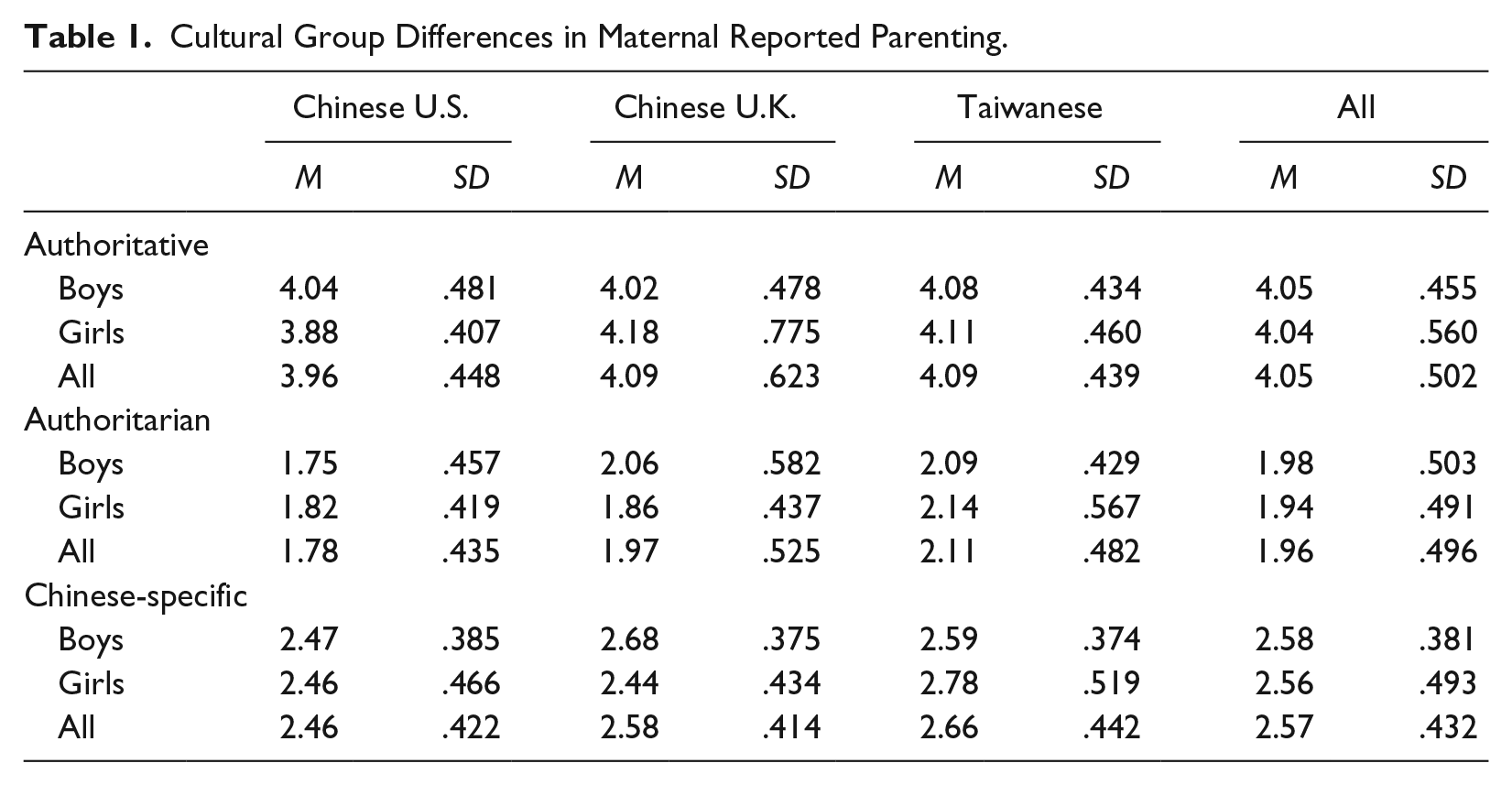
A two-way MANCOVA was conducted to examine the effects of child gender and cultural group on the parenting dimensions, while controlling for the effects of child age and temperament. The MANCOVA revealed a significant main effect of cultural group, F(2, 112) = 2.452, Pillai–Bartlett trace = .122, p < .005, η2 = .061. The achieved statistical power of this MANCOVA was .822. Follow-up ANCOVAs with Bonferroni corrections were then conducted to examine the effects of covariates and cultural group on each of the dependent variables. The ANCOVA revealed significant effects for child age (covariate) on Chinese-specific parenting, F(1, 114) = 5.156, p < .05; for EC on authoritarian parenting, F(1, 114) = 4.000, p < .05; and significant univariate effects for cultural group on authoritarian parenting, F(2, 114) = 4.715, p < .05. Subsequent pairwise comparisons revealed that the Taiwanese mothers used more authoritarian parenting (Mean Difference = .323, p < .01) than the Chinese immigrant mothers in the United States. The mean scores and standard deviations of each group are summarized in Table 1.
Cultural Group Differences in Maternal Reported Parenting.
Interrelations Between Perceived Child EC and Parenting
We first conducted correlational analyses on perceived child EC and each dimension of parenting within each group while partialing out the effects of child age and maternal educational level. Fisher’s Z tests were used to examine group differences between the correlations. Then we used hierarchical regressions to determine whether variations in child characteristics, maternal educational level, cultural group, and perceived child EC predicted scores on each of the parenting dimensions. In the following hierarchical regressions, child age, child gender, and maternal educational level were entered first to control for their effects on the outcome variables; cultural groups (as dummy variables, U.S. immigrant vs. the rest, and U.K. immigrant vs. the rest) were entered in the second step; and perceived child EC was entered in the third step. We wanted to examine whether cultural groups and maternal perceived child EC could account for variation on each parenting dimension after the effects of child characteristics and maternal educational level had been controlled for.
The results of the correlational analyses revealed that the three groups showed different patterns of correlation between perceived child EC and parenting styles. For Chinese immigrant mothers in the United States, perceived child EC was positively correlated with Chinese-specific parenting (r = .377, p < .05), particularly with scores on the parental protection (r = .384, p < .05) subdimensions. For Taiwanese mothers, perceived child EC was positively associated with autonomy granting (r = .334, p < .05) within the authoritative dimension. The results of the correlation analyses are summarized in Table 2. A Z test revealed that the difference between the U.S. Chinese immigrant and the U.K. Chinese immigrant group correlations between perceived child EC and Chinese-specific parenting was significant (Z = 2.016, p < .05).
Partial Correlations Between Child Effortful Control and Different Dimensions of Parenting in the Three Groups (Controlling for the Effects of Child Age and Maternal Educational Level).
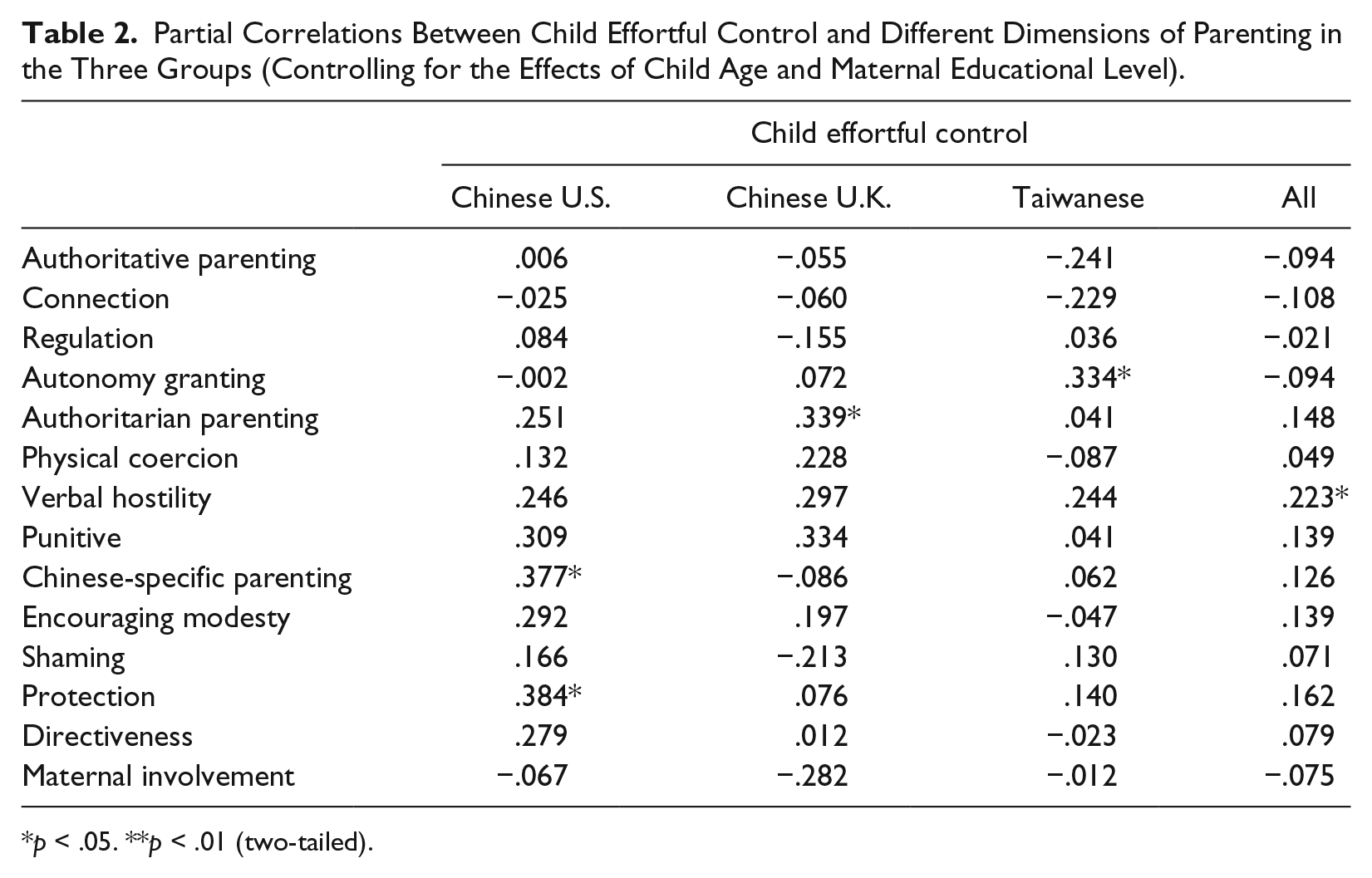
p < .05. **p < .01 (two-tailed).
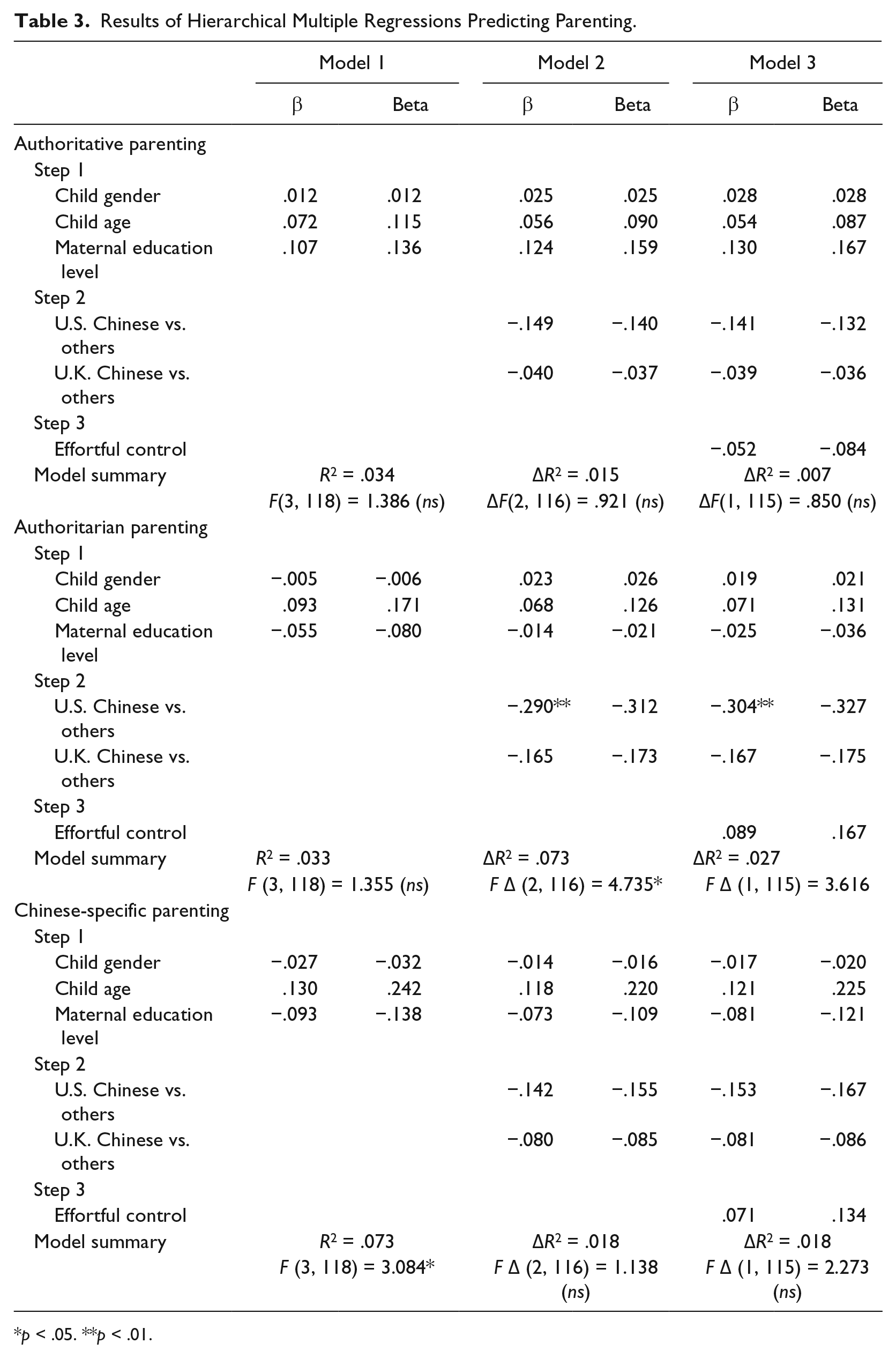
The results of the hierarchical regressions (see Table 3) demonstrated that, when the outcome variable was authoritative parenting, child age, gender, and maternal educational level jointly explained 18.5% of the variance, R2 = .185, F(3, 118) = 1.386, p = .250, and the model was not significant. Adding cultural groups, ΔF(2, 116) = .921, p = .401; ΔR2 = .015, or perceived child EC did not increase the proportion of variance explained, ΔF(1, 115) = .850, p = .359; ΔR2 = .007. None of the models predicting authoritative parenting was significant, suggesting that the mothers’ use of authoritative parenting could not be adequately predicted by these variables.
Results of Hierarchical Multiple Regressions Predicting Parenting.
p < .05. **p < .01.
When the outcome variable was authoritarian parenting, child age, gender, and maternal educational level jointly explained 18.3% of the variance, R2 = .183, F(3, 118) = 1.355, p = .260, and the model was not significant. Adding cultural group significantly increased the proportion of variance explained, ΔF(2, 116) = 4.735, p = .011; ΔR2 = .073, and adding perceived child EC nonsignificantly increased the proportion of variance explained, ΔF(1, 115) = 3.616, p = .060; ΔR2 = .027. The regression coefficients indicated that the Chinese immigrant mothers in the United States reported significantly lower authoritarian parenting use than the other two groups even when child age, gender, and maternal educational level were controlled for.
When the outcome variable was Chinese-specific parenting, child age, gender, and maternal educational level jointly explained 18.3% of the variance, R2 = .270, F(3, 118) = 3.084, p = .030, and the model was significant. However, adding cultural groups, ΔF(2, 116) = 1.138, p = .324; ΔR2 = .018, and perceived child EC did not increase the proportion of variance explained, ΔF(1, 115) = 2.273, p = .134; ΔR2 = .018.
In summary, the results of the correlation analyses showed that the three cultural groups showed different patterns of associations between perceived child EC and the parenting dimensions. Perceived child EC was positively associated with Chinese-specific parenting only in the U.S. Chinese immigrant group, whereas in the U.K. Chinese immigrant group, perceived child EC was positively associated with authoritarian parenting. For the Taiwanese mothers, perceived child EC was positively associated with their use of authoritative parenting. The results of the regression analyses revealed that cultural group was a significant predictor of authoritarian parenting, even after child age, gender, and maternal educational level were controlled for. However, perceived child EC did not significantly increase the prediction of scores on any parenting dimension after the other variables were accounted for.
Discussion
Cultural Differences in Parenting
To our knowledge, this is the first study to examine and compare parenting styles and perceived child EC in two different groups of Chinese immigrant parents across two contexts, and a third group of nonimmigrant Chinese. The findings from the current study can further our understanding of immigrant Chinese parents’ parenting practices within context. The most compelling findings from this study were the differences in parenting styles among these three groups. Overall, the significant differences across these three groups were with the authoritarian parenting style, whereas the authoritative and Chinese parenting styles did not differ. The Taiwanese mothers had higher authoritarian parenting scores than did the Chinese immigrant mothers in the United States. Our findings were consistent with previous findings that Chinese immigrant parents’ practices changed in the course of acculturation (Buki et al., 2003; Costigan & Su, 2008). The nonimmigrant Taiwanese mothers endorsed authoritarian parenting more than their U.S. immigrant counterparts did. These are expected patterns and are consistent with previous findings that immigrant parents increasingly adopt the child-rearing practices and attitudes of the dominant culture as they acculturate (Buki et al., 2003; Costigan & Su, 2008; Huang & Lamb, 2015; Lin & Fu, 1990), suggesting that immigrant parents’ practices may change more readily than their attitudes and beliefs (Bornstein & Bohr, 2011; Bornstein & Cote, 2004).
The three groups of mothers all reported similarly high levels of authoritative parenting style, which is consistent with other findings that elements of both authoritative and authoritarian parenting are present in Chinese societies (e.g., F. Chen & Luster, 2002; X. Chen, Liu, & Li, 2000; X. Chen, Liu, Li, Cen, et al., 2000; Xu et al., 2005). Our finding also echoed Chiu et al.’s (1992) findings that Chinese immigrant youth did not differ in their perception of parental warmth. It seemed that authoritative parenting style was well endorsed by Chinese parents and youth, either immigrant or nonimmigrant. Moreover, these mothers’ overall scores on the Chinese-culture-specific parenting dimension were not significantly different, suggesting that the Chinese immigrant mothers in the United States and in the United Kingdom continue to endorse some Chinese-culture-specific parenting styles. This finding is consistent with Lin and Fu’s (1990) finding that immigrant Chinese parents’ reported parenting values were more similar to those of indigenous Chinese parents than to those of Caucasian American parents, suggesting that immigrant parents’ culturally significant parenting beliefs and norms tend to resist change (LeVine, 1988; Ngo & Malz, 1998). It is likely that, because these Chinese immigrant mothers were all first-generation immigrants, they tended to retain some of their original cultural values and practice. For instance, Chiu et al. (1992) reported differences between first- and second-generation Chinese immigrant youths’ perceptions of their parents’ parenting practices. Overall, these findings support previous interview findings where first-generation Chinese immigrant mothers discussed maintaining certain parenting beliefs and practices from their heritage culture (e.g., focus on education) while adjusting and incorporating parenting practices endorsed by the larger societal context (e.g., decreasing coercive practices and increasing autonomy-promoting practices) as they sought to promote their child’s development in the United States (Cheah et al., 2013).
Moreover, some scholars have suggested that it might not be until the third or fourth generation that families fully acculturate to the host culture (Kelley & Tseng, 1992; Szapocznik & Kurtines, 1993). Future research should examine the Chinese parenting style in second- and third-generation immigrants to understand how such parenting styles change with acculturation.
Associations Between Perceived Child EC and Parenting
Our data revealed no significant cultural group differences in perceived child EC, but perceived child EC was associated with different dimensions of parenting styles in different groups. Perceived child EC was positively associated with Chinese-specific parenting only in the U.S. Chinese immigrant group, and this association was particularly different from that in the U.K. Chinese immigrant group. However, when the effects of child age, gender, maternal education, and cultural groups were accounted for, perceived child EC was not strongly associated with dimensions of parenting.
We saw unique associations between perceived child EC and Chinese-specific parenting style in the U.S. Chinese immigrant group, particularly in relation to the parental protection, encouraging modesty, and directiveness subdimensions. It appeared that the Chinese immigrant mothers in the United States used more culturally rooted parenting styles when they perceived their children to be more self-regulated. Because U.S. society encourages individualism and assimilation, immigrant parents might be more protective of self-regulated children and encourage them to embrace the Chinese model of “good kids (乖孩子, which connotes obedient and self-regulated kids).”
In the Confucian Taiwanese society, by contrast, children’s self-regulation is highly encouraged throughout society, so Taiwanese parents would use Chinese parenting strategies regardless of how they perceived their children’s EC, and children’s EC would be jointly reinforced by parents, families, schools, and society at large (Phelps, 2005). The association between perceived child EC and autonomy granting (a subdimension of authoritative parenting) in the Taiwanese group was largely consistent with findings obtained previously (e.g., Eisenberg, Zhou, et al., 2005; Guo et al., 2011). Perhaps Taiwanese mothers, rooted in Confucian values, viewed the children’s high EC as a sign of developed maturity and so encouraged more autonomy in their children. Children low in self-regulation seem to benefit from parenting that places less emphasis on autonomy granting, and more on control and guidance, which in turn predict lower externalizing (Van Leeuwen, Mervielde, Braet, & Bosmans, 2004; Y. Xu, Farver, & Zhang, 2009) and decreases in internalizing behavior (Kiff, Lengua, & Bush, 2011). Thus, the positive association between parental autonomy granting and perceived child EC may promote Taiwanese children’s positive developmental outcomes.
Effect of Child Gender and Age
In general, child gender did not affect the parents’ self-reported parenting in the current study. Some researchers have revealed small or inconsistent effects of gender on parental behavior (e.g., Chao & Kim, 2000; Chuang & Su, 2009), although boys of all ages tend to be disciplined more harshly than girls (Chang, Schwartz, Dodge, & McBride-Chang, 2003; McKee et al., 2007). The absence of gender differences in the present study may be attributable to the sample size, or to our focus on mothers and children, which precluded the examination of sex of parent by sex of child interactions. However, there was one significant interaction between cultural group and child gender on maternal directiveness: In both Chinese immigrant groups, mothers reported being slightly more directive with boys than with girls, whereas in the Taiwanese group, mothers reported being significantly more directive with girls than with boys. This may be attributed to the lingering traditional Chinese gender role beliefs in Taiwan, which devalues women’s status and emphasizes women’s dependence upon men (X. Xu & Lai, 2002). Women are expected to be wives and/or mothers responsible for household work rather than to have jobs outside the household. Although this gender hierarchy has been challenged by industrialization and urbanization, the influence of the traditional Chinese culture remains stronger in Taiwan than in other Chinese societies such as Hong Kong and Mainland China (X. Xu & Lai, 2004), especially in domestic domains (Hu & Kamo, 2007). Thus, the Taiwanese mothers may be more directive with girls than with boys because Taiwanese girls are not expected to be as independent as boys.
Previous research has shown that parenting changes and adapts as children grow older, especially during infancy and early childhood (e.g., Crouter & Booth, 2003; O’Connor, 2002), perhaps in response to developmental differences in children’s self-regulatory, cognitive, and communicative abilities. Our findings showed that mothers reported being more verbally hostile, more protective, and more directive with older children than with younger children. Perhaps mothers started to use more culturally rooted means (e.g., parental protection and directiveness are both subdimensions of Chinese-specific parenting) to shape children’s behavior because older children can understand verbal instructions and cultural meanings better than younger children, and to prepare older children for formal schooling.
Strengths, Limitations, and Future Directions
The current study provided unique insights into different immigrant Chinese mothers’ parenting styles and perceived child EC. It was the first to examine two different groups of Chinese immigrant mothers’ parenting styles and perceived child EC in matched groups of Chinese (Taiwanese), immigrant Chinese in the United States and immigrant Chinese in the United Kingdom. It was also the first study to examine the relations between Chinese-specific parenting dimensions and perceived child EC. However, some limitations need to be acknowledged. First, the current sample was fairly small and the parents tended to be well-educated. The small sample size not only restricted the analyses that could be conducted but also compromised the validity of the data. Thus, our findings and the generalizability of these findings need to be evaluated with caution.
Also, well-educated Chinese parents, especially in the Chinese immigrant population, could have tried to adopt more Westernized parenting behaviors, as suggested by Chang and colleagues (2003). Future studies involving larger, more demographically diverse samples may provide further insights. Second, our data were based on maternal reports, and these may have been biased. Although research evidence has established that caregivers’ perceptions of child behavior and personality can predict future child adjustment (e.g., Olson, Bates, Sandy, & Lanthier, 2000), it is also important to assess child characteristics and behavior from different perspectives to understand child development fully. Future research should adopt multi-informant designs (for instance, using teachers’ reports or observational assessments of child EC and observations of parenting) to ensure less biased measures and more comprehensive assessment. Finally, the current study did not include measure of acculturation, although immigrant parents’ acculturation affects their parenting beliefs and behavior (e.g., Cheah, Leung, Tahseen, & Schultz, 2009; Huang & Lamb, 2015) and acculturation strategies differ in different receiving societies (e.g., Sabatier & Berry, 2008; Vedder et al., 2007). Future studies should also measure acculturation to better understand Chinese immigrant parents’ parenting.
Conclusion
The current study provided valuable insights into Chinese mothers’ parenting styles and their perceived child EC in the United Kingdom, the United States, and Taiwan. Significant group differences in the authoritarian dimension of parenting were found but the immigrant mothers’ endorsement of Chinese-culture-specific parenting demonstrated that heritage-culture specific parenting practices might change less readily, and the mainstream cultural environments to which they are adjusting may influence how immigrant parents interpret child EC, as well as their culture-specific parenting styles. The different patterns of associations between perceived child EC and parenting dimensions in these three groups demonstrate the heterogeneity within the Chinese population and highlight the need to take into account differences among immigrant communities and receiving societies. Although limited by the sample size and the correlational nature of the design, the current study provides valuable insights into parenting styles and perceived child EC in Chinese families living in the United States, the United Kingdom, and Taiwan and contributes to our understanding of diversity in the Chinese diaspora across different cultural contexts.
Footnotes
Acknowledgements
The authors thank all the families who graciously and generously participated in this project.
Declaration of Conflicting Interests
The author(s) declared no potential conflicts of interest with respect to the research, authorship, and/or publication of this article.
Funding
The author(s) disclosed receipt of the following financial support for the research, authorship, and/or publication of this article: Data concerning the Taiwanese families and the Chinese immigrant families in the United Kingdom were gathered by Ching-Yu Huang as part of her PhD research project at the University of Cambridge with generous funding from King’s College, Cambridge. Data concerning the Chinese immigrant families in the United States were gathered by Charissa Cheah and her research group at the University of Maryland (1R03HD052827-01).