



Abstract
Parents are under pressure to perform well in both professional and family life while simultaneously remaining involved in their children’s development. This pressure is reflected by the prevalence of parental burnout, which is of concern in numerous societies. Drawing upon the demands-resources framework, we investigated parental burnout, parental involvement, and their antecedents (i.e., gender, socioeconomic status, single parenthood, the number of schoolchildren, in-group collectivism, self-esteem, and parent–teacher collaboration) in a cross-cultural setting. Analyses were based on 856 Chinese and 421 German parents’ self-reports. The results of latent mean comparisons showed that Chinese parents reported more parental burnout symptoms, less parental involvement, lower global self-esteem, and higher quality of parent–teacher collaboration in comparison with German parents. Multigroup structural equation models revealed that the relationships between parental burnout, parental involvement, and presumed factors of influence were comparable between the two cultural groups. Furthermore, self-esteem and parent–teacher collaboration can be seen as factors that protect against parental burnout and should encourage parents to get involved in their children’s education. This study provides evidence of the cross-cultural validity of the demands-resources framework and novel insights into the roles of resilience and engagement as a protective function of parenting resources.
Keywords
In achievement-driven societies, such as China and Germany, performance is the yardstick for personal success and determines an individual’s social class. This association goes hand in hand with increasing academic pressure on school students across education systems (e.g., Salmela-Aro et al., 2009; Storm & Hanewinkel, 2019; Teuber et al., 2021a; Walburg, 2014). Parents have also reported being overwhelmed with the need to adequately support their children’s academic success while balancing the parental role with their own personal needs (Henry-Huthmacher, 2008; Mikolajczak, Raes, et al., 2018; Roskam et al., 2017, 2018, 2022; Roskam & Mikolajczak, 2020). The high demands on parents can lead to parental burnout (Mikolajczak, Raes, et al., 2018; Roskam et al., 2017, 2018, 2022; Roskam & Mikolajczak, 2020) and diminish the extent to which parents remain involved in their children’s development (e.g., Wuyts et al., 2017), thus negatively impacting students’ academic achievement in the long run (Bakker & Demerouti, 2014).
The demands-resources framework (Bakker & Demerouti, 2014; Bakker et al., 2014) originated in the occupational context for examining the determinants of job burnout and work engagement. This framework has been successfully adapted to study the predictors of parental burnout (Roskam & Mikolajczak, 2020), but no empirical work has been devoted to adapting this framework to the joint context of parental burnout and parental involvement to date. Using the demands-resources framework (Bakker & Demerouti, 2014; Salmela-Aro & Upadyaya, 2014; Teuber, 2021; Teuber et al., 2021a, 2021b), we view parental burnout and parental involvement as resulting from the interplay between parenting demands and parenting resources. Accordingly, whereas parenting demands (e.g., single parenthood or a lack of support between coparents, individualism) are health-impairing and can cause parental burnout, parenting resources (e.g., self-esteem, Gavidia-Payne et al., 2015; high-quality school–parent collaboration, Dettmers et al., 2019) can contribute to adaptive coping with stress, can provide support for parents, and can encourage parental involvement.
We designed this study to test the validity of the demands-resources framework in the parenting context by including cultural values, parental sociodemographic characteristics, parental global self-esteem, and parent–teacher collaboration as predictors of parental burnout and parental involvement in a cross-cultural setting. To pursue this research aim, we conducted a cross-cultural comparative study with 856 Chinese parents and 421 German parents. In the following sections, we introduce and review the literature on parental burnout and parental involvement, map the core constructs onto the demands-resources framework, and provide the rationale behind our decision to focus on Chinese and German parents.
Parental Burnout
Research on parental burnout can be traced back to the 1980s (Pelsma et al., 1989; Procaccini & Kiefaber, 1983). Recently, Roskam et al. (2018) revisited the conceptualization of parental burnout, provided a comprehensive definition, and offered a dimensional approach. Accordingly, parental burnout is a phenomenon that occurs in the parenting context characterized by (a) emotional exhaustion (i.e., being emotionally overextended by the parental role); (b) emotional distancing from one’s children (i.e., being unable to show love and doing the bare minimum for one’s children); (c) loss of pleasure in one’s parental role (i.e., loss of personal fulfillment as a parent); and (d) a contrast with one’s previous parental self (i.e., being ashamed about one’s current parenting and feeling that one is not as good a parent as one used to be). We adopted this dimensional approach in this study.
Depending on the group of parents considered, the prevalence of parental burnout has been found to be as high as 36% (for details, see Mikolajczak, Raes, et al., 2018). Parental burnout is associated with a variety of health problems and dysfunctional partner relationships, such as more depressive symptoms, sleep problems, addiction problems, thoughts of escape and suicide, and partnership conflicts (Brianda et al., 2020; Mikolajczak, Brianda, et al., 2018; Mikolajczak et al., 2019). Parental burnout can also harm child development (Mikolajczak et al., 2019). In a study by Hansotte et al. (2021, p. 158) of over 2,500 parents, five different profiles of parents (“Not in parental burnout,” “Inefficient,” “At risk of parental burnout,” “Emotionally exhausted and distant,” and “Burned-out parents”) were identified on the basis of three components: exhaustion, emotional distancing, and loss of fulfillment. In the sample, burned-out parents were found to be most likely to exhibit neglectful and verbally violent behavior toward their children. In another study, Mikolajczak, Brianda et al. (2018) also revealed a strong association between parental burnout and neglectful and violent behavior toward one’s children.
Notably, however, most existing studies on parental burnout include mixed parent samples (i.e., parents of toddlers and schoolchildren; Kroshus et al., 2023; Piotrowski et al., 2023). While such approaches provide a broad view of parental burnout, they may not fully account for the unique challenges that parents face at specific stages of their child’s development. In this study, we address this limitation by focusing specifically on parents of schoolchildren across all age groups within the educational system, allowing us to delve deeper into the unique challenges faced by parents during this critical stage of child development. By narrowing our sample to this specific group, we aim to provide a more nuanced understanding of parental burnout within the context of children’s education.
Parental Involvement
Parental involvement (often used as a synonym for parental engagement in the literature; Jeynes, 2018) refers to parents’ active engagement in supporting their children’s development in a specific domain (Epstein & Sanders, 2002; Grolnick, 2016; Jeynes, 2003). Educational success holds significant importance throughout one’s educational journey and can shape far-reaching opportunities and developmental trajectories (Pekrun & Perry, 2014). From international comparison studies and meta-analyses (Jeynes, 2015; Kim, 2020; Organization for Economic Co-Operation and Development [OECD], 2016, 2019a), we know that parental involvement in schooling influences the academic and psychological adjustment of children and adolescents. Therefore, we focused on parents’ involvement in their children’s education in this study. In the literature, parental involvement is mainly categorized into school-based and home-based involvement (Grolnick, 2016; Hoover-Dempsey & Sandler, 1997, 2005; Walker et al., 2005). School-based involvement includes parental participation in school-related activities, for example, attending parent–teacher conferences or school meetings, communicating with teachers, and volunteering at school. Home-based involvement encompasses communicating with children at home, for example, talking with children about school-related issues, exposing children to intellectually stimulating activities, and assisting children with homework (Grolnick, 2016).
For four decades, an enormous amount of research has been devoted to investigating the effects of parental involvement on child development. By now, the results of several meta-analyses have shown that parental involvement has a strong impact on children’s academic and psychological development (Barger et al., 2019; Fan & Chen, 2001; Hill & Tyson, 2009; Jeynes, 2007, 2016; Ma et al., 2016). Jeynes (2005) concluded that parents’ involvement in their children’s education may have an influence that even largely overrides direct effects of social status and ethnicity. However, the effects of parental involvement on children’s academic outcomes differ by the type and quality of the involvement. For instance, parental help with homework has frequently been found to be even negatively related to academic outcomes because many homework situations are fraught with parent–child conflict. In comparison, academic socialization (i.e., parents’ expectations of their children’s education and discussions about learning strategies) has shown the strongest associations with positive achievement development in various meta-analyses (Fan & Chen, 2001; Hill & Tyson, 2009; Jeynes, 2005, 2007). Moreover, school-based involvement has demonstrated moderate correlations with children’s academic outcomes (Desforges & Abouchaar, 2003). On the basis of these findings, Grolnick (2016) concluded that the types of involvement that include parent–child interactions (e.g., providing children with a supportive home learning environment through communicating about school-related topics) are most effective for promoting children’s school success. This conclusion was further supported by a comprehensive literature review by Boonk et al. (2018). In this study, we operationalized parental involvement as parent–child communication about school-related topics, which we view as a prerequisite for other, high-quality, home-based parental involvement activities (Yotyodying et al., 2020).
The Demands-Resources Framework
As elaborated above, not only parental burnout but also parental involvement has a significant impact on child development. To date, however, parental burnout and parental involvement have been investigated in two separate spheres. Although Roskam and colleagues (Mikolajczak, Raes, et al., 2018; Roskam et al., 2017, 2018) used the demands-resources framework (Bakker & Demerouti, 2014) to reveal the antecedents of parental burnout, no attempts have been made to include parental involvement in the educational domain. The demands-resources framework was designed for the combined investigation of job burnout and work engagement (Bakker & Demerouti, 2014). In the parenting context, parental burnout is considered the counterpart to job burnout, and parental involvement is considered the counterpart to work engagement. The demands-resources framework has recently been adapted to school and higher education contexts, and there is strong evidence of its cross-cultural validity and structural equivalence in these contexts (Gusy et al., 2016; Niewöhner et al., 2022; Salmela-Aro & Upadyaya, 2014; Teuber, 2021; Teuber et al., 2021a, 2021b). This framework has proven to be a valuable tool in both professional and academic settings, serving as a guiding framework for research and practice. It aids in the identification of employees or students who may be at risk and facilitates the enhancement of work or school environments (Bakker & Demerouti, 2014; Lesener et al., 2019; Salmela-Aro et al., 2022). From our point of view, the demands-resources framework provides a useful model for incorporating parental burnout and parental involvement. This enables the identification of parents at risk and offers practical implications for schools and practitioners to simultaneously support parents.
Relying on the assumptions of the demands-resources framework, Figure 1 illustrates our understanding of the antecedents of parental burnout and parental involvement. Accordingly, factors in the parenting environment can be categorized into parenting demands (risk factors) and parenting resources (protective factors). Mikolajczak and Roskam (2018) identified six categories of parenting demands and resources: (a) sociodemographics (e.g., socioeconomic background); (b) critical life events (e.g., loss of a family member); (c) psychological characteristics of the parent (e.g., individualism/collectivism, self-esteem); (d) child-rearing practices (e.g., positive parenting); (e) family functioning (e.g., support from the coparent); and (f) social support (e.g., grandparents’ or teachers’ support). From the demands-resources perspective, parenting demands (e.g., the maternal role, single parenthood, low parental self-efficacy or global self-esteem, and a myriad of parental duties; Mikolajczak & Roskam, 2018) consume parents’ physical, emotional, social, and psychological energy. Therefore, parenting demands are potentially health-impairing and can lead to parental burnout. By contrast, parenting resources (e.g., high parental global self-esteem and positive coparenting) can reduce the associated costs of parenting demands, offer motivational and protective effects, and fuel parental involvement. Notably, the demands-resources framework can be applied very flexibly, and various kinds of parental characteristics can be specified. However, as pointed out by Schaufeli and Taris (2014), the demands-resources framework provides limited insight into the psychological mechanisms that are involved. Therefore, we used this framework as a heuristic model and supplemented it with explanatory theories while incorporating specific antecedents.
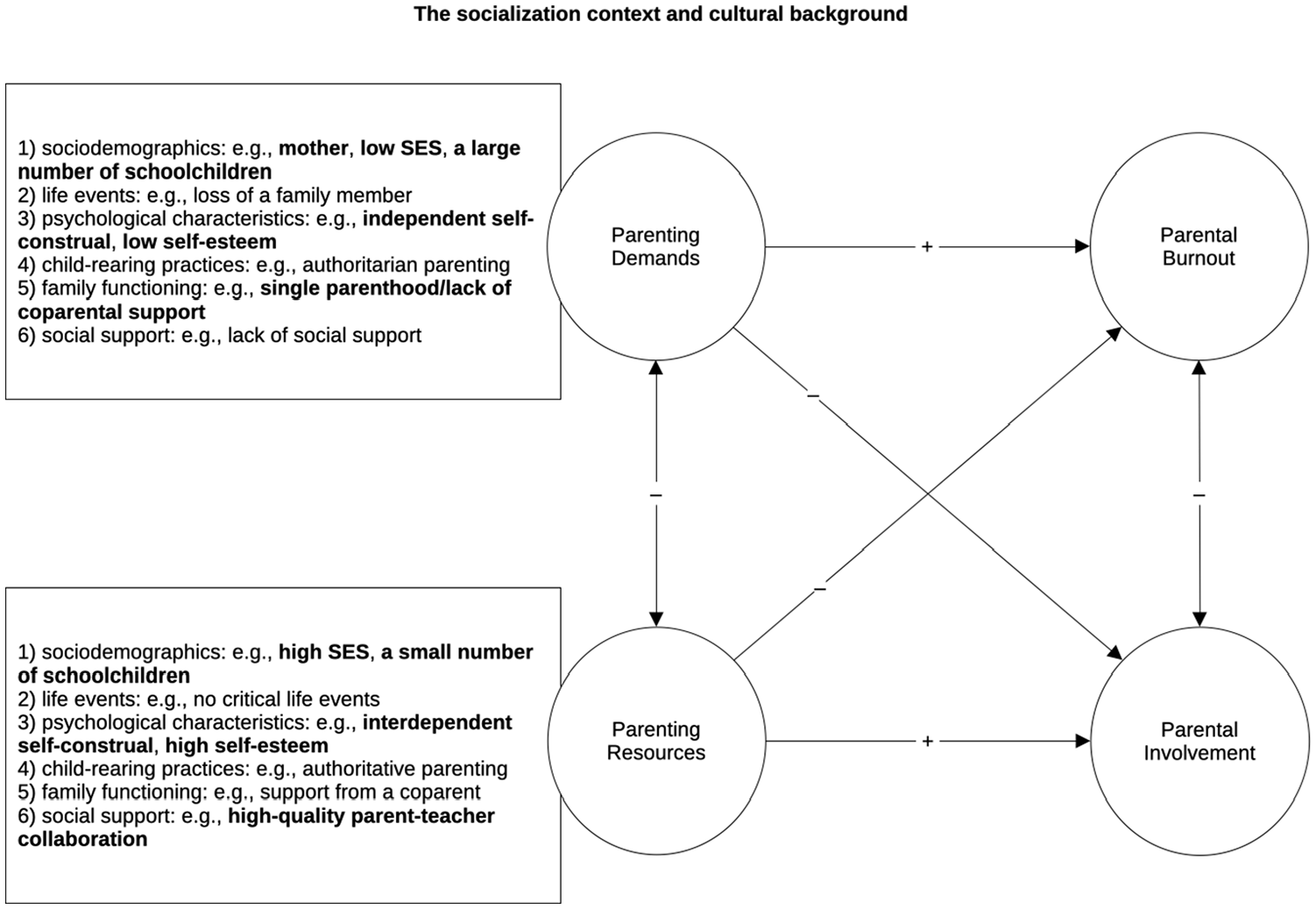
The Adapted Demands-Resources Framework in the Parenting Context.
Parents’ gender, socioeconomic status (SES), single parenthood, and the number of schoolchildren in the household were included in this study to capture potential parenting demands and resources within the sociodemographic category. Previous studies (Mikolajczak & Roskam, 2018; Roskam & Mikolajczak, 2020) have shown that mothers, single parents, parents with lower SES, and parents with more children are more vulnerable to parental burnout. Regarding parental involvement in children’s schooling, mothers are more involved than fathers (Kim, 2018), whereas low-SES and single parents are more likely to show maladaptive parental involvement behaviors (e.g., low responsiveness and ineffective communication with children regarding school-related matters; Yotyodying & Wild, 2014). As aforementioned, existing studies have mainly assumed that a greater number of children in the household are a risk factor for parental burnout (Mikolajczak & Roskam, 2018; Roskam & Mikolajczak, 2020). Given the specific focus of this study, we were interested in whether the number of schoolchildren is linked to parental burnout and parental involvement.
In this study, we focused on parents’ global self-esteem and assigned it to the resource category of psychosocial characteristics in the demands-resources framework (see Figure 1). The selection of self-esteem was motivated by its etiological role in various clinical affective disorders worldwide, highlighting the need for further research and therapeutic attention (Kresznerits et al., 2022; Zeigler-Hill, 2011). Self-esteem refers to a person’s global evaluation of their personal worth (Harter, 1983; Rosenberg, 1979). According to the prominent Transactional Stress Theory (Lazarus & Folkman, 1984), stress is a product of the transaction between an individual and their environment. This transaction is mediated by the individual’s appraisals (i.e., cognitive evaluation) and coping processes, which eventually determine the outcome of the stress process. Self-esteem has frequently been operationalized as a personality trait and a component of resilience and has been revealed to positively affect individuals’ appraisals and coping as well as to promote engagement at work or school in both Western and Eastern cultures (Bakker & Demerouti, 2014; Lazarus & Folkman, 1984; Teuber et al., 2021b; Vollrath, 2001). In child-rearing situations, parents with low self-esteem are more vulnerable to daily hassles, including relationship problems and obstacles in completing their parenting tasks (Florian & Findler, 2001; M. S. Thompson et al., 2013). Parental global self-esteem also affects parental involvement by positively influencing attitudes toward the parental role (McBride et al., 2002). Therefore, we expect that parents with higher self-esteem are less likely to experience parental burnout and are more likely to be involved in their children’s education.
In addition to parental global self-esteem, we integrated parent–teacher collaboration into the demands-resources framework as a resource involving social support. This choice was made with the intention of deriving practical implications on how schools or teachers can contribute to parental burnout prevention while concurrently fostering parental involvement. Based on the Parental Involvement Process Model by Hoover-Dempsey and Sandler (1997, 2005), parental decisions about involvement are directly and indirectly determined by several factors, including parental motivational beliefs (i.e., parental role construction and parental self-efficacy), general invitations to get involved from the school, and specific invitations from the child and the child’s teachers. High-quality parent–teacher collaboration is characterized by a collective endeavor between parents and teachers to best support the child through bilateral communication about expectations, goals, learning progress, and problems (Epstein, 2018; Grüter et al., 2021). Notably, parent–teacher collaboration and parental involvement are two distinct constructs: Whereas parental involvement encompasses the active engagement and participation of parents in their children’s upbringing and education, parent–teacher collaboration emphasizes the cooperation and interaction between parents and teachers. Through a collaborative parent–teacher relationship, parents feel that their participation in school life is desired, welcomed, supported, and valued by their child’s teachers, and they feel empowered, more responsible, and more capable of engaging in their child’s schooling (Hoover-Dempsey et al., 2005; Hoover-Dempsey & Sandler, 1997). The results of a U.S. study (Patrikakou & Weissberg, 2000) suggested that the more parents perceived that their child’s teachers tried to keep them informed about their child’s learning progress and attempted to provide them with suggestions to help their child, the more parents were involved in their child’s education both at home and at school. Similar motivational effects of parent–teacher collaboration on parental involvement have been found in various parent populations (Kohl et al., 2000; Rogers et al., 2009; Yotyodying & Wild, 2019). To date, however, most studies have focused on the effect of parent–teacher collaboration on parental involvement, and little is known about whether it can also affect how parents cope with stress. According to the Social Support Theory (Leahy-Warren, 2014), social interactions and relationships, such as parent–teacher collaboration, can serve as valuable sources of support, mitigating the detrimental impact of stress. In our view, collaborating with schools/teachers can offer parents of schoolchildren emotional support, practical assistance, and access to information and resources. Consequently, parents may become more resilient in managing the demands of parenting and education, thereby reducing the likelihood of experiencing parental burnout.
Previous Cross-Cultural Findings
Theories on parental burnout and parental involvement stem mainly from the Western scientific community. However, the ways in which parents understand their role and involve themselves in their children’s education are influenced by their cultural values, which are embedded in a larger societal and cultural context (Bornstein, 2012; Cheah et al., 2013; He et al., 2021). Therefore, theories developed on the basis of Western studies might not be applicable in Eastern contexts. To gain reliable insights into the generalizability of the demands-resources framework in Eastern societies, cross-cultural studies are necessary. In this study, we addressed Chinese and German parents as examples of Eastern and Western populations, aiming to provide a starting point for examining the cross-cultural applicability of the demands-resources framework.
The role of cultural background in parental burnout was the research interest in a study by Roskam et al. (2021). They examined parental burnout in parents from 42 nations by considering six cultural factors (i.e., power distance, individualism/collectivism, uncertainty avoidance, long-term orientation, masculinity, and indulgence). Among these, only individualism/collectivism was found to be linked to parental burnout. Across the 42 nations, parental burnout was more prevalent in individualistic societies than in collectivistic ones. According to cross-cultural researchers (Markus & Kitayama, 1991), individualist-oriented people view themselves as independent individuals and feel self-worthy when they achieve personal goals and realize their individual potential. Hence, individualistic cultures cultivate an environment of performance and perfectionism that is associated with maladaptive coping with parenting demands (Roskam et al., 2021). By contrast, individuals in many collectivistic cultures view themselves as more connected to others and feel self-worthy if they are accepted and respected by other social group members (Markus & Kitayama, 1991).
In the literature, individualism/collectivism has been operationalized in different ways (e.g., conformity, hedonism, self-direction, dependence and independence; House, 2004; Schwartz, 1992; Singelis, 1994). House (2004, p. 30) introduced the index of in-group collectivism: “the degree to which individuals express pride, loyalty, and cohesiveness in their organizations or families.” Given this study’s focus on parental experiences and behaviors that are closely connected to family members’ interactions, in-group collectivism can more accurately reflect individuals’ personal values with respect to the interdependence among family members and is more suitable for investigating cultural differences in family-related constructs. In previous studies, scholars have recommended this index for capturing collectivism/individualism in line with its typical understanding in the literature and established its cross-cultural validity (House, 2004; Vieluf et al., 2013). It can be assumed that in a collectivistic culture, parents are more likely to receive support from other family members and the community. On the grounds of previous evidence, we assume that German parents (as more individualist-oriented individuals) tend to experience more parental burnout symptoms compared with Chinese parents (as more collectivist-oriented individuals; Hofstede et al., 2010).
Regarding parent–child communication about school as a specific form of home-based parental involvement, cross-cultural findings are still scarce. However, existing meta-analyses and cross-cultural studies on parental involvement have pointed to cultural differences in the form of parental involvement: Whereas Eastern parents are more involved in the home learning environment, Western parents are more involved in school (Borgonovi & Montt, 2012; Fingerman et al., 2016; Kim, 2020; Yamamoto et al., 2016). We assume that Chinese parents are involved in their children’s education within the home environment to a greater extent than German parents.
Cross-cultural differences are also evident in the extent of parental global self-esteem and parent–teacher collaboration, presumed as parenting resources in this study. Ever since the concept of individualism/collectivism was proposed, scholars have been interested in cultural differences in global self-esteem as a core component of self-evaluation. In the literature, it has been documented that the standard of the evaluation of self-worth is embedded in social norms and societal expectations (e.g., Bleidorn et al., 2016; Diener & Diener, 2009; Gnambs et al., 2018). In collectivistic cultures, individuals value modesty and group harmony, and expressing an overly positive self-view is less appropriate (Markus & Kitayama, 1991), leading to lower self-esteem in collectivist-oriented individuals as a response tendency in empirical studies (e.g., Bleidorn et al., 2016; Diener & Diener, 2009; Gnambs et al., 2018). Furthermore, these cross-cultural differences likely extend to parent–teacher collaboration, as Chinese parents and teachers should be more likely to cooperate because both feel highly responsible for children’s education. This idea was supported by the recent findings of the Program for International Student Assessment (PISA; OECD, 2019a) showing that seven out of 10 Chinese parents discuss their children’s progress with teachers, whereas the rate is significantly lower for German parents (i.e., three out of 10). Therefore, on the basis of ample empirical evidence, we suggest that Chinese parents report lower global self-esteem and higher levels of parent–teacher collaboration than German parents.
The Present Study
The demands-resources framework provides a useful model for explaining the phenomenon of burnout and involvement in both occupational and educational contexts (Bakker & Demerouti, 2014; Salmela-Aro & Upadyaya, 2014; Teuber et al., 2020, 2021a, 2021b). We employed it here to incorporate two research branches: the stress branch and the involvement branch. By doing so, we aimed to provide evidence for the cross-cultural validity of the demands-resources framework and contribute to the understanding of the etiology of parental burnout. Given the complexity of a rigorous cross-cultural methodology, we set two research objectives and formulated five hypotheses in the current study.
The first research objective was to investigate the relationships between parental burnout, parental involvement, parental global self-esteem, parent–teacher collaboration, in-group collectivism, gender, SES, single parenthood, and the number of schoolchildren in both cultural groups. Figure 1 shows the presumed associations:
The second research objective was to estimate cultural similarities and differences in these relationships and uncover subtle differences in the core psychological constructs, namely, parental burnout, parental involvement, parental global self-esteem, and parent–teacher collaboration:
Method
Participants and Procedure
Data were collected from December 2020 to March 2021. The Chinese sample was recruited from three schools in a southeastern province of China, whereas the German sample was recruited nationwide through diverse schools and social media. Both questionnaires were completed online. Relying on various rules of thumb (for an overview, see Kyriazos, 2018), a sample size of 300 individuals per cultural group was chosen as sufficient for testing a multigroup confirmatory factor analysis (CFA) model or a multigroup structural equation model (SEM; for details, see the “Analytical Strategies” section). This study was reviewed and granted ethical approval by the ethics committee of Bielefeld University prior to data collection. The study design was explained to participants, and they were informed that their participation was voluntary, and that they could withdraw their participation at any time without consequences. Participants responded to the survey anonymously. To be eligible, participants were required to provide informed consent.
Parents were eligible to participate in this study only if they had at least one schoolchild in their household. After data cleaning (30 cases with more than 25% missing values were excluded from the analyses), the sample included 1,277 parents. In the total sample, 856 parents (253 fathers and 603 mothers) were from China, whereas the other 421 parents (32 fathers and 361 mothers, 38 no response) were from Germany. In both samples, about 60% of the participants were between the ages of 36 and 45. Around 15% of the Chinese participants had received higher education, whereas 40% of the German participants had received higher education. The proportion of single parents was 5% and 16% in the Chinese and German samples, respectively. Compared with the statistics reported by the National Bureau of Statistics of China (2022) and the German Federal Office for Statistics (2021), parents with higher education were overrepresented in the German sample but underrepresented in the Chinese sample, whereas single parents were underrepresented in both samples. Parental SES, as assessed through home literacy resources (for more details, see “Measures” and Table 1), revealed a similar picture: on average, German participants exhibited significantly higher levels of SES than Chinese participants. To minimize potential biases in the results, we controlled for these factors by including them as predictors in the SEMs (for details, see the “Analytical Strategies” section). The average number of schoolchildren in the household was 1.60 (SD = 0.49) in the Chinese sample and 1.67 (SD = 0.95) in the German sample; this difference was statistically not significant (Table 1).
Descriptive Statistics for the Variables of Interest.
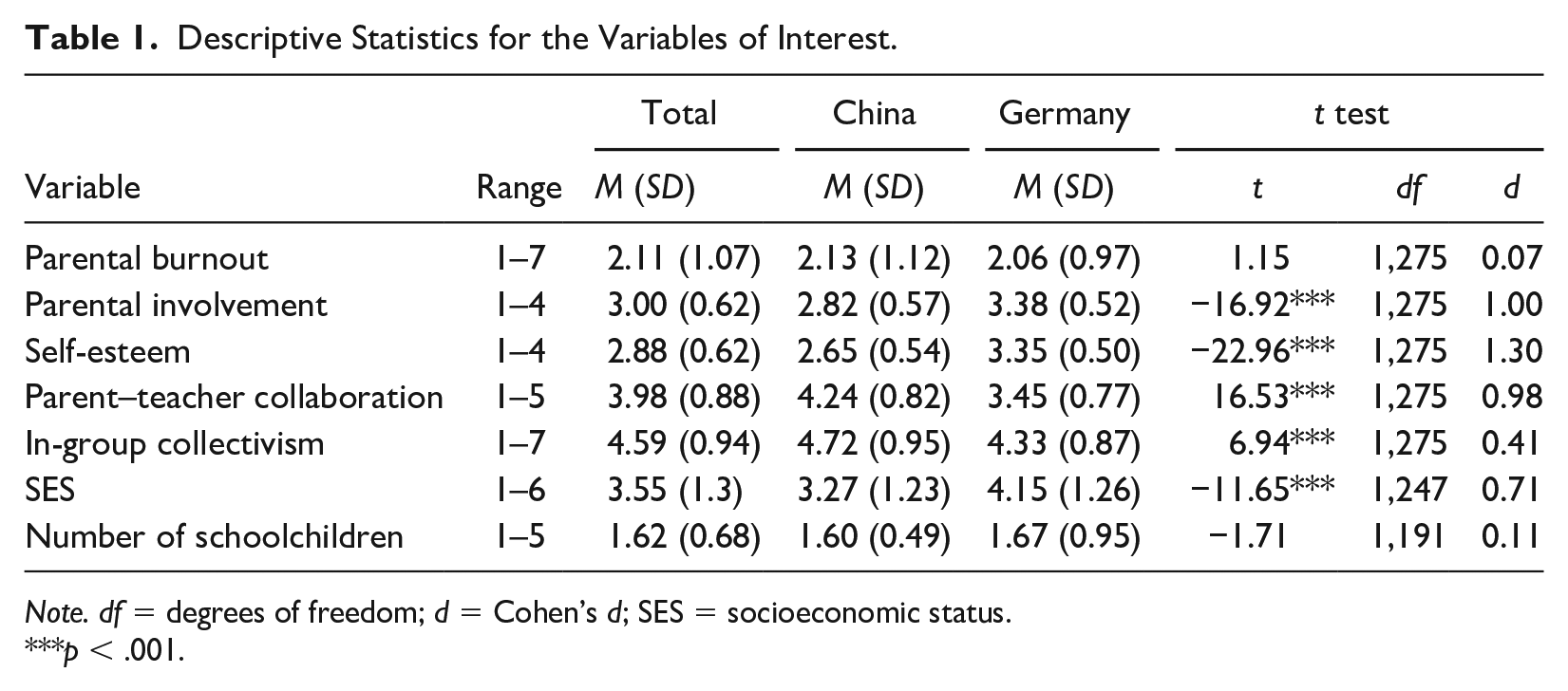
Note. df = degrees of freedom; d = Cohen’s d; SES = socioeconomic status.
p < .001.
Measures
In this study, parental burnout and parental involvement were included as outcome measures, whereas parent–teacher collaboration, self-esteem, in-group collectivism, and demographics (i.e., gender, SES, single parenthood, and the number of schoolchildren) were considered either parenting resources or parenting demands that predicted parental burnout and parental involvement. Except for in-group collectivism and demographics, all constructs were modeled as latent variables with multiple indicators. We computed McDonald’s (1999) omega as a measure of internal consistency.
Parental Burnout
To assess parental burnout, we adapted the Parental Burnout Assessment (PBA) by Roskam et al. (2018). The original PBA consisted of 22 items. We selected three items with the highest factor loadings for each of the four following dimensions: Emotional Exhaustion (e.g., “I feel completely run down by my role as a parent”), Contrast with Previous Parental Self (e.g., “I don’t think I’m as good of a father/mother that I used to be to my child[ren]”), Loss of Pleasure in One’s Parental Role (e.g., “I can’t stand my role as a father/mother anymore”), and Emotional Distancing from One’s Child(ren) (e.g., “I do what I’m supposed to do for my child[ren], but nothing more”). Responses were given on a 7-point Likert-type scale (0 = never, 6 = every day). According to the original authors (Roskam et al., 2018), parental burnout is a higher-order construct with these four lower-order factors. This factor structure was found for the total sample in this study, χ2(50) = 152.50, p < .001, comparative fit index [CFI] = .97, root mean square error of approximation [RMSEA] = .04, 90% confidence interval [CI] for RMSEA [.04, .05], standardized root mean squared residual [SRMR] = .04. The internal consistency of the total scale was high (ωfull sample = .93).
Parental Involvement
We adapted the German Home–Based Parental Involvement Scale (Yotyodying et al., 2020) to capture parent–child communication about school-related topics as an aspect of parental home-based involvement. This scale has been utilized to compare parental involvement between Thai and German parents and has exhibited sound psychometric properties in both samples (Yotyodying & Wild, 2014). We translated and back-translated the items from German into Chinese. The scale consisted of six items that were rated on a 4-point scale ranging from 1 (never) to 4 (always; e.g., “I talk to my child about everyday school life”). The scale had a unidimensional factor structure in the total sample, χ2(8) = 43.30, p < .001, CFI = .99, RMSEA = .06, 90% CI for RMSEA [.05, .07], SRMR = .02. The internal consistency was high (ωfull sample =.92).
Parent–Teacher Collaboration
To measure parent–teacher collaboration, the Quality of Parent–Teacher Collaboration Scale (Grüter et al., 2021) was used. Using the translation and back-translation approach, we translated it into Chinese. This scale consisted of four items (e.g., “My child’s teachers listen to me carefully”). Participants evaluated the perceived quality of their collaboration with their child’s teacher on a 5-point Likert-type scale (1 = totally disagree, 5 = totally agree). In the total sample, the scale showed acceptable to good fit indices, χ2(2) = 23.02, p < .001, CFI = .98, RMSEA = .09, 90% CI for RMSEA [.06, .12], SRMR = .02. The internal consistency was high (ωfull sample = .85).
Self-Esteem
The Chinese (Yeung, 1998) and German (von Collani & Herzberg, 2003) versions of Rosenberg’s (1979) Self-Esteem Scale were used to measure self-esteem. This measure served as an indicator of parental resources on the predictor side in this study. Five items captured positive self-esteem (e.g., “On the whole, I am satisfied with myself”). Answers were scored on a 4-point rating scale ranging from 1 (totally disagree) to 4 (totally agree). A one-factor CFA model fit the full data well, χ2(4) = 18.05, p < .001, CFI = .99, RMSEA = .05, 90% CI for RMSEA [.04, .07], SRMR = .01. The internal consistency was high (ωfull sample = .93).
In-Group Collectivism
To reflect individualism/collectivism, we used the index for in-group collectivism from the Global Leadership and Organizational Behavior Effectiveness Research Program (GLOBE; House, 2004). This index was operationalized with four items rated on a 7-point Likert-type scale (e.g., “In this society, children take pride in the individual accomplishments of their parents”; 1 = strongly disagree, 7 = strongly agree). As suggested by House (2004), we used the scale mean in this study. The internal consistency was acceptable (ωfull sample = .76).
Demographics
Demographic variables included parental gender, SES, single parenthood, and the number of schoolchildren. Gender was dummy coded (0 = male, 1 = female). To assess SES, we asked about home literacy resources, that is, the number of books (including E-books) in the household, using the same item as in the PISA study (1 = fewer than 20 books, 6 = more than 500 books; OECD, 2013). Numerous studies (e.g., OECD, 2013) have demonstrated a robust correlation between this item and parents’ income and educational level, and this item can thus be viewed as a powerful indicator of SES. Single parenthood was measured as 0 (not a single parent) and 1 (single parent). Parents were asked to specify the number of schoolchildren in their household by responding to the question, “How many schoolchildren do you have in your household?.”
Analytical Strategies
The data were analyzed with RStudio (Version 2022.02.0.443; RStudio Team, 2022). The Chinese data set was complete. In the German cleaned data set, the proportion of missing values was 0.5% for all variables. Little’s test indicated that the missing values were missing completely at random (MCAR), χ2(65) = 59.23, p = .68. The full-information robust maximum likelihood estimator (MLR) was used to handle non-normality and missing values. The R code behind this analysis has been made publicly available at the Open Science Framework and can be accessed at https://osf.io/sv3tz/. The data for this study are available by emailing the corresponding author.
Structural Equation Modeling
To test the relationships between parental burnout, parental involvement, and the predictors (Hypotheses 1, 2), we ran SEM models separately for the Chinese and German samples with the R package lavaan (Rosseel, 2012). In the SEM models, parent–teacher collaboration, self-esteem, in-group collectivism, parental gender, SES, single parenthood, and the number of schoolchildren were regressed on parental burnout and parental involvement. These SEM models were the baseline SEM models. To evaluate model fit, we relied on the recommendations by Hu and Bentler (1999), with a nonsignificant χ2 value, a CFI ≥ .95, RMSEA ≤ .06, and SRMR ≤ .06 indicating good model fit, and CFI ≥ .90, RMSEA ≤ .08, and SRMR ≤ .08 indicating acceptable fit.
Multigroup CFA and Latent Mean Comparisons
Before testing our cross-cultural hypotheses, we estimated measurement invariance across cultural groups for each of the four latent constructs with lavaan: parental burnout, parental involvement, parent–teacher collaboration, and self-esteem. We applied the forward approach (Dimitrov, 2010) such that, in the configural measurement invariance model, all parameters were freely estimated; in the metric measurement invariance model, factor loadings were constrained to be equal across groups; and in the scalar measurement invariance model, indicator intercepts were additionally set equal. Due to the fact that scalar measurement invariance is frequently not supported in empirical studies, it has been common practice to accept certain violations of measurement invariance by releasing constraints on some parameters, like factor loadings or item intercepts (Putnick & Bornstein, 2016). Therefore, we decided to release constraints on the basis of modification indices if the model fit became significantly worse.
To investigate cultural differences in parental burnout, parental involvement, parent–teacher collaboration, and self-esteem (Hypotheses 3, 4), we used lavaan to conduct latent mean comparisons that were based on the final multigroup CFA models from the last step. A meaningful mean comparison requires the latent construct to demonstrate at least partial scalar measurement invariance (Steenkamp & Baumgartner, 1998). In this case, we defined the German group as the reference group. In the German group, the intercept of the latent mean was fixed to 0, and the variance of the latent factor was fixed to 1. In the Chinese group, these parameters were freely estimated. The estimate of the latent mean in the Chinese group can be interpreted as the latent mean difference between the two cultural groups. Wald’s z test was computed to evaluate the significance of the latent mean difference, and Cohen’s d was calculated as the effect size (S. Thompson & Green, 2013).
Multigroup Structural Equation Modeling
Built upon the baseline SEM and the latent mean comparison models (i.e., including the constraints in the measurement models), we used lavaan to conduct multigroup SEMs to examine the cultural differences and similarities in the structural relationships (Hypothesis 5). The multigroup SEMs included two steps. First, we implemented a configural SEM in which all the parameters were freely estimated. Next, we constrained all the path coefficients and covariates to be equal across cultural groups in the structural invariance model. If there was substantial deterioration in the goodness-of-fit, the constraints were gradually released, relying on the parameter estimates from the configural SEM. The chi-square difference test (Δχ2) was used to make model comparisons. However, χ2 values depend on sample size, and even irrelevant amounts of misfit can lead to significant χ2 values when the sample size is moderate to large (Chen, 2007). To account for this problem, we additionally followed Chen’s (2007) suggestion (for sample sizes >300) that noninvariance should be assumed if there is a decrease of ≥.010 in the CFI, an increase of ≥.015 in the RMSEA, and an increase of ≥.030 in the SRMR.
Results
Table 1 presents the mean values and standard deviations for the manifest variables, along with the scale mean comparisons between the cultural groups. Overall, parental burnout levels were comparable across cultural groups. However, Chinese participants reported lower levels of parental involvement and self-esteem, as well as higher levels of parent–teacher collaboration quality and in-group collectivism compared with Germans. The intercorrelations of the zero-order variables and latent constructs are presented in Tables 2 and 3, respectively. Correlation patterns were consistent at both manifest and latent levels. Notably, while self-esteem and parental burnout showed a negative correlation in the German sample, this correlation was not significant in the Chinese sample. In addition, parent–teacher collaboration and parental involvement exhibited a positive correlation, but only in the Chinese sample.
Zero-Order Correlations Between the Variables of Interest.
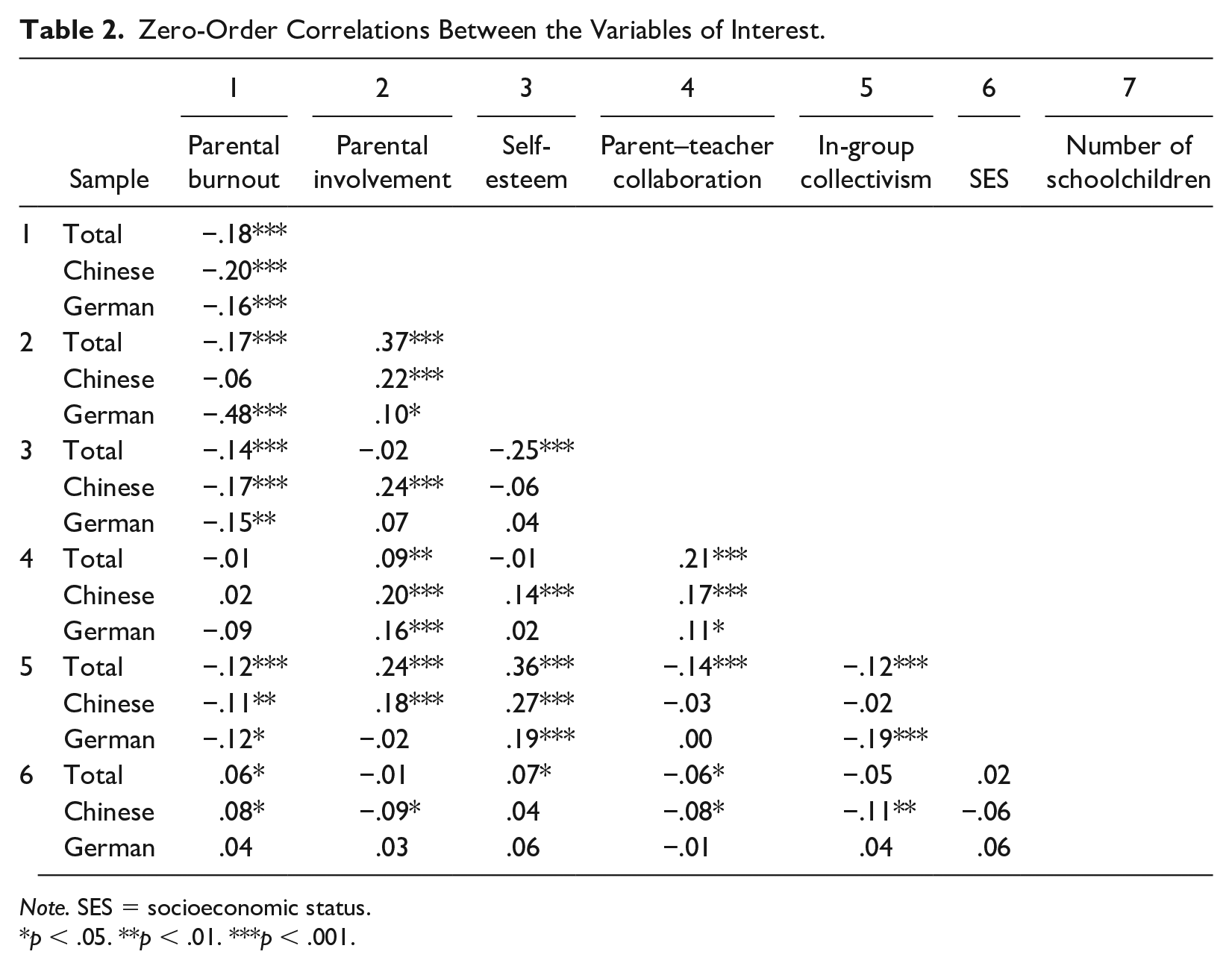
Note. SES = socioeconomic status.
p < .05. **p < .01. ***p < .001.
Intercorrelations of the Latent Constructs.
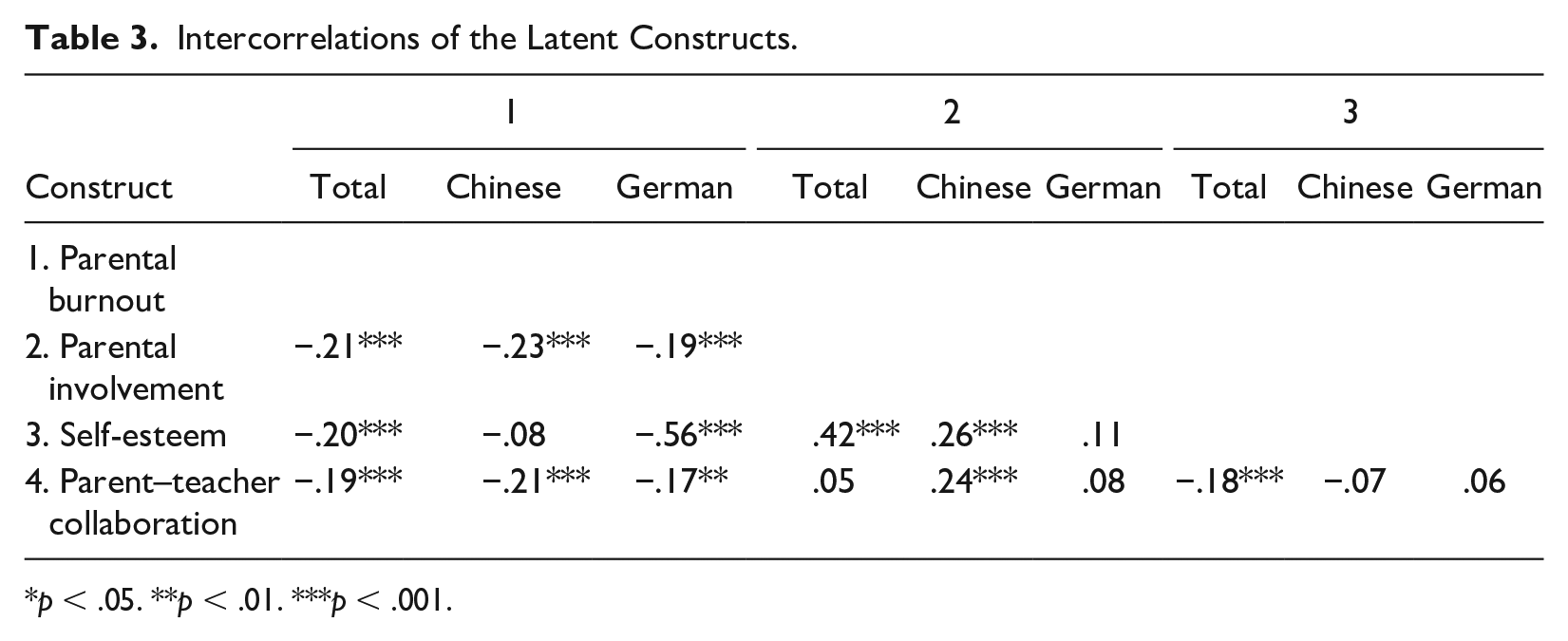
p < .05. **p < .01. ***p < .001.
Baseline SEM Results
We conducted a baseline SEM for each cultural group. For the Chinese sample, the model showed good fit, χ2(427) = 773.84, p < .001, CFI = .97, RMSEA = .03, 90% CI for RMSEA [.03, .03], SRMR = .04. Mothers (β = .15, p < .001), single parents (β = .13, p < .01), collectivist-oriented parents (β = .09, p < .05), and parents with more schoolchildren (β = .09, p < .05) reported higher levels of parental burnout symptoms. In comparison, parental global self-esteem (β = −.09, p < .05) and parent–teacher collaboration (β = −.23, p < .001) were negatively associated with parental burnout. SES (β = .18, p < .001), in-group collectivism (β = .12, p < .001), parent–teacher collaboration (β = .24, p < .001), and parental global self-esteem (β = .21, p < .001) were positively related to parental involvement. For the German sample, the baseline SEM model also fit the data well, χ2(427) = 726.98, p < .001, CFI = .94, RMSEA = .04, 90% CI for RMSEA [.04, .05], SRMR = .04. Mothers and parents with more schoolchildren reported higher levels of parental burnout (β = .09, p < .05). Parent–teacher collaboration (β = −.13, p < .01) and parental global self-esteem (β = −.55, p < .001) were negatively associated with parental burnout, whereas in-group collectivism was positively associated with parental involvement (β = .14, p < .05). Moreover, single German parents reported lower levels of parental involvement (β = −.12, p < .001).
Multigroup CFA and Latent Mean Differences
In accordance with the data analytic strategy outlined earlier, we first tested for the measurement invariance of our core latent constructs (i.e., parental burnout, parental involvement, parent–teacher collaboration, and parental global self-esteem). The results of the final measurement invariance models are presented in Table 4. All constructs showed at least partial scalar invariance across cultural groups, enabling latent mean comparisons of these constructs. The German sample was set as the reference group. Table 5 provides an overview of the latent mean differences. Compared with German parents, Chinese parents reported overall parental burnout scores that were 0.21 standard deviation units higher (z = 2.26, p < .001, d = 0.13), parental involvement scores that were 1.28 standard deviation units lower (z = −14.38, p < .001, d = 0.85), quality of parent–teacher collaboration scores that were 0.52 standard deviation units higher (z = 7.23, p < .001, d = 0.43), and self-esteem scores that were 1.75 standard deviation units lower (z = −13.79, p < .001, d = 0.83). Notably, the sign of the latent difference reversed for one of the four lower order parental burnout factors: The latent mean of emotional exhaustion was lower in the Chinese sample than in the German sample (z = −6.42, p < .001, d = 0.38).
Final Measurement Invariance Models for the Latent Constructs Across the Cultural Groups.
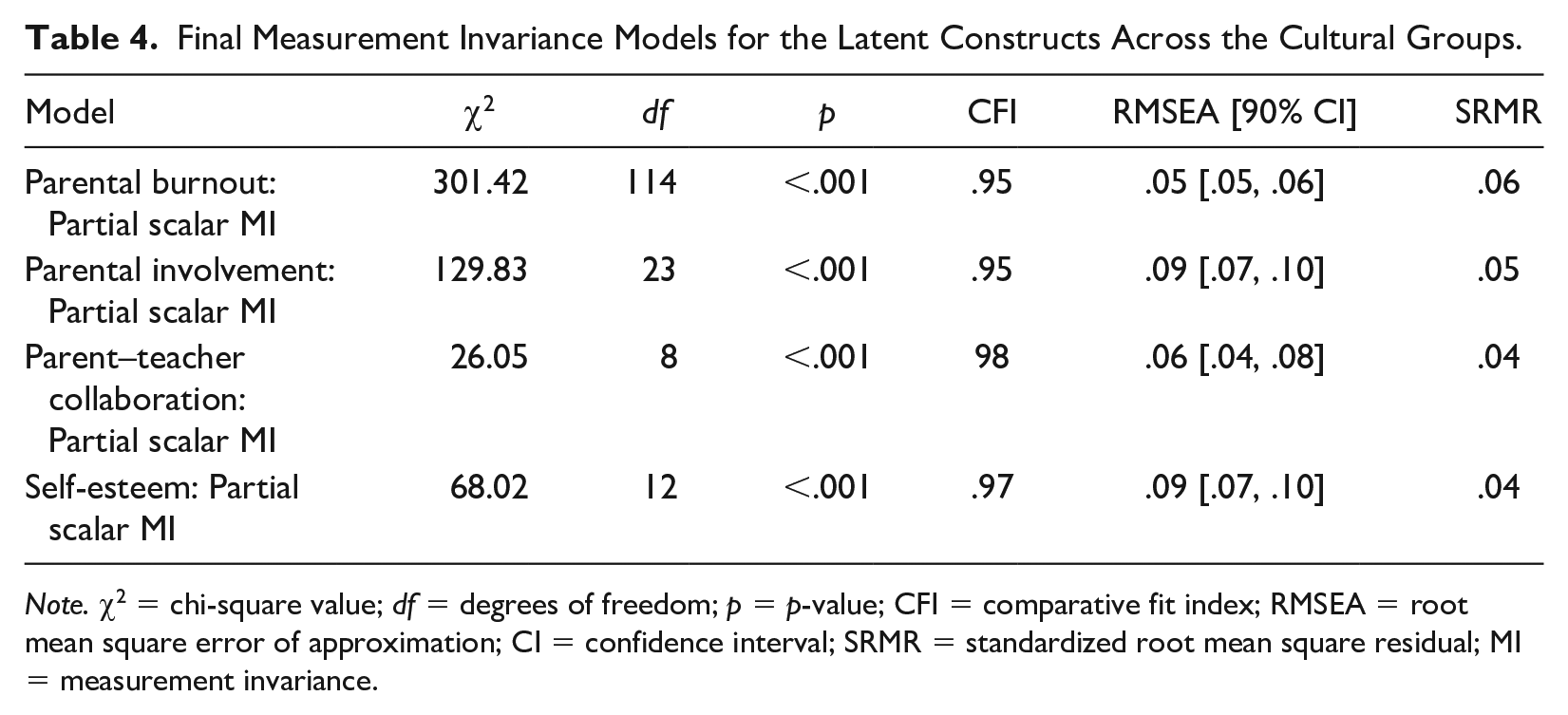
Note. χ2 = chi-square value; df = degrees of freedom; p = p-value; CFI = comparative fit index; RMSEA = root mean square error of approximation; CI = confidence interval; SRMR = standardized root mean square residual; MI = measurement invariance.
Latent Mean Comparisons.
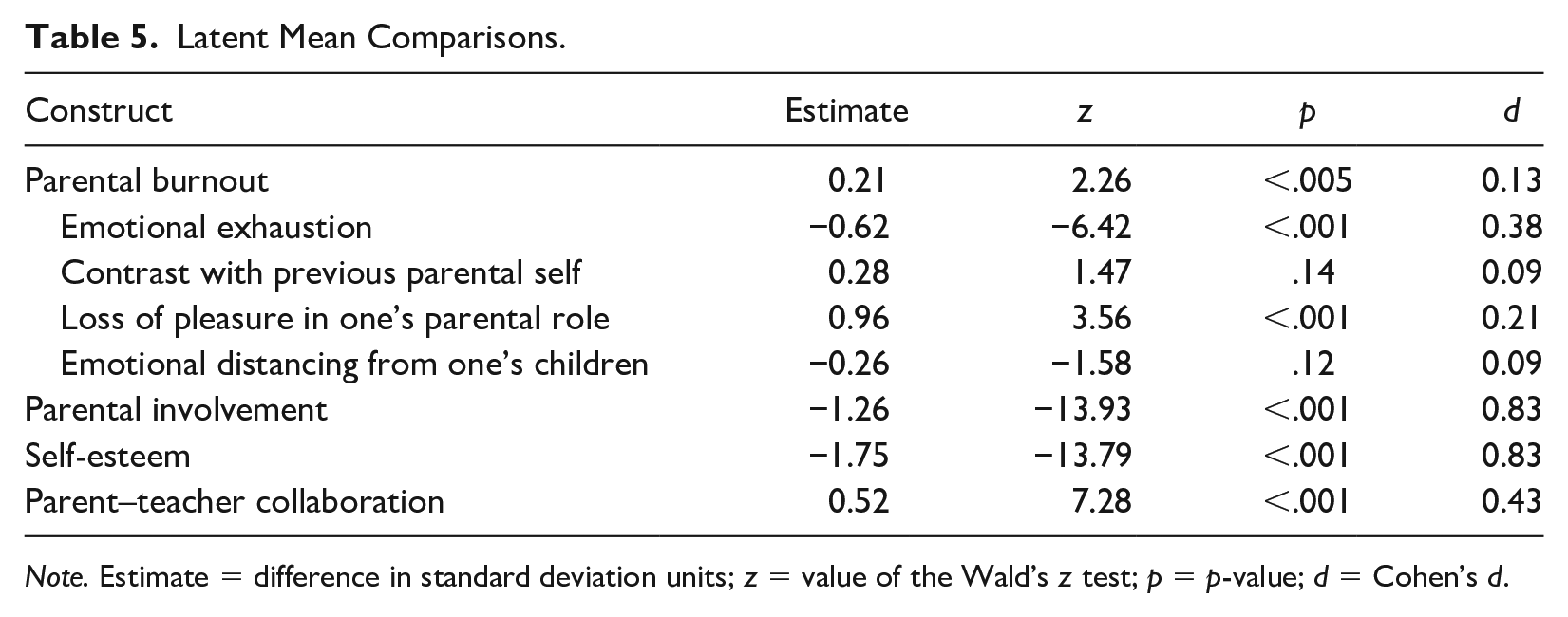
Note. Estimate = difference in standard deviation units; z = value of the Wald’s z test; p = p-value; d = Cohen’s d.
Multigroup SEM Results
The configural SEM (i.e., all path coefficients and covariates were freely estimated) fit the data acceptably well, χ2(890) = 1722.79, p < .001, CFI = .95, RMSEA = .04, 90% CI for RMSEA [.04, .04], SRMR = .05. After constraining all path coefficients and covariates, the structural invariance SEM continued to fit the data acceptably well, χ2(922) = 1847.97, p < .001, CFI = .94, RMSEA = .04, 90% CI for RMSEA [.04, .04], SRMR = .06. According to the criteria suggested by Chen (2007), the differences in the fit indices were not substantial, Δχ2(32) = 125.18, p < .001, ΔCFI = −.006, ΔRMSEA = .002, ΔSRMR = .016. Table 6 presents the path coefficients in the final SEM model and shows that several significant relationships in the baseline SEM models lost their statistical significance in the final restrictive SEM model. Briefly, there were no significant differences in the structural relationships between parental burnout, parental involvement, and the presumed factors of influence between the two cultural groups (Figure 2).
The Results of the Structural Invariance Model.
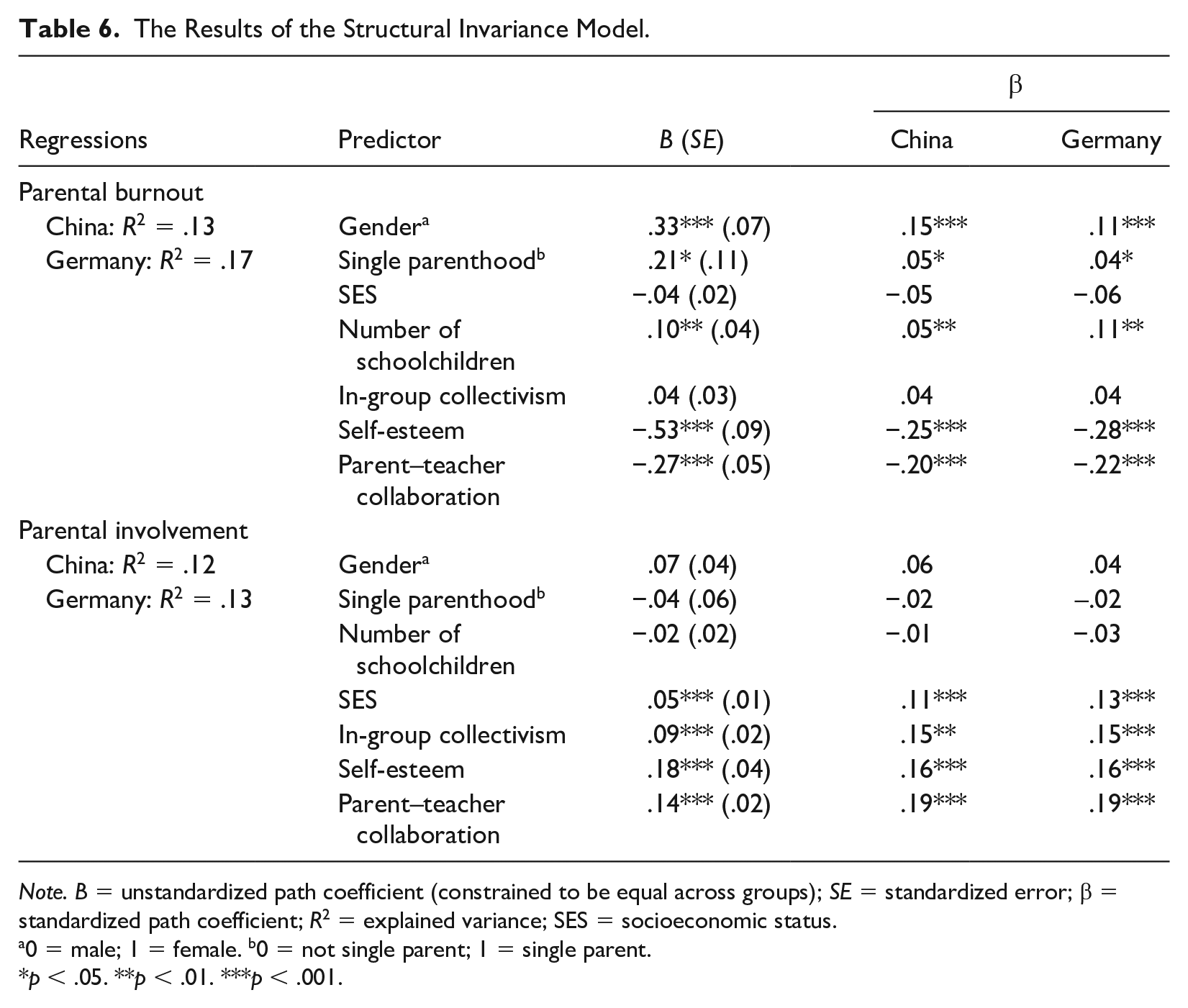
Note. B = unstandardized path coefficient (constrained to be equal across groups); SE = standardized error; β = standardized path coefficient; R2 = explained variance; SES = socioeconomic status.
0 = male; 1 = female. b0 = not single parent; 1 = single parent.
p < .05. **p < .01. ***p < .001.
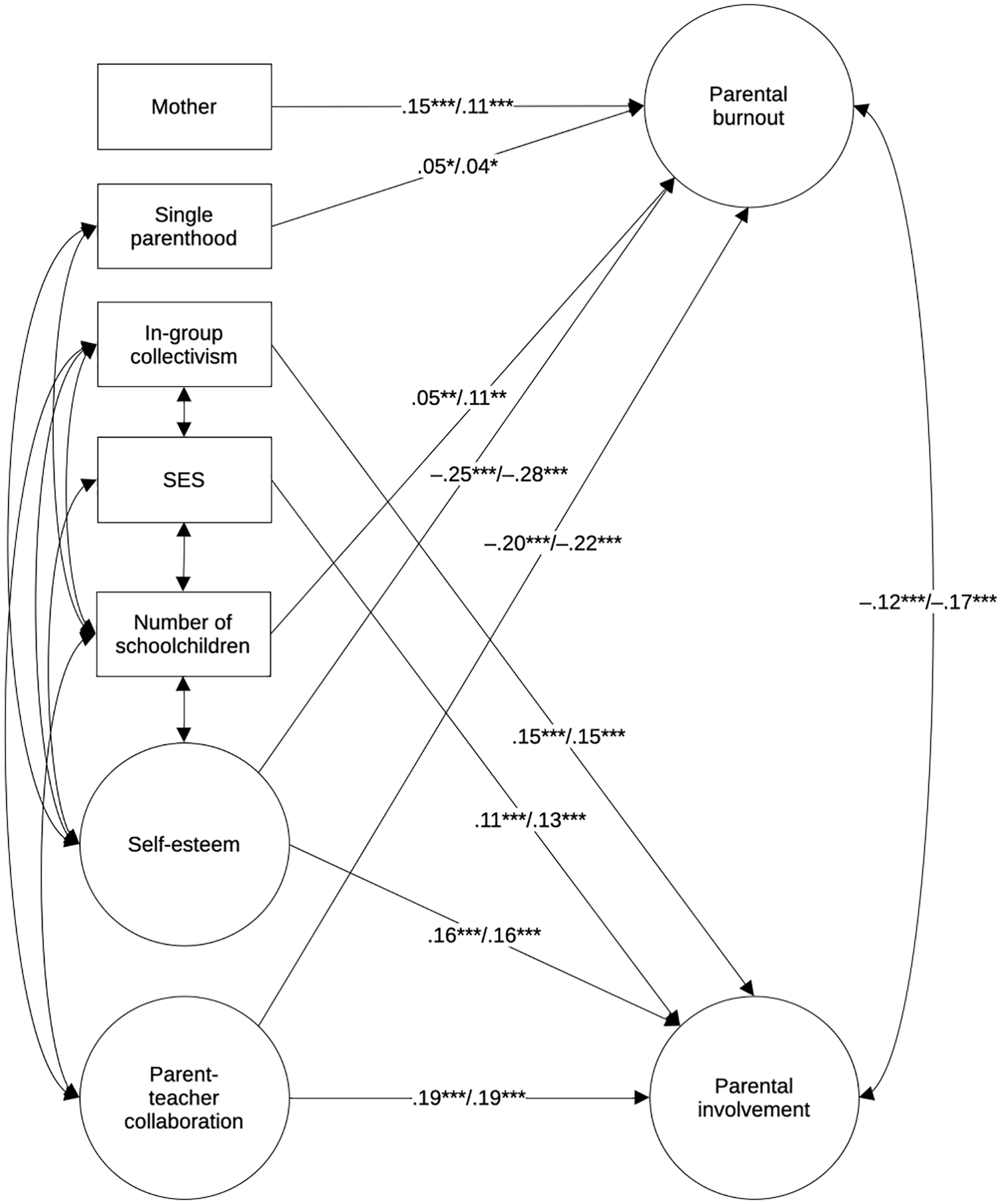
The Final Structural Invariance Model.
Discussion
The overarching goal of this study was to test the cross-cultural validity of the demands-resources framework in the parenting context by incorporating two fairly independent research traditions and including important cultural values and parental characteristics. Overall, our results support the notion of high applicability of the demands-resources framework in the parenting context in both Chinese and German cultures. In line with our assumptions, parental global self-esteem and high-quality parent–teacher collaboration are protective factors that can prevent parents from having negative emotional responses to parenting stressors and may encourage parental involvement. This finding was robust across Chinese and German parents, offering an initial indication of the universality of the resilience effect of such parenting resources. In addition, we used a rigorous methodology to uncover cultural differences and similarities in parental burnout, parental involvement, parental global self-esteem, and parent–teacher collaboration. Overall, Chinese parents reported more parental burnout symptoms, less parental involvement, lower self-esteem, and higher quality of parent–teacher collaboration than German parents.
Cross-Cultural Associations Between Parental Characteristics, Burnout, and Involvement
The high level of fit of the baseline SEM models provided an initial indication of the validity of the demands-resources model for estimating the predictors of parental burnout and parental involvement. The results of the multigroup SEM models further suggest that the relationships between parental burnout, parental involvement, and the presumed factors of influence (i.e., gender, SES, single parenthood, the number of schoolchildren, in-group collectivism, self-esteem, and parent–teacher collaboration) were invariant across the cultural groups. In other words, population membership did not significantly change these associations, implying the robustness of these findings across Chinese–German cultures and a potentially universal underlying mechanism.
More specifically, parents who reported higher self-esteem and higher quality of parent–teacher collaboration reported lower levels of parental burnout and higher levels of parental involvement. Hence, consistent with our hypotheses, self-esteem and high-quality parent–teacher collaboration can be regarded as parenting resources for both Chinese and German parents. This finding offers further evidence in support of the universality of the positive link between well-being and a general positive self-evaluation (Schmitt & Allik, 2005). It also indicates that high self-esteem assists parents in maintaining their well-being and involvement in demanding parenting situations. Quality parent–teacher collaboration does not only foster parental involvement in children’s schooling (Hoover-Dempsey et al., 2005) but also serves as an additional resource to help parents cope with parenting and educational demands. In line with previous findings (Roskam et al., 2017), mothers were found to experience more parental burnout symptoms and were more involved in their children’s education. This result indicates that the mother may still be the main caregiver and shoulders the main responsibilities with respect to children’s education (Mikolajczak & Roskam, 2018). However, as in many studies involving parents (e.g., Lamela et al., 2016; Roskam et al., 2017; Teuber, Tang, et al., 2022), mothers were overrepresented in this study. The authors of previous studies (Lindström et al., 2011; Mikolajczak, Raes, et al., 2018; Roskam et al., 2017) have pointed out that parental burnout concerns both fathers and mothers and that fathers who care about their paternal role and make an effort to be involved in their children’s development have the same likelihood of experiencing parental burnout as mothers. To validate this finding, future studies should put more effort into recruiting fathers.
As hypothesized, low SES was associated with more parental burnout symptoms (Mikolajczak & Roskam, 2018) and less parental involvement in children’s education (Hoover-Dempsey & Sandler, 2005; Jeynes, 2003, 2007), thus indicating that low SES can be viewed as a risk factor for parental maladjustment. As postulated by the demands-resources framework (Bakker & Demerouti, 2014; Gusy et al., 2016; Niewöhner et al., 2022; Salmela-Aro & Upadyaya, 2014; Teuber, 2021; Teuber et al., 2021a, 2021b), in both cultural groups, parents who reported higher scores on parental burnout reported lower scores on parental involvement. In-group collectivism, which reflects the extent of interdependence within a family, was related to more parental involvement as expected. In contrast to previous findings (Mikolajczak & Roskam, 2018), in-group collectivism was not related to parental burnout. An explanation is that greater interdependence within the family may be more strongly linked to emotional exhaustion but not necessarily to the other dimensions of burnout. The practice of sharing parenting responsibilities with relatives, which is common in collectivistic cultures, may serve as a valuable resource in alleviating mental and physical fatigue among parents. However, the dimensions of burnout related to emotional distancing from one’s child, loss of parenting pleasure, and shame about the current parental self may necessitate higher levels of parents’ self-regulatory competence. It is important to note that parental burnout is a complex phenomenon influenced by various individual, interpersonal, and cultural factors. To comprehensively understand the unique dynamics involved in parental experiences within different cultural contexts, further research is needed to explore the specific mechanisms and factors contributing to each dimension of burnout.
In addition, we observed a positive association between the number of schoolchildren and parental burnout, suggesting that the demands and responsibilities associated with parenting school-aged children may contribute to elevated levels of parental burnout. Managing multiple children’s academic, social, and extracurricular activities, along with the added pressures of navigating school systems and supporting educational needs, can impose significant strain on parents.
Unexpectedly, single parenthood was not associated with parental burnout or parental involvement, suggesting that single parents are not necessarily at higher risk of parental burnout per se. Although this result is encouraging at first glance, it can likely be attributed to the fact that single parenthood was measured by asking participants whether they were single parents. Such an approach might not be accurate enough to reflect a lack of coparenting support (Feinberg, 2003; Mikolajczak & Roskam, 2018) because ex-partners or new partners can still be involved in parenting tasks.
Cross-Cultural Findings on Parental Burnout, Parental Involvement, and the Presumed Parenting Resources
As discussed above, the health-impairing effects of parenting demands and the motivational effects of parenting resources appeared to be comparable between the two cultural groups. Yet, the levels of the relevant constructs differed between the groups. The results of the previous cross-cultural study by Roskam et al. (2021) suggested that parental burnout is more prevalent in individualist-oriented cultures (Roskam et al., 2021). Although it should be noted that the size of Roskam et al.’s (2021) German sample was small (N = 135), which may have influenced the reliability of the results from their German sample. In this study, however, Chinese parents reported a higher average level of parental burnout than German parents, and the results of latent mean comparisons showed that, overall, Chinese parents experienced more parental burnout symptoms than German parents did. In Chinese society, supporting children’s school success is of paramount importance to parents because obtaining a higher education is generally seen as the primary path to socioeconomic advancement for most families (Teuber et al., 2021b). These high social expectations create immense pressure for Chinese parents and may make them more vulnerable to education-related parenting demands. However, it is crucial to clarify that our study did not specifically measure parental burnout related to children’s education. While acknowledging the potential influence of societal pressures, we strive to maintain a balanced perspective and avoid overemphasizing this particular aspect of parental burnout in our interpretation of the results. Furthermore, we found more fine-grained cultural differences and similarities in the components of burnout. Compared with German parents, Chinese parents were less likely to suffer from emotional exhaustion but more likely to lose pleasure in their parental role. Yet, there were no cultural differences in the feeling of being less competent as parents and emotional distancing from one’s children. Differences in family structure may explain this finding. The risk of parental burnout increases with the number of children (Mikolajczak & Roskam, 2018). Emotional exhaustion may be particularly affected. Although the one-child policy was abolished in 2015, most Chinese families still have a one-child household (National Bureau of Statistics of China, 2022). In addition, in collectivist-oriented China, more grandparents are involved in bringing up children (Luo et al., 2020), and they can therefore serve as social resources, share the parents’ burden, and reduce the parents’ emotional exhaustion (Mikolajczak & Roskam, 2018). For a deeper understanding of the effects of family structure on parental burnout, factors such as the number of children in the household and grandparental support should be included in future studies. In terms of the cultural variation in the loss of parenting pleasure, we speculate that it may be associated with more frequent emotional suppression among Chinese parents. Previous cross-cultural studies have consistently shown that expressive suppression is used to a greater extent by individuals from collectivistic cultures than by individuals from individualistic cultures (Arens et al., 2013; English & John, 2013). Furthermore, research has demonstrated that expressive suppression is linked to lower emotional well-being and reduced enjoyment in parenting (e.g., Le & Impett, 2016). Therefore, future cross-cultural investigations on parental burnout should place greater emphasis on exploring emotion regulation strategies.
Contrary to our hypothesis, Chinese parents reported less parental involvement than German parents. This result may be explained by the manner in which parental involvement was measured. Parental involvement in this study was limited to parent–child conversations about school-related topics. Cross-cultural studies on parent–child interactions have revealed that parents in individualistic cultures talk more frequently with their children not only about school but also about the children’s emotions and needs (Eid & Diener, 2001; Markus & Kitayama, 1991; Teuber, Schreiber, et al., 2022). We speculate that Chinese students tend to suppress their emotions and avoid talking to their parents when they have difficulties in school in order to maintain family harmony. Another possible explanation is the variation in parental educational level, which was found to be positively associated with parental involvement (Kohl et al., 2000). In this study, the proportion of parents with an academic education was relatively high in the German sample but relatively low in the Chinese sample. Although we controlled for the number of books in the household, which is an indicator of parental cultural capital and SES (Bourdieu, 1986; Paulus, 2009; Stubbe et al., 2011), we could not rule out a possible bias in the results in this respect.
In terms of parental global self-esteem and the perceived quality of parent–teacher collaboration, we found that the Chinese parents reported lower levels of self-esteem and perceived the quality of parent–teacher collaboration to be higher than the German parents did. Hence, our study supports the notion that individuals in collectivistic-oriented cultures tend to exhibit greater humility in expressing their self-image compared with individuals in individualistic-oriented cultures (e.g., Bleidorn et al., 2016; Diener & Diener, 2009; Gnambs et al., 2018). The findings concerning the cross-cultural difference in the quality of parent–teacher collaboration are consistent with previous results reported in PISA studies (OECD, 2019b). This alignment is not surprising, given the long-standing issue of trust in public schools in Germany, which has persisted over the years (Teuber, 2021) and was further exacerbated during the COVID-19 pandemic (Huebener et al., 2021), the period during which this study was conducted.
Theoretical and Practical Implications
As the first study to combine parental burnout and parental involvement using the demands-resources framework, our findings support the usability of this framework in the parenting context. Parental global self-esteem and high-quality parent–teacher collaboration are two significant factors that offer protection against parental burnout and foster parental involvement in children’s education. By contrast, low SES can be regarded as a risk factor. The demands-resources framework may be useful for identifying more protective and risk factors that influence parental emotional responses and parental involvement. In future research, the role of in-group collectivism and coparenting should be investigated further.
Several practical implications can be derived from the current findings. In both cultural groups, high parental global self-esteem and high-quality parent–teacher collaboration may prevent parents from experiencing parental burnout and may facilitate parental involvement. Teachers are suggested to establish a supportive and collaborative relationship with parents by welcoming parents as active participants in school and communicating with parents in effective ways (Parent Teacher Association, 2021). In particular, previous studies have indicated that parent–teacher collaboration is more relevant in individualistic societies, including Germany, such that many parents do not trust public primary and secondary schools and do not feel welcomed by the school (for details, see Froiland, 2021). However, teachers sometimes have reservations and label parents as hard-to-reach when they do not participate in school events, such as parent–teacher conferences (Christenson & Reschly, 2010; Grüter et al., 2021; Sacher et al., 2019). Schools that seek to involve parents should encourage diverse ways of engagement that considers the individual situation of the family and the student’s need for support and offer opportunities to get involved to parents who are limited in their resources (e.g., because of other siblings or the parents’ work situation; Amatea et al., 2013; Grolnick, 2016; Hornby & Blackwell, 2018).
Limitations and Future Research
Several limitations that may open avenues for future research should be mentioned. First, this study had a cross-sectional design, and we were not able to draw causal conclusions. Yet, as this is the first study to examine parental burnout and parental involvement using the demands-resources model in a cross-cultural setting, a more complex study design would be beyond the scope of this study. The current findings provide a foundation for future studies that can apply this model longitudinally. Second, both samples were collected during the first outbreak of COVID-19. Whereas German school students received partial remote schooling, Chinese students in the data collection areas still went to school. This contextual difference may have additionally contributed to differences in levels of parental burnout and parental involvement. Third, we included mainly sociodemographic data related to parents, more child-related information may be beneficial. In our study, the two cultural samples differed in terms of single parenthood, educational level, and SES. Future scholars are encouraged to recruit more comparative cultural samples. Moreover, we used the availability of home literacy resources as an indicator of SES, which is closely related to educational level. While this approach is cost-effective, it may not be the most optimal choice. We recommend utilizing the International Socioeconomic Index of Occupational Status (ISEI; Ganzeboom et al., 1992) as a more accurate indicator. Although different sample sizes do not critically affect multigroup CFA and SEM results (Koh & Zumbo, 2008), it would be desirable to obtain more balanced samples. Furthermore, German society is strongly affected by immigration. The nationwide proportion of immigrant school students was 39% in 2020 (Federal Statistical Office of Germany, 2021). It may be interesting to conduct an in-depth investigation of parental burnout between different immigrant groups in Germany. Fourth, this study focused on parental perceptions and experiences. Given the potential impact of parental burnout and parental involvement on child development reported in the literature, it may be worthwhile to obtain children’s and also teachers’ reports of associated factors. Fifth, as elaborated in the literature review, parental global self-esteem affects parental burnout by influencing cognitive appraisals and coping, and parent–teacher collaboration affects parental involvement by improving parents’ motivational beliefs. Investigating such mediating mechanisms may be worthwhile as an additional way to contribute to the literature and to our understanding. Finally, we opted for a dimensional approach to assess parental burnout. While this approach allowed us to capture important aspects of the construct, it may limit the direct comparability of our findings with other studies that have utilized the full-scale measurement of parental burnout. To enhance the comparability and comprehensiveness of future research, it would be advantageous to incorporate the complete scale when examining parental burnout.
Conclusion
Supporting and witnessing children’s development can be a joyful experience. Yet, the increasing demands on parents can bring great strife. In this study, we used the demands-resources framework for the first time to investigate the relationships between parental burnout, parental involvement, parenting demands, and parenting resources in a cross-cultural setting. Our results show that Chinese parents are on average more likely to experience parental burnout and are less involved in their children’s education through communicating about school-related topics than German parents. Furthermore, Chinese parents report lower self-esteem but better collaboration with teachers. Across both cultures, parental global self-esteem and high-quality parent–teacher collaboration can be seen as important parenting resources, which have the potential to empower parents and decrease the likelihood of parental distress. However, further longitudinal cross-cultural studies are encouraged to gain a deeper understanding of the mechanisms behind parental burnout and parental involvement in different cultural and education systems.
Footnotes
Author Contributions
Z.T. designed the study, collected the data, analyzed the data, interpreted the results, and drafted and revised this manuscript. Q.W. and Y.S. contributed to the study by collecting data. S.G., K.B., and S.G. contributed by revising the manuscript. All authors read and approved the final manuscript.
Data Availability Statement

Declaration of Conflicting Interests
The authors declared no potential conflicts of interest with respect to the research, authorship, and/or publication of this article.
Funding
The authors received no financial support for the research, authorship, and/or publication of this article.
Compliance With Ethical Standards
The study protocol (protocol number: 2020-175) was approved by the Ethical Review Board of Bielefeld University, Germany. Participation was voluntary, and informed consent forms were collected from both samples of participants.