



Abstract
According to Western folk theory of social change, modernization of societies causes them to become less warm but more competent over time. Since WEIRD (Western, educated, industrialized, rich, and democratic) societies are often at the forefront of modernization (with some exceptions, most notably China), these societies may also be most prone to internalizing this folk theory. In this research, we test this idea by making a comparison across a sample group of Western and Asian societies, using a self-report measure of perceived societal warmth and competence: The Social Change Perception Scale (SCPS). We found the scale to be metrically invariant among university students from a set of Western and Asian countries (United States, Australia, New Zealand, Austria, The Philippines, China, and Malaysia). In all seven countries, people expected their society to become more competent over time. In most countries, people also expected their society to become colder over time, although this tendency was slight and insignificant among New Zealanders and Americans. The perceived social cooling tended to be more prevalent in Asian countries rather than in Western countries. The countries’ degrees of WEIRDness, as reflected in their country-level indicators of individualism, education, industrialization, wealth, and democracy, did not adequately account for the observed variation. Though there is still much work to be done in applying the SCPS to broader samples and contexts, this study provides a starting point for measuring and understanding how people experience the social implications of modernization around the world.
“Modernization theory” suggests that the economic, political, technological, and more broadly, social and cultural aspects of societies, evolve over time, and transform traditional communities into modern societies. According to Knöbl (2003), “modernization theory” is a set of ideas that is difficult to attribute to specific thinkers as these ideas echo through both historical (Bendix, 1967; Durkheim, 1893/1964; Gusfield, 1967; Marx, 1890; Tönnies, 1887/2002) and contemporary (Greenfield, 2009; Hamamura, 2012; Inglehart & Baker, 2000; Tu, 2000) social scientific research. Many societies have become more democratic (Russett, 1990; Sen, 1999), educated (Conceição, 2020), and wealthy (Davies et al., 2017) in the course of modernization. Henrich et al. (2010) brought these background notions into sharp focus by suggesting that those cultures at the forefront of broad trends of modernization could be categorized as WEIRD, an acronym for Western, educated, industrialized, rich, and democratic. Those countries that began the path toward “modernity”—a rather contested notion in and of itself (e.g., Giddens, 1990)—have significantly diverged from the rest of the world both culturally and psychologically.
In addition to the academic theories of how societies change over the course of their modernization processes, there are so-called “folk theories of social change” (Y. Kashima et al., 2009). Instead of being based on social scientific research, these folk theories represent popular beliefs about how society changes. One particular folk theory, “Western folk theory of social change” (hereafter Western FTSC), seems to be especially widespread. In short, this theory embodies the notion that through the universal process of modernization, societies everywhere change from close-knit communities to more industrialized and market-oriented societies, the latter being less warm yet more competent. One of the most discernible indicators of this assumed structural change is a change in people’s behavior patterns. Acording to Western FTSC, as societies structurally change from traditional communities to market economies, the vast majority of individuals, and as a result, their society as a whole, become more competent and capable, but less warm.
The present paper addresses two issues associated with Western FTSC research: First, there is no established method to measure perceived changes in a society’s competence and warmth. Second, given that most countries in the world may currently be seen to be modernizing, it is unclear whether Western FTSC is actually occurring only in Western societies. This naturally raises the question of whether or not Western FTSC has become more widespread. To address the first issue, we developed the Social Change Perception Scale (SCPS), a self-report measure of perceptions of one’s society’s past and future warmth and competence. Detail regarding the development and functionality of the scale will be presented in a subsequent section in this paper. To address the second issue, we used the SCPS to measure the prevalence of Western FTSC across a small set of Western and Asian countries and examine if WEIRDness accounts for the variations in Western FTSC across these countries.
How Does Western FTSC Relate to Future Development?
Y. Kashima et al. (2011) have proposed that the notion of societies becoming cooler but more competent, as implied by Western FTSC, is not merely a reflection on and extrapolation of history into the future. Instead, this notion may influence future-oriented behavior via mechanisms described in the “collective futures” framework (Bain et al., 2013; Milfont et al., 2014; Park et al., 2015).
Although people generally believe that their society will become cooler and more competent over time, they usually want it to remain as warm, or be even warmer, than it currently is. Indeed, Y. Kashima et al. (2009) found that Australian students who believed their future society would be less warm tended to support social policies designed to improve community cohesion, especially when they thought their society could be changed for the better by such policies. Thus, expectations about social warmth may be important motivators of people’s actions. In other words, people are more likely to support social movements and policies designed to promote social cohesion rather than efficiency. Tapping this preference for warmth and morality could potentially facilitate sustainable and culturally sensitive societal development, however, to make the best use of this potentially universal motivator, the first step is to reliably measure perceptions of social change across different countries.
Measuring Changes in Perceptions of a Society’s Competence and Warmth
As noted earlier, Western FTSC proposes that as societies become more market-oriented as they modernize, they become less warm but more competent. It is not a coincidence that Western FTSC revolves around these two dimensions, also referred to in the field as the “Big Two” (Abele et al., 2021; Paulhus & Trapnell, 2008), as they are likely universal and fundamental dimensions of social perception (Abele & Wojciszke, 2014; Cuddy et al., 2008; Fiske et al., 2007; Judd et al., 2005) that represent broad classes of meaning in the human mind. While competence relates to task-oriented functioning and goal achievement, warmth relates to forming and maintaining social relationships (Abele & Wojciszke, 2007). A large amount of the variance in how individuals perceive other people’s actions is accounted for by warmth and competence (Wojciszke, 2005a), and indeed, most people tend to spontaneously construe past events in terms of either warmth or competence (Wojciszke, 1994). For example, people tend to use terms such as well-done or clever when describing their own behavior while terms such as helpful or kind are more frequently used to describe observed behavior. Warmth and competence also typically capture stereotypes about social groups across cultures (Cuddy et al., 2009; Fiske & Durante, 2016), which suggests that these two dimensions are suitable for cross-cultural research on the perceptions of social groupings in general.
Unsurprisingly, research also found some cultural differences in the way people ascribe warmth and competence to social entities. For example, Western cultures seem to be more prone than Asian cultures to ascribing warmth and/or competence to their own groups than to other groups (Fiske & Durante, 2016). People in societies with higher income inequality (as measured by the Gini index) tend to describe groups ambivalently (e.g., high warmth yet low competence) and to perceive competitive groups as less competent (Durante et al., 2013, 2017) than people in more equal societies. Together, these studies point to the possibility that warmth and competence can capture the content of perceptions about human groups in many cultures, albeit with variations due to cultural particularities. Western FTSC research looks specifically at how people think their own society’s warmth and competence change over time and whether these perceptions relate to some specific features of their society.
Although early research in social perception (e.g., Fiske et al., 2002; Rosenberg et al., 1968) typically included both morally good (e.g., sincere) and interpersonally good (e.g., likeable) as characteristics that fell into the warmth dimension, it has been argued that morality should be distinguished from warmth in the narrow sense of interpersonal likability (Bain et al., 2013; Brambilla et al., 2021; Leach et al., 2007; Wojciszke, 2005b; Wojciszke & Klusek, 1996). For example, morality is reflected in traits such as sincerity, honesty, and trustworthiness, while warmth is reflected in traits such as friendliness and likeability. According to the moral primacy model of impression development (Brambilla et al., 2021), morality plays the primary role in impression development because it presents especially important cues as to whether other individuals are likely to be beneficent or harmful to the person forming the impression. Consequently, one aspiration in the development of the SCPS was to distinguish morality as a separate factor. As communities change into more modern societies, Western FTSC may predict that both warmth and morality (together referred to as benevolence; Bain et al., 2013) or only one of them, will decline. Therefore, investigating morality as a separate factor may improve our understanding of Western FTSC. Being mindful of the differences between warmth and morality, we aimed for a three-dimensional solution (warmth, competence, and morality), but would adopt two-dimensional solutions (warmth and competence; benevolence and competence) in case three-dimensional solutions would turn out to be untenable across cultures.
Investigating cultural similarities and differences requires culturally invariant measures. Violations of measurement invariance may occur when the same measure is interpreted in conceptually different manners in different cultural contexts, which can result in inappropriate comparisons and conclusions (Chen, 2008). For example, Chinese people tend to focus on the somatic symptoms of depression while Westerners tend to focus on the psychological symptoms (Isaac et al., 1996; Kirmayer & Young, 1998; Ryder et al., 2002). As such, when using Western instruments to measure depression in China, one ends up with depression rates several magnitudes smaller than in Western cultures (e.g., Zhang, 1995). It has been proposed that the cultural syndromes in which depression manifests differ across cultures. Westerners tend to focus on the psychological distress, including negative moods, feelings of guilt, and worthlessness while Chinese people tend to focus on somatic problems, such as exhaustion (e.g., Parker et al., 2001). Western instruments designed to measure depression are therefore likely to underestimate depression rates in China and vice versa. Measurement invariance analysis allows us to detect such problems and to modify the instrument to factor out such cultural specifics. There are at least two relevant types of invariance: metric and scalar. A scale is metrically invariant when its items load on their respective latent factors in a way that is comparable across groups. Scalar invariance arises when the item intercepts, as opposed to the loadings, are equivalent across groups and, therefore, any mean differences between groups are unlikely to arise from the properties of the scale itself. Achieving metric invariance thus facilitates the comparison of patterns but not means across different groups, whereas achieving scalar invariance makes the comparison of means possible (Putnick & Bornstein, 2016).
To develop such a culturally invariant measure we recruited participants from several Western cultures (United States, Australia, New Zealand, and Austria) and Asian cultures (China, The Philippines, and Malaysia). The SCPS is the end product of that effort and is designed to measure how people in a given culture perceive their society’s change over time. For this purpose, metric invariance is sufficient (e.g., Milfont & Fischer, 2010).
Is Western FTSC a WEIRD Theory?
The SCPS also allows us to address the question of whether Western FTSC is indeed a Western phenomenon, as its name suggests. Although the beginning of modernization is hard to pinpoint, starting perhaps thousands of years ago when humans started farming and city building, it is fair to say that industrialization and the resulting economic growth that starting in 18th century Europe sometime between the invention of the spinning jenny and the steam engine, provided the basis of today’s modern societies. Because industrialization started in countries that later turned out as WEIRD, Western FTSC naturally has a longer history in these countries than elsewhere. It is therefore plausible that Western FTSC is more prevalent in WEIRD societies such as the United States. In other words, the prevalence of Western FTSC may depend on how WEIRD a society currently is. Available empirical observations suggest that Western FTSC does accurately depict beliefs in both Western cultures, such as Australia, as well as some Asian cultures, such as China and Japan (Y. Kashima et al., 2011), suggesting that the Western FTSC is not, or no more, a purely Western phenomenon. However, these empirical observations are few in number and limited in scope, meaning a comprehensive overview of how prevalent Western FTSC is around the globe is currently lacking. Furthermore, because Western FTSC is a theory of how modernization dynamically affects society, its prevalence may be coupled to a society’s current speed of modernization or the rate at which it is currently approaching “WEIRDness,” as evidenced by high levels of formal education, industrialization, and wealth generation. We will address these possibilities by investigating the relationship between the prevalence of Western FTSC, as measured by the PSCS in our samples, these samples’ present-day WEIRDness indicators, and the changes in these indicators.
Our objectives in this paper were twofold. First, we wanted to design a measure of past and future societal warmth and competence perceptions, which we did and then tested its invariance across seven countries. Second, we wanted to use the new measure to determine the prevalence of Western FTSC across the sample group of countries to determine the extent to which Western FTSC relates to WEIRDness. To provide a fine-grained investigation, we correlated the cultures’ differential adherence to Western FTSC with country-level indicators using certain aspects of WEIRDness: individualism, education, industrialization, wealth, and democracy.
Method
Samples
Participants for this study were 1,516 university students from seven countries: Three Asian countries, namely The Philippines (n = 219), China (n = 233), and Malaysia (n = 355), and four Western countries, namely Australia (n = 204), United States (n = 199), New Zealand (n = 219), and Austria (n = 87). All the participants were between 18 and 30 years old (M = 20.3, SD = 2.20), the majority (62%) were between 18 and 20 and 66% were female. Supplemental Table S1 summarizes the demographic composition of each sample. The survey project was initiated by one of the authors who ran the study in Australia and the United States. The other authors joined the project by creating translations of the survey as required, using back-translation, and distributing it at their local universities in New Zealand, Austria, the Philippines, China, and Malaysia. A subset of the Malaysian sample was collected in Kuala Lumpur where the English version of the questionnaire was administered as it was that university’s language of instruction; the rest of the Malaysian sample was collected in Sabah, where the questionnaire was bilingual (Malay and English). A translation of the questionnaire was not required in the Philippines because English is the primary language of instruction at all levels of education. The data were collected between October 2016 and September 2017 while the seven countries and specific locations were selected because the authors had ready access to student populations in these locations.
Sample size considerations
Determining the minimum sample size for structural equation models is complex (e.g., Kline, 2015). A common and simple approach is to focus on the parameter to participant ratio (also referred to as N:q ratio) of the groups. Minimum recommendations for this ratio range from 5:1 (Bentler & Chou, 1987), 10:1 (Schreiber et al., 2006), or even as high as 20:1 (Kline, 2015) and all our subsamples exceeded even the strictest of these N:q ratios.
Materials
Social Change Perception Scale (SCPS)
The scale was initially written in English and the instructions were designed to induce reflections about perceived social changes across time: “We would like to ask you about how you think your society has changed from the past to the present and will change into the future. We will give you a list of words that can be used to characterize your society’s past and future.” To begin the process, we asked people about the changes they perceived from the past to the present: “First, please answer the following questions regarding how you think your society was 20 years ago (1996) relative to now (2016).” Immediately after that, we asked participants to use the same set of items to indicate how they think their society will change in the future: “Next, please answer how you think your society will be in 20 years from now (2036) relative to now.” For both past and future perceptions, we used the same items for warmth (warm, caring, friendly, and cooperative), morality (honest, ethical, just, and fair) and competence (efficient, effective, confident, assertive, active, intelligent, competent, and capable) and a scale ranging from 1 (Much less than now) to 7 (Much more than now). The scale midpoint (4) was labeled as “About the same.” We chose these items based on those used in previous studies (Y. Kashima et al., 2009, 2011), with no particular selection strategy in mind (see Supplemental Table S5 for a summary of the items used in past studies vs. those used in the present study). However, we did use three novel items (ethical, just, and fair) which were not used in any previous research. The intent behind this was to increase the chances of separating morality and warmth across cultures as we anticipated the novel items would allow us to capture morality as an independent dimension rather than being conflated with warmth. For reference purposes, Appendix A contains the final versions of the SCPS and scoring instructions in English, German, Chinese and Malay.
Demographic questionnaire
The demographic questions included age (in years), gender, student status, paid-work experience (yes vs. no), volunteer experience (yes vs. no), socio-economic status (low-income, lower-middle class, middle class, upper-middle class, and high-income), region (rural, a small city of less than 500,000, and a large city of more than 500,000), primary cultural background, language spoken with mother, and language of instruction at high school (see Supplemental Table S1 for a summary).
Current WEIRDness indicators
For individualism, we combined Hofstede’s individualism index (Hofstede, 2001), the collectivism indicators from the GLOBE study (House et al., 2004), Minkov et al. (2017) and three indicators from Schwartz (2007): intellectual autonomy, affective autonomy, and embeddedness. We averaged all the above after re-scaling their values to range from 0 to 10 based on the respective measures’ absolute minima and maxima. Since the GLOBE collectivism indicators and Schwartz’s embeddedness indicator represent collectivism instead of individualism, we reversed these variables prior to averaging. The internal consistency of this set of measures (α = .80) was sufficient for averaging. Note that it is debatable whether individualism and collectivism can be thought of as the opposite ends of a single continuum, however, recent evidence supports a unidimensional view of individualism-collectivism at the country-level (Taras et al., 2014), which is the level of interest in this study. To quantify education, we used the 2016 Education Index as provided by the United Nations Development Program (Conceição, 2020). For industrialization and wealth, we used per capita gross domestic product (GDP) figures from 2016 (expressed in constant 2010 US$ values) based on the GDP estimates provided by the World Bank Group’s database (World Bank, 2021a, 2021b, 2021c). GDP represents an aggregate of all economic activity in a country and this was deemed sufficient for our purpose even though there are more specific indicators of industrialization (e.g., sectoral data for mining, manufacturing, construction and power consumption, etc.) that may be more preferable in other contexts. However, these specific indicators are not ideal for the present purpose because of the current global economic trend away from manufacturing and toward services (Rodrik, 2016), especially digital ones (Bukht & Heeks, 2019), meaning that specific indicators may lead to some countries appearing as more or less industrialized than they actually are. For democracy, we used the Democracy Index (The Economist Intelligence Unit, 2020).
WEIRDness change indicators
To quantify the change in individualism, we used data from a cross-cultural study that quantified worldwide changes in individualistic values (importance of friends relative to family, whether they valued self-expression and so forth) over time (Santos et al., 2017). Santos et al. (2017) reported these changes as regression coefficients representing estimates of the yearly changes in standardized indicators of individualistic values. In order to estimate 20-year growth rates of countries’ individualism levels, we multiplied these coefficients by 20, which is the number of years people had to look into the past and the future when filling out the SCPS. To quantify changes in education, industrial performance, wealth, and democracy, we relied on the same indicators used to indicate the countries’ current WEIRDness, however, we calculated the differences between these indicators in the years 2016 and 1996. For comparability, we calculated and used growth rates for each indicator. For example, to quantify changes in wealth, we calculated each country’s 20-year per capita GDP growth rate (((2016 GDP − 1996 GDP)/1996 GDP) × 100).
Procedure
The SCPS was administered as the first part of a larger online survey that was comprised of five parts: (1) beliefs about the past and the future of society (i.e., the basis for the SCPS), (2) beliefs about the past and the future of the self, (3) a 35-item social motive scale, (4) individual difference measures, and (5) demographic questions. Parts 2 to 4 of the survey are not relevant to this paper and the research outcomes based on data from these parts are presented in different publications (E. S. Kashima, Ochoa, et al., 2021; E. S. Kashima, Plusnin, et al., 2021).
Data Analysis
We analyzed the data in five steps. In Steps 1 to 3, we constructed the SCPS and examined its cross-cultural invariance. In Step 4, we tested whether the people in our samples actually held the view proposed by Western FTSC using an ANOVA with three factors: time (past and future), characteristic (warmth and competence) and country (Australia, United States, New Zealand, The Philippines, China, Malaysia, and Austria). If people did hold such a view, we surmised that we should observe a Time × Characteristic crossover interaction that arises from past societies being perceived as warmer than future ones and future societies being perceived as more competent than past ones. Obtaining a Time × Characteristic × Country interaction would indicate differences between countries in the way people ascribe warmth and competence to their past and future societies and, hence, to qualitative and/or quantitative cultural differences in the prevalence of Western FTSC in their respective societies. In Step 5, we used Spearman’s rank correlations to test our prediction that country-level averages of perceived reduced warmth but increased competence are related to how WEIRD the countries are, and how WEIRD they have become over the past 20 years. Data and codes are available at https://osf.io/tkzcq/?view_only=86458c7bbc2048c2b2f9968e4d288b07.
Results
In this section, we present the country comparisons of social change perceptions (Step 4) and their relationships with country-level WEIRDness (Step 5). Detailed results related to Steps 1 to 3 (the construction of the SCPS, including the measurement invariance analysis) are reported in the supplementary materials. To summarize Steps 1 to 3, the morality dimension could not be distinguished from the warmth dimension across cultures using exploratory factor analyses. Therefore, we settled on two dimensions: warmth and competence (Step 1). In the second step, we dropped items that did not load on warmth or competence across the sample countries to maximize cross-cultural applicability (Step 2). A multi-level confirmatory factor analysis on the resulting warmth and competence item sets provided evidence for metric invariance but not for scalar invariance (Step 3; see supplementary materials for further details). Having achieved metric invariance, comparisons of patterns across the countries was possible, however, when viewing our data we caution against comparing absolute levels of warmth and competence between the countries as the scale did not achieve scalar invariance.
Comparisons of the Factors’ Mean Levels Within Countries
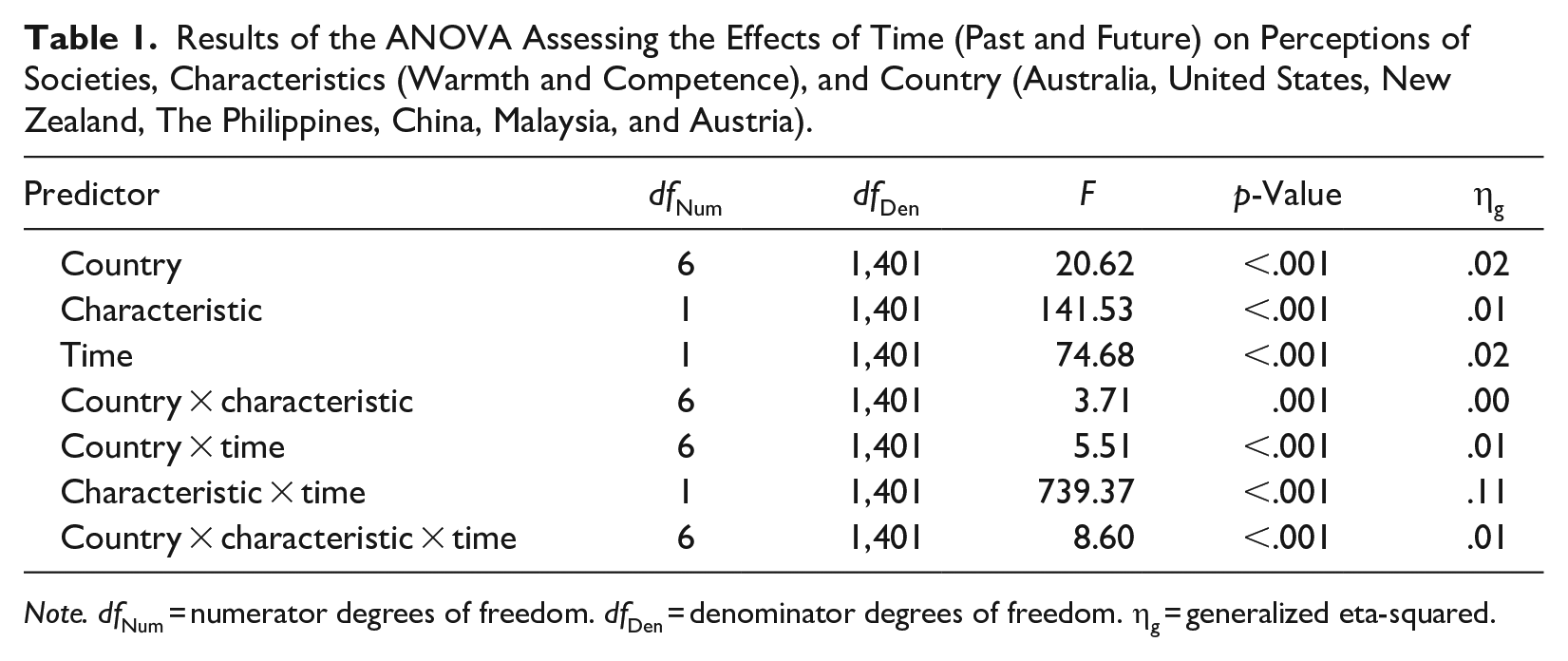
The ANOVA was used to examine the presence of Western FTSC in the sample group (Step 4) and revealed the main effects of time (levels: past and future), characteristic (levels: warmth and competence), and country (Australia, United States, New Zealand, The Philippines, China, Malaysia, and Austria) that were qualified by three two-way interactions (see Table 1).
Results of the ANOVA Assessing the Effects of Time (Past and Future) on Perceptions of Societies, Characteristics (Warmth and Competence), and Country (Australia, United States, New Zealand, The Philippines, China, Malaysia, and Austria).
Note. dfNum = numerator degrees of freedom. dfDen = denominator degrees of freedom. ηg = generalized eta-squared.
Unpacking the crucial and significant Time × Characteristic interaction revealed that people did indeed report that their future society will be more competent than their past society and their past society was warmer than their future society will be (see Figure 1), although the latter effect tended to be somewhat smaller than the former. Notably, the Time × Characteristic interaction proved to be the strongest predictor in the entire model (see Table 1). The Characteristic × Country interaction indicated that people from different countries ascribed different amounts of warmth and competence to their societies while the Time × Country interaction indicated that overall past and future ratings differed across countries. Both of these last two interactions, if considered in isolation, are irrelevant for the present question and, as such, will not be discussed further. Moving on to our central question, the three-way interaction was significant, indicating that the Time × Characteristic interaction was not uniform across countries. This points to the existence of cultural commonalities and differences in the way people in the seven countries endorse Western FTSC, which we will unpack next.
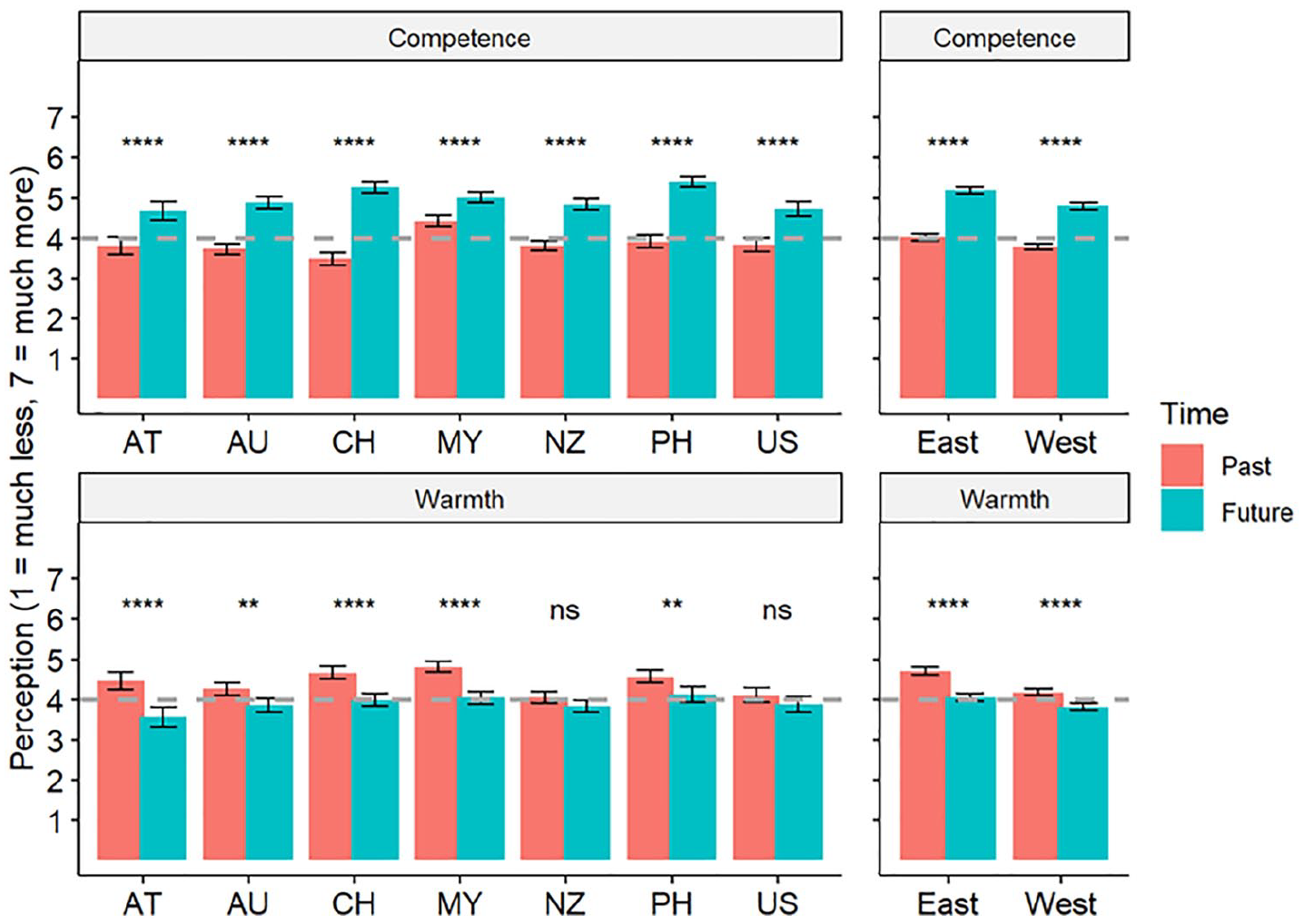
Country-level averages of perceived changes in competence (top panel) and warmth (bottom panel) from past to present (red) and from present to future (turquoise). With few exceptions, people perceived that their societies are going to become more competent but less warm in the future. The dashed horizontal line denotes the scale midpoint which was labeled “about the same.”
People in most of the seven countries (not New Zealand and the United States) tended to perceive their past societies primarily as warmer than the present while they perceived their future societies would be more competent than the present (see Figure 1), indicating overall support for the idea that Western FTSC is widespread.
With regard to competence, the pattern for the future was straightforward (see Figure 1) as the ratings all tended to be well above the scale midpoint, indicating participants in all the countries perceiveded their society’s competence would grow in the coming 20 years. Interestingly, and somewhat unexpectedly, participants gravitated toward the scale midpoint, which indicates no change, when describing their past society’s competence. When directly comparing past and future perceptions of their societies’ competence, people in all the sample countries perceived their future society as more competent than their past society (see Figure 1).
With regard to warmth, the pattern was less clear. In four of the seven countries under investigation (Austria, China, Malaysia, and the Philippines) people perceived their respective past societies as warmer than their present society, whereas Australians, New Zealanders, and Americans tended to perceive the warmth of their past society to be largely unchanged to their current society (see Figure 1). Interestingly in the Western FTSC context, most respondents perceived their future society to be largely as warm as their current society, as seen in the fact that future warmth ratings tended to hover around the scale midpoint, indicating no change. The one stand-out result in this regard was that Austrian respondents perceived that their future society would be somewhat less warm than their current society. When directly comparing past and future warmth perceptions, all the countries except New Zealand and the United States perceived their future society as colder than their past society.
Summarizing these findings into a simple narrative, participants in most of the seven countries exhibited a pattern of response consistent with predictions made by Western FTSC where the perceived rise in competence was greater than the perceived societal cooling, with the latter being undetectable in people from two out of the seven countries. Intriguingly and again unexpectedly, the only countries in which we found no direct evidence for the presence of widespread predictions of society cooling in the future were Western countries, namely New Zealand and the United States. The cooling aspect of Western FTSC seems to be more of a “thing of the past,” whereas the increased competence aspect seems to be more of a “thing of the future.”
To determine the effect sizes associated with the perceived warmth and competence differences between past and future societies, we compared the past with future warmth and competence ratings in each country and calculated the respective d-scores (see Table 2). Warmth reductions ranged from being small in the United States to large in Austria. Forecasts of increased societal competence were somewhat greater and ranged from being medium in Malaysia to large in China.
Perceived Changes in Warmth and Competence From Past to Present and From Present to Future for Each Sample Country.
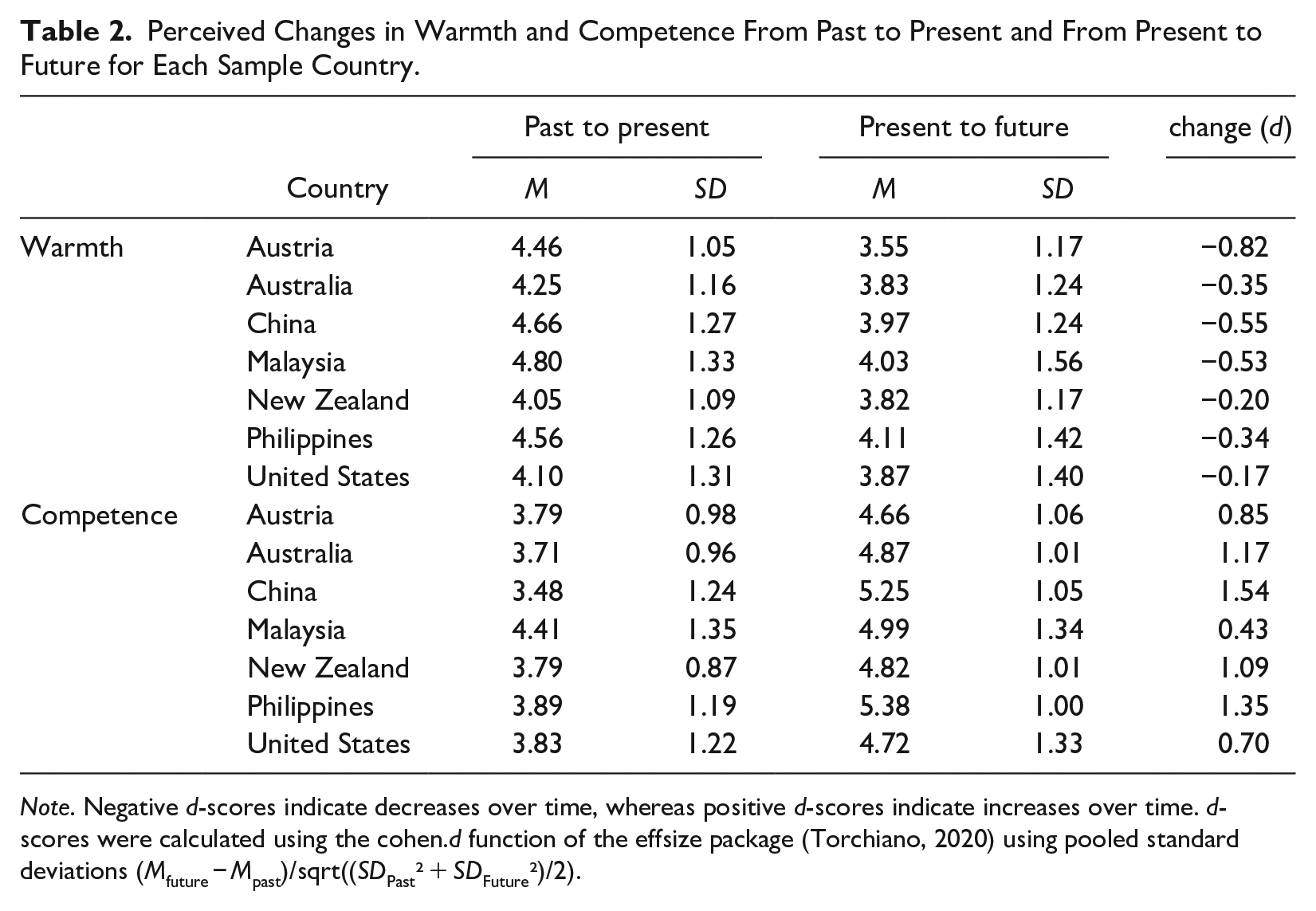
Note. Negative d-scores indicate decreases over time, whereas positive d-scores indicate increases over time. d-scores were calculated using the cohen.d function of the effsize package (Torchiano, 2020) using pooled standard deviations (Mfuture − Mpast)/sqrt((SDPast² + SDFuture²)/2).
Relationship Between WEIRDness and Social Change Perceptions
Finally, we tested our hypothesis that people in WEIRD countries conform more tightly to the premises put forward by Western FTSC by correlating country-level averages of perceived change in social warmth and competence with country-level indicators of WEIRDness: individualism, education levels, industrialization, wealth, and democracy. Because we also wanted to investigate whether Western FTSC is more prevalent in societies that have recently become WEIRD (i.e., that have experienced rapid modernization in recent years), we correlated the changes in perceived warmth and competence, as measured by the SCPS, with a series of indicators of WEIRDness: Individualism, the Education Index, per capita GDP, and the Democracy Index. We performed these correlations with the values of these indicators in 2016 and with the changes in these indicators over the last 20 years, which is the time SCPS respondents were asked to think back to. The results indicated no significant hypothesized relationships between Western FTSC prevalence and WEIRDness (see Figure 2).
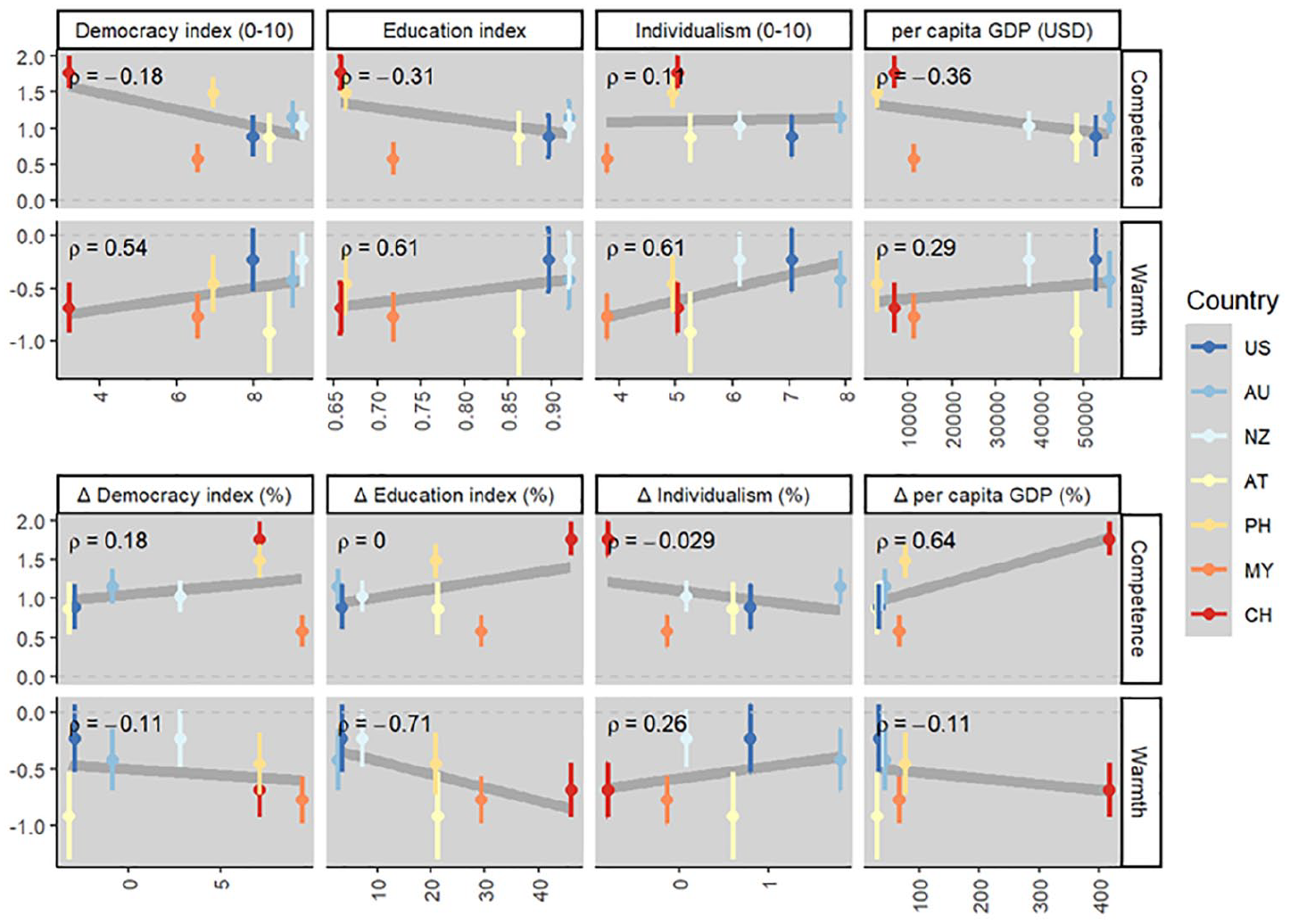
The relationship between perceived changes in warmth and competence (y-axis) and WEIRDness indicators (x-axis) around the time of data collection (top) and the change in WEIRDness over 20 years (bottom).
However, while perceptions of decreasing societal warmth and increasing societal competence do tend to be somewhat related to changes in WEIRDness, they are negatively related to current WEIRDness. Let us exemplify this using the two extreme cases from our sample group: China and the United States. China has experienced remarkable three-digit growth in its GDP together with increases in democracy and education levels between 1996 and 2016, indicating that it has become WEIRDer in these decades. The Chinese sample expected significant decreases in social warmth but increases in social competence despite China’s relatively low absolute levels of per capita GDP, education, and democracy. In the United States, per capita GDP only experienced a two-digit growth rate within the same timeframe together with a modest increase in its education level and even a slight reduction in the country’s democracy level. American respondents in our study perceived virtually no change in their society’s warmth and only a comparably small increase in its competence, despite having a relatively large per capita GDP as well as high democracy and education levels by international standards.
Discussion
According to Western FTSC, close-knit communities transition into market-oriented societies as they become more industrialized and, as a result, become less moral and warm but more competent. The SCPS provides a tool for measuring the extent to which people’s perceptions of their society line up with that theory. The SCPS measures the degrees to which people attribute warmth and competence to their past and future societies, thus allowing scholars to investigate these attributions with greater methodological rigor (i.e., measurement invariance) than before. Although we initially hoped to be able to distinguish warmth and morality as separate dimensions in the SCPS, we ultimately could not do so consistently across cultures. Instead of keeping both the morality and the warmth dimension, we focused on the warmth dimension and established that the reduced instrument was metrically invariant across the seven countries under investigation. With the newly created instrument in hand, we probed the universality of Western FTSC by comparing past and future warmth and competence scores across seven countries. In accordance with the theory, people generally ascribed less warmth but more competence to their respective future society when compared to the past. Remarkably, we found this pattern in most of the sample countries, which suggest that the outcomes predicted by Western FTSC hold true on a fairly widespread basis.
Cross-Cultural Variability in Perceived Social Change
Nevertheless, there were significant cross-cultural variations to this general pattern. First, there was cross-cultural variability in the extent to which perceptions of a society’s morality, in the sense of moral appropriateness, are distinguishable from perceptions of a society’s warmth, which stems from traits such as sociability or likeability (Abele et al., 2016; Abele & Hauke, 2020; Bain et al., 2013; Brambilla et al., 2021; Leach et al., 2007; Wojciszke, 2005b; Wojciszke & Klusek, 1996). Our factor analyses indicated that although morality and warmth were dissociable in most countries, they were not dissociable in some and these conflations occurred mostly with regard to the future. When rating their past societies, only Malaysians seemed to conflate warmth and morality. In contrast, when rating their future societies, the Chinese, Malaysians, and Austrians all tended to conflate warmth and morality. In light of these frequent conflations, it seemed inappropriate to universally treat warmth and morality as separate dimensions. Because our goal was to maximize cross-cultural invariance, and thus the cross-cultural applicability of the scale, we decided to adopt a two-factor solution involving warmth and competence while completely excluding the items designed to measure morality (honest, ethical, just, and fair).
There may be different reasons for our inability to universally dissociate warmth and morality, not the least of which is that some cultures construe morality in different ways to others. For example, most societies have traditionally relied on religion in the past, to a greater or lesser extent, to determine what is morally right and wrong, however, the modernization process has seen these societies increasingly employ non-religious frameworks for that purpose (e.g., Norris & Inglehart, 2011). Because religions typically prescribe both warmth and morality, cultures may construe morality from a somewhat religious perspective and this may partly explain different degrees of warmth-morality conflation (see also Inglehart & Baker, 2000). The fact that morality and warmth tended to be more mixed in people’s future perspectives is also noteworthy. The work of Bain et al. (2013) seems to confirm this notion as they found that perceived future social benevolence (combined warmth and morality) relate to people’s present-day attitudes. Judging one’s past society can be argued to involve some degree of memory, whereas predicting the future of a society cannot be based on memory alone and must rely on different cognitive processes. Whatever these processes are, they may be more susceptible to warmth-morality conflation than the processes employed to form a view of past society. We hope that by paying close attention to the differences between cultures and between past and future perspectives, future versions of the SCPS will be able to provide a more fine-tuned assessment of how people construe their society in the past and future.
Second, turning to perceived warmth and competence, there was a clear and consistent perceived social change regarding competence from the past to the present and into the future across cultures, however, the perceived social changes in warmth were generally weaker and more variable across cultures. Similarly to Y. Kashima et al. (2011), we found that competence ratings increased approximately twice as much as warmth ratings decreased in the same timeframe. Put differently, the magnitude of perceived competence gains appears to be much greater than the magnitude of perceived warmth losses. Given the cross-cultural generalizability and replicability of this phenomenon, we offer three possible explanations. First, perceived societal competence may be anchored in perceived changes in science and technology, whereas perceived warmth may be more difficult to discern. As we have seen from the technical advances made in the current digital age, the snowball effect of technological progress and its seeming continuation into the future, it may not be too surprising that the competence changes surpass those of warmth. Second, the higher rate of competence change may arise because people think of warmth as more stable over time and therefore as less malleable than competence (Kenworthy & Tausch, 2008). Finally, people may simply be more interested in, or believe their society is more interested in, cultivating competence than warmth. People seem to be more motivated to improve themselves by changing morally irrelevant traits, such as competence, than those that are morally relevant, such as compassion and honesty (Sun & Goodwin, 2020). Consistent with this proposal, competence is more closely related to individual-level self-esteem than warmth (Soral & Kofta, 2020).
Now turning specifically to the warmth dimension, an interesting and unexpected result was gathered from the respondents as they perceived more social change had already taken place than was likely to occur in the future. The confidence levels of the future warmth ratings tended to include the scale midpoint (indicative of no change) in most sample countries. In contrast, most societies’ past warmth confidence intervals did not include zero, implying that the perceived societal cooling is nostalgic rather than apprehensive. Furthermore, when comparing past and future warmth, people perceived their future society as significantly cooler than their past society in all but two Western countries (New Zealand and the United States). Ironically, our results may seem to suggest that Western FTSC holds true more consistently in Asian countries than in Western countries. Nevertheless, it should be noted that we did not examine morality losses over time because we discarded the morality dimension due to the problem with cross-cultural invariance. In Y. Kashima et al.’s (2011) study, perceived warmth losses were relatively weak and could not be observed in China however, morality losses were consistently observed in Australia, Japan as well as in China, where participants predicted a morality loss 20 years into the future, although they expected that the level of morality would recover to the present level 100 years into the future. This raises the question of whether or not the moral dimension is of greater importance than warmth in investigating Western FTSC—something which can only be answered by future investigation.
Perceived social change and WEIRDness
In an attempt to find out whether there was a correlation between how strongly people perceived social changes that are in line with Western FTSC, and the WEIRDness of their country, we correlated country-level averages of perceived social change with indicators of individualism, education, industrial performance, wealth, and democracy as well as the changes in these indicators over the past 20 years. The results did not provide a statistically reliable picture that outcomes in line with Western FTSC are more prevalent in societies that currently have a large degree of WEIRDness or that have become more WEIRD in recent decades. Nonetheless, some insightful observations can be made. First, perceived social changes are generally related in the expected ways to changes in the countries’ national statistics rather than their current states. The current state of WEIRDness relates negatively with competence change but positively with warmth change. This is the opposite of what is suggested by Western FTSC. However, the change in WEIRDness relates more positively with competence change as expected, with GDP being a particularly good indicator of industrialization and wealth. As we noted earlier, it may be that technology-led industrialization and increasing national prosperity are at the forefront of people’s minds when they ponder their society’s future competence. In contrast, the pattern was less clear for perceived changes in societal warmth. It is critically important to emphasize that caution is warranted when interpreting these non-significant results given that they are based on a very small number of observations. To examine whether Western FTSC is a WEIRD theory with greater confidence, we will need more data from a larger sample of countries, social strata, and age groups. The observations offered here should be seen as somewhat preliminary and rudimentary.
In summary, one possible interpretation of the pattern of findings in the present study is that Western FTSC’s prediction of a transition from close-knit communities to market-oriented societies, and its concomitant perceived social changes in competence, warmth, and morality, is most likely to manifest in countries that have recently experienced a period of rapid transition and entry into the technology-driven globalized economy. However, when societies experience relative stability and prosperity in economy and polity for a prolonged period, as is currently the case for many WEIRD countries, people may believe that the current market-oriented social organization will continue as it is into the future. They may then perceive competence to increase due to advancing technology without any major change in warmth. However, it is also possible that people in some societies may have developed an “extended folk theory of social change.” In this extended form, the transition from the traditional close-knit community to the modern market-oriented society may be amended by a further discontinuous change into a “postmodern” (Lyotard, 1984) or “postmaterial” (Inglehart & Baker, 2000) society. It is difficult, at this point, to determine exactly which factors are playing which role in the picture that is slowly emerging as the imagined futures people conjure in their minds is still an emerging field of research (Kashima & Fernando, 2020).
The Future of Western Folk Theory of Social Change
By measuring perceptions of social warmth and competence across cultures, the SCPS and the present findings can help advance research on other theories of cultural change. For example, modernization theory suggests that cultures are becoming more individualistic due to industrialization, whereas cultural heritage theory suggests that traditions exert an independent influence on the cultural changes caused by economic development (Hamamura, 2012; Inglehart & Baker, 2000). The SCPS enables researchers to study how folk theories interrelate with modernization. For example, some cultural contexts and individuals whose perceptions of their societies tend to align with Western FTSC forecasts may also be factors in the equation which are becoming more individualistic and less influenced by traditions. While the SCPS renders these and other hypotheses testable, more cross-cultural research is needed on how social change perceptions relate to other broad social changes (Greenfield, 2009; Hamamura, 2012; Inglehart & Baker, 2000), future-oriented attitudes and behaviors (Bain et al., 2013; Park et al., 2015) such as those relevant to climate action (Milfont et al., 2014) and on cross-cultural differences in these relationships (Guo et al., 2012; Oettingen, 1997).
The future is likely to offer many exciting applications for the SCPS, especially as global crises, such as climate change, drag on economic growth, and threaten industrialization and modernization processes. In this regard, endless economic growth based on finite resources has long been argued to be an impossibility (Meadows et al., 1972) and humanity’s persistent efforts to achieve it anyway is a major driver of the current cascading series of environmental crises that increasingly threaten civilization (Intergovernmental Panel on Climate Change, 2018). The world’s environmental crises may lead to both voluntary and involuntary reductions in economic growth or even “degrowth” (deliberately reducing global consumption and production), which may stall or even reverse industrialization efforts in many countries. This may lead people to regard future societies engaged in “degrowth” as warmer and more communal but less competent and unsophisticated. This idea is somewhat consistent with evidence that Australians tended to think that when society reverted to a traditional form, people would be warmer but less competent (Kashima et al., 2009; Study 2). The SCPS can help researchers keep track of such dynamic changes in societal perceptions which could provide useful for policy-making by allowing efforts to combat these crises and public perceptions to be positively tethered together rather than working against each other.
More specifically in this regard, tackling global threats such as climate change and pandemics requires a psychologically informed understanding of how collectives shape their future and what characteristics of that future they are motivated to bring about. Warmth and competence associated with these possible futures seem to play a particularly important role (Milfont et al., 2014; Park et al., 2015). That is, people are more likely to endorse intentions and attitudes designed to facilitate warmth and morality in their society than those designed to facilitate competence (Bain et al., 2013). The goal of producing a future society with a relatively high degree of mutual care and high moral standards may play a bigger role than achieving objective material benefits. For crises such as pandemics, the current situation involving COVID-19 may also influence how people perceive their past, present, and future societies, all of which can be gleaned by using the SCPS. For example, witnessing mutual support through measures designed to limit the spread of the disease, such as social distancing and lockdowns, may make people think that their present society is warmer (and perhaps less competent) than they thought. In contrast, the pandemic suddenly making so many societies reliant on digital communication and Internet-based services may lead people to think that their society’s competence is on the rise. These impressions may influence individuals’ perceptions of future social warmth and competence. The SCPS, with its ability to measure social competence and warmth across cultures and time, may prove useful in exploring the value of social warmth and competence for sustainable policy-making in various cultural contexts.
Limitations and Outlook
First, we were able to show that the SCPS is metrically invariant, enabling researchers to make within-country comparisons. However, because scalar invariance was not met, comparing mean differences in warmth and competence between people from different countries should be avoided, as it could result in unjustified conclusions (Chen, 2008), an important fact to keep in mind when using the SCPS in cross-cultural investigations. Nevertheless, it would be useful to expand the SCPS’s functionality to include the morality dimension. Past research on Western FTSC often conflated morality and warmth (Y. Kashima et al., 2009); when morality and the narrow sense of warmth are measured separately, perceptions of near-future morality (20 years from now) tended to be lower than now across Australia, China, and Japan but the narrow sense of warmth did not show a similar declining pattern in Australia or China (Y. Kashima et al., 2011). Future research may also investigate whether people’s far-future (e.g., 100 years from now) predictions of warmth, competence, and the like may differ from their near-future forecast.
Second, our respondents were not representative of the general populations of the sample countries. They consisted primarily of university students. It is, therefore, possible that the effects obtained in this study are different from what one would find in these countries’ general populations. Furthermore, our respondents, although drawn from both Western and Asian countries, are perhaps more WEIRD in some regards than the average population in their respective countries. Being students at universities, they may be more highly educated, richer, and perhaps more in favor of democracy than many of their fellow citizens because they may be more exposed to Western liberal ideas on their campuses. Nevertheless, it is unclear how, or even if, selective sampling may have influenced the results because the role of individual differences for social change perceptions is understudied and thus poorly understood. Several other factors may also be in play here that influence outcomes, for example, conservatism often places great value on tradition and preservation of the status quo while both liberals and conservatives have been found to nostalgically reflect on times when society was more open to other cultures and traditions (Stefaniak et al., 2021). As such, both representative sampling and research on the individual have relevance for the premises presented by Western FTSC and further study into both is needed.
A third major limitation of this study is that it only looks at only seven countries, which is a very small and therefore unrepresentative fragment of the world’s almost 200 countries. We cannot stress enough that the conclusions we draw about the prevalence of FTSC in the Western and Eastern worlds and its relationship to a country’s WEIRDnes must be regarded as highly preliminary in nature. Despite this weakness, the SCPS provides a tool which, given ongoing critical review and modification, can help answer pressing questions related to causes, consequences, and corollaries of perceived societal development.
Western FTSC theorizing implicitly assumes that the meaning of the key concepts (warmth, morality, and competence) is constant over time. From a cultural evolution viewpoint, this assumption is questionable, at least with regard to the concept of morality. For example, an account of the cultural evolution of religion (Norenzayan et al., 2014) suggests that morality co-evolved with prosocial religions in human history to provide the basis for the transformation of small communities into large societies. In this transformation, impersonal interactions between strangers have necessarily replaced kin-based personal interactions and may have changed the meaning of morality itself from referring to a more warmth-based personal concern with family and friends to a more impersonal and abstract concern with justice and fairness required to maintain social structure in larger groups of mostly strangers. The notion of morality itself, rather than just people’s perception of it, may also have changed over time and gone from being relatively warm to a cooler version. Theoretically, such dynamic changes in the meaning of key constructs such as morality may explain why warmth and morality are conflated in some cultures but not others. Future research should explicitly investigate whether the meaning of competence and warmth are undergoing similar changes and, if so, how these changes affect the explanatory power of Western FTSC.
Conclusion
This research has validated the SCPS as a tool to measure Western FTSC as it proved to be metrically invariant when assessing responses from a sample group of university students drawn from seven countries. Using the SCPS we found that Western FTSC in most of the countries we analyzed. People perceived their future society as cooler but more competent than it was in the past, with the competence change tending to be larger than the warmth change. This research also suggests, albeit with caution, that recent changes in a country’s WEIRDness do seem echo in people’s perceptions of social change. Though there is still much work to be done, both in improving the scale itself and collecting data among broader samples and contexts, this study provides a solid starting point for measuring and understanding how people make sense of the social implications of the changes experienced in different societies over time.
Supplemental Material
sj-doc-1-jcc-10.1177_00220221221104962 – Supplemental material for A WEIRD Theory? On the Prevalence of Western Folk Theory of Social Change in the West and Asia
Supplemental material, sj-doc-1-jcc-10.1177_00220221221104962 for A WEIRD Theory? On the Prevalence of Western Folk Theory of Social Change in the West and Asia by Johannes Klackl, Danielle P. Ochoa, Hongfei Du, Eva Jonas, Emiko S. Kashima, Getrude C. Ah Gang and Yoshihisa Kashima in Journal of Cross-Cultural Psychology
Footnotes
Declaration of Conflicting Interests
The author(s) declared no potential conflicts of interest with respect to the research, authorship, and/or publication of this article.
Funding
The author(s) received no financial support for the research, authorship, and/or publication of this article.

Supplemental Material
Supplemental material for this article is available online.
References
Supplementary Material
Please find the following supplemental material available below.
For Open Access articles published under a Creative Commons License, all supplemental material carries the same license as the article it is associated with.
For non-Open Access articles published, all supplemental material carries a non-exclusive license, and permission requests for re-use of supplemental material or any part of supplemental material shall be sent directly to the copyright owner as specified in the copyright notice associated with the article.
