




Abstract
There is a need for a simple and graspable model of culture covering the main cultural differences across modern nations. A two-dimensional model might be a reasonable choice. We analyzed data from the World Values Survey and the European Values Study to test whether different two-dimensional models are factor rotations of each other. We took into account criticisms regarding the choice of items in Inglehart’s analysis of the same data source. Nevertheless, we replicated his dimensions. By means of factor rotation by various angles we aligned our dimensions and those of Inglehart with other previously published sets of dimensions. Thus, although different studies seem to have produced different two-dimensional solutions depending on the study design, those solutions are actually related to each other. There is no right or wrong placement of axes—they describe the same relationships between cultural elements. By showing the positions of various sets of cultural dimensions relative to each other, this study adds another viewpoint that can help researchers make sense of the huge variety of cultural dimensions in the literature.
There is an abundance of different models of culture, understood as a societal-level pattern of values attitudes and beliefs, and there are numerous cultural dimensions proposed by researchers in different fields of social science. A decade ago, Taras et al. (2009) provided an overview of 121 sets of cultural dimensions of varying popularity. While some of those dimensions are quite different statistically and theoretically, many overlap to various degrees. This confusing proliferation has given rise to calls for more clarity and triggered attempts to systemize various sets of dimensions according to their similarities (Fog, 2021; Kaasa, 2021; Maleki & de Jong, 2014; Nardon & Steers, 2009).
One of the most important reasons for measuring culture is our expectation that these measures will help us explain and predict various societal phenomena. In that respect, there is a clear need for a cultural model that is as simple and graspable as possible, while enabling us to describe the main cultural differences and changes in the world. Ideally, a small number of measures should explain a lot of variation in diverse domains. However, we still do not have consensus on the most appropriate way to dimensionalize culture. Although it may be unrealistic and unnecessary to expect the cross-cultural field to adopt one single model of culture, the current plethora of diverse measures is bothersome as it creates confusion. We do not even have good answers to basic questions, such as how many dimensions of culture we need, let alone what those dimensions should target.
A Two-Dimensional Approach to Culture?
When deciding the number of dimensions in a cultural model, one possibility is to follow the principle of as few dimensions as possible and as many as necessary. We argue that a two-dimensional model might be a reasonable choice. Two dimensions are easy to show and grasp on two-dimensional figures. Moreover, often similarities between cultural maps and geographical maps are sought (Fog, 2021; Minkov, 2018; Minkov & Kaasa, 2021b) and this can be most easily done with two-dimensional cultural models.
One good example is the well-known Inglehart’s (Inglehart, 1997; Inglehart & Baker, 2000) model consisting of two dimensions—survival versus self-expression and traditional versus secular-rational—that has been extremely popular. It was derived from a comprehensive analysis of the joint database of the World Values Survey (WVS) and European Values Study (EVS), the world’s largest open-access repository of culture-related measures. Inglehart’s analysis suggests that two dimensions are probably enough to capture much, and perhaps most, of the cultural variation in that enormous source of cultural measures.
The two-dimensional approach of Inglehart (1997) and later Inglehart and Welzel (2005, 2021) is supported by findings by other authors as well. Among other well-known models, Hofstede (1980, 2001), Hofstede et al. (2010) expanded his model twice, starting from four dimensions and arriving at six, but as Beugelsdijk and Welzel (2018) note, it has been also criticized for overestimating the number of dimensions. Studies by Minkov (2018) and Beugelsdijk and Welzel (2018) found that some of those dimensions are seriously flawed or superfluous, possibly because the IBM database that Hofstede used did not properly represent the cultures from which it was drawn. After eliminating the dimensions of uncertainty avoidance and masculinity versus femininity, which could not replicate and did not have internal consistency (Merritt, 2000; Minkov, 2018; Minkov & Kaasa, 2021a), and treating individualism-collectivism and power distance as a single dimension since Hofstede distinguished between them for doubtful theoretical reasons, the result was the revised two-dimensional Hofstede model proposed by Minkov (Minkov, 2018; Minkov, Dutt et al., 2018). It consists of individualism-collectivism and flexibility-monumentalism (previously also called long-short term orientation) inspired by the findings of the The Chinese Culture Connection (1987)
Schwartz (1994, 2004, 2008a) model is also presented in a two-dimensional space, despite the fact that it proposes three major value contrasts at the national level: autonomy versus embeddedness or conservatism, harmony versus mastery, and egalitarianism versus hierarchy. The latter two contrasts were initially hypothesized (Schwartz, 1994) as one wider dimension and have been viewed as such later (Dobewall & Strack, 2014) as well.
Beugelsdijk and Welzel’s (2018) synthesis of Hofstede and Inglehart based on the WVS/EVS data resulted in three dimensions: collectivism-individualism, duty-joy, and distrust-trust. However, the core of the latter reflects political trust. Although it may be a useful measure in political science, it is questionable whether this factor reflects culture in the same sense as the dimensions of Hofstede, Inglehart, or Schwartz.
Recently, Fog (2021) factor-analyzed the cultural dimensions of all major studies and found two recurrent factors demonstrating that a large number of validated dimensions of culture can be represented by a two-dimensional model. The first factor draws together the dimensions related to individualism-collectivism and power distance, whereas the second reflects monumentalism-flexibility and short-long term orientation. Hence, it is reasonable to assume that it is possible to account for the main cultural differences between modern nations with just two dimensions.
Relationships Between Different Two-Dimensional Models
Different two-dimensional models provide dimensions that differ not only in name, but also in nature. However, there is reason to believe that at the same time, they still deal with the same range of cultural elements—values, beliefs, attitudes, etc. Recently, Kaasa (2021) has shown that with the help of rotation it is possible to merge theoretically the models of Inglehart, Hofstede, and Schwartz based on the keywords those authors have used in the theoretical descriptions, conceptualizations, and explanations of their dimensions. In his recent analysis, Fog (2021) concludes that the common practice of factor rotation has often led to differently rotated factor solutions with differently named factors, without their authors realizing that they were similar to previously published factors. This is in accordance with Browne (2001), who noted that rotations based on different samples might give different factors and the choice of the best solution cannot be made without human judgment. Fog (2021 notes that “Cultural maps published by different authors appear to be approximately equivalent, but differently rotated, skewed, or mirror imaged due to the different rotations of factors.” Hence, it is possible that (a) different cultural models cover mainly the same range of cultural elements, (b) different theories just group the same cultural elements in different ways, and (c) cultural dimensions from different models might be just rotations of each other.
Goal and Concept of This Study
We define culture as a pattern of values, beliefs, and attitudes that distinguish one group of people from another, be it a country, a region, or some other group (Hofstede, 2001; Schwartz, 2008a). We base our analysis on the belief that a two-dimensional model is an easily graspable and adequate choice for capturing the main cultural differences in the world. We admit that for more specific tasks, more dimensions might be useful and/or necessary.
The main goal of our study is to find out if it is possible to rotate various two-dimensional sets of cultural dimensions so that they align with each other. For this task, we start with data from the partner surveys WVS and EVS, which together form the best publicly available source of culture-related items at the moment in terms of countries and periods covered. Our approach is to create a two-dimensional set of factors including as many different items as possible that could relate to dimensions of various previously proposed cultural models. That would enable us to regroup items with the help of factor rotation so as to align the initial factors with those of previous two-dimensional sets.
Seeking a two-dimensional structure is reasonable also because an analysis of a huge dataset, such as the WVS/EVS, will inevitably yield many factors that satisfy conventional factor-retention criteria, yet many of these are likely to be theoretically obscure, empirically weak, and of doubtful practical utility. In other words, they would be difficult to explain, the factor loadings would not be strong, and the resulting national indices may not be closely related to any extraneous variables of interest. Therefore, we argue for a small number of theoretically sound, empirically strong, and practically useful factors.
The WVS/EVS has also served as a basis for Inglehart’s model. However, as it has also been criticized because of the choice of items included in the analysis, we intend to address those criticisms and check whether Inglehart’s model still holds after that.
We intend to use as many waves of the WVS/EVS as possible in order to rule out as much random fluctuation as possible. We decided to analyze the culture-related items in the WVS/EVS that have been fielded in every wave since 1989 (wave 2 in both surveys). We excluded the first wave because a considerable amount of items fielded in all later waves were missing in the first one (11 out of 25 items used in our final analysis). This approach enables us to cover the highest possible number of countries and periods.
We share the view of Welzel and Inglehart (2016) that culture is a group-level phenomenon, and focus on the factor structure at the societal, that is, aggregate level. It has been shown that correlations between variables at the individual level can be very different from those between aggregate measures of the same variables (Puntscher et al., 2016; Robinson, 1950; Welzel & Inglehart, 2016). Hence, we aggregate all variables to the country level, wave by wave, and then factor-analyze our final set of variables. As an alternative method, we also perform a multi-dimensional scaling analysis.
Considering the extensive research on the measuring of culture since Hofstede’s (1980) study, and the abundance of various dimensions in the literature, we do not expect our analysis to uncover some unknown dimension of culture.
H1: We hypothesize that the two-dimensional structure emerging from our factor analysis replicates Inglehart and Welzel’s (2021) dimensions.
We also expect that our two-dimensional structure is related to the dimensions by Minkov et al. (2017), Minkov, Bond et al. (2018), Minkov, Dutt et al. (2018), and the first two dimensions of Beugelsdijk and Welzel’s (2018) that doubtlessly reflect culture.
In addition to a correlation analysis for comparing the dimensions, we aim to try rotations of the axes of our two-dimensional model at different angles in the space of items that we included in our analysis. We intend to find a specific rotation angle for each set of dimensions from the previous literature that aligns our dimensions with that set in the best possible way. Our aim is to avoid as much as possible a situation where one dimension in one set is equally highly correlated with both dimensions of another set. Hence, we search for rotation angles that correlate both dimensions as closely as possible with their counterparts in another set, and as minimally as possible with the “non-counterparts” in the other set. This approach enables us to uncover and demonstrate the relationships between different two-dimensional models. We also use targeted rotation as an alternative method. We compare the correlations of our aligned factors and original dimensions with various social indicators to check our results. We provide a plot of WVS/EVS items and dimensions of culture from various studies, illustrating the relationships between them.
H2: We hypothesize that after certain rotations the dimensions obtained from our factor analysis will align with the other two-dimensional sets from previous literature.
Confirmation of this hypothesis would support Fog’s (2021) claim that many previously published cultural factors are in fact “differently rotated solutions reflecting the same or closely related underlying cultural differences,” as he showed that his meta-level factors can be aligned with Inglehart-Welzel cultural map with the help of rotation. Although Fog suggests that the frequent use of factor rotation in extracting cultural dimensions has obscured similarities between different studies, we believe that our methodology, including factor rotation, provides a clearer understanding of the relationships between various sets of cultural dimensions.
As mentioned, we do not expect our analysis to uncover some unknown dimension of culture. However, we intend to investigate the relationships between dimensions originating from our factor analysis and previous two-dimensional sets that we align our factors with, with the dimensions from the well-known cultural models of Hofstede and Schwartz. In the spirit of Welzel and Inglehart (2016) noting that external linkages help us to assess a construct’s outreach into reality, we intend to compare the correlations of all cultural dimensions with various social indicators. Although this will not provide any ultimate conclusions, it might shed some light on the question of whether the two-dimensional models of culture are reasonable and adequate for capturing the main cultural differences across modern nations.
Data and Methods
Data
We compiled a database from two surveys that cooperate and field similar questions: the WVS and the EVS. We matched the waves of two databases in the way shown in Table 1. As the wave numbers of the WVS and the EVS do not match (there have been more waves in the WVS), we use the wave numbers of the WVS for the pooled data. Some countries have participated in both the WVS and the EVS, sometimes in the same year. In those cases, all observations from a given country collected during the same wave were treated as stemming from the same period so as to avoid some countries to be overrepresented. For some countries, data from the same respondents were available in both the WVS and the EVS. In those cases, double observations were deleted. Altogether, we have data from 115 countries but not all of them are represented in all waves.
Matching the Waves of the WVS and EVS.
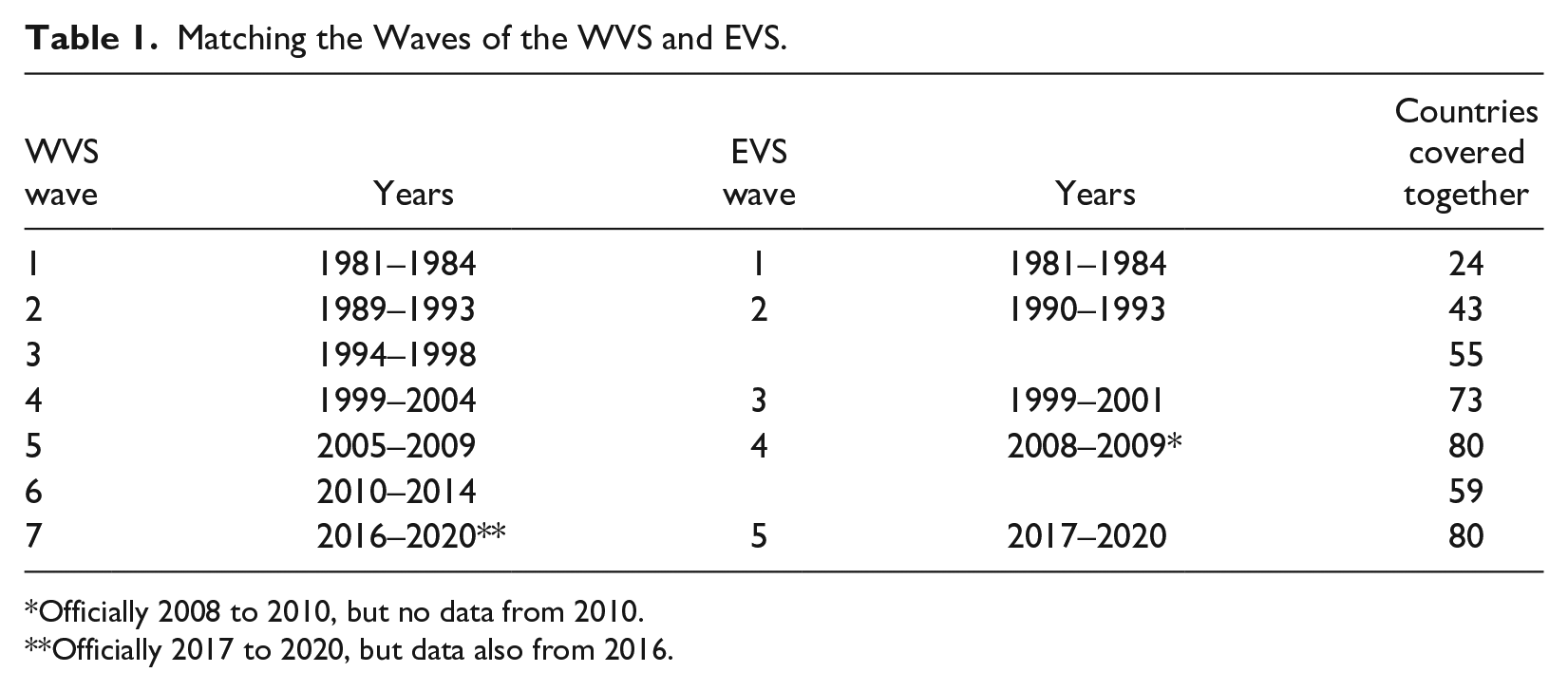
Officially 2008 to 2010, but no data from 2010.
Officially 2017 to 2020, but data also from 2016.
Previous Concerns About the Inglehart-Welzel Model
The WVS/EVS was also the basis for Inglehart’s model (Inglehart, 1997; Inglehart & Baker, 2000; Inglehart & Welzel, 2021). In the initial analysis, Inglehart (1997) used 43 variables (p. 82), but later Inglehart and Baker (2000) reduced that number to five variables per dimension and presented a list of additional items that are correlated with their two dimensions. Despite the great popularity of the Inglehart-Welzel model, its choice of items has also been criticized and we intend to address those criticisms to the extent that is possible. One issue may be the heterogeneity of the items used for the factor extraction (Haller, 2002), especially the inclusion of measures of subjective well-being and political views (Dobewall & Rudnev, 2014). As Lakatos (2015) notes, such items do not describe culture, at least not if it is defined as patterns of values, attitudes, and generalized beliefs. Also, an item that asks if the respondent has signed a petition may target something that simply does not exist in some countries. Another concern is the use of complex measures, such as a post-materialism index, alongside single items. That index mixes two conceptually different issues: economic matters (materialism) and authoritarian views (Flanagan, 1982; Inglehart & Flanagan, 1987; Lakatos, 2015). The inconsistency in the scoring of the items has been pointed out (Minkov, 2013). It is unclear why some items were scored as percentage of respondents who had selected an extreme answer, whereas happiness was measured in terms of percentage “not very happy” (and not for instance “very happy” or “not at all happy”) in Inglehart and Baker (2000) and Inglehart and Welzel (2005). Although some criticisms have been answered by Welzel and Inglehart (2016) or Welzel et al. (2021), who justified their measures by the constructs’ linkages with their expected correlates, we still intend to address as much of these criticisms as possible to check whether the Inglehart’s model still holds.
Choice of Items
We aimed to focus on items that unambiguously measure culture as it is currently understood in the mainstream cross-cultural literature—as consisting of relatively stable elements, such as personal values, ideologies concerning appropriate behaviors, attitudes, and generalized beliefs or worldviews. We excluded the questions that might be situation-dependent, reflecting shifting political preferences, emotions, or economic matters. Our aim was to avoid overrepresentation of cultural aspects that have been covered by more questions in the WVS/EVS than other aspects. Hence, although we wished to cast our net as widely as possible as we selected items, the wordings of the questions and the nation-level correlations between the aggregated variables suggested that some of them would be redundant. This approach addresses some of the previously mentioned criticisms of Inglehart’s choice of items.
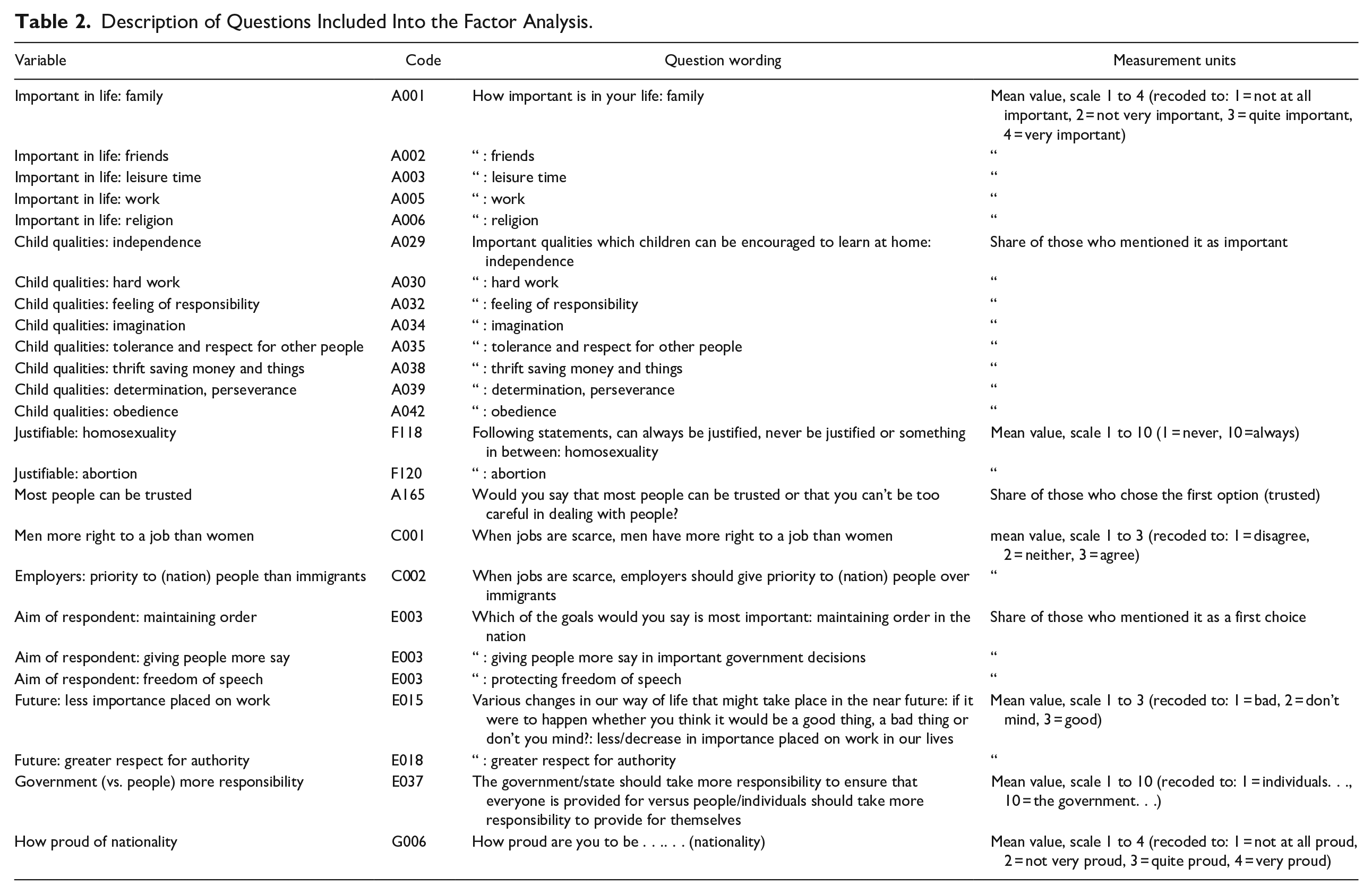
First, we searched all waves of the WVS and the EVS for items that address aspects of culture and are available in all waves of both surveys. Unfortunately, this excluded a lot of items, for example the questions inspired by Schwartz’s theory that were included only in the sixth and seventh waves of the WVS (but not at all in the EVS). We recoded the items or changed their names, so that a high score on an item always stands for what the name suggests. We used all the answer options to provide longer scale. We use mean scores or the share of those who mentioned a particular answer option. For the item that asks the respondents to choose their preferred option out of four, we created new variables for each option. The individual-level data were then aggregated to the country level. We repeated this procedure for each wave.
Once we had this initial list of questions, we analyzed the exact wording of the questions, their meaning, and their overlap with other questions. We also checked correlations and, as a threshold rule, we assumed that two questions cover the same concept when their correlation is greater than ±0.7.
A detailed description of the choice of questions is given in the Appendix. In brief, first, we took care to avoid over-representation of particular topics. For instance, unlike Lakatos (2015), we retained only one of the six questions that address religiosity. It correlates so highly with the other five religiosity-related items as to make them practically redundant. Similarly, we included only one indicator about attitudes toward immigrants and one addressing homosexuality. We did not include all items addressing moral norms as they are all strongly correlated. We retained two of those items: justifiability of abortion and homosexuality as they produce the lowest correlation with each other. We also left out four items about the justifiability of various unfair practices that have been shown to be unrelated to known cultural dimensions (Minkov et al., 2013). From the “important child qualities” section we dropped the question about unselfishness as it is very weakly related or unrelated to any other variables.
Hence, our final set of items for this analysis consisted of 25 variables shown in Table 2.
Description of Questions Included Into the Factor Analysis.
Results From the WVS/EVS Data
Results of Factor Analyses
Next, we performed a factor analysis (principal component method with varimax rotation) of the selected 25 items. We obtained six factors with eigenvalues over 1.00 (factor loadings presented in the Online Appendix Table OA1). The first factor explained 17% and the second 15% of variance. The percentage of variance explained by the next four factors dropped sharply as each explained only between 8% and 9%. This result supports the choice of a two-dimensional model. Next, we requested a two-factor structure. The first factor explained 24.1% and the second 20.0% of variance. The results of factor analysis are presented in Table 3. For better comparability and interpretability, we reversed Factor 2 by multiplying it by −1. The factor scores for all observations are available in Table OA3 in the Online Appendix.
Results of Factor Analysis (All Waves, N = 390).
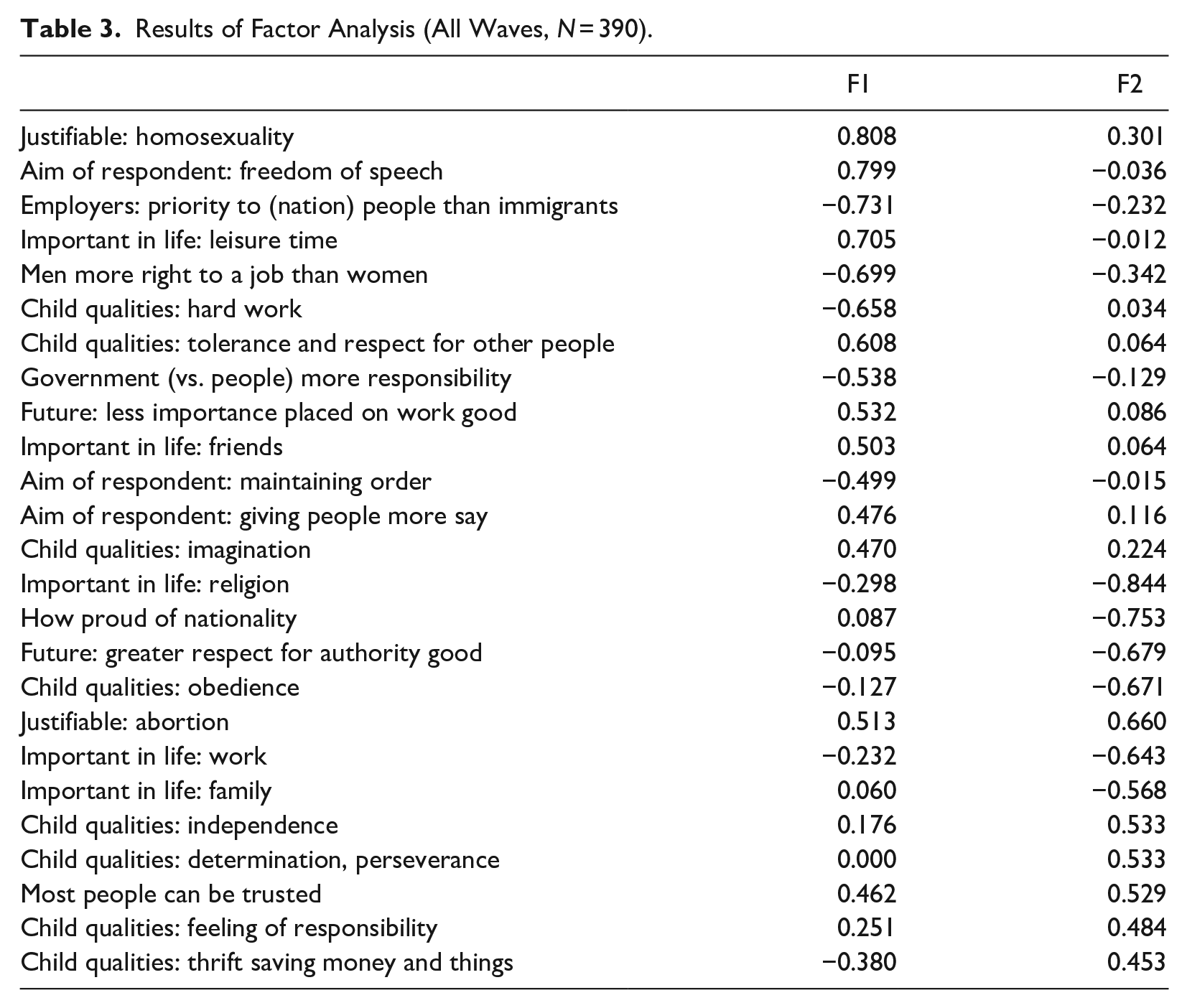
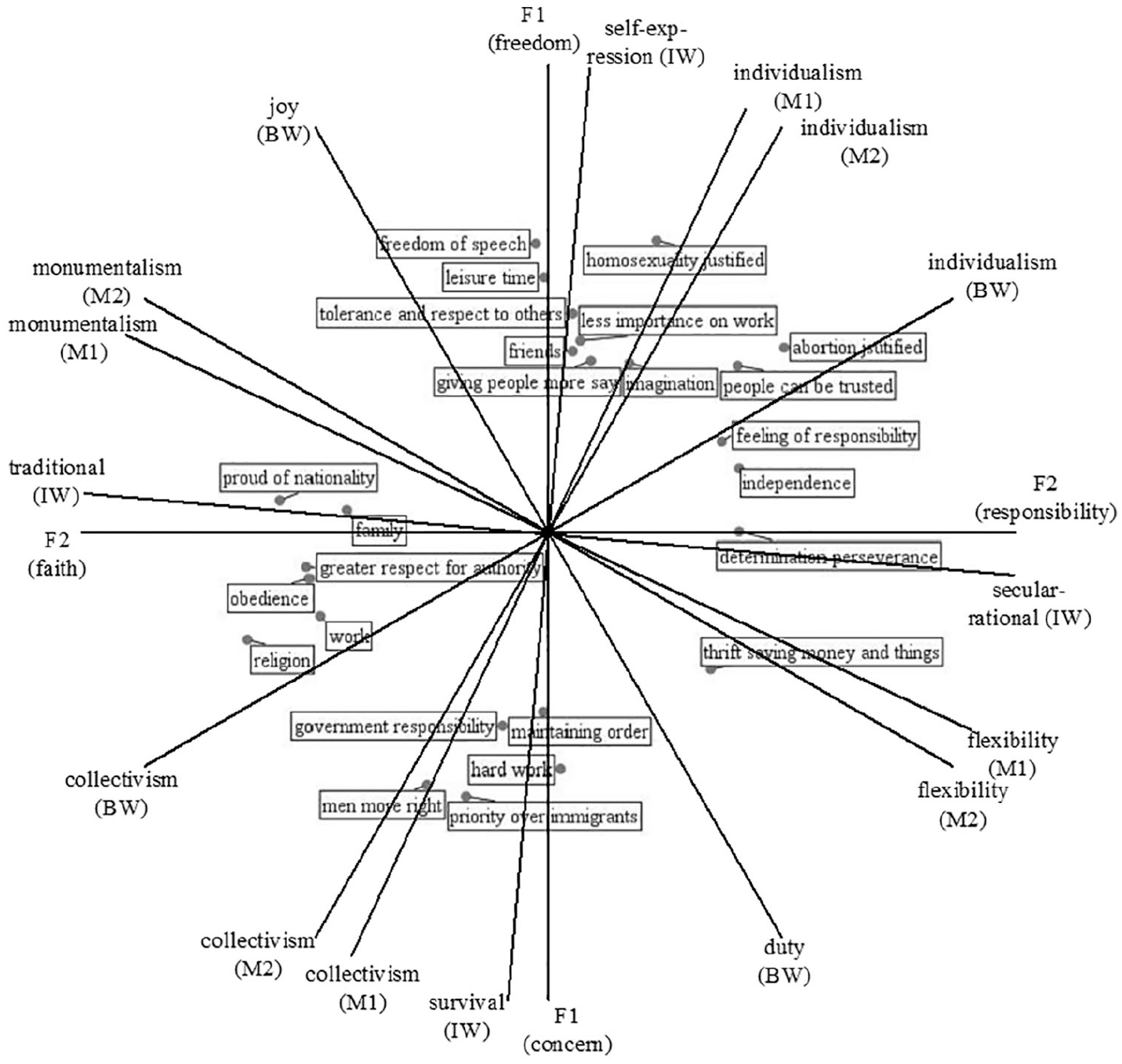
On one pole of our first factor F1 is freedom: freedom of speech and the possibility to express one’s opinion, freedom to decide how to live one’s life and the right to be accepted as one is, freedom from work duty and the freedom to enjoy leisure. On the other pole of that dimension are various types of concern: concern with what is unfamiliar or different and concern for maintaining order, as well as concern about having enough resources which leads to rejection of outgroups. Hence, F1 seems to capture the opposition of self-expression versus survival proposed by Inglehart (1997), but it also covers some elements of individualism versus collectivism as explained for example by Minkov et al. (2017) and elements of joy versus duty as in Beugelsdijk and Welzel (2018). On one pole of our second factor F2 is responsibility, valuing independence, taking one’s life in one’s own hands, and being able to cope on one’s own. The opposite pole is defined by faith: faith in God and in one’s nation, faith in authority and its ability to sort everything out when obeyed, as well as faith in traditions and traditional values. Hence, F2 appears to cover the opposition between secular-rational and traditional by Inglehart, but has also some resemblance to flexibility versus monumentalism (Minkov, Bond et al., 2018) while some elements are common with individualism-collectivism as extracted by Beugelsdijk and Welzel.
Figure 1 illustrates the results of the factor analysis in the spirit of Inglehart (1997, p. 82). It is a two-dimensional plot of the items used in the factor analysis, using the two factors as axes and the factor loadings as coordinates. As it can be seen, the data that we were able to use do not cover the space of cultural elements completely evenly.
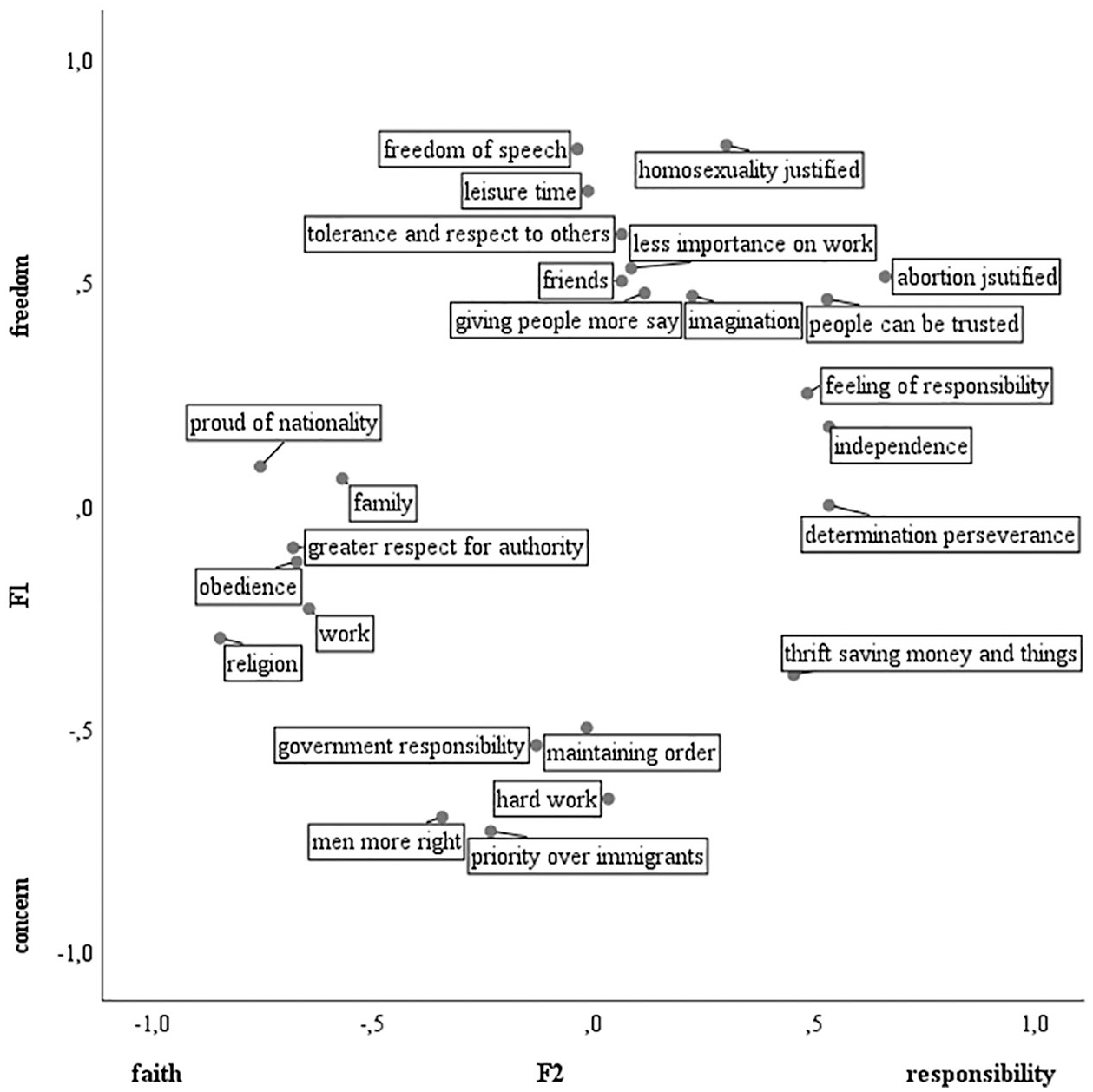
Positions of questions in the space of our two-dimensional factor solution (factor loadings of questions on the two factors are shown on the axes).
We checked the robustness of the results by using different rotation methods, both orthogonal and oblique. Regardless of the method, all items loaded on the factors almost as in our first analysis and the correlations of factors resulting from different rotation methods fell in the range between 0.980 and 0.998 (and between 0.939 and 0.995 for the initial six-factor solution). In order to check for possible fluctuations, we performed the same factor analysis wave by wave. The results of those analyses are presented in Table OA1 in the Online Appendix. Some items did not always load as in the original solution. However, those were not the items with the highest loadings on either F1 or F2 in the original solution. Relatively similar factor structure is a logical result: although all cultures have been shown to change, they tend to change in the same direction (Hofstede, 2001; Inglehart, 2018). In order to assess the extent of the deviation from the structure in the original analysis, we calculated correlations between the factor scores from the analysis of all waves at the same time and the scores from the wave-by-wave analysis (Table OA2 in the Online Appendix). The respective scores are highly correlated, but considering the factor loadings, using as many waves as possible seems justified.
Results From Multidimensional Scaling
We also used multidimensional scaling (MDS) as an alternative method for mapping the items included according to their correlations. The obtained results (see Figure 2) were very similar to those obtained from the factor analysis. It can be seen from Figure 2 that those items that form F1 with positive and negative signs are placed close to each other in the lower right and upper left sectors, respectively. Similarly, the opposite poles of F2 are placed in the lower left and upper right corners. The only exception is imagination as a children’s value that appears to be closer to F2 than F1, whereas the factor analysis assigned it to F1, albeit with the lowest factor loading. We also performed the same analysis wave by wave. The results were very similar with variables still pertaining to the same groups. The only thing that changed was their places relative to each other. For some waves, imagination also grouped with variables from F1.
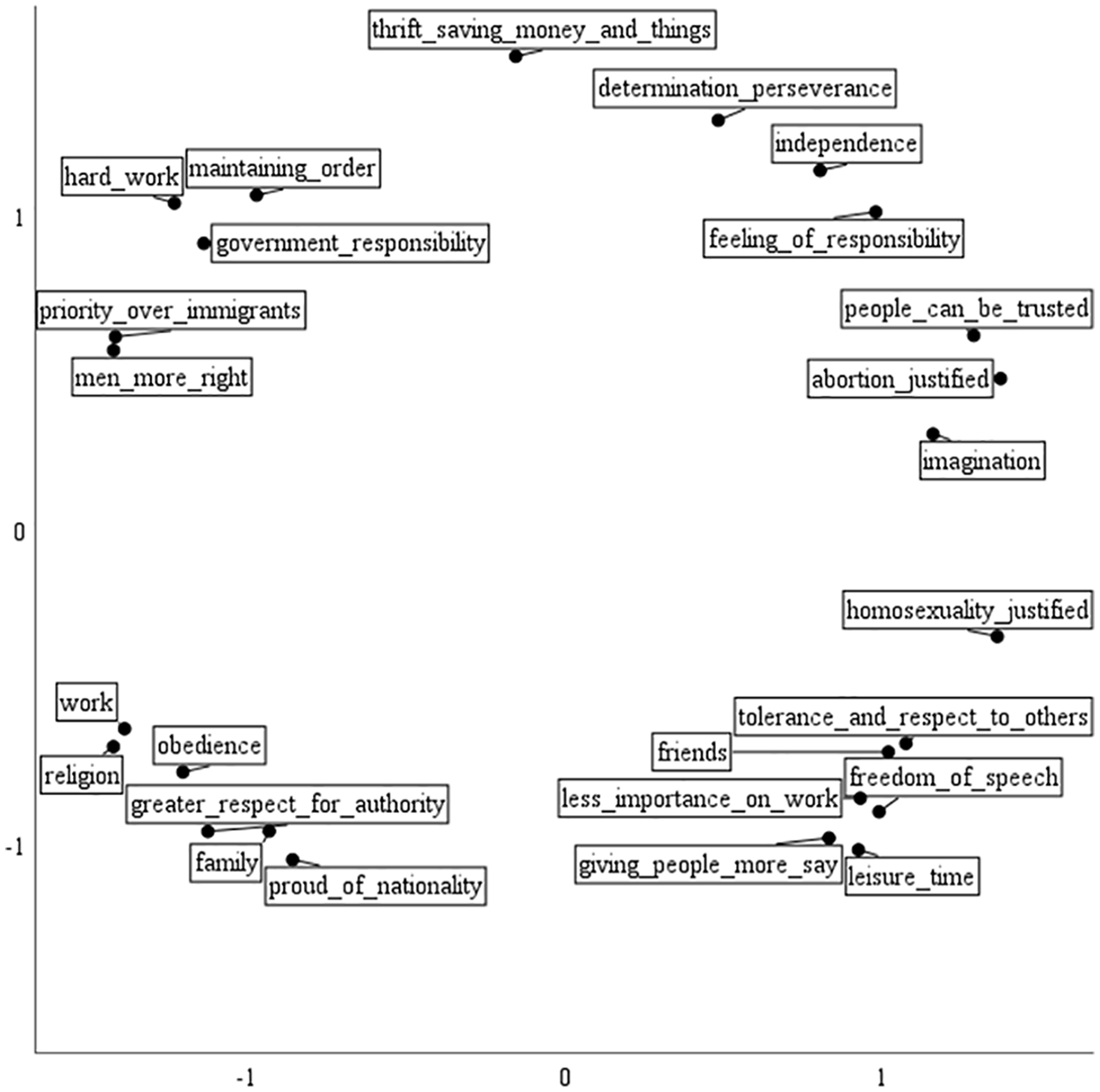
Results of MDS (Euclidean distance model).
Country Scores
Finally, for comparability with the existing sets of cultural dimensions, we calculated mean country scores across the three latest waves. Our goal was a set of relatively recent scores covering as many countries as possible and reducing the effect of score fluctuation due to random measurement error by using averaged data from available observations in a particular country. This approach resulted in country scores for 108 countries covering the years 2005 to 2020, which enables us to compare our scores with the latest available scores of various previously published cultural models. The scores are provided in Table A1 of the Appendix. Figure 3 maps those countries using the two dimensions as axes.
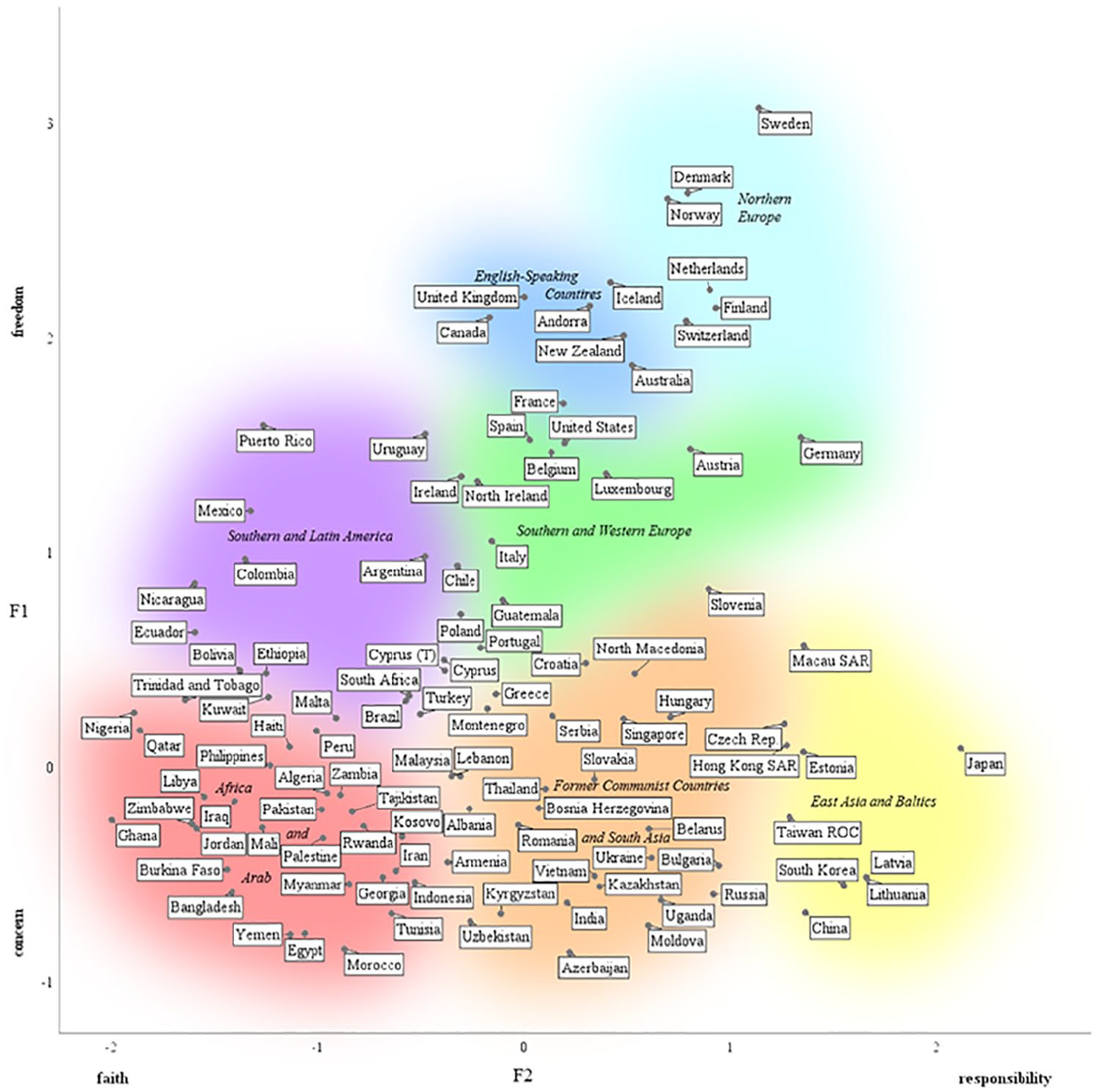
Cultural map according to F1 (freedom vs. concern) and F2 (responsibility vs. faith dimensions) (the names of colored clouds describe the countries forming core of a particular cloud).
Correlations With Other Sets of Cultural Dimensions
Correlations between the two dimensions obtained in this study and previously reported sets of cultural dimensions are provided in Table 4. The scores for Inglehart’s dimensions come from Inglehart and Welzel (2021). For better comparability, we calculated mean scores on their dimensions across the last three waves. For Hofstede’s and Schwartz’s dimensions, we used the latest data available (Hofstede, 2015; Schwartz, 2008b). Data about Minkov’s revised Hofstede model come from multiple sources. First, we obtained scores for individualism (vs. collectivism) from Minkov et al. (2017) and flexibility (vs. monumentalism) from Minkov, Bond et al. (2018). Alternatively, we used the factor-analytical scores for collectivism (vs. individualism) and monumentalism (vs. flexibility) from Minkov, Dutt et al. (2018), which we reversed for better comparability. Lastly, we use the wave-aggregated scores published by Beugelsdijk and Welzel’s (2018).
Correlations of our Two Dimensions and Previous Sets of Cultural Dimensions (Number of Common Observations in Parentheses).
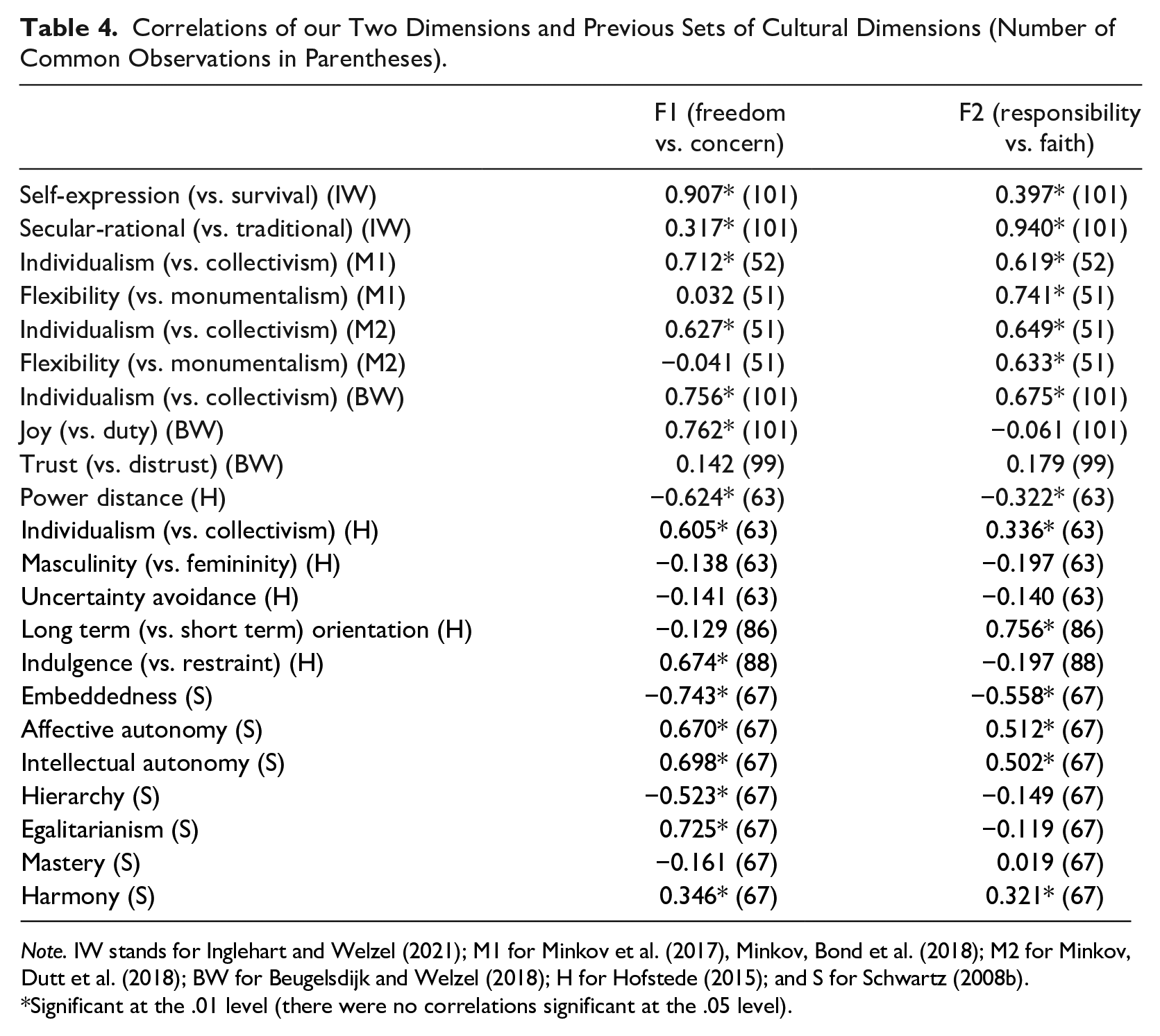
Note. IW stands for Inglehart and Welzel (2021); M1 for Minkov et al. (2017), Minkov, Bond et al. (2018); M2 for Minkov, Dutt et al. (2018); BW for Beugelsdijk and Welzel (2018); H for Hofstede (2015); and S for Schwartz (2008b).
Significant at the .01 level (there were no correlations significant at the .05 level).
Unsurprisingly, F1 was most closely correlated with self-expression-survival whereas F2 was strongly associated with the secular-rational-traditional dimension. Both of the dimensions obtained in this study are also quite highly correlated with various dimensions related to individualism-collectivism as well as power distance and hierarchy. However, F1 yields higher correlations with these dimensions than F2. Neither masculinity-femininity nor uncertainty avoidance are correlated with our two dimensions. This is not unexpected as those Hofstede’s dimensions have not been successfully replicated in any studies (Beugelsdijk & Welzel, 2018; Merritt, 2000; Minkov, 2018; Minkov & Kaasa, 2021a). Beugelsdijk and Welzel’s (2018) trust-distrust dimension is not correlated with either of the two dimensions from this study. Interestingly, the flexibility-monumentalism dimension (the second dimension next to individualism-collectivism in Minkov’s model), as well as long term orientation, are correlated only with F2, while joy-duty as well as indulgence-restraint are correlated only with F1. This suggests that while both Minkov’s and Beugelsdijk-Welzel’s models include individualism-collectivism, their second dimensions—flexibility-monumentalism and joy-duty—cover different elements of culture. So it might be that the individualism-collectivism dimensions of Beugelsdijk-Welzel and Minkov tap somewhat different parts of the quite large individualism-collectivism domain.
Rotating Dimensions
Trying Different Rotations
Next, we tried different rotations of F1 and F2, keeping the axes on the same plane for simplicity. Our goal was to position the axes as close as possible to dimensions from previous studies. First, we used a rotation matrix formula for calculating the factor loadings after rotation of the axes of our two dimensions by different angles. Next, we calculated factor scores after those different rotations with the help of an inverse correlation matrix. We moved the axes five degrees at a time and compared the correlations of the rotated factor scores with the dimensions of Inglehart and Welzel (2021), Minkov et al. (2017), Minkov, Bond et al. (2018), Minkov, Dutt et al. (2018), and Beugelsdijk and Welzel (2018).
Our aim was to find a set of axes satisfying the following conditions. First, a particular dimension from our factor analysis (F1) should be highly correlated with one dimension (D1) in some previously published set, while the other dimension from our factor analysis (F2) should be highly correlated with the other dimension (D2) of the previously published set. The correlations between F1 and D1 and between F2 and D2 should be as similar as possible. Second, and equally important, the correlations between F1 and D2, and between F2 and D1, should be as low as possible and as similar as possible. Our aim was to align each two sets as closely as possible, considering that some of the previous sets were not designed to have orthogonal dimensions. It is important to stress that we did not try to maximize single correlations. This approach is also supported by the results of Dobewall and Strack (2014) showing that it is difficult to maximize overlap simultaneously for more than one dimension. We searched for combinations of four correlation coefficients between two pairs of dimensions that would best satisfy our aims. All correlations are presented in Table OA5 in the Online Appendix. The correlations from the rotations producing the best alignment with the respective previously reported sets of dimensions are presented in Table 5 (initial method).
Correlations Between Certain Rotations of the Factor Solution Obtained in This Study and Various Cultural Dimensions.
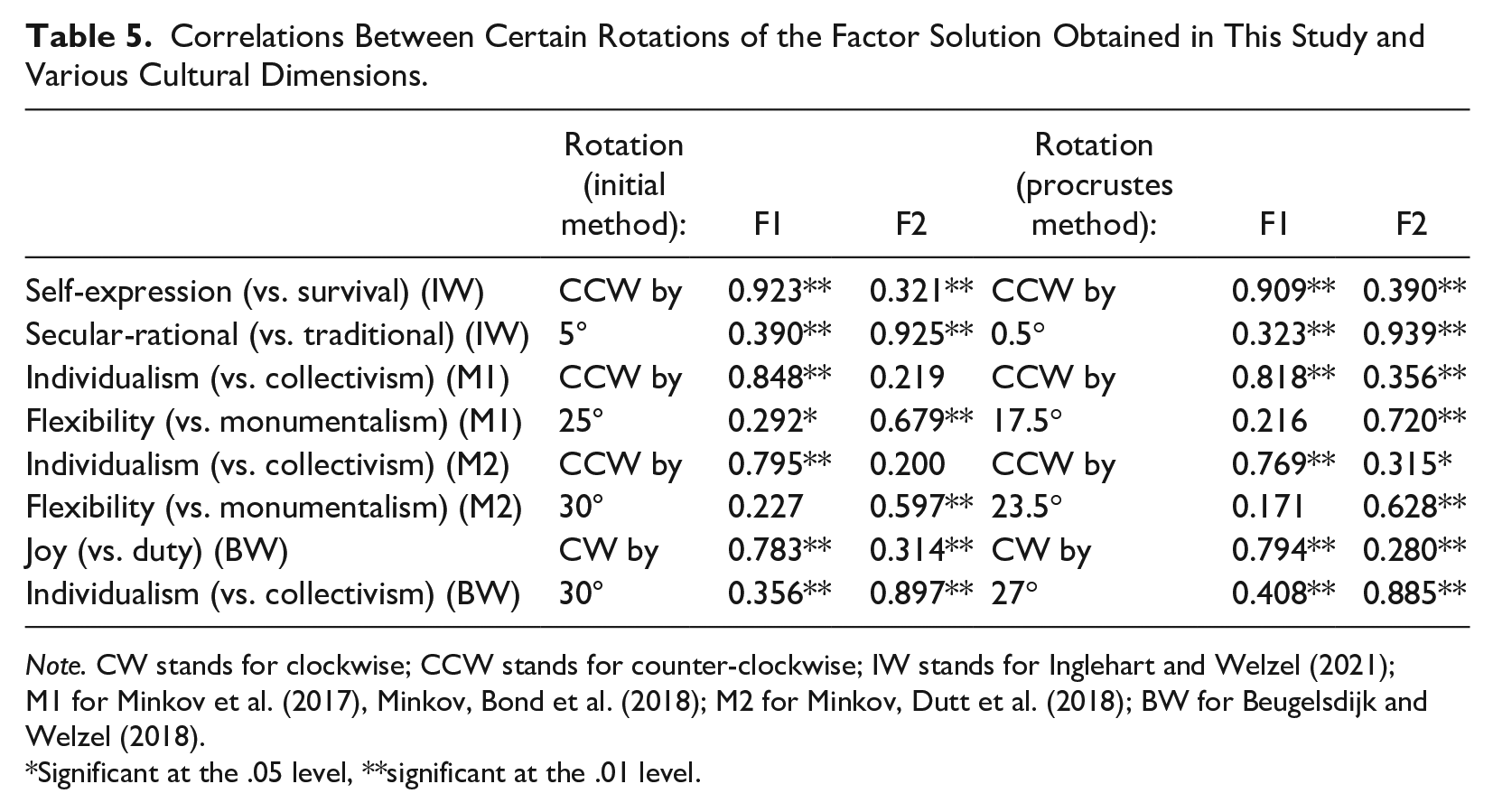
Note. CW stands for clockwise; CCW stands for counter-clockwise; IW stands for Inglehart and Welzel (2021); M1 for Minkov et al. (2017), Minkov, Bond et al. (2018); M2 for Minkov, Dutt et al. (2018); BW for Beugelsdijk and Welzel (2018).
Significant at the .05 level, **significant at the .01 level.
We conclude that F1 and F2 align most well with:
(a) The self-expression (vs. survival) and secular-rational (vs. traditional) dimensions, respectively, from Inglehart and Welzel (2021), after a counter-clockwise rotation by 5° (correlations of aligned dimensions: .923 and .925, respectively),
(b) The joy (vs. duty) and individualism (vs. collectivism) dimensions, respectively, from Beugelsdijk and Welzel (2018), after a clockwise rotation by 30° (correlations .783 and .897, respectively),
(c) The individualism (vs. collectivism) dimension from Minkov et al. (2017) and the flexibility (vs. monumentalism) dimension from Minkov, Bond et al. (2018), respectively, after a counter-clockwise rotation by 25° (correlations of .848 and .679, respectively),
(d) The reversed collectivism (vs. individualism) and reversed monumentalism (vs. flexibility) dimensions, respectively, from Minkov, Dutt et al. (2018) after a counter-clockwise rotation by 30° (correlations of .795 and .597, respectively).
Based on this information, we were able to create Figure 4. It gives an overview of how various sets of cultural dimensions might be placed relative to each other. A more detailed explanation of Figure 4 is given in the Appendix. It is important to note that in Figure 4 the axes bearing the names of cultural dimensions from previous sets do not represent exactly those dimensions, but the rotated axes of F1 and F2 that align best with a particular previous set.
Placement of various sets of cultural dimensions relative to each other.
Targeted Rotation
As an alternative method, we used targeted (Procrustes) rotation that aims to find a matrix that conforms best to the specified target matrix. Targeted rotation has been used in psychology research for finding out the similarities of different factors obtained based on different samples (Fischer & Fontaine, 2011; McCrae et al., 1996). We had no factor loadings of our set of items available for the dimensions of Inglehart and Welzel (2021), Minkov et al. (2017), Minkov, Bond et al. (2018), Minkov, Dutt et al. (2018), and Beugelsdijk and Welzel (2018), but as factor loadings are describing the correlations of items with factors, we used the correlations of our items with the aforementioned dimensions to form the target matrices as an approximation. After finding out the rotated factor loadings, we again calculated factor scores with the help of an inverse correlation matrix.
The targeted rotation aims for the best fit of both factors. That means a particular dimension from our factor analysis (F1) should be most highly correlated with one dimension (D1) in some previously published set, while the other dimension from our factor analysis (F2) should be most highly correlated with the other dimension (D2) of the previously published set. However, targeted rotation does not aim for the correlations between F1 and D1 and between F2 and D2 to be as similar as possible or the correlations between F1 and D2 and between F2 and D1 to be as low as possible and as similar as possible. This means, the results of targeted rotation are slightly different from our initial rotations, but they still confirm the direction and approximate extent of the rotations. The rotation angles and correlations are also reported in Table 5. We also checked the congruence indicators. They were similarly high for both our initial rotations and the rotations obtained by targeted rotation (Table A2).
The factor solutions aligned with various sets of dimensions are provided in Tables OA6 to OA9 of the Online Appendix.
Comparing Rotated Dimensions and Original Dimensions With Social Indicators
We also compared the correlations between the cultural dimensions on Figure 4 and nearly 200 diverse social indicators with the correlations between the respective aligned factors and the same social indicators.
The correlation patterns with the cultural dimensions and the respective aligned factors were very similar. These results indicate that the predictive properties of the rotated/aligned factors are very similar to those of the original dimensions. The correlations of the original dimensions with the most important social indicators are presented in Table A3. Comparative tables presenting correlations of both original dimensions and respective aligned factors with most important social indicators can be found in Table OA10 in the Online Appendix.
Correlations of Two-Dimensional Models and Other Models With Various Social Indicators
Finally, we checked the correlations of Hofstede’s and Schwartz’s dimensions with the same social indicators that we used before in order to shed some light on the question of whether a two-dimensional solution is enough and whether we have overlooked some other important dimensions. When choosing those social indicators, we intended to cover various aspects of social life that could be associated with either the dimensions of two-dimensional sets that we have analyzed or with Hofstede’s or Schwartz’s cultural dimensions. We included inequality measures, including gender inequality, behavior-related health and demographic indicators, indicators related to education, research and innovation, measures of entrepreneurial climate and the state of democracy, as well as environmental issues. Correlations between these social indicators are shown in Table OA11 of the Online Appendix.
The correlations between the dimensions on Figure 4 and other cultural dimensions with social indicators are provided in Tables A3 and A4, respectively. It appears that at least some dimension(s) from the two-dimensional sets by Inglehart and Welzel (2021), Minkov et al. (2017), Minkov, Bond et al. (2018), Minkov, Dutt et al. (2018) or the two first dimensions of Beugelsdijk and Welzel (2018) yield higher correlations than any dimensions from Hofstede’s or Schwartz’s model (and the third dimension extracted by Beugelsdijk and Welzel (2018)—trust-distrust) with most of the social indicators that we checked. To put it differently: for most social indicators, no dimension from Hofstede’s or Schwartz’s model shows higher correlations with those social indicators than the correlations that can be found between the dimensions of the two-dimensional sets and the same social indicators. The only exception is the embeddedness versus autonomy dimension of Schwartz’s model. It produces slightly higher correlations with some social indicators than any of the dimensions from the two-dimensional models. However, the differences are marginal and there is no doubt that Schwartz’s embeddedness-autonomy contrast is also covered by the individualism-collectivism dimensions and both of Inglehart’s dimensions (Kaasa, 2021; Maleki & de Jong, 2014).
In order to account for the economic development level of countries that can influence various aspects of social life, we performed the same analysis also with GDP per capita controlled for (Table OA12 in the Online Appendix) with almost the same results with the addition of Schwartz’s hierarchy dimension yielding slightly higher correlations with the democracy indicator than any dimensions from two-dimensional models. Again, the differences are marginal and the contents of the hierarchy-egalitarianism dimension are covered for example by Inglehart’s traditional-secular dimension (Kaasa, 2021). They have also been viewed as a part of a wider conceptualization of individualism-collectivism (Maleki & de Jong, 2014). In order to account for different coverage of countries in data pertaining to various models, we repeated the same analysis including only 43 countries for which data about all cultural dimensions included in this article were available. The results were still similar with the already mentioned exception of Schwartz’s embeddedness versus autonomy and hierarchy versus egalitarianism dimension (Table OA13 in the Online Appendix). It seems that there are no cultural aspects reported by Hofstede or Schwartz that explain some social phenomena that are not explained by the dimensions from our study or by Inglehart and Welzel (2021), Minkov et al. (2017), Minkov, Bond et al. (2018), Minkov, Dutt et al. (2018), or Beugelsdijk and Welzel (2018). This might be in accordance with the results of Field et al. (2021) stating that different cultural models explain similar amounts of variance, but unfortunately, they did not include any from Inglehart and Welzel (2021), Minkov et al. (2017), Minkov, Bond et al. (2018), Minkov, Dutt et al. (2018), or Beugelsdijk and Welzel (2018). According to Kaasa (2021) the aspects of masculinity-femininity (and mastery-harmony) as well as uncertainty avoidance are covered by the self-expression-survival dimension while the aspects of power distance (and hierarchy-egalitarianism) together with individualism-collectivism (and embeddedness-autonomy) are covered by the secular-rational-traditional dimension. Thus, it might be that all the important elements of Hofstede’s or Schartz’s dimensions are covered by the two-dimensional sets that we analyzed.
Discussion
Using 25 culture-related items fielded in all waves of the WVS/EVS except the first, we extracted two factors that explain similar shares of variance, capturing freedom versus concern (F1) and responsibility versus faith (F2). As expected, the obtained dimensions are very highly correlated with the two dimensions from Inglehart and Welzel (2021). This confirms our hypothesis H1. With the help of different rotations, we were able to align our two dimensions with the two-dimensional solutions of Inglehart and Welzel (2021), Minkov et al. (2017), Minkov, Bond et al. (2018), Minkov, Dutt et al. (2018), and the first two dimensions of Beugelsdijk and Welzel (2018), thus confirming our hypothesis H2. The dimensions of Minkov and those of Beuglesdijk and Welzel appear to be rotated variants of those by Inglehart and Welzel (2021), or vice versa.
As can also be seen from Figure 4, the axis of individualism-collectivism seems to be placed diagonally between the axes of F1 and F2 (or self-expression vs. survival and secular-rational vs. traditional). This supports previous claims (Dobewall & Strack, 2014; Inglehart & Oyserman, 2004; Schwartz, 2004; Yeganeh, 2013) that both of Inglehart’s dimensions capture aspects of individualism-collectivism. However, Beugelsdijk and Welzel’s individualism-collectivism seems to be closer to the secular-rational-traditional dimension, whereas the individualism-collectivism of Minkov et al. (2017), Minkov, Dutt et al. (2018) seems to cover concepts closer to self-expression-survival dimension (see Figure 4). Similarly, while Minkov’s flexibility-monumentalism seems to be more similar to secular-rational-traditional dimension, Beugelsdijk-Welzel’s duty-joy appears rather to tap the contents of the self-expression-survival dimension. Maleki and de Jong’s (2014) and Fog’s (2021) meta-analyses grouped dimensions related to individualism-collectivism together with self-expression-survival, and those related to flexibility-monumentalism together with the secular-rational-traditional dimension. This is rather in accordance with the two dimensions in the model proposed by Minkov. However, the approach of Kaasa (2021) viewing each set of dimensions as one unit covering the whole space of values, norms, beliefs, and attitudes, offers us a framework in which one can place sets of dimensions that are rotated with respect to each other by whatever angle.
Figure 5 compares the system proposed by Kaasa (2021) merging together Inglehart’s, Hofstede’s, and Schwartz’s models with our results. We rotated the figure presented in Kaasa (2021) by 180° for better comparability. Also, we placed our rotation results in such a way that the rotation aligned with Inglehart’s dimensions is represented by the vertical and horizontal axes. We can see that in that context it is very logical that Beugelsdijk and Welzel’s individualism-collectivism, which is rotated with respect to Minkov’s individualism collectivism, is closer to secular-rational-traditional than to the self-expression-survival dimension.
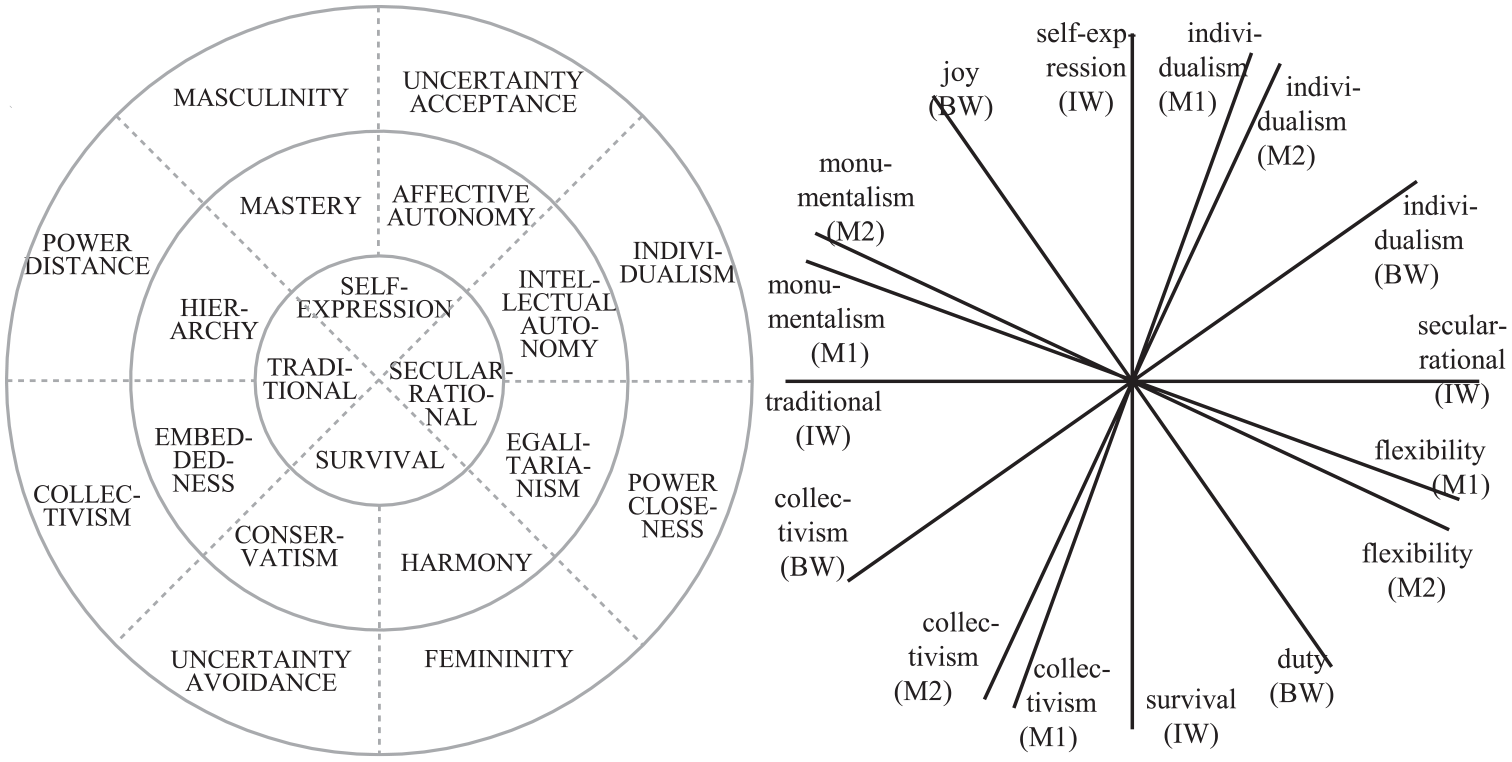
Comparison of the system proposed by Kaasa (2021) (rotated by 180°) and our results about placement of various sets of cultural dimensions (Inglehart’s dimensions aligned with vertical and horizontal axes) relative to each other.
Of course, there are also common elements in Minkov’s flexibility-monumentalism and Beugelsdijk-Welzel’s duty-joy, both tapping the opposition between self-transcendence and self-enhancement. This is again in accordance with Schwartz (1994), who theorized that autonomy versus embeddedness (conservatism) is “parallel” to individual-level openness to change versus conservation whereas hierarchy/mastery versus egalitarianism/harmony is “parallel” to individual-level self-enhancement versus self-transcendence. These similarities are also supported by the positions of various dimensions with respect to each other proposed by Kaasa (2021). However, while intellectual and affective autonomy and embeddedness (Schwartz, 2008b) are all highly correlated (all correlations over .7) with Minkov’s and Beugelsdijk-Welzel’s individualism-collectivism scores, flexibility-monumentalism, and duty-joy are much less correlated (all correlations below .3) with the mastery, harmony, hierarchy, and egalitarianism (Table OA14 in the Online Appendix). This may be due to the crucial differences in the operationalizations of these dimensions.
Thus, we conclude:
(a) The factor structure that can be extracted from the WVS/EVS questions covering various elements of culture, while addressing the criticisms about the choice of items in Inglehart’s model, replicates the Inglehart’s dimensions (H1).
(b) Studies that field different items and rely on different sets of countries may produce different two-dimensional solutions. However, those solutions are related to each other and one can align the solutions by rotating the dimensions axes (H2).
Concerning our second conclusion, it is worth stressing that there is no mathematically right or wrong placement of axes. Moreover, different research problems might require different approaches. For example, some social phenomena might be better explained by one particular dimension whereas other phenomena may be better explained by another dimension. For instance, as we can see from Table A2, Minkov’s flexibility-monumentalism outperforms Beugelsdijk-Welzel’s duty-joy dimension in terms of its closer relationship with adolescent fertility or educational performance, whereas prevalence of mental disorders is closer to the duty-joy dimension.
Regarding our decision to seek a two-dimensional structure, although we cannot completely rule out that we have overlooked some other important dimensions, our correlation analysis did not indicate that the sets including more than two dimensions have any significant additional explanatory power with respect to a wide range of diverse social indicators. It seems that the two-dimensional models might be a reasonable and adequate choice for capturing the main cultural differences across modern nations.
Different studies of the same social phenomenon in the last four decades have often used different sets of cultural dimensions. Therefore, it is important to have some orientation points in this thicket of studies in order to connect their results more successfully and draw meaningful conclusions. We believe that this study is a further step in this direction as it adds another viewpoint in addition to previous attempts by Maleki and de Jong (2014), Fog (2021), and Kaasa (2021) to make sense of the huge variety of cultural dimensions in the literature.
Limitations and Further Research
There are several limitations that we want to stress here. First, the availability of data limited our ability to cover all the aspects that have been covered by previously published well-known cultural models. We intended to use as many waves of the WVS/EVS as possible in order to rule out random fluctuations, however a lot of items were only asked in one or two waves or only in either the WVS or the EVS. For that reason, we could not use items, such as the questions inspired by the Schwartz’s theory (about wealth, power, success, caring for nature, helping others, etc.) that were included only in the sixth and seventh wave of the WVS, but not in the EVS. This might also be the reason why the items do not cover the space in Figure 1 quite evenly. If we could include more aspects, the obtained factor structure could be different. We hope that future studies might be able to fill that gap.
Similarly, although we intended to cover as many aspects of social life as possible when searching for social indicators that we correlated with cultural dimensions, it is possible that we have missed some relevant aspects that could shed more light on the comparison of cultural models. Also, it can be expected that culture that surrounds people has an influence on people’s behavior. While we decided to limit our analysis to aspects of social life measured at the societal level, it would be equally interesting to compare how various cultural models explain individual-level behavior. This could be done through multilevel analysis.
Finally, when using data from international surveys, one can always ask whether there are some differences in response style across cultures. However, response style can also be viewed as part of culture (Hamamura et al., 2008; Johnson et al., 2011; Minkov, 2009). Moreover, it can be expected that previous studies resulting in various cultural models have faced similar differences. We believe that response style does not have a significant effect on our results of the comparison of various cultural models.
The scores on the two dimensions extracted in this study capturing freedom-concern and responsibility-faith enable us to compare up to 115 countries and track longitudinal changes over six waves of the WVS/EVS, but they can be calculated also for within-country regions if information about the respondent’s region is available and there is a reasonable amount of respondents from that region. For example, scores for European within-country regions are available in Table OA15 in the Online Appendix. Similarly, if the next waves of the WVS and the EVS include the questions that recur in waves 2 to 7, it will be possible to calculate scores for the same dimensions based on the new information.
Supplemental Material
sj-pdf-1-jcc-10.1177_00220221211072790 – Supplemental material for Are Different Two-Dimensional Models of Culture Just a Matter of Different Rotations? Evidence From the Analysis Based on the WVS/EVS
Supplemental material, sj-pdf-1-jcc-10.1177_00220221211072790 for Are Different Two-Dimensional Models of Culture Just a Matter of Different Rotations? Evidence From the Analysis Based on the WVS/EVS by Anneli Kaasa and Michael Minkov in Journal of Cross-Cultural Psychology
Footnotes
Appendix
Declaration of Conflicting Interests
The author(s) declared no potential conflicts of interest with respect to the research, authorship, and/or publication of this article.
Funding
The author(s) disclosed receipt of the following financial support for the research, authorship, and/or publication of this article: This work was supported by the Estonian Research Council grant PRG380. The work of the second author was supported also by the HSE University Basic Research Program.

Supplemental Material
Supplemental material for this article is available online.
References
Supplementary Material
Please find the following supplemental material available below.
For Open Access articles published under a Creative Commons License, all supplemental material carries the same license as the article it is associated with.
For non-Open Access articles published, all supplemental material carries a non-exclusive license, and permission requests for re-use of supplemental material or any part of supplemental material shall be sent directly to the copyright owner as specified in the copyright notice associated with the article.
