




Abstract
There are various sets of cultural dimensions in the literature. Can they be merged into a single system? While previous studies have mainly compared different dimensions empirically, this article takes a conceptual approach and explains how Hofstede’s, Schwartz’s, and Inglehart’s models can be merged into one system. Instead of looking at dimensions from different sets one by one, this study uses a novel approach: each set of dimensions is viewed as one unit covering a certain space of values, norms, beliefs, attitudes, etc. The results make it possible to arrange three sets of dimensions into one visualized system and confirm several conclusions in the existing literature. Knowing how different models are related to each other allows easier comparisons of the results of studies using different sets of cultural dimensions as explanations of extraneous variables.
Introduction
Culture is a societal-level phenomenon studied by scholars for more than a century. Almost 70 years ago, Kroeber and Kluckhohn (1952) collected more than 200 pages of different definitions of culture and this number has grown since then. In general, culture is seen as something different from personality, which is an individual-level concept: culture is a societal level concept, and a group phenomenon. It consists of values, norms, beliefs, attitudes, and more, forming patterns that distinguish one group of people from another, be it a country, a region, an ethnicity, or some other group (Hofstede, 2001; Schwartz, 2008). The number and diversity of these elements of culture is such that it seems impossible to grasp them all at once. One way to comprehend and make sense of this enormous amount of available information is the multidimensional approach. This widely used method is based on the assumption that every group of people, a country or region for example, can be imagined as a point in a multidimensional space. The dimensions forming the imaginary axes that define this space are generalizations. Their number should be reasonably small so that the human mind can easily grasp them, as also noted by Taras et al. (2009). Dimensions are created by researchers so as to reduce a complex reality into a few meaningful concepts. As Minkov (2013, p. 135) notes, dimensions do not exist outside people’s minds. They are only means for researchers to explain human behavior and there is no one set of true cultural dimensions (Tuleja & Schachner, 2020). The number and nature of dimensions that emerge from a particular analysis depend on many circumstances: the variables included into the analysis, the available observations (countries), the data-collection period, data reduction methods used for capturing various elements of culture into a reasonable number of dimensions, etc. Hence, the number of dimensions that one can create is seemingly unlimited. For example, in their literature review Taras et al. (2009) identified 121 distinct sets of dimensions (which they call “instruments”) measuring culture.
Is it possible to merge different sets of dimensions into a single system and how would they all fit together? This article proposes an approach that can provide an answer to this question. Three widely known and used sets of cultural dimensions were chosen: Hofstede’s (1980), Schwartz’s (1994, refined 2004), and Inglehart’s (1997). Each of the three sets is derived from analyses of large datasets measuring various elements of culture quite comprehensibly. In addition to their popularity, these cultural models have important predictive properties: they are associated with, and explain, diverse cross-cultural differences as demonstrated by the work of their authors.
Some studies have compared Schwartz’s and Hofstede’s dimensions (Gouveia & Ros, 2000; Schwartz, 1994; Smith et al., 2002; Steenkamp, 2001) or Schwartz’s and Inglehart’s (Dobewall & Rudnev, 2014; Dobewall & Strack, 2014, Schwartz, 2004) or all three (Basabe & Ros, 2005, Fog, 2021). These studies used mainly an empirical approach, mostly based on correlation analysis. There are also many studies analyzing empirically the usefulness of different sets of dimensions for some specific research problem (e.g., De Mooij, 2017; Luthar & Luthar, 2007, Voss et al., 2014). While an empirical analysis is doubtlessly important as it gives valuable information about statistical relationships, the importance of a theoretical analysis cannot be overrated. Even if the dimensions are a result of an empirical analysis, their interpretations and names contain an element of creativity and subjective choice, reflecting a researcher’s concept of the main problems that societies face. Hence, a theoretical approach to complement the work that has been done empirically would be beneficial. However, there are only a few attempts in literature to systematize various dimensions of culture from a theoretical point of view, such as the works of Nardon and Steers (2009) and Maleki and de Jong (2014). A more theoretical discussion comparing Schwartz’s dimensions with those of Hofstede, and later also Inglehart’s, can also be found in Schwartz (1994, 2004).
This article shows how three different sets of cultural dimensions can be merged into one system. Unlike most previous studies, this one uses a conceptual approach: the focus of this exercise is on how different theories and dimensions are conceptually related, and not on empirical correlations. While the empirical correlations are expected to reflect conceptual relationships between dimensions, they might also be affected by the measurement problems. Hence, a theoretical view would be very useful to complement the empirical analyses.
When developing theoretical view, this article takes an approach that differs from the one used by Nardon and Steers (2009) and Maleki and de Jong (2014), who have grouped dimensions from various sets based on the similarity of the dimensions’ descriptions. While those studies considered single dimensions separately, disregarding the system that they form with the remaining dimensions in the set that they belong to, this article views each and every set of dimensions as one unit or one system that can be assumed to cover a certain space of values, norms, beliefs, attitudes, etc. The outcome is an analysis of whole sets of dimensions, allowing an estimate of how they are related to each other.
Studies of Hofstede, Schwartz, and Inglehart
The studies of Hofstede (1980), Schwartz (1994, 2004), and Inglehart (1997) have both similarities and differences. Hofstede originally analyzed 40 national samples of IBM employees. Schwartz analyzed 38 samples of teachers and 35 samples of university students from 38 nations. Inglehart analyzed World Values Survey data that were demographically representative of the populations of 43 societies. While Hofstede’s data were collected in 1967 to 1973, Schwartz and Inglehart used data collected two decades later: 1988 to 1992 and 1990 to 1991, respectively. The items included in Hofstede’s analysis were initially meant to survey employee attitudes. The cultural dimensions that they yielded were a by-product of the study, whereas Schwartz based his choice of items on theoretical considerations aiming to cover all motivational types of values. The World Values Survey was also designed to cover basic values and motivations with a focus on investigating the potential change in values caused by economic and technological development. While all the items used by Schwartz can be viewed as personal values, the items analyzed by Hofstede and Inglehart also include various personal preferences, practices, attitudes, and beliefs. In addition, Hofstede analyzed respondents’ perceptions of organizational practices.
All three authors analyzed data that were aggregated to the society level and used some data reduction technique in order to capture various elements of culture into a reasonable number of dimensions. Hofstede and Inglehart used factor analysis, whereas Schwartz’s method was multidimensional scaling. Both of these methods arrange variables in a multidimensional space, based on their similarities and dissimilarities. Factor analysis relies on Pearson correlations, whereas multidimensional scaling uses various distance measures.
Hofstede’s original analysis produced three dimensions, but he split one of them into two based on theoretical considerations: individualism-collectivism and power distance. 1 The other two dimensions were named masculinity-femininity and uncertainty avoidance. Schwartz’s work yielded three dimensions, one of which is asymmetrical: conservatism (later called embeddedness) at one pole versus affective autonomy and intellectual autonomy at the opposite pole. The other two dimensions were called hierarchy-egalitarianism and mastery-harmony. Inglehart’s analysis created two dimensions: traditional versus secular/rational authority and survival versus self-expression. While Schwartz’s dimensions are correlated with each-other, forming a so-called circle of overlapping domains, Inglehart’s dimensions resulting from factor analysis using the method of principal components are orthogonal (independent). Hofstede’s dimensions were also aimed to be orthogonal, but as power distance and individualism-collectivism were created by splitting a single factor, they cannot be expected not to be correlated.
Results of Previous Comparisons
Previous works comparing Hofstede’s, Schwartz’s, and Inglehart’s dimensions from a theoretical point of view have come to similar conclusions. Nardon and Steers (2009) and Maleki and de Jong (2014) both see Hofstede’s individualism-collectivism and Schwartz’s embeddedness-autonomy as reflecting the same cultural dimension that is called “individual/collectivistic social organization” by Nardon and Steers (2009) and “individualism versus collectivism” by Maleki and de Jong (2014). Similarly, both see Hofstede’s power distance-closeness and Schwartz’s hierarchy-egalitarianism as capturing the same dimension named “power distribution: hierarchical versus egalitarian” (Nardon & Steers, 2009) or “power distance” (Maleki & de Jong, 2014). Third, they both place Hofstede’s masculinity-femininity and Schwartz’s mastery-harmony together in the dimension describing the “relationship with the environment: mastery versus harmony” (Nardon & Steers, 2009) or simply “mastery versus harmony” (Maleki & de Jong, 2014). This leaves Hofstede’s uncertainty avoidance-acceptance without any counterpart in Schwartz’s set of dimensions. While Nardon and Steers (2009) did not include Inglehart’s dimensions, Maleki and de Jong (2014) viewed traditional versus secular/rational and survival versus self-expression as coming under additional separate dimensions. Schwartz (2004) notes that his “autonomy/embeddedness dimension and Hofstede’s individualism/collectivism overlap conceptually to some degree”: while autonomy-embeddedness also contrasts openness to change with maintaining the status quo, Hofstede’s individualism-collectivism does not. Indeed, this aspect is captured by Hofstede’s uncertainty avoidance dimension. Similarly, Schwartz (2004) acknowledges conceptual overlap in power distance and hierarchy as well as in masculinity and mastery. Regarding Inglehart’s dimensions, Schwartz (2004) recognizes a conceptual overlap of traditional-secular/rational dimension with both embeddedness-autonomy and hierarchy-egalitarianism dimensions. The survival-self-expression dimension is considered to have some overlap with both embeddedness-autonomy and harmony-mastery dimension, but also some common elements with egalitarianism-hierarchy (Schwartz, 2004).
These theoretical viewpoints are supported by empirical analyses. Table 1 presents results of various empirical studies regarding the relationships between the dimensions from the three dimension sets. Some of these studies have used correlation analysis, some factor analysis, and one both. In the same spirit with Schwartz (2004), the correlations with absolute value greater than 0.3 were marked in the table. The table does not include the study of Dobewall and Rudnev (2014), who used a different method, multidimensional scaling concluding similarity of Inglehart’s traditional-secular/rational dimension and Schwartz’s embeddedness-autonomy. The positions of different items they used, also implicated similarity between embeddedness-autonomy and survival-self-expression.
Results of Previous Empirical Studies Comparing Dimension Sets of Hofstede, Schwartz, and Inglehart.

Note. +Stands for positive correlation over 0.3, −stands for negative correlation with absolute value over 0.3, × means that the correlation was checked/reported, but with absolute value below 0.3; f+ means that two dimensions loaded into one factor with the same sign, f− means that they loaded into one factor with different signs. H stands for Hofstede, S for Schwartz, and I for Inglehart.
Although the sign in Table 4 of Maleki and de Jong (2014) states otherwise, the statements in text allow to conclude relationships in the way they are presented here.
It appears that for every pair of dimensions all studies including that pair have reached the same conclusion about the empirical relationship between those dimensions. However, the overall picture is fragmentary as some pairs have received a lot more attention than others. Nevertheless, it can be seen that empirical studies support the conclusions of Schwartz (2004), Nardon and Steers (2009), and Maleki and de Jong (2014).
Mapping the Dimensions onto the Space of Items
One way to map dimensions from different sets onto the space of various items is using the plot similar to the one that might be produced by a multidimensional scaling analysis. This approach assumes that for visualization purposes all dimensions can be pictured on the two-dimensional figure so that they form a star-like configuration, with the origin of axes in the middle. Different items (various elements of culture) are now represented by points on this figure and the items describing a particular dimension are placed close to the axis representing this dimension. Across the origin are the opposites of the same dimension. Axes that are close to each other represent conceptually related/similar dimensions, whereas those axes that are at right angles represent unrelated dimensions. A very similar approach was used by Schwartz (1994, 2004) to present his results and this approach has been viewed as very useful for a theoretical overview (Minkov et al., 2015) and comparing models (Hanel et al., 2018). A quite similar approach was also used by Inglehart (1997, p. 82), although his figure was created through a different method: the axes represent two factors determined by the loadings of the items onto the two dimensions. Imaginably, a similar figure could also be created by projecting Hofstede’s four dimensions onto a two-dimensional plot. For these reasons, the approach offered in this article will have most resemblance with the approach of Schwartz. It can be assumed, however, that this is not the only possible approach and other approaches can provide similarly plausible results.
The limitation of this approach is the possible distortion caused by projecting a set of more than two axes onto a two-dimensional figure. One could imagine, however, that all dimensions are placed vertically at different angles with respect to the plane of the two-dimensional figure, surrounded by the cloud of their relevant items. Those items from each dimension(cloud) that are closest to the plane of the two-dimensional figure can be assumed to be most likely the ones that form the similarities between the dimensions placed close to each-other on the two-dimensional figure.
The keywords placed as items on the figure created in this article come from the theoretical descriptions, conceptualizations, and explanations of the main facets of their dimensions by the authors (Hofstede, 1980; Inglehart, 1997; Inglehart & Baker, 2000; Schwartz, 1994, 2004). Only those wordings (keywords) were included that were used by authors in theoretical discussion. In order to keep the focus on theoretical essence of each dimension, wordings used in the questions asked from respondents, but not in theoretical discussion, were not included. Next, a brief overview of the theoretical descriptions of dimensions of Hofstede, Schwartz, and Inglehart introduces those keywords.
Descriptions of Dimensions
According to Hofstede (1980), individualism-collectivism contrasts individualistic and collectivistic self-concept: individual identity versus collective identity. While individualism is related with independence, inner-directedness, and personal interests, collectivism is associated with greater emotional dependence, importance of family, and group interests. Power distance-closeness is about interpersonal power and the desirability of (in)equality: whether inequality should be minimized (aiming thus equality) or there should be an order of inequality with everyone having their rightful place (similar to ascribed roles mentioned at the description of hierarchy later). This dimension opposes authority, autocratic decision-making, obedience and fear of disagreement to consultative decision-making, participation, and willingness to disagree.
Masculinity-femininity contrasts achievement, self-realization, assertiveness, competitiveness, ambitiousness, attracting favorable notice, recognition, and advancement with interpersonal aspects, relationships, affectionateness, compassion, benevolence, environment, physical conditions, and position or employment security. Hofstede’s masculinity-femininity dimension has been conceptually associated not only with achievement-orientated values but also with gender egalitarianism (Maleki & de Jong, 2014; Taras et al., 2009). As Taras et al. (2009) also note, although Hofstede’s original definition and some of the items that loaded on the masculinity factor reflect achievement orientation, Hofstede (1980, 2001) also discussed gender egalitarianism under the same heading. Later, these two aspects, however, have been viewed as defining separate dimensions (Maleki & de Jong, 2014; Taras et al., 2009) and recent studies have confirmed this distinction (Minkov & Kaasa, 2021). The usual approach now is to conceive of masculinity as achievement orientation values, whereas gender egalitarianism is associated with some other dimension. Maleki and de Jong (2014) and Minkov and Kaasa (2021) see it as part of the individualism-collectivism dimension, whereas Schwartz (2004) sees a relationship with all his dimensions. Hence, in this article only the items related to achievement orientation and its opposite are treated as relevant to masculinity-femininity.
Uncertainty avoidance-acceptance is about (in)tolerance of ambiguity or uncertainty. The uncertainty avoidance pole is associated with tendency to conservatism, desire for order, need for rules, traditions and security, resistance to change, and intolerance of different opinions, while the other pole is related to the opposite: willingness to take risks, as few rules as possible, tolerance toward outgroups: people with different ideas, with deviant behavior or coming from other countries. Hofstede’s operationalization of uncertainty avoidance included also being nervous and tense. However, recently, several studies have shown that the dimension of uncertainty avoidance as it was operationalized by Hofstede, does not replicate in empirical studies (Merritt, 2000; Minkov, 2018, Minkov & Kaasa, 2021): obeying laws or rule orientation do not seem to form a dimension together with anxiety or work stress (Minkov, 2018; Minkov & Kaasa, 2021). Hence, in the same spirit with Maleki and de Jong (2014), in this article the items related to anxiety are not treated as relevant to uncertainty avoidance.
As stated by Schwartz (1994, 2004), hierarchy-egalitarianism is related to the use of power and preferred degree of hierarchical relations in society. It contrasts power, wealth, authority, and hierarchical allocation of fixed or ascribed roles with concern for others and their welfare, social justice, and equality. Mastery-harmony dimension opposes active efforts to modify one’s surroundings and get ahead of other people, exploitation of people and resources and self-assertion, success, ambition, and daring with emphasizing harmony with nature, valuing world at peace and protecting the environment. While mastery and hierarchy share “the broad concern for self-enhancement,” harmony and egalitarianism are both associated with self-transcendence (Schwartz, 1994). A close relationship between mastery-harmony and hierarchy-egalitarianism is also reflected in initial hypotheses of Schwartz (1994) consisting in two dimensions: (1) autonomy versus conservatism and (2) hierarchy and mastery versus egalitarian commitment and harmony with nature.
Regarding the autonomy-conservatism/embeddedness dimension, the autonomy pole was divided into two parts by Schwartz (1994, 2004). Intellectual autonomy has more intellectual emphasis on self-direction, independence, curiousness, creativity, broadmindedness. Affective autonomy has more affective emphasis on stimulation and hedonism valuing varied life, adventure, excitement, enjoying life. Both autonomy dimensions are related to openness to change (Schwartz, 1994). The counter side of autonomy in Schwartz’s approach is covered by one relatively broad dimension that was named “conservatism” in Schwartz (1994), but “embeddedness” later in Schwartz (2004). The items that measure this cultural domain actually cover two somewhat different aspects. One emphasizes maintenance of the status quo, respecting traditions and social order, security, self-discipline, and moderation, which justifies the term conservatism. The other covers values important in societies based on close-knit harmonious relations: reciprocation of favors, sharing, preserving public image, and interdependence. These are more appropriately called embeddedness. Hence, in this article, the area across from affective and intellectual autonomy is split into two sub-dimensions: conservatism and embeddedness. Conservatism is more closely related to formal aspects, such as order, rules, and traditions, while embeddedness is related to relationships and dependence between people. Schwartz (2004) notes that his “autonomy/embeddedness dimension and Hofstede’s individualism/collectivism overlap conceptually to some degree”: while autonomy-embeddedness also “contrasts openness to change with maintaining the status quo, individualism/collectivism does not.” This approach will separate the part of Schwartz’s autonomy-conservatism/embeddedness dimension that coincides with Hofstede’s individualism-collectivism from the part that does not. Distinguishing two sub-dimensions is also supported by the results of Dobewall and Rudnev (2014) implying that Schwartz’s dimension called embeddedness includes two subtypes of values, one more close to survival pole of the Inglehart’s survival-self-expression dimension and the other more close to the traditional pole of traditional-secular/rational dimension. It makes sense to differentiate between conservatism and embeddedness also for the sake of symmetry since the opposite part is divided into affective and intellectual autonomy. Conformity, also mentioned by Schwartz (1994), is related to both: conformity to the rules and traditions associates with conservatism, but conformity can also be guided by the desire for harmony with others, thus related to embeddedness aspect.
According to Inglehart (1997), the traditional-secular/rational dimension contrasts traditional, that is, religious authority with secular-rational authority: rational organizations designed for efficiently achieving impersonal goals. This dimension opposes emphasis on and importance of religion and family with importance of politics. The traditional authority pole is associated with ascribed status, sharing, and conformity (the first mentioned in the description of hierarchy pole and the other two in the embeddedness pole by Schwartz (1994, 2004), indicating quite broad conceptualization by Inglehart). Inglehart and Baker (2000) further explain that the traditional-secular/rational dimension is among others about social conformity versus individualistic striving and that the traditional pole emphasizes accepting and trusting authority passively while secular/rational pole has the opposite preferences, relating it to the contrast between obedience and participation (also related to power distance-closeness). The survival-self-expression dimension’s logic is closely related to Maslow’s (1943) theory of human motivation. As stated by Inglehart (1997), self-expression becomes important after security (both physical and economic) is taken granted. Security is conducive to tolerance and interpersonal trust, while insecurity is conducive to fear of everything unknown. On the self-expression pole the focus is on self-realization and meaningful work, and it is believed that scarcity could be alleviated by individual achievement; while the other pole, as put by Inglehart and Baker (2000), emphasizes “economic and physical security above all other goals,” and comprises feeling threatened by foreigners and ethnic diversity, which leads to an intolerance of gays and other outgroups.
Bringing Hofstede, Schwartz, and Inglehart Together
Figure 1 presents previously mentioned keywords or items arranged into a circle so that similar items are close to each other. The distance of items from the origin where the axes meet is arbitrary. On this space of items, the dimensions of Hofstede (1980), Schwartz (1994, 2004), and Inglehart (1997) are placed as axes based on their conceptual similarities. This approach follows the spirit of Schwartz (1992) when developing his individual-level theory of basic human values, assuming single values as “arrayed on a continuum of related motivations” without “empty space around them.” The process of positioning items and axes on the figure can be described in the following way. First, items related to one dimension were placed on the figure. Then, dimensions including the same or similar items were found and placed on either side of the first dimension. Then, the items of the first dimension were rearranged so that the items shared by two dimensions are positioned between those two dimensions, and the items belonging to only one dimension are positioned on the axis of that dimension. Next, the procedure was repeated starting with the search for next dimensions sharing items with the just added dimensions. Hence, Figure 1 is based on the assumption that dimensions from different sets overlap (Taras et al., 2009) and items between two axes are associated with both dimensions. In case of similar wording (e.g., ambition/ambitiousness, ascribed status/ascribed roles, self-assertion/assertiveness, order/social order, interdependence/emotional dependence, broadmindedness/tolerance, physical condition/physical security) only one keyword was chosen. In some cases the items were placed between two dimensions based on the conceptual suitability, although mentioned as such only in the description of one dimension (e.g., benevolence, individualistic striving, willingness to take risks, success, accepting authority passively, resistance to change, employment security, fear of unknown). Conformity, sharing, and ascribed roles, although also mentioned by traditional authority, were placed at those dimensions where they form a core of dimension.
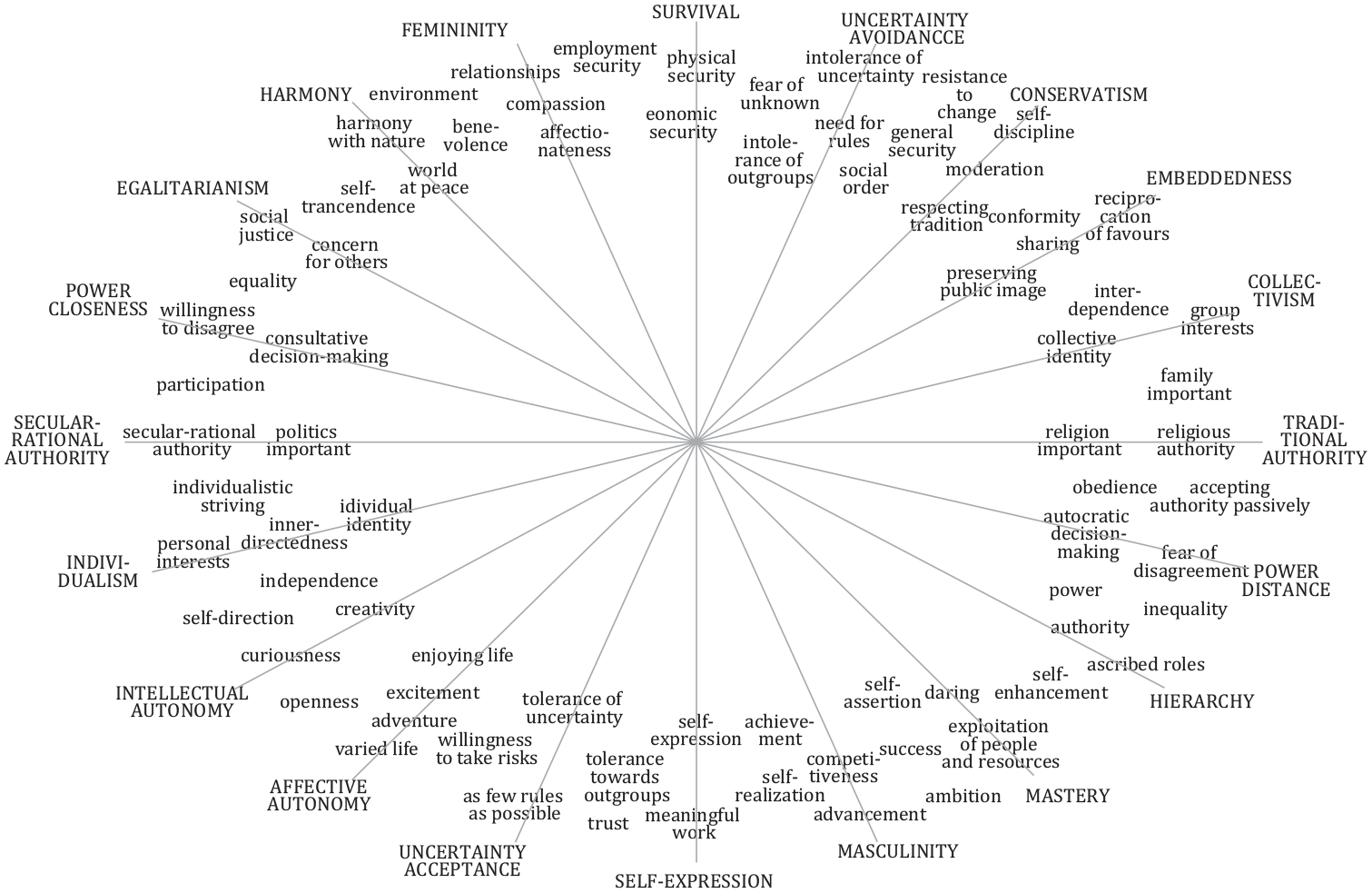
Placement of Hofstede’s, Schwartz’s, and Inglehart’s dimensions in the space of various items as a projection on the two-dimensional figure.
The spatial orientation of the figure is arbitrary in the sense that it can be rotated or flipped without compromising its meaning, as the only significant information in it is the sequence/order of the dimensions resulting from the described process. The focus is on that sequence, whereas the distance between adjacent axes is not necessarily assumed to be the same. Some neighboring axes can be closer to each-other and some can be farther away. It is also important to stress that the axes denote the approximate center of the cloud of items relevant to a particular dimension.
Figure 1 confirms the close relationship between Hofstede’s individualism-collectivism and Schwartz’s autonomy-embeddedness/conservatism. At that, the embeddedness-related items appear to be closer to Hofstede’s collectivism concept than the conservatism-related items that, in turn, have a lot in common with Hofstede’s uncertainty avoidance. On the opposite pole, affective autonomy has similar elements with uncertainty acceptance while intellectual autonomy is more similar to Hofstede’s concept of individualism. This is in accordance with Schwartz (2004), who stressed that his autonomy-embeddedness includes also an aspect that Hofstede’s individualism-collectivism does not: contrasting openness to change with maintaining the status quo. Figure 1 shows that this aspect is closely related with uncertainty avoidance, thus offering a counterpart from Schwartz’s approach to Hofstede’s uncertainty avoidance dimension that was missing in the comparisons of Nardon and Steers (2009) and Maleki and de Jong (2014). Next, Figure 1 confirms that Inglehart’s traditional-secular/rational dimension is related to both collectivism-individualism as well as embeddedness-autonomy (Maleki & de Jong, 2014). As Schwartz (2004) notes, they all have to do with the degree to which the individual is submerged in a structure of mutual obligations. At the same time, the traditional-secular/rational dimension also overlaps with power distance-closeness and hierarchy-egalitarianism as they all are about deference to authority (Schwartz, 2004). As expected based on previous results, Hofstede’s power distance-closeness and Schwartz’s hierarchy-egalitarianism are close to each-other. As Schwartz (2004) mentions, they both concern legitimizing social inequality. However, power distance-closeness stresses fear versus involvement, while hierarchy-egalitarianism is not necessarily about fear of authority. Hence, power distance-closeness is closer to traditional-secular/rational dimension with the contrast between accepting authority passively and participation. Hierarchy-egalitarianism, in turn, appears to be closer to mastery-harmony both reflecting aspects of self-enhancement versus self-transcendence. As Schwartz (1994) initially hypothesized hierarchy and mastery versus egalitarian commitment and harmony with nature as one dimension and it has been viewed as one wider dimension later as well (Dobewall & Strack, 2014), it is logical that those are placed next to each other. Next, Figure 1 supports the view that mastery-harmony overlaps with masculinity-femininity, both stressing assertiveness and ambition (Schwartz, 2004) while femininity and harmony both include benevolence and care for the environment. Also, Figure 1 indicates that Inglehart’s self-expression-survival dimension is close to masculinity-femininity, both including the opposition of achievement and self-realization with supportive environment. Mastery-harmony dimension seems to be more far from self-expression-survival, although Schwartz (2004) has noted that focus on material security versus environmental protection of the self-expression-survival dimension parallels mastery-harmony. At the same time, self-expression-survival dimension appears to be closely related to both uncertainty acceptance-avoidance and the opposition of affective autonomy and conservatism. Here, the common elements are open-mindedness and tolerance opposed to need for security and fear of unknown. Concerning both sides of the self-expression-survival dimension, Schwartz (1994) noted that both mastery and affective autonomy have elements of preference for change versus preservation of, and fitting into the environment that are also covered by the self-expression-survival dimension. Hofstede (1980) also noted that while high uncertainty avoidance is related to desire for security, low uncertainty avoidance is related to achievement motivation, supporting the positioning of uncertainty acceptance-avoidance, and masculinity-femininity close to each other over the self-expression-survival dimension. In similar spirit, Schwartz (1994) noted that mastery is related only to affective and not to intellectual autonomy. Figure 1 shows the overlap between the uncertainty avoidance-acceptance and conservatism-affective autonomy, both contrasting security, social order, and resistance with change to acceptance of risks. At that, uncertainty avoidance-acceptance is closer to survival-self-expression while conservatism-affective autonomy is placed next to the other part of the Schwartz’s original dimension: embeddedness versus intellectual autonomy. In wider view, the position of uncertainty avoidance-acceptance between femininity-mastery and collectivism-individualism is supported by Hofstede (1980) explaining uncertainty avoidance: people see conflict and competition more threatening (similar to femininity and harmony) and there is greater need for consensus (similar to embeddedness and collectivism).
Framing Up Three Sets of Dimensions
As mentioned, dimensions on Figure 1 are not necessarily assumed to be at equal distances from each-other. It can be assumed for example that hierarchy-egalitarianism is a little closer to power distance-closeness than to mastery-harmony. Also, some dimensions might cover a wider area than the others: Figure 1 includes four (sub)dimensions from both Schwartz and Hofstede, but only two from Inglehart. Based on this, it is worth asking whether it would be possible to create a figure that would give a more comprehensive overview of the three sets of dimensions and how they are related to each-other. This is a question of great interest also because for the concept of cultural dimensions to be useful, the number of dimensions used at a time, even in the case of a synthesized approach, has to be kept reasonable. Adding more dimensions into the system decreases the marginal utility of the additions (Taras et al., 2009).
One option is to view every set of cultural dimensions as a ring evenly covered by the dimensions of that set. We could place all those rings around the same origin and then rotate the rings so that dimensions covering similar items are juxtaposed one above another. The result would be a more comprehensive and generalized figure, although slightly less precise than Figure 1. Figure 2 offers one example where, for the sake of clarity, the rings are presented around (instead of above) each other. Again, the figure can be rotated or flipped without compromising its meaning and the order of the sets (rings) outward from origin is arbitrary.
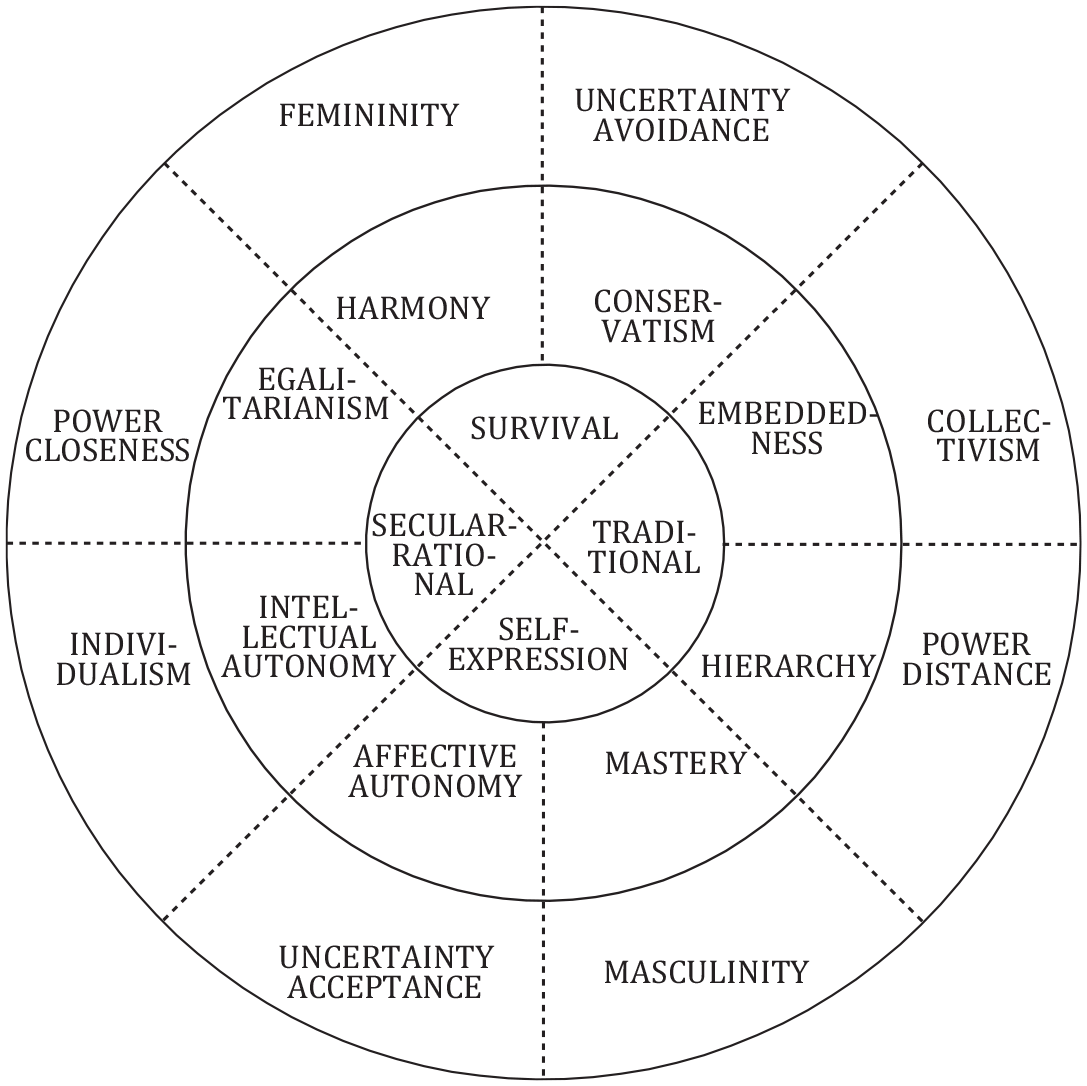
Simplified overview of the similarities between the sets of cultural dimensions of (from in to out) Inglehart, Schwartz, and Hofstede.
As discussed before, Inglehart’s traditional-secular/rational dimension has common elements with collectivism-individualism and embeddedness- intellectual autonomy (Maleki & de Jong, 2014; Schwartz, 2004) as well as with power distance-closeness and hierarchy-egalitarianism (Schwartz, 2004). Thus, the traditional-secular/rational dimension seems to cover both dimensions that loaded on one factor in Hofstede’s (1980) factor analysis: power distance and collectivism-individualism. The self-expression-survival dimension, in turn has common elements with masculinity-femininity and mastery-harmony as well as uncertainty acceptance-avoidance and affective autonomy-conservatism. Dobewall and Rudnev (2014) relate survival values with embeddedness, but in their analysis the embeddedness dimension included elements related to both conservatism part and embeddedness part. The arrangement of dimensions proposed in this article is also supported by the views of some authors (Beugelsdijk & Welzel, 2018; Dobewall & Strack, 2014; Welzel, 2013) that autonomy versus embeddedness and hierarchy and mastery versus egalitarianism and harmony as in Schwartz’s value space are rotated by 45° compared to Inglehart’s dimensions.
This approach enables us to elaborate on the view that both Inglehart and Schwartz cover a smaller number of cultural dimensions than Hofstede (Hsu et al., 2013). Although the three sets contain different numbers of dimensions, they seem to cover a similar range of concepts. Figure 2 is in accordance with the previous conclusions (Maleki & de Jong, 2014; Nardon & Steers, 2009; Schwartz, 2004) about the significant overlap of Hofstede’s power distance-closeness and masculinity-femininity and Schwartz’s hierarchy-egalitarianism and mastery-harmony dimensions, respectively. While demonstrating the overlap between Hofstede’s individualism-collectivism dimension with Schwartz’s autonomy-embeddedness dimension, Figure 2 also offers a counterpart for Hofstede’s uncertainty avoidance-acceptance dimension in Schwartz’s framework. The opposition of intellectual autonomy with embeddedness (related to relationships) overlaps with individualism-collectivism, while affective autonomy versus conservatism (related to rules and other formal aspects) overlaps significantly with uncertainty acceptance-avoidance dimension. Similarly to Maleki and de Jong (2014), Inglehart’s two dimensions are not directly equated with any of Hofstede’s or Schwartz’s dimensions. Instead, they are placed between those dimensions, but in the way that each of Inglehart’s dimensions is related and having an overlap with two of both Hofstede’s and Schwartz’s dimensions. Traditional-secular/rational dimension overlaps with collectivism/individualism and embeddedness-intellectual autonomy on one side and with power distance/closeness and hierarchy-egalitarianism on the other side. Self-expression-survival dimension overlaps with uncertainty acceptance-avoidance and affective autonomy-conservatism on one side and with masculinity-femininity and mastery-harmony on the other side.
Discussion
This article discusses an approach for merging different sets of cultural dimensions into one system, using Hofstede’s (1980), Schwartz’s (1994), and Inglehart’s (1997) dimensions as an example. This was done from a theoretical point of view. Although theories must also be accompanied by empirical tests and empirics might give valuable ideas for theory-building, with the continuous inflow of new data and possibilities for empirical analysis, there is a risk of relying too much on empirical outcomes when assessing previously created cultural dimensions. Empirical comparisons of cultural dimensions from different models, or attempts to find out which of them provide the best explanation of extraneous variables cannot give conclusive answers. This is so because the available studies are based on different countries, different types of respondents, different periods, different questions, and modes of measurement. Hence, the empirical analysis has to be accompanied by a theoretical one going back to the theoretical reasoning used by the authors when they conceptualized their cultural dimensions. This article aims to complement the prevalent empiricism in the literature on cultural dimensions.
The theoretical approach applied in this article is different from the classifications of cultural dimensions offered before. Instead of looking at dimensions from different sets one by one, here every set of dimension is viewed as one whole that is assumed to cover relatively evenly the space of various items: values, norms, beliefs, attitudes, etc., all of which measure some aspects of culture. This method works well for the three sets of dimensions selected for this study, each of which stems from one comprehensive analysis of one dataset. While in this article only three well-known sets of cultural dimensions were merged for reasons of simplification, the method allows incorporation of additional sets of dimensions. In the similar way, in future analysis next sets of dimensions could be analyzed regarding the similarities and overlaps with each-other and with the sets included in this study. However, an important precondition would be that the additional sets of dimensions also have to be created based on one analysis of one dataset with items covering various aspects of culture.
The system in Figure 1 is more precise than that in Figure 2. However, Figure 2 provides a better overview. The visualization in Figure 2 is a simplification, but it can be useful for getting a better overview. For example, Figure 2 can help compare the results of different studies using different sets of cultural dimensions as explanatory variables for some other phenomena, and fit the findings into a single system. It is important to stress that dimensions of culture are not something real (Hofstede, 1980, p.14; Minkov, 2013, p. 135; Tuleja & Schachner, 2020): researchers define them to exist, they are artifacts used to describe culture. Most importantly, they are tools that enable to relate culture to other phenomena, allowing researchers to gain useful insights, and make predictions and recommendations. Hence, it seems pointless to search for one unique, best, and timeless set of cultural dimensions. There are very many sets of dimensions available in the literature and new ones may be created in future empirical analyses. What is important, however, is to make sense of how those models relate to each other and how the new ones relate to those already present in the literature. Also, when investigating the relationship between culture and some other phenomenon, it is important to include one set of dimensions at a time in order to avoid multicollinearity stemming from the inclusion of similar cultural dimensions that can substitute one another.
This analysis provides a conceptual framework that calls for empirical analyses. The overlaps and similarities that are brought out provide an opportunity to clarify the understanding of cultural dimensions and to reduce the number of dimensions that are needed to cover the most important cultural differences. Such an exploration could be done using data available from cross-national studies, such as World Values Survey. However, as such studies do not cover all items included here, a new large cross-cultural study might prove to be very useful, if designed to cover various aspects of culture from different previous studies that were drawn together into Figure 1 in this study. The results of this study could be viewed as a starting point for further exploration and not necessarily a search for confirmation. First, the empirical relationships between various aspects are of interest in order to test the placements of items on Figure 1. At that, focusing on the wording of questions asked of respondents is crucial. It is possible that different studies show different relationships because items touching seemingly the same aspect have different meanings for the respondents. Next, recent studies (Minkov, 2018; Minkov & Kaasa, 2021) have shown that Hofstede’s uncertainty avoidance-acceptance and masculinity-femininity dimensions do not replicate when following Hofstede’s operationalization. Hence, it does not make sense to adhere to Hofstede’s measurements of uncertainty avoidance-acceptance and masculinity-femininity. However, this does not mean that the aspects of culture that these dimensions include are not relevant. On the opposite, this study showed that important elements of these dimensions are in accordance with dimensions from other sets. Hence, the findings of this study could serve as a starting point for a search for replicable measurements based on nationally representative samples that reflect the contrast between conservatism and openness or the contrast between achievement and relationships. It would be also interesting to check whether a new large cross-cultural study of nationally representative samples would show dimensions similar to individualism-collectivism and power distance-closeness that Hofstede created based on the responses of IBM employees and to dimensions Schwartz created based on the responses of teachers and university students. Also, it would be of interest whether for example the multidimensional scaling analysis will confirm the sequential, circular arrangement of the axes as presented in this study.
Footnotes
Declaration of Conflicting Interests
The author declared no potential conflicts of interest with respect to the research, authorship, and/or publication of this article.
Funding
The author disclosed receipt of the following financial support for the research, authorship, and/or publication of this article: This work was supported by the Estonian Research Council grant PRG380.
