




Abstract
Emerging evidence suggests that people not only categorize themselves and others based on age but also in terms of their generational membership. This cross-cultural study compared attitudes and stereotypes toward age and generational groups across the life span in China, Germany, and the United States including 1,112 participants between 18 and 86 years of age. We asked younger, middle-aged, and older respondents to rate either six age groups (e.g., adolescents, young adults, middle-aged adults, young-old, older, and old-old adults) or six matching generational groups (e.g., Generation Z, Millennials, Generation X, Baby Boomer, Silent Generation, and Greatest Generation) on various characteristics (e.g., happy, competent, selfish). Consistent with our hypotheses, the results demonstrate that across all three countries older generations were perceived consistently more positive, whereas older age groups were perceived as less positive. These findings suggest that generations represent a source of positive regard and high social status in later life across different countries with different historical backgrounds and cultures.
Ageism—the endorsement of negative aging-related attitudes and age stereotypes—is prevalent in virtually all modern societies (Butler, 1969; Löckenhoff et al., 2009; North & Fiske, 2015). In contrast to middle-aged adults, younger and older people are often socially devalued, and attitudes toward older adults often entail an overgeneralization and overestimation of negative age-related characteristics (Hummert et al., 1994; Kite et al., 2005; Robertson & Weiss, 2017; Weiss, 2018). For example, younger people are seen as self-absorbed, entitled, and lazy, whereas older people are seen as grumpy, slow, and senile (Zebrowitz & Montepare, 2000). Nevertheless, people can derive attitudes toward aging from multiple sources and previous research on the dual age identity (Perry et al., 2017; Weiss, 2014; Weiss & Lang, 2009, 2012; Weiss & Perry, 2020) has shown that people hold more positive attitudes and stereotypes toward older generations (e.g., Baby Boomer) as compared with older age groups (e.g., older adults). Less clear, however, is whether perceptions of age groups and generations vary across cultures. Previous cross-cultural research examining aging attitudes has solely focused on attitudes and stereotypes toward age groups and did not yet examine attitudes and stereotypes toward different generations. This omission is consequential because people are not only influenced by age-based categorization but also by the assignment to different generations that are situated in a specific historical and cultural context. Therefore, the present research extends our current theoretical understanding of aging attitudes and stereotypes by comparing and contrasting attitudes toward age groups and generations from adolescence to old age across three countries (China, Germany, and United States). Specifically, we tested whether the dual age identity is culturally specific or occurs in all three countries. In other words, do people hold similar or different attitudes toward age groups and generations across different countries with distinct historical backgrounds and cultures?
Attitudes Toward Age Groups
Aging is a multifaceted phenomenon (Baltes, 1987) and research shows that views on aging are complex and multidimensional (Diehl et al., 2014; Hummert, 1990; Kornadt & Rothermund, 2011). There is considerable evidence that chronological age is one of the three most salient social categories (i.e., the “big three” social categories: age, race, and sex; Brewer, 1988; Fiske, 1998; Kite et al., 2005). People have a clear understanding about what it means to be “younger,” “middle-aged,” or “older.” Age stereotypes reflect generalized beliefs about the physical, social, and psychological characteristics of younger, middle-aged, and older people including desirable (gains) and undesirable (losses) characteristics (Chan et al., 2012; Grühn et al., 2011; Löckenhoff et al., 2009; Weiss & Weiss, 2019). Aging-related beliefs and expectations often entail perceptions of competence such that younger adults are considered to be immature and inexperienced and older adults as “doddering but dear” (Cuddy & Fiske, 2002). Research suggests that these stereotypes can have significant consequences. For example, studies show that negative age stereotypes can have detrimental effects on individuals’ self-perceptions as well as on their well-being, cognitive performance, physical functioning, health, and longevity (Barber, 2017; Levy, 2009). While research shows that positive age stereotypes can counteract these effects to some degree, negative age-related expectations are more pervasive (i.e., effects appear almost three times larger, see Meisner, 2012) making them more likely to be chronically activated than positive stereotypes (Weiss & Kornadt, 2018).
Because perceptions of aging often reflect generalized expectations concerning biologically based differences in functioning, we assume that stereotypes about different age groups should be similar across cultures. In support for this argument, a study by Löckenhoff and colleagues (2009) revealed that basic patterns of aging perceptions (i.e., growing old) regarding age-related biological changes were mostly shared across 26 cultures. In addition, Cuddy and colleagues (2009) as well as Zhang and colleagues (2016) showed that stereotypes about older adults consisting of perceptions of high warmth and low competence consistently appeared across different cultures. Another study (Boduroglu et al., 2006) showed that age stereotypes were similar across East-Asian and Western cultures (i.e., US and China) reflecting an aging-associated shift from more positive to increasingly negative views of mental and physical traits. Moreover, a study by Chan and colleagues (2012) showed that people across 50 different countries shared similar age-stereotypic beliefs about different age groups from adolescence to old age. For example, in this study adolescents were more likely to be seen as emotionally unstable, impulsive, and rebellious, whereas older people were more likely to be considered as agreeable, closed-minded, and depressed. Finally, a study including data from more than 60 different countries demonstrated that aging attitudes resemble an inverted U-shaped curve across the adult life span with middle-aged adults’ having the highest social standing as compared with younger and older adults (Robertson & Weiss, 2017). Although this study revealed substantial variation across countries, it confirmed the aging-attitude pattern of an inverted U-shaped curve in the majority of countries under investigation. Taken together, previous research has shown that attitudes and stereotypes toward younger and older age groups are less positive as compared with attitudes and stereotypes toward middle-aged adults and this pattern appears consistent across different countries and cultures.
Attitudes Toward Generations
While people categorize themselves and others based on age, there is emerging evidence that people may perceive themselves and others in terms of their generational membership (Joshi et al., 2010; Mannheim, 1928/1952; Perry et al., 2017; Rudolph & Zacher, 2017; Weiss & Lang, 2012; Weiss & Perry, 2020). Although generations hardly differ in their life goals, values, work behavior, concerns, or social and political engagement (Costanza & Finkelstein, 2015; Rudolph & Zacher, 2017; Schröder, 2018; Trzesniewski et al., 2008), generation is a powerful social category that may build the basis of an important social identity. More specifically, generation represents a social category that is embedded in social and historical processes and a result of social interactions between individuals. According to Mannheim (1928/1952), generation is a social phenomenon and thus differs from the implications of biological aging including biological decline and a limited lifespan. Consistent with this perspective, research suggests that one’s birth cohort builds the basis for multiple age identities (Weiss & Lang, 2009). According to that, people maintain a dual age identity comprising membership in their age group (e.g., young adults, middle-aged adults, older adults) versus their generation (e.g., Baby Boomer, Millennials, Greatest Generation). Thus, apart from being associated with temporary membership in a series of different age groups, age is also associated with permanent membership in a specific generation (Weiss, 2014). Individuals remain members of the same generation throughout their whole life, while they become members of different age groups as they grow older. Importantly, the concept of generation goes well beyond assigning people to different cohorts born in a given time period, as it comprises collective experiences of growing up in a unique historical context (Lyons et al., 2015). Specifically, Mannheim (1928/1952) argued that throughout their life, members of a given birth cohort share critical stages of development by being collectively exposed to historical events and changes. This experience, in turn, gives rise to a consciousness of belonging to a distinct generation. Such identification with one’s generation may reflect an awareness of the changing social, political, and economic conditions during one’s life time and important historical events including generational traumata as well as consumer items and lifestyle choices (Eyerman & Turner, 1998; Halbwachs, 1939/1992; Mannheim, 1928/1952). Research shows that experiences of key events of a cohort earlier in life during the time of youth and young adulthood provide the basis of shared memories of a generation (Holmes & Conway, 1999; Schuman & Scott, 1989). Over time, cohorts accumulate shared experiences and interpretations of historical and cultural events, which transforms them into generations. In line with this, research has shown that generational identity exhibits a unique age-differential dynamic as individuals start to strongly identify with their generation as they enter later adulthood (see Weiss, 2014; Weiss & Lang, 2009; Weiss & Perry, 2020). Importantly, the representation of historical events rather the events themselves becomes significant in shaping generations (Eyerman & Turner, 1998). For example, research has shown that the perceived meaning of historical events differs between cohorts and that these collective memories of events distinguish generations (Schuman & Scott, 1989).
Differences in the Perception of Age Groups and Generations
There is also solid evidence for perceptual differences between age groups and generations across the life span (Perry et al., 2015). Research shows that individuals hold different attitudes and stereotypes toward age groups and generations. On one hand, attitudes and stereotypes toward generations differ (e.g., Millennials vs. Baby Boomer), and on the other hand, attitudes and stereotypes toward generations differ from attitudes and stereotypes toward matching age groups (Greatest Generation vs. very old people). For example, younger generations are often described as entitled, lazy, and self-centered, older generations are often seen as hard working, responsible, and experienced, whereas older age groups are perceived as slow, senile, and unattractive. In fact, content analyses of age and generational stereotypes suggest that perceptions of older age groups were associated with physical decline (e.g., “slow,” “problems hearing”), whereas perceptions of older generations were associated with agency (e.g., “hard working”) and a particular lifestyle (e.g., “sexual revolution,” Weiss & Lang, 2012; Weiss & Perry, 2020). Because images of older generations are more positive and meaningful than those of older age groups, generations represent a resource in later adulthood (Correll & Park, 2005; Haslam et al., 2005; Weiss, 2014; Weiss & Lang, 2012). For example, how generational (meta)stereotypes have the capacity to empower older adults and mitigate perceptions of stereotype threat (Weiss & Perry, 2020). By contrast and as discussed above, older age groups are often associated with a threat due to negative age-based stereotypes that can impair older adults’ well-being and functioning (Barber, 2017; Chasteen et al., 2012; Levy, 2009; Marquet et al., 2019; Weiss & Lang, 2009; Weiss & Weiss, 2019).
A motivational perspective on generation identity suggests that generations provide a sense of positive self-regard, continuity, and generativity to older adults (Weiss, 2014). Thus, generational membership not only has the capacity to buffer the detrimental effects of negative age stereotypes, but also helps older adults deal with the finitude of life. As people grow older, they start to “recognize and manage the generational turnover as well as managing or becoming reconciled to one’s functional losses, finitude, and impending death” (Baltes et al., 1999, p. 478). Therefore, an important social and psychological function of generations points to the preservation of cultural heritage because generations serve the function of passing on their vision of social reality to younger generations. Mannheim (1928/1952) has argued that “members of any one generation can participate only in a temporally limited section of the historical process, and it is therefore necessary continually to transmit the accumulated cultural heritage [. . .]” (p. 292). Studies have shown that generations provide older adults with a sense of continuity, finitude, positive legacy, and generativity (Wade-Benzoni, 2006; Weiss, 2014). For example, older participants who strongly identified with their generation reported a more positive self-perception and higher levels of agency (Weiss & Lang, 2009, 2012). In another study, higher levels of generation identification among older adults were associated with the perception of being a member of a proud generation which made unique contributions to society and whose reputation would endure after one is gone (Weiss, 2014).
In terms of cross-cultural similarities, studies from the United States and Germany suggest that people hold more positive attitudes and stereotypes toward older generations (Perry et al., 2015; Weiss & Lang, 2012; Weiss & Perry, 2020) and more negative attitudes and stereotypes toward younger generations (Protzko & Schooler, 2019; Trzesniewski et al., 2008; Twenge, 2006). For example, in the United States and Germany, younger generations are often seen as entitled and narcissistic. However, there is a scarcity of cross-cultural studies examining attitudes and stereotypes toward generations across the life span in non-Western countries such as China.
On one hand, across countries with a different culture as well as different historical events and changes, perceptions of generations should differ. According to this, perceptions of generations (in terms of stereotype content and structure) may differ because they are shaped by unique cultural and historical influences. On the other hand, however, generations should represent meaningful social categories in all cultures that should be positively evaluated. According to this, generations attain a more and more positive connotation as they move throughout the lifespan. As generations grow older, they are viewed in the light of accumulated achievements and contributions to society that may result in high social status in the eyes of others. In this way, generations may serve similar social and psychological functions across cultures as they provide a sense of positive self-regard, continuity, and generativity in the face of negative age stereotypes and finitude in later adulthood. As a consequence, older generations in all three countries should be perceived as more positive as compared with older age groups.
The Current Research
While previous research has confirmed the dual age identity in German and US samples (Weiss & Lang, 2009, 2012; Weiss & Perry, 2020), two questions have remained unsolved so far. First of all, most of the previous research was constrained to self-perception (i.e., asking participants to think about their own age group or generation) and it is unclear whether such perceptions still hold if people were asked to evaluate others in terms of age versus generation. Second, it is still an open question whether the dual age identity found in Germany and the United States is culturally specific or might occur also in other countries and cultures such as China (Cuddy et al., 2009; Hess et al., 2017; Löckenhoff et al., 2009; North & Fiske, 2015; Westerhof & Barrett, 2005). Studies show that attitudes and stereotypes toward older age groups appear to be similar across cultures with a shift to more negative attitudes toward older adults (Boduroglu et al., 2006; Chan et al., 2012; Cuddy et al., 2009; Löckenhoff et al., 2009; Zhang et al., 2016). With respect to younger age groups and generations, research indicates that stereotypes of adolescents and young adults as well as younger generations appear to be similar negative at least in the West (Chan et al., 2012; Protzko & Schooler, 2019; Robertson & Weiss, 2017; Trzesniewski et al., 2008; Twenge, 2006). By contrast, there is lack of research comparing attitudes toward younger and older generations across cultures. Whereas attitudes toward older adults appear to be relative similar across cultures, it is not clear whether older generations are perceived as more positive in all three countries. Because of the above reviewed cross-cultural commonalities of aging as well generational attitudes, we predict that across three countries (China, Germany, and the United States) individuals will perceive (a) older generations as more positive than older age groups, (b) older generations as more positive than younger generations, and (c) younger and older age groups as less positive as compared with middle-aged adults.
By applying a cross-cultural study design, we compared attitudes toward age and generational groups across the life span (i.e., from adolescence to old age) in China, Germany, and the United States extending previous research in two important ways. First, we tested whether perceptual differences of age groups and generations found in self-perceptions may also apply to perceptions of other people. Second, we examined whether such differences are culture-specific phenomenon or whether these differences can be replicated in different countries with different historical backgrounds and cultures. In doing so, younger, middle-aged, and older respondents in China, Germany, and the United States rated six age groups (e.g., middle-aged adults) and six matching generational groups (e.g., Baby Boomer) on various characteristics (“competent,” ‘happy,’ and “selfish”).
Method
Participants and Procedure
We surveyed participants in China, Germany, and United States in Fall 2018. The samples were gathered with the goal to attain a roughly equal distribution of younger, middle-aged, and older participants. Our final sample included 1,112 adults between 19 and 83 years of age (M = 46.93, SD = 16.82, 49% female) including 407 Chinese participants (M = 46.11, SD = 17.22; 46.2% female), 364 German participants (M = 49.40, SD = 17.63; 47.3% female), and 341 U.S. participants (M = 45.29, SD = 15.13; 53.4% female). The study hypotheses as well as the study procedure for the German study were preregistered via OSF (https://doi.org/10.17605/OSF.IO/C62RH). We used the program G*Power to conduct a power analysis. Our goal was to obtain .95 power to detect a medium effect size of .27 (see Weiss & Lang, 2012) at the standard .05 alpha error probability across different age groups resulting in a sample size of 344 per country. Thus, our target sample size per country was 350 to 400 participants and we enforced a quota ensuring an equal distribution of age (18–29, 30–39, 40–49, 50–59, 60–69, 70 and older) and gender (male, female) groups.
We commissioned professional panel provider to recruit participants from online panels in Germany and the United States and relied on data collection through local schools and communities in China. Participants were given a nominal payment for completing the survey and only those were included who passed attention checks and provided complete data. Demographic information of each subsample is provided in Table 1 and Table S1 (see Online Supplemental Material) for younger, middle-aged, and older respondents. German respondents were slightly older than Chinese and American respondents. US American respondents reported significantly better subjective health as compared with Chinese respondents. In terms of education, the three samples showed a comparable distribution with Chinese respondents reporting relatively lower levels of education.
Sociodemographic Information of the Sample by Country.
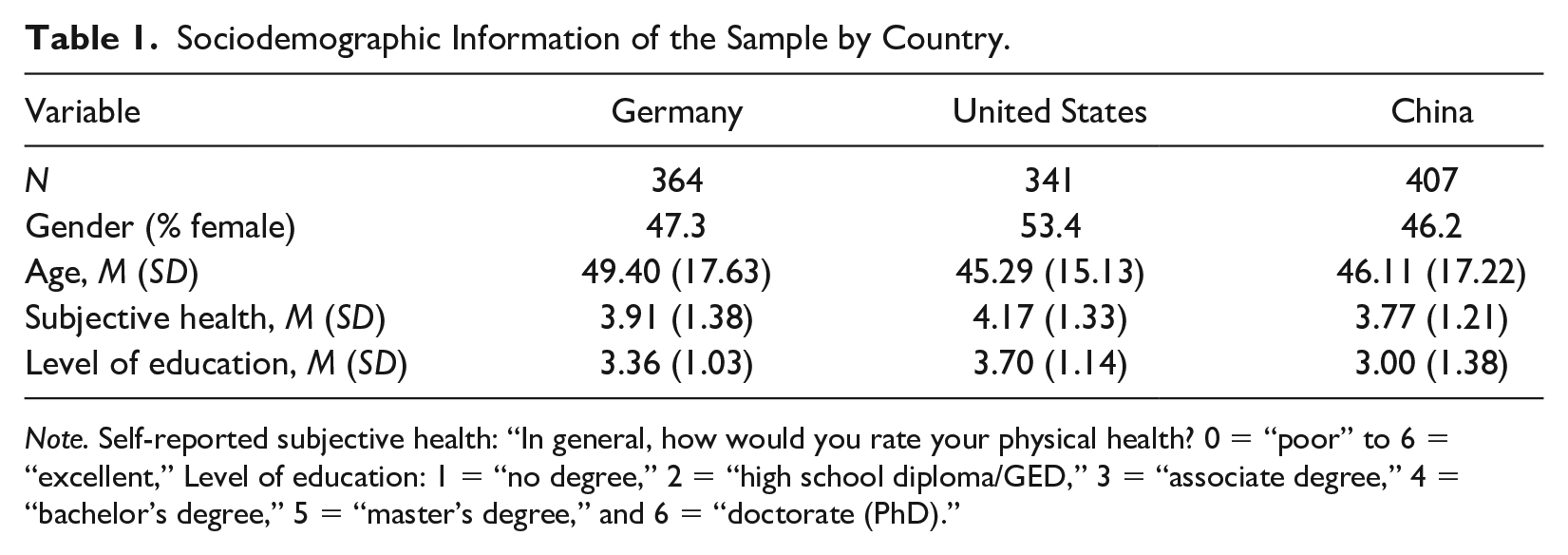
Note. Self-reported subjective health: “In general, how would you rate your physical health? 0 = “poor” to 6 = “excellent,” Level of education: 1 = “no degree,” 2 = “high school diploma/GED,” 3 = “associate degree,” 4 = “bachelor’s degree,” 5 = “master’s degree,” and 6 = “doctorate (PhD).”
Measures
Participants rated six age groups and six matching generational groups on a six-item semantic differential (see below). Specifically, we provided two “parallel” versions of our attitude questionnaire (“age group” and “generation” version) to participants in China, Germany, and the United States (see Online Supplemental Material). The order of presenting the age group or generation attitude items was counterbalanced. The English version of the questionnaire was translated into German and Mandarin. Bilingual individuals translated the questionnaire back to English. Discrepancies were reviewed and discussed, and the items were adapted until everyone agreed upon the translation. In addition, intraclass correlations (ICC[1, k]) ranged from .78 to .92 (see Table S2; see Online Supplemental Material) suggesting that respondents generally agreed on the perceived typical characteristics of different age groups and generations.
Attitudes toward age groups
Attitudes toward age groups were assessed using a six-item semantic differential that was anchored on a 7-point rating scale ranging from “−3” to “3.” Participants reported to each of the six pairs of bipolar adjectives how the six different age groups are typically perceived (i.e., [Age groups] are typically . . . “lazy”–“hard working,” “incompetent”–“competent,” “stupid”–“intelligent,” “foolish”–“wise,” “sad”–“happy,” “selfish”–“altruistic”). The characteristics were adapted from previous research on aging- and generational attitudes (Cuddy et al., 2009; Hummert, 1990; Löckenhoff et al., 2009; Perry et al., 2017; Rudolph & Zacher, 2017; Weiss & Lang, 2012; Weiss & Perry, 2020). In all three countries, these age groups were specified using the following six labels: “adolescents (13–19 years),” “young people (20–39 years), “middle-aged people (40–52 years),” “young-old people (53–69 years),” “old people (70–89 years),” “very old people (90 and older years).” Higher scores represent a more positive attitude on the respective adjective pair. Factor analyses confirmed a one-factor solution for the age group attitude scale within and across all cultures. Specifically, for the age group attitude scale, a principal components analysis yielded one component with Eigenvalues > 3.52, accounting for > 58.69% of the variance. Cronbach’s alpha estimates of internal consistency for the age group attitude scale for the six age groups were .86, .86, .85, .86, .83, and .85 for the United States; .81, .81, .86, .89, .87, and .87 for Germany; and .84, .86, .87, .87, .88, and .91 for China, respectively. For analyzes, we computed a mean composite score across all six items with higher values representing more positive attitudes.
Attitudes toward generations
Attitudes toward generations were assessed using the same six-item semantic differential anchored on a 7-point rating scale ranging from “−3” to “3.” On the basis of the six pairs of bipolar adjectives, participants reported how the six different generations are typically perceived (i.e., [Generation] are typically . . . “lazy”–“hard working,” “incompetent”–“competent,” “stupid”–“intelligent,” “foolish”–“wise,” “sad”–“happy,” “selfish”–“altruistic”). We used six different generational labels in the study that differed between China, Germany, and the United States (see below) that matched the six different age groups. Again, factor analyses confirmed a one-factor solution for the generation attitude scale within and across all cultures with one component and Eigenvalues > 3.88, accounting for > 64.71% of the variance. We computed mean composite measures across all six items assessing attitude/stereotypes toward generations. For the generational attitude scale, Cronbach’s alpha estimates were .88, .89, .90, .89, .88, and .88 for the United States; .88, .91, .91, .93, .91, and .90 for Germany; and .85, .87, .90, .91, .91, and .92 for China, respectively. Again, we computed a mean composite score with higher values representing more positive attitudes.
The generation labels for Germany and the United States were drawn from the literature (Perry et al., 2017; Pew Research Center, 2015; Rudolph & Zacher, 2017; Weiss & Lang, 2009, 2012; Weiss & Perry, 2020). More specifically, for Germany we specified generations by “Generation Z (1999),” “Millennials (1980–1998),” “Generation X (1966–1979),” “68er Generation (1946–1965),” “Post-War Generation (1929–1945),” “War Generation (1900–1928).” In the United States, we used the following labels: “Generation Z (1999),” “Millennials (1980–1998),” “Generation X (1966–1979),” “Baby Boomer (1946–1965),” “Silent Generation (1929–1945),” and “Greatest Generation (1900–1928).” The cohorts mentioned in the generation labels matched all age ranges in the age group labels. Because of the lack of research on generations in China, we conducted a pilot study including 940 participants (11–61 years, born in the year between 1957 and 2007). Participants were asked to provide a name of six different generations that were specified by cohort and range of birth years. The agreement for the six generational labels was high (74.73%–90.70%) and resulted in six highly reliable and consistent labels that only differed slightly from the cohorts specified for Germany and the United States. More specifically, the generation labels in China were “Post-00 Generation (2000–),” “Post-80/90 Generation (1980–1999),” “Cultural Revolution Generation (1966–1979),” “New China Generation (1949–1965),” “War Generation (1931–1948),” and “Republic of China Generation (1911-1930).”
Results
To illustrate the findings, we computed the proportion of negative attitudes and stereotypes toward age group and generations (i.e., responses > −3 and < 0). Descriptive statistics for the overall sample show that adolescents (35.8%) and very old adults (30.8%) were perceived most negatively as compared with young adults (11.1%), middle-aged adults (7.1%), young-old adults (9.1%), or older adults (18.4%). The youngest generation (Generation 1, see below for different labels within the different countries) was perceived most negatively (29.4%) as compared with Generation 2 (17.8%), Generation 3 (9.4%), Generation 4 (7.5%), Generation 5 (7.4%), or Generation 6 (12.1%). In the United States, adolescents (51.6%) and very old adults (37.8%) were perceived more negatively as compared with young adults (12.9%), middle-aged adults (8.8%), young-old adults (8.2%), or older adults (17.9%). Generation Z (35.2%) and Millennials (32.6%) were perceived more negatively than Generation X (9.7%), Baby Boomer (8.8%), Silent Generation (8.2%), or Greatest Generation (10.3%). In Germany, adolescents (51.1%) and very old adults (25.8%) were perceived more negatively than young adults (16.5%), middle-aged adults (8.2%), young-old adults (9.9%), or older adults (17.9%). In addition, Generation Z (44.5%) was perceived most negatively in Germany as compared with Millennials (17.6%), Generation X (9.9%), 68er Generation (10.7%), Post-War Generation (9.9%), and War Generation (15.9%). Finally, in China very old adults (29.5%) and old adults (19.4%) were perceived as most negatively as compared with adolescents (8.8%), young adults (4.7%), middle-aged adults (4.7%), or young-old adults (9.1%). The proportion of negative generational attitudes in China was very similar between the six generations: Post-00 Generation (11.1%), Post-80/90 Generation (5.7%), Cultural Revolution Generation (8.8%), New China Generation (3.4%), War Generation (4.4%), and Republic of China Generation (10.1%).
To further analyze the data, we conducted a series of Age × Country × Group Type GLM-based analyses designed to predict attitudes and stereotypes toward the six age groups and generations testing our three main hypotheses. Second, we conducted simple effects analyses comparing attitudes toward age groups and generations reporting effects sizes for the whole sample as well as for each country. Group type (age group vs. generation), country (China, Germany, and the United States), and age (young 18–39 years, middle-aged 40–59 years, and older adults 60–83 years) were treated as categorical variables. Analyses performed on attitudes toward age groups and generations scores revealed significant effects due to group type and country. In addition, we found also some evidence of an effect of age.
Older generations are viewed as more positive than older age groups (H1)
In line with our main hypothesis, we found a significant multivariate main effect of group type, F(6, 2217) = 51.35, p < .001, Wilks’s Λ = .878, η2 = .12, such that attitudes and stereotypes toward age groups and matching generations differed. Follow-up analyses showed that ratings of the two older age groups (older adults, very old adults) were perceived as significantly less positive than older generations (ps < .001) including medium effect sizes (see Figure 1 and Table S3, Online Supplemental Material). This effect was further qualified by country such that effects differed across countries, F(12, 4426) = 17.29, p < .001, Wilks’s Λ = .912, η2 = .05. More specifically, we found small to medium effect sizes in the German sample and large effect sizes in the United States and Chinese samples when comparing the two older age groups with matching generations (ps < .001). In addition, results show that in China also young-old adults were perceived as less positive than the matching generation. Figure 2 depicts mean differences between attitudes toward age groups and generations including effect size d for mean comparisons in all three countries (Panels A, B, & C). Tables S4a and S4b in the Online Supplemental Material report differences between attitudes toward age groups and generations on the item level. No effects by Group Type × Country × Age were observed.
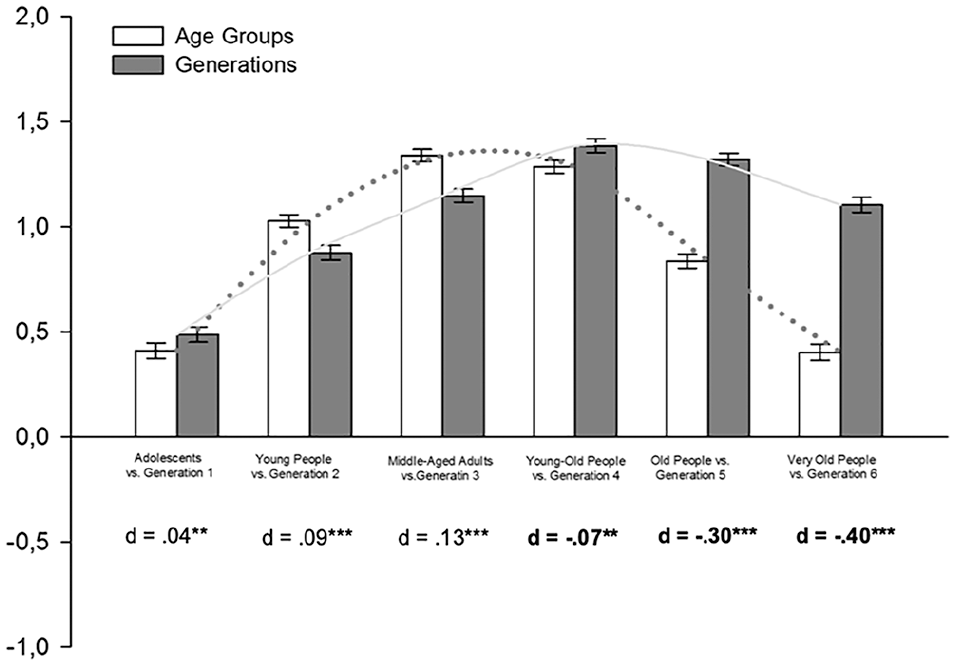
Attitudes toward age groups and generations in the total sample. Higher scores indicate more positive attitudes. Error bars represent standard errors of the mean. Effect size d is included for mean comparisons of attitudes toward age groups and matching generations, statistically significant at *p < .05; **p < .01; ***p < .001.
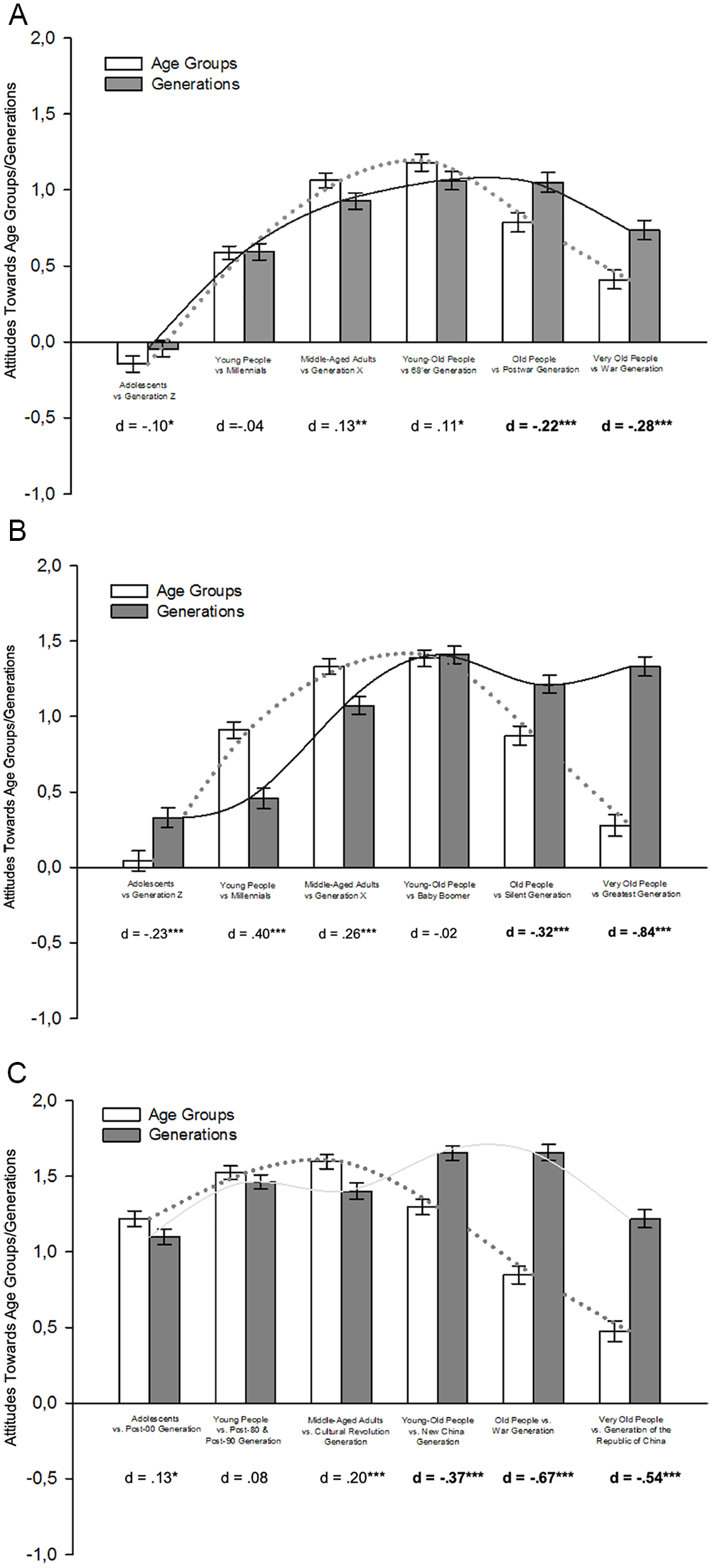
Attitudes toward age groups and generations for Germany (Panel A), the United States (Panel B), and China (Panel C). Higher scores indicate more positive attitudes. Error bars represent standard errors of the mean. Effect size d is included for mean comparisons of attitudes toward age groups and matching generations, statistically significant at *p < .05; **p < .01; ***p < .001.
Older generations are seen as more positive than younger generations (H2)
Results show that in the overall sample, older generations were perceived as more positive than younger generations, F(5, 1105) = 109.45, p < .001, Wilks’s Λ = .669, η2 = .33. Specifically, analyses yielded a quadratic effect for attitudes and stereotypes toward generations, F(1, 1109) = 327.52, p < .001, η2 = .23, but also showed that this effect was qualified by country such that attitudes and stereotypes toward younger and older generations differed across countries, F(2, 1109) = 13.16, p < .001, η2 = .02. A closer look revealed that attitudes toward the three older generations were more positive than attitudes toward the three younger generations (ps < .001) with one exception for China such that the oldest generation (Generation of the Republic of China) was perceived as more positive than the youngest Post-00 Generations but less positively than the Post-80&90 Generation and the Cultural Revolution Generation (ps < .001). In addition, we found that the three younger generations were perceived more positively in China as compared with the United States and Germany and the three older generations were perceived as more positive in the United States and China as compared with Germany (ps < .001).
Younger and older age groups are perceived as less positive as compared with middle-aged adults (H3)
Analyses yielded a quadratic effect for attitudes toward age groups, F(1, 1109) = 1084.94, p < .001, η2 = .50, which was qualified by country, F(2, 1109) = 41.29, p < .001, η2 = .07. According to that, this quadratic effect resembles an inverted U-shaped curve for Germany, F(1, 363) = 418.71, p < .001, η2 = .54, and the United States, F(1, 340) = 471.16, p < .001, η2 = .58, suggesting that middle-aged adults were perceived as most positive and the two younger and two older age groups as least positive (ps < .001; see Figure 2, Panels A & B). However, in China the quadratic effect, F(1, 406) = 188.49, p < .001, η2 = .32, suggests that the two younger age groups (adolescents, young people) were perceived more positive and similar to middle-aged adults. In China, only the two older age groups (old people, very old people) were perceived as less positive than the younger age groups (ps < .001; see Figure 2, Panel C).
The role of further factors predicting attitudes toward age groups and generations
We conducted additional analyses to test for effects of age, sex, subjective health, and level of education on attitudes and stereotypes toward age groups and generations. Analyses yielded a cubic effect for Country × Age, F(20, 1105) = 6,667.37, p < .001, Wilks’s Λ = .964, η2 = .009. Follow-up analyses showed an overall cubic age effect in the United States, F(2, 336) = 3.88, p < .05, η2 = .01, and Germany, F(2, 354) = 4.73, p < .01, η2 = .01, suggesting that younger and older adults reported more positive attitudes toward generations and age groups. A cubic age effect also appeared for China, F(2, 407) = 3.51, p < .05, η2 = .009, but with the difference that younger adults reported the least positive attitudes. Across countries, no main effects appeared for sex, level of education, or subjective health.
Discussion
The current research suggests that the dual age identity is a phenomenon that occurs in three different countries with different historical backgrounds and cultures. We found cross-cultural consensus (across China, Germany, and the United States) regarding the perception of age groups and generations across the life span. In support for our main hypothesis, the data demonstrate that across all three countries older generations were perceived as more positive than older age groups (older adults, very old adults) with small to medium effect sizes in the German sample and large effect sizes in the United States and Chinese samples. There was also evidence for cross-cultural variation in attitudes toward age groups and generations such that older generations were perceived as more positive than younger generations in Germany and the United States partly supporting our hypothesis. In China, however, younger generations and age groups were generally perceived as more positive. Only in Germany and the United States, the perception of age groups across the life span resembled an inverted U-shaped curve with younger and older age groups being perceived less positive than middle-aged adults. In China, only older age groups were perceived as less positive as compared with middle-aged and younger age groups. Further analyses considering the age of the respondents showed that in the United States and Germany younger and older adults reported more positive attitudes and stereotypes toward age groups and generations than middle-aged adults. In China, older adults reported the most positive attitudes as compared with middle-aged and younger people.
In this article, we provided the first empirical investigation of attitudes toward age groups and generations from adolescence to old age in three different cultural contexts including China, Germany, and the United States. Thus, the current study extends the cross-cultural aging literature by showing that it is important to consider not only attitudes toward different age groups but also attitudes toward different generations. While our data confirm previous findings that attitudes toward older age groups are less positive across cultures (Boduroglu et al., 2006; Chan et al., 2012; Löckenhoff et al., 2009), we could also reveal that attitudes toward older generations are generally more positive in all three countries. Therefore, future research needs to take into account these differential perceptions of age groups and generations when examining aging attitudes and stereotypes.
The current findings are consistent with recent research showing that ageism toward older people is prevalent in Eastern and Western cultures being tied to higher levels of modernization and industrialization within a country (Giles et al., 2002; North & Fiske, 2015). Thus, despite different cultural contexts that may provide different socialization experience for generations as a function of the prevailing social, political, and economic, conditions in which people grew up, in all three countries images of older generations appear to be more positive than images of older age groups. This might point to the social and motivational basis of generations as they positively reflect on older adult’s self-perception and provide them with a sense of continuity and generativity. Our findings also extend previous research on generation perception from focusing on people’s age group and generational self-perception to the perception of other age groups and generations across the life span. The results confirm that the differential age group and generational perceptions in the second half of life are shared by people all ages. In addition, the results further show that the more positive images of generations do not apply to younger generations in Germany and the United States.
The results show that in the United States and Germany adolescents were perceived the least positive followed by Generation Z and Millennials, whereas in China younger age groups and generations were perceived generally more positive. These results are consistent with findings by Boduroglu et al. (2006) showing that younger people were perceived more negatively in the United States as compared with China. Butler (1969) already noted that ageism occurs not only toward older adults but toward people all ages. In fact, studies show that younger people report to experience even more age discrimination than older people (Bratt et al., 2018; Chasteen et al., 2020). However, the consequences of ageism might be less detrimental for younger as compared with older adults as they can look forward to gaining social status in the future (Robertson & Weiss, 2017). According to this, young adults expect to join an age group that is seen as more positive as they grow up (i.e., middle-aged adults). Therefore, this might be more problematic for older than for younger people as they are moving into old age and cannot escape growing older, whereas younger adults “outgrow” unfavourable age stereotypes (von Hippel et al., 2019). This is consistent with the notion that age is associated with a transient and temporary membership in different age groups and, thus, differs from permanent group memberships (e.g., generation; Weiss & Lang, 2009). Thus, as people grow older, they dynamically change age-group memberships and leave ingroups behind (e.g., middle-aged adults) to become members of former outgroups (e.g., older adults).
The results of the present study indicate that younger generations in the United States and Germany were perceived as least positive and even negative. This is consistent with the generalized perception and negative evaluation of younger generations such as Millennials and Generation Z in the West. For example, popular media often emphasize the inadequacy of younger generations (“Dumbest Generation,” “Generation Hopeless,” “entitled,” “lazy,” and “self-centered”; Arnett et al., 2013). However, there is no evidence for the claim that younger generations today are more narcissistic than previous generations (e.g., Trzesniewski et al., 2008). The general tendency to disparage younger generations has been recently identified as resulting from a biased view of individuals’ personal memories and traits (Protzko & Schooler, 2019). Other research has linked these negative attitudes toward younger generations to emerging from an intergroup context that can be characterized by a conflict over economic and cultural resources (Bourdieu, 1993). Eyerman and Turner (1998) argue that “Anti-youth sentiment grows out of this clash of aspirations, especially among declining social groups who see their power being overtaken by younger cohorts” (p. 95). Thus, negative stereotyping of younger generations might be explained by attempts of older cohorts to justify the status quo including the rationalization of existing intergenerational divisions and distribution of resources.
Because generational membership is permanent, individuals stay in this group as they grow older and the reputation of one’s generation may change across time. Research has shown that a strong generation identity does not develop before later adulthood (Weiss & Lang, 2009; Weiss & Perry, 2020). Future research needs to investigate how stereotypes about generations change across time and, for example, how formerly negative viewed generations transform into generations with a more positive reputation (e.g., Baby Boomer: “from hippies to hard working citizens”).
Age represents an important determinant of overall social status inference (Berger et al., 1972). Social status is the standing of a person or group in the social hierarchy and may decline after midlife. Negative aging-related expectations and old-age stereotypes have been linked to a loss of social status in later adulthood (Robertson & Weiss, 2017). However, social status is a multifaceted construct and research highlights the importance of considering alternative social status dimensions. The current findings suggest that as generations move through time, they are more likely to be associated with more positive characteristics and a higher social standing in all three countries. For example, previous research has shown that older generations are linked to collective accomplishments and common fate (e.g., “went through hard times together,” “made a difference in the world” see Weiss & Lang, 2012; Weiss & Perry, 2020). This may contribute to generations capacity to provide admiration and respect representing a source of high social status in later adulthood. The present research suggests that this is not only the case for the perception of older adults themselves but also for how older generations are seen in the eyes of others.
Aging attitudes can have a profound influence on our own aging. Our previous studies (Weiss, 2014; Weiss & Kornadt, 2018; Weiss & Lang, 2012) have already suggested that it is important for older individuals to draw upon alternative age identities such as their generation when confronted with negative views of aging. Therefore, the present study has important implications regarding how to confront negative age stereotypes that are often widely shared by categorizing older adults in terms of their generation rather than age. As a consequence, older generations might activate sense of respect, value, and admiration toward older adults, and thus, represent a mean to combat societal ageism. Shifting the perception of older people through the lens of generations may reduce and mitigate ageism. In this way, generations provide older adults with a positive social identity that they can embrace (Weiss & Lang, 2009).
Limitations and Future Research
A limitation of this study is that despite the large sample, including only three countries provides relatively low power for comparisons at the country level. Of course, age differences reported in this study are only cross-sectional and need to be interpreted with caution. Research that includes more countries including a longitudinal design is an important next step for understanding how contexts and cultures shape attitudes toward age groups and generations across the life span.
Defining cutoff years for age groups and generations has been previously criticized because this approach presumes some kind of arbitrary boundaries and comes with an unavoidable ambiguity and fuzziness in distinguishing different generations (Lyons et al., 2015; Spitzer, 1973). In a similar vein, the tension between qualitative and quantitative nature of generations has been emphasized (Pilcher, 1994). According to that, time intervals such as year of birth that differentiate cohorts become “subjectively experienceable time” (Mannheim, 1928/1952, p. 282). Moreover, although research confirms that people perceive others and themselves in terms of generations, the labels that are attached to generations may change across time. In the current research, we used labels to best portray the six different age groups and generations from adolescent to old age. However, given the unavoidable ambiguity of these categories and their somewhat arbitrary boundaries we cannot preclude that participants did not agree with these categories. Nevertheless, analyses of intraclass correlations suggest that participants generally agreed on the prototypicality of the characteristics for the different age groups and generations.
Another limitation of the current study is that our attitude scale is far from comprehensive and the six characteristics only selectively capture the multidimensional nature of age and generational attitudes. Given the complex design of the study including six different age groups and six different generations in three different countries, it was necessary to implement a brief and parsimonious measure. Clearly, future research needs to replicate the current finding by implementing measures that are more inclusive. Finally, frequency of contact with older adults might be another interesting variable to explain attitudes toward older age groups and generations. For example, previous research shows that more frequent contact with older adults is associated with more positive aging attitudes (Löckenhoff et al., 2009). Thus, future studies should examine how intergenerational relations shape generational stereotypes, attitudes, and behavior. For example, one interesting question is under which conditions are intergenerational relations marked by solidarity and mutual support rather than competition and conflict.
Conclusion
Taken together, the current results from three different countries (China, Germany, and the United States) suggest that across cultures attitudes and stereotypes toward aging can be derived from multiple sources (age group vs. generation) and that despite apparent historical and cultural differences, older generations are consistently perceived as more positive than older age groups. Thus, when studying aging attitudes and stereotypes it is important to take into account both individuals’ age together with their generation. Moreover, this distinction has important implications because age and generational stereotypes have significant consequences not only for our images of aging but may also impact the well-being of aging individuals.
Supplemental Material
Supplemental_material – Supplemental material for Multiple Sources of Aging Attitudes: Perceptions of Age Groups and Generations From Adolescence to Old Age Across China, Germany, and the United States
Supplemental material, Supplemental_material for Multiple Sources of Aging Attitudes: Perceptions of Age Groups and Generations From Adolescence to Old Age Across China, Germany, and the United States by David Weiss and Xin Zhang in Journal of Cross-Cultural Psychology
Footnotes
Declaration of Conflicting Interests
The author(s) declared no potential conflicts of interest with respect to the research, authorship, and/or publication of this article.
Funding
The author(s) disclosed receipt of the following financial support for the research, authorship, and/or publication of this article: This research was supported by a Heisenberg Fellowship from the German Research Foundation awarded to David Weiss (WE 5441/1-1).

Supplemental Material
Supplemental material for this article is available online.
References
Supplementary Material
Please find the following supplemental material available below.
For Open Access articles published under a Creative Commons License, all supplemental material carries the same license as the article it is associated with.
For non-Open Access articles published, all supplemental material carries a non-exclusive license, and permission requests for re-use of supplemental material or any part of supplemental material shall be sent directly to the copyright owner as specified in the copyright notice associated with the article.
