



Abstract
Older employees are stereotyped at work (e.g., as technophobic), making them susceptible to stereotype threat, or the concern of being reduced to a negative stereotype. Although consequences of age-based stereotype threat have been identified (e.g., poorer job attitudes), far less is known about workplace triggers and underlying mechanism. Three studies aimed to identify the workplace antecedents and mechanism underlying stereotype threat. Together, Studies 1a and 1b identified 10 potential antecedents associated with stereotype threat (e.g., being overlooked for training). Mediation analysis revealed that experiencing any of the potential antecedents was associated with increased age salience, which, in turn, was associated with greater feelings of stereotype threat. Study 2 manipulated three of the potential antecedents through short videos and found that experiencing the antecedents led to increased age salience and stereotype threat. This experimental approach complemented the cross-sectional nature of Studies 1a and 1b, providing evidence for the proposed causal pathways.
Older employees are stereotyped as more resistant to change, less physically and mentally capable, and less willing to adopt new technologies than their younger counterparts (for a meta-analysis, see Ng & Feldman, 2012). The prevalence of these negative stereotypes can make older employees susceptible to age-based stereotype threat, or the concern about confirming or being reduced to a negative stereotype (Steele, 1997). Stereotype threat was originally proposed to explain performance gaps in academic contexts (e.g., African American students underperforming on intellectual ability tests; Steele & Aronson, 1995), with one of the mechanisms for underperformance being the possibility that stereotype threat can lead to disidentification or disengagement (Steele, 1997). Performance deficits have received more attention than disengagement (Block et al., 2011; Kalokerinos et al., 2014), but researchers have found initial support for Steele’s (1997) disengagement hypothesis. For example, higher levels of age-based stereotype threat are associated with more negative job attitudes and intentions to quit among older employees (Kulik et al., 2016; Oliveira & Cabral-Cardoso, 2018; von Hippel et al., 2013, 2019).
Despite evidence for the potential impact of age-based stereotype threat in the workplace (Kulik et al., 2016; Oliveira & Cabral Cardoso, 2018; von Hippel et al., 2013, 2019), we know little about when and why older employees experience age-based stereotype threat at work. In the current research, we draw on the literature on age salience (i.e., the extent to which age is at the forefront of someone’s mind when interpreting an event; Krech & Crutchfield, 1948; Taylor & Fiske, 1978) to explore whether workplace factors that trigger older employees’ age salience also lead to feelings of stereotype threat.
Antecedents of Stereotype Threat in the Workplace
To date, research has identified only a handful of antecedents of age-based stereotype threat, most of which are focused on job design and work composition factors. Specifically, having a younger manager, a younger work group, and working in an organization where most employees are younger are all associated with feelings of age-based stereotype threat among older employees (Kulik et al., 2016; Oliveira & Cabral-Cardoso, 2017). These findings hearken back to Cooley’s (1902) looking glass self, or the idea that we tend to see ourselves as we believe others see us. One aspect of the self that attracts others’ attention, and hence our own attention, is the extent to which a particular trait is distinctive by virtue of its rarity (McGuire & Padawer-Singer, 1976). This distinction is particularly pronounced in the context of readily available physical differentiators, such as gender, race, and age (Montepare & Zebrowitz, 1998). For example, McGuire et al. (1978) found that students were more likely to spontaneously describe themselves in ethnic terms if their ethnicity was in the minority rather than the majority in their classroom. In the context of age-based stereotype threat, all three factors described above (having a younger manager, a younger work group, and working in an organization where most employees are younger) would cause a person’s age to stand out by virtue of its distinctiveness (e.g., Avery et al., 2007).
These findings raise the possibility that workplace factors that cause age to become salient in older employees’ minds will lead to stereotype threat, but only if the factors leading to age salience have negative connotations (i.e., the valence-salience effect; Paolini et al., 2010; Weiss & Freund, 2012). If older employees are considered the most prized workers in a particular setting, their underrepresentation should not lead to stereotype threat. In contrast, if older employees are perceived to be less capable in a particular setting, then their underrepresentation will be particularly likely to lead to stereotype threat (Murphy et al., 2007). For example, because employers (Jenkins & Poulston, 2014; Loretto & White, 2006) and employees (Duncan & Loretto, 2004) both believe that manual labor is better suited to younger employees, working in semiskilled and unskilled jobs was associated with greater feelings stereotype threat for older employees (Kulik et al., 2016).
The goal of the current research was to test whether workplace experiences that increase age salience may, for this reason, increase experiences of stereotype threat. Prior research focusing on stable job design and work composition factors (e.g., having a younger manager) is consistent with this possibility (Kulik et al., 2016; Oliveira & Cabral-Cardoso, 2017), but the idea has not yet been tested directly. We aimed to, first, draw on the literature on age salience to identify a series of potential workplace experiences that should lead older employees to focus on their own age.
Potential Workplace Antecedents of Stereotype Threat
There are likely to be a host of experiences in the workplace that could increase age salience and hence stereotype threat among older employees. Some of these experiences are internal in nature, such as whom employees compare themselves to when evaluating their performance. Cross-sectional and experimental research in the workplace has shown that upward social comparisons can trigger stereotype threat (Kalokerinos et al., 2017; von Hippel et al., 2011). Because comparisons with outgroup members should also make a person’s own group membership more salient (Festinger, 1954; Turner, 1975), it is possible that when older employees compare themselves to their younger coworkers, these upward comparisons could lead to age salience and stereotype threat.
Other potential workplace triggers of stereotype threat are likely to be caused by attributions made in response to different types of events or policies in the workplace that might be a product of employee age or age stereotypes (e.g., that older employees are incompetent, unadaptable, politically incorrect; Marcus & Fritzsche, 2015). For example, if an older employee is overlooked for professional development or training opportunities, it raises the question of whether it is due to their proximity to retirement, and hence age-related, or if it is because they are deemed more valuable to the firm in their current capacity.
We hypothesized that whenever such events are readily interpretable as a product of age or age stereotypes, they are particularly likely to draw the attention of older adults to their own age and subsequently lead to feelings of stereotype threat. Based on these possibilities, we generated an initial list of eight potential antecedents that could lead older adults to experience age-based stereotype threat: (a) being overlooked for professional development or training opportunities, (b) experiencing a lack of recognition for contributions at work, (c) experiencing rapid change in the job or organization, (d) experiencing technology-related issues, (e) having coworkers avoiding asking for help or advice, (f) worrying about saying or doing something politically incorrect, (g) feeling excluded from informal social aspects of the workplace (e.g., grabbing coffee, Friday night drinks), and (h) engaging in upward social comparisons with younger coworkers.
Psychological mechanism: Age salience
Contexts that magnify the salience of age should increase age-based stereotype threat for older adults by increasing the likelihood that events are interpreted as being age-relevant. The occurrence of any of the eight antecedents may heighten awareness of older employees’ age and, consequently, the associated negative age-based stereotypes. For example, being left out of a coffee invitation with younger coworkers might activate the concept of age, and older employees might believe their age was the reason they were excluded.
Finally, research on age-related stereotypes has shown that they have negative effects on a wide range of cognitive and physical functioning outcomes (e.g., Levy, 2003). For example, when older adults are exposed to age-related stereotypes, they demonstrate a decline in memory performance (Levy, 1996), balance (Levy & Leifheit-Limson, 2009), and even cardiovascular health (Levy et al., 2009). More specific to workplace settings, age-based stereotype threat is associated with more negative job attitudes (i.e., job engagement, job satisfaction, and organizational commitment), reduced workplace well-being, and greater intentions to quit among older employees (Kulik et al., 2016; Oliveira & Cabral Cardoso, 2018; von Hippel et al., 2013, 2019). Thus, we expect to replicate these findings:
Overview of Studies
The current research aims to explore and identify the workplace antecedents to age-based stereotype threat and subsequently test them experimentally to establish causal relationships. Drawing on the age salience literature, we identified a list of eight potential workplace antecedents. Study 1a tested the associations between the potential antecedents, age salience, stereotype threat, and workplace outcomes among older employees. To ensure a comprehensive list of potential antecedents, Study 1a employed an open-ended “critical incident” style question, which allowed older employees to generate any events they felt were not captured in the existing list. Extending on the findings from Study 1a, Study 1b aimed to replicate those results and explore two new potential antecedents that were generated by participants in Study 1a. Study 1b also sought to replicate the work-composition antecedents identified in prior research (Kulik et al., 2016; Oliveira & Cabral-Cardoso, 2017). Next, we designed an experimental study to test the causal effects of three of the potential antecedents on age salience and stereotype threat. We presented older employees with a series of short videos that manipulated whether participants experienced the antecedents. The preregistration, data, and code for all studies are available on the Open Science Framework (OSF; https://osf.io/yfrtv/?view_only=f352bbc8d78344bf8cfd8caeddccef54). 1
Study 1a
Method
Participants and procedure
An advocacy group that combats ageism in Australia circulated a web link to an online survey to their membership database. Members who were 50+ years old 2 and currently working were asked to complete a 15-min survey. Participants were able to enter a prize draw for one of several AUD$50.00 vouchers to an Australian grocery store chain. We kept the survey live for 2 months to maximize our sample size. The final sample 3 consisted of 420 older employees (see Table 1 for their demographic information). Sensitivity analysis in G*Power 3.1 showed sufficient power (.80; α = .05) to detect a small to medium effect (Cohen, 1988). Regression coefficients for a multiple linear regression with eight predictors could detect an effect size of f2 = 0.04.
Participant demographic information: Study 1a.

Note. Due to missing data, not all cells total 100%.
Results of the mediation analysis remained consistent when all three conditions were included. The output can be found in the online Supplemental Material.
Participants were first asked to respond to several demographic questions (e.g., age, gender, work status). The rest of the survey comprised the antecedents, the age salience scale, and workplace outcomes (e.g., job satisfaction). To control for possible order effects, the survey order was counterbalanced: half of the participants responded to the workplace outcomes first, whereas the other half responded to the workplace outcomes last. Additionally, the order of items within each scale was randomized.
Measures
Antecedents
To minimize demand on participants’ time while measuring many different potential causes of stereotype threat, we used brief scales for each antecedent (one to four items). Single-item measures are appropriate when the construct is straightforward and sufficiently narrow (e.g., Fuchs & Diamantopoulos, 2009).
Overlooked for training was measured using a single item (i.e., “I’m overlooked for professional development or training opportunities”; 1 = never, 5 = always).
Failing to receive recognition was measured using a single, reverse-scored item (i.e., “I get recognition for my contributions at work”; 1 = never, 5 = always).
Job change (α = .84) was measured with three items (e.g., “My job is very different from what it was when I first started working here”; 1 = strongly disagree, 7 = strongly agree).
Technology-related issues (α = .59 4 ) was measured with three items (e.g., “I rely on the people I work with to explain technology to me”; 1 = never, 5 = always).
Coworkers avoid asking for help was measured using a single item (i.e., “The people I work with avoid asking me for help or advice”; 1 = never, 5 = always).
Worry about political correctness were measured using a single item (i.e., “I worry about unintentionally saying or doing something politically incorrect”; 1 = never, 5 = always).
Exclusion from socializing was measured using a single item (i.e., “I feel that I am excluded from the informal social aspects of the workplace (e.g., grabbing coffee)”; 1 = never, 5 = always).
Upward social comparison (α = .91) was measured using four items (e.g., “Compared to the younger employees at the same (or similar) level to me, I have greater difficulty getting my ideas/suggestions taken seriously; 1 = strongly disagree, 7 = strongly agree).
Finally, an open-ended item was added to allow participants to self-generate antecedents that we may have missed in the current list, in which participants were asked to describe a time when they felt negatively evaluated on the basis of their age at work. To facilitate recall of the event, participants were asked when and where the event happened, and how likely they thought the experience was due to their age. Participants who could not think of an age-related incident were asked to describe a stressful event at work instead.
Age salience
Age salience (α = .71) was measured using Weiss and Freund’s (2012) three-item scale (e.g., “When I’m at work, I think about my age”; 1 = never, 5 = very frequently).
Stereotype threat
Age-based stereotype threat (α = .94) was measured using three items from von Hippel et al.’s (2011) scale (e.g., “Some of the people I work with feel that I am not as committed to my career because of my age”; 1 = strongly disagree, 7 = strongly agree).
Workplace outcomes
Unless otherwise stated, participants responded to items regarding workplace outcomes using a 7-point scale (1 = strongly disagree, 7 = strongly agree).
Job satisfaction (α = .89) was measured using Brayfield and Rothe’s (1951) five-item scale (e.g., “I feel satisfied with my present job”).
Job engagement (α = .91) was measured using nine items from Rich et al.’s (2010) Job Engagement Scale (e.g., “I exert my full effort to my job”).
Workplace well-being (α = .91) was measured with Warr’s (1990) 12-item scale. Participants read, “Thinking over the past few weeks, how much of the time has your job made you feel each of the following?” And responded to six positive (e.g., calm) and six negative (e.g., tense) items (1 = never, 5 = all of the time). The negative items were reverse-coded, such that higher numbers corresponded to better workplace well-being.
Intentions to quit the organization were measured with Boroff and Lewin’s (1997) two-item scale (e.g., “I am seriously considering quitting this job for an alternative employer”; interitem correlation = .83).
Organizational commitment (α = .84) was measured using six items from Allen and Meyer’s (1990) Affective Commitment Scale (e.g., “This organization has a great deal of personal meaning for me”).
Control variables
We preregistered several control variables, including job status, gender, and tenure (von Hippel et al., 2013).
Results
Antecedents
To examine the relationship between the potential antecedents and stereotype threat for older employees, we first ran a series of bivariate correlations. The correlations, descriptive statistics, and prevalence rates of the antecedents are reported in Table 2. The prevalence rates represent the percentage of participants who reported experiencing each antecedent at least once (0 = never, 1 = rarely to always). Generally, participants reported that these antecedents occurred infrequently. The most frequent antecedent was failing to receive recognition (M = 2.60), whereas the least frequent was being avoided by coworkers asking for help or advice (M = 1.95). Although infrequent, the prevalence rate indicates that a large proportion of the sample experienced each antecedent at least to some degree. For example, 95.95% of the sample reported experiencing technology-related issues, meaning that only 4.05% never faced such issues. Two antecedents (i.e., job change and upward social comparison) were measured on a “strongly disagree” to “strongly agree” scale and thus their prevalence rates were not calculable. Consistent with predictions (H1), all eight antecedents were associated with stereotype threat, such that older employees who reported greater levels of the antecedents also reported experiencing more stereotype threat.
Correlations and descriptive statistics: Study 1a.

Note. N = 420. Gender was coded dichotomously (1 = male, 2 = female). The correlations with gender are point-biserial correlations. PR = prevalence rate.
p < .050. **p < .010. ***p < .001.
Next, all eight antecedents were simultaneously entered into a multiple regression to determine which of them accounted for unique variance in stereotype threat. Four antecedents predicted unique variance in stereotype threat: (a) engaging in upward social comparisons with younger coworkers, (b) being avoided by coworkers asking for help or advice, (c) feeling excluded from the informal social aspects of the workplace (e.g., grabbing coffee), and (d) worrying about unintentionally saying or doing something politically incorrect (see Table 3).
Multiple regression results predicting age-based stereotype threat from the antecedents: Study 1a.

Note. N = 420. Antecedents were simultaneously entered into a regression analysis. Significant results are boldfaced.
Self-generated antecedents
From 160 open-ended responses that were provided, two potential antecedents were discovered. First, seven older employees described events in which people made assumptions about their employment preferences based on their age (e.g., “When I had my performance appraisal, my immediate supervisor was instructed to ask me when I planned to retire”). Second, 11 older employees described hearing age-related jokes or comments at work (e.g., “At my staff appraisal last week, I was told my ways were old-fashioned, then she said, not old-fashioned . . . old school”). The remaining events were either already covered in the survey (e.g., “A group of younger coworkers were going for drinks, and it was assumed that due to my age I would not want to go”) or insufficient detail was provided (e.g., “In a previous employment received negative feedback regarding reaching financial targets”).
Psychological mechanism: Age salience
To test whether age salience mediated the relationship between antecedents and stereotype threat (H2), a series of mediation analyses were conducted using Model 4 of the PROCESS macro (Hayes, 2018). Including the covariates in the mediation analyses did not impact the significance of the indirect effects (with the exception of the model testing the impact of experiencing workplace change on stereotype threat 5 ). To report more parsimonious models, Table 4 displays the results of these mediational models excluding the covariates (refer to the online Supplemental Material for the results including the covariates). As expected, there were significant indirect effects between each of the antecedents and stereotype threat via age salience. For example, older employees who reported experiencing technology-related issues reported greater age salience, which, in turn, was associated with increased stereotype threat. These effects are consistent with the possibility that age salience partially mediates the impact of the antecedents on stereotype threat.
Standardized path coefficients and indirect effects for the relationship between antecedents and stereotype threat as mediated by age salience: Study 1a.

Note. N = 420. Each antecedent was entered into the mediation analysis individually. Bootstrapping sample size = 5,000. Significant indirect effects are boldfaced. SE = standard error; CI = confidence interval.
p < .010. ***p < .001.
Workplace outcomes
To replicate past research (Kulik et al., 2016; Oliveira & Cabral Cardoso, 2018; von Hippel et al., 2013, 2019), we tested the prediction that stereotype threat would be associated with poorer workplace outcomes for older employees (H3). Consistent with predictions, stereotype threat was associated with all the workplace outcomes examined. Specifically, participants who experienced greater stereotype threat also reported lower job satisfaction, job engagement, workplace well-being, organizational commitment, and greater intentions to quit (see Table 5).
Correlations and descriptive statistics on workplace outcomes: Study 1a.

Note. N = 420. Gender was coded dichotomously (1 = male, 2 = female). The correlations with gender were conducted with point-biserial correlation.
p < .050. **p < .010. ***p < .001.
Discussion
Although all antecedents related to stereotype threat at the bivariate level, only four of the eight antecedents accounted for unique variance in stereotype threat. These findings suggest that the effect of the antecedents on stereotype threat was both cumulative and overlapping. The responses from the open-ended, critical incident style question revealed that the antecedents originally generated were comprehensive, but two new antecedents seemed sufficiently important to warrant inclusion in Study 1b. Additionally, age salience partially mediated the relationship between the antecedents and stereotype threat, such that experiencing these antecedents was associated with age salience, which in turn related to greater feelings of stereotype threat. Finally, we replicated previous research (Kulik et al., 2016; Oliveira & Cabral Cardoso, 2018; von Hippel et al., 2013, 2019) that experiencing stereotype threat was associated with poorer workplace outcomes for older employees.
Study 1b
In addition to replicating the results from Study 1a, the goal of Study 1b was to test the two new potential antecedents generated by participants in Study 1a and the work composition antecedents from past research (Kulik et al., 2016; Oliveira & Cabral-Cardoso, 2017). In service of the first goal, we tested two new hypotheses:
Hypothesis 4. Older employees will experience greater age-based stereotype threat if they are exposed to (a) age-related assumptions about their employment preference (e.g., an increased likelihood to switch to part-time work, a decreased willingness to transfer), and/or (b) age-related comments or jokes.
Hypothesis 5. Older employees will experience greater age-related stereotype threat if they (a) have a younger manager, (b) have a younger work group, (c) work in a manual occupation, and/or (d) work in an organization where most employees are younger.
Second, we extended the findings from Study 1a to a sample of municipal council employees. 6 Municipal councils have two notable advantages: they (a) include numerous types of jobs within a single council and (b) these are then duplicated across different cities in Australia. Thus, working with municipal councils enabled us to examine a range of occupations and replicate those tests across different municipalities that differ in organization-level variables.
Method
Participants and procedure
The sample consisted of 666 older employees (50+ years old) from 24 Australian municipal councils (see Table 6 for their demographic information). Approximately 20 councils with 30 older employees in each affords 80% power to detect a medium effect.
Participant demographic information: Study 1b.

Note. Due to missing data, not all cells total 100%.
Measures
In addition to the survey items from Study 1a (scale reliabilities are reported in Table 7), we included the two new potential antecedents derived from Study 1a’s open-ended question. These new items were: “People make assumptions about my employment preferences based on my age (e.g., switch to part-time work, willingness to transfer)” and “People in my workplace make age-related comments or jokes” (1 = never, 5 = always).
Scale reliabilities: Study 1b.

Note. Ns ranged from 661 to 666. The interitem correlation is provided for the Intentions to Quit Scale given that it only has two items.
We also included several additional antecedents from past research (Kulik et al., 2016). Having a younger manager was calculated by subtracting participant’s estimated age of their manager (i.e., “Approximately, how old is your manager?”) from their own age (i.e., “How old are you?”). A positive number indicates the number of years the manager is younger than the participant, whereas a negative number indicates the number of years the manager is older than the participant.
To determine whether participants had a younger workgroup, they were asked to estimate the percentage of their coworkers who were under 30 years old. Higher numbers indicate that participants were surrounded by a greater proportion of younger employees.
Working in a manual occupation was measured using the same item as Kulik et al. (2016). Participants were asked to select their occupation from five options that reflected the major occupational groups listed in the Australian and New Zealand Standard Classification of Occupations (Australian Bureau of Statistics [ABS], 2013). We coded occupation as a dichotomous variable (managerial, professional, technical or scientific; clerical or secretarial; sales or personal service = 0; craft or skilled manual, semiskilled or unskilled manual = 1).
Results
Antecedents
Consistent with predictions (H1) and the results from Study 1a, all antecedents were associated with stereotype threat; older employees who reported greater levels of the antecedents reported experiencing more stereotype threat (see Table 8). Additionally, the two new antecedents were associated with stereotype threat whereby older employees who reported having assumptions made about their future employment preferences or heard age-related jokes or comments experienced greater stereotype threat (H4a and H4b). Overall, participants reported that the antecedents occurred infrequently. Consistent with Study 1a, the most frequent antecedent was failing to receive recognition (M = 2.73), and the least frequent was being avoided by coworkers asking for help or advice (M = 1.85). The majority of the sample experienced each antecedent at least to some degree, with the highest prevalence of experiencing technology-related issues (92.94%).
Correlations and descriptive statistics: Study 1b.

Note. Ns range from 645 to 666. Gender and manual occupation were coded dichotomously (Male = 1, female = 2. Managerial, professional, technical, or scientific; clerical or secretarial; sales or personal service = 0; craft or skilled manual; semiskilled or unskilled manual = 1). The correlations with gender and manual occupation were point-biserial. PR = prevalence rate.
p < .050. **p < .010.
Next, we tested the relationship between the antecedents identified in past research and older employees’ experience of stereotype threat. On average, older employees reported their managers to be 8.5 years younger than their own age, and they reported the average age of their work group to be 13.4 years younger than their own age. The age breakdown of the councils provided by the human resources (HR) representative revealed that the average percentage of employees who were 50+ years old was 42.2%. Consistent with Kulik et al. (2016), the correlational analyses contained in Table 8 revealed that having a younger manager, younger workgroup, and working for an organization where more employees were younger were associated with greater feelings of stereotype threat for older employees. Contrary to Kulik et al. (2016), working in a more manual occupation did not predict stereotype threat for older employees, though only 76 employees reported working in manual occupations.
To determine which antecedents accounted for unique variance in stereotype threat, all 14 antecedents were included simultaneously in a linear mixed effects regression. Multilevel modelling was used (“lme4” package in R; Bates et al., 2015) to fit a linear mixed effects model predicting stereotype threat (Level 1) from participants’ reported experience of the antecedents (Level 1), controlling for random effects of council (Level 2). Seven antecedents predicted unique variance in stereotype threat: (a) engaging in upward social comparison, (b) having assumptions made about future employment preferences, (c) having coworkers avoiding asking for help or advice, (d) being overlooked for training, (e) feeling excluded from the informal social aspects of the workplace, (f) having a younger manager, and (g) older employee underrepresentation (see Table 9). The intraclass correlation was .03, indicating that most of the differences in feelings of stereotype threat were at the level of the individual, and council had little explanatory value.
Linear mixed effects regression results predicting age-based stereotype threat from the antecedents: Study 1b.

Note. N = 637. Antecedents were entered simultaneously into a regression analysis. Significant effects are boldfaced.
Psychological mechanism: Age salience
To investigate whether age salience mediated the relationship between experiencing an antecedent and stereotype threat (H2), we fit several multilevel mediation models using the MLmed macro in SPSS (Rockwood & Hayes, 2017). The antecedents (predictor variables), age salience (mediator), and stereotype threat (outcome variable) were all measured at the individual level (1-1-1 model); but responses were nested within council (Level 2). For parsimony, Table 10 displays the results excluding the covariates (the online Supplemental Material reports the results with the covariates). As predicted, there were significant indirect effects between experiencing each of the antecedents and stereotype threat via age salience (with the exception of having a younger manager, working in an organization where older employees are underrepresented, and working in manual occupations). For example, older employees who reported experiencing technology-related issues experienced greater age salience, which in turn was associated with increased stereotype threat. Replicating Study 1a, these effects are consistent with the possibility that age salience partially mediates the impact of the antecedents on stereotype threat.
Unstandardized path coefficients and indirect effects for the relationship between antecedents and stereotype threat as mediated by age salience: Study 1b.

Note. Ns ranged from 645 to 661. Each antecedent was entered into the mediation analysis individually. Restricted maximum likelihood estimator. Monte Carlo samples = 10,000. SE = standard error. MCLL and MCUL = lower and upper bound of the 95% confidence interval estimated. Significant effects are boldfaced.
p < .050. **p < .010. ***p < .001.
Workplace outcomes
In line with past research (Kulik et al., 2016; Oliveira & Cabral Cardoso, 2018; von Hippel et al., 2013, 2019), we expected that stereotype threat would relate to poorer workplace outcomes for older employees (H3). Consistent with predictions, stereotype threat was associated with all the workplace outcomes examined. Specifically, participants who experienced greater stereotype threat reported lower job satisfaction, job engagement, workplace well-being, organizational commitment, and greater intentions to quit (see Table 11).
Correlations and descriptive statistics on workplace outcomes: Study 1b.

Note. Ns ranged from 660 to 666. Gender was coded dichotomously (1 = male, 2 = female). The correlations with gender were conducted with point-biserial correlation.
p < .050. **p < .010. ***p < .001.
Discussion
Among 24 municipal councils, we replicated the findings from Study 1a that older employees who experienced any of the eight antecedents reported greater feelings of stereotype threat. The two new antecedents generated by older employees from Study 1a (assumptions being made about their employment preferences, and hearing age-related comments or jokes) also related to stereotype threat. Additionally, Study 1b replicated the relationship between stereotype threat and antecedents from past research (i.e., having a younger manager, younger workgroup, or working for an organization in which older workers are underrepresented; Kulik et al., 2016; Oliveira & Cabral-Cardoso, 2017). However, contrary to Kulik et al. (2016), working in manual occupations did not relate to stereotype threat. This finding should be interpreted with caution given the small number of employees working in manual positions (n = 76). Age salience partially mediated the relationship between experiencing an antecedent and stereotype threat, such that experiencing an antecedent led to greater age salience, which in turn led to greater feelings of stereotype threat. Further replicating Study 1a and past research (Kulik et al., 2016, Oliveira & Cabral Cardoso, 2018; von Hippel et al., 2013, 2019), experiencing stereotype threat was associated with poorer workplace outcomes for older employees.
An important limitation of these studies is that the cross-sectional and correlational nature of the research makes it impossible to assess whether the associations that emerged between the potential antecedents, age salience, and stereotype threat are causal in nature. It is possible that age salience or stereotype threat makes employees more likely to recall or even experience the various potential antecedents. It is also possible that an unmeasured factor causes the potential antecedents and feelings of stereotype threat. Thus, the current studies can only be taken as tentative evidence for the proposed model. The goal of Study 2 was to address this limitation.
An additional limitation of these studies relates to how stereotype threat was measured. Specifically, many stereotype threat scales, including the one used in Studies 1a and 1b, often omit the “worry” component, which is central to the experience of stereotype threat. For example, the items focused on perceptions of others’ views (e.g., “Some of the people I work with think I’m less committed due to my age”) rather than the anxiety that accompanies these perceptions (e.g., “I worry that some of the people I work with think I’m less committed because of my age”). Steele and Aronson’s (1995) original scale did not explicitly include this “worry” component, which has led many subsequent adaptations of the scale to omit this component as well (von Hippel et al., 2024). To address this, we modified the items in Study 2 to explicitly include the “worry” component, which we believe provides a more accurate assessment of stereotype threat.
Study 2
Together, Studies 1a and 1b identified 10 potential workplace antecedents that relate to feelings of stereotype threat among older employees. However, the cross-sectional and correlational nature of the research raises questions about the causal order of the potential antecedents, age salience, and stereotype threat. To address these questions, Study 2 tested the antecedents experimentally.
We created a series of videos set in a fictional workplace and filmed from the participants’ point of view (i.e., we asked participants to imagine that what they were shown by the camera was what they were actually seeing at work). In these videos, we manipulated whether participants experienced a potential antecedent by either depicting a workplace interaction that was intended to be stereotype threatening (antecedent condition), positive (positive condition), or neutral (neutral condition). We predicted that:
Hypothesis 6. Participants in the antecedent condition will experience greater age salience and stereotype threat than participants in the positive or neutral condition.
Hypothesis 7. Age salience will mediate the relationship between the potential antecedents and stereotype threat, such that participants in the antecedent condition will experience greater age salience than those in the positive or neutral condition, which in turn will relate to greater feelings of stereotype threat.
Finally, because the videos depicted a fictional workplace context, traditional job attitudes (e.g., job satisfaction) were not measured. Instead, we focused on measuring participants’ momentary outcomes (i.e., energy and stress levels, and a sense of belonging). Nonetheless, we expect feelings of stereotype threat to negatively impact these outcomes.
Hypothesis 8. Stereotype threat will be associated with lower energy, higher stress, and a reduced sense of belonging.
Method
Participants and procedure
A sample of 450 participants (150 per condition) were recruited via Prolific (see Table 12 for their demographic information). To be eligible, participants were required to be working, over the age of 55, 7 and residing in Australia, New Zealand, or the United Kingdom (UK). Participants were randomly assigned to one of three conditions (i.e., an antecedent condition, a positive condition, or a neutral condition). After providing informed consent, participants were asked to imagine that the camera was their eyes before watching three short videos about a fictional workplace. Using a between-subjects design, participants watched three videos all from the same condition. For example, participants in the antecedent condition watched three videos depicting a workplace interaction that was intended to be stereotype threatening. The workplace interactions depicted in the videos were mapped onto three of Study 1’s potential antecedents that predicted unique variance in stereotype threat and were most amenable to a short video format: (a) feeling excluded from the informal social aspects of the workplace, (b) having assumptions made about future work preferences, and (c) engaging in upward social comparisons. For example, one of the videos designed for participants in the antecedent condition depicted a younger coworker inviting another younger coworker out for Friday night drinks, before simply saying the older coworker (the participant) goodbye. The equivalent video for participants in the positive condition depicted the younger coworker extending the invitation to the older coworker (the participant). Finally, in the neutral condition, the younger coworker simply says goodbye to both the younger and the older coworker (the participant). The videos are provided in the online Supplemental Material.
Participant demographic information: Study 2.

Note. Due to missing data, not all cells total 100%.
After each video, participants were provided a multiple-choice question about what took place in the video to ensure they had watched it (e.g., “In the video, were you invited for a drink by your colleague?”). If participants answered this comprehension check incorrectly, they were asked to rewatch the video. The rest of the survey comprised the Age Salience Scale, Stereotype Threat Scale, workplace outcomes (i.e., energy, stress and sense of belonging), and demographics. We conducted a sensitivity analysis in G*Power 3.1 (Faul et al., 2007) and found that the minimum effect that we could detect (1 – β = 0.80; α = .05) was f = 0.15.
Measures
Age salience
Age salience was measured using two items adapted from Weiss and Freund’s (2012) scale. These were, “While watching these videos. . .” (a) “I was preoccupied with thoughts about my age” and (b) “I thought about my age.” We also created two new items that tapped into the construct. These were, “My age was at the forefront of my mind while watching these videos” and “In these videos, people’s attention was drawn to my age.” In Studies 1a and 1b, age salience was measured using a 5-point scale (1 = never, 5 = very frequently), whereas we used a 7-point scale (1 = strongly disagree, 7 = strongly agree) in this study. The four items demonstrated excellent internal reliability (α = .92).
Stereotype threat
Age-based stereotype threat (α = .97) was measured using three items adapted from von Hippel et al.’s (2011) scale. These were, “If I was the employee in these videos, I would worry people think. . .” (a) “I’m limited in my career because of my age,” (b) “I have less to contribute because of my age,” and (c) “I am less capable because of my age” (1 = strongly disagree, 7 = strongly agree).
Workplace outcomes
Energy and stress were measured using Menges et al.’s (2017) adapted 7-item scale. Participants read, “Watching these videos leaves me feeling. . .,” followed by the items “energetic,” “mentally refreshed,” “enthusiastic,” and “satisfied” measuring energy (α = .94), and “stressed,” “exhausted,” and “strained” measuring stress (α = .89). Responses were measured on a 7-point scale (1 = strongly disagree, 7 = strongly agree).
Sense of belonging (α = .97) was measured using three items adapted from Good et al.’s (2012) scale. These were, “In these videos. . .” (a) “I felt valued,” (b) “I felt accepted,” and (c) “I felt like I fit in” (1 = strongly disagree, 7 = strongly agree).
Results
The correlations and descriptive statistics are presented in Table 13. To test whether experiencing the potential workplace antecedents caused participants to report greater age salience and stereotype threat (H6), we conducted two one-way, independent groups analyses of variance (ANOVAs). The results revealed that both age salience and stereotype threat varied as a function of condition, F(2, 449) = 24.20, p < .001, ηp2 = .10 and F(2, 449) = 88.83, p < .001, ηp2 = .28, respectively. In line with Hypothesis 6, post hoc comparisons using the Bonferroni correction revealed that participants in the antecedent condition reported greater age salience (M = 2.85, SE = 0.10) compared to participants in the positive (M = 2.05, SE = 0.10, p < .001) or neutral condition (M = 1.96, SE = 0.10, p < .001). Participants in the antecedent condition also reported greater stereotype threat (M = 4.59, SE = 0.12) than participants in the positive (M = 2.52, SE = 0.12, p < .001) or neutral condition (M = 2.74, SE = 0.12, p < .001). However, there were no significant differences in age salience (p = 1.000) and stereotype threat (p = .622) between participants in the positive and neutral conditions.
Correlations and descriptive statistics: Study 2.
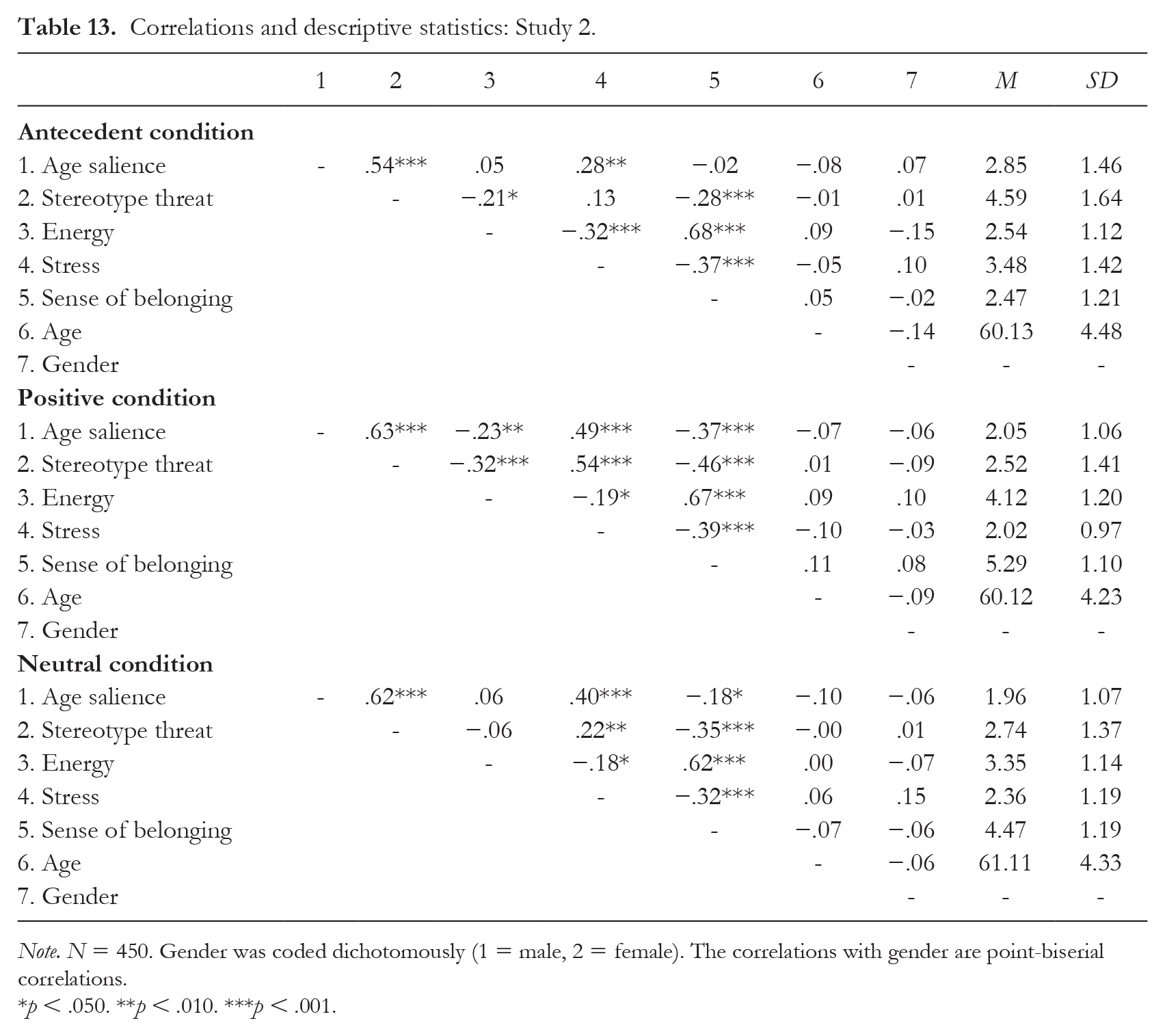
Note. N = 450. Gender was coded dichotomously (1 = male, 2 = female). The correlations with gender are point-biserial correlations.
p < .050. **p < .010. ***p < .001.
Psychological mechanism: Age salience
To test whether age salience mediates the relationship between experiencing the potential antecedents and stereotype threat (H7), we ran a mediation analysis using Model 4 of the PROCESS macro (Hayes, 2018). Given that there was no significant difference in age salience (mediator) and stereotype threat (outcome variable) reported by participants in the positive and neutral conditions, we collapsed their responses and created a dichotomous variable as the predictor (1 = antecedent condition, 0 = positive or neutral condition). 8 As seen in Figure 1, the relationship between experiencing the antecedents and stereotype threat was partially explained by age salience (indirect effect = 0.59, SE = 0.10, 95% CI [0.40, 0.79]).
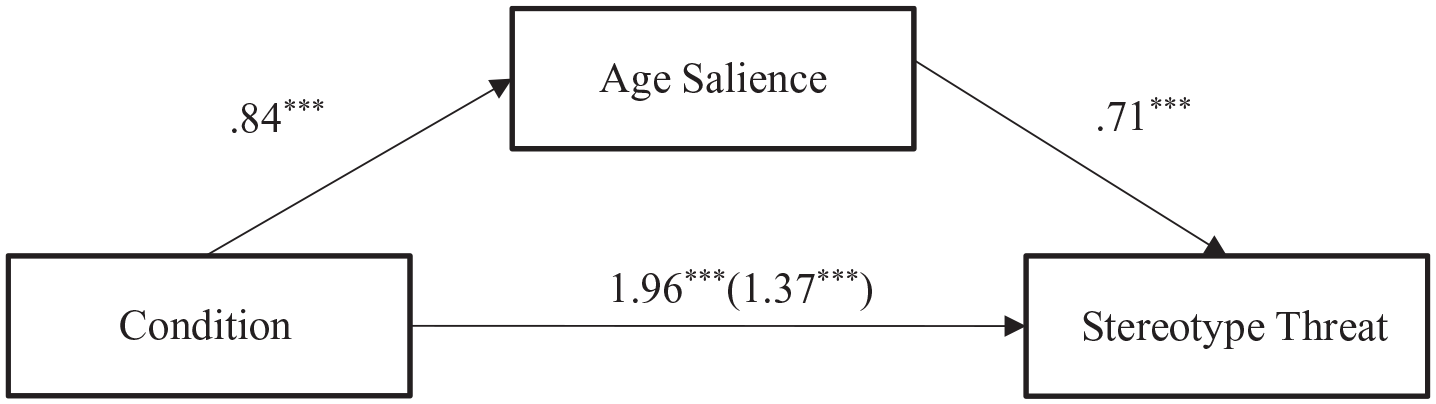
Path coefficients for the relationship between condition and stereotype threat as mediated by age salience.
Workplace outcomes
Consistent with predictions (H8), stereotype threat was associated with poorer momentary outcomes. Across conditions (N = 450), greater feelings of stereotype threat were associated with lower energy (r = −.38, p < .001), higher stress (r = .44, p < .001), and a reduced sense of belonging (r = −.58, p < .001). Additionally, results from a series of one-way independent groups ANOVAs revealed that these outcomes varied as a function of condition, Fenergy(2, 447) = 70.75, p < .001, ηp2 = .24; Fstress (2, 447) = 60.24, p < .001, ηp2 = .21; and Fbelonging (2, 447) = 230.02, p < .001, ηp2 = .51. Post hoc comparisons using the Bonferroni correction showed that participants in the antecedent condition reported less energy (M = 2.54, SE = 0.09), greater stress (M = 3.48, SE = 0.10), and a poorer sense of belonging (M = 2.48, SE = 0.10) than participants in the positive (Menergy = 4.12, SE = 0.09, p < .001; Mstress = 2.02, SE = 0.10, p < .001; Mbelonging = 5.29, SE = 0.10, p < .001) or neutral condition (Menergy = 3.35, SE = 0.09, p < .001; Mstress = 2.36, SE = 0.10, p < .001; Mbelonging = 4.47, SE = 0.10, p < .001). Additionally, participants in the neutral condition reported less energy (p < .001) and a poorer sense of belonging (p < .001) than those in the positive condition. However, there was no significant difference between the stress levels reported by participants in the positive and neutral conditions (p = .050).
Discussion
In Study 2, we found experimental support for our model. Participants in the antecedent condition experienced greater age salience and stereotype threat than those in the positive and neutral conditions. These findings provide causal evidence that experiencing the three workplace antecedents leads to greater age salience and stereotype threat. Mediation analysis revealed that age salience partially mediated the relationship between experiencing an antecedent and stereotype threat. Finally, across conditions, feelings of stereotype threat related to poorer outcomes (i.e., greater stress, less energy, and a poorer sense of belonging), with participants in the antecedent condition reporting more negative outcomes than those in the positive or neutral conditions.
General Discussion
Our studies contribute to the limited research on the triggers of age-based stereotype threat in the workplace (Kulik et al., 2016; Oliveira & Cabral-Cardoso, 2017). Drawing on the age salience literature, Study 1a identified eight potential antecedents that consistently related to stereotype threat for older employees. For example, older employees who reported being overlooked for professional development or training opportunities experienced greater feelings of stereotype threat. In Study 1b, we tested two additional potential antecedents generated by Study 1a’s participants and also replicated past research demonstrating that having a younger manager or workgroup and working for an organization where older employees are underrepresented were associated with greater feelings of stereotype threat for older employees (Kulik et al., 2016; Oliveira & Cabral-Cardoso, 2017). Finally, Study 2 experimentally manipulated the presence of three potential antecedents through short videos to test the causal pathways of the model. The results revealed that witnessing these antecedents in short videos led to increased age salience and stereotype threat. In sum, two surveys and an experiment conducted with older working adults provided consistent evidence for the role of 10 workplace antecedents in increasing age salience and subsequent feelings of stereotype threat.
These findings contribute to a better understanding of the psychological mechanisms underlying why experiencing antecedents leads to stereotype threat. Research on selective attention demonstrates that we pay greater attention to the features that make us distinct in an environment (McArthur & Ginsberg, 1981; McGuire & Padawer-Singer, 1976; Taylor & Fiske, 1978). When older employees experienced an antecedent, their age was more likely to come to the forefront of their mind, leading to greater feelings of stereotype threat. Nonetheless, the relationship between the antecedents and stereotype threat was only partially explained by age salience. Rumination has been shown to mediate the relationship between stereotype threat and disengagement from work (von Hippel et al., 2019), suggesting that it might also explain why the antecedents led to greater stereotype threat. Stressful or stigma-related events (Hatzenbuehler et al., 2009; Wang et al., 2013) and age-related inhibitory deficits (von Hippel et al., 2008) have been linked to a greater tendency to ruminate. Thus, it is possible that when older employees experience an antecedent, they may ruminate about it, increasing feelings of stereotype threat.
In both studies, participants reported relatively low frequencies of experiencing the antecedents, as well as low levels of age salience and stereotype threat. Nevertheless, the results were still in line with the hypotheses; correlations were in the expected directions in Studies 1a and 1b, and significant differences were found between conditions in Study 2. These findings suggest that while these experiences may not be frequent or intense, their presence is still associated with the expected outcomes. For example, consistent with previous research, age-based stereotype threat was associated with poorer workplace outcomes (Kulik et al., 2016; Oliveira & Carbral Cardoso, 2018; von Hippel et al., 2013, 2019).
Practical Implications
Our studies have several practical implications for individuals and organizations. The aging population has led to predictions of an upcoming labor shortage across industrialized countries (United Nations, 2019). As older employees transition to retirement, this gap in the supply and demand of workers places increasing pressure on the remaining workforce to support the economy (Feyrer, 2007; Harasty & Ostermeier, 2020; Walker, 2007). To counteract these changes in the labor supply, governments and organizations have implemented strategies to delay retirement. For example, several countries have adopted policy changes to pension access eligibility and raised the statutory retirement age (Organisation for Economic Co-operation and Development [OECD], 2017; Vogel et al., 2017), and organizations have shifted focus to greater promotion of active aging (e.g., fostering retention and recruitment of older employees and addressing age discrimination; International Labour Organization [ILO], 2017). However, these strategies will be less effective in alleviating the labor shortage if older employees nonetheless feel stereotyped and disengage from work (Kulik et al., 2016, Oliveira & Cabral Cardoso, 2018; von Hippel et al., 2013, 2019). Thus, gaining a better handle on the triggers of stereotype threat can help organizations design and prioritize interventions to minimize feelings of stereotype threat and better retain the aging workforce. For example, organizations could focus on addressing the most prevalent antecedents, such as technology-related issues, by offering tailored training to older employees. More frequently occurring antecedents, like failing to receive recognition for contributions, can be addressed by implementing awards, public acknowledgments, or regular feedback sessions, ensuring older employees’ contributions are valued.
Limitations and Future Directions
While Study 1 identified 10 potential antecedents to stereotype threat, Study 2 only selected three to be manipulated. The selection of these three potential antecedents was based on two factors: first, they were identified as unique predictors of stereotype threat in Study 1, and second, they could be effectively presented in a short video format. While this selection process was data-driven and pragmatic, it is important to note that the remaining seven potential antecedents lack causal evidence regarding their impact on age salience or stereotype threat. Future research should endeavor to investigate the full list of potential antecedents, taking into consideration both the ethical considerations and feasibility of manipulating each potential antecedent.
It is also worth keeping in mind that participants in the antecedent condition watched all three antecedent videos consecutively. This design choice probably led to a larger effect size than presenting a single antecedent, and also does not allow us to disentangle the individual contributions of each video. It could be possible that one particular antecedent video may be driving the observed effects. Future research could investigate each antecedent independently to examine the unique causal impact of each one on age salience and stereotype threat.
While the experimental videos manipulated the presence of the antecedents, they did not directly manipulate age salience. It therefore remains unclear whether age salience mediates the relationship between the antecedents and stereotype threat, or stereotype threat mediates the relationship between the antecedents and age salience. Future research could employ an experimental design that manipulate age salience, allowing for a clearer understanding of the underlying mechanism explaining why experiencing antecedents leads to stereotype threat. Additionally, a longitudinal design would provide further insight into the temporal ordering of the model.
The regression results across Studies 1a and 1b suggest that the potential antecedents have a cumulative impact. To explore this finding further, research could investigate how frequently or infrequently these antecedents occur in the workplace (e.g., daily or fortnightly), and whether accumulation of antecedents has an appreciable impact on older employees’ feelings of stereotype threat. These future research goals could be explored through diary studies.
In addition to working in manual occupations, working in technology-heavy occupations could also be an antecedent to stereotype threat. Studies 1a and 1b found that experiencing technology-related issues was associated with feelings of stereotype threat. However, since older employees are often stereotyped as resistant to change and technophobic (e.g., Posthuma & Campion, 2009), simply working in a technology-heavy role—even without experiencing issues—could trigger stereotype threat. Future research could investigate whether older employees working in technology-heavy occupations (such as information technology) are more susceptible to stereotype threat.
Age-based stereotype threat is not limited to older employees. Younger employees are stereotyped as less reliable, less committed to the organization, and less skilled (Bal et al., 2011; van Dalen et al., 2010), also making them susceptible to age-based stereotype threat at work (von Hippel et al., 2013, 2019). Although younger employees have reported experiencing greater stereotype threat than older employees (von Hippel et al., 2013), these feelings were not associated with poorer job attitudes and greater intentions to quit among them. Younger employees’ resilience in the face of stereotype threat seems to be partially driven by a greater likelihood to appraise stereotype threat as a challenge, and a reduced likelihood to ruminate on stereotype threat events when these occur, compared to their older counterparts (von Hippel et al., 2019). Given that younger employees are not as susceptible to poorer workplace outcomes, the current research focused on identifying the workplace antecedents for older (rather than younger) employees.
Conclusion
Older employees are often negatively stereotyped at work (e.g., as less flexible, less willing to adopt new technology; Posthuma & Campion, 2009; van Dalen et al., 2010), making them susceptible to stereotype threat (Steele & Aronson, 1995). Given that stereotype threat in the workplace is associated with poorer job attitudes and greater intentions to quit (Kulik et al., 2016; Oliveira & Cabral Cardoso, 2018; von Hippel et al., 2013, 2019), identifying the antecedents to age-based stereotype threat for older employees can help minimize feelings of such threat, and consequently increase work engagement. We explored a broad range of potential antecedents to age-based stereotype threat for older employees, identifying 10 key antecedents that were associated with greater feelings of stereotype threat, three of which were tested experimentally and found to lead to greater feelings of stereotype threat. Mediation results revealed that experiencing any of the potential antecedents was associated with increased age salience, which, in turn, related to greater feelings of stereotype threat.
Footnotes
Data Availability

Declaration of Conflicting Interests
The author(s) declared no potential conflicts of interest with respect to the research, authorship, and/or publication of this article.
Funding
The author(s) disclosed receipt of the following financial support for the research, authorship, and/or publication of this article: This research is funded by an Australian Research Council Discovery grant (ARC DP190100546) awarded to C. von Hippel.