



Abstract
How inclusive are European national identities of Muslim minorities and how can we explain cross-cultural variation in inclusiveness? To address these questions, we draw on large-scale school-based surveys of Muslim minority and non-Muslim majority and other minority youth in five European countries (Children of Immigrants Longitudinal Survey [CILS]; Belgium, England, Germany, the Netherlands, and Sweden). Our double comparison of national identification across groups and countries reveals that national identities are less strongly endorsed by all minorities compared with majority youth, but national identification is lowest among Muslims. This descriptive evidence resonates with public concerns about the insufficient inclusion of immigrant minorities in general, and Muslims in particular, in European national identities. In addition, significant country variation in group differences in identification suggest that some national identities are more inclusive of Muslims than others. Taking an intergroup relations approach to the inclusiveness of national identities for Muslims, we establish that beyond religious commitment, positive intergroup contact (majority friendship) plays a major role in explaining differences in national identification in multigroup multilevel mediation models, whereas experiences of discrimination in school do not contribute to this explanation. Our comparative findings thus establish contextual variation in the inclusiveness of intergroup relations and European national identities for Muslim minorities.
Introduction
This article examines the implications of religious diversity for European national identities by comparing the national identification of Muslim minority adolescents with that of their majority (and other minority) peers across five European countries: Belgium, England, Germany, the Netherlands, and Sweden. In all of these countries, anti-Muslim sentiments are part of the public and political discourse, for example, in the form of the PEGIDA 1 movement that explicitly constructs Islam to be in opposition to the culture of the “Occident.” According to data from the European Values Study, anti-Muslim prejudice was more widespread than anti-immigrant prejudice among European majority populations already before September 11, 2001, and the ensuing terrorist attacks in Europe (Strabac & Listhaug, 2008). Such anti-Muslim attitudes can affect the identity formation of Muslim minorities in Europe. It is therefore not surprising that, according to the comparative data of the International Comparative Study on Ethno-cultural minority Youth (ICSEY) project (Berry et al., 2006), the associations between minority ethnic identity and host national identity are mainly negative among immigrant youth in Europe, and particularly so among Muslim minorities.
Despite such evidence for tensions between Muslims’ religious and European national identities, however, there is growing evidence that the extent to which these identities are compatible varies substantially within Europe. This can be explained from the importance of the intergroup context for identification patterns, and the stance taken by majority members for minorities’ identity formation. In particular, the validation of so-called dual identities, for example, as British Muslims, depends on recognition and acceptance by members of the dominant group (Hopkins & Greenwood, 2013). Two recent comparative studies (Fleischmann & Phalet, 2016; Kunst, Tajamal, Sam, & Ulleberg, 2012) showed that the extent to which Muslim identity is negatively related to European national identities varies considerably across countries and cities, and includes positive associations (e.g., among second-generation Turkish and Moroccan Muslims in Brussels), negative associations (e.g., among comparable samples in Amsterdam and Stockholm, and adult Muslims in Germany), as well as nonsignificant correlations (e.g., among second-generation samples in Rotterdam and adult Muslims in Norway). Importantly, and in contrast to claims made in the public debate, this variation implies that there is no inherent conflict between European national identities and Muslims’ religious identity. Instead, the way in which intergroup relations are shaped at the local and national level provides more or less room for Muslims to reconcile their religious identity with the identities they share with their fellow European citizens. The present study extends this comparative literature by studying the national identification of Muslim youth in comparison with their majority (and other minority) peers in five European countries. We aim to explain group differences in the levels of national identification (a) within countries, from adolescents’ level of religious commitment and intergroup relations and (b) between countries, from the way societies institutionalize religious diversity.
Our article builds on previous comparative work in the institutional literature on the accommodation of Muslims as a religious minority, which studied the extent to and process by which Muslims acquired religious rights in different European countries (e.g., Fetzer & Soper, 2005). Only recently, this literature has been able to also include individual-level data from Muslim minorities across European countries. Although relevant both from a scientific and societal perspective, such comparative work was limited by a lack of suitable data that allow for optimal comparisons across countries. 2 Our analysis sheds light on European cultures and, in particular, the role of religious diversity for European national identities, by comparing across five European countries. This allows us to reveal common processes as well as country differences in the inclusiveness of national identities for Muslim minorities.
Religious Diversity in Europe: Intergroup Relations Among Youth
We approach the relation between religious diversity and national identification in Europe from the point of departure that religion, like ethnicity or nationality, is a social identity (Verkuyten, 2007). As such, it consists of two aspects: (a) categorization as Muslim and (b) commitment to Islamic religious identity. The first is captured by religious self-affiliation, whereas the latter is more appropriately assessed by differentiating between levels of religious importance and involvement in religious practices (e.g., prayer and service attendance). Both aspects of religious identity can vary across sociocultural contexts depending on the extent to which particular identities are recognized and valued or stigmatized by relevant others (Klein, Spears, & Reicher, 2007).
With regard to national identification in Europe, the majority population plays a key role in recognizing immigrants’ and their descendants’ claims to membership in this group. This is because Europeans often conceptualize their national identity in ethnic terms, that is, having ancestry in the country is considered a requirement to be a true national (e.g., Pehrson, Vignoles, & Brown, 2009), and hence immigrants, who do not have a long family history in the country are considered as less representative of the nation. Accordingly, immigrants display lower levels of national identification than their nonimmigrant fellow citizens, but national identification increases with each subsequent migrant generation (De Vroome, Verkuyten, & Martinovic, 2014). Moreover, recent research identified a new, cultural dimension to citizenship in addition to the ethnic and civic definitions of national identity in which being a Christian is considered to be a requirement to be a true national (Reijerse, Van Acker, Vanbeselaere, Phalet, & Duriez, 2013). Comparative research based on European data from the International Social Survey Program (ISPP; Kunovich, 2006) shows that the extent to which being a Christian is considered to be important to be a true national varies between countries, but increases with a higher share of Muslims among the population. These approaches to defining the national in-group are clearly problematic for youth of immigrant origin, and particularly for Muslims as the largest and most politicized religious minority. We therefore expect that Muslim youth will endorse the national identity of the country significantly less than their majority peers:
It might seem odd that Europeans place so much emphasis on being a Christian for being a true member of their nation when European countries have seen dramatic levels of secularization. Secularization is particularly apparent in the countries under study in the present research, to the extent that in countries such as the Netherlands, a majority of the population is no longer affiliated to any religion (Bruce, 2011). But although religion has lost its role for meaning-making in daily life for many Europeans, it has not become irrelevant. Rather, it has been argued that it retains a more symbolic meaning as part of the national heritage and national identity (Storm, 2011). This “belonging-without-believing” or symbolic form of religiosity among European majority populations contrasts remarkably with the much higher levels of religiosity among Muslim minorities, both in terms of the stated importance of religion for one’s life as well as participation in practices such as service attendance and prayer. These are not only higher among adult immigrants (Van Tubergen & Sindradóttir, 2011); also among adolescents, Muslim youth consistently score higher on all measures of religiosity than their non-Muslim peers (Simsek, Jacob, Fleischmann, & van Tubergen, forthcoming). We therefore examine to what extent the expected difference in mean levels of national identification between Muslims and majority youth can be explained by Muslims’ greater commitment to their religious identity, and we will explore whether this explanation applies only to Muslims or also other minorities:
If religious commitment can account for the difference in national identification between minority and majority youth in a similar way among Muslim and non-Muslim youth, this would suggest that religiosity as such, rather than Islam specifically, is a barrier to identifying with European nations.
Differences in religiosity between Muslim and majority youth are well documented and vary only little between European countries (e.g., Simsek et al., forthcoming). Hence we do not expect that religious commitment will fully account for differences in identification between Muslim and majority youth, and for between-country variation in these differences. We therefore additionally aim to explain them from the way youth experience intergroup relations. Based on the concept of identity threat (Branscombe, Ellemers, Spears, & Doosje, 1999), and more specifically potential threats to minorities’ dual (in casu, religious and national) identity (Hopkins, 2011), we expect that national identities will be least accessible for Muslims in intergroup contexts where Muslims’ identity is most threatened. Previous comparative findings among Turkish and Moroccan young adults in five European cities indeed show that identity conflict (i.e., a negative association between religious and national identification) is largely explained by Muslims’ experiences of personal discrimination and ensuing negative evaluations of national majorities (Fleischmann & Phalet, 2016). Similarly, Kunst et al. (2012) found that the national identification of Muslims in Norway and Germany is lower the more Islamophobia and religious discrimination they perceive. The present study aims to replicate this finding and extend the comparative scope by including more diverse Muslim minority youth and comparing them with majority peers as reference group, and by adding England to the cross-national comparison.
Specifically, we expect that experiences of discrimination will affect the national identification of youth such that those who have experienced unequal treatment more often will feel less of a sense of belonging to the national group. This relation is described as rejection-disidentification (Jasinskaja-Lahti, Liebkind, & Solheim, 2009) in the literature and has been found in previous studies among Muslim minorities in Europe (Fleischmann & Phalet, 2016; Kunst, et al., 2012). In addition to perceived discrimination, we expect that peer relations affect the national identification of adolescents. All youngsters in our study attend diverse schools, implying that they have regular intergroup contact. Yet adolescents’ friendship choices are not only shaped by contact opportunities; even in diverse schools, youth tend to select their friends among those who are similar to them in terms of gender, ethnicity, religion, socioeconomic status, and so forth (McPherson, Smith-Lovin, & Cook, 2001). The composition of ethnic minorities’ friendship networks is related to their national identification, such that those with more majority friends identify stronger with the nation (Leszczensky, Stark, Flache, & Munniksma, 2016). We therefore expect that Muslim youth with more majority friends will have higher levels of national identification. In addition, because Muslims are more targeted by anti-immigrant prejudice than other minorities in Europe, we expect that they will perceive more discrimination in schools and are relatively less likely to have majority friends. Perceived discrimination in school and the share of majority friends should, therefore, at least partially account for the Muslim effect on identification:
Religious Diversity in Europe: Institutional Approaches
Going beyond variation in national identification within countries, we examine whether the inclusiveness of national identities also differs between countries depending on how religious diversity is institutionalized at the national level. Institutions figure prominently among the defining elements of culture (Kroeber & Kluckhohn, 1963) and therefore the institutional context of religious diversity needs to be taken into account to understand the identification processes of religious minority members in the specific sociocultural contexts provided by different European countries (Markus & Hamedani, 2007).
Our five comparison countries differ in the way they have historically institutionalized religion, and this subsequently affected the way in which they have approached the religious diversity that resulted from international migration (Fetzer & Soper, 2005). In England, Islam has been institutionalized building on the history of multifaith settlements during colonial times. As Soper and Fetzer (2007) described, the privileges of the Anglican church were effectively used by minority religions to claim equal religious rights. Thus, British Muslims have obtained significant legislative changes and developed their own religious institutions, most notably in education.
Like England, the Netherlands has a long history of governing multifaith societies as a former colonial empire. Due to historical “pillarization” (Lijphart, 1968), religious pluralism characterized domestic state–church relations that enabled Catholics and Protestants to live together as equals under the same national roof. High levels of secularization notwithstanding, the institutional legacy of “pillarization” has provided ample opportunities for religious newcomers to develop their own religious institutions (Rath, Penninx, Groenendijk, & Meijer, 1996). From the early 1980s onwards, Islamic communities have been granted formal equal status and Dutch Muslims have established a dense network of mosque associations as well as state-funded Islamic institutions (e.g., schools, Doomernik, 1995).
By comparison, the institutional position of Islam is the most underprivileged in Germany. Due to their formal status as corporations of public law, Christian churches in Germany profit from taxes collected by the state. In the absence of a centralized organizational structure of German Muslims, German authorities have refrained from granting Islam the same legal status (Fetzer & Soper, 2005). Consequently, Islamic organizations in Germany lack legal recognition and financial support in comparison with established churches (Doomernik, 1995).
In Belgium, Islam was recognized as a national religion already in 1974. However, to receive the state funding for religious services that comes with this legal recognition, Muslim communities were required to set up a nationally representative Islamic council, and this was not realized before the early 2000s (Foblets & Overbeeke, 2002). As a consequence to the delayed implementation of the recognition of Islam, Islamic organizational structures are less fully developed in Belgium than in the Netherlands or England.
Finally, the Swedish situation is somewhat comparable with that in both the Netherlands and Belgium as Islam enjoys the same legal status as other religions, and Islamic organizations are entitled to state funding proportionally to the size of their membership (Alwall, 2002). However, due to the history of the state–church model, Islam occupies a relatively marginal position in the Swedish religious landscape, which continues to be dominated by the Swedish Lutheran Church counting almost 80% of the Swedish population as its members (Alwall, 2002).
We will examine whether these varying institutional approaches to the accommodation of Muslims religious minority rights are reflected in country differences in national identification of Muslim as compared with majority youth. In line with our expectations regarding the role of identity threat as experienced at the individual level for Muslims’ national identification, we posit that greater religious accommodation may foster Muslims’ national identification by communicating that Muslims are accepted as citizens while their religious identity is respected. Conversely, where Islam is institutionally disadvantaged, Muslims might be relatively less inclined to adopt the national identity. We therefore expect cross-national differences in the effect of being Muslim (compared with being a majority adolescent) on national identification. Moreover, the differences in national identification between Muslim and majority youth should be largest in Germany, smallest in England and the Netherlands, with Belgium and Sweden in-between.
Data and Method
Participants
Our analyses use the first wave of the cross-national school-based panel CILS4EU (“Children of Immigrants Longitudinal Study in 4 European countries”; Kalter et al., 2015), conducted in 2010-2011, pooled with the first wave of the LeuvenCILS study (Emonds, Meeus, Heikamp, & Meuleman, 2014) conducted in 2012-2013. 3 The questionnaires of both studies are largely overlapping and equivalent fieldwork designs were applied, resulting in optimally comparative samples of adolescents in diverse lower secondary schools in five countries: England, Germany, the Netherlands, Sweden, and Flanders–Belgium. A two-stage sampling procedure was used. First, all lower secondary schools were assigned to four strata within countries, based on their share of minority students to ensure the inclusion of sufficient minority adolescents by oversampling schools with high shares of minorities. Second, within each sampled school, classes with students in the relevant age range were randomly selected. CILS4EU targeted 14-year-old pupils, whereas LeuvenCILS used a broader age range targeting 12- to 14-year-olds. After acquiring parental consent, participating youth completed a questionnaire in class, which assesses their identification with the country of study, religious self-categorization and religiosity, perceptions of intergroup relations in school, as well as parental characteristics and other relevant sociodemographic measures. We compare these measures across Muslim minority youth, majority, and other minority adolescents.
We construct a dummy variable for Muslim minority participants based on two pieces of information. First, religious affiliation is measured by self-categorization in response to the question “What is your religion?” Answer options were Islam, Christianity, other religions, and no religion. 4 We exclude the few cases of majority members who self-categorized as Muslims (N = 19 across the five countries) from this category. Other minorities are participants who indicated no religious affiliation or an affiliation other than Islam and who are not part of the majority population. Second, to measure minority status, participants were asked about the country of birth of themselves, their mother and father, and their four grandparents. Based on this information, an elaborate classification of generational status was constructed for CILS4EU (Dollmann, Jacob, & Kalter, 2014) and replicated in LeuvenCILS. We consider members of the 4+ generation (participant, both parents, and all four grandparents born in the survey country) as majority members, and all others (at least one grandparent, parent, or student born abroad) as minorities, and we additionally distinguish between minority groups based on their religious self-categorization, as described above.
The minority samples vary within and between countries in terms of their origin countries. Among Muslims, the largest origin countries or regions are Turkey and Morocco in Belgium; India and Pakistan in England; Turkey and Ex-Yugoslavia in Germany; Turkey, Morocco, and West Asia in the Netherlands; and Turkey, Ex-Yugoslavia, and Iraq in Sweden. The sample sizes of these origin groups are too small to allow group-specific analyses. The internal diversity is even larger among the other minority participants, who hail from Western and Eastern Europe, Africa, and Asia. This internal diversity makes findings for the category of other minority participants more difficult to interpret substantively, and we therefore focus our comparison on Muslim minority and majority youth. To provide a comprehensive and nonselective analysis, however, we include this category in all analytical steps.
Measures
National identification was assessed with a single item, “How strongly do you feel British/German/Dutch/Swedish/Belgian?” After recoding, answers ranged from 1 (not at all) to 4 (very strongly). In Belgium, an additional answer category 0 (I don’t feel Belgian) was recoded as 1 (not at all) with a view to construct a consistent scale across countries. 5
Religious commitment is captured with three items. Religious importance is assessed with the question “How important is religion to you?” Answers range, after reverse coding, from 1 (not important at all) to 4 (very important). Participants were also asked how often they visited a religious meeting place with answers ranging from 1 (never) to 5 (more than once a week). Finally, they indicated how often they prayed ranging from 1 (never) to 6 (5 times a day or more). In Belgium, participants who declared to have no religion did not answer these questions and were assigned a score of 1 on all three indicators.
Intergroup relations in school
Perceived discrimination in school was measured with the question “How often do you feel discriminated against or treated unfairly in school?” Answers range, after reverse coding, from 1 (never) to 4 (almost always). Positive majority contact was captured by the share of majority friends, which was measured with the question “How many of your friends have a White British/German/Dutch/Swedish/Belgian background?” We reversed the scales so that the answers range from 1 (none or very few) to 5 (all or almost all). 6
Controls
We include a dummy for female gender (male = 0), a continuous measure of age in years, centered on the modal value of 15, and indicators of parental education. Participants reported whether their mother and father completed primary, secondary, and tertiary education. We combine their answers into a series of dummy variables: Both parents completed maximally primary education (the reference category), one completed secondary, both completed secondary, one completed tertiary, both completed tertiary, information on both parents’ education missing.
Analyses
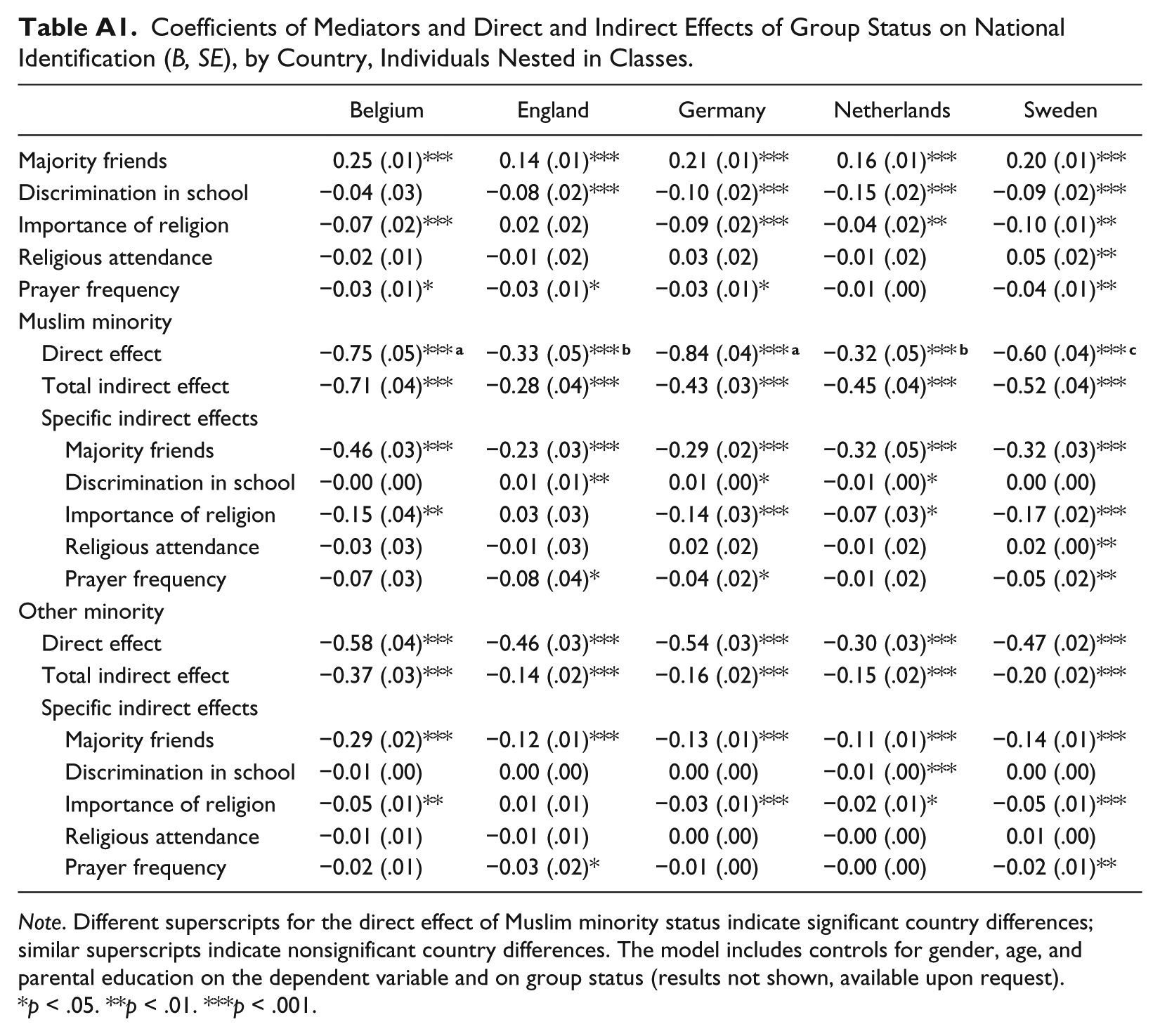
To examine differences in levels of national identification between Muslim minority and majority (and other minority) youth across countries, we estimate multigroup models using country as grouping variable. To test to what extent differences between Muslim minority and majority adolescents in levels of national identification are accounted for by religiosity and intergroup relations in school, we estimate path models to assess direct and indirect effects of being Muslim, with majority youth as reference group. We implement equality constraints to assess whether the direct effect of being a Muslim differs across countries after all mediators and controls have been taken into account. Due to the nested structure of our data, three-level models (adolescents in classes in schools) would be ideal. However, current software does not allow the estimation of indirect effects—which are crucial to test our hypotheses—in models that contain more than two levels of analyses. Therefore, we first estimated an intercept-only model with three levels to find out how much variance in national identification is located at the class and at the school level. The ICCs of national identification were found to be significant, but limited in their magnitude both at the class and the school level in all five countries. Importantly, national identification varies more between schools than between classes within schools. ICCs at the class level range between 0.9% in England and 3.1% in the Netherlands, whereas ICCs at the school level range between 2.7% in Belgium and 19.8% in Sweden. Because relatively more variance is located at the school level, we specified schools as second level in multigroup multilevel analyses to estimate indirect effects (thus ignoring the additional nesting in classes). We also repeated the analyses with classes specified as second level (ignoring the nesting within schools) and show these results in the appendix. The results from both models differ only marginally, and they also do not differ substantially from a model that does not take the clustering of the data into account.
Results
Table 1 shows country-specific descriptive statistics of all variables in our analysis, including country comparisons of means, and Table 2 presents the correlations between the variables of interest. The correlations between the measures are not strong, but moderate to weak; but the direction of the associations is in line with our expectations: National identification is higher among adolescents who have more majority friends and lower among those who experience more discrimination in school, and we find significant negative correlations of national identification with all aspects of religiosity.
Descriptive Statistics: Means (SDs) per Country.
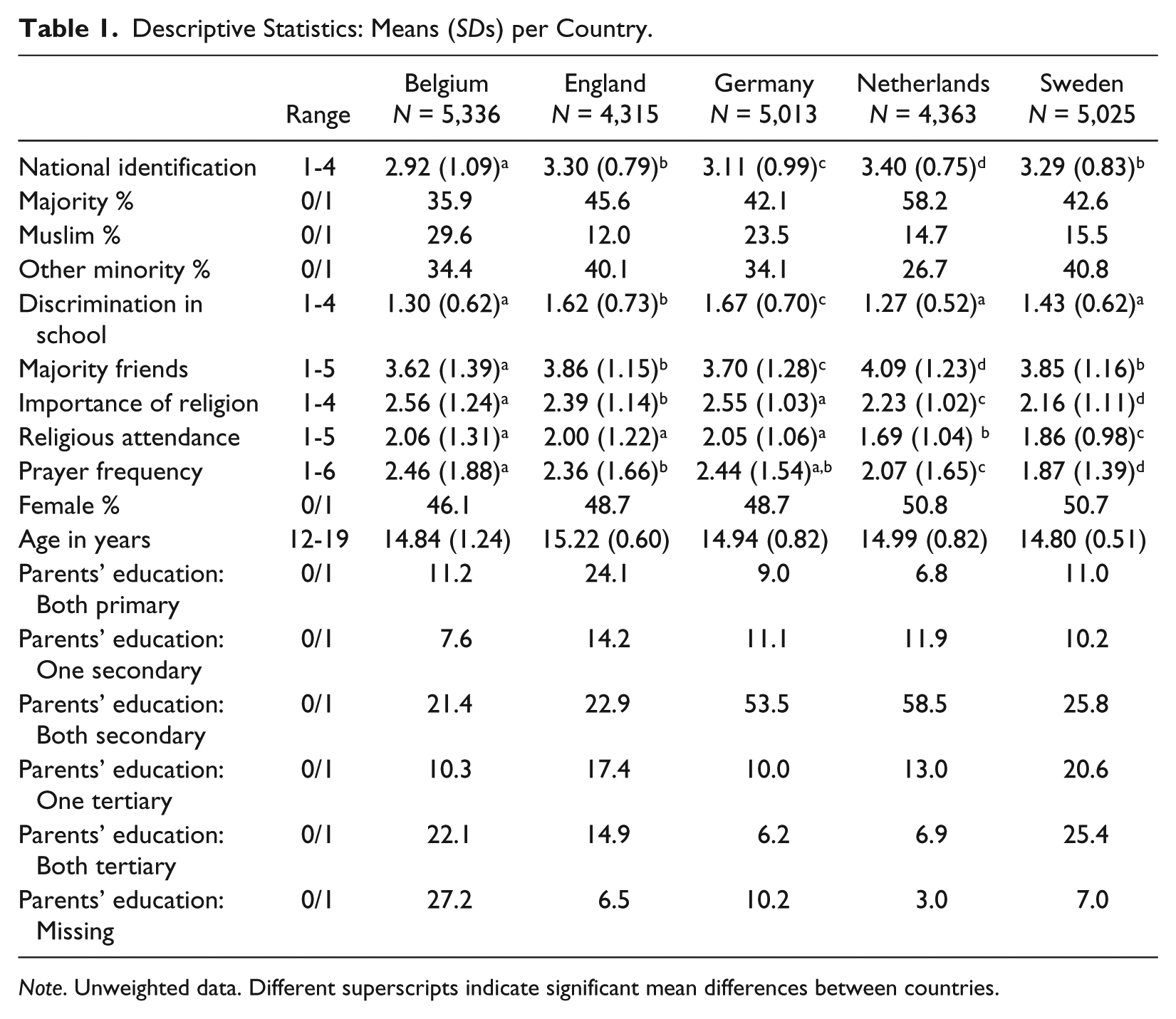
Note. Unweighted data. Different superscripts indicate significant mean differences between countries.
Correlations, Pooled Sample.
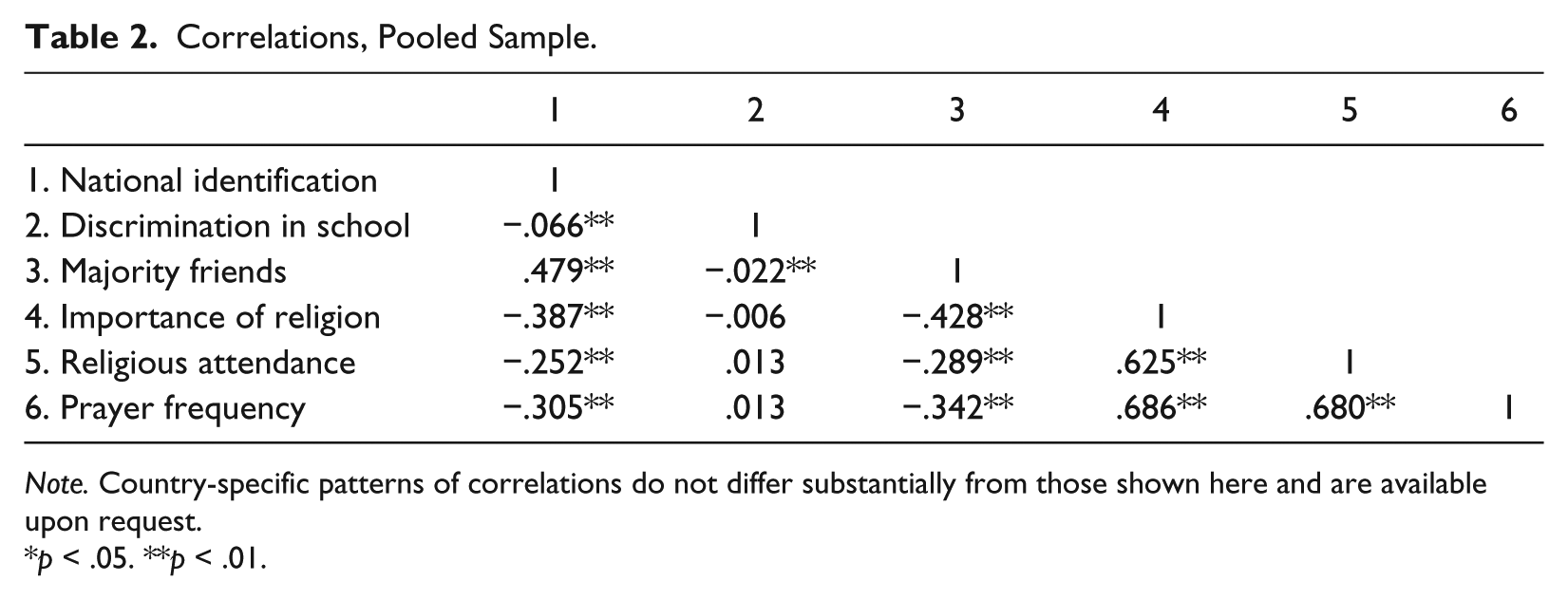
Note. Country-specific patterns of correlations do not differ substantially from those shown here and are available upon request.
p < .05. **p < .01.
Figure 1 shows the means of national identification across the three groups of participants by country. In all countries, majority youth score highest with means indicating “fairly strong” to “very strong” national identification, and minority adolescents score significantly lower (all ps < .05 based on ANOVA with Bonferroni post hoc estimation). Moreover, in all countries except England, Muslim minorities in turn have significantly lower levels of national identification than other minority adolescents (ps < .05), in line with our first hypothesis.
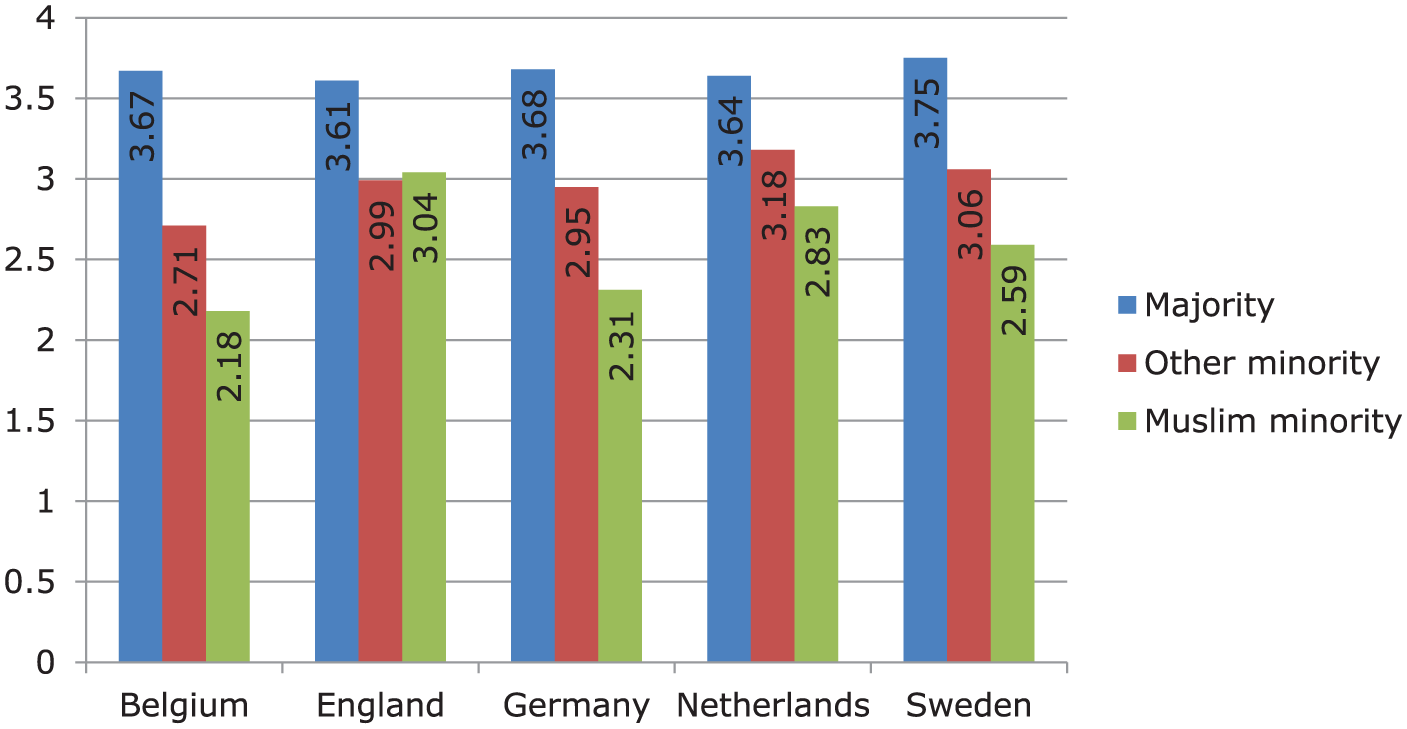
National identification of majority, Muslim, and other minority youth, by country.
Figure 2 is a conceptual representation of the path model that we estimate across countries. Because we are interested in differences between countries, we allow all paths to vary across countries and present the results separately for each country. Table 3 shows the direct effects of the mediators on national identification of youth, as well as the direct, total indirect, and specific indirect effects of being Muslim (or other minority) compared with majority youth. The fit of the full model is acceptable with χ2(215 df) = 4,234.94, p < .001, comparative fit index (CFI) = .918, Tucker–Lewis index (TLI) = .840 and root mean square error of approximation (RMSEA) = .063, but note that model fit is problematic in path analyses (Cole & Preacher, 2014). 7 The final model succeeds in explaining substantial portions of the variance in national identification at the individual level, with R2 ranging from .246 in England to .541 in Belgium.
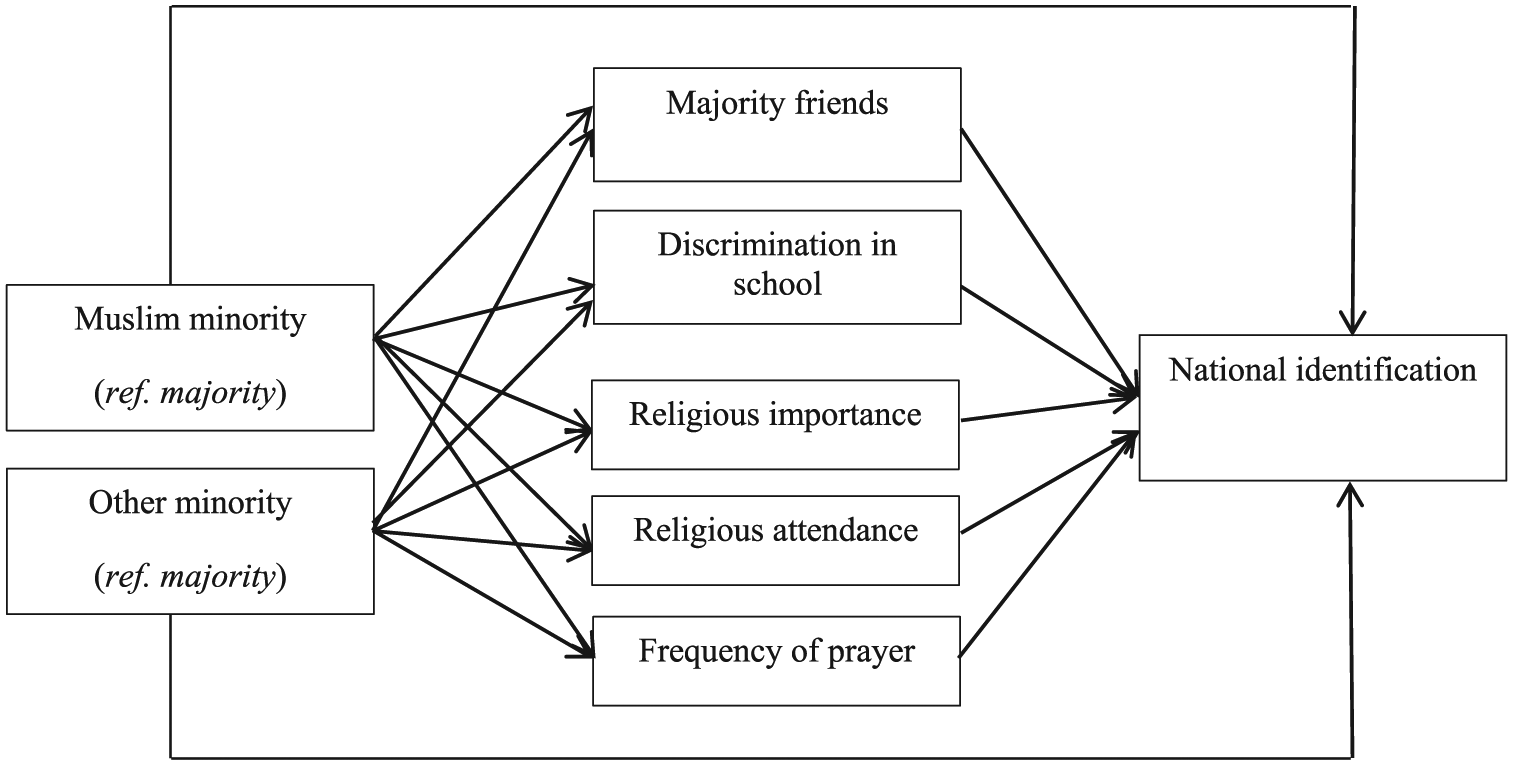
Path model of national identification.
Coefficients of Mediators and Direct and Indirect Effects of Group Status on National Identification (B, SE), by Country, Individuals Nested in Schools.
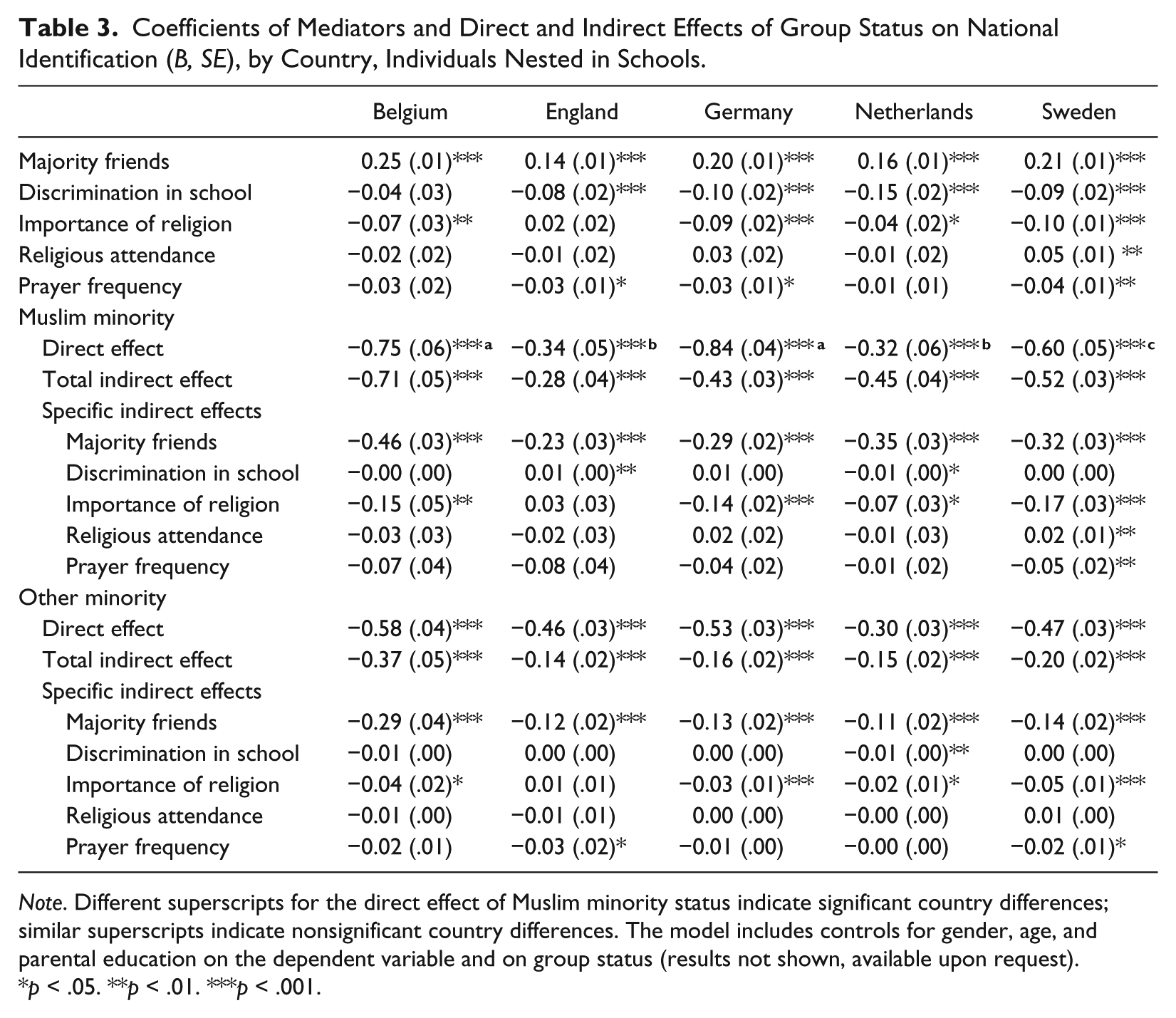
Note. Different superscripts for the direct effect of Muslim minority status indicate significant country differences; similar superscripts indicate nonsignificant country differences. The model includes controls for gender, age, and parental education on the dependent variable and on group status (results not shown, available upon request).
p < .05. **p < .01. ***p < .001.
Our two-level multigroup mediation models provide support for our expectations regarding the main effects on adolescents’ national identification although not all paths are significant in all countries (see Table 3 for details). In all countries, a larger share of majority friends is strongly associated with greater national identification, and more discriminatory experiences go together with lower national identification (Belgium is an exception: the association is in the same direction, but nonsignificant). Similarly, higher levels of religious commitment also go together with lower national identification.
These significant associations, which are consistent if not equal across all five countries, go a long way to explain group differences in national identification between Muslim and majority youth. Despite some differences in magnitude, we observe that in all countries the largest indirect effect of being a Muslim on national identification is via the share of majority friends. Despite the significant main effects of perceived discrimination in school in all countries except Belgium, the indirect effect fails to reach significance in most countries, and where it is significant, it is small in magnitude and not always in the expected direction. Indirect effects through religiosity are somewhat larger than those of perceived discrimination, but substantially smaller than the path through majority friends, and they differ between countries. Particularly, religious importance is found to explain the negative effect of being Muslim on national identification, and this indirect path is stronger in Belgium, Germany, and Sweden than in England and the Netherlands. The direct effects of the mediators and the negative indirect effects suggest that, compared with majority students, Muslims score lower on national identification because they have fewer majority friends and higher levels of religious commitment.
To further examine the relations between the mediators and group status, Table 4 shows a comparison of the three categories of youth on all mediators. Significant and consistent group differences are revealed in all countries for majority friends and religiosity: Muslim and other minority youth have significantly less majority friends and they score consistently higher on all measures of religious commitment than majority youth. With regard to perceived discrimination in school, there are no significant differences between Muslim minority and majority youth in England, Germany, and Sweden, whereas in Belgium and the Netherlands, Muslims experience more discrimination. Combining these differences with the main effects of the mediators explains why the indirect paths from being a Muslim through majority friends and religiosity explain a substantial share of the mean difference in national identification between Muslim and majority youth, whereas differences in perceived discrimination play only a minor role.
Mean Comparison of Mediators Between Majority, Muslim, and Other Minority Youth, by Country.
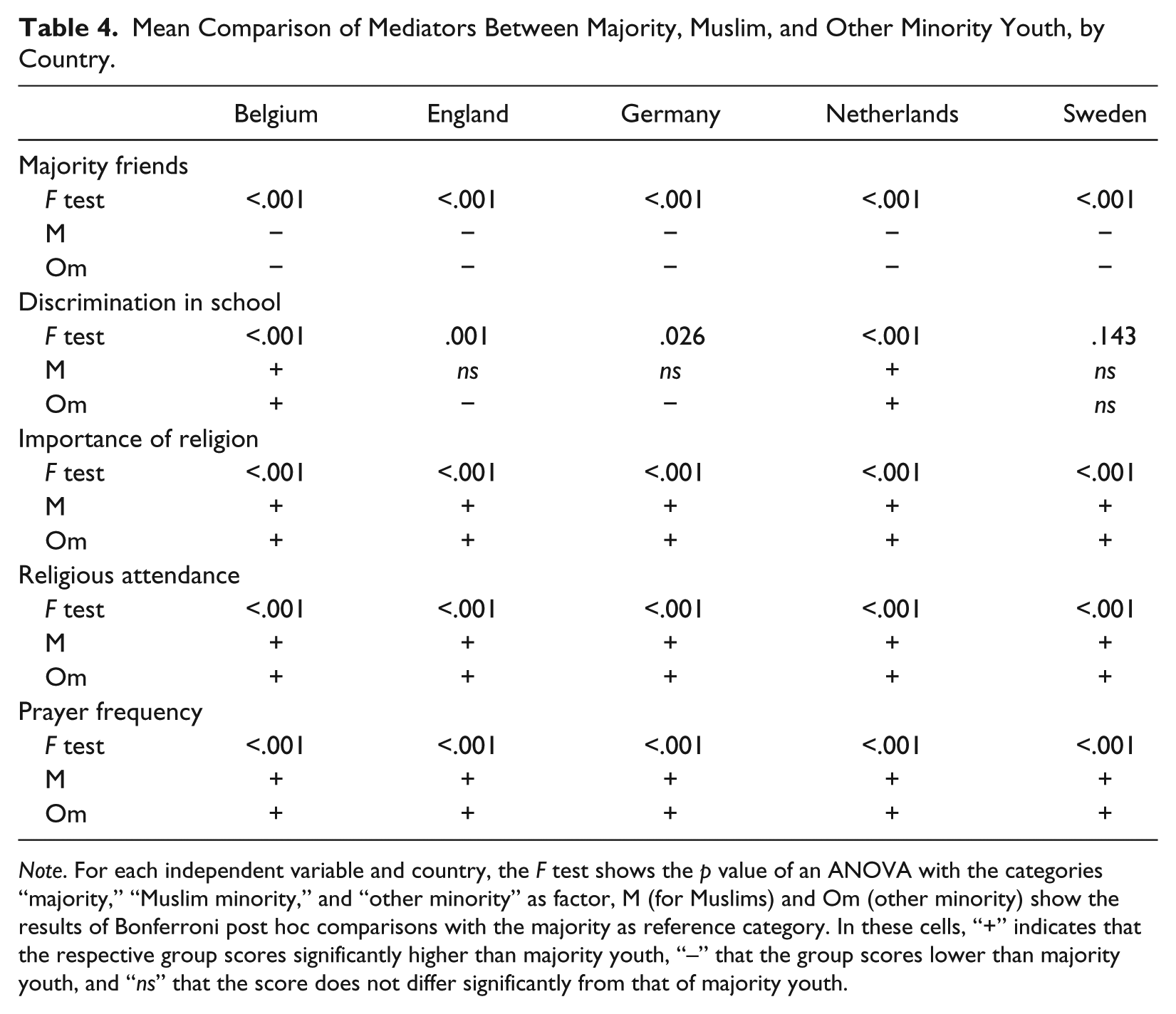
Note. For each independent variable and country, the F test shows the p value of an ANOVA with the categories “majority,” “Muslim minority,” and “other minority” as factor, M (for Muslims) and Om (other minority) show the results of Bonferroni post hoc comparisons with the majority as reference category. In these cells, “+” indicates that the respective group scores significantly higher than majority youth, “–” that the group scores lower than majority youth, and “ns” that the score does not differ significantly from that of majority youth.
These results provide support for our expectation that religious commitment and intergroup relations in school can account for the difference in national identification between Muslim minority and majority adolescents (H2 fully confirmed, H3 not confirmed for discrimination but for majority friends). Specifically, importance of religion is a significant and important mediator, which implies that the most committed Muslim minority youth are most excluded (or excluding themselves) from European national identities. In addition, closer interpersonal relations with majority members go together with higher levels of national identification, but are least likely to occur among as the most stigmatized minority group. However, our expectations that higher levels of perceived discrimination in school could contribute to the explanation was only confirmed in the Netherlands, and even there, the indirect path had a very small magnitude. In the remaining countries, Muslims were either not experiencing more unfair treatment in school than majority youth, or the direct effect of discrimination on national identification failed to reach significance.
Regarding our second research goal relating to country variation in group differences in national identification, Table 3 shows that our measures of intergroup relations and religious commitment succeed in explaining about half of the difference between Muslim and majority participants in all countries except Germany, where we can only explain one third of the total effect of being Muslim. Moreover, we still observe residual country differences in the direct effect of being a Muslim, which implies that country differences in the inclusiveness of national identity are not fully accounted for by intergroup relations and religious commitment of Muslim minority youth. Specifically, constraining the effect of being a Muslim on national identification to be equal across all countries in the full model results in a highly significant Wald test (p < .001), indicating that differences in identification between Muslim and majority youth still vary significantly across countries. However, the effect of being Muslim can be constrained to be equal in England and the Netherlands (where it is also smallest, p = .778), and in Belgium and Germany (p = .228). 8 Thus, in terms of the size of the difference in levels of national identification between Muslims and majority youth, Sweden occupies a middle position between Germany and Belgium (largest difference) and England and the Netherlands (smallest difference). This grouping of countries relates to the pattern of cross-national variation in the institutional accommodation of Islamic minority rights, although we had expected Belgium to be more similar to Sweden rather than Germany. The finding that importance of religion mediates the effect of being Muslim more strongly in Germany, Belgium, and Sweden as compared with England and the Netherlands resonates with the idea that less complete accommodation of religious minority rights impedes national identification for most committed Muslims.
Finally, the lower panel of Table 3 shows the results for other minority youth. As Figure 1 already showed, these adolescents’ national identification differs much less (though still significantly) from majority youth. These differences are explained by similar factors as for Muslim youth, but the magnitude of these indirect effects is smaller than for Muslims, and larger direct effects remain. Despite similar mechanisms affecting both minority groups, therefore, the explanatory power of intergroup friendships, discrimination, and religious commitment is larger for Muslim than for other minorities. On the one hand, the finding of significant negative indirect effects of religious commitment on national identification also among non-Muslims suggests that religious commitment as such, and not only Islamic religiosity, is problematic for national identification in Europe. On the other hand, the fact that these indirect effects are substantially larger among Muslims underlines that European national identities are particularly exclusive of most religious Muslim minorities.
Discussion
This article examined the national identification of Muslim minority adolescents from a double comparative perspective. Within countries, we compared Muslims with majority youth (and other minority youth) and examined to what extent differences in national identification can be explained by religious commitment and intergroup relations in the school context. Between countries, we compared the unexplained effect of being Muslim on national identification. Our findings from multigroup multilevel models, based on large-scale survey data, document substantial differences in national identification between Muslims and their majority peers. After taking into account religious commitment and intergroup relations, these differences are largest in Germany and Belgium, followed by Sweden, and finally England and the Netherlands. Moreover, the difference in national identification between Muslims and majority youth is significantly larger than that between other minority and majority youth in all countries except England. Our comparative findings thus provide evidence for the noninclusiveness of European national identities of minority youth in general, and Muslims in particular. Hence, they confirm the notion that European national identities are not only defined in terms of ethnic ancestry, but also that cultural aspects, particularly having a Christian heritage, matter for national belonging (Reijerse et al., 2013), also from the minority perspective.
We argued that this lack of inclusiveness is not rooted in stable identity content and allegedly incompatible values, but rather constituted in specific sociocultural contexts (Markus & Hamedani, 2007). Because Muslim youth stand out due to their greater religiosity in the secularized countries under study (Simsek et al., forthcoming), we examined whether the extent to which they are committed to their religious identity explains why they identify less with the nation. We found this to be true in all countries, and most strongly in those where Muslims are more institutionally disadvantaged vis-à-vis established religious communities (Belgium, Germany, and Sweden). Moreover, based on previous findings on the role of perceived discrimination for Muslims’ national identification (Fleischmann & Phalet, 2016; Kunst et al., 2012), we expected that perceptions of unfair or hostile treatment would explain Muslims’ lower level of national identification. Indeed and in line with these previous studies, more discrimination was related to lower national identification, but this did not account for the difference in identification between Muslims and majority youth because these groups did not differ greatly in the levels of perceived discrimination in school. This might be due to the way we measured discrimination, which might not only capture unfair treatment due to one’s religious (or other) group membership, but also interpersonal mistreatment, which can also be frequently experienced by majority youth.
Finally, we expected the share of majority friends to account for the Muslim penalty on national identification because of the positive association between having majority friends and identifying with the nation (Leszczensky et al., 2016). Indeed, we found the share of majority friends to be the strongest indirect path and thus to contribute most to the explanation of the difference in national identification between Muslims and majority youth. This finding ties in with recent research using social network analysis that document that religion matters for adolescents’ friendship choices, and that the boundary between Muslims and non-Muslims is most salient (Leszczensky & Pink, 2017; Simsek, van Tubergen, & Fleischmann, under review), and it adds the consequences of this segregation for national identification. In line with the homophily principle (McPherson et al., 2001), adolescents in both studies prefer their religious in-group members as friends (Christians befriend Christians, Muslims befriend Muslims), but additionally, Muslims are more strongly avoided as friends by non-Muslims. Future research is needed to find out what is behind this religious boundary in friendship choices. Muslims’ higher religious commitment cannot be a sufficient explanation for this finding because we find that the share of majority friends explains why Muslims identify less with the nation while taking religious commitment into account. Moreover, both network studies also measure religiosity and still establish a salient boundary between Muslim and non-Muslim adolescents. What else then can account for this strong boundary between Muslim youth and their peers? Additional explanations for the national identification of Muslim youth might be sought beyond the school context, for example, in parents’ attitudes toward intergroup friendships, or intergroup relations in society more generally.
Limitations
Many of the limitations of this study relate to the use of existing cross-national survey data. Although optimally comparative and including large numbers of Muslim minority, majority, and other minority youth, the CILS data are limited in the available measures of national identification and intergroup relations. Particularly, the lack of intergroup relations beyond the immediate school context limits our ability to draw conclusions on the role of intergroup relations for Muslims’ national identification. Moreover, we were restricted to single-item measures of dependent and independent variables. Using latent indicators of national identification would improve the robustness of the findings by taking measurement error into account. Regarding our explanatory mechanisms, however, we think that our approach of using multiple separate measures of the same underlying construct (religious commitment) provides a more conservative test of our hypotheses because the shared variance (which is included in the model) will make it less likely for each individual indicator to reach significance.
In addition to limited measures, we were unable to differentiate minority youth by their ethnic background and immigrant generation due to the large diversity within the categories of interest and across countries (Dollmann et al., 2014). This diversity implies that splitting up Muslim and other minority youth into distinct ethnic groups and immigrant generations leads to a number of subsamples that is too large to be meaningfully interpreted and that prevents the robust estimation of multigroup multilevel models.
Finally, our analyses are limited to a single time-point and thus do not capture changes in national identification among youth. Yet the mutual constitution of culture and self (Markus & Kitayama, 2010) also implies that the meaning of national identity can change through bottom-up processes such as collective action for social change if groups in society openly challenge or more subtly subvert existing conceptions of national identity. For instance, by affirming their dual identities and asserting their religion as part of the national identity, Muslims can actively seek validation of their dual identity as Muslim and European nationals and thus act to extend the inclusiveness of European national identities to their religious minority group (Hopkins & Greenwood, 2013; Klein et al., 2007). Longitudinal research is needed to capture such dynamics and analyze how changes in intergroup relations relate to changes in identification of minority youth.
Conclusion
Our double comparative approach has shown that in all five European countries under study, national identity is less inclusive of Muslim minorities than of majority and other minority youth. Although this descriptive evidence tunes in with public concerns about the failing integration of immigrant minorities in general, and Muslims in particular, into European national identities, our analyses revealed common processes that explain why some youth identify more strongly with the nation than others. Having more majority friends and being less committed to religion facilitate a sense of belonging in all five European nations, and because Muslims particularly stand out from majority youth on both indicators, they are found to have the lowest levels of national identification. Residual country variation in group differences in identification map onto the ordering of inclusiveness that can be derived from the ways in which European countries have institutionalized religious diversity. Thus, most inclusive approaches were found in England and the Netherlands and least inclusive approaches in Germany and Belgium, with Sweden in-between. Future research can further enhance the insights generated by our analysis by incorporating an even broader range of European countries. A more complete set of indicators of the mediating relationships between the collective realities of national identities and the psychological processes by which majority and minority adolescents come to adopt national identity will also contribute to improve our understanding of the role of religion for national identification in Europe.
Footnotes
Appendix
Coefficients of Mediators and Direct and Indirect Effects of Group Status on National Identification (B, SE), by Country, Individuals Nested in Classes.
| Belgium | England | Germany | Netherlands | Sweden | |
|---|---|---|---|---|---|
| Majority friends | 0.25 (.01)*** | 0.14 (.01)*** | 0.21 (.01)*** | 0.16 (.01)*** | 0.20 (.01)*** |
| Discrimination in school | −0.04 (.03) | −0.08 (.02)*** | −0.10 (.02)*** | −0.15 (.02)*** | −0.09 (.02)*** |
| Importance of religion | −0.07 (.02)*** | 0.02 (.02) | −0.09 (.02)*** | −0.04 (.02)** | −0.10 (.01)** |
| Religious attendance | −0.02 (.01) | −0.01 (.02) | 0.03 (.02) | −0.01 (.02) | 0.05 (.02)** |
| Prayer frequency | −0.03 (.01)* | −0.03 (.01)* | −0.03 (.01)* | −0.01 (.00) | −0.04 (.01)** |
| Muslim minority | |||||
| Direct effect | −0.75 (.05)*** a | −0.33 (.05)*** b | −0.84 (.04)*** a | −0.32 (.05)*** b | −0.60 (.04)*** c |
| Total indirect effect | −0.71 (.04)*** | −0.28 (.04)*** | −0.43 (.03)*** | −0.45 (.04)*** | −0.52 (.04)*** |
| Specific indirect effects | |||||
| Majority friends | −0.46 (.03)*** | −0.23 (.03)*** | −0.29 (.02)*** | −0.32 (.05)*** | −0.32 (.03)*** |
| Discrimination in school | −0.00 (.00) | 0.01 (.01)** | 0.01 (.00)* | −0.01 (.00)* | 0.00 (.00) |
| Importance of religion | −0.15 (.04)** | 0.03 (.03) | −0.14 (.03)*** | −0.07 (.03)* | −0.17 (.02)*** |
| Religious attendance | −0.03 (.03) | −0.01 (.03) | 0.02 (.02) | −0.01 (.02) | 0.02 (.00)** |
| Prayer frequency | −0.07 (.03) | −0.08 (.04)* | −0.04 (.02)* | −0.01 (.02) | −0.05 (.02)** |
| Other minority | |||||
| Direct effect | −0.58 (.04)*** | −0.46 (.03)*** | −0.54 (.03)*** | −0.30 (.03)*** | −0.47 (.02)*** |
| Total indirect effect | −0.37 (.03)*** | −0.14 (.02)*** | −0.16 (.02)*** | −0.15 (.02)*** | −0.20 (.02)*** |
| Specific indirect effects | |||||
| Majority friends | −0.29 (.02)*** | −0.12 (.01)*** | −0.13 (.01)*** | −0.11 (.01)*** | −0.14 (.01)*** |
| Discrimination in school | −0.01 (.00) | 0.00 (.00) | 0.00 (.00) | −0.01 (.00)*** | 0.00 (.00) |
| Importance of religion | −0.05 (.01)** | 0.01 (.01) | −0.03 (.01)*** | −0.02 (.01)* | −0.05 (.01)*** |
| Religious attendance | −0.01 (.01) | −0.01 (.01) | 0.00 (.00) | −0.00 (.00) | 0.01 (.00) |
| Prayer frequency | −0.02 (.01) | −0.03 (.02)* | −0.01 (.00) | −0.00 (.00) | −0.02 (.01)** |
Note. Different superscripts for the direct effect of Muslim minority status indicate significant country differences; similar superscripts indicate nonsignificant country differences. The model includes controls for gender, age, and parental education on the dependent variable and on group status (results not shown, available upon request).
p < .05. **p < .01. ***p < .001.
Declaration of Conflicting Interests
The author(s) declared no potential conflicts of interest with respect to the research, authorship, and/or publication of this article.
Funding
The author(s) disclosed receipt of the following financial support for the research, authorship, and/or publication of this article: The project was supported by a research grant from the Netherlands Organisation for Scientific Research (NWO), awarded to the first author (project number 327-25-005).